Implications
The results of this study indicate that selenium (Se) source can influence the distribution of total Se within the tissues of game birds. Furthermore, the responses to dietary Se and the distribution of Se species within the tissues of unimproved, wild type birds are markedly different from those of developed commercial breeds. This would imply that the Se requirements of game type birds may be appreciably different from those of commercial genotypes, despite the fact that literature suggests that they are similar.
Introduction
Selenium (Se) is an important trace element, essential for all selenoproteins, which contain a functional selenocysteine (SeCys) core. Before the late 1950s, much of the work on Se focussed on the toxic and detrimental effects that high concentrations of dietary Se had on animal health (Underwood and Suttle, Reference Underwood and Suttle2001). However, during the latter part of the 1950s, it was noted that Se played an important physiological role in higher animals, as Se-deficient animals were seen to suffer from liver necrosis and muscular dystrophy (Underwood and Suttle, Reference Underwood and Suttle2001). In the early part of the 1970s, a specific biological role for Se became apparent with the discovery of the first selenoprotein, glutathione peroxidase (GSH-Px; Rotruck et al., Reference Rotruck, Pope, Ganther, Swanson, Hafeman and Hoekestra1973). GSH-Px catalyses the reduction of lipid and hydrogen peroxides to less harmful hydroxides via the oxidation and subsequent reduction of the SeCys active centre of the enzyme (Surai, Reference Surai2006). The antioxidant functions of Se, via the actions of tissue GSH-Px, have been shown to persist postmortem in poultry muscle tissue (Juniper et al., Reference Juniper, Phipps and Bertin2011) and delay the onset of oxidation reactions (DeVore et al., Reference DeVore, Colnago, Jensen and Greene1983).
During the last 40 years, a number of selenoproteins have been identified. These include those involved in the protection of cellular membranes against the effects of oxidative stress, namely, the GSH-Pxs and thioredoxin reductases, deodinases, which are essential for proper thyroid function, and selenoproteins S, W and P, the latter of which is involved in Se transport. The expression and subsequent activity of all selenoenzymes is dependent upon an adequate Se supply. Furthermore, Se within an organism is not evenly distributed as there is a hierarchy of selenoenzymes (Burke et al., Reference Burke, Hill and Xia2005). Consequently, when Se is limiting there maybe full expression of some selenoenzymes and restricted expression of others.
Pheasants are typically wild type and have not undergone the same rigorous genetic selection that has been applied to commercial lines of poultry to improve rates of growth and feed conversion efficiency. However, despite this lack of selection, the Se requirements of Ring-necked Pheasants are given to be similar to those of growing turkeys (National Research Council (NRC), 1994). Differences in responses to dietary Se have been reported between a commercial porcine genotype and a pure breed (Banoch et al., Reference Banoch, Fajt, Odehnalova, Drabek and Svoboda2009), indicating that Se metabolism and subsequent requirements may differ between animals selected for growth and efficiency when compared with unimproved breeds.
The objective of this study was to determine tissue Se distribution, erythrocyte and tissue GSH-Px activity in growing pheasants fed diets containing additions of dietary Se from either sodium selenite (SS) or seleno-yeast (SY) sources.
Material and methods
The work was conducted in accordance with the UK Animals (Scientific procedures) Act 1986 (Home office, 1986) and procedures were undertaken by competent technical staff holding appropriate license authorities under the Act. All birds were housed on white wood shavings with a stocking density of 1.3 m2/bird. Fresh water was available at all times via a gravity fed bell drinker.
A total of 500 pheasant chicks (Holme Park Game Hatcheries, Wokingham, Berks, UK) were purchased and brooded according to commercial shoot specifications. During this pre-trial period all chicks were offered a starter ration, formulated to meet nutritional requirements (NRC, 1994) that had not been augmented with supplementary Se. At 5 weeks of age, when gender identification was possible following sufficient plumage development, all male pheasant chicks were removed and all female pheasant chicks weighed to provide data for experimental blocking. A total of 216 female chicks were selected on the basis of live weight (mean BW 527.6 ± 4.1 g). Of these 216 selected birds, 24 were randomly selected to form a pretreatment slaughter group, which were subsequently euthanased by cervical dislocation. Samples of blood were taken from all euthanased birds and tissue samples (breast, leg, heart and liver) were retrieved from six randomly selected birds for determination of pretreatment Se concentrations. All remaining birds were blocked by live weight and randomly allocated to one of four dietary treatments: an unsupplemented control (Con), supplemented with 0.08 or 0.23 mg Se/kg dry matter (DM) of SY (SY-L and SY-H, respectively; Sel-Plex, Alltech, Nicholasville, KY, USA), or 0.08 mg/kg DM of an inorganic Se source (SS-L), to achieve final total Se concentrations of 0.30, 0.45 and 0.30 mg/kg DM, respectively. All diets were formulated to meet the nutritional requirements of growing Ring-necked Pheasants (NRC, 1994).
Birds were penned in groups of eight birds per pen with six pens per treatment. All birds remained within established pen groups throughout the study. Pens were bedded with white wood shavings, which were replenished regularly to maintain litter quality. Each pen was equipped with one bell type automatic drinker and one plastic poultry tube feeder with a feeding circumference of 60 cm. Birds were offered the experimental diets, with respect to treatment designation, for the duration of the study.
Feeding stuffs and feed intake
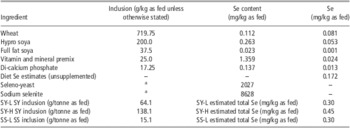
Diets were formulated and manufactured by Dairy Direct (Mill Feed Services, Anglia, UK). Before manufacture, the Se content of individual compositional ingredients of the diets was sent to UT2A laboratories (Pau, France) for determination of background Se of compositional ingredients (Table 1). The quantities of either SY or SS supplements required to achieve target doses with respect to treatment were calculated and mineral supplements were subsequently manufactured. Following manufacture, representative samples of each mineral supplement were analysed to confirm the correct level of Se.
Constituent ingredients, inclusion rates, Se contents and estimated Se contents of experimental diets

Se = selenium; SY-L = lowest level of selenised-enriched yeast; SY-H = highest level of selenised-enriched yeast; SS-L = lowest level of sodium selenite.
aDetermined by experimental protocol.
Vitamin and mineral premix composition: calcium pantothenate 400 mg/kg, riboflavin (B2) 200 mg/kg, vitamin B12 320 μg/kg, thiamin (B1) 40.0 mg/kg, pyridoxine (B6) 40.0 mg/kg, biotin 2.0 mg/kg, cobalt (cobalt carbonate) 10 mg/kg, iodine (as sulphate) 40 mg/kg, copper (as sulphate) 800 mg/kg, iron (as sulphate) 400 mg/kg, manganese (manganous oxide) 3200 mg/kg, zinc (zinc oxide) 2400 mg/kg, choline chloride 1740 mg/kg, phosphorus 140.6 g/kg, vitamin A 400 000 IU/kg, vitamin D3 120 000 IU/kg, vitamin E 800 mg/kg, vitamin K 80 mg/kg, folic acid 40 mg/kg, niacin 800 mg/kg.
Birds were offered their respective diets (according to experimental design) ad libitum daily throughout the study. Feed offered and refused were weighed and recorded daily with DM contents being determined on a weekly basis. Weekly samples of each diet were stored at −20°C for subsequent laboratory determination (Euorofins, Wolverhampton, UK) of DM, CP, starch, NDF, total sugars, oil, ash and Se.
Following 42 days exposure to experimental diets (T42), four birds were randomly selected from each pen (n = 24 birds per treatment) and euthanased by cervical dislocation, and samples of blood and tissue (breast, leg, gizzard, kidneys and liver) retrieved for determination of Se concentrations. Following an additional 49 days exposure (T91), all remaining birds (n = 24 birds per treatment) were euthanased by cervical dislocation, and samples of blood and tissue (breast, leg, gizzard, kidneys and liver) retrieved for determination of Se concentrations.
At each time point (T42 and T91) blood was collected following exsanguination into three pretreated lithium heparin tubes per bird (Sarstedt, Leicester, UK). One tube was sent for determination of whole blood GSH-Px activity (Veterinary Laboratories Agency, Shropshire, UK), one for determination of Se content (UT2A) and the third centrifuged at 1252 × g for 10 min at room temperature in a bench top centrifuge (Weiss-Gallenkamp, Loughborough, UK) after which the plasma fraction was decanted and sent for determination of Se content (UT2A).
Following slaughter at T42, one bird per pen (six birds per treatment) was randomly selected and dissected. The ventral aspect of the carcass was skinned, and a sample of breast tissue (M. Pectoralis Major (PM)) from the left side of the carcase retained for Se analysis. The musculature of the left thigh was exposed and samples of muscle tissue (M. Gastrocnemius (MG) and M. Peroneus Longus (PL)) retained for Se analysis. The heart, liver, kidneys and gizzard were removed from the body cavity and retained for Se analysis.
At the T91 slaughter point, the remaining 24 birds per treatment were plucked and dressed, and one bird per pen (six birds per treatment) was randomly selected and underwent dissection as previously described. In addition, the whole breasts were removed and skinned from 12 birds per treatment, packaged in a zip-lock bag, refrigerated and transported in a cool box on the day of slaughter to the University of Bristol for determination of thiobarbituric acid reactive substances (TBARS) and tissue GSH-Px activity.
Total Se in feeding stuffs, whole blood samples, plasma and tissues was determined according to the method of Mester et al. (Reference Mester, Willie, Sturgeon, Caruso, Fernandez, Fodor, Goldschmidt, Goenaga-Infante, Lobinski and Wolf2006). Briefly, 1 g of each sample was mineralised in 4 ml 16 M HNO3 and 2 ml 9.8 M H2O2 within a closed-vessel heating block system. The solution was further diluted with water and Se subsequently determined using inductively coupled plasma mass spectrometry (ICP-MS; Perkin Elmer Elan 6100 ICPMS, Waltham MA, USA).
The selenised amino acid (AA) contents of blood were determined by speciation using the method of Bierla et al. (Reference Bierla, Vacchina, Szpunar, Bertin and Lobinski2008a). Samples were initially incubated for 5 h with dl-dithiothreitol and iodoacetamide to reduce and alkylate SeCys. Samples were then spiked with selenomethionine (SeMet77), and subsequently incubated for 24 h at 37°C with a mixture of protease and lipase maintained at a pH 7.5. Following incubation, the mixture was centrifuged and the supernatant separated and purified by size exclusion liquid chromatography. Aliquots of the supernatant were analysed by reversed-phase HPLC using an ICP-MS equipped with a collision cell (Perkin Elmer Elan 6100 ICP-MS). The selenised AA content of tissues (breast, thigh, liver and kidney) was determined by speciation according to the method of Bierla et al. (Reference Bierla, Vacchina, Szpunar, Bertin and Lobinski2008b). Samples were mixed and sieved after which a representative subsample was taken. Urea was added to the subsample and the subsample sonicated after which it was reduced, alkylated and submitted to proteolysis. The extract was then purified by size exclusion chromatography and the AAs quantified by reverse phase HPLC-ICP-MS.
Breast tissue was stored at 3°C for 5 days after which TBARS were determined by the method of Tarladgis et al. (Reference Tarladgis, Watts and Younathan1960), modified by the use of a Büchi 321 distillation unit (Büchi Labortechnik AG, Postfach, Switzerland). Tissue GSH-Px activity was determined in samples of breast tissue taken immediately post slaughter and from breast tissue that had undergone 5 days aging in MAP, using the coupled assay procedure of Paglia and Valentine (Reference Paglia and Valentine1967), modified by DeVore and Greene (Reference DeVore and Greene1982) and Daun et al. (Reference Daun, Johansson, Önning and Åkesson2000). Results are presented as nmol of NADPH oxidised per mg of protein/min. GSH-Px activity in whole blood was determined using the Olympus AU400 Chemistry Analyser (Olympus UK, Watford, UK) based on the method of Anderson et al. (Reference Anderson, Berrett and Patterson1978). Results are presented as units per ml.
The study was of a complete block randomised design. Statistically significant differences between treatments for all traits at T42 and T91 were determined by ANOVA using a GLM (Minitab v. 15, Minitab Inc., State College, PA, USA). Sources of variation within the model included treatment (3 d.f.) and block (5 d.f.). Data pertaining to animal performance (feed intake, live weight gain and feed conversion ratio) were analysed on a group pen basis. Data pertaining to carcass characteristics (carcass weight, dressing out percentage), Se analysis and meat quality were analysed on an individual bird basis. Results are presented as least square means with the standard error of the mean (s.e.m.). Tukey's simultaneous test was used to establish statistical differences (P < 0.05) among individual treatment means.
Results
With the exception of Se concentrations, which were dictated by treatment structure, there were no appreciable differences in any determined or calculated feed nutritional parameter. Diets had a mean (±s.d.) DM content of 871 ±1.1 g/kg fresh weight (FW), CP content of 204.8 ± 3.5 g/kg FW, oil content of 27.8 ± 0.5 g/kg FW and estimated Metabolisable Energy content of 12.9 ± 0.6 MJ/kg FW. Diets had a mean (±s.d.) Se concentration of 0.12, 0.30, 0.46 and 0.27 ± 0.02 mg/kg FW for treatments Con, SY-L, SY-H and SS-L, respectively.
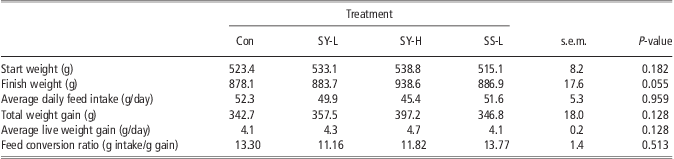
Although intakes and rates of gain were lower than anticipated, there were no appreciable effects of treatment on any aspect of bird physical performance; birds within all treatments started and finished at similar weights and consumed similar quantities of feed over the course of the study (Table 2).
Physical performance of female Ring-necked Pheasants, following 91 days exposure to diets containing graded additions of supplementary Se
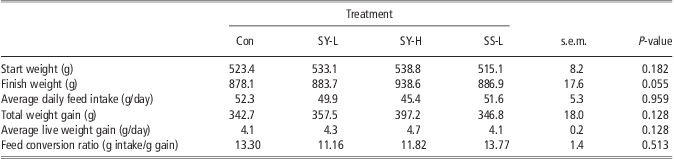
Se = selenium; Con = control; SY-L = lowest level of selenised-enriched yeast; SY-H = highest level of selenised-enriched yeast; SS-L = lowest level of sodium selenite.
There were effects of treatment (P < 0.001) at both T42 and T91 on the whole blood total Se contents (Table 3). At both time points the total Se content of whole blood from Con birds did not change appreciably from those recorded at T0. Total Se values of SS-L birds were similar to those of Con and SY-L birds at T42, although whole blood total Se contents were greater in SY-L birds when compared with both T0 and Con birds (P < 0.05). Whole blood total Se contents at T42 were greater in treatment SY-H when compared with Con and SS-L (P < 0.05). At T91, whole blood total Se values of treatments SY-L and SY-H were similar when compared with each other, but were greater than Con and SS-L (P < 0.05). This trend is also reflected in the total Se content of plasma at T91; plasma total Se values of SY-L and SY-H birds were similar when compared with each other but greater than Con and SS-L birds (P < 0.05).
Se content of whole blood, plasma and whole blood GSH-Px activities of female Ring-necked Pheasants, following 42 (T42) and 91 (T91) days exposure to diets containing graded additions of supplementary Se

Se = selenium; GSH-Px = glutathione peroxidase; Con = control; SY-L = lowest level of selenised-enriched yeast; SY-H = highest level of selenised-enriched yeast; SS-L = lowest level of sodium selenite; FW = fresh weight.
xyzDifferent superscripts within a row differ significantly (P < 0.05).
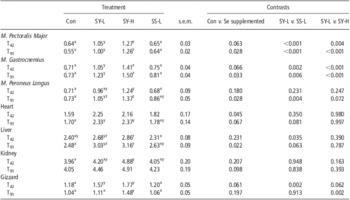
The Se content of tissues at T0 differed between the different tissue types (Table 4) with total Se concentrations being greatest in kidney, followed by liver, heart, gizzard and skeletal muscle. Although there were effects of treatment on the total Se content of each tissue at successive time points (T42 and T91), the hierarchy of tissue Se concentrations seen at T0 was maintained within the treatment structure at each time point. There were effects (P < 0.005) on the total Se content of skeletal muscles at T42 to the graded addition of SY to the diet. Total Se values in the skeletal tissues of Con birds at both T42 and T91 were not appreciably different from those recorded at T0. Similarly, the total Se contents of skeletal tissue of SS-L birds at both time points did not differ from those of Con birds or T0. However, total Se values of breast and leg tissue of SY-L birds were generally greater at both T42 and T91 when compared with Con and SS-L birds at the same time points (P < 0.05) and greater in treatment SY-H when compared with SY-L (P < 0.05), the exceptions to this being in the PL at T42.
Total Se contents (mg/kg dry matter) of postmortem tissues of female Ring-necked Pheasants offered diets containing graded additions of supplementary Se for either for 42 (T42) or 91 (T91) days

Se = selenium; Con = control; SY-L = lowest level of selenised-enriched yeast; SY-H = highest level of selenised-enriched yeast; SS-L = lowest level of sodium selenite.
xyzDifferent superscripts within a row differ significantly (P < 0.05).
There were effects in the total Se contents of heart and liver to the graded addition of Se to the diet, differences being more pronounced at T91 than at T42. The total Se contents of heart tissue from Con and SS-L birds at T42 and T91 did not differ appreciably from those recorded in the baseline group at T0. Conversely, total Se values were greater in treatments SY-L and SY-H (P < 0.05) at both T42 and T91 than those of Con and SS-L birds at the same time points. The total Se contents of liver tissue in Con and SS-L birds at T42 were similar to those of T0 and did not change appreciably by T91, whereas those of SY-L and SY-H were higher at T42 and T91 when compared with T0 samples (P < 0.05).
Kidney tissue total Se contents were generally higher in those birds that had received some degree of Se supplementation (P < 0.05) and only numerically higher in those birds that had received the highest level of supplementation (SY-H) when compared with the lowest levels (SY-L and SS-L). There were no discernable differences between SS and SY-supplemented birds at a comparable dose (SY-L v. SS-L). The total Se content of gizzard tissue at T42 was greatest in those birds that had received SY supplements (P < 0.05), irrespective of dose, with there being no difference between Con and SS-L birds, which had values similar to those at T0. At T91, total Se values of gizzard tissue had appeared to decline slightly in all treatments, with the greatest Se concentration being in the gizzards of birds receiving the highest level of Se supplementation (P < 0.05). However, this decline may reflect the fact that the slaughter groups at T42 and T91 comprised different birds.
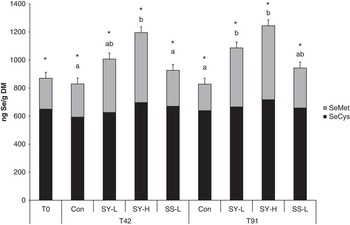
SeCys was the predominant selenised AA (P < 0.05) within whole blood samples at all time points irrespective of treatment (Figure 1) with values being similar, regardless of treatment or time point. This is reflected in erythrocyte GSH-Px activities, which were generally similar between treatments, although values were marginally higher in SY-H when compared with SY-L and Con birds (P < 0.05). SeMet although comprising a smaller proportion of total Se, was greater at both T42 and T91 in SY-L and SY-H birds when compared with Con birds (P < 0.05), but similar between SY-L, SY-H and SS-L birds.
Total Se and the proportion of total Se comprised as selenomethionine (SeMet) or selenocysteine (SeCys) in the whole blood of female Ring-necked Pheasants at day 0 (T0), 42 (T42) and 91 (T91). Different lowercase letters within time point denote SeMet differences (P < 0.05) between bars. Asterisks denote differences between SeMet and SeCys within bars. DM = dry matter.

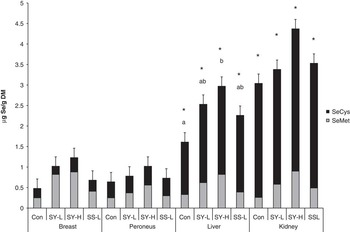
SeCys was the predominant selenised AA in liver and kidney tissue, irrespective of treatment, accounting for ∼75% of total Se (Figure 2). SeMet comprised a much smaller fraction of total Se in liver and kidney tissue and was not different between treatments. There were no appreciable differences between treatments in the selenised AA contents of breast and thigh tissue, although SeMet values were numerically higher than SeCys values in the breast tissue of SY-supplemented birds (P < 0.1) when compared with selenised AA in breast tissue of all birds, irrespective of treatment, although values were markedly higher in the breast tissue of birds that had received diets containing SY supplements (P < 0.05). Conversely, in leg tissue, SeMet was the predominant form of Se in those birds that had received diets supplemented with SY and SeCys the predominant form in those birds that had received diets that had not been augmented with additional Se (Con) or had been supplemented with selenite (SS-L). However, absolute SeCys values were similar in leg tissue irrespective of treatment indicating that increases in total Se in the leg tissue of SY-supplemented birds was predominantly the result of increases in the SeMet content of the tissue.
Total selenium (Se) and the proportion of total Se comprised as selenomethionine (SeMet) or selenocysteine (SeCys) in the tissues of female Ring-necked Pheasants following 91 days of dietary treatment. Different lowercase letters within tissue denote SeCys differences (P < 0.05) between bars. Asterisks denote differences between SeMet and SeCys within bars. Con = control; SY-L = lowest level of selenised-enriched yeast; SY-H = highest level of selenised-enriched yeast; SS-L = lowest level of sodium selenite.

There were no effects of treatment on breast muscle TBARS or tissue GSH-Px activities at both 0 and 5 days postmortem (Table 5).
TBARS and tissue GSH-Px activity in the breast tissue of female Ring-necked Pheasants offered diets containing graded additions of supplementary Se for 91 days

TBARS = thiobarbituric acid reactive substances; GSH-Px = glutathione peroxidase; Se = selenium; Con = control; SY-L = lowest level of selenised-enriched yeast; SY-H = highest level of selenised-enriched yeast; SS-L = lowest level of sodium selenite; MDA = malondialdehyde.
Discussion
In general, there were no major differences between the different treatments in nutritive composition of the experimental diets as would be expected, given that all compositional ingredients and mineral mixes, with the exception of Se, were derived from the same source.
The lack of effect of any significant response over time in whole blood and plasma Se concentrations of Con birds would be expected and is consistent with the findings of other authors (Echevarria et al., Reference Echevarria, Henry, Ammerman and Miles1988; Pan et al., Reference Pan, Huang, Zhao, Qin, Chen and Hu2007; Yoon et al., Reference Yoon, Werner and Butler2007; Juniper et al., Reference Juniper, Phipps and Bertin2011). However, the Se values recorded in the T0 group and Con birds were higher than those recorded in commercial lines of poultry in other studies that had received diets, which had not been augmented with supplementary Se (Petrovič et al., Reference Petrovič, Boldižárová, Faix, Mellen, Arpášová and Leng2006; Yoon et al., Reference Yoon, Werner and Butler2007 and Juniper et al., Reference Juniper, Phipps and Bertin2011). The differences seen between comparable doses of SY and SS are indicative of improved uptake and incorporation of Se derived from SY and are consistent with the findings in sheep (Van Ryssen et al., Reference Van Ryssen, Deagen, Beilstein and Whanger1989; Juniper et al., Reference Juniper, Phipps, Ramos-Morales and Bertin2008a), cattle (Gunter et al., Reference Gunter, Beck and Phillips2003; Phipps et al., Reference Phipps, Grandison, Jones, Juniper, Ramos-Morales and Bertin2008; Juniper et al., Reference Juniper, Phipps, Ramos-Morales and Bertin2008b), pigs (Mahan and Parrett, Reference Mahan and Parrett1996; Mahan et al., Reference Mahan, Cline and Richert1999; Kim and Mahan, Reference Kim and Mahan2001) and poultry (Petrovič et al., Reference Petrovič, Boldižárová, Faix, Mellen, Arpášová and Leng2006; Juniper et al., Reference Juniper, Phipps and Bertin2011). However, the degree of response to supplementary Se is markedly lower than those recorded in other studies and most probably reflect the much higher blood and plasma Se levels seen at T0 and in Con pheasants. This may be indicative of a more efficient Se retention system in wild type classes of bird when consuming diets low in Se. However, as dietary Se levels increase this efficient scavenging system may become quickly saturated, hence why responses in pheasants are not as pronounced as those seen in commercial lines of poultry (Petrovič et al., Reference Petrovič, Boldižárová, Faix, Mellen, Arpášová and Leng2006; Juniper et al., Reference Juniper, Phipps and Bertin2011). Similar observations have been reported in different breeds of pig, whereby Se uptake and metabolism of a commercial hybrid was different to that of a pure breed when fed identical diets (Banoch et al., Reference Banoch, Fajt, Odehnalova, Drabek and Svoboda2009).
The hierarchy of Se concentrations observed in different tissues tends to reflect the relative metabolic activity of each tissue. Glandular visceral tissues tend to have greater total Se concentrations than muscle tissue and cardiac muscle has a greater Se content than skeletal tissue or gizzard tissue. These data agree with those reported in laying hens (Petrovič et al., Reference Petrovič, Boldižárová, Faix, Mellen, Arpášová and Leng2006; Pan et al., Reference Pan, Huang, Zhao, Qin, Chen and Hu2007), broilers (Wang and Xu, Reference Wang and Xu2008), turkeys (Juniper et al., Reference Juniper, Phipps and Bertin2011) and are also similar to those reported in lambs (Juniper et al., Reference Juniper, Phipps, Ramos-Morales and Bertin2008a) and beef cattle (Juniper et al., Reference Juniper, Phipps, Ramos-Morales and Bertin2008b).
The differences seen in cardiac, skeletal and gizzard muscle tissue total Se concentrations, when comparing comparable doses of SS and SY, are indicative of improved uptake and assimilation of Se derived from SY. However, these responses in muscle tissue lack the same degree of response reported in other studies on commercial lines of poultry (Petrovič et al., Reference Petrovič, Boldižárová, Faix, Mellen, Arpášová and Leng2006; Juniper et al., Reference Juniper, Phipps and Bertin2011) reflecting the responses seen in blood and plasma within this study. Furthermore, muscle tissue Se concentrations at T0 and in Con birds were greater than those reported in commercial lines of poultry receiving unsupplemented diets (Petrovič et al., Reference Petrovič, Boldižárová, Faix, Mellen, Arpášová and Leng2006; Juniper et al., Reference Juniper, Phipps and Bertin2011). This may further indicate that wild type birds, such as pheasants, may have more efficient means of Se capture than those of commercial lines of poultry at low dietary levels of Se and that this system becomes very quickly saturated as dietary Se levels increase.
SeCys was the predominant selenised AA within blood, irrespective of treatment or time point (Figure 1). This observation in pheasants is unlike those reported for turkeys (Juniper et al., Reference Juniper, Phipps and Bertin2011) in which SeMet was the predominant selenised AA, but similar to those reported for lambs (Juniper et al., Reference Juniper, Phipps, Ramos-Morales and Bertin2008a), beef cattle (Juniper et al., Reference Juniper, Phipps, Ramos-Morales and Bertin2008b) and dairy cattle (Phipps et al., Reference Phipps, Grandison, Jones, Juniper, Ramos-Morales and Bertin2008) where SeCys was the predominant form.
SeCys was the predominant selenised AA in liver and kidney tissue, irrespective of treatment (Figure 2). The predominance of SeCys in liver and kidney tissue has been reported in turkeys (Juniper et al., Reference Juniper, Phipps and Bertin2011), as well as in lambs (Juniper et al., Reference Juniper, Phipps, Ramos-Morales and Bertin2008a) and beef cattle (Juniper et al., Reference Juniper, Phipps, Ramos-Morales and Bertin2008b), and may reflect the greater metabolic activity of these tissues. Much of the difference in total Se content of skeletal muscle with SY-supplemented diets is attributable to increases in SeMet content rather than changes in SeCys content, as SeCys content is comparable between treatments. Furthermore, the lack of any difference in SeCys content of skeletal muscle is reflected in the lack of any difference in tissue GSH-Px activity.
The predominance of SeMet in skeletal muscle in SY-supplemented treatments is similar to observations made in the breast tissue of turkeys (Juniper et al., Reference Juniper, Phipps and Bertin2011) and the skeletal tissue of beef cattle (Juniper et al., Reference Juniper, Phipps, Ramos-Morales and Bertin2008b), although the specific SY dose response that was reported in these studies is not apparent in this study.
The lack of any effect of treatment on breast tissue TBARS and GSH-Px activity in poultry is not uncommon. Radmilla et al. (Reference Radmilla, Jovanovic, Baltic, Sefer, Petrujkic and Sinovec2008) and Sevcikova et al. (Reference Sevcikova, Skrivan, Dlouha and Koucky2006) have both reported an absence of effect in broilers and a similar lack of response has also been reported in turkeys (Juniper et al., Reference Juniper, Phipps and Bertin2011). In addition, both pigs (Mahan et al., Reference Mahan, Cline and Richert1999) and cattle (Skřivanová et al., Reference Skřivanová, Marounek, De Smet and Raes2007; Taylor et al., Reference Taylor, Marchello, Finley, Neville, Combs and Caton2008; Juniper et al., Reference Juniper, Phipps, Ramos-Morales and Bertin2008b) have shown a lack of response in both tissue TBARS and GSH-Px activity in skeletal muscle to additional dietary Se. These results would suggest that higher tissue total Se contents tend not to reflect improvements in GSH-Px activity to the oxidative stability of skeletal tissue meat keeping quality.
Conclusion
The incorporation of graded additions of SY into the diets of growing pheasants increased total Se in tissues and blood in a dose-dependent manner. The high levels of total Se seen in T0 birds at the start of the study, and in control birds throughout the study, maybe indicative of a more efficient Se capture system in wild type birds. Furthermore, the limited responses seen in both blood and tissue of both control and SS-L birds would also indicate that this efficient Se capture system may become very quickly saturated, as dietary Se concentrations increase. However, the moderate increases in the Se content of tissues of SY-supplemented birds appear to be the result of increases in the proportion of total Se comprised as SeMet, reflecting improved uptake and incorporation of SeMet.
Acknowledgements
This research was funded by Alltech France. The authors would also like to give special thanks to Ryszard Lobinski (UT2A laboratories) for performing the Se analyses and Duncan Marriott and Ian Richardson (DFAS) for undertaking tissue TBARS analysis and determining tissue GSH-Px activities.