Research documenting the developmental parallels between second language (L2) and first language (L1) acquisition of morphosyntax has been longstanding (e.g., Dulay & Burt, Reference Dulay and Burt1973, Reference Dulay and Burt1974; see Zobl & Liceras, Reference Zobl and Liceras1994, for review). More recently, research comparing the morphosyntax of child L2 learners to sameage L1 learners with specific language impairment (SLI) in French and Swedish has also shown striking similarities between these two groups (Crago & Paradis, Reference Crago, Paradis, Levy and Schaeffer2003; Grüter, Reference Grüter2005; Håkansson Reference Håkansson2001; Paradis, Reference Paradis2004; Paradis & Crago, Reference Paradis and Crago2000, Reference Paradis, Crago, Prévost and Paradis2004). Paradis (Reference Paradis2005) found evidence for SLI-like patterns in child English L2 learners' acquisition of grammatical morphology, but to date, no direct comparison of English L2 and SLI acquisition of morphosyntax has been undertaken. The presence of overlap in the linguistic characteristics between L2 and SLI is relevant for applied concerns, such as differential diagnosis of SLI in the L2 population. Overlap is also relevant for theoretical accounts aimed at characterizing only those features of impaired grammars to the exclusion of typically developing (TD) learner grammars among same-aged peers.
Morphosyntax related to functional categories might be expected to be vulnerable across acquisition contexts on linguistic theoretical grounds, because the functional layer of the grammar could be considered the locus of much cross-linguistic variation in language-particular grammars (Paradis & Prévost, Reference Paradis, Prévost, Prévost and Paradis2004). Certainly the L2 versus TD L1 and L2 versus SLI comparative research supports this expectation. In contrast, it is reasonable to assume that shared characteristics notwithstanding, at some level there should be differences between impaired and TD learner grammars. More specifically, Paradis and Crago (Reference Paradis and Crago2000, Reference Paradis and Crago2001, Reference Paradis, Crago, Prévost and Paradis2004) suggested that both French SLI and L2 acquisition have the characteristics of an (extended) optional infinitive ([E]OI) grammar (e.g., Rice & Wexler, Reference Rice and Wexler1996) because of the particular patterns children displayed in their production of tense- and nontense-marking morphemes. However, TD L2 learners older than preschool age would not be expected to have OI grammars because this is hypothesized to be a maturationally timed stage in L1 acquisition that extends past the primary acquisition period only in the case of children with impairment (cf. Haznedar & Schwartz, Reference Haznedar, Schwartz, Hughes, Hughes and Greenhill1997; Ionin & Wexler, Reference Ionin and Wexler2002; Schwartz, Reference Schwartz2004). Accounts of L2 acquisition, such as the missing surface inflection hypothesis (MSIH; Haznedar & Schwartz, Reference Haznedar, Schwartz, Hughes, Hughes and Greenhill1997; Lardiere, Reference Lardiere1998, Reference Lardiere and Archibald2000; Prévost & White, Reference Prévost and White2000a, Reference Prévost, White, Friedemann and Rizzi2000b), offer explanations for acquisition patterns with tense morphology that make different claims than the (E)OI model about the nature of learner grammars. Paradis and Crago's (Reference Paradis and Crago2000, Reference Paradis, Crago, Prévost and Paradis2004) prior work on French SLI and L2 did not examine the L2 learners' morphosyntax with respect to predictions from L2 theoretical accounts. The contention of the present research is that conducting comparisons between L2 children and children with SLI in terms of contrastive theoretical accounts of these populations may bring the differences between them to light.
Prior comparative research between L2 and SLI acquisition also has some methodological limitations. The majority of research has used spontaneous speech production data (Crago & Paradis, Reference Crago, Paradis, Levy and Schaeffer2003; Håkansson, Reference Håkansson2001; Paradis, Reference Paradis2004; Paradis & Crago, Reference Paradis and Crago2000, Reference Paradis, Crago, Prévost and Paradis2004), with the exception of Grüter (Reference Grüter2005). In spontaneous production data, some constructions with correct use of morphological forms may be memorized formulas, less frequent morphemes may not be used at all, and there is a lot of variation in the frequency of contexts for target morphemes between individuals' samples. Consulting more controlled data sources, such as elicited production and receptive knowledge tasks like grammaticality judgments, would add more depth to our understanding of the similarities and dissimilarities between L2 and SLI acquisition. Furthermore, the equivalencies between comparative learner groups in some prior research also show some limitations. In Paradis and Crago (Reference Paradis and Crago2000) and Paradis (Reference Paradis2004), the L2 children had equivalent mean ages and mean length of utterances (MLUs) to the group of children with SLI; however, in other studies, only comparisons on the basis of age were undertaken between the L2 and SLI groups (Grüter, Reference Grüter2005; Håkansson, Reference Håkansson2001). Even if L2 children and children with SLI are the same age, this does not guarantee that they are at the same level of language development, and thus, differences found between them could be because of differences in general level of language development, rather than because of the presence or absence of impairment. If the goal is to establish whether L2 acquisition shows similar or dissimilar linguistic characteristics to L1 acquisition, with and without SLI, controlling for level of language development among all participant groups is preferable to just controlling for age only among the L2 children and the children with SLI.
In this study, English-learning children's use and knowledge of tense morphology were examined using elicitation and grammaticality judgment tasks. The group of L2 children had the same mean age and equivalent mean MLU as the group of monolingual children with SLI. The group of L2 children also had an equivalent mean MLU to the group of younger, TD L1 children. We sought to document the extent of similarities, and more particularly, dissimilarities between L1, SLI, and L2 tense morpheme acquisition in English. In so doing, we wanted to determine whether English L2 acquisition is similar to TD L1 or SLI acquisition and shows an (E)OI profile, or whether English L2 acquisition has dissimilarities with TD L1 or SLI acquisition that would indicate that the MSIH provides a better explanatory account of this learner context.
TENSE-MARKING MORPHEMES IN ENGLISH
Before discussing the prior research on English tense acquisition across learner contexts, we present a brief description of this set of morphemes in English, how they distribute in sentence structures, and their frequency in the input. The set of English tense morphemes consists of both suffixal inflections (Examples 1a and 1b) and unbound morphemes (Examples 1c and 1e). The copula and auxiliary Be morphemes form a suppletive paradigm marking number and person overtly (Examples 1c–1h). Note that the [-s] marking habitual aspect also marks person (Example 1a). The [-ing] verbal suffix (Examples 1e, 1f, and 1h) is primarily associated with progressive aspect, whereas the auxiliary verb bears tense and agreement features (cf. Rice & Wexler, Reference Rice and Wexler1996).
1.


English lacks thematic verb raising (Déprez & Pierce, Reference Déprez and Pierce1993; Pollock, Reference Pollock1989). Consequently, in interrogative and negative sentences including a simple past or habitual verb, a dummy auxiliary verb, Do, appears in a position left of the negative operator or subject, and marks tense and agreement features, whereas the thematic verb occupies a position within the verb phrase (VP) and is nonfinite in form (Examples 2a–2e). The verb Do as an auxiliary is thus part of the set of unbound tense-marking morphemes in English. In contrast to sentences with inflected main verbs, in interrogative and negative sentences with copular or present progressive auxiliaries, Be forms appear in a left-linear position (Examples 2f–2i). In more recent theoretical approaches like minimalist theory (Chomsky, Reference Chomsky1995), all finite verbs must raise from the lexical layer (VP) to the functional layer to check features such as <tns> (tense) and <agr> (agreement); however, in the case of English, such movement is considered to be “covert” for thematic verbs with simple past and habitual inflections in declaratives, meaning it is not visible in the morphophonological spellout of the sentence structure. In sentences with Be, these forms raise to the functional layer. Whether Do auxiliary is base generated in, or raised to, a left linear functional position is still under investigation (Chomsky, Reference Chomsky1995, p. 164, footnote 20), but this distinction is not important for the purposes of this study. Henceforth, the abbreviations for the set of English tense morphemes given in Examples 1 and 2 will be used.
2.
To summarize, the set of inflectional and unbound tense morphemes examined in this study are 3S[-s], PAST[-ed], BE-COP, BE-AUX, and DO. Notice that BE has a collection of properties that make it distinct from the inflectional tense-marking morphemes. The BE forms mark person and number agreement, they are unbound morphemes,Footnote 1 appear consistently in statements as well as interrogatives and negatives, and undergo overt movement to the functional layer. In contrast, although the 3S[-s] marks both person agreement and habitual aspect, there is no agreement feature for PAST [-ed]. These inflectional affixes display some distributional inconsistencies in that they are not present in negative and interrogative sentences, but instead alternate with the unbound morpheme, DO. In addition, inflected verbs undergo covert movement to the functional layer in English, which is a marked operation crosslinguistically. The distinct characteristics of BE versus the inflectional tense morphemes, in terms of surface distributional consistency and/or underlying syntactic properties, have been argued to play a role in rendering the inflectional morphemes less accessible to language learners, (Ionin & Wexler, Reference Ionin and Wexler2002; Theakston, Lieven, & Tomasello, Reference Theakston, Lieven and Tomasello2003; Zobl & Liceras, Reference Zobl and Liceras1994; see also Vainikka & Young-Scholten, Reference Vainikka, Young-Scholten and Beck1998). To understand the relative frequencies of these morphemes in oral English, we consulted the British National Corpus (BNC). Even though the children in this study were exposed to Canadian and American English, the BNC was chosen because of the superior size of the spoken corpora, tagging, and search tools available. We have no reason to suspect that dialect differences would have influenced the overall relative frequency of these morphemes between British and North American English. The spoken corpora of the BNC consist of 10 million words, across educational, institutional, business, and leisure contexts, as well as across demographic groups based on age, gender, and social group. The BNC spoken corpora were searched using VIEW (Davies, Reference Davies2005; http://view.byu.edu) for frequency of 3S[-s], PAST[-ed], and the different forms of BE and DO.
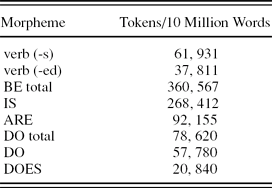
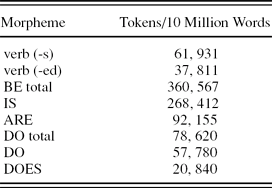
The results of these searches are given in Table 1. The column labeled “tokens” for the inflections 3S[-s] and PAST[-ed] shows the number of verb tokens appearing with that inflection across the corpora, and for BE and DO, it shows the number of tokens of IS, ARE, DO, and DOES across the corpora, contracted and uncontracted combined. (BE and DO forms marking past, e.g., WAS, WERE, and DID, were not included because they are not examined in this study.) For DO forms, tokens are based on the appearance of DO and DOES in subject–auxiliary inversion and negative constructions to eliminate instances of Do as a thematic verb. The data in Table 1 indicate that 3S[-s] and PAST[-ed] are much less frequent in the language compared to instances of both IS and ARE. For example, instances of IS were 7:1 times more frequent than PAST[-ed] and 4:3 times more frequent than 3S[-s]. In addition, instances of DO forms (DO and DOES combined = 78,620/million words) are more frequent than either 3S[-s] and PAST[-ed]. We do not intend to argue that such frequency data predict acquisition orders according to strict ranking (cf. Brown, Reference Brown1973). Instead, we have included this frequency data to lend support to the notion discussed above that some division between inflectional tense morphemes and unbound tense morphemes may be apparent in the English input children hear.
Token frequency in the BNC spoken corpora of English tense morphemes
(E)OI PROFILE FOR L1 AND SLI
The OI stage refers to a period in the early acquisition of nonnull subject languages where children variably produce tense-marking morphology but generally show targetlike abilities in accuracy with form choice for these morphemes and the distributional contingencies associated with them (Wexler, Reference Wexler, Lightfoot and Hornstein1994). For example, English-speaking children will alternate between the finite utterance he is running and the nonfinite utterance he running, but will rarely produce form choice errors like he are running and word order errors like he not is running. Children with SLI have a protracted or “extended” OI stage in their development, where alternate use of finite verb morphology persists until at least 9 years of age, but alternate use of certain nontense morphemes, like plural [-s] or progressive [–ing], is much lower or nonexistent after the age of 5 years (Bedore & Leonard, Reference Bedore and Leonard1998; Rice, Reference Rice, Levy and Schaeffer2003; Rice & Wexler, Reference Rice and Wexler1996, Reference Rice and Wexler2001; Rice, Wexler, & Cleave, Reference Rice, Wexler and Cleave1995; Rice, Wexler, & Hershberger, Reference Rice, Wexler and Hershberger1998). The (E)OI phenomenon has also been found in French TD L1 and SLI acquisition, as well as in numerous Germanic languages, and thus is robust crosslinguistically (Paradis & Crago, Reference Paradis and Crago2000, Reference Paradis and Crago2001, Reference Paradis, Crago, Prévost and Paradis2004; Paradis & Genesee, Reference Paradis and Genesee1996; Pierce, Reference Pierce1992; Rice, Noll, & Grimm, Reference Rice, Noll and Grimm1997; Wexler, Reference Wexler, Lightfoot and Hornstein1994, Reference Wexler1998).
Let us examine in more detail the empirical findings supporting the (E)OI profile. In both TD L1 and SLI acquisition, tense morphemes tend to cluster together at the end of the acquisition sequence for grammatical morphology in English, children's accuracy rates with these morphemes tend to be correlated, and these morphemes exhibit similar growth curves to mastery after they emerge in children's speech (Brown, Reference Brown1973; de Villiers & de Villiers, Reference De Villiers and de Villiers1973; Rice et al., Reference Rice, Wexler and Cleave1995, Reference Rice, Wexler and Hershberger1998; Rice & Wexler, Reference Rice and Wexler1996; Zobl & Liceras, Reference Zobl and Liceras1994). At the same time that children with SLI variably produce tense morphemes in their speech, they also show impaired representational knowledge of the obligatoriness of tense marking, because they have limited ability to detect ungrammatical tense omission in the speech of others, but do not show the same limited ability to detect other kinds of ungrammatical usage, such as omission of [-ing], for example, he is jump (Rice, Wexler, & Redmond, Reference Rice, Wexler and Redmond1999). In short, the omission of tense morphemes is not a production-only problem for affected children. Finally, form choice errors such as is for are, or playeded for played are marginal in the speech of TD L1 children and children with SLI (Hadley & Rice, Reference Hadley and Rice1996; Rice et al., Reference Rice, Wexler and Cleave1995; Rice & Wexler, Reference Rice and Wexler1996).
This collection of properties where ungrammatical omission of tense morphology persists along side consistent grammatical competence for form choice, word order, and well-formedness judgments of nontense related ungrammatical structures, constitutes the (E)OI profile. This profile suggests that TD L1 children and children with SLI do not have global difficulties with morphosyntax. Instead, TD L1 children and children with SLI appear to have a selective deficit on abstract grammatical tense, which Wexler has formally characterized as the (extended) unique checking constraint ([E]UCC; Wexler Reference Wexler1998, Reference Wexler, Levy and Schaeffer2003) in a minimalist linguistic framework (Chomsky, Reference Chomsky1995). The (E)UCC is proposed as a developmental principle of universal grammar (UG) that prohibits checking noninterpretable D features in the computation more than once (for details on the technical aspects of the UCC, see Wexler, Reference Wexler1998). The operation of the UCC results in the variable omission of tense agreement-related morphology in TD children's speech until the principle fades, sometime in the preschool years. In contrast, for children with SLI, the EUCC operates for a very protracted period of time, if not permanently to some extent (see Rice et al., Reference Rice, Wexler and Hershberger1998). Because the (E)UCC operates at the level of underlying linguistic representation, all tense-marking morphemes should be affected to some degree in development, and thus, deficits in both the production and receptive knowledge of tense morphology would be expected. The (E)UCC is a principle with specific and limited effects on children's grammars, and thus, children in the (E)OI stage should show full competence in their abilities with other aspects of morphosyntax (barring the influence of other developmental constraints). Finally, form choice errors would be relatively rare compared with omission errors because the operation of the (E)UCC should result in the dropping of the morphophonological reflexes of either <tns> or <agr> because the relevant functional phrase has not entered the computation, or the computation “crashed” because the morphophonological form was violated.
It is important to point out that the (E)UCC predicts variability in the morphophonological expression and knowledge of tense in developing grammars, but does not necessarily predict that all individual tense-marking morphemes would be acquired in absolute synchrony, or that no distinctions between bound and unbound morphology could be possible (see Rice et al., Reference Rice, Wexler and Hershberger1998, p. 1427). Other factors, both internal (e.g., linguistic markedness of syntactic operations involving forms with tense features) and external (e.g., input frequency), could influence the acquisition sequences of individual tense morphemes. The central claim is that, despite these differences, tense morphemes are affected as a group in general, meaning they show some cohesion in their acquisition patterns, such as clustering together toward the end of the acquisition sequence with similar growth curves (Rice at al., Reference Rice, Wexler and Hershberger1998). We return to this point in the discussion.
The key insight offered by the (E)OI/(E)UCC model for our purposes is that it is a maturational account of the L1 development of morphosyntax. Other maturational accounts have been put forward to explain the root infinitive phenomenon. For example, Rizzi (Reference Rizzi1993/94) put forward the truncation hypothesis, which suggests that child, but not adult, grammars lack the principle requiring root clauses to project a complementizer phrase, and thus, children's sentences could have an underlying VP or inflection phrase as the highest projection, resulting in omission of morphophonological reflexes of higher projections. We adopt the (E)OI/(E)UCC maturational model to contrast with L2 theories because it was developed for L1 learners both with typical language development and with SLI.
OIs AND L2 THEORETICAL ACCOUNTS
Numerous studies have shown that child English L2 learners also display variable use of tense morphemes in their interlanguage (Dulay & Burt, Reference Dulay and Burt1973, Reference Dulay and Burt1974; Gavruseva, Reference Gavruseva2002, Reference Gavruseva2004; Haznedar, Reference Haznedar2001; Haznedar & Schwartz, Reference Haznedar, Schwartz, Hughes, Hughes and Greenhill1997; Ionin & Wexler, Reference Ionin and Wexler2002; Jia & Fuse, Reference Jia and Fuse2007; Lakshmanan, Reference Lakshmanan1994; Paradis, Reference Paradis2005). The more particular question for our purposes is whether they show the (E)OI patterns as described above in their use of OIs.
The clustering of tense morphemes in acquisition appears to be less apparent in English L2 than in English L1, with and without SLI. For example, researchers have documented precocious emergence and mastery of BE in L2 English (Dulay & Burt, Reference Dulay and Burt1974; Gavruseva, Reference Gavruseva2002; Haznedar, Reference Haznedar2001; Ionin & Wexler, Reference Ionin and Wexler2002; Jia & Fuse, Reference Jia and Fuse2007; Lakshmanan, Reference Lakshmanan1994; Schwartz, Reference Schwartz2004; Zobl & Liceras, Reference Zobl and Liceras1994). In Haznedar's (2001) case study, the Turkish L1–English L2 boy used copula BE over 90% accurately after 4 months of exposure, whereas inflectional tense morphemes were produced less than 75% correctly in context after 17 months of exposure (Haznedar, Reference Haznedar2001, pp. 32–39). Ionin and Wexler (Reference Ionin and Wexler2002) found that a group of Russian L1–English L2 children omitted 78% of 3S[-s] and 58% of PAST[-ed] in context, while omitting 16% of BE copula and 33% of BE auxiliary in context (Ionin & Wexler, Reference Ionin and Wexler2002, p. 106). By contrast, Rice et al. (Reference Rice, Wexler and Cleave1995) report only slightly higher percentage of correct scores from TD L1 children and children with SLI for BE forms versus inflectional morphemes. For example, 5-year-olds with SLI produced 34% of 3S[-s] correctly, while producing 46% of BE correctly in spontaneous speech (Rice et al., Reference Rice, Wexler and Cleave1995, p. 858; see also Hadley & Rice, Reference Hadley and Rice1996). Furthermore, Ionin and Wexler (Reference Ionin and Wexler2002) also documented a phenomenon of BE overgeneration, where BE was inserted in non-BE contexts, for example, and then the police is come there, and seemed to function as an all-purpose early finiteness marker (Ionin & Wexler, Reference Ionin and Wexler2002, p. 110). Lardiere (Reference Lardiere2007) also reports BE overgeneration examples from adult L2 English (Lardiere, Reference Lardiere2007, p. 92). Thus, the precocious acquisition of BE in child L2 English does not parallel the (E)OI patterns for English TD L1 and SLI acquisition, where some sequence with unbound and inflectional tense morphemes may be apparent, but not as pronounced as in L2 acquisition.
In terms of error types, researchers have found that omission errors are far more common than form choice errors in child L2 English (Ionin & Wexler, Reference Ionin and Wexler2002; Paradis, Reference Paradis2005). But importantly, form choice errors are not extremely rare because Paradis (Reference Paradis2005) found that an average of 12.5% of all contexts for tense morphemes in English L2 children's spontaneous speech consisted of form choice errors in their productions; in contexts for DO auxiliary, form choice errors reached 19.4% of these children's productions (Paradis, Reference Paradis2005, p. 180). With respect to whether errors with tense morphology in production implicate deficits in receptive knowledge, Ionin and Wexler (Reference Ionin and Wexler2002) examined L2 learners' grammaticality judgments for tense morpheme omission using a similar task to that of Rice et al. (Reference Rice, Wexler and Redmond1999). They found higher scores for this task than for use of tense in production, suggesting that learners' underlying knowledge outstripped their productive abilities. However, the participants were not entirely the same group for the production and grammaticality judgment data, which limited comparison between them. Furthermore, the participants ranged in age from 6 years, 0 months (6;0) to 14;0, and such heterogeneity in cognitive ability also limits the interpretations that can be drawn from a metalinguistically demanding task. In sum, whereas variable use of tense morphology is a common characteristic of TD L1, SLI, and L2 acquisition, there appear to be some differences in the L2 acquisition patterns that do not fit the (E)OI profile. A direct comparison of TD L1, SLI, and L2 learner groups would clarify how robust these differences are.
What the variable use of morphology in L2 learners' speech suggests about their underlying grammatical competence has been the subject of much debate. White (Reference White2003a) identifies two sets of theories in her review: morphology before syntax and syntax before morphology. The former accounts have in common that they make appeal to some kind of incompleteness or underspecification in functional structure to explain the variable use of morphology (e.g., Beck, Reference Beck1998; Hawkins & Chan, Reference Hawkins and Chan1997; Vainikka & Young-Scholten, Reference Vainikka and Young-Scholten1996, Reference Vainikka, Young-Scholten and Beck1998), whereas the latter accounts take the contrary position that the presence or absence of morphology on the surface does not necessarily reflect whether the underlying functional structure and operations are intact in L2 learner grammars. The most widely assumed syntax before morphology account, the MSIH, is the L2 account we focus on because it offers the strongest contrast to the (E)OI profile of TD L1 and SLI acquisition in its predictions regarding morphosyntactic development. In addition, most morphology before syntax accounts have been developed on the basis of adult L2 data, with implicit or explicit assumptions about limitations in ultimate attainment for L2 learners. By contrast, syntax before morphology accounts have been proposed to account for the profile displayed by both child and adult L2 learners.
Proponents of the MSIH argue that variable use of grammatical morphemes is caused by the inability to access the correct morphophonological form in speech production postsyntax, rather than by the presence of underlying deficiencies in functional features, syntactic structure, or the presence of developmental principles like the (E)UCC (Haznedar, Reference Haznedar2001, Reference Haznedar and Lleo2006; Haznedar & Schwartz, Reference Haznedar, Schwartz, Hughes, Hughes and Greenhill1997; Lardiere, Reference Lardiere1998, Reference Lardiere and Archibald2000; Prévost & White, Reference Prévost and White2000a, Reference Prévost, White, Friedemann and Rizzi2000b, 2003b). Lardiere (Reference Lardiere1998, Reference Lardiere and Archibald2000) characterizes variable use of morphology by L2 learners as a mapping problem between functional features in the syntax and the appropriate forms in the lexicon. In a similar vein, Prévost and White (Reference Prévost and White2000a) put forward a distributed morphology approach for explaining variable inflection based on underspecification of functional features in the developing lexicon. The MSIH is compatible with some of the L2 findings discussed above that do not reflect the (E)OI profile for SLI, for example, that underlying grammatical knowledge of a structure can outstrip accuracy in production, or that BE forms might display a unique acquisition trajectory from other tense morphemes. However, like the (E)UCC account, the MSIH is argued to predict omission errors to be common and form choice errors to be rare. Prévost and White (Reference Prévost and White2000a) and Lardiere (Reference Lardiere and Archibald2000) emphasize that missing surface inflection does not mean faulty inflectional processes, presumably because this might imply deficiencies in morphosyntactic operations like subject–verb agreement, and such an outcome would be more consistent with morphology before syntax theories. However, even data from adult learners do not entirely support the claim that form choice errors are rare in L2 acquisition. For example, Prévost and White (Reference Prévost and White2000a) found that the adult German L2 learners they studied showed inaccurate subject–verb agreement in 10–30% of contexts for certain inflections, and one of two French L2 learners had less than 90% agreement between clitics and doubled subjects (Prévost & White, Reference Prévost and White2000a, pp. 122–124). Furthermore, White (Reference White2003b) and Lardiere (Reference Lardiere1998, Reference Lardiere and Archibald2000, Reference Lardiere, Dekydtspotter, Sprouse and Liljestrand2005) report data from fossilized L2 learners with long-time practice, and it is possible that form choice errors could have occurred during the initial stages of their acquisition. White (Reference White2003a) points to the possibility that systematic and unidirectional substitutions could be compatible with the MSIH account, as long as they were explainable by extrasyntactic mechanisms. Assuming this position for the MSIH permits us to make a contrast with the (E)OI profile for error types, in addition to the contrast for representational knowledge being disassociated from productive abilities, and for differential acquisition patterns for BE and the inflectional morphemes. More specifically, if a maturational constraint like the (E)UCC is the mechanism underlying OIs, then omission errors should prevail and form choice errors should be rare. However, if OIs are the result of inadequate access to the appropriate morphophonological forms from the lexicon to map onto syntactic structures, then both omission and (systematic) substitution errors are a possibility.
Thus far we have not considered the role of the L1 in child L2 acquisition of English tense morphemes, or in theoretical accounts of L2 morphosyntax. Under the full transfer/full access account, the initial state of the L2 grammar is the L1 grammar (Schwartz & Sprouse, Reference Schwartz and Sprouse1996). This account would predict that a child L2 learner whose L1 includes grammatical tense, and therefore, the feature <tns> is active in their syntax and lexicon, would begin learning English with a different initial state from a child whose L1 does not include grammatical tense. Different initial states could result in different rates and patterns of tense morpheme use in the L2, as the child whose L1 has the feature <tns> would begin the acquisition process with an initial state grammar closer to the target grammar. Lardiere (Reference Lardiere, Dekydtspotter, Sprouse and Liljestrand2005) offers a conceptualization of building L2 grammatical competence starting from the L1 gammar as a reassembly of features and lexical items. This conceptualization would also predict that L2 learners whose L1s have the feature <tns> linked to lexical items in the L1 in a parallel fashion to the target L2 system would have an advantage over their peers whose L1s do not.
Transfer from the L1 could interact with the developmental processes related to access to morphophonological forms in L2 acquisition as characterized by the MSIH. It might be expected that variable use of tense morphology would be less pronounced or overcome more quickly in learners whose L1s mark tense grammatically. However, available empirical evidence does not support a role of transfer in English tense morphology acquisition, because the patterns we have described hold for learners from a variety of L1 backgrounds, including L1s where tense is not grammatically marked at all, like Cantonese or Mandarin. Nevertheless, we examine our L2 data for potential L1 transfer effects.
PREDICTIONS FOR THIS STUDY
The goal of this study was to compare child English L2 acquisition with L1 and SLI acquisition, to determine whether English L2 grammars are better characterized by an (E)OI or a MSIH profile of morphological acquisition. We assumed that the TD L1 children and the children with SLI would follow the (E)OI patterns, and used these groups as controls to interpret the tense acquisition patterns of the L2 children. We expected that all three groups of children would display variable use of tense morphemes, have omission errors as the most common type overall, and would show evidence for syntactic movement operations implicating functional projections, such as subject–auxiliary inversion. Both profiles would be consistent with these patterns; however, the profiles contrast on other key points. We reasoned that if the L2 children showed the following patterns, the MSIH would better characterize their acquisition of tense morphology: (a) significantly distinct acquisition of BE morphemes than inflectional tense morphemes compared to the TD L1 children and the children with SLI; (b) distinct patterns in their receptive knowledge abilities and their production of tense morphology, in contrast to the children with SLIFootnote 2; and (c) proportionally more form choice errors than the TD L1 children and the children with SLI.
METHOD
Participants
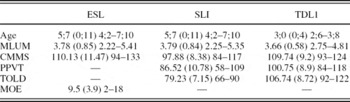
Twenty-four TD English L2 children, 24 monolingual English-speaking children with SLI, and 20 TD monolingual English-speaking children participated in the study. The TD English L2 children (henceforth, the English as a second language [ESL] group) had a mean age of 5;7 (SD = 0;11, range = 4;2–7;10) and a mean of 9.5 (SD = 3.9, range = 2–18) months of exposure to English (MOE), in a school or preschool setting, at time of testing. These children had a wide variety of L1 backgrounds: Korean, Mandarin, Spanish, Romanian, Cantonese, Arabic, Japanese, Farsi, Dari, and Ukrainian. Eight children had Cantonese or Mandarin as their L1, languages that do not mark tense grammatically (Lin, Reference Lin2001; Matthews & Yip, Reference Matthews and Yip1994). Six of the children had Spanish as their L1. The other L1s were fairly evenly distributed among the remaining 10 children. The majority of the children had recently immigrated to Canada, and 5 of the children were born in Canada, but their parents were immigrants. The children who were born in Canada, according to parental report, were not exposed to English consistently until they began a preschool or school program, and showed no signs of being able to speak or understand English until after they entered the program. The families were recruited for the study from agencies that assist new immigrants, from English L2 classes for newcomers to Canada, and by word of mouth. In addition, according to parental report, none of the children experienced any difficulties or delays in learning their L1. As part of the testing protocol, the children were given the Columbia Mental Maturity Scale (CMMS; Burgemeister, Hollander Blum, & Lorge, Reference Burgemeister, Hollander Blum and Lorge1972), and all of the children had nonverbal IQs above 85.
Two groups of comparison children participated, all of whom were residing in monolingual homes in the midwestern United States. Twenty-four children with SLI (henceforth, the SLI group) were selected from an ongoing longitudinal study to form a group equivalent to the ESL group on the basis of age and MLU in morphemes (MLUM). They met the following inclusionary criteria: (a) they were initially recruited from clinicians' caseloads with diagnoses of language impairment; and (b) at the time of the data collection for this study, their language abilities were lower than 1 SD below the mean on standardized tests of receptive and productive language, which were the Peabody Picture Vocabulary Test—Revised (PPVT-R; Dunn & Dunn, Reference Dunn and Dunn1981) and the Test of Language Development—Primary, Second Revision (TOLD-P:2; Newcomer & Hammill, Reference Newcomer and Hammill1988). The children also met the following exclusionary criteria: (a) they did not have clinically identified social or behavioral impairments, and (b) their nonverbal IQ levels were 85 or higher on the CMMS. They passed a hearing screening. Equivalence was determined by selecting children within the same MLUM range as the ESL group and then adjusting the group for age to eliminate children whose age was outside the range of the ESL group. The mean MLUM values for the two groups are 3.79 for SLI (SD = 0.84, range = 2.25–5.35) and 3.78 for ESL (SD = 0.85, range = 2.22–5.41). A t test confirmed no significant difference. The mean age and age range for the SLI group was the same as for the ESL group (mean = 5;7, SD = 0;11, range = 4;2–7;10).
Twenty unaffected control children participated in the study, with typical language development (henceforth, the TDL1 group). They were recruited from preschools in the same area as the SLI group. They scored within the normal range or slightly above on the PPVT-R and TOLD-P:2. They met the same exclusionary criteria as the SLI group. Equivalence was determined by selecting 20 children from a larger group whose MLUMs were within the same range as those of the ESL children. The final 20 chosen had a mean MLUM very close to the mean of the ESL group. The TDL1 group MLUM mean was 3.66 (SD = 0.58, range = 2.75–4.81), not statistically different from the ESL group according to t test calculations. Their mean age was 3;0 (SD = 0;4, range = 2;6–3;8).
The descriptive information from all three groups is summarized in Table 2.
Participants' ages; MLUMs; standard scores from the CMMS, PPVT, and TOLD; and months of exposure to English
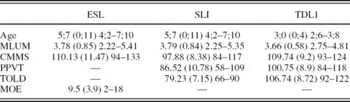
Note: Descriptives are written as mean (standard deviation) and ranges. TOLD scores are the spoken language quotient. MOE, months of exposure to English.
Procedures
Elicitation probes were used to obtain accuracy scores for the tense morphemes 3S[-s], PAST[-ed], BE-COP, BE-AUX, and DO-AUX. All three elicitation probes are from the Test of Early Grammatical Impairment (TEGI; Rice & Wexler, Reference Rice and Wexler2001). Elicitation of 3S[-s] and PAST[-ed] was accomplished through asking children to describe pictures. For the 3S[-s] probe, children were shown pictures of professionals engaged in work activities and given prompts like, “Here is a teacher. Tell me what a teacher does.” For the PAST[-ed] probe, children were shown pictures of children engaged in activities, followed by a picture showing the activity being completed, and given prompts like, “Here the boy is raking. Now he is done. Tell me what he did.” Elicitation of BE and DO was accomplished through a play scenario involving a puppet, stuffed animals, and other items. Children were told that only the puppet could talk to the stuffed animals, so if the child wanted to know something about the animals, she would have to ask the puppet. The child was encouraged by the experimenter to ask the puppet about the animals, for example, “I wonder if the bears are thirsty after their nap. You ask the puppet,” or to make statements about the animals, “Oh, the kitty's soft. Tell me about the bears.” Thus, this play scenario elicited third person singular and plural statements and questions with BE and DO.
In addition, the SLI and ESL groups were given the grammaticality judgment task, also from the TEGI, where they had to detect ungrammaticality in tense omission when the target sentence had a bare lexical verb, “He want-Ø a drink,” or when a BE form was missing, “He Ø running away,” or He Ø behind the box.” Children were presented with a scenario where two figurines were described as robots who were just learning English and sometimes made mistakes. As the scenario was presented to the child, the experimenter spoke for the robots, using grammatical and ungrammatical sentences and invited the children to judge whether what the robots said was “right” or “not so good.” The children in the TDL1 group were too young to participate in this task, so comparative analyses were based on the SLI and ESL groups.
Spontaneous speech samples were collected from children in each group for the purposes of calculating MLUs. The spontaneous speech transcripts were also searched for examples of BE-overgeneration in declarative utterances, like those reported in Ionin and Wexler (Reference Ionin and Wexler2002). Declarative utterances with overgenerated BE forms were defined as having BE forms outside of the target-language context for BE-COP or BE-AUX. Several examples of BE overgeneration were found in the ESL group's transcripts, but were unattested in the spontaneous speech of the SLI and TDL1 groups.
Data scoring
The children's responses for the 3S[-s] probe were coded as correct if the inflection was produced, or as omissions if the bare verb stem was used. If the children used a verb that was not the target verb, their responses were considered scorable and coded for correct use or omission. Unscorable responses were those where the verb appeared in other tense/aspect forms like the progressive, or with modals, and so forth. The percent correct scores for 3S[-s] were calculated as the number of correctly produced forms out of the total of scorable responses. A similar system was used for the past tense probe. Children's attempts at the simple past tense were considered scorable if they consisted of correct use of the past tense [-ed] or a bare verb stem (omission error). If the children used a nontarget verb that was a regular verb, this was scorable; however, if the children substituted an irregular verb using the strong form of the past tense, this response was considered unscorable because our analyses were focused on the [-ed] affixal pattern. PAST[-ed] percent correct scores were calculated as the number of correctly produced forms out of the total of scorable responses. Scoring of the BE-DO probe was more complicated. This probe included both question and statement targets for BE-COP and BE-AUX, but only question targets for DO. If a child's response to a question target was not in interrogative form, that is, noninverted, it was excluded and analyzed separately. Reponses that were off topic or included other tense/aspect forms were considered unscorable. For statement targets, children's scorable responses were coded as one of the following: correct, omission, or wrong form of BE. For question targets with BE and DO, children's scorable responses were coded as correct, omission, wrong form of BE, or double marked (use of two auxiliaries in one sentence). The percent correct scores were calculated for BE-COP, BE-AUX, and DO as the number of correctly produced forms in questions and statements combined, out of the total of scorable responses. For error analyses with BE forms, proportions of children's scorable responses that fell into each coding category were calculated, totaling 1.0. For all elicitation probes, scorable contexts were those in which the child produced an overt subject. Finally, for the grammaticality judgment task, the proportion of children's correct rejections (of ungrammatical targets), false alarms (incorrect rejections of grammatical targets), misses (incorrect acceptances of ungrammatical targets), and hits (correct acceptances of grammatical targets) were calculated. The results of the calculations for hits and false alarms were entered into a formula to calculate A-prime scores. The A-prime scores are a preferred measure for children's grammaticality judgments because they correct for the “yes” bias children often show. For more information about A-prime scores, see Rice et al. (Reference Rice, Wexler and Redmond1999). It is important for us to point out that the scoring procedures we used for the elicitation and grammaticality judgment tasks differed somewhat from the scoring procedures described in the Examiner's Manual for the TEGI.
RESULTS
L1 and English exposure influences on ESL children's tense acquisition
Before turning to the between- and within-group analyses for all the children, we first conducted within-group analyses for the ESL data to investigate whether heterogeneity in MOE or in L1 background were skewing the results for this group. Pearson correlations were performed between each of the outcome variables for the elicitation and grammaticality judgment tasks and children's MOE. Coefficients ranged from −.026 to .100, and none were significant at the p < .05 level. Therefore, the variance in amounts of exposure time among these children was not associated with their performance on the tasks. Next, we divided the children according to whether their L1 marked tense grammatically or not. Because there were just eight children from nontense L1 backgrounds (Mandarin and Cantonese), we used a nonparametric unpaired group test, the Mann–Whitney U test. A series of comparisons were conducted between the [+tense] L1 and [−tense] L1 groups for each of the outcome variables. None were significant at the p < .05 level. Therefore, the presence or absence of tense as a grammatical feature in the L1 was not systematically influencing these children's accuracy with and knowledge of tense morphemes, at least not at this early stage of their L2 development.Footnote 3
To provide a sketch of individual performance, the table in Appendix A lists the percent correct scores for bound morpheme production (3[-s] and PAST[-ed] combined) together with MOE and L1 for the ESL children. The table is organized by L1 groupings, with ordering according to MOE within each group. A few examples from Appendix A illustrate why the statistical analyses showed no systematic relationship between MOE and L1 background in these data: DNLN, a Cantonese L1 child with MOE 14 had a score of 39%, whereas JNNH, a Mandarin-speaking child with MOE 18, had a score of just 18%. FLPP, a Spanish L1 child with MOE 10 achieved the highest score overall at 85%, but another Spanish L1 child, SBST, with MOE 15 had a score of just 7%. Note that SBST's score was much lower than the Cantonese L1 child, DNLN, even though he has an L1 that marks tense grammatically and has 1 more month of exposure to English than DNLN.
Accuracy in tense morpheme production
The mean percent accuracy in obligatory context for 3S[-s], PAST[-ed], BE-COP, BE-AUX, and DO are given for the ESL, SLI, and TDL1 groups in Figure 1 (bars are standard errors). One-way between-subjects analyses of variance (ANOVAs) were performed on the groups' accuracy scores for each morpheme. Results showed significant between-group differences for 3S[-s], F (2, 61) = 6.564, p = .003, and PAST[-ed], but not for BE-COP, BE-AUX, and DO. Post hoc Tukey honestly significant difference (HSD) pairwise comparisons on the group means for 3S[-s] and PAST[-ed] revealed that the ESL group scored lower than the TDL1 (3S[-s]: ESL = 16% vs. TDL1 = 42%; PAST[-ed]: ESL = 20% vs. TDL1 = 47%), and SLI groups (3S[-s]: ESL = 16% vs. SLI = 52%; PAST[-ed]: ESL = 20% vs. SLI = 46%), whereas there was no difference between the TDL1 and SLI groups. Therefore, on this analysis, all groups of children performed similarly for the unbound morphemes of BE and DO, but the ESL group performed differently, and worse, for the inflectional morphemes. Note also from Figure 1 that the TDL1 and SLI groups displayed a narrower range of scores across inflectional (38 to 62%) and unbound morphemes (43 to 65%). In contrast, the ESL group displayed a broader range of accuracy scores (16 to 78%) with the two lowest scores belonging to the inflectional morphemes. These within-group patterns are analyzed statistically below.
The mean percent correct scores for production of tense morphemes.

To further explore the between-group distinction in accuracy with inflectional and unbound morphophonological expressions of tense, we conducted multivariate, multilevel regression analyses (SAS Proc Mixed) with outcome variables consisting of composite scores for inflectional affixes (the average of scores for 3S[-s] and PAST[-ed]) and auxiliary verbs (the average of scores for BE-COP, BE-AUX, and DO) and a fixed effect variable for group. This kind of statistical procedure has the advantage of better control of Type I error, and greater power, than the univariate ANOVAs we have reported above. It allows us to determine if the effect of an explanatory variable, like group, on one of the outcome variables, for example, auxiliary composite, is larger than its effect on a second outcome variable, for example, inflectional composite. It also allows for the inclusion of different covariance matrices for each group should they not have the same variance/covariance structures, which was the case for the groups in these analyses. Thus, the models for both these analyses used heterogeneous covariance structures. We present details of the procedures involved in this technique for the first analysis and then report summaries only for subsequent multivariate, multilevel regression analyses for the sake of brevity.
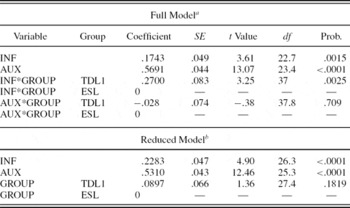
In the first analysis, we were interested in the fixed effects of INF (estimated mean of inflectional composite for ESL), AUX (estimated mean of auxiliary composite for ESL), and GROUP (estimated difference for the TDL1 group, as referenced to ESL group, for either tense variable), and we held constant the random effects in the models. The variable INF*GROUP refers to the estimated difference of INF for the TDL1 group, as referenced to the ESL group. Similarly, the variable AUX*GROUP refers to the estimated difference of AUX for the TDL1 group as referenced to the ESL group. Further descriptions of the variables, as well as statistical results, are given in Table 3. For the model comparisons, maximum likelihood estimation was used. For each model, maximum likelihood estimation produces a statistic (the deviance statistic or −2 log likelihood), which is an indicator of how well the model fits the data. Consequently, the deviance statistic may be used to compare models, with the smaller deviance generally indicating a better fitting model. In the case of nested models, a statistical test may be conducted because the difference in the deviance statistics for the two nested models is distributed as chi squared with the degrees of freedom equal to the difference in the number of parameters. Nested models are created when effects in a general or full model are removed or constrained to create a reduced model. In this study our reduced model had constrained the group effect to be the same for the AUX variable as it is for the INF variable, whereas the full model allowed the group effects to vary depending on the variable, AUX or INF. The null hypothesis that the reduced model fit the data as well as the full model was rejected (difference in deviances = 10.8, difference in number of parameters = 1, χ2 (1), p = .0010).
Results from the multivariate multilevel analysis for ESL and TDL1 for the auxiliary and inflectional composite scores
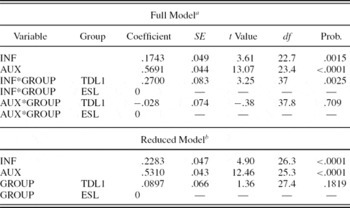
Note: The coefficients in the full model are interpreted as follows: INF, estimated mean of INF for the reference group (ESL); AUX, estimated mean of AUX for the reference group (ESL); INF*GROUP, estimated difference of INF for the TDL1 group compared to the ESL reference group, that is, the estimated mean for TDL1 is .1743 + .2700; AUX*GROUP, estimated difference of AUX for the TDL1 group compared to the ESL reference group, that is, the estimated mean for TDL1 is .5691 – .028. The coefficients in the reduced model are interpreted as follows: INF, estimated mean of INF for the reference group (ESL); AUX, Estimated mean of AUX for the reference group (ESL); GROUP, estimated difference for the TDL1 group compared to the ESL reference group for either variable, that is, the estimated mean for the TDL1 group for INF is .2283 +.0897, and for AUX the estimate is .5310 + .0897.
aDeviance (−2 log likelihood) = −4.5, number of parameters = 4.
bDeviance (−2 log likelihood) = 6.3, number of parameters = 3; difference in deviances = 10.8, difference in number of parameters = 1.
Now we turn to the interpretation of the coefficients. GROUP is a categorical variable with the ESL group as the reference group. (Degrees of freedom are calculated using the Satterthwaite method.) Based on the results from the difference of the deviance statistics, we concluded that the model that allows the group effect to vary depending on the INF or AUX variable was a better fitting model than the model that did not allow this variability. However, it appears that a more parsimonious model than the full model, but one that would fit the data well, would be a model that includes the INF*GROUP effect but drops the AUX*GROUP effect. This suggestion is based on the full-model results in Table 3 that show a significant coefficient for the INF*GROUP effect, indicating that the two group means differed significantly on this effect, but the coefficient for the AUX*GROUP effect was not statistically significant, indicating that the two groups did not differ on the AUX means. Using the same procedures of model comparison described above, a model that included AUX, INF, and INF*GROUP was fit. This model had a deviance statistic of −4.3; the difference in the deviance statistics between the full model (−4.5), and this reduced model was not statistically significant, indicating that the inclusion of both interaction effects (AUX*GROUP and INF*GROUP) did not provide a better fit than the model that included only the INF*GROUP interaction effect.
The second analysis paralleled the first analysis in terms of the two outcome variables, inflectional, and auxiliary tense composites, and a fixed effect for group, but concerned comparisons between the ESL and SLI groups. We again examined the results for two nested models: a full model that included variables allowing the regression coefficients for the outcomes to differ between the two groups, and a reduced model in which the regression coefficients were constrained to be equal. The difference in the deviance scores between the models was 12.5, which as χ2 (1) = 12. 5, was significant (p = .0004), indicating that the model including both regression slopes was the more appropriate model. For the next step, we again examined the significance probabilities for each of the regression coefficients from the previous model comparison. Of the two coefficients, only the inflectional composite indicated significant differences between the two groups, t (41.9) = 3.57, p = .0009. Again, we conducted a second confirming comparison with a full model, including variables for both regression coefficients with a reduced model in which we included only the composite for the inflectional tense morphemes. The difference in the deviance values for the two models was not significant according to a chi-squared test. Therefore, this analysis showed that the ESL group differed from the SLI group on the composite for the inflectional tense morphemes, but the groups did not differ on the BE/DO auxiliary verb composite.
These two multilevel, multivariate regression analyses established that the ESL group differed from both the TDL1 and SLI groups with respect to their accuracy with inflectional but not auxiliary tense morphemes. We wanted to further understand whether this statistical approach would reveal whether there were group differences in children's accuracy with BE versus DO, which the univariate ANOVAs did not reveal. Accordingly, two sets of analyses were carried out to examine the relationship between the two auxiliary verbs, BE (copula and auxiliary) and DO (auxiliary), as outcome variables, with group as a fixed effect. The first analysis included ESL and SLI as the two groups, the second analysis included ESL and TDL1, and the steps followed paralleled the analyses above, although in this case the variance/covariance matrices were not significantly different for either pair on these variables; therefore, models being compared assumed homogeneous variances.
For the first analysis, the first step was to determine if the regression coefficients for the outcomes differed between the ESL and SLI groups. This was accomplished by comparing two nested models: one in which the regression coefficients were allowed to vary and the second in which they were constrained to be equal. The test statistic for the difference in the deviance values was χ2 (1) = 8.8 and was significant (p = .003), indicating that the model with unequal regression slopes was the more appropriate model. Upon examination of the significance probabilities for each of the regression coefficients from this model comparison, we observed that, of the two coefficients, only the DO auxiliary verb had a low probability, indicating that a more parsimonious model may need to have only the regression coefficient for the DO auxiliary, rather than coefficients for both BE and DO. To further confirm this possibility, we conducted a second comparison of a full model including variables for both regression coefficients with a reduced model in which we included only the coefficient for the DO auxiliary, with the result that the full model did not provide a significantly better fit according to a chi-squared test. Therefore, this analysis showed that the ESL group differed significantly from the SLI group on DO but not BE.
The second analysis compared models with BE and DO as outcomes and the groups of ESL and TDL1 as fixed effects, and followed the same initial model comparison as above, but for the ESL and TDL1 groups, no differences were found; a model with two different regression coefficients did not fit significantly better than a model with a single regression coefficient for the two verbs. No further model comparisons were undertaken, and thus, this analysis showed that ESL and TDL1 did not differ in their accuracy with either DO or BE, in contrast to ESL and SLI.
Grammaticality judgments of tense morpheme omission
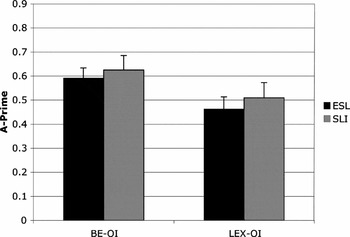
The mean A-prime scores for the ESL and SLI groups' judgments of sentences with omission of a tense inflection (LEX-OI) or a BE form (BE-OI) are plotted in Figure 2. Bars are standard errors. Recall that the TDL1 children were too young to perform this task. In contrast to the production data in Figure 1, there was a smaller difference in the ESL group's average grammaticality judgments for inflectional versus unbound morpheme usage (A′ LEX-OI = .46, A′ OI-BE = .63). Furthermore, results of independent sample t tests between SLI and ESL were not significant for either morpheme type. Follow-up multivariate, multilevel regression analyses using the same steps as described in the previous section yielded the same conclusions as the t test analysis, namely, that the ESL group did not differ from the SLI group in their abilities to detect ungrammatical usage with either inflectional or auxiliary morphemes.
The mean A-prime scores for grammaticality judgments.

Comparisons between auxiliaries and inflectional tense morphemes
To further explore the differences in the acquisition patterns for BE (AUX and COP), DO (auxiliaries), and 3S[-s] and PAST[-ed] (inflectional morphemes), a series of within-group analyses were performed using the general linear mixed model (GLMM) approach as implemented in SAS Proc Mixed. The analyses are similar to paired t tests in that they account for the correlation between the variables; however, the GLMM approach is generally more powerful because it allows use of more observations. For each group of children, comparisons were undertaken between (a) the auxiliary composite (BE and DO) versus the inflectional composite (3S[-s] and PAST [-ed]) percent correct scores from the elicitation tasks, (b) BE (copula and auxiliary) versus DO percent correct scores from the BE/DO probe, and (c) the BE versus lexical A′ scores from the grammaticality judgment task. For the TDL1 children, they were significantly more accurate in producing BE than DO forms (64 vs. 34%), t (18) = 5.74, p < .0001, but there was no difference in their accuracy with auxiliaries and inflectional morpheme composite scores. For the SLI group, they were also significantly more accurate in their use of BE than DO forms (63 vs. 38%), t (21.5) = 3.99, p = .0006, but there were no differences between their accuracy in producing auxiliaries versus inflections, and between their abilities to detect ungrammaticality for BE versus lexical forms on the grammaticality judgment task. In contrast, the ESL groups were significantly better with BE forms versus DO forms (69 vs. 19%), t (17) = 8.75, p < .0001, and auxiliaries versus inflectional morphemes in production (57 vs. 17%), t (22.9) = 7.65, p < .0001, and better at detecting grammatical use of BE targets versus lexical targets (.63 vs. .46), t (24) = 3.77, p = .0001.
Subject–auxiliary inversion
The ratio of noninverted questions was calculated out of the total of question responses with and without inversion. Noninverted questions would have declarative structure but rising intonation, and these responses are not included in our other analyses of BE uses. We wanted to know if the children showed evidence for the syntactic operation of subject–auxiliary inversion, which would imply the presence of functional projections in their grammars. In addition, we wanted to know if there were any differences between the groups in how frequently they produced questions with inversion. According to a one-way, between-subjects ANOVA, there were no significant differences between the ESL, SLI, and TDL1 groups in their ratios of noninverted questions for BE-COP constructions (ESL = .57 vs. SLI = .43 vs. TDL1 = .27), or for BE-AUX constructions (ESL = .46 vs. SLI = .38 vs. TDL1 = .17). For the ESL group in particular, roughly half of their question attempts included inversion.
Errors with BE
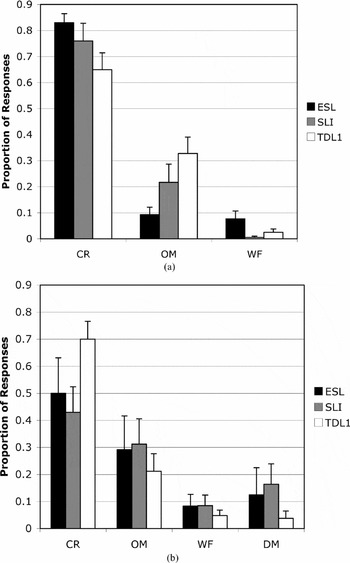
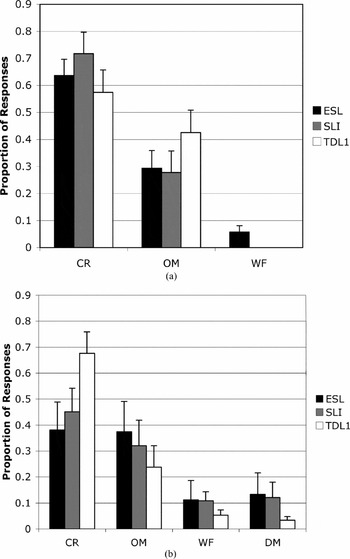
To investigate the distribution of error forms, we undertook a detailed analysis of the children's responses from the BE-DO probe. The proportion of different response types for BE-COP in statements, BE-COP in questions, BE-AUX in statements, and BE-AUX in questions, are plotted in Figures 3 and 4. Bars are standard errors. For statements, response types consisted of (a) correct (CR), (b) omission (OM), and (c) wrong form (WF). For questions, response types consisted of (a) CR, (b) OM, (c) WF, and (d) double-marked (DM). The proportion of correct responses was included to aid in interpretation of the distribution of error forms, as the entire distribution of responses totals 1.0 for each group. Comparing across the figures, two trends are apparent: the proportion of correct responses was lower for both BE-COP and BE-AUX in questions for ESL and SLI, and the proportion of omission errors was greater than other error types for all groups, for both morphemes, and both sentence types. A series of one-way between-subjects ANOVAs was carried out for each response type for each morpheme and sentence type. First, there were no significant between-group differences in the proportion of correct responses to either BE morpheme in either sentence type. Second, there were no significant between-group differences in the proportion of any of the error responses in either BE-COP or BE-AUX questions. For BE-COP statements, there were significant between-group differences for the proportion of omissions, F (2, 63) = 4.297, p = .018, and wrong form errors, F (2, 63) = 3.673, p = .031. Post hoc Tukey HSD pairwise comparisons on omission responses showed that the ESL group had fewer omissions than SLI (.093 vs. .217), but there were no differences between the SLI and TDL1 groups, or between the ESL and TDL1 groups. For wrong form responses, post hoc comparisons showed that the ESL group had more of these errors than the SLI group (.077 vs. .005), but had the same as the TDL1 group, and there were no differences between the SLI and TDL1 groups. The between-subjects ANOVA for wrong form responses in BE-AUX in statements was also significant, F (2, 62) = 5.46, p = .007, although the ANOVA for omission responses was not. Post hoc comparisons on the wrong form errors with BE-AUX showed that the ESL had more than the SLI and TDL1 groups (.058 vs. .000 and .000). In sum, where there were group differences in type of error form, these differences consisted of the ESL group having more wrong form errors than one or both of the monolingual groups.
(a) The proportion of correct (CR), omission (OM), and wrong form (WF) responses for statements with BE copula. (b) The proportion of correct (CR), omission (OM), wrong form (WF), and double-marked (DM) responses for questions with BE copula.

(a) The proportion of correct (CR), omission (OM) and wrong form (WF) responses for statements with BE auxiliary. (b) The proportion of correct (CR), omission (OM), wrong form (WF), and double-marked (DM) responses for questions with BE auxiliary.

Overgeneration of BE
The ESL children had a mean of 8% overgenerated BE forms (range = 0–67%) out of all of the BE forms used in their spontaneous speech transcripts. Examples of overgeneration of BE forms, where BE is the only overt finite morpheme or an “extra” finite morpheme in the clause, are in given in Example 3. Children's name codes followed by their L1 backgrounds and MOE to English are in parentheses. Note that BE overgeneration occurred across L1 backgrounds, including those without grammatical tense, and across MOEs. In contrast, the range of occurrence indicates that this phenomenon was unevenly distributed across individual children's English production: some children never overgenerated BE in their spontaneous speech.
- 3.
a. No, I’m black hair. (SHHN, L1 = Farsi, MOE = 12)
b. I’m got sevens. [playing cards – “got” is present time reference] (SHHN, L1 = Farsi, MOE = 12)
c. Ah, you’re win. (SHHN, L1 = Farsi, MOE = 12)
d. It’s has two one. (SHHN, L1 = Farsi, MOE = 12)
e. I’m a show you. (RMLM, L1 = Japanese, MOE = 9)
f. Yes, but if I was hurt my teeth. (RMLM, L1 = Japanese, MOE = 9)
g. If you’re like that [i.e., if you do like that + gesture]. (CNDX, L1 = Mandarin, MOE = 8)
h. If you don't be careful it’s not you won. (CNDX, L1 = Mandarin, MOE = 8)
i. But sometime we are try something. (CNDX, L1 = Mandarin, MOE = 8)
j. And I’m sit down on my spot. [past temporal reference] (GSYN, L1 = Korean, MOE = 2)
k. And playtime I’m # play on the paint. (GSYN, L1 = Korean, MOE = 2)
l. But, my brother’s always play with him. (DNLN, L1 = Cantonese, MOE = 14)
m. I want is a this. (BRND, L1 = Spanish, MOE = 10)
n. They’re can take many people. (SMNS, L1 = Spanish, MOE = 6)
DISCUSSION
It has long been noted that the acquisition of tense-marking morphology is a vulnerable domain for English language learners across acquisition contexts, TD L1, SLI, and L2. For example, learners of all groups typically take time, even years, to produce tense morphemes accurately. Comparisons across learner contexts could determine which characteristics of tense acquisition are general to all learners of English, and which are unique to say, learning an additional language later in life, learning a language with a disordered language faculty, or learning a language when neurocognitively immature. Because this study compared three learner groups directly, and group inclusion was controlled for both age and level of language development, the results can give a more comprehensive picture of the extent of learner similarities and differences than prior work on this topic (e.g., Ionin & Wexler, Reference Ionin and Wexler2002; Zobl & Liceras, Reference Zobl and Liceras1994).
Regarding similarities, all three groups of children, ESL, SLI, and TDL1, showed variability in their use of both inflectional and unbound tense morphemes at this stage in their language development. Thus, at a certain level of English development as measured by MLU, child learners have difficulties accurately producing tense morphemes, regardless of their acquisition context. For the ESL children, these difficulties were not systematically related to the within-group variation in English exposure times or L1 background. This finding is in line with prior research documenting similarities across TD L1, L2, and SLI acquisition contexts in French (e.g., Paradis & Crago, Reference Paradis and Crago2000, Reference Paradis, Crago, Prévost and Paradis2004). At the same time as these English-learning children variably produced tense morphology, they all also showed similar use of subject–auxiliary inversion, which reflects the presence of movement to functional projections. This finding suggests that difficulties with producing tense morphemes do not reflect incomplete or faulty underlying syntactic operations related to the functional layer in English child learner grammars.
In contrast to the prior research on French, this study also found several key differences between the ESL group and the TDL1 and SLI groups. The primary goal of this study was to determine if such differences existed, and if so, whether the acquisition patterns of the ESL children would be better characterized by the (E)OI or MSIH profiles.
The (E)OI versus the MSIH profile for L2 acquisition
Earlier we put forward three predictions that, if upheld, would provide more evidence for an MSIH over an EOI profile for the ESL group: (a) significantly distinct acquisition of BE morphemes than inflectional tense morphemes compared to the TD L1 children and the children with SLI; (b) distinct patterns in their receptive knowledge abilities and their production of tense morphology, in contrast to the children with SLI; and (c) proportionally more form choice errors than the TD L1 children and the children with SLI.
The findings for accuracy with tense production were consistent with prediction (a), as significant group differences were found in the percent correct use of the inflections, 3S[-s] and PAST[-ed], where the ESL group were less accurate than both the SLI and TDL1 groups, but no differences were found between the groups for the use of the unbound morphemes, BE-COP, BE-AUX, and DO. These outcomes were similar based on the ANOVA procedures for individual morphemes as well as the more advanced, multilevel, multivariate regression procedures for composite scores. The follow-up multilevel model comparisons with BE versus DO forms revealed that the ESL group were the same as the SLI group in their performance with BE (but not DO), whereas the ESL group was the same as the TDL1 group with both BE and DO. Overall, these results reinforce the claim that unequal development of inflectional and unbound morphemes is a hallmark of English L2 acquisition (e.g., Ionin & Wexler, Reference Ionin and Wexler2002; Zobl & Liceras, Reference Zobl and Liceras1994) through demonstrating this pattern with direct cross-learner comparisons.
These results for accuracy in tense morpheme production show some parallels to those of Paradis and Crago (Reference Paradis and Crago2000) for French L2 and SLI. In that study, there were also some differences in accuracy scores between the individual tense morphemes examined, even if the French SLI and L2 groups had similar composite scores for overall finite verb use. For example, the L2 learners performed the same as the children with SLI for the present indicative verb forms, but performed significantly worse than the children with SLI for use of the past and future tense verb forms. In addition, the children with SLI had a narrower range of accuracy scores than the L2 children across these morpheme types (64–89% for SLI vs. 48–88% for L2; Paradis & Crago, Reference Paradis and Crago2000, p. 8).
The results from the grammaticality judgment task, compared with the results from the accuracy in production tasks, showed that prediction (b) was borne out. The ESL group were less accurate in producing inflectional morphemes than the SLI group, but showed equivalent abilities to detect ungrammatical omission of these morphemes as the SLI group. In contrast, the ESL group showed equivalent abilities to SLI with both the production and ungrammatical use detection of unbound morphemes. Taken together, these findings suggest a dissociation between the ESL children's ability to accurately access the correct morphophonological forms for inflectional morphemes in speech production and their receptive knowledge regarding correct usage of inflection.
The within-group analyses on inflectional tense morphemes and auxiliaries provide further support for predictions (a) and (b). For the TDL1 and SLI groups, no differences were found between these morpheme groups; the only differences that emerged were between DO and BE. In addition, the SLI group showed no differences between their abilities to detect ungrammaticalities with lexical or BE targets. In contrast, the ESL group displayed significantly superior performance in both production and grammaticality judgments for auxiliaries than lexical tense morphemes, particularly BE.
Finally, we found some limited support for prediction (c). The ESL group had significantly lower omission errors than the SLI group for BE-COP in statements, and higher form choice errors for BE-COP and BE-AUX in statements. There were no between-group differences for question responses. Perhaps the overall high levels of accuracy with BE forms, resulting in lower frequencies of errors, made it difficult to detect differences in error distribution between the groups consistently across sentence types. But, it is important to note that where differences were found, they were in the predicted direction for ESL. Furthermore, we also documented BE overgeneration in declarative utterances in the spontaneous speech of the ESL children, but not in the spontaneous speech of children from the SLI and TDL1 groups. Therefore, there was some indication in these data of distinct error patterns between ESL and the monolingual groups.
Let us look more closely at what kinds of wrong form errors were being made by the ESL children. For BE-COP in statements and questions, the proportions for substitutions for third plural (ARE) targets were greater than for third singular targets (IS), .204 versus .023 and .357 versus .00, respectively. Thus, the ESL children were mainly substituting IS for ARE, which would be a directional and systematic substitution error. However, the same pattern did not obtain for BE-AUX, where wrong form proportions for third plural and singular were reversed: .158 versus .227 for statements and .185 versus .417 for questions. We have no explanation at this time for this contradiction between BE-COP and BE-AUX, but can only state that evidence for directionality in error forms was not conclusive.
Note that we found the proportion of correct BE forms to be higher in statements than in questions for both the ESL and SLI groups in particular, and in questions more variation was apparent within these groups (cf. error bars in Figures 3 and 4). The extra computational complexity associated with subject–auxiliary inversion may have affected these learners' accuracy with surface morphology. This accuracy differential most likely reflects processing difficulties, rather than some deficit at the level of syntactic competence, as all learner groups produced inverted sentences to the same extent. Further probing of the effects of statement and question production on the accurate production of BE forms would be an interesting topic for future research.
In summary, whereas some similarities were apparent in tense acquisition patterns between the TDL1, SLI, and ESL groups, there were clear differences between the ESL group and the other groups. These differences support the MSIH as the better characterization for the ESL children's acquisition patterns.
Sources of missing surface inflection in L2 acquisition
The MSIH is compatible with differences in acquisition rates and patterns between inflectional tense morphemes and auxiliaries, but offers no particular explanation for this phenomenon. Proponents of this perspective do not have an agreed-upon mechanism underlying the problem learners have in producing obligatory tense morphology. Instead, the MSIH is more focused on what is not a probable explanation for variable use of morphology: the functional structure of learner grammars is incomplete or underspecified. Therefore, even though we have argued that the tense acquisition patterns of these ESL children followed the predictions of the MSIH, we still need to explore possible explanations for these patterns.
Ionin and Wexler (Reference Ionin and Wexler2002) and Zobl and Liceras (Reference Zobl and Liceras1994) agued that because covert verb movement is marked, in terms of both linguistic typology and computational complexity, this might render inflectional tense morphology in English more difficult to acquire than unbound morphemes that undergo overt movement like BE. Ionin and Wexler (Reference Ionin and Wexler2002) proposed that L2 learners would initially associate finite verb morphology with overt movement, meaning BE forms in English, and might not initially parse English inflectional affixes as tense markers. Their proposal was summarized as follows “Universal rules but not language-specific rules governing morphological expression . . . are initially available to the child L2 learners” (Ionin & Wexler, Reference Ionin and Wexler2002, p. 128). A problem with this proposal for our purposes is how to reconcile it with a MSIH account, which our L2 data generally support. Would it mean that early English interlanguage grammars would have incomplete morphosyntactic competence in the sense that overt movement would be instantiated before covert movement? If so, such a proposal might be more in line with the morphology before syntax approach of Vainikka and Young-Scholten (Reference Vainikka and Young-Scholten1996, Reference Vainikka, Young-Scholten and Beck1998) than with the MSIH. A second potentially problematic issue with this proposal is how to account for the acquisition of DO in our study. On the one hand, DO like BE appears in a left-linear position and perhaps might be more accessible to learners; on the other hand, unlike BE, its location in the functional layer may not be derived via movement, and DO support is a somewhat idiosyncratic property of English. Furthermore, in our study, findings for BE versus DO were mixed in that the ESL and TDL1 groups did not differ in their use of BE and DO, whereas the ESL and SLI groups did.
An alternative explanation for the precocious acquisition of BE could lie in factors determining differential retrieval of lexical items. Lardiere (Reference Lardiere1998, Reference Lardiere and Archibald2000) suggested the mechanisms underlying missing surface inflection were most likely at the level where lexical forms are retrieved to match features in the computational string to spell out the sentence phonologically. The question is what factors would make a form more accessible than another in the lexicon? It is possible that input frequency and distributional consistency (which acts as an additional form of frequency information) could play a role in differential grammatical morpheme acquisition (cf. Theakston et al., Reference Theakston, Lieven and Tomasello2003). Individual lexical forms, both mono- and multimorphemic, have varying degrees of strength, such that the stronger the form, the more likely it will be retrieved accurately in production by language learners (Bybee, Reference Bybee2001, Reference Bybee2002). In Bybee's (2001, 2002) model of the lexicon, the strength of a lexical form consists of the strength of its phonological and semantic features, and feature strength is built up mainly through frequency of exposure and use. Therefore, because BE forms are much more frequent and consistently distributed in the input than verb[-s] and verb[-ed] (see Table 1), they would have more strength than these inflected forms for the grammatical feature <tns>, and would be retrieved more reliably to spell out <tns> features in sentence structures. The overall impact on acquisition patterns would be that success in matching features, retrieving, and spelling out the correct morphophonological form would emerge earlier in an English learner's development with BE than with inflectional tense morphemes, and possibly with DO as well. In this perspective, BE-overgeneration could be seen as the occasional retrieval of the strongest, rather than the appropriate, lexical form to spell out <tns>. In addition, the presence of form choice errors, like substituting IS for ARE, would be easier to explain on the basis of lexical strength and retrieval than on the basis of early emergence of verb raising in the syntax.Footnote 4 Finally, we would like to point out that a lexical strength account need not be mutually exclusive with Ionin and Wexler's (2002) overt/covert movement account, if we leave aside the issue of general consistency with a syntax before morphology approach. For example, it is conceivable that linguistic markedness information from UG conspires with input factors in English to promote the precocious acquisition of BE.
A residual issue stemming from both the lexical strength and verb movement approaches is why they do not adequately predict tense acquisition patterns in TD L1 and SLI acquisition. In other words, why do linguistic markedness and input frequency not impact on L1 learners such that precocious acquisition of BE is as apparent as it is in L2 acquisition? After all, L1 learners have access to the same UG and the same input. We believe the answer lies in the assumption underlying the (E)OI profile, that the acquisition of tense morphemes is subject to internal constraints in L1 acquisition, which fade away in children with typical language development and operates for considerably longer in children affected with SLI. Learners unaffected with SLI who are acquiring an L2 after the primary acquisition years would not have their acquisition patterns determined by maturational principles like the (E)UCC. Therefore, it is plausible to assume that internal constraints on the development of tense-related morphology would mute or override the impact of linguistic markedness and input frequency in L1 learners, with and without SLI. To turn the argument around, the contrast between L1 and L2 regarding the clustering of tense morphology in acquisition could serve as further evidence that the (E)OI model is on the right track in assuming the influence of additional factors, such as maturational constraints, on the acquisition of tense in the L1 context. In addition, the greater clustering of tense morphemes in the acquisition sequence, together with the evidence that children with SLI cannot detect errors produced with tense by others, argues against a production-only account for morphological deficits in SLI that could be construed as analogous to the MSIH (see Rice et al., Reference Rice, Wexler and Redmond1999).
Schwartz (Reference Schwartz2004) argues that L1–child L2 differences in acquisition patterns would be compatible, prima facie, with a maturational account of L1, but L1–child L2 similarities would not. Her review of existing research led her to conclude that child L2 is similar to L1 except when differences can be attributed to transfer. By contrast, the results of the present study showed no evidence of L1 transfer but evidence for L1–child L2 differences. Therefore, on Schwartz's (Reference Rice, Wexler and Hershberger2004) account, our results are compatible with maturational accounts of L1 acquisition.
CONCLUSIONS AND IMPLICATIONS
OI clauses are a characteristic of the incomplete stage of English acquisition in all populations of learners; however, the underlying cause of this phenomenon is most likely different for L2 than for L1, both with and without SLI. For example, this study showed that the tense acquisition patterns for the English L2 children were more compatible with a MSIH than an (E)OI profile. As such, these findings also reinforce the (E)OI characterization of TD L1 and SLI acquisition.
In a nutshell, we have proposed the following: the influence of child internal factors, like linguistic markedness, and child external factors, like input frequency and distributional consistency, should be apparent in TD L1, SLI, and L2 tense morpheme acquisition. However, certain dissimilarities between L2 acquisition and TD L1 and SLI acquisition point to differences in the degree of influence of these factors. The key example of this is the extent to which auxiliary morphemes are acquired in advance of inflectional morphemes in the L2 context. What might be causing linguistic markedness and input frequency to have a diminished role in TD L1 and SLI is the presence of other constraints in these learner contexts, namely, maturational constraints.
Although the main focus of this study was theoretical, we would like to end with a comment about clinical implications. In terms of surface linguistic characteristics, one key distinction between L2 learners and children with SLI appears to be accuracy with BE forms and how this compares to accuracy with inflectional tense morphemes. It is relevant to ask, for the purpose of differentially diagnosing SLI in the L2 population, what surface linguistic characteristics would be expected for L2 learners who also have SLI. On the assumption that tense-marking difficulties exhibited by children with SLI are because of an internal constraint, this constraint should be operative whether English is the affected children's L1 or L2. Paradis (Reference Paradis, Haznedar and Gavruseva2008) examines this possibility in longitudinal data from two English L2 children with SLI, and found that they showed acquisition patterns that in some cases resembled their monolingual peers with SLI and in other ways resembled their L2 peers with typical language development. Paradis (Reference Paradis, Haznedar and Gavruseva2008) argues that timing of acquisition onset with respect to a child's internal linguistic maturity is the key to understanding the differences between child L1 and L2 acquisition with SLI.
APPENDIX A
Individual inflectional morpheme percent correct scores, months of exposure to English, and first language background for ESL children

Note: L1, first language; MOE, months of exposure to English. Inflectional morpheme score was calculated as the number of correct responses divided by the number of scorable attempts on the 3S[-s] and PAST[-ed] probes combined. A zero score does not mean the child could not respond to the task, it means that their scorable responses did not result in any correct use of inflection. Dari is closely related to Farsi.
ACKNOWLEDGMENTS
We thank the research assistants and students in Johanne Paradis' Language Acquisition Lab at the University of Alberta, as well as those in Mabel Rice's Language Acquisition Studies Lab at the University of Kansas. Special thanks go to Denise Perpich for her assistance with data processing and preliminary summaries and to Heather Golberg and Tamara Sorenson Duncan for preparation of the ESL data. Finally, we acknowledge the time and effort of the children and their families who participated. This research was funded by the Social Sciences and Humanities Research Council of Canada (SSHRCC 410-2002-0093 to J.P.), the Alberta Heritage Foundation for Medical Research (AHFMR 200100341 to J.P.), the US National Institutes of Health (NIH P30DC005803, R01DC001803, and R01DC005226 to M.R.), and the University of Kansas Mental Retardation and Developmental Disabilities Research Center (P30HD002528 to M.R.), for which we are grateful.