INTRODUCTION
The World Porifera Database (Van Soest et al., Reference Van Soest, Boury-Esnault, Hooper, Rützler, de Voogd, Alvarez de Glasby, Hajdu, Pisera, Manconi, Schoenberg, Janussen, Tabachnick, Klautau, Picton, Kelly, Vacelet, Dohrmann and Cristina Díaz2012) provides 200 accepted listings of Geodia but only two have been previously reported from Alaskan waters: G. agassizi Lendenfeld, Reference Lendenfeld1910 and G. lendenfeldi, Stone et al., Reference Stone, Lehnert and Reiswig2011. This very large genus has a worldwide distribution and occurs from the shallow littoral zone to bathyal depths and over a broad range of water temperatures. Species are known to occur on soft and rocky substrates (Uriz, Reference Uriz, Hooper and Van Soest2002). Here we report the discovery of a new species made during a fisheries research survey during the summer of 2012 in the western Aleutian Islands, Alaska.
MATERIALS AND METHODS
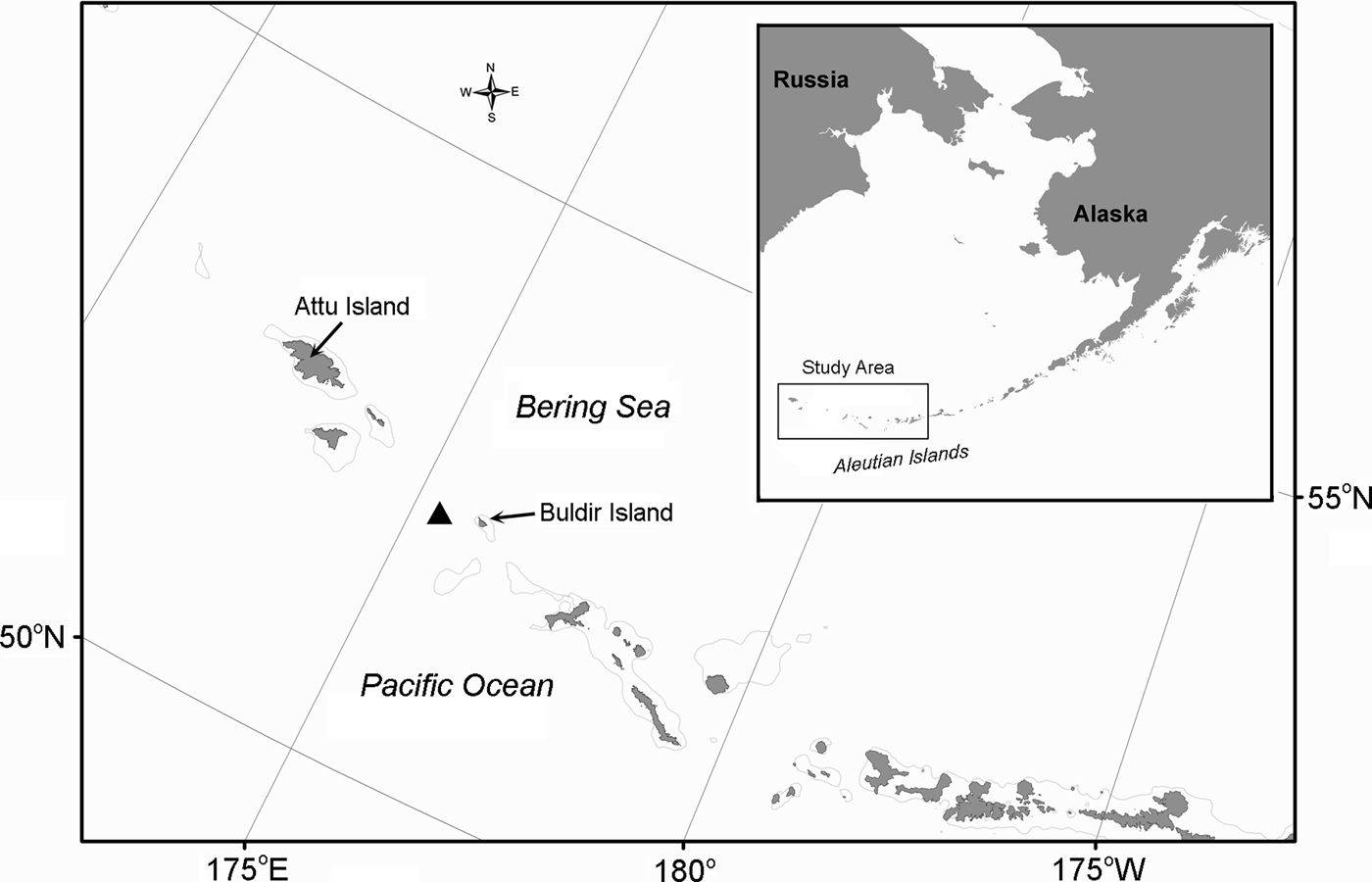
Specimens were collected with a research otter trawl during biennial fish stock assessment surveys in the Aleutian Islands (Figure 1). Two specimens were collected with the trawl at an approximate depth of 234 m on pebble and sand substrate. Sponges were kept frozen at –10°C until a small section was transferred to 90% ethanol for identification. Semi-thin sections obtained with a razor blade and spicules, obtained with the usual procedures, were embedded in Canada balsam and examined with light microscopy. For scanning electron microscopy (SEM) examination, spicules were mounted on a stub and sputtered with gold. The SEM investigations were made with a Leo 1430 VP.
Type locality (triangle) of Geodia starki sp. nov. in the western Aleutian Islands.

RESULTS
SYSTEMATICS
Phylum PORIFERA
Class DEMOSPONGIAE
Order ASTROPHORIDA Sollas, Reference Sollas1888
Family GEODIIDAE Gray, 1867
Genus Geodia Lamarck, 1815
Geodia starki sp. nov.
TYPE MATERIAL
The type material is deposited at the Zoologische Staatssammlung (ZSM) in Munich. The holotype (ZSM no. 20130013) is the smaller specimen, 260 × 205 × 110 mm. The paratype (ZSM no. 20130014) is the larger specimen, 290 × 205 × 97 mm. Both specimens were collected by Jim Stark on 26 July 2012 at 52°17.16′N 175°21.48′E, 34 km west-south-west of Buldir Island, western Aleutian Islands, at a depth of 234 m and a water temperature of 3.7°C.
DESCRIPTION
Large, massive sponge, 260–290 × 205 × 97–110 mm (Figure 2A, B). The colour is light-brown to creamy-white; the surface of the holotype is optically smooth and partially covered with a mat of long protruding spicules. Some of the spicule mat may have been lost during collection or possibly in situ. No oscules are visible; oscules and pores are hidden under a sieve of the cortex as is characteristic for the genus. Due to the relatively thick cortex the consistency is hard, almost incompressible and cracks if firmly pressed. The cortex is approximately 0.5 mm thick and consists of several layers of sterrasters with strongylo- and oxyspherasters in between. The outer surface of the cortex is covered by a single layer of the strongylospherasters. Dermal oxeas are often arranged perpendicularly and protrude above the surface. Spicules are long oxeas, 3.2–13.7 mm × 60–210 µm; abundant orthotriaenes (Figure 2C), rhabds up to 13.2 mm × 100–170 µm, clads 800–2000 µm in diameter; occasional plagiotrianes, which may have malformations (Figure 2G); rare anatriaenes with long, thin rhabds 4.3mm × 12–18 µm (Figure 2D), clads 190–230 µm in diameter. Possibly there are longer anatriaenes, but as these are rare and the rhabds are quite thin they are often broken in spicule preparations; extremely rare diaenes and orthomesotriaenes, both types only observed once, rhabds broken, clads in the dimensions of the anatriaenes; small dermal oxeas are 240–265 × 6–8 µm. There are two categories of sterrasters: larger, oval sterrasters, 126–145 × 165 × 203 µm (Figure 2E, F) and smaller, almost spherical sterrasters (Figure 2E, F, H), 98–105 × 110–115 µm; abundant strongylospherasters with spined rays, 8–20 µm, (Figure 2I, K), oxyasters with spined rays, 7–25 µm in diameter Figure 2K, L) and rare oxyasters with spined rays, 42–53 µm (Figure 2J), the latter observed only just below the cortex.
(A) Holotype, upper side, grid marks are 1 cm2; (B) holotype, bottom side, grid marks are 1 cm2; (C) orthotriaene; (D) anatriaene; (E) large and small sterrasters; (F) large sterraster (left) and small sterraster (right); (G) plagiotriaene with malformed rhabdome; (H) broken sterraster showing internal structure; (I) small dermal oxea on top of sterrasters; note several strongylospherasters also on sterrasters; (J) large and small category of oxyasters on top of sterraster; (K) two strongylospherasters with acanthose rays (right) and small category of oxyaster with acanthose rays; (L) small category of oxyaster.
ETYMOLOGY
We name the new species in honour of Jim Stark, NOAA research fisheries biologist and collector of the specimens, for his many years of diligence on fisheries research surveys in the Aleutian Islands.
DISCUSSION
According to existing literature and our investigations this is the only species of Geodia with two categories of sterrasters. Two Geodia have previously been reported from Alaska: G. agassizi Lendenfeld, Reference Lendenfeld1910 ranging from South-east Alaska to California and G. lendenfeldi Stone, Lehnert & Reiswig, Reference Stone, Lehnert and Reiswig2011 from the Aleutian Islands and South-east Alaska. We (Stone et al., Reference Stone, Lehnert and Reiswig2011) previously listed G. mesotriaena Lendenfeld, Reference Lendenfeld1910 as having been reported from the Gulf of Alaska because de Laubenfels (Reference Laubenfels1932, pp. 27–28) synonymized G. mesotriaena, G. agassizi, G. mesotrianella, G. breviana, G. ovis and Cydonium muelleri (Lambe, 1892). The World Porifera Database (2013) did not follow this synonymization and we concur with this view since there are obvious differences between the taxa. Accordingly G. mesotriaena is reported from California only. Geodia agassizi has shorter oxeas (2.1–4.8 mm × 57–93 µm), shorter orthoplagiotriaenes (1.5–4.2 mm × 50–150 µm) with smaller clads (250–560 µm), abundant mesoprotriaenes, only one category of sterrasters which are oval but of similar dimensions to the small round category of G. starki. Geodia lendenfeldi is a small cylindrical species with one category of oval sterrasters (170–200 × 130–140 µm) comparable to the large category of G. starki but without triaenes and with smaller oxeas.
In the following paragraphs we briefly compare the new species with 41 species of Geodia from outside Alaskan waters, providing the species name, author and year and the main differences from G. starki in parentheses. We compare the new species with Geodia reported from the Pacific coast of the United States and Canada south to Mexico, west to the Hawaiian Islands and the Sea of Japan. We also include species from the Bering Sea, Arctic Ocean and the North Atlantic Ocean south to the Azores. None of these species have two size-categories of sterrasters and in all cases the megascleres are considerably smaller, except the long anatriaenes of G. mesotriaena (discussed below). We consider these factors sufficient justification to erect the new species.
There are nine species of Geodia reported along the west coast of the United States from Washington to southern California: G. acanthylastra Lendenfeld, Reference Lendenfeld1910 (shorter oxeas and triaenes, mesoprotriaenes, smaller sterrasters); G. angulata Lendenfeld, Reference Lendenfeld1910 (shorter triaenes, smaller sterrasters); G. bicolor Lendenfeld, Reference Lendenfeld1910 (shorter oxeas and triaenes, larger oxyasters, no anatriaenes); G. breviana Lendenfeld, Reference Lendenfeld1910 (shorter oxeas and triaenes, mesoprotriaenes, dermal anaclades (Lendenfeld used ‘anaclades’, p. 159, pl. 36, figs 1–9, for small, dermal spicules which occur as anatriaenes, anadiaenes or anamonaenes), smaller sterrasters); G. californica Lendenfeld, Reference Lendenfeld1910 (shorter oxeas and triaenes, smaller sterrasters); G. isabella (Dickinson, Reference Dickinson1945) (smaller oxeas, large oxyspherasters, tylostyles, smaller sterrasters); G. mesotrianella Lendenfeld, Reference Lendenfeld1910 (long but, still shorter oxeas and triaenes, smaller sterrasters); G. ovis Lendenfeld, Reference Lendenfeld1910 (oxeas, ortho- and plagiotriaenes up to 8 mm long, smaller sterrasters, larger oxyasters); and G. mesotriaena Lendenfeld, Reference Lendenfeld1910 (smaller choanosomal oxeas, abundant mesotriaenes, smaller ortho/plagiotriaenes, longer anatriaenes which may reach 15 mm, and four categories of asters). Lendenfeld described the following for G. mesotriaena (p. 96): ‘Their spicule-fur is composed of large and conspicuous mesotriaenes’. Geodia starki has a comparable spicule-fur, but we found no mesotriaenes there. Geodia mesotriaena is described as cone-shaped and smaller than G. starki and G. mesotriaena has a surface with depressions and ‘gyrus-shaped ridges’ (p. 97) in between, quite different from the relatively even surface of G. starki.
A single species is reported from Hawaii: G. gibberella de Laubenfels, Reference de Laubenfels1951 (small species with a diameter of little more than one cm, much smaller sterrasters, smaller oxyasters and oxyspherasters, no strongylospherasters).
Fourteen species are known from Japan and Korea: G. amadaiba Tanita & Hoshino, Reference Tanita and Hoshino1989 (shorter oxeas, dichotriaenes, larger sterrasters); G. cylindrica Thiele, Reference Thiele1898 (shorter oxeas, sterraster of similar size to large category of G. starki, pycnasters); G. exigua Thiele, Reference Thiele1898 (shorter oxeas, smaller sterrasters); G. hilgendorfi Thiele, Reference Thiele1898 (smaller oxeas, mesoprotriaenes, smaller sterrasters); G. hyotania (Tanita, Reference Tanita1965) (smaller oxeas, no strongylospherasters); G. japonica Sollas, Reference Sollas1888 (type specimen examined by Lendenfeld Reference Lendenfeld1910, p. 79: smaller oxeas, smaller sterrasters); G. obscura (Thiele, Reference Thiele1898) (shorter oxeas and plagiotriaenes, smaller sterrasters); G. orthomesotriaena Lebwohl, Reference Lebwohl1914 (oxeas up to 4.8 mm, dichotriaenes, promesotriaenes, orthomesotriaenes, smaller strongylasters, larger oxyasters); G. reniformis Thiele, Reference Thiele1898 (larger oxyasters, pycnasters 5 µm in diameter); G. reniformis var. robusta (promesotriaenes); G. strongyla Hoshino, Reference Hoshino1981 (shorter triaenes, no strongylasters); G. ulleungensis Sim & Kang, Reference Sim and Kang2004 (shorter oxeas and triaenes); G. variospiculosa Thiele, Reference Thiele1898 (shorter oxeas, mesoprotriaenes, smaller sterrasters, much larger oxyasters, pycnasters, 6–8 µm in diameter); and G. velata Lebwohl, Reference Lebwohl1914 (shorter oxeas and triaenes, styles, smaller sterrasters).
Seventeen species are reported from the Arctic and North Atlantic Oceans: G. atlantica (Stephens, Reference Stephens1915) (shorter triaenes, oxyspherasters 5–20 µm in diameter); G. barretti Bowerbank, Reference Bowerbank1858 (shorter triaenes, smaller sterrasters, smaller spherasters, no strongylospherasters); G. cydonium (Jameson, Reference Jameson1811) (shorter oxeas and triaenes, smaller sterrasters); G. divaricans Topsent, Reference Topsent1928 (shorter oxeas, dichotriaenes, smaller sterrasters); G. echinastrella Topsent, Reference Topsent1904 (smaller sterrasters, oxyspherasters, lengths of oxeas and orthotriaenes not given); G. hentscheli Cardenas et al., Reference Cárdenas, Rapp, Schander and Tendal2010 (promesotriaenes, dichotriaenes, smaller sterrasters); G. macandrewii Bowerbank, Reference Bowerbank1858 (according to Sollas, Reference Sollas1888, p. 265: larger spherical sterrasters up to 270 µm in diameter); G. megastrella Carter, Reference Carter1876 (shorter oxeas and triaenes, large sterrasters spherical, 170–190 µm in diameter); G. nodastrella Carter, Reference Carter1876 (smaller spherical sterrasters); G. normani (Sollas, Reference Sollas1888) (larger spherical sterrasters, up to 320 µm in diameter); G. pachydermata (Sollas, 1886) (shorter oxeas and triaenes, larger oval sterrasters, larger oxyasters to 64 µm per ray, oxyspherasters to 35 µm, sperasters 14 µm); G. pergamentacea Schmidt, Reference Schmidt1870 (unrecognizable in our opinion, Schmidt gives no description or measurements of occurring spicules, although his ‘parchment-like cortex, 0.25 mm’ differs from our species); G. phlegraei Sollas, Reference Sollas1880 (Sollas describes ‘globates, 0.0036 inch in diameter’ which we translate into spherical sterrasters, 91.4 µm in diameter); G. ramosa (Topsent, Reference Topsent1928) (shorter oxeas, smaller sterrasters); G. simplex Schmidt, Reference Schmidt1870 (again Schmidt's description is unrecognizable but according to Hentschel, Reference Hentschel, Römer, Schaudinn, Brauer and Arndt1929, it has shorter oxeas and smaller sterrasters to 70 µm in diameter); G. simplicissima Burton, Reference Burton1931 (smaller oxeas and triaenes, smaller sterrasters, pycnasters 4 µm in diameter); G. spherastrella Topsent, Reference Topsent1904 (oval sterrasters of similar size to the small category in G. starki, dimensions of oxeas and triaenes not given, no anatriaenes).
ACKNOWLEDGEMENTS
We thank Jim Stark and the crew of the FV ‘Ocean Explorer’ for collecting the specimens. Many thanks to the Zoologische Staatssammlung, München for providing access to the SEM, and special thanks to Enrico Schwabe for help operating the SEM. We thank two anonymous referees for their positive comments.
FINANCIAL SUPPORT
David Drumm was supported by the North Pacific Research Board (Grant number 1016) and the Joint Institute for the Study of Atmosphere and Ocean, University of Washington, Seattle. Helmut Lehnert was supported by a contract from the Alaska Fisheries Science Center of NOAA/NMFS.