

1. Introduction
The question of whether immigrants affect the labor market prospects of natives is one of the central issues in labor economics.Footnote 1 The competitive labor market model with homogenous labor suggests that immigration inflows depress native wages and also cause the displacement of native workers, at least in the short run. However, in an economy where labor is not qualitatively identical, which is a more realistic assumption, the immigration effects depend on the substitutability between natives and immigrants in terms of production. Immigration will lead to a decrease in the marginal product and wages of native workers in cases where natives and immigrants are substitutable, yet native workers who are complements for immigrants will enjoy beneficial effects. Assume that immigrant workers are low-skilled in general, then immigration will negatively affect the labor market outcome of low-skilled natives and raise the wages and employment levels of high-skilled natives, contributing to relative wage inequality. On the other hand, if the inflow of immigrants is “skill-balanced” — one with the same skill distribution as the existing native labor force — immigration will not change the relative wage structure [Card (Reference Card2009)].
In the South Korean context, immigrants have been most heavily concentrated in low-skilled sectors. The number of foreign residents in South Korea is increasing sharply, from 0.3 million in 1998 to 2.5 million in 2019. Among that, a sizable number of immigrants have come with temporary low-skilled work visas who have been recruited to solve a labor shortage for low-skilled jobs. Low-skilled immigrants are generally viewed as competing with low-skilled native workers, and it has stirred public debate about whether immigration has harmed the labor market outcomes of low-skilled native workers. However, the existing empirical literature on the labor market effects of immigration in South Korea is relatively scarce since a lack of reliable microdata concerning immigrants has limited any rigorous analysis. We use a richer version of the nationally-representative labor force survey for immigrants, thus allowing us to provide reliable empirical evidence about the effects of immigration.
This paper investigates the impact of immigration in South Korea and how it varies across education levels. Though numerous studies employ the spatial approach to estimate the immigration effect, we use a national skill-cell approach by Borjas (Reference Borjas2003). It slices the national labor market into education and experience cells and produces the descriptive correlations between immigrant inflows and native labor market outcomes. We do this because of the relatively small scale of South Korea. Moreover, most immigrants in the South Korean labor market are adult migrants who have completed their education in the home country before migrating. Thus, it is least likely that immigrants choose a particular skill group in which economic benefits are the best. This strategy also mitigates the possibility of compensatory native in-migration flows. Indeed, it is impossible for natives to change their skill mix by becoming younger or older, and it is hard and costly to obtain additional education to avoid competition with immigrants in the same skill group.
We place native and immigrant workers into education-experience cells and exploit the variation in the inflows of immigrants across skill groups. Then we examine how the immigration inflows in particular skill groups are associated with the labor market outcomes of native workers. Our results add to the literature by providing non-U.S. and non-European evidence, given that South Korea has a fast-growing immigrant population and a continued demand for a foreign workforce.
The data source we used is the Survey on Immigrant's Living Conditions and Labour Force (SILC-LF) merged with the Local Area Labour Force Survey (LALFS) for the years from 2012 to 2019. The first is a labor force survey of immigrants, and the latter is for native workers. Since we exploit yearly variation, our estimates can be interpreted as the short-run effects of immigration. The regression results for the entire sample indicate that immigration has no adverse impact on overall native wages and employment. Results on different effects by educational groups reveal that wage-depressing effects are pronounced for high school dropouts, but the impacts for college graduates are positive. Specifically, there was a 0.2 pp decrease in the wage growth rate for high school dropouts and a 1.1 pp increase for college graduates for every 1 pp increase in the share of immigrants. The results might be due to the greater overlap between the occupations that high school dropout native workers and immigrant workers have, whereas college graduate natives and immigrants are dissimilar in occupational distributions. Also, high school dropout immigrants catch-up the earnings of their native counterparts only after six months in South Korea, college-educated immigrants experience much a slower assimilation. In other words, low-educated natives and immigrants are more substitutable than are highly educated natives and immigrants. Our results are not sensitive to various specifications or sample definitions.
The rest of this paper is structured as follows. In the next section, we review some literature regarding the impact of immigration on the host labor market. Section 3 presents the contextual information and institutional background of immigration in South Korea. In section 4, we introduce the data and methodology we employ. Descriptive statistics, empirical results, and discussion are in section 5. We conclude in section 6.
2. Literature review
Until the 1990s, most researchers exploited geographical variations to estimate the labor markets of immigration. Most cross-region analyses of the labor market effects of immigration show that the estimated coefficient indicating the sensitivity of native wages to an increase in immigrants in a given local labor market was closely clustered around zero [Altonji and Card (Reference Altonji, Card, Abowd and Freeman1991); Friedberg (Reference Friedberg2001); Dustmann et al. (Reference Dustmann, Fabbri and Preston2005); Card and Lewis (Reference Card, Lewis and Borjas2007); Card (Reference Card2009); Basso and Peri (Reference Basso and Peri2015)]. At least two problems are widely recognized with this spatial approach: endogenous immigrant penetration across local markets and native internal responses. The first problem arises since immigrants tend to cluster in cities where the economic prospects are promising, and it would generate a spurious positive correlation between immigration and local outcomes. Next, the initial adverse effects of immigration would dissipate if natives were to react to an immigrant inflow by moving their labor or capital across regions.
A skill-cell approach at the national level, pioneered by Borjas (Reference Borjas2003), can avoid these problems by examining how native wages and employment in a particular skill group (based on education and potential experience) are affected by the immigration penetration into that group. Borjas (Reference Borjas2003) finds a significant and sizable negative immigration effect on native wages in the U.S., and since then, several papers have replicated Borjas' study using alternative samples in other countries. The results are mixed. Some studies suggest that immigration has a detrimental effect on native wages [Bonin (Reference Bonin2005); Aydemir and Borjas (Reference Aydemir and Borjas2007)], but other studies find insignificant impacts [Carrasco et al. (Reference Carrasco, Jimeno and Ortega2008); Breunig et al. (Reference Breunig, Deutscher and To2017)]. Ortega and Verdugo (Reference Ortega and Verdugo2014), using French data, report that the increase in immigrant share raises native wages. The lack of consensus can be accounted for by the differences in sample selection, data structure, specification, and institutional settings across studies.
The important assumption in the skill-cell approach is that immigrants and natives of similar education and experience are substitutable, but the substitutability of natives and immigrants is a controversial issue. Using a structural approach, Brücker and Jahn (Reference Brücker and Jahn2011) for Norway, Manacorda et al. (Reference Manacorda, Manning and Wadsworth2012) for the U.K., and Ottaviano and Peri (Reference Ottaviano and Peri2012) for the U.S. provide evidence suggesting imperfect substitutability between natives and immigrants within skill groups. Peri and Sparber (Reference Peri and Sparber2009) support these findings by providing evidence for different comparative advantages in production tasks between natives and immigrants with similar human capital characteristics. Nevertheless, Borjas et al. (Reference Borjas, Grogger and Hanson2012) and Borjas (Reference Borjas2014) argue these findings are sensitive to assumptions and specifications; thus, one cannot reject that immigrants and natives are perfect substitutes. Steinhardt (Reference Steinhardt2011) and Smith (Reference Smith2012) examine the degree of substitutability using statistics on occupational or industrial clustering. Steinhardt (Reference Steinhardt2011) highlights that German natives and immigrants are employed in different occupations within the same skill groups; thus, they are likely to be imperfect substitutes, and the classical skill-cell approach by Borjas (Reference Borjas2003) might generate biased estimates. Smith (Reference Smith2012) shows that young native workers are more likely to work in the same industry-occupations as less-educated immigrants than adult native workers and demonstrates how immigration inflows have an adverse effect on employment for native youths rather than for native adults.
The first empirical research into the labor market effect using a skill-cell approach for South Korea is conducted by Choi (Reference Choi2012), which finds that immigration does not affect native wages but reduces employment by a huge magnitude. However, these results rely on an unrealistic assumption due to data limitations. He uses the 2010 Population Census as a sample for immigrants and assumes the immigrants' share is zero in 2000, the base year. Our paper offers more rigorous evidence on the effects of immigration in South Korea using richer and more recent data and further demonstrates how heterogeneous the impact of immigration is across education groups.
3. Immigration to South Korea
According to the Immigration Service, the number of the foreign population is 2.5 million, and the foreigner's share in the total population is 4.9% in 2019.Footnote 2 The number of foreigners with visas allowing to stay for more than 90 days accounts for about 69% of all foreign residents. Korean-Chinese is the main group of foreigners who emigrated to China in the first half of the 20th century and their descendants; most of Korean-Chinese can speak South Korean. Excluding this group, a large fraction of foreigners is Chinese nationals and Southeast Asians.Footnote 3
The foreign population comprises primarily short-term labor migrants and long-term residents. Work visas are divided into low-skilled and mid-to-high skilled. Two types of low-skilled work permits are issued through Employment Permit System (EPS), which is explained in detail later. These are Non-professional Employment (E-9) for Chinese nationals, Southeast and Central Asians, and Working Visit (H-2) for Ethnic South Korean. The proportion of foreigners with these two low-skilled work visas is approximately 28% in 2019. The maximum stay is three years for E-9 or H-2 holders, but if an employer wants to provide reemployment and a foreign worker also wishes to remain in South Korea, the period of stay can be extended by one year and ten months. Skilled workers (E-1–E-7) comprised only 2.5% of long-term foreign residents and can indefinitely renew their visas. The number of long-term visas (F visa) holders has been growing and accounted for 43% of foreigners in 2019. Specifically, one-quarter of the foreigners are Overseas South Korean (F-4), many of whom are South Korean-Chinese.Footnote 4 Permanent Residents (F-5) and Marriage migrants (F-6), and Residents (F-2) accounted for 8.4%, 7.2%, and 4.4% respectively.
The temporary labor migration program for low-skilled workers, EPS, was introduced in the early 2000s. The purpose of this program is to ease the low-skilled labor shortage in small and medium-sized enterprises for a few sectors such as manufacturing, construction, services, and agriculture.Footnote 5 The workers admitted through EPS are subject to restrictions on their employment in selected sectors. The recruitment process for E-9 visa is based on bilateral agreements between the Ministry of Employment and Labor and 16 sending countries: Bangladesh, Cambodia, China, East Timor, Indonesia, Kyrgyzstan, Mongolia, Myanmar, Nepal, Pakistan, Sri Lanka, Thailand, the Philippines, Uzbekistan and Vietnam, and PDR Laos. Overseas South Koreans with relatives who are South Korean nationals or listed in the South Korean family register can apply for H-2 visas. To be eligible for the EPS, employers must prove that they had posted a job offer and that the position has not been filled after a mandatory advertising period. The visa program for E-9 and H-2 take slightly different forms. The annual inflows of E-9 visa holders are controlled by a fixed admission quota, and E-9 workers are expected to stay with their initial employer unless they are subject to illegal employment practices or firm closure.Footnote 6 On the other hand, H-2 workers do not face quota restrictions and job mobility constraints.
4. Data and empirical framework
The data source is the SILC-LF, a nationally representative sample of immigrants, merged with the Local Area Labor Force Survey (LALFS), the microdata for native workers, for the years from 2012 to 2019. The target population for the two surveys is those aged over 15 (and who have stayed in South Korea longer than 90 days, in the case of immigrants).Footnote 7 The SILC-LF and LALFS contain information on labor market-related and socio-demographic characteristics. It is known that a tiny portion of immigrants is included in the LALFS sample but that the immigrant share is not identified in the dataset. Given that the immigration effect on immigrant wages and employment is negative, our estimates of native labor market outcomes would be in the lower bound of the true effect.
The main sample used is male full-time workers aged 18–64.Footnote 8, Footnote 9 We sort workers into three distinct educational groups (high school dropouts, high school graduates, and college graduates) and eight potential experience groups (1–5 years of experience, 6–10, 11–15, 16–20, 21–25, 26–30, 31–35, and 36–40).Footnote 10 Potential experience is calculated as age–schooling year–6. We further restrict our sample to individuals with between one and 40 years of experience. We calculate the labor supply by multiplying the hours of worked for each worker by the personal weight and aggregating them within each education-experience cell. This measure, the total number of working hours in a cell, is the basic measure of total labor supply.
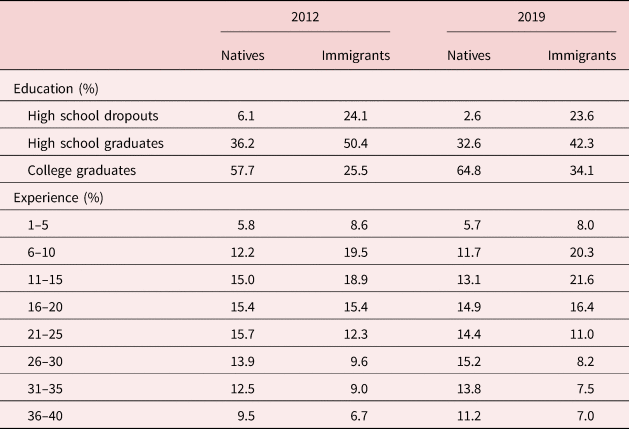
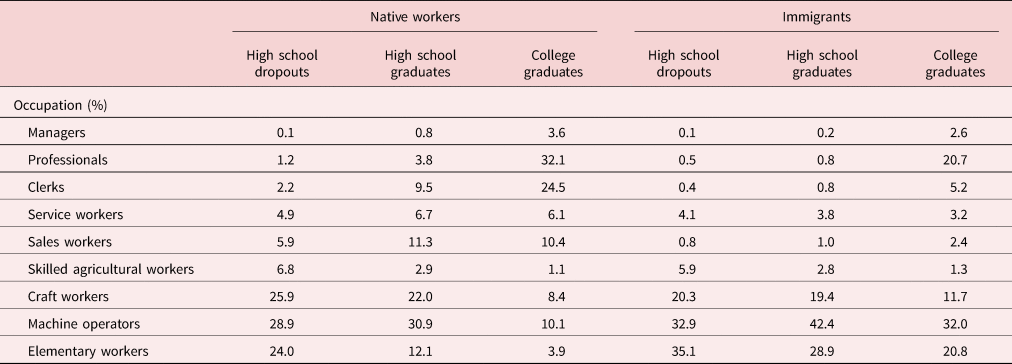
Table 1 shows the distribution of educational attainment and experience for native and immigrant workers. On average, immigrants are less educated and younger. Despite the rise in educational attainment between 2012 and 2019 for immigrants, only about one-third of immigrants are college graduates in 2019, whereas the figure for native workers is just under two-thirds (65%). Immigration is not balanced evenly across all age groups but concentrated in the lower years of experience. The occupational distribution for natives and immigrants is presented in Table 2. High school dropout natives are more likely to be employed in low-skilled jobs commonly held by high school dropout immigrants. However, college-educated natives are less likely to work in the same occupation as college-educated immigrants. Native workers are primarily employed as professionals, clerks, and sales workers, while approximately 65% of immigrants are craft workers, machine operators, or elementary workers.
Education and experience of natives and immigrants

Source: Author calculations, 2012 and 2019.
Note: Listed are the share of full-time male native and immigrant workers aged 18–64 in each education-experience group for the years 2012 and 2019.
Occupational distribution of natives and immigrants

Source: Author calculations, 2012–2019.
Note: Listed are the average share of full-time male native and immigrant workers aged 18–64 in each occupation group in years 2012–2019 pooled.
Immigration inflows experienced by native workers with education e and experience x at year t can be measured by m ext:

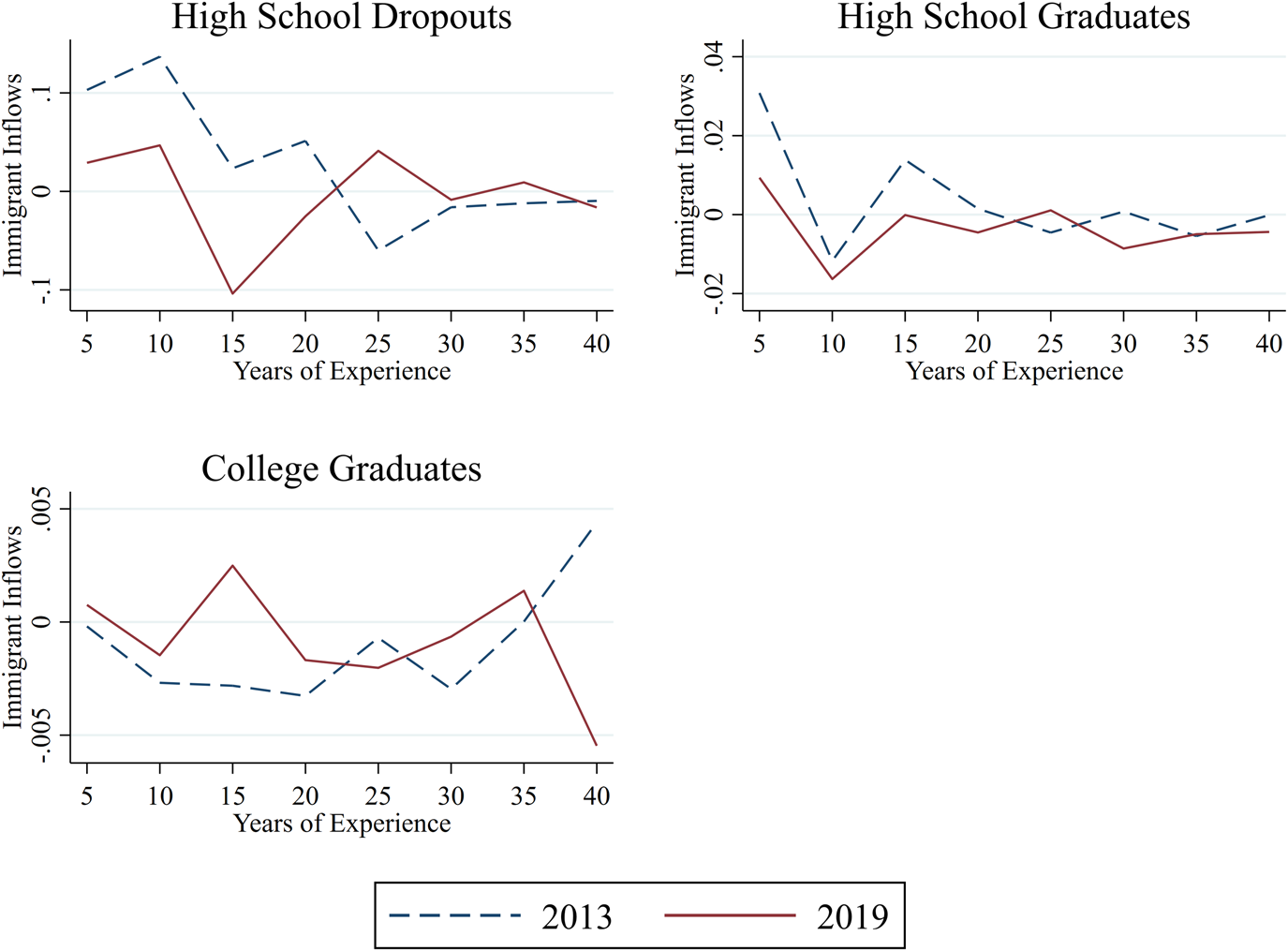
where M ext and N ext, respectively, represent the numbers of hours worked by immigrants and natives in the skill cell (e,x,t). Figure 1 displays the immigrant inflows by education groups for 2013 and 2019.Footnote 11 There is certainly substantial variation across skill groups to find out how immigrant inflows affect native labor outcomes. Remarkably, the inflows are more dispersed within the least-educated, from a 15 pp increase to a 10 pp decrease, in stark contrast to the relatively much less fluctuation seen among the college-educated. Also, it is observed that the influx of immigrants with fewer years of experience is made up mostly of high school dropouts and graduates.
Immigrant inflows by skill group.
Source: Author calculations, 2013 and 2019.
Note: Values on the vertical axis are the male immigrant inflows, which is the change in the hours worked by immigrant workers in an education-experience group from t–1 and t, standardized by the total hours worked in the corresponding group in t–1.

We run the regression for the entire sample and separately for the three education groups. The empirical analysis estimates the following regression model:

where Δy ext is the change in the mean of log monthly wages, mean of log hourly wages, numbers of hours worked (standardized by total hours worked) by native workers in the (e,x,t) cell, and m ext is the immigrant inflow.Footnote 12, Footnote 13 φFE is the education, experience, and time fixed effects, as well as the interaction between education and time fixed effects, experience and time fixed effects, and education and experience fixed effects for the entire sample. Fixed effects help control for any systematic differences in growth in labor market outcomes across skill groups and time. The regression for subsample analyses includes the experience and time fixed effects. Also, time-invariant factors that affect the level of variables are accounted for because we use first-differenced variables. εext is a zero-mean random error term.
In Borjas (Reference Borjas2003) and other replication studies, the share of immigrants, the fraction of immigrants in a particular skill group, is preferred as an explanatory variable, but this specification can be biased due to endogenous native flows. Even worse, if the dependent variable is native employment, it forces an artificial negative correlation between the dependent and explanatory variables [Peri and Sparber (Reference Peri and Sparber2011); Card and Peri (Reference Card and Peri2016)]. Thus, we follow Card and Peri's (Reference Card and Peri2016) specification where the explanatory variable is the immigrant inflows that would not generate a spurious correlation.
5. Empirical evidence
5.1 Results
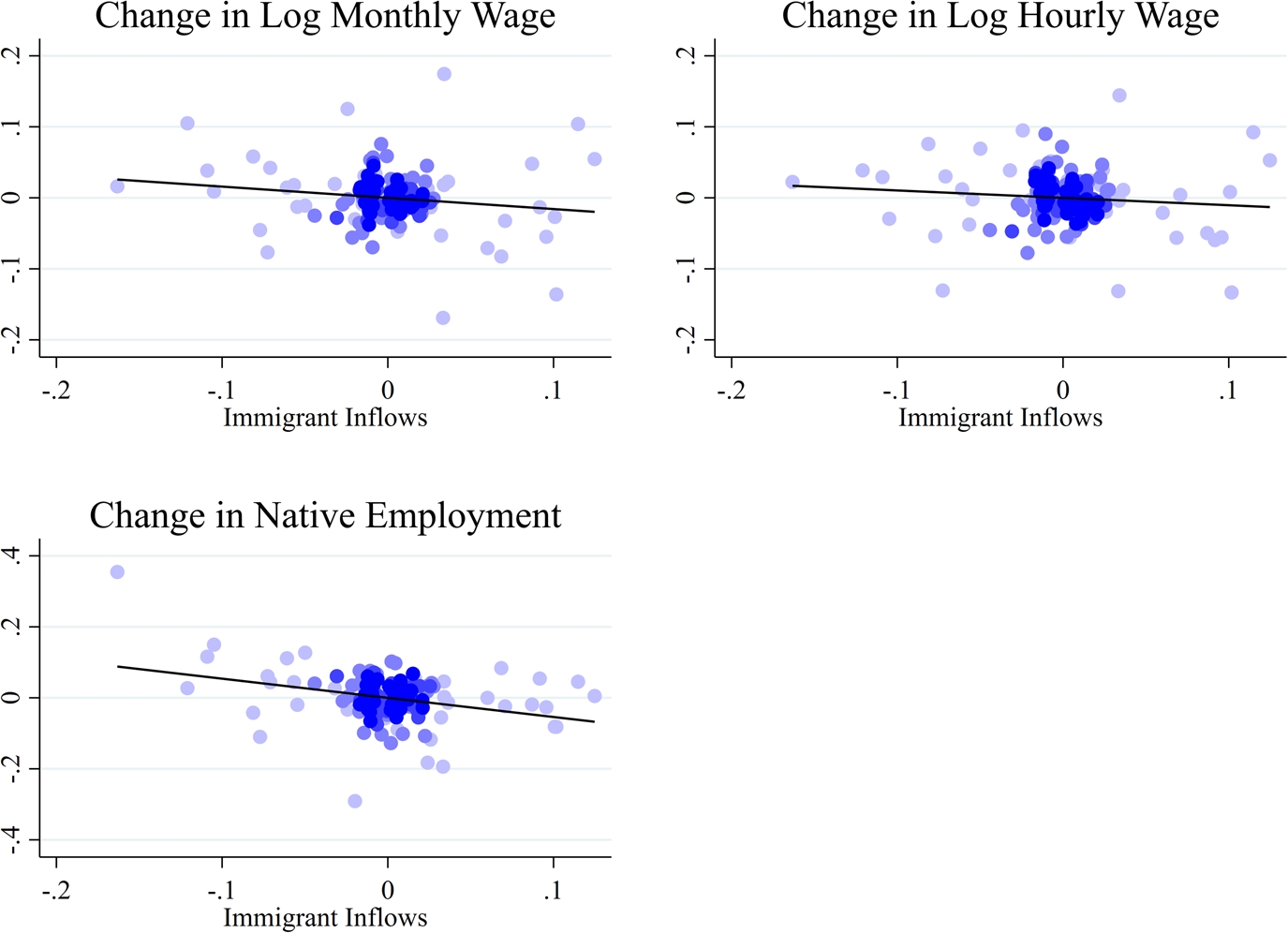
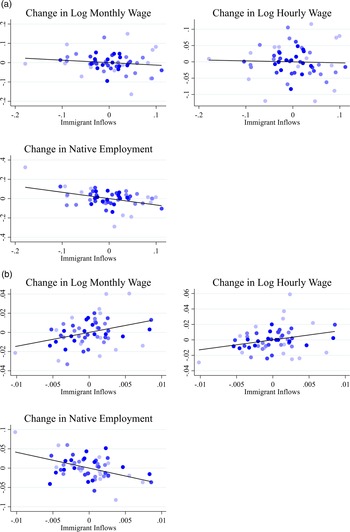
Figure 2 provides a preliminary look at the data about the relationship between changes in the labor market outcomes of native workers and immigrant inflows. The figure plots the residuals from the regression of the yearly change native labor market outcome on the vectors of education-experience fixed effects and survey year fixed effects, and the residual of the immigrant inflows on the same fixed effects. Each point represents an observation of an education-experience cell, with dark shading of an individual point implying greater weight, defined as the total employment of a cell. At first, the figure illustrates the sufficient dispersion for identification again, and these do not appear to be driven by specific outliers. The scatter diagrams of changes in log monthly wages and log hourly wages and in the labor supply of natives vs. immigrant inflows from a simple ordinary least squares estimation provide negative correlations. Figure 3 shows the scatter plot separately for high school dropouts (panel A) and college graduates (panel B). They reveal that the wage effect is highly heterogeneous across education groups. There is a negative correlation between immigrant inflows and wages for the low-educated, but the opposite results appear for the highly educated.
Scatter plot relating native labor market outcome and immigrant inflows.
Source: Author calculations, 2013–2019.
Note: The figures plot the residuals from the regressions of the yearly change in male native labor market outcomes on vectors of education-experience fixed effects and survey year fixed effects, and the residual of the male immigrant inflows on the same fixed effects. The shading of an individual observation indicates the weight of a skill group defined as total employment, with dark shading of an individual point implying greater weight.

Scatter plots relating native labor market outcomes and immigrant inflows, restricted to high school dropouts or college graduates. (a) High school dropouts. (b) College graduates.
Source: Author calculations, 2013–2019.
Note: The figures plot the residuals from the regressions of the yearly change in male native labor market outcomes on vectors of education-experience fixed effects and survey year fixed effects, and the residual of the male immigrant inflows on the same fixed effects. The shading of an individual observation indicates the weight of a skill group defined as total employment, with dark shading of an individual point implying greater weight.

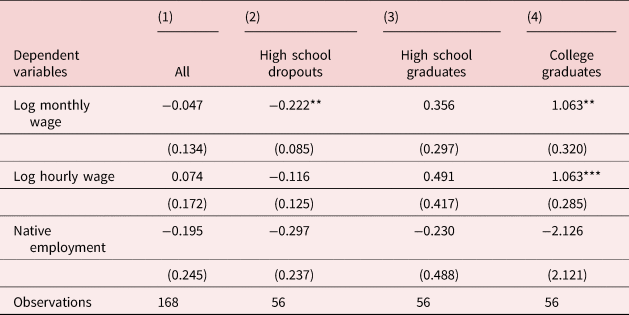
Table 3 reports the coefficient estimates of equation (2). We weight each skill cell by its total employment, and standard errors are adjusted for clustering within skill cells to account for the possibility of serial correlation. Negative wage and employment effects for the entire sample turn statistically insignificant after controlling a set of fixed effects. Columns 2–4 in Table 3 show the estimates when restricting the cells, including high school dropouts (column 2), high school graduates (column 3), and college graduates (column 4). Results for wage effects disaggregated by education groups are in line with the descriptive findings.Footnote 14 The estimate exhibits a negative sign for the low-educated. The point estimates in column 2 indicate that a monthly wage growth rate fall by about 0.2 pp sees a 1 pp increase in the immigrant share in a skill group. The coefficient on hourly wages for high school dropouts is not significant, albeit negative. On the other hand, immigrant inflows are found to be positively associated with wages for college graduates. The magnitude of coefficient estimates is larger than for the low-educated, showing a 1.1 pp increase in wage growth rates with a 1 pp increase in immigrant shares. Column 3 displays positive coefficients for the estimated wage effects for high school graduates, around one-third or half the size of the coefficients for college graduates. The effect sizes are not negligible but statistically insignificant, perhaps due to the small number of observations. The detrimental effects of immigration are concentrated among the least-educated native workers. Regarding employment effects, the insignificant effects are observed for all education groups.Footnote 15
Impact of immigrant inflows on native worker wages and employment

Source: Author calculations, 2013–2019.
Note: The table shows the coefficients of the male immigrant inflows from regressions where the dependent variables are the yearly change of log monthly wage, log hourly wage, and the number of hours supplied by male natives for the period from 2013 to 2019. The regressions reported in column 1 include the education, experience, and time fixed effects, as well as the interaction between education and time fixed effects, experience and time fixed effects, and education and experience fixed effects. The regressions reported in columns 2–4 include experience and the time fixed effects. Standard errors are reported in parentheses and are adjusted for clustering within education-experience cells (in column 1) and within experience cells (in columns 2–4).
*p < 0.1; **p < 0.05; ***p < 0.01.
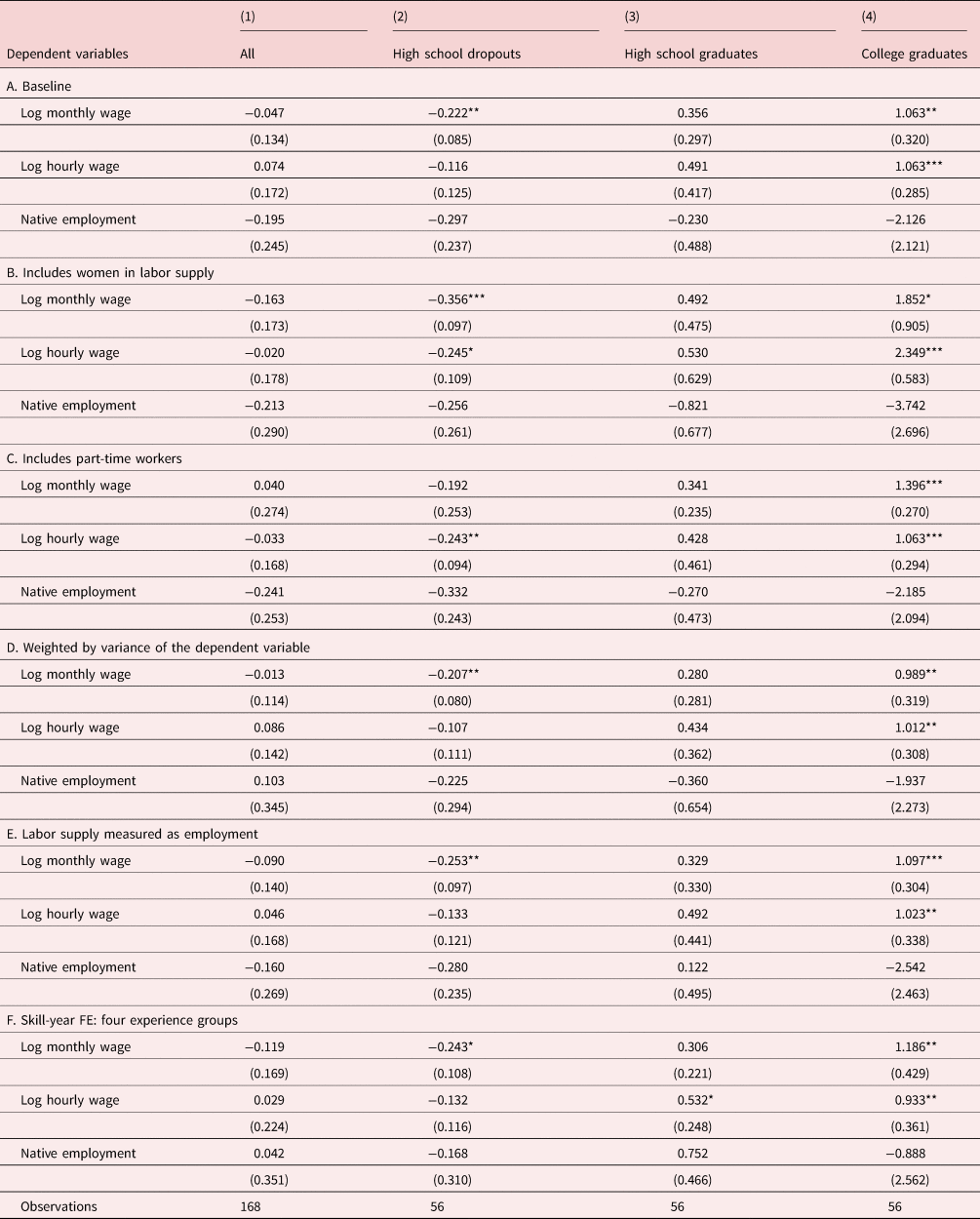
We also perform the robustness test to check the sensitivity of our main results. The results are shown in Table 4. First, we include both males and females when measuring the immigrant inflows. Women tend to have a more discontinuous career than men; thus, the classification into age-based experience cells may be inaccurate [Borjas (Reference Borjas2003); Ottaviano and Peri (Reference Ottaviano and Peri2012); National Academies of Sciences, Engineering, and Medicine (2017)]. Despite the imprecise classification of women, the results are similar, and coefficients are larger than baseline results. Second, data for part-time workers are included. They have weak labor market attachment, and their wages can introduce non-classical measurement errors [Ottaviano and Peri (Reference Ottaviano and Peri2012)]. When including part-time workers, the results are very much comparable to the main results. Third, we change the regression weights from total employment to the inverse of the sampling variance of the dependent variable [Borjas et al. (Reference Borjas, Grogger and Hanson2012)], and it yields qualitatively similar estimated coefficients. Fourth, we calculate the labor supply by summing up the count of employed people instead of hours worked in a cell. The results still show the negative wage effects for high school dropouts and positive effects for the college-educated. Last, given the possibility that the impact of demand shocks on the set of fixed effects do not perfectly absorb the impact of time-varying skill group-specific demand shocks, we additionally include interaction between education, time, and 10-year experience groups for the entire sample and interaction between time and 10-year experience groups for subsamples, following Ortega and Verdugo (Reference Ortega and Verdugo2014). Our results are robust to the inclusion of skill-year fixed effects, except for the positive wage effects for high school graduates. On the whole, the results are virtually robust to alternative sample selections and specifications.
Robustness checks

Source: Author calculations, 2013–2019.
Note: The table shows the coefficients of the immigrant inflows from regressions where the dependent variables are the yearly change of log monthly wage, the log hourly wage, and the number of hours supplied by male native workers for the period from 2013 to 2019. The regressions reported in column 1 include the education, experience, and time fixed effects, as well as the interaction between education and time fixed effects, experience and time fixed effects, and education and experience fixed effects. The regressions reported in columns 2–4 include the experience and time fixed effects. Standard errors are reported in parentheses and are adjusted for clustering within education-experience cells (in column 1) and within experience cells (in columns 2–4).
*p < 0.1; **p < 0.05; ***p < 0.01.
5.2 Discussion
The results presented in the previous subsection suggest that, overall, we found no impact on wages and employment. In the subgroup analysis, immigrants' inflows reduce the wages of the least-educated native workers, while they have a positive impact on the wages of the highly educated. This finding can be explained by the difference in the degree of substitutability between natives and immigrants across education groups. It seems that the substitutability of immigrants for natives is greater for the less-educated group.Footnote 16
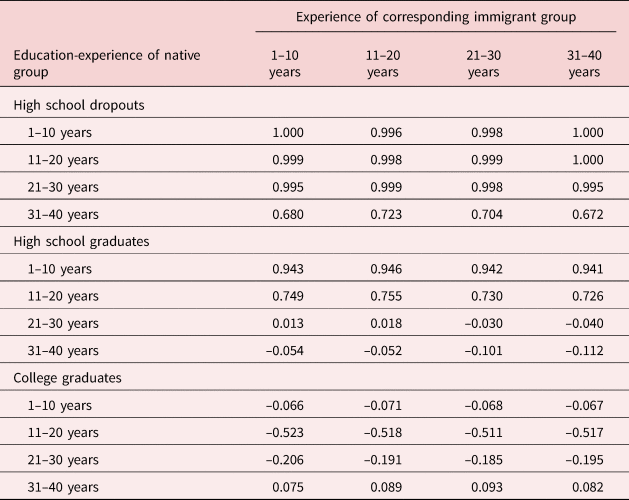
In order to investigate the similarity in occupational distribution between natives and immigrants, we use Welch's (Reference Welch1999) congruence index, defined by

where q no and q fo respectively give the share of natives and immigrants in occupation o (at the one-digit level), and $\overline {q_o}$ gives the share of workers in occupation o.Footnote 17 This index equals one if the occupational distributions of two groups completely overlap and minus one if natives and immigrants work in totally different occupations. We aggregate workers into 10-year experience intervals, instead of five-year intervals, to have sufficient observations in each occupation-education-experience cell. Table 5 presents the calculated congruence index using SILF-LC and LALFS for the years from 2012 to 2019. Remarkably, there are significant differences in congruence values across education groups. The indices for high school dropouts are close to one. In particular, consider workers with 30 years of experience or under. The congruence index is 0.998–0.100, suggesting the natives and immigrants have almost identical occupation distributions. In high school graduates, the similarity is high for young workers, whereas older groups have negative congruence values.Footnote 18 Lastly, it seems that college-educated natives and immigrants are clustered in different occupations, except for workers with 31–40 years of experience. This might be due to the fact that 53% of college educated immigrants come to South Korea with E-9 or H-2 visas, which makes them confined to blue-collar positions. In sum, it is inferred that substitution is easier with the least educated workers and this finding provides an important mechanism to explain the heterogeneous immigration effect by education level.
Congruence index

Source: Author calculations, 2013–2019.
Note: The table shows the index of congruence, and it is calculated separately for each education-experience pair of male native and immigrant workers.
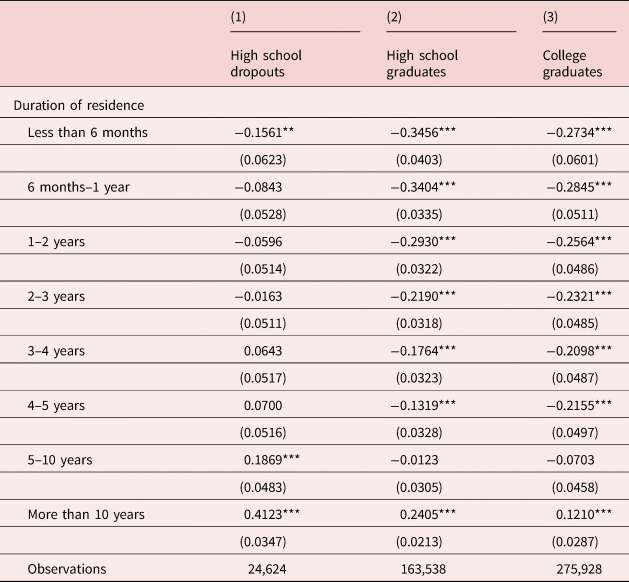
Next, we examine the native-migrant wage gap and assimilation within schooling groups.Footnote 19 As Table 6 shows, upon arrival, immigrants of all three education groups experience earning disadvantages due to lack of language proficiency and limited knowledge of the host country's customs. Moreover, the quality of education immigrants acquired in their country of origin may not be as high as that in South Korea.Footnote 20 However, it takes only six months for high school dropout immigrants to reach wage equality with high school dropout natives. The labor market performance of high school graduate and college graduate immigrants also improves as they acquire host country-specific skills with the time spent in South Korea. High school graduates show a relatively large initial wage gap, but immigrants' wages converge rapidly. On the contrary, we witness a slower assimilation for college graduate immigrants. After 5–10 years in South Korea, high school graduate immigrants earn 13.2%, and college graduates earn 21.5% less than their native counterparts. Eventually, immigrants with more than ten years of residence earn more wages than natives, with the least wage premium for college graduates. Note that less than 10% of immigrants stay in South Korea more than ten years, therefore only a few immigrants enjoy wage premium.Footnote 21
Assimilation patterns across education groups

Source: Author calculations, 2013–2019.
Note: Robust standard errors in parentheses, ***p < 0.01, **p < 0.05, *p < 0.1. The dependent variables give the log hourly wage for male immigrant workers. All regressions include controls for potential experience, interactions between immigrant dummy and potential experience, dummies for immigrant arrival cohort (before 2003, between 2003 and 2007, between 2008 and 2012, after 2012), survey year dummies.
The dual nature of the South Korean labor market can explain the different degrees of downgrading at arrival and subsequent assimilation by education level. In an economy with a segmented labor market, low-educated natives are more likely to be in the secondary market or blue-collar jobs where education is not very important, and lack of language proficiency is less of a barrier to employment, so it might be not difficult for low-educated immigrants to converge toward the wage distribution of low-educated natives. On the contrary, converging for high-educated immigrants toward the wage distribution of high-skilled natives, who are likely to work in the primary labor market or white-collar jobs, is undoubtedly challenging [Alcobendas and Rodríguez-Planas (Reference Alcobendas and Rodríguez-Planas2009)]. Moreover, the college graduate immigrants with E-9 or H-2 visas are recruited for work in the industries that need few skills and thus offer few possibilities for advancement. The limited job mobility for E-9 visa workers could suppress wage growth as well. The occupational congruence index and assimilation patterns again highlight that high school dropout immigrants and natives may be substituted for one another. College graduate immigrants may work in low salary jobs for quite a long time after migration and increase the productivity of their native counterparts by complementing their work.Footnote 22
6. Conclusion
This paper investigates how inflows of immigrants are associated with native labor market outcomes for the years from 2012 to 2019 by using the variation found in education-experience cells. Results reveal that wages and employment are unaffected by immigrant inflows, on average. We also estimate the regression within education groups to allow the immigration effect to vary and observe significant heterogeneity, with negative wage effects for the least educated and beneficial effects for the highly educated. Our results are shown to be robust to different sample selections and specifications.
We provide suggestive evidence of there being different degrees of substitution across education groups. We examine the degree of overlap between the occupational distribution for natives and immigrants and the speed of convergence of immigrants' earnings toward native workers within each education group. The least-educated immigrant workers are very likely to be employed in the same occupation as corresponding natives, but it is not the case for college-educated immigrants. Moreover, high school dropout immigrants catch up with the earnings of their native counterparts in a very short time. In contrast, the earnings of college-educated immigrants do not converge to those of corresponding natives until ten years after arrival.
Our regression estimates capture the direct own-group effects of immigration inflows on native worker wages and employment within a skill-cell, given that the labor supply in other skill cells is constant. However, the approach we employ omits the indirect cross-group effects. Immigration inflows can affect not only labor market outcomes of native workers with similar skills but also affect those of native workers with dissimilar skills. Therefore, future research is needed to identify the overall effect on native workers that aggregates the direct effect plus the cross-effects. One can simulate the wage effects using a structural approach or adopt the spatial approach with a credible instrument [Dustmann et al (Reference Dustmann, Schönberg and Stuhler2016)].
Acknowledgements
We thank Chulhee Lee, Dae-il Kim, Sok Chul Hong, Chang Won Lee, Jongkwan Lee, seminar participants at the 2019 AASLE conference and two anonymous referees for helpful comments. This research was supported by the BK21Plus Program of the Ministry of Education and National Research Foundation of Korea (NRF-21B20130000013). The views expressed in this paper are those of the author and cannot be taken to represent those of the Bank of Korea. All remaining errors are our own.