Introduction
In the growing body of research on childhood bilingualism, more and more evidence is emerging regarding how and to what extent a bilingual child's two linguistic systems interact. In the past, much research on bilingual language acquisition focused on the patterns of acquisition that set them apart as “atypical” in comparison to their monolingual counterparts, particularly to the point that their development was considered relatively “delayed” (for review, see Yavaş & Goldstein, Reference Yavaş and Goldstein1998). However, more recent research on childhood bilingualism shows evidence of rates and paths of acquisition of different linguistic constructs which are not only delayed, but also similar to, as well as advanced, in comparison to those of their monolingual peers (e.g., Fabiano-Smith & Barlow, Reference Fabiano-Smith and Barlow2010; Fabiano-Smith & Goldstein, Reference Fabiano-Smith and Goldstein2010a, Reference Fabiano-Smith and Goldsteinb; Gawlitzek-Maiwald & Tracy, Reference Gawlitzek-Maiwald and Tracy1996; Goldstein & Washington, Reference Goldstein and Washington2001; Goldstein, Fabiano & Washington, Reference Goldstein, Fabiano and Washington2005; Kehoe, Reference Kehoe2002; Kehoe, Trujillo & Lleó, Reference Kehoe, Trujillo, Lleó, Cantone and Hinzelin2001; Lleó, Kuchenbrandt, Kehoe & Trujillo, Reference Lleó2003; Padilla & Liebman, Reference Padilla and Liebman1975; Paradis, Reference Paradis2001; Paradis & Genesee, Reference Paradis and Genesee1996). These different acquisition paths have been attributed in part to language-specific variation in the patterning of linguistic structures which impact the relative age at which they are acquired, as well as the extent and type of errors that affect such structures during the course of acquisition (e.g., Locke, Reference Locke1983; Pye, Ingram & List, Reference Pye, Ingram, List, Nelson and Van Kleeck1987). In turn, this variation may manifest in the bilingual child's linguistic system in a facilitative or inhibitory manner. Specifically, Paradis and Genesee (Reference Paradis and Genesee1996) attribute delayed acquisition (or deceleration, per Fabiano-Smith & Goldstein, Reference Fabiano-Smith and Goldstein2010b) and acceleration (advanced acquisition) to the separate but interactive development of the child's two languages, which can slow or speed the acquisition of specific properties of the language relative to monolingual acquisition (Goldstein, Reference Goldstein2004; Hecht & Mulford, Reference Hecht and Mulford1982; Romaine, Reference Romaine1992; Weinreich, Reference Weinreich1953).
Interaction in bilingualism
Research thus far has indicated that interaction between bilingual children's two languages generally occurs with relatively low frequency (Fabiano & Goldstein, Reference Fabiano and Goldstein2005; Genesee, Reference Genesee1989; Genesee, Nicoladis & Paradis, Reference Genesee, Nicoladis and Paradis1995; Goldstein et al., Reference Goldstein, Fabiano and Washington2005; Meisel, Reference Meisel, Hyltenstam and Obler1989; Schnitzer & Krasinski, Reference Schnitzer and Krasinski1994). Higher levels of interaction have typically been attributed to dominance in one language over another or incomplete acquisition of one of the two languages (Fantini, Reference Fantini1985; Romaine, Reference Romaine1992; So & Leung, Reference So, Leung, Hua and Dodd2006; Verhoeven, Reference Verhoeven1994; Watson, Reference Watson and Bialystok1991; Yavaş & Goldstein, Reference Yavaş, Goldstein, Hua and Dodd2006). Moreover, the extent and areas of interaction are also dependent on the typological, lexical, and historical similarities between the bilingual's two languages (Döpke, Reference Döpke2000; Flege, Reference Flege and Strange1995, Reference Flege, Cole and Hualde2007; Flege, Schirru & MacKay, Reference Flege, Schirru and MacKay2003; Flege, Yeni-Komshian & Liu, Reference Flege, Yeni-Komshian and Liu1999; MacWhinney, Reference MacWhinney, Kroll and De Groot2004).
A current challenge in the field is predicting which aspects of the bilingual child's two linguistic systems will be more likely to interact with one another, and how that interaction might present itself (e.g., as deceleration or acceleration). It has been suggested that interaction will occur most in areas of the two languages that are similar to one another or shared between the two languages (e.g., Döpke, Reference Döpke2000; Flege, Reference Flege and Strange1995, Reference Flege, Cole and Hualde2007; Flege et al., Reference Flege, Schirru and MacKay2003; Flege et al., Reference Flege, Yeni-Komshian and Liu1999; MacWhinney, Reference MacWhinney, Kroll and De Groot2004). Speech acquisition specifically may be affected by multiple domains, including language skills, which act as a catalyst, accelerating the emergence of new sounds, or as a constraint, causing speech development to slow or even plateau (Green & Nip, Reference Green, Nip, Maassen and Van Lieshout2010). A number of different theoretical models have been proposed to account for the interaction between an individual's two sound systems, whether acquired simultaneously or sequentially (Best, Reference Best and Strange1995; Brown, Reference Brown1998; Escudero, Reference Escudero and Pennington2007; Escudero & Boersma, Reference Escudero and Boersma2004; Flege, Reference Flege and Strange1995; Kuhl, Reference Kuhl1991; Major, Reference Major2001). (See also Escudero, Reference Escudero and Pennington2007, for a review.)
Interaction is attributed to copied, shared, overlapping, or intersecting representational units and/or grammars for the L1 and L2 (e.g., Cook, Reference Cook and Cook2002; Escudero, Reference Escudero and Pennington2007; Major, Reference Major2001). For instance, according to Flege's Speech Learning Model (SLM; Flege, Reference Flege and Strange1995, Reference Flege, Cole and Hualde2007), a bilingual's two languages share a “common phonological space”, and because of this, they will interact with one another throughout the lifespan, no matter the age at which the second language (L2) is acquired. Evidence for this interaction has come primarily from acoustic measures of speech production, such as voice onset time (VOT) or durational and spectral properties of vowels, to name just two examples (e.g., Fabiano-Smith & Bunta, Reference Fabiano-Smith and Bunta2012; Flege, Reference Flege1987; Flege et al., Reference Flege, Schirru and MacKay2003; Johnson & Wilson, Reference Johnson and Wilson2002; Kehoe, Reference Kehoe2002; Kehoe, Lleó & Rakow, Reference Kehoe, Lleó and Rakow2004; Mack, Reference Mack1982, Reference Mack1984; MacLeod & Stoel-Gammon, Reference MacLeod and Stoel-Gammon2010; Menke, Reference Menke2010; Riney & Okamura, Reference Riney and Okamura1999; Thornburgh & Ryalls, Reference Thornburgh and Ryalls1998). (See also Flege, Reference Flege, Cole and Hualde2007, for a review.)
A variety of explanations have been offered to account for this interaction (Best, Reference Best and Strange1995; Brown, Reference Brown1998; Escudero, Reference Escudero and Pennington2007; Escudero & Boersma, Reference Escudero and Boersma2004; Flege, Reference Flege and Strange1995; Kuhl, Reference Kuhl1991; Major, Reference Major2001), and perception is generally assumed to play an important role. Accordingly, L2 sounds are mapped to those sounds (or, more specifically, positional allophones) of the L1 that are similar to those segments of the L2 input, in some cases hindering the acquisition of new phonemic contrasts (Flege, Reference Flege and Strange1995). For example, under the SLM, interaction between sound systems manifests itself via assimilation or dissimilation (Flege, Reference Flege and Strange1995). With assimilation, a phonetic category (allophone) of the L2 may be perceived as phonetically equivalent to an existing category in the first language (L1). This equivalence classification (Flege, Reference Flege1980, Reference Flege1987; Flege & Port, Reference Flege and Port1981) may prevent the new L2 category from being formed, and instead the two categories will be “merged” into one, a process referred to as category assimilation (Flege, Reference Flege, Cole and Hualde2007). Over time, additional input in both languages may lead to perceptual reorganization of the two sound systems, and productions of the L1 and L2 sounds may become more distinct from one another. The bilingual may phonetically approximate the two sound categories of the respective languages; nevertheless, they may not achieve monolingual-like productions, and instead will produce sounds that are intermediate in the phonological space to those of the monolingual norm (Flege, Reference Flege1987, Reference Flege, Cole and Hualde2007). With dissimilation, a new phonetic category (allophone) from the L2 will be established but, due to its phonetic similarity to an existing L1 phonetic category, the two categories will dissimilate from one another in order to prevent “crowding” of the phonetic space (Flege, Reference Flege, Cole and Hualde2007). Generally speaking, the closer two phonetic categories are to one another in the phonological space, the more likely they are to assimilate. In contrast, the greater the distance between two similar categories, the more likely a new category will be established for the L2 sound, which will, in turn, become further distinct from the phonetically similar L1 category (Flege, Reference Flege, Cole and Hualde2007).
Per the SLM, interaction is bidirectional, though the extent to which one language (e.g., L1) influences the other (L2) is determined in part by the amount and type of input and output in each language, as well as the age of acquisition of the L2 (Baker & Trofimovich, Reference Baker and Trofimovich2005; Fabiano-Smith & Goldstein, Reference Fabiano-Smith and Goldstein2010b; Flege, Reference Flege1991; Flege, Munro & MacKay, Reference Flege, Munro and MacKay1995; Flege et al., Reference Flege, Yeni-Komshian and Liu1999; Lee & Iverson, Reference Lee and Iverson2012). For instance, L1 dominance will result in greater influence from the L1 on the L2; whereas, L2 dominance will result in greater influence of the L2 on the L1. Moreover, the longer the child has to acquire the L1 prior to exposure to the L2, the more likely the L1 phonetic categories will assimilate those of the L2 (Flege, Reference Flege, Cole and Hualde2007).
We adopt the term early bilingual to refer to those young bilinguals who begin to acquire the L2 before the L1 is fully established, generally before the age of five or six years (Flege, Reference Flege1991; Flege et al., Reference Flege, Munro and MacKay1995; Genesee, Paradis & Crago, Reference Genesee, Paradis and Crago2004; Gildersleeve-Neumann & Wright, Reference Gildersleeve-Neumann and Wright2010; Hamers & Blanc, Reference Hamers and Blanc2000; Lee & Iverson, Reference Lee and Iverson2012; McLaughlin, Reference McLaughlin1978; see also Padilla & Lindholm, Reference Padilla, Lindholm, Martinez and Mendoza1984). This is contrasted with those acquiring both languages from birth (referred to as bilingual first language acquisition, or BFLA), or those late bilinguals who acquire the L2 after the L1 is established (after age six or seven years) (Flege, Reference Flege1991; Flege et al., Reference Flege, Munro and MacKay1995; Lee & Iverson, Reference Lee and Iverson2012). Per the SLM, the likelihood of assimilation of L1 phonetic categories will be greater for late versus early bilinguals. Evidence of interaction as predicted by the SLM is nevertheless evident for early bilinguals and those undergoing BFLA, though to a lesser degree (Bosch & Sebastián-Gallés, Reference Bosch and Sebastián-Gallés2003; Gildersleeve-Neumann & Wright, Reference Gildersleeve-Neumann and Wright2010; Sundara, Polka & Baum, Reference Sundara, Polka and Baum2006; Watson, Reference Watson, Trouvain and Barry2007).
Other types of interaction
Differences in the functional properties of sounds – that is, whether two sounds pattern as separate phonemes or not – also are likely areas of interaction between a bilingual's two languages (e.g., Eckman & Iverson, Reference Eckman, Iverson, Hannahs and Young-Scholten1997; Shea & Curtin, Reference Shea and Curtin2011; Vokic, Reference Vokic2010). Many dialects of English, for example, contrast [ð] and [d] (e.g., then [ðɛn] vs. den [dɛn]) as separate phonemes; yet, in Spanish these two phonetically similar sounds are allophones of the same phoneme (e.g., un dedo [undeðo] “a finger”, but los dedos [los ðeðos] “the fingers”) (Harris, Reference Harris1969). In studies on adult L2 acquisition, researchers have focused on the difficulty that Spanish-speaking learners of English encounter in learning the phonemic split between these two allophones (Barlow, Reference Barlow2003c; Zampini, Reference Zampini1996). The different patterning of [ð] and [d] in English and Spanish has also shown to be an area of interaction in Spanish–English bilingual children's sound systems. Specifically, a common pattern in Spanish child phonology is to substitute [l] for both [ð] and [d] allophones (e.g., target nadando “swimming” [naðando] produced as [nalanlo]), and this pattern also is manifested in Spanish–English bilingual children's productions of target /ð/ and /d/ phonemes in English (Barlow, Reference Barlow2003c).
Notably, learning the phonemic split has shown to be more of a challenge than learning that two sounds which are separate phonemes in the learner's L1 are allophones of the same phoneme in the L2 (Eckman & Iverson, Reference Eckman, Iverson, Hannahs and Young-Scholten1997; Lado, Reference Lado1957). Indeed, English-speaking L2 learners of Spanish do not exhibit as much difficulty with learning that [ð] and [d] are allophones of the same phoneme (Zampini, Reference Zampini1994, Reference Zampini1996). Moreover, errors associated with acquisition of an allophonic pattern, though apparent, are less likely to contribute to unintelligibility as compared to errors associated with learning a phonemic split; native Spanish speakers would be more accepting of [ð] or [d], even if used in the wrong allophonic context, than English speakers would be if [ð] is used in place of [d] or if [d] is used in place of [ð] (Flege, Reference Flege, Cole and Hualde2007; Port & Mitleb, Reference Port and Mitleb1983).
Presence of more marked properties in the L2 would also be expected to feature prominently in potential areas of interaction in bilingual child language acquisition, given the role that markedness plays in the language acquisition process generally (Jakobson, Reference Jakobson1968). Though complex structures are more prone to errors early in acquisition, it is the positive evidence of more complex structure that is assumed to drive language acquisition (Gierut, Reference Gierut2007; Pinker, Reference Pinker, Gleitman and Liberman1995; Wexler, Reference Wexler, Wanner and Gleitman1982); for bilinguals, a greater amount of complex input in one language may facilitate acquisition of that complex structure in both languages (Döpke, Reference Döpke2000; Meisel, Reference Meisel, Cenoz and Genesee2001).
This form of acceleration or bilingual bootstrapping (Gawlitzek-Maiwald & Tracy, Reference Gawlitzek-Maiwald and Tracy1996) has been found for acquisition of coda consonants by Spanish–German bilingual children (Kehoe et al., Reference Kehoe, Trujillo, Lleó, Cantone and Hinzelin2001; Lleó, Reference Lleó2002; Lleó et al., Reference Lleó, Kuchenbrandt, Kehoe, Trujillo and Müller2003). Researchers found that Spanish–German bilinguals showed greater use of codas in Spanish, comparable to that of German monolinguals; in contrast, Spanish monolinguals did not show such a high rate of coda usage (Kehoe et al., Reference Kehoe, Trujillo, Lleó, Cantone and Hinzelin2001; Lleó et al., Reference Lleó, Kuchenbrandt, Kehoe, Trujillo and Müller2003). German has a larger inventory of consonants that may occur in coda position relative to Spanish; the greater amount of positive evidence of these complex structures in the (German) input may have assisted with the earlier acquisition of those structures for the bilinguals. Because Spanish does allow some coda consonants to occur, no phonotactic restrictions, other than what would be present as part of the acquisition process for all children (Locke, Reference Locke1983), negatively influenced coda acquisition in either language (Lleó, Reference Lleó2002).
These findings illustrate two important issues that are relevant to our current study. First, as far as monolingual phonological acquisition is concerned, generally speaking, some linguistic structures may be acquired relatively early in one language but late in other. Second, the bilingual child acquiring these two languages may acquire those structures earlier in both languages due to the interaction that occurs between their two languages during the acquisition process. We focus on the acquisition of lateral approximant /l/ in Spanish and English to further illustrate this point.
Acquisition of /l/
In the phonological acquisition of English, the phoneme /l/ is considered to be among the more difficult sounds, as it often emerges late relative to other phonemes, and it typically undergoes substitution by less complex, earlier-acquired glides [j, w] (Goldman & Fristoe, Reference Goldman and Fristoe2000; Locke, Reference Locke1983; Smit, Reference Smit1993). Moreover, its occurrence is associated with more complex phonetic inventories, and it does not appear in the English-speaking child's phonetic inventory until a fricative and/or affricate has emerged (Dinnsen, Chin, Elbert & Powell, Reference Dinnsen, Chin, Elbert and Powell1990).
In contrast, /l/ is among the earliest sounds to be acquired in Spanish (Bedore, Reference Bedore, Taylor and Leonard1999; Jiménez, Reference Jiménez1987), and it typically serves as a substitute for other sounds, including tap /ɾ/ and trill /r/, as well as some of the spirants (Anderson & Smith, Reference Anderson and Smith1987; Barlow, Reference Barlow2003c; Goldstein & Iglesias, Reference Goldstein and Iglesias1996; Jiménez, Reference Jiménez1987). Furthermore, it is associated with the simplest phonetic inventory types among children's developing Spanish sound systems, often emerging before a fricative or affricate, unlike English phonetic inventory development (Cataño, Barlow & Moyna, Reference Cataño, Barlow and Moyna2009).
Why would /l/ be acquired in such a different manner by Spanish versus English monolinguals? What is the explanation for this difference in acquisition patterns between children learning Spanish versus English /l/? It is clear that markedness alone cannot account for acquisition of /l/, since the English evidence would suggest that /l/ is relatively marked, while the Spanish evidence would suggest it is relatively unmarked. Although no single explanation offered thus far can satisfactorily account for the difference in ages of acquisition of /l/ in English versus Spanish (see Cataño et al., Reference Cataño, Barlow and Moyna2009, for discussion), differences in the frequency of occurrence and functional load of a given sound or property are often cited for other such differences in acquisition of the world's languages (e.g., King, Reference King1967; Martinet, Reference Martinet1955; Pye et al., Reference Pye, Ingram, List, Nelson and Van Kleeck1987). For instance, /l/ is a frequently occurring sound in both Spanish and English, but it may have a greater functional load in Spanish, due to its occurrence in definite articles (e.g., el perro “the dog” [el pero], la pelota “the ball” [la pelota]) and clitics (le, la, lo, les, las, los) (Alameda & Cuetos, Reference Alameda and Cuetos1995; Alarcos Llorach, Reference Alarcos Llorach1991; Carterette & Jones, Reference Carterette and Jones1975; Mines, Hanson & Shoup, Reference Mines, Hanson and Shoup1978; Quilis & Esgueva Martínez, Reference Quilis and Esgueva Martínez1980; Rojo, Reference Rojo, Brea and Fernández Rei1991; Wilson, Reference Wilson1984).
Articulatory and acoustic correlates of /l/ darkness
An additional explanation for the different acquisition patterns pertains to the differences in articulatory and allophonic properties of /l/ in the two languages. First, in most English dialects, /l/ is described as alveolar; in Spanish /l/ is dental. Neither place of articulation is assumed to be more complex than the other; languages of the world generally show a preference for sounds in the dental/alveolar region (Maddieson, Reference Maddieson1984; Paradis & Prunet, Reference Paradis and Prunet1991). Moreover, speakers of some dialects of English, notably Chicano English (Santa Ana, Reference Santa Ana1996) and California English (based on anecdotal evidence; see Jones, Reference Jones2004, June 17), tend to produce /l/ in the dental place of articulation.
Alternatively, differences in allophonic variation between the two languages may contribute to the different acquisition patterns (Cataño et al., Reference Cataño, Barlow and Moyna2009). Specifically, English /l/ has two allophones, clear [l] and dark (or velarized) [ɫ], which occur in complementary distribution. The clear [l] is heard in prevocalic (syllable onset) contexts in English. It is described as more consonantal in quality, and is produced with the body of the tongue more toward the front of the oral cavity (Huffman, Reference Huffman1997; Recasens, Reference Recasens2004). The dark [ɫ] occurs in the syllable rhyme of English words. It is described as more vowel-like in quality, and is produced with the tongue body toward the back of the oral cavity, and the back of the tongue may be raised toward the velum (hence the term velarized) (Huffman, Reference Huffman1997; Recasens, Reference Recasens2004).
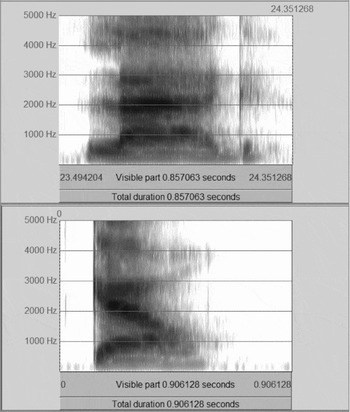
The different vocal tract shapes that correspond to perceptually clear [l] and dark [ɫ] have different resonant qualities that can be objectively determined from the formant frequencies: A lower second formant (F2), combined with a higher first formant (F1), corresponds to a darker [l] quality (Recasens & Espinosa, Reference Recasens and Espinosa2005; Simonet, Reference Simonet2010). Based on the speech of adult speakers, [l] is perceived as clear when F2 is produced above 1200–1450 Hz, and as dark when F2 is below that range; moreover, the smaller the difference between F2 and F1, the darker the quality (Proctor, Reference Proctor2010; Recasens, Reference Recasens2004; Recasens & Espinosa, Reference Recasens and Espinosa2005; Simonet, Reference Simonet2010). Refer to Figure 1 for a spectrogram depicting an adult female's productions of the words lag and gal, where a clear [l] is visible in onset position (with relatively high F2) and a dark [ɫ] is visible in coda position (where F2 slopes down to a lower frequency from the preceding vowel), respectively.
Representation of a Praat (Boersma & Weenink, Reference Boersma and Weenink2008) spectrogram for clear [l] in lag (top) and dark [ɫ] in gal (bottom) as produced by a female adult American English speaker.

It should be noted, however, that the clear/dark distinction occurs along a continuous, rather than categorical, dimension. In fact, English [l], even the so-called clear variant, is considered to be relatively dark, particularly for many American English speakers, with adult male mean F2 values of 1000 Hz for prevocalic English [l] and below 1000 Hz for postvocalic [ɫ] (Ladefoged, Reference Ladefoged2000; Proctor, Reference Proctor2010; Recasens, Reference Recasens2004). In contrast, Spanish [l] is relatively clear, with adult male mean F2 values occurring upwards of 1800 Hz, and it shows no comparable allophonic variation with respect to the clear/dark distinction. It occurs as relatively clear in all contexts (Proctor, Reference Proctor2010; Recasens, Reference Recasens2004; Recasens & Espinosa, Reference Recasens and Espinosa2005).
One might be inclined to attribute the different acquisition patterns for Spanish and English /l/ to the articulatory/acoustic and allophonic differences between these two languages. Based on (the limited) cross-linguistic normative studies of speech sound acquisition, however, it does not appear that the darker lateral approximant is necessarily more difficult to acquire than the clearer variety. For instance, Brazilian Portuguese /l/, which is characterized as relatively dark in onset position (vocalization occurs postvocalically), is acquired before the age of 3;0, similar to ages of acquisition of /l/ in Spanish (as described above) and German, both of which have the clear variety (Azambuja, Reference Azambuja1998; Fox & Dodd, Reference Fox and Dodd2001; Hernandorena, Reference Hernandorena1990; Rangel, Reference Rangel1998; Recasens, Reference Recasens2004; Recasens & Espinosa, Reference Recasens and Espinosa2005). Moreover, in those languages like English that exhibit allophonic variation between clearer and darker variants, the lateral phoneme is not necessarily acquired late. For instance, acquisition research on Turkish, in which the palatal lateral [ʎ] and dark [ɫ] pattern as allophones (dependent on the backness of preceding vowels), shows the lateral phoneme being acquired between the ages of 2;6 and 2;11 (Göksel & Kerslake, Reference Göksel and Kerslake2005; Levi, Reference Levi2001; Topbaş, Reference Topbaş2004/2005, Reference Topbaş2006).
To summarize, there is no clear explanation for why /l/ is acquired earlier in Spanish than in English monolingual phonological acquisition, though it could be attributed to the interaction of a number of factors, including functional load, the relative darkness of the sound in the two languages, and whether or not more than one allophonic variant occurs for the /l/ phoneme.
Bilinguals’ acquisition and production of / l /
It is particularly noteworthy that research on acquisition of English by Spanish–English bilingual children has shown earlier acquisition of and higher accuracy rates for /l/ as compared to English monolinguals (e.g., Goldstein & Washington, Reference Goldstein and Washington2001); moreover, Spanish–English bilingual children have also been observed to use [l] as a substitute for other English sounds, which is similar to production patterns of Spanish monolinguals, but unlike those of English monolinguals (Barlow, Reference Barlow2002, Reference Barlow2003c). This may be due to dominance in or earlier exposure to Spanish; however, it raises some important questions. Does early acquisition of Spanish /l/ somehow support the earlier acquisition of English /l/ in bilinguals? This in fact could be an example of acceleration or bootstrapping in bilingual phonological development (Fabiano-Smith & Barlow, Reference Fabiano-Smith and Barlow2010; Fabiano-Smith & Goldstein, Reference Fabiano-Smith and Goldstein2010b; Gawlitzek-Maiwald & Tracy, Reference Gawlitzek-Maiwald and Tracy1996; Paradis & Genesee, Reference Paradis and Genesee1996), as described earlier, where Spanish–English bilinguals are acquiring English /l/ at a faster rate due to the same factors (whatever they may be) that allow for the earlier acquisition of Spanish /l/.
Furthermore, given that /l/ is common to both languages, perhaps Spanish–English bilinguals are treating the /l/ in each language as phonetically equivalent (Flege, Reference Flege1980, Reference Flege1987, Reference Flege, Cole and Hualde2007; Flege & Port, Reference Flege and Port1981). If so, then they might be producing the same surface form of target /l/ in both languages, thereby facilitating the earlier acquisition of the phoneme in English. In fact, the use of clear [l] in place of dark [ɫ] has been described as an area of potential transfer between Spanish and English by adult Hispanic speakers of American English (McDonald, Reference McDonald, Bjarkman and Hammond1989), and while clear/dark allophonic distinctions for /l/ have been noted to occur among native speakers of Chicano English, the distinction is described as subtler than that of mainstream American English (Frazer, Reference Frazer1996; Santa Ana, Reference Santa Ana1996).
Although no prior research has acoustically evaluated the [l] productions of Spanish–English bilinguals, findings from prior research with adult bilinguals suggest category assimilation is likely to occur when an /l/ phoneme is common to both languages (Llisterri & Martínez-Daudén, Reference Llisterri and Martínez-Daudén1991; Simonet, Reference Simonet2010). For example, Simonet (Reference Simonet2010) evaluated productions of [l] in Spanish and Catalan (which has a dark [ɫ]) by adult bilinguals who were dominant in either Spanish or Catalan. Productions were analyzed in terms of mean F2 values and mean differences between F2 and F1. Simonet found that both groups of bilinguals produced [l] in each language with F2 values and F2–F1 differences that were unlike those of monolingual speakers of the respective languages, which is suggestive of phonetic assimilation (Flege, Reference Flege and Strange1995). However, the speakers also produced two separate [l]s for the respective languages, such that mean F2 values and mean F2–F1 differences were lower for Catalan than for Spanish for both bilingual groups. (Note, for the Spanish-dominant bilinguals, this was only true of males, and not females.) Moreover, the two groups differed from each other, in that the Catalan-dominant bilinguals’ F2 values and F2–F1 differences were lower than those of the Spanish-dominant bilinguals in each language, which suggested that the relative darkness of /l/ in the dominant language was influencing that in the other language (Simonet, Reference Simonet2010).
Current study
Based on these findings, and given that English and Spanish /l/s differ from one another in terms of darkness (F2 frequency and the F2–F1 difference), it is possible that Spanish–English bilingual children will also show evidence of phonetic category assimilation, which might improve our understanding of bilingual children's earlier acquisition of English /l/. The purpose of the current study, therefore, was to acoustically measure the Spanish and English [l] productions of Spanish–English bilingual children and compare them to those of Spanish and English monolingual children. We elected to compare [l] productions in terms of F2 and the F2–F1 difference, given that these measures distinguish adult Spanish from adult English [l] in relative darkness and due to the fact that the English /l/ phoneme (but not the Spanish one) varies by context along these same dimensions.
Our predictions were as follows (based on findings of Flege, Reference Flege and Strange1995; Proctor, Reference Proctor2010; Recasens, Reference Recasens2004; Recasens & Espinosa, Reference Recasens and Espinosa2005; Simonet, Reference Simonet2010):
1. Monolingual English F2 and F2–F1 values overall would be lower than monolingual Spanish values, regardless of context;
2. Monolingual English F2 and F2–F1 values would be lower in postvocalic position than in prevocalic position, while Spanish F2 values would not differ by context; and
3. F2 and F2–F1 values for Spanish–English bilinguals would be intermediate to those of English and Spanish monolinguals, due to category assimilation.
Methods
Participants
Data from 21 children were drawn from the archives of a larger study on the acquisition of Spanish and English by monolingual and bilingual children in the Southern California and Baja California area. Seven children were monolingual Spanish speakers (three males, four females) with a mean age of 5 years; 1 month (range: 4;0–6;2). An additional seven children were monolingual English speakers (three males, four females) with a mean age of 4;10 (range: 2;5–8;4). Finally, seven other children were Spanish–English bilinguals (two males, five females) with a mean age of 4;7 (range: 2;2–6;4). All children were recruited to participate in the original study through public announcements distributed to area day cares, preschools, kindergartens, and health care facilities. The 21 children included in the current study were determined to be typically developing as based on an extensive case history and parent report (following Restrepo, Reference Restrepo1998) evaluating the children's linguistic, cognitive, and motoric development. Based on the case histories and parent reports, none of the children included in the study had any known history of hearing problems.
An extensive questionnaire evaluating the children's language development, input, and output was also used to determine bilingual status (following Gutiérrez-Clellen & Kreiter, Reference Gutiérrez-Clellen and Kreiter2003; Pearson, Fernandez, Ledeweg & Oller, Reference Pearson, Fernandez, Ledeweg and Oller1997; Restrepo, Reference Restrepo1998). Specifically, to be considered bilingual, a child had to have at least 20% input and output in both English and Spanish (Pearson et al., Reference Pearson, Fernandez, Ledeweg and Oller1997). Further, each bilingual child's language comprehension and use was rated on a five-point proficiency scale, from 0 (unable to speak/understand the language) to 4 (native-like proficiency). Only bilingual children rated at 3 or 4 in each language were included in the current study (Gutiérrez-Clellen & Kreiter, Reference Gutiérrez-Clellen and Kreiter2003; Peña, Bedore & Rappazzo, Reference Peña, Bedore and Rappazzo2003). The questionnaires were also used to determine when the children began to acquire each of their two languages. All bilingual children included in the current study were determined to be early bilinguals, following the definition adopted above (Flege, Reference Flege, Cole and Hualde2007; Flege et al., Reference Flege, Yeni-Komshian and Liu1999; Hamers & Blanc, Reference Hamers and Blanc2000; McLaughlin, Reference McLaughlin1978). None of the bilingual children in this study was exposed to English from birth (that is, none was undergoing BFLA); they had used Spanish only for an average of three years prior to learning English.
A further criterion for inclusion in the current study was that all children had to produce a perceptually accurate [l] in their respective languages (both languages for bilinguals). Details on how this was determined are provided below.
Data
Data included for analysis in the current study were drawn from the children's productions on the Assessment of Spanish Phonology (ASP; Barlow, Reference Barlow2003b) and/or the Assessment of English Phonology (AEP; Barlow, Reference Barlow2003a). These picture-naming assessments target all the phonemes of the respective target language in a minimum of five words per relevant context. The ASP targets 44 Spanish /l/ words in word-initial, intervocalic, word-final, and initial cluster contexts. The AEP targets 41 English /l/ words in those same contexts. The target words are elicited in isolation by having the child look at a picture and name it in response to questions such as, What is this? (¿Qué es esto?) or What color is this? (¿De qué color es esto?). Children were encouraged to provide a one-word response (balloon or globo as opposed to a balloon or un globo). Whenever possible, a spontaneous production was elicited; however, in some cases (e.g., if the child did not know the intended word) it was necessary to elicit the forms as imitations: It's a balloon. What is it? (Es un globo. ¿Qué es?) or Say balloon (Diga globo). The children's productions were digitally recorded directly onto a Dell Latitude 7200 laptop using Adobe Audition® 1.5 software via a SONY ECM-MS907 omnidirectional electret condenser microphone. The recording parameters included a single-channel input, 16-bit resolution, and a sampling rate of 44.1 kHz.
For the purposes of the current study, the relevant /l/ words to be analyzed were identified in two different ways. First, all AEP and ASP productions were phonetically transcribed by judges trained in the use of narrow notation of the IPA for both English and Spanish. English productions were transcribed by native English speakers, while Spanish productions were transcribed by native Spanish speakers. A second judged re-transcribed 20% of the data for reliability purposes. Point-to-point interjudge reliability for each target probe word was 90% for English transcriptions and 89% for Spanish transcriptions. Interjudge reliability for 269 target /l/ words specifically was 94% for English (139 words) and 96% for Spanish (130 words). For both languages, the few disagreements that occurred typically related to target /l/ in syllable coda position (e.g., Spanish sol “sun” [sol]) or in the second position of a consonant cluster (e.g., English plate [pleɪt]). Based on the transcriptions, all single-word productions containing a perceptually accurate [l] were spliced out of the original audio files via Praat (Boersma & Weenink, Reference Boersma and Weenink2008) for further acoustic analysis (described below). Two separate judges acoustically analyzed each child's [l] productions. Only those forms for which both judges perceived an [l] were included in the analysis.
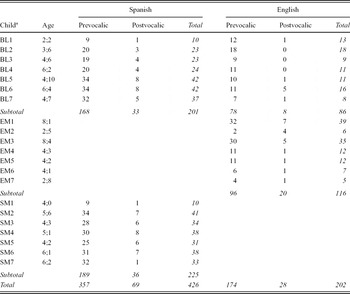
Not surprisingly, not every child produced every target /l/ word with a perceptually correct (i.e., adult-like) [l] production. The average number of English words with perceptually correct [l] per child was 17 for monolinguals (range: 5–39 words; total: 116) and 12 for bilinguals (range: 8–18 words; total: 86). The average number of Spanish words produced with a perceptually correct [l] per child was 32 for monolinguals (range: 10–41 words; total: 225) and 29 for bilinguals (range 10–42 words; total: 201). In all, 202 English words and 426 Spanish words were analyzed. Refer to Table 1 for a breakdown of the number of productions per child per language.
Age (years;months) and number of [l] productions by language and context for each child.

BL = bilingual, EM = English monolingual, SM = Spanish monolingual
It is clear from Table 1 that the older children in each group typically produced more correct [l] forms than the younger children in each group, which is not surprising. Moreover, despite a comparable number of opportunities to produce target /l/ words in each language, the average number of correct productions clearly shows an advantage for Spanish, for both the monolinguals and the bilinguals. This is consistent with the earlier acquisition of /l/ in Spanish as compared to English (Bedore, Reference Bedore, Taylor and Leonard1999; Goldman & Fristoe, Reference Goldman and Fristoe2000). That the bilinguals produced, on average, fewer [l] forms in English than in Spanish may be attributable to relative dominance in Spanish, given their earlier exposure to the language (as discussed above).
It should be noted that the bilinguals’ relatively smaller number of correct [l] forms overall does not necessarily imply poorer performance or less complete acquisition of /l/ as compared to the monolinguals. It has been documented that bilingual children have smaller lexicons than their monolingual peers, though their combined lexicons are generally larger (Hoff, Core, Place, Rumiche, Señor & Parra, Reference Hoff, Core, Place, Rumiche, Señor and Parra2012). The bilinguals in this study may have produced fewer [l] forms in each language due to greater unfamiliarity with the probe words as compared to the monolinguals; however, it is noteworthy that, across both of their languages, the bilinguals produced an average of 41 correct [l] forms.
Each [l] production was categorized as prevocalic (if /l/ preceded a vowel) or postvocalic (if /l/ followed a vowel). Although the syllabification of intervocalic consonants in English is subject to some debate (Blevins, Reference Blevins and Goldsmith1995; Borowsky, Reference Borowsky1986), we followed the assumptions of onset maximization and conservatively grouped all intervocalic /l/ forms into the prevocalic context (Selkirk, Reference Selkirk, van der Hulst and Smith1982). Note that some assume that post-tonic intervocalic /l/ is syllabified in the coda of the preceding stressed syllable in English (e.g., vanilla [və.ˈnɪɫ.ə]), or even as ambisyllabic, and this may also be morphologically conditioned (Blevins, Reference Blevins and Goldsmith1995; Borowsky, Reference Borowsky1986; Clements & Keyser, Reference Clements and Keyser1983; Hayes, Reference Hayes, Dekkers, van der Leeuw and van de Weijer2000). Such is not the case for Spanish, however: All intervocalic consonants in Spanish are syllabified in onset position (e.g., regalo “gift” [re.ˈɡa.lo]) (Colina, Reference Colina1997; Harris, Reference Harris1983, Reference Harris, Hale and Keyser1993). Regardless of the facts of the adult systems, the syllabification of intervocalic consonants in developing systems is unclear and likely differs at an individual level (for review, see Barlow, Reference Barlow2007; Bernhardt & Stemberger, Reference Bernhardt and Stemberger2002); moreover, Spanish–English bilingual children may not syllabify words in the same manner as their monolingual peers in their respective languages. For consistency, we categorized all intervocalic forms in the same manner across both languages. For English, this resulted in a more conservative estimation of potential F2 differences by context. Specifically, including some forms that are likely to be velarized (such as vanilla) in the prevocalic category would potentially lower the mean F2 for prevocalic position (since F2 lowers with velarization), thereby reducing potential differences between F2 and F2–F1 values for the two contexts. As is evident from Table 1, there are many more prevocalic forms than postvocalic forms, which is primarily due to this method of categorizing intervocalic forms as prevocalic. Moreover, the postvocalic (syllable-final) position is generally considered more complex; because of this, consonants are typically acquired later in that context than in prevocalic position (Baković, Reference Baković, Schwegler, Tranel and Uribe-Etxebarria1998; Carreira, Reference Carreira, Parodi, Quicoli, Saltarelli and Zubizarreta1996; Goad & Brannen, Reference Goad and Brannen2000; Kaye, Reference Kaye1990; Lleó, Reference Lleó2003; Nuñez-Cedeño, Reference Nuñez-Cedeño2007; Stemberger, Reference Stemberger, Bernhardt, Gilbert and Ingram1996; Zamuner, Gerken & Hammond, Reference Zamuner, Gerken and Hammond2004). This also may have contributed to smaller number of postvocalic forms. Given the large difference in numbers of prevocalic and postvocalic forms, then, any statistically significant differences in F2 and F2–F1 values due to context would be robust. In total, there were 531 prevocalic forms (357 in Spanish, 174 in English) and 97 postvocalic forms (69 in Spanish, 28 in English) for analysis.
As is clear from the discussion above, the archival nature of our sample is highly heterogeneous in terms of age as well as number of productions per child and per context. We discuss how we account for this variability with our statistical model below.
Acoustic analysis
Each [l] word was spliced from the original audio recordings and acoustically analyzed in Praat (Boersma & Weenink, Reference Boersma and Weenink2008) by the second author, who is trained in acoustic phonetics and the use of Praat. The middle of the steady-state portion of each [l] production was then identified perceptually and visually (from the spectrographic and waveform displays). F1 and F2 measurements were taken for each form using the “Get Formants” command in Praat.
To control for the somewhat subjective procedure of finding the steady state portion of each [l], an independent judge also trained in acoustic phonetics and use of Praat re-analyzed a subset of the data from six of the children (two Spanish monolinguals, two English monolinguals, and two Spanish–English bilinguals). Correlation between the F1 measures for the two judges for 150 items was r(148) = .812, p < .01. Correlation between the F2 measures was r(148) = .725, p < .01. Reliability was also calculated by determining the absolute difference in measures (following Shriberg, Austin, Lewis, McSweeny & Wilson, Reference Shriberg, Austin, Lewis, McSweeny and Wilson1997), which is calculated by determining the mean of the original judge's measures, calculating the mean of the absolute value of the difference between the original judge's mean and the mean of the second judge's measures, and then dividing the absolute mean by the original mean. The mean absolute difference for F1 and F2 was 5% and 9%, respectively.
Given the heterogeneous nature of our sample, we used a linear mixed statistical model to analyze the acoustic differences for [l] between groups, languages, and contexts, which allowed us to account for the individual differences in age and number of productions per child. Specifically, the model was estimated using PROC MIXED in SAS to evaluate differences by language (Spanish vs. English), context (prevocalic vs. postvocalic), and background (monolingual vs. bilingual) for F2 values for [l] in each language. Restricted maximum likelihood (REML) was used to estimate model parameters. The degrees of freedom were estimated using the Sattherwaite method. Because vocal tract size and configuration changes rapidly with age, particularly in early childhood (Vorperian, Kent, Lindstrom, Kalina, Gentry & Yandell, Reference Vorperian, Kent, Lindstrom, Kalina, Gentry and Yandell2005; Vorperian, Wang, Chung, Schimek, Durtschi, Kent, Ziegert & Gentry, Reference Vorperian, Wang, Chung, Schimek, Durtschi, Kent, Ziegert and Gentry2009), age was included in the model as the covariate in order to account for possible differences in F2 values attributed to vocal tract size. This was especially important given the wide range of ages within and across groups. By covarying for age, any effects of age on the differences between languages or groups would not confound our results. Subject was added as a random effect in order to account for the very uneven numbers of productions per child per context. By doing so, any influence of one (for example, older) child's higher number of [l] productions would not be the cause for any (lack of) significant effects of language, background, or context. Only interactions (two-way and three-way) between language, context, and background were included to determine how these variables interacted on F2 values during the production of [l].
The same model was also estimated to evaluate variations by language, context, and background for the difference between F2 and F1 (hereafter, F2–F1) values for [l] in each language. In addition, PROC GLMPOWER was used to estimate statistical power for all null interactions and main effects in each model in order to determine how the small number of participants in each group may have affected the findings. A table containing the full set of power analyses may be found in a supplementary file on the journal website.
Results
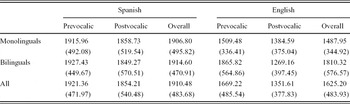
The means and standard deviations for F2 values for the children's [l] productions are shown in Table 2, which is organized by language, background, and context.
F2 means (and standard deviations) in Hz for [l] productions by language, context, and background.

Results of the F2 analysis showed that the three-way interaction between language, background, and context was not significant F(1,616) = 2.37, p > .05. Similarly, the two-way interaction between language and background was also not significant F(1,142) = 1.62, p > .05. The two-way interaction between language and context, however, was significant F(1,617) = 5.74, p < .05; specifically, the difference between prevocalic and postvocalic F2 values for [l] was greater in English than in Spanish. Moreover, the two-way interaction between background and context was also significant, F(1,616) = 4.16, p < .05, such that there was a greater difference between prevocalic and postvocalic F2 values for [l] in the bilingual children's productions than in the monolingual children's productions.
Age was not found to be significant, F(1,22.2) = .73, p > .05, nor was the main effect of background F(1,37.8) = 1.05, p > .05. The main effect of language was found to be significant, F(1,138) = 33.72, p < .05, with English [l]s having an overall lower F2 compared to Spanish. Finally, the main effect of context was significant, F(1,618) = 9.59, p < .05, with postvocalic [l] having a lower F2 than prevocalic [l].
To determine how the small number of participants may have affected the null findings, PROC GLMPOWER was used to estimate the statistical power in the model. The three-way interaction was estimated to have 22% power, the two-way language and background interaction 11% power, main effect of age 9% power, and main effect of background 11% power. These very low estimates of statistical power indicate there was very little probability in reaching significance for any of these interactions and main effects due to the small sample size.
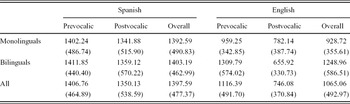
The means and standard deviations for the F2–F1 values for the children's [l] productions are shown in Table 3, organized by language, background, and context.
F2–F1 difference means (and standard deviations) in Hz for [l] productions by language, context, and background.

Results of the F2–F1 analysis showed a marginally-significant three-way interaction between language, background, and context, F(1,616) = 3.30, p = .069. (See below for follow-up analyses.) The two-way interactions between language and context, F(1,617) = 9.11, p < .05, and between background and context, F(1,616) = 4.53, p < .05, were significant. Similar to our findings for F2, the difference between prevocalic and postvocalic F2–F1 [l] values was greater in English than in Spanish, and there was a greater difference between prevocalic and postvocalic F2–F1 [l] values in the bilinguals’ productions than in the monolinguals’. The interaction between background and language, however, was not significant, F(1,138) = 1.48, p > .05. Further, the main effect of age for the F2–F1 values was not significant, F(1,22) = 3.11, p > .05, nor was the main effect of background, F(1,37.1) = 1.62, p > .05. Finally, the main effect of language, F(1,135) = 49.85, p < .05, was significant, as was the main effect of context, F(1,618) = 12.54, p < .05. Once again, as with the findings for F2, English [l]s had overall lower F2–F1 values compared to Spanish [l]s, and postvocalic [l]s had lower F2–F1 values than prevocalic [l]s.
The three-way interaction for F2–F1 had 28% power, as determined by PROC GLMPOWER, indicating that an increased number of participants and productions will likely lead to greater statistical significance. PROC GLMPOWER was also used to determine statistical power for the null findings for F2–F1. The two-way interaction of language and background was estimated to have 12% power, the main effect of age 33% power, and the main effect of background 16% power. These findings indicate that there was a low probability of reaching significance for this interaction and the main effects for F2–F1.
To follow up on the three-way interaction for F2–F1, bilingual speakers were separated from monolingual speakers and two separate multi-linear models were run using PROC MIXED. Age was retained as a covariate, as was the random intercept for each subject. The fixed effects of language, context, and the interaction between language and context were included in the model.
For the monolinguals, the two-way interaction between language and context was significant F(1,282) = 8.24, p < .05, as [l] had significantly smaller F2–F1 values in postvocalic position than in prevocalic position, but only in English. The main effect of language was significant, F(1,280) = 15.25, p < .05, with Spanish having larger F2–F1 values than English. The main effect of context was also significant, F(1,281) = 11.24, p < .05, with postvocalic [l] having smaller F2–F1 values than prevocalic [l]. The main effect of age was not significant, F(1,6.27) = .02, p > .05. PROC GLMPOWER estimated that age only had 5% power, demonstrating a very low probability of finding a significant effect for age.
For the bilinguals, the two-way interaction between language and context was not significant F(1,336) = 1.20, p > .05. In addition, the main effects of age, F(1,14.2) = 3.64, p > .05, and context, F(1,336) = 1.39, p > .05, also were not significant. However, the main effect of language was significant, F(1,20) = 30.81, p < .05, with Spanish having larger F2–F1 values than English. Power analyses conducted with PROC GLMPOWER estimated that the two-way interaction had 7% power, age 57% power, and context 16% power. Although there is low probability of finding a significant two-way interaction between language and context or the main effect of context, with a larger number of bilingual participants, age may become a significant main effect, which would not be surprising due to age-related differences in vocal tract length (Vorperian et al., Reference Vorperian, Kent, Lindstrom, Kalina, Gentry and Yandell2005; Vorperian et al., Reference Vorperian, Wang, Chung, Schimek, Durtschi, Kent, Ziegert and Gentry2009).
In summary, we found that, for both F2 and F2–F1, there was a significantly greater difference between prevocalic and postvocalic contexts for English as opposed to Spanish, and for bilinguals as opposed to monolinguals. Overall, F2 and F2–F1 values were significantly greater in Spanish than in English, and were higher in prevocalic as compared to postvocalic position. Furthermore, subsequent analyses revealed that, among the monolinguals, F2–F1 values were significantly greater in prevocalic as opposed to postvocalic position in English but not in Spanish. Moreover, the bilinguals showed significantly greater F2–F1 values in Spanish than in English. Next, we evaluate these results in light of our original study predictions.
Discussion
In this study we acoustically analyzed the [l] productions of Spanish–English bilingual children to determine if values for F2 and the F2–F1 difference (both of which correlate with relative darkness) were similar between the children's two languages and between the prevocalic and postvocalic contexts, which would be indicative of category assimilation of the two [l]s in the phonological space. Monolingual children's [l] productions were also included for comparison purposes in order to determine if any differences in F2 and F2–F1 values were apparent by language and/or context for these young children.
As predicted, overall F2 values were significantly lower for English monolinguals than for Spanish monolinguals, and English monolinguals also had significantly smaller F2–F1 values than Spanish monolinguals, as evidenced by the main effect of language for the monolingual group. These findings are consistent with prior descriptions of the two languages which characterize English [l] as generally darker than Spanish [l], regardless of context (Proctor, Reference Proctor2010; Recasens, Reference Recasens2004). The mean F2 for Spanish monolinguals (independent of context) was 1906.80 Hz, while for English monolinguals it was 1487.95 Hz. The mean F2–F1 for Spanish monolinguals (independent of context) was 1392.59 Hz, while for English monolinguals it was 928.72 Hz. Thus, even young children's speech shows sensitivity to the relative darkness of [l] in the language being acquired. Although the mean F2 values are somewhat higher than values reported for adult speakers of the respective languages (Proctor, Reference Proctor2010; Recasens, Reference Recasens2004), this would be expected for children given their shorter vocal tracts (Vorperian et al., Reference Vorperian, Kent, Lindstrom, Kalina, Gentry and Yandell2005; Vorperian et al., Reference Vorperian, Wang, Chung, Schimek, Durtschi, Kent, Ziegert and Gentry2009).
We had also predicted that, for English (but not Spanish) monolinguals, F2 and F2–F1 values would be lower in postvocalic than prevocalic position, reflective of the velarization pattern that is observed in adult English (but not Spanish). This was partially supported. Postvocalic F2 values were not significantly lower than prevocalic values for either language group as demonstrated by the lack of a significant three-way interaction for F2. Nevertheless, both groups showed a trend in that direction, and the difference between prevocalic and postvocalic F2 values was greater for English monolinguals, as predicted. As shown in Table 2, English monolinguals had mean F2 values of 1509.48 Hz prevocalically and 1384.59 Hz postvocalically, while Spanish monolinguals had mean F2 values of 1915.96 Hz and 1858.73 Hz in those respective contexts. There was, however, a significant language-by-context interaction for F2–F1 among the monolinguals, with English monolinguals showing a significantly greater difference by context than Spanish monolinguals. As shown in Table 3, English monolinguals had mean F2–F1 values of 959.25 Hz prevocalically and 782.14 Hz postvocalically, while Spanish monolinguals had mean F2–F1 values of 1402.24 Hz prevocalically and 1341.88 Hz postvocalically. Taken together, these differences by context for F2 and F2–F1 are consistent with what has been reported in comparative descriptions of the two adult languages (Ladefoged, Reference Ladefoged2000; Lehiste, Reference Lehiste1964; Quilis, Esgueva, Gutiérrez Araus & Cantarero, Reference Quilis, Esgueva, Araus and Cantarero1979; Recasens & Espinosa, Reference Recasens and Espinosa2005). Moreover, despite the lack of a significant three-way interaction for F2, recall that power analyses revealed that there is only a 22% chance of reaching significance for that interaction with our current sample. Perhaps with a larger number of participants and productions, the difference by context for F2 would have proven to be significant for the English monolinguals. Alternatively, perhaps (some of) the English monolinguals are still in the process of mastering the allophonic distributional pattern of clear [l] and dark [ɫ], and, with time, the difference by context will increase and/or become more systematic in these children's productions. (See below for further discussion of this point.)
We also predicted that the Spanish–English bilinguals would produce F2 and F2–F1 values for [l] in both languages that were intermediate to those of the Spanish and English monolinguals, which would indicate that the children classified target /l/ allophones in each language as phonetically equivalent. Recall that, per the SLM (Flege, Reference Flege and Strange1995, Reference Flege, Cole and Hualde2007), phonemes of the L1 and L2 are related to one another at the phonetic level, in terms of positional allophones. Our original prediction that the bilinguals would show evidence of merged phonetic categories for /l/ in the two languages was not borne out, given the main effect of language for F2–F1 in the bilingual data. As shown in Table 3, the bilinguals produced F2–F1 values (independent of context) that were significantly lower in English (1248.96 Hz) than in Spanish (1403.19 Hz). A similar but non-significant trend was also apparent for F2. As shown in Table 2, the bilinguals produced F2 values (independent of context) that were lower in English (1810.32 Hz) than in Spanish (1914.60 Hz).
This distinction between their two languages, for F2–F1 at least, might be taken as evidence of category separation – that the bilinguals have formed two separate categories for English versus Spanish /l/. However, our findings suggest that the situation is more complicated than that. Consider that the bilinguals showed a greater difference by context for both F2 and F2–F1 in English as compared to Spanish. And recall that the bilinguals’ English productions showed mean F2 values of 1865.82 Hz prevocalically and 1269.16 Hz postvocalically, while their Spanish productions showed mean F2 values of 1927.43 Hz and 1849.27 Hz in those respective contexts (Table 2). Though these differences were not significant (based on the lack of a three-way interaction for F2), they are remarkable. Recall also that there was a marginally-significant three-way interaction for language, background, and context for F2–F1, such that the bilinguals’ mean F2–F1 values for English were 1309.79 Hz prevocalically, and 655.92 Hz postvocalically, while for Spanish they were 1411.85 Hz and 1359.12 Hz in those respective contexts (Table 3); these differences between the bilinguals’ two [l]s are likewise remarkable. As stated above, this three-way interaction for F2–F1 had 28% power, which suggests that a greater number of participants and [l] productions would likely lead to greater statistical significance.
Given these findings, the bilinguals may be distinguishing their English [l]s by context, illustrating productive knowledge of the distribution of the two allophones in the target system. Furthermore, they may be demonstrating the lack of such an allophonic distribution in their Spanish productions. The bilinguals’ prevocalic English [l]s are comparable in relative (lack of) darkness to monolingual Spanish [l]s (based on F2 and F2–F1 values), while their postvocalic English [l]s are of comparable darkness to those of English monolinguals. In other words, the apparent difference between their F2 and F2–F1 values for English versus Spanish may be due in large part to the much darker postvocalic English [l]s. Perhaps with a larger number of participants and productions, the interactions for F2 and F2–F1 would have proven to be significant for the bilinguals.
It appears, then, that the bilinguals have formed separate phonetic categories for postvocalic [l] allophones in Spanish and English, but have a merged phonetic category for prevocalic [l]. If they had formed separate categories in all contexts, we might have expected their English prevocalic [l] F2 and F2–F1 values to be comparable to those of the English monolingual children. Perhaps the prevocalic [l]s in Spanish and English are similar enough that new category formation is difficult; in contrast, postvocalic [l]s are sufficiently distinct that the bilinguals are able to form separate phonetic categories for postvocalic /l/ in the two languages. If this is so, then the bilinguals have also demonstrated grammatical separation between their two sound systems, insofar as /l/ is concerned.
Specifically, the fact that bilinguals’ postvocalic English [l] F2 and F2–F1 values were so much lower than those in Spanish is not necessarily evidence that two separate phonemic /l/ categories have been formed; rather, it simply shows that the bilinguals have acquired the allophonic rule that governs the distribution of clear [l] and dark [ɫ] in English, and that, moreover, they know the rule applies uniquely to English and not Spanish. Thus, while they may not have developed separate phonemic categories for /l/ in the two languages, they do show autonomy of their two phonological systems by producing an allophonic alternation in one language but not the other. Though the prevocalic phonetic category may be merged for the two languages, the bilingual children's grammatical systems of the two languages appear to be separate insofar as the patterning of /l/ is concerned, if we assume a standard generative framework for the representation of phonemes and allophones (Chomsky & Halle, Reference Chomsky and Halle1968; Kenstowicz, Reference Kenstowicz1994).
This assumption is not far-fetched, nor is it novel. This is the basic assumption of the WEAVER++ model (Roelofs & Verhoef, Reference Roelofs and Verhoef2006), for example, which assumes that phonemes are shared between a bilingual's two languages, but the processes (grammatical rules) that determine their phonetic realization will differ for the two languages. Much evidence in the L2 phonological acquisition literature suggests that phonetic and phonemic categories evolve independently of phonological rules in the learner's L2. For instance, once Spanish-speaking L2 learners of English establish a phonemic contrast between [d] and [ð], the allophonic rule in the Spanish L1 that governs the distribution of [d] and [ð] may continue to apply (in the form of a neutralization rule) in the learner's English L2 productions (Barlow, Reference Barlow2003c; Eckman & Iverson, Reference Eckman, Iverson, Hannahs and Young-Scholten1997). Consider also the evidence from Flege (Reference Flege1987) that French L2 learners of English appeared to have merged phonetic categories for stop consonants in their two languages, based on VOT measures; yet, these learners still produced longer VOTs in English than in French, which suggests that they had some understanding that the allophonic aspiration rule applied in English but not in French (Flege, Reference Flege1987).
This brings us to the observation that, in all the research that has focused on interaction in bilingual sound systems, it is striking that relatively few studies have evaluated bilinguals’ acquisition and use of allophonic alternations that occur within a single phonemic category (Bullock, Toribio, Davis & Botero, Reference Bullock, Toribio, Davis and Botero2004; Fabiano-Smith & Bunta, Reference Fabiano-Smith and Bunta2012; Khattab, Reference Khattab2002; Oh, Reference Oh2002; Shea & Curtin, Reference Shea and Curtin2011; Vokic, Reference Vokic2010; Young-Scholten, Reference Young-Scholten2004; Zampini, Reference Zampini1994). One particularly relevant study by Khattab (Reference Khattab2002) evaluated English–Arabic bilingual children's productions of English /l/. Arabic /l/ is characterized as clear in most contexts, and Khattab wished to determine if bilinguals used English /l/ allophones in the appropriate phonetic contexts. Based on perceptual judgments, the children were characterized as producing clear [l] and dark [ɫ] target appropriately, and Khattab claimed that no interaction occurred between the bilinguals’ two languages, despite the different patterning of the /l/ phoneme in each target language. However, these findings must be interpreted with caution, given the lack of more objective acoustic measures or monolingual comparison groups; it is possible that interaction was in fact occurring in terms of subtle acoustic differences by language and context.
There are numerous other directions that research can take to further analyze bilinguals’ acquisition of allophonic variation. For instance, there have been many studies on Spanish–English bilinguals’ productions of laryngeal contrasts among voiceless stop consonants, because the two languages have different lags in VOT (Deuchar & Clark, Reference Deuchar and Clark1996; Fabiano-Smith & Bunta, Reference Fabiano-Smith and Bunta2012; Thornburgh & Ryalls, Reference Thornburgh and Ryalls1998). In these studies, productions of word- or foot-initial voiceless stops in English, which are associated with a long lag VOT, are typically compared with those in Spanish that have a much shorter VOT. Most such comparisons show that Spanish–English bilinguals maintain a systematic VOT difference between Spanish and English voiceless stops, though the VOT values may differ from those of monolinguals, often occurring in ranges intermediate to those of the monolingual speakers of the two languages (e.g., Deuchar & Clark, Reference Deuchar and Clark1996; Fabiano-Smith & Bunta, Reference Fabiano-Smith and Bunta2012; Thornburgh & Ryalls, Reference Thornburgh and Ryalls1998). This is attributed, once again, to perceptual assimilation (Best, Reference Best and Strange1995; Flege, Reference Flege and Strange1995). But what about the allophones of the voiceless stops in English? What is lacking is a monolingual-bilingual comparison of the VOT values for English voiceless stops in both long lag (e.g., pie [pʰaɪ]) and short lag (e.g., spy [spaɪ]) contexts and how they compare to the bilinguals’ voiceless stops in Spanish. Do Spanish–English bilinguals evidence context-sensitive VOT differences according to the allophonic distribution of voiceless stops in English? Are their VOTs for unaspirated English stops comparable to monolingual English or Spanish voiceless stops? This is an area of bilingual research that remains underexplored, and there is much that we still do not understand regarding how bilinguals acquire the distinct (and numerous) allophonic variants of phonemes that are shared between their two sound systems.
Our study was motivated by the observation that Spanish–English bilingual children appear to acquire English /l/ earlier than English monolinguals. However, our findings do not necessarily provide additional evidence in support of this claim, because all children included in the study produced at least some perceptually accurate [l]s. Furthermore, both the bilinguals and the monolinguals appear to show (emerging) knowledge of the allophonic rule governing the distribution of clear [l] and dark [ɫ] in English, as evidenced by their lower F2 and F2–F1 values in postvocalic contexts.
That the bilinguals may have maintained a merged phonetic category for /l/ might make acquisition of the allophonic contrast between clear [l] and dark [ɫ] easier, and this may contribute to the earlier acquisition of /l/ by bilinguals as described in other research. The bilinguals are able to systematically produce an allophonic distinction between two variants that is arguably much easier to control than that produced by the English monolinguals if we consider that the bilinguals’ prevocalic [l]s have such comparatively high F2 (and F2–F1) values. Producing any kind of dark [ɫ] (that is, with F2 below 1400 Hz or so) will be substantially lower than their prevocalic [l]s produced with F2 values in the 1800 Hz range. On the other hand, the English monolinguals are producing an [l] with much lower F2 values in prevocalic position (in the 1500 Hz range), closer to productions of adult monolingual English speakers (Proctor, Reference Proctor2010; Recasens, Reference Recasens2004). To systematically produce a comparatively darker [ɫ] in postvocalic position would require producing a much finer-grained distinction between the two allophones of /l/. Phonological acquisition research has shown that children acquire broad distinctions between sounds, such as obstruents versus sonorants, much earlier than the subtler distinctions that occur within each sound class, such as sibilants versus nonsibilants within the class of fricatives (Dinnsen, Reference Dinnsen, Ferguson, Menn and Stoel-Gammon1992; Jakobson, Reference Jakobson1968). Presumably, the finer the contrast, the more difficult it is to acquire, following the notion of phonetic equivalence (Flege, Reference Flege1980, Reference Flege1987; Flege & Port, Reference Flege and Port1981). Perhaps the bilinguals are simply faced with a less complex allophonic pattern than the English monolinguals, because their prevocalic [l]s are comparatively so clear. This may be what facilitates their acquisition of the allophonic pattern in English.
It is also possible that the bilingual children will, over time and with added input from the surrounding English-speaking community, begin to produce target English /l/ with a darker quality in prevocalic position (i.e., lower F2 and F2–F1 values) (Flege, Reference Flege1987); if and when that happens, we may more confidently assume that category separation has occurred for the bilinguals’ two languages. However, there may be very little motivation to produce prevocalic English [l] with a darker quality, as a clearer [l] is considered an acceptable alternative to the darker English [l] in prevocalic position; the bilinguals therefore have no communicative need to darken their [l]s in that context (Flege, Reference Flege, Cole and Hualde2007; Port & Mitleb, Reference Port and Mitleb1983). A longitudinal study of early and late bilingual children's productions of [l] in both languages, as well as additional such research with adult Spanish–English (early and late) bilinguals would be particularly informative in this regard.
Our study had a number of limitations that should be addressed in future research. We included only seven children per group, and therefore the findings may not be generalizable to larger populations of English monolinguals, Spanish monolinguals, or, in particular, Spanish–English bilinguals, who have diverse language experiences. Moreover, although our statistical model controlled for the large range of ages and numbers of productions per child and per context, future studies should include more children who are better matched for age and number of productions. It would also be of particular interest to further analyze the formant characteristics of /l/ as produced in a variety of different contexts. For instance, /l/ as a singleton may pattern similarly to or differently from /l/ in tauto- and hetero-syllabic cluster contexts, depending on their subsyllabic organization (e.g., Baertsch & Davis, Reference Baertsch and Davis2003). In addition, English intervocalic /l/ may vary in darkness depending on stress, morphological structure, and the language background (monolingual or bilingual) of the speaker (Blevins, Reference Blevins and Goldsmith1995; Borowsky, Reference Borowsky1986; Clements & Keyser, Reference Clements and Keyser1983; Hayes, Reference Hayes, Dekkers, van der Leeuw and van de Weijer2000). Recall that, in the current study, we used a conservative method of categorizing all intervocalic consonants as prevocalic, despite the possibility that /l/ may be darker in that context than in other prevocalic contexts (e.g., word-initial position), at least for English. That we observed any difference by context, given this conservative categorization method, suggests that more pronounced differences might be apparent if word-initial /l/ targets are analyzed separately from intervocalic targets. A future study that allows for a more controlled comparison of these factors might be revealing of additional differences within and across the two languages, as well as within and across monolinguals and bilinguals.
To conclude, our study of Spanish–English bilingual children's [l] productions showed evidence of distinct production patterns for English versus Spanish. We interpret the findings to be evidence of phonetic category assimilation for prevocalic but not postvocalic [l], and evidence of phonological knowledge of the allophonic velarization rule of English. Future research should consider the acquisition of allophonic patterns by early and late bilingual children and adults to determine how and to what extent allophonic variants in one of a bilingual's two languages are acquired and interact with the phonetically similar properties of the other language.