Introduction
Vocal process granulomas are common lesions encountered in otolaryngology practice. The patient may be asymptomatic, or may complain of excessive throat clearing, cough, globus sensation and change in voice quality.Reference Ylitalo and Lindestad1 Laryngeal examination often reveals a well localised lesion at the level of the vocal process that is either sessile or pedunculated. In more advanced cases, the lesion may extend beyond the vocal process and across the midline when the vocal folds are in the abducted position.Reference Farwell, Belafsky and Rees2 Several aetiological factors have been implicated in the pathophysiology of vocal process granulomas. These include phonotraumatic behaviour, laryngeal manipulation such as traumatic or prolonged intubation, laryngopharyngeal reflux disease, and/or intractable cough following an upper respiratory tract infection.Reference Ylitalo and Lindestad1,Reference Altman3
The need to control for reflux disease and functional voice disorders in the management of vocal process granulomas has been emphasised by numerous authors.Reference Havas, Priestley and Lowinger4–Reference Karkos, George, Van Der Veen, Atkinson, Dwivedi and Kim7 Many conservative treatment modalities have been implemented, in isolation or in combination, with variable results. These include primarily voice therapy, anti-reflux medications, topical and systemic steroids, anti-allergy medications, and antibiotics.Reference Havas, Priestley and Lowinger4,Reference Hoffman, Overholt, Karnell and McCulloch8,Reference Carroll and Rosen9 In a review by Lee et al. on the efficacy of various treatment modalities, the authors reported a long-term good response in 44 per cent of cases for proton pump inhibitors and in 44.3 per cent for voice therapy.Reference Lee, Hong, Choi, Sun, Park and Lee6 In a retrospective study by de Lima Pontes et al. on 66 vocal process granuloma cases, the authors reported success rates of 75 per cent and 87 per cent for anti-reflux treatment and voice therapy, respectively.Reference de Lima Pontes, De Biase and Gadelha10
The inability to successfully treat all patients with vocal process granuloma is attributed to the diverse clinical presentation of affected patients and the multifaceted aetiology of these lesions. Failure to respond to conservative therapy and the prolonged course needed to achieve complete regression have prompted the need for surgical intervention, namely excision under general or local anaesthesia. Other indications for surgical intervention include a compromised airway and the need for tissue biopsy.Reference Hoffman, Overholt, Karnell and McCulloch8
A main challenge following excision of these lesions is the high post-operative recurrence rate, estimated to be in the range of 37.1–50 per cent.Reference Havas, Priestley and Lowinger4,Reference Karkos, George, Van Der Veen, Atkinson, Dwivedi and Kim7,Reference de Lima Pontes, De Biase and Gadelha10 This has revamped the management strategy of these lesions, with knowledge brokering on the benefit of chemo-denervation in the treatment of laryngeal movement disorders such as adductor dystonia.Reference Hillel, Maronian, Robinson, Waugh and Klotz11 Subsequently, patients with vocal process granulomas are now offered unilateral or bilateral localised injections of botulinum toxin type A in the thyroarytenoid and/or lateral cricoarytenoid muscles, with the rationale of reducing the forceful and abrupt closure of the vocal processes during various phonatory tasks.
Since the first description of this procedure by Nasri et al. in 1995,Reference Nasri, Sercarz, McAlpin and Berke12 numerous authors have corroborated its success.Reference Orloff and Goldman13–Reference Pham, Campbell, Mattioni and Sataloff17 Based on a nationwide multicentre review that included 590 cases of contact granulomas, botulinum toxin injection achieved the highest long-term complete or marked response rate (74 per cent), in comparison to surgical removal and other conservative measures.Reference Lee, Hong, Choi, Sun, Park and Lee6
Nevertheless, despite the high success rate of localised botulinum toxin injections within the thyroarytenoid and/or lateral cricoarytenoid muscles, a main limitation has been the adverse effects on voice and swallowing, namely breathiness, inability to project the voice, aspiration, and dysphagia. In an attempt to reduce these side effects while maintaining the same benefits of localised neurotoxin injections, Fink et al. reported botulinum injections within the interarytenoid muscle in eight patients with vocal process granuloma, all of whom had anti-reflux therapy and half of whom had recurrence after surgical removal.Reference Fink, Achkar, Franco and Song18 The authors reported complete or partial regression of the lesion in seven out of the eight participants.
This study aimed to shed more light on the efficacy of this procedure in a group of patients with vocal process granulomas who underwent botulinum toxin injection within the interarytenoid muscle after anti-reflux treatment failure.
Materials and methods
After obtaining Institutional Review Board approval, a retrospective chart review was conducted of all patients with vocal process granulomas who underwent interarytenoid office-based botulinum toxin A injection between January 2016 and April 2018. Demographic data collected included age, gender and smoking history. History of laryngeal manipulation such as endotracheal intubation, and history of prior therapies such as voice therapy, proton pump inhibitors and/or surgical excision are also reported. The main outcome measure used in assessing the response to the interarytenoid muscle botulinum toxin injection was lesion size as seen on laryngeal endoscopic examination using a flexible nasopharyngoscope. The lesion grade, as described by Farwell et al.,Reference Farwell, Belafsky and Rees2 was assessed before and after treatment.
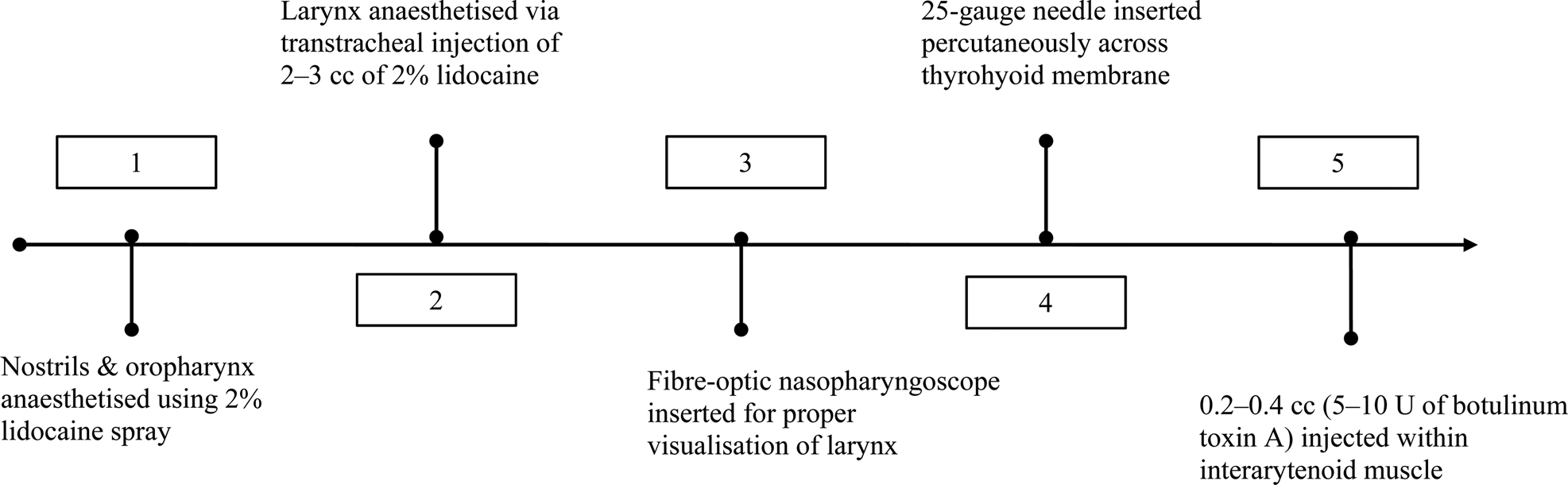
The technique used for interarytenoid muscle injection in this study is the same as that described by Fink et al. in their report on interarytenoid botulinum toxin A injection for recalcitrant vocal process granulomas.Reference Fink, Achkar, Franco and Song18 While the patient was in a seated position, the nostrils and oropharynx were anaesthetised using 2 per cent lidocaine spray, and the larynx was anaesthetised via a transtracheal injection of 2–3 cc of 2 per cent lidocaine. After diluting 100 U of botulinum toxin A in 4 cc of normal saline, a 0.2–0.4 cc syringe containing 5–10 U of the solution was injected within the interarytenoid muscle using a 25-gauge, 1.5-inch (3.81 cm) needle. The needle was inserted percutaneously just above the thyroid notch across the thyrohyoid membrane, and through the laryngeal lumen at the level of the petiole. While an assistant held the fibre-optic nasopharyngoscope for proper visualisation, the botulinum toxin was injected within the interarytenoid muscle under direct visualisation (Figure 1). Laryngeal electromyography was not used to confirm the position of the needle in the interarytenoid muscle.
Line diagram of percutaneous botulinum toxin A injection within the thyroarytenoid muscle.

Results
Demographics and prior therapies
A total of eight patients with unilateral vocal process granulomas were included in this study. The mean age of the subjects was 52.87 ± 16.29 years. Two patients were smokers. Five patients had a history of laryngeal manipulation. All patients had undergone prior treatment with proton pump inhibitors, one patient had received voice therapy, and one patient had a history of prior surgical resection of the vocal process granuloma (twice) under suspension microlaryngoscopy (Table 1). Four patients had a grade 1 lesion, two patients had grade 2 lesions, one patient had a grade 3 lesion and one patient had a grade 4 lesion.
Demographic data

SD = standard deviation; PPI = proton pump inhibitor
Response to injection and adverse events
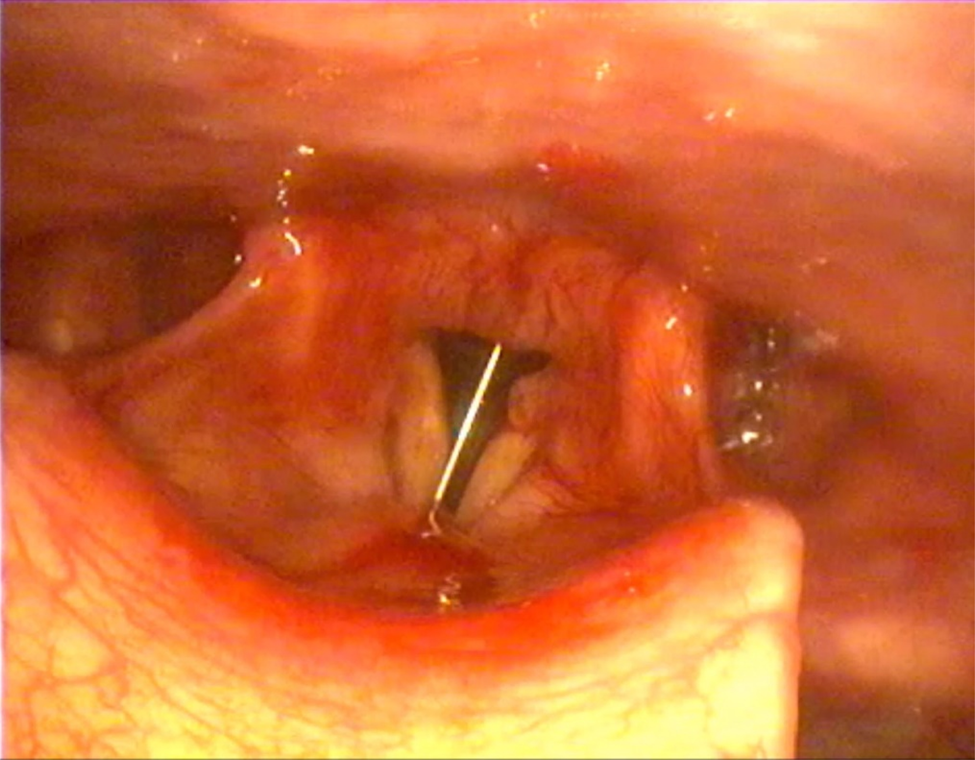
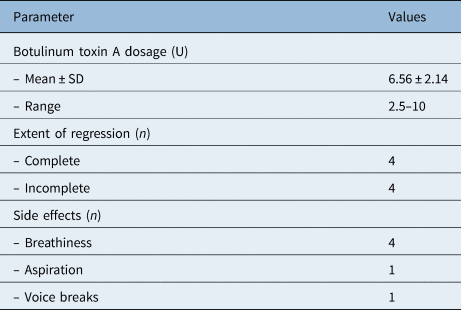
All eight patients underwent interarytenoid botulinum toxin A injection (Figure 2). The mean dosage of botulinum injected within the interarytenoid muscle was 6.56 ± 2.14 U, with a range of 5–10 U. One patient (with a grade 4 lesion) had botulinum additionally injected within the thyroarytenoid muscle (2.5 U), together with an intra-lesional methylprednisolone injection (3 mg).
Case of left vocal process granuloma with a 25-gauge needle directed towards the interarytenoid muscle.

During a follow-up period that ranged between three months and one year, four patients had complete resolution of the granuloma, and the remaining four had incomplete resolution or partial regression. It is important to note that the extent of regression did not depend on the extent of the lesion. Among those with incomplete regression, two had grade 1 lesions, and among those who had complete regression, one patient had a grade 3 lesion.
Adverse events were reported in four patients, namely breathiness (n = 4), aspiration (n = 1) and voice breaks (n = 1) (Table 2). Note that aspiration and voice breaks were present in patients who had breathiness.
Botulinum toxin A dosage, extent of regression and side effects

SD = standard deviation
Discussion
Vocal process granulomas are challenging conditions, both for patients and physicians. The slow response to medical treatment and the high recurrence rate after surgical removal have prompted the push for more radical interventions that address the basic pathophysiology of this disease entity. It is well known that the aetiology of vocal process granuloma is multifactorial. It starts with an insult to the vocal process overlying mucosa, which is followed by exposure of the denuded surface to a repeated stimulus that impedes healing and perpetuates inflammation.
Phonotraumatic behaviour in the form of voice abuse, overuse or misuse, and exposure of the laryngeal mucosa to gastric refluxate material, have been recognised as main culprits in the growth of these lesions. Mitigating the harsh glottal attack during phonation through chemodenervation of the adductor muscles has been suggested as a sound management strategy. Inducing a temporary paresis or weakening of the glottal attack creates a time window during which the contact between the vocal processes is reduced; this enables the lesion to heal and regress in size. Unlike anti-reflux medications and voice therapy where granuloma resolution occurs after several months,Reference Ylitalo and Lindestad1,Reference Emami, Morrison, Rammage and Bosch5 complete granuloma resolution has been observed as early as two weeks after botulinum toxin A injection within the adductor muscles.Reference Damrose and Damrose15
The efficacy of thyroarytenoid botulinum toxin injection in the treatment of vocal process granulomas was first supported by Nasri et al. in 1995 (Table 3).Reference Nasri, Sercarz, McAlpin and Berke12 The authors described a success rate of 100 per cent in a group of six patients. Four years later, de Lima Pontes et al. reported successful regression in three cases treated with botulinum toxin injection.Reference de Lima Pontes, De Biase and Gadelha10 In addition, Orloff and Goldman described complete lesion resolution in eight patients.Reference Orloff and Goldman13 Emami et al. reported the use of botulinum toxin in 3 out of 52 patients who had been followed up, and emphasised the importance of controlling for confounding aetiological factors such as reflux disease.Reference Emami, Morrison, Rammage and Bosch5 Yılmaz et al., in 2016, reported a success rate of 77 per cent in a series of 22 patients treated with bilateral botulinum toxin A injection within the thyroarytenoid and lateral cricoarytenoid muscles.Reference Yılmaz, Kayahan, Günaydın, Kuşçu and Sözen16 In 2018, Pham et al. described significant regression in the size of two vocal process granuloma lesions following office-based injection of botulinum toxin within the lateral cricoarytenoid muscle, thus alluding to the safety and effectiveness of this procedure.Reference Pham, Campbell, Mattioni and Sataloff17
Studies of botulinum toxin A injection for vocal process granuloma

*Three patients had simultaneous surgical excision. †One patient had simultaneous surgical excision; there was recurrence post-excision, which responded to a repeated injection. ‡Four patients had a simultaneous steroid injection, one patient had concurrent thyroarytenoid muscle and cricothyroid muscle botulinum toxin A injections, and one patient underwent simultaneous surgical excision. **One of the responders had a recurrent contact granuloma a year after the first injection, and he was treated in similar way with a good result. §Both cases were initially grade 3 granuloma that improved to grade 1. TA = thyroarytenoid muscle; LCA = lateral cricoarytenoid muscle; N/A = not available; SD = standard deviation
Despite the aforementioned advantages of thyroarytenoid and/or lateral cricoarytenoid botulinum toxin injections, the chemical paralysis induced by the botulinum toxin has its drawbacks, namely the phonatory and swallowing disturbances. In the studies by Nasri et al. and Damrose et al., all participants suffered from breathiness.Reference Nasri, Sercarz, McAlpin and Berke12,Reference Damrose and Damrose15 Similarly, in Orloff and Goldman's study, 90 per cent of the patients had breathiness.Reference Orloff and Goldman13
The high prevalence of dysphonia following thyroarytenoid botulinum toxin injections has led to an evolution in the management strategy of recalcitrant vocal process granulomas. As the interarytenoid muscle is an anatomically proven adductor of the posterior glottis,Reference Hillel, Maronian, Robinson, Waugh and Klotz11 Fink et al. postulated that the interarytenoid muscle is a good target for botulinum toxin injection in the treatment of affected patients.Reference Fink, Achkar, Franco and Song18 The authors reported successful interarytenoid botulinum injection in seven out of eight patients, and complete regression in five out of eight patients (55 per cent) (Table 3). The results of our investigation are in agreement with those of Fink et al. Fifty per cent of our patients had complete regression of their lesion and the other 50 per cent had partial regression. It is also important to note that only four out of the eight patients had an adverse effect, namely breathiness.
In summary, the use of interarytenoid injections has several advantages. For instance, it has a high success rate, as reported by Fink et al.Reference Fink, Achkar, Franco and Song18 and as shown in this study. This high success rate can be attributed to the fact that interarytenoid muscle contraction has a greater effect on the closure of the cartilaginous portion of the glottis than the thyroarytenoid muscle which adducts more efficiently. Another advantage is the low prevalence of breathiness in comparison to thyroarytenoid injections.
• This study investigated the effectiveness of botulinum toxin A injection within the interarytenoid muscle as an office-based procedure in vocal process granuloma cases
• Eight patients with unilateral vocal process granulomas were included
• The injection was performed using a percutaneous approach through the thyrohyoid membrane
• The extent of disease regression and the side effects were reported
• Interarytenoid botulinum toxin injection is a viable alternative for treating vocal process granulomas
This study is the second to shed light on the efficacy of interarytenoid botulinum injection for the treatment of vocal process granuloma. Nevertheless, it has its limitations. Firstly, there were a limited number of patients enrolled in this investigation. A larger number of participants are needed if we are to draw any conclusion regarding its effect in relation to the severity and grade of the lesion. The second limitation relates to the approach used, namely the percutaneous thyrohyoid approach. Obscure anatomical landmarks in the neck may preclude the ability to administer an interarytenoid muscle injection.
Conclusion
Given its high success rate, limited side effects and ease of performance, the authors of this manuscript advocate the use of interarytenoid botulinum toxin injection as a primary treatment modality for vocal process granulomas.
Competing interests
None declared