A preliminary note on radiocarbon dates
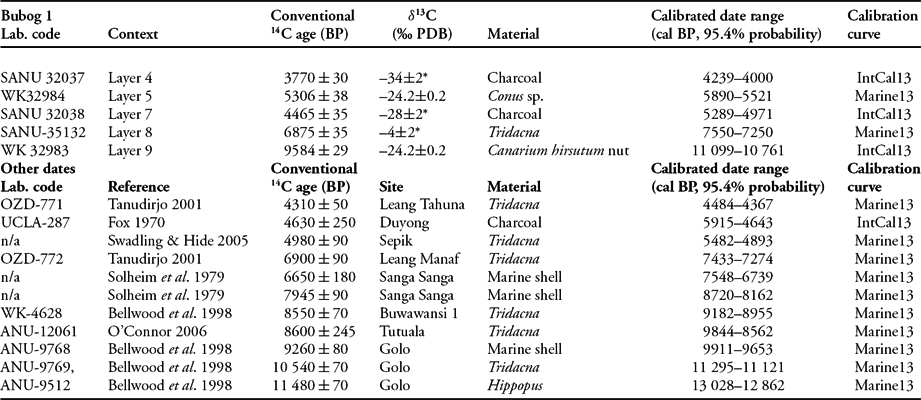
All radiocarbon dates in this paper, whether previously published or presented for the first time here, have been calibrated against either IntCal13 (terrestrial samples) or Marine13 (marine samples; Reimer et al. Reference Reimer, Bard, Bayliss, Beck, Blackwell, Ramsey, Buck, Cheng, Edwards, Friedrich, Grootes, Guilderson, Haflidason, Hajdas, Hatté, Heaton, Hoffmann, Hogg, Hughen, Kaiser, Kromer, Manning, Niu, Reimer, Richards, Scott, Southon, Staff, Turney and van der Plicht2013) in OxCal v.4.2 (Bronk Ramsey Reference Bronk Ramsey2009). The local ΔR (marine reservoir correction) is –14±76 14C years BP, derived from three pre-1950 shell samples from the Philippines (Southon et al. Reference Southon, Kashgarian, Fontugne, Metivier and Yim2002). Uncalibrated dates are given at 68.2% probability, and the 95.4% probability range of the calibrated dates is presented. Unfortunately, it is difficult to assess the accuracy of many dates because of limited publication.
Introduction
Molluscan shell artefacts are a prominent feature within Island Southeast Asia and Pacific prehistory (e.g. Fox Reference Fox1970; Asato Reference Asato1991; Bellwood Reference Bellwood1997; Kirch Reference Kirch1997; Szabó et al. Reference Szabó, Brumm and Bellwood2007). The most common, and probably best known, are the broad range of bracelets, earrings, discs and disc beads. These are fashioned from a variety of raw materials, including Melo, Trochus, Conus, Tridacna and Nassarius that predominantly date from c. 4000–3500 cal BP onwards (Szabó Reference Szabó2004), and they are often associated with the expansion of Austronesian-speaking people across the region (for discussion, see Bellwood Reference Bellwood1997; O’Connor & Veth Reference O’Connor and Veth2005; Bulbeck Reference Bulbeck2008).
Another mollusc shell artefact type commonly found across parts of Island Southeast Asia and the Pacific is the shell adze (Kirch & Weisler Reference Kirch and Weisler1994; Szabó Reference Szabó2004). These implements are generally manufactured from the body or hinge of large clamshells of Tridacna or Hippopus. It is generally thought that they began to be produced towards the end of the Pleistocene. The earliest direct dates of between c. 13 and 11 ka cal BP are from Golo Cave on Gebe Island, Moluccas (Bellwood Reference Bellwood1997). These shell adzes were mostly unmodified with the exception of ground cutting edges. Similar Tridacna shell adzes have been recovered from archaeological deposits in Pamwak Cave on Manus Island in the Admiralty Islands and dated to c. 10–7 ka cal BP (Spriggs Reference Spriggs1997: 59). A completely ground and shaped Tridacna shell adze was found embedded in the road surface near the township of Tutuala in East Timor (O’Connor Reference O’Connor, Bacus and Glover2006: 81). This specimen has a remarkably similar morphology to quadrangular Neolithic stone adzes (dating to after c. 4500 cal BP from Island Southeast Asia) in shape and form but has a direct radiocarbon date of 9844–8562 cal BP (ANU 12061, 8600±245 BP).
However, O’Connor (Reference O’Connor, Bacus and Glover2006: 81) recognised an inherent problem with directly dating shell adzes: the potential use in their manufacture of old shell from beach-collected raw material. Any radiocarbon assay taken directly is likely to reflect the time the mollusc laid down the carbonates in shell composition (see below), rather than the transformation of the shell into an artefact. This problem is compounded in the case of the Tutuala sample (and many others) by the fact that the artefact is a surface find without any reliable stratigraphic or chronological context that could securely anchor the adze to a particular timeframe for production (O’Connor Reference O’Connor, Bacus and Glover2006: 81).
Three further problems exist when dating Tridacna shell adzes. First, diagenetic alteration through, for example, recrystallisation, may introduce carbon of a different age to shell carbonate. Tridacna shells are composed of the aragonitic form of carbonate; however, calcite (the stable form of carbonate), under normal conditions, will form if recrystallisation occurs. It is possible to identify problematic calcites through X-ray diffraction prior to dating, and calcitic content can be recorded and its effects on potential radiocarbon dates assessed. Unfortunately, published dates are rarely accompanied by details of screening protocols, and it is impossible to determine whether radiocarbon assays may have been affected by diagenesis.
The other two problems may cause errors of hundreds rather than thousands of years. First, an effect similar to the ‘old-wood effect’ in charcoal will exist because Tridacna can live for several hundred years (Hardy & Hardy Reference Hardy and Hardy1969). Shell carbonate is not remodelled during the life of the animal, so a radiocarbon date will represent the 14C/12C ratio during shell formation, which may have occurred several hundred years before the death of the animal. Second, it is becoming increasingly apparent that ΔR (localised reservoir correction) is species-specific because of differing habitats and feeding strategies (Petchey et al. Reference Petchey, Ulm, David, McNiven, Asmussen, Tomkins, Dolby, Aplin, Richards, Rowe, Leavesley and Mandui2013). Petchey and Clark (Reference Petchey and Clark2011) suggest that a symbiotic relationship with zooxanthellae may reduce the reservoir effect in Tridacna shells but only by c. 100 14C years. Taken together, if diagenetic alteration has not occurred, a direct date on a shell adze almost certainly provides a maximum age for artefact manufacture.
Shell adzes are frequently found in the Philippine archaeological record, but problems of chronological accuracy and provenance exist. For example, a human burial from Duyong Cave on Palawan produced three shell adzes and a ‘gouge’ manufactured from the giant clam Tridacna gigas neatly aligned down either side of the body (Fox Reference Fox1970: 63, figs 19a & b). Charcoal found in the grave fill produced a 14C date of 5915–4643 cal BP (UCLA-287, 4630±250 BP) (Fox Reference Fox1970: 60). The validity of a date on charcoal in the backfill of a grave should be regarded with caution. Shell adzes from Balobok rockshelter on Tawi Tawi Island, southern Philippines, were argued to date to at least 7.5 ka cal BP (Spoehr Reference Spoehr1973; Ronquillo et al. Reference Ronquillo, Santiago, Asato and Kazuhiko1993); however, both the association between adzes and dates, and the stratigraphic and chronological integrity of the site have been disputed; it was argued that the artefacts could be considerably younger than originally reported (Spriggs Reference Spriggs1989).
As a result of the uncertainty surrounding the chronology of shell adzes in Island Southeast Asia (Spriggs Reference Spriggs1989, Reference Spriggs2011; Mijares Reference Mijares2008; Pawlik et al. Reference Pawlik, Piper, Faylona, Padilla, Carlos, Mijares, Vallejo, Reyes, Amano, Ingicco and Porr2014) and the almost complete lack of data on their manufacture and use contexts (but see Szabó Reference Szabó2004), we report on the discovery of a complete shell adze from the Bubog I rockshelter on Ilin Island off the coast of Mindoro, in the Philippines. In this paper, we confirm the early Middle Holocene production of shell adzes in the Philippines and present new data on morphological and functional analyses, in addition to placing shell adzes within the context of technological innovations within Island Southeast Asian prehistory. The initial timing for, and extent of inter-regional contact between, human populations inhabiting the various islands of Southeast Asia (including Wallacea) and Melanesia is an ongoing debate. A common view is that the establishment of the Lapita Cultural Complex in the Bismarck Archipelago, which ultimately resulted in migration and colonisation of the Pacific, led to the ‘opening up’ of lines of communication between the two regions. The recovery of obsidian from the Bismarck Archipelago in Sabah, Malaysian Borneo, dating to before 3000 cal BP, is one example of reverse interactions from Melanesia into Island Southeast Asia following the Austronesian expansion (Bellwood Reference Bellwood2013: 195). Others have advocated ‘interaction spheres’ across Southeast Asia, developing in the Late Pleistocene and expanding through the Holocene (see Solheim Reference Solheim2006; Soares et al. 2008; Rabett & Piper Reference Rabett and Piper2012). This included the emergence and spread of new belief systems, burial rites and modes of treating the dead (Lloyd-Smith Reference Lloyd-Smith2012). Bulbeck (Reference Bulbeck2008) identified the distribution of shell adze technologies from the southern Philippines to the Moluccas as one potential line of evidence supporting inter-island communication. Here, we re-evaluate the geographic distribution of Early to Middle Holocene shell adze technologies and argue that Tridacna adze manufacture supports early Middle Holocene transregional contact. Furthermore, this suggests that at least some potential down-the-line communication and interaction may have existed between the Philippines and Island Melanesia (via northern Wallacea) prior to the migration of Austronesian-speaking populations and the emergence of the Lapita Cultural Complex. (It should be noted that Melanesia is used to encompass Papa New Guinea (e.g. Sepik), while Island Melanesia is used to refer only to the lesser islands.)
Archaeological background to Bubog I
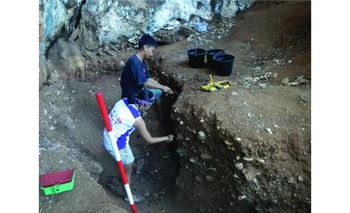
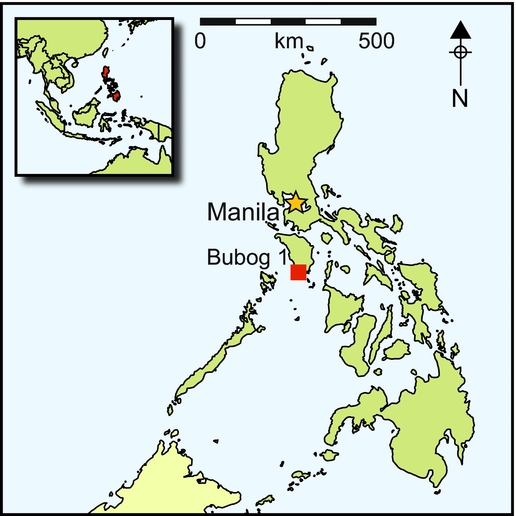
An interdisciplinary research project, established in 2010 by the University of the Philippines Archaeological Studies Program in collaboration with the University of Western Australia, the Australian National University and the National Museum of the Philippines, aimed to locate and record the early human colonisation of the Philippine archipelago. It further sought to identify how changes in landform and sea levels might have influenced the mobility of human populations, and how any early colonists might have adapted to, and utilised, the different local and regional ecologies they encountered. The initial phase of the project has focused on the Mindoro Occidental, where more than 40 cave and rockshelter sites have been identified during surveys (Porr et al. Reference Porr, Pawlik, Mijares, Piper and Padilla2012; Pawlik et al. Reference Pawlik, Piper, Faylona, Padilla, Carlos, Mijares, Vallejo, Reyes, Amano, Ingicco and Porr2014). Amongst these is Bubog I, a rockshelter located on the small island of Ilin, which is currently separated from south-west Mindoro by a 900–1300m-wide channel (Figure 1). Bubog I is situated on the south-eastern side of Ilin (facing Mindoro) at c. 30m above present sea level. Excavations in 2011–2013 produced evidence of a c. 1.4m-deep, well-stratified, human-derived shell midden (Figure 2). This midden sequence chronicled the palaeoenvironmental history of landscape change between Ilin and Mindoro from lakes and mangrove swamps during low sea levels at the end of the last glaciation, through shallow, intertidal marine environments to the development of ‘mature’ lagoon conditions by the later Holocene (Pawlik et al. Reference Pawlik, Piper, Faylona, Padilla, Carlos, Mijares, Vallejo, Reyes, Amano, Ingicco and Porr2014). The nine distinctive layers of midden deposition at Bubog I are anchored to an absolute chronology by four radiocarbon dates (Table 1).
Radiocarbon dates from Bubog 1 and other sites with shell adzes in Island Southeast Asia and Melanesia.

* δ13C is measured by AMS and used in age calculation. It is not equivalent to EA-IRMS measurement.
Map of Mindoro and Ilin Island with the location of archaeological sites found during surveys from 2010–2013; the Bubog sites are highlighted.

Sampling of the shells at the northern section of treasure-hunter pit 1. Note the large marine mollusc shells protruding from the upper stratigraphy of the profile.

The upper three layers of stratigraphy contained seven potsherds that postdate a radiocarbon date on charcoal from layer 4 of 4240–4081 cal BP (S-ANU 32037). A Conus sp. shell recovered from layer 5 returned a date of 5891–5525 cal BP (WK-32984). A charcoal fragment from layer 7 produced a slightly later date than layer 5, of 5290–4972 cal BP (S-ANU 32038). The sediments in the middle of the stratigraphy (between layers 4 and 9) are relatively thin and composed primarily of large gastropods and bivalves, and it is possible that some slight downward movement of charcoal, through the sequence, has occurred. A fragment of Canarium hirsutum from layer 9 at the base of the shell midden sequence produced a terminus post quem of 11 099–10 761 cal BP (WK-32983) for shell midden deposition. The shell adze was recovered from layer 8, a stratigraphic horizon that contained substantial numbers of the bivalve Geloina coaxans and gastropod Terebralia palustris, indicating a local estuarine/mangrove environment (Pawlik et al. Reference Pawlik, Piper, Faylona, Padilla, Carlos, Mijares, Vallejo, Reyes, Amano, Ingicco and Porr2014), rather than the open lagoon conditions preferred by giant clams. This implies the raw material for adze production was not sourced locally, but rather imported from elsewhere, although that ‘elsewhere’ may not necessarily have been very far away along the coasts of Mindoro.
The shell adze from Bubog I
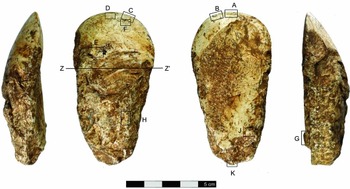
The shell adze was found during the 2013 excavations in a 0.6m × 0.8m sampled square (Figure 2) at 29.4–29.5m above sea level (Figure 3). Modern comparative analysis indicates that the raw material used was the hinge and fold of a giant clam, Tridacna (Figure 4).
Assembled south profile of the three joint treasure pits of Bubog 1. Layers 1–9) shell midden; layer 9a) anthropogenic transitional layer with crushed shells (trampling); layers 10–11) silty homogenous deposits, probably aeolian; layer 12) silty-clayey homogenous deposits, contains few small speleothem fragments.

The shell adze from Bubog I layer 8 with the use-wear traces illustrated in Figure 5 indicated.

The adze is trapezoidal in shape with a total length of 85.5mm, a width near the working edge of 45mm and a butt of 24mm. The implement has a maximum thickness of 27mm, and it weighs 90.2g. The slightly asymmetrical convex working edge has a radius of c. 23mm. The shell adze preform has been knapped and shaped to produce the desired elongated shape. Only the functional edge of the implement has been ground on both sides. Microscopic analysis indicates that the ground edge is almost completely intact with just a few isolated micro-scars with some slight edge-rounding damage evident (Figure 5a: Pos. A, 30× magnification). Regular striations close to the functional edge imply that the artefact was ground at a transverse angle to the shell's natural lamellar structure and that slight chamfering was applied to the immediate edge (Figure 5b: Pos. B & Figure 5c: Pos. C). Deeper, cross-cutting striations parallel to the tool's long axis are almost certainly use related (Figure 5d: Pos. D). Multi-directional coarse striations near the boundary between the ground and unground dorsal surface (indicated by line ZZ’ in Figure 4) might suggest that rejuvenation, through re-grinding and sharpening of the working edge, had occurred (Figure 5e: Pos. E). The re-sharpening process appears to have removed most of the potential use-wear traces from the blade, thereby restricting further interpretations related to functional use. Blackish residues along the edge are probably manganese dendrites precipitated on the surface after deposition (Figure 5f: Pos. F). There are several notable areas of abrasion and smoothing on the partially flaked ventral and dorsal surfaces and on the butt (Figure 5g: Pos. G; Figure 5h: Pos H; Figure 5j: Pos. J; & Figure 5k: Pos. K) that were probably caused by slight movements of the adze within its shaft during use. The overall shaping of the Tridacna artefact into a roughly conical shape at its distal end, and the evidence of hafting traces on all surfaces, might suggest that the implement was hafted in a socket-like receptacle in the shaft.
Microphotos of use-wear: a) Pos. A, isolated microscars and edge rounding; b) Pos. B, striations from grinding; c) Pos C, edge chamfering; d) Pos. D, cross-cutting use striations; e) Pos. E, multi-directional striations on dorsal, possibly rejuvenation; f) Pos. F, post-depositional dendritic residues; g) Pos. G, abrasive wear near the butt caused by hafting; h) Pos. H, abrasive wear on the dorsal surface caused by hafting; j) Pos. J, smoothed surface on the ventral surface, caused by hafting; k) Pos. K, smoothed surface on the butt, caused by hafting.

Dating the shell adze from Bubog I
Following micro-wear analysis, the shell adze was sent to the AMS Radiocarbon Laboratory at the Australian National University in Canberra for dating. A 14mg sample of carbonate was drilled from the adze after the removal of c. 4mm2 of the shell's surface (Figure 6). The sample was not chemically pre-treated, but X-ray diffraction screening was undertaken to determine what proportions of the shell matrix could influence the accuracy of any radiocarbon date through recrystallisation from aragonite to calcite.
The shell adze after 14C-dating, showing the sampling drill hole.

A direct date on the adze of 6875±35 BP, or 7550–7250 cal BP (S-ANU-35132), was obtained. The sample was found to contain 2.6±0.43 per cent calcite. If all of the re-crystallised carbonate was of modern origin, the date would shift to 7170±35 BP (7830–7500 cal BP). If the contamination was ‘fossil’ and contained no 14C, the date would be 6665±35 BP (7390–7000 cal BP). However, it is likely that much of the re-crystallisation occurred during the process of drilling the sample, where elevated temperatures resulting from friction have been observed to convert 5–20 per cent of a shell sample into calcite (Douka et al. Reference Douka, Hedges and Higham2010). If this is the case, the vast majority of the calcite observed in the tested sample is most likely derived from the drilling process, and the radiocarbon date is probably accurate without adjustment for calcitic content.
Whether or not the different levels of recrystallisation are taken into consideration, the direct date places the maximum age of the Tridacna artefact from Bubog I in the mid-sixth millennium BC. The security of this date is enhanced by the known recovery location of the shell implement within a well-dated and stratigraphically secure context that brackets the shell adze between c. 11 ka and c. 6 ka cal BP, indicating that adze manufacture almost certainly occurred in the timeframe suggested by the direct date—in the early Middle Holocene.
Discussion
The morphological and functional analysis of the shell artefact from Bubog I has demonstrated that it had been manufactured from the hinge and fold of the giant clam Tridacna. The shell fragment had been shaped by flaking to produce an elongated adze blade rough-out, and the end had been ground to manufacture a sharp working edge. Use-wear and micropolish on and around the modified butt indicates that this implement had almost certainly been parallel-hafted as a composite tool, and it can be considered a true adze blade.
Few microscopic use-wear studies have been conducted on fully ground and polished stone adzes, and none on edge-ground stone or shell adzes. Pawlik (Reference Pawlik2006) identified a use on wood as well as traces of transverse hafting for Neolithic adzes from Ille Cave, Palawan. Tsutsumi (Reference Tsutsumi2012) analysed 36 stone axes of different sizes and morphology from Hinshu Island, Japan. The larger specimens showed extensive wear traces consistent with heavy-duty woodworking activities, while the smaller axes were used for the processing of hide. Unfortunately, rejuvenation of the working edge of the Ilin shell adze has obliterated most of the potential use-wear traces, but the shell aragonite has a Mohs hardness of approximately 5, making it useful for numerous heavy-duty tasks including those identified for ground-stone adzes. It is possible that the development of adze technology reflects a more progressive use of wood as a building material, and as a response to changing environments at the end of the Pleistocene. Golson (Reference Golson, Pawley, Attenborough, Golson and Hide2005: 484) has even argued that the shell adze might be a specific innovation for use in the construction of maritime technologies.
The dating of the shell adze from Ilin has confirmed manufacture of these implements during the Middle Holocene in the Philippines. This encourages confidence in the antiquity of edge-ground shell adzes recovered from across the Philippines, Moluccas and in Melanesia. It provides unequivocal evidence that shell adze technology was an innovation several thousand years before the beginning of the Neolithic and the introduction of pottery, fully ground and polished stone tool types and many of the decorative shell ornaments that appear in the later Holocene (see Bellwood Reference Bellwood1997).
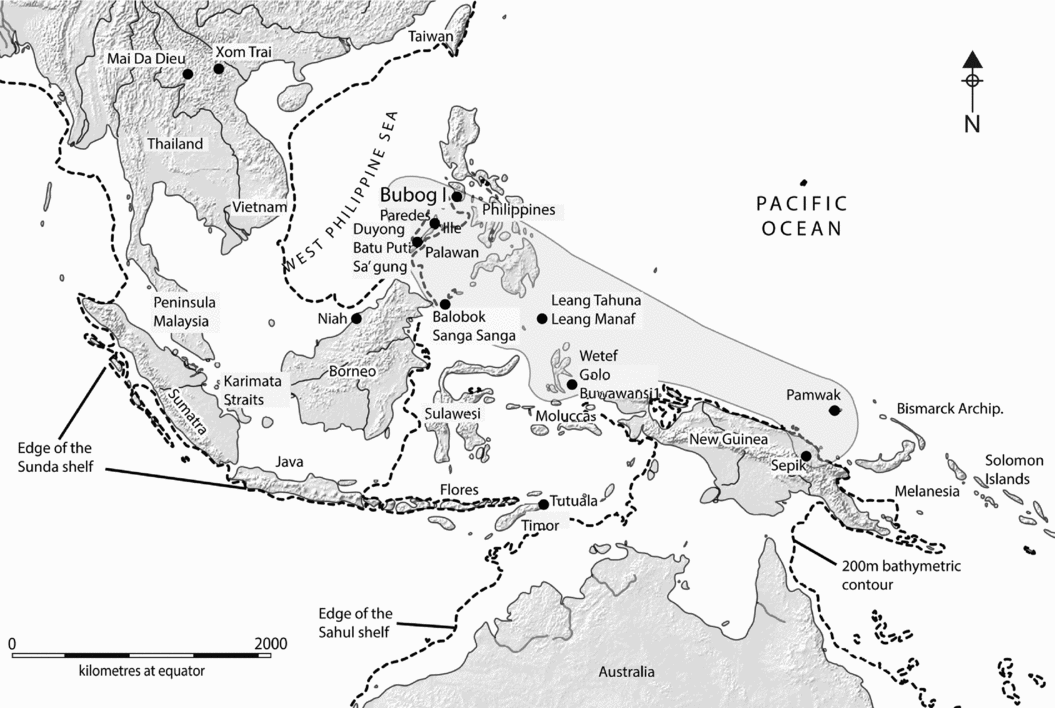
So, how and where did shell adze technology emerge, and how is it related to stone adzes? Edge-ground flaked and pebble tools occur in northern Australia and in Papua New Guinea, where the grinding of stone tools and adzes in association with ‘waisting’, for the attachment of the implement to a haft, can be traced back to the Late Pleistocene (Groube et al. Reference Groube, Chappell, Muke and Price1986; Morwood & Trezise Reference Morwood and Trezise1989; Bulmer Reference Bulmer, Pawley, Attenborough, Golson and Hide2005; Anderson & Summerhayes Reference Anderson and Summerhayes2008; Summerhayes et al. Reference Summerhayes, Leavesley, Fairbairn, Mandui, Field, Ford and Fullagar2010; Geneste et al. Reference Geneste, David, Plisson, Delannoy and Petchey2012). Pamwak, in the Admiralty Islands, where some of the earliest shell adzes have been identified, also produced edge-ground stone adzes from the same phases of occupation. At least one of these adzes was ‘waisted’, similar to those found in New Guinea (Figure 7; Spriggs Reference Spriggs1997: 59). At Pamwak, of the 16 Tridacna implements recovered, the majority were recovered from layer 2 and associated with four radiocarbon dates on charcoal and Celtis seeds of 5500–7000 cal years BP. Just two Tridacna adzes were identified in the top of layer 4, a deposit with six radiocarbon dates around 11 ka (Fredericksen et al. Reference Fredericksen, Spriggs, Ambrose, Smith, Spriggs and Fankhauser1993). A large Tridacna adze with a direct date of 5482–4893 cal BP (no lab. code provided, 4980±90 BP, calibration assumes a ΔR of 70±60 14C years (McGregor et al. Reference McGregor, Gagan, McCulloch, Hodge and Mortimer2008)) was recovered in the Sepik Region of New Guinea (Swadling & Hide Reference Swadling, Hide, Pawley, Attenborough, Golson and Hide2005: 291).
The geographic distribution of archaeological sites referred to in the text that have produced shell adzes dating from the Terminal Pleistocene/Early to Middle Holocene across Island Southeast Asia and Melanesia (background map by Multimedia Services, ANU, details added by the authors).

Two shell adzes, one produced from Tridacna and the other from Hippopus, from Golo Cave on Gebe Island, have been directly dated to 11 925–11 121 cal BP (ANU-9769, 10 540±70 BP) and 13 028–12 862 cal BP (ANU-9512, 11 480±70 BP). However, they were recovered from within deposits above a layer with a date on an unspecified marine shell species of 9911–9653 cal BP (ANU-9768, 9260±80 BP; Bellwood et al. Reference Bellwood, Nitihaminoto, Irwin, Gunadi, Waluyo, Tanudirjo and Bartstra1998: 239), raising the possibility that they were produced using ‘old’ shell. Another displaced Tridacna adze from Buwawansi 1 on Gebe was also directly dated to 9182–8955 cal BP (WK-4628, 8550±70 BP). Based on direct and associated dates, together with the stratigraphic locations of the artefacts, it is perhaps more likely that adze manufacture in Island Melanesia and the Moluccas, as in the Philippines, was an Early Holocene innovation rather than Late Pleistocene as suggested by Fredericksen et al. (Reference Fredericksen, Spriggs, Ambrose, Smith, Spriggs and Fankhauser1993).
Two edge-ground Tridacna adzes were identified at Leang Tahuna on Merampit Island, south-east of Halmahera, and at Leang Manaf on Sanana. These returned direct dates on the shell of 4484–4367 cal BP (OZD-771, 4310±50 BP) and 7433–7274 cal BP (OZD-772, 6900±90 BP) respectively, indicating a Middle to Late Holocene manufacture (Tanudirjo Reference Tanudirjo2001). No archaeological sites in Wallacea have produced any evidence of edge-ground stone artefacts at this early date.
The Philippines currently represent the western geographic limits of the distribution of potential Early to Middle Holocene shell adzes (Figure 7). Within this region, the only site to have produced edge-ground stone artefacts is Sa’gung rockshelter in central Palawan (Kress Reference Kress and Paz2004). Although undated, the Sa’gung implements were associated with tightly flexed burials, a technique of interment common across the Sunda Shelf region of Island Southeast Asia in the Early to Middle Holocene (see Lloyd-Smith Reference Lloyd-Smith2012).
Beyond the examples of shell adzes from Bubog I, Duyong and Balobok rockshelters (see above), two shell adzes similar to those found at Duyong were recovered from shallow, disturbed deposits in Bato Puti, a cave on Lipuun Point, Palawan (Fox Reference Fox1970). Fox associated these with the ‘Neolithic’ burials identified in the cave, although no definite stratigraphic or chronological correlations were evident. A Tridacna ‘tool’ was also recovered from a grave in Paredes rockshelter, which is associated with two fully flexed inhumations and one supine burial (Fox Reference Fox1970). Shell adzes have also been reported from Sanga Sanga Island, in the Sulu Sea, in aceramic layers with associated radiocarbon dates on unspecified marine shell species of 7548–6739 cal BP and 8720–8162 cal BP (6650±180 and 7945±90 BP, Solheim et al. Reference Solheim, Legaspi and Neri1979; no lab. codes provided).
Some differences exist in the techniques used in the production of those adzes found in the Philippines, which are generally produced on the shell hinge, while those from the Moluccas and Island Melanesia are generally created from a single fold. The bevelled edges of those produced from the hinge are straight, whereas those from a single fold in the shell are curved, suggesting that they might have served slightly different technological functions (Szabó Reference Szabó2004). Nevertheless Szabó (Reference Szabó2004: 343) considered that the Tridacna and Hippopus shell adzes—recovered from the Philippines through eastern Indonesia to Melanesia—represent a single, related tradition, rather than independent innovations.
The only two adzes produced on the hinge of the giant clamshell found in Melanesia are an example from an Early Holocene context at Pamwak, and the large Tridacna implement recovered in the Sepik Region of New Guinea and dated to around 5000 cal BP. The appearance of these hinge adzes in Melanesia coincides, time wise, with the production of similar Tridacna adze implements in the western Philippines.
Current chronologies suggest, therefore, that the manufacture of shell adzes either developed from pre-existing edge-ground stone technology in Near Oceania, or as an independent innovation in eastern Indonesia or Island Melanesia during the Early Holocene, before spreading west as far as the western Philippines by the early Middle Holocene. Bellwood (Reference Bellwood1997: 189) has argued that the distribution of shell adzes in eastern Indonesia and Melanesia possibly indicated some inter-regional contact. The complete geographic distribution of shell adzes would imply a capacity for inter-island voyaging, and at least some down-the-line contact between Island Melanesia and the Philippines by the Middle Holocene, if not earlier (Solheim Reference Solheim2006: 121–24).
In support of this proposed inter-regional contact, there is evidence for substantial human mobility and the development of ‘spheres of interaction’ across Island Southeast Asia beginning in the terminal Pleistocene and Early Holocene (see Bulbeck Reference Bulbeck2008; Soares et al. Reference Soares, Trejaut, Loo, Hill, Mormina, Lee, Chen, Hudjashov, Forster, Macaulay, Bulbeck, Oppenheimer, Lin and Richards2008), and expanding geographically during the Middle Holocene. This includes technological innovations in bone artefact manufacture that may have their origins in northern Borneo and parts of Wallacea, before appearing more widely across the region by the Middle Holocene (Rabett & Piper Reference Rabett and Piper2012). The movements of economically important plants and knowledge of their management strategies from Melanesia into Island Southeast Asia started, perhaps, during the Early Holocene (Barker & Richards Reference Barker and Richards2012; Denham Reference Denham2013); and the translocation of some animals from large islands with diverse faunas to depauperate small offshore islands had possibly begun in Island Melanesia already in the Late Pleistocene, before becoming a more widespread phenomenon by the Middle Holocene (Allen et al. Reference Allen, Gosden and White1989; Heinsohn Reference Heinsohn2003).
Conclusion
Excavation at the site of Bubog I on Ilin Island has produced a well-stratified edge-ground Tridacna shell adze. Use-wear analysis has demonstrated that this artefact was parallel-hafted into a composite tool with a ground and polished working edge, and it fits the technological description of a true adze. Re-sharpening of the working edge has obliterated most edge-wear traces; however, the rejuvenation of the adze implies use over a considerable time. The timing for its manufacture has been securely anchored to the early Middle Holocene by a sequence of associated dates on charcoal and a direct radiocarbon date on the implement itself of 7550–7250 cal BP.
At present, the Bubog I shell adze represents the earliest well-stratified and securely dated shell adze in Island Southeast Asia, although it is unlikely to remain the earliest. Several specimens from sites in the Wallacean islands (Golo Cave, Gebe Island) and Melanesia have been identified in Early Holocene contexts and are almost certainly older than those recorded in the Philippines. What they and the Ilin shell adze tell us is that this form of composite shell-organic tool technology was already present across Island Southeast Asia and Near Oceania by the early Middle Holocene and cannot, therefore, be a local variant on the fully ground and polished stone adzes that are only recorded in the later Holocene, and possibly introduced from Mainland Southeast Asia after c. 4500–4000 cal BP (see Bellwood Reference Bellwood1997: 202). What is perhaps more likely is that composite shell adze technologies were a local innovation in Island Melanesia or eastern Indonesia, possibly stemming from edge-ground stone technologies that are evident across parts of the region from the Late Pleistocene onwards.
Traditionally, it is believed that voyaging and contact between the Philippines and Island Melanesia occurred during the later Holocene, after 3500 cal BP, with the migration of Austronesian-speaking peoples and the appearance in Near Oceania of the Lapita Cultural Complex (see Kirch Reference Kirch1997; Bellwood Reference Bellwood2013). The geographic distribution of shell adze technology suggests, however, that contacts between eastern Indonesia, the Philippines and Near Oceania might have already been established several thousand years earlier, during the Middle Holocene.
Acknowledgements
We would like to acknowledge the contribution of the following people and institutions for the successful conduct of the project so far: Director Jeremy Barns and Angel Bautista of the National Museum of the Philippines; the Mayor of San Jose, Hon. Romulo Festin; and the administrative personnel of San Jose and the Barangay Pawikan. This research is supported by an Emerging Interdisciplinary Research Grant from the University of the Philippines, OVPAA, Code no. 2-002-1111212. The fieldwork in 2013 was funded by the National Geographic Society and its Global Exploration Fund (GEFNE 62-12). A University of the Philippines Diliman OVCRD Outright Research Grant (131316-PNSE) funded the research of Alfred Pawlik. An ARC Future Fellowship Grant FT100100527 funded the research of Philip Piper.