Introduction
Cardiovascular diseases (CVD) are the leading cause of death in Europe and around the world (Nichols et al., Reference Nichols, Townsend, Scarborough and Rayner2014), CVD were the leading cause of death in Germany, comprising 39.7% and a total of 354,493 deaths in 2013 (Debus et al., Reference Debus2013). Heart failure (HF) is a condition caused by a number of CVD and is primarily exhibited by the elderly (Uemura, Reference Uemura1988; Peeters et al., Reference Peeters, Mamun, Willekens and Bonneux2002; Ramsay et al., Reference Ramsay, Whincup, Papacosta, Morris, Lennon and Wannamethee2014). Its prevalence is increasing and an estimated 15 million people in Europe are affected by this disease (Ewen et al., Reference Ewen, Mahfoud and Böhm2015). Epidemiological data show that when considering a steadily aging population and assuming a stable incidence in people over 65 years, a doubling of the incidence of HF is expected compared to the interval 2000 to 2040 (Edelmann, Reference Edelmann2015).
HF is characterized by clinical signs of insufficient cardiac activity such as shortness of breath, fatigue, and fluid retention, an increased incidence of arrhythmias and a reduced quality of life and poor prognosis (Ewen et al., Reference Ewen, Mahfoud and Böhm2015). These impairments can be associated with depression (Heßlinger et al., Reference Heßlinger2002). Notwithstanding, depression symptoms are associated with increased risk for HF in a dose response manner. They can trigger extracardiac events which cause HF, such as neurohormonal stress activity, which regulates blood pressure, heart rate, proinflammatory cytokine, and catecholamine levels (Edelmann, Reference Edelmann2015; Ewen et al., Reference Ewen, Mahfoud and Böhm2015). Further, depression symptoms influence other risk factors for HF, in particular, obesity and reduced physical activity (Gustad et al., Reference Gustad, Laugsand, Janszky, Dalen and Bjerkeset2014).
Despite the high prevalence rates, the individual burden, cost, and negative prognostic impact, depression is often not recognized and treated in patients with HF (Müller-Tasch et al., Reference Müller-Tasch2007). Studies concerning the prospective association between depression risk and HF are rare (Gustad et al., Reference Gustad, Laugsand, Janszky, Dalen and Bjerkeset2014) especially in primary care practices. There is a lack of knowledge, specifically relating to the frequency of mental disorders such as depression in patients in primary care practices as well as to how often they are associated with somatic disorders like HF (Pieper et al., Reference Pieper, Schulz, Klotsche, Eichler and Wittchen2008). Therefore, the goal of this study was to estimate the prevalence of and risk factors for diagnosed depression in HF patients in German primary care practices.
Methods
Database
The Disease Analyzer database (IMS HEALTH) compiles drug prescriptions, diagnoses, basic medical, and demographic data obtained directly and in anonymous format from computer systems used in the practices of general practitioners (Becher et al., Reference Becher, Kostev and Schröder-Bernhardi2009). Diagnoses (ICD-10), prescriptions (Anatomical Therapeutic Chemical (ATC) Classification System), and the quality of reported data have been monitored by IMS based on a number of criteria (e.g. completeness of documentation, linkage between diagnoses and prescriptions). In Germany, the sampling methods used for the selection of physicians' practices were appropriate for obtaining a representative database of primary care practices (Becher et al., Reference Becher, Kostev and Schröder-Bernhardi2009). Prescription statistics for several drugs were very similar to data available from pharmaceutical prescription reports (Becher et al., Reference Becher, Kostev and Schröder-Bernhardi2009). The age groups for given diagnoses in Disease Analyzer were also consistent with those in corresponding disease registries (Becher et al., Reference Becher, Kostev and Schröder-Bernhardi2009).
Study population
This study included patients between 40 and 90 years of age from 1,072 primary care practices who received a first HF diagnosis (ICD 10: I50) during the index period (January 2004 to December 2013). Follow-up lasted up to five years and ended in April 2015. Patients were excluded when they were diagnosed with depression (ICD-10: F32, F33) or received any antidepressant prescription (ATC: N06A) within 12 months prior to HF diagnosis (index date). A total of 66,497 HF patients were selected after applying these exclusion criteria. Finally, 66,497 controls without HF, depression diagnosis or antidepressant prescriptions within 12 months prior to index date (any random selected visit date) were chosen and matched (1:1) to HF patients by age, sex, type of health insurance (private or statutory), depression diagnosis in the past (more than 12 months prior to index date), and follow-up duration after index date.
Study outcome
The primary outcome was the diagnosis of depression recorded in the database between the index date and the end of follow-up. Depression diagnoses were based on primary care documentation. Depression diagnoses documented by primary care physicians are mainly confirmed by psychiatrists.
Statistical analyses
Descriptive statistics were obtained and differences in characteristics of patients (HF vs. controls) were assessed using Wilcoxon tests for paired samples or McNemar's tests. The analyses of depression-free survival were carried out using Kaplan–Meier curves and log-rank tests. Cox proportional hazards models (dependent variable: depression) were used to adjust for confounders. Other chronic conditions which could be associated with depression risk were determined based on primary care diagnoses and included as confounders. They include the following: diabetes mellitus (E10-14), hypertension (I10), dementia (F01, F03, G30), stroke (F63, F64, G45), coronary heart disease (I24, I25), myocardial infarction (I21-23), osteoporosis (M80, M81), cancer (C00-C98), osteoarthritis (M15-19). p-values < 0.05 were considered as statistically significant. The analyses were carried out using SAS version 9.3.
Results
Patient characteristics
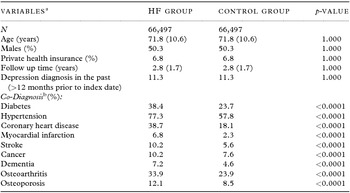
Patient characteristics are displayed in Table 1. A total of 132,994 participants were included in both HF and control groups. Mean age was equal to 71.8 years (SD 10.6 years) and 50.3% of patients were men. 6.8% of patients and matched controls had private health insurance coverage. The proportion of patients with prior depression diagnosis (>12 month prior to index date) was 11.3% in both groups. Diabetes, hypertension, coronary heart disease, myocardial infarction, stroke, cancer, dementia, osteoarthritis, and osteoporosis diagnoses were more frequent in the HF group than in the control group (p < 0.001).
Characteristics of heart failure patients and matched controls in German primary care practices

a Data are means (SD) or proportions (%).
b Diagnosis prior to index date.
Proportion of patients with depression diagnosis
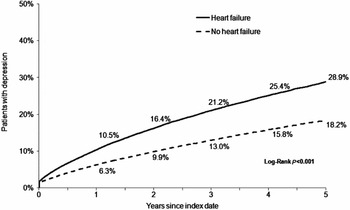
Kaplan–Meier curves for time to depression diagnosis in HF and control groups are displayed in Figure 1. A total of 10.5% of HF patients and 6.3% of matched controls developed depression after one year of follow-up (p < 0.001). Depression diagnoses were presented in 28.9% of the HF group and 18.2% of the control group after the five-year follow-up (p < 0.001).
Kaplan–Meier curves for time to depression diagnosis in heart failure patients and matched controls.

Risk factors for depression diagnosis
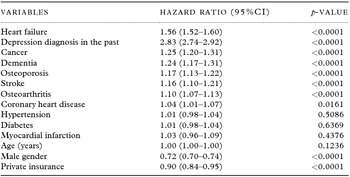
The results of the multivariate Cox regression model for depression diagnosis in HF patients and matched controls are illustrated in Table 2. HF was a strong risk factor for depression development (HR: 1.56, p < 0.0001). As was anticipated, prior depression episodes also increased the risk of renewed depression diagnosis (HR: 2.83, p < 0.0001). Furthermore, cancer (HR: 1.25), dementia (HR: 1.24), osteoporosis (HR: 1.17), stroke (HR: 1.16), and osteoarthritis (HR: 1.10) were associated with a higher risk of developing depression (p-values < 0.0001). By contrast, male gender (HR: 0.72) and private health insurance (HR = 0.90) were associated with lower risk of depression.
Multivariate Cox regression model for depression diagnosis in heart failure patients and matched controls

Discussion
Cardiovascular disorders (including HF) are in general associated with depressive disorders (Bleumink et al., Reference Bleumink2004; Pieper et al., Reference Pieper, Schulz, Klotsche, Eichler and Wittchen2008; de Hert et al., Reference De Hert2011). In this study, we observed that HF is significantly associated with depression risk. Our results are consistent with previous research exhibiting an increased prevalence of depression among HF patients (Bleumink et al.; Reference Bleumink2004, Pieper et al., Reference Pieper, Schulz, Klotsche, Eichler and Wittchen2008). The results of this study further indicated that the proportion of HF patients with depression continually increased over the five years of follow-up. Polikandrioti et al. were also able to show that longer duration of the condition was associated with a higher probability of being depressed (Polikandrioti et al., Reference Polikandrioti2015). This can be attributed to the fact that functional limitations in patients with HF increase with a longer duration and a higher degree of HF severity. This in turn can lead to an increased prevalence of depressive symptoms and depression development (Bleumink et al., Reference Bleumink2004).
In accordance with international results, the risk of depression in women is greater than in men (Pieper et al., Reference Pieper, Schulz, Klotsche, Eichler and Wittchen2008). Current outcomes from the DEGS study (Study on Adult Health in Germany) showed that women are affected by depression twice as often as men (w: 10.2%; m: 6.1%) (Busch et al., Reference Busch, Maske, Ryl, Schlack and Hapke2013). Our study likewise indicated that male gender was associated with a lower risk of depression. It is interesting to note that we observed that study subjects with private health insurance coverage have a lower risk of developing depression. Although a correlation with social status likely exists, no information pertaining to this criterion is available to explain the result.
In the present study, a positive association was indicated between depression and the aforementioned chronic conditions. Comorbidities such as cancer, dementia, osteoporosis, stroke, and osteoarthritis are associated with a greater chance of developing depression. These results correspond to prior research. Cancer patients experience a three-fold higher rate of depression than the general population within the first five years of diagnosis (Currier et al., Reference Currier and Nemeroff2014). Depression is also an important precursor to dementia. In this context, dementia was associated with significantly higher rates of depression (Snowden et al., Reference Snowden2015) and depression has been shown to be associated with dementia and cognitive decline (Rapp et al., Reference Rapp2006; Rapp et al., Reference Rapp2011). Increased rates of depression can be observed in patients with osteoporosis. A pathophysiological mediation is also discussed for the relationship between depression and osteoporosis (Pieper et al., Reference Pieper, Schulz, Klotsche, Eichler and Wittchen2008). Stroke is a risk factor for the development of depression (Petersson et al., Reference Petersson, Mathillas, Wallin, Olofsson, Allard and Gustafson2014). Depression is highly prevalent after stroke, and is also associated with the presence of stroke risk factors such as hypertension (Pieper et al., Reference Pieper, Schulz, Klotsche, Eichler and Wittchen2008). On the one hand, a bidirectional connection can be established for stroke, since patients who are suffering from a depressive disorder have an increased risk of cerebrovascular events. On the other hand, depressive syndromes after stroke can be frequently observed (Hellmann-Regen et al., Reference Hellmann-Regen, Regen, Heuser, Endres and Otte2014). Osteoarthritis is the most common type of arthritis among older adults. Increased rates of depression can be observed in patients with osteoarthritis (Albrecht, Reference Albrecht2014). It is assumed that depression is an indirect consequence in terms of a response to a feared or actual disability by means of a somatic disorder. Finally, the risk of depression increases steadily with the number of comorbid diseases (Pieper et al., Reference Pieper, Schulz, Klotsche, Eichler and Wittchen2008).
In general, retrospective primary care database analyses are limited by the degree of completeness of the data on which they are based. The major limitation is related to the diagnoses performed by primary care physicians, as depression cannot be fully diagnosed. Unfortunately, additional data on the depression diagnoses was lacking and in diagnosed patients no information was available regarding the extent to which the diagnoses were made, for example, whether they were made solely on a clinical basis or by means of additional validated questionnaires. Detailed information on the severity of the depression was also lacking. Data on socioeconomic status (e.g. education, income) and lifestyle-related risk factors (e.g. smoking, alcohol, physical activity) were lacking, which is a probable explanation for the relationship between insurance status and depression.
In conclusion, HF was a strong risk factor for depression development. Overall, it should be noted that individuals with depression and HF have shorter life expectancies compared to the general population (Lederbogen et al., Reference Lederbogen, Schwarz, Häfner, Schweiger, Bohus and Deuschle2015). The current findings also indicate that improved detection and treatment of patients with HF and depression is of importance. For this purpose, it is necessary to educate more primary care physicians on how to properly detect the symptom overlap between these two disorders. Sustainable supply concepts are required for an aging society in primary care practices in view of the complex treatment needs of an increasing number of chronically ill and multimorbid patients (Lübeck et al., Reference Lübeck, Beyer and Gerlach2015). Therefore, further research is of high relevance.
Conflict of interest
None.
Description of authors’ roles
Marcel Konrad co-wrote the article. Jens Bohlken participated in formulating the research questions, co-designed the study, and provided his medical expertise. Michael A Rapp participated in formulating the research questions and provided his medical expertise. Karel Kostev participated in formulating the research questions, co-designed the study, analyzed the data, and co-wrote the paper.
Acknowledgments
Professional English language editing services were provided by Claudia Jones, MA, Radford, Virginia, United States.