INTRODUCTION
Since 2004, excavations have been conducted on the site of a Late Geometric apsidal temple (probably dedicated to Poseidon Heliconius, the patron deity of ancient Helike) on the property of A. Komninos and D. Karachalios at Nikoleika near Aegion. An overview of the excavations is given by Erophile Kolia in this volume. Among the discoveries have been the fragments of a terracotta model depicting the roof of a small temple or naiskos, which is the subject of this article; the fragments themselves are described in the following section.
A. CATALOGUE OF FRAGMENTS
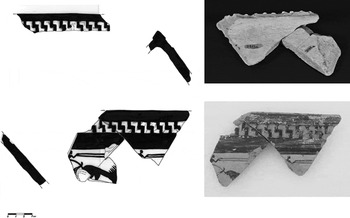
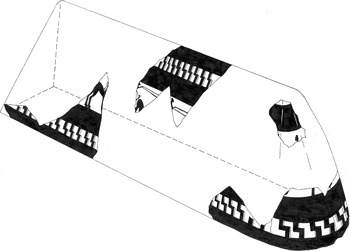
Α: Αegion Archaeological Museum (AMA) 2170a and 2313a(Fig. 1). Section of a pitched roof, restored, preserving the roof ridge. Preserved height 0.085 m, width 0.145 m. Decorated in a combination of painted and impressed techniques. On side A, in a reserved field 0.04 m deep, two charioteers are depicted facing to the right. One preserves the face and the upper torso, with the hands outstretched denoting movement, and holding the reins of the horse. A small part of the chariot survives (the edge of one wheel and the pole connecting the chariot to the horse). The other preserves the head, left shoulder and the hands holding reins in the same manner as the first charioteer. The top of the scene is defined by a black-glaze band (0.02 m wide) with a zone of impressed zigzag lines above it (0.015 m deep). To judge from traces of impressed zigzag lines, there was probably a zone of corresponding height and decoration below the scene as well. Black glaze is preserved on the two parts of the ridge, while the impressed zigzag lines are repeated on the surviving part of side B.
Fragment Α. Αegion Archaeological Museum (AΜΑ) 2170a and 2313a.

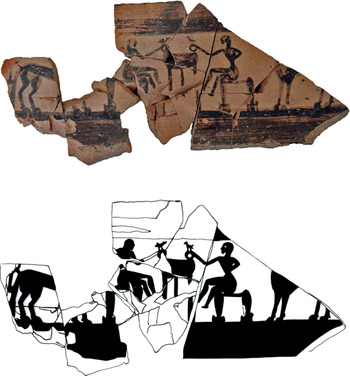
Β: ΑΜΑ 2018(Fig. 2). Section of a pitched roof restored from sherds. On side B, two identical nude males seated on stools (diphroi) are depicted in a reserved field (0.055 m deep, preserved width 0.23 m). The legs of the stools are short with marked curvature in the upper part, and are supported upon two objects with elevated sides. A tripod set between the figures has circular handles embellished with confronted standing birds. The two figures touch the tripod with their right hands: their left arms are bent with the hand resting on the waist. Their legs do not touch the ground. The lower forequarter and all four legs of a horse are preserved behind the right seated figure, while behind the left are parts of a horse and of the pole of the chariot to which it was tethered. It therefore seems that there was a one-horse chariot behind each seated figure, corresponding to, but larger than, the horses of the chariot race depicted on the other side of the roof. The reserved field is defined by two parallel black-glaze bands (0.025 m wide).
Fragment Β. ΑΜΑ 2018.

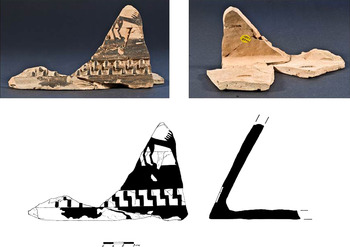
C: ΑΜΑ 2170b, 2313b and 2018b(Fig. 3). Section of the base and sloping side, restored from eight sherds. Preserved height 0.092 m; width 0.172 m. A band of black glaze (0.015 m deep) runs around the bottom, above which is a zone (0.017 m deep) of impressed vertical zigzag lines, followed by a second black-glaze band (0.022 m deep). Immediately above this band, part of a horse from the chariot race is visible, namely the haunches, the hindquarters and the back legs, part of one front leg and part of the mane, drawn so as to convey motion.
Fragment C. ΑΜΑ 2170b, 2313b and 2018b.

On the lower surface, not designed to be seen, a rebate may indicate that the roof fitted onto the lower part of the model (now missing). Traces of black paint at the edge of one sherd probably indicate that this part was visible, and consequently that the horses moved towards the right, as suggested for fragment A (Figs. 5, 6).
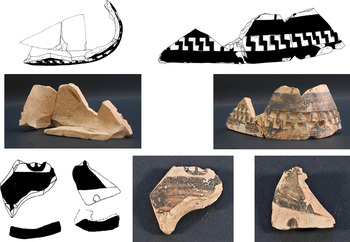
D: ΑΜΑ 2313c, d, e and 1993(Fig. 4). Section of the back of the model (with pronounced curvature) restored from six smaller fragments (two from the base and four from the side and back). Height 0.065 m; width 0.16 m. A band of black glaze (0.016 m deep) runs around the bottom, above which is a zone (0.02 m deep) of impressed vertical zigzag lines, followed by a second black-glaze band (0.022 m deep). Immediately above the upper band are traces of figure decoration in a reserved zone: part of one wheel and one vertical line can be discerned, perhaps from a chariot race. In another part of the reserved field, one slightly curved sherd (2313d) preserves traces of a wheel and another (2313e) the top of a head, probably of a charioteer: the latter is restored higher on the back of the roof, in the same zone as the charioteers on fragment A (Fig. 5). Fragments C and D come from the sides and the curved back of the roof, and not from the lower part of the model (the surviving fragments preserve no transitional features) (Fig. 5).
Fragment D. ΑΜΑ 2313c, d, e and 1993.

Possible reconstruction of the roof model. Side A.

Since the excavation is still in progress and our fragments were found scattered at various points of the temple, it remains possible that the model has a lower part yet to be found. We cannot assume that only the roof was dedicated. Should fragments of the lower part come to light, the model would then resemble that from the Argive Heraion, which consists of two separate parts, the roof and the building proper (Oikonomou Reference Oikonomou1931, figs. 2–15).
B. THE CIRCUMSTANCES OF DISCOVERY
The fragments of the model were found dispersed to the east and southeast of the mud-brick altar which lies roughly in the centre of the later apsidal temple (see Kolia, this volume). Other fragments probably lie under the north wall of the first phase of the temple (see Kolia, this volume, fig. 12). The model was dedicated together with several other objects before the temple was built and when the mud-brick altar was the focus of cult. Its date, no earlier than 725 bc, thus gives a terminus post quem for the construction of the apsidal temple. The mud-brick altar was incorporated into the later building (Kolia and Gadolou Reference Kolia and Gadolou2007, 72; Kolia, this volume), and the temple floors elevated at the point where the altar stands (see Kolia, this volume, fig. 21). This is explicable in terms of the importance of this particular feature – the temple builders used the altar as a building foundation (Wells Reference Wells, Hägg, Marinatos and Nordquist1988). The excavation data do not allow us to assume such importance for the model. Its discovery in fragments in several places reflects a post-depositional phenomenon rather than a deliberate ceremonial act.
C. TECHNICAL CHARACTERISTICS AND IDENTIFICATION
The clay, fine grained with minimal inclusions, light red (2.5YR 7/6) to yellowish red (5YR 7/6), is consistent with the known categories used in Late Geometric Achaean pottery workshops,Footnote 3 as are the black glaze and pinkish buff (5YR 8/2) slip. These characteristics, combined with the use of the impressed techniqueFootnote 4 for specific filling motifs, confirm that our model is an Achaean product of the eighth century bc. This is corroborated by the figure drawing, which is clearly different from that of other workshops in the Peloponnese.
The Nikoleika model belongs within a tradition of Geometric building models, and adds to those known from the Argive Heraion, the Heraion at Perachora, Sparta, Ithaca and Samos.Footnote 5 At the same time, it belongs within a local Achaean tradition of model-making evident in both the sanctuary at Nikoleika (Kolia and Gadolou Reference Kolia and Gadolou2007) and that of Artemis Aontia at Ano Mazaraki of the same period (Petropoulos Reference Petropoulos2002, 143–60, pl. 3; Gadolou Reference Gadolou2003, 307–29, pls. 28–38). This tradition continued in the ensuing centuries, as shown by a sixth-century bc miniature column capital, and a fragment of a terracotta miniature temple with parts of the entablature and triglyphs, from the sanctuary of Artemis at Ano Mazaraki. Another terracotta temple model fragment with a Doric column capital crowned by a frieze with relief floral decoration, found in ancient Keryneia (Mamousia) in the Aegialeia, dates to the Classical period (Petropoulos Reference Petropoulos2002, 152, fig. 11; Kolia Reference Kolia2002–5, 140–1, fig. 14).
The difficulty of distinguishing temple from house architecture during this period is well known.Footnote 6 The proposed identification of the roof from Nikoleika as that of a temple rather than a house is based mainly on the ritual character of the figured scenes which, as will be shown, reflect Achaean social and ritual beliefs of the last quarter of the eighth century bc. The depiction of such ritual scenes on a house model would show an impiety which runs contrary to the deep respect for the divine indicated by the actions of, and use of certain symbolically charged items by, Achaean society in the early historical period. A fragmentary clay plaque from Iria on Naxos is a valuable comparandum for the Nikoleika model as a temple: this partially preserves the front legs and feet of two horses seemingly hauling a chariot, and has been explained as part of the entablature of Iria temple III.Footnote 7 The Iria plaque constitutes important evidence for early temple decoration and establishes a context for the model under discussion.
The Nikoleika model is one of the earliest instances (if not the earliest) in Greece of figural representations on an architectural model. In the case of Aetos 600 (Vathy Museum 244) from Ithaca, which is probably contemporary with it, the figured sherds have now been dissociated from the large section of a pitched roof with chequerboard decoration, and Aetos 600 interpreted as parts of a second model or more likely a pyxis.Footnote 8
The Nikoleika model has a pitched roof with a curved back end, a form which appears consistent with that of the roof of the first temple erected at the site (Kolia, this volume). However, excavation has yielded no evidence to confirm that the architectural members of this building had painted decoration, and we cannot assume that the model is an exact copy of it. It is important to emphasise that any interpretation of the figure scenes based on present evidence is open to revision should further parts of the model come to light. Nonetheless, those fragments found so far are sufficient to proceed to a preliminary, if hypothetical, restoration.
Interpretation of the model and its iconography has the potential to provide information both on the deity worshipped and on the ritual practices observed in the specific Achaean sanctuary which is especially important in the absence of textual sources. As will be shown, both the context of the model and its figure decoration indicate that it was a ritual object, made to honour the god worshipped in the sanctuary. The figure decoration belongs to a more general iconographic programme of votive offerings made in the sanctuary, and reflects through them the ritual performances enacted there.Footnote 9
D. THEORETICAL ISSUES
Discussion and interpretation of the Nikoleika model raises a number of theoretical and art-historical questions pertaining to the history and archaeology of early historical times. The most important is whether, and to what extent, representations in Late Geometric vase-painting reflect the heroic past or contemporary reality.Footnote 10 And what were the sources of inspiration for Late Geometric figurative vase-painting? Opinions range from those who argue that Late Helladic IIIC decorated pottery inspired Late Geometric artists, to those who consider that representations on Geometric vases were inspired by the art of the Near East (Egypt, Syria and Palestine).Footnote 11 The first view has drawn increasing support following recent discoveries of Late Helladic IIIC figure scenes, but the question remains open, since there is a hiatus of several centuries between the end of Late Helladic IIIC and the mid-eighth century bc when such scenes begin to appear with greater frequency. Figurines depicting human, animal and mythological subjects (such as centaurs) exist during the intervening centuries, but the number of vases with figure decoration is currently extremely small.Footnote 12 Studies espousing the second hypothesis are far more numerous, and inspiration from the East has been claimed not only for the figure scenes but also for several Greek myths (Morris Reference Morris1995; Burkert Reference Burkert1992; Kopcke and Tokumaru Reference Kopcke and Tokumaru1992; Powell Reference Powell and Langdon1997, 154–93). Yet even though there is evidence for direct or indirect contacts between Achaea and the Near East in the form of the scarabs dedicated in the sanctuary at Ano Mazaraki and as grave goods in Aegion (in the latter case together with a jug of probable Cypriot origin [Petropoulos Reference Petropoulos2002, 148, pls. 1–4]),Footnote 13 it seems unlikely that Achaean vase painters had oriental subjects in mind. Although contacts with the Near East are well attested in the archaeological record from as early as the tenth century bc (at Lefkandi, for example), for various reasons Greeks did not always copy oriental images as they did in later periods (Lemos Reference Lemos, Rutter and Sparkes2000).
In this connection it is important to assess the character of these representations, and especially the extent to which they are narrative in nature.Footnote 14 It is here argued that the representation on the Nikoleika model is narrative in character and echoes contemporary ritual practices, consistent with the more general social and religious beliefs of the period. The observation of John Boardman, made some twenty-five years ago, offers sound advice when attempting to interpret unique objects for which there are no exact parallels: ‘… it is perhaps salutary to return to where all our archaeological studies should begin, and of which they should never lose sight, the evidence from the ground, and the exercise of our eyes as well as of our imaginations’ (Boardman Reference Boardman and Moon1983, 33; cf. Morgan Reference Morgan1990, 2; Langdon Reference Langdon2008).
E. ANALYSIS OF THE FIGURE SCENES
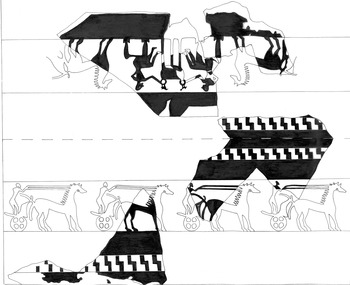
To summarise the iconographical scheme, on one side of the roof model, a chariot race involves at least four charioteers with one-horse chariots (Figs. 5, 6). These advance towards the two seated nude male figures depicted on the other side. These figures sit on stools on either side of a tripod, the handles of which are decorated with birds. The men touch the tripod. The central composition is flanked by two groups of stationary chariots which differ in size from those participating in the race. Let us now consider each aspect of this composition in turn.
Possible reconstruction of the roof model. Sides A–B.

E1. Chariot race (Figs. 1, 5, 6)
As noted in the descriptions of the individual sections, the drawing of both the charioteers and the surviving parts of the horses reflects the painter's intention to convey strong movement. The identification of a race is thus secure and is reinforced by other drawing conventions, as will be shown. No analogous scene is yet known in the Late Geometric repertoire of Achaea; in fact, there are no chariots of any form.Footnote 15 However, the horse was known to eighth-century Achaean artists. Individual horses appear on an oinochoe fragment also from the sanctuary at Nikoleika (Kolia and Gadolou 2011), and there is a line of horses in impressed techniqueFootnote 16 on a pyxis from the sanctuary at Ano Mazaraki (Gadolou Reference Gadolou and Greco2002, cat. 104, pl. 17 [RAK 42]; Gadolou Reference Gadolou2003, cat. 19, fig. 7, pl. 3 a). Horse figurines have also been found at Nikoleika (Kolia and Gadolou 2011).
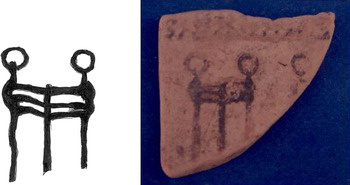
Part of a votive plaque depicting parts of two tripods from Ano Mazaraki.

The depiction of horses, alone or with a human figure or a chariot, in Early Iron Age vase decoration (either painted or modelled, as for example on Middle Geometric Attic pyxides), as well as in coroplastic art and in bronze, has given rise to extensive discussion of the meaning of this subject.Footnote 17 The horse was considered a potent heroic, religious and mythical symbol which reflected the power of the elite who had the economic means to keep horses and to use them in conspicuous display of their wealth, in mortuary as well as in ritual/ceremonial practices.Footnote 18 As Coldstream notes, the horse models adorning the lids of Attic Geometric pyxides which, in combination with granary models, are frequently found in Athenian burials, represent ‘the basis of social status in ownership of land and its attendant produce and livestock’ (Coldstream Reference Coldstream1977, 55).Footnote 19 The importance of the horse, not only in human life but also to most of the gods, is reflected inter alia by the large number of votive offerings depicting individual horses or horses with chariots in Greek sanctuaries throughout antiquity (Bevan Reference Bevan1986, 214–15). The presence of the horse and the chariot among the votive offerings at Nikoleika must therefore hold particular significance both for the deity worshipped and for the society to which this sanctuary belonged.
Very little survives of the one-horse chariot depictions on the model – from the chariot race just the edge of one wheel and the pole connecting the chariot to the horse, and from the stationary chariots, part of the stake to which the horse will have been tethered, plus part of one wheel on another sherd. It is thus impossible to determine the type of chariot shown.Footnote 20 The surviving wheels are of the four-spoked type common in all known chariot representations of the Late Geometric period (Crouwel Reference Crouwel1992, 34–6). Indeed, terracotta models of four-spoked wheels, probably from chariots, are present among the votive offerings at Nikoleika (Kolia and Gadolou, forthcoming).
Chariot representations appear in Achaean iconography during the closing years of the Mycenaean period. Notable among the vases recovered from the Mycenaean cemetery at Voudeni is a krater with a representation of charioteers.Footnote 21 The drawing of the Nikoleika charioteers, as of the nude seated male figures, finds parallels in the nude dancers on a fragmentary oinochoe from the same sanctuaryFootnote 22 and, strikingly, with the drawing on a fragmentary Geometric krater from DelphiFootnote 23 previously identified as Corinthian. This identification is open to question, however, because the light brown clay with several inclusions, tempers of calcite and mica, observed in examination of the fragments, is not characteristic of Corinthian pottery. Yet neither is it characteristic of Late Geometric Achaean, and so despite the similarity in the drawing it seems that it cannot have been made in Achaea. Presumably it could be the product of an as yet unidentified local pottery workshop.
There has been extensive discussion of the interpretation and meaning of chariots in eighth-century art. Chariot races are commonly depicted on Late Geometric funerary vases and are usually interpreted as scenes from funerary games.Footnote 24 According to Snodgrass, ‘the chariots on Geometric vases represent no existing contemporary war-chariots, but are “heroic property” inspired partly by surviving representations of Mycenaean chariots, partly by Epic, and partly by the example of other contemporary wheeled vehicles’ (Snodgrass Reference Snodgrass1964, 160). Webster (Reference Webster1955, 44–7) has argued that chariot depictions may well represent heroic rather than contemporary practice. He observes that those showing both wheels belong to processions, whereas those showing only one are in races: the chariots on the Nikoleika model show only one wheel, further indicating that they are part of a chariot race which is not funerary in character.Footnote 25 Rombos (Reference Rombos1988, 127) notes that there is no particular reason to suppose that chariot races were held only at funerary games, and Crouwel (Reference Crouwel1992, 56) argues that the bronze and terracotta chariot models dedicated at Olympia imply that chariot races took place in honour of a god. Even though the chariot race became a formal part of the Olympic games rather later, in 680 bc, it is possible that races took place in the sanctuary much earlier and not necessarily in the context of the games (Morgan Reference Morgan1990, 90). It is thus plausible to connect the chariot race on the Nikoleika roof model with an event in the sanctuary perhaps organised in honour of the deity worshipped (the identity of whom is discussed in detail below).
E2. Seated figures on either side of a tripod (Figs. 2, 6)
The charioteers appear to move towards the central scene on side B of the model, which depicts two identical nude male figures seated on stools on either side of a tripod, on the handles of which rest two birds. This scene is framed by two one-horse chariots which are clearly different in size and character from those in the chariot race, although they provide an iconographical link between the two scenes. There is no exact parallel for the composition on side B in Late Geometric vase-painting. Consequently, its interpretation rests on analysis of the individual iconographical elements.
E2a. The tripod
The significance of the tripod as a votive offering in the eighth century bc has been examined by several scholars.Footnote 26 The example depicted on side B of our model is of the same height as the seated figures and can therefore be described as monumental. However, it is not necessarily unrealistic as several of the metal tripods dedicated in Olympia during the eighth century were monumental in size. The birds on the two ring handles find parallels on a skyphoid krater sherd of Thapsos type from Aegion, which has been characterised as Achaean work of the last quarter of the eighth century (AMA 1554).Footnote 27 We will return to the question of whether the birds on the tripod were merely decorative or held symbolic meaning.
Depictions of tripods on their own, combined with horses, or between human figures (often interpreted as athletes) are found in the Middle Geometric and Late Geometric iconography of several areas of southern Greece, but they are common in Attica, the Argolid and Boeotia. Interpretation of specific representations differs each time.Footnote 28 The earliest known depiction of a tripod as a prize appears on a Late Geometric Argive sherd (725–700 bc).Footnote 29 In other media, tripods appear between figures (perhaps athletes) on an early Archaic sealstone from Brauron (Boardman Reference Boardman1970, 112, fig. 162) and on the leg of a bronze tripod from Olympia, where two helmeted male figures lay claim to the tripod between them. The latter scene has been read as the dispute between Herakles and Apollo over the Delphic tripod (Rombos Reference Rombos1988, 212; Schweitzer Reference Schweitzer1969, pl. 213), an interpretation consistent with more general attempts to identify mythological scenes in Late Geometric art. Yet there are no special features to identify the two figures as mythological, and they could be seen as ordinary athletes claiming the prize.Footnote 30 The figures on either side of a large tripod depicted in a secondary decorative zone on a krater in New York (Metropolitan Museum of Art 14.130.15) have also been interpreted as athletes. On the left of the tripod stands a warrior with helmet and sword, and on the right a double figure identified as the mythical Siamese twins the Aktorione or Molione.Footnote 31 The scene is interpreted as the handing over of the tripod as the prize in the chariot race won by the twins (making the second figure to the left the runner up in the race).Footnote 32 These representations might seem to facilitate the interpretation of the figures flanking the tripod on the Nikoleika model as athletes. Yet the fact that they are seated is at variance with this identification, as figures interpreted as athletes on either side of a tripod always stand.
A relief pithos from Prinias offers a useful parallel for the ritual meaning of our scene. An interesting combination of the agonistic with the ritual or cultic is presented in the depiction of the Mistress of Horses (Potnia Hippon) on the neck, and the representation in a zone on the lower body of a chariot race in which the prize tripod is interposed between the competitors (Pernier Reference Pernier1914, 68–70, figs. 37, 39). The use of this pithos as a votive offering in a sanctuary extols the significance of the race and confirms the cultic and symbolic meaning of the elements represented. An analogous spirit seems to animate the representations on the Nikoleika model. As will be further argued, it seems that one of the aims of the dedicators was to reflect ritual performances in the sanctuary.
Alongside tripods interpreted as prizes in athletics games, there are much rarer cases where tripods are shown as prizes in music and dance competitions. The tripod as prize is considered to be depicted on two Late Geometric vases. First, tripods around the outside of the skyphos Athens 874 have been interpreted as prizes awarded for the dance competition depicted on the interior.Footnote 33 This particular skyphos belongs to a group of Late Geometric vases, in the main funerary, on which tripods depicted in the background of agonistic scenes are usually interpreted as prizes for the victors in funerary games. Secondly, the central scene on the fragmentary funerary krater Athens 810 depicts a dance of young men between two Orientalising-style cauldrons.Footnote 34 It has been argued that this main subject, in combination with those around it (horse taming, a chariot race, and heroic duels), presents a series of events typical of the life of an aristocrat. Nonetheless, the intent behind featuring tripods in the central scene may be to emphasise the principal and essential role of these vessels in ritual acts towards the end of the Geometric period. Finally, in addition to Late Geometric funerary vases depicting tripods interpreted as prizes for victors in chariot races in honour of the dead, one should note a later example in the form of a Protocorinthian aryballos (c.670 bc) from Syracuse, with a representation of four charioteers moving towards the agonothetes, before whom is the victor's prize, a tripod (Johansen Reference Johansen1967, 88–90, fig. 22).Footnote 35 In short, the tripod in Late Geometric iconography is identified generally as the symbol of victory in contests of the body and mind held in the context of important games, either athletic or funerary. Therefore, the tripod depicted between the two seated male figures and the chariots on the Nikoleika model should be interpreted first of all as a prize.
In interpreting scenes in which the tripod is the main or one of the basic iconographic elements, it is important to bear in mind that it was a potent religious symbol of pan-Hellenic significance from Geometric to Roman times.Footnote 36 In addition to its religious meaning and its role as proof of victory in athletic games, the tripod as a prize in poetry competitions and contests of the intellect demonstrated the ‘wisdom’ of the victor and symbolised his good and sound thought – a gift of the gods. For all of these reasons, tripods were mostly returned to the gods as votive offerings (Papalexandrou Reference Papalexandrou2005, 9–11). The victors' obligation to dedicate their prizes is recorded by Herodotus (1.144): ‘At the games in honour of Triopian Apollo, certain bronze tripods were given to the victors. The victors did not take the tripods away with them but dedicated them there to the god, Apollo’.Footnote 37
Literary sources confirm, inter alia, the symbolic significance of the tripod as proof of wisdom or knowledge. Hesiod (Works and Days, 654–9) reports that the prize for his victory in a poetry competition, held on the occasion of the funerary games organised in Chalkis by the sons of Amphidamas for their dead father, was a tripod which he then dedicated in the sanctuary of the Muses on Mount Helicon, because it was thanks to the Muses that he acquired his skill and to them that he owed his victory. And at the end of Odysseus' long tale in the court of Alkinoos, which earned him the distinction of a gifted and ‘veracious’ storyteller, Alkinoos proposed that each member of the council of the Phaeacians give the hero a tripod and a cauldron before his departure for home (Odyssey 13.5–13).Footnote 38 In general in the Odyssey, tripods are presented as objects exchanged between royal personages, with possession considered as proof of prestige (Papalexandrou Reference Papalexandrou2005, 20–2).
Tripods are mentioned much more often in the Iliad than in the Odyssey, however. Their basic use is as loutrophoroi, to hold water with which to bathe dead heroes (Hector and Patroclus included). A comparable use is attested in the Odyssey, but in the milieu of the house. However, the majority of references to tripods concern their importance as prestige objects circulated and exchanged among powerful men in the heroic world. In the Iliad too they commonly appear as prizes in games: thus at Iliad 11.699–702, in recounting the causes of the war between the Pylians and the Epeians, Nestor refers to ‘four horses, winners of prizes’ and their chariot, which were sent to Elis to compete for a tripod. It is telling too that in the funeral games of Patroclus, the victor's prize in the chariot race and the wrestling contest was one tripod and one woman (Iliad 23.259–66).Footnote 39 In the Homeric world the tripod was a more valuable prize than an object of gold (Papalexandrou Reference Papalexandrou2005, 24–30).
The handles of bronze cauldrons are frequently decorated with figurines of various animals or of humans, stimulating discussion of their significance and interpretation (Papalexandrou Reference Papalexandrou2005, 67–70). Bird figurines, however, constitute a very limited category of handle decoration.Footnote 40 Miniature bronze tripods and cauldrons with birds on the handles are found at the sanctuary of Olympia and in the northern sacrificial area of the sanctuary of Apollo Daphnephoros at Eretria respectively,Footnote 41 while isolated bronze bird figurines from Delphi, Olympia and the Argive Heraion have been considered as handle decoration (Benton Reference Benton1934–5, 101, pl. 21:4–5). There are more examples of painted representations of birds in combination with tripods, although not always as handle decorations as on the actual bronze vessels. Birds adorn the handles of the tripod between two horses depicted on the neck of a Late Geometric Attic amphora in Dresden (Sakowski Reference Sakowski1997, 359, pl. 1), as well as on the tripod on a pyxis sherd from the Heraion of Argos (Benton Reference Benton1934–5, 105 no. 13, pl. 26:2; Rombos Reference Rombos1988, 268, pl. 59 f). The depiction of birds in early Greek vase-painting holds multiple symbolic significance,Footnote 42 and attempts to interpret birds shown inside or even under tripods are particularly interesting. In comparable cases (see below for a shield from Crete and an oinochoe in Brussels) the presence of birds has been taken to denote either the exterior space in which the event represented takes place, or an oracular symbol. Yet what is the meaning of the birds depicted inside one of the four tripods decorating the neck of a Late Geometric Attic amphora in Athens (Benton Reference Benton1934–5, 105, pl. 25:1), or on the tripods on the lower body of an amphora from a Late Geometric grave in the recently excavated cemetery of Kephissia (Schilardi Reference Schilardi2006, 92–3, fig. 6; Schilardi 2011)? Given the purely mortuary use of these vases, these tripods could be interpreted as prizes awarded in funerary games in honour of the dead (Hesiod, Works and Days 654–9; see also below), or as prizes won by the deceased in his lifetime, while the birds are frequently associated with the religious and metaphysical beliefs of the period, and perhaps symbolised the soul of the deceased (Kourou Reference Kourou1999, 179–82).
In the case of the tripod on the Nikoleika model, however, the birds decorating the handles do not appear to have been metaphysical symbols since the representation is not funerary in character. They could be interpreted as oracular symbols,Footnote 43 a view which will be set alongside evidence for the interpretation of the tripod itself (not only a prize for the chariot race but also an offering to the deity worshipped in the sanctuary, in whose honour the games were held). Bird divination in the Geometric period has been discussed thoroughly by Irad Malkin (Reference Malkin1987, 108–9). Indeed, given that the tripod itself has been interpreted as a means of exchanging information on seafaring, the interpretation of birds as oracular symbols appears attractive. Herodotus (4.179) recounts that during the voyage of the Argonauts, Jason found himself in North Africa, trapped in Lake Tritonis, where he met Triton son of Poseidon.Footnote 44 He gave a tripod to Triton in exchange for information on navigation. Papalexandrou proposes the following explanation: ‘It is possible that in Delphi the tripod at a stage when it had not yet become an instrument of divination, was a means of payment for information about colonisation, sea routes, travelling, prospective markers or whatever knowledge was consider necessary for entrepreneurial expeditions outside the narrow confines of the Aegean’ (Papalexandrou Reference Papalexandrou2005, 42). The purificatory and divinatory power of the tripod seems to be supported by certain Cretan works of art, notably the representation on a Late Geometric lid or shield from a grave at Fortetsa which offers interesting analogies to the Nikoleika scene (Stampolidis, Karetsou and Kanta Reference Stampolidis, Karetsou and Kanta1998, 205 no. 227). Here a male figure holding a thunderbolt and a bird advances towards a tripod. A second bird touches one tripod handle with its beak, while a third bird is shown inside the tripod. Under the cauldron, a human bust turned to the right emerges from the ground. The scene has been interpreted as a divine epiphany of Zeus in association with his oracular cults, and mantic practices are reflected by the presence of the birds and tripod (Brock Reference Brock1957, 122–3). While this does not change the interpretation of the tripod on the Nikoleika model as a prize-dedication in the sanctuary, the oracular dimension may be useful in discussion of the identity of the deity worshipped in the sanctuary. It is possible that this specific symbolic dimension may be correlated inter alia with colonisation, and in particular the colonisation of Sybaris from Helike which took place c.720 bc according to Strabo 6.1.13 (C 263).
Tripods were known to the inhabitants of Achaea in early historical times. Fragments of a bronze tripod have been recovered from the acropolis of Aigeira (Mazarakis Ainian Reference Mazarakis Ainian2000, 211–12, pl. 300 a), and a miniature bronze tripod was dedicated in the sanctuary of Artemis Aontia at Ano Mazaraki (Petropoulos Reference Petropoulos2002, pl. 3:3).Footnote 45 From this latter sanctuary comes a fragmentary terracotta votive plaque depicting parts of two tripods (Fig. 7), terracotta tripod models from the impressed-ware workshop (Gadolou Reference Gadolou2003, 311–12, 326–8, figs. 24–6), and three joining sherds from a votive plaque painted on both sides (Patras Museum no. 7445, height 0.125 m, preserved width 0.095 m, thickness 0.025 m). This last preserves the upper and lower edges and one side.Footnote 46 The barely distinguishable figure representations are in black glaze which has flaked, revealing the orangey red slip. A tripod, part of a horse and a bird can be seen on the lower left edge. The closest parallels for this plaque come from the sanctuary at Eleusis (Noack Reference Noack1927, 12–13, figs. 4–5; Sakowski Reference Sakowski1997, pl. 9).Footnote 47 The depiction of tripods on terracotta votive plaques has been rightly interpreted as a substitute for the more expensive ex-voto in bronze (Boardman Reference Boardman1954, 199).
E2b. Seated figures and seats (Figs. 2, 6)
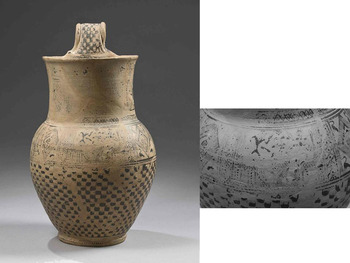
On either side of the tripod are two seated nude male figures, whose outstretched hands touch the tripod handles. The fact that the men are seated is of interest because there is only one other known representation of seated figures on either side of a tripod. Yet while that scene is difficult to interpret, the proposed interpretation is completely different from the representation on the Nikoleika model. Two female or male figures are depicted in the central panel on the shoulder of a mid-eighth century Attic oinochoe now in Brussels (Fig. 8). The figures sit on high-backed seats (thrones?), rest their feet on footstools, and with one hand touch the handles of a tripod set between them, and with the other hand shake sistra. Below the tripod is a mesh-like filling motif which may allude to fire. Rombos places the vase in group 2 of the Krotala Group workshop, with the seated figures interpreted as participating in funerary ritual. It is therefore proposed that the tripod on the Brussels oinochoe should be interpreted as a funerary cremation vase replacing the square chequerboard that Rombos interprets as a grave.Footnote 48 Rombos (Reference Rombos1988, 295) interprets the bird upon the tripod somewhat simplistically as indicating that the specific scenes take place in the open air. However, if we accept that birds on tripod handles indicate divine epiphany (Langdon Reference Langdon2008, 238), the representation as a whole could be purely cultic in character and the gestures of the seated figures could reflect some ritual performance rather than a funerary rite.Footnote 49
Attic Geometric oinochoe. Brussels. Musées Royaux d'Art et d'Histoire (Cinquantenaire) Α 1941.

Taking all of this evidence into consideration, the most tenable interpretation of the scene on the Nikoleika model is that it depicts the prize in the chariot race represented on the other side of the roof. Yet in combination with the interpretation of the seated figures which follows, it is likely that this prize tripod was simultaneously dedicated to the deity in whose honour the chariot race depicted was organised. The conditions in which the object was found and its symbolic meaning allow us to define the reasons behind the dedication of the prize in this particular sanctuary.
So who are the seated figures and what is their relation to the tripod? No particular feature indicates the identity of the two male figures. The elements that may contribute to their identification are the type of seat and the role of those figures represented seated in Geometric iconography. The seat is the diphros of Archaic and Classical times – specifically, Richter's type 3. The basic features of this type are a single seat set on relatively short legs, with perpendicular sides and upward-flaring top. It is used mainly by gods or heroes.Footnote 50 No other example of a diphros has yet been identified on Geometric vases apart from on Late Geometric krater sherds in the Louvre (A 517 and CA 3385) where mourners sit on very similar seats (Villard Reference Villard1954, pls. 1:1 and 9:6). Another example is a divine winged figure on an early seventh-century relief pithos from Tenos, on a seat with exactly the same type of legs (Kontoleon Reference Kontoleon1953, 265, fig. 9; Anderson Reference Anderson1975, 30, pl. 5, with select bibliography). The legs of the bier in the prothesis scene on the fragment of a Late Helladic IIIC krater from Agia Triada in Eleia are of the same kind.Footnote 51 However this particular kind of seat is relatively rare in this period.Footnote 52
There is no evidence with which to define the role of the figures seated on the various types of seats. In a recent study, van Wees (Reference Wees and Crielaard1995, 151) attempted to define the use of different types of seat, according to the specific status of the person seated, through reference to Homer. He concludes that although servants and members of the lower social orders sit on diphroi, the same seat is also used by women in the women's quarters (gynaikonites) of the house, as well as by Nestor himself. Thus it appears that in Homer different types of seats are used indiscriminately. Seated figures in Late Geometric vase-painting are either mourners or persons involved in ritual (usually funerary) performance.Footnote 53 However, a unique scene on the skyphos Athens 784 shows a procession advancing towards an important figure (if not a deity, a person of high status or even a ruler).Footnote 54 According to one view, this reflects the habit of representing moments of contemporary cult practice under the influence of oriental iconography (Carter Reference Carter1972, 46–8, pl. 11).Footnote 55
In short, while the seat cannot define clearly the role of the person seated on it, the seated figures on the Nikoleika model held some special position in the society to which they belonged. In all probability they were able to own horses, and were of the social and economic standing to enter chariots, driven by themselves or by others, in chariot races organised, perhaps on their own initiative and responsibility, in the sanctuary. They were able to commission this unique work of art, the dedication of which would consolidate their reputation.Footnote 56 In the eighth century bc, these were men in the highest social echelons (chiefs, rulers, leaders) who, as evidence from various contemporary sites shows, were charged also with sacerdotal duties, mainly organising and coordinating cult practices (Mazarakis Ainian Reference Mazarakis Ainian2006, 181–211). It was men like these who were responsible for the prize, the tripod. From the dozens of tripods dedicated in the sanctuaries of Olympia and Delphi, we are able to appreciate the size of such objects, as well as the cost of making them.
As various studies have shown, the prevailing system of social stratification was reflected in the use of specific objects with special symbolism.Footnote 57 Particularly pertinent is Langdon's observation that ‘The profusion of horses, chariots, and prestigious weaponry that equip the warrior ranks of Geometric pottery provided an archaising model by which aristocratic families or groups could mark their exclusivity and authority’ (Langdon Reference Langdon2008, 10). The wealth and power of the aristocratic elite were also demonstrated indirectly by the dedication in sanctuaries of certain items that, in most cases, had a special symbolic significance (Morgan Reference Morgan1990, 1–25). The elite in early historical times was linked not only to the ownership of metal objects, but also to the supply of metals, and the production, trade or distribution of the final products (Mazarakis Ainian Reference Mazarakis Ainian2006, 181–2; Eder Reference Eder2006, 572). On another view, the Late Geometric elite employed figurative art to underline their social status or heroic descent (Morgan and Whitelaw Reference Morgan and Whitelaw1991; Whitley Reference Whitley1991; Crielaard Reference Crielaard, Crielaard, Stissi and van Wijngaarden1999, 62–8; Langdon Reference Langdon2008, 11; Kourou Reference Kourou2008, 85–7).
In short, our two figures linked to the tripod prize/dedication are likely to have been members of the local aristocracy, men charged with political and ritual duties, distant descendants of the inhabitants of the Aegialeia who participated with 12 ships in the Trojan War under the command of Agamemnon (Iliad 2.198–204, 569–75; Pausanias 7.1.4).Footnote 58 Their likely participation at the sanctuaries of Olympia and Delphi, neither far away, made them actors in the dedicatory code used by all powerful elites of the time (Morgan Reference Morgan2003, 38; Eder Reference Eder2006, 566).
Archaeological finds (mainly grave assemblages, particularly in eastern Achaea) reflect the existence of an elite which possessed important artefacts of clay and metal (vases, bronze vessels, jewellery, iron weapons), as well as objects of Eastern provenance (Egyptian scarabs). Thus in the Aegialeia, the distinguished deceased buried in a pithos at Mavriki with two bronze cauldrons, one ‘Thapsos’-type krater and iron weapons as grave goods,Footnote 59 may have belonged to the same elite class as those in pithoi VI (in which more than one burial was observed) and XII at Trapeza, where the grave goods included many vases and two bronze fibulae (in pithos VI), as well as iron weapons (an iron spear point and Naue II sword in pithos XII).Footnote 60 The deceased buried in a pithos in Plastira Street in Aegion with two scarabs, a jug probably of Cypriot provenance, four Boeotian-type fibulae, two necklaces and one biconical bronze bead, evidently had relations with the East (Petropoulos Reference Petropoulos2002, 148 with n. 39, pl. 1:2–4; Eder Reference Eder2006, 569).
Archaeological data enable us to identify social stratification in Achaea in the eighth century bc. As in other regions at this time, members of elite families constituted the state.Footnote 61 The seated figures on the Nikoleika model will therefore have been members of the upper class who, by organising chariot races in honour of the deity, worshipping in the sanctuary and dedicating the prize tripod to the deity, sought to consolidate and enhance their social and political status.
F. THE DEITY WORSHIPPED
Despite differences in subject, the scenes on the Nikoleika model give the work a religious content analogous to that recognised in the representation on the krater fragment from Argos which shows a man controlling a horse, reins in one hand and a prod in the other. Two vertically placed fish are depicted in front of and behind the horse, with a bird just below its tail and four dancers with branches in the upper right corner of the scene. This scene has been linked with the sacrifices of horses in honour of Poseidon celebrated in Argos according to (later) literary sources.Footnote 62
Poseidon is widely associated with chariot races.Footnote 63 Pindar (Isthmian 4.19–23) mentions races in his honour at the sanctuary of Poseidon at Onchestos (of course much later), and dubs the god ‘benefactor of chariots’ (Isthmian 1.53–4).Footnote 64 Both the Homeric Hymn 22 and the Orphic Hymn 17 present Poseidon as ‘tamer of horses’. The god created the horse, taught men the art of handling horses by using the bridle, and was the originator and protector of horse races (Homer, Iliad 23.307, 584; Pindar, Pythian 6.50; Sophocles, Oedipus at Colonus 712). He is designated by the epithets hippios, hippeios, or hippios anax (Pausanias 1.30.4, 8.25.5, 6.20.8, 8.37.7; Euripides, Phoenissae 1707; Livy 1.9 terms him equester). He was regarded as the friend of charioteers (Pindar, Olynthian 1.63; Tzetzes, Ad Lycophron 156), and even metamorphosed into a horse to deceive Demeter. At Olympia, he was worshipped as ‘Hippios’ at a common altar with Hera ‘Hippia’.
Thus the sanctuary at Nikoleika, in which chariot races were probably held, was probably dedicated to Poseidon, an identification supported by the other votive offerings (a large number of wheel models and horse figurines), the topography of the area and the identification of the site as Helike (see Kolia, this volume).
According to Musaeus (mentioned by Pausanias), Poseidon and Gaea were worshipped at Delphi before Apollo. He agreed to concede his place in exchange for Calaureia, which perhaps explains the epithet ‘Amoebeus’ ascribed to Apollo at Delphi (Pausanias 2.33.2, 10.5.3; Apollonius Rhodius 3.1243, with Schol.) (Farnell Reference Farnell1907, 27). It is not therefore implausible to suggest that the tripod was dedicated to the god to request, among other things, the help of the patron deity of their city (if the identification with the sanctuary of Poseidon Heliconius is correct) on their voyage to colonise Sybaris (Strabo 6.1.13) (Rizakis Reference Rizakis1995, 297 no. 515). The birds on the handles and their proposed interpretation as oracular symbols may well denote continued divine assistance to the founder-hero (oikistes) and participants in this colonisation (Malkin Reference Malkin1987, 113).
CONCLUSIONS
What does the dedication of the roof model represent and what does it tell us about the social and political circumstances prevailing in the region to which the sanctuary belonged, specifically in the second half of the eighth century bc?
It is argued that any change in political circumstances is reflected in cult practices, and in the formation of the sanctuary space in which they are enacted (Papadimitriou Reference Papadimitriou2006, 545–7). The view that sanctuary activity is determined by the kinds of votive offerings, which possibly reflect the personal status of the dedicators as well as developments in the political process (Morgan Reference Morgan1990, 2, 20, 191–205, 233–4; 2003, 17–18, 107–13), is the starting point for discussion of both general policy and the special conditions of dedication characteristic of eighth-century sanctuaries, a period when the concepts of ‘state’ and personal initiative had not yet been crystallised.
Depictions of horses, chariots and a tripod on the Nikoleika model constitute a strong argument for the existence of an aristocracy who sought, via such dedications, to honour the deity worshipped in the sanctuary and to declare their singularity and authority. An offering of this kind in the sanctuary reflects the existence of wise ‘creators’, whose presence in the social body indicates social differentiation and stratification. Furthermore, the depiction of specific representations on a model and not a vase is deliberate. It defines the identity of the object and thus the identity of the sanctuary. Representations may reflect the ritual practices observed in the sanctuary – chariot races, and the climactic moment of the ritual, the dedication of the prize to the deity. This iconography honours the god twice, via the offering of a temple model and by commemorating games in his honour held in his sanctuary.
The dedicators were apparently aware that the dedication of a tripod, with its many symbolic connotations, was the best means of achieving social credit. Furthermore, the dedication of a model so decorated in an Achaean sanctuary late in the third quarter of the eighth century reflects the fact that here, too, people subscribed to the form of ritual and cult practice that held sway in the rest of the sanctuaries of the period, and were in the habit of expressing their cultural values through objects. We may conjecture that their social status enabled them to organise games and offer a precious prize. And the iconographic conventions evident on the Nikoleika model are effectively an invocation to the deity for support and continual assistance, shortly before the voyage to colonise Sybaris.
If future research confirms that the deity worshipped at Nikoleika was indeed Poseidon, there could be no better helpmeet in a colonising venture than the god of the sea, in whose honour an apsidal temple was built on the site of the old open-air shrine as the enterprise departed.