Introduction
Endophenotypes are neurophysiological, biochemical, endocrinological, neuroanatomical, cognitive or neuropsychological phenomena that constitute intermediate markers of brain dysfunction. They are located between clinical manifestations of the disease (phenotype) and the distal genotype (Gottesman & Gould, Reference Gottesman and Gould2003; Bearden & Freimer, Reference Bearden and Freimer2006).
Several recent studies of unaffected first-degree relatives (UFD), carried out by the same group, have analysed the existence of endophenotypes in obsessive-compulsive disorder (OCD). One of these studies (Chamberlain et al. Reference Chamberlain, Fineberg, Menzies, Blackwell, Bullmore, Robbins and Sahakian2007) showed that unaffected relatives of OCD probands presented deficits in cognitive flexibility and motor inhibition that were similar to those recorded in obsessive patients. Menzies et al. (Reference Menzies, Achard, Chamberlain, Fineberg, Chen, del Campo, Sahakian, Robbins and Bullmore2007) also found a significant association between impaired execution of the stop-signal test (a measure of motor inhibition) and certain structural alterations in the brain of OCD patients and relatives compared with healthy controls, such as grey matter reductions in orbitofrontal and right inferior frontal regions and grey matter increases in cingulate, parietal and striatal regions. Results using functional neuroimaging techniques have identified reduced activation of the lateral orbitofrontal cortex (OFC), lateral prefrontal cortex (LPFC) and parietal cortex during reversal learning in patients with OCD and their unaffected relatives (Chamberlain et al. Reference Chamberlain, Menzies, Hampshire, Suckling, Fineberg, del Campo, Aitken, Craig, Owen, Bullmore, Robbins and Sahakian2008). Similarly, white matter abnormalities in frontal and parietal regions have been found in obsessive patients and in their relatives (Menzies et al. Reference Menzies, Williams, Chamberlain, Ooi, Fineberg, Suckling, Sahakian, Robbins and Bullmore2008). These findings support the hypothesis that these neurobiological markers can be considered as endophenotypes of OCD.
Neuropsychological deficits may constitute interesting endophenotypic markers of psychiatric disorders because they are quantitative, have moderate heritability within the normal population (Dougherty et al. Reference Dougherty, Bjork, Moeller, Harper, Marsh, Mathias and Swann2003) and can be extended to animal models of the disorder (Glahn et al. Reference Glahn, Bearden, Niendam and Escamilla2004). Previous studies have proposed several measures of executive functions, such as motor inhibition, cognitive flexibility and reversal learning as cognitive endophenotypes for OCD (Chamberlain et al. Reference Chamberlain, Fineberg, Menzies, Blackwell, Bullmore, Robbins and Sahakian2007, Reference Chamberlain, Menzies, Hampshire, Suckling, Fineberg, del Campo, Aitken, Craig, Owen, Bullmore, Robbins and Sahakian2008; Menzies et al. Reference Menzies, Achard, Chamberlain, Fineberg, Chen, del Campo, Sahakian, Robbins and Bullmore2007). Memory impairments are among the most consistent findings in OCD. Studies of non-verbal memory in OCD report poorer free recall of information, mediated by poor organization during its processing (Savage et al. Reference Savage, Baer, Keuthen, Brown, Rauch and Jenike1999; Deckersbach et al. Reference Deckersbach, Otto, Savage, Baer and Jenike2000; Savage et al. Reference Savage, Deckersbach, Wilhelm, Rauch, Baer, Reid and Jenike2000), while storage capacity remains intact (Savage et al. Reference Savage, Keuthen, Jenike, Brown, Baer, Kendrick, Miguel, Rauch and Albert1996). As regards studies of verbal memory, some report no differences between obsessive patients and the general population (Christensen et al. Reference Christensen, Kim, Dysken and Hoover1992; Dirson et al. Reference Dirson, Bouvard, Cottraux and Martin1995), while others (Deckersbach et al. Reference Deckersbach, Otto, Savage, Baer and Jenike2000; Savage et al. Reference Savage, Deckersbach, Wilhelm, Rauch, Baer, Reid and Jenike2000) point to differences in the recall of verbal episodic information. The latter studies suggest that poor recall in obsessive patients is mediated by alterations in the way in which information is organized (i.e. the use of semantic strategies), as in the case of non-verbal memory. Some authors argue that deficits in the organization of information, both verbal and non-verbal, are the consequence of executive dysfunction, which, ultimately, may reflect alterations in the frontostriatal circuits involved in the neurobiology of OCD (Abbruzzese et al. Reference Abbruzzese, Ferri and Scarone1997; Savage et al. Reference Savage, Baer, Keuthen, Brown, Rauch and Jenike1999, Reference Savage, Deckersbach, Wilhelm, Rauch, Baer, Reid and Jenike2000; Deckersbach et al. Reference Deckersbach, Otto, Savage, Baer and Jenike2000).
The aim of our study was to analyse whether deficits in organization and recall of verbal and non-verbal information constitute an endophenotype in OCD. Accordingly, among other variables we measured the recall and use of organizational strategies during the processing of verbal and non-verbal tasks in OCD patients, UFD and healthy volunteers (HV). Our hypothesis was that UFD, like OCD patients, would show impaired neuropsychological performance compared with healthy controls.
Methods and materials
Participants
In total, 75 subjects were included in the study: 25 outpatients with a diagnosis of OCD; 25 UFD; 25 unrelated HV. Patients were recruited from a series of consecutive admissions to the Obsessive-Compulsive Disorders Unit of Bellvitge University Hospital in Barcelona, between 2006 and 2008. All those included met the criteria for OCD described in DSM-IV (American Psychiatric Association, 1994) and, in each case, the diagnosis was confirmed by two experienced psychiatrists (P.A. and C.S.) through two separate interviews conducted 1 month apart using the Structured Clinical Interview for DSM-IV Axis I Disorder (First et al. Reference First, Spitzer, Gibbon and Williams1997b). Exclusion criteria were: a history of substance abuse and/or dependence; neurological disease (except tics); having suffered a head injury with loss of consciousness; a history of bipolar disorder; a history of psychotic episodes; having undergone electroconvulsive therapy and/or neurosurgery.
OCD patients with other co-morbid psychiatric disorders were not excluded from the study, since OCD was both the dominant pathology and the reason for seeking treatment. The SCID-I-CV was used to assess the presence of Axis I disorders and the Structured Clinical Interview for DSM-IV Axis II Personality Disorders (SCID-II) was used to assess the presence of personality disorders (First et al. Reference First, Gibbon, Spitzer and Williams1997a). Six OCD patients (24%) presented co-morbidity with other Axis I psychiatric disorders: major depressive disorder in two cases and dysthymic disorder in four. Four more patients (16%) presented co-morbidity with an Axis II disorder: obsessive-compulsive personality disorder was the most frequent (three patients), followed by schizotypal personality disorder (one patient). A clinical version of the Yale–Brown Obsessive Compulsive Scale (YBOCS) Symptom Checklist (Goodman et al. Reference Goodman, Price, Rasmussen, Mazure, Fleischmann, Hill, Heninger and Charney1989), which includes >50 examples of obsessions and compulsions, was used to obtain scores on five previously identified symptom dimensions (Mataix-Cols et al. Reference Mataix-Cols, Rauch, Manzo, Jenike and Baer1999) designated as symmetry/ordering, hoarding, contamination/cleaning, aggressive/checking and sexual/religious obsessions. If a patient identified at least one of the specific symptoms under one of these dimensions, the dimension was considered present; otherwise, the dimension was considered absent. A total of 50 patients (60%) presented aggressive/checking obsessions, 14 (56%) contamination/cleaning obsessions, seven (28%) symmetry/ordering obsessions, two (8%) sexual/religious obsessions and eight (30%) hoarding obsessions.
A total of 24 obsessive patients (96.6%) were receiving psychopharmacological treatment at the time of the neuropsychological assessment. Treatment with psychoactive drugs had remained stable and unchanged for a period of at least 12 weeks prior to the assessment. Among patients receiving this treatment, 16 (64%) were receiving monotherapy: nine were taking selective serotonin reuptake inhibitors (SSRIs) and seven clomipramine. Eight patients (32%) had a prior history of resistance to at least three treatments with SRIs alone and were receiving a combination of clomipramine and SSRIs. One patient was unmedicated. In total, 17 patients had completed a cognitive-behavioural therapy (CBT) programme comprising a minimum of 20 weekly 1-h sessions, which basically involved exposure with response prevention techniques and cognitive restructuring. CBT was not considered necessary in four patients who presented significant levels of symptom resolution with pharmacological treatment. Four patients commenced CBT but dropped out before completing the first five sessions. No patients were receiving psychotherapy at the time of the neuropsychological assessment.
We enrolled 32 patients at the beginning of the study, but eligible first-degree relatives were only available in 25 cases. All patients authorized us to contact their relatives for interview. HV were recruited from local communities. UFD and HV were excluded if they had a past or current history of a psychiatric or neurological disorder, treatment with psychotropic medication, substance dependence and/or abuse or head injury. These data were collected retrospectively through direct interview. We used the Structural Clinical Interview for DSM-III-R: Non-Patient Version to exclude psychiatric disorders (Spitzer et al. Reference Spitzer, Williams, First and Kendler1989) in both groups. We initially evaluated 35 UFD, but 10 were excluded: five with a past history of psychotropic medication and two who met criteria for OCD, two for alcohol abuse and one for panic disorder. Of the 25 remaining UFD, 14 (56%) were parents, seven (28%) were siblings and four (16%) offspring.
Written informed consent was obtained from each subject after a complete description of the study, which was approved by the hospital's ethics committee.
Socio-demographic and clinical variables
The clinical data analysed in the sample included sociodemographic variables such as sex, age and educational level (years of education).
General non-verbal intelligence was assessed using Raven's Advanced Progressive Matrices (Raven & Court, Reference Raven and Court1996). Hand dominance was determined by means of the Spanish version of the Edinburgh Handedness Inventory (Oldfield, Reference Oldfield1971) and a current mental health questionnaire, the General Health Questionnaire (GHQ; Goldberg & Hillier, Reference Goldberg and Hillier1979), was administered to the whole sample.
Presence of subclinical obsessive-compulsive symptoms was assessed in HV and UFD using the Padua Inventory-Washington State Revision (PI-WSUR, Burns et al. Reference Burns, Keortge, Formea and Sternberger1996). This inventory was designed to provide a purer measure of obsessive-compulsive symptoms than the original questionnaire by Sanavio (Reference Sanavio1988), in which several items evaluated worry-like themes more than obsessive contents. The PI-WSUR includes five subscales: obsessive thoughts about harm to self/others; obsessive impulses to harm self/others; contamination obsessions and washing rituals; checking compulsions; dressing/grooming rituals. The Spanish version of the instrument was applied (Ibàñez et al. Reference Ibàñez, Olmedo, Peñate and González2002; Morillo et al. Reference Morillo, Belloch and Garcia-Soriano2007). In the patient group, OCD severity was measured using the clinical version of the YBOCS (Goodman et al. Reference Goodman, Price, Rasmussen, Mazure, Fleischmann, Hill, Heninger and Charney1989).
Depression was measured in all subjects with the 21-item version of the Beck Depression Inventory (BDI; Beck et al. Reference Beck, Ward, Mendelson, Mock and Erbaugh1961) and state-related anxiety was measured with the State subscale of the State-Trait Anxiety Inventory (STAI; Spielberger et al. Reference Spielberger, Gorsuch and Lushene1982).
Neuropsychological assessment
Attention
Attention was assessed using the Spanish version of the Digit Span Test from the Wechsler Adult Intelligence Scale (Wechsler, Reference Wechsler1981).
Verbal memory
Verbal memory was assessed using the Spanish-Complutense Verbal Learning Test (TAVEC). The reliability, validity and psychometric properties of this test were established in a previous study (Benedet & Alejandre, Reference Benedet and Alejandre1998). The test comprises three lists. The first (list A) contains 16 items from four different categories (fruit, spices, items of clothing and tools) and is presented five times. After each presentation, subjects are assessed according to the number of words remembered correctly. We measured the number of words after the first trial, after the fifth trial, the total number of words in the five trials (learning rate), the number of intrusions (words recited by the subject but that do not feature in list A), the number of perseverations (repetition of words, both correct ones and intrusions) and the use during recall of semantic strategies/clusters (grouping words according to categories) and/or series-based strategies/clusters (grouping words by the order in which they are presented). The second list (list B) comprises 16 different items to those in list A, which are also taken from different categories; its aim is to cause interference after the fifth attempt to learn list A. After administration of list B, subjects are assessed on their short-term free recall of list A. Following a 20-min rest period, during which time other tests are administered for the purpose of distraction, subjects' long-term free recall is assessed. Finally, a third list comprising 44 words (including the 16 from list A) is presented in order to measure subjects' recognition. The characteristics and research aims of the TAVEC are similar to those of the California Verbal Learning Test (Delis et al. Reference Delis, Kramer, Kaplan and Ober1987) and so it is possible to compare the results obtained with the two instruments at both clinical and research levels.
Non-verbal memory
Non-verbal memory was assessed using the Rey–Osterrieth Complex Figure Test (RCFT; Osterrieth, Reference Osterrieth1944). Subjects are initially presented with a RCFT to copy. A period of 3 min after completing the task, during which time other distraction tests are administered, subjects are asked to draw what they remember of the original figure in order to assess immediate recall. To measure delayed recall, after a further 30-min period, during which subjects are distracted with other tasks, they are once again asked to draw what they remember of the original figure. During the test the experimenter copies the subject's drawings in order to analyse the organization. At the end of the assessment, to measure recognition, subjects are presented with a fixed number of figures, of which only some (12) form part of the original figure. The organization and accuracy of the drawing are scored during the three phases: copying; immediate recall; delayed recall.
The accuracy of the copy and the immediate and delayed recall figures and recognition were scored using the system developed by Meyers & Meyers (Reference Meyers and Meyers1995). The organization of the drawing was assessed using the system developed by Savage et al. (Reference Savage, Baer, Keuthen, Brown, Rauch and Jenike1999), which divides the RCFT into five segments (base rectangle, two diagonals, horizontal midline, vertical midline and the vertex of a triangle). The scoring, which ranges from 0 to 6, takes into account the construction of each of the five segments as non-fragmented units.
All the subjects (OFC, HV and UFD) were clinically evaluated by a psychiatrist of the Obsessive-Compulsive Research Unit (C.S.) before inclusion in the study. All the neuropsychological tests were administered and scored by a trained examiner, a psychiatrist who does not work in our hospital and who was blind to group membership.
Statistical analysis
Analyses were carried out using PASW17 for Windows. First, the clinical, sociodemographic and neuropsychological variables of the three groups were compared, using χ2 tests for categorical variables and one-way analyses of variance (ANOVA) for quantitative variables. Scheffé's multiple comparison procedure was used to assess differences between groups. Differences in the presence of subclinical obsessive-compulsive symptoms (assessed with the PI-WSUR) between HV and UFD were evaluated with the non-parametric Mann–Whitney U test.
Second, analysis of covariance (ANCOVA) was also performed to assess differences in the neuropsychological performance between the three groups, adjusting for the covariates age, level of anxiety and depression.
Third, Spearman's Rho correlations stratified by group were estimated to evaluate the association between clinical variables (age, STAI, BDI, PI-WSUR and YBOCS) and neuropsychological measures. In this analysis, only the variables that achieved significant differences (p<0.05) between HV and UFD in the earlier ANCOVA analysis were considered.
Finally, multiple linear regressions (STEPWISE procedure) were adjusted in order to explore the association of group (codified as HV=0 and UFD=1) with the neuropsychological measures. Age, level of anxiety, depression and subclinical obsessive-compulsive symptoms were entered as covariates. Probabilities for stepwise entry and removal were 0.05 and 0.10 respectively.
Results
Clinical and demographic characteristics
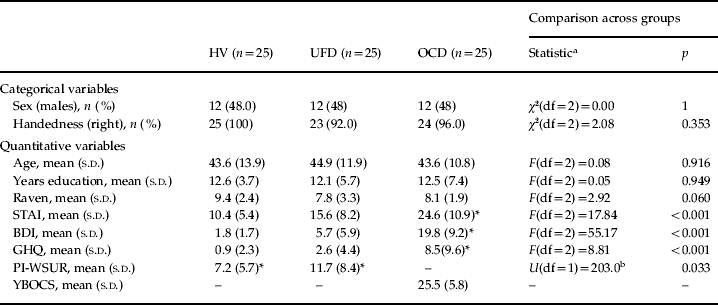
Table 1 shows the distribution of the demographic and clinical characteristics in the sample. Groups did not differ in terms of age, years of education, sex, handedness or general intelligence. However, statistical differences were found for state anxiety levels (STAI; p<0.001), depressive symptoms (BDI; p<0.001) and general mental health (GHQ; p<0.001). Specifically, OCD patients had higher mean scores on the STAI and BDI scales than HV (p<0.001) or UFD (p=0.002 and p<0.001 respectively). As expected, OCD scored higher on the GHQ than HV (p=0.001) and UFD (p=0.009). No differences were found between HV and UFD on the STAI (p=0.109), BDI (p=0.106) and GHQ (p=0.523) mean scores, whereas UFD had higher mean scores on the subclinical obsessive-compulsive symptoms scale (PI-WSUR) than HV (p=0.033).
Comparison of demographic and clinical characteristics

HV, Healthy volunteers; UFD, unaffected first-degree relatives; OCD, obsessive-compulsive disorder; df, degrees of freedom; STAI, State-Trait Anxiety Index; BDI, Beck Depression Inventory; GHQ, General Health Questionnaire; PI-WSUR, Padua Inventory-Washington State Revision; YBOCS, Yale-Brown Obsessive Compulsive Scale.
a χ2 for categorical variables and analysis of variance procedures for quantitative variables.
b Mann–Whitney's U test comparing only HV to UFD.
* Group that differs from the rest in post-hoc comparisons.
Neuropsychological performance
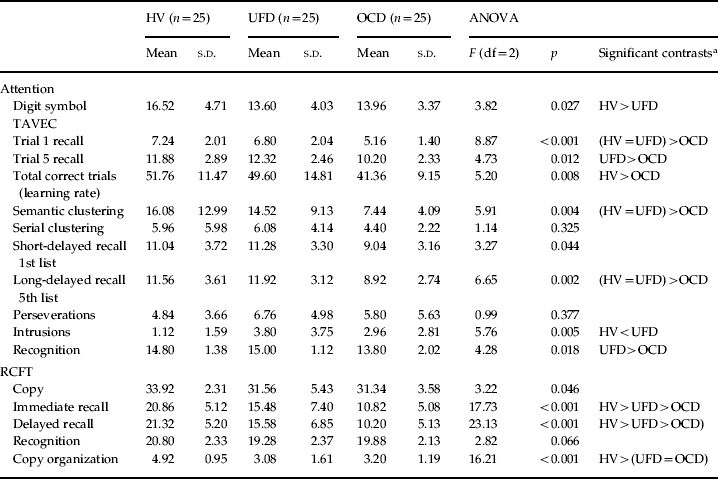
Table 2 shows the distribution of the neuropsychological variables (means and standard deviation) for the three groups, and the results of the ANOVA procedures. As regards attention, HV had higher mean scores for the digit symbol task than UFD (p=0.046) (Table 2).
Comparison of neuropsychological performance mean scores

HV, Healthy volunteers; UFD, unaffected first-degree relatives; OCD, obsessive-compulsive disorder; ANOVA, analysis of variance; df, degrees of freedom; TAVEC, Spanish-Complutense Verbal Learning Test; RCFT, Rey-Osterrieth Complex Figure Test.
a Scheffé's post-hoc comparison (only significant results are tabulated).
With regard to verbal memory, the groups presented different mean scores on some measures on the TAVEC: recall after the first and fifth trials, number of items recalled over five successive learning trials (learning rate), semantic strategies, short and long delayed recall, number of intrusions and recognition. HV had higher scores than OCD on recall after the first trial (p=0.001), learning rate (p=0.012), semantic strategies (p=0.008) and long delayed recall (p=0.017) and lower scores than UFD on intrusions (p=0.006). UFD scored higher than OCD on recall after the first (p=0.010) and fifth (p=0.018) trials, semantic strategies (p=0.036), long delayed recall (p=0.006) and recognition (p=0.029). Although the global effect of group was statistically significant for short delayed recall (p=0.044), non-significant post hoc comparisons (using Scheffé's contrasts) were found between groups.
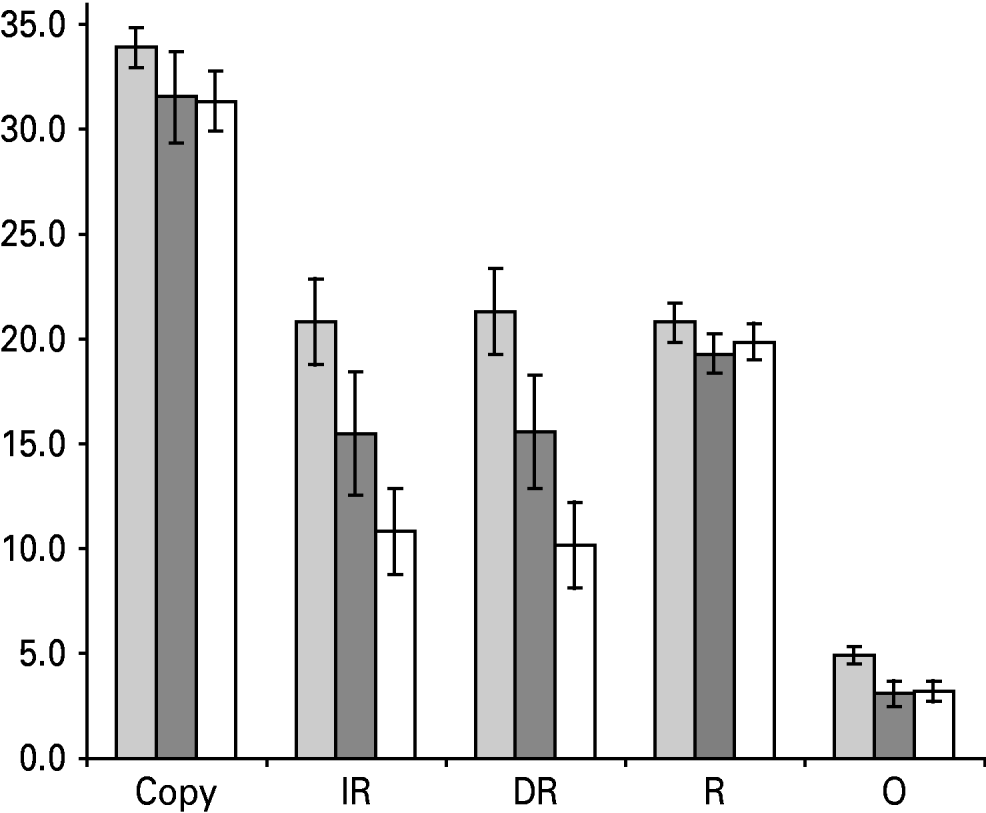
With regard to non-verbal memory, statistical differences between groups also appeared on several measures of the RCFT: copy, immediate and delayed recall and use of organizational strategies. The three groups differed on immediate and delayed recall, with HV scoring higher than UFD (p=0.009 and p=0.003 respectively) and OCD (p<0.001) and UFD scoring higher than OCD (p=0.027 and p=0.006 respectively). HV also had higher scores on organizational strategies than UFD and OCD (p<0.001), whereas there were no differences between UFD and OCD. Although the global effect of group was statistically significant for copy (p=0.046), non-significant post hoc comparisons were found using Scheffé's contrasts (Fig. 1).
Error bars (±2 s.e.) for means of the primary Rey-Osterrieth Complex Figure test (RCFT) scores. HV ( ), healthy volunteers; UFD (
 ), unaffected first-degree relatives; OCD (□), obsessive-compulsive disorder; Copy, copy of RCFT; IR, immediate recall; DR, delayed recall; R, recognition; O, organization.

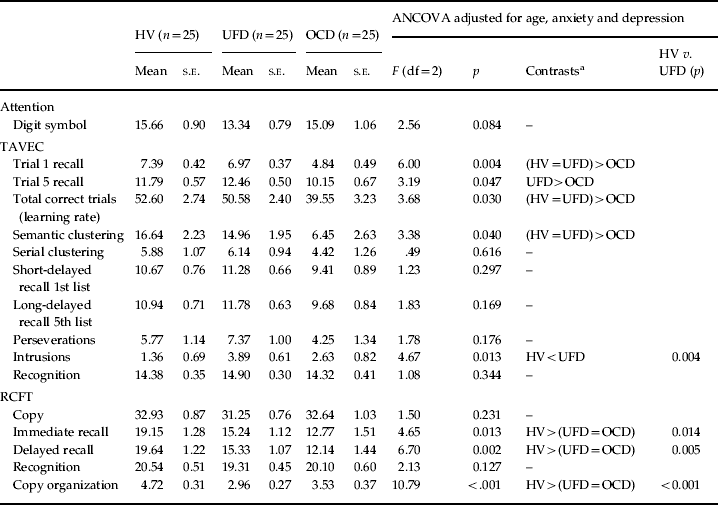
Table 3 presents the adjusted means and standard errors of neuropsychological variables for the three groups and results of the ANCOVA for each measure, adjusted for age, anxiety and depression. Most of the results remained unchanged with regard to the results of the ANOVA (Table 2). However, differences between the three groups disappeared for digit symbol (p=0.084), short (p=0.297) and delayed (p=0.169) recall and recognition (p=0.344) on the TAVEC and the copy task on the RCFT (p=0.231). Moreover, UFD scored significantly higher than OCD on learning rate on the TAVEC (p=0.016), but the groups did not differ on delayed recall on the RCFT (p=0.345). In summary, when age, anxiety and depression were added as covariates, differences between HV and UFD were only observed for the following variables: intrusions on the TAVEC (p=0.004); immediate (p=0.014) and delayed (p=0.005) recall; use of organizational strategies (p<0.001) on the RCFT.
Comparison of neuropsychological performance adjusted for age, anxiety and depression

HV, Healthy volunteers; UFD, unaffected first-degree relatives; OCD, obsessive-compulsive disorder; TAVEC, Spanish-Complutense Verbal Learning Test; RCFT, Rey–Osterrieth Complex Figure Test.
a Scheffé's post-hoc comparison (only significant results are tabulated).
Correlation analysis
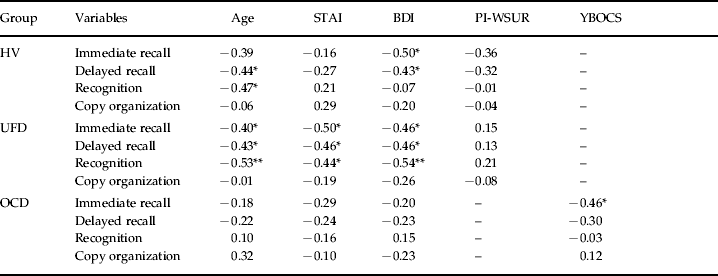
Table 4 shows the correlation coefficients between clinical measures and neuropsychological variables of non-verbal memory in each group. Age was inversely correlated with measures of recall and recognition in HV and UFD (r coefficients between −0.39 and −0.53). Levels of anxiety and depression were also inversely correlated with recall and recognition in UFD (r values ranging from −0.44 to −0.54), whereas in HV only depression correlated significantly with recall (r coefficients between −0.43 to −0.50). Subclinical obsessive-compulsive symptoms (scored with PI-WSUR) did not show significant correlations with any of the RCFT measures in HV and UFD (absolute r values between 0.01 and 0.36). In OCD none of the correlations was statistically significant (absolute r values between 0.10 and 0.32), except severity of obsessive-compulsive symptomatology (scored with YBOCS), which was inversely correlated with immediate recall of RCFT (r=−0.46, p=0.020).
Spearman's Rho correlations between neuropsychological variables of non-verbal memory (Rey-Osterrieth Complex Figure Test) and clinical measures

HV, Healthy volunteers; UFD, unaffected first-degree relatives; OCD, obsessive-compulsive disorder; STAI, State-Trait Anxiety Index; BDI, Beck Depression Inventory; PI-WSUR, Padua Inventory-Washington State Revision; YBOCS, Yale-Brown Obsessive Compulsive Scale.
* p<0.05, ** p<0.01.
As regards the correlations between clinical measures and neuropsychological variables of verbal memory, age was only negatively related to the different domains of recall, recognition and semantic clustering in HV (r values between −0.53 and −0.68, p<0.01) and to learning rate in OCD (r=−0.41, p=0.042). In OCD, long-delayed recall was also negatively associated with anxiety (r=−0.44, p=0.029). Finally, in UFD only recognition correlated negatively with depression (r=−0.54, p=0.006).
As for attention, the scores for digit span test correlated negatively with age in HV (r=−0.44, p=0.029) and UFD (r=−0.56, p=0.004) and with depression in OCD (r=−0.43, p=0.033).
Predictors of neuropsychological performance
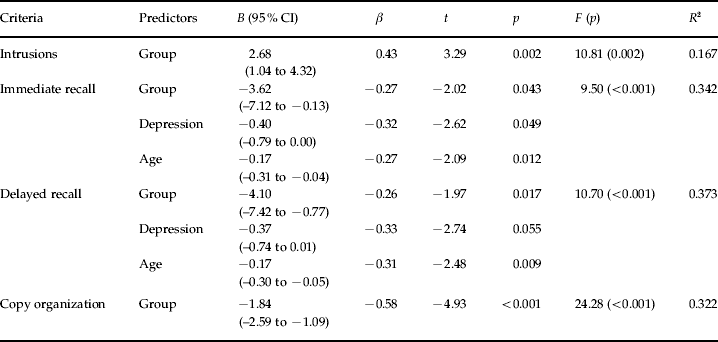
Table 5 presents the results of the four final models obtained with multiple-regression: one for each measure that previously presented differences between HV and UFD (after adjusting for age, anxiety and depression, see Table 3). UFD were associated with more intrusions [95% confidence intervals (CI) for B: 1.04–4.32, p=0.002] and HV with better immediate recall (95% CI for B: 0.13–7.12, p=0.043), delayed recall (95% CI for B: 0.77–7.42, p=0.017) and copy organization (95% CI for B: 1.09–2.59, p<0.001). As regards recall on the RCFT, older participants and those with higher levels of depression also showed worse immediate and delayed recall (β coefficients ranging from −0.26 to −0.33).
Predictors of verbal and non-verbal memory

R 2, Adjusted R 2 coefficient.
Results obtained with multiple lineal regression (stepwise procedure).
Group codified: 0=health volunteers; 1=unaffected first-degree relatives.
Discussion
To our knowledge, this is the first study to explore verbal and non-verbal memory and information-processing strategies in UFD of OCD patients. In the execution of the RCFT, our UFD sample presented a cognitive pattern similar to the characteristic profile of obsessive patients, with impairments both in recall and in the use of organizational strategies in information processing; however, in verbal memory tasks, their neuropsychological performance did not present the dysfunctions seen in OCD patients.
Non-verbal memory
The profile of dysfunction on the execution of RCFT in UFD was indistinguishable from that of OCD patients. This pattern of cognitive dysfunction in UFD and OCD but not in HV remained unchanged after covarying for age, anxiety and depression. The results of the multiple-regression model confirmed our hypothesis; only UFD were associated with worse copy organization on the RCFT, although other independent variables such as age and intensity of depression were associated with poor performance in recall measures on the RCFT. The findings regarding the use of organizational strategies suggest that UFD present the same cognitive deficits in the information-encoding process as those reported in obsessive patients (Savage et al. Reference Savage, Baer, Keuthen, Brown, Rauch and Jenike1999, Reference Savage, Deckersbach, Wilhelm, Rauch, Baer, Reid and Jenike2000; Deckersbach et al. Reference Deckersbach, Otto, Savage, Baer and Jenike2000; Penades et al. Reference Penades, Catalan, Andres, Salamero and Gasto2005) and in patients with Parkinson's (Grossman et al. Reference Grossman, Carvell, Peltzer, Stern and Hurtig1993). Similarly, the impairments in information recall replicate the results obtained in several studies in obsessive patients (Savage et al. Reference Savage, Baer, Keuthen, Brown, Rauch and Jenike1999, Reference Savage, Deckersbach, Wilhelm, Rauch, Baer, Reid and Jenike2000; Deckersbach et al. Reference Deckersbach, Otto, Savage, Baer and Jenike2000; Segalas et al. Reference Segalas, Alonso, Labad, Jaurrieta, Real, Real, Jiménez, Menchón and Vallejo2008). Our results corroborate those of other studies, which found the same cognitive deficits in different measures of executive functions in both obsessive patients and first-degree family members, supporting the notion that these neuropsychological deficits may be endophenotypes of OCD (Chamberlain et al. Reference Chamberlain, Fineberg, Menzies, Blackwell, Bullmore, Robbins and Sahakian2007, Reference Chamberlain, Menzies, Hampshire, Suckling, Fineberg, del Campo, Aitken, Craig, Owen, Bullmore, Robbins and Sahakian2008; Menzies et al. Reference Menzies, Achard, Chamberlain, Fineberg, Chen, del Campo, Sahakian, Robbins and Bullmore2007). These findings, which are free of the possible bias deriving from medication or from the existence of a psychiatric disorder in UFD, indicate that the use of organizational strategies and the recall of non-verbal information during the execution of the RCFT should be considered as a deficit with a familial component. There are several possible explanations for these results. One explanation is genetically based: non-verbal memory dysfunctions could be considered as possible endophenotypes in OCD, although further work is needed to determine the hereditability of these cognitive domains. A second explanation would point to the effect of family factors such as parenting styles, care, control and discipline that are associated with cognition and the development of anxiety disorders (Gallagher & Cartwright-Hatton, Reference Gallagher and Cartwright-Hatton2008), which we did not control in this study.
Verbal memory
OCD patients performed worse on the TAVEC in tasks that assess learning and information processing. These results are in agreement with those of many studies performed in obsessive patients (Deckersbach et al. Reference Deckersbach, Otto, Savage, Baer and Jenike2000; Savage et al. Reference Savage, Deckersbach, Wilhelm, Rauch, Baer, Reid and Jenike2000; Savage & Rauch, Reference Savage and Rauch2000; Cabrera et al. Reference Cabrera, McNally and Savage2001), though not all (Christensen et al. Reference Christensen, Kim, Dysken and Hoover1992; Dirson et al. Reference Dirson, Bouvard, Cottraux and Martin1995). These impairments were not found in our two groups of control subjects (UFD and HV); in these groups, cognitive performance was preserved and did not display the dysfunctions found in the patients' group. Classically, semantic clustering has been used as a marker of verbal information processing, both in neurological diseases such as Parkinson's and Huntington's chorea (Massman et al. Reference Massman, Delis, Butters, Levin and Salmon1990), which share a neurobiological substrate similar to that of OCD (Starkstein et al. Reference Starkstein, Brandt, Folstein, Strauss, Berthier, Pearlson, Wong, McDonnell and Folstein1988; Huber & Glatt, Reference Huber and Glatt1992) and in studies of obsessive patients (Deckersbach et al. Reference Deckersbach, Otto, Savage, Baer and Jenike2000; Savage et al. Reference Savage, Deckersbach, Wilhelm, Rauch, Baer, Reid and Jenike2000). Nevertheless, recent reports have described semantic intrusions as being a new cognitive marker of frontal lobe epilepsy and reflect impairments on encoding verbal information in Parkinson's disease as well (Hernandez et al. Reference Hernandez, Sauerwein, Jambaqué, de Guise, Lussier, Lortie, Dulac and Lassonde2003; Weintraub et al. Reference Weintraub, Moberg, Culbertson, Duda and Stern2004). The high number of intrusions in UFD (higher even than in patients) may reflect alterations in information processing in these subjects. The superior performance of UFD compared with HV on certain measures of learning (e.g. recall after the fifth trial) is striking, although HV learnt a greater quantity of words after the five attempts and there were no significant differences between the two control groups, HV and UFD. The results for verbal memory did not identify it as a useful cognitive marker of OCD. Verbal and non-verbal memory present differences in neurobiological bases and functional independence in organizational strategies (Lezak, Reference Lezak and Lezak1995; Deckersbach et al. Reference Deckersbach, Otto, Savage, Baer and Jenike2000). Given the existence of these biological differences between the two kinds of memory, our results could be explained by the fact that verbal memory is less likely to be affected by a familial component (genetic or parenting factors) than non-verbal tasks in OCD and UFD, although this conclusion is only tentative at present.
Clinical variables and neuropsychological performance
UFD and HV did not show statistical differences in levels of anxiety and depression. Only presence of subclinical obsessive-compulsive symptoms was significantly higher in UFD than in HV, although Axis I and II pathology was ruled out by the administration of specific scales (First et al. Reference First, Gibbon, Spitzer and Williams1997a, b). UFD showed an inverse correlation between age, BDI and STAI and measures of recall on the RCFT; higher scores on the BDI were negatively associated with recognition on the TAVEC. In HV, age and BDI were inversely correlated with measures of recall and recognition on the RCFT; recall, recognition and semantic clustering on the TAVEC were negatively associated with age. These results suggest that HV and UFD present different degrees of cognitive vulnerability to the clinical variables studied, which, in the final analysis, may reflect underlying neurobiological differences.
In the case of OCD patients, severity of obsessive symptoms (measured with the YBOCS) was associated negatively with immediate recall on the RCFT, the intensity of depressive symptoms (scored with the BDI) was inversely correlated with attention and higher levels of anxiety were associated with worse recall of verbal information. These results partially corroborate those of previous studies in OCD patients, which reported associations between the intensity of the responses on the YBOCS obsession subscale and performance on non-verbal memory tasks (Penades et al. Reference Penades, Catalan, Andres, Salamero and Gasto2005). Nonetheless, in our sample of OCD we did not replicate the correlations between the severity of the depressive symptoms and performance on the RCFT reported in previous studies (Moritz et al. Reference Moritz, Kloss, Jahn, Schick and Hand2003; Segalas et al. Reference Segalas, Alonso, Labad, Jaurrieta, Real, Real, Jiménez, Menchón and Vallejo2008). Those studies found that higher scores of depressive symptoms measured in their samples modulated cognitive performance on non-verbal memory tasks. However, unlike the samples used in the Moritz et al. (Reference Moritz, Kloss, Jahn, Schick and Hand2003) and Segalas et al. (Reference Segalas, Alonso, Labad, Jaurrieta, Real, Real, Jiménez, Menchón and Vallejo2008) studies, our patients presented only mild depressive symptoms, which could explain the lack of association between depressive symptoms and the execution of non-verbal memory tasks in our patients.
Limitations
The relatively small sample size could be considered a limitation of the study. Another possible limitation is the use of first-degree family members in the search for endophenotypes, as not all family members will necessarily present the marker studied. Our UFD sample included parents, siblings and children of obsessive patients. In future studies, we suggest that the UFD should comprise only obligate-carriers (unaffected relatives with both an affected child and parent) or the parametric influence of familial loading (the number of affected relatives) (Faraone et al. Reference Faraone, Seidman, Kremen, Toomey, Pepple and Tsuang2000).
On the basis of our findings and taking into account the limitations of the study, we can conclude that UFD and OCD patients show the same pattern of cognitive dysfunction during the execution of a non-verbal memory task. This supports the hypothesis that deficits in non-verbal memory could be considered an endophenotype of OCD. These results need to be confirmed through broader studies to determine the heritability of these cognitive domains.
Acknowledgements
This study was supported in part by grants 010210 from the Fundació la Marató TV3, Barcelona, 2005 FI 00738 from the Agència de Gestió d'Ajuts Universitaris i de Recerca, Generalitat de Catalunya, by the European Commission under the Seventh Framework Programme (FP7-ICT-215839–2007; Playmancer Project), by the Instituto de Salud Carlos (III) Centro de Investigación en Red de Salud Mental (CIBERSAM) and by Fondo de Investigaciones Sanitarias de la Seguridad Social, FIS PI071029 and FIS PI071044.
Declaration of Interest
None.