Introduction
Experiencing life-threatening events in childhood and adolescence can result in the development of posttraumatic stress disorder (PTSD), which is estimated to effect between 11% and 20% in trauma-exposed populations (Alisic et al., Reference Alisic, Zalta, van Wesel, Larsen, Hafstad, Hassanpour and Smid2014). PTSD represents a significant threat to a young person's developmental trajectory (Mathews, Dempsey, & Overstreet, Reference Mathews, Dempsey and Overstreet2009; McDermott, Reference McDermott2009), and symptoms can persist well into adulthood (Morgan, Scourfield, Williams, Jasper, & Lewis, Reference Morgan, Scourfield, Williams, Jasper and Lewis2003; Yule et al., Reference Yule, Bolton, Udwin, Boyle, O'Ryan and Nurrish2000), causing longer-term deleterious impacts across several major domains of mental health and functioning (Bolton et al., Reference Bolton, Hill, O'Ryan, Udwin, Boyle and Yule2004; Galovski, Blain, Chappuis, & Fletcher, Reference Galovski, Blain, Chappuis and Fletcher2013).
Following a traumatic event, women have a two to three times higher risk of developing PTSD compared to men (Kessler, Sonnega, Bromet, Hughes, & Nelson, Reference Kessler, Sonnega, Bromet, Hughes and Nelson1995; Kilpatrick et al., Reference Kilpatrick, Resnick, Milanak, Miller, Keyes and Friedman2013; Tolin & Foa, Reference Tolin and Foa2006), which may be explained by differences in neurohormonal, affective, and social cognitive risk factors associated with sex (Christiansen & Berke, Reference Christiansen and Berke2020; Ramikie & Ressler, Reference Ramikie and Ressler2018) as well as coping styles used by men and women (Olff, Langeland, Draijer, & Gersons, Reference Olff, Langeland, Draijer and Gersons2007). PTSD is also more likely to develop into a chronic condition in women than in men (Breslau, Davis, Andreski, Peterson, & Schultz, Reference Breslau, Davis, Andreski, Peterson and Schultz1997) and is associated with higher comorbidity rates of depression and anxiety disorders (Breslau et al., Reference Breslau, Davis, Andreski, Peterson and Schultz1997; Castillo et al., Reference Castillo, Joseph, Tharp, C'De Baca, Torres-Sena, Qualls and Miller2014; Tolin & Foa, Reference Tolin and Foa2006) as well as an increased risk of chronic disease and mortality (Roberts, Kubzansky, Chibnik, Rimm, & Koenen, Reference Roberts, Kubzansky, Chibnik, Rimm and Koenen2020). While studies within the adult and adolescent literature typically identify robust sex differences in PTSD prevalence, evidence from the child literature is scarce. For example, results from a large meta-analysis report that female sex is a stronger risk factor for PTSD in older children and adolescents, when compared with younger children (Trickey, Siddaway, Meiser-Stedman, Serpell, & Field, Reference Trickey, Siddaway, Meiser-Stedman, Serpell and Field2012). Similarly, evidence from the UK ALSPAC cohort indicated higher levels of PTSD symptoms in trauma-exposed females v. males in adolescence, but not in childhood (Haag et al., Reference Haag, Fraser, Hiller, Seedat, Zimmerman and Halligan2020). The emergence of sex differences in adolescence may potentially be explained through changes in neuroendocrine, hormonal, and stress response systems that are naturally affected during puberty (e.g. changes in adrenal androgens and sex steroids); (Garza & Jovanovic, Reference Garza and Jovanovic2017) as well increasing socialisation into constructed gender roles that could impact coping, social support, symptom expression, and symptom reporting. However, direct evidence of developmental change in vulnerability is limited.
The current evidence base relating to developmental sex differences in PTSD has notably been focused on cross-sectional prevalence studies. Significant natural recovery from PTSD occurs in the first 3–6 months following trauma among children and adolescents (Hiller et al., Reference Hiller, Meiser-Stedman, Fearon, Lobo, McKinnon, Fraser and Halligan2016) but potential sex differences in this natural recovery have not been examined. In the adult literature, higher rates of spontaneous remission have been observed in women v. men exposed to natural disasters (Karamustafalioglu et al., Reference Karamustafalioglu, Zohar, Güveli, Gal, Bakim, Fostick and Sasson2006); however, to our knowledge, equivalent evidence child evidence is lacking. The moderating effect of age at the time of exposure could also conceivably play a key role in the exacerbation or alleviation of symptoms due to the impact of sex-specific hormonal or socialisation influences that arise during adolescence. Improved understanding of the children who are more likely to recover naturally in comparison to those who retain chronic symptoms has significant implications for the identification and intervention for at-risk youth and determining appropriate periods for watchful waiting.
The current study evaluated the presentation and natural recovery of PTSD symptoms in children following acute single-incident trauma. We performed a secondary analysis of longitudinal data obtained from a large international database (N = 3397) and examined the pattern of sex differences in PTSD in children aged between 7 and 18 years. Specifically, we examined both the effects of sex and age in the initial presentation of PTSD symptom severity, as well as their contribution to the natural recovery of PTSD symptoms at both 3 months and 6 months after the event. We adjusted in our analyses for trauma type (intentional v. unintentional), as intentional trauma (e.g. physical or sexual assault) is associated with a greater risk of PTSD (Alisic et al., Reference Alisic, Zalta, van Wesel, Larsen, Hafstad, Hassanpour and Smid2014), more severe symptoms (Birkeland, Skar, & Jensen, Reference Birkeland, Skar and Jensen2021), and has been identified as a possible contributor to sex differences (Tolin & Foa, Reference Tolin and Foa2006; Trickey et al., Reference Trickey, Siddaway, Meiser-Stedman, Serpell and Field2012). We also accounted for study clustering due to data being collated from multiple sources.
Methods
Pact/R data archive
Longitudinal data of child PTSD scores were provided by the international data archive for The Prospective studies of Acute Child Trauma and Recovery (PACT/R) – for a description of the archive see Kassam-Adams et al. (Reference Kassam-Adams, Kenardy, Delahanty, Marsac, Meiser-Stedman, Nixon and Palmieri2020). The archive comprises 32 longitudinal studies across five countries, featuring over 5500 children that have experienced trauma such as injury, acute illness, RTA, or interpersonal violence. All original studies identified eligible children through exposure to a trauma, for example in a presentation to an emergency ward following injury.
For the purposes of this study, data were included from 24 studies where PTSD symptoms, also known as posttraumatic stress symptoms (PTSS), were recorded at T1 (1-month post-trauma), T2 (3 months) and/or T3 (6 months), resulting in the exclusion of eight of the original studies where data were not available at these timepoints; see online Supplementary Table S1 for details on the studies included. Timepoint eligibility included study measurements within 1 month before or after the desired timepoint. For example, for T1 the time since trauma could range from 0 to 2 months, whereas for T3 it was 5–7 months. The resultant sample comprised a total of 3397 children between ages 7 and 18 years, from five different countries (USA k = 14 studies; Australia k = 4, UK k = 4, Switzerland k = 2; See online Supplementary Table S1 for full details). For the longitudinal analyses, studies with consistent PTSD measurements across at least two timepoints from T1, T2, and T3 were used. This sub-sample featured 18 of the eligible 24. To identify an appropriate sample size, an a priori power analysis for one-way analysis of variance (ANOVA), with two groups, was conducted using the recommended statistical power (80; Aberson, Reference Aberson2011). Existing meta-analyses that explore sex differences in PTSD severity among adolescents report a small effect size of approximately f = 0.20 (Tolin & Foa, Reference Tolin and Foa2006; Trickey et al., Reference Trickey, Siddaway, Meiser-Stedman, Serpell and Field2012). Using this as an estimate, we predicted a sample size of 200 participants would be required to recognise similar effects. We did not conduct a priori power analyses to examine age by sex interactions due to a lack of previous evidence for this developmental period.
Procedure
Each of the original studies obtained ethical approval from the required local body. Further ethical approval was obtained from the University of Bath Psychology Research Ethics Committee. Seven different PTSD measurement instruments were used across studies (Child and Adolescent Trauma Survey; Child PTSD Symptom Scale; Acute Stress Checklist; Clinician-Administered PTSD Scale; Children's Revised Impact of Events Scale; UCLA PTSD Reaction Index for DSM-IV; UCLA PTSD Reaction Index for DSM-5). All instruments assessed PTSD symptoms according to the DSM-IV criteria, apart from the UCLA PTSD Reaction Index for DSM-5 which additionally measured DSM-5 symptoms. Measures were predominantly administered in English, with translation to Spanish (k = 1) and German (k = 2) as appropriate (see online Supplementary Table S1 for details). PTSD scores were harmonised to improve the comparability of PTSD scores from separate studies. This involved firstly calculating the mean score among PTSD symptom items for each measurement (e.g. UCLA-IV) and at each timepoint where data was available. Mean scores were then standardised by dividing by the range of the measurement scale used, resulting in a mean score between zero and one (Griffith et al., Reference Griffith, van den Heuvel, Fortier, Sohel, Hofer, Payette and Raina2015). For example, scores for the UCLA-IV were harmonised by dividing the UCLA-IV scores by four based on its zero to four scale. The type of trauma exposure was indexed as a binary variable indicating whether the trauma had been unintentional or intentional. Children who had experienced an unintentional injury, road traffic accident (RTA), acute medical event (non-injury) or disaster such as a hurricane were coded as having experienced an unintentional trauma, whereas exposure to interpersonal violence was classified as an intentional trauma.
Statistical analyses
We examined the influence of self-reported sex and age of trauma on PTSD symptoms at 1 month (T1), 3 months (T2) and 6 months (T3) post-trauma and the contribution of both sex and age in the natural recovery of symptoms at T2 and T3. PTSD scores were positively skewed and were made approximately normal through square root transformation. Several outliers, identified for lower and upper boundaries of PTSD scores by inspection of box plots and Mahalanobis distances, were retained as plausible values as they were unlikely to have occurred from data entry or measurement error. Initial analyses involved comparing males (coded 0) and females (coded 1) using independent t tests and chi-square tests of independence. Research questions were addressed through a series of multiple linear regression models. Models labelled ‘Model 1’ examined the main effects of sex and age (continuous variable from 7 to 18 years) on PTSS symptoms at all three time points. All models were adjusted for the type of trauma experienced (0 = unintentional, 1 = intentional) as a potential confounder and accounted for clustering based on study ID using a random-effects model. Models labelled ‘Model 2’ included Model 1 + a sex × age interaction term using a full factorial model in the examination of PTSS scores. The set threshold for an indication of an interaction effect was p < 0.10 (Sterne & Davey Smith, Reference Sterne and Davey Smith2001).
For the longitudinal analyses, the natural recovery in PTSD symptoms was indexed by subtracting T1 scores from T2, providing the variable ΔT2, and T1 scores from T3, providing the variable ΔT3. Thus, more negative values indicate a better recovery. Due to a smaller sample available for these two variables (ΔT2 = 1196 participants; ΔT3 = 707 participants), with certain ages less well represented, age was not used as a continuous variable but instead was dichotomised into two approximately equal-sized groups of children of ≤12 years and 13≥ years. Previous evidence also suggests that sex differences in PTSS emerge at around 13 years (Haag et al., Reference Haag, Fraser, Hiller, Seedat, Zimmerman and Halligan2020). Like the cross-sectional analyses, the main effects of sex and dichotomised age (Model 1) were used to predict rates of symptoms change at ΔT2 and ΔT3. These models were also adjusted for the initial scores at baseline (T1), as higher initial symptoms potentially allow for a greater rate of change. In Model 2, the interaction term between sex and dichotomised age was added. If there was evidence of an interaction between sex and age, sex-stratified analyses were conducted and simple effects between sexes were reported. Statistical analyses were conducted using Stata, version 16.1 (Statacorp, College Station, TX).
Results
The sample population comprised 3397 cases with 2118 males (62.3%) and 1279 females (37.7%). Participants had a mean age of 12.43 years (s.d. = 2.74) ranging from 7 to 18 years, which was similar for males (12.48 ± 2.71 years) and females (12.34 ± 2.78 years) (t = 1.41, p = 0.16). Overall, 88.3% (n = 2974) of the sample had been exposed to an unintentional trauma, compared with 11.7% (n = 393) exposed to an intentional trauma. A similar proportion of males and females had experienced an intentional trauma (males: 12.1%, n = 253; females: 11.0%, n = 139) compared to an unintentional trauma (males: 87.9%, n = 1847; females: 89.0%, n = 1127; χ2 = 0.94, p = 0.33). There were more males v. females at each time point; see Table 1. Table 1 also shows descriptive statistics (mean, standard error) for the harmonised, square-root transformed PTSD scores at the three time points adjusted for type of trauma exposure and study clustering. The original harmonised, non-transformed PTSD scores (with no adjustments) can be found in the supplementary material (online Supplementary Table S2).
Number of observations at each time point and PTSS scores displaying means ± standard error after square root transformations. Means are adjusted for type of trauma exposure and study clustering

Does sex and age at exposure predict PTSD severity at T1, T2 and T3?
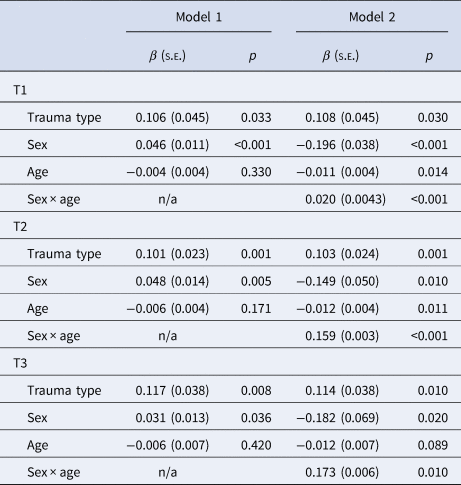
From 2293 participants available from 17 studies at T1, there were 2005 individuals (87.4%) with complete data for analysis. The mean PTSD score at T1 was 0.493 ± 0.037, and symptoms were 9% higher in females (0.523 ± 0.033) compared to males (0.476 ± 0.040). Table 2 contains the beta coefficients and p values for linear regression models examining the prediction of PTSS by age, sex (model 1) and their interaction (model 2), covarying for trauma type and study clustering.
Associations of sex, age, and the interaction between sex and age on PTSD symptom severity at T1, T2 and T3

Model 1: Child sex (0 = male, 1 = female) and age (continuous variable) as predictors of PTSD symptom severity controlling for type of trauma exposure (0 = unintentional, 1 = intentional) and study clustering. Model 2: Model 1 + (child sex × age interaction).
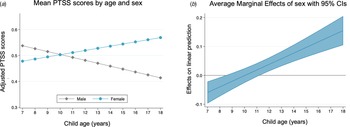
In model 1, a main effect of sex was observed [model F(3,16) = 6.05, p = 0.006, R 2 = 0.029], with girls reporting higher symptoms than boys. Age as the main effect was not predictive of PTSS. Trauma type was a significant covariate, with intentional v. unintentional trauma being associated with higher PTSS. In model 2 which included the interaction term, there was strong evidence of a sex × age interaction [model F(4,16) = 10.89, p = 0.002, R 2 = 0.045] (see Table 2 for full results). In sex-stratified analyses, increasing age was positively associated with PTSD scores in females (β = 0.008, s.e. = 0.004, p = 0.047), whereas age was negatively associated with PTSD scores in males (β = −0.011, s.e. = 0.004, p = 0.014). Figure 1a shows adjusted predictions for PTSD scores according to sex. Simple effects post-interaction show PTSD scores were significantly higher in males at age 7 years (p = 0.004) and 8 years (p = 0.019), similar at 9–11 years (p > 0.05) and higher in females between the ages of 12 and 18 years (all p < 0.001) as shown in Fig. 1b.
Sex differences in PTSS, according to age, at T1 (baseline). (a) Markers show adjusted predictions at representative values with PTSS increasing with age in girls, and decreasing with age in boys; (b) sex differences in PTSS increase with increasing adolescent age. Plot shows average marginal effects of sex with 95% confidence intervals with the horizontal line indicating males as the reference group.

From 2460 participants originally available at T2, there were 2034 complete cases for analysis (82.7%). Overall mean PTSD scores were 0.374 ± 0.022, representing a 24% reduction in symptoms from T1. In model 1, linear regression found the main effects of sex and trauma type, but no main effect of age; model F(3,14) = 13.86, p < 0.001, R 2 = 0.026 (see Table 2). With the addition of the interaction term in model 2, a main effect of age was additionally identified, as well as sex × age interaction; model F(4,14) = 39.02, p < 0.001, R 2 = 0.035. In sex-stratified analyses, age was negatively associated with PTSD scores in males (β = −0.012, s.e. = 0.004, p = 0.011) but not females (β = 0.004, s.e. = 0.005, p = 0.430). Simple effects show that PTSD scores were higher in females aged 12 years and older (all p < 0.05), but not at younger ages.
At T3, there were 1293 (83.0%) complete cases from an original sample of 1557 participants. The average PTSS score was 0.372 ± 0.023, which was a 25% decrease from T1, but approximately the same as T2. In model 1, linear regression identified the main effects of sex and trauma type, but no main effect of age; model F(3,14) = 6.44, p = 0.006, R 2 = 0.041. In model 2, there was again a significant sex × age interaction (see Table 2); model F(4,14) = 3.72, p = 0.029, R 2 = 0.052. In sex-stratified analyses, age was not associated with PTSD scores in females (β = 0.005, s.e. = 0.008, p = 0.532) or males (β = −0.012, s.e. = 0.007, p = 0.089). However, PTSD scores were higher in females aged 12 years and older (all p < 0.05), but not at younger ages.
Does sex and age of trauma influence the recovery in PTSD scores at follow up?
The rate of change in PTSD from baseline (T1) to 3 months (ΔT2), and T1 to 6 months (ΔT3) were also examined. Linear regression examined the potential contributions of sex, dichotomised age (≤12 or 13>= years), and their interaction to the natural recovery of symptoms, adjusting for baseline symptoms.
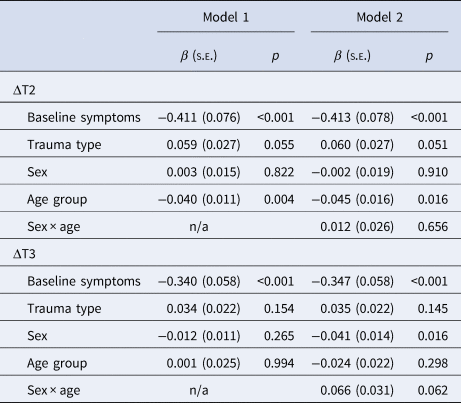
Eleven studies had consistent measurements across T1 and T2 (total sample size, n = 1696). There were 1196 complete cases for calculating ΔT2, meaning that 70.5% of the sample assessed at 1 month were again reassessed at 3-months, with more male v. female participants (n = 740, 61.9% v. n = 456, 38.1%). There was a similar proportion of younger (≤12yrs) and older (≥13yrs) males (n = 373, 50.4% v. n = 367, 49.6%) and younger and older females (n = 245, 53.7% v. n = 211, 46.3%). There was no evidence that sex (p = 0.61) or age (p = 0.25) was related to missing ΔT2 scores. Overall mean scores at ΔT2 were negative, consistent with psychological recovery (−0.125 ± 0.026). In model 1, linear regression found a main effect of dichotomised age, with those aged 13=> years showing greater signs of recovery, model: F(4,10) = 18.03, p < 0.001, R 2 = 0.187. There were no main effects of sex or trauma type (see Table 3). With the addition of the interaction term in model 2, dichotomised age was again identified as the main effect, model, F(5,10) = 23.74, p < 0.001, R 2 = 0.187), but there was no evidence of an interaction between sex and age.
Associations of sex, dichotomised age, and the interaction between sex and age on PTSD symptom recovery at ΔT2 and ΔT3

Model 1: Child sex (0 = male, 1 = female) and dichotomised age (0 ≤ 12 years, 1 ≥ 13 years) as predictors of PTSD symptom recovery controlling for baseline symptoms (T1), type of trauma exposure (0 = unintentional, 1 = intentional), and study clustering. Model 2: Model 1 + (child sex × age interaction).
Eleven studies also contained consistent measurements for T1 and T3 (n = 1008). For this analysis, 707 complete cases were available, representing 70.1% of the original sample recruited at T1. There were more male v. female participants in this group (n = 442, 62.5% v. n = 265, 37.5%) and there was also a similar proportion of younger and older males (n = 236, 53.4% v. n = 206, 46.6%) and younger and older females (n = 149, 56.2% v. n = 116, 43.8%). Neither sex (p = 0.49) or age (p = 0.71) was related to missing outcomes. At ΔT3 mean scores were again negative, although in this sample of participants recovery was less compared to ΔT2 (−0.085 ± 0.014). In model 1, neither sex, dichotomised age, or trauma type were significant predictors of ΔT3 scores; model, F(4,10) = 14.55, p < 0.001, R 2 = 0.169. In model 2 (F(5,10) = 21.37, p < 0.001, R 2 = 0.177), a main effect of sex was identified, and there was some evidence of a sex × age interaction (p = see Table 3). Overall, females showed greater recovery than males (female M = −0.092, s.e. = 0.016; male M = −0.080, s.e. = 0.013). Post hoc simple effects show that estimated means for males and females differed in the younger age group (female M = −0.110, s.e. = 0.022; male M = −0.069, s.e. = 0.013; F(1,10) = 8.44, p = 0.016) but not in the older age group (female M = −0.069, s.e. = 0.028; male M = −0.094, s.e. = 0.021; F(1,10) = 1.45 p = 0.256), consistent with a greater recovery in the younger female age group only.
Discussion
This study investigated sex differences in the presentation and natural recovery of PTSD symptoms in children following acute trauma. This secondary analysis of longitudinal data obtained from a large international database provides unique insight into the pattern of sex differences in PTSD in children aged between 7 and 18 years in the first 6 months following a single-incident trauma. Greater symptom severity among females compared to males was identified at baseline, 3 months, and 6 months post-trauma. Furthermore, at baseline, the age at which the trauma was encountered moderated the observed sex differences; increasing age resulted in greater symptom severity in females, whereas in contrast, increasing age resulted in fewer symptoms in males; a pattern that was partially replicated at follow-up assessments. Finally, we found evidence of sex differences in the natural recovery of symptoms at 6-months post-trauma, with females showing a greater natural recovery than males. There was also trend-level evidence that child age could be a moderating factor; younger females (aged 7–12 years) displayed a greater natural recovery than males of the same age. In contrast, sex differences in changes to PTSD scores were not observed in older children.
Findings that female children exhibit significantly greater symptom severity than males in the acute aftermath of trauma are in line with current adult and adolescent literature. A consensus has now emerged that females are at a greater risk of PTSD regardless of the type or severity of the trauma, and international context (Christiansen & Berke, Reference Christiansen and Berke2020; Hiscox et al., Reference Hiscox, Hiller, Fraser, Rabie, Stewart, Seedat and Halligan2021; Kessler et al., Reference Kessler, Sonnega, Bromet, Hughes and Nelson1995; Olff et al., Reference Olff, Langeland, Draijer and Gersons2007; Tolin & Foa, Reference Tolin and Foa2006). However, this study identified age as a significant moderating variable in children, whereby sex differences in the presentation of PTSD increase with the age of exposure. That is, females show greater symptoms than males if the exposure occurred between the ages of 12 and 18 years, which coincide with important developmental changes to the neuroendocrine, hormonal, and stress response systems (Christiansen & Berke, Reference Christiansen and Berke2020; Glover, Jovanovic, & Norrholm, Reference Glover, Jovanovic and Norrholm2015) and other socialisation adaptations. These results support findings from the ALPAC cohort whereby females had shown higher levels of PTSS in adolescence but not during childhood (Haag et al., Reference Haag, Fraser, Hiller, Seedat, Zimmerman and Halligan2020). As a result, the assumption of increased female vulnerability to PTSD should not be generalised to responses among younger children.
While adolescence may present a risk factor for females in the presentation of PTSD symptoms, we additionally found novel evidence that older males may be more resilient to the symptoms of PTSD. Specifically, while increasing age was associated with higher PTSS in females, males showed the inverse, with lower symptoms observed in older males. This intriguing finding suggests that the search to identify processes that contribute to sex differences in PTSD, such as the contributions of hormones such as oestrogen and orexin (Grafe & Bhatnagar, Reference Grafe and Bhatnagar2018) should focus as much on understanding potential male resistance as on female vulnerability. Nevertheless, the amount of variance in PTSS explained by sex, age and their interaction were small at all time points, highlighting the need to consider other factors that contribute to the observed variation in symptoms.
This study also sought to address the substantial gap in the child PTSD literature regarding the effect of sex and age in the change in symptoms through the natural recovery following traumatic exposure. Our results are supportive of previous observations that report how child PTSD symptoms improve naturally in the first few months (Hiller et al., Reference Hiller, Meiser-Stedman, Fearon, Lobo, McKinnon, Fraser and Halligan2016), with the current study identifying a ~25% reduction in symptoms by 3 months. We also found evidence for sex differences in the recovery pattern, which was either dependent on child age or assessment time point. More specifically, between the trauma incident and 6 months, females showed greater recovery than males, which is supportive of higher spontaneous remission rates in females throughout a 20-month prospective follow-up study of adult survivors exposed to a severe earthquake (Karamustafalioglu et al., Reference Karamustafalioglu, Zohar, Güveli, Gal, Bakim, Fostick and Sasson2006). We also found some evidence that younger females exhibit greater improvement relative to males of the same age by 6 months. This sex difference in recovery was not apparent in older children, or at the 3-month assessment. Our study is the first to consider the impact of sex on the natural recovery of PTSS in children, and the fact sex differences were evident even controlling for initial symptom levels is striking. Importantly, these findings require replication, particularly the sex and age interaction effect for recovery which was only at trend level significance. Nonetheless, our findings suggest that in trying to understand sex differences in PTSD we should consider factors that act to maintain PTSS, as well as those that contribute to the initial development of this disorder. This could include consideration of psychological processes such as rumination (Hampel & Petermann, Reference Hampel and Petermann2005), as well sociodemographic factors such as social support (Bernard-Bonnin, Hébert, Daignault, & Allard-Dansereau, Reference Bernard-Bonnin, Hébert, Daignault and Allard-Dansereau2008), or biological and epigenetic vulnerabilities (Garza & Jovanovic, Reference Garza and Jovanovic2017; Olff et al., Reference Olff, Langeland, Draijer and Gersons2007). Further examination of how the capacity for spontaneous recovery might change with age is particularly warranted.
Finally, although not the focus of our study, we accounted for intentional v. non-intentional trauma in our analyses. Consistent with previous research, we found that intentional v. unintentional trauma was associated with higher PTSS scores at each time point (Alisic et al., Reference Alisic, Zalta, van Wesel, Larsen, Hafstad, Hassanpour and Smid2014; Birkeland et al., Reference Birkeland, Skar and Jensen2021), and also found preliminary evidence that interpersonal trauma is associated with weaker recovery, even accounting for initial symptom severity. As we included index trauma type as a covariate in all analyses, differences in exposure to interpersonal v. non-interpersonal trauma are unlikely to be an explanatory factor in the age and sex effects identified. However, it is possible that some children in the current sample will have been exposed to trauma prior to the index event, which could influence the severity of symptoms reported. As some evidence suggests that females may be exposed to higher accumulated trauma over their lifetime (Breslau, Reference Breslau2002; Walker, Carey, Mohr, Stein, & Seedat, Reference Walker, Carey, Mohr, Stein and Seedat2004), we cannot rule out prior trauma as a contributor to sex effects in this sample.
A major advantage of the current study design is its use of child self-report measures to capture children's current responses to trauma, which offers a more reliable insight into internalising symptoms (Hawkins & Radcliffe, Reference Hawkins and Radcliffe2006) than parental-reporting or retrospective measures (Tolin & Foa, Reference Tolin and Foa2006; Haag et al., Reference Haag, Fraser, Hiller, Seedat, Zimmerman and Halligan2020). The use of PACT/R data also provided significant benefits including a large sample size for sufficiently high statistical power; indeed, most analyses performed exceeded the minimum of 200 participants recommended through a priori power analyses. Further, as we have previously mentioned, all analyses were controlled for the type of trauma encountered which is a key potential explanatory variable in the context of sex differences in PTSD.
The results of this study should be considered in the context of several limitations. First, data were collated by combining results from 24 separate studies, which could have skewed the study findings based on methodological variations, as well as minimised statistical power due to homogeneity between subjects in clusters. However, all linear regression models accounted for clustering based on a study, which appropriately generates larger standard errors with subsequently wider confidence intervals and more conservative p values. Second, the prevalence or severity of other mental health symptoms such as depression and comorbid Axis 1 disorders were not available, which would have provided confirmation on the independent effects of PTSS (Salk, Hyde, & Abramson, Reference Salk, Hyde and Abramson2017) although previous work suggests co-occurring depressive symptoms are unlikely to explain sex differences in child PTSS (Haag et al., Reference Haag, Fraser, Hiller, Seedat, Zimmerman and Halligan2020; Hiscox et al., Reference Hiscox, Hiller, Fraser, Rabie, Stewart, Seedat and Halligan2021). We also harmonised PTSD symptoms across studies but did not harmonise the dichotomisation of scores based on probable PTSD diagnoses; thus, replication of these results based on the presence/absence of diagnosed PTSD is warranted. Third, while children did not receive treatment or therapy in any systematic way, it is possible that interventions may have taken place for some children. Consequently, the results provided here are based on the assumption that symptom recovery occurred naturally. Fourth, longitudinal data were not available beyond 6 months post-trauma, potentially omitting the contribution of those with ‘delayed expression’. Nonetheless, such cases are rare (De Young, Kenardy, Cobham, & Kimble, Reference De Young, Kenardy, Cobham and Kimble2012), and a systematic review of longitudinal studies of PTSD in young people has previously reported that mean symptom levels typically plateau in the first 6 months post-trauma (Hiller et al., Reference Hiller, Meiser-Stedman, Fearon, Lobo, McKinnon, Fraser and Halligan2016). Finally, this study did not consider gender identification despite evidence that feminine and masculine identification has been positively and negatively associated with distress-related appraisals of potentially traumatic events, respectively (Valdez & Lilly, Reference Valdez and Lilly2014). Future work should consider the contribution of gender identity, gender roles, and societal norms to understand active explanatory factors underlying the findings presented.
Conclusions
The current study investigated sex differences in the presentation and natural recovery of PTSD symptoms in children in the first 6 months following a single-incident trauma. Overall, our findings show that females consistently show higher PTSD scores 1 month, 3 months, and 6 months post-trauma and heightened female risk for PTSD symptoms is more pronounced in later adolescence. Strikingly, the more pronounced sex differences in PTSD scores in older adolescents is due to both an increase in symptoms in older females, but also a relative decline in symptoms reported by males. Findings also show that there is a substantial natural recovery from the acute post-trauma period in the absence of intervention, most notably within the first 3 months. We also found evidence to suggest that females show greater recovery 6 months post-trauma compared to males, even while adjusting for the severity of initial baseline symptoms, and that greater female recovery may depend on the age of exposure. Overall, understanding sex differences in psychological responses to trauma in children will require examination of the underlying mechanisms for age-related changes in males as well as females.
Supplementary material
The supplementary material for this article can be found at https://doi.org/10.1017/S0033291721004694.
Acknowledgements
We thank Nancy Kassam-Adams, Leila Graham and the PACT/R team for their support with this study.
Financial support
This work was funded by MRC grant MR/T002816/1 (SH). This publication is the work of the authors, and they will serve as guarantors for the contents of this paper.
Conflict of interest
No potential competing interest was reported by the authors.
Data availability statement
The data that support the findings of this study can be accessed via The PACT/R Data Archive: https://childtraumadata.org/use-pactr-data.