Introduction
Central to developed countries’ development agendas is the concept of ‘trade-as-aid’. The idea is that trade can enhance the growth of poor countries by giving them access to rich markets on preferential terms. The most salient program, in this regard, is the Generalized System of Preferences (GSP), a tariff scheme that gives poor countries duty-free access to rich markets without requiring them to open up their own markets in return. How successful has GSP been? On the one hand, supporters insist that poor countries in the GSP scheme likely export more, promoting economic growth as a result. On the other hand, critics worry that the program undermines economic growth because recipients do not have to liberalize in order to access export markets, leaving them less open to imports than non-recipients (Hudec, Reference Hudec1987; Trachtman, Reference Trachtman, Thomas and Trachtman2009). The literature has generally sought to resolve this debate by isolating the effects of GSP on poor-country trade. We argue that this approach is mistaken. GSP was always meant to work within the framework of the General Agreement on Tariffs and Trade (GATT), and thus needs to be viewed in relation to membership in the multilateral trading system. We argue, and empirically show, that GSP recipients who join the GATT or its successor, the World Trade Organization (WTO), realize lesser gains in trade – notably in terms of imports – than non-members. The intuition is that GATT/WTO membership makes GSP more predictable by making it non-discriminatory – i.e., requiring that recipients be treated in a similar manner across similar situations. This leaves exporters in recipient countries less vulnerable to ad hoc conditionality under GSP, and thus less inclined to lobby against domestic protectionism, resulting in lesser imports for GSP recipients that join the GATT/WTO than for those that do not join. The irony, of course, is that by making GSP non-discriminatory, the GATT/WTO has reduced the trade-as-aid effects of GSP.
At first blush, GSP looks too good to be true. Poor countries get duty-free access to rich markets without having to liberalize their own import regimes. Critics point out, however, that GSP is by no means a free lunch. Recipients are at the mercy of the political whims of rich countries because GSP comes with conditionality (Silva, Reference Silva2011), including intellectual property rights, investor rights, and labor standards, for example, leading to questions about the predictability of these preferences (Zappille, Reference Zappile2011). In fact, poor countries worried about this conditionality when the scheme was first negotiated in the late 1960s, and wanted GSP brought under GATT disciplines for this reason. This connection between GSP and the GATT/WTO, which has escaped much of the literature, is hard to miss in the historical record. The logic was to give poor countries the chance to shape the rules of GSP, and access dispute settlement if these rules were not followed. In other words, the GATT/WTO would thus ensure that GSP was applied similarly across recipients under similar circumstances, making it less likely that rich countries would subject recipients to ad hoc conditionality. Put simply, poor countries wanted the GATT/WTO to make GSP non-discriminatory.
Yet, herein lies the problem: GSP's conditionality is instrumental in keeping exporters in recipient countries engaged in lobbying against domestic protectionism. If this ad hoc conditionality is curbed, exporters have less reason not only to lobby against import-competing industries on protectionism, but also to lobby for good foreign policy relations with grantor countries more generally. Put another way, the effect that much of the literature credits to GSP being non-reciprocal actually has as much, if not more to do with the program's ad hoc conditionality: poor-country protectionism is less kept in check where GSP is non-discriminatory. Membership in the GATT/WTO undermines the goals of GSP, making the political effect of the programs non-reciprocity more credible. Accordingly, we hypothesize that the marginal benefit of GATT/WTO membership for GSP recipients is lower than for non-GSP recipients.
We test our argument on a new data set that makes corrections to those commonly used in the literature. First, our data cover all GSP programs, not just one or a couple of programs; and, second, we include only GSP-eligible dyads, not all dyads regardless of GSP eligibility. These data refinements make our estimations especially revealing, and we find strong, robust support for our hypothesis that the marginal effect of joining the WTO is lower for GSP recipients than for non-recipients. Moreover, this result holds across a wide variety of robustness checks and replications of four other studies of the WTO's effect on trade (Rose, Reference Rose2004; Tomz et al., Reference Tomz, Goldstein and Rivers2007a and Reference Tomz, Goldstein and Rivers2007b; Subramanian and Wei, Reference Subramanian and Wei2007). Put succinctly, GSP recipients are the ones casting doubt on the trade effects of WTO membership.
Others have found – but not explained – this result. In particular, Tomz et al., find that the interaction between GSP and GATT/WTO is negative and significant, urging that ‘[t]his finding is implausible but resistant to manipulation’ (Tomz et al., Reference Tomz, Goldstein and Rivers2007b: 63). We agree that this result is robust – indeed, it is the most robust finding across all five data sets in this paper – but it is not implausible. On the contrary, critics have long been suspicious of GSP, insisting that the program has ‘perverse effects’ because it de-mobilizes exporters at home, leaving import-competing constituents unopposed (Özden and Reinhardt, Reference Özden and Reinhardt2005). Our contribution is to make the case, and empirically show, that the perverse effect of GSP depends on recipients being members of the GATT/WTO, not the non-reciprocal nature of the program by itself.
Our findings contribute to the literature on trade and development. First, although GSP is regularly included in gravity models of trade, few studies even attempt an explanation of how to interpret the variable's performance in relation to the GATT/WTO. Going back to the negotiating history of GSP, we submit that these two institutions were clearly meant as complements, not substitutes. Second, for those countries on GSP, policymakers interested in trade liberalization should be alert to the potential for how preferences, in combination with the WTO, influence domestic politics. Indeed, our results highlight the unintended effect of trying to make a one-way tariff scheme work with a non-discriminatory multilateral trade system.
Our paper proceeds as follows. First, we describe how GSP works, and show how it was intended to work within the context of the GATT/WTO. Second, we explain why GSP recipients are the least likely to benefit from GATT/WTO membership; for these countries we expect a negative marginal effect of GATT/WTO membership on trade via imports. Third, we explain the novelties of our data set, and describe our methodology. Fourth, we report our results, and subject them to a wide variety of robustness checks, including replications of four studies that figure the most prominently in the literature, all of which make clear the robustness of our results. Finally, we conclude with the implications of our study.
Argument
GSP provides duty-free market access on tens of thousands of (but far from all) products exported by developing countries to 13 high- and upper-middle income countries, and the members of the European Union (EU).Footnote 1 The stated purpose of these GSP programs is to spark economic growth and development in developing countries by facilitating exports as a type of trade-as-aid (see Holliday, Reference Holliday1997; Santos et al., Reference Santos, Farias and Cunha2005; Hoeckmann and Özden, Reference Hoekman, Özden, Hoekman and Özden2007). While the purpose of the program is clear, the economic and political aspects are debated. And empirically, despite the expectation that GSP should always be positively signed for exports, many studies report a negative relationship (Özden and Reinhardt, Reference Özden and Reinhardt2005; Tomz et al., Reference Tomz, Goldstein and Rivers2007b; Felbermayr and Kohler, Reference Felbermayr and Kohler2009; Chang and Lee, Reference Chang and Lee2011; Herz and Wagner, Reference Herz and Wagner2011; Buono and Lalanne, 2012). Lower exports under GSP are likely due to a lack of universality in product coverage, as well as the fact that there are ‘competitive limitations’ placed on poor-country exports under the program, meaning that exports can be suspended if they surpass specified year-on-year growth rates.
Most important, for our purposes, are the three other design features of GSP that render the programs highly political. First, GSP is one way, or non-reciprocal, meaning recipients do not extend similar market access to rich country grantors. Second, poor-country recipients are ineligible for GSP once they attain a set level of wealth, at which point they are ‘graduated’ from the program. Third, GSP comes laden with conditionality, meaning that a violation of intellectual property, or workers’ rights, for example, can lead to the mandatory or discretionary ‘suspension’ of the recipient from the grantor's program. GSP is a system that is highly vulnerable to the political whims of the granting country, making it unpredictable, and thus less attractive to exporters in recipient countries, who in turn may underutilize these preferences. The actual number of suspensions pales in comparison to the constant threats of suspension (see below), triggered by unions, business associations, and other stakeholders in the GSP-granting country looking for protectionism or a greater share of the economic rents at stake (Silva, Reference Silva2011). In the US, for example, there are numerous requests for so-called ‘out of cycle’ Special 301 reviews by interest groups looking to have a recipient removed from GSP, given that violating intellectual property is a mandatory criterion for suspension. There is even greater political latitude in the case of discretionary criteria, especially where, as in the EU, they call for the adherence to ‘good governance’ practices and other less concrete triggers. This is where the GATT/WTO comes in.
GSP and the GATT/WTO
The GSP dates to a 1968 meeting in New Delhi, held under the auspices of the United Nations Conference on Trade and Development (UNCTAD). At the time, there were already one-way tariff preferences offered by rich countries such as Australia and Austria (UNCTAD, 1968).Footnote 2 In this sense, the novelty of GSP was not that it was non-reciprocal. On the contrary, the issue was that in providing non-reciprocal tariff preferences to a larger group of poor countries, care was needed to generalize these programs in a non-discriminatory way. Many conferees agreed that the patchwork of preferences granted by a few rich countries to former colonies and others was unfair. Moreover, grantors were members of GATT (but not GSP recipients), so the program needed to fit within the rules of the multilateral trading system. To do this, the plan was to make GSP temporary. Vietnam proposed 20 years (UNCTAD, 1968: 166), but when the first GATT waiver was signed in 1971, the program was set at ten years. Europe's GSP was the first launched that same year, and the US's the 23rd program in 1976 (Graham, Reference Graham1978: 513). The GATT's ‘Decision on Differential and More Favourable Treatment Reciprocity and Fuller Participation of Developing Countries’ – i.e., the ‘Enabling Clause’ – made GSP a permanent fixture of the global economy in 1979.Footnote 3
The Enabling Clause allows – but does not require – rich countries to give non-reciprocal tariffs to poor countries, the need stemming from the fact that GSP is, itself, inconsistent with most favored-nation (MFN) treatment.Footnote 4 Since GSP is non-reciprocal, the concern has long been that its recipients might fail to liberalize because exporters would have little incentive to lobby against protectionism at home, in which case import-competing industries would be the ones left calling the shots.Footnote 5 The literature has long rehearsed this logic: the GATT/WTO's insistence on negotiating reciprocal market access is the reason exporters mobilize to weigh in on domestic tariffs (Gilligan, Reference Gilligan1997), along with concerns for the cost of imported intermediate inputs (Milner, Reference Milner1988). By contrast, if preferences are non-reciprocal, as under GSP, the fear is that exporters will demobilize politically, resulting in greater protectionism at home and less trade (Özden and Reinhardt, Reference Özden and Reinhardt2005). Others echo this same concern: GSP is widely feared to hurt liberalization in poor countries by leaving protectionist voices unopposed (e.g., Hudec, Reference Hudec1987; Trachtman, Reference Trachtman, Thomas and Trachtman2009).
We share this concern, but not because GSP, by itself, is non-reciprocal. Rather, we argue that the key is that the GATT/WTO makes GSP non-discriminatory and, in turn, makes the effect of non-reciprocity more credible. Because of the prospect of suspension from GSP, exporters have to engage politically on a wide variety of commercial and foreign policies. This is because GSP programs include mandatory and discretionary criteria for suspending recipients, from respect for workers’ rights to compliance with democratic governance (GATT, 1971), and unions, business associations, and other stakeholders in rich countries can seek influence by lobbying on these. For example, US legislation requires compliance with investor and intellectual property rights – the former being a mandatory criterion, the latter a discretionary one. Along these lines, the United States suspended Nicaragua (1987), Paraguay (1987), Romania (1987), Chile (1988), Sudan (1991), and Belarus (2000) for violating worker rights; Argentina (2012) for non-compliance with two arbitral decisions under the countries’ bilateral investment treaty; and India (1992), Argentina (1997), and Ukraine (2001) for intellectual property rights violations.Footnote 6 Similarly, Europe's GSP legislation calls for the suspension of recipients for ‘systematic violations’ of human rights, contains environmental standards, and attributes the ‘temporary withdrawal’ of Myanmar and Belarus to their ‘political situation’ more generally. But beyond the number of actual suspensions is the politics of threatening suspensions, which in many industries is standard fare. Worker rights, in particular, have many poor countries continuously on the defensive over suspension from GSP, motivated, for example, by union and business concerns in rich countries over outsourcing and off-shoring.
The evidence suggests, moreover, that these actual and threatened suspensions have the intended effect, especially in the case of workers’ rights regimes (Elliott, Reference Elliott2000), which have been found to be amenable to influence through international trade sanctions like GSP (Hafner-Burton, Reference Hafner-Burton2005). But, in fact, GSP conditionality has even broader influence. Sykes finds, for example, that countries on US GSP have been less likely to retaliate for unilateral sanctions imposed by Washington under Section 301 of the 1974 Trade Act (Sykes, Reference Sykes1992). Likewise, Kelley finds that GSP recipients are far more likely to sign agreements with the US to resist surrendering American citizens to the International Criminal Court, even if the countries are not, themselves, party to the Court (Kelley, Reference Kelley2007: 588). As Brazil explained to the WTO, GSP is ‘a tool of foreign policy of developed countries’ (WTO, 2004b: 19).
It was no accident that Brazil shared this perspective with the WTO. The prompt for all of these foreign policy concerns is how the grantor's industries see their competitive position in relation to recipients. For example, exporters in rich countries can call attention to a recipient's compliance with mandatory and discretionary criteria if their sales underperform in these markets. US unions and businesses can keep GSP recipients under review in perpetuity. At the 1968 UNCTAD meeting, poor countries thus urged that if these tariff preferences were to be taken seriously, then the GATT/WTO had to make GSP non-discriminatory. But what does this mean?
A non-discriminatory GSP
Despite the Enabling Clause, GSP is not a legal obligation; rich countries are not required to offer these preferences to poor countries (Hudec, Reference Hudec1987: 60). What, then, are recipients owed if they join the GATT/WTO? Poor countries demanded a lot at the New Delhi meeting. Some urged, for example, that rich countries should not be allowed to set any conditionality. The worry was that GSP would be too politicized if left unchecked. In this sense, the Enabling Clause was seen by recipients as a way to inform the rules, and enforcement, of GSP. In fact, as we discuss below, the Enabling Clause has been treated as a source of law in WTO litigation. This is key, in that poor countries were united in asking that the GATT/WTO offer a forum in which recipients could have access to both informal (i.e., committees) and formal dispute settlement. These were touted as being among the main benefits of GATT/WTO membership.
In terms of rule making, the ink was not even dry on the first GATT waiver before poor countries urged the Geneva-based institution to discipline GSP. In 1971, for example, Spain raised concerns about GSP, but took comfort in the fact that it ‘retained all its rights under the General Agreement if it considered that the system caused prejudice to its interests’ (GATT, 1971: 3). These rights, as recipients insisted, were unambiguous. In a remarkable statement that still echoes today, Brazil explained in 1987 that ‘[t]he fact that [GSP] schemes were of a voluntary character and did not constitute a binding obligation for the preference-giving countries did not … give those countries the right to ignore the legal GATT framework under which they had been authorized to implement such schemes’ (GATT, 1987b: 12). Like Brazil, Egypt also urged that rich countries should notify GATT of all modifications to their GSP programs (GATT, 1984: 13). Singapore agreed, demanding that GSP was arbitrary and in need of GATT's full attention (GATT, 1985: 6). Nicaragua backed a request by Brazil to have GATT review GSP implementation more generally (GATT, 1987a: 19). On a greater scale still, India showed support for participating in the GATT's Tokyo Round of negotiations, mainly as a way to bring GSP rules into sharper relief (GATT, 1974: 4).
Little has changed under the WTO. In preparation for the 1999 WTO Ministerial, for example, Cuba, the Dominican Republic, and Honduras proposed that ‘[p]reference-giving countries shall not subject preferential market access to conditionalities, whether trade-related or not, in order to comply fully with the provisions of the Enabling Clause’, and should ‘not initiate any form of unilateral action against preference-receiving countries, including through ‘warnings’, ‘watch lists’, ‘priority watch lists’ or any other form of discriminatory characterization’, all of which ought to be ‘monitored’ by the General Council every three months (WTO, 1999b, emphasis added). Likewise, Malaysia said that the Enabling Clause is ‘non-discriminatory’ and asked the WTO to ensure ‘compliance with Enabling Clause’ so that GSP would continue to be ‘generalized, non-discriminatory and non-reciprocal in nature’ (WTO, 1999a). Offering specific examples, India explained that ‘there is an attempt to give concessions under their GSP scheme subject to recipient governments committing to comply with certain environmental/labour standard norms. This is in violation of the ‘enabling clause’ of GATT relating to GSP which clearly sets out that GSP must be non-discriminatory, non-reciprocal and generalized’ (WTO, 1998b: 4, emphasis added). More generally, the GATT Council explained in 1995 that recipients were concerned about ‘new conditions under some GSP schemes, as well as changes regarding beneficiary countries of GSP schemes’ (WTO, 1995: Section VII, 4).
Importantly, recipients expected that their rights would be enforced by the GATT. GSP has only twice been the subject of formal dispute settlement: India filed a WTO case against Europe, known as EC–Tariff Preferences (WTO, 2004a). A second case, brought by Thailand, with support from Colombia and Costa Rica, ended in consultations (WTO, 2002a: 7–8). By contrast, informal dispute settlement, which involves raising complaints before GATT/WTO committees, has been common. For example, Singapore took up its frustration over being graduated from US GSP at GATT, noting its intention to ‘raise this matter again in other appropriate GATT bodies’ (GATT, 1988a: 36). A decade later, Brazil requested ad hoc consultations with several grantors before the GATT's Committee on Trade and Development, hoping to curb those practices it perceived as being discriminatory, given the language of the Enabling Clause (GATT, 1981: 29). Likewise, in 1988, Chile sought meetings with the US over its GSP, raising legal claims that caused Europe to fear for the legality of its own GSP program (GATT, 1988b: 25). In fact, these concerns were subsequently litigated in EC–Tariff Preferences.
The Appellate Body's ruling in EC–Tariff Preferences speaks to our argument. It establishes, among other things, that the Enabling Clause is an ‘exception’ and not a waiver to GATT Article I:1 MFN (WTO, 2004a: para. 99). It says that GSP programs should be non-discriminatory even if ‘identical’ tariff preferences are not offered to all recipients. But as the Appellate Body cautions, for this to hold true, ‘preference-granting countries are required, by virtue of the term ‘non-discriminatory’, to ensure that identical treatment is available to all similarly-situated GSP beneficiaries…’ (WTO, 2004a: para. 173, emphasis added). The term ‘similarly-situated’ is with respect to the ‘development, financial and trade needs’ of the recipients in question. So, for example, if Europe offers a provision to Pakistan to assist it in the fight against drugs, Europe must offer this provision to ‘all GSP beneficiaries that are similarly affected by the drug problem’ (WTO, 2004a: para. 180). In practice, since the WTO has resisted ruling on the ‘development’ needs of poor countries in disputes,Footnote 7 it is hard to see how differential conditionality will pass legal scrutiny in the future, even between developing and least-developed countries. This is the crux of our argument.
India's reaction to the verdict in EC–Tariff Preferences is even more revealing. In explaining its disappointment over the ruling in this case, India noted that, had the Appellate Body consulted the documents from the 1968 UNCTAD meeting, it would have had no choice but to rule that ‘differentiation between developing countries was impermissible’ (WTO, 2004b: 11). The Appellate Body did not entirely disagree; once the ‘development, financial and trade needs’ of recipients are taken into account, the WTO suggested that there may be no room left for differential treatment of poor countries. This accords with Trachtman, who, in light of this interpretation, explains that GSP ‘will be tested in future litigation’ (Trachtman, Reference Trachtman, Thomas and Trachtman2009: 116). The fact that GSP can be tested in litigation is key: the program is disciplined by the GATT/WTO.
Note that the ratio of informal versus formal efforts at dispute settlement is not unique to GSP. In the case of regulatory politics, for example, the number of ‘specific trade concerns’ brought before WTO committees on health and safety standards, or technical barriers to trade, outnumber formal dispute settlement by a ratio of more than 10 to 1.Footnote 8
In summary, we argue that exporters in GSP recipient countries that join the GATT/WTO de-mobilize politically because the multilateral trade regime lessens their concern for ad hoc conditionality. The key, in other words, is that the GATT/WTO makes GSP non-discriminatory, not that GSP, by itself, is non-reciprocal. The conventional wisdom is that, because GSP is non-reciprocal, exporters in recipient countries do not have to lobby against domestic protectionism, since their market access abroad is not contingent upon liberalizing at home (Özden and Reinhardt, Reference Özden and Reinhardt2005). But this ignores conditionality. Where preferential treatment is tied to a recipient's respect for intellectual property or workers’ rights, for example, its exporters will have to lobby on a wide variety of commercial and foreign policies. Membership in the GATT/WTO enables them to demobilize more fully, given that it makes the effect of non-reciprocity more credible. True, membership in the multilateral trading system does not put a stop to conditionality, but it does reduce the risk of one-off influence attempts by grantor countries, enabling exporters to de-mobilize, resulting in lower levels of trade (through imports).
GATT/WTO accession
Ours is not a theory of GATT/WTO accession. The literature points to a host of economic and political factors that influence the decision to seek membership in the multilateral trading system (Davis and Wilf, Reference Davis, Wilf and Martin2015). Once a country chooses to pursue membership, however, it might be argued that accession would re-engage the very same exporters we claim are more at liberty to de-mobilize. This is not the case.
The accession of poor countries is informed by the norm of ‘special and differential treatment’, such that developing countries can lock in the effect of GSP by joining the multilateral trading system. As the WTO explains, ‘[a] major challenge for acceding governments is building and sustaining stable coalitions for trade opening’ (WTO, 2010: 5). To help in this regard, Pelc notes that import-competing industries in poor countries are unlikely to be asked for many concessions. Most importantly, the markets of GSP recipients tend to be of little economic value to exporters in rich countries, curtailing their incentive to lobby for market access. For this reason, Pelc finds that poor countries get far more generous accession terms (Pelc, Reference Pelc2011).
Second, the WTO proscribes asking too much of poor applicants. The norm, long since codified, says clearly that ‘WTO Members shall exercise restraint in seeking concessions and commitments on trade in goods and services’ (WTO, 2002b: 2, emphasis added). In particular, developing countries get special and differential treatment on all of their accession terms, including a longer period in which to phase in obligations (such as intellectual property) and a prohibition against conditioning their membership on signing so-called ‘plurilateral’ agreements, such as the one on government procurement.
As evidence, consider, for example, Nigeria, Egypt, and Fiji. Each is a GSP recipient and all are members of the WTO. Nonetheless, Nigeria has capped only 20% of its tariffs, and negotiated an average of 106 percentage points of ‘overhang’ between its bound and applied rates (versus an average of 18% for all WTO members), leading the WTO to warn that its tariff is ‘quite unpredictable and acts as a significant disincentive to investment’ (WTO, 2011). Egypt expressly attributes much of this problem to GSP itself, noting to the WTO's Committee on Trade and Development that ‘one of the fundamental ways in which developing countries are exempted from WTO disciplines regarding market access is the principle of non-reciprocity in trade negotiations with developed countries in reducing [sic] tariff or removing other trade barriers. This principle is recognized in Article XXXVI of GATT 1994 and in the enabling clause. Consistent with these provisions, many developing countries have not bound their tariffs on industrial products to levels comparable to those of developed countries’ (WTO, 1998a: para. 16, emphasis added). Looking to the future, the WTO's 1997 Trade Policy Review of Fiji lends additional weight to our argument. Fiji explains that, in anticipating the expiration of EU preferences, the country will have to use ‘a more reciprocal, tariff-based arrangement’, and that its reforms, especially in the sugar industry, will have to succeed if Fiji is to remain competitive. Our point is that GSP, and not WTO accession per se, made this a political reality (WTO, 1997: para. 3.1).
None of this is to say WTO accession is costless. It is not. Rather, our point is that the process of GATT/WTO accession is highly accommodating of the domestic trade politics to which GSP gives rise in recipient countries.
Hypothesis:
The marginal effect of WTO membership on imports, will be lower for GSP recipients than for non-GSP recipients
Empirics
To test our hypothesis, we estimate a gravity model of imports into GSP-eligible countries. We construct a data set that includes imports to 137 developing countries for the period 1970–2011.Footnote 9 To preview our results, the interaction between GSP and GATT/WTO membership is always negative and statistically significant. This does not indicate negative flows. It means that countries that are both GSP recipients and GATT/WTO members import less than countries that are non-recipients.
Method
We follow Anderson and van Wincoop (Reference Anderson and van Wincoop2004) in specifying a symmetric model of trade (i.e., a directed dyad model), linking imports to economic size, bilateral trade barriers (distance), multilateral resistance, and our policy variables of interest in a particular country (Bergstrand and Egger, Reference Bergstrand, Egger, Bernhofen, Falvey and Greenaway2011).
We measure imports, as per convention, with the log of imports to country i from country j. The data come from the IMF's Direction of Trade Statistics (DOTS) for 1948 to 2011 (IMF, 2011). We rely on importer's trade values where available, as these statistics tend to be more reliable than export figures.Footnote 10 Where import data are not available, we use export data (exports reported by country j to country i).Footnote 11 Continuing with convention, we eliminate all import flows of zero when creating the log of trade flows. Although 17% of import flows in our dataset are zeros, and thus eliminated from the dataset, the vast majority of the zeros represent country-pairs that never trade with each other on a normal basis (trade flows are always zero for the country-pair), and their presence in the estimations would be likely to bias our estimates.Footnote 12
Second, we eliminate developed countries from our list of target countries. Developed countries are not eligible for GSP. Much of the literature ignores this point, but the problem is that if we code these as zeros, our results may be biased. Looking behind the curtain, we show that our results also work when developed countries are included. That said, our main specifications do not include these rich countries.
Third, we include year fixed effects to control for time-varying concerns, and either dyad fixed effects or country (importer and exporter) fixed effects for both the country of interest, and its paired trade partner, to proxy for multilateral resistance.Footnote 13 As is conventional, our robust standard errors are clustered by directed-dyad. We do not include importer–year and exporter–year fixed effects in our model. While their inclusion has become nearly standard in gravity models to account for multilateral trade resistance, we needed to allow our question to drive our econometric model. Because of the interaction term between our two institutional variables (WTO and GSP), the WTO level variable is perfectly correlated with country–year fixed effects and cannot be estimated in the model. Thus, the inclusion of country–year fixed effects, while controlling for multilateral trade resistance, would make it impossible for us to test our hypothesis (Hicks, Reference Hicks and Martin2015).
Finally, we exclude observations for years prior to 1970, as GSP was first introduced in 1971. However, we show that our results work when we expand the dataset back to 1948, although our main specification focuses on years during which GSP was formally in operation.
Independent variables
Our key independent variables are whether a country is a recipient of GSP from its exporting partner, and whether it is a member of the GATT/WTO. GSP is coded as 1 in each year that country i received one-way (non-reciprocal) tariff concessions from country j. Importantly, our data set includes all 13 GSP schemes on offer in the global economy,Footnote 14 as notified to UNCTAD and coded by Herz and Wagner (Reference Herz and Wagner2011).Footnote 15 Data on WTO membership is somewhat controversial in the literature. We follow the standard coding of membership as being equal to 1 in any year that a target country is a formal member of GATT/WTO. However, in our robustness checks, we show that our findings on the conditional nature of GSP and GATT/WTO are robust to considerations of non-member participation in the multilateral trading system as well as the membership of both parties in the relationship (Rose, Reference Rose2004; Tomz et al., Reference Tomz, Goldstein and Rivers2007a and Reference Tomz, Goldstein and Riversb).
Control variables
Our choice of control variables follows the literature on gravity models of trade, supplemented by a number of studies on the relationship between WTO membership and trade. We include distance between country-pairs and joint income variables. Distance is measured in kilometers as the log of the great circle distance between capital cities. The data are from Gleditsch (Reference Gleditsch2012). Income is measured as the log of each country's GDP and GDP per capita.Footnote 16 Additionally, we follow Rose (Reference Rose2004) in augmenting the standard gravity equation with country- and dyad-level factors that may affect trade (a few of these are only included in non-dyadic fixed effects models).
We include a dummy variable equal to 1 if: one country is currently a Colonizer of the other (Current Colony); both belong to the same currency union (Common Currency); and both countries are members of a regional trading block (Regional). In non-dyadic fixed effects estimations, we include a dummy variable equal to 1 if: the country-pair shares a Common Language as their official language; the countries share a land Border; both countries were colonies of the same colonizer (Common colony); and if one country was ever a Colonizer of the other (Ever Colony).
Our data cover 137 GSP eligible countries for the period 1970–2011. On-line Appendix Table 1 presents descriptive statistics. At the start of our time period, in 1970, 36% of eligible GSP recipients were WTO members, increasing to nearly 70% by 2011. There is wide variation in when GSP eligible countries became members of the WTO. For example, 19 countries joined the WTO within ten years of gaining access to GSP; of these 19, seven joined within five years. Although many of these are ex-Communist states entering the world trade regime for the first time, the fast-joiners also includes countries as diverse as Argentina, Djibouti, Barbados, and South Korea. At the other end of the spectrum, nine countries joined the WTO over 25 years after first gaining access to a GSP program – and, again, this includes a diverse set of countries, including Honduras, Cape Verde, Papua New Guinea, Ecuador, and Nepal. A less diverse set of countries, including Algeria, Equatorial Guinea, Ethiopia, and Bermuda, have long had access to GSP but never joined the WTO, while a very diverse set, including Bangladesh, Cameroon, and the Dominican Republic, were members of the multilateral trading system before GSP existed. The list of GSP granting countries and recipients is available in the on-line Appendix.
Directed dyads – imports

Notes: Robust standard errors in parentheses.
* significant at 10%; ** significant at 5%; *** significant at 1%
Models
Our basic specification takes the following linear form: the log of imports to country i in year t depends on country i’s access to GSP from country j in year t, membership of country i in the WTO in year t, their interaction (GSP*WTO), our vector of gravity variables (Gravity), our vector of control variables (Controls), country-level fixed effects for the importer (M i) and the exporter (X i) (or dyadic fixed effects), fixed period effects (τ), and an error term (ε):
 $\eqalign{& Log\; Imports_{i,j,t} = \; \alpha + \; \beta _1 GSP_{i,j,t} + \beta _2 WTO_{i,t} + \beta _3 \left( {GSP{^\ast}WTO} \right)_{i,j,t} \cr & \quad+ \beta _4 {\bi Gravity}_{{\bi i},{\bi j},{\bi t}} + \beta _5 {\bi Controls}_{i,j,t} + \gamma M_i + \delta X_j + \tau _t + \varepsilon _{i,j,t}}$
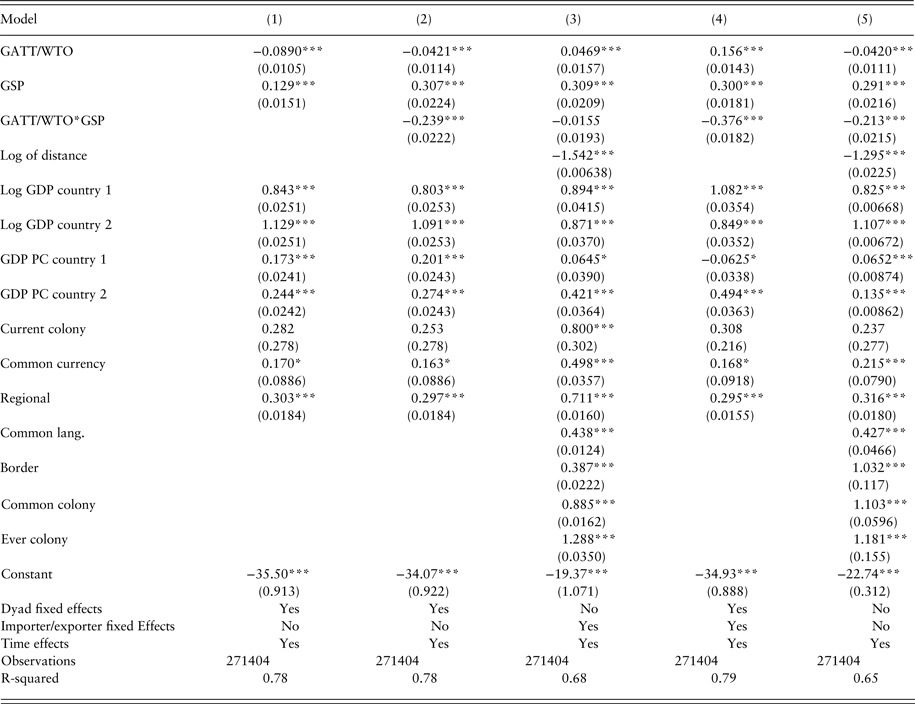
Table 1 presents estimates of our dyad fixed effects model as well as three alternative specifications: fixed country effects (for both importers and exporters), fixed dyad and country effects,Footnote 17 and random effects.Footnote 18 We find strong support for our argument across all specifications: the marginal effect of WTO membership on trade is lower for GSP recipients than for those not on GSP. Specifically, those countries that are GSP recipients and members of the GATT/WTO trade less than other countries that are either on GSP, or members of the multilateral trading system, but not both.
Model (1) excludes the interaction term between GSP and WTO membership. We believe that this equation is mis-specified without the interaction term, but include it to compare our results with the extant literature. Here, GSP has a positive association with imports, while GATT/WTO membership has a negative relationship (consistent with the literature that does not break GATT/WTO up by membership type).
Model (2) includes the interaction term between GSP and WTO. Here, WTO membership alone (for those countries not on GSP) again has a negative association with imports, while GSP by itself (for those countries that are not members of the WTO) has a positive association. The interaction term is negative and significant, indicating that the relationship is indeed conditional. Specifically, the marginal effect of WTO membership on imports for those developing countries on GSP is equal to –25% ≈ e (−0.042−0.239) − 1
The results for our interaction term and GSP are very similar for the country fixed effects model, dyad and country fixed effects combined, and random effects models. Not surprisingly, as in all the general models, the impact of WTO membership, by itself, on trade flows is mixed, while GSP is consistently positive. In addition, the interaction between WTO and GSP is consistently negative and statistically significant.
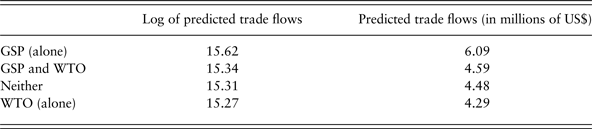
While the robustness of the interaction effect is extremely interesting, our hypothesis is that the marginal effect of joining the WTO is lower for GSP recipients than for non-recipients. Table 2 displays the average predicted trade flows for each possible category of membership: WTO (alone), GSP (alone), neither or both. This clearly demonstrates that trade, while always positive, differs based on the set of institutional memberships. Because we cannot clearly see differences from the logged values, we display the anti-log as well. Focusing on our preferred model (Table 1, Model 2), we find that predicted trade flows, holding all other variables at their means, are greatest for those low-income countries that only have GSP. Countries who only have WTO membership have the lowest predicted trade flows, while the difference between having access to neither and having both is minimal. There are two important factors to note here. First, although the interaction between GSP and the WTO is negative across all of our specifications, this does not mean negative trade flows, rather lower trade than without membership in the WTO. Second, and speaking directly to our main hypothesis, there is little to no difference in predicted trade flows for developing countries that have access to neither GSP nor the WTO, versus those countries that are members of both institutions. In sum, GSP, conditional on WTO membership, yields lesser imports.
Average predicted trade flows for WTO and GSP membership

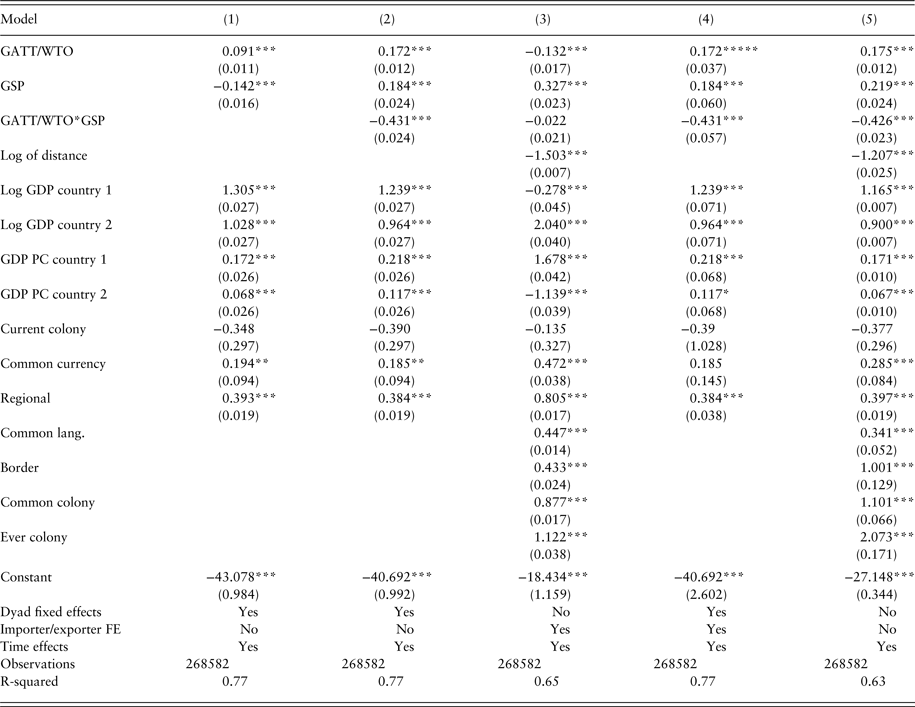
If the marginal effect of WTO membership on imports is lower for GSP recipients than for those not on GSP, what does this mean for exports? Expectations from our political story would support a positive interpretation: exporters – more confident in GSP thanks to protections afforded by WTO membership – should increase exports. Yet, this is not the case. Table 3 examines exports using the same methodology as in Table 1. Again, we see that, regardless of the specification, the interaction between GSP and the WTO is negative and significant. That is to say, the impact on exports is always positive, but the marginal effect is less for those countries that have access to both GSP and the WTO.
Directed dyads – exports

Notes: Robust standard errors in parentheses.
* significant at 10%; ** significant at 5%; *** significant at 1%
What explains this negative marginal effect? To begin, recall that the economic effects of GSP on exports are widely debated, and many studies have found that GSP, itself, is negatively signed (Özden and Reinhardt, Reference Özden and Reinhardt2005; Tomz et al., 2007; Felbermayr and Kohler, Reference Felbermayr and Kohler2009; Chang and Lee, Reference Chang and Lee2011; Herz and Wagner, Reference Herz and Wagner2011; Zappile, Reference Zappile2011; Buono and Lalanne, 2012). There are three reasons for this.
First, because GSP demobilizes exporters, the expectation is that it will result in greater domestic protectionism, higher costs on imported inputs, and thus lesser exports (Milner, Reference Milner1988). Second, since not all products are eligible for GSP, recipients are likely to focus on offering those products that are eligible, even if these do not reflect their comparative advantage and are not competitive (Herz and Wagner, Reference Herz and Wagner2011; Silva, Reference Silva2011) This will be especially problematic where GSP's ‘rules of origin’ skew sourcing decisions, favoring geography over cost. Third, and most important, because eligible products are subject to competitive limitations, meaning sales can be suspended if they exceed set year-on-year growth rates, GSP recipients have an incentive to curb their own exports, hoping not to exceed these ‘trigger’ thresholds, or spark political debate in the grantor country about what these triggers should be.
Along these lines, Herz and Wagner (Reference Herz and Wagner2011: 770) find that GSP helps recipients in the short-run, but has negative long-run effects on their trade because of the way the program distorts incentives, and thus the structure of the recipient's economy. We submit that by making GSP more predictable, membership in the GATT/WTO only heightens these negative effects. To get a better sense for this, and to allow for the possibility that our interaction term is picking up on heterogeneous treatment effects, we performed a separate analysis of GSP utilization rates at the product level for all recipients in our sample (available from the authors). We include all of the controls used above, as well as country, year and product fixed effects. We find that, as country-level exports increase as a percentage of GDP, GSP utilization actually decreases across product-eligible lines. The implication is that, as recipients export more, they use GSP less. Keeping in mind that we already include that time and country are dyadic fixed effects in all of the models reported above, the key takeaway is that a non-discriminatory GSP exaggerates the negative effects of GSP by making it more predictable. In terms of possible heterogeneous treatment effects, the point is that our central result is robust, with exporters using GSP less as they sell more.
Robustness checks
The performance of policy variables in gravity models can be significantly affected by changes to the sample and specification. To check the robustness of our results, we conducted a variety of additional tests (the results are available in the on-line Appendix). Our appendix tables focus on imports into GSP-eligible countries, but results on exports mirror those of imports and are available from the authors. Unless stated otherwise, all of the estimates below rely on dyad fixed-effects estimation.
First, in the on-line Appendix Table 2 we make some changes to the sample. Models (1) and (2) include high-income countries as potential importers, regardless of the fact that they are not eligible for GSP. In Model (1), we include a measure for high-income GATT/WTO membership separate from developing countries, as in Subramanian and Wei (Reference Subramanian and Wei2007). In Model (2), we pool all WTO members together. In Model (3) we return to including only developing countries, but open the dataset to the years 1948–2011 (i.e., prior to the formal launch of GSP in 1971). In Model 4, we include both high-income countries (pooled with developing countries) and the earlier time period. Finally, in Model 5 we include all of the zero trade flows that we eliminated from earlier models using Poisson pseudo maximum likelihood. In each of these models, the marginal effect of WTO membership is significantly smaller for those countries on GSP than those that are not partaking in these one-way tariff preferences.
Second, in on-line Appendix Table 3 we look at a few potential time dynamics. Model (1) is our primary estimation including a lagged dependent variable. This lagged dependent variable is highly significant and very strong, swamping both GSP and WTO membership. Importantly, however, the interaction retains its negative sign and significance. Model (2) excludes the time dummy variables and includes a time counter. Model (3) averages all variables over a five-year time period to deal with any potential spikes in trade flows. Again, our results remain robust to these changes in specification: the interaction between GSP and the GATT/WTO is negative and significant, indicating lower levels of trade for countries that are both on GSP and are members of the GATT/WTO.
Third, we look to see if there are any differences across income groups. On-line Appendix Table 4 shows estimates of our main specification for all developing countries by upper-middle income (Model 1), lower middle-income (Model 2), and low-income countries (Model 3). Here, too, our results hold for each of the income groupings.
Fourth, we look for regional differences. On-line Appendix Table 5 displays estimates of our model for East Asia and the Pacific (Model 1), Europe and Central Asia (Model 2), Latin America and the Caribbean (Model 3), Middle East and North Africa (Model 4), South Asia (Model 5), and Sub-Saharan Africa (Model 6). The only region where our results differ from our main results in the Middle East and North Africa, likely reflecting the lack of reach of either GSP or GATT/WTO to these regions and the ‘rentier state’ orientation of many of these economies (i.e., their reliance on oil rents versus domestic tariff revenue).
Taken together, our results for the marginal effect of WTO membership, whether or not a country is on GSP, are strongly robust. We believe that some of the confusion surrounding the relationship between WTO membership and trade flows may stem from a misunderstanding of the relationship between GSP and the WTO. The literature has long appreciated that GSP can make recipients more protectionist than they otherwise would be. Our argument is that, in pursuit of a non-discriminatory GSP, these recipients have an incentive to join the GATT/WTO, rather than simply take advantage of trade as aid. However, in doing so, we find that empirically the two do not mix well.
Replications
We have shown that regardless of the effect of the WTO or GSP individually, the policies are contingent on each other and together have a negative relationship with imports. To better insure the robustness of our results and to test our hypothesis on overall trade flows, we replicate four of the most influential studies examining the trade effects of the WTO: Rose (Reference Rose2004); two by Tomz et al. (2007a and b); and Subramanian and Wei (Reference Subramanian and Wei2007). We replicate each of their models in turn, including an interaction between GSP eligibility and GATT/WTO membership. We find strong support for our hypothesis across all four replications. All replication tables are available in an online Appendix.
Replication 1: Rose (Reference Rose2004)
Rose (Reference Rose2004) measures trade as the log of the average value of exports and imports between a pair of countries. To measure WTO membership at the dyad level, Rose creates three exclusive groups: both countries in the dyad are WTO members (both in), one country in the dyad is a member (one in) or none is a member (the excluded category). To Rose's model, we add an interaction between GSP and both in and one in. Rose follows a standard gravity model, including distance between country pairs, joint income variables and several dyad-level factors. We add year fixed effects to control for time-varying concerns, and, diverging slightly from Rose, employ both dyad fixed effects and importer/exporter fixed effects.Footnote 19 Rose's dataset covers the years 1948–1999, with gaps (Rose, Reference Rose2004).
Replication Table 1 presents Rose's default specification (Model 1) (Rose, Reference Rose2004: 104), fixed-effects (by dyad and importer/exporter) estimates of Rose's specification (Models 2 and 4) and his specification, including our interaction between GSP and the WTO (Models 3 and 5). As in Rose, WTO membership has a weak (though significant) association with trade flows and GSP has a strong positive association with trade flows. It is in the marginal effect of WTO membership for those members on GSP that might help to explain the negative relationship between WTO membership and trade that Rose finds in a number of his specifications. Specifically, when both countries in the dyad are members of the WTO, but neither is a GSP recipient, the marginal effect of membership on trade is about 19% ≈ e (0.17) − 1. However, when both countries in the dyad are WTO members and at least one is on GSP, the marginal effect of WTO membership on trade is actually negative: –12% or –49%, depending on the model. The effect is smaller when only one country is a member, but we do not interpret the marginal impact, because here the interaction does not necessarily represent a real relationship between GSP and the WTO. In a large number of the cases, one party is a member to the WTO and the other is on GSP.
Replications 2 and 3: Tomz et al. (Reference Tomz, Goldstein and Rivers2007a and Reference Tomz, Goldstein and Riversb)
Tomz et al., criticize Rose's accounting of how non-member participants in the WTO are counted as non-WTO members. The idea is that some countries, which were not formally members of the WTO, inherited obligations from colonizers, or enjoyed rights while awaiting membership because they were politically consequential in a foreign policy context. While we have no theoretical reason to believe that non-member participation should be any more or less likely than membership to affect the conditional relationship between GSP and the WTO, we replicate both their original study (which is in turn a replication of Rose) and a second study, which expands the time period of the dataset and focuses on imports rather than the average of imports plus exports as in Rose. Both help us to calibrate whether our results are sensitive to definitions of membership. Rather than a simple membership variable, the authors break WTO membership into five categories: (1) i and j are formal members (gattff); (2) i or j is a formal member, the partner is a non-member participant (gattfn); (3) i and j are non-member participants (gattnn); (4) i or j is a formal member, the partner is not a member (gattfo), a non-formal member, (5) i or j is a non-member participant, the partner is a non-member (gattno). We include each of these variables with both countries as non-members as the excluded category, and include the interaction between each and GSP.
In Replication Table 2, we present dyad and importer/exporter fixed-effects estimates of a replication of Tomz et al. (Reference Tomz, Goldstein and Rivers2007a) (Models 1 and 3) and a replication including our interaction terms (Models 2 and 4). As in the original article, the replication shows a strong positive association between trade flows and any type of membership pairing, as compared to non-WTO membership. However, the interaction between WTO membership and GSP on trade is negative and significant. That is, in most cases countries are worse off being both WTO members and having GSP than having neither, and in all cases they are worse off having both than being WTO members alone. Again, we do not interpret the marginal impact, because the interaction does not necessarily represent a real relationship between GSP and the WTO.
In Tomz et al. (Reference Tomz, Goldstein and Rivers2007b), they expand on their replication of Rose, focusing not only on institutional standing, but also on institutional embeddedness. Their econometric focus is similar to their AER piece, but the data are extended through 2004 and the focus on imports between directed dyads of all countries in the world. Replication Table 3 (Tomz et al., Reference Tomz, Goldstein and Rivers2007b: 54) presents directed dyad fixed-effects estimates of a replication of their main model (Model 1), a replication including our interaction terms (Model 2) and a replication including our interaction term, but limiting the time frame to post 1970 and the introduction of GSP.
As in the original article, the replication shows a strong positive association between trade flows and any type of membership pairing, as compared to non-WTO membership. Further, as with our replication of their Rose data, once we include our interactions between GSP and the WTO, the marginal effect of WTO membership on trade for those members on GSP is always less than for those that are only members of the WTO or that only have access to GSP.
Replication 4: Subramanian and Wei (Reference Subramanian and Wei2007)
Subramanian and Wei (Reference Subramanian and Wei2007) argue that WTO membership works differently depending on the income level of the WTO member. Specifically, they hypothesize and show that high-income countries benefit from trade flows while low-income countries do not. Their gravity model is a mirror of Rose in terms of control variables, but differs in three important respects. First, rather than examining a dyadic relationship, they use a unidirectional model and look only at imports to i from j, hypothesizing that the trade effects of GSP and the WTO relate to imports. Second, they code WTO membership according to income level to separate out their hypothesized effect, so WTO Developed is a dummy variable equal to 1 for high-income countries that are members of the WTO and WTO Developing is a dummy variable equal to 1 for low-income countries that are members of the WTO.
Third, and most interesting from our perspective, Subramanian and Wei hypothesize that the WTO, GSP, and free trade areas (FTAs) offer differing degrees of liberalization and code them as mutually exclusive variables. This means that GSP is coded as 1 in any year that country j offers GSP to country i, unless the pair of countries is a member of the WTO or an FTA or customs agreement. This specification is problematic for our purposes because we want to understand the conditional relationship between GSP and the WTO. Thus, we recode Subramanian and Wei's data so that these categories are not mutually exclusive: GSP is equal to 1 in any year that country j offers GSP to country i, regardless of their status as WTO or FTA members.
Replication Table 4 presents a replication of Subramanian and Wei's (Reference Subramanian and Wei2007: 162–163) base specification (Model 1) as well as dyad and importer/exporter fixed-effects estimates of a replication of Subramanian and Wei, adjusting for our recoding of their GSP variable (Models 2 and 4) and a replication including our interaction terms (Models 3 and 5).
We focus on the models including the interaction terms. As in their model, the marginal effect of WTO membership is positive for developed countries and negative for developing countries. Specifically, developed country members of the WTO have import flows that are 63% ≈ e (.49) − 1 or 34% ≈ e (.29) − 1 higher than non-members, depending on the model. Developing country WTO members that are not on GSP have import flows that are 7% or 28% ≈ e −(.32) − 1 lower than non-members.
Summary
In each and every replication, the inclusion of our interaction term is negatively signed and highly statistically significant. It is, in fact, the most robust result across these studies. This is worth repeating, since the literature has tended to treat GSP and GATT/WTO as if they were substitutes. Our model, and all the replications, bear out that the interaction between GSP and the GATT/WTO has unintended consequences for trade.
Conclusion
GSP was always meant to be a form of trade-as-aid. It works by giving poor countries duty-free access to rich country markets without requiring them to reciprocate market access. Ironically, GSP has perverse effects, which are often attributed to its non-reciprocal design, but which we explain as the result of the program's interaction with the GATT/WTO, which makes the political effect of non-reciprocity more credible. By making GSP less ad hoc, or what we call non-discriminatory, the GATT/WTO undermines the incentive for exporters to lobby, not just against domestic protectionism, but also in favor of good foreign policy relations with grantor countries more generally. This results in lower imports, and explains why recipient countries do not derive as many trade benefits from joining the multilateral trading system as do other countries.
Two implications follow. First, it would be a mistake to discount WTO membership simply because GSP recipients do not liberalize like other members. It is not surprising that membership has differential effects across countries. Subramian and Wei (Reference Subramanian and Wei2007) premise their entire study on this expectation. And Tomz et al. (2007a and b) provide an important insight: that even GATT/WTO membership, itself, does not mean the same thing for all countries, in that some are informal versus formal beneficiaries. We contribute to this line of research by highlighting the interaction between GSP and the GATT/WTO. While we are not the first to find that this interaction is negative, we are the first to explain it. The literature has long been of the view that GSP matters, but struggles to make sense of this result in a global economy that is mostly under GATT/WTO disciplines. One of our contributions is to show that the key is not GSP, by itself, but GSP conditional on GATT/WTO membership. The negotiating history of GSP, and the Enabling Clause in particular, as well as formal and informal litigation over these preferences, reveals that our hypothesis has been hiding in plain sight.
Second, making preferences non-discriminatory can have unintended consequences. Conferees in New Delhi insisted that, for these one-way tariff preferences to work, the program had to be non-discriminatory, not just non-reciprocal. This encouraged recipients to join the multilateral trading system, in large measure to take greater advantage of GSP. Of course, poor countries joined the GATT/WTO for a wide variety of reasons, as the literature makes clear. Our point is that GSP should be counted among these reasons. That said, the irony is that GATT/WTO membership has had the effect of making the politics of GSP less conducive to trade.