Introduction
Bioluminescence, the emission of visible light by a natural chemical reaction, is found in a wide variety of organisms of different phyla, from bacteria to eukaryotes (Haddock et al., Reference Haddock, Moline and Case2010). According to a recent estimate by Lau & Oakley (Reference Lau and Oakley2021), bioluminescence has evolved at least 94 times in the phylogenetic tree of life. Bioluminescence is considered to play an important role in biological interactions such as protection from predators (e.g. Latz, Reference Latz1995; Deheyn et al., Reference Deheyn, Mallefet and Jangoux2000; Jones & Nishiguchi, Reference Jones and Nishiguchi2004; von der Heyden et al., Reference von der Heyden, Lipinski and Matthee2010) and mate attraction (e.g. Morin & Bermingham, Reference Morin and Bermingham1980; Lewis & Cratsley, Reference Lewis and Cratsley2007; Rivers & Morin, Reference Rivers and Morin2008, Reference Rivers and Morin2009; Morin & Cohen, Reference Morin and Cohen2010). A well-known example of bioluminescence is the light emitted by fireflies on land. However, bioluminescent organisms are more common in the ocean than in terrestrial environments (Widder, Reference Widder2001). Stable, dark without light, and optically clear environmental conditions, as well as the variety of biological interactions in the ocean may favour the evolution of luminescence (Haddock et al., Reference Haddock, Moline and Case2010). Marine organisms are therefore important subjects in the study of bioluminescence.
Annelida includes over 20,000 described species and is one of the major taxa in the marine environment (Capa & Hutchings, Reference Capa and Hutchings2021). Bioluminescence occurs in various lineages in Annelida, such as scale worms (Polynoidae), spaghetti worms (Terebellidae) and earthworms (Megascolecidae) (reviewed by Verdes & Gruber, Reference Verdes and Gruber2017). The family Syllidae includes bioluminescent species and is one of the most specious families of Annelida with more than 1100 described species (Martin et al., Reference Martin, Aguado, Fernández Álamo, Britayev, Böggemann, Capa, Faulwetter, Fukuda, Helm, Petti, Ravara and Teixeira2021). Many syllid species are benthic worms with a pelagic stage for reproduction, exhibiting altered morphology of the parapodia and chaetae (bristles), and bioluminescence (Daly, Reference Daly1975; Tsuji & Hill, Reference Tsuji and Hill1983; Deheyn & Latz, Reference Deheyn and Latz2009). A few syllid genera, such as Eusyllis (Zörner & Fischer, Reference Zörner and Fischer2007), Nudisyllis (as Pionosyllis in Bassot, Reference Bassot1979), and Odontosyllis, contain luminescent species.
The bioluminescence of Odontosyllis spp., known as ‘fireworms’ (not the Amphinomidae here), is the best documented in this family. At least nine described species, namely Odontosyllis ctenostoma Claparède, 1868 (see Verdes et al., Reference Verdes, Alvarez-Campos, Nygren, Martin, Rouse, Deheyn, Gruber and Holford2018), Odontosyllis guillermoi Fukuda & Nogueira, 2006 (see Verdes et al., Reference Verdes, Alvarez-Campos, Nygren, Martin, Rouse, Deheyn, Gruber and Holford2018), Odontosyllis hyalina Grube, 1878 (Van Lummel, Reference Van Lummel1932), Odontosyllis enopla Verrill, 1900 (Galloway & Welch, Reference Galloway and Welch1911; Huntsman, Reference Huntsman1948; Markert et al., Reference Markert, Markert and Vertrees1961; Shimomura et al., Reference Shimomura, Johnson and Saiga1963; Haneda, Reference Haneda1971; Wilkens & Wolken, Reference Wilkens and Wolken1981; Wolken & Florida, Reference Wolken and Florida1984; Fischer & Fischer, Reference Fischer and Fischer1995; Brugler et al., Reference Brugler, Aguado, Tessler and Siddall2018; Prentiss, Reference Prentiss2020), Odontosyllis luminosa San Martín, 1990 (San Martín, Reference San Martín1990; Gaston & Hall, Reference Gaston and Hall2000), Odontosyllis octodentata Treadwell, 1917 (Erdman, Reference Erdman1965), Odontosyllis phosphorea (Potts, Reference Potts1913; Fraser, Reference Fraser1915; Berkeley, Reference Berkeley1935; Tsuji & Hill, Reference Tsuji and Hill1983; Deheyn & Latz, Reference Deheyn and Latz2009), Odontosyllis polycera (Schmarda, 1861) (Daly, Reference Daly1975), and Odontosyllis undecimdonta Imajima & Hartman, 1964 (Horii, Reference Horii1982; Inoue et al., Reference Inoue, Okada, Tanino, Kakoi and Horii1990), and several unidentified species of Odontosyllis (Haneda, Reference Haneda1971; McCloskey et al., Reference McCloskey, Schell, Sandland and Gerrish2017; Ramesh et al., Reference Ramesh, Mohanraju, Karthick and Murthy2017; Verdes et al., Reference Verdes, Alvarez-Campos, Nygren, Martin, Rouse, Deheyn, Gruber and Holford2018) have been reported as bioluminescent. Interestingly, the swarming of luminescent Odontosyllis spp. reportedly starts from about an hour after sunset on days close to the full moon for reproduction (Markert et al., Reference Markert, Markert and Vertrees1961; Gaston & Hall, Reference Gaston and Hall2000). In O. enopla, females swim in circles with a strong and continuous glow and release their gametes (Galloway & Welch, Reference Galloway and Welch1911). Subsequently, males swim directly towards the luminous circle with sharper and intermittent flashes and locate a glowing female (Galloway & Welch, Reference Galloway and Welch1911). Recently, the luciferases of O. undecimdonta (Schultz et al., Reference Schultz, Kotlobay, Ziganshin, Bannikov, Markina, Chepurnyh, Shakhova, Palkina, Haddock, Yampolsky and Oba2018) and O. enopla (Brugler et al., Reference Brugler, Aguado, Tessler and Siddall2018) were sequenced and those of syllids were uniquely obtained among all known luminescent taxa (Schultz et al., Reference Schultz, Kotlobay, Ziganshin, Bannikov, Markina, Chepurnyh, Shakhova, Palkina, Haddock, Yampolsky and Oba2018). The biological traits of several luminescent Odontosyllis spp. have become apparent as mentioned above, but the presence or absence of bioluminescence in Odontosyllis is still not sufficiently understood to discuss the evolutionary gain or loss of bioluminescence, considering the relatively high species diversity of this genus with over 50 described species.
To date, bioluminescence of a single syllid species, Odontosyllis undecimdonta, has been reported from Japan (Horii, Reference Horii1982), and this species has become the subject of subsequent studies on chemistry and genetics (Inoue et al., Reference Inoue, Okada, Tanino, Kakoi and Horii1990, Reference Inoue, Okada, Tanino, Kakoi, Ohnishi and Horii1991, Reference Inoue, Okada, Tanino and Kakoi1993; Tanino et al., Reference Tanino, Takakura, Kakoi, Okada and Inoue1994, Reference Tanino, Takakura, Kakoi, Okada and Inoue1996; Kakoi et al., Reference Kakoi, Tanino, Okada and Inoue1995; Schultz et al., Reference Schultz, Kotlobay, Ziganshin, Bannikov, Markina, Chepurnyh, Shakhova, Palkina, Haddock, Yampolsky and Oba2018; Kotlobay et al., Reference Kotlobay, Dubinnyi, Purtov, Guglya, Rodionova, Petushkov, Bolt, Kublitski, Kaskova, Ziganshin, Nelyubina, Dorovatovskii, Eliseev, Branchini, Bourenkov, Ivanov, Oba, Yampolsky and Tsarkova2019). In this study, we found a bioluminescent Odontosyllis cf. australiensis from Japan for the first time and determined the phylogenetic placement of this species by reconstructing the molecular phylogenetic tree of Eusyllinae based on two mitochondrial (COI and 16S rRNA) and one nuclear (18S rRNA) gene sequences.
Materials and methods
Visual observations and net sampling were conducted in 2020 and 2021 (Table 1) at a pier in Nagasaki, Japan. Protected by breakwaters, the sea off the pier is generally calm and underwater video camera observations showed that the seabed around the pier is mainly covered with rocks. Luminant specimens swimming near the sea surface were collected with a spoon net at about 21:00 (JST) on 17–19 and 21 July 2020. Additional observations were conducted at the same location ~1.5 h after sunset on days near the new moon in October 2020 and April through October 2021. Sunset times and ages of the moon in Nagasaki city (32°45′N 129°52′E) during observation days were obtained from the National Astronomical Observatory of Japan homepage (https://eco.mtk.nao.ac.jp/koyomi/dni/index.html.en). Seawater temperatures on observation days were represented by the sea surface temperature measured and published weekly by the Nagasaki Prefectural Institute of Fisheries at an aquaculture cage located several hundred metres from the pier (https://www.pref.nagasaki.jp/bunrui/shigoto-sangyo/suisangho/suisan-shiken-suishi-teichi-water-temperature/). Benthic samples, including the surface of seaweeds, stones, the shells of dead and living oysters in the intertidal to subtidal (~8 m depth) zone, were examined on 13 April 2021 to detect the benthic mode of the swimming specimens. The specimens were fixed and preserved in 70 or 99% ethanol. The morphological characters of the specimens were examined under a stereomicroscope and photographed (Figure 1).
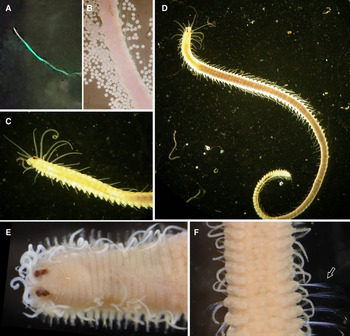
Odontosyllis cf. australiensis collected from Japan. (a) Swimming bioluminescent specimen. A movie is available in Supplementary data 1. (b) Eggs released from a specimen during observation under a microscope. (c, d) Living specimen. (e, f) Ethanol fixed specimen. (e) Dorsal view of the anterior body. (f) Ventral view of chaetigers on the middle part of the body. An arrow indicates elongated notochaetae.

Metadata of visual observations

Protocols of preparation of template DNA and PCR were basically conducted by following the methods described in Kobayashi et al. (Reference Kobayashi, Itoh, Fukuda and Kojima2021). Portions of the body wall of the specimens were cut out and treated with a mixture of 10 μl of proteinase K solution (Nacalai Tesque, Kyoto, Japan) and 100 μl of 10% solution of Chelex 100 Resin (Bio-Rad, Hercules, CA) at 56°C for 20 min and then 100°C for >20 min to use the supernatant fluid as template DNA.
The partial mitochondrial 16S rRNA and COI gene sequences, and the nuclear 18S rRNA gene sequences of three specimens were determined. The PCR mixtures were as follows: (Mixture 1) 8.75 μl of sterilized water, 0.07 μl of TaKaRa Ex Taq Hot Start Version (TaKaRa Bio, Kusatsu, Japan), 1.25 μl of 10 × Ex Taq Buffer, 1.0 μl of 2.5 μM dNTP mixture, 0.15 μl of 20 μM forward and reverse primers (Table 2), and 1.0 μl of template DNA; or (2) 4.50 μl of sterilized water, 6.25 μl of KOD One PCR Master Mix (TOYOBO), 0.375 μl of 10 μM forward and reverse primers (Table 2), and 1.0 μl of template DNA. PCR amplifications were performed as follows: (Mixture 1) initial denaturation at 94°C for 120 s; followed by 35 cycles comprising denaturation at 94°C for 30 s, annealing at 50°C for 20 s, and extension at 72°C for 20 s; and then final extension at 72°C for 300 s (16S and COI) or (Mixture 2) initial denaturation at 98°C for 10 s; followed by 30 cycles comprising denaturation at 98°C for 10 s, annealing at 60°C for 5 s, and extension at 68°C for 2 s (18S). The PCR product was purified using ExoSAP-IT (Thermo Fisher Scientific, Waltham, MA). Sequencing was outsourced to Eurofins Genomics (Tokyo, Japan). The obtained nucleotide sequences were deposited in the DNA Data Bank of Japan (DDBJ) with DDBJ/EMBL/GenBank accession numbers LC641713–LC641716, LC654403–LC654404.
Nucleotide sequences of primers used in this study

aForward (F) or reverse (R); bPCR (P) or sequencing (S).
Phylogenetic analysis based on the concatenated dataset (18S + 16S + COI) was conducted using 33 ingroup and four outgroup taxa to reveal the phylogenetic position of our specimen (Table 3). Taxa were selected based on a previous study of phylogenetic relationships within Syllidae (Aguado et al., Reference Aguado, San Martín and Siddall2012). All sequences except our specimens were obtained from GenBank. Alignment was performed using MAFFT v7.294b (Katoh et al., Reference Katoh, Rozewicki and Yamada2017). The following substitution models were selected based on the corrected Akaike information criterion (AICC) using PartitionFinder2 (Lanfear et al., Reference Lanfear, Frandsen, Wright, Senfeld and Calcott2017): TRN + I + G for 18S rRNA, GTR + I + G for 16S rRNA, and TRN + I + G, TVM + I and HKY + G for the 1st 2nd and 3rd codon of COI, respectively. Molecular phylogenetic analyses using the concatenated dataset were conducted with Bayesian inference and maximum likelihood (ML) methods. Bayesian analysis was performed using MrBayes v3.2.6. (Ronquist & Huelsenbeck, Reference Ronquist and Huelsenbeck2003) with the setting ‘branch lengths unlinked’. Two parallel runs were made for 5,000,000 generations (with a sampling frequency of 1000), using the default value of four Markov chains. The initial 25% of samples were discarded and the following 75% were accepted to ensure that the four chains reached stationary distributions based on the average standard deviation of split frequencies (Ronquist & Huelsenbeck, Reference Ronquist and Huelsenbeck2003). A ML phylogenetic analysis was conducted with IQ-TREE v1.6.12 (Nguyen et al., Reference Nguyen, Schmidt, von Haeseler and Minh2014) using 1000 ultrafast bootstrap replicates. The resultant tree was edited using FigTree v1.4.3 (http://tree.bio.ed.ac.uk/software/figtree/).
Species used in the phylogenetic analysis based on the concatenated dataset with GenBank accession numbers

Results
The glowing creatures swimming near the surface of the sea around the pier were first spotted around 21:00 (JST) on 17 July 2020. They turned out to be worms about 2–4 cm long by visual estimate after being collected with a spoon net (Figure 1A). They were found within 10 m of the pier at a density of several individuals per m2 and were swimming spirally or straight ahead at a speed of about 5 cm s−1 (Supplementary data 1). They glowed green and released luminescent particles as they swam, leaving glowing trails behind them for several seconds. Glowing fogs were also observed at about 30 cm depth from the surface. The glowing worms were observed on 5 consecutive nights until 21 July, the new moon day, around 21:00, but not on 22 July between 20:30 and 21:30. The sea surface temperature measured at a nearby station on 22 July was 27.0°C and the sunset times during 17–21 July were about 19:30. The bioluminescence of the worm was sighted again on 18 and 19 October 2020, 6–11 July 2021, and 4, 5 and 7 August 2021, 4 and 7 September 2021, and 3 October 2021 about 1.2–1.5 h after sunset. Moon ages on these days were 25–29 or 0–2, and sea surface temperatures measured nearby were 20.2–29.3°C. On these days, we typically observed several to several tens of glowing worms only during 10–30 min from the first worm sighting. However, on 4 August 2021, a total of more than 100 of them were observed continuously for more than an hour from the first sighting. The specimens captured alive on 10 and 11 July released thousands of white particles that appeared to be eggs during observation under a microscope (Figure 1B). On 9 April, 9–14 May 2021 and 7–14 June, all of which were near the new moon day and when sea surface temperatures were 16.8–23.5°C, no glowing worms were observed around 1.5 h after sunset. The results of the observations are summarized in Table 1.
The bodies of the fixed specimens (N = 2) were about 17–19 mm long and 1.3–1.4 mm wide (Figure 1C & D). The pharynx possessed at least four teeth. Occipital flaps of the specimens covered the posterior part of the prostomium (Figure 1E). The notochaetae were capillary and the ventral compound chaetae in midbody are bidentate. Long notochaetae were present on the chaetiger 34 or 35 and subsequent 19 chaetigers (Figure 1F). Dorsal cirri were long and smooth, and ventral cirri were ovoid shape. Morphologically matching specimens to the swimming worms were not found in the sediment samples at the site where the swimming worms were collected.
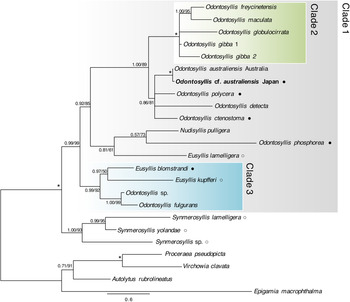
The concatenated dataset for molecular phylogenetic analysis comprised 3165 characters of COI (659 characters), 16S rRNA (556 characters) and 18S rRNA (1950 characters) gene sequences. The results of phylogenetic analysis showed that the ingroup was monophyletic with full support, i.e. posterior probability (PP) = 1.00 and maximum likelihood bootstrap value (BS) = 100%. The monophyly of several lineages was recovered (Figure 2): species of Synmerosyllis (PP = 1.00, BS = 93%); Odontosyllis, Eusyllis and Nudisyllis (PP = 0.99, BS = 99%; Clade 1); Odontosyllis, except for O. phosphorea, Odontosyllis fulgurans (Audouin & Milne Edwards, 1833) and Odontosyllis sp. (PP = 1.00, BS = 89%); Odontosyllis freycinetensis Augener, 1913, Odontosyllis maculata Uschakov in Annenkova, 1939, Odontosyllis globulocirrata Hartmann-Schröder, Reference Hartmann-Schröder1981, and Odontosyllis gibba Claparède, 1863 (PP = 1.00, BS = 100%; Clade 2); O. fulgurans, Odontosyllis sp., Eusyllis blomstrandi Malmgren, 1867, and Eusyllis kupfferi Langerhans, 1879 (PP = 0.99, BS = 92%; Clade 3). Our specimen was clustered with Australian Odontosyllis australiensis Hartmann-Schröder, 1979 with full support. Although the overlapping regions of the 18S rRNA gene sequences of our specimen and Odontosyllis australiensis were identical (1147 bp), their 16S rRNA sequences differed by 2% (10 of 477 bp). At least five taxa, including Odontosyllis cf. australiensis, were bioluminescent in the current analysis (reviewed by Verdes et al., Reference Verdes, Alvarez-Campos, Nygren, Martin, Rouse, Deheyn, Gruber and Holford2018). They belonged to various lineages in Clade 1 except for Clade 2 (Figure 2).
Bayesian phylogeny of Odontosyllis and closely related syllids based on the combined dataset, which comprises nuclear 18S rRNA (1916 characters), mitochondrial 16S rRNA (546 characters) and mitochondrial COI (659 characters) gene sequences. The numbers above the branches indicate posterior probability (PP), followed by the percentage of maximum likelihood bootstrap (BS) values. Asterisks indicate full support (PP = 1, BS = 100). Closed and open circles represent bioluminescent species or not, respectively (after Verdes et al., Reference Verdes, Alvarez-Campos, Nygren, Martin, Rouse, Deheyn, Gruber and Holford2018, except for Odontosyllis cf. australiensis Japan). The status of bioluminescence is known for species without circles. An operational taxonomic unit with newly obtained DNA sequences is shown in bold.

Discussion
Our specimens are morphologically distinct from the other species of Odontosyllis known from Japan, including another bioluminescent syllid species Odontosyllis undecimdonta (Imajima, Reference Imajima1996). The morphological characters of our specimens were consistent with the description of Odontosyllis australiensis in San Martín & Hutchings (Reference San Martín and Hutchings2006), except for the larger size of our specimens (17–19 mm) than the known maximum size (6.6 mm) (Hartmann-Schröder, Reference Hartmann-Schröder1981; see San Martín & Hutchings, Reference San Martín and Hutchings2006). However, the genetic divergence between Japanese and Australian specimens of O. australiensis was relatively large when compared with the intra-specific differences between other coastal invertebrates of Japan and Australia, and the differences between syllid species. The variation in the 16S rRNA gene sequences of O. australiensis from Japan (LC641716) and Australia (JF913955) was 2%. The 16S rRNA gene sequences of the ring top cowrie Monetaria annulus (Linnaeus, 1758) collected from Japan (LC469295) and Australia (KT753889) were identical. Contrarily, the 16S rRNA gene sequences of the blue swimming crab Portunus pelagicus (Linnaeus, 1758) from Japan (LC469668) and Australia (FJ152161 and FM208750) differed (5 of 169 bp; 3%). The genetic difference between our specimens and O. australiensis from Australia is much greater than that of M. annulus but is within the intra-specific variation of P. pelagicus. Considering the genetic differences among syllid species, the inter-specific difference in the 16S of Amblyosyllis is 4–28% with two exceptions (1.5 and 2.9%), while the intra-specific difference was less than 1.9% (Aguado et al., Reference Aguado, Capa, Lago-Barcia, Gil, Pleijel and Nygren2019). The Syllis gracilis species complex shows higher variation in the genetic divergence of 16S between species; the inter-specific divergence is 3.9–59.2%, while the intra-specific variation in some lineages is also high (≤26%) (Álvarez-Campos et al., Reference Álvarez-Campos, Giribet and Riesgo2017). Therefore, it is difficult to judge whether our specimens are O. australiensis or not based on molecular data. Considering the above morphological and molecular information, we tentatively refer to our specimens as Odontosyllis cf. australiensis. Scrutinizing morphological characters of the atoke (sexually immature) specimens of Japanese Odontosyllis cf. australiensis would be needed in the future after a comprehensive revision of the diagnostic characters and phylogenetic relationships of the genus.
Our findings on bioluminescence in Odontosyllis cf. australiensis also represent the first observation of bioluminescence in relevant species of O. australiensis. Swarming of Japanese Odontosyllis cf. australiensis may exhibit lunar periodicity, as has been reported for other Odontosyllis species (Potts, Reference Potts1913; Huntsman, Reference Huntsman1948; Markert et al., Reference Markert, Markert and Vertrees1961; Gaston & Hall, Reference Gaston and Hall2000). For example, the swarming for reproduction of O. enopla and O. luminosa peaks about one hour after sunset on several days after full moon (Markert et al., Reference Markert, Markert and Vertrees1961; Gaston & Hall, Reference Gaston and Hall2000). On the other hand, Odontosyllis cf. australiensis was found to be luminous on days within 5 days from the new moon day, 1.2–1.5 h after sunset in July and October 2020, and July through October 2021. It is therefore possible that swarming of Odontosyllis cf. australiensis occurs during certain moon ages and from certain times after sunset, similar to other species of Odontosyllis but with different timing parameters. While swarming of O. enopla and O. luminosa, which inhabit tropical waters, can be observed during most months of the year, we found no glowing worms during the months of April to June 2021, indicating that occurrence of swarming of Odontosyllis cf. australiensis is a seasonal event, perhaps because temperatures above a certain threshold are required for maturation. Further systematic collection of positive and negative observational data throughout the entire year is essential to further test the hypotheses.
The article posted on bioRxiv includes a phylogenetic analysis with more species than our analysis (Verdes et al., Reference Verdes, Alvarez-Campos, Nygren, Martin, Rouse, Deheyn, Gruber and Holford2018). Overall, the topology was similar between the tree shown in Verdes et al. (Reference Verdes, Alvarez-Campos, Nygren, Martin, Rouse, Deheyn, Gruber and Holford2018) and this study. However, Synmerosyllis was clustered with Eusyllis lamelligera 1–3 in Verdes et al. (Reference Verdes, Alvarez-Campos, Nygren, Martin, Rouse, Deheyn, Gruber and Holford2018), whereas Synmerosyllis was sister to the clade comprising the rest of eusylline species (Clade 1) in our analysis (Figure 2). The paraphyletic status of Eusyllis and Odontosyllis was shown by previous studies on the syllid phylogeny (Aguado et al., Reference Aguado, Nygren and Siddall2007, Reference Aguado, San Martín and Siddall2012). Verdes et al. (Reference Verdes, Alvarez-Campos, Nygren, Martin, Rouse, Deheyn, Gruber and Holford2018) suggested that bioluminescence in Eusyllinae was obtained once at the common ancestors of the lineages of Eusyllinae and Odontosyllis based on ancestral state reconstruction analysis. It should be noted that the information on the presence or absence of bioluminescence of most lineages remains unknown in the analysis. Parsimoniously, it is legitimate that the common ancestors of Eusyllinae and Odontosyllis were luminous, i.e. bioluminescence was obtained once and lost independently at least in Eusyllis lamelligera and in Eusyllis kupfferi, because the loss of complex traits is more plausible than their multiple acquisitions (Kobayashi et al., Reference Kobayashi, Goto, Takano and Kojima2018; Audino et al., Reference Audino, Serb and Marian2020). Further discussion of the ancestral character states and loss/gain of bioluminescence in syllids requires considerable efforts to confirm the presence/absence of bioluminescence for each species, in addition to the obtaining of a more robust phylogenetic framework for the Eusyllinae in the future.
Supplementary material
The supplementary material for this article can be found at https://doi.org/10.1017/S0025315421000850
Acknowledgements
We thank Manabu Bessho-Uehara (Nagoya University) for comments on possible analyses on bioluminescence using our ethanol fixed specimens. Two anonymous reviewers are thanked for their invaluable comments on the earlier version of the manuscript.