The impact of Fedele Fenaroli (1730–1818) on the teaching of musical grammar and composition during his long career, and well beyond, can hardly be overstated. Not only did Fenaroli train a vast number of students, but his theoretical output remained the firm basis for music education throughout nineteenth-century Italy. While a number of recent publications have dealt with Fenaroli's partimento and counterpoint pedagogy, they have not aspired to comprehensiveness, leaving certain issues undiscussed or awaiting more extensive study.Footnote 1 In this article I hope to expand our understanding of two of those hitherto underexposed aspects. My first aim is to present an accurate outline of Fenaroli's partimento pedagogy. I intend to show that Fenaroli followed a clearly determined order in which his students had to assimilate all the partimento rules, and that he even seems to have imposed a deliberate sequence of keys in which each individual rule needed to be practised – a key sequence that is also to an extent reflected in the organization of the partimenti as a whole. Moreover, it turns out that Fenaroli specifically composed these partimenti to act as keyboard-based applications of individual rules, guidelines, techniques and genres, and therefore included them at the appropriate place in the method, expecting them to be realized at that very point. Secondly, I will assess the way in which the consonance–dissonance distinction was treated in Fenaroli's teaching – in particular the treatment of the perfect and augmented fourth, the diminished fifth, and the minor and diminished seventh. Although the way Fenaroli differentiated between consonances and dissonances might not appear quite coherent,Footnote 2 I argue that the opposite is true. Moreover, my research shows that this coherence was not limited to Fenaroli's partimento theory and practice, but that dissonance treatment in Fenaroli's counterpoint class was virtually identical to that of his partimento teaching. Finally, against a brief stylistic outline of Neapolitan music pedagogy in the eighteenth century, I will provide a contextualization of the voice-leading matters dealt with in this article in thoroughbass and music-theory manuals from that period.
When tackling eighteenth-century Neapolitan music pedagogy, one is confronted with the fact that written precepts, explanations and elaborations make only sparse appearances, which is inherent in teaching traditions that are basically orally transmitted. Although Fenaroli published a set of rules – his Regole Musicali – which enjoyed at least four reprints during his lifetime,Footnote 3 this primer does not represent a method as such and does not include any musical examples or partimenti. Moreover, it only covers the basics of music theory, leaving many questions (and contradictions) unanswered. We may therefore assume that Fenaroli dealt more extensively with topics such as modulation, dissonance treatment and voice leading during his lessons than he did in Regole Musicali. This renders all material related to Fenaroli's teaching potentially rewarding as a means of broadening our understanding of his pedagogical method and music-theoretical framework.
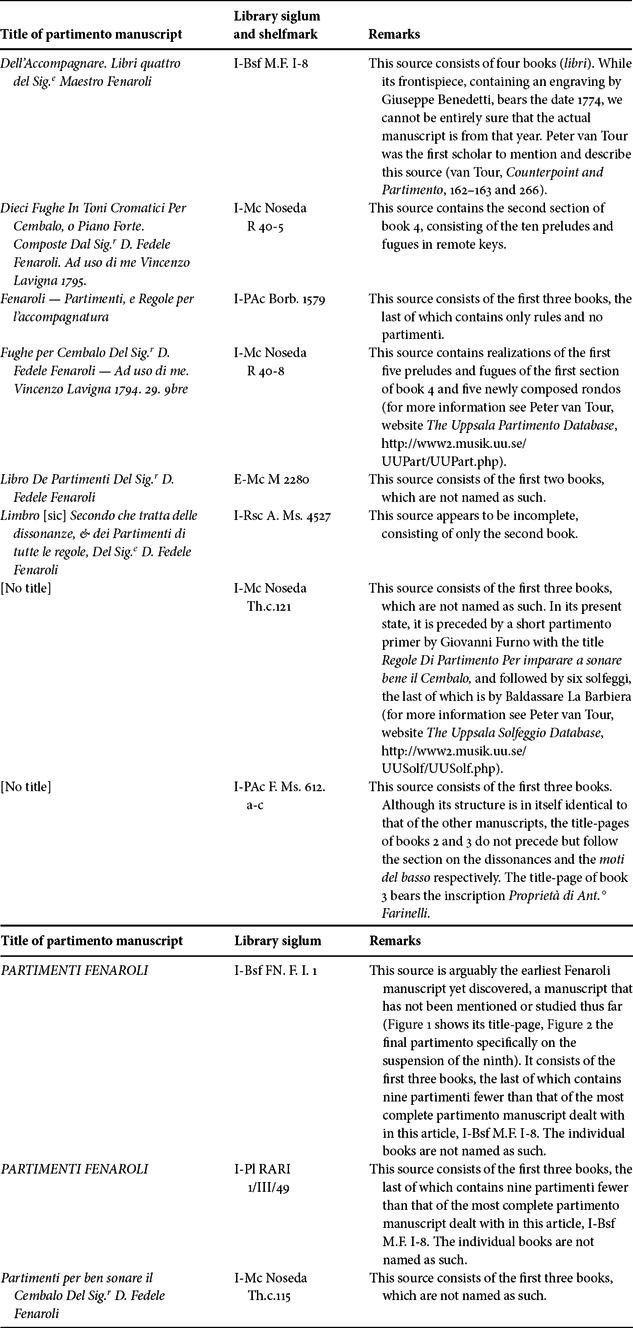
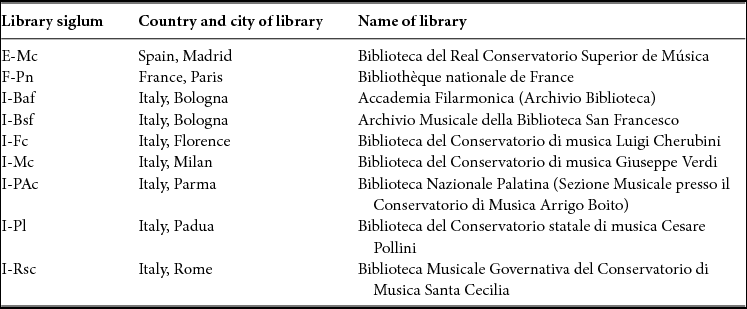
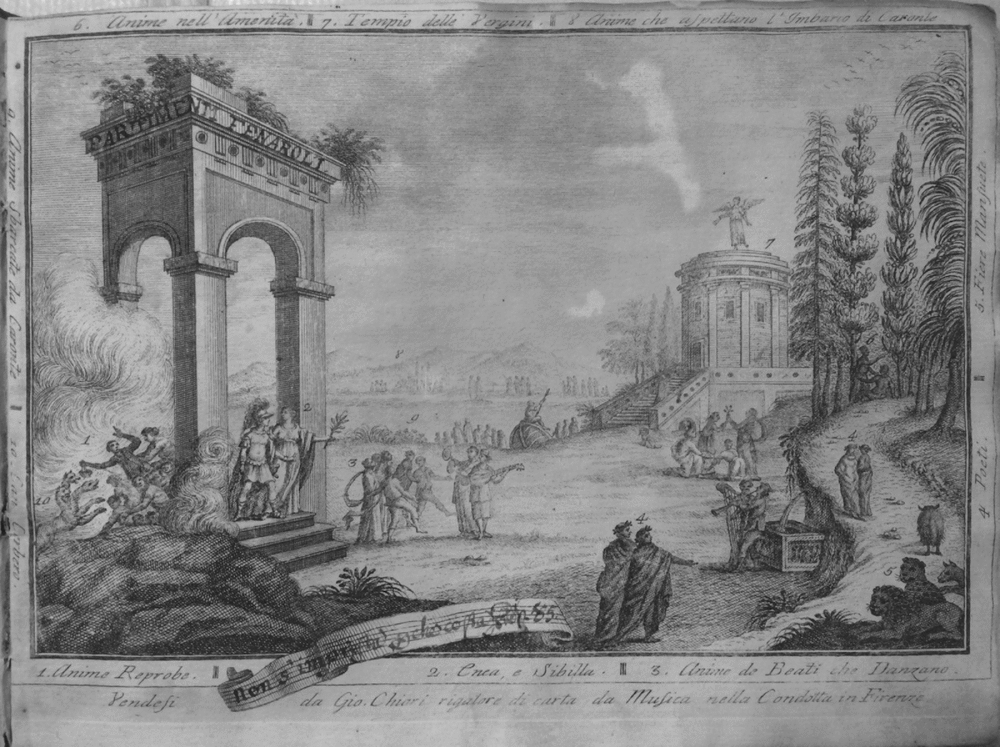
In order to gain a better insight into the successive pedagogical steps a partimento student of Fenaroli had to go through, the most relevant sources are arguably the many manuscripts with actual musical examples, to which Regole Musicali refers by using letters, and a large number of partimenti by Fenaroli that apply the regole musically. Table 1 describes the partimento manuscripts that I have assessed and compared, while Table 2 contains library references for all sources mentioned in this article. These manuscripts, which have hardly received the attention they deserve in recent scholarly work,Footnote 4 appear to be direct or indirect, mostly anonymous copies of Fenaroli's own, yet to be discovered, manuscript(s), made by professional copyists and pupils. Notwithstanding the great difficulty of identifying and dating them, let alone establishing a stemmatic relationship between them, these sources do offer consistent enough a content for us to be able to reconstruct quite accurately the partimento curriculum Fenaroli applied for approximately half a century, revealing a distinct pedagogical structure in four books (libri). Still, this set-up, as illustrated by I-Bsf M.F. I-8, probably came about only around 1775, while the supposedly older sources or copies of them consist of only the first three books, the last of these containing up to nine partimenti fewer in the very oldest sources. The latter organization occurs, for instance, in PARTIMENTI FENAROLI (I-Bsf FN. F. I. 1), arguably the earliest Fenaroli manuscript yet discovered, a manuscript that thus far has not been mentioned or studied; Figure 1 shows its beautiful title-page.
Partimento manuscripts assessed

Locations of sources consulted

Title-page of PARTIMENTI FENAROLI, I-Bsf FN. F. I. 1, fol. 1r, arguably the earliest Fenaroli manuscript yet discovered

With the aim of enlarging our comprehension of Fenaroli's dissonance treatment, I will deal, in addition to the first five editions of Regole Musicali and the partimento manuscripts, with the following sources: the counterpoint notebooks written under Fenaroli by Biagio Muscogiuri from 1781 to 1782 (I-Fc B.505 and I-Baf MSGI-MUSC-MUS.1 (C. 1R)) and Vincenzo Lavigna from 1791 to 1795 (I-Mc Noseda Th.c.117),Footnote 5 and a letter from Fenaroli to one of his former students, Marco Santucci, from 1791. Since Muscogiuri's and Lavigna's counterpoint manuscripts, the most extensive yet discovered in their genre, are fair copies, we may assume that Fenaroli, who probably corrected earlier drafts of their constituent exercises, approved of their musical content, and therefore that these sources represent, to a very large extent, Fenaroli's views on dissonance treatment. As for the partimento manuscripts, they do contain some variants of figures, yet not so much as to contradict the theoretical framework.
In relation to both Fenaroli's pedagogical method and his theoretical frame of reference, I will also refer to the 1813 Italian–French bilingual edition of Fenaroli's Regole Musicali and partimenti, which was edited by Emmanuele Imbimbo and published in Paris by Raffaele Carli (henceforth Imbimbo 1813),Footnote 6 yet I will not treat it, as certain scholars have done, as a primary source.Footnote 7 While Fenaroli was involved in the publication to a certain extent, a number of arguments, some of which will be elaborated below, strongly suggest caution in linking its concept and precepts to him and in understanding it as the ultimate representation of Fenaroli's lifelong teaching. First, Imbimbo 1813 was published only at the very end of Fenaroli's life and teaching career; moreover, it appeared not in Naples (or any other Italian city) but in Paris, far from Fenaroli's pedagogical activities. Secondly, whereas Fenaroli integrated specific (series of) partimenti into the first three books of the partimento manuscripts in order to present musical applications of the regole, Imbimbo moved several of those series to places in the edition where the link with their respective rules is lost. This editorial decision clearly results in a pedagogically questionable order and may represent one of the many mistakes in Imbimbo 1813 to which Fenaroli referred in a letter to Santucci of 30 January 1812.Footnote 8 Thirdly, the fact that Imbimbo 1813 contains fifty-five newly composed partimenti does not automatically make this edition more important than the partimento manuscripts. Fenaroli actually seems to have considered this new series of partimenti as an extra book to be added to the established four-book structure that is reflected in the partimento manuscripts. Basically, while Imbimbo rearranged Fenaroli's original four-book structure into a five-book form, and then concluded his edition with a sixth book containing the fifty-five new partimenti, Fenaroli had mentioned to Santucci in another letter, dated 18 January 1811, that he was composing a new, fifth book of partimenti specifically for Imbimbo's edition.Footnote 9 Finally, Imbimbo 1813 includes a new theoretical introduction which deviates on certain elementary points from Regole Musicali, making it seem unlikely that Fenaroli would have instigated or agreed with them. And if that were the case, Fenaroli would surely have adopted these differences in the fifth edition of Regole Musicali, which postdates Imbimbo's edition by one year.
FENAROLI'S PARTIMENTO CURRICULUMFootnote 10
When reading the first fifteen-odd pages of any edition of his Regole Musicali, one gets the impression that Fenaroli advocated starting partimento training with the study of three basic cadences – the semplice, the composta and the doppia, followed by the practice of the rule of the octave. Yet all the partimento manuscripts I know systematically give the rule of the octave before the three basic cadences, suggesting that Fenaroli made his students study those primary rules in that very order.Footnote 11 And while I-Bsf M.F. I-8 does not contain any musical examples of the cadences, the fact that the illustrations of the rule of the octave start on the verso of the title-page confirms that partimento training started with this rule.
Following the rule of the octave and the cadences, the partimento manuscripts present a first series of sixteen figured partimenti that are principally conceived so as to allow the assimilation of these features into a musical context at the keyboard; these partimenti conclude the first libro.Footnote 12 (Still, since Regole Musicali hardly mentions them, Fenaroli must have verbally introduced two new matters at the latest at this point: when the rule of the octave should or could not be applied, and how to modulate.)
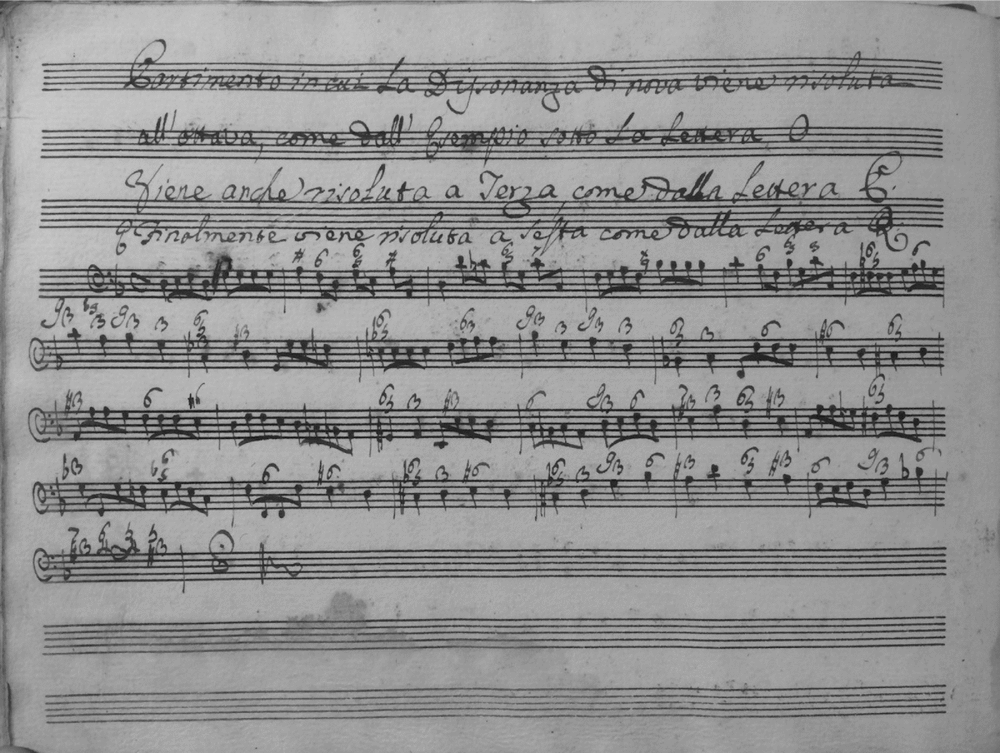
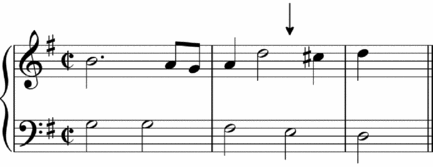
The next step in the curriculum was the study of suspensions – first in the upper voices, then in the bass – the sole topic of the second book of Fenaroli's method. This book opens with thirteen illustrated rules, each of which is followed by a figured partimento specifically to practise that rule in a more elaborate context, and it concludes with fourteen figured partimenti in which everything that has been learned until then is combined. (Figure 2 shows the final partimento specifically dealing with the suspension of the ninth from I- Bsf FN. F. I. 1. We may assume that, during the lessons on suspensions, dissonance treatment in general was treated more elaborately than in Regole Musicali.)
Partimento on the suspension of the ninth, I-Bsf FN. F. I. 1, fol. 15v

Subsequently, the moti del basso (bass motions) were the point of focus, to which the third book, again with two sections, is devoted. In the first section, all moti del basso are presented successively, mostly with several options for realization, none of which, however, is followed by an individual partimento. As for the second section, it is a corpus of forty-nine nearly unfigured partimenti in which not only the moti del basso and everything learned until then is brought together, but also some idiomatic keyboard textures and the first steps in imitation are introduced.Footnote 13
At this point, the partimento student would have gone through all the rules and could start with the study of counterpoint if he was judged capable enough.Footnote 14 The fact that six of the eleven partimento manuscripts that I have studied actually contain precisely the first three books underlines that these books indeed form a unity in themselves, constituting what we could call Fenaroli's basic partimento course. As for the fourth, more demanding book – his advanced partimento course – it consisted of twelve partimento preludes and fugues in commonly used keys and ten partimento preludes and fugues in more remote keys, and was dealt with parallel to the final stages of counterpoint training.Footnote 15
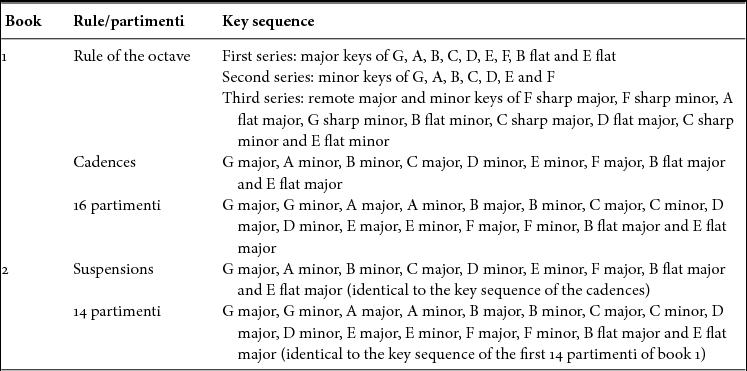
Fenaroli's concern for methodological order applied not only to the different steps in partimento teaching but also in large part to the key sequence of the illustrations of each individual rule and of the partimenti in the first two books, which often prove to be similar (see Table 3). The rule of the octave is first given in nine major keys and seven minor keys, to be practised in the three positions. In succession, a selection of scales in more remote major and minor keys (scale cromatiche) appear, all to be practised in the three positions as well.Footnote 16 As for the three cadences, each of them is shown in a similarly ascending series of common keys, yet combining major and minor modes by always utilizing the key with the least accidentals. The partimenti that conclude book 1 simply alternate between the common major and minor keys for practising the rule of the octave, again according to an (overall) ascending key sequence. As for book 2, it shows that every type of suspension needed to be practised according to the key sequence used for the cadences. And while Fenaroli composed the partimenti specifically accompanying each rule on suspension in a more limited number of keys, the concluding fourteen partimenti of book 2 occur in the same key sequence as the first fourteen partimenti that conclude book 1 (thus without partimenti in B flat major and E flat major).Footnote 17
Key sequences of the illustrations of each individual rule and of the partimenti in books 1 and 2 of Fedele Fenaroli, Dell'Accompagnare. Libri quattro del Sig.e Maestro Fenaroli

If we now compare this pedagogically coherent method with Imbimbo 1813, two structural problems arise – the first more serious than the second – in relation to the latter, problems which are due to the repositioning of partimenti. First, while Imbimbo did present the rule of the octave and the cadences in that order and in a way similar to that found in the partimento manuscripts, he did not include the sixteen partimenti Fenaroli purposely composed to train these partimento rules in book 1. Instead, he printed these partimenti only at the beginning of the second section of book 2, after the explanation of the suspensions with their individual partimenti. This order implies that the series of easiest partimenti is not only separated from its regole but also that it appears between two series of more complex partimenti – a doubtful judgment. Secondly, whereas the partimenti diminuiti occur in the partimento manuscripts amongst the last eight partimenti of book 3, marking the culmination of ‘Fenaroli's basic partimento course’, in Imbimbo 1813 they are moved to the beginning of book 5 – the beginning of ‘Fenaroli's advanced partimento course’, where they are alienated from the other partimenti of that book, all preludes and fugues.Footnote 18
CONSONANCES AND DISSONANCES
One cannot deal with dissonance treatment within Fenaroli's teaching without taking the famous rivalry between the Leisti and the Durantisti – adepts of the pedagogical methods and theoretical frameworks of Leonardo Leo and Francesco Durante respectively – as a starting-point. This is a subject that has been explored extensively in recent scholarly work,Footnote 19 and the main point of interest for this study lies in the different approaches taken by the two eighteenth-century Neapolitan schools to voice leading and counterpoint. Whereas Leo advocated a stricter approach to voice leading – an essential tenet in his teaching of an older-style cantus-firmus counterpoint – Durante adopted a more modern, harmonic perspective on counterpoint, which included, amongst other things, treating the augmented fourth and the diminished fifth and seventh as consonances that required no preparation. In other words, while both schools did actually have the same strict view on how to prepare an on-beat dissonance – the preparation that introduces the dissonance and the dissonance itself had to be the same note – they came to different conclusions as to which intervals were considered dissonant or consonant, conclusions which were mostly based on whether or not these intervals required preparation. From what follows, it will become clear that Fenaroli too, as a devoted student of Durante, had an up-to-date view on dissonance treatment that applied to the practice of both partimento and counterpoint. It will come as no surprise, therefore, that voice leading and chord choice within Fenaroli's pedagogy are far from unique; they largely agree with any eighteenth-century thoroughbass or music-theoretical treatise, a point I will touch upon by drawing from several of them.
With regard to the distinction between and the definition of consonances and dissonances, each of the first five editions of Regole Musicali states that there are four consonances – octave, third, fifth and sixth – and four dissonances – second, fourth, seventh and ninth – and that the intervals of the latter class always have to be prepared and resolved by those of the former.Footnote 20 In itself, this notion would be straightforward enough, were it not for the fact that at other places in Regole Musicali, Fenaroli expressed views and gave musical examples that do not respect this initial classification of consonances and dissonances. Consider the beginning of his discussion of the dissonance of the fourth, acting as a momentary strong-beat substitute for the third of a chord. Fenaroli argued that:
L[a] quarta si può preparare da tutte le quattro Consonanze, cioè, dall’ 8. 3. 5., e 6.
The fourth can be prepared by all four consonances, that is, by the octave, third, fifth and sixth.Footnote 21
Subsequently, he illustrated how the dissonance of the fourth can be prepared by each of these consonances. Yet he expanded the list of intervals that could be used to prepare the suspension of the fourth with two other ones, namely the minor seventh, at first thus described as a dissonance, and the diminished fifth, which was not even mentioned in the enumeration of consonances and dissonances:
Si nota, che la quarta si può anche preparare dalla settima minore, e dalla quinta falza [sic].
Note that the fourth can also be prepared by the minor seventh and by the diminished fifth.Footnote 22
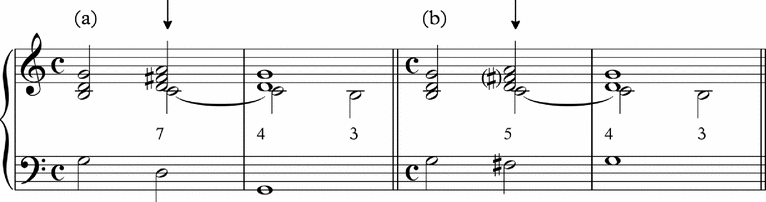
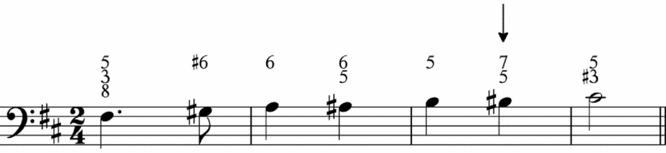
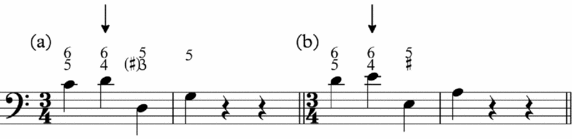
Moreover, instead of proposing a voice leading whereby both minor seventh and diminished fifth were prepared as well, as one might perhaps expect, Fenaroli illustrated this guideline with two examples in which both intervals were freely introduced, and hence, according to Fenaroli's definition of consonances and dissonances, should be interpreted as consonances (see Example 1). Fenaroli confirmed the consonant status of the diminished fifth, albeit somewhat casually, in his discussion of the bass suspension of the seventh scale step returning to the first, by mentioning the presence of ‘la consonanza di quinta falsa’ (the consonance of the diminished fifth) above the seventh scale step.Footnote 23 And while it is true that the 1775 edition does not specifically mention the minor seventh as a consonance, the freely introduced minor seventh of Example 1, excerpted from a source from approximately the same year as the first edition of Regole Musicali, implies that this was something of an oversight. Indeed, this was then rectified in the third edition of 1795 in a footnote, elucidating the consonant character of the minor seventh and more explicitly confirming this status with regard to the diminished fifth than in the 1775 edition:
La settima minore, e la quinta falsa, sono consonanze; perchè non hanno bisogno di preparazione, ma soltanto di risoluzione calando di grado.
The minor seventh and diminished fifth are consonances because they do not require preparation, but only resolution by descending step.Footnote 24
Partimento manuscript Dell'Accompagnare. Libri quattro del Sig.e Maestro Fenaroli, (a) I-Bsf M.F. I-8, fol. 17v (first example) (b) I-Bsf M.F. I-8, fol. 18r (first example). Used by permission

The confirmation that Fenaroli considered the minor seventh to be a consonance actually dates from well before 1795; further, it does not occur in a partimento-related source, but in Libro VI° (1781) of Biagio Muscogiuri's counterpoint course with Fenaroli (I-Fc B.505). As Peter van Tour has observed, this manuscript includes what seems to be the result of Fenaroli dictating the rules of counterpoint to his pupil, thereby modifying the rule of the suspension of the fourth.Footnote 25 At first, Fenaroli formulated this precept as it appears in the first edition of Regole Musicali, but then immediately suggested some alterations and had Muscogiuri cross out ‘four’ and add ‘minor seventh and diminished fifth’ as possible consonant intervals preparing the suspension of the fourth, resulting in the following version:
La quarta si può preparare da tutte quattro le consonanze; cioè, dall’ 8.; dalla 3; dalla 5.a; dalla 6.a; dalla 7.a minore, e dalla 5.a falsa.
The fourth can be prepared by all four consonances, that is by the octave, third, fifth, sixth, minor seventh and diminished fifth.Footnote 26
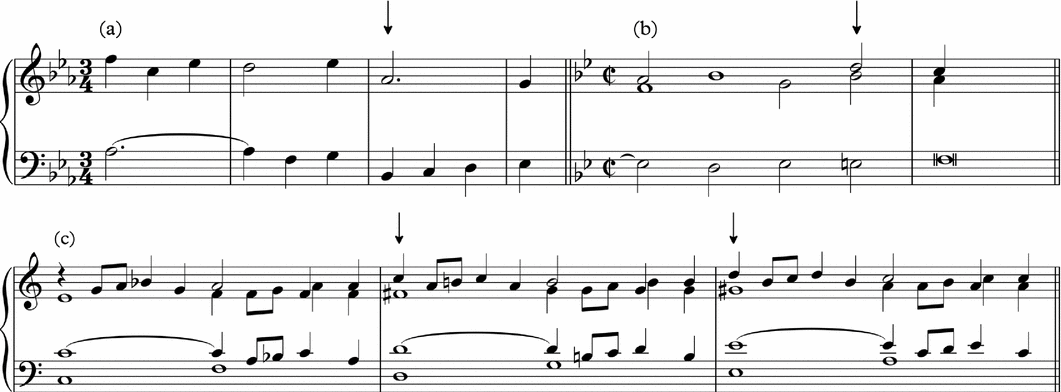
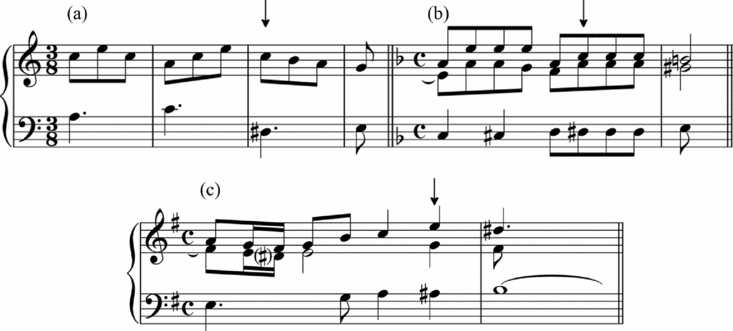
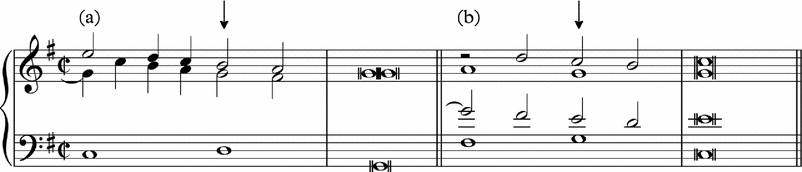
That both diminished fifth and minor seventh could be treated as consonances within Fenaroli's counterpoint teaching as well as in partimento is a first important indicator of the similar theoretical frameworks adopted for both fields. Indeed, both Muscogiuri's and Lavigna's counterpoint notebooks abundantly display unprepared diminished fifths and minor sevenths, of which Example 2 shows but a few occurrences.Footnote 27 Treating these intervals as freely introduced consonances did not imply, however, that their resolution was unbound as well. As the rectification in the third edition of 1795 makes clear, these intervals needed to resolve by means of stepwise descent. And in his 1791 letter to Marco Santucci, Fenaroli added an interesting nuance to the view of the minor seventh as a consonance, which renders it perhaps somewhat ‘less consonant’ than the normal consonances. He described the minor seventh as ‘una consonanza falsa, che hà bisogno di risoluzione’ (a false consonance, which needs to resolve).Footnote 28
(a) Counterpoint notebooks written under Fedele Fenaroli by Biagio Muscogiuri, I-Baf MSGI-MUSC-MUS.1 (C. 1R), fol. 35r, system 5, bars 13–161 (b) Counterpoint notebooks written under Fedele Fenaroli by Biagio Muscogiuri, I-Fc B.505, fol. 74v, system 3, bars 3–4 (c) Counterpoint notebooks written under Fedele Fenaroli by Vincenzo Lavigna, I-Mc Noseda Th.c.117, fol. 50r, system 2, bars 6–8. Used by permission

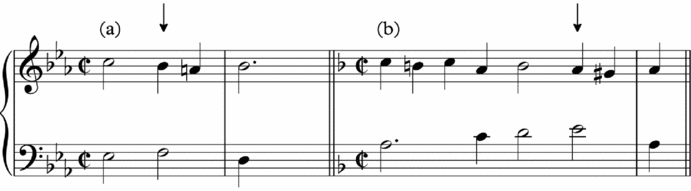
Summarizing the evidence from the Fenaroli sources on the minor seventh, it can be said with confidence that it could function as a dissonance or as a consonance from at least as early as 1775, and that, in spite of Fenaroli's silence on its precise conditions, this distinction clearly depended on the harmonic context. When the minor seventh – or any kind of seventh, for that matter – functioned as an on-beat temporary replacement for the sixth in a sixth chord, it was treated as a dissonance and therefore prepared (Example 3 gives this standard voice leading). On the other hand, as Examples 1 and 2 illustrate, the minor seventh was treated as a consonance, and so could enter unprepared when it acted as a genuine chordal note, mostly of a dominant-seventh chord, and occasionally of a half-diminished-seventh chord, instead of as a suspension.
I-Baf MSGI-MUSC-MUS.1 (C. 1R), fol. 28r, system 3, bars 3–51. Used by permission

The Preface to Imbimbo's 1813 edition, however, describes the dominant-seventh chord – not specifically the minor seventh – as being dissonant:
Il primo accordo fondamentale consonante datoci dalla natura, per cui si chiama perfetto, è quello di 1.a 3.a e 5.a; se a quest'accordo vi si aggiunge in progressione di terza, la settima minore, ne nascerà un secondo accordo pur fondamentale, ma dissonante chiamato di settima dominante.
Le premier accord fondamental consonant qui nous a été donné par la nature se nomme parfait; c'est celui de 1.re 3.e et 5.e; si on y ajoute, en progression de tierces, la septième mineure il en sortira un second accord fondamental, mais dissonant, qu'on nomme 7.e dominante.
The first fundamental consonant chord that was given to us by nature is called perfect, being the one consisting of a prime, a third and a fifth. If one adds, by progression of thirds, the minor seventh, this will produce a second purely fundamental but dissonant chord, which is called the dominant seventh.Footnote 29
Although this formulation obviously differs from Fenaroli's and so suggests that Fenaroli did not write or oversee this Preface, Imbimbo did allow this interval – as well as the diminished seventh and the diminished fifth, for that matter – to be introduced without preparation, by drawing, somewhat curiously, from opinions that are not his own:
La 7.a minore, la diminuita, e la 5.a falsa, detta ancora diminuita, godono il privilegio di darsi senza preparazione, la prima sulla Dominante, le altre due sulla Sensibile, considerandosi da molti teorici come intervalli mezzani tra la consonanza e la dissonanza, e consequentemente partecipi dell'una e dell'altra specie.
La 7.e mineure, la diminuée, et la fausse 5.e, qu'on appelle aussi diminuée, jouissent du privilège de se donner sans préparation, la premiere sur la Dominante, les deux autres sur la Sensible, étant considérées par plusieurs théoriciens comme intervalles intermédiaires entre la consonnance et la dissonance, et conséquemment participantes de l'une et de l'autre espece.
The minor seventh, the diminished seventh and the diminished fifth enjoy the privilege of being used without introduction, the first one on the dominant, the two others on the leading note, since they are considered by many theoreticians as intermediate intervals between a consonance and dissonance, and consequently belong to both types.Footnote 30
In themselves, freely introduced diminished fifths and minor sevenths were not features exclusive to the Durantisti. After all, while still ranked mostly among the dissonances,Footnote 31 the unprepared diminished fifth and minor seventh belonged to the normal voice-leading framework of many eighteenth-century musicians and theorists throughout Europe, as did the prepared version of those intervals, for that matter. Francesco Gasparini, for instance, explained that the diminished fifth ‘negl’ accompagnamenti può venir legata, e sciolta’ (may occur either joined or free in accompaniments).Footnote 32 And while the musical examples in L'Armonico Pratico mostly imply prepared sevenths of any kind, Gasparini approved of their being unprepared on the fourth and the raised fourth scale steps leading to the dominant.Footnote 33 As for Johann David Heinichen, he similarly stated in his General-Bass in der Composition that the diminished fifth ‘lieget zuweilen vorhero, zuweilen auch nicht’ (is sometimes prepared, sometimes not), a directive he repeated with regard to the seventh in general; his examples of the latter category include both unprepared minor and diminished sevenths.Footnote 34
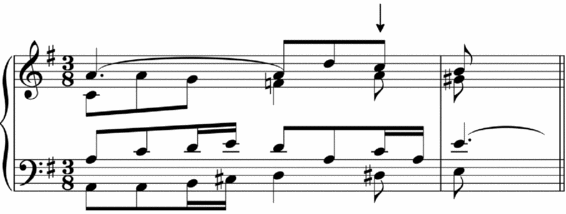
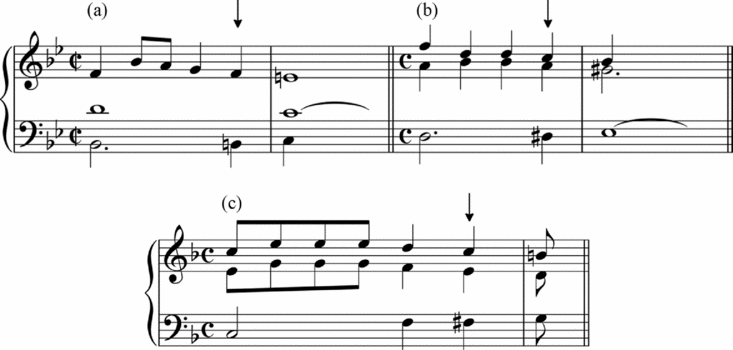
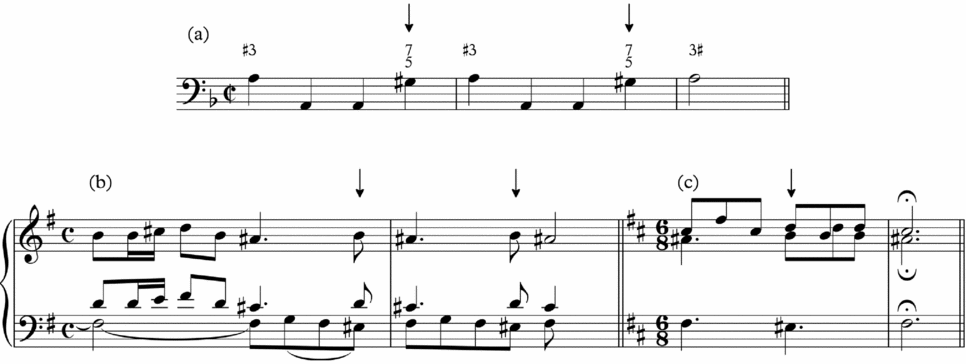
Besides the unprepared minor seventh and diminished fifth, the unprepared diminished seventh also figured amongst the normal voice-leading options within Fenaroli's theoretical framework. In fact, while Fenaroli did not touch upon the latter interval in Regole Musicali, it seems to have been used as freely as the minor seventh, also corresponding to the specific concept of consonanza falsa. Another similarity with the unprepared minor seventh is that the unprepared diminished seventh occurs in the context of all the partimento and counterpoint sources I have consulted – an observation that further confirms that there was no essential difference in voice-leading approach between partimento and counterpoint teaching. Indeed, the unprepared diminished seventh already occurs on a number of occasions in the partimento manuscripts (Example 4 offers an instance), and remains remarkably present, approached by both conjunct motion and by a leap, in Muscogiuri's and Lavigna's counterpoint notebooks (for a selection of instances in which the minor seventh is approached by leap see Example 5). While these unprepared diminished sevenths do mostly resolve correctly, that is, via a stepwise descent, I have come across one type of voice leading in I-Mc Noseda Th.c.117 where the diminished seventh was treated in an even freer way than was the case with the unprepared minor seventh. Not only did Lavigna once write a chord containing a doubled diminished seventh, both unprepared, but he decided upon a faulty resolution of one of them as well, obviously in order to avoid parallel octaves (Example 6).
I-Bsf M.F. I-8, fol. 27v, system 5, bars 4–7. Used by permission. All the partimento manuscripts that I have examined that contain the partimento from which Example 4 is excerpted figure the b♯ as 7/5, except for I-Mc Noseda Th.c.121, in which that note is unfigured

(a) I-Baf MSGI-MUSC-MUS.1 (C. 1R), fol. 54r, system 1, bars 6–91 (b) I-Fc B.505, fol. 64r, system 3, bars 6–72 (c) I-Mc Noseda Th.c.117, fol. 73v, system 3, bars 6–7. Used by permission

I-Mc Noseda Th.c.117, fol. 98v, system 1, bars 5–63. Used by permission

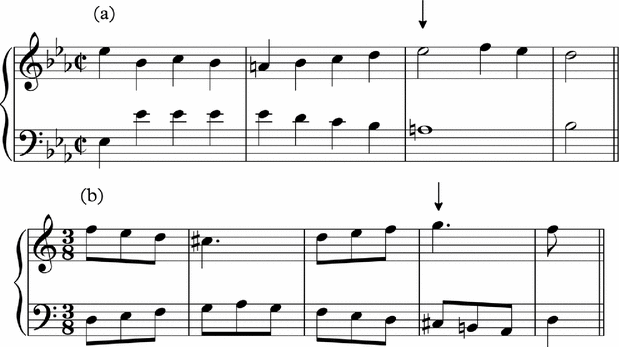
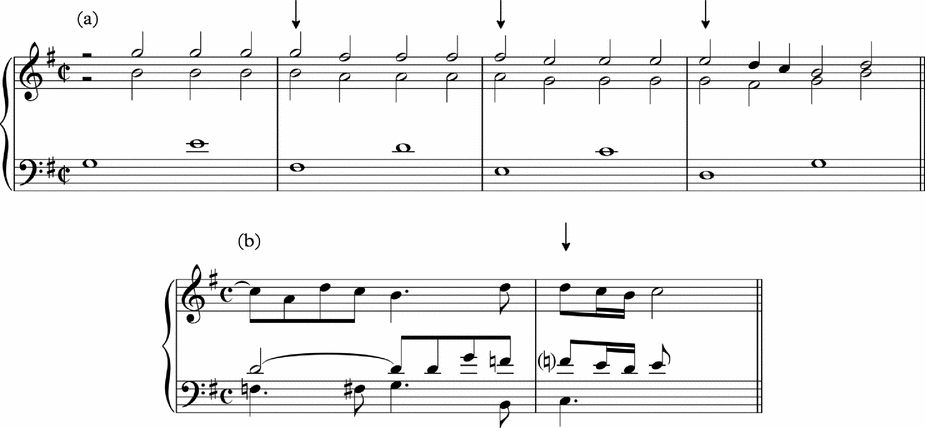
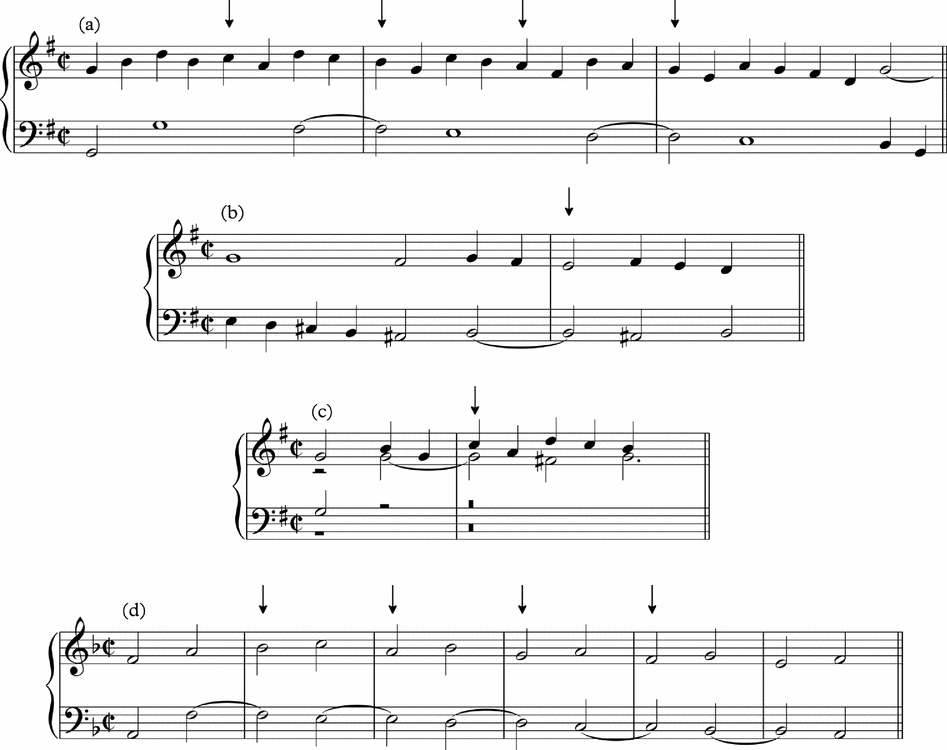
Apart from the use of the unprepared diminished fifth, minor seventh and diminished seventh as valid vertical intervals on the leading note in themselves, they also functioned as steadfast elements of certain schemata, that is to say, of stock compositional phrase units characterized by a particular voice leading, harmonization, rhythm, metre and/or form.Footnote 35 First, an unprepared diminished fifth, accompanied or not by an unprepared minor or diminished seventh, occurs on a number of occasions on the raised fourth scale step, a local leading note, in what Robert O. Gjerdingen would call a Converging Cadence, which ‘is so named by virtue of the way its outer voices [or the two upper voices against the bass] move toward each other, converging on the dominant chord’ (see Example 7).Footnote 36 Note, however, that this chromatically ascending bass did not imply this particular voice leading per se in the Fenaroli circle. As Examples 2b, 5b and 5c have already shown, a diminished fifth, minor seventh or diminished seventh on the raised fourth scale step could also be approached by leap. Secondly, an unprepared diminished seventh accompanied by a diminished fifth occurs a number of times as a neighbouring chord, again on the raised fourth scale step, in between dominant chords, resulting in a variant of what Gjerdingen might call a Ponte, a schema that ‘highlight[s] a dominant pedal point and the tones of the dominant triad or seventh chord’ (see Example 8).Footnote 37 Thirdly, an unprepared diminished fifth also occurs, albeit somewhat less frequently, as the penultimate chord of what Gjerdingen would call a variant of a Fenaroli, a schema in which the upper voice gives the seventh, first, fourth and third scale steps as main notes against the fourth, third, seventh and first scale steps in the bass (Example 9).Footnote 38
(a) I-Mc Noseda Th.c.117, fol. 78r, system 2, bar 10 and system 3, bar 1 (b) I-Fc B.505, fol. 68r, system 4, bar 17 and fol. 68v, system 1, bar 1 (c) I-Mc Noseda Th.c.117, fol. 75v, system 1, bars 7–81. Used by permission

(a) I-Bsf M.F. I-8, fol. 29v, system 8, bar 7 and system 9, bars 1–21 (b) I-Fc B.505, fol. 58v, system 4, bars 2–3 (c) I-Mc Noseda Th.c.117, fol. 79v, system 4, bars 14–15. Used by permission. All the partimento manuscripts that I examined that contain the partimento from which Example 8a is excerpted figure both g♯s as 7/5

(a) I-Baf MSGI-MUSC-MUS.1 (C. 1R), fol. 32r, system 1, bars 9–121 (b) I-Baf MSGI-MUSC-MUS.1 (C. 1R), fol. 54v, system 1, bars 8–122. Used by permission

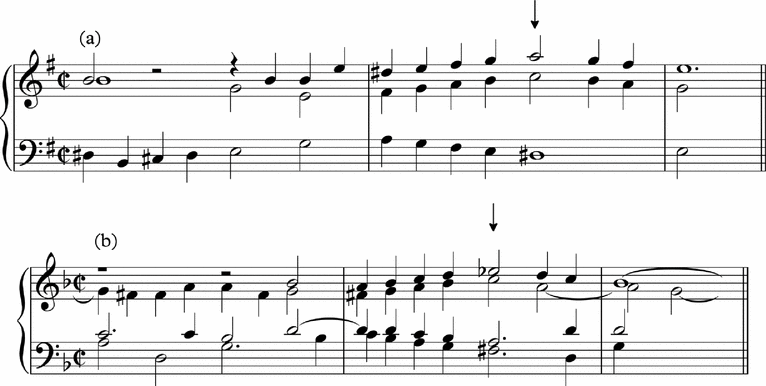
Whereas the two-part variant of this pattern occurs in both major and minor keys, as illustrated in Example 9, a three- or four-part version was occasionally written in a minor key, with a third voice moving in sixths below or thirds above the upper voice of the two-part variant of the Fenaroli and with an unprepared diminished seventh as penultimate chord (Example 10). Incidentally, the vertical interval or chord at the beginning of the variant of the Fenaroli demonstrates that the augmented fourth could also be introduced without preparation. The fact that this very voice leading, also left unmentioned by Fenaroli, is abundantly present in the counterpoint notebooks of Muscogiuri and Lavigna (from which Example 11 shows only two excerpts) contributes further to the observation that the rules of counterpoint corresponded to those of partimento.
(a) I-Fc B.505, fol. 93v, system 1, bars 7–93 (b) I-Mc Noseda Th.c.117, fol. 88r, system 2, bars 3–52. Used by permission

(a) I-Baf MSGI-MUSC-MUS.1 (C. 1R), fol. 49r, system 4, bars 4–52 (b) I-Mc Noseda Th.c.117, fol. 82v, system 1, bars 4–5. Used by permission

Contrary to Fenaroli's pedagogical practice and to the diminished fifth on the seventh scale step, however, the augmented fourth on the fourth scale step, where both notes are introduced freely, is mentioned or illustrated less in eighteenth-century thoroughbass and music-theoretical treatises. Still, giving a musical example with this very voice leading, Carl Philipp Emanuel stated that ‘die verminderte Quarte hat einer Vorbereitung nöthig; die reine und übermäßige nicht allezeit’ (the diminished fourth requires preparation; the perfect and augmented fourths, not always).Footnote 39
With regard to the vertical perfect fourth, Fenaroli's Regole Musicali provides information just as rudimentary as it does for the diminished fifth and any kind of seventh. Apart from mentioning the need to prepare this interval when, as illustrated by the accompanying examples, it functions as an on-beat, dissonant, temporary replacement for the third of a chord, Fenaroli only gave the following rule indicating which vertical interval should accompany this type of fourth:
la dissonanza di quarta deve esser sempre accompagnata con la consonanza di quinta; per lo che la detta dissonanza non può mai aver luogo sopra una nota, la quale di sua natura non voglia la quinta.
the dissonance of a fourth should always be accompanied by the consonance of the fifth. That is because the aforementioned dissonance can never have a place above a note that, by its nature, does not take the fifth.Footnote 40
Yet the third partimento in the partimento manuscripts (Example 12) already puts this directive somewhat into perspective, illustrating that, when the fifth would indeed have been a perfect option, the sixth could also accompany the fourth, a chord distribution that is regularly asked for throughout the corpus of figured partimenti. And the counterpoint notebooks of Muscogiuri and Lavigna illustrate that, besides the fifth, the sixth was also abundantly used to accompany the on-beat fourth, in which case the latter was even introduced without preparation on a number of occasions (Example 13) – yet another indication that the dissonance treatment for counterpoint was highly similar to that for partimento. (In spite of the possibility of using an unprepared fourth within the cadential six-four chord, this voice leading apparently did have to comply with the condition that the fourth be introduced via a descending step in contrary motion with the bass.) As a matter of fact, both of these voice-leading options are described in Muscogiuri's Libro VI, although the one with the sixth is judged as only a second choice in a three-part setting:
Sappiasi, che l'accompagnamento della 4. è la 5.a, quando si usa come dissonanza: quando poi si voglia usare la quarta sù la nota che fà cadenza, allora perche si dà senza preparaz.e, può avere l'accompagnamento della 6.a e della 5.a a piacere libero del compositore; avvertendosi ancora che quando si scrive a trè Parti, è meglio usar la quinta invece della sesta.
One should know that the accompaniment of the fourth is the fifth, when one uses it as a dissonance. If one wants to use the fourth on the dominant, and because it is then allowed without preparation, it can have the accompaniment of the sixth [or] the fifth at the composer's pleasure. One should still be warned that, when one writes in three parts, it is better to use the fifth than the sixth.Footnote 41
(a) I-Bsf M.F. I-8, fol. 10r, system 3, bars 3–4 (b) I-Bsf M.F. I-8, fol. 10r, system 4, bars 1–2. Used by permission. All the partimento manuscripts that I examined that contain this partimento give the same figuring in Examples 12a and b

(a) I-Fc B.505, fol. 29r, system 2, bars 5–6 (b) I-Mc Noseda Th.c.117, fol. 59v, system 1, bars 4–5. Used by permission

One could argue, of course, that Fenaroli saw the cadential six-four as a chord in which the (unprepared) fourth functions as a consonance and therefore that the fourth, similar to the seventh, could be dissonant or consonant depending on the context, a view that is actually advocated in Imbimbo 1813:
VII. La 4.a è di doppia specie, cioè a dire, consonante accompagnata colla 6.a, e dissonante colla 2.a, o colla 5.a
VII. La 4.e est d'espèce double, c'est à dire, consonnante accompagnée de la 6.e, et dissonante accompagnée de la 2.e ou de la 5.e
VII. The fourth is of two species, that is, consonant when accompanied by the sixth, and dissonant when accompanied by the second or the fifth.Footnote 42
Still, several factors with regard to Muscogiuri's guideline given above seem to favour a dissonant view of the cadential six-four chord within the Fenaroli circle. In the first place, Muscogiuri proposed the sixth as an alternative for the fifth to accompany the (dissonant) fourth. In addition, he did not mention that, when using the sixth, the fourth would become consonant. And finally, he discussed this matter in a section called Della Dissonanza, o sia Ligatura della Quarta.
Whether the fourth of a six-four chord should be regarded as a dissonance or as a consonance was actually a heavily debated issue in the eighteenth century, dividing theorists roughly into three camps.Footnote 43 Jean-Philippe Rameau, for instance, defined the perfect fourth of a six-four as a consonance, the consequence of viewing a six-four as the second inversion of a (consonant) triad.Footnote 44 Georg Andreas Sorge went even a step further and defended all types of fourths that belong to six-four chords as ‘würkliche Consonanzen’ (genuine consonances) because he considered these fourths to be ‘umgekehrte Quinten’ (inverted fifths), all of which he considered to be consonant as well.Footnote 45 As for C. P. E. Bach, he unambiguously labelled any fourth that belonged to a six-four chord as a dissonance.Footnote 46 Nuancing these two opposing standpoints, Johann Philipp Kirnberger argued that depending on harmonic and metric context, a six-four chord could be either consonant or dissonant.Footnote 47 When interpreted as the second inversion of a triad, he called the six-four consonant, a chord which could occur on both strong and weak beats. When, however, the fourth and the sixth were viewed as ‘zufällige Dissonanzen’ (non-essential dissonances) to the third and the fifth of a triad respectively, he called this a dissonant chord that could only occur on strong beats.Footnote 48
Regardless of the theoretical belief, though, the voice-leading principles for a six-four chord in each of the three camps remained remarkably similar, and they are equally similar to those taught by Fenaroli. In the case of a strong-beat six-four chord, the fourth did not always require preparation yet always needed to resolve to the third. In the case of a weak-beat six-four, the fourth could be introduced without preparation, could be doubled and/or did not require resolution, a free treatment also displayed in Muscogiuri's and Lavigna's counterpoint books (see Example 14). These books illustrate two more applications of the dissonant fourth that further nuance Regoli Musicali and the guideline found in Muscogiuri's Libro VI. In the first place, regardless of whether it was prepared or not, a dissonant fourth as a substitute for a chord's third was frequently used in a two-part setting, which, by its very nature, does not permit the simultaneous presence of the fourth and the fifth or the sixth (Example 15).Footnote 49 Secondly, the fourth was not only combined with the fifth or the sixth but also with the ninth, creating a double dissonance, in which case both dissonances are prepared (Example 16) – a typically galant voice leading that was discussed by C. P. E. Bach.Footnote 50
(a) I-Baf MSGI-MUSC-MUS.1 (C. 1R), fol. 33v, system 1, bars 7–8 (b) I-Baf MSGI-MUSC-MUS.1 (C. 1R), fol. 45r, system 1, bar 4 (c) I-Mc Noseda Th.c.117, fol. 94v, system 1, bar 3. Used by permission

(a) I-Baf MSGI-MUSC-MUS.1 (C. 1R), fol. 32v, system 1, bar 13 and system 2, bar 1 (b) I-Baf MSGI-MUSC-MUS.1 (C. 1R), fol. 46v, system 2, bars 5–61. Used by permission

(a) I-Fc B.505, fol. 38r, system 4, bars 1–4 (b) I-Mc Noseda Th.c.117, fol. 73v, system 2, bars 7–83. Used by permission

(a) I-Baf MSGI-MUSC-MUS.1 (C. 1R), fol. 57v, system 1, bars 7–9 (b) I-Baf MSGI-MUSC-MUS.1 (C. 1R), fol. 57v, system 3, bars 2–33 (c) I-Mc Noseda Th.c.117, fol. 101v, system 3, bars 2–3 (d) I-Baf MSGI-MUSC-MUS.1 (C. 1R), fol. 36r, system 6, bars 11–16. Used by permission

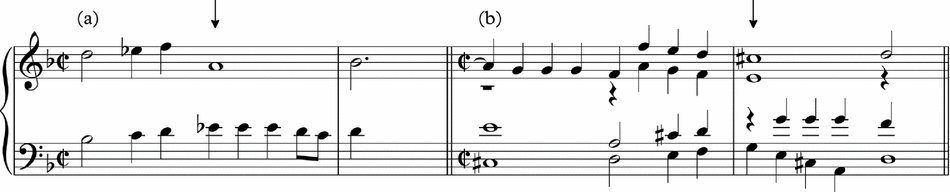
Another type of fourth that is discussed only briefly in Regole Musicali is the one accompanying the bass suspension on the first scale step resolving to the seventh scale step, a suspension that, according to Fenaroli, ‘richiede seconda maggiore’ (requires a major second) as well.Footnote 51 Muscogiuri's and Lavigna's counterpoint books, however, show that not only could the second be struck after the fourth on a weak (part of the) beat, but also that the presence of the second did not altogether seem a necessity, not even when this voice leading occurred multiple times within a ‘partimento, che scende legato’ (partimento that descends in ties) (see Example 17).Footnote 52
(a) I-Mc Noseda Th.c.117, fol. 61r, system 2, bar 6 (b) I-Mc Noseda Th.c.117, fol. 90r, system 2, bars 5–6. Used by permission

While one might have expected that, in addition to the major second and the fourth, Fenaroli would have suggested adding an optional sixth as well (a standard chord choice in the bulk of eighteenth-century thoroughbass and music-theory treatises), he did not do so; he gave this possibility only when the fourth was augmented instead of perfect. Even in the four-part contrapuntal exercises Lavigna wrote under Fenaroli, settings of this bass suspension with a perfect fourth systematically avoid the inclusion of the sixth (Example 18).Footnote 53 Still, in the last two books of those four-part contrapuntal exercises, Lavigna did add another interval – the fifth – to this 4/2 chord on the first scale step on a number of occasions (see Example 19), again resulting in a generally accepted chord in the eighteenth century.Footnote 54 In the 1791 letter to Santucci already mentioned, however, Fenaroli disapproved of the addition of the fifth to the fourth and second on the bass suspension on the first scale step, giving the following comment supposedly on a student's work:
Circa l'esempio mandatomi le dico che molti sul basso legato, cioè su la prima del tono che risolve a settima usano mettere la quinta con la seconda, e quarta, dichiarando la quinta come a basso fondamentale, e la quarta come a settima minore, facendo comparire il basso ligato una dissonanza di quarta; ciò a me non piace, né all'orecchio mi suona, mentre la dissonanza di quarta mai devesi accompagnare con la settima minore essendo una consonanza falsa, che hà bisogno di risoluzione, come la quarta. Io però l'ho veduto usare da più autori, tanto con la quinta da sotto, come da sopra, ma a me mai è piaciuto e mai mi piacerà.
With regard to the example that you have sent me, I say that many are accustomed to adding the fifth to the second and the fourth on the bass suspension, that is, on the tonic that resolves to the leading note, thereby announcing the fifth as a fundamental bass, and the fourth as a minor seventh, and making the bass suspension appear as a dissonance of the fourth. That does not please me, nor does it sound well to my ears, since the dissonance of the fourth must never be accompanied by the minor seventh, being a false consonance, which needs to resolve, as does the fourth. I, however, have seen it used by so many authors, both with the fifth above as below, but it has never pleased me and will never please me.Footnote 55
(a) I-Mc Noseda Th.c.117, fol. 95r, system 2, bars 6–73 (b) I-Mc Noseda Th.c.117, fol. 106r, system 2, bars 1–22. Used by permission

These rather inconsistent views could be interpreted as an indication that Fenaroli went from rejecting to approving (or perhaps at least accepting) the addition of the fifth to a four-two chord somewhere during the three years between the letter to Santucci of 1791 and the penultimate book of four-part counterpoint exercises Lavigna wrote under him in 1794–1795, in spite of his statement that ‘it will never please him’. Until further evidence presents itself, however, this remains only speculation.
As for Imbimbo, he simply approved of both the four-two as the five-four-two chords as valid realizations of a bass suspension on the first scale step, yet he also did not give the option with a six-four-two chord.Footnote 56
After a thorough investigation of two aspects of Fenaroli's pedagogy in this article – his partimento curriculum and his treatment of dissonance in partimento and counterpoint training – one particular conclusion imposes itself. Fenaroli must have been a remarkable teacher, manifesting great method, efficiency, pragmatism and consistency. His partimento curriculum, remaining virtually unaltered during his roughly fifty-year teaching career, reveals a carefully constructed, progressive approach in which theory and practice went hand in hand. Starting with elementary rules such as the rule of the octave and the standard cadences, and proceeding with dissonance treatment and the study of the moti del basso, a partimento student also had to work, parallel to those rules, through an extensive corpus of top-quality partimenti as their musical applications. And only if he had successfully finished this ‘basic partimento course’ could he realize more advanced partimenti. This ‘hands-on’ method is also demonstrated by the fact that Fenaroli's counterpoint teaching, which followed the ‘basic partimento course’, was actually based on that course and complemented it. Not only did a counterpoint student need to go back to the cadences and the moti del basso to explore their contrapuntal possibilities before engaging with more specifically discipline-related assignments,Footnote 57 but he also continued to apply the voice-leading tenets and dissonance treatment learned during his partimento training. Since Fenaroli's teaching had as its main purpose to train future professional composers, it actually could not be anything other than coherent, efficient, practical and up-to-date; everything Fenaroli taught accorded with contemporary standards and served a real-life working situation. Today, his method remains a unique tool for deepening our understanding of Italian compositional practice in the second half of the eighteenth century and for acquiring a working knowledge of that language, a method that I hope will find a central place in present-day music education once again.