Introduction
Transcranial direct current stimulation (tDCS) is a non-invasive form of brain stimulation in which a relatively weak direct current is passed into the cerebral cortex through small scalp electrodes. This results in a modulation of cortical excitability and spontaneous neural activity, dependent upon the polarity of the stimulation (Bindman et al. Reference Bindman, Lippold and Redfearn1964; Nitsche et al. Reference Nitsche, Boggio, Fregni and Pascual-Leone2009). Anodal tDCS enhances cortical excitability and resting membrane potential shifts towards depolarization, with increased rate of firing (i.e. neurons underlying the anode become ‘excited’), whereas cathodal tDCS reduces cortical excitability and resting membrane potential shifts towards hyperpolarization, with a reduced rate of neuronal firing (i.e. neurons underlying the cathode become ‘inhibited’). These effects have been shown to last for more than 1 h, given a sufficient duration of stimulation (Nitsche & Paulus, Reference Nitsche and Paulus2000, Reference Nitsche and Paulus2001; Nitsche et al. Reference Nitsche, Fricke, Henschke, Schlitterlau, Liebetanz, Lang, Henning, Tergau and Paulus2003, Reference Nitsche, Boggio, Fregni and Pascual-Leone2009).
Because of its neuromodulatory effects, tDCS has been investigated as a treatment for neurological and psychiatric diseases. Attempts to explore the effects of tDCS on mood and depressive symptoms in humans have been made for several decades. However, the methodology and experimental protocols of currently performed studies differ fundamentally from those applied in the first studies in the 1960s (summarized in Supplementary Table S1, online).
Early studies aimed to stimulate the brainstem, and for this reason anodal electrodes were placed bi-frontally, as close as possible to the eyebrows. A reference electrode was positioned at the knee, and a relatively strong and long-lasting stimulation of up to 8 h per day for several days was performed (Costain et al. Reference Costain, Redfearn and Lippold1964; Lippold & Redfearn, Reference Lippold and Redfearn1964; Redfearn et al. Reference Redfearn, Costain and Lippold1964). Some open-label studies and clinical observations reported positive effects of tDCS in depression (Redfearn et al. Reference Redfearn, Costain and Lippold1964; Ramsay & Schlagenhauf, Reference Ramsay and Schlagenhauf1966; Baker, Reference Baker1970; Carney et al. Reference Carney, Cashman and Sheffield1970; Nias & Shapiro, Reference Nias and Shapiro1974). However, controlled trials failed to replicate these findings (Arfai et al. Reference Arfai, Theano, Montagu and Robin1970), and a recent study by Koenigs et al. (Reference Koenigs, Ukueberuwa, Campion, Grafman and Wassermann2009) could not replicate any mood-altering effects of tDCS in healthy subjects. These initial mixed findings, together with the development of psychotropic drugs, led to a decreased interest in tDCS as a treatment tool for major depression during the 1970s and 1980s.
Methodological improvements and the promising results of repetitive transcranial magnetic stimulation (rTMS) in depression led to a re-evaluation of the therapeutic application of tDCS. Based on the hypothesis that the left dorsolateral prefrontal cortex (DLPFC) is hypoactive in depression (Grimm et al. Reference Grimm, Beck, Schuepbach, Hell, Boesiger, Bermpohl, Niehaus, Boeker and Northoff2008), the common rationale of currently performed studies is to modify activity in the prefrontal cortex and to re-establish the balance of left and right prefrontal cortex activation (i.e. to enhance excitability of the left prefrontal and to reduce excitability of the right prefrontal cortex). Therefore, anodal stimulation on the left DLPFC is performed, with the return cathodal electrode typically placed over the contralateral DLPFC or supraorbital region. Stimulation parameters typically involve current strength of 1–2 mA and duration of stimulation of typically 20 min per session.
A series of both open-label studies and randomized controlled trials (RCTs) have recently been conducted with the anodal electrode placed over the left DLPFC and contemporary stimulation parameters. To review the available evidence in an objective fashion, we present a systematic review of open-label studies and RCTs of tDCS in the treatment of depression and a meta-analysis of the results of RCTs. The key questions we aim to address in the systematic review are:
-
(1) Is active tDCS associated with a reduction in symptom severity?
-
(2) What is the weighted mean and range of percentage change in symptom severity?
-
(3) Is any reduction in symptom severity following active tDCS clinically relevant?
-
(4) What is the weighted mean and range of percentage of responders and remitters following treatment?
-
(5) Is the beneficial effect of active tDCS lasting?
-
(6) How many studies report that the beneficial effects persist at 1-month follow-up?
The meta-analysis aims to answer:
-
(1) Is active tDCS associated with a significant reduction in symptom severity compared with sham tDCS?
-
(2) What is the pooled effect size of RCTs?
-
(3) What possible predictors are there for treatment response? For example, what patient population responds best to tDCS? What are the optimal tDCS parameters for the treatment of depression?
-
(4) Is meta-regression between effect size and baseline symptom severity, concurrent antidepressant use, current strength and the total number of sessions significant?
Method
Data sources
Open-label studies and RCTs of tDCS were identified by entering the search terms (‘transcranial direct current stimulation’ or ‘tDCS’) and (‘depression’ or ‘depressed’) into the search engines of Medline and Embase. The search was completed in May 2011, with a start date of 1 January 1998. The start date was chosen with reference to the year of the first study performed with contemporary stimulation parameters (Priori et al. Reference Priori, Berardelli, Rona, Accornero and Manfredi1998) and has also been employed in a review of adverse effects of tDCS (Brunoni et al. Reference Brunoni, Amadera, Berbel, Volz, Rizzerio and Fregni2011a ). Reference lists of included studies were searched for further studies.
Study selection
Titles and abstracts of identified citations were examined independently by two authors (U.G.K. and C.E.S.) and any disagreements were resolved by discussion and consensus. For a paper to be included in the systematic review, the study had to report on tDCS in the treatment of patients with unipolar or bipolar major depression, and provide original data of open-label or RCTs with depressive severity as the outcome measure. Studies published as journal articles and letters were included, but conference abstracts were excluded. Authors of conference abstracts that had not been subsequently published as a peer-reviewed article or letter were contacted to ascertain the status of their research, and studies accepted for publication included. If data were published repeatedly as a whole or in parts, the most inclusive publication was used.
For studies to be included in the meta-analysis, the following inclusion criteria had to be met: (1) studies had to be of a randomized parallel or cross-over design, with sham control; (2) both patients and raters had to be unaware of treatment condition; (3) study findings had to be reported using clinician-assessed severity measures [Hamilton Depression Rating Scale (HAMD) or Montgomery–Åsberg Depression Rating Scale (MADRS)], with percentage change in severity measure either available or possible to derive from the publication, or made available post-publication by authors. In cross-over trials, only data from the initial stage of the trial were used to avoid carry-over effects between trial stages.
Data extraction and analysis
For the systematic review, the following variables were recorded independently by two authors (U.G.K. and C.E.S.) in a structured fashion: (1) study design; (2) patient characteristics (including age, bipolar or unipolar diagnosis); (3) tDCS parameters (electrode placement, current strength, duration of stimulation frequency, number of treatment sessions); (4) results (percentage change in severity score, percentage of responders and remitters, whether any beneficial effect persisted at 1-month follow-up). Response was defined as a reduction in severity score by at least 50%. Remission was defined as a HAMD score ⩽7 or MADRS score ⩽10. For the meta-analysis, the mean and standard deviation of the percentage change in severity measure before and after treatment was extracted or calculated. Again, any disagreements were resolved by discussion and consensus.
For the systematic review, weighted means for the percentage change in severity score, percentage of responders and percentage of remitters were calculated from available data. For the meta-analysis, the efficacy of tDCS was investigated by calculating random model effect sizes (Hedges' g) based on percentage change in depression scales in active and sham groups (Comprehensive Meta-Analysis 2.2.048; Biostat Inc., USA). The random-effects model was chosen a priori, as we wished to make an unconditional inference beyond included studies (Hedges & Vevea, Reference Hedges and Vevea1998). Heterogeneity was assessed using Cochran's Q and I 2, the percentage of the total variability due to between-studies variability (Higgins et al. Reference Higgins, Thompson, Deeks and Altman2003). Publication bias was evaluated using Begg and Mazumdar rank correlations (Begg & Mazumdar, Reference Begg and Mazumdar1994) and Egger's regression intercept test (Egger et al. Reference Egger, Davey Smith, Schneider and Minder1997).
Fixed-effect regression with Hedges' g was performed with the baseline symptom severity, concurrent antidepressant use (yes/no, yes if any patient was reported to be concurrently receiving antidepressants), current strength and the total number of active tDCS sessions. For baseline symptom severity the HAMD was used. If a HAMD score was not available, it was converted from MADRS score or scaled from the 24-item HAMD score (Heo et al. Reference Heo, Murphy and Meyers2007).
To obtain the most complete dataset possible, authors were contacted and asked to provide any missing data. For Palm et al. (Reference Palm, Schiller, Fintescu, Obermeier, Keeser, Reisinger, Pogarell, Nitsche, Möller and Padberg2011) subgroups of 1 mA and 2 mA were entered as if they were separate studies in order to reduce heterogeneity within each study.
Results
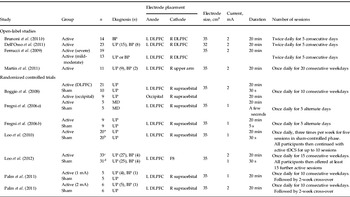
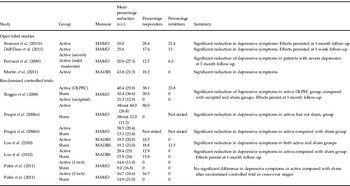
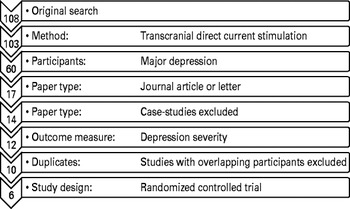
Titles and abstracts of 108 identified citations were screened; a flow diagram of the identification and attrition of studies is provided in Fig. 1. A total of 10 studies were included in the systematic review and are outlined in Tables 1 and 2. Of the studies, four were open-label trials and six were RCTs. The meta-analysis included six studies and a total of 96 depressed patients randomized to active tDCS and 80 randomized to sham tDCS.
Overview of tDCS studies in major depression – participant details and methods

tDCS, Transcranial direct current stimulation; BP, bipolar; L, left; DLPFC, dorsolateral prefrontal cortex; R, right; UP, unipolar; MD, major depression.
a 19 completed sham and open phases. b 16 completed sham phase, 15 completed open phase. c 31 completed sham phase. d 29 completed sham phase.
Overview of tDCS studies in major depression – results

tDCS, Transcranial direct current stimulation; s.d., standard deviation; HAMD, Hamilton Depression Rating Scale; MADRS, Montgomery–Åsberg Depression Rating Scale; DLPFC, dorsolateral prefrontal cortex.
Identification and attrition of studies.

Is active tDCS associated with a reduction in symptom severity?
The weighted mean for percentage reduction of symptom severity with active tDCS was 28.9% (open-label 24.8%, RCT 32.3%), ranging from 14.6% [1 mA group of Palm et al. (Reference Palm, Schiller, Fintescu, Obermeier, Keeser, Reisinger, Pogarell, Nitsche, Möller and Padberg2011) ] to 60% (Fregni et al. Reference Fregni, Boggio, Nitsche, Marcolin, Rigonatti and Pascual-Leone2006a ).
Is any reduction in symptom severity following active tDCS clinically relevant?
The weighted mean for percentage of patients classified as responders after active tDCS was 19.8% (open-label 17.5%, RCT 21.8%), ranging from 0% [1 mA group of Palm et al. (Reference Palm, Schiller, Fintescu, Obermeier, Keeser, Reisinger, Pogarell, Nitsche, Möller and Padberg2011) ] to 80.0% (Fregni et al. Reference Fregni, Boggio, Nitsche, Marcolin, Rigonatti and Pascual-Leone2006a ).
Regarding the percentage of patients that reached remission following active tDCS, the weighted mean was 8.5% (open-label 10.0%, RCT 6.1%), ranging from 0% (Loo et al. Reference Loo, Sachdev, Martin, Pigot, Alonzo, Malhi, Lagopoulos and Mitchell2010, Reference Loo, Alonzo, Martin, Mitchell, Galvez and Sachdev2012; Martin et al. Reference Martin, Alonzo, Mitchell, Sachdev, Galvez and Loo2011; Palm et al. Reference Palm, Schiller, Fintescu, Obermeier, Keeser, Reisinger, Pogarell, Nitsche, Möller and Padberg2011) to 23.8% (Boggio et al. Reference Boggio, Rigonatti, Ribeiro, Myczkowski, Nitsche, Pascual-Leone and Fregni2008).
Is the beneficial effect of active tDCS lasting?
A 1-month follow-up was reported by four studies. Boggio et al. (Reference Boggio, Rigonatti, Ribeiro, Myczkowski, Nitsche, Pascual-Leone and Fregni2008), Brunoni et al. (Reference Brunoni, Ferrucci, Bortolomasi, Vergari, Tadini, Boggio, Giacopuzzi, Barbieri and Priori2011b ) and Ferrucci et al. (Reference Ferrucci, Bortolomasi, Brunoni, Vergari, Tadini, Giacopuzzi and Priori2009) all reported that beneficial effects persisted at 1-month follow-up. Furthermore, percentage reduction in severity score increased from 18% to 50% in Brunoni et al. (Reference Brunoni, Ferrucci, Bortolomasi, Vergari, Tadini, Boggio, Giacopuzzi, Barbieri and Priori2011b ). Percentage reduction in severity score also increased at 1-month follow-up in Loo et al. (Reference Loo, Alonzo, Martin, Mitchell, Galvez and Sachdev2012), although it is important to note that participants in this study were offered at least 15 further active sessions following the initial course of 15 tDCS sessions.
Is active tDCS associated with a significant reduction in symptom severity compared with sham tDCS?
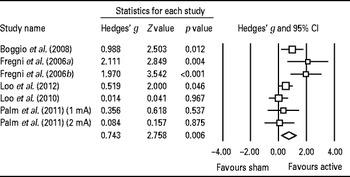
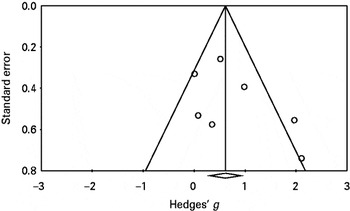
The pooled estimate of effect size (Hedges' g) for the reduction of depressive symptoms (as indicated by percentage reductions in severity score) between active and sham tDCS was 0.74 [Z=2.76, p=0.006, 95% confidence interval (CI) 0.21–1.27], indicating a significant medium to large effect size (Fig. 2). However, the test for heterogeneity was significant (Q=15.5, df=6, p=0.017; I 2=61.4), indicating that the variability in outcome measures between the studies exceeded that expected by chance. Measures of publication bias were significant with neither Begg and Mazumdar rank correlations (Kendall's τ=0.29, p=0.37) nor Egger's regression intercept test (t value=1.35, p=0.24) (Fig. 3). If the two significant Fregni studies not published as full papers are excluded, the equivalent figures are: Hedges' g=0.42 (95% CI 0.09–0.75), Z=2.50, p=0.013. In other words, the pooled effect size remained significant. While the heterogeneity of effect sizes, Q, was significant for all seven studies, it was no longer so for the five remaining studies (Q=4.1, df=4, p=0.39).
Forest plot of effect sizes (Hedges' g) for active versus sham treatment. CI, Confidence interval.

Funnel plot of standard error by Hedges' g.

What possible predictors are there for treatment response?
Meta-regression with baseline symptom severity, concurrent antidepressant use, current strength and the total number of sessions did not reveal any significant correlations.
Discussion
Our systematic review indicated that active tDCS is associated with a reduction in symptom severity of approximately 29% and that the beneficial effects persist at 1-month follow-up. However, there was a wide range in percentage reduction in severity score reported between studies, and only four studies reported 1-month follow-up data. The percentage of responders and remitters to treatment reported varied considerably between studies, presumably reflecting the degree of treatment resistance of the samples recruited and possibly differences in tDCS treatment parameters.
Our meta-analysis detected a significant reduction in symptom severity in active tDCS compared with sham conditions. Although Cochran's Q can be underpowered when analysis involves few studies, heterogeneity was significant. While meta-regression with possible sources of heterogeneity was not significant, this may be a result of the small number of studies included and the lack of availability of quantitative data on treatment resistance. Further, meta-regression was limited by ‘missing data’; although authors were contacted regarding details not explicitly stated within their studies and several positive responses were received (detailed in Acknowledgements), it was not possible to obtain all outcome measures for all studies. Absence of homogeneous results suggests that no individually described protocol can be taken as paradigmatic for tDCS, i.e. can be claimed to generate the pooled effect size. Absence of homogeneity after meta-regression with likely confounders of treatment method suggests that patient sampling may be one of the major reasons for differing results and emphasizes the need for large-scale clinically representative trial samples.
Methodological considerations
There are limitations associated with performing a meta-analysis on a small number of studies, so our results need to be treated with caution. Results must be considered in the light of possible bias within studies and also variability in patient characteristics (concurrent medication, baseline severity score, number of adequate, but unsuccessful antidepressant trials) and stimulation parameters (number and spacing of sessions, current strength, electrode site) between studies, which may influence outcome and result in significant heterogeneity.
An important possible source of bias within trials of tDCS of depression, especially open-label studies, is the placebo effect. While all RCTs included in the meta-analysis were double-blind, blinding success was only reported by three studies (Loo et al. Reference Loo, Sachdev, Martin, Pigot, Alonzo, Malhi, Lagopoulos and Mitchell2010, Reference Loo, Alonzo, Martin, Mitchell, Galvez and Sachdev2012; Palm et al. Reference Palm, Schiller, Fintescu, Obermeier, Keeser, Reisinger, Pogarell, Nitsche, Möller and Padberg2011). All three studies did not find a significant difference between active and sham conditions and guesses. Across studies, it should be noted that research groups often reported multiple studies, although studies included in the meta-analysis did not contain overlapping participants.
Variability in patient population is a key factor that may have contributed to differences in outcomes between studies. As it has been repeatedly noted that the effects of tDCS are influenced substantially by neuromodulators including dopamine and acetylcholine (Nitsche et al. Reference Nitsche, Niehaus, Hoffmann, Hengst, Liebetanz, Paulus and Meyer2004, Reference Nitsche, Boggio, Fregni and Pascual-Leone2009; Kuo et al. Reference Kuo, Grosch, Fregni, Paulus and Nitsche2007, Reference Kuo, Paulus and Nitsche2008), a crucial question is whether the efficacy of tDCS is influenced by the current medication status of patients. In this review, the medication status of patients varied both between and within studies. For example, all patients included in Boggio et al. (Reference Boggio, Rigonatti, Ribeiro, Myczkowski, Nitsche, Pascual-Leone and Fregni2008) and Fregni et al. (Reference Fregni, Boggio, Nitsche, Marcolin, Rigonatti and Pascual-Leone2006a , b) had not received antidepressant medication for at least 2 (Boggio et al. Reference Boggio, Rigonatti, Ribeiro, Myczkowski, Nitsche, Pascual-Leone and Fregni2008) or 3 (Fregni et al. Reference Fregni, Boggio, Nitsche, Marcolin, Rigonatti and Pascual-Leone2006a ) months before tDCS, and remained antidepressant-free for the duration of tDCS treatment. In contrast, the studies performed by Loo et al. (Loo et al. Reference Loo, Sachdev, Martin, Pigot, Alonzo, Malhi, Lagopoulos and Mitchell2010, Reference Loo, Alonzo, Martin, Mitchell, Galvez and Sachdev2012; Martin et al. Reference Martin, Alonzo, Mitchell, Sachdev, Galvez and Loo2011) and Palm et al. (Reference Palm, Schiller, Fintescu, Obermeier, Keeser, Reisinger, Pogarell, Nitsche, Möller and Padberg2011) included both antidepressant-free patients and patients receiving antidepressant treatment. Medication had been stable for at least 3 weeks (Palm et al. Reference Palm, Schiller, Fintescu, Obermeier, Keeser, Reisinger, Pogarell, Nitsche, Möller and Padberg2011) or 4 weeks (Loo et al. Reference Loo, Sachdev, Martin, Pigot, Alonzo, Malhi, Lagopoulos and Mitchell2010, Reference Loo, Alonzo, Martin, Mitchell, Galvez and Sachdev2012) prior to tDCS treatment, and was maintained throughout the course of tDCS. As participants had failed to respond to antidepressant treatment, and as concurrent antidepressant use would affect active and sham groups similarly, concurrent antidepressant treatment was unlikely to enhance results in these studies. However, it is still possible that it is the interaction between tDCS and medication that caused the treatment response. A meta-analysis of rTMS in the treatment of depression found that rTMS was more effective when used in monotherapy, rather than as an adjunctive to antidepressant treatment (Slotema et al. Reference Slotema, Blom, Hoek and Sommer2010). Meta-regression with concurrent antidepressant use was not significant; however, this result cannot be interpreted as conclusive. There were insufficient data available to systematically investigate the effect of other concurrent medications (e.g. anti-convulsants, benzodiazepines, lithium salts, anti-psychotics), but these were noted in some studies included in the meta-analysis (Boggio et al. Reference Boggio, Rigonatti, Ribeiro, Myczkowski, Nitsche, Pascual-Leone and Fregni2008; Palm et al. Reference Palm, Schiller, Fintescu, Obermeier, Keeser, Reisinger, Pogarell, Nitsche, Möller and Padberg2011).
The efficacy of tDCS in the treatment of depression may also vary with baseline symptom severity. Meta-regression with baseline severity score did not reveal a significant correlation with effect size, and Boggio et al. (Reference Boggio, Rigonatti, Ribeiro, Myczkowski, Nitsche, Pascual-Leone and Fregni2008) also did not detect a significant relationship within their sample. Only one study to date has included separate groups of mild-moderate and severe depression (Ferrucci et al. Reference Ferrucci, Bortolomasi, Brunoni, Vergari, Tadini, Giacopuzzi and Priori2009). A significant reduction of depressive symptoms in patients at 1-month follow-up was only noted for the group of patients with severe depression.
Variability in the stimulation parameters used in the studies included is a second important consideration. Meta-regression with current strength and number of tDCS sessions did not identify any significant relationships with effect size. However, regression analysis is limited as it examines each parameter separately and not the combination of parameters employed. Frequency of sessions may also make an impact upon outcome, with Alonzo et al. (Reference Alonzo, Brassil, Taylor, Martin and Loo2011) reporting that daily tDCS leads to greater increases in cortical excitability than second daily tDCS. Further large-scale studies are needed to systematically investigate optimal treatment parameters.
It is not yet certain which specific brain areas should be targeted with tDCS to achieve optimal treatment efficacy. The rationale behind electrode placement in many of the early studies was stimulation of the brainstem, and for this reason anodal electrodes were placed as close as possible to the eyebrows. However, it is possible that cortical, midbrain or diencephalic stimulation was at least partly responsible for the effects of tDCS in these early studies (Priori, Reference Priori2003). Moreover, taking into account current knowledge about pathological alterations in depression, it is unclear if brainstem modulation can affect depressive symptoms. The majority of recent studies have employed a bi-frontal montage, in which the cathode is placed over a contralateral frontal area, and results in a focal frontal stimulation. An alternative approach is a fronto-extracephalic (F-EX) montage in which the cathode is placed over the right upper arm. This is hypothesized to result in a more widespread pattern of activation compared with a bi-frontal montage. Martin et al. (Reference Martin, Alonzo, Mitchell, Sachdev, Galvez and Loo2011) performed F-EX tDCS in 11 participants who had previously shown inadequate response to, or relapsed, following a course of bi-frontal tDCS. F-EX tDCS resulted in a significant reduction in depressive symptoms, with participants displaying greater initial treatment responses with F-EX tDCS than with bi-frontal tDCS.
tDCS risks and safety
The most frequently reported side-effects within studies included in the systematic review were headache, itchiness and redness at the site of the stimulation (Boggio et al. Reference Boggio, Rigonatti, Ribeiro, Myczkowski, Nitsche, Pascual-Leone and Fregni2008; Loo et al. Reference Loo, Sachdev, Martin, Pigot, Alonzo, Malhi, Lagopoulos and Mitchell2010, Reference Loo, Alonzo, Martin, Mitchell, Galvez and Sachdev2012; Palm et al. Reference Palm, Schiller, Fintescu, Obermeier, Keeser, Reisinger, Pogarell, Nitsche, Möller and Padberg2011), with side-effects reported in both active and sham groups. Palm et al. (Reference Palm, Keeser, Schiller, Fintescu, Nitsche, Reisinger and Padberg2008) also reported several cases of skin lesions. However, after physiological saline solution was used for electrode preparation rather than tap water, no further skin lesions were observed (Palm et al. Reference Palm, Schiller, Fintescu, Obermeier, Keeser, Reisinger, Pogarell, Nitsche, Möller and Padberg2011). tDCS can be reliably given without causing skin lesions with careful attention to stimulation technique (Loo et al. Reference Loo, Martin, Alonzo, Gandevia, Mitchell and Sachdev2011). tDCS was reported to be well tolerated in all other studies (Fregni et al. Reference Fregni, Boggio, Nitsche, Marcolin, Rigonatti and Pascual-Leone2006a , b; Ferrucci et al. Reference Ferrucci, Bortolomasi, Brunoni, Vergari, Tadini, Giacopuzzi and Priori2009; Brunoni et al. Reference Brunoni, Ferrucci, Bortolomasi, Vergari, Tadini, Boggio, Giacopuzzi, Barbieri and Priori2011b ; Dell'Osso et al. Reference Dell'Osso, Zanoni, Ferrucci, Vergari, Castellano, D'Urso, Dobrea, Benatti, Arici, Priori and Altamura2011; Martin et al. Reference Martin, Alonzo, Mitchell, Sachdev, Galvez and Loo2011).
Such findings are in line with a recent systematic review of adverse effects that found that the most common adverse effects reported in 172 tDCS studies were itching, tingling, headache, burning sensation and discomfort. Although adverse effects were more frequently reported with active tDCS, the difference was not statistically significant and there was a selective bias for reporting, assessing and publishing adverse effects (Brunoni et al. Reference Brunoni, Amadera, Berbel, Volz, Rizzerio and Fregni2011a ). Brunoni et al. (Reference Brunoni, Amadera, Berbel, Volz, Rizzerio and Fregni2011a ) therefore propose a revised adverse effects questionnaire, which should be employed by future studies of tDCS in depression.
Three studies reported induction of a hypomanic episode during treatment with tDCS (Loo et al. Reference Loo, Sachdev, Martin, Pigot, Alonzo, Malhi, Lagopoulos and Mitchell2010, Reference Loo, Alonzo, Martin, Mitchell, Galvez and Sachdev2012; Martin et al. Reference Martin, Alonzo, Mitchell, Sachdev, Galvez and Loo2011), with two detailed as case-reports (Arul-Anandam et al. Reference Arul-Anandam, Loo and Mitchell2010; Galvez et al. Reference Galvez, Alonzo, Martin, Mitchell, Sachdev and Loo2011). A further case-report of hypomania (Baccaro et al. Reference Baccaro, Brunoni, Bensenor and Fregni2010) has been detailed in an ongoing clinical trial of tDCS for depression (Brunoni et al. Reference Brunoni, Valiengo, Baccaro, Zanao, de Oliveira, Vieira, Bueno, Goulart, Boggio, Lotufo, Bensenor and Fregni2011c ).
Conclusions
In conclusion, this review indicates that tDCS has potential as an effective clinical treatment for depression. However, our study was limited by the small number of studies included, which often had small sample size. Also, studies included in our review varied in sample characteristics and treatment parameters, both of which have the potential to influence the results of individual studies. Further large-scale studies in representative health service patient samples are needed to identify the optimal treatment parameters systematically. Additionally, studies with longer follow-up times are required, in order to explore whether antidepressant effects are lasting or if maintenance treatment is necessary.
Note
Supplementary material accompanies this paper on the Journal's website (http://journals.cambridge.org/psm).
Acknowledgements
Many thanks to Drs Alzono, Boggio, Ferrucci, Fregni, Palm and Priori for supplying additional data. U.G.K. and C.E.S. were funded by the Gordon Small Charitable Trust (Scottish Charity Register no. SC008962).
Declaration of Interest
None.