Introduction
The adequacy of the categorical approach, which forms the basis of modern descriptive systems of psychosis such as the International Classification of Diseases (ICD)-10 and the Diagnostic and Statistical Manual of Mental Disorders, 4th edition (DSM-IV), has been increasingly questioned (Crow, Reference Crow1980; Liddle, Reference Liddle1987; Arndt et al. Reference Arndt, Alliger and Andreasen1991; Malla et al. Reference Malla, Norman, Williamson, Cortese and Diaz1993; Lindenmayer et al. Reference Lindenmayer, Grochowski and Hyman1995). Some recent research has suggested that the phenomenology of psychosis may be better conceptualized by several symptom dimensions (Van Os, Reference Van Os, Marcelis, Sham, Jones, Gilvary and Murray1997). Many factor analytic studies of symptom profiles have been carried out (e.g. Bilder et al. Reference Bilder, Mukherjee, Reider and Panduragi1985; Liddle, Reference Liddle1987; Brown & White, Reference Brown and White1992; Peralta & Cuesta, Reference Peralta and Cuesta2001). In addition to positive and negative syndromes identified in the early 1980s (Crow, Reference Crow1980; Andreasan & Olsen, Reference Andreasen and Olsen1982), a syndrome of disorganization has often emerged, and, although less reproducible, its existence is evident in meta-analytic work (Grube et al. Reference Grube, Bilder and Goldman1998, Smith et al. Reference Smith, Mar and Turoff1998). In studies that included patients with all forms of psychosis, more complex patterns including manic and depressive dimensions have been described (Peralta et al. Reference Peralta, Cuesta and De Leon1994; Kitamura et al. Reference Kitamura, Okazaki, Fujinawa, Takayanagi and Kasahara1995; Lindenmayer et al. Reference Lindenmayer, Grochowski and Hyman1995; Van Os et al. Reference Van Os, Fahy, Jones, Harvey, Sham, Lewis, Bebbington, Toone, Williams and Murray1996; McGorry et al. Reference McGorry, Bell, Dudgeon and Jackson1998; Wickham et al. Reference Wickham, Walsh, Asherson, Taylor, Sigmundson, Gill, Owen, McGuffin, Murray and Sham2001; Cuesta et al. Reference Cuesta, Peralta, Gil and Artamendi2003).
Although the dimensional approach looks promising, it remains unclear whether it has clinical utility. In the attempt to establish validity of dimensions, authors have examined associations of identified dimensions with different sociodemographic and clinical parameters (Mellers et al. Reference Mellers, Sham, Jones, Toone and Murray1996; Wickham et al. Reference Wickham, Walsh, Asherson, Taylor, Sigmundson, Gill, Owen, McGuffin, Murray and Sham2001; Guerra et al. Reference Guerra, Fearon, Sham, Jones, Lewis, Mata and Murray2002). In addition, it has been shown that psychopathological dimensions have distinct genetic and neurocognitive correlates (Norman et al. Reference Norman, Malla, Morrison-Stewart, Helmes, Williamson, Thomas and Cortese1997; Cardno et al. Reference Cardno, Sham, Murray and McGuffin2001; Guerra et al. Reference Guerra, Fearon, Sham, Jones, Lewis, Mata and Murray2002; Rietkerk et al. Reference Rietkerk, Boks, Sommer, Liddle, Ophoff and Kahn2008). Studies exploring associations of categorical and dimensional models with different clinical parameters have reported the superiority of dimensions over diagnostic categories at predicting clinical course, outcome and treatment response (Van Os et al. Reference Van Os, Fahy, Jones, Harvey, Sham, Lewis, Bebbington, Toone, Williams and Murray1996; Peralta et al. Reference Peralta, Cuesta, Giraldo, Cardenas and Gonzalez2002; Rosenman et al. Reference Rosenman, Korten, Medway and Evans2003). Recent research suggests, however, that complementary use of categorical and dimensional approaches may best explain clinical characteristics, with dimensions further enriching information contained within the traditional diagnostic systems (Dikeos et al. Reference Dikeos, Wickham, McDonald, Walshe, Sigmundsson, Bramon, Grech, Toulopoulou, Murray and Sham2006; Allardyce et al. Reference Allardyce, McCreadie, Morrison and Van Os2007).
In order to examine the relative utility of dimensional representation and correctly identify relationships between dimensions and their aetiological, physiopathological and clinical correlates, a clearer identification of dimensions is essential (Peralta & Cuesta, Reference Peralta and Cuesta2001). Much research has focused on samples of patients with schizophrenia only, and dimensional models identified in such studies may not apply to other subgroups within the spectrum of psychotic disorders (McGorry et al. Reference McGorry, Bell, Dudgeon and Jackson1998). Furthermore, most studies have focused on chronic samples, often using subjects exposed to long-term antipsychotic treatment, with persistent symptomatology, and long periods of institutionalization. Studies using first-onset psychosis samples, free of chronicity bias, have tended to replicate the dimensional structure seen in other studies (McGorry et al. Reference McGorry, Bell, Dudgeon and Jackson1998) but they have often used relatively small samples, excluded older subjects or used a narrow symptom range.
Therefore, there is a need to examine symptom dimensions in large, epidemiologically well-characterized samples of patients with a first episode of psychosis and to determine the relative clinical usefulness of dimensional and categorical models of psychosis, by measuring the amount of variability explained in predicting various risk and clinical parameters. We set out to establish the underlying psychopathological dimensions in a representative sample of patients with first-onset psychosis using factor analytical methods on a comprehensive psychopathology. To examine the validity of identified dimensions, we explored their associations with a large number of risk indicators including parental history of psychosis, neurological soft signs, minor physical anomalies, cannabis use, pre-morbid intelligence and social variables, and with clinical parameters such as mode of onset, admission status and duration of untreated psychosis (DUP). Differential associations of dimensions with risk and clinical factors would demonstrate validity of the dimensional approach (Van Os & Verdoux, Reference Van Os, Verdoux, Murray, Jones, Susser, van Os and Cannon2003). Finally, we explored the dimensional versus the categorical approach in explaining these variables.
Method
Sample
Subjects were recruited as part of a large, population-based, incidence study of psychosis (Aetiology and Ethnicity in Schizophrenia and Other Psychoses; AESOP). All patients aged 16–64 years who presented to specialist mental health services with a first episode of psychosis (ICD-10 codes F20-29 and F30-33), over a 2-year period, within tightly defined catchment areas in south-east London and Nottingham, were included. Exclusion criteria were: (a) the presence of a disease of the central nervous system; (b) moderate or severe learning disabilities as defined by ICD-10; and (c) transient psychotic symptoms resulting from acute intoxication as defined by ICD-10.
Data collection
Symptom data
Psychopathology was assessed using the Schedules for Clinical Assessment in Neuropsychiatry (SCAN; WHO, 1992). The SCAN is based on phenomenological descriptions as in the Present State Examination (PSE) and encompasses a large number of symptoms and signs. Ratings on the SCAN are based on clinical interview, case-note review and information from informants (e.g. health professionals, close relatives). All SCAN interviews were conducted as soon as possible after first contact was made with psychiatric services. For the purposes of the analysis, symptom ratings were calculated according to the SCAN's Item Group Checklist (IGC) algorithm. The IGC is advantageous in that it reduces the number of symptoms and signs entering the analysis and also allows for a case-notes- and informant-based assessment of symptoms to be made when it is not possible to conduct a face-to-face patient interview. The IGC combines scores on several SCAN items specific to a particular group of symptoms. For instance, an IGC item, ‘special features of depressed mood’, includes feeling of loss of feeling, unremitting depression, morning depression, preoccupation with catastrophe, pathological guilt, guilty ideas of reference, loss of self-esteem and dulled perception. Scores for individual item groups range from 0 (absent) to a maximum of 2 depending on the frequency and severity of symptoms. The choice of items to be included in the analysis was guided by previous studies that have used the PSE (Liddle, Reference Liddle1987; Mellers et al. Reference Mellers, Sham, Jones, Toone and Murray1996, Hutchinson et al. Reference Hutchinson, Takei, Sham, Harvey and Murray1999).
The following item groups were included: depersonalization and derealization; special features of depressed mood; depressed mood; depressive delusions and hallucinations; delusions about the body; heightened subjective functioning; rapid subjective tempo; expansive mood; expansive delusions and hallucinations; overactivity; altered perception; non-specific auditory hallucinations; non-specific visual hallucinations; non-specific psychotic; non-affective auditory hallucinations; experience of disordered form of thought; delusions of control; bizarre delusions and interpretations; miscellaneous delusions; delusions of reference; delusions of persecution; emotional turmoil; incoherent speech; other speech abnormality; socially embarrassing behaviour; flat and incongruous affect; poverty of speech; non-verbal communication; self-neglect; motor retardation and catatonic behaviour.
Clinical data
Further clinical data were collated. Diagnoses were established according to ICD-10 Diagnostic Criteria for Research (WHO, 1992) during a series of consensus meetings with senior clinicians, blind to ethnicity, and based on all available information for each case, such as clinical vignettes prepared by clinical assessor, SCAN interview or IGC. These consensus diagnostic groups included at least one principal investigator, experienced diagnostician and the clinical assessor (for full details, see Fearon et al. Reference Fearon, Kirkbride, Morgan, Dazzan, Morgan, Lloyd, Hutchinson, Tarrant, Fung, Holloway, Mallett, Harrison, Leff, Jones and Murray2006). In line with previous studies (Harrison et al. Reference Harrison, Croudace, Mason, Glazebrook and Medley1996), mode of onset was rated, using the WHO Personal and Psychiatric History Schedule, according to two categories: acute (psychotic symptoms appeared incrementally within 1 month) and insidious (psychotic symptoms appeared incrementally over a period of more than 1 month). DUP was defined as the period in weeks from the onset of psychosis to first contact with statutory mental health services. The end point for DUP was contact with secondary mental health services (for full details, see Morgan et al. Reference Morgan, Fearon, Hutchinson, Mckenzie, Lappin, Abdul, Morgan, Dazzan, Boydell, Harrison, Craig, Leff, Jones and Murray2006). A parental history of any mental illness including psychosis was established using the Family Interview for Genetic Studies applied to study subjects and case-notes. Cannabis use in the previous year was determined on the basis of information from multiple sources, including the SCAN, psychiatric history schedule and case-notes.
Sociodemographic data
Sociodemographic information was obtained using a specially designed questionnaire, the Medical Research Council Sociodemographic Schedule (available from authors). Age at onset was defined as the age of first onset of psychosis to the nearest year. Ethnicity was self-ascribed by participants at interview, using 2001 UK Census categories (for details, see Morgan et al. Reference Morgan, Fearon, Hutchinson, Mckenzie, Lappin, Abdul, Morgan, Dazzan, Boydell, Harrison, Craig, Leff, Jones and Murray2006).
Physical and neuropsychological data
Neurological soft signs were assessed as soon as possible after initial presentation using an expanded version of the Neurological Evaluation Scale (Buchanan & Heinrichs, Reference Buchanan and Heinrichs1989). For details of assessment, see Dazzan et al. (Reference Dazzan, Morgan, Orr, Hutchinson, Xavier Chitnis, Suckling, Fearon, Salvo, McGuire, Mallett, Jones, Leff and Murray2004). Minor physical anomalies were assessed as soon as possible after initial presentation with an abridged version of the Lane scale (Lane et al. Reference Lane, Kinsella, Murphy, Byrne, Keenan, Colgan, Cassidy, Sheppard, Horgan, Waddington, Larkin and O'Callaghan1997). The pre-morbid intelligence quotient (IQ) was estimated with the National Adult Reading Test (Nelson & Willison, Reference Nelson and Willison1991).
Statistical analysis
Factor analysis
We performed principal axis factor analysis on the scores of 28 IGC items available for at least 10% of cases, using SPSS software (version 13.0; SPSS Inc., USA) computer software. Delusions about the body, other speech abnormalities and catatonic behaviour were present in only 9.5, 7.5 and 2% of our sample, respectively, and therefore were excluded. We performed exploratory factor analysis (EFA) rather than confirmatory factor analysis (CFA), since our aim was to explore dimensional symptom formation and not to test or confirm the statistical fit of previous theoretical or empirical models. Our approach to factor extraction differs from methods reported in some of the previous studies that mostly employed a principal component analysis, a data reduction technique that is often used to estimate the number of factors. The optimum number of factors was determined using a scree plot in combination with an a priori determined number of factors, based on theoretically expected factor structure (Tabachnik & Fidell, Reference Tabachnick and Fidell1989; Costello & Osborne, Reference Costello and Osborne2005). The decision to retain five factors was based on previous studies that have identified five-factor solutions (Van Os et al. Reference Van Os, Gilvarry, Bale, Van Horn, Tattan, White and Murray1999; Wickham et al. Reference Wickham, Walsh, Asherson, Taylor, Sigmundson, Gill, Owen, McGuffin, Murray and Sham2001; Liddle et al. Reference Liddle, Ngan, Duffield, Kho and Warren2002; Dikeos et al. Reference Dikeos, Wickham, McDonald, Walshe, Sigmundsson, Bramon, Grech, Toulopoulou, Murray and Sham2006).
Unrotated factors were then subjected to orthogonal rotation using the Varimax method. In addition, we applied Promax rotation, which allows correlation between factors. Only items with robust loadings greater than 0.4 were used to interpret resulting dimensions (Comrey & Lee, Reference Comrey and Lee1992; Wickham et al. Reference Wickham, Walsh, Asherson, Taylor, Sigmundson, Gill, Owen, McGuffin, Murray and Sham2001; Rosenman et al. Reference Rosenman, Korten, Medway and Evans2003; Dikeos et al. Reference Dikeos, Wickham, McDonald, Walshe, Sigmundsson, Bramon, Grech, Toulopoulou, Murray and Sham2006). Finally, we obtained factor scores for subjects on each dimension by summing the IGC scores for the relevant symptoms within the dimension.
Regression analyses
First stage
The association of the factor scores with the following risk indicators was examined, using linear or logistic regression as appropriate: parental history of psychosis; neurological soft signs; minor physical anomalies; cannabis use; living status (alone or with others); relationship status (single or with partner); employment (unemployed or working); pre-morbid IQ and the presence or absence of a special educational needs history. In terms of clinical ratings, mode of onset (acute or insidious), admission status (compulsory or voluntary) and DUP were also examined with respect to their association with the factor scores.
The risk indicators and clinical ratings were entered as the dependent variables whereas the individual factor scores were used as the independent variables in two sets of linear or logistic regression analyses as appropriate. Age and gender were confounding factors in the first set. In the second set, diagnosis was added to age and gender as another confounding factor.
Second stage
In the second stage of multiple regression analyses, the factor scores were combined into an aggregate factor score and were used to predict each of the risk indicators and clinical ratings. In this set of analyses the relative contribution of the factor scores versus that of clinical diagnosis in explaining these variables was explored, by adding diagnosis to each regression model and comparing these using the R 2 differences, in line with methodology employed by Dikeos et al. (Reference Dikeos, Wickham, McDonald, Walshe, Sigmundsson, Bramon, Grech, Toulopoulou, Murray and Sham2006). The effects of age and gender were controlled for.
Ethics
Ethical approval for the study was obtained for each of the two study centres from the relevant local research ethics committee.
Results
Sample characteristics
During the study period, 536 patients with first-onset psychosis presented to services: 330 in South-East London and 206 in Nottingham (UK). Of these, there was sufficient symptom information to complete IGCs for 91% (n=484). The subjects with complete and incomplete IGCs were comparable for age, gender, diagnosis, mode of contact and mode of onset. A significantly higher proportion of white British patients had complete IGCs compared with patients from other ethnic groups. With respect to the two study centres, a significantly higher proportion of IGCs was completed in London (data not shown).
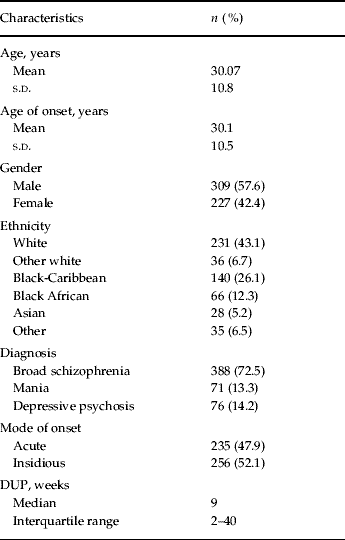
Demographic and clinical data for the sample are presented in Table 1. The mean age of the total sample was 30 (s.d.=10.8, range 18–65) years, and the mean age at onset of psychosis was 30 (s.d.=10.5) years. The proportion of males was 57%. Almost half of the sample (43%) was white British and most (72%) were diagnosed with broad schizophrenia, 14% with depressive psychosis and the remaining 13% with mania with psychotic symptoms. The median of the DUP was 9 (interquartile range 2–40) weeks.
Basic demographic and clinical characteristics of the AESOP sample
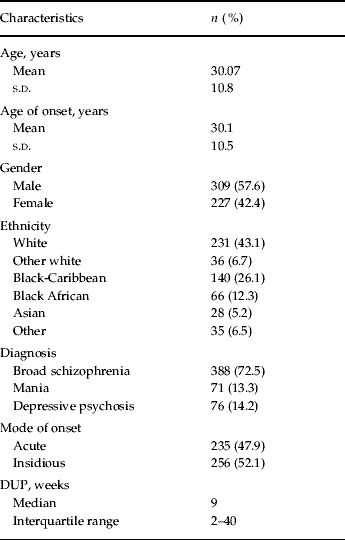
AESOP, Aetiology and Ethnicity in Schizophrenia and Other Psychoses; s.d., standard deviation; DUP, duration of untreated psychosis.
Psychopathological dimensions
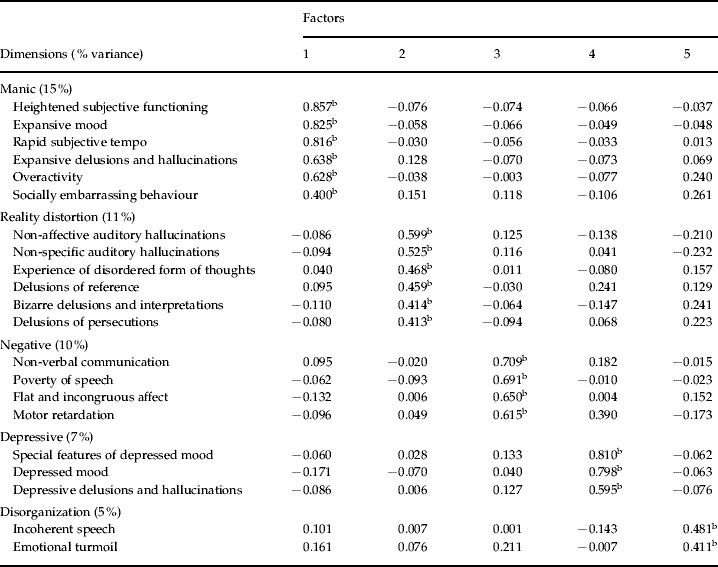
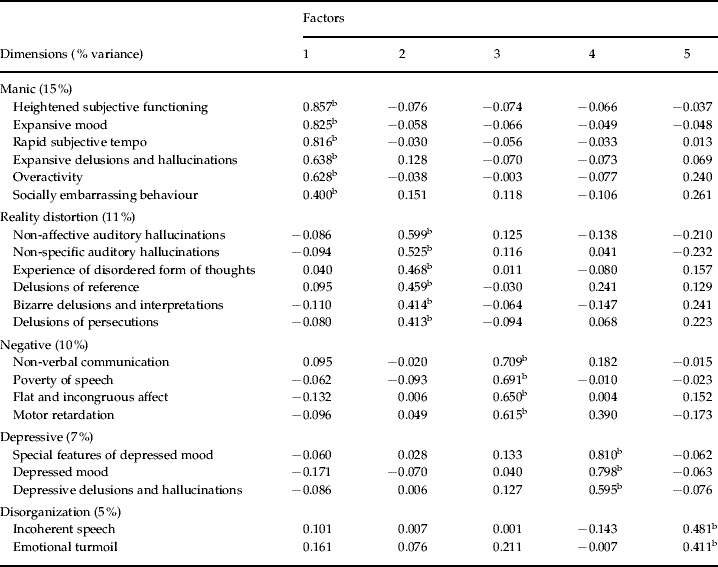
Principal factor analysis gave rise to a five-factor solution of manic, reality distortion, negative, depressive, and disorganization symptom dimensions, accounting for 47% of the total variance. Promax and Varimax rotations yielded very similar factor solutions. The Varimax solution is presented in Table 2.
Psychopathological dimensions in the AESOP studyFootnote a
AESOP, Aetiology and Ethnicity in Schizophrenia and Other Psychoses.
a The extraction method used was principal axis factoring. Unrotated factors were subjected to orthogonal rotation using the Varimax method.
b High factor loadings.
The first factor comprised six items related to mania: heightened subjective functioning; expansive mood; rapid subjective tempo; expansive delusions and hallucinations; overactivity; and socially embarrassing behaviour. The second factor was aligned with reality distortion symptoms: non-affective auditory hallucinations; non-specific auditory hallucinations; experience of disordered form of thoughts; delusions of reference; bizarre delusions and interpretations; and delusions of persecution. Non-verbal communication, poverty of speech, flat and incongruous affect and motor retardation loaded heavily on the third negative factor. The fourth factor comprised items related to depression and depressive psychosis: special features of depressed mood; depressed mood; and depressive delusions and hallucinations. The fifth factor, disorganization, was composed of incoherent speech and emotional turmoil. Incoherent speech is an IGC composed of items related to thought disorder, and similarly emotional turmoil encompasses different aspects of inappropriate affect. In most factorial studies inappropriate affect has emerged, along with formal thought disorder, on the disorganization dimension.
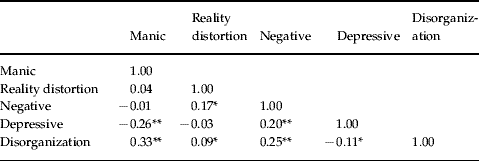
There were significant inter-factor correlations, presented in Table 3.
Interfactor correlations
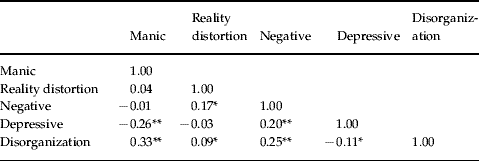
* p<0.05, ** p<0.01.
The most prevalent dimension was reality distortion, being present in 87.4% of patients. Manic symptoms were present in 49.6% of patients, closely followed by symptoms of disorganization, present in 47.3% of patients. Negative and depressive symptoms were present in 45.7% and 42.1% of patients, respectively. Present factors had a rating of 1 or greater.
Dimensions and diagnosis
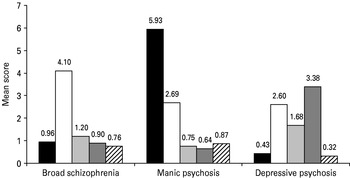
Fig. 1 shows the mean scores for each symptom dimension by diagnostic category and demonstrates that the symptom dimensions cut across, and are evident in, all diagnostic groups.
Symptom dimension scores (▪, manic; □, reality distortion;  , negative;
 , depressive;
 , disorganization) by diagnosis.

Associations with risk indicators and clinical variables
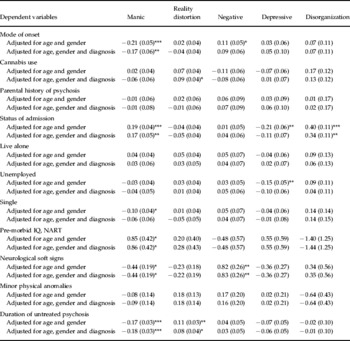
The manic factor was shown to have the highest number of significant associations with the risk indicators and clinical ratings, i.e. acute mode of onset, compulsory admission, higher pre-morbid IQ, fewer neurological soft signs and shorter DUP. After adjusting for diagnosis, these associations remained statistically significant but were generally weakened. Reality distortion, disorganization and negative factors were each significantly associated with one variable only: longer DUP, compulsory admission and neurological soft signs, respectively. Associations with the depressive factor fell short of statistical significance. None of the factor scores showed any significant association with age or gender. Regression analyses of the associations of dimensional scores and these variables before and after controlling for diagnosis are shown in Table 4.
Regression of clinical factors and risk indicators on five-factor scores

IQ, Intelligence quotient; NART, National Adult Reading Test.
Effect size is indicated by β coefficients (standard errors) for logistic or linear regression.
* p⩽0.05, ** p⩽0.01, *** p⩽0.001.
Variations in risk indicators and clinical ratings: the relative impact of factor scores and diagnostic categories
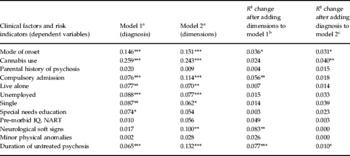
Independently, both factor scores and diagnostic categories were found to explain mode of onset, cannabis use, compulsory admission, solitary living, unemployment, single relationship status and DUP. Neurological soft signs were only explained by factor scores and, similarly, special educational needs were only explained by diagnosis (model 1 and model 2, Table 5). When the factor scores were added to the model 1 analysis (diagnosis) there was a significant increase in the amount of variability explained in mode of onset, compulsory admission, neurological soft signs and DUP (see Table 5, ‘R 2 change after adding dimensions to model 1’ column). When diagnostic category was added to the model 2 analysis (factors) there was also an increase in the amount of variability explained in mode of onset and DUP, but to a considerably lesser effect, and additionally in cannabis use, the effect not observed when diagnosis was considered first (see Table 5, ‘R 2 change after adding diagnosis to model 2’ column). With respect to the neurological soft signs, adding diagnostic category to the analysis of factor scores did not increase the amount of variability explained when compared with the effect of adding factor scores to diagnostic category. See Table 5 for the results of comparing regression models to assess the relative impact of factor scores and diagnostic category in the variation of risk indicators and clinical parameters.
Regression of clinical factors and risk indicators on diagnosis (model 1) and dimension scores (model 2) with effect size indicated by R 2 values

IQ, Intelligence quotient; NART, National Adult Reading Test.
a Controlling for age and gender.
b Difference in the amount of variability explained in the dependent variables when dimension scores are added to model 1 (R 2 change).
c Difference in the amount of variability explained in the dependent variables when diagnostic categories are added to model 2 (R 2 change).
Significance of R 2 values and R 2 differences
* p⩽0.05, ** p⩽0.01, *** p⩽0.001.
Discussion
This is the largest study to directly compare the relative utility of symptom dimensions versus categorical diagnoses in an epidemiologically representative cohort of patients with a first-episode psychosis. We identified a clearly delineated dimensional structure, which corroborates previous findings from both chronic and first-episode studies. Furthermore, we have demonstrated that the scores of these dimensions were differentially associated with specific clinical parameters and various risk indicators, which supports the validity of the dimensional approach. Finally, our results indicate that the dimensional and categorical approaches are complementary in representation of psychosis and could therefore be used synergistically in clinical and research settings.
Psychopathological dimensions
A five-factor solution, which explained 47% of the variance, gave rise to manic, reality distortion, negative, depressive, and disorganization dimensions. Our results are in line with those reported by previous studies (Van Os et al. Reference Van Os, Gilvarry, Bale, Van Horn, Tattan, White and Murray1999; Wickham et al. Reference Wickham, Walsh, Asherson, Taylor, Sigmundson, Gill, Owen, McGuffin, Murray and Sham2001; Liddle et al. Reference Liddle, Ngan, Duffield, Kho and Warren2002; Dikeos et al. Reference Dikeos, Wickham, McDonald, Walshe, Sigmundsson, Bramon, Grech, Toulopoulou, Murray and Sham2006). The first four dimensions identified in our study closely resemble those consistently reported in many previous studies (Kitamura et al. Reference Kitamura, Okazaki, Fujinawa, Takayanagi and Kasahara1995; McGorry et al. Reference McGorry, Bell, Dudgeon and Jackson1998; Van Os et al. Reference Van Os, Gilvarry, Bale, Van Horn, Tattan, White and Murray1999), albeit with some differences in factor constitutions, inherent to the different rating scales and methodology used.
The emergence of a distinct dimension of disorganization in our sample of first-onset psychosis is interesting. The disorganization dimension, although evident in three-syndromic models (Liddle, Reference Liddle1987; Liddle & Barnes, Reference Liddle and Barnes1990; Peralta et al. Reference Peralta, De Leon and Cuesta1992; Malla et al. Reference Malla, Norman, Williamson, Cortese and Diaz1993; Silver et al. Reference Silver, David, Kaplan, Hadjez, Tubi, Darnel, Calev and Lerer1993), has been considerably less replicated or stable, particularly in studies considering a wider range of symptoms, and even less so in first-episode psychosis studies. One first-episode study (Allardyce et al. Reference Allardyce, McCreadie, Morrison and Van Os2007) identified this dimension, but as disorganization symptoms loaded together with bizarre delusions and behaviour. McGorry et al. (Reference McGorry, Bell, Dudgeon and Jackson1998) identified four factors using a comprehensive psychopathological instrument on a large first-onset psychosis sample, with a somewhat reduced representativeness due to age constraints. They used a scree test to determine the number of factors and hence identified a relatively small number of factors in spite of employing a large pool of 85 items; they did not identify a disorganization dimension, but instead found an association of negative and disorganization symptoms. They concluded that in first-episode psychosis disorganization is not yet established and therefore it is not clinically distinct or specific at this stage of psychosis, but becomes more prominent with time. Similarly, McGlashan & Fenton (Reference McGlashan and Fenton1993) suggested that symptoms of disorganization tend to evolve and accumulate over time. Although disorganization is clearly delineated in the present study, it explains only 5% of the variance; perhaps, ours being a first-onset psychosis sample, the early stage of the illness could explain this small variance.
Associations of symptom dimensions with risk indicators and clinical variables
All dimension factors in our study, except for the depressive dimension, were significantly associated with at least one or more different variables.
The manic dimension was observed to be significantly associated with most of the variables when diagnosis was controlled for: acute mode of onset; compulsory admission; higher pre-morbid IQ; less neurological soft signs; and shorter DUP. These findings are in general agreement with previous publications (McIntosh et al. Reference McIntosh, Forrester, Lawrie, Byrne, Harper, Kestelman, Best, Miller, Johnstone and Owens2001; Wickham et al. Reference Wickham, Walsh, Asherson, Taylor, Sigmundson, Gill, Owen, McGuffin, Murray and Sham2001; Guerra et al. Reference Guerra, Fearon, Sham, Jones, Lewis, Mata and Murray2002).
In line with findings reported by Larsen et al. (Reference Larsen, Moe, Vibe-Hansen and Johannessen2000) we observed an association between reality distortion and a longer DUP. Another significant association to emerge in our study was the one between an excess of neurological soft signs and negative symptoms, which is largely consistent with previous literature (Wong et al. Reference Wong, Voruganti, Heslegrave and Awad1997; Arango et al. Reference Arango, Kirkpatrick and Buchanan2000; Boks et al. Reference Boks, Liddle, Burgerhof, Knegtering and Van den Bosch2004). Such an association further supports the neurodevelopmental theory of schizophrenia (Murray & Lewis, Reference Murray and Lewis1987), indicating that negative symptoms may be a phenomenological expression of a neurodevelopmental vulnerability involving structural brain abnormality (Sanfilipo et al. Reference Sanfilipo, Lafargue, Rusinek, Arena, Loneragan, Lautin, Feiner, Rotrosen and Wolkin2000; Dazzan et al. Reference Dazzan, Morgan, Chitnis, Suckling, Morgan, Fearon, McGuire, Jones, Leff and Murray2006).
In contrast with our findings, most studies have reported associations between negative symptoms and at least one other variable suggesting insidious onset (Fenton & McGlashan, Reference Fenton and McGlashan1991; Rotakonda et al. Reference Rotakonda, Gorman, Yale and Amador1998; Dikeos et al. Reference Dikeos, Wickham, McDonald, Walshe, Sigmundsson, Bramon, Grech, Toulopoulou, Murray and Sham2006), association with minor physical anomalies (O'Callaghan et al. Reference O'Callaghan, Buckley, Madigan, Redmond, Stack, Kinsella, Larkin, Ennis and Waddington1995), longer DUP (Larsen et al. Reference Larsen, Moe, Vibe-Hansen and Johannessen2000; Edwards et al. Reference Edwards, McGorry, Wadell and Harrigan1999; Malla et al. Reference Malla, Norman, Manchanda, Ahmed, Scholten, Harricharan, Cortese and Takhar2002) or poor cognitive functioning (Brown & White, Reference Brown and White1992; Norman et al. Reference Norman, Malla, Morrison-Stewart, Helmes, Williamson, Thomas and Cortese1997). One interpretation could be that these studies have explored associations in chronic samples. Negative symptoms in first-onset psychosis tend to be unstable (Edwards et al. Reference Edwards, McGorry, Wadell and Harrigan1999) and their status in early-stage psychosis is unclear (Malla & Payne, Reference Malla and Payne2005). In concordance with our findings, Harris et al. (Reference Harris, Henry, Harrigan, Purcell, Schwartz, Farrelly, Prosser, Jackson and McGorry2005), in their first-episode sample of 318 patients, demonstrated that the negative dimension was not significantly related to DUP, reflecting the instability of negative symptomatology in first episode. In the study by Malla et al. (Reference Malla, Norman, Manchanda, Ahmed, Scholten, Harricharan, Cortese and Takhar2002) conducted on 110 first-episode psychosis patients it was demonstrated that DUP was related to avolition and anhedonia and not flat affect or alogia. This could partly explain our findings, since our negative dimension consists of poverty of speech (alogia) and flat affect but not items such as avolition or anhedonia.
The observed associations between depressive symptoms and informal admission status and lower rates of unemployment did not remain significant after adjustment for diagnosis. In agreement with our findings, no associations of the depressive dimension with other parameters were observed in previous publications. (Guerra et al. Reference Guerra, Fearon, Sham, Jones, Lewis, Mata and Murray2002; Dikeos et al. Reference Dikeos, Wickham, McDonald, Walshe, Sigmundsson, Bramon, Grech, Toulopoulou, Murray and Sham2006). Finally, the disorganization dimension was associated only with compulsory admission.
Dimensional versus categorical contribution in explaining risk indicators and clinical characteristics
We found that both traditional diagnostic categories and dimensions independently explained a number of clinical characteristics and risk indicators. However, when dimensions were added to diagnosis a significant increase in the amount of variability explained in mode of onset, neurological soft signs, DUP and compulsory admission was observed, indicating that dimensions provide additional information to that contained in diagnostic categories, particularly with regards to clinical parameters. To an extent this supports previous findings that have assumed superiority of dimensions in explaining clinical characteristics (Van Os et al. Reference Van Os, Fahy, Jones, Harvey, Sham, Lewis, Bebbington, Toone, Williams and Murray1996; Rosenman et al. Reference Rosenman, Korten, Medway and Evans2003). On the other hand, when diagnostic categories were added to dimensions in our sample, they also increased the amount of variability explained in two of these variables, specifically DUP and mode of onset, but the degree of their explanatory power was lower than that observed when dimensions were added to diagnoses with respect to these two variables. Overall, dimensions still provide more information, albeit by a very small difference in explanatory power, which parallels findings by Dikeos et al. (Reference Dikeos, Wickham, McDonald, Walshe, Sigmundsson, Bramon, Grech, Toulopoulou, Murray and Sham2006). Similarly, Allardyce et al. (Reference Allardyce, McCreadie, Morrison and Van Os2007) concluded that combining these two approaches would best discriminate between the causes and correlates of schizophrenia, although in contrast with our findings they observed that neither is sufficient on its own to explain most of the risk factors. Such findings suggest that the simultaneous use of both models could be most clinically informative. Since dimensions provide additional quantitative measures, their use in clinical practice would facilitate appropriate intervention at a more appropriate time (Jablensky & Kendell, Reference Jablensky, Kendell, Maj, Gaebel, López-Ibor and Sartorius2002). It has been proposed that dimensional measures can be derived from rating scales such as the Positive and Negative Syndrome Scale (PANSS; Kay et al. Reference Kay, Fiszbein and Opler1987) (Allardyce et al. Reference Allardyce, McCreadie, Morrison and Van Os2007). Their integration in current diagnostic constructs would facilitate their use in clinical settings.
Methodological considerations
Our study has a number of limitations. In comparison with chronic studies, the amount of variance explained by the five-factor solution in our study is rather low. The amount of variance is dependent on the number of items entered into the analysis and is therefore dependent on the instrument used. A wider range of symptoms and signs, restricted ratings and possible symptomatic instability of a first-episode sample may all have reduced the amount of variance explained. We excluded symptoms of anxiety from our analysis, which have been shown to segregate with depressive symptoms on the same factor (Emsley et al. Reference Emsley, Oosthuizen, Joubert, Roberts and Stein1999), but we have been guided by studies that similarly did not include anxiety symptoms. One other potential limitation of our study is that our subjects were not medication naive. Medication through treatment response or side effects may influence symptomatology and thus the dimensional structure. Further, we have included a large number of risk indicators, but, further validation with neurobiological correlates are clearly needed, Finally, we examined dimensions in a cross-sectional sample, which does not account for dimensional stability over time. Drake et al. (Reference Drake, Dunn, Tarrier, Haddock, Haley and Lewis2003) followed up 257 first-admission patients and found differences in factor structure at 3 and 18 months, which contrasts with suggestions by Cuesta et al. (Reference Cuesta, Peralta, Gil and Artamendi2003) that there is relative stability in dimensional structure across time.
Nonetheless, our study has a number of strengths. It is the largest first-episode psychosis study conducted in the UK, incorporating an epidemiologically representative sample in deprived inner-city areas with large ethnic minority populations and high incidences of psychosis. Large numbers of subjects provide a very good subject:item ratio, essential for factor analytical studies. We used operational consensus diagnosis and a wide variety of psychotic symptoms and signs including affective symptoms and thus yielded precise, well-defined dimensions.
Furthermore, to the best of our knowledge, this is the first study to explore and compare dimensional and categorical representations of psychosis in explaining various illness domains in a homogeneous first-onset psychosis sample.
Guided by Van der Gaag et al. (Reference Van der Gaag, Cuijpers, Hoffman, Remijsen, Hijman, de Haan, van Meijel, van Harten, Valmaggia, de Hert and Wiersma2006a, Reference Van der Gaag, Hoffman, Remijsen, Hijman, de Haan, van Meijel, van Harten, Valmaggia, de Hert, Cuijpers and Wiersmab) who tested the goodness of fit of previously published five-factor models of the PANSS, we will explore the possibility of using CFA in our next paper in the attempt to confirm our current pentagonal dimensional model derived from EFA, and examine whether it remains valid with a new larger dataset.
Conclusion
The purpose of diagnosis in psychiatry, as in any other specialty, is to encapsulate clinical information in a concise and precise way, shed more light on the underlying aetiology and pathophysiology, and form the basis for treatment guidance. Although current diagnostic constructs have been much criticized, our study shows that in fact they contain important information, which is enriched and further enhanced by the use of dimensions. We therefore suggest that the concomitant use of both approaches may best conceptualize the richness of psychopathology and provide the most useful description of psychotic patients.
Acknowledgements
We acknowledge the contributions of the entire AESOP study team (listed online at http://www.psychiatry.cam.ac.uk/aesop). This study was funded by the UK Medical Research Council. We also wish to thank the Stanley Medical Research Institute for their support. P.D's research is supported by the American Psychiatric Institute for Research and Education, NARSAD and the Bial Foundation. The study is part of The Biomedical Research Centre for Mental Health at the Institute of Psychiatry, King's College London and The South London and Maudsley NHS Foundation Trust.
Declaration of Interest
None.