Introduction
Events in the last few years, like The Fukushima incident in Japan in 2011, terrorist attacks, and the Ebola outbreak, have raised awareness about the need for disaster preparedness. Classical emergency preparedness planning and training tends to focus on adult victims. Children, however, make up at least 20% of society, and in any disaster, potential victims include children, at least in proportion to their number in the population.Reference Mortelmans, Maebe, Dieltiens, Anseeuw, Sabbe and Van de Voorde 1 - Reference Gausche-Hill 3 Moreover, in some recent examples of terrorist attacks, children were not only secondary victims but also primary targets.Reference Mace, Doyle and Fuchs 4 , Reference Stamell, Foltin and Nadler 5
This pediatric population needs special attention. Age-related cognitive and physical limitations may hamper appropriate reactions to hazardous situations. Furthermore, anatomic and physiologic characteristics make children more susceptible to harmful effects of environmental, biological/chemical, and nuclear/radiological exposure.Reference Chokshi, Behar and Nager 6 - Reference Burke, Iverson and Goodhue 8 The psychosocial impact of a disaster, both in the acute phase as well as on a longer term, demand particular attention and specialized counseling.Reference Markenson and Reynolds 9 - Reference Brandenburg and Arneson 11
Given this, the goal of this study was to evaluate the perceived disaster medical-related knowledge and self-estimated capability of tertiary pediatricians to deal with children during disaster, and the perceived need of education on this matter. Furthermore, the willingness to perform in potential high-risk situations was measured.
Materials and Methods
To evaluate pediatric preparedness, an online survey based on a cross-sectional descriptive study was performed. The population was limited to pediatricians or pediatric emergency physicians from tertiary care centers recruited amongst members and worldwide contacts of the European Society of Emergency Medicine pediatric section (EUSEM-PEM) and/or selected participants to the first Pediatric Resuscitation and Emergency Medicine Congress (PREM 2013; Ghent, Belgium);Reference Mace, Sharieff and Bern 12 all of them were key role players in specialized pediatric emergency care all over the world. Those not active (full or part time) in emergency care were excluded.
An online survey (Survey Monkey; Palo Alto, California USA) was sent to the network with an email reminder to non-responders. Validated structural questionnaires covering this subject aren’t readily available; therefore, a questionnaire based upon available literature, previous studies, and work in recent pilot projectsReference Van de Voorde and Graham 13 - Reference Mortelmans, Van Boxstael and De Cauwer 26 was used. The questionnaire was validated by several disaster management specialists.
This survey evaluated demographic data, data on perceived risk for and knowledge of disasters, and capability to act in different disaster situations. Furthermore, willingness to respond in certain situations and eventual factors convincing to respond were evaluated. Questions were multiple choice and scores were measured on a 0 to 10 visual analogue scale. Data were collected and processed in an anonymous way. Local ethical committee approval was obtained from ZiekenhuisNetwerk Antwerpen (Antwerp, Belgium). Data were evaluated statistically by the use of Stata SE 10.1 (StataCorp LP; College Station, Texas USA). The Pearson chi square test was used for comparison of proportions/percentages and the two-sample (two-sided) t-test for comparing means. For comparing medians, the Wilcoxon-Mann-Whitney test was used; for comparing normal numerical with normal numerical variables, the Pearson correlation coefficient was used and the Spearman correlation coefficient as the non-parametric version of this for not normal numerical variables. To provide an estimation on the margin of error for results, 95% confidence intervals (CI) are given. A P value smaller than.05 was considered to be significant.
Results
One hundred eighteen fully completed surveys were available for evaluation, being a response rate of 51%; 87% were from Europe, seven percent from Oceania, four percent from Asia, and two percent from America. Mean age of respondents was 43.9 years; 56% were male. Of these, 86% worked in a university hospital and 19% were active in prehospital care. Up to 46% worked in an exclusive pediatric hospital; 40% worked in a (minus) 350 beds hospital and 21% worked in a hospital of over 1,000 beds. Only 35% ever had some disaster management training, while 53% stated that basic disaster management training should be obligatory included in training of all pediatric residents. Only one percent evaluated such training as useless.
Hospital Disaster Planning
Importantly, 95% of the respondents reported that their hospitals would receive pediatric patients of incidents in the larger region (direct catchment area and referral zones), but only 44% of these hospitals had any specific emphasis on children in their hospital disaster plan. Only one-half of them had arrangements for family reunion, and the same amount offered child specific post-traumatic psychological relief.
Of all hospitals, 29% had a known risk for natural disasters in the catchment area, 25% had a chemical high-risk plant (Seveso-type) in their neighborhood, and 15% had a nuclear installation in the vicinity. Up to 64% of the hospitals could mobilize specialized pediatric personnel in case of a disaster. Extra pediatric beds were available in 58% of hospitals, extra pediatric intensive care (IC) beds in 54%, and specific pediatric IC supplies (eg, ventilators) in 46%. Facilities for medical isolation of pediatric patients were available in 75% of the hospitals and 43% had decontamination facilities. There was a 24/7 availability of advice from an infectious disease specialist in 69% of hospitals, a nuclear medicine specialist in 33% of the hospitals, and disaster medicine specialists in 34% of hospitals.
Personal Preparedness
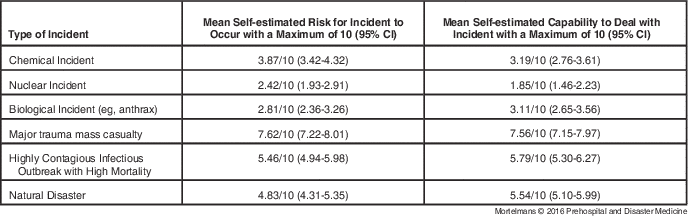
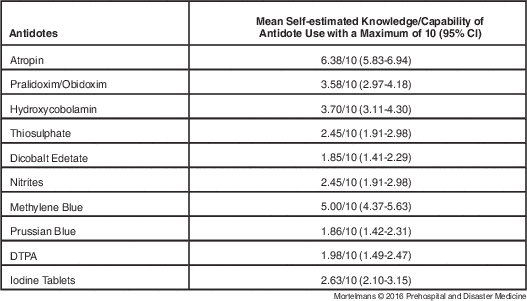
The mean scores on self-estimated risk for occurrence, and self-estimated capability to deal with several hypothetic incidents, are presented in Table 1. From all participants, 14% stated they had been confronted with a chemical incident and three percent had ever dealt with a nuclear incident. Only 25% stated they knew how to use radio-detection material. Further, only 32% had practical training in decontamination. The mean estimated knowledge on decontamination of all respondents was scored at 2.39/10. In addition, only 25% had had some practical training in use of personal protective equipment (PPE), and the mean score on estimated knowledge of PPE use in all participants was 1.8/10. The self-estimated capability on the use of several antidotes is presented in Table 2.
Mean Scores on a Maximum of 10 and 95% Confidence Interval for Self-estimated Risk that Different Disaster Scenarios could Occur and Self-estimated Capability to Deal with these Scenarios

Mean Scores on a Maximum of 10 and 95% Confidence Interval on the Self-estimated Knowledge and Capability on the use of Several Antidotes

Abbreviation: DTPA: diethylenetriaminepentaacetic acid.
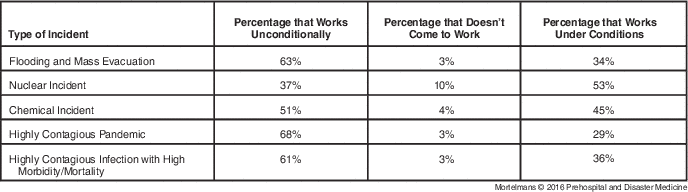
Finally, Table 3 shows the willingness to work in several hypothetical disaster scenarios. The unconditional response to work varied from 37% in nuclear incidents to 68% in highly contagious pandemics like swine flu. Conditions that convinced pediatricians to go to work were mainly sufficient personal protection (up to 92%), guaranteed security of own family (up to 83%), and specific training (up to 70%).
Figures on the Willingness to Respond to Work in Several Hypothetical Disaster Situations

Content Assessment
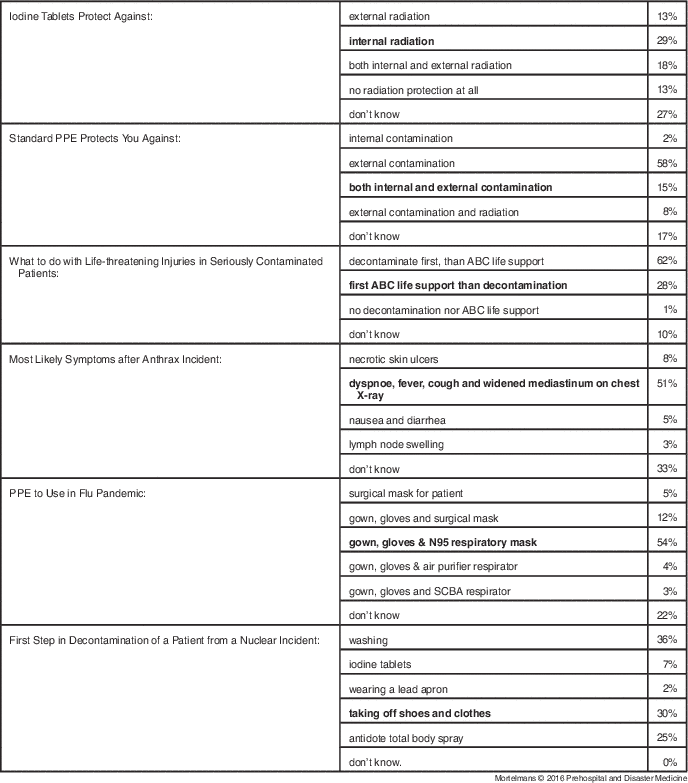
The mean score on the set of six theoretical questions was 2.06/6 (minimum of zero, maximum of five) with the best score on the PPE use in a contagious pandemic. Knowledge on protective capacity of PPEs in general, however, had the weakest score. All answers are provided in Table 4.
Distribution of Different Answers on the Six Content Assessment Questions. Correct answers are given in bold.

Abbreviations: ABC, airway, breathing, circulation; SCBA, self-contained breathing apparatus.
Male sex; prior disaster management training; knowledge of antidote, PPE, and decontamination use; risk estimation; self-estimated capability; and prior exposure were significant (P<.05) positive predictors for higher scores on the theoretical questions. Willingness to work correlated significantly with age, self-estimated capability, and risk estimation. In the case of chemical and nuclear incidents, willingness to work correlated with knowledge about the use of decontamination, PPE, and radio-detection devices.
Discussion
Literature on this subject is scarce, especially in the pediatric field. Preparedness studies are very fragmented, studying limited populations in very specific situations, and mainly highlighting the absence of pediatric disaster preparedness.Reference Stamell, Foltin and Nadler 5 , Reference Mortelmans, Bakker and Jacobs 27 - Reference Ferrer, Balasuriya and Iverson 29 Surge capacity in pediatric hospitals mainly is discussed in a theoretical way and mainly focused on IC settings.Reference Koenig 19 , Reference Thompson, Lyle and Mullins 30 , Reference Scarphone, Coffin and Fieldston 31 Data on factors promoting willingness to work are more widely available, but always in a context of pandemic situations.Reference Mortelmans, Van Boxstael and De Cauwer 26 , Reference Campbell 32 , Reference Devnani 33 Once again, an evaluation of pediatricians/pediatric emergency medicine physicians as a separate group is not available.
Although every pediatrician can be confronted with pediatric disaster victims, most often this study population, working in referral centers, will be solicited in case of such a disaster. People and hospitals tend to plan for those risks that already happened and are far less aware of the likelihood of future events to come. Less than one out of two hospitals has specific emphasis on children, being their target population, in their hospital disaster plan. Specific needs in pediatric populations as family reunion and post-traumatic stress relief are dealt with in only 50% of hospitals, and only one out of three hospitals can rely on a disaster medicine specialist. The limited availability of decontamination facilities and nuclear specialists probably correlates with a limited risk perception as chemical and nuclear plants are not as common in the catchment area. However, incidents can occur everywhere, be it from traffic/transportation accidents or from malicious attacks. Data on surge capacity are somewhat better but might still prove insufficient in large parts of Europe when there would really be a mass-casualty incident. Severe Acute Respiratory Syndrome and flu pandemic threats made people aware of the risks of a high inflow of patients, and children are extremely vulnerable in these circumstances. These findings are in the line with data from studies in general hospitals, but one might expect that tertiary care centers, being centers for pediatric referral, are equipped sufficiently to cope with a disaster in their region that involves children.Reference Summerhill, Mathew and Stipho 25 , Reference Ferrer, Balasuriya and Iverson 29 , Reference Draper, Wilson and Ives 34
Focusing on the personal preparedness of this study population, data are daunting. Although one-half of the respondents feel that some disaster training should be obligatory in their training, only one out of three has had some education on this topic. Comparing this with Belgian and Dutch emergency physicians, were the ratio is one out of two,Reference Mortelmans, Van Boxstael and De Cauwer 26 this is even less. This discrepancy between perceived needs and effective training supports the necessity of a curriculum adaptation.
The study population felt slightly more confident in cases of trauma or infectious diseases as these are most closely linked with their normal practice, but they clearly were uncomfortable in other incidents.
The set of content assessment questions confirmed this. The only question with a reasonable score is on personal protection in influenza pandemic, a situation highlighted in the last years. When it comes to decontamination, real PPE use and use of iodine tablets scores are clearly low. More than one out of five tertiary care pediatricians/pediatric emergency physicians believes that iodine tablets protect against external radiation. The good correlation between prior training and exposure, risk estimation, knowledge, self-estimated capability, and higher scores on the test supports the validity of the survey.
Antidote use follows the same trend. Only atropine, which is commonly used in daily practice, scores well in the evaluation. Specific chemical, biological, radio nuclear antidotes commonly are unknown with a surprisingly low score for iodine tablets.
Despite the limited preparedness, there is a high willingness to work in the population, even in nuclear incidents and infections with a high mortality rate. Sufficient personal protection is rated the most important condition “sine qua non,” although the knowledge to use it is extremely limited. Specific training indeed is stated to be the second most important promoting factor to convince respondents to go to work but, in the majority of the population, training is lacking. Safety and training are important factors to respond to work in other studies, but most of them are limited to influenza pandemics. One study evaluated willingness to work in physicians of a large metropolitan hospital group for similar disaster situations as in this groupReference De Cauwer, Mortelmans and d’Orio 35 and found this to be lower than in the study population for all situations. Effective protective equipment, good and timely information, and possibility to contact family were the main factors to convince these colleagues to respond.
Limitations
The limited number of respondents, as well as the use of a self-response survey, are limitations of this study. However, the good correlation with the results of the theoretical question set supports these data. One could have the impression that the survey is a European evaluation as the majority of the contacts are from Europe; however, international faculty from other continents was included on purpose to have some comparison in view of fundamental differences. There were no significant differences between the continents. Although the total numbers of participants is low, key role players in pediatric emergency medicine from all over the world were included, so the sample is relevant. Tertiary care specialists are not representative for the average pediatrician, but most likely are involved in any disaster that involves children – thus, probably every disaster in their region.
Conclusion
Despite a clear perception of the risks, disaster preparedness is limited in the study population. Training is an important factor, as is acknowledged by the participants. The basics of disaster management should be a mandatory part of pediatric training.