Prosthetic joint infections (PJIs) are uncommon but devastating complications that significantly increase morbidity, mortality, and cost following total hip (THA) or total knee (TKA) arthroplasty.Reference Kurtz, Lau, Schmier, Ong, Zhao and Parvizi 1 – Reference Rodríguez, Pigrau and Euba 4 A PJI may result from hematogenous spread of organisms from distant sources, including urinary tract infection (UTI).Reference Maderazo, Judson and Pasternak 2 , Reference Bengtson, Blomgren, Knutson, Wigren and Lidgren 5 – Reference Kaandorp, Dinant, van de Laar, Moens, Prins and Dijkmans 7 Furthermore, catheter-associated UTIs account for 40% of healthcare-associated infections (HAIs).Reference Hooton, Bradley and Cardenas 8 , 9 Therefore, orthopedic surgeons often attempt to identify and treat UTIs in patients undergoing THA and TKA to minimize the theoretical risks of PJIs and their complications.
Urine cultures remain the gold standard test for identifying UTIs in symptomatic patients. However, many clinicians use urinalysis (UA), including urine dipstick and urine microscopy, as a screening test, and they often misinterpret a positive UA as indicating that the patient has a UTI. Unfortunately, positive predictive values for urine nitrite levels, leukocyte esterase levels, and white blood cell (WBC) counts are low in surgical patients and in older patients, and they should not be used as diagnostic tests for UTI.Reference De Rosa, Grosso and Bruschetta 10 , Reference Devillé, Yzermans, van Duijn, Bezemer, van der Windt and Bouter 11 Furthermore, clinicians who use these tests to screen asymptomatic patients for UTI are likely to prescribe antimicrobial agents for many patients who do not have a UTI, which may predispose patients to acquire resistant organisms or Clostridium difficile infection (CDI).Reference Pépin, Saheb and Coulombe 12
Each patient undergoing THA or TKA at the University of Iowa Hospitals and Clinics typically has a preoperative clinical visit in a surgical co-management clinic 1–2 months before the operation as well as a work-up in the orthopedic clinic on the same day or 2–3 weeks before the operation. Clinicians in the surgical co-management clinic assess risk factors for medical complications of operations and optimize patient comorbidities. Subsequently, orthopedic nurses, physical therapists, and advanced-practice providers ensure that medical therapy is optimized, and they review the final preoperative instructions. During a preoperative clinical visit, clinicians obtain UAs from patients to screen for UTI and asymptomatic bacteriuria. During the postoperative period (usually postoperative day 1), each patient is screened for UTI after the urinary catheter, which is inserted immediately before the operation, is removed. Clinicians rarely obtain urine cultures to confirm screening test results in either the pre- or postoperative period.
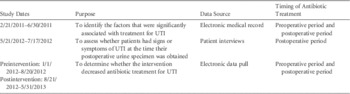
We conducted a retrospective cohort study to identify factors significantly associated with receiving antimicrobials for UTI in the preoperative and postoperative periods (Table 1). We conducted a prospective cohort study to validate the findings of the retrospective cohort study for the postoperative period and to assess the association of signs or symptoms of UTI with antimicrobial treatment. Based on these data, the surgeons changed pre- and postoperative screening and treatment practices to prevent unnecessary antibiotic treatment for patients without UTI. We conducted a follow-up before-and-after study to assess whether antimicrobial treatment for UTI decreased after the new practices were introduced and to determine whether rates of PJI and other surgical site infections (SSIs) increased after the evidence-based screening and treatment protocol was implemented.
Study Descriptions

NOTE. UTI, urinary tract infection.
The Institutional Review Board at our institutions approved these 3 studies.
PATIENTS AND METHODS
Retrospective Cohort Study
We identified all patients undergoing primary or revision THA or TKA between February 21, 2011, and June 30, 2011. We excluded patients who did not have preoperative clinical visits (eg, patients who underwent emergency procedures) because we could not assess factors associated with receiving preoperative antimicrobial prescriptions. We also excluded patients <18 years old and patients who required straight catheterization to relieve postoperative urinary retention. If a patient had multiple procedures during the study period, we included only the earliest procedure. In this retrospective cohort study, we identified and included 100 consecutive patients that had THAs and 100 consecutive patients that had TKAs and met our inclusion criteria.
We abstracted the following data from patient medical records: demographic information (ie, age, sex, race, weight, body mass index [BMI]); symptoms of UTI (eg, dysuria, frequency, or urgency); results of urine dipstick, microscopy, and culture; preoperative antimicrobial prescriptions (agent and reason for use); reason for the procedure; length of stay; postoperative antimicrobials (agent, duration, and reason for use); attending surgeon; and vital signs. We entered these data into Microsoft Excel (Microsoft, Redmond, WA) and validated the data entry.
Prospective Cohort Study
We concurrently acquired the names of all patients undergoing THA or TKA between May 21, 2012, and July 17, 2012, from the operating room schedule. We excluded patients from whom the interviewer could not obtain consent, patients <18 years old, and patients who required straight catheterization to relieve postoperative urinary retention. Less than 24 hours after the patient’s urinary catheter was removed, we asked each patient about symptoms and signs of UTI: dysuria, frequency, urgency, flank pain, hematuria, and fever. We recorded each patient’s answers as “yes,” “no,” or “I don’t know.” We collected and managed these data as described for the retrospective cohort study.
Follow-up Before-and-After Study
Based on the results from the retrospective and prospective cohort studies, we introduced a new screening and treatment protocol on August 21, 2012. The protocol stipulated the following: (1) Patients with positive urine leukocyte esterase and nitrite tests on urine dipstick or symptomatic patients with either positive urine leukocyte esterase or nitrite should have urine cultures, and (2) only patients whose urine cultures grew >100,000 colony-forming units of a single organism should be treated for UTI. The protocol, which was to be used during preoperative clinic visits and the immediate postoperative period, was implemented by educating the staff. To assess the effect of this change, we acquired a list of patients who were admitted to the hospital for THA or TKA during the preintervention period (January 1, 2012, through August 20, 2012) and the intervention period (August 21, 2012, through May 31, 2013). We acquired the following data: demographic information (age, gender, race, ethnicity, procedure), antimicrobials prescribed at preoperative visits, antimicrobials administered for UTI, the antimicrobial agent, and the number of doses administered. The infection preventionist who conducted SSI surveillance provided the number of patients who acquired SSI during the study periods.
Signs, Symptoms, and Laboratory Test Results Consistent with Urinary Tract Infection and Treatment of Urinary Tract Infection
We determined whether patients had signs, symptoms, or laboratory values that could be consistent with UTI: (1) a UA with positive leukocyte esterase, positive nitrite, or WBC count>5 per high power field (/hpf) and (2) ≥2 of the following signs of systemic inflammatory response: temperature<36°C or >38°C; heart rate>90 beats per minute; respiratory rate>20 per minute; peripheral WBC count <4,000 or >12,000 leukocytes/mL; or >10% immature forms. We defined antimicrobials prescribed for UTI as those for which orders indicated that UTI was the reason for treatment or for which a clinician’s note stated the patient was treated for UTI.
Statistical Analyses
We calculated frequencies, means, and medians to describe the distributions of the variables. We used χ2 and Fisher’s exact tests to assess differences in categorical variables and the Student t test and Wilcoxon rank-sum test to assess differences in continuous parametric and non-parametric variables, respectively. We assessed the normality of variables using the Shapiro-Wilk test. For variables with P<.15, we applied backward selection logistic regression to assess whether variables met criteria for statistical significance, and we applied the Wald test to assess the statistical significance of the model. We computed the C statistic to assess the ability of the final multivariable models to discriminate between patients treated for UTI and those who were not treated. We used the Hosmer-Lemeshow goodness-of-fit test to assess the adequacy of the model fit. We conducted all statistical analyses using SAS software, version 9.3 (SAS Institute, Cary, NC).
RESULTS
Retrospective Cohort
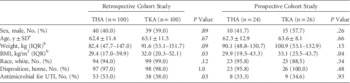
During the study period, surgeons performed 117 THAs and 111 TKAs. We identified 4 patients who had >1 THA and 7 patients who had >1 TKA; these patients were included only once. We excluded 2 patients (1 THA patient and 1 TKA patient) because they were <18 years old, and we excluded 15 patients (12 THA patients and 3 TKA patients) because they had not had preoperative clinic visits. Finally, 200 consecutive patients (100 THA patients and 100 TKA patients) were included in the retrospective cohort study. Overall, patients underwent primary THAs (36%), THA revisions (14%), primary TKAs (47%), or TKA revisions (3%). The mean age was 62.8 years, and 39.5% were male. Patients who underwent THAs and those who underwent TKAs had similar characteristics (Table 2).
Retrospective and Prospective Cohort Studies: Patient Characteristics

NOTE. BMI, body mass index; THA, total hip arthroplasty; TKA, total knee arthroplasty; SD, standard deviation; IQR, interquartile range; UTI, urinary tract infection.
a Values expressed as mean±standard deviation, t-test.
b Values expressed as median, with range in parentheses, Wilcoxon Rank Sum test.
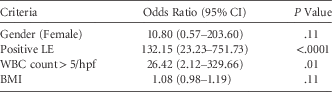
During the preoperative period, 190 patients (95%) had urine dipstick tests; 182 (91%) had urine microscopy; and 1 (0.5%) had a urine culture. In addition, 37 patients (18.5%) received antimicrobials for UTI. In a multivariable model, positive leukocyte esterase and urine WBC count>5/hpf were significantly associated with preoperative antimicrobial treatment for UTI (Table 3).
Retrospective Cohort Study: Results of the Multivariable Analysis of Factors Associated With Preoperative Antimicrobial Treatment for Urinary Tract Infectiona

NOTE. LE, leukocyte esterase; WBC, white blood cell; BMI, body mass index; hpf, high power field.
aC statistic=0.97, indicating that the model has good predictive ability; Hosmer and Lemeshow Goodness-of-fit Test, P=.77, indicating that the model fits the data.
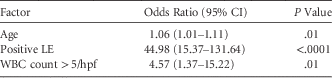
During the postoperative period, 198 patients (99%) had urine dipstick tests; 196 (98%) had urine microscopy; and 5 (2.5%) had urine cultures after their urinary catheters were removed. In addition, 72 (36%) patients received postoperative antimicrobial treatment for UTI. Attending physician, patient gender, weight, and length of stay were not associated with postoperative antimicrobial treatment for UTI. Positive leukocyte esterase, urine WBC count>5/hpf, and older age were associated with postoperative antimicrobial treatment for UTI (Table 4). Positive leukocyte esterase tests were associated with older patient age (P=.03) and having a THA (P=.02). Of the 72 patients treated for UTI, 29 (40.3%) had some signs and laboratory values that were consistent with UTI.
Retrospective Cohort Study: Results of the Multivariable Analysis of Factors Associated with Postoperative Antimicrobial Treatment for Urinary Tract InfectionFootnote a

NOTE. LE, leukocyte esterase; WBC, white blood cell; hpf, high power field.
a C statistic=0.95, indicating that the model has good predictive ability; Hosmer and Lemeshow Goodness-of-fit Test P=.90, indicating that the model fits the data.
Prospective Cohort: Postoperative Data
We interviewed 50 of 83 patients that had THA or TKA during the prospective cohort study period. We did not interview 33 patients: 3 declined enrollment; 3 did not speak English; 2 had altered mental status; 1 was admitted to the surgical intensive care unit; 1 had urinary retention; and 1 died. The interviewer was not available to interview 22 patients. The mean age of study participants was 62.9 years, and 25 (50%) were male (Table 2). Patients had primary THA (38%), THA revision (10%), primary TKA (46%), or TKA revision (6%). The characteristics of patients in the retrospective and prospective cohort studies did not differ significantly.
Of these 50 patients, 17 (34.0%) received postoperative antimicrobials for UTI. Total length of stay (P <.05) and positive leukocyte esterase (P <.0001) were associated with postoperative antimicrobial treatment for UTI in bivariable analyses. In addition, 37 patients (74%) had some signs or symptoms consistent with UTI; of these patients, 21 (42%) had at least 2 signs consistent with UTI, and 12 (24%) had both signs and symptoms consistent with UTI. However, the likelihood of treatment did not vary with the presence or absence of either symptoms or signs (P=.78 and P=.62, respectively).
Follow-up Before-and-After Study
During the follow-up before-and-after study period, 914 patients (364 preintervention and 550 intervention) underwent THA or TKA. The mean age of these patients was 60.8 years; 45.2% were male; 93.7% were white; and 50.5% had TKA. The preintervention and intervention groups had similar patient characteristics.
Clinicians in the surgical co-management clinic treated a few patients for UTI both before (n=7; 1.9%) and after (n=4; 0.7%) the new protocol was implemented. During orthopedic preoperative clinic visits, 57 of 364 patients (15.7%) received 58 prescriptions before the new protocol was implemented, and 9 of 550 patients (1.6%) received 10 prescriptions thereafter (P<.0001). In the postoperative period, 90 of 364 patients (24.7%) received 92 antimicrobial prescriptions for UTI before the intervention, and 29 of 550 patients (5.3%) received 30 antimicrobial prescriptions for UTI after the intervention (P<.0001). Patients in the intervention group who received antimicrobials for UTI were older than those in the preintervention group. Despite the significant decrease in antimicrobial prescriptions after the new protocol was introduced, the percentage of patients who had urine cultures did not increase.
The combined SSI/PJI rate after total joint arthroplasty did not increase after the new screening and treatment protocol was implemented. Between January 2010 and August 2012, the SSI/PJI rates were 2.37% (95% CI, 1.56%–3.60%) for THA and 1.63% (95% CI, 0.95%–2.81%) for TKA. Between September 2012 and May 2013 (the intervention period for the follow-up before-and-after study), the SSI/PJI rates were 2.33% (95% CI, 1.17%–4.66%) for THA and 2.02% (95% CI, 0.91%–4.50%) for TKA. We continued to follow SSI/PJI rates after the study period. Between September 2012 and December 2014, the SSI/PJI rate was 2.14% (95% CI, 1.42%–3.21%) for THA and 0.79% (95% CI, 0.39%–1.57%) for TKA.
DISCUSSION
Several investigators have found an association between UTI and increased risk of PJI after THA and TKA,Reference Maderazo, Judson and Pasternak 2 , Reference Pulido, Ghanem, Joshi, Purtill and Parvizi 3 , Reference Deacon, Pagliaro, Zelicof and Horowitz 6 , Reference Kaandorp, Dinant, van de Laar, Moens, Prins and Dijkmans 7 , Reference David and Vrahas 13 – Reference Wymenga, van Horn, Theeuwes, Muytjens and Slooff 15 and numerous studies have implicated uropathogens as the cause of late PJI.Reference Maderazo, Judson and Pasternak 2 , Reference Bengtson, Blomgren, Knutson, Wigren and Lidgren 5 – Reference Kaandorp, Dinant, van de Laar, Moens, Prins and Dijkmans 7 , Reference Donovan, Gordon and Nagel 16 However, some studies, including the prospective multicenter study conducted by Wymenga et al,Reference Wymenga, van Horn, Theeuwes, Muytjens and Slooff 15 did not compare the organisms causing PJI and those causing UTI.Reference Pulido, Ghanem, Joshi, Purtill and Parvizi 3 Other investigators either did not find an association between PJI and UTIReference Berbari, Hanssen and Duffy 17 – Reference Fitzgerald, Nolan, Ilstrup, Van Scoy, Washington and Coventry 20 or found that the organisms causing PJI and those causing UTI were different.Reference Surin, Sundholm and Bäckman 14 Although most studies implicating UTI as a risk for PJI had methodological weaknesses, many orthopedic surgeons screen patients and treat patients who meet their criteria for UTI or asymptomatic bacteriuria to minimize the risk of hematogenous spread of uropathogens to prosthetic joints.
In our study, positive leukocyte esterase and urine WBC count >5/hpf were the 2 variables most strongly associated with receiving treatment for UTI during the preoperative and the postoperative periods among patients undergoing THA or TKA. The sensitivity and specificity of urine dipstick tests vary widely depending on the reagents used and the patient populations tested. The sensitivity and specificity for nitrite (0.10–0.71 and 0.85–0.99, respectively) and for leukocyte esterase (0.34–0.86 and 0.17–0.93, respectively) vary substantially.Reference Devillé, Yzermans, van Duijn, Bezemer, van der Windt and Bouter 11 , Reference Ducharme, Neilson and Ginn 21 – Reference Schwartz and Barone 24 Among catheterized patients, the predictive values positive for leukocyte esterase and nitrite are considerably lower.Reference Schwartz and Barone 24 Similarly, the sensitivity and specificity of urine WBC counts range from 0.56 to 0.99 and from 0.72 to 0.77, respectively.Reference De Rosa, Grosso and Bruschetta 10 , Reference Khasriya, Khan and Lunawat 22 , Reference Schwartz and Barone 24 Thus, UTI diagnoses based solely on results of these tests are likely to be inaccurate, and many treatments are likely to be unnecessary.Reference Schwartz and Barone 24 – Reference Leuck, Wright, Ellingson, Kraemer, Kuskowski and Johnson 26
Screening postoperative patients for UTI is problematic. Many studies have shown that UA performs poorly when used to test urine from catheterized patients.Reference Hooton, Bradley and Cardenas 8 , Reference Schwartz and Barone 24 Furthermore, UAs do not distinguish between symptomatic UTI and asymptomatic catheter-associated bacteriuria. Reference Hooton, Bradley and Cardenas 8 , Reference Ducharme, Neilson and Ginn 21 One study demonstrated that asymptomatic bacteriuria was an independent risk for PJI, but the organisms causing PJI were not the same as those in the urine samples.Reference Sousa, Muñoz-Mahamud and Quayle 27 Other studies have found no association between asymptomatic bacteriuria and PJI.Reference Cordero-Ampuero, González-Fernández, Martínez-Vélez and Esteban 28 , Reference Glynn and Sheehan 29 Asymptomatic bacteriuria is common among older women and often resolves without treatment.Reference Monane, Gurwitz, Lipsitz, Glynn, Choodnovskiy and Avorn 23 In addition, the Infectious Diseases Society of America’s (IDSA) catheter-associated UTI guideline recommends against screening for and treatment of catheter-associated asymptomatic bacteriuria.Reference Hooton, Bradley and Cardenas 8
Our retrospective and our prospective cohort studies both found that physicians treated patients for UTI primarily based on results of leukocyte esterase tests and urine WBC counts. In the retrospective cohort, 45.5% of patients were treated for UTI, either in the preoperative or postoperative periods, and in the prospective cohort, 36.0% of patients were treated for UTI postoperatively. These rates are much higher than rates of healthcare-associated UTI rates, including catheter-associated UTI rates. 9 Most patients treated for UTI before or immediately after their THA or TKA were asymptomatic, and clinicians rarely obtained confirmatory urine cultures; thus, few patients met standard definitions of UTI.
After we discussed the study results, the surgeons changed their protocol for screening and treating patients. Subsequently, antimicrobial treatment for UTI decreased significantly, but the percent of patients who had urine cultures did not increase. We did not use best practice alerts and computerized order sets to implement the changes, which may explain, in part, why the frequency of urine cultures did not increase. However, the surgeons knew the results of the retrospective and prospective cohort studies and intentionally limited their antimicrobial prescriptions for UTI when leukocyte esterase or nitrite alone were positive, and they did not obtain urine cultures.
To our knowledge, this is the first study to assess predictors of antimicrobial treatment for UTI or asymptomatic bacteruria among patients undergoing THA or TKA. Our study had several strengths. We conducted a prospective cohort study to validate the findings of the retrospective cohort study, and we interviewed patients to assess their symptoms, which may not have been documented in their medical records. The surgeons changed their practices based on our findings, and we assessed the effect of this intervention on antimicrobial use and on the incidence of PJI and other SSIs.
Our study had several limitations. First, our retrospective cohort study may have been affected by bias. We attempted to minimize the influence of selection bias by enrolling consecutive eligible patients in the retrospective and prospective studies. The demographic characteristics for patients in the retrospective cohort study who had THAs or TKAs and for patients in the retrospective and prospective cohort studies were similar. Therefore, we believe that selection bias had minimal effect on the results of the retrospective cohort study. Second, we likely underestimated the number of patients in the prospective cohort who did not have UTIs because the urinary symptoms that patients reported after removal of their urinary catheters were often consistent with postoperative conditions other than UTI, and a 36.0% postoperative UTI rate would be extremely high. 9 Finally, some patients in the retrospective cohort may have had signs or symptoms that could be consistent with UTI, but this information was not documented in their medical records. We conducted the prospective cohort study to address this limitation.
We found that positive leukocyte esterase test results and urine white blood cell counts were the primary determinants of antimicrobial treatment for presumed UTI. After learning the study results, the orthopedic surgeons at our institution changed their practices. Subsequently, antimicrobial prescriptions for UTI decreased 89.5% in the orthopedic preoperative clinic and 78.7% during the postoperative period. Rates of SSI, including PJI, did not increase.
ACKNOWLEDGMENTS
We thank Michele Fang, MD, for helping us design the chart abstraction form and Hsiu-Yin Chiang, PhD, for providing advice on the statistical analyses. We thank John Callaghan, MD, and Charles Clark, MD, for allowing us to include their patients in this study.
Financial support: This study was supported by the University of Iowa Carver College of Medicine Medical Student Research Program.
Potential conflicts of interest: All authors report no conflicts of interest relevant to this article.