The Chinese People’s Liberation Army Navy [PLA(N)] Peace Ark is a standard hospital ship designed and built by the People’s Republic of China. She is outfitted with medical equipment found in a land-based level 3 hospital, possessing a total bed capacity of 300. The Peace Ark, just like her USNS counterparts (Mercy and Comfort), is designed to serve as a medical facility for mass casualties from natural disasters or acts of war.Reference Boren, Forbus and Bibeau 1 She was commissioned in October 2008. Since her commission, the PLA(N) Peace Ark has succeeded in several humanitarian assistance missions, such as Mission Harmony 2010, 2011, 2013, and most recently 2014, providing various medical care for the people in Africa, Latin America, Asia, and the South Pacific islands.
On November 8, 2013, Typhoon Haiyan struck the Philippines, ultimately resulting in an estimated 6200 deaths and the displacement of 4 million persons.Reference Barmania 2 The most severely affected area was the city of Tacloban. Within hours after the typhoon, the Chinese government activated the hospital ship Peace Ark and a medical response team was assembled with 110 medical care providers, who waited for authorization from the Philippines government. The PLA(N) Peace Ark set sail for the affected area on November 21, 2013, from her home port of Zhoushan, Zhejiang province. She anchored 3 miles off the coast of Tacloban in Leyte Gulf on November 24, 2013.
Radiological services were integral and very important to this humanitarian medical relief mission to the Philippines. To our knowledge, detailed information regarding radiology support on humanitarian missions has not been recorded previously. Herein, we review the radiological services provided throughout the mission, sharing information about the mission from the radiologist’s perspective, with the aim of augmenting the success of future missions conducted by the Peace Ark hospital ship.
Methods
One radiologist, one radiographer, and one radiographer assistant constituted the radiology department staff. The imaging facilities aboard the ship consist of a 6-slice helical computed tomography (CT) scanner (Siemens, Malvern, PA), a digital radiography (DR) system (Dongjian Company, Beijing, China) and a dry laser imager (Kodak DryView 8900; Kodak, Rochester, NY). The images can be routed to remote computers in the hospital ship over a picture archive and communication system (PACS).
After arrival, we set up a field hospital based on the destroyed Leyte provincial hospital near the coast off which the Peace Ark was anchored. The completely destroyed infrastructure and medical facilities caused the provincial hospital to be nonfunctional. A deployable field hospital was used to provide triage and initial medical care for patients with typhoon-related injuries and other medical problems. Some minor surgical procedures such as wound debridement, suture of superficial wounds, and initial stabilization were executed in the field hospital ashore. Patients who were deemed surgical candidates and those who required imaging examination for diagnosis or intervention were evacuated to the Peace Ark. All shipboard surgical candidates received chest X-rays for detection of tuberculosis. The radiology department performed helical CT scans or plain radiography of different regions of the body for patients with multifarious medical maladies. Contrast-enhanced scans were not performed aboard the ship. Multiplanar reconstruction of CT images was acquired when necessary.
All CT images and radiographs were evaluated by an experienced radiologist for radiological diagnoses. All data collection and review were approved by our institutional review board and bioethics commission. All medical practices were approved by the Philippines Ministry of Health. Oral informed consent for imaging was obtained from all patients. The patients agreed to undergo DR or CT scan after being informed of the necessity and potential radiation damage.
Results
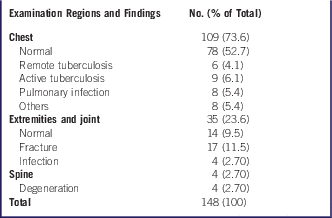
From November 24 to December 10, 2013, field hospital personnel ashore saw 2208 patients. A total of 113 patients were admitted to Peace Ark and 44 surgeries were done aboard the ship. A total of 109 patients (64 males: mean age, 39.7 years; range, 1–78 years; and 45 females: mean age, 43.7 years; range, 2–73 years) underwent DR of the chest (n=109), extremities (n=35), and spine (n=4). A total of 148 DR examinations were performed because some patients received radiography for 2 or more regions of the body. In total, 73.6% of the plain radiography was of the chest; of these cases, remote tuberculosis was found in 6 cases, active tuberculosis in 9 cases, pulmonary infection in 8 cases, and other lesions (nodules, bronchitis, pneumothorax) in 8 cases. In the radiography of the extremities and joints, 17 cases of fracture and 4 cases of soft tissue and bone infection were seen; the number of injury-related fractures was 17 of 109 cases (15.6%). The number of DR examinations and findings are shown in Table 1.
Number of Digital Radiography Examinations and Positive Findings

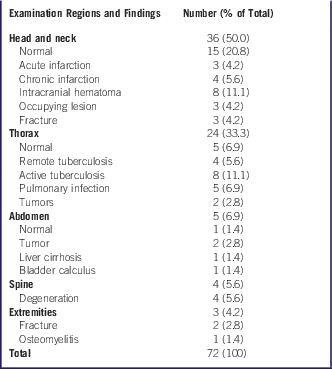
The CT set consisted of 59 patients (32 males: mean age, 43.8 years; range, 2–78 years; and 27 females: mean age, 49.1 years; range, 2–76 years) who underwent 72 CT examinations of the head and neck (n=36), thorax (n=24), abdomen (n=5), spine (n=4), and extremities (n=3). The majority of the CT scans had positive findings (70.8%, 51 of 72). Only 21 scans showed normal CT findings (29.2% of total examinations): 15 for the head and neck (41.7%) and 5 for the thorax (20.8%), respectively. There were several cases with a severe acute massive cerebral infarction, acute intracranial hematoma, and occupying lesions diagnosed for the first time for these patients. With regard to the thorax imaging, half of the patients were for further and definite evaluation for pulmonary tuberculosis detected by radiographs. The imaging characteristics of liver cirrhosis with concomitant linear calcification were demonstrated in one CT scan of the liver and incidentally in 3 thoracic CT scans. Multiplanar and volume rendering reconstruction of images were acquired for 3 patients with fracture and osteomyelites of extremities to assist in planning surgery. The number of CT examinations and findings are shown in Table 2.
Number of Computed Tomography Examinations and Positive Findings

Discussion
The humanitarian medical relief mission to the Philippines was the first response by Peace Ark to provide medical care to a natural disaster area. Humanitarian medical response after sudden impact disasters can be divided into 3 phase: (1) early emergency medical care (the first 48 hours); (2) from day 3 to day 15; and (3) the last phase, which might continue for more than 2 years. 3 Peace Ark functioned mainly in the last phase. Patients with non-disaster-related problems often surge in this phase. However, disaster-related or other injuries still continue. 3 , 4 During the 16-day stay, orthopedic cases accounted for 23.6% (not including the spine) of the examined regions. The majority of the orthopedic fractures and infections were typhoon disaster-related. Some of the injuries were non-disaster-related injuries with no definite proportion because of incomplete documentation. An explanation for the sustained number of disaster-related injuries several weeks after the event might be delayed access to health care and transfer of patients with disaster-related injuries from other hospitals. 4
Actually, it is neither requisite nor significant to classify disaster and non-disaster-related injuries from a humanitarian standpoint. Medical providers should provide medical care for all people in need in a disaster area regardless of the cause of the maladies. In a cohort study about tsunami in Southeast Asia, Fitzsimons et al attributed only 8.4% of their population to disaster-related injuries or conditions associated with the disaster.Reference Fitzsimons, Sparks and Jones 5 In our study, numerous patients with common medical conditions were diagnosed and treated. Fifteen cases of remote or active tuberculosis were found radiologically, which showed that the Philippines has a high tuberculosis incidence.Reference Corbett, Watt and Walker 6 Liver cirrhosis was found incidentally in 5 cases by CT scan. Linear calcification suggested that it may have been caused by schistosome, although laboratory evidence was lacking. There were also several severe neurological cases of acute large area brain infarction, acute intracranial hematoma, and occupying tumors seen aboard the Peace Ark. In the third phase of humanitarian response, other common medical problems can have a great impact on public health. 4 Certainly, the sample size was too small to reveal the true disease prevalence in this area. The range of the diseases seen on this mission highlights the importance of concern about common medical conditions and public health care in disaster response, and radiologists with multiple system experience will be especially useful and welcome.
In the typhoon aftermath, the international response with humanitarian relief was swift and considerable; many other field hospitals and makeshift clinics run by governmental or nongovernmental organizations were set up in the Tacloban area. As a floating medical platform, the Peace Ark hospital ship had a unique capacity to provide comprehensive patient care in this disaster area. Over a 16-day period, Peace Ark provided important and unique medical care for patients. Medical personnel saw 2208 patients in the field hospital ashore, while admitting 113 patients, performing 44 surgeries, and performing 148 DR and 72 CT examinations aboard the ship. All major hospital facilities had been destroyed in this area and the typhoon disrupted all CT scanners, rendering them unusable. This should have led to a high demand for health care and shipboard CT scans; however, the CT scanner was not utilized sufficiently, with an average number of scans of only 4.5 per day. The theoretical huge influx of patients did not materialize. Beyond the short duration of stay, an explanation for the relatively small number of patients aboard the ship might have been inadequate advertising, poor coordination between different organizations, and limitations of transportation for patients to and from the ship. The ship was anchored 3 miles off the coast owing to draft depth (8.5 meters), and patients arrived primarily by one helicopter and occasionally by small boats. Constraint on transportation of patients highly impacted the utilization of imaging modalities and the number of treated patients. When the ship is pier-side, the transport capacity of patients would be improved,Reference Hartgerink, Chapman and Stevenson 7 and more patients would be able to receive medical care and radiological imaging aboard the ship. Adequate and efficient transportable equipment should be considered. Furthermore, Peace Ark and the host nation had a joint responsibility to advertise the capacity of Peace Ark to local residents and other clinics for better medical care. Although the World Health Organization coordinated the Philippines humanitarian response, patients were seldom transferred to Peace Ark, the only full-capacity level 3 medical center in this disaster area, from other clinics. The Peace Ark experience reinforces the need to improve communication and coordination strategies in humanitarian medical relief response to disaster incidents.
There were several limitations to this mission and our study. First, high-pressure injector and contrast materials were not available on the ship, so contrast-enhanced CT scans could not be performed. This diminished diagnostic accuracy for some cases, such as occupying lesions, and the degree of patient satisfaction. High-pressure injector and contrast materials should be provided in future missions. Second, there was no mobile x-ray machine suitable for use on shore. Patients had to undergo radiography to rule out tuberculosis aboard the ship, causing an increased risk of disease spread from affected patients to other patients and crew members. A mobile x-ray machine suitable for use on shore is suggested in areas with a high incidence of communicable disease in future humanitarian medical relief missions. Third, owing to the short time station and later arrival (during the last phase), the sample size of the study was not large enough to reflect the true public medical condition. Also, the nature of our study was descriptive, and no sophisticated statistical methods were used. The results of our study should be reviewed accordingly. Detailed information on more patients should be considered in future studies.
Conclusions
The PLA(N) Peace Ark proved to be a capable floating medical platform and played a major and unique role in providing medical care for patients during its deployment for a Humanitarian Medical Relief Mission to the Philippines. It is equally important to be concerned about common medical conditions, public health care, and disaster-related injuries in disaster response. Radiological services played a considerable role in the humanitarian medical relief mission, and radiologists with multiple system experience would be especially useful and welcome.