The return of antiquities from North American museum collections to Italy gathered pace during the closing months of 2006. The agreement to return 13 antiquities from the Museum of Fine Arts in Boston made a significant step forward against the background of the decision by the Metropolitan Museum of Art in New York to return the Euphronios krater.1
Gill and Chippindale, “From Boston to Rome.” For the contexts of the New York acquisition and return, see Picón et al., Art of the Classical World, 19.
Frammolino and Felch, “Getty Makes New Offer to Italy.”
For the return of the wreath and kore to Greece: Felch and Frammolino, “Getty Set to Return Two Greek Works.” The two pieces are reported to have been purchased for $4.45 million.
THE RETURNING OBJECTS FROM MALIBU
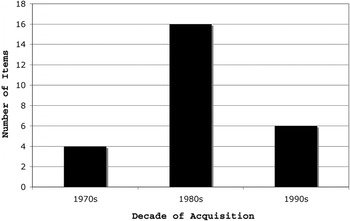
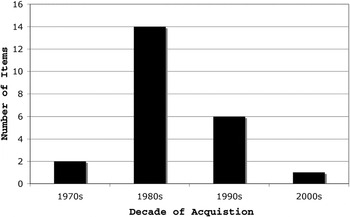
The antiquities returning to Italy from Malibu were acquired from 1971 to 1996 (Figure 1). They range from Roman fresco fragments acquired in 1971 (Appendix A, no. 25) to a series of antiquities that formed part of the Barbara and Lawrence Fleischman collection that were added in 1996 (Appendix A, nos. 4, 5, 12, 22, 24, 26). Most acquisitions were made during the 1980s. The largest group of objects is represented by nine pieces of Attic pottery, some fragmentary (Appendix A, nos. 7–15). The near-complete nature of some of the Attic pottery implies that the pieces were found in a tomb; and Etruria is a likely, but not the only, possibility.4
For Greek pottery in Etruria, see Gill and Vickers, “They were Expendable”; Osborne, “Why Did Athenian Pots Appeal to the Etruscans?” See also Gill, “METRU.MENECE.”

Decade of acquisition for antiquities due to be deaccessioned by the J. Paul Getty Museum and returned to Italy.

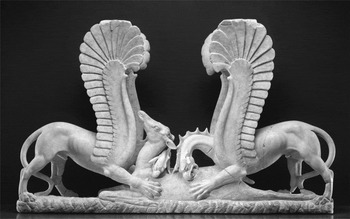
Table Support of Two Griffins Attacking a Fallen Doe. Malibu 85.AA.106. Courtesy of The J. Paul Getty Museum [Appendix A, 3].

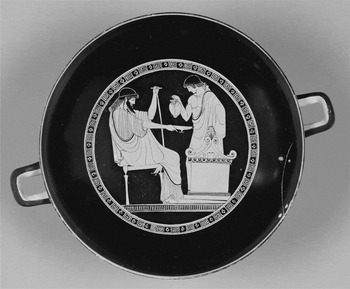
Attic Red-Figure Kylix with King Kekrops Preparing to Make an Offering. Malibu 84.AE.569. Courtesy of The J. Paul Getty Museum [Appendix A, 9].

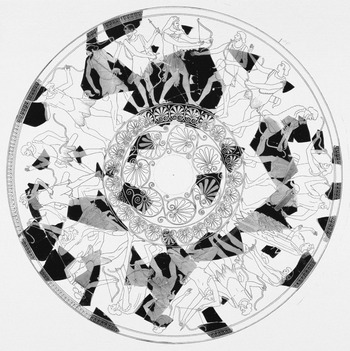
Fragmentary Attic Red-Figure Phiale Mesomphalos, signed by Douris. Malibu 81.AE.213. Courtesy of The J. Paul Getty Museum [Appendix A, 10].

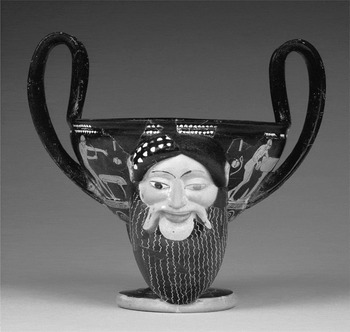
Attic Red-Figure Mask Kantharos, Attributed to the Foundry Painter. Malibu 85.AE.263. Courtesy of The J. Paul Getty Museum [Appendix A, 13].

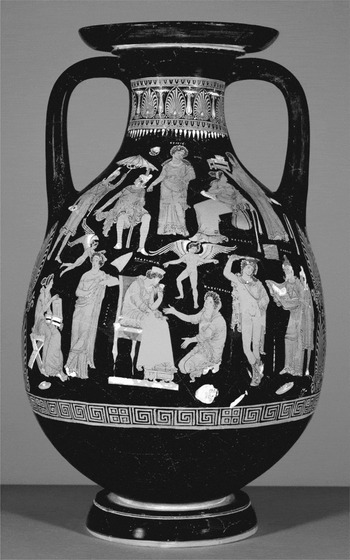
Apulian Red-Figure Pelike with Perseus and Andromeda. Attributed to the Darius Painter. Malibu 87.AE.23. Courtesy of The J. Paul Getty Museum [Appendix A, 16].

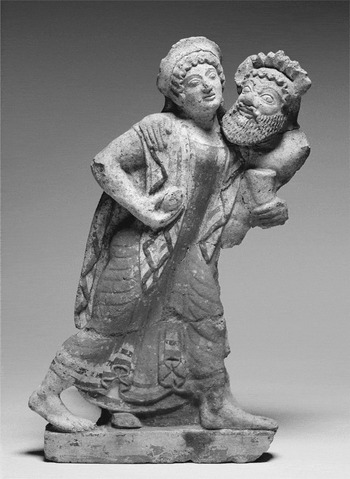
Terracotta Antefix in the Form of a Maenad and Silenos. Malibu 96.AD.33. Courtesy of The J. Paul Getty Museum [Appendix A, 24].
MASTERPIECES FROM THE J. PAUL GETTY MUSEUM
In 1997 the J. Paul Getty Museum published slightly more than 100 antiquities as Masterpieces of the J. Paul Getty Museum.5
Towne-Markus, Masterpieces. For a review article of this collection, see Gill, “Review of Masterpieces.”
Malibu 70.AA.109. Towne-Markus, Masterpieces, 106–07.
The more one researches individual Masterpieces in this selection, the more one is left asking questions about provenance, authenticity, and loss of context. These Masterpieces appear to represent a major loss of knowledge in that they have probably been removed from their archaeological context in an unscientific manner. Devoid of real knowledge, all that is left is speculation masquerading as connoisseurship. If these pieces were Masterpieces in their own time and cultures, we shall probably never know thanks to the activities of the clandestini.7
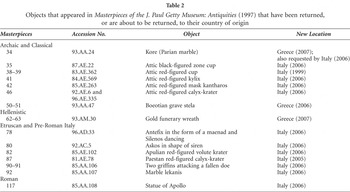
It now appears that it was right to be concerned: at least 10 items in the Getty's list of 26 pieces to be transferred to the Italian state appear in Masterpieces.
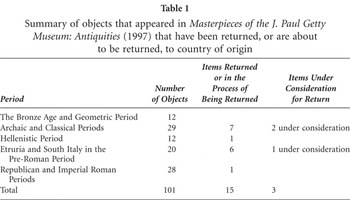
Summary of objects that appeared in Masterpieces of the J. Paul Getty Museum: Antiquities (1997) that have been returned, or are about to be returned, to country of origin

Objects that appeared in Masterpieces of the J. Paul Getty Museum: Antiquities (1997) that have been returned, or are about to be returned, to their country of origin

From the “Archaic and Classical” section, seven items have been or are due to be returned. Among them is the marble kore purchased from Robin Symes that has been returned to Greece (Appendix B, no. 1). Polaroids of the sculpture, still showing attached earth, were allegedly seized in Giacomo Medici's warehouse in Geneva. A second piece of classical sculpture is a Boeotian funerary stela that was almost certainly removed from a cemetery site in Central Greece (Appendix B, no. 2). The remaining Archaic and Classical objects consisted of five Attic pots; one was returned to Italy in 1999 and the other four are due to follow (Appendix A, nos. 7, 9, 12, 13).
One item from the “Hellenistic” section was returned to Greece in 2007. The gold wreath is said to have been discovered near Serres in northern Greece in 1990 before passing through the antiquities market in Germany and Switzerland (Appendix B, no. 3).8
Eakin and Carassava, “Getty Museum is Expected to Return Gold Wreath to Greece.”
Watson and Todeschini, The Medici Conspiracy, 286–87. For the price paid, see Felch and Frammolino, “Getty Had Signs it was Acquiring Possibly Looted Art”; Frammolino and Felch, “Getty Makes New Offer to Italy”; Felch and Frammolino, “Getty Set to Return Two Greek Works.”
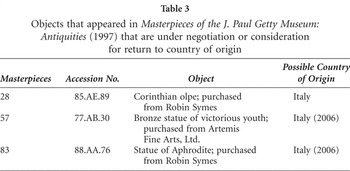
At least two further items from Masterpieces, the bronze athlete recovered from the Adriatic and the acrolithic statue of Aphrodite, are subject to requests from Italy (Table 3). A Corinthian olpe attributed to the painter of Vatican 73, and purchased from Robin Symes, has also been identified in the Medici Polaroids and may form part of a future request.10
Watson and Todeschini, The Medici Conspiracy, 346. This was also acquired with a Corinthian oinochoe (inv. no. 85.AE.88), attributed to the same painter, and acquired from the same source at the same time.
Objects that appeared in Masterpieces of the J. Paul Getty Museum: Antiquities (1997) that are under negotiation or consideration for return to country of origin

Former Owners and Private Collectors
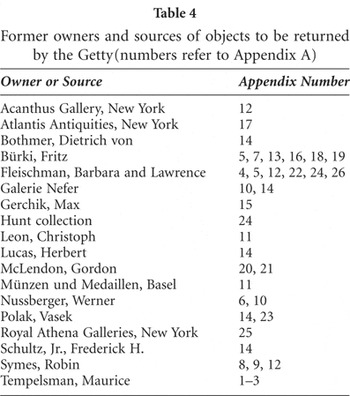
The Getty material was derived a range of private collectors, dealers, and galleries (Table 4). Three of the pieces appear to have resided at one stage in the Maurice Tempelsman collection. Tempelsman is chairman of the board of Lazare-Kaplan, a diamond company;11
Watson and Todeschini, The Medici Conspiracy, 74, 123–25.
Watson and Todeschini, The Medici Conspiracy, 124. The total value of the three pieces is given as $10.2 million, see Felch and Frammolino, “Getty Had Signs it was Acquiring Possibly Looted Art.” Symes is reported as the source for many of the Tempelsman pieces.
Watson and Todeschini, The Medici Conspiracy, 124.
Vermeule, “The God Apollo,” 27; “They were found as a group in a mound, probably in the western Greek lands.”
At the beginning of the month I had a chance to discuss the matter with the dealer who had bought [the] three objects from the excavators. This individual, Giacomo Medici, had sold one (the lekanis) to a second dealer, Robert Hecht, and the griffins and Apollo to a third, Robin Symes. Hecht later sold the lekanis to Symes, who then passed on the three sculptures as a group to Maurice Tempelsman, from whom we bought them. Medici informed me that he had acquired the lekanis and Apollo in 1976 or 1977, and that both had been found at the same location, a tomb which included a number of vases by the Darius Painter, at a site “not far from Taranto.” Hecht said the site was Orta Nova … Medici also said that the Apollo came from the same site, but was found in the ruins of a villa some 150 or 200 meters distant from the tomb whence the lekanis and griffins came …15
Watson and Todeschini, The Medici Conspiracy, 285–86.
Other former Tempelsman objects include the two marble portraits of L. Licinius Nepos and an anonymous balding man both in the Getty,16
Malibu 85.AA.111 and 85.AA.112. The portrait of the balding man features in Masterpieces: Towne-Markus, Masterpieces, 123.
Ortiz, In Pursuit of the Absolute, nos. 35–37.
Former owners and sources of objects to be returned by the Getty(numbers refer to Appendix A)

At least six of the pieces to be returned to Italy had formed part of the Barbara and Lawrence Fleischman collection (Appendix A, nos. 4, 5, 12, 22, 24, 26). The Getty acquired this collection in 1996, in part through donation and in part through purchase (reportedly for some US$20 million).18
John Walsh, “Director's Foreword,” in Towne-Markus, Masterpieces, 7. The remainder is reported to have been valued at $40 million: Felch and Frammolino, “Getty Had Signs it was Acquiring Possibly Looted Art.” $20 million for 30 pieces.
Getty Museum, A Passion for Antiquities.
Chippindale and Gill, “Material Consequences of Contemporary Classical Collecting,” 474–75, Tables 3 and 4. Barbara Fleischman is reported to have said in 2005: “We were absolute innocents…. We thought we were buying it from legitimate dealers. Looking back at it, maybe it was naïve” (in Felch and Frammolino, “Getty Had Signs it was Acquiring Possibly Looted Art”).
For the choice of 1973 as a watershed: Chippindale and Gill, “Material Consequences of Contemporary Classical Collecting,” 470–71. Some would consider 1971 more appropriate. It is perhaps significant that Shelby White suggests that public awareness of looted antiquities is something new, “It is hard to apply current standards to something that happened thirty years ago” (quoted in Mead, “Den of Antiquity,” 60). The ethical standards were adopted by the AIA more than 30 years ago.
For a useful overview, see Renfrew, Loot, Legitimacy and Ownership, 28–30, 69–70.
Getty Museum, A Passion for Antiquities, 341–44, no. 180.
Pieces formerly owned by the Fleischmans were increasingly suspect after Polaroids showing items from the collection had been seized at the Geneva Freeport.24
For a list, see Watson and Todeschini, The Medici Conspiracy, 349–52.
For a loan (now returned) from Atlantis Antiquities to the Getty, see Gill and Chippindale, “The Illicit Antiquities Scandal.”
Tompkins, Wealth of the Ancient World, no. 16; Getty Museum, A Passion for Antiquities, 195–97, no. 92. The Hunt collection was sold at Sotheby's, New York, on June 19, 1990.
For the significance of the signature, see Moore, Attic Red-figured and White-ground Pottery, 96. See also Smith, “Eurymedon and the Evolution of Political Personifications,” 133.
Watson and Todeschini, The Medici Conspiracy, 120–21.
Gill, “Pots and Trade”; Gill, “Positivism, Pots and Long-distance Trade”; Gill, “A Greek Price Inscription from Euesperides, Cyrenaica.” One stater was worth an Attic tetradrachm, so the equivalent of approximately 17 g of silver. For an alternative reading of ancient prices see Boardman, The History of Greek Vases, 156–58.
Vickers and Gill, Artful Crafts.
Boardman, The History of Greek Vases, 158, where a link is acknowledged between the low price of pottery in antiquity and the value placed on Greek pottery by modern collectors. Boardman's views are echoed by Dr. Alan Walker in an online review article of Atwood, Stealing History (2004) published on the web site of the Ancient Coin Collectors Guild (http://accg.us/issues/editorials/pro/walker) and quoted in full by Wayne G. Sayles of the Ancient Coin Collectors Guild in evidence submitted to the U.S. Government Committee on Ways and Means (http://waysandmeans.house.gov).
One of the other donors of the returning Italian antiquities was Vasek Polak of Canada. Among the objects associated with Polak is the Etruscan dusk askos (Appendix A, no. 23) that was reported as having once been in the S. Schweitzer collection (1940). The Schweitzer collection certainly existed. Sir John Beazley was familiar with pottery from this collection in his studies of Attic black- and red-figured pottery that were published in 1956 and 1963 respectively, and several of these pieces now reside in the Antikenmuseum und Sammlung Ludwig in Basel.32
Nørskov, Greek Vases in New Contexts, 184. For Beazley's study of Attic figure-decorated pottery, see Beazley, Attic Black-figure Vase-painters; Beazley, Attic Red-figure Vase-painters.
Watson and Todeschini, The Medici Conspiracy, 95. For further comments on their work, see Gill and Chippindale, “The Illicit Antiquities Scandal.”
Nørskov, Greek Vases in New Contexts, 275, Table 15. This included two Attic pots, Lots 40 (now Melbourne, University 1980.0209, see Connor and Jackson, A Catalogue of Greek Vases in the Collection of the University of Melbourne, 124–27, no. 43), and 55 (location unknown).
Watson and Todeschini, The Medici Conspiracy, 95. Further on the Onesimos cup, see Elston, “Technical and Aesthetic Considerations.”
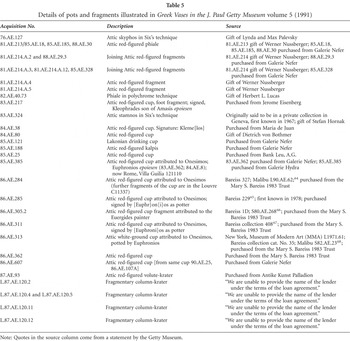
In 1982 Polak also donated one of the fragments for the calyx-krater attributed to the Berlin painter (Appendix A, no. 14). The earliest fragment was donated in 1977 by Herbert L. Lucas, a trustee of the Getty, and this was followed by further gifts from Dietrich von Bothmer (1984) and purchases from Galerie Nefer (1984) and Frederick H. Schultz, Jr. (1987). Together the price paid for the purchased fragments is reported to have been $101,900.36
Watson and Todeschini, The Medici Conspiracy, 226.
Nørskov, Greek Vases in New Contexts, 331. For further comments on von Bothmer as a collector of fragments, see Gill and Chippindale, “The Illicit Antiquities Scandal.”
Watson and Todeschini, The Medici Conspiracy, 95–97.
Malibu 82.AA.135.
Gordon McLendon donated two Apulian pots to the Getty in 1977 (Appendix A, nos. 20, 21). McLendon, who was involved in radio stations, collected antiquities in part derived from Summa Galleries and Numismatic Fine Arts.40
For Hecht's link with Bruce McNall and Summa Galleries, see Watson and Todeschini, The Medici Conspiracy, 130. For McNall and Numismatic Fine Arts, see Nørskov, Greek Vases in New Contexts, 254.
Watson and Todeschini, The Medici Conspiracy, 362 no. 3.
Malibu 77.AE.11.
Dealers and Restorers
Most antiquities being returned to Italy from the Getty passed through the hands of dealers and restorers in Switzerland, the United Kingdom, and North America. At least two of the dealers were, at the time, members of the International Association of Dealers in Ancient Art (IADAA); one of the two galleries, Galerie Nefer, has recently resigned from the organization.43
The authors are grateful to Michael Petropoulos (Galerie Rhéa, Zurich) of the IADAA for this information (January 30, 2007). For earlier observations on a member gallery of the IADAA and the Boston return, see Gill and Chippindale, “From Boston to Rome,” 320–21.
North America
One returning Getty piece was acquired from Atlantis Antiquities in New York (Appendix A, no. 17). This gallery was jointly owned by Robert E. Hecht and Jonathan Rosen, and some of the Boston deaccessioned antiquities had also passed through it.44
Gill and Chippindale, “From Boston to Rome.”
Also noted by Watson and Todeschini, The Medici Conspiracy, 227, 240.
Watson, “The Investigation of Frederick Schultz”; Watson and Todeschini, The Medici Conspiracy, 238–40. For Schultz's trial, see Gerstenblith, “Recent Developments in the Legal Protection of Cultural Heritage,” 69–74.
Gill and Chippindale, “From Boston to Rome,” 320–21, 325, nos. 10–11.
Nørskov, Greek Vases in New Contexts, 178. Nørskov observes, “From 1971 to 1974 acquisitions in general were made at high speed, due to the construction of the famous villa which houses the Getty collection.”
United Kingdom
Robin Symes was the main U.K.-based dealer in antiquities who handled several of the Getty pieces. These included three pieces of Attic pottery (Appendix A, nos. 8, 9, 12); in one case the Getty acquired the pot through the Fleischmans (Appendix A, no. 12). Symes also handled the archaic kore (Appendix B, no. 1), and the three pieces from the Tempelsman collection (Appendix A, nos. 1–3).49
Watson and Todeschini, The Medici Conspiracy, 125, 198.
Apostolidis, Archaiokapilia, Fig. 60 (image of letter). Four of the pots appear in Towne-Markus, Masterpieces, 14–15, see Malibu 91.AE.28–31 (plus 91.AE.27 not in Masterpieces). These formerly belonged to the Erlenmeyer collection, see Doumas, Silent Witnesses, nos. 1–5. For the Erlenmeyers' close association with Cycladic objects apparently looted from Greece, see Sotirakopoulou, The “Keros Hoard.”
Switzerland
At least six of the returning antiquities from the Getty were handled by Fritz Bürki (Appendix A, nos. 5, 7, 13, 16, 18, 19), whose associations with Hecht and Giacomo Medici have been documented elsewhere.51
Watson and Todeschini, The Medici Conspiracy; Gill and Chippindale, “From Boston to Rome.”
Listed on http://www.iadaa.org (accessed on January 29, 2007, but page dated to December 2005; Galerie Nefer was no longer listed on April 30, 2007). The gallery was founded in the early 1980s, see Nørskov, Greek Vases in New Contexts, 253.
The point is also made by Watson and Todeschini, The Medici Conspiracy, 211–12, 227.
Watson and Todeschini, The Medici Conspiracy, 212.
Watson and Todeschini, The Medici Conspiracy, 286–87.
Watson and Todeschini, The Medici Conspiracy, 199–200.
Watson and Todeschini, The Medici Conspiracy, 246.
At least seven Getty pieces appeared in Polaroids found on Medici's premises in the Geneva Freeport.58
For a convenient list of pieces associated with the Getty, see Watson and Todeschini, The Medici Conspiracy, 344–49.
An image of the letter can be found at http://www.latimes.com/media/acrobat/2005–09/19604121.pdf (accessed December 22, 2006).
Nørskov, Greek Vases in New Contexts, 304. For the Bareiss collection, see Getty Museum, Greek Vases: Molly and Walter Bareiss Collection.
Mr. and Mrs. Werner Nussberger are named as the source of three Coptic items given to the Princeton University Art Museum, inv. 88–46, 47, 48, see Princeton University Art Museum, “Acquisitions of the Art Museum 1989,” 53.
Watson, Sotheby's, the Inside Story, 117–19.
Watson and Todeschini, The Medici Conspiracy, 291–92
Details of pots and fragments illustrated in Greek Vases in the J. Paul Getty Museum volume 5 (1991)Getty Museum, Greek Vases: Molly and Walter Bareiss Collection, 51–53, no. 36, 79, no. 150.Getty Museum, Greek Vases: Molly and Walter Bareiss Collection, 51–53, no. 37, 79, no. 151.Getty Museum, Greek Vases: Molly and Walter Bareiss Collection, 81, no. 172.Getty Museum, Greek Vases: Molly and Walter Bareiss Collection, 81, no. 178.Getty Museum, Greek Vases: Molly and Walter Bareiss Collection, 50–51, no. 35, 82, no. 181.

OUTSTANDING ITEMS IN THE GETTY
The items to be returned to Italy by the Getty are not the only pieces identified in Polaroids seized in Geneva.69
It is reported that a further twenty items have been requested by the Italian authorities, see Felch and Frammolino, “Getty Risks Embargo, Italy Warns”; Felch and Frammolino, “Getty Set to Return Two Greek Works.”
Watson and Todeschini, The Medici Conspiracy, 119–20, 348.
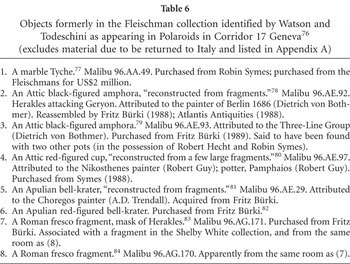
Objects formerly in the Fleischman collection identified by Watson and Todeschini as appearing in Polaroids in Corridor 17 GenevaBased on Watson and Todeschini, The Medici Conspiracy, 349–52. (excludes material due to be returned to Italy and listed in Appendix A)Getty Museum, A Passion for Antiquities, 237–40, no. 120; Watson and Todeschini, The Medici Conspiracy, 347, 349.Getty Museum, A Passion for Antiquities, 82–83, no. 34; Watson and Todeschini, The Medici Conspiracy, 348, 350. For earlier publication, see Atlantis Antiquities, Greek and Etruscan Art, 38–41, Fig. 35.Getty Museum, A Passion for Antiquities, 84–85, no. 35; Watson and Todeschini, The Medici Conspiracy, 348, 350–51.Getty Museum, A Passion for Antiquities, 94–95, no. 39; Watson and Todeschini, The Medici Conspiracy, 351.Getty Museum, A Passion for Antiquities, 125–28, no. 56; Watson and Todeschini, The Medici Conspiracy, 347, 351–52. This is the “name vase” of the Choregos painter.Two further Apulian bell-kraters are listed, see Getty Museum, A Passion for Antiquities, 129–35, nos. 57–58. No. 57 (Malibu 96.AE.112), attributed to the Rainone painter, was known to A.D. Trendall in the collection of Castello dei Landriani, Vidigulfo. No. 58 (Malibu 96.AE.113), attributed to the Cotugno painter, surfaced on the Swiss market.Getty Museum, A Passion for Antiquities, 251–52, no. 126.Getty Museum, A Passion for Antiquities, 250–51, no. 125.

The Geneva Polaroids also identify non-Fleischman material, mostly pottery, in the Getty. These include a Corinthian olpe and a Corinthian oinochoe, both attributed to the painter of Vatican 73 and both purchased from Robin Symes in 1985.71
Malibu 85.AE.88 and 85.AE.89 (Towne-Markus, Masterpieces, 28). Watson and Todeschini, The Medici Conspiracy, 346.
Malibu 79.AE.139. Watson and Todeschini, The Medici Conspiracy, 345–46. For the amphora, see Brommer, “Herakles und Theseus auf Vasen in Malibu,” 195, Fig. 13.
Malibu 83.AE.287. Watson and Todeschini, The Medici Conspiracy, 346. For Milken see his personal web site: http://www.mikemilken.com.
A point made in Gill and Chippindale, “From Boston to Rome,” 314.
Malibu 83.AE.218 and 83.AE.242. Watson and Todeschini, The Medici Conspiracy, 349.
There are also two important pieces of sculpture in the Getty that have been requested by the Italian government, but they do not form part of the present agreement. The first is an acrolithic statue (in part consisting of marble from the island of Paros) perhaps representing a goddess.85
Malibu 88.AA.76. Towne-Markus, Masterpieces, 82–83. See also Felch and Frammolino, “Getty Had Signs it was Acquiring Possibly Looted Art.” In March 2007 the J. Paul Getty Museum announced that it would hold a symposium in May 2007 as preparatory for a possible return to Italy.
Details in Gill, “Review of Towne-Markus, Masterpieces”; Carabinieri and Gribbon, “Aphrodite”; Philp, “No Love Lost with Getty Museum.” It is reported that Renzo Canavesi, a Sicilian, sold the statue to Symes.
Carabinieri and Gribbon, “Aphrodite.”
Carabinieri and Gribbon, “Aphrodite.”
Bell, “The Getty Aphrodite: A Reply.” The statue has been the subject of a closed conference held at the Getty in May 2007.
The second statue is a bronze of a victorious youth acquired by the Getty in 1977 for a reported $3.95 million.90
Malibu 77.AB.30. Towne-Markus, Masterpieces, 56–57; Mattusch, The Victorious Youth. See also Moltesen, “The Reopened Getty Villa,” 157, who suggests that the find-spot in the sea off the Italian coast is no more than “alleged.”
Mattusch, The Victorious Youth, 20. Elsewhere Mattusch has suggested the date 1961, see Mattusch, The Fire of Hephaistos, 33, caption to Fig. 18.
Stewart, Greek Sculpture, 315. Stewart dates the statue to the fourth or third centuries bce, and places it in the School of Lysippos (p. 200).
Countries other than Italy or Greece may have claims for other objects in the Getty. Among the Masterpieces are the mummy portrait of Isidora “probably from el-Hibeh (Ankyronpolis)” acquired in 1981,93
Malibu 81.AP.42, see Towne-Markus, Masterpieces, 116; Walker and Bierbrier, Ancient Faces, 113, no. 108. Purchased from Archeart Invest S.A. of Fribourg. The company went into liquidation in 1994.
Malibu 85.AF.84, see Towne-Markus, Masterpieces, 104; Harden, Glass of the Caesars, no. 36. Purchased from Robin Symes; formerly part of the Ernst and Martha Kofler-Truniger collection, sold at auction at Christie's, London, 1985.
Malibu 84.AF.85, see Towne-Markus, Masterpieces, 105; Harden, Glass of the Caesars, no. 31. Purchased from Mehdi Mahboubian, a New York art dealer.
Malibu 84.AB.670, 84.AB.671, and 85.AB.109, see Towne-Markus, Masterpieces, 112–13, 115. Two of the Malibu pieces were purchased from Robin Symes (84.AB.670 and 671), and the other was purchased from Maurice Tempelsman (85.AB.109). Cleveland Museum of Art 1984.25. For the four bronzes, see Kozloff et al., The Gods Delight, 333–43, nos. 64–66. The link between the four pieces was stated in Gill, “Review of Masterpieces.”
POSSIBLE FUTURE REQUESTS TO NORTH AMERICAN MUSEUMS
The success of the Italian authorities in obtaining the return of antiquities from three major museums in North America means that the spotlight will be turned onto several other collections that are reported to have acquired antiquities from the same route. These are likely to include the Cleveland Museum of Art (see Figure 8), the Toledo Museum of Art, the Minneapolis Institute of Arts, and the Princeton University Art Museum.

Decade of acquisition for antiquities in the Cleveland Museum of Art which were reported by Mazur as requested by the Italian Government (April 2007).
The Cleveland Museum of Art
The museum is alleged to have acquired “looted material” from Hecht, and is said to have had “close relations” with Becchina.98
Watson and Todeschini, The Medici Conspiracy, 109, 293.
- A Lucanian calyx-krater, attributed to the Policoro painter:
1991.1100; ex-Hunt collection and sold 1990; alleged to have been purchased from Hecht
Reverman, “The ‘Cleveland Medea’ Calyx Crater.”
- An Apulian bell-krater, attributed to the Choregos painter:
1989.73101
The “name vase” of the Choregos painter is one of the Apulian kraters being returned by the Getty. Getty Museum, A Passion for Antiquities, 128, under no. 56.
- An Apulian volute-krater, attributed to the Darius painter: 1988.41
- A Campanian red-figured acorn lekythos: 1986.204; gift of Jonathan Rosen
- A Paestan black-figured lekythos: 1985.1; allegedly acquired through Hecht
A more extensive list of objects reportedly claimed by the Italian government was published by Mazur in April 2007.102
This list included material that was known before the UNESCO 1970 convention. Among them was a Roman silver cup found in the sanctuary at Vicarello in Italy and first published in 1866,103Cleveland 1966.371. This passed through the collections of R. Garrucci, Naples; Sir William Drake, London; Edmond de Rothschild, Paris. For bibliography, see Oliver, Silver for the Gods, 142–43, no. 95.
Cleveland 1925.945. Gift of J.H. Wade.
Cleveland 1987.64. Kozloff et al., The Gods Delight, 344–46, no. 67.
Cleveland 1987.2 and 1987.3. Kozloff et al., The Gods Delight, 323–29, nos. 61 and 62. Both appeared in the annual reports for Artemis S.A. (Luxembourg, 1985–86, 1986–87).
Cleveland 1984.25. Kozloff et al., The Gods Delight, 340–43, no. 66.
James Kopniske of the Cleveland Museum of Art kindly informed us that there was as yet no formal press statement from the museum.
The Toledo Museum of Art
It was noted by Watson and Todeschini that Hecht sold the Toledo Museum of Art “looted material.”109
Sewell, “Ancient Vase to be Returned if Stolen”; Watson and Todeschini, The Medici Conspiracy, 109.
Toledo 82.134. Boulter and Luckner, The Toledo Museum of Art, 14–16, pl. 90 (973) 1–3. For the allegations, see Sewell, “Ancient Vase to be Returned if Stolen.”
In April 2001, the Toledo Museum of Art provided copies of its documentation and correspondence regarding an Etruscan kalpis to Thomas A. Karol, Assistant U.S. Attorney, Northern District of Ohio (Toledo), U.S. Department of Justice. The Museum understood that such information was solicited at the request of the Italian government. Since supplying the requested information, the Museum has received no further inquiries. The Museum has cooperated with all official inquiries and will continue to do so.111
Rundgren, Toledo Museum of Art Statement.
The Minneapolis Institute of Arts
An Attic red-figured volute-krater, attributed to the Methyse painter, was the gift of Mr. and Mrs. Donald C. Dayton; it was purchased from Robin Symes in 1983.112
Minneapolis Institute of Arts 83.80. Padgett, “Influence of a Satyric Drama on a Vase by the Methyse Painter.” For full details, see Padgett, “An Attic Red-figure Volute-krater.”
The Minneapolis Institute of Arts has learned that an object in our permanent collection could be among a number of objects in American museums that the Italian government alleges to have been recently excavated in Italy. We have not been contacted by the Italian authorities about this object. We have seen only an electronic image of a detail of the shoulder of a vase, which we received from a Los Angeles Times journalist without any accompanying documentation. As a leading museum, we uphold the principle that all collecting be done according to the highest standards of ethical and professional practice. Although no contact or claim has been made, to date, by the Italian authorities, we are nonetheless taking the matter seriously, and, if after gathering the facts it is established that the Italian government has a legitimate claim, we will respond in an appropriate and responsible fashion.113
The Princeton University Art Museum
Four pieces in Princeton are reported by Osellame to be under investigation.114
The first is an Attic red-figured psykter, attributed to the Kleophrades Painter, and given to the Princeton University Art Museum by a group of Princeton alumni, Peter Jay Sharp (class of 1952) through the Peter Jay Sharp Foundation; Lloyd E. Cotsen (class of 1950); John B. Elliott (class of 1951); and Jonathan P. Rosen through the Joseph Rosen Foundation.115Princeton University Art Museum, “Acquisitions of the Art Museum 1989,” 46 (ill.), 47 (catalog entry); Lissarrague, Greek Vases, 29, Fig.17.
Meritt, History of the American School, 339.
Padgett, “Objects of Desire.”
Rosen was the donor of other antiquities to Princeton. These include a white-ground Attic vicup, said to have been found at Taranto (with a vicup in a private collection in New York, and another one on the New York market, both attributed to the same workshop as the Princeton cup by Robert Guy), inv. 1988–7, museum purchase, and gift of Peter W. Josten and of Jonathan P. Rosen through the Joseph Rosen Foundation (Princeton University Art Museum, “Acquisitions of the Art Museum 1988,” 53; Gaunt, “A Cup in Princeton”); an Attic red-figured lekythos, attributed to the Phiale painter, inv. 1990–59 (Princeton University Art Museum, “Acquisitions of the Art Museum 1990,” 58); the fragment of an Attic red-figured cup (inv. 1991–63), attributed to the Amphitrite painter, which fits fragments acquired in 1989 as a museum purchase, gift of Joyce von Bothmer (inv. 1989–84) (Princeton University Art Museum, “Acquisitions of the Art Museum 1989,” 48; Princeton University Art Museum, “Acquisitions of the Art Museum 1991,” 71).
Mauro [Moroni] met me [Hecht] at the airport and we drove directly to his home in Cerveteri to show me the vase. It was a psykter, a vase used for wine cooling, decorated with reclining banqueters drinking from various vessels … Within a few days Mauro delivered the psykter to Zurich and we concluded the deal at $225,000.119
Quoted in Watson and Todeschini, The Medici Conspiracy, 178.
This psykter was offered to the Getty but is reported to have been turned down because it was thought that the pot was a forgery. The psykter was subsequently acquired by Princeton.120
Watson and Todeschini, The Medici Conspiracy, 179.
Osellame, “Italian Government Says University Owns Stolen Art.” The inventory numbers have not been made public in the news reports. Possible pieces could include the Apulian loutrophoros, attributed to the Darius painter (inv. 1989–29), museum purchase, anonymous gift (Princeton University Art Museum, “Acquisitions of the Art Museum 1989,” 47 [ill.], 53 [text]), and the recently acquired Roman silver cup (inv. 2000–356), museum purchase (Princeton University Art Museum, “Acquisitions of the Art Museum 2000,” 90 [ill.]).
In December 2004, Italian authorities investigating an alleged violation of the laws of Italy requested details about the acquisition in 1989 of two ancient Greek painted ceramic vases by the Princeton University Art Museum.
The vases in question are an Athenian red-figure wine-cooler (psykter), dating to 510 to 500 bc, and an Apulian red-figure loutrophoros of about 330 bc. In January 2005, the art museum provided Italian authorities with the information requested. Since that time, the museum has received no further communication from authorities in Italy, but they are quoted in recent press accounts as stating that they possess evidence that the two vases left Italy illegally and should be returned. According to Susan M. Taylor, who has been director of the Princeton University Art Museum since 2000, “The museum purchased these vases in good faith and has no knowledge of any wrongdoing associated with their acquisition. If proof of illegality is presented to the museum, the vases will be returned, as we have returned other items in the past.”122
Princeton University Statement. 2005.
SUMMARY
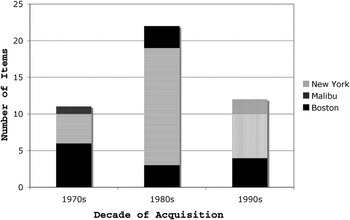
A study of the antiquities to be returned by the Getty to Italy has raised several issues and has highlighted the corrupting influence of a flawed acquisition policy over the last 35 years. It is important to praise both the Getty and the Museum of Fine Arts in Boston for their transparency in this matter because they agreed to the return of their items. The acquisition histories have been made available without any restrictions (see Figure 9).123
The Getty's October 2006 acquisition policy now states: “6. All information obtained about the provenance of an acquisition must be preserved, and … all such information shall be made available to the public upon written request.” For the policy: www.getty.edu/about/governance/pdfs/acquisitions_policy.pdf (accessed on April 23, 2007).

Decade of acquisition for antiquities deaccessioned by the Museum of Fine Arts, Boston, the Metropolitan Museum of Art, New York, and the J. Paul Getty Museum.
There are several lessons to learn from these cases of returning antiquities. First, it is clear that it was nearly impossible to build up a collection of legitimately provenanced masterpieces in the closing decades of the twentieth century either through purchases on the open market or by the acquisition of contemporary North American private collections. High-quality finds that are unknown to scholarship are very likely to be fresh finds from looted sites. The antiquities acquired since 1970 have been liberally peppered with items that appear to have surfaced through illicit digging. A collection such as that formed by the Getty is widely acknowledged as containing items with “no provenance or known context.”124
Moltesen, “The Reopened Getty Villa,” 156.
Conveniently found at www.unesco.org (accessed May 14, 2007), and Renfrew, Loot, Legitimacy and Ownership, 93–102. The new Getty acquisition policy (October 23, 2006) explicitly uses November 17, 1970 (the date of he UNESCO Convention) to define the surfacing of archaeological material. For a good example of an archaeologically-based North American collection, see Bald Romano 2006.
Second, the evidence suggests that the attribution of objects to old collections can be deliberately falsified. The placing of objects in uncataloged (or partially cataloged) late nineteenth-century collections seems to be a calculated move on the part of some dealers. Museums need to have certified evidence of the attribution. Word of mouth can no longer be used as evidence.
Third, bodies such as the IADAA need to demonstrate that their members do stick to their guidelines. James Ede, managing director of Charles Ede Ltd. and a vice-president of the IADAA, recently commented, “For many years, responsible dealers have been aware of the damage uncontrolled excavation does and have fought hard to distance themselves from those who operate outside the law and to avoid purchasing the fruits of such activity.”126
Ede, “Who Owns Objects?” 78.
The appearance of objects that have passed through the galleries of members of the IADAA and that appear in the list of returning objects from both Boston and the Getty can only suggest that the IADAA guidelines are little more than window dressing. Has the IADAA taken appropriate action against members that flout their guidelines? Some scholars have been quick to defend dealers and the antiquities market, and in so doing have implicitly endorsed the continuing destruction of archaeological sites; but such views are in a minority.127
Boardman, “Archaeologists, Collectors, and Museums.” For Boardman's wider position, see Scarisbrick, “A Classical Warrior.” See also Gill, review article of Archaeology, Cultural Heritage, and the Antiquities Trade.
Fourth, it is clear from studies of the Boston and Malibu material that the same names of dealers and restorers are appearing, among them Bürki, Hecht, and Symes. The organigram linked to the Medici conspiracy seems to lead into the heart of these institutions.
Fifth, dealers in antiquities may have devised strategies to ensure sales to the Getty by using pottery fragments to initiate an acquisition process. A sale was planned to take several years, perhaps started by an initial donation and then followed up by sales from key dealers, notably Galerie Nefer. This selling strategy seems to have included the deliberate breaking of pots to make the system work.
These returns of antiquities are damaging to the reputations of fine public institutions and their curatorial staff. Whereas in past decades major museums may have been seen as the final resting place for collections in private hands, the acquisition of a collection like that formed by the Fleischmans has only brought severe embarrassment to the Getty. Who would now acquire the Shelby White and Leon Levy collection knowing that several of the items appear in the Polaroids seized in Geneva and that the Italian authorities have reportedly asked for the return of antiquities?128
Pavoledo, “Top Collector is Asked to Relinquish Artifacts”; Vala, “Italy Versus the Illicit Trade.” It is perhaps significant that the Leon Levy and Shelby White Court will open in April 2007 at the Metropolitan Museum of Art in New York. Failure by Shelby White to resolve this issue can only be detrimental to the reputation to the MMA. For an interview with Shelby White, see Mead, “Den of Antiquity,” especially 60.
For Shelby White's view of collecting, see White, “Building American Museums.” For the collection, see von Bothmer, Glories of the Past. Philippe de Montebello, director of the Metropolitan Museum of Art, regards Shelby White and Leon Levy as “those two most generous and dedicated New York collectors” (in Picón et al., Art of the Classical World, vii). For a discussion of the collection, see Taylor, “Shelby White in Center Court at the Met.”
The story is far from over. There are thousands of antiquities now residing in public and private collections still to be identified from the seized Polaroids. There is already a short list of antiquities which museums in North America, Europe, and Japan should return before formal requests are made by the Italian and other governments.130
For the links between the Miho Museum and Becchina, see Watson and Todeschini, The Medici Conspiracy, 294–96. The Taipei Times reported (January 12, 2007) that the Italian authorities had requested the return of the 50 items from the Miho Museum.
POSTSCRIPT
On August 1, 2007 the J. Paul Getty Museum announced that a further 14 objects would be returned to Italy in addition to the objects discussed here. Seven of the additional items were formerly in the Fleischman collection; some are listed in Table 6.
Press release: http://www.getty.edu/news/press/center/italy_getty_joint_statement_0801070.html
Want to Comment on this Article? Go to www.culturalproperty.org/forum/
APPENDIX A
Objects to be returned to Italy from the J. Paul Getty Museum (statement November 2006)
Sculpture
1. Statue of Apollo. 85.AA.108. Marble. Purchased from Maurice Tempelsman, New York.131
Watson and Todeschini, The Medici Conspiracy, 347; Towne-Markus, Masterpieces, 117.
2. Lekanis. 85.AA.107. Marble, polychrome. Purchased from Maurice Tempelsman, New York.132
Watson and Todeschini, The Medici Conspiracy, 347; Towne-Markus, Masterpieces, 92.
3. Two griffins attacking a fallen doe. 85.AA.106. Marble, polychrome. Purchased from Maurice Tempelsman, New York.133
Watson and Todeschini, The Medici Conspiracy, 347; Towne-Markus, Masterpieces, 90–91.
4. Statuette of Dionysos with an animal. 96.AA.211. Marble. Gift of Barbara and Lawrence Fleischman, New York.134
Watson and Todeschini, The Medici Conspiracy, 348, 352; Getty Museum, A Passion for Antiquities, 339–41, no. 179.
Pottery
Pontic
5. Pontic amphora. 96.AE.139. Attributed to the Tityos painter. Sold by Fritz Bürki (1988) to the Fleischmans; gift of Barbara and Lawrence Fleischman.135
De Puma, The J. Paul Getty Museum, Malibu, 23–24, Pls. (1766–1770) 489, 1–2, 490, 1–2, 491, 1, 492, 1–3, 493, 1–2; Watson and Todeschini, The Medici Conspiracy, 348; Getty Museum, A Passion for Antiquities, 190–92, no. 90.
Corinthian
6. Fragmentary Corinthian olpe. 81.AE.197.2. Gift of Werner Nussberger. This may be one of the olpai referred to in a letter from True to Medici (January 1992): “I was also very grateful to have the information on the provenance of our three fragmentary proto-Corinthian olpai. To know that they came from Cerveteri and the area of Monte Abatone is very helpful for the research of one of our staff members.”136
Watson and Todeschini, The Medici Conspiracy, 98.
Attic
7. Attic black-figured zone cup. 87.AE.22. Manner of Lysippides painter (attributed by Robert Guy). Purchased from Fritz Bürki & Son, Switzerland.137
Towne-Markus, Masterpieces, 35.
8. Attic red-figured kalpis (hydria). 85.AE.316. Attributed to Kleophrades painter. Purchased from Robin Symes. Known in fragments from Polaroids seized in Geneva.138
Watson and Todeschini, The Medici Conspiracy, 344–45.
9. Attic red-figured kylix (cup, type B). 84.AE.569. Signed, “Douris egraphsen.” Purchased from Robin Symes. Polaroids seized in Geneva.139
Watson and Todeschini, The Medici Conspiracy, 344–45; Ober and Hedrick, Birth of Democracy, 61, Fig. 5.1; Towne-Markus, Masterpieces, 41.
10. Douris phiale fragments. 81.AE.213. Gift of Werner Nussberger (81.AE.213); purchase from Galerie Nefer (85.AE.18, 85.AE.185, 88.AE.30); anonymous loan (L.92.AE.88.2–3). Polaroids seized in Geneva.140
Watson and Todeschini, The Medici Conspiracy, 346.
11. Attic red-figured calyx krater. 88.AE.66. Attributed to Copenhagen/Aegisthus painters. Surfaced in Basel, Münzen und Medaillen; then Freiburg, Morat-Institut; purchased from Christoph Leon.
12. Attic red-figured calyx-krater. 92.AE.6 and 96.AE.335. Syriskos (signature). Purchased from Robin Symes (1988); New York, private collection (Beazley archive); purchased from New York, Fleischman collection (92.AE.6); purchased from Acanthus Gallery, New York (96.AE.335). Known from Polaroids seized in Geneva.141
Watson and Todeschini, The Medici Conspiracy, 120–21, 346; Towne-Markus, Masterpieces, 46.
13. Attic red-figured mask kantharos. 85.AE.263. Attributed to Foundry painter (Robert Guy). Euphronios as potter. Alleged to have been with Robin Symes (1982–1984) and seen there by Robert Guy; exported to Switzerland; purchased from Fritz Bürki & Son, Switzerland (US$200,000).142
Watson and Todeschini, The Medici Conspiracy, 91; Towne-Markus, Masterpieces, 42.
14. Group of red figure calyx fragments (Berlin painter, Kleophrades painter). 77.AE.5. Gift of Herbert Lucas.
a. Berlin painter (attributed by Frel). Gift of Herbert Lucas (77.AE.5); gift of Vasek Polak (82.AE.124); gift of Dietrich von Bothmer (84.AE.972); purchase from Galerie Nefer (84.AE.68); purchase from Frederick H. Schultz, Jr. (87.AE.51).
b. Kleophrades painter (attributed by Robertson). Gift of Herbert Lucas (77.AE.5.5, 77.AE.5.8).
15. Attic red-figured bell krater. 81.AE.149. Gift of Max Gerchik.
Apulian
16. Apulian red-figured pelike. 87.AE.23. Attributed to Darius painter. Purchased from Fritz Bürki & Son, Switzerland.
17. Apulian red-figured loutrophoros. 84.AE.996. Attributed to the Metope group. Purchased from Atlantis Antiquities, Ltd., New York.
18. Apulian pelike with arms of Achilles. 86.AE.611. Attributed to Near the Group of Ruvo 423. Purchased from Fritz Bürki & Son, Switzerland.143
The pelike is reported to have been purchased for U.S.$42,000 in July 1986, see Felch and Frammolino, “Getty Had Signs it was Acquiring Possibly Looted Art.” It is reported that Hecht claimed, “the Carabinieri were looking for the pelike with the arms of Achilles.”
19. Apulian red-figured volute krater. 85.AE.102. Attributed to the Sisyphus painter. Purchased from Fritz Bürki & Son, Switzerland.144
Towne-Markus, Masterpieces, 82.
20. Apulian red-figured volute krater. 77.AE.14. Gift of Gordon McLendon.
21. Apulian red-figured volute krater. 77.AE.13. Gift of Gordon McLendon. Attributed to White Saccos painter.
Paestan
22. Paestan squat lekythos. 96.AE.119. Gift of Barbara and Lawrence Fleischman. Attributed to Asteas.145
Getty Museum, A Passion for Antiquities, 146–49, no. 65.
Etruscan
23. Etruscan red-figured plastic duck askos. 83.AE.203. Said to be from S. Schweitzer collection (1940); gift of Vasek Polak (Canada). Known from Polaroid in Geneva.146
Watson and Todeschini, The Medici Conspiracy, 348.
Terra-cotta
24. Antefix in the form of a maenad and Silenos dancing. 96.AD.33. “Said to come Cerveteri.” Formerly Hunt collection; purchased from Lawrence Fleischman, New York. Known from Polaroid in Geneva.147
Tompkins, Wealth of the Ancient World, no. 16; Watson and Todeschini, The Medici Conspiracy, 347; Towne-Markus, Masterpieces, 78.
Wall Paintings
25. Fresco fragments. 71.AG.111. Purchased from the Royal Athena Galleries, New York.
Bronze
26. Askos in shape of siren. 92.AC.5. Bronze. Purchased from Lawrence Fleischman, New York.148
Towne-Markus, Masterpieces, 80.
APPENDIX B
Objects returned to Greece IN 2006 and 2007 from the J. Paul Getty Museum
1. Marble kore, Parian. 93.AA.24. Purchased from Robin Symes. Returned 2007.
2. Grave stele of Athanias. 93.AA.47. Purchased from Safani Gallery. Returned 2006.
3. Gold funerary wreath. 93.AM.30. Purchased from Christoph Leon. Returned 2007.