Introduction
With Alzheimer's disease (AD) now described as an ‘epidemic’ and a worldwide ‘crisis’ with a recent prevalence estimate set at 35.6 million worldwideReference van den Dungen, van Marwijk, van der Horst, Moll van Charante, Macneil Vroomen, van de Ven and van Hout1 and the projected costs deemed ‘unsustainable’,2 the race is on to develop a cure that will work not only at the symptom level but as one treatment (or a combination) which will stop the neurodegenerative process before it can begin. Last year, new AD guidelinesReference Jack, Albert, Knopman, McKhann, Sperling, Carrillo, Thies and Phelps3, Reference Sperling, Aisen, Beckett, Bennett, Craft, Fagan, Iwatsubo, Jack, Kaye, Montine, Park, Reiman, Rowe, Siemers, Stern, Yaffe, Carrillo, Thies, Morrison-Bogorad, Wagster and Phelps4 appeared with the focus shifting from symptoms and diagnosis to both the early preclinical stages and to how biomarkers may aid diagnostic accuracy. Molinuevo et al.Reference Molinuevo, Sánchez-Valle, Lladó, Fortea, Bartrés-Faz and Rami5 recently reported that the preclinical stage of AD is biologically active even before cognitive changes are evident, while at the same time not all ApoE-ε4 carriers go on to develop AD. What the protective factors are for these individuals is not yet known.Reference Khachaturian, Corcoran, Mayer, Zandi and Breitner6
What has become clear is that AD has a long prodromal/preclinical phase lasting from 10–20 years before the diagnosis is made.Reference Jessen, Wiese, Cvetanovska, Fuchs, Kaduszkiewicz, Kolsch, Luck, Mosch, Pentzek, Riedel-Heller, Werle, Weyerer, Zimmermann, Maier and Bickel7–Reference Bateman, Xiong, Benzinger, Fagan, Goate, Fox, Marcus, Cairns, Xie, Blazey, Holtzman, Santacruz, Buckles, Oliver, Moulder, Aisen, Ghetti, Klunk, McDade, Martins, Masters, Mayeux, Ringman, Rossor, Schofield, Sperling, Salloway and Morris9 In the first preclinical phase, patients are asymptomatic or have subtle symptoms and complaints. The new guidelines see this phase as essential for research purposesReference Jack, Albert, Knopman, McKhann, Sperling, Carrillo, Thies and Phelps3, Reference Sperling, Aisen, Beckett, Bennett, Craft, Fagan, Iwatsubo, Jack, Kaye, Montine, Park, Reiman, Rowe, Siemers, Stern, Yaffe, Carrillo, Thies, Morrison-Bogorad, Wagster and Phelps4, Reference Kimchi, Desai and Grossberg10 while also highlighting the importance of much earlier diagnosis and treatment than has hitherto been the case. The National Alzheimer's Project Act (NAPA) has recently established five goals, which they aim to achieve by 2025, the most important being: ‘to prevent and effectively treat AD’. In a recent editorial in Lancet Neurology,11 specific knowledge gaps in this field were highlighted and included the identification of ‘modifiable risk factors to prevent cognitive decline or AD, effective pharmacological agents, and validated diagnostic criteria’ (p. 201). Identifying what the risk factors are for specific cognitive deficits (as assessed both subjectively by patients and objectively via neuropsychological tests) is clearly a priority in both AD research and clinical practice.
The aim of this review is to determine when subjective cognitive complaints (SCC) do or do not predict current cognitive functioning and future dementia, and to estimate how relevant they are for patients and their proxies. We also attempt to provide guidelines to assist clinicians in their interpretation of their patients’ SCC and to help them make the correct treatment decisions.
The literature for this review was identified by searching PubMed, Google Scholar and the Social Science Citation Index for articles published between 1975 and the present. Search terms included ‘subjective cognitive complaints’, ‘subjective memory complaints’, ‘objective cognitive performance’, ‘mild cognitive impairment’, ‘elderly’, ‘older people’, ‘Alzheimer's dementia/disease’, ‘(early) diagnosis’, ‘community samples’, ‘proxy reports’, ‘self report’, ‘risk factors’ and ‘predictor variables’.
Subjective cognitive complaints
Some researchers have suggested that SCC can be evident in the first stage of the progression to AD, with mild cognitive impairment (MCI; especially the subtype amnestic-MCI) recognized as a kind of ‘in-between’ station. Furthermore, at a relatively recent consensus conference, SCC were said to precede MCI and/or AD by around 15 years.Reference Gauthier, Reisberg, Zaudig, Petersen, Ritchie, Broich, Belleville, Brodaty, Bennett, Chertkow, Cummings, de Leon, Feldman, Ganguli, Hampel, Scheltens, Tierney, Whitehouse and Winblad12 SCC are essentially what individuals can tell us about how they perceive their own cognition and are also often used as a diagnostic criterion for MCI,Reference Petersen, Smith, Waring, Ivnik, Tangalos and Kokmen13 something not all researchers agree with (MCI remains a much-debated construct – seeReference Roberto, Blieszner, McCann and McPherson14). Indeed, some researchers believe that SCC should be excluded from the MCI diagnostic criteria (see e.g.Reference Abbate, Trimarchi, Nicolini, Bergamaschini, Vergani and Mari16). SCCs are different from actual cognitive performance on standard neuropsychological tests in that the former depend on patient self-reports, while the latter depend on actual cognitive ability. It is not therefore surprising that SCC and objective cognitive performance (OCP) are not always strongly related; people can and do under- or over-estimate their cognitive functioning.
SCCs are common not only in general practice and memory clinic settings, but also in the community. Population studies typically estimate the prevalence of SCC to be around 22–56%, the percentage depending on how it is measured.Reference Jonker, Launer, Hooijer and Lindeboom17 Many older people over the age of 65 talk about having ‘senior moments’, typically problems finding words (often saying ‘it is on the tip of my tongue’) and general forgetfulness.Reference Desai and Schwarz18 SCC might also include slowed thinking, being less capable of doing more than one task at the same time (multi-tasking), general clumsiness, and decreased attention and concentration. The problem of course is how to differentiate between normal and abnormal changes in ageing (see e.g.Reference Doaga, Lee, Russell and Nair19). In other words, when should we take these concerns seriously? When do they indicate an underlying cognitive decline or the beginning of AD, and when do they indicate normal ageing? Ultimately, can SCC be used to aid early diagnosis of a dementing illness? This article attempts to address these issues.
Importance of early diagnosis of AD
Both the UK National Dementia Strategy20 and the US Preventive Services Task Force21 emphasize the need for early recognition of cognitive decline. Clinicians should investigate cognitive impairment if there are concerns from the patient or informants or from direct observation. As such then, many see SCC as a crucial part of the initial assessment (see for exampleReference Weyer Jamora, Young and Ruff22). Most clinicians recognize that biomarker techniques are (a) not yet standardized, (b) unavailable to the general practitioner, and (c) often too expensive for routine assessment. Not enough attention, however, has yet been paid to how individuals are expected to present (psychologically, biologically, etc.) in the early stages. Current research suggests that preclinical AD begins in mid-life, so more research efforts should be directed at this population.Reference Paradise, Glozier, Naismith, Davenport and Hickie23
Early diagnosis is so important for a number of reasons, including: (a) to reduce the public health burden of AD by identifying possible reversible causes and treating them once diagnosed:Reference Roberts, Geda, Knopman, Cha, Pankratz, Boeve, Ivnik, Tangalos, Petersen and Rocca24 treatment for AD is very often started too late when neuropathology is advanced;Reference Heun, Kölsch and Jessen25 (b) to attempt to prevent the development of other/secondary health problems; and (c) to inform both patients and their caregivers and provide subsequent education, management tips and counseling, and in this way increase quality of life (QoL) for all affected and delay the need for nursing home placement/institutional care.Reference Appels and Scherder26 There are, however, barriers to diagnosis including those at the patient, caregiver, health care system and GP level.Reference Bradford, Kunik, Schulz, Williams and Singh27 The problem at the primary care level is that GPs have often limited time to assess each individual and older patients often present with co-morbidities, making an AD diagnosis even more difficult (seeReference van den Dungen, van Marwijk, van der Horst, Moll van Charante, Macneil Vroomen, van de Ven and van Hout1 for a discussion of these issues).
Subjective memory complaints
Due to the fact that episodic memory is widely recognized as one of the first signs of early AD, memory has been the focus of most studies in this field.Reference Lister and Barnes28 Subjective memory complaints (SMCs) are the most widely studied cognitive complaints,Reference Jonker, Geerlings and Schmand29, Reference Rouch, Anterion, Dauphinot, Kerleroux, Roche, Barthelemy and Laurent30 but unfortunately there is no consensus on how best to define them.Reference Abdulrab and Heun31 Most studies find that about one-third of their non-institutionalized older populations report memory complaintsReference Riedel-Heller, Matschinger and Angermeyer32–Reference Tobiansky, Blizard, Livingston and Mann34 and that the frequency of these complaints typically rises in a linear fashion with age (quoted at 43% in the age range 65–74 years, 51% for those between 75 and 84 years, and 88% for those aged 85 and olderReference Bassett and Folstein35). On the other hand, memory complaints in populations with cognitive impairments (MCI/early AD) have been found to be changeable depending on the specific questions asked and the patient's level of awareness. In a recent meta-analysisReference Mitchell36 SMC were found in 43% of AD patients, 38% in those with MCI and 17% in healthy older controls. In other words, the majority of the patients (57% with AD and 62% with MCI) denied or did not report SMC when they were questioned directly. Patients’ awareness is clearly an issue as to whether they will complain about their cognition or not. While most studies in this field have focused on SMC, the term SCC will be used in the remainder of this review except when making a specific distinction between SMC and the more widespread SCC.
Measuring SCC
Some (especially population and/or large scale research) studies have started to more thoroughly investigate SCC using detailed questionnaires asking specific questions about general daily cognitive functioning. There are a number of these self-report questionnaires covering various aspects of cognition including among others: the Cognitive Failures Questionnaire (CFQReference Broadbent, Cooper, FitzGerald and Parkes37); the Memory Functioning Questionnaire (MFQReference Gilewski, Zelinski and Schaie38); the Memory self-rating scale (MAC-SReference Crook and Larrabee39); the McNair & Kahn;Reference McNair, Kahn, Crook, Ferris and Bartus40 the Everyday Memory Questionnaire (EMQReference Sunderland, Harris and Baddeley41); and the Ruff Neurobehavioral Inventory (RNBIReference Ruff and Hibbard42), etc. A more recent and AD-related scale, the Alzheimer Questionnaire (AQReference Malek-Ahmadi, Davis, Belden, Laizure, Jacobson, Yaari, Singh and Sabbagh43) is filled in by a close informant or proxy and it includes SCC items that the authors claim can detect MCI and AD. The AQ's short administration time (3 minutes) and easy interpretation makes it a good instrument for time-strapped GPs.Reference Malek-Ahmadi, Davis, Belden, Laizure, Jacobson, Yaari, Singh and Sabbagh43
Other investigators use interview (or single) questions to assess SCC in their patients, for example the Cambridge Mental Disorders of the Elderly Examination-Revised (CAMDEX-RReference Roth, Huppert, Mountjoy and Tym44). Some of these questionnaires and/or interviews also assess change of cognition over time, including frequency and severity, while others ask close informants to (also) fill in the questionnaires in order to enable a comparison between patient and so-called proxy reports (incidentally this is also often used as a way to assess a patient's awareness – see e.g.Reference Clare45).
Questionnaires have the advantage over simple yes/no questions in that they use specific examples from daily living, and in that sense might be more easily understood by responders and less susceptible to age-bias (older patients saying they have memory complaints because they think that is what is expected of them because of their age). However, questionnaires also have their disadvantages, including: unwillingness to admit to complaints, inability to remember (i.e. an actual/real memory problem) and other factors including mood (e.g. anxietyReference Jorm, Christensen, Korten, Jacomb and Henderson46, depressionReference Jungwirth, Fischer, Weissgram, Kirchmeyr, Bauer and Tragl47). Pre-morbid personality characteristics (e.g. neuroticismReference Kliegel, Zimprich and Eschen48) and embarrassment at perceived failure could also affect how people respond to questions about how they evaluate their own current level and/or change in cognitive functioning. Furthermore, none of the SCC questionnaires has been extensively validated to date and there is a huge variability in how SCC are assessed between and across studies.Reference Simmons, Johansson, Zarit, Ljungquist, Plomin and McClearn49
The issue of whether SCC are directly measured (via direct questioning or self-report questionnaires) or spontaneously offered by patients in their GPs’ surgeries has also been a topic of scientific study.Reference Coley, Ousset, Andrieu, Matheix Fortunet and Vellas50 Some researchers find that direct questioning may be more clinically relevant than self-report questionnaires for older people living in the community.Reference Mattos, Lino, Rizo, Alfano, Araújo and Raggio51 For example, Mattos et al.Reference Mattos, Lino, Rizo, Alfano, Araújo and Raggio51 stated that people who cannot judge their own memory may engage in risky activities putting themselves and others at risk, and may not seek help when they actually need it.
Pre-existing factors that enhance the likelihood of reporting SCC
There seem to be pre-existing factors that determine whether a patient will have SCC in the first place. These are female sex (e.g.Reference Jonker, Geerlings and Schmand29, Reference Gagnon, Dartigues, Mazaux, Dequae, Letenneur, Giroire and Barberger-Gateau52, Reference Waldorff, Rishoj and Waldemar53); a history of/or current depression (e.g.Reference Bassett and Folstein35, Reference Gagnon, Dartigues, Mazaux, Dequae, Letenneur, Giroire and Barberger-Gateau52, Reference Middleton, Denney, Lynch and Parmenter54–Reference Hohman, Beason-Held and Resnick57); perceived daily stress;Reference Sims, Whitfield, Ayotte, Gamaldo, Edwards and Allaire58 personality traits like high neuroticism and low extroversion;Reference Sims, Whitfield, Ayotte, Gamaldo, Edwards and Allaire58–Reference Vestberg, Passant, Risberg and Elfgren60 low education (e.g.Reference Jonker, Geerlings and Schmand29, Reference Bassett and Folstein35 but seeReference Caracciolo, Gatz, Xu, Pedersen and Fratiglioni61 for conflicting findings with education and SCC); age (SCC increase with increasing ageReference Jonker, Geerlings and Schmand29, Reference Bassett and Folstein35, Reference Jessen, Wiese, Bickel, Eiffländer-Gorfer, Fuchs, Kaduszkiewicz, Köhler, Luck, Mösch, Pentzek, Riedel-Heller, Wagner, Weyerer, Maier and van den Bussche62, Reference Montejo, Montenegro, Fernández and Maestú63) and those who are in poor health, are less physically active or actually physically disabled.Reference Doaga, Lee, Russell and Nair19, Reference Middleton, Denney, Lynch and Parmenter54 Reduced activities in daily living (ADL) have also been linked to SCC.Reference Turvey, Schultz, Arndt, Wallace and Herzog64
Most researchers recognize the importance of the positive link between depressive symptoms and SCC,Reference Jorm, Christensen, Korten, Jacomb and Henderson46, Reference Wong, Lam, Lui, Chiu, Chan and Tam65, Reference Geerlings, Jonker, Bouter, Ader and Schmand66 while causality (i.e what comes first) is debated.Reference Paradise, Glozier, Naismith, Davenport and Hickie23 Indeed, some researchers believe that all SCC depend mainly on the psychological state of the person rather than on their actual cognitive difficulties.Reference Minett, Da Silva, Ortiz and Bertolucci56, Reference Farrin, Hull, Unwin, Wykes and David67, Reference Binder, Storzbach, Anger, Campbell and Rohlman68 This relationship may, however, be due to the overlap between cognitive symptoms of depression as assessed for example by the Geriatric Depression Scale (GDS)Reference Yesavage, Brink, Rose, Lum, Huang, Adey and Leirer69 and patients complaining of poor concentration,Reference Wolf, Dziobek, McHugh, Sweat, de Leon, Javier and Convit70 and/or that both SCC and depressive symptoms tend to be assessed by self-report questionnaires.Reference Dave71 It might also be more likely that SCC are linked to affective disturbances rather than cognitive performance only in specific populations (e.g. Gulf War veteransReference Minett, Da Silva, Ortiz and Bertolucci56).
Some authors have also suggested that depressive symptoms in and of themselves may be a manifestation of pre-AD in some older cohorts, and/or that a continuum exists between depression, MCI and AD.Reference Panza, Frisardi, Capurso, D'Introno, Colacicco, Imbimbo, Santamato, Vendemiale, Seripa, Pilotto, Capurso and Solfrizzi72 It is also possible that depressive symptoms are part of the AD profile.Reference Hohman, Beason-Held and Resnick57
SCC and the brain
Positive links have been found between SCC and neuropathology,Reference Abdulrab and Heun31 including: white matter lesions;Reference Minett, Dean, Firbank, English and O'Brien73 reduced grey matter in some brain regions and smaller left hippocampal volumes;Reference Coley, Ousset, Andrieu, Matheix Fortunet and Vellas50 temporal lobe atrophy;Reference von Gunten and Ron74 ApoE-ε4 allele carriage;Reference van der Flier, Pijnenburg, Schoonenboom, Dik, Blankenstein and Scheltens75 but seeReference Coley, Ousset, Andrieu, Matheix Fortunet and Vellas50); and more general AD pathology.Reference Barnes, Schneider, Boyle, Bienias and Bennett76 SCC have also been linked with AD biomarkers (e.g. amyloid;Reference Perrotin, Mormino, Madison, Hayenga and Jagust77 FDGReference Mosconi, Pupi and De Leon78).
Objective cognitive performance and the link with SCC
Objective cognitive performance (OCP) refers to how a person actually performs on (usually standard) neuropsychological tests. Neuropsychological assessment is of course not only used for diagnosis but also to estimate how suitable someone will be for a specific rehabilitation programme, and/or whether they are able to return to work or should drive or not, etc.Reference Schoo, van den Berg, van Zandvoort and Postma79 Impairments in OCP have been associated with poorer QoL,Reference Holmen, Ericsson and Winblad80 impaired physical functioning,Reference Di Carlo, Baldereschi, Amaducci, Maggi, Grigoletto, Scarlato and Inzitari81 a higher risk for a number of diseases, diminished therapy adherence, the increased likelihood of institutionalization, and premature death.Reference Di Carlo, Baldereschi, Amaducci, Maggi, Grigoletto, Scarlato and Inzitari81, Reference Black, Rabins and German82
Studies that have assessed the link between SCC and OCP have been carried out in a variety of chronic patient populations. They have typically found that when OCP were equivalent in the two groups, patients nevertheless tended to report more SCC than controls. This has been interpreted to mean that patients tend to be poor at evaluating their own cognitive functioning: most of them underestimate their performance, in other words, complaining more than their OCP would suggest.
When the link (SCC-OCP) is typically found
Positive links between SCC and OCP have been found when participants had clear cognitive impairments at baseline measurementReference Jonker, Launer, Hooijer and Lindeboom17, Reference Schofield, Marder, Dooneief, Jacobs, Sano and Stern33, Reference Bassett and Folstein35, Reference Gagnon, Dartigues, Mazaux, Dequae, Letenneur, Giroire and Barberger-Gateau52 and/or when both specific objective memory tasks (e.g. free recall, orientation to time and place, category fluency and factual memory) and specific SMC questions have been employed.Reference Middleton, Denney, Lynch and Parmenter54 The time interval between SCC and OCP measurement can also play a role with longer retention intervals increasing the link between SCC and OCP found in epileptic patients,Reference Witt, Glöckner and Helmstaedter90 while others have found a stronger link when SCC are assessed immediately after performing on a test assessing the same cognitive ability.Reference West, Dennehy-Basile and Norris83 Furthermore, individual factors such as insight, level of pre-morbid functioning, education level, stage of neuropsychological decline, personality,Reference Carter, Rourke, Murji, Shore and Rourke84 coping style and social support are all likely to be important in ascertaining whether a link between SCC and OCP will be found or not.
Reid and MacLullich's reviewReference Reid and Maclullich85 suggested that SCC are linked more with future than current cognitive decline (corroborated more recently byReference Jessen, Wiese, Cvetanovska, Fuchs, Kaduszkiewicz, Kolsch, Luck, Mosch, Pentzek, Riedel-Heller, Werle, Weyerer, Zimmermann, Maier and Bickel7, Reference Metternich, Schmidtke and Hull86, Reference Rodda, Dannhauser, Cutinha, Shergill and Walker87). In a community sample of older people, Tobiansky et al.Reference Tobiansky, Blizard, Livingston and Mann34 found that those with SCC at baseline were both four times more likely to develop dementia and two times more likely to develop depression when followed up after 2 years. The problem is, however, that not every study confirms this link (see Table 1 in Reference Coley, Ousset, Andrieu, Matheix Fortunet and Vellas50 for a list of studies (n = 10) that found a link between SCC and future AD, those that found a link between SCC and future cognitive decline (n = 4) and those who failed to find a link (n = 5)). Furthermore, the large-scale Kungsholmen cohort studyReference Palmer, Bäckman, Winblad and Fratiglioni88 found that only 18% of AD patients screened positive for SCC in the preclinical phase.Reference Iliffe and Pealing89
When the link (SCC-OCP) is typically not found
A link is generally not found: when a cross-sectional design is employed; when the population tested are clinic- rather than population-based; when a control and/or a group with evident cognitive impairment are excluded;Reference Jonker, Launer, Hooijer and Lindeboom17, Reference Schofield, Marder, Dooneief, Jacobs, Sano and Stern33 when jargon used between professionals and patients is different;Reference Schoo, van den Berg, van Zandvoort and Postma79 when self-awareness of the patient is lowReference Witt, Glöckner and Helmstaedter90 and when the statistical power is too low. Reduced effort on the part of the patient can also reduce the likelihood of a link between SCC and OCP (p. 102).Reference Armistead-Jehle, Gervais and Green91
Zelinski et al.Reference Zelinski, Burnight and Lane92 suggested that it was difficult to find a link between SCC and OCP for the following reasons: (a) memory decline in the normal older population is modest at best and therefore difficult to measure subjectively while in the AD population reduced awareness may hinder memory self-reporting; (b) there is selection bias in convenience samples reducing variance (most are highly educated and healthy) while the link between SCC and OCP tends to be higher in population samples due to greater variance; (c) statistical power needs to be high enough to find a link and most studies are carried out on sample sizes that are too small; (d) the link tends to be increased if the questions/tests are matched and/or they measure the same aspects; and (e) the link is reduced if cultural assumptions are high (age bias – see ‘Measuring SCC’ section).
The links between SCC and OCP are difficult to find when traditional neuropsychological tasks are used, and may be easier to find with ecologically valid tests (e.g.Reference Helmstaedter, Hauff and Elger93), or at least those that assess the same aspects of cognition.Reference Schoo, van den Berg, van Zandvoort and Postma79 The failure to find links between SCC and OCP are therefore very likely to lie in the simplicity of the questions used to date for both measures, or due to the fact that many tests (SCC and OCP) are heterogeneous and do not measure just one cognitive function.Reference Rouch, Anterion, Dauphinot, Kerleroux, Roche, Barthelemy and Laurent30 At the very least we should measure more than SMC; executive functioning (EF) also declines with age, for example.Reference Bruckner94 We should therefore aim to assess subjective attention, language and executive functioning complaints in our patients and not just SMC exclusively.Reference Martins, Mares and Stilwell95 Individuals with EF complaints can have lower IADL and this can lead to safety problems not only for the patient but also for the people living with them.Reference Rouch, Anterion, Dauphinot, Kerleroux, Roche, Barthelemy and Laurent30
Specific versus global SCC and the link with OCP
Snitz et al.Reference Snitz, Yu, Crane, Chang, Hughes and Ganguli96 stated that while we still do not know the best way to measure SCC, Item Response Theory might be the way forward in an attempt to tease out the individual differences in those with SCC and their subsequent predictive value. This suggests that subdivisions of both SCC and OCP may be more fruitful than global measures in producing links between the two. More researchers are beginning to look into which specific SCC are linked with OCP. For example, Amariglio et al.Reference Amariglio, Townsend, Grodstein, Sperling and Rentz97 found that some SCC were more strongly linked than others with OCP, namely: finding one's way around familiar streets and having trouble following a group conversation. They also found that instances such as walking into a room and forgetting why you have just done so are more likely to reflect normal ageing. Finally, these authors found that the more SCC a person reported the more likely they were to have actual OCP deficits.
In the GuidAge study investigating older patients who spontaneously complained about their memory to their GPs, Coley et al.Reference Coley, Ousset, Andrieu, Matheix Fortunet and Vellas50 suggested that specific items like: ‘I forget the day of the week’ etc., as assessed by the McNair & Kahn scale, rather than treated as general memory complaints, were more likely to predict future AD, and SCC should therefore receive attention in general practice. Calero-Garcia et al.Reference Calero-García, Navarro-González, Gómez-Ceballos, López Pérez-Díaz, Torres-Carbonell and Calero-García98 stated quite rightly that memory is multi-dimensional and some aspects are more affected by ageing than others. Other researchers are beginning to focus on different SCC (not just SMC) like language or executive functioning complaints.Reference McGlone, Gupta, Humphrey, Oppenheimer, Mirsen and Evans99 In summary, assessing specific SCC items might be more fruitful for GPs and other healthcare workers when they are attempting to predict the likelihood of future AD in their patients.
Risk factors which increase the likelihood that those with SCC will convert to AD
Other factors like family history of AD, behavioural impairments, depression, vascular disease, other neurological abnormalities and slowness of gait have been identified as risk factors which increase the likelihood that people with SCC will convert to dementia.Reference Desai and Schwarz18, Reference Jorm, Christensen, Korten, Jacomb and Henderson46, Reference McGlone, Gupta, Humphrey, Oppenheimer, Mirsen and Evans99, Reference Panza, Frisardi, Capurso, D'Introno, Colacicco, Imbimbo, Santamato, Vendemiale, Seripa, Pilotto, Capurso and Solfrizzi72 Current depressive status is a risk factor for having SCC, but whether it then predicts current or future OCP is harder to determine. Indeed, some studies have found that subjects with either depressive symptoms or a clinical depressive disorder tended to do better on objective memory tests, even though they also complained more about their memories.Reference Kahn, Zarit, Hilbert and Niederehe100, Reference Williams, Little, Scates and Blockman101 At the same time some studies have found depression to be a better predictor of OCP than SCC.Reference Schofield, Marder, Dooneief, Jacobs, Sano and Stern33, Reference Snitz, Yu, Crane, Chang, Hughes and Ganguli96, Reference Bolla, Lindgren, Bonaccorsy and Bleecker102 Furthermore, it has been suggested that SCC in the highly educated might actually be predictive of AD even when there is no sign of decline on OCP tests.Reference Jonker, Geerlings and Schmand29, Reference van Oijen, de Jong, Hofman, Koudstaal and Breteler103 Indeed, the highly educated are more likely to score at ceiling on the cognitive screens like the Mini Mental State Examination (MMSE), which many GPs use.Reference van Oijen, de Jong, Hofman, Koudstaal and Breteler103 A stronger link between SCC and future AD has also been found for individuals with: a high level of education, a high socioeconomic status, married patients,Reference Caracciolo, Gatz, Xu, Pedersen and Fratiglioni61 and those whose partners have corroborated their complaints and who have noted cognitive change over time.
Most community/population-based longitudinal studies have found a link between SCC and future cognitive decline.Reference Schofield, Marder, Dooneief, Jacobs, Sano and Stern33, Reference Tobiansky, Blizard, Livingston and Mann34, Reference Jorm, Christensen, Korten, Jacomb and Henderson46, Reference Jessen, Wiese, Bickel, Eiffländer-Gorfer, Fuchs, Kaduszkiewicz, Köhler, Luck, Mösch, Pentzek, Riedel-Heller, Wagner, Weyerer, Maier and van den Bussche62, Reference Farrin, Hull, Unwin, Wykes and David67, Reference Dave71 Determining which underlying individual (and environmental) factors are important both within and between patient groups is clearly necessary, as is eventually forming a model that can predict links between specific SCC and their corresponding OCP at the individual level. As has already been discussed, some researchers are attempting to do just that.Reference Jessen, Wiese, Bickel, Eiffländer-Gorfer, Fuchs, Kaduszkiewicz, Köhler, Luck, Mösch, Pentzek, Riedel-Heller, Wagner, Weyerer, Maier and van den Bussche62, Reference Kivipelto, Ngandu, Laatikainen, Winblad, Soininen and Tuomilehto104, Reference Barnes, Covinsky, Whitmer, Kuller, Lopez and Yaffe105
Relevance of SCC
Prediction of (future) cognitive decline/AD
A number of researchers have taken the relevance of SCC to the next level and attempted to develop prediction scores derived from how people respond on both self-report questionnaires/items and standard neuropsychological tests. In the large longitudinal AgeCoDe cohort study, Jessen and colleaguesReference Jessen, Wiese, Bickel, Eiffländer-Gorfer, Fuchs, Kaduszkiewicz, Köhler, Luck, Mösch, Pentzek, Riedel-Heller, Wagner, Weyerer, Maier and van den Bussche62 found that the best set of baseline variables which predicted future AD were: age, SMC (with and without worry), and performance on the MMSE, an IADL scale and on two short cognitive tests – a delayed verbal recall test and a verbal fluency test. All of these measures can be relatively easily obtained during a routine GP appointment.
Other researchers have also attempted to determine prediction scores. Kivipelto et al.Reference Kivipelto, Ngandu, Laatikainen, Winblad, Soininen and Tuomilehto104 studied a younger cohort than Jessen et al.Reference Jessen, Wiese, Bickel, Eiffländer-Gorfer, Fuchs, Kaduszkiewicz, Köhler, Luck, Mösch, Pentzek, Riedel-Heller, Wagner, Weyerer, Maier and van den Bussche62 and included the following variables in their prediction score: age, education, sex, systolic blood pressure, body mass index, total cholesterol, physical activity and ApoE-ε4 status. Barnes et al.Reference Barnes, Covinsky, Whitmer, Kuller, Lopez and Yaffe105 added white matter lesions on MRI scans to their prediction score. This work is, however, still in the early stages and Barnes and LeeReference Barnes and Lee8 rightly pointed out that current prediction models have two main limitations: (a) they do not take the issue of mortality into account, and (b) they have not investigated all the important variables (imaging, biomarkers, risk factors) over the entire preclinical stage, which, as has already been mentioned, can last anything from 10–20 years. However, such prediction studies/models are crucial because they will pave the way towards helping doctors decide which patients may be at a heightened risk for developing AD in the future.
Personal relevance for the patient, quality of life and the impact of life events
Begum et al.Reference Begum, Morgan, Chiu, Tylee and Stewart106 recently suggested that SCC are common and have emotional and functional importance for older people. These authors found that complaints about their memory worried their participants more than asthma, previous heart attacks, angina or hypertension, while at the same time, only one person from a total of 126 older participants actually sought out medical help for them, possibly suggesting fear of AD and the stigma many attach to it. However, more effort should be directed towards encouraging people with SCC to seek help at the primary care level. Some authors see SCC as a somatoform disorder in its own right,Reference Metternich, Kosch, Kriston, Härter and Hüll110 which is common in older people and can trigger anxiety and fear of possible dementia. Indeed, a new scale to assess fear of AD has recently been designed.Reference French, Floyd, Wilkins and Osato107
Furthermore, patients who complain about their cognition tend to have a poorer QoL with every dimension of QoL affected.Reference Waldorff, Rishoj and Waldemar53 Instrumental Activities in Daily Living (IADL) performance is also generally lower in those with SCCReference Montejo, Montenegro, Fernández and Maestú63 and this may in turn be linked to reduced treatment adherence and poorer recovery. Causality is of course an issue: as with depression, what comes first – poor QoL or more SCC?Reference Mol, Ruiter, Verhey, Dijkstra and Jolles108 Future, prospective longitudinal studies should hopefully shed light on this issue of causality. SCC have also been found to be an independent predictor not only for future AD but also for increased healthcare use and future nursing home placement.Reference Waldorff, Siersma, Vogel and Waldemar109 People who do seek help for SCC have access to training programmes to improve their cognitive performances and thereby reduce distress and improve QoL. However, many patients appear to be unaware of what treatment options are available to them.Reference Metternich, Kosch, Kriston, Härter and Hüll110 Education and more high-profile public awareness campaigns are clearly necessary.
Major stressful life events (e.g. widowhood, falls, illness, etc.) might also have an impact on the predictive worth of SCC on future OCP in longitudinal studies. For example, an interesting study found elevated cortisol levels to be associated with SCC in their older population while no subsequent link was found between SCC and OCP.Reference Wolf, Dziobek, McHugh, Sweat, de Leon, Javier and Convit70 These authors speculated that people with SCC might actually have poorer OCP in situations where their stress is elevated.
The importance of proxy reports
Proxy reports are an important corroborative technique during both clinical assessment and in research studies. Some studies have found high correlations between proxy and (neurological) patient self-report,Reference Richardson and Chan111 while others have not always found this overlap.Reference Onor, Trevisiol, Negro and Aguglia112 Some researchers have even suggested that proxy- may be better than patient-report in predicting future AD.Reference Carr, Gray, Baty and Morris113 Another important consideration is that family members differ in their acceptance (this can be complete, passive or partial) of the patient's memory complaints and subsequent MCI or AD diagnosis.Reference Roberto, Blieszner, McCann and McPherson14 This research emphasizes the need to include the family in a patient's diagnosis because their reactions can influence treatment adherence and all of the family members’ QoL.
In a recent paper Malek-Ahmadi et al.Reference Malek-Ahmadi, Davis, Belden, Jacobson and Sabbagh15 suggested that certain, specific proxy-reported symptoms might help clinicians differentiate between MCI and normal ageing. These included four types of items, namely: orientation, ability to manage finances, repetition of statements and visuospatial disorientation. Abbate et al.Reference Abbate, Trimarchi, Nicolini, Bergamaschini, Vergani and Mari16 also found that informants tended to overrate episodic memory problems and attentional deficits and underrated other cognitive functions. Specific items/questions might therefore be more fruitful than general questions about memory/other cognition not only in patients but also in their informants. It is important to note that proxy reports are not perfect, in the sense that they are not typically systematic, planned or even complete, and they are influenced by the proxy's mood and their relationship (in turn influenced by length, quality, etc.) with the patient (see alsoReference Abbate, Trimarchi, Nicolini, Bergamaschini, Vergani and Mari16).
Guidelines/recommendations
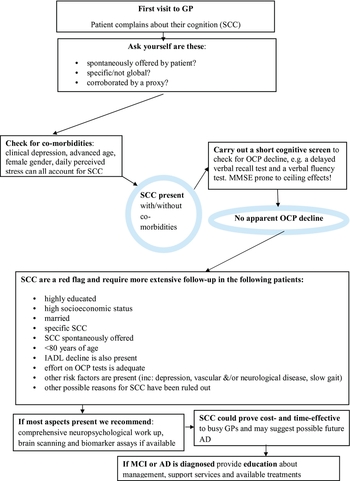
In the flowchart we provide some guidelines/recommendations for GPs and other healthcare workers who listen to their patients’ SCC and wonder what to make of them.
How to interpret patients’ subjective cognitive complaints (SCC): recommendations for General Practitioners and other healthcare workers

The relationship between SCC and OCP is likely to be complex and multi-dimensional.Reference Rayner, Wrench and Wilson114 Many of the risk factors for having SCC in the first place can be important in predicting future cognitive decline; there is obvious overlap between risk factors and predictor variables. In the flowchart we highlight the individual characteristics that are the most likely signs of underlying neurodegeneration and subsequent AD in those presenting with SCC at baseline.
Furthermore, as discussed earlier in this review, the context and time of measurement, study design, demographic characteristics, and the instruments and specific questions used to assess both SCC and OCP are also important. Patients who spontaneously complain to their GPs about their cognition may be more likely to convert to AD versus those who are asked to fill in self-report questionnaires or those who are directly questioned by their doctors.Reference Coley, Ousset, Andrieu, Matheix Fortunet and Vellas50 Of course it is also true that GPs can help or hinder patient disclosure and educating GPs on the importance of SCC may be of fundamental importance in the years ahead as people live longer.Reference Pennbrant, Pilhammar Andersson and Nilsson115 GPs are after all the gatekeepers for patient referralReference Artero and Ritchie116 and it is a worry that many AD patients are not diagnosed early enough.Reference van den Dungen, van Marwijk, van der Horst, Moll van Charante, Macneil Vroomen, van de Ven and van Hout1
Also, as stated earlier, the literature suggests that links between SCC and OCP are more likely to be found when longitudinal designs are employed (rather than cross-sectional) (see e.g.Reference Jonker, Geerlings and Schmand29, Reference Jessen, Wiese, Bachmann, Eifflaender-Gorfer, Haller, Kolsch, Luck, Mosch, van den Bussche, Wagner, Wollny, Zimmermann, Pentzek, Riedel-Heller, Romberg, Weyerer, Kaduszkiewicz, Maier and Bickel117, Reference Reisberg, Shulman, Torossian, Leng and Zhu118) and important variables are controlled (e.g. depression, gender, age, dementia status, education, premorbid IQ, etc.) in community-based samples.Reference Carter, Rourke, Murji, Shore and Rourke84 At the very least, doctors should take the age of the patient, their education level, and their history of depression into account when attempting to interpret that patient's SCC.
Conclusions and implications
The link between SCC and OCP demands further investigation and long-term follow-up. Unfortunately, AD is under-diagnosed in primary care centres and often not recognized by GPs until it is in the moderate stages, often due to time constraints, GPs not testing for cognitive difficulties unless mentioned by patients and/or their families, and lack of confidence in AD diagnosis among doctors.Reference Malek-Ahmadi, Davis, Belden, Laizure, Jacobson, Yaari, Singh and Sabbagh43 Identifying AD at the primary care level is not an easy task.Reference Artero and Ritchie116 We need measures that are sensitive to very subtle cognitive decline (one of the recommendations by the National Institute on Aging/Alzheimer's Association workgroupReference Sperling, Aisen, Beckett, Bennett, Craft, Fagan, Iwatsubo, Jack, Kaye, Montine, Park, Reiman, Rowe, Siemers, Stern, Yaffe, Carrillo, Thies, Morrison-Bogorad, Wagster and Phelps4). Assessing the individual patient's specific SCC may be the measures we are looking for and may be present long before OCP decline. Crucially, SCC are easily obtained in primary practice and cost next to nothing to measure. In an ideal world the physician could then use a patient's cognitive complaints plus their individual characteristics and proxy reports to predict current daily and long-term cognitive functioning and ultimately provide a better service to both the patient and their family.
Listening to patients has always been part of medical practice. What they and their caregivers tell us could help us predict how well our patients will recover or deteriorate, whether they will develop AD or not, and should in turn guide not only rehabilitation strategies but also provide patients and their caregivers strategies to improve their QoL. Biomarkers, brain scans and comprehensive neuropsychological assessments all still have their parts to play; SCC may simply be the first cost- and time-effective clues for some individuals on the road to clinical diagnosis. At the very least, SCC are simple tools that can help GPs identify vulnerable patients who require close follow-up.Reference Waldorff, Siersma, Vogel and Waldemar109 We should, however, not rely on SMC alone but rather assess all SCC including language, attention and executive functioning. SCC are typically first mentioned by patients in primary care and should be carefully considered along with other variables as a risk factor for developing AD (see alsoReference Cappa119). Research in this field might even provide the clues needed to achieve the holy grail in dementia care: to catch AD early enough in the lifespan that we can eventually wipe it out completely.
Conflicts of interest
None declared.