Quantitative and qualitative reviews suggest that children's involvement in interparental conflict, characterized by behavioral efforts to directly mediate or intervene in parental disputes, is a significant public health issue (Macfie, Brumariu, & Lyons-Ruth, Reference Macfie, Brumariu and Lyons-Ruth2015; Rhoades, Reference Rhoades2008). In underscoring its prevalence, research indicates that more than 70% of children intervene in parental disputes (Jenkins, Smith, & Graham, Reference Jenkins, Smith and Graham1989; Mueller, Jouriles, McDonald, & Rosenfield, Reference Mueller, Jouriles, McDonald and Rosenfield2015). In addition, previous research demonstrates that children's risky involvement in interparental conflict uniquely predicts internalizing, externalizing, and social problems over and above the effects of other known predictors (e.g., interparental problems, child life stress, and socioeconomic status; e.g., Davis, Hops, Alpert, & Sheeber, Reference Davis, Hops, Alpert and Sheeber1998; Jenkins et al., Reference Jenkins, Smith and Graham1989; Mueller et al., Reference Mueller, Jouriles, McDonald and Rosenfield2015; O'Brien, Bahadur, Gee, Balto, & Erber, Reference O'Brien, Bahadur, Gee, Balto and Erber1997; O'Brien, Margolin, & John, Reference O'Brien, Margolin and John1995). By the same token, the wide array of different forms of pathological sequelae of children's risky involvement limits the ability to identify children who are most at risk for experiencing specific patterns of maladjustment. Distinguishing between different forms of risky involvement may provide greater specificity in predicting children's developmental sequelae. However, there is currently a paucity of research that has attempted to dissect distinct forms of children's risky involvement (e.g., Davis et al., Reference Davis, Hops, Alpert and Sheeber1998; Schermerhorn, Cummings, DeCarlo, & Davies, Reference Schermerhorn, Cummings, DeCarlo and Davies2007). Thus, this study examined the developmental value of disentangling different forms of children's risky involvement in predicting children's subsequent adjustment. Although research has largely pathologized children's risky involvement in interparental conflict, these behaviors likely emerged as part of an adaptive coping response to threatening socialization contexts and may confer benign developmental outcomes (Davies, Martin, & Sturge-Apple, Reference Davies, Martin, Sturge-Apple, Cicchetti and Cohen2016). Consequently, we tested whether the different forms of risky involvement provided developmental utility in predicting both children's benign and maladaptive adjustment.
Although little is known about the sequelae of children who exhibit specific forms of risky involvement, several prevailing theories have emphasized the general developmental significance of children's interventions in interparental conflict. According to emotional security theory (Cummings & Davies, Reference Cummings and Davies2010), involvement is a sign of children's difficulties preserving a sense of security in the interparental relationship and, as a result, is theorized to increase children's risk for psychopathology. In building on the original theory, the reformulated version of emotional security theory (EST-R) proposes that some forms of involvement reflect distinct, overarching strategies for identifying and guarding against the harm of exposure to interparental conflict (Davies & Martin, Reference Davies and Martin2014). For example, bids to entertain the parents during conflicts have been identified as part of a mobilizing pattern of garnering attention and support from parents as a way to defuse the threat associated with interparental conflict. Likewise, family systems theory has highlighted how boundary disturbances in the family unit may manifest in parent–child relationship patterns characterized by parentification (i.e., child assumes the role of the parent) and triangulation (i.e., child is drawn into the parental subsystem) (Nuttall & Valentino, Reference Nuttall and Valentino2017). Although these theories support the utility of examining children's ways of intervening in interparental conflict, no systematic taxonomy exists for distinguishing between the composition and sequelae of different forms of involvement. Therefore, guided by existing theories, a primary goal of this study is to identify the specific developmental implications of a system for distinguishing between three patterns of risky involvement that are organized around higher-order functions of coercive control (i.e., coercive involvement), caretaking (i.e., caregiving involvement), and vigilance (i.e., cautious involvement).
Coercive involvement
Coercive involvement reflects a dysregulated, authoritarian pattern of risky involvement characterized by children's attempts to interrupt or end parents’ conflict by undermining parental authority (Davis et al., Reference Davis, Hops, Alpert and Sheeber1998; Davies, Coe, Martin, Sturge-Apple, & Cummings, Reference Davies, Coe, Martin, Sturge-Apple and Cummings2015; Schermerhorn et al., Reference Schermerhorn, Cummings, DeCarlo and Davies2007; Warmuth, Cummings, & Davies, Reference Warmuth, Cummings and Davies2018). Support for the viability of a coercive involvement dimension is rooted, in part, in constructs from emotional security theory. Guided by emotional security theory, children's behavioral dysregulation characterized by hostile, aggressive, and defiant ways of responding to interparental conflict has been identified as a dimension of emotional insecurity (Davies et al., Reference Davies, Harold, Goeke-Morey, Cummings, Shelton, Rasi and Jenkins2002b; Schermerhorn et al., Reference Schermerhorn, Cummings, DeCarlo and Davies2007; Warmuth et al., Reference Warmuth, Cummings and Davies2018). However, because behavioral dysregulation reflects general patterns of aversive behavior in response to interparental conflict, it does not specifically distinguish between involvement responses directed toward parents from disruptive behavior aimed at other family members (e.g., siblings) or inanimate objects (e.g., toys) (Davies et al., Reference Davies, Harold, Goeke-Morey, Cummings, Shelton, Rasi and Jenkins2002b). Likewise, the dominant pattern of responding in EST-R is characterized by some coercive involvement behaviors (e.g., name-calling, yelling) that are part of a broader pattern integrated into a profile of anger, vigilance, defensiveness, and suppression of vulnerable negative emotions. However, involvement in interparental conflict is not a necessary criterion for children who exhibit dominant patterns of reactivity to interparental conflict (Davies & Martin, Reference Davies and Martin2013). In applying EST-R specifically to the characterization of involvement, Davies et al. (Reference Davies, Coe, Martin, Sturge-Apple and Cummings2015) identified a coercive pattern of child involvement during an observational parent disagreement task, which was defined by children's aversive, bossy, and domineering efforts to interrupt or stop parental conflicts.
Various theories provide some initial support for the premise that coercive involvement will be a particularly potent predictor of children's externalizing problems and callous traits. Family systems and social learning applications have proposed that children's aversive behavioral reactions to interparental conflict may progressively increase in frequency and intensity through the function they serve in distracting parents from their conflicts and successfully terminating the aversive nature of the disagreement for the entire family unit (Davies, Cicchetti, & Martin, Reference Davies, Cicchetti and Martin2012; Davies & Cummings, Reference Davies and Cummings1994; Emery, Reference Emery1989). Over time, this negative reinforcement of children's bossy, aversive behavior is posited to develop into a more intense, trait-like pattern of bold, aggressive, and domineering behavior. Likewise, in EST-R, dominant patterns of responding to interparental conflict are proposed to be coupled with tendencies for children to progressively downplay the value of close social relationships and, in turn, lay the foundation for the development of interpersonal callousness and hostility (Davies & Martin, Reference Davies and Martin2013). In highlighting the potential benefits of a coercive pattern of involvement, EST-R proposes that successful efforts to control challenging and stressful interactions may foster broader self-confidence for approaching other risky or novel interpersonal contexts (Davies & Martin, Reference Davies and Martin2013). Thus, this emerging confidence is proposed, in EST-R, to coalesce into the higher-order trait of extraversion (Davies & Martin, Reference Davies and Martin2013; Depue & Collins, Reference Depue and Collins1999).
Although research has yet to examine coercive involvement as a distinct precursor of the pattern of adjustment marked by externalizing problems, callousness, and extraversion, there is some piecemeal, indirect support for parts of the hypotheses. For example, the broad assessment of behavioral dysregulation in response to conflict in emotional security theory, which may partially reflect forms of coercive involvement, has been concurrently and prospectively related to greater externalizing problems (Davies et al., Reference Davies, Harold, Goeke-Morey, Cummings, Shelton, Rasi and Jenkins2002b; Schermerhorn et al., Reference Schermerhorn, Cummings, DeCarlo and Davies2007; Warmuth et al., Reference Warmuth, Cummings and Davies2018). Likewise, in sharing partial overlap with coercive forms of involvement, the dominant pattern of reactivity in EST-R has been documented to be a predictor of both greater externalizing symptoms and extraversion (Davies, Martin, Sturge-Apple, Ripple, & Cicchetti, Reference Davies, Martin, Sturge-Apple, Ripple and Cicchetti2016). Finally, as the most direct test of the psychological sequelae of coercive involvement, Davies et al. (Reference Davies, Martin, Sturge-Apple, Ripple and Cicchetti2016b) showed that a behavioral observational assessment of children's coercive involvement in interparental conflict was concurrently related to greater oppositional defiant disorder and attention deficit disorder symptoms but was not a prospective predictor of subsequent increases in these forms of externalizing symptoms. However, the analyses did not test the distinctive role of coercive involvement as a predictor in the context of other risky forms of involvement. Likewise, the power to identify sequelae in this study may have been limited by the brief observational assessment of coercive involvement during a 10-minute interparental conflict interaction. Thus, more research is needed to provide a direct test of whether children's characteristic tendencies to become coercively involved in conflicts may be a precursor of a unique portfolio of adjustment outcomes.
Caregiving involvement
As a second risky form of involvement, caregiving involvement is reflected in a parentified role-reversal process in which children function as caregivers to provide instrumental and emotional support to fulfill their parents’ unmet needs (Borzormenyi-Nagy & Spark, Reference Borzormenyi-Nagy and Spark1973; Jurkovic, Reference Jurkovic and L'Abate1998). Consistent with the conceptualization of caregiving involvement, studies examining parentification in broader family contexts have indicated that even young children act as confidantes, mediators, problem-solvers, and emotional caretakers for parents (e.g., Burton et al., Reference Burton, Hooper, Tomek, Cauley, Washington and Pössel2018; Peris, Goeke-Morey, Cummings, & Emery, Reference Peris, Goeke-Morey, Cummings and Emery2008). Thus, from a family systems perspective, parentification in the form of role reversal across various family contexts may be specifically manifested in children's caretaking behaviors directed explicitly toward one or both parents. Behaviors indexing caregiving involvement also share some overlap with emotional security formulations of overall involvement (e.g., solving parental problems, comforting one or both parents) (Davies et al., Reference Davies, Harold, Goeke-Morey, Cummings, Shelton, Rasi and Jenkins2002b, Reference Davies, Coe, Martin, Sturge-Apple and Cummings2015; Davies, Forman, Rasi, & Stevens, Reference Davies, Forman, Rasi and Stevens2002; Shelton & Harold, Reference Shelton and Harold2008). However, the broader constellation of involvement within the EST framework also reflects other forms of involvement (e.g., yelling at parent, siding with one parent over the other) that may have distinct sequalae from caregiving forms of involvement.
Emotional security and role-reversal conceptualizations provide a theoretical base for the hypothesis that caregiving involvement will be a predictor of children's internalizing problems. According to the role-reversal literature, children's caregiving behaviors during conflict offer a brief temporary modicum of comfort and security through increasing parental proximity and attention (Macfie et al., Reference Macfie, Brumariu and Lyons-Ruth2015; Solomon & George, Reference Solomon, George, Solomon and George2011). However, children's caregiving behaviors are unlikely to meet the complex expectations of parents fostering feelings of self-blame and incompetence, which, in turn, increase children's risk for internalizing problems (Kerig, Reference Kerig2005). Relatedly, emotional security theory hypothesizes that young children's rudimentary caregiving and problem-solving skills are likely to emotionally entangle children in conflicts while having only limited success in resolving the difficulties between their parents. Thus, the resulting insecurity, self-blame, and helplessness they experience are theorized to increase children's risk for anxiety and depressive symptoms (Davies et al., Reference Davies, Harold, Goeke-Morey, Cummings, Shelton, Rasi and Jenkins2002b). Although caregiving involvement may increase children's vulnerability to internalizing problems, it is also plausible that it may provide a training ground for the acquisition and refinement of emotion understanding and caretaking skills. Thus, children exhibiting this risky pattern of involvement are hypothesized to have higher levels of prosocial behavior by virtue of their heightened sensitivity to the distress of others and better social perspective taking abilities (Van der Graaff, Carlo, Crocetti, Koot, & Branje, Reference Van der Graaff, Carlo, Crocetti, Koot and Branje2018; Williams, O'Driscoll, & Moore, Reference Williams, O'Driscoll and Moore2014).
Although caregiving involvement has yet to be empirically examined as a predictor of children's internalizing problems and prosocial behavior, there is some indirect support for this hypothesis. For example, studies have shown that children's adoption of caregiving roles in the greater family unit (e.g., with siblings) are associated with both greater internalizing problems and prosocial behavior (e.g., for reviews, see Macfie et al., Reference Macfie, Brumariu and Lyons-Ruth2015; Nuttall & Valentino, Reference Nuttall and Valentino2017). However, Peris and Emery (Reference Peris and Emery2005) have noted a relative paucity of research empirically examining parentification specifically within contexts of interparental conflict. Research has predominantly been limited to involvement constructs within emotional security theory and have yielded mixed results. For example, some studies have identified significant associations between involvement and internalizing symptoms that are limited to a specific informant (i.e., child report vs. parent report) (Davies et al., Reference Davies, Forman, Rasi and Stevens2002a), while other studies have failed to identify either concurrent or prospective associations between the constructs (Davies et al., Reference Davies, Coe, Martin, Sturge-Apple and Cummings2015). As noted in previous emotional security work (Davies et al., Reference Davies, Forman, Rasi and Stevens2002a), the mixed findings may reflect the need to further parse involvement into specific dimensions and examine their distinctive implications for children's psychological functioning. Toward this goal, we examined whether a dimensional assessment of caregiving involvement uniquely predicts children's psychological adjustment relative to the other risky forms of involvement, particularly in predicting children's internalizing symptoms and prosocial behavior.
Cautious involvement
As a final form of intervention, cautious involvement is conceptualized as a product of competing impulses to simultaneously avoid and engage in parental conflicts as reflected in apprehension, vigilance to threat, and guarded involvement (Davies & Forman, Reference Davies and Forman2002). Although the cautious form of involvement has yet to be empirically examined in the literature, a previous study on the multiplicative interaction between multiple domains of responding to interparental conflict supported the existence of a group of children who exhibited high levels of fearful distress coupled with heightened involvement (Davies et al., Reference Davies, Coe, Martin, Sturge-Apple and Cummings2015). Thus, although it is not clear whether high levels of fearful distress and involvement were expressed in reticent, submissive forms of intervention, the findings provided some indirect support for the prevalence of a cautious form of involvement. In further support of the occurrence of cautious involvement, emotional security scales indexing involvement and avoidance behaviors that are partly expressed in submissive, guarded behaviors have been shown to be moderately correlated (Davies et al., Reference Davies, Forman, Rasi and Stevens2002a).
Emotional security formulations provide an underlying theoretical foundation for hypothesizing that cautious involvement will be a predictor of children's anxiety and social withdrawal. For example, EST-R proposes that the reticence and hypervigilance accompanying cautious involvement is specifically theorized to increase children's sensitivity to threat and harm avoidance in subsequent conflicts and, in turn, increase their risk for entrenched patterns of anxiety and social withdrawal over time (Davies & Martin, Reference Davies and Martin2013). In highlighting the potential benign side of cautious involvement, EST-R additionally postulates that children's heightened sensitivity to social stimuli and tendency to comply with challenging interpersonal situations may facilitate children's cooperation and consideration, reflected in greater prosocial behavior (Davies & Martin, Reference Davies and Martin2013). Likewise, children's ability to regulate outward displays of personal distress are proposed to engender higher levels of sympathy and may confer developmental benefits in the form of prosocial behavior (Eisenberg, Reference Eisenberg2000). Although studies have yet to directly test these hypotheses, there is some, albeit mixed, evidence that loosely related proxies for cautious involvement may be associated with some of the hypothesized outcomes. For example, an aggregated measure of children's avoidance and involvement responses to interparental conflict was concurrently related to their greater social withdrawal and anxiety problems (Davies et al., Reference Davies, Harold, Goeke-Morey, Cummings, Shelton, Rasi and Jenkins2002b). However, in another study examining the interaction between heightened fearful distress and greater involvement failed to predict children's externalizing problems but not their internalizing symptoms (Davies et al., Reference Davies, Coe, Martin, Sturge-Apple and Cummings2015). Given that the limited empirical work does not precisely capture the hypothesized organization of behaviors within the cautious involvement construct, additional research is needed to trace the specific developmental implications of this pattern-based form of risky involvement.
Present study
We specifically examined the distinct predictive utility of each risky form of involvement in the prediction of children's developmental sequelae during the transition to formal schooling for several developmental reasons. First, research suggests that the tendency to become involved in interparental conflict is higher during this developmental period relative to earlier and subsequent periods (Davies & Cummings, Reference Davies and Cummings1994; Grych & Fincham, Reference Grych and Fincham1990). Second, improvements in social perspective taking abilities from toddlerhood to the preschool age may increase preschool children's concerns about the welfare and safety of their parents outside of the parent–child relationship, thus potentially drawing children into conflicts in the interparental subsystem (Cummings & Davies, Reference Cummings and Davies2010; Davies et al., Reference Davies, Martin, Sturge-Apple, Cicchetti and Cohen2016a). Third, in contrast to older children, preschool children are more likely to experience self-blame in response to interparental discord, which may increase their risk for engaging in interparental conflict (Grych & Fincham, Reference Grych and Fincham1990). Fourth, the early school years has been conceptualized as a switch point for the consolidation of socialization experiences into relatively stable strategies for responding to subsequent adversity that may, by virtue of their enduring nature, increase their potency as predictors of later mental health outcomes (Del Giudice, Gangestad, & Kaplan, Reference Del Giudice, Gangestad, Kaplan and Buss2015).
In summary, despite providing some preliminary support for the value of identifying multiple dimensions of risky involvement, research has yet to examine the unique predictive utility of coercive, caregiving, and cautious forms of involvement. In addressing this gap, we sought to examine, for the first time, these three risky forms of involvement as simultaneous predictors of children's maladaptive and benign developmental sequelae. To increase the rigor of our analytic tests, we utilized a multimethod, multi-informant, longitudinal design across two waves of data spaced 2 years apart. Our goal in developing the measurement approach for capturing risky forms of involvement was to complement the predominant reliance on questionnaire and observational assessments in previous research by coding maternal narratives derived from a semistructured interview on interparental conflict (e.g., Davies et al., Reference Davies, Coe, Martin, Sturge-Apple and Cummings2015; Mueller et al., Reference Mueller, Jouriles, McDonald and Rosenfield2015; Schermerhorn et al., Reference Schermerhorn, Cummings, DeCarlo and Davies2007). In comparison to observational assessments that typically capture brief snapshots of behavior over the span of minutes, the semistructured interview format can be designed to assess characteristic patterns of responding across multiple interactions. Relative to the prefabricated items on questionnaires that are largely generated by researchers and potentially open to multiple interpretations by participants, the open-ended responses derived from reciprocal exchanges between interviewer and partner facilitate the development of a shared understanding of events and behaviors and the potential to identify novel patterns of behaviors (Sullivan, Reference Sullivan1998; Yoshikawa, Weisner, Kalil, & Way, Reference Yoshikawa, Weisner, Kalil and Way2008).
Given that theory and limited research provide only initial support for the three risky forms of involvement, we utilized a mixed methods approach to investigate the nature and sequelae of pattern-based forms of children's risky involvement of interparental conflict (Korbin, Coulton, Chard, Platt-Houston, & Su, Reference Korbin, Coulton, Chard, Platt-Houston and Su1998; Sullivan, Reference Sullivan1998; Yoshikawa et al., Reference Yoshikawa, Weisner, Kalil and Way2008). Thus, our grounded qualitative approach was designed to maximize the objective, systematic identification of possible forms of involvement including forms reflected in the existing literature as well as forms that have yet to be identified. More specifically, for the qualitative component of the study, we utilized thematic analysis to distinguish between specific risky forms of involvement through a recursive process that combines deductive and inductive approaches to reducing data and identifying pattern-based themes (Braun & Clarke, Reference Braun and Clarke2006, Reference Braun, Clarke, Cooper, Camic, Long, Panter, Rindskopf and Sher2012). In reflecting the quantitative facet of the study, we developed a quantitative coding system for capturing dimensional ratings of the coercive, caregiving, and cautious forms of involvement identified in thematic analysis (see the Method section for more details). Guided by our hypotheses about the sequelae for each form of involvement, we subsequently specified coercive, caregiving, and cautious forms of involvement as simultaneous predictors of change in children's externalizing symptoms, callousness, extraversion, separation anxiety, depressive symptoms, social withdrawal, and prosocial behavior. Each of these sequelae are highly salient during children's transition to the early school years. For example, in support of the developmental prominence of separation anxiety as an index of anxiety, research on the rates of anxiety symptoms indicate that separation anxiety is more prevalent relative to other forms of anxiety (e.g., generalized, social) during the early school years (Earls, Reference Earls1982; Franz et al., Reference Franz, Angold, Copeland, Costello, Towe-Goodman and Egger2013; Keenan, Shaw, Walsh, Delliquadri, & Giovannelli, Reference Keenan, Shaw, Walsh, Delliquadri and Giovannelli1997). Likewise, externalizing behaviors and callousness during this developmental period are proposed to substantially increase children's risk for significant psychological impairments throughout childhood, adolescence, and adulthood (Bongers, Koot, van der Ende, & Verhulst, Reference Bongers, Koot, van der Ende and Verhulst2003; Kouros, Cummings, & Davies, Reference Kouros, Cummings and Davies2010; Waller & Hyde, Reference Waller and Hyde2018).
Method
Participants
Two hundred and forty-three mothers and their children were recruited from a moderate-sized metropolitan area in the Northeast. To obtain a diverse demographic sample we recruited from multiple agencies (i.e., local preschools, Head Start agencies, public and private daycares). Families were invited to participate in a study that was focused on how family relationships impact child development. Families were eligible to participate in the larger project if (a) partners and child were all willing to participate, (b) the child was the biological offspring of at least one parent, (c) the mother, their intimate partner, and the child had regular sustained interactions as a triad (i.e., at least 2 to 3 days per week) for the past year, (d) the child was 4 or 5 years old at Wave 1 and within 1 year of expected enrollment into kindergarten, (e) the child was not in an adoptive, foster, or kinship care arrangement, and (f) the child had no significant cognitive, sensory, or motor impairments that may have compromised the validity of assessments. At Wave 1, children were on average 4.6 years old (SD = .44) and approximately half of the sample (56%) was girls. The median household income was $36,000 per year (range = $2,000–$121,000), and most families (69%) received public assistance. The median parental education consisted of a GED (General Education Development) or high school diploma, with approximately 19% of parents receiving less than a high school diploma or GED. About half of the families identified as Black or African American (48%), and the remainder were White (43%), multiracial (6%), or another race (3%). Approximately 16% of the family members identified as Latino. At Wave 1, the majority of mothers (99%) were the child's biological parent and 74% of intimate partners were the child's biological father. About half of partners (47%) were married and the majority (93%) lived together currently. Partners had lived together for an average of 3.36 years and, on average, the triad interacted on a daily basis (range = daily to two or three days a week). The retention rate across the waves was 91%.
Procedures
Families visited our research laboratory at two waves of data collection spaced 2 years apart. All research procedures were approved by the Institutional Review Board at the University of Rochester prior to conducting the study (Title: “Children’s Development in the Family”; Approval #: 00030261).
Interparental disagreement interview
The interparental disagreement interview (IDI) is a semistructured, narrative interview completed with mothers and examines children's behavioral and emotional reactivity during and immediately after interparental conflicts (Davies et al., Reference Davies, Cicchetti and Martin2012). During Wave 1, mothers were asked to pick conflict topics that they and their partner disagreed about most often in front of their child during the past year. Trained experimenters then administered a series of six open-ended questions to mothers pertaining to children's behavioral (e.g., “During these disagreements that [child] sees or hears, how does s/he respond?”) and emotional (e.g., “How do you think [child] feels during these disagreements?”) reactivity in response to the interparental conflict topic chosen by the mother. Interviews were on average 22.6 min long (range = 9.1 to 49.6 min) and were video recorded for later coding.
Maternal assessments of child adjustment
At both time points, mothers completed the parent version of the MacArthur Health and Behavior Questionnaire (HBQ; Ablow et al., Reference Ablow, Measelle, Kraemer, Harrington, Luby and Kupfer1999) and the Young Child Diagnostic Interview Schedule for Children (DISC-IV-YC; Lucas, Fisher, & Luby, Reference Lucas, Fisher and Luby1998). As one assessment of children's psychopathology, the HBQ measures children's mental health symptoms along a three-point scale (0 = never or not true, 2 = often or very true). The HBQ has demonstrated sound psychometric properties (Ablow et al., Reference Ablow, Measelle, Kraemer, Harrington, Luby and Kupfer1999), including strong test–retest reliability and discriminant validity. As a second assessment of children's psychopathology, the DISC-IV-YC is a structured interview modified from the DISC-IV (Shaffer, Fisher, Lucas, Dulcan, & Schwab-Stone, Reference Shaffer, Fisher, Lucas, Dulcan and Schwab-Stone2000) and provides a symptom count (1 = present, 0 = absent) for various forms of psychopathology. Research has provided support for the concurrent, convergent, and predictive validity of the DISC-YC modules (Kim-Cohen et al., Reference Kim-Cohen, Arseneault, Caspi, Tomás, Taylor and Moffitt2005, Reference Kim-Cohen, Arseneault, Newcombe, Adams, Bolton, Cant and Matthews2009; Luby et al., Reference Luby, Heffelfinger, Mrakotsky, Hessler, Brown and Hildebrand2002; Piacentini et al., Reference Piacentini, Shaffer, Fisher, Schwab-Stone, Davies and Gioia1993; Shaffer et al., Reference Shaffer, Fisher, Lucas, Dulcan and Schwab-Stone2000). At both waves, mothers also completed the Inventory of Callous-Unemotional Traits (ICU; Essau, Sasagawa, & Frick, Reference Essau, Sasagawa and Frick2006; Frick, Reference Frick2004), which consists of three subscales (i.e., callous, unemotional, uncaring) measuring children's callous and unemotional traits along a four-point scale (0 = not at all true, 3 = definitely true). The ICU has demonstrated acceptable validity in previous research (Cardinale & Marsh, Reference Cardinale and Marsh2020).
Experimenter assessments of child adjustment
At Waves 1 and 2, experimenters completed the California Child Q-Set (CCQ; Block, Reference Block2008), which provides 100 descriptors of children's psychological adjustment that experimenters categorize into nine piles ranging from “extremely uncharacteristic” to “extremely characteristic.” The CCQ has sound psychometric properties including concurrent and predictive validity (Wilson, Schalet, Hicks, & Zucker, Reference Wilson, Schalet, Hicks and Zucker2013). CCQ scores were derived from the experimenters who primarily oversaw the child during laboratory visits and rated children's functioning based on an average of five cumulative hours of contact with children that included visit tasks, transition periods, and transportation between homes and the research center (SD = 1, range = 3–8 hr). For the purposes of calculating reliability, a second experimenter responsible for videotaping and observing a portion of the visits also completed the CCQ for 100% of the visits. In most cases, different experimenters completed the CCQ across the two waves of data collection.
Measures
Children's risky involvement in interparental conflict
At Wave 1, we obtained measurements of children's risky involvement in interparental conflict using the IDI. Risky forms of involvement were identified utilizing thematic analysis, a method for organizing patterns, or themes from qualitative data (Braun & Clarke, Reference Braun and Clarke2006, Reference Braun, Clarke, Cooper, Camic, Long, Panter, Rindskopf and Sher2012). Following Braun and Clarke's (Reference Braun, Clarke, Cooper, Camic, Long, Panter, Rindskopf and Sher2012) step-by-step guide, the first step involved simultaneously familiarizing ourselves with the maternal narratives derived from the IDI while conducting a systematic analysis of the interparental conflict and broader parent–child relationships (e.g., family systems, attachment) literature from which we deductively identified four existing forms of involvement (i.e., adaptive, caregiving, coercive, and disorganized) and derived 12 initial specific involvement behaviors: (a) benign mediation of parental conflict, (b) asking questions about parental dispute, (c) empathetic concern for parents’ welfare, (d) problem-solving, (e) comforting/protecting one or both parents, (f) placating parents through appeasing behaviors (e.g., inauthentic displays of charm or over-bright behavior), (g) drawing parental attention to self, (h) attempting to end the disagreement through bossy, authoritarian behavior, (i) undermining one or both parents, (j) taking sides, (k) emotionally vulnerable, (l) mixed usage of strategies. Following familiarization with our data and the generation of these initial codes, we more thoroughly examined a random sample of the maternal narratives to identify any additional codes through an inductive, data-driven process. During this process we identified three additional involvement behaviors (assessing climate/safety, assessing need for protection/comfort, assessing parental emotional state). Next, behaviors were sorted and organized into five potential themes, or forms, of involvement: coercive, caregiving, cautious, disorganized, and adaptive. After specific involvement behaviors were organized into overarching themes, we reviewed the themes to determine whether any themes could be: (a) aggregated due to considerable substantive overlap; (b) parsed further into distinct patterns, or (c) dropped due to limited support for their prevalence. Through this revision process we excluded the disorganized and adaptive forms of involvement from our identification of risky forms of involvement. Adaptive involvement, characterized by children's secure and prosocial strategies for constructively regulating interparental conflict was excluded because it did not reflect significant preoccupation or risk associated with risky involvement. Disorganized involvement, reflecting emotional vulnerability and incoherent involvement strategies (i.e., inexplicable fluctuations between strategies, out of context behaviors), was further excluded because there was insufficient evidence for its prevalence. As a result, three risky forms of children's involvement in interparental conflict were subsequently quantified from the full data set of maternal narratives. We used a global coding approach to more meaningfully capture children's organized patterns of involvement across the duration of the interparental conflict.
Trained raters coded each risky involvement profile along a five-point continuous scale (1 = not at all characteristic, 5 = highly characteristic) based on maternal descriptions of frequency, intensity, and patterning of children's behavioral responses across the entire maternal narrative. First, coercive involvement reflects children's behavioral attempts to interrupt or end interparental conflict by undermining parental authority. Coercive involvement behaviors co-occur with anger or aggression. Example behaviors include: (a) using bossy, authoritarian tactics to interrupt or end the conflict (e.g., yelling “Stop!”); (b) undermining parental authority (e.g., talking over parents); (c) taking sides (e.g., mocking or insulting one parent); (d) verbally or physically aggressive behavior directed toward one or both parents (e.g., yelling at parents); and (e) angry or coercive behaviors (e.g., misbehaving) that distract parents from their disagreements. Whereas low scores were reserved for interviews in which there was little to no indication that the child engaged in coercive involvement, high scores reflected maternal portrayals of their children who exhibit intense and prolonged coercive behaviors challenging parental authority.
Second, caregiving involvement is reflected in children's behaviors that place the instrumental or emotional needs of a parent before their own needs for attention, comfort, or guidance. Example caregiving involvement behaviors include: (a) providing comfort to one or both parents (e.g., hugging parents); (b) placating parents through anxious, appeasing behaviors (e.g., intense, awkward smiling); (c) providing protection to one or both parents with minimal signs of anger or coercion (e.g., saying “Stop yelling at mom.”); (d) problem-solving (e.g., verbally offering solutions); and (e) acting as a confidante or advisor (e.g., keeping a parent's secret). Low scores reflected maternal narratives in which there was little to no indication that the child engaged in caregiving behaviors. High scores were reserved for maternal portrayals of their children who exhibit intense and prolonged caregiving behaviors across maternal narratives.
Third, cautious involvement is characterized by a pattern of intervention in which children take a cautious, reserved approach by maintaining awareness to the possibility of danger and threat accompanying parental exchanges. Cautious involvement behaviors co-occur with signs of fear. Example behaviors include: (a) monitoring the safety of the environment (e.g., slowly approaching parents); (b) seeking protection (e.g., hiding behind one parent); and (c) assessing parental emotional states (e.g., asking “Are you ok?” coupled with reserved signs of distress). Low scores reflected little to no indication in maternal narratives that the child engaged in cautious involvement. High scores reflected maternal portrayals of their children who exhibit intense and prolonged cautious attempts to intervene across a multiplicity of forms. To obtain interrater reliability, three coders independently rated 100% of the videos at Wave 1. Coders met with the first author on a weekly basis to discuss and achieve consensus on coding discrepancies. The resulting intraclass correlation coefficient values for coercive, caregiving, and cautious involvement were .89, .80, and .74, respectively. Consensus scores were used when possible; however, when not available (e.g., discrepancies were minimal and thus not discussed in consensus meetings), risky involvement scores were averaged across the three coders for analyses.
Externalizing problems
Children's externalizing problems were measured at Waves 1 and 2 using mothers’ reports of children's externalizing behaviors based on the HBQ (Ablow et al., Reference Ablow, Measelle, Kraemer, Harrington, Luby and Kupfer1999) and the DISC-IV-YC (Lucas et al., Reference Lucas, Fisher and Luby1998). Specific subscales from the HBQ included: (a) conduct problems (12 items; e.g., “Lies or cheats”); (b) overt hostility (four items; e.g., “Gets in many fights”); (c) relational aggression (six items; e.g., “Tries to get others to dislike a peer”); and (d) oppositional defiant disorder (i.e., ODD; nine items; e.g., “Argues a lot with adults”). Internal consistencies for the subscales ranged between .67 and .84 (M = .78) across the two waves of data. Children's externalizing problems extracted from mothers’ interview responses to the DISC-IV-YC conduct disorder (past year) module were represented by a symptom count score computed by summing the 14-items together (e.g., “Bullies, threatens, or intimidates others”; Lucas et al., Reference Lucas, Fisher and Luby1998). Internal consistencies for the conduct problems past year module were .61 and .55 at Waves 1 and 2, respectively. The four HBQ subscales and the DISC-IV-YC conduct problems past year module were standardized and averaged together to create a composite of children's externalizing problems (α = .77 at Wave 1; α = .78 at Wave 2).
Separation anxiety
At Waves 1 and 2, children's separation anxiety was assessed using maternal reports of the HBQ separation anxiety subscale (10 items; e.g., “Is afraid of being away from home”; Ablow et al., Reference Ablow, Measelle, Kraemer, Harrington, Luby and Kupfer1999). Internal consistency for the separation anxiety subscale was .75 and .79 at Waves 1 and 2, respectively. Additionally, a measure of children's separation anxiety was extracted from mothers’ interview responses to the DISC-IV-YC separation anxiety disorder module (Lucas et al., Reference Lucas, Fisher and Luby1998). Children's separation anxiety consisted of a symptom count score computed by summing the 12-items together (e.g., “Sometimes was unable to fall asleep without attachment figure present”). Internal consistencies for the separation anxiety module were .65 and .68 at Waves 1 and 2, respectively. The two separation anxiety assessments obtained from the HBQ and DISC-IV-YC were standardized and averaged together to create a composite of children's separation anxiety (correlations between the two scales were r = .46, p < .001 at Wave 1, and r = .44, p < .001 at Wave 2).
Depressive symptoms
At Waves 1 and 2, children's depressive symptoms were assessed using maternal reports of the HBQ depression subscale (seven items; e.g., “Underactive, slow-moving, or lacks energy”; Ablow et al., Reference Ablow, Measelle, Kraemer, Harrington, Luby and Kupfer1999). Internal consistency for the depression subscale was .51 and .68 at Waves 1 and 2, respectively. Additionally, a measure of children's depressive symptoms was extracted from mothers’ interview responses to the DISC-IV-YC major depressive episode module (Lucas et al., Reference Lucas, Fisher and Luby1998). Children's depression was represented by a symptom count score computed by summing the 22-items together (e.g., “Less energy in the last three months”). Internal consistencies for the depressive symptoms module were .75 and .72 at Waves 1 and 2, respectively. The two depression assessments obtained from the HBQ and DISC-IV-YC were standardized and averaged together to create a composite of children's depressive symptoms. Maternal reports from the HBQ and DISC-IV-YC were moderately and significantly correlated at each wave (r = .46, p < .001 at Wave 1; r = .42, p < .001 at Wave 2).
Social withdrawal
Children's social withdrawal was assessed at Waves 1 and 2 using maternal reports of the HBQ asocial with peers subscale (six items; “Prefers to play alone”; Ablow et al., Reference Ablow, Measelle, Kraemer, Harrington, Luby and Kupfer1999). Internal consistency for the asocial with peers subscale was .68 and .75 at Waves 1 and 2, respectively.
Callous and unemotional traits
At Waves 1 and 2, we obtained a measure of children's callous and unemotional traits using mothers’ responses to the ICU (Essau et al., Reference Essau, Sasagawa and Frick2006; Frick, Reference Frick2004). Consistent with previous research (Essau et al., Reference Essau, Sasagawa and Frick2006), we adopted the more parsimonious approach of using a total score for analyses. The ICU total score was calculated by taking the average of 12 items (e.g., “Does not seem to know ‘right’ from ‘wrong’”). Internal consistency for the ICU total score was .70 and .78 at Waves 1 and 2, respectively.
Prosocial behavior
At Waves 1 and 2, children's prosocial behavior was assessed using the 16-item CCQ Prosocial Behavior scale measuring children's ability to get along with and help others (e.g., “Warm and responsive,” “Helpful and cooperative”; Block, Reference Block2008). Internal consistency for the prosocial behavior scale was .87 and .84 at Waves 1 and 2, respectively. Interrater reliability across experimenters was excellent (.85 and .84 at Waves 1 and 2, respectively).
Extraversion
At Waves 1 and 2, children's extraversion was assessed using the nine-item CCQ Extraversion scale measuring children's social preferences and energy levels (e.g., “talkative,” “vital, energetic, lively”; Block, Reference Block2008). Internal consistency for the extraversion scale was .91 and .94 at Waves 1 and 2, respectively. Interrater reliability was excellent (.86 and .88 at Waves 1 and 2, respectively).
Covariates
At Wave 1, mothers completed the Couples Satisfaction Index (CSI; Funk & Rogge, Reference Funk and Rogge2007). The CSI includes 16 items and captured maternal satisfaction in their relationship with their partner (e.g., “I really feel like part of a team with my partner”; α = .78). Another covariate indexing conflict frequency was quantified from maternal IDI reports of how frequently children were exposed to interparental conflict on a 6-point scale (1 = once or twice a year; 6 = daily). Lastly, two covariates were extracted from the demographic interview with mothers: (a) children's gender (1 = girls, 2 = boys); and (b) maternal educational attainment, derived from the seven-point educational attainment scale (1 = less than seventh grade, 7 = graduate/professional training) of the Hollingshead Four Factor Index of Social Status (Hollingshead, Reference Hollingshead1975).
Results
Descriptive results
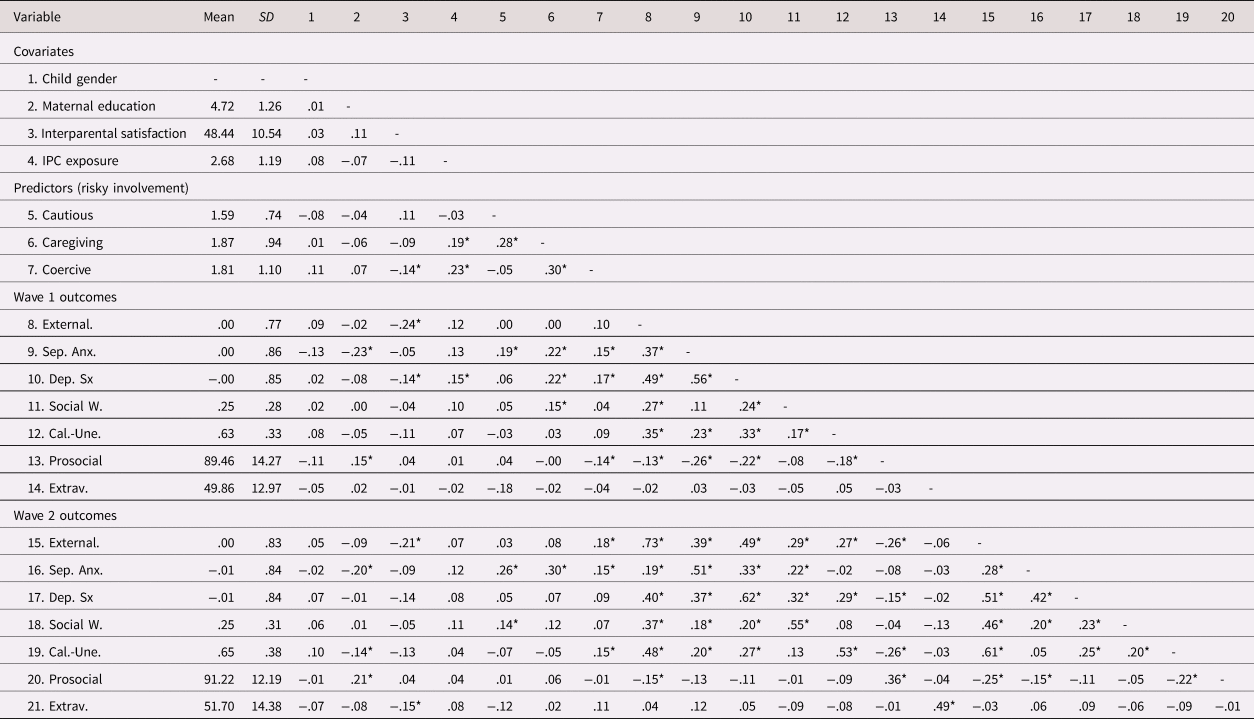
Table 1 provides the means, standard deviations, and correlations among the covariates and primary variables included in the study. Maternal education was significantly correlated with separation anxiety at Waves 1 (r = −.23, p < .001) and 2 (r = −.20, p = .004), prosocial behavior at Waves 1 (r = .15, p = .02) and 2 (r = .21, p = .002), and callousness at Wave 2 (r = −.14, p = .04). Interparental satisfaction was significantly correlated with coercive involvement (r = −.14, p = .04), externalizing problems at Waves 1 (r = −.24, p < .001) and 2 (r = −.21, p = .003), depressive symptoms at Wave 1 (r = −.14, p = .03), and extraversion at Wave 2 (r = −.15, p = .03). Children's frequency of conflict exposure was significantly correlated with children's caregiving involvement (r = .19, p = .003), coercive involvement (r = .23, p < .001), and Wave 1 depressive symptoms (r = .15, p = .02). Although cautious and coercive forms of involvement were not correlated (r = −.05, p = .49), moderate associations were identified between cautious involvement and caregiving involvement (r = .28, p < .001) and caregiving involvement and coercive involvement (r = .30, p < .001). Consistent with hypotheses, cautious involvement was significantly correlated with children's separation anxiety at Waves 1 (r = .19, p = .003) and 2 (r = .26, p < 001) and their social withdrawal at Wave 2 (r = .14, p = .04). Caregiving involvement was significantly correlated with separation anxiety at Waves 1 (r = .22, p = .001) and 2 (r = .30, p < .001), depressive symptoms at Wave 1 (r = .22, p = .001), and social withdrawal at Wave 1 (r = .15, p = .02). Supporting hypotheses, coercive involvement was positively correlated with externalizing problems (r = .18, p = .009) and callous and unemotional traits (r = .15, p = .03) at Wave 2. Finally, coercive involvement was also positively correlated with depressive symptoms at Wave 1 (r = .17, p = .01) and separation anxiety at Wave 1 (r = .15, p = .02) and Wave 2 (r = .15, p = .04), and negatively correlated with prosocial behavior at Wave 1 (r = −.14, p = .03).
Means, standard deviations, and correlations among study variables

Note. IPC exposure = Children's frequency of exposure to interparental conflict; External. = Externalizing problems; Sep. Anx. = Separation anxiety; Dep. SX = Depressive symptoms; Social W. = Social withdrawal; Cal.-Une. = Callous–unemotional traits; Extrav. = Extraversion.
* p < .05.
Study variables were assessed for normality and skewed variables (i.e., DISC-IV-YC and HBQ Wave 1 and 2 conduct problems, HBQ Wave 2 relational aggression, and HBQ Wave 2 depression) were log transformed. Data in our sample were missing on average for 5.0% of the values (range 0–12.8%). Little's MCAR test revealed that the data were missing completely at random, χ2 = 221.81, df = 191, p = .06 (Little, Reference Little1988; Schlomer, Bauman, & Card, Reference Schlomer, Bauman and Card2010). Because maximum likelihood approaches produce accurate parameter estimates for all types of missing data when less than 20% of the data are missing (Schlomer et al., Reference Schlomer, Bauman and Card2010), we used the full information maximum likelihood technique for estimating data.
Primary analyses
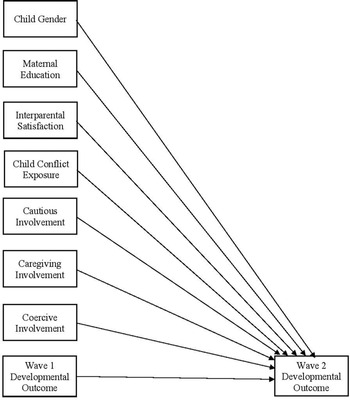
We examined each form of risky involvement at Wave 1 as simultaneous predictors of children's Wave 2 adjustment (i.e., externalizing problems, separation anxiety, depressive symptoms, social withdrawal, callous-unemotional traits, prosocial behavior, and extraversion) in seven successive path analysis models. All primary analyses were conducted using AMOS 25.0 software (Arbuckle, Reference Arbuckle2017). Figure 1 presents a conceptual depiction of the path model. In each model, we specified the four covariates (i.e., child sex, maternal education, interparental satisfaction, and the frequency of children's exposure to interparental conflict) and three forms of risky involvement (i.e., cautious, caregiving, and coercive) as predictors of children's Wave 2 developmental outcomes. We also estimated an autoregressive path between the target outcome construct at Wave 1 and Wave 2. Finally, although not illustrated for clarity, covariances were estimated between all Wave 1 predictors (see Table 1 for correlations). Because all possible pathways were estimated, the models were fully saturated resulting in perfect model fit.
Conceptual depiction of the path analysis models utilized for primary analyses.

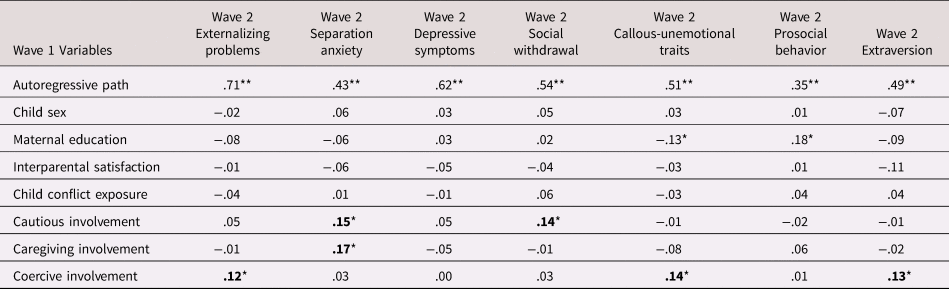
Table 2 presents the results of the structural paths between the study covariates, predictors, and children's Wave 2 developmental outcomes. Wave 1 levels of children's adjustment were all positively and significantly associated with children's Wave 2 levels of adjustment. In the full structural model, maternal education was significantly associated with children's callous and unemotional traits, ß = −.13, p = .02, and prosocial behavior, ß = .18, p = .006, at Wave 2. However, child gender, interparental satisfaction, children's exposure to interparental conflict were unrelated to children's adjustment over time. Although hypotheses were tested in seven successive models, for clarity, we organized the results around the forms of involvement and not by model.
Standardized path coefficients for structural paths between study variables
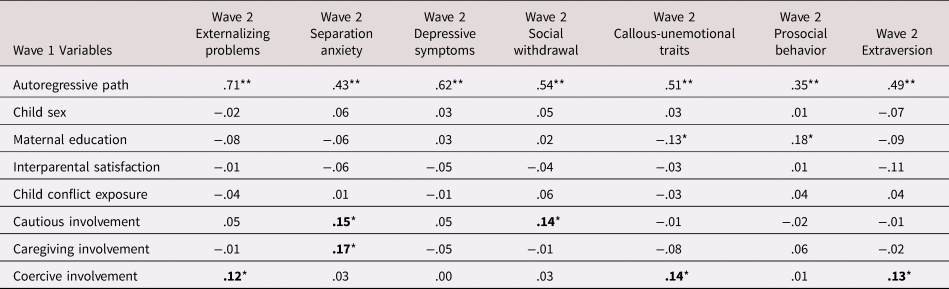
Note: Significant structural paths between the risky forms of involvement and children's developmental outcomes have been bolded, for the sake of clarity.
* p < .05; **p < .01.
Coercive involvement
Consistent with hypotheses, children's coercive involvement was significantly associated with their subsequent externalizing problems, callous and unemotional traits, and extraversion even after controlling for caregiving and cautious involvement, the autoregressive paths for the child outcomes, child gender, maternal education, interparental satisfaction, and children's exposure to interparental conflict (Table 2). Children's coercive involvement at Wave 1 was prospectively associated with increases in their externalizing problems at Wave 2, ß = .12, p = .04, controlling for externalizing problems at Wave 1, ß = .71, p < .001. Higher levels of children's coercive involvement were significantly associated with greater callousness at Wave 2, ß = .14, p = .02, while accounting for Wave 1 callousness, ß = .51, p < .001. Coercive involvement at Wave 1 predicted increased extraversion at Wave 2, ß = .13, p = .046, controlling for Wave 1 extraversion, ß = .49, p < .001. Children's coercive involvement was unrelated to their Wave 2 separation anxiety, ß = .03, p = .62, depressive symptoms, ß = .00, p = .99, social withdrawal, ß = .03, p = .58, and prosocial behavior, ß = .01, p = .94.
Caregiving involvement
Controlling for coercive and cautious involvement, autoregressive paths, child gender, maternal education, interparental satisfaction, and children's frequency of exposure to interparental conflict, children's caregiving involvement was significantly associated with their subsequent separation anxiety (Table 2). Supporting hypotheses, caregiving involvement in interparental conflict was uniquely associated with subsequently greater separation anxiety at Wave 2, ß = .17, p = .01, accounting for Wave 1 separation anxiety, ß = .43, p < .001. However, in contrast to hypotheses, caregiving involvement was unrelated to Wave 2 depressive symptoms, ß = −.05, p = .38, and prosocial behavior, ß = .06, p = .41. Caregiving involvement was also unrelated to Wave 2 externalizing problems, ß = −.01, p = .86, social withdrawal, ß = −.01, p = .86, callousness, ß = −.08, p = .19, and extraversion, ß = −.02, p = .72.
Cautious involvement
In accord with our hypotheses, children's cautious involvement was significantly associated with their subsequent separation anxiety and social withdrawal even after controlling for coercive and caregiving involvement, autoregressive paths, child gender, maternal education, interparental satisfaction, and children's frequency of exposure to interparental conflict (Table 2). Cautious involvement in interparental conflict at Wave 1 was uniquely associated with greater separation anxiety at Wave 2, ß = .15, p = .02, even after controlling for Wave 1 separation anxiety, ß = .43, p < .001. Greater cautious involvement was significantly associated with greater social withdrawal 2 years later, ß = .14, p = .02, after accounting for Wave 1 social withdrawal, ß = .54, p < .001. Inconsistent with hypotheses, cautious involvement was unrelated to children's prosocial behavior 2 years later, ß = −.02, p = .77. Cautious involvement was also unrelated to children's externalizing problems at Wave 2, ß = .05, p = .30, depressive symptoms, ß = .05, p = .43, callous and unemotional traits, ß = −.01, p = .83, and extraversion, ß = −.01, p = .83.
Discussion
Through the predominant use of unidimensional assessments of involvement in interparental conflict, research has shown that children who intervene in their parents’ relationship difficulties are at risk for a heterogeneous array of psychological problems. However, differentiating between risky forms of involvement may yield greater precision in predicting children's developmental sequelae. To address this gap, our multimethod, multi-informant investigation was designed to examine links between different risky forms of children's involvement and their subsequent maladaptive and benign developmental outcomes. Supporting six out of nine hypotheses, the results revealed that children's cautious, caregiving, and coercive involvement in interparental conflict during preschool predicted unique configurations of their developmental outcomes 2 years later, including externalizing problems, callous and unemotional traits, separation anxiety, social withdrawal, and extraversion.
Our qualitative thematic analysis revealed a coercive form of involvement characterized by children's bold, domineering, and aggressive ways of intervening in parental disputes that was consistent with children's dominant pattern of reactivity identified in EST-R. Although the anger, hostility, and domineering behavior reflected in a dominant pattern of reactivity share some overlap with coercive involvement, dominant reactivity is defined by a broader pattern of reactivity (e.g., vigilance, anger, suppressing vulnerable displays of emotion) that is not necessarily expressed in children's involvement in interparental conflict (Davies & Martin, Reference Davies and Martin2013). Providing evidence for discriminant validity of the risky involvement taxonomy, our results indicated that coercive involvement selectively predicted higher levels of externalizing problems, callousness, and extraversion over a 2-year period after controlling for prior levels of children's outcomes. Interpreted within EST-R (Davies & Martin, Reference Davies and Martin2013), children's coercive ways of intervening in interparental conflict may ultimately increase or maintain their power through direct efforts to defeat and overcome interparental threat (Johnson, Leedom, & Muhtadie, Reference Johnson, Leedom and Muhtadie2012). In the literature on dominance, intensification or maintenance of power in social hierarchies has been associated with children's norm violations and aggression, diminished sensitivity and compassion for others, and greater confidence and reward-seeking behavior in interpersonal relationships (Johnson et al., Reference Johnson, Leedom and Muhtadie2012). Thus, their greater power in the family may help to explain why coercive involvement predicted children's subsequent externalizing problems, callousness, and extraversion.
Social learning models (Davies et al., Reference Davies, Cicchetti and Martin2012; Davies & Cummings, Reference Davies and Cummings1994; Emery, Reference Emery1989) offer a complementary explanation for these findings. Coercive family process theory (Patterson, Reference Patterson1982) suggests that children's aggressive and hostile behavior is the result of a negative reinforcement process whereby children respond to parental demands with negative behavior to which parents ultimately concede, consequently reinforcing children's future negative behavior. In a specific application of Patterson's coercion theory to the context of interparental conflict, Emery (Reference Emery1989) proposes that children's recurring use of coercive ways of intervening in interparental conflict may be effective in distracting parents from their conflicts. As a result, the domineering, aggressive behavior exhibited by children may be negatively reinforced through the reduction or elimination of the aversive properties of parental conflicts. Through this same negative reinforcement process, children may also progressively exhibit bolder forms of social engagement that are manifested in a more general form of extraversion. In accord with this possibility, personality research has identified a specific type of extraversion characterized by social dominance, assertiveness, leadership, and agency (Depue & Collins, Reference Depue and Collins1999; DeYoung, Weisberg, Quilty, & Peterson, Reference DeYoung, Weisberg, Quilty and Peterson2013).
Consistent with constructs identified in the emotional security and role-reversal frameworks (i.e., mediation, parentification; Borzormenyi-Nagy & Spark, Reference Borzormenyi-Nagy and Spark1973; Davies et al., Reference Davies, Forman, Rasi and Stevens2002a, Reference Davies, Harold, Goeke-Morey, Cummings, Shelton, Rasi and Jenkins2002b, Reference Davies, Coe, Martin, Sturge-Apple and Cummings2015; Macfie et al., Reference Macfie, Brumariu and Lyons-Ruth2015), our qualitative analysis of the maternal narratives of their children's responses to interparental conflict identified a caregiving form of involvement characterized by children adopting the role of a caretaker toward one or both parents in response to conflicts. Children's caregiving involvement was proposed to be an antecedent of their greater separation anxiety, depression, and prosocial behavior. Supporting our hypothesis and providing further evidence of discriminant validity, children's caregiving involvement was a significant predictor of their subsequent separation anxiety even after controlling for separation anxiety at Wave 1. In accordance with emotional security frameworks, the emotional burdens and entanglement experienced by young children adopting the role of a caregiver in response to interparental conflict is likely to undermine their autonomy (Davies et al., Reference Davies, Forman, Rasi and Stevens2002a, Reference Davies, Martin, Sturge-Apple, Cicchetti and Cohen2016a). This resulting vulnerability is proposed to lay the foundation for more entrenched patterns of dependency and separation anxiety, which may be especially likely to develop from the recurring enactment of caregiving involvement. Likewise, the role-reversal literature suggests that children who adopt caregiving roles are unlikely to have their emotional needs met by their parent (Macfie et al., Reference Macfie, Brumariu and Lyons-Ruth2015) and tend to have significant concerns about their parents’ ability to function without their assistance (Johnston, Roseby, & Kuehnle, Reference Johnston, Roseby and Kuehnle2009). Thus, a related interpretation is that high separation anxiety may reflect children's significant doubts about the ability of their parents to serve as a secure base.
In contrast to hypotheses, children's caregiving involvement was not a significant predictor of their subsequent depressive symptoms. Links between caregiving involvement and depressive symptoms may not have been evident for several reasons. Caregiving involvement may be a more proximal predictor of processes that eventually give rise to depressive symptoms during later developmental periods (e.g., adolescence) when depression is more prevalent. Thus, it is possible that caregiving involvement may be a more distal predictor of later depressive symptoms through its association with mechanisms that increase depression more slowly over time. For example, emotional security theory proposes that children's involvement in interparental conflict may increase depressogenic mechanisms of helplessness and self-blame (Davies et al., Reference Davies, Forman, Rasi and Stevens2002a). Likewise, separation anxiety has been posited to precede the onset of depressive episodes (Cicchetti & Toth, Reference Cicchetti and Toth1998; Kovacs, Reference Kovacs1996). Thus, when coupled with our findings documenting caregiving involvement as a predictor of children's separation anxiety, it is plausible that caregiving involvement may indirectly pose a risk for the later development of depressive symptoms by increasing children's separation anxiety. Finally, differences in the manifestation of depression during childhood in comparison to adolescence or adulthood may make it difficult for adult informants to accurately identify children's symptoms, consequently contributing to the under-identification of childhood depressive symptoms (Abela & Hankin, Reference Abela and Hankin2008). For instance, depressive symptoms during childhood often manifest as somatic complaints and irritable mood rather than verbalizations of depressive affect (Abela & Hankin, Reference Abela and Hankin2008; Bhatia & Bhatia, Reference Bhatia and Bhatia2007). As depressive symptoms become more easily recognized during adolescence, caregiving involvement may become a stronger predictor during later developmental stages (i.e., adolescence).
Cautious involvement, characterized by guarded involvement, apprehension, and vigilance to threat, was the final form of risky involvement identified through thematic analysis. Although our investigation is the first study, to our knowledge, to identify a cautious pattern of involvement, it is consistent with some previous findings. For example, documentation of positive correlations between children's involvement and their emotional distress and avoidance is consistent with the premise that some children may exhibit fearfulness and reticence in combination with involvement (Davies et al., Reference Davies, Harold, Goeke-Morey, Cummings, Shelton, Rasi and Jenkins2002b). Likewise, the dissection of the interaction between children's involvement and fearful distress supported the occurrence of a subgroup of children who were both high in fearful distress and involvement (Davies et al., Reference Davies, Coe, Martin, Sturge-Apple and Cummings2015). In building on this indirect support, our results provided some evidence for the discriminant validity of the cautious involvement pattern. More specifically, cautious involvement selectively predicted children's subsequent separation anxiety and social withdrawal even after controlling for earlier levels of children's outcomes and the two other risky forms of involvement. In drawing on emotional security and attachment formulations, children's underlying reticence, hypervigilance, and fear involved in cautious involvement may reflect doubts about their caregivers as consistent sources of support, accompanying increases in fears of abandonment (Bowlby, Reference Bowlby1982; Davies & Martin, Reference Davies and Martin2013; Manassis, Reference Manassis, Silverman and Treffers2001). Thus, children's inability to gain a sense of safety within the interparental subsystem may not only engender separation anxiety but also foster the development of internal working models of future social relationships as unreliable, increasing children's social withdraw from peers and other adult figures.
Running counter to hypotheses, children's cautious and caregiving involvement did not significantly predict children's subsequent prosocial behavior. Because children's emotional distress is a key aspect of the pattern-based assessment of the two forms of risky involvement, the two forms may be primarily associated with psychological maladjustment. Research testing emotional security theory provides some support for this possibility. For instance, Davies et al. (Reference Davies, Coe, Martin, Sturge-Apple and Cummings2015) showed that children's emotional reactivity and involvement significantly interacted to predict increases in their psychological difficulties such that the co-occurrence of emotional reactivity and involvement disproportionately increased their risk for developing psychopathology. Likewise, the parentification literature proposes that adopting caregiving roles that are likely to be unsuccessful in addressing complex adult problems and needs may be too emotionally burdensome for children to yield benign or beneficial developmental processes (Macfie et al., Reference Macfie, Brumariu and Lyons-Ruth2015; Nuttall & Valentino, Reference Nuttall and Valentino2017). Thus, the two forms of risky involvement may be accompanied by emotional burdens and preoccupation that are too intense to confer any potentially benign consequences.
Alternatively, it is possible that our sensitivity to identify benign sequelae of these types of risky involvement may have been diluted by our assessment of prosocial behavior. Previous research has identified two forms of prosocial behavior: (a) a compliance form reflecting prosocial responses to direct requests, and (b) a spontaneous form characterized by prosocial responses without an explicit request (Eisenberg et al., Reference Eisenberg, Fabes, Miller, Shell, Shea and May-Plumlee1990; Eisenberg, McCreath, & Ahn, Reference Eisenberg, McCreath and Ahn1988). Thus, cautious and caregiving involvement may have been unrelated to subsequent prosocial behavior because our assessment of prosocial behavior largely reflects spontaneous rather than compliant prosocial behaviors (e.g., “Is eager to please”; Block, Reference Block2008). Children enacting compliant prosocial behavior experience greater personal distress in response to others’ negative responses, undermining their ability to adopt an other-oriented focus and enact spontaneous prosocial behavior (Eisenberg et al., Reference Eisenberg, McCreath and Ahn1988, Reference Eisenberg, Fabes, Miller, Shell, Shea and May-Plumlee1990). Thus, the heightened distress associated with children's cautious and caregiving involvement in interparental conflict may specifically foster their tendency to comply with prosocial requests.
Although our findings provide the first step in developing a systematic taxonomy of children's risky forms of involvement in interparental conflict and their subsequent psychological functioning, it is important to more broadly consider avenues for future research. First, although our emphasis of child-initiated behaviors in operationalizing the forms of involvement is consistent with interparental conflict theories (e.g., Davies & Cummings, Reference Davies and Cummings1994; Emery, Reference Emery1989), it may be useful to consider other frameworks as guides for characterizing children's involvement in interparental conflict. For example, the boundary dissolution literature places stronger emphasis on parent-initiated demands on their children to assume roles as mediators, confidants, and emotional and instrumental caretakers (e.g., Nuttall & Valentino, Reference Nuttall and Valentino2017).
Second, in complementing our focus on delineating the sequelae of risky forms of involvement, future empirical advances hinge on examining the developmental (e.g., temperamental) and family antecedents of children's risky involvement. For example, temperamental anger, impulsivity, and high activity may increase the likelihood of coercive forms of intervening. Likewise, in the domain of family antecedents, different sets of socialization factors (e.g., parenting practices, dimensions of interparental conflict, forms of parent psychopathology) may be distinct precursors of each of the forms of risky involvement (Davies & Martin, Reference Davies and Martin2013). For example, EST proposes that both destructive and constructive dimensions of interparental conflict carry equal weight as predictors of children's insecure responses to interparental conflict (Davies & Cummings, Reference Davies and Cummings1994; Davies & Martin, Reference Davies and Martin2014). Thus, if risky forms of involvement are signs of insecurity as EST suggests, destructive and constructive interparental conflict may respectively increase or diminish their risky forms of involvement as part of a mediational chain that lays the foundation for their psychological sequelae. In contrast, EST-R proposes that a negative valence system organizes children's distress responses and consequently, interpersonal threat cues are more potent predictors of children's negative responses to interparental conflict (Davies & Martin, Reference Davies and Martin2014; Davies & Sturge-Apple, Reference Davies and Sturge-Apple2007). Accordingly, in mediational models destructive interparental conflict should be more salient than constructive interparental conflict in predicting children's risky forms of involvement in interparental conflict and, in turn, greater mental health problems. Given the modest magnitude of risky forms of involvement as predictors of children's psychological adjustment, it is also plausible that interparental conflict may moderate associations among risky forms of involvement and children's psychological outcomes. For example, enacting risky forms of involvement in families where parents have considerable difficulties regulating their conflicts, anger, and hostility may compound children's vulnerability to psychopathology by exposing them to disproportionately higher levels of interpersonal threat (Davies & Martin, Reference Davies and Martin2014; Johnston et al., Reference Johnston, Roseby and Kuehnle2009).
Findings must also be interpreted within the context of several study limitations. First, despite a demographically and racially diverse sample, further research is necessary to understand the generalizability of the results of this study to other samples (e.g., clinical samples, affluent families). Second, this study focused on risky involvement in interparental conflict during early childhood; however, it is possible that developmental processes during other developmental stages may alter the nature and sequelae of risky forms of involvement. Third, the modest effect sizes of the different risky forms of involvement highlight the need to identify sources of variability in children's adjustment. For instance, children's reactive (e.g., irritability) and self-regulatory (e.g., effortful control) dimensions of temperament may potentiate or mitigate the risks associated with these risky forms of involvement. In addition, although our findings provide support for discriminant validity of the risky involvement taxonomy, caregiving involvement only significantly predicted children's separation anxiety, which was also identified as an outcome of cautious involvement. Thus, future research may be able to further document the distinctive clinical significance of caregiving and cautious forms of involvement by expanding the assessments of sequelae (e.g., social anxiety). Fourth, although we identified three risky forms of involvement through an established qualitative approach, other possible patterns of involvement may exist (e.g., empathetic, well-regulated involvement in interparental conflict). Fifth, internal consistencies for some of the psychological functioning measures were relatively low. However, low internal consistencies for measures of children's socioemotional adjustment are not uncommon in the literature (e.g., αs ranging between .45 and .63 for conduct problems, depression, anxiety, and peer problems; Dunn, Deater-Deckard, Pickering, O'Connor, & Golding, Reference Dunn, Deater-Deckard, Pickering, O'Connor and Golding1998; Kertz, Sylvester, Tillman, & Luby, Reference Kertz, Sylvester, Tillman and Luby2019; Pettit, Laird, Dodge, Bates, & Criss, Reference Pettit, Laird, Dodge, Bates and Criss2001). Finally, while our assessment of forms of involvement from maternal interview narratives offered several methodological advantages, future research would benefit from supplementing this approach with other methods (e.g., observations, surveys) and expanding our multi-informant assessment of sequelae to include other reporters.
Despite these limitations, this study provides the first test of the developmental utility of parsing cautious, caregiving, and coercive forms of involvement in interparental conflict in predicting children's subsequent maladaptive and benign developmental outcomes. Although earlier empirical work has demonstrated the high prevalence and public health significance of children's risky involvement in interparental conflict, no systematic taxonomy exists for distinguishing between various risky forms of involvement. Utilizing thematic analysis, we identified three patterns of risky involvement organized around higher-order functions of coercive control (i.e., coercive involvement), caretaking (i.e., caregiving involvement), and vigilance (i.e., cautious involvement). Extending previous work, the findings from this study indicated that each risky form of involvement offered unique predictive utility in predicting different configurations of children's externalizing problems, callous and unemotional traits, extraversion, separation anxiety, and social withdrawal. From a translational perspective, identifying the developmental value of unpacking different forms of involvement may be leveraged for developing and refining therapeutic targets and tools for protecting children from the maladaptive outcomes associated with their risky involvement in interparental conflict.
Acknowledgments
We would like to thank Mike Ripple and the Mt. Hope Family Center Staff and the families who participated in the research.
Financial Statement
This study was conducted at the Mt. Hope Family Center and supported by the Eunice Kennedy Shriver National Institute of Child Health and Human Development (R01 HD065425) awarded to Patrick T. Davies and Melissa L. Sturge-Apple.
Conflict of Interest
None.