Introduction
Frailty is broadly understood to be a state of vulnerability to adverse outcomes, though its definitions and methods of empirical operationalization vary (Hogan et al., Reference Hogan, MacKnight and Bergman2003; Abellan van Kan et al., Reference Abellan van Kan, Rolland, Houles, Gillette-Guyonnet, Soto and Vellas2010). In particular, it has been debated whether non-physical attributes contribute to defining frailty (Rockwood et al., Reference Rockwood, Andrew and Mitnitski2007; Kulminski et al., Reference Kulminski, Ukraintseva, Kulminskaya, Arbeev, Land and Yashin2008). Despite such debate, there is evidence linking frailty with vulnerability deriving from more than physical attributes; factors such as social circumstances, cognitive decline, and psychiatric illness have each been implicated (Woo et al., Reference Woo, Goggins, Sham and Ho2006; Andrew and Rockwood, Reference Andrew and Rockwood2007; Andrew et al., Reference Andrew, Mitnitski and Rockwood2008).
The link between frailty and cognitive and affective processes is of interest in the context of what has been described as the “frailty identity crisis.” This sense of “crisis” has been proposed to occur when challenging transitions from independence to frailty are accompanied by maladaptive psychological responses (Fillit and Butler, Reference Fillit and Butler2009). Affected individuals are said to experience a crisis of identity and a decline in psychological well-being as they are faced with losses in health and independence that mark the transition from fitness to frailty. This is a provocative idea which has to date received little empirical attention. In addition to being provocative, the idea of an identity crisis is usually applied to individuals in different age groups (e.g. adolescents progressing through developmental stages), and may, therefore, not bring to mind issues that affect older adults. Even so, it seems reasonable to consider how increasing frailty might relate to identity as it relates to psychological well-being. Aspects of the frailty identity crisis have not been fully operationalized. Even so, it seems likely that maladaptive psychological responses would impact negatively on psychological well-being for which operationalization is somewhat more advanced. This might in turn contribute to understanding whether a frailty identity crisis has value or is redundant in the face of what is known about psychological well-being, allowing for further empirical research to be framed.
We aimed to test the hypothesis of the frailty identity crisis by studying whether psychological well-being was related to frailty and mortality in a sample of older community-dwelling Canadians.
Methods
Study sample
The Canadian Study of Health and Aging (CSHA) is a representative study of dementia and aging-related conditions, in which sampling was population-based and representative of English- and French-speaking Canadians aged 65 years and older. The sampling design excluded those who lived in the Yukon or Northwest Territories, residents of Aboriginal Reserves or military bases, and those with an immediately life-threatening illness (Rockwood et al., Reference Rockwood, McDowell and Wolfson2001). The full sample of 10,263 individuals was clustered within five geographical regions and was stratified by age, with oversampling of those over the age of 75. Baseline assessments were conducted in 1991 at 18 study centers throughout Canada, with follow-up at five (CSHA-2) and ten (CSHA-3) years. In CSHA-1, 9,008 community-dwelling older people participated in a screening interview, of whom 5,703 had a repeat screening interview at CSHA-2. The current paper reports findings of a secondary analysis of the 5,703 people aged 70 years and older interviewed at CSHA-2, at which time the Ryff psychological well-being questionnaire was administered.
Measures
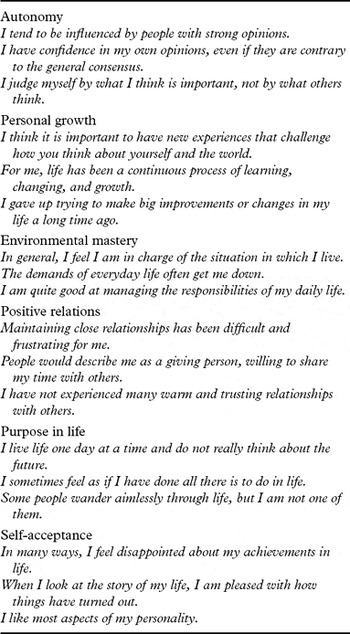
Psychological well-being was measured using the previously published and validated Ryff Psychological Well-Being scale (Ryff, Reference Ryff1989; Clarke et al., Reference Clarke, Marshall, Ryff and Wheaton2001). This scale includes 18 items which are subdivided into six domains (each having three items): autonomy, personal growth, environmental mastery, positive relations, purpose in life, and self-acceptance (Table 1). The last is especially likely to be associated with a frailty identity crisis. For each item, respondents answered on a six-point scale (strongly disagree, disagree, slightly disagree, slightly agree, agree, strongly agree). Items were coded such that higher scores represented worse psychological well-being. Item scores were summed, first within each of the six individual domains and then for the entire scale, yielding a possible domain score range of 3–9 and a total score range of 18–108.
Ryff psychological well-being scale (validated short 18-item version) used in the CSHA (Clarke et al., Reference Clarke, Marshall, Ryff and Wheaton2001)

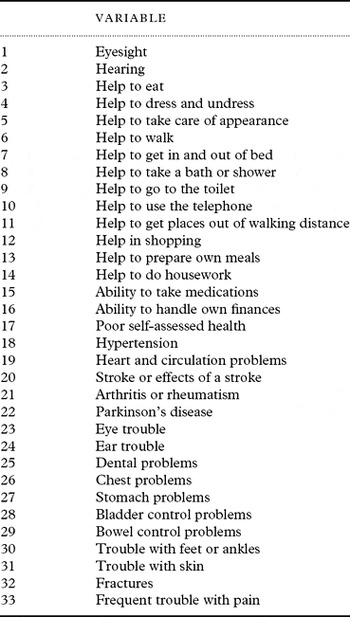
Frailty was operationalized using a previously validated frailty index which comprised 33 health deficits representing self-reported physical symptoms, illnesses, and impaired functions (Table 2). Respondents were assigned a score between 0 and 1 on each of these potential frailty “deficits”; 0 if the deficit was absent and 1 if it was endorsed, with intermediate values applied for ordinal response categories. For example, on the item “can you dress and undress yourself?,” the three possible responses of “without any help,” “with some help,” and “can't do at all” were assigned values of 0, 0.5, and 1, respectively (Table 2). These deficit scores were then summed and divided by the total number of deficits considered (33) to generate a frailty index, such that a greater score corresponded to worse health status and increased frailty (Mitnitski et al., Reference Mitnitski, Song and Rockwood2004; Reference Mitnitski2005). Although one of the benefits of the frailty index approach is that it allows for graded distribution of risk and avoids arbitrary compartmentalization, published cutpoint guidelines suggest that scores greater than 0.2–0.25 identify persons as frail (Rockwood et al., Reference Rockwood, Andrew and Mitnitski2007; Kulminski et al., Reference Kulminski, Ukraintseva, Kulminskaya, Arbeev, Land and Yashin2008).
CSHA frailty index (Mitnitski et al., Reference Mitnitski, Song and Rockwood2004)

Educational attainment was reported by the participants as the number of years of formal schooling that they had completed.
Cognition was measured using the Modified Mini-Mental State Examination (3MS), a well-validated cognitive screening tool with a possible score of 0–100; scores less than 78 suggest cognitive impairment. It includes items testing immediate and remote memory, orientation, attention and concentration, language and naming, verbal fluency, and executive function (Teng and Chui, Reference Teng and Chui1987). Given that the distribution of scores on the 3MS was skewed, log transformations were used for regression analyses.
Mental health was assessed using five items drawn from the Mental Health subscale (also called the Mental Health Index-5, or MHI-5) of the widely validated SF-36 (Ware, Reference Ware1993). Using a common stem, five questions were asked: “How much time during the past 4 weeks. . .(1) Have you been a very nervous person, (2) Have you felt calm and peaceful, (3) Have you felt downhearted and blue, (4) Have you been a happy person, and (5) Have you felt so down in the dumps that nothing could cheer you up?” Respondents scored each question on a six-point scale, with choices “all of the time, most of the time, a good bit of the time, some of the time, a little of the time, none of the time.” Items were coded such that higher scores represented worse mental health; scores from all five questions were summed to create a composite mental health score with a possible range of 5–30. According to published scoring guidelines, a score of 11 or more on this version of the MHI-5 would be expected to correlate with the likely presence of a common mental disorder (anxiety or depression) (Kelly et al., Reference Kelly, Dunstan, Lloyd and Fone2008).
Statistical analyses
The distributions of individual items comprising the Ryff scale, the summed scores for each domain subscale, and the total scale score were analyzed descriptively. Univariate associations between Ryff scores and each of the covariates (age, sex, education, frailty, mental health, and 3MS score) were analyzed using linear regression for continuous covariates or Student's t-test in the case of gender. Linear regression was used to investigate the association between the Ryff scores (using the full index as well as individual domains) and frailty index, adjusting for age, gender, education, mental health, and 3MS score. Logistic regression was used to model psychological well-being in relation to five-year mortality, adjusting for these same covariates. Interaction terms among covariates were tested for influence on model fit. All analyses were conducted using STATA 8.1 software.
Ethics
Ethical approval was obtained from the ethics committees of each of the 18 CSHA study centers. Written, informed consent for participation in the CSHA was obtained from each participant or proxy respondent.
Results
For the 5,703 individuals in the CSHA-2 screening interview sample, the mean age was 79.1 (SD 6.4) years, 60.7% of the sample were women, and mean years of education was 10.5 (SD 0.10). The mean frailty index score was 0.17 (SD 0.10), which is not defined as frail. Eighteen percent of the sample met criteria for frailty based on a cutpoint frailty index score of 0.25. The median 3MS score was 88 (IQR 80–94). Summary scores of the SF-36 Mental Health items were skewed, with most participants reporting good mental health (median score 8, IQR 7–11), although 24% of the sample screened positive for a common mental disorder according to published cutpoints.
Composite Ryff psychological well-being index scores were normally distributed with a mean of 44.5 (SD 7.0); scores ranged from 20 to 78 (Figure 1, Panel A). Older respondents had worse (i.e. higher) well-being scores, as did those with lower education, greater frailty, poorer mental health, and lower cognitive ability as measured by the 3MS (all p < 0.001 by linear regression). Well-being scores did not differ between males and females (t = –0.73, p = 0.47).
Distribution of the Ryff psychological well-being complete index (Panel A). Panel B shows the usual response pattern for most items (most responded “pretty good”), while Panel C shows the exceptional response pattern seen for three items, in which “pretty good” and “pretty bad” responses were equally likely.

Responses to each of the 18 individual Ryff scale items had very similar distributions, with most respondents scoring 2 out of 6, or “pretty good” (Figure 1, Panel B). Three items were exceptions to this pattern: “I live life one day at a time and don't really think about the future” and “I sometimes feel as if I've done all there is to do in life” from the Purpose in Life domain, and “I gave up trying to make big improvements or changes in my life a long time ago” from the Personal Growth domain. For these three items, respondents were as likely to score 2 (pretty good) as 5 (pretty bad) (Figure 1, Panel C).
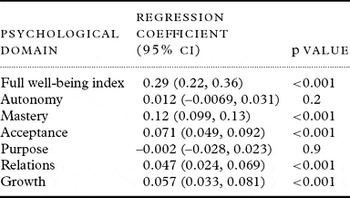
The Ryff psychological well-being index and the individual domain scores for personal growth, environmental mastery, positive relations, and self-acceptance were all strongly associated with frailty (independent of age, sex, education, 3MS scores, and mental health; Table 3). This association with frailty was not present for the Ryff individual domain scores for purpose in life and autonomy. When the full Ryff index was analyzed in relation to frailty, for every additional frailty deficit the Ryff psychological well-being index score worsened by 0.3 points (regression coefficient 0.29, 95% CI: 0.22–0.36, p < 0.001).
Associations between psychological well-being and frailty (linear regression analyses, adjusting for age, sex, education, cognition, and mental health)

Worse psychological well-being as identified by the Ryff total score was predictive of five-year mortality independent of frailty, age, sex, education, and SF-36 Mental Health summary score; for each additional point worsening in psychological well-being, the odds of mortality increased by 1% (OR 1.01, 95% CI: 1.00–1.03, p = 0.02). However, this association was no longer statistically significant once baseline 3MS score was taken into account (OR 1.01, 95% CI: 1.00–1.02, p = 0.24). Inclusion of interaction terms between covariates did not improve model fit.
Discussion
In a population-based sample of community-dwelling older Canadians, we found that poor psychological well-being and frailty were strongly correlated. Within the general construct of psychological well-being, most subdomains were associated with frailty (i.e. growth, mastery, positive relations, self-acceptance) though not all (i.e. autonomy and purpose in life). Worse psychological well-being was also a risk factor for mortality that was independent of frailty, although here cognitive abilities appeared to play a role.
Our findings must be interpreted with caution. Our measures of psychological well-being and frailty were both based on self-report, though each has been previously well-validated (Ryff, Reference Ryff1989; Mitnitski et al., Reference Mitnitski, Song and Rockwood2004). The observed associations between psychological well-being and frailty were in a cross-sectional sample, so the direction of causality cannot be ascertained. It is possible that increasing frailty leads to worsening well-being, but the reverse could also be the case. A bi-directional relationship, in which decline in health and function and in psychological well-being occurs in tandem and in response to one another may be most likely. Regardless of the direction of causality, the strong association between psychological well-being and frailty clearly has implications for clinical care of frail older people.
Given that the idea of a frailty identity crisis is a new one, which lacks a well-established operationalization, we worked with the data at hand. Even so, such exploratory work helps point to what might constitute an identity crisis. The proposal of Fillit and Butler (Reference Fillit and Butler2009) stands to reason, and reflects too an older psychological literature about the so-called “work of aging” presented as aging with equanimity (e.g. Erikson's ego integrity vs. despair) (Erikson and Erikson, Reference Erikson and Erikson1997). Whether this “identity crisis” is intrinsic to aging, or whether it differs substantially from the challenges presented to anyone faced with disability is not well established. While it currently remains unclear how low psychological well-being in frail individuals differs from adjustment difficulties in disability and chronic illness, there are reasons to suspect a difference. Frailty is a state in which many (usually smaller) deficits exert a combined influence; this is distinct from a single disease or functional impairment in the usual chronic illness or disability model. The cumulative effect of deficit accumulation over time may afford some people the perspective of gradual accommodation, while the normative effect of seeing other people facing similar challenges is likely also an important mediating effect for many. Further research is needed to address this issue. Additionally, one might wonder whether the association that we have identified is specific to frailty in old age. This is another area in which further study is warranted, particularly as frailty is increasingly being found to be a relevant construct across the lifespan, not just in old age (Rockwood et al., Reference Rockwood, Song and Mitnitski2011).
Mental health is clearly a key aspect of overall psychological well-being and the increasing prevalence with age of mental health problems suggests that it is also important to the measurement of frailty. Here, we adjusted our analyses for mental health as measured by five SF-36 items addressing anxiety and depressive symptoms and found that our results were robust even when taking self-reported mental health into account. However, this measure did not reflect clinical diagnosis of depression or other mental health conditions and it is possible that clinical diagnoses of these conditions could have had an influence on the associations between psychological well-being, frailty, and survival for which we were unable to account.
We found that psychological well-being was predictive of mortality independent of age, sex, frailty, education, and mental health but not of cognition as measured by 3MS scores. This finding suggests that people's cognitive abilities may have important ramifications for their reporting of psychological well-being, and merits further study.
Three of the individual Ryff scale items differed in their distribution of responses: “I live life one day at a time and don't really think about the future” and “I sometimes feel as if I've done all there is to do in life” from the Purpose in Life domain, and “I gave up trying to make big improvements or changes in my life a long time ago” from the Personal Growth domain. Interestingly, in Ryff's original description of this psychological well-being scale, older adults had lower scores than both young and middle-aged adults in both of these domains (Ryff, Reference Ryff1989). This raises the question of whether feelings about these specific items change with age independent of changes in health. For instance, as older people encounter challenges and reflect on their lives, do these particular aspects of well-being change as they learn to “go with the flow”? As has been described in relation to the proposed “frailty identity crisis,” impaired chronesthesia (deficit in the ability to project oneself into the future or to imagine future opportunities) frequently accompanies aging, particularly in the face of mounting physical infirmities (Fillit and Butler, Reference Fillit and Butler2009). These changes may account for the qualitative differences in response patterns to these three particular items, which have, as their focus, future opportunities and fulfillment. The Purpose in Life domain was not associated with frailty; the unusual scaling properties of two of its three items may have contributed to this.
Among the subdomains contributing to psychological well-being, autonomy stands out in not showing association with frailty. This might seem to be a surprising finding, given that when we think of frail individuals, we might reasonably expect them to have reduced autonomy (i.e. reduced functional independence). An important distinction, here, is that autonomy is framed more in the sense of “self-determination” and “the regulation of behaviour from within” (Clarke et al., Reference Clarke, Marshall, Ryff and Wheaton2001, p. 80), with the three items referring to being swayed or influenced by others, having confidence in one's own opinions and judging oneself by one's own standards. It may be that these items relate to personality traits that would be less likely to be swayed by increasing frailty.
It is interesting to speculate on mechanisms that might account for the observed association of worse psychological well-being with frailty, and particularly, with mortality. Others have reported an association between some aspects of psychological well-being and plasma inflammatory markers (Friedman et al., Reference Friedman, Hayney, Love, Singer and Ryff2007; Hubbard and Woodhouse, Reference Hubbard and Woodhouse2010) providing support for a physiological mechanism. Exercise and other healthy behaviors may be additional mechanisms that establish and maintain a link between psychological well-being and health. Though frailty itself has been shown to predict mortality robustly in many settings (Goggins et al., Reference Goggins, Woo, Sham and Ho2005; Mitnitski et al., Reference Mitnitski2005; Woo et al., Reference Woo, Goggins, Sham and Ho2006), here we found that psychological well-being predicted mortality independent of frailty.
It has been proposed that the challenging transition from independence to frailty may be accompanied by a “frailty identity crisis” if an older person experiences a maladaptive psychological response to this transitional life stage (Fillit and Butler, Reference Fillit and Butler2009). Potential challenges abound during this transition, and include changing identity and body image as well as the need to develop coping strategies to deal with the twists and turns, both expected and unexpected, in functional and health trajectories.
Psychological well-being and frailty appear to be closely interrelated. Taken as a whole, our findings provide evidence for a link between frailty and low psychological well-being, and raise the possibility that an “identity crisis” of sorts may play a role in defining frailty. That frailty is related to psychological factors strengthens the argument that frailty is more than just a purely physical phenomenon. At a practical level, while we would not recommend explicit use of the Ryff scale in clinical practice, these findings suggest that clinicians caring for frail older persons should be alert to psychological well-being as they care for patients who are experiencing (or have experienced) important transitions in physical and functional abilities.
Conflict of interest
None.
Description of authors' roles
M. Andrew, J. Fisk, and K. Rockwood conceived the study. M. Andrew designed and conducted the statistical analyses and wrote the first draft of the paper. All authors contributed to substantial subsequent revisions of the paper.
Acknowledgments
This analysis was supported by the Canadian Institutes for Health Research grant MOP 62823. The data reported in this paper were collected as part of the CSHA. The core study was funded by the Seniors' Independence Research Program, through the National Health Research and Development Program (project no. 6606-3954-MC(S)). Kenneth Rockwood receives career support from the Dalhousie Medical Research Foundation as Kathryn Allen Weldon Professor of Alzheimer Research. The sponsors had no input into the analyses, and Professor Rockwood holds a copy of and has full access to the CSHA dataset at Dalhousie University.