





Diet-related disease remains one of the defining public health challenges of the twenty-first century(Reference Ma, Wang and Qin1). The Global Burden of Disease Study 2017 estimates 11 million deaths and 255 million disability-adjusted life years are attributable to dietary risk factors(Reference Afshin, Sur and Fay2). At the same time, food demand is projected to increase by approximately 60% by 2050, intensifying pressures on planetary boundaries, including land, water, climate and biodiversity(Reference Aydoğdu and Gezmen Karadağ3,Reference Rockström, Thilsted and Willett4) . Today, we stand at a critical turning point, where the call for transformation towards healthier, sustainable, equitable diets is resonating across the entire food system signalling that the time for action is now.
Defining such diets, and the changes required, is inherently complex. Population-level dietary guidelines must balance nutrition science, environmental constraints, affordability, cultural norms, equity considerations and be developed with urgency as the world’s population continues to increase(Reference Gibney5). The reality today is that adherence to population-level food-based dietary guidelines is extremely low(Reference Leme, Hou and Fisberg6). In the UK, fewer than 0.1% of adults were reported to meet all nine Eatwell Guide recommendations(Reference Scheelbeek, Green and Papier7). Evidence has repeatedly shown that multicomponent, individually tailored interventions are needed for successful healthier behaviour change(Reference Celis-Morales, Livingstone and Marsaux8–Reference Jinnette, Narita and Manning11). Emerging research further suggests that multiple dietary patterns may be capable of satisfying both health and environmental criteria and that presenting individuals with context-specific options they identify with may be more effective than a broad generic approach to dietary recommendations(Reference Gebara, Berthet and Vandenabeele12).
Simultaneously, advances in nutrition science have revealed increasing biological and behavioural heterogeneity. High-throughput, data-intensive research has highlighted individual variability in metabolic responses, disease risk and dietary behaviours(Reference Hillesheim, Yin and Sundaramoorthy10,Reference Jinnette, Narita and Manning11,Reference Agrawal, Goktas and Kumar13) . The growing use of glucagon-like peptide-1 (GLP-1) receptor agonists for obesity management has also accelerated shifts in dietary patterns and has led to individuals considering specific nutritional and lifestyle needs, with expert guidance recommending a person-centred approach(Reference Mozaffarian, Agarwal and Aggarwal14,Reference Hristakeva, Liaukonyte and Feler15) . Collectively, these developments challenge current one-size-fits-all dietary guidance and point toward the need for more adaptive, data-informed approaches.
Digital technology and artificial intelligence
Algorithms, artificial intelligence (AI) and generative AI (GenAI) are increasingly being used in nutrition research and implemented in various ways across food and healthcare systems, transforming how knowledge is generated, analysed and applied. A number of reviews have explored how AI is reshaping the field of nutrition science with reported enhancements of dietary assessment, customisation of nutrition plans, enhanced product recipe search and discovery and management of complex health conditions(Reference Agrawal, Goktas and Kumar13,Reference Kassem, Beevi and Basheer16,Reference Panayotova17) .
Rapid advancement in digital technology and AI is also reshaping how food is produced, marketed, purchased and consumed(Reference Granheim, Torheim and Terragni18). Mobile applications, online retail platforms, telehealth systems and product-scanning technologies offer new opportunities for influencing food choice at scale(Reference Bennett, Keeble and Zorbas19,Reference McGuirt, Winkler and Melo Herrera20) such as increased fruit and vegetable consumption(Reference Curtin, Green and Brown21) and personalised support for obesity treatment(Reference Mozaffarian, Agarwal and Aggarwal14). Lack of content regulation within social media platforms has resulted in substantial distribution of nutrition misinformation which poses a significant risk to public health(Reference Segado Fernández, Jiménez Gómez and Jiménez Hidalgo22). For example, research has demonstrated high levels (75%) of unbalanced and inaccurate content on the TikTok platform(Reference Zeng, Grgurevic and Diyab23).
Citizens are increasing their utilisation of AI-enabled tools. Usage data for ChatGPT shows an increase from 400 million weekly users in February 2025 to 800 million weekly users at the end of the year, 5.8 billion monthly visits and over 2 billion daily queries processed compared with 14 billion daily searches on Google(Reference Singh24,Reference Blake25) . This represents a substantial shift in a 12-month period in both routes of access to information and how that information is presented. The ability for users to provide more personalised prompts means that responses from large language model (LLM)-based generative systems are now more highly contextualised to the individual, with such systems offering a level of interpretation and synthesis of information that was not previously possible.
Challenges to overcome
Understanding and improving dietary patterns requires the use of multiple data sources generated across the food system(Reference Schulz, Oluwagbemigun and Nöthlings26–Reference Micha, Coates and Leclercq28). Within the food system, various stakeholders rely on different datasets to achieve specific objectives, ranging from ingredient functionality and product formulation to retail monitoring and dietary surveillance(Reference Zeb, Soininen and Sozer29–Reference Rejeb, Keogh and Rejeb31). For example, manufacturers generate formulation and nutrient data to enable product development and reformulation; multiple stakeholders (e.g. regulators, retailers, manufacturers) use product-level data to assess compliance and portfolio healthfulness; and researchers draw on behavioural and consumption data to evaluate dietary patterns and policy impacts. Despite the proliferation of digital technology, data accessibility, fragmentation, inconsistent data structures, divergent health definitions and metrics and methodological inconsistencies across the food system represent significant barriers to progress.
Asynchronous timelines across academia, policy, industry and technology create a landscape in which evidence generation, regulatory implementation, industry practices, product development and technological deployment often move at different speeds. While digital tools and technology-enabled platforms are evolving on a timescale of months(Reference Singh24), policy implementation typically unfolds over years. For example, the trajectory of the high in fat, sugar or salt (HFSS) legislation in England, from the 2018 Obesity Strategy(32) to phased implementation of placement, promotion and advertising restrictions of HFSS foods between 2022 and 2026, illustrates the extended timelines required for consultation, legislative drafting and industry adaptation.
Whilst technological developments (e.g. rule-based algorithms and AI-based tools) offer potential to address capacity and complexity challenges, their design and deployment raises important questions around transparency, ethics, expert input, reproducibility, accessibility, data governance and scientific alignment. Approaches based on incomplete, poor-quality data risk amplifying divergence and misinformation rather than resolving these challenges.
Nutrition Intelligence and the Food Data Landscape
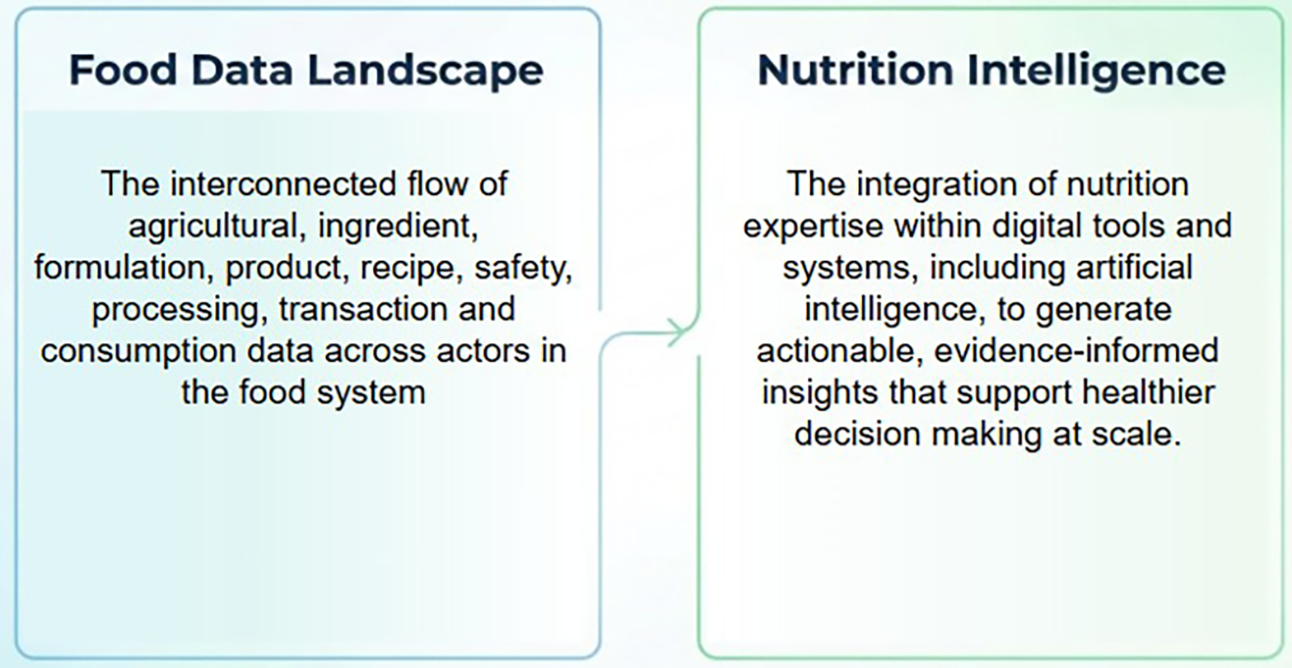
To harness advances in digital technology and AI to support healthier transformation of the food system, greater conceptual clarity is required. Nutrition informatics, an existing and widely used term, has been defined as the effective retrieval, organisation, storage and optimum use of information, data and knowledge for food and nutrition-related problem solving and decision making, supported by information standards, processes and technology(Reference Rusnak and Charney33). It refers to the foundational digital infrastructure and information management processes that enable nutrition data to be captured, exchanged and utilised across systems. Nutrition Intelligence (NI) describes the specific capability through which nutrition expertise is integrated within digital tools and systems to support evidence-informed decision making at scale. It transforms nutrition data into actionable, expert-informed, technology-enabled intelligence that can be embedded within multiple digital tools and decision-support systems in clinical practice, public health, food systems and consumer-facing applications. This review builds upon the concept of NI introduced by McCarthy(Reference McCarthy34), exploring opportunities for its application, whilst also addressing critical aspects of the Food Data Landscape (FDL), which underpins its implementation (Fig. 1).
Definitions for the Food Data Landscape and Nutrition Intelligence.

The following sections explore: 1) The structure and limitations of the FDL 2) Technology-enabled Nutrition Intelligence 3) A proposed Food Data- Nutrition Intelligence Framework 4) Operationalising Nutrition Intelligence for Food System Transformation.
The central message of this review is that realising the transformative potential of NI within the food system requires a joined-up, systems-based approach grounded in robust data infrastructure, expert-led design and deployment, transparent definitions and assumptions, traceable decision making and intersectoral collaboration. Moving from data to metrics, from metrics to impact, at the pace and scale technological change can enable, requires digital capability, scientific expertise, applied experience and coordinated action across the food system.
The Food Data Landscape (FDL)
The ability to apply NI depends fundamentally on the structure and quality of the underlying FDL. These data are generated and transferred across multiple actors: farmers, ingredient suppliers, manufacturers, retailers, technology providers, regulators, researchers and consumers. Third-party digital platforms increasingly mediate these exchanges, supporting specification management, nutrient calculation, recipe management, supply chain transparency, online grocery retail, food delivery and consumer-facing applications, including wearables, that generate additional product, behavioural and purchasing data.
A wide range of data is generated as part of the FDL. This section describes a subset of data types most directly relevant to food and health.
Product and portfolio data
Product and portfolio data encompass product-level datasets generated by manufacturers and retailers. Product-level data describe the characteristics of individual food and drink products, including ingredients, formulations, nutrient composition, portion size, product categorisation and labelling information(Reference Pravst, Hribar and Žmitek35,Reference Harrington, Adhikari and Rayner36) . Portfolio-level data aggregate these attributes across groups of products, enabling assessment of reformulation, nutrient profiling and overall portfolio healthfulness. These data underpin regulatory compliance and monitoring, particularly where product classification determines marketing or promotional eligibility, such as the application of HFSS restrictions in the UK(Reference Jenneson, Kininmonth and Wilkins37).
Detailed product labels and specifications enable assessment of reformulation progress and calculation of portfolio-level health metrics, supporting evaluation of industry responses to policy interventions and benchmarking product healthfulness across categories(Reference Martin, Zarro and Rahn38). External monitoring initiatives, such as the Access to Nutrition Initiative (ATNI), further demonstrate how structured portfolio data can benchmark company performance against public health goals(39), while emerging health reporting frameworks increasingly depend on accurate product-level data to enable sales-weighted nutrient assessment(Reference Leon, Hugo and Jenkins40).
Despite their importance, product and portfolio datasets are frequently fragmented across retailer/manufacturer databases, third-party data platforms and specification systems. Data structures vary considerably between organisations, and standardisation is often guided by information required for regulatory compliance. Ingredient percentages and formulation-level details may remain commercially sensitive and inaccessible to external researchers, policymakers or the wider supply chain(Reference Bohn, Amberg and Meier41). Ongoing reformulation and product development cycles can also lead to inconsistencies in publicly available datasets, limiting the ability to monitor reformulation progress at scale(Reference Van Dam and Vandevijvere42). Open Food Facts provides an example of an openly accessible database whereby individual users can upload product data to an openly accessible database for both consumer and researcher use(Reference Chazelas, Deschasaux and Srour43).
Product-level data describe what is available for purchase, but not how products are promoted, purchased or consumed. To assess real-world dietary impact, portfolio datasets must be linked with transaction and consumption data, enabling sales-weighted analyses and evaluation of population-level dietary patterns.
Retail food environment data
Retail food environment data describe how food is presented to consumers through its availability, accessibility, pricing, marketing and prominence across physical and digital retail settings(Reference Granheim, Torheim and Terragni18,Reference Turner, Aggarwal and Walls44) . As food systems increasingly shift toward digitalisation, monitoring of potential influences within digital food retail environments, such as supermarket websites, meal kit providers and meal delivery apps, has become increasingly important(Reference Bennett, Keeble and Zorbas19,Reference Granheim, Løvhaug and Terragni45–Reference Jia, Bennett and Gupta47) .
These data provide insight into the structural drivers of food choice that influence purchasing decisions, including product availability, pricing, promotions, placement and digital features such as search rankings, personalised recommendations and filters(Reference Mah, Luongo and Hasdell48–Reference Khandpur, Zatz and Bleich50). Standardised measurement protocols aim to capture these characteristics consistently to enable robust comparisons and monitoring of food environments(Reference Mah, Luongo and Hasdell48,Reference Castro, Majmundar and Williams49) . Yet measurement approaches remain inconsistent across settings, and the absence of standardised protocols for digital food retail environments continues to limit comparability and synthesis across studies(Reference Maganja, Miller and Trieu46,Reference Glanz, Johnson and Yaroch51) .
Retail food environment data describe what is available and promoted but not whether products are purchased, consumed or associated with health outcomes(Reference Mah, Luongo and Hasdell48,Reference Kapoor, Shields and Reynolds52) . Consequently, they require integration with product composition, transaction and dietary consumption to assess real-world impact.
Transaction and food purchase data
Transaction data capture purchasing behaviour through loyalty card systems and household purchase panels(Reference Burgess, Suhag and Skatova53,Reference Bandy, Adhikari and Jebb54) . Typically large-scale, longitudinal and routinely collected, these datasets enable evaluation of healthy food intervention trials, nutritional intake and the impact of government campaigns and legislation(Reference Burgess, Suhag and Skatova53,Reference Jenneson, Pontin and Greenwood55) . Compared with self-reported intake data, transactions reduce recall bias and allow in-depth analysis by geography and socioeconomic status(Reference Green, Watson and Brunstrom56,Reference Clark, Shute and Jenneson57) .
However, transaction data capture purchasing rather than consumption and may exclude purchases made through other retailers, out-of-home settings or instances where loyalty cards are not used, leading to incomplete data coverage(Reference Burgess, Suhag and Skatova53). Their use for dietary exposure assessment is further limited by the need to link purchasing records with detailed nutrition and formulation data, which may be commercially sensitive or not readily accessible. As such, transaction data provide insight into what consumers purchase but require integration with product-level and consumption datasets to determine health implications(Reference Jenneson, Pontin and Ennis58). The proposed Optimal Food Data Hub, developed through the DIO Food project at the University of Leeds, illustrates the type of structured open data infrastructure needed to enable such linkage and support analysis of nutrition, health and sustainability outcomes at scale(Reference Kininmonth, Stone and Jenneson59,Reference Wilkins, Dineva and Green60) .
Consumption data
Consumption data capture what individuals eat and drink and remain central to furthering nutrition science and dietary guideline development(Reference Kesaite, Chavez-Ugalde and White61,Reference Ruxton62) . They are traditionally generated through national dietary surveys using 24-hour recalls, food frequency questionnaires and food diaries(Reference Bailey63,64) , underpinning risk assessment nutrient intake modelling and evaluation of dietary inequalities(Reference Tang, Adams and Ferguson65–67).
A key strength is their capacity to estimate individual dietary intake and nutrient exposure to link health outcomes and socioeconomic status(Reference Miller, Singh and Onopa68). However, dietary assessment methods are subject to well-documented limitations, including recall bias, underreporting and difficulty with estimating portion sizes(Reference Bailey63). In addition, consumption datasets often lack brand-level or product-specific data, limiting assessment of reformulation and evaluation of dietary exposure in real-world retail environments(Reference Williams, Cade and Beer69,Reference Pravst, Hribar and Žmitek70) . Although academics may continue to use traditional dietary approaches, there are new database tools such as myfood24 that capture large-scale food product datasets, which can alleviate challenges with product-specific data accessibility(71).
In addition, mobile applications have been suggested for dietary tracking in research and clinical settings, alongside novel consumer-facing platforms such as ZOE which generate new types of data on individual dietary responsiveness(72). While these technologies offer considerable potential, these data are often held within proprietary systems and may not be readily available for research or policy use.
Data challenges
Despite the breadth of data generated across the FDL, several structural challenges limit their effective use. Data availability and accessibility are uneven, with formulation-level details often commercially sensitive and transaction datasets proprietary to retailers or third-party providers. Standardisation is limited, with inconsistent product categorisation systems and different platforms for data that make linking between product, retail and consumption difficult. Methodological assumptions (e.g. category scope, nutrient estimations, fruit vegetable and nut content) can influence outputs such as nutrient profiling which informs sales-weighted health metrics. Large-scale datasets require infrastructure and expertise for data cleaning and analysis, while ongoing reformulation and product turnover demand continuous updating and quality assurance. These challenges highlight that a significant constraint is not only the lack of data or access to it, but fragmentation between datasets, which are limitations that must be addressed to enable scalable application of NI.
From fragmentation to integration
These datasets show that different stakeholders operate within distinct data domains, but collectively they hold significant potential to transform our understanding and ability to impact the health of the food system. Together they contribute pieces of a broader evidence base that can be combined to inform policy, research and industry practices(73). However, fragmentation across data sources, inconsistent accessibility, interoperability and limited real-time data availability remain key barriers to the generation of a comprehensive understanding of how food environments shape dietary outcomes and leveraging these datasets for timely policy design and evaluation(Reference Micha, Coates and Leclercq28,Reference Marshall, Bellows and McLaren74) . Addressing these challenges requires greater automation of data flows across supply chains, improved standardisation, sufficient data characterisation (e.g. audits) and governance frameworks, all of which can lead to enhanced collaboration between the food industry, technology companies, policymakers and academia.
Technology-enabled Nutrition Intelligence
A rapidly evolving ecosystem of digital technologies offers potential to address many of the data challenges described and leverage the FDL to generate actionable, evidence-based insights, tools and systems to inform healthier, more sustainable decision making at scale. The technologies currently most relevant to the integration of NI within the food system are outlined below. Whilst these rarely operate in isolation and are instead typically applied in combination in real-world settings, to aid clarity they have been individually outlined in this section.
Data integration & retrieval
Data-driven and evolving AI-based techniques can enhance data accessibility through large-scale collation, restructuring and integration of diverse datasets. By combining multiple data sources, these approaches can enhance the level of product information available, enable the automatic application of criteria based on dietary principles allowing the immediate identification of all items that meet or do not meet the specified requirements(Reference McCarthy34). Automated data extraction has been identified as a route for researchers to gather larger and richer datasets, thereby increasing the validity and relevance of their findings, with the need for monitoring the reproducibility of outputs a key requirement(Reference Halim, Reynier and Fv75).
Image translation
AI, most commonly deep learning, is used to extract and interpret data from images. This can include structured information from images e.g. numerical values from nutrition labels and also pixel-based data from transformed food images to classify foods, estimate portion sizes and nutrient content. These approaches can support dietary assessment with reported accuracy rates exceeding 90% alongside high precision(Reference Agrawal, Goktas and Kumar13,Reference Kassem, Beevi and Basheer16,Reference O’Hara, Kent and Flynn76) . When compared with manual approaches and a reference standard (e.g. a nutrient compositional database), a systematic review stated whilst AI tools are reaching a high degree of accuracy, substantial variability exists between the food image databases and the type of analytical outputs reported, with the need for increased consistency on the characteristics that are integrated into such tools and validation methodology to assess performance(Reference Shonkoff, Cara and Pei77).
Generative AI (GenAI)
Gen AI utilises generative models to understand patterns and structures within datasets, which can include images, text and other multimedia, alongside training datasets, to produce new data(Reference Sengar, Hasan and Kumar78). An example of GenAI applied within the food and health ecosystem is the generation of meal plans or recipes based on dietary preferences. An analysis of menu recommendations for a person with type 2 diabetes showed overall alignment with the Diabetes Plate Method but responses varied over time which led authors to question reliability of the information a patient would receive(Reference Chatelan, Clerc and Fonta79,80) . Limitations have been noted with the presence of nutritional misinformation in outputs as well as a lack of regulatory health guidelines and holistic dietary context(Reference Szymanski, Wimer and Anuyah81).
Conversational AI
Conversational AI simulates human-like interactions though natural language processing (NLP). This AI technology has a broad range of applications such as chatbots and virtual assistants, enabling systems to interact with people via simple interfaces, across multiple channels, 24/7 using engaging dialogue(Reference Kusal, Patil and Choudrie82). A comparative analysis of LLM-based conversational agents with dietetic students found some LLMs demonstrated proficiency in nutrition knowledge which at times surpassed students in certain areas although specific details e.g. food group classification and relationship between diet and certain health conditions, were lacking in LLMs compared to students with specialist knowledge(Reference Bragazzi, Monica and Bergenti83). The integration of nutrition expertise into the design and implementation of LLMs, e.g. GPT-4, has been shown to significantly improve the alignment of a model’s outputs with dietitian standards(Reference Szymanski, Wimer and Anuyah81). This research and prototype development case study clearly demonstrates that iterative incorporation of specialised knowledge can ensure identification of errors, enable the design of specific guidelines to fine-tune outputs and ensure curation of appropriate sources of information, essential in the validation of outputs that are relevant, applicable and present minimal risk to users.
Recommender systems
These systems provide users with personalised suggestions aligned with their preferences and interests. These models process information in layers enabling numerous tasks to be performed at once. A systematic review highlighted how the incorporation of data, algorithms and deep learning significantly enhanced the accuracy and effectiveness of these systems, with the integration of contextualised real-time data improving recommendation relevance that align with user-specific interests(Reference Masciari, Umair and Habib Ullah84). Nutrition-oriented recommendation systems can be used to identify foods with appropriate compositions which match the preferences of individuals to provide dietary recommendations in a variety if contexts e.g. to nudge healthier choices(Reference Majjodi, Starke and Trattner85).
Explainable AI
Approaches to improving the explainability of AI systems have been trialled to enhance user trust by providing insight into how models made decisions and generated outputs(Reference Nfor, Theodore Armand and Ismaylovna86). This emerging area is currently lacking within many existing AI models(Reference Agrawal, Goktas and Kumar13). Strengthening transparency and traceability through the provision of information that helps ensure understanding of the system decision making is important for building clinical and consumer trust and safety as well as enabling effective insights to inform those responsible for monitoring, evaluation and governance of technology-enabled systems and tools.
From Artificial Intelligence to Nutrition Intelligence
Despite the considerable potential of GenAI and other digital technologies to transform nutrition decision support, important limitations remain. Current models may generate plausible but inaccurate or misleading nutrition advice, lack the contextual understanding required for complex dietary recommendations and reproduce biases or misinformation present within their input data(Reference Panayotova17,Reference Abdur Rahman, Dedousis and Papathanail87) . Currently a lack of transparency and traceability of the rulesets used to inform outcomes limits the availability of information that could enable independent evaluation or audit procedures.
AI-generated outputs require robust validation, transparent governance and expert oversight prior to implementation in public-facing or clinical applications. In this context, NI provides an important opportunity to embed robust nutrition expertise within digital systems to generate actionable, trustworthy and evidence-based insights, rather than relying on generic AI-generated outputs alone.
Towards a Food Data-Nutrition Intelligence Framework that supports Food System Transformation
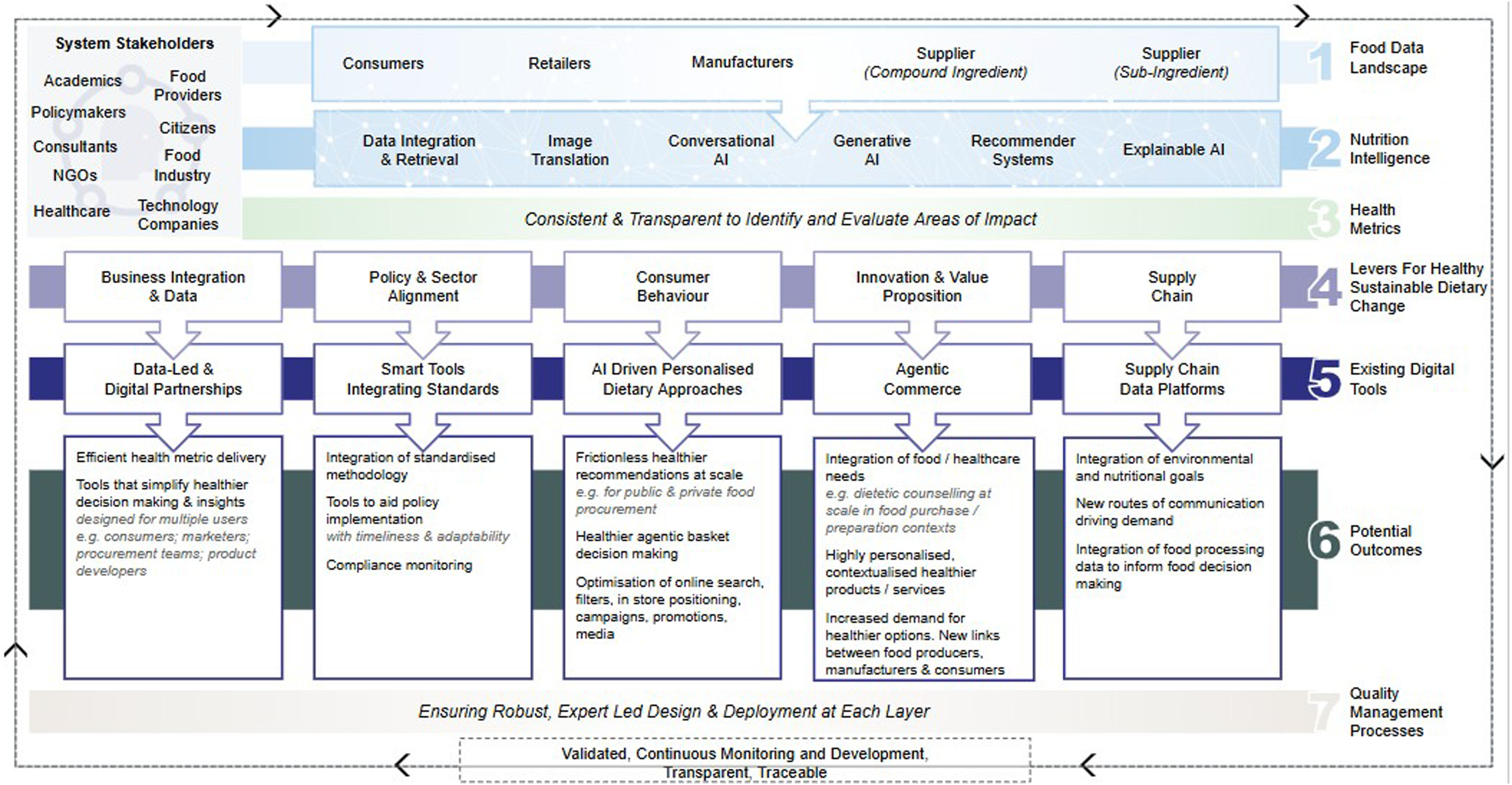
Realising the transformative health potential of NI, while addressing the structural challenges within the FDL, requires a joined-up, action-oriented, systems-based approach. Fig. 2 presents a conceptual Food Data-Nutrition Intelligence (FD-NI) framework that captures the interconnected nature of data, technology and food system stakeholders and the potential of this convergence to enable healthier food system transformation.
Food Data-Nutrition Intelligence (FD-NI) framework. This conceptual FD-NI framework illustrates the integration of the Food Data Landscape (Layer 1) and Nutrition Intelligence (Layer 2) to deliver consistent, transparent health metrics (Layer 3). These outputs can inform organisational levers for population-level dietary change (Layer 4) supported by existing and emerging digital tools (Layer 5) and enable cross-system outcomes at scale (Layer 6). Quality Management Processes (Layer 7) should underpin all layers to ensure robust, expert-informed design, deployment and governance. Stakeholders across and adjacent to the food system, including public and institutional food providers (e.g. schools, hospitals), the food industry (retailers, manufacturers, out-of-home food businesses such as caterers and quick service restaurants, ingredient suppliers and agriculture) NGOs, academia, technology companies, healthcare providers, consultants and citizens, may both contribute to and benefit from each layer. Continuous validation, monitoring and iterative development with transparent and traceable processes are essential to ensure the framework can effectively and meaningfully support transformation of population and planetary health.

The FD-NI framework highlights the critical importance of data quality, accessibility and governance which are represented in level 1 and the underpinning quality management layer 7 of the framework. This FD-NI framework illustrates how NI extends beyond data alone and can support health metrics, which can be used to define and evaluate health impact. The framework underscores the role multiple stakeholders play in the generation and utilisation of data and the need to integrate approaches across technology, policy, academic research, food providers, non-governmental organisations (NGOs), consultants, healthcare systems and citizens to enable the development and delivery of scalable, impactful digital solutions. This integration includes not only technical solutions, but also transparent data, shared standards and ongoing dialogue between stakeholders.
The FD-NI framework also incorporates previously identified food system levers for progress towards healthier and sustainable diets(Reference Sadler, Hannah, Hannah and Daniel88), linking these strategic mechanisms to existing digital technologies and decision-support tools and the potential health outcomes they may enable. By explicitly connecting strategic levers with technology-enabled implementation pathways, this framework provides a mechanism though which NI can help translate evidence into coordinated action across the food system. Such an approach could actively address current fragmentation and misaligned timeframes of activity across domains and ensure expertise and evidence are embedded within technological design and deployment whilst ensuring system-wide access to relevant digital tools. While the scale and complexity of diet-related diseases is a significant challenge, the convergence of data, metrics and technology provides a foundation for coordinated action. With the appropriate structures and governance in place, NI offers a pathway to integrate and align these domains and accelerate progress towards healthier and more sustainable food systems at scale.
Operationalising Nutrition Intelligence for Food System Transformation
The FD-NI framework provides a conceptual model for integrating nutrition expertise, digital technologies and stakeholder action to support healthier and more sustainable food systems. To illustrate its practical application, the following section considers health metrics and the seven organisational levers for population dietary change previously proposed(Reference Sadler, Hannah, Hannah and Daniel88) to examine how data-driven and technology-enabled approaches are already being deployed in practice and highlight further opportunities for NI to embed evidence-based nutrition expertise within digital systems to accelerate coordinated action and support healthier food system transformation at scale.
Health metrics
Cascading data demands
Implementation of the UK Nutrient Profiling Model (NPM) for classification of products in scope of mandatory HFSS restrictions shows how health metrics can create cascading data demands across manufacturers, retailers, out-of-home businesses, convenience stores and third-party data providers, which have needed to calculate HFSS scores as part of product listing, advertising and regulatory compliance processes.
Although much of the underlying product-level data required for calculations is governed by food information legislation, implementation revealed structural limitations in data availability and interoperability across the FDL. Different actors may hold data for different products (e.g. branded vs own brand) alongside different components of the required information, including nutrient composition, ingredient percentages and product categorisation.
Evidence from stakeholder engagement further indicates that implementation challenges have been exacerbated by delayed technical guidance, limited communication and restricted access to product-level data required for nutrient profiling(Reference Kininmonth, Stone and Jenneson59,Reference Dhuria, Muir and Shaw89,Reference Muir, Dhuria and Roe90) . HFSS policy has therefore not only reshaped marketing strategies but also highlighted the extent to which feasibility of implementation depends on the underlying food data infrastructure.
Operational challenges
Operationalising health metrics, such as the UK NPM, requires detailed product-level data, including nutrient composition and calculation of fruit, vegetable and nut content. Where formulation data are unavailable, calculation can require assumptions or estimations, introducing variability in classification results.
Challenges vary depending on the dataset used. Consumption datasets often rely on generic food composition databases, where qualitative classifications such as NOVA categories(Reference Monteiro, Cannon and Lawrence91) or Eatwell Guide(92) criteria can be applied at the product name/category level. In contrast, product/portfolio analyses typically use quantitative product-level data derived from labelling and specification systems.
Operational challenges can also become more prominent as scientific understanding of nutrition evolves. The proposed transition from total sugars to free sugars within the updated UK NPM 2018 shows how evolving scientific definitions generate new data dependencies. Unlike total sugars, free sugars cannot be measured analytically and instead require estimation from ingredient composition, nutrient reference data and processing information. A recent stakeholder roundtable highlighted practical challenges related to capturing ingredient-level data through multi-tiered supply chains, gaps in specification information, variation in ingredient interpretation and inconsistencies in assumptions made, limiting consistent free sugar calculation(Reference Daley, Skeggs and Clarke93). Implementing metrics that rely on manual calculation therefore requires enhanced data sharing across ingredient suppliers, manufacturers and retailers or the incorporation of nutrient values within product specifications beyond those currently provided.
Divergence in health metrics
Beyond operational challenges, the growing diversity of health metrics introduces further complexity. Nutrient profiling models are used for a range of purposes, including front-of-pack nutrition labelling, marketing restrictions, dietary assessment and portfolio benchmarking, yet differ in their objectives, methodological approaches (e.g. components included) and thresholds. The same product may therefore receive different classifications depending on the metric applied.
Consumer-facing applications and digital tools further contribute to the proliferation of health metrics by translating product-level data into simplified health scores or classifications, using proprietary algorithms or adaptations of existing nutrient profiling models(72,94–Reference Creedon, Kim and Bermingham96) . By drawing on product-level data sourced from barcode databases, open data platforms or user-generated inputs, these tools operationalise health metrics directly at the point of consumer decision making. Yet the underlying methodologies, scoring criteria, transparency and alignment with national dietary guidelines can vary considerably. In some cases, they incorporate or adapt established frameworks such as Nutri-Score(97) or UK traffic light labelling(98), while others employ novel composite metrics that may include processing level, additives or broader health indicators. As these applications increasingly influence consumer perception and purchasing behaviour(Reference Croker, Packer and Russell99), they introduce a parallel, largely unregulated layer of nutrition interpretation that may influence future food industry strategies.
This heterogeneity raises important questions regarding the consistency, interpretability and scientific validity of the scores generated. There is a clear need for systematic evaluation of these tools, including validation against established dietary recommendations, assessment of their real-world impact on purchasing and dietary patterns and greater transparency around algorithm design and data sources. Strengthened governance will be important to ensure that such tools are evidence-based, comparable and support public health objectives.
The proliferation of health metrics surfaces a broader tension between the multidimensional nature of diet quality and the need for simplified and personalised indicators that can be operationalised at scale. Although the UK NPM remains central to HFSS policy, an expanding international literature, both academic and policy, describes diverging nutrient profiling models with varying methods and implementation experiences(Reference Martin, Turcotte and Cauchon100). This evolving landscape underscores the need to consider how future policy frameworks may integrate multiple dimensions of health and reflect emerging scientific consensus.
Emerging health reporting requirements
The importance or robust product-level data and expert alignment on metrics is reinforced by emerging regulatory reporting requirements. The UK government has announced plans for mandatory health reporting by large retailers and manufacturers, intended to improve transparency and encourage healthier food environments(101). The data challenges presented in this review need to be carefully considered when implementing any such policy. Such reporting requirements may mandate companies to calculate and disclose portfolio-level indicators based on health metrics and sales data, making methodological standardisation and consistent audit procedures essential for comparability, monitoring and enforcement across diverse food businesses(Reference Taibjee, Chacko and Barber102). Transparency initiatives such as those developed by ATNI demonstrate how structured health metrics can support benchmarking and accountability for investor decision making and a level playing field, encouraging change(39).
Role of technology
Technology-enabled tools and systems have potential to improve the scalability and consistency of health metrics although variability in access to these within the food system has been noted(Reference Guru103). Algorithmic tools have been developed that are freely available to aid the application of nutrient profiling models e.g. NPM Calculator(104). Automated tools, AI or algorithms can standardise calculations, reduce manual effort and support consistency across industry, research, policy enforcement and auditing(Reference Daley, Skeggs and Clarke93). Technology therefore has potential to address challenges within the FDL, however this should remain expert-informed and aligned with published technical guidance.
There has been a rapid rise in LLM-based chatbots, such as ChatGPT and Claude, with emerging evidence highlighting these tools are increasingly being used by the public to obtain health-related information, including dietary advice(Reference Yun and Bickmore105). As these technologies evolve and their use in both personal and professional decision making expands, it is imperative that their development is guided by principles of accuracy, transparency and robust alignment with the scientific evidence base.
Levers for population dietary change
Business integration & data
Business integration and data have been identified as key enablers of healthier transformation within organisations, including embedding health goals within business growth metrics and strengthening cross-functional governance and capability(Reference Sadler, Hannah, Hannah and Daniel88). Achieving this requires the integration of diverse data sources across the FDL into interoperable systems that enable organisation-wide, health-based decision making and transparent health reporting. Sustainability-focused initiatives already demonstrate this potential, including Ocado’s collaboration with Mondra to deliver a fully integrated product-level scope 3 reporting system and the partnership between Compass UK Group and Foodsteps that improved the capability of over 4000 chefs to report the carbon footprint of over 180 million meals delivered annually(Reference Compass Group106,107) .
Technology-enabled NI is increasingly supporting real-time integration of nutrition criteria into business decision making. For example, Spoon Guru provides AI-enabled NI capabilities to global food retailers and organisations such as Coeliac UK, enabling businesses, customers and members to navigate online and instore food shopping environments in ways that support healthier, safe choices. These systems also enable cross-functional retail teams to deliver multi-channel interventions e.g. automated product swaps, signposting, loyalty programmes and incentives that promote healthier choices(Reference Guru108).
In future, conversational AI and other digital interfaces may further democratise access to NI, supporting evidence-based decision making across both organisational and consumer contexts.
Policy and sector alignment
The implementation of HFSS restrictions across the UK food sector represents a world-first example of not only wide-scale mandatory, promotion, placement and marketing restrictions but also researcher-led evaluations using retail transaction data to evaluate policy impact. At the national level, evaluation of England’s HFSS placement restrictions estimated that approximately two million fewer in-scope HFSS products were sold per day following implementation(Reference Jenneson, Kininmonth and Wilkins37). This example highlights the potential for structural food policies to drive measurable dietary shifts and the pathway to academic evaluation at a new scale. Effective implementation across sectors requires robust compliance monitoring, standardised health metrics, alignment with nutrient profiling models and standardised guidelines(109).
NI has potential to enable such requirements to be realised at scale in multiple contexts. A pilot by the Food Standards Agency and Department of Education in the UK highlighted capacity and capability challenges within local authorities to follow up areas of non-compliance with school food standards, alongside resource challenges of food safety officers to complete audits and some inconsistencies in applying checks(110). Technology-enabled solutions may halpe address such challenges. For example, Woolworths at Work and Spoon Guru have recently delivered a smart recipe planning tool for early childhood education and care centres enabling the development of menu plans which align with the Australian Dietary Guidelines(111) making it easier for cooks to cater for the needs of children in their care(Reference Guru112).
A recent multi-stakeholder workshop examining the role of technology in the feasible and consistent implementation of the NPM 2018(113) highlighted substantial variability in access to digital tools and systems across the food system(Reference Guru103). The workshop identified a clear need for greater interoperability between datasets, digital platforms and stakeholders, together with more equitable access to technology-enabled tools and systems to realise their full potential in supporting the consistent implementation of mandatory nutrition policy.
These examples reinforce the importance of integrated, technology-enabled NI to connect fragmented data sources, embed nutrition expertise within digital systems and facilitate scalable policy implementation and compliance monitoring across the food system.
Consumer behaviour
Optimisation of consumer touchpoints e.g. online search, filters, in-store positioning, campaigns, promotions and media, to help nudge choices towards healthier, more sustainable products has been called for(Reference Sadler, Hannah, Hannah and Daniel88). Meanwhile, the potential of LLMs as applied educational tools and, if designed appropriately, novel routes to expanded access to nutritional care has been noted. Evidence also suggests AI-driven dietary approaches, which provide personalised, data-driven recommendations, deliver greater effectiveness compared with traditional interventions with benefits noted in glycaemic control, irritable bowel syndrome, metabolic health and psychological wellbeing(Reference Wang, Sun and Xue114,Reference Belkhouribchia and Pen115) .
In market digital tools which address this lever include Instacart’s GenAI-enabled ‘smart shop’ analyses customer habits and dietary preferences to present products to consumers in a simple, intuitive, personalised online food shopping experience(116). Intent-based patterns in user behaviour are used to predict more personalised recommendations with dynamic adjustments as real-time data is used to prioritise the most relevant products to each user. The company have also collaborated with the American Diabetes Association to deliver inspiration pages with shoppable recipes alongside health recommendations for those with prediabetes, diabetes and obesity(116). Similarly, EatLove provides personalised meal recommendations, including restaurant food recommendations, food tracking and nutrient analysis, food shopping list creation with optional delivery and dietitian-approved recipes across healthcare and workplace contexts(117).
The rise of agentic commerce, which shifts how food shopping decisions are made, moving from an individual browsing and selecting products, to instead, an individual reviewing and approving AI-curated selections, further demonstrates the integration of technology into consumer food decision making(Reference Gal118). For example, a partnership between Walmart and Google now enables shoppers to shop Walmart products directly on Gemini, a Google AI chatbot(Reference Ludmir119).
These developments highlight how adjacent technologies can rapidly reshape the consumer experience of the food system and have potential to expand the reach of NI. There is a need for larger, longer-term studies to evaluate AI-driven dietary approaches alongside careful consideration of methodological and ethical requirements(Reference Wang, Sun and Xue114,Reference Starke, Dierkes and Lied120) .
Innovation and value proposition
By 2030 health-conscious consumers may use AI to ‘shuffle’ their weekly diet, much like they shuffle their digital music today, to inspire diverse food choices(121). The AI-generated meal plan market, valued at 1.34 billion USD reflects growing demand for fitness apps, wearable devices alongside levels of lifestyle-related disease(122). These future predictions of how consumers will interact and make food choices represents a significant opportunity for cross-sector innovation across food, healthcare and digital technology.
Health-orientated value propositions are also emerging in response to medical trends. GLP-1 medications, whilst posing a commercial risk to food businesses, also create an opportunity for new health-based value propositions. For example, Sifter’s Food as Medicine platform is a tech-enabled tool that can assist patients with the selection of foods whilst they are taking GLP-1 medications, prioritising lean proteins, whole foods and those that are low in saturated fat, salt and added sugars(123). Recent research demonstrated that integration of dietitian counselling alongside food ordering and delivery significantly reduced blood pressure and low-density lipoprotein cholesterol (LDL-C)(Reference Juraschek, Col and Ferro124). Innovative use of AI-based technology could enable the expansion of such exploratory science and its translation at a scale.
AI-driven chatbots are creating novel, value-added customer experiences through personalised interactions(Reference Ludmir119). Insights gained from the personalised prompts are likely to inform new value propositions and further innovations in shopping experiences and product development as businesses’ respond to ever-evolving consumer needs. Such developments also have the potential to bring consumers in more direct contact with wholesalers, manufacturers and producers, presenting new opportunities for food businesses across the supply chain to have direct consumer engagement.
Supply chain
Resilient supply chains and long-term sourcing strategies that integrate environmental and nutritional goals are essential for healthy sustainable diets(Reference Sadler, Hannah, Hannah and Daniel88). Blockchain is already used across supply chains, capturing details of production, processing etc. As supply chain data becomes increasingly integrated with nutrition and health information, it could provide new ways for producers to communicate the quality and differentiation of their ingredients and processes, potentially increasing consumer awareness and demand for higher-quality, healthier and more resilient food production and manufacturing methods.
IBM Food Trust has digitalised and integrated supply chain data in a platform that enables organisations to transcend traditional organisational silos and increase food quality and safety, improve efficiencies and minimise waste(125). With increasing attention on the impact of food processing on health, technologies that capture digitised end-to-end production data could offer mechanisms for deeper exploration and translation of research exploring the impact of food processing on health.
Conclusions
We are at a pivotal moment in which nutrition science, data, digital technology, AI and policy are increasingly converging, creating unprecedented potential to transform food systems and improve population health. However, this potential remains constrained by fragmentation across these domains. Data are siloed, health metrics are inconsistently defined and applied, timelines for scientific, technological and policy developments are often misaligned, with technological advancement outpacing both regulation and scientific publication timeframes alongside high variability in access to technology-enabled tools and systems between stakeholders.
Addressing these challenges requires a systems-level understanding of how data, metrics, nutrition science and digital technology interact within the broader FDL, alongside greater recognition of existing and emerging technology-enabled practices within and adjacent to the food system. This review contributes a unified conceptual framework (the FD-NI framework) that brings these elements together, providing a shared foundation for advancing more coherent research, policy and practice. The FD-NI framework positions NI as an integrative layer that embeds nutrition expertise within digital systems to support the translation of complex, fragmented data into evidence-based, actionable insights that can support healthier decision making at pace and scale.
However, the scale and urgency of diet-related health challenges require action beyond conceptual alignment. Progress will depend on coordinated efforts to improve data quality, interoperability and governance, alongside the development of transparent, standardised and validated health metrics. It requires technological innovation to be grounded in scientific evidence and aligned with public health priorities. Future research should investigate the roles of different actors in generating, sharing and utilising data across the FDL, as well as the methodological and governance frameworks needed to support system-wide deployment of NI and its ongoing evaluation.
There is now a clear need for accelerated, collaborative action across sectors. Researchers, policymakers, food industry, healthcare systems and technology developers must work together to co-design and implement NI solutions that are evidence-based, scalable, context-specific and accessible. This includes embedding robust evaluation frameworks to assess real-world impact and aligning technological innovation, regulatory and scientific developments. Acting now, through coordinated and cross-sector collaboration, will be critical to harness the full potential of NI and deliver meaningful, system-wide, timely transformation towards healthier and more sustainable diets.
Acknowledgements
The authors would like to express their gratitude to the Nutrition Society for the invitation and opportunity to present these findings at the 2026 Nutrition Society Winter Conference.
Author contributions
Both authors contributed to the development and review of the manuscript.
Financial support
This research received no specific grant from any funding agency, commercial or not-for-profit sectors.
Competing interests
Danielle McCarthy is Chief Health Officer at Spoon Guru, Co-Founder of Nutrition Talent and Honorary Professor of Practice at Queen’s University Belfast.
Lewis Wallis is a Regulatory & Nutrition Affairs Advisor at Campden BRI and a Postgraduate Researcher at University of Leeds. While both roles have informed his expertise, this review was drafted and revised independently of either organisation.

 Open access

