Introduction
One of the key challenges facing humanity is hunger. One out of every six people is suffering from hunger (FAO, 2009). Poor nutrition decreases physical, cognitive and mental development. In 2004–2005, 30% of people worldwide were undernourished, 51% of children under the age of five were underweight, 51% of children were stunted and 36% of infants had a low birth weight (UNDP, 2008). Malnutrition affects one in three children (32.5%) in developing countries (de Onis et al., Reference De Onis, Frongillo and Blossner2000). Solving the problem of hunger is hindered by lack of financial resources in poor countries. In Bangladesh, more than half of children between the ages of 6 and 59 months are anaemic and many have an inadequate intake of iodine and vitamin A (Government of Bangladesh, 2005). Although the poor and hungry have insufficient food throughout the year, in particular protein from animal sources, some of the malnourishment is due to the lack of awareness, knowledge and skills of mothers when preparing and cooking food for their households (Islam, Reference Islam2009).
There are currently three widely accepted strategies for reducing malnutrition, namely: fortification, supplementation and dietary diversification. However, all of these involve financial resources. Since Bangladesh lacks adequate financial resources to reduce malnutrition, providing appropriate knowledge and skills in nutrition and hygiene practices among the population, especially the ultra-poor in rural communities, may be the most effective and sustainable strategy. Although people in these communities do eat rice and vegetables in their daily meals, because of their lack of knowledge on nutrition and appropriate cooking practices, there is either a loss of nutrients due to overcooking or lack of diversity in their vegetable intake. Thus, they suffer from double nutrient loss, rendering them vulnerable to malnourishment and various nutrition-related diseases due to an inadequate intake of protein, vitamins and minerals.
Another factor affecting the health of poor communities is lack of hygiene. Basic practices, such as hand-washing, provide barriers to transmission of enteric pathogens, and thus significantly reduce the risk for diarrhoeal disease and acute respiratory infections. A systematic review of the effects of washing hands with soap on the risk of contracting diarrhoea, which is among the top three killers of children in the world today (WHO, 2000), found a reduction of 42–47% in diarrhoea incidence (Curtis & Cairncross, Reference Curtis and Cairncross2003). However, little is known about the health benefits of hand-washing, particularly in low-income countries like Bangladesh, and especially among people living in extreme poverty.
In order to effectively address the challenges of maternal, infant and child mortality and to fight hunger and poverty in a cost-effective manner, it will be necessary to take interventional steps aimed at promoting health awareness and capacity building. The present study attempts to examine whether a targeted and low-cost intervention designed specifically for ultra-poor communities can improve the quality of life and health outcomes of the community. The specific aims were to assess whether educating the communities in appropriate cooking practices, food habits and sanitation can improve the overall well-being of ultra-poor women in Bangladesh.
Methods
Study area and population
The study was carried out in four rural communities (sub-districts) of Rangpur district in Bangladesh, which have the highest concentrations of extremely poor households as defined by previous poverty mapping (Bangladesh Institute of Development Studies, 2000). The districts of Bangladesh are divided into sub-districts called Upazila or Thana, which are the second lowest tiers of regional administration in Bangladesh. Villages under Upazilas/Thanas with high concentrations of poor households were selected by the programme based on the knowledge level of the local BRAC (Bangladesh Rural Advancement Committee: a multi-faced non-governmental development organization) field staff. BRAC has initiated a health forum and skills training programme targeting ultra-poor communities and is one of the largest non-governmental organizations in the world. In Bangladesh, more than 40% of people live under the poverty line and of these 15–20% are ultra-poor women. These ultra-poor women depend on domestic work and/or begging for survival, only own 10 decimals (a unit of area in Bangladesh approximately equal to 40.46 m2) of land, have no active male family member and own no productive assets (BRAC, 2006). BRAC works with these communities in Bangladesh with the ultimate goal of improving their overall lives and economic conditions through several programmes. One such programme is called the ‘Challenging the Frontiers of Poverty Reduction – Targeting the Ultra Poor’ programme (CFPR-TUP). The study population consisted of two groups of women, namely: (a) CFPR-TUP members: this group belonged to the CFPR-TUP and received a comprehensive support package that included enterprise development training, economic support in the form of asset transfers and subsistence allowances, essential health care support and health subsidies, as well as social development support; and (b) the other group, which did not get any organized support to fight poverty. This study included TUP women from the DABI group (Daridro Bimochon/Poverty Alleviation Programme of BRAC) who joined during 2002–2003 (major representation from year 2002) as well as women not covered by the programme above but who were of comparable socioeconomic status.
Sample size and study design
A three-stage sampling method was used to select a representative sample from the target and control groups. In the first phase of sampling, Rangpur district was selected because of its high concentration of poor households. In the second stage, four Upazilas (Badarganj, Gangachora, Pirgachha, Taragonj) was selected randomly out of eight eligible Upazilas in Rangupr district and then villages under each chosen Upazila were selected by systematic random sampling. The calculated sample size was a minimum of 49 in each Upazila. The sample size was adjusted by doubling the computer-aided sample, keeping in mind that we were trying to see the effect of the health forum and skills training of the Specifically Targeted Ultra-Poor (STUP) with a statistical power of 0.80. However, a total of 200 samples was eventually collected instead of 196. A total of four Thanas were visited and on average 50 samples were collected from each Upazila for both groups.
Data collection
A questionnaire was developed based on the questionnaires used in the studies conducted by the Bangladesh Human Resource Development Board (BAN-HRDB) under the Ministry of Agriculture (MOA). Before implementing the final survey, a pilot study was carried out. Pre-tested structured questionnaires were used in face-to-face interviews by trained interviewers. The qualitative sample size in the intervention area included twelve in-depth interviews and four focus group discussions, which were duplicated in a similar manner for the control group. The ethics committee of BRAC University Bangladesh approved the study. Written and sometimes verbal consent was obtained from respondents. An interview schedule was developed comprising of both structured and open-end questions for collecting both qualitative and quantitative information from the primary respondents (both intervention and non-intervention groups). Besides, a mixture of other techniques, including observations, informal discussion, in-depth interviews and FGDs were used to obtain additional qualitative information for the study population.
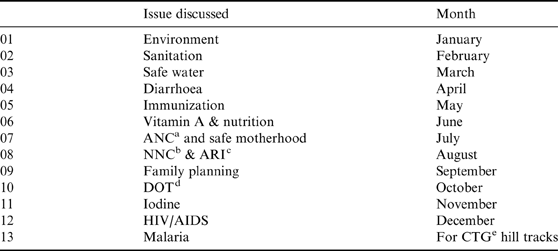
The BRAC health organizers discussed the issues listed in Table 1 with the targeted groups at a rate of about one issue per month. They planned health forums three times weekly (Saturdays, Mondays and Wednesdays) and twelve times monthly during village organization meetings. On average, there were always about 20–25 micro-credit holders present, including Specially Targeted Ultra-Poor (STUP) members. These members discussed issues for an hour during each forum. Every programme participant received appropriate enterprise development training before starting their income-generating activities. The training programme designed for the ultra-poor group involved participatory and need-based approaches, so that the method of delivery, demonstrations and evaluation of training outputs were quite different from the standard training programmes run by BRAC. The courses were flexible and were continuously upgraded in response to the feedback generated from the participants and others.
Annual schedule of the health forum conducted in target groups in Rangpur district by the Bangladesh Rural Advancement Committee (BRAC)

aANC, antenatal care; bNNC, neonatal care; cARI, acute respiratory infection; dDOT, direct observed treatment; eCTG, Chittagong.
The STUP participants had been trained during 2002–2006 on the following issues: an enterprise development training component, which included basic technical training in poultry, livestock, agriculture, social forestry, fisheries and others (source: BRAC field office). The training cited above was supported by confidence building training and regular monitoring. The information perceived from these forums and training was expected to improve their knowledge and facilitate behavioural changes. This study was designed to assess the effect of health information dissemination and related skills training knowledge on appropriate cooking practice and food preparation behaviour, and particular attention was given to the following outcomes: sanitation, use of water, oil and salt, cooking practices of rice and vegetables, and the roles of gender, education and media exposure in cooking practices. Guidelines for appropriate cooking practice were adopted from BAN-HRDB and the Ministry of Agriculture.
General dietary habits of the ultra-poor respondents
The study respondents were excessively poor and, as such, their houses were mainly of the kutcha type, i.e. temporary structures made up of crude materials such as mud, bamboo, straw with a hay-stack or tin roof. Such structures normally cannot survive harsh weather conditions. Respondents from both groups were able to cook rice and vegetables every day despite their limited financial resources. Because the study was conducted during the winter season, there were a lot of leafy vegetables available in the market, including the roadside, as well as the rice field, which in banglais is called kata shak. These rice field vegetables are normally picked and eaten by the poorest of the poor households, and, occasionally, they also cook fish and non-vegetarian foods. All the households sourced their water from tube wells and used it for general and cooking purposes, and the water was equally accessible to both the target and control groups. Because of the high cost of fruit, it was very difficult for the ultra-poor respondents to buy and eat. Nonetheless, subjects from the target group made efforts to eat fruit as frequently as possible by getting it from nearby trees or buying affordable seasonal fruit.
Statistical analyses
The characteristics of the study subjects from target and control groups were compared using analysis of variance and chi-squared tests for continuous and categorical variables, respectively. Means, standard deviations and percentages are presented, where appropriate. To determine if differences in general behaviour exist between the two groups (target and control), a chi-squared test was performed. The effects of intervention on the outcomes of interest were also explored using a random coefficient model. To evaluate the magnitude of the association of cooking practice and sanitation with the effect of the intervention, adjusted odds ratios (ORs) and 95% confidence intervals (CIs) were estimated using mixed models. In the applied mixed models, clustering was limited to the individual-level nested within intervention/control conditions. All the models were adjusted for age (year, continuous), household size (continuous), education (illiterate vs formal education), occupation (household work, other work) and marital status (currently married, other). Two-sided p-values of less than 0.05 were considered as statistically significant. All analyses were performed using Stata Version 12.0 (Lakeway Drive, College Station, Texas, USA).
Results
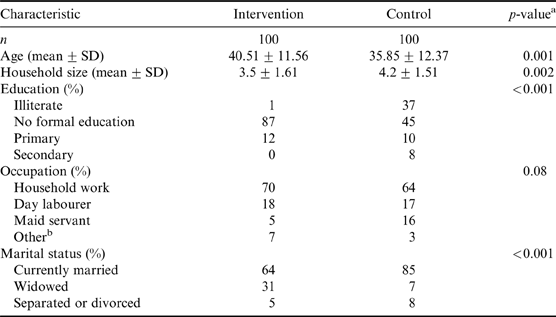
There were significant differences in age, household size and marital status between the target and control groups (see Table 2). The control group were younger, less likely to be currently married and had a greater household size.
Characteristics of study subjects, ultra-poor women, Rangpur district, Bangladesh
a Based on chi-squared test for categorical variables and analysis of variance for continuous variables.
b Other occupational categories included begging, business and service.
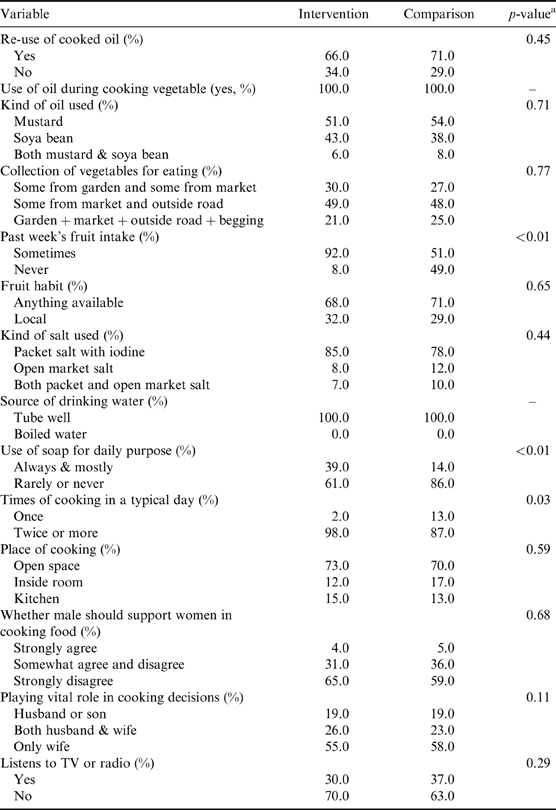
Significant differences were noted in fruit intake, use of soap during hand-washing for general hygiene and before cooking between the target and the control groups (p<0.05) (Table 3). However, no discernible difference was found between the two groups in other general behaviours (Table 3).
Differences in general behaviour following intervention, ultra-poor women, Rangpur district, Bangladesh
a Based on chi-squared test.
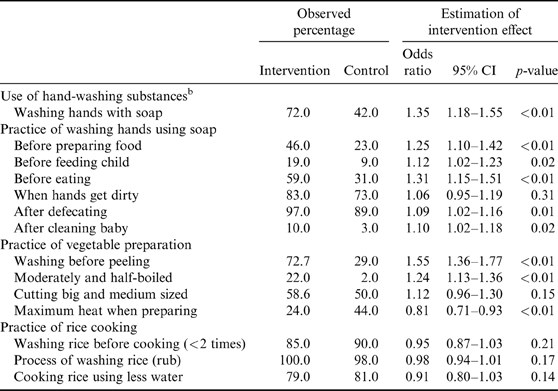
A significant change in hand-washing behaviour was observed in the target population. Washing hands using soap was 1.35 times more likely to occur in the target than the control groups (Table 4) (p<0.01), i.e. before preparing food, feeding children and eating, after toilet visits (defecating, urinating) and after cleaning the baby (p<0.05 for all). There was also a significant change in the routine of vegetable preparation between the target compared with the control groups, in the following procedures: hand-washing before peeling vegetables was 1.55 times more likely in the target than the control groups (p<0.001); moderately and half-boiled vegetables were 1.24 times more likely in the target than the control groups (p<0.01); use of maximum heat when cooking vegetables was 19% less likely in the target than the control groups (p<0.01). However, no significant difference was noted in rice cooking.
Effect of interventions on cooking practice and sanitation of targeted ultra-poora, Rangpur district, Bangladesh
Control groups are considered as reference (1.00) group to estimate intervention effect.
a All the models are adjusted for age (year, continuous), household size (continuous), education (illiterate, have some formal education), occupation (household work, others) and marital status (married, others).
b Hand-washing substances include soap and other materials such as ash, mud, or ash and soap.
Discussion
This study reveals that targeted intervention through knowledge dissemination programmes on, for example, appropriate cooking practices can lead to positive behavioural changes in ultra-poor communities. In this study, targeted compared with control groups were more likely to adopt and maintain hygiene in routine personal procedures and in the handling of food and vegetables during cooking. To the authors' knowledge, this is the first study that addresses the effectiveness of knowledge dissemination in positively changing the behaviours of ultra-poor rural women in Bangladesh. It successfully demonstrated clear improvements in cooking and sanitation practices in communities where the majority of the people were illiterate and lacked proper knowledge on nutrition and sanitation.
Nutrition and food consumption studies have observed that rural dietary patterns in Bangladesh are not well balanced (Jahan & Hossain, Reference Jahan and Hossain1998; Bhattacharjee et al., Reference Bhattacharjee, Saha and Nandi2007). Specifically, consumption of protein- and micronutrient-rich foods such as fish, meat, eggs, milk, milk byproducts, fats and oils accounts for less than 10% of the diet of rural people, and the consumption of vegetables and fruits is mostly seasonal and inadequate in Bangladesh (Kanungsukkasem et al., Reference Kanungsukkasem, Ng, Van Minh, Razzaque, Ashraf and Juvekar2009). Some of the key underlying factors contributing to these pervasive nutritional deficiencies and imbalances include poverty, inadequate knowledge and information on nutrition and appropriate food preparation methods, unhealthy food habits, lack of environmental hygiene and sanitation and a culture of gender inequity and lack of maternal education.
Food preparation methods are frequently cited as the most significant single cause of nutritional loss. For instance, minerals and vitamins, especially B-complex vitamins, are lost (40% of thiamine and niacin) when rice is washed before cooking. Further, boiling rice and discarding the water results in even more nutrient losses. The manner in which vegetables are washed and cooked also leads to considerable loss of vitamin C and B-complex vitamins (Bhattacharjee et al., Reference Bhattacharjee, Saha and Nandi2007). Indeed, the Asian Development Bank (2004) reported that more than three billion people globally are prevented from achieving their full potential as students, parents, workers and citizens due to micronutrient deficiencies. Anaemia caused by iron deficiency impairs the growth and learning ability of children, lowers resistance to infectious diseases and increases the risk of maternal death and low birth weight (Hurtado et al., Reference Hurtado, Claussen and Scott1999; Zimmermann & Hurrell, Reference Zimmermann and Hurrell2007). Notably in Bangladesh, anaemia affects pre-schoolers (49%), pregnant women (47%), non-pregnant women (33%) and adolescents (29%) (Mitra and Associates, 2005; Bhattacharjee et al., Reference Bhattacharjee, Saha and Nandi2007). These trends are despite considerable improvement in rural health. The nutritional condition of the rural poor populations in Bangladesh is still in a deplorable state, in part because of a lack of basic information on nutrition and appropriate cooking practices.
The present study demonstrates that the dissemination of basic information and skills training can have a positive impact on cooking practice and lead to behavioural change that ultimately improve the health and nutritional status of the ultra-poor rural people of Bangladesh. In line with this study, a previous study conducted among communities of lower socioeconomic status in the United States also found that knowledge intervention can change eating habits in 75% of respondents (Starkey, Reference Starkey2011). In addition, another study conducted in rural United States found that community-based interventions can have a significant impact on the serving and intake of vegetables (Wenrich et al., Reference Wenrich, Brown, Wilson and Lengerich2012).
The present study also found a significant change in fruit intake after targeted interventions. Vegetables, especially leafy, and fruit have significant amounts of calcium, iron and other minerals, including vitamins A and C. Vitamins are vital for controlling the body's chemical reactions. Malnutrition early in life has long-lasting and negative effects on overall growth, morbidity, cognitive development, educational attainment and adult productivity (Bhattacharjee et al., Reference Bhattacharjee, Saha and Nandi2007). Unfortunately, more than two-thirds of the daily diet in Bangladesh consists only of cereals (largely rice), followed by non-leafy vegetables, roots and tubers. Because diets rich in fruit and vegetables probably play a role in protecting against many chronic diseases such as cancer and heart disease (Van Duyn & Pivonka, Reference Van Duyn and Pivonka2000) and inadequate consumption of fruits and vegetables is estimated to cause about 31% of ischaemic heart disease and 11% of strokes worldwide (WHO, 2002), most people in Bangladesh are likely to suffer from these disorders. Overall, it is estimated that up to 2.7 million lives could be saved every year with a sufficient increase in fruit and vegetable consumption (WHO, 2002), and a high-fibre diet can reduce susceptibility to diseases (Bazzano et al., Reference Bazzano, He, Ogden and Loria2003; Estruch et al., Reference Estruch, Martínez-González and Corella2009). In poor countries with limited financial resources, low-cost and sustainable solutions are needed to improve the lives of poor people and combat their chronic diseases. Here, it is shown that dietary diversification through adequate nutritional and health information dissemination, supported by health forums and skills development programmes, can be a viable and sustainable approach to fighting infectious and chronic diseases.
The present study shows that the practice of washing hands with soap is significantly more likely to develop in target than control groups. This is an important outcome since the impact of hand-washing behaviour on reducing child mortality and diarrhoea diseases has been consistently reported (Curtis & Cairncross, Reference Curtis and Cairncross2003; Ejemot et al., Reference Ejemot, Ehiri, Meremikwu and Critchley2008; Luby et al., Reference Luby, Halder, Huda, Unicomb and Johnston2011). For this reason, public health programmes in low-income populations commonly promote hand-washing with soap, and because these intervention trials have consistently demonstrated a health benefit, hand-washing promotion interventions focus almost exclusively on hand-washing with soap (Iyer et al., Reference Iyer, Sara, Curtis, Scott and Cardosi2005). Sadly, in most poor countries, hand-washing with soap is uncommon across a wide range of the population due, in part, to the prohibitive cost of soap. For instance, in Bangladesh, a study showed that hand-washing was more common among households of higher socioeconomic status (Luby et al., Reference Luby and Halder2008). This implies that households from poor communities are less likely to wash their pathogen-contaminated hands before touching food, and therefore are more likely to become contaminated with gastrointestinal pathogens (Lynch et al., Reference Lynch, Tauxe and Hedberg2009). Therefore, proper knowledge on washing hands in poor Bangladesh communities will be particularly important to prevent diarrhoea and other infectious diseases. In a previous study conducted in Bangladesh, Luby & Halder (Reference Luby and Halder2008) showed that encouraging hand-washing, either with water alone or with soap and water, were beneficial. Therefore, the promotion of hand-washing exclusively with soap may be unwarranted, and the primary focus should rather be on promoting hand-washing behaviour in general. Previous studies in Bangladesh have also shown that higher socioeconomic status of the respondents and household head, including education and access to media, have strong positive associations with hand-washing with soap (Luby & Halder, Reference Luby and Halder2008; Rabbi & Dey, Reference Rabbi and Dey2013).
Mass media play an important role in influencing awareness and use of health services – particularly radio, which is generally more accessible to the poor (Grilli et al., Reference Grilli, Ramsay and Minozzi2002). Radio can be used to educate poor communities on how to cook in a way that minimizes nutrient loss, preferably if broadcast from 15:30 to 17:30 h as this is the time the majority of respondents (45%) preferred to listen.
There is a need to develop nutrition and sanitation campaigns that promote the benefits of behavioural changes, particularly aimed at women, who are the ones who take care of children and other family members. There are existing programmes popularizing these practices, but these are currently only being accessed by the most resourceful women. Also, if husbands could be encouraged to help with food preparation this might help the situation. Other short- or long-term programmes, such as government and NGO health campaigns and satellite clinics, should be used to impart knowledge on dietary diversification among disadvantaged groups.
The present study is the first intervention to demonstrate that, despite the limited resources and very low incomes of ultra-poor Bangladeshi rural women, appropriate training and knowledge dissemination can help them retain higher nutritional values in their food, improve their hygiene and mitigate diseases associated with malnutrition and inadequate sanitation. However, the study does have some limitations that should be addressed in future studies. It was based on a relatively small sample size and in a specific area of Bangladesh, so the results may not be generalizable to the entire ultra-poor population of the country. As the study was based on ultra-poor women, sometimes it was difficult to assess the actual association due to poverty and limited earnings. For example, although these ultra-poor women wanted to use fortified salt containing iodine, they could not do so due to its high cost. Similarly, the high cost of cooking oil forces them to re-use it when they would prefer not to. In addition, although a clear improvement in cooking and sanitation behaviours was found after intervention, the sustainability of these remains questionable. However, it is likely that they will be sustained by the natural shifting of behavioural norms.
In conclusion, this study demonstrates that knowledge and skills training of ultra-poor women can have a positive impact on their cooking practices, food habits and sanitation, which collectively, in part, can mitigate the problems associated with malnutrition. Thus, popularizing appropriate cooking and related hygiene practices through low-cost awareness-raising programmes is an effective approach for rural Bangladesh. The observed association and sustainability of this approach require confirmation in prospective studies.
Acknowledgments
This research was financially supported in part by the BRAC University, James P. Grant School of Public Health, Bangladesh. The authors declare that they have no conflict of interest.