1. Introduction
To follow trends, schools and what one considers to be the ‘correct’ or normative musical compositional discourse is according to Alain Savouret:
the surest way to get lost very quickly. Going forwards ‘in a backwards way’, on the other hand, means following one’s road using all kinds of landmarks, even very distant ones, as long as they resonate with us, or as long as they once touched us. They may be represented by a composer, or a genre, or they may take a non-musical form: a place, a type of architecture, a moment in history, a person, a voice. The more landmarks we use, the easier it is to move forward ‘in a backwards way’. (Savouret Reference Savouret1998: 229)
In their creative practice, each of the authors owes a significant debt to their acousmatic training and continuing influence of this practice on their work. However, each in their own way, to coin Savouret’s term, incorporates landmarks from other forms of musical practice into their work to the extent it could arguably no longer be considered acousmatic music. Whilst, for some this may merely be a matter of terminology or genre definition, the authors identify similar trends within the practice of many other contemporary practitioners that indicates a wider cultural shift. The authors consider this work as a positive development in response to acousmatic practice that in its broadest sense enriches the heritage from which it stems.
Through choosing the term ‘post-acousmatic’, the authors are clearly identifying with Pierre Schaeffer’s thinking even as we take distance from it. As Joanna Demers writes when commenting on Tony Myatt’s editorial to a previous edition of Organised Sound (Myatt Reference Myatt2008), the ‘connection between institutional affiliation and commitment to Schaeffer’ is an easy one to make. However, as Demers continues, ‘many independent sound artists … such as Francisco López and Toshiya Tsunoda, espouse clearly Schaefferian positions even as they pursue careers as independent freelance artists’ (Demers Reference Demers2010: 145). To this list of those sympathetic to or advocating such an aesthetic position could be added artists as diverse as Helena Gough, Hanna Hartman, Matthew Herbert, Giuseppe Ielasi and ErikM.
The term ‘acousmatic’ has in general parlance come to mean a number of things, all of which will be drawn upon in the authors’ definition of the post-acousmatic, but needs to be clarified here. In 1955, Jérôme Peignot used the term acousmatique to define the listening experience of musique concrète (Piegnot Reference Peignot1960: 111–23). This was refined by Pierre Schaeffer in 1966 as ‘referring to a sound that one hears without seeing the causes behind it’ (Schaeffer Reference Schaeffer1966), a position developed from Husserlian phenomenology. Francis Dhomont further extends the use of the term maintaining that it is:
a theoretical and practical compositional approach, to particular listening and realization conditions, and to sound projection strategies … By shrouding ‘behind’ the speaker (a modern Pythagorean partition) any visual elements (such as instrumental performers on stage) that could be linked to perceived sound events, acousmatic art presents sound on its own, devoid of causal identity, thereby generating a flow of images in the psyche of the listener. (Dhomont Reference Dhomont1995)
This definition considers the ‘acousmatic’ not merely as an approach to listening but also as one towards the treatment of sonic materials and their presentation in concert, in essence the establishment of a well-defined musical practice. An even broader use of the term to define a somewhat nebulous genre of works existing as fixed media sound works for concert presentation has been put forward by François Bayle who writes:
With time, this term – both criticized and adopted, and which at first may strike one as severe – has softened through repeated use within the community of composers, and now serves to demarcate music on a fixed medium (musique de support) – representing a wide aesthetic spectrum – from all other contemporary music. (Bayle Reference Bayle1993: 18)
In these definitions we can apprehend a paradigmatic practice that has extended beyond mere listening to include social organisation, ways of thinking and meta-levels of organisation that go into the construction, organisation and maintenance of a genre and its attendant institutions and communities of practice. Writings by some of the most prominent practitioners of this genre tend to defend such a position; for instance, Francis Dhomont expresses a desire for the emergence of a classicism in acousmatic music to facilitate personal expression within a common language. As Dhomont writes:
a repertoire founded on mechanisms that have become familiar, personal musical ideas expressed in a language no longer local, but common, recognised and intelligible. In addition, I believe that the acousmatic modality is currently going through this process. As the eldest daughter of musique concrète, it seems today, after more than fifty years of existence, production and research, both consolidated and free enough to reach this maturity. (Dhomont Reference Dhomont2008)
This ‘mature’ view is not seen as positive by everyone. There have always been alternative approaches to thinking about and making electronic art music that co-exist alongside the core acousmatic practice and repertoire. In the mid-1990s, a more tangible questioning of the prevailing aesthetics dominant within the academy emerged from within the academy itself. Symptomatic of this emerging debate and just a few years before the fiftieth anniversary of the ‘birth’ of musique concrète in 1998 (a spurious date, but one which recognises Schaeffer’s first concert of 10 October 1948 as a historically significant event), there was an outcry against the musical form that had developed from Schaeffer’s original work. In 1996, the jury for Computer Music of the Prix Ars Electronica wrote that since its inception the field could ‘be said to have matured’ but:
For its own good, it needs, perhaps, to be leaner and fitter! Its ideas and their expression are in a bit of a rut. The same mannerisms are encountered in piece after piece … suggesting an outbreak of the virus of cliché, even of epidemic proportions. It is especially disappointing to realise that the infection has spread to the younger generation of composers … it is disconcerting to observe the extent to which they are apparently content to bow down in front of the middle-aged icons set before them. (Prix Ars Electronica Reference Prix1996)
By 1997, the jury of the Ars Electronica could hold their tongues no more. The jury statement entitled ‘Avoid those clichés’ stated unequivocally that:
listening to over 250 pieces in a short period of time made it embarrassingly clear that much computer music was becoming the ‘oldest swinger in town’ and that an over-reliance on new digital tools as barriers to ‘speaking with a genuinely distinctive voice … the deadline conformity extends beyond mere technique, which is often of admirable accomplishment, to an over-formulaic approach to gesture, pacing and mood’. (Prix Ars Electronica Reference Prix1997)
In the same year in Beyond the Acousmatic, Simon Waters wrote that:
Electroacoustic composers have until recently been less interested in the social and cultural than the acoustic construction of their music. This concern with acoustics and the phenomenology of sound has resulted in some wonderful, if obsessively self-referential pieces of music, but it has potentially impoverished the aesthetic development of the genre, and stifled some aspects of a serious investigation of the application of electronic and digital means to music. (Waters Reference Waters1997: 3)
While it is recognised that such statements have their own agenda behind them and for some can be happily ignored, for others these statements were the public manifestation of sentiments current at the time. Damning critiques can have the reactionary effect of turning the musical practice in question further in on itself as a defence mechanism. In this instance, it is arguable that the converse happened, that almost 20 years later there has been a flowering and proliferation of electronic art music in many guises, much of which displays a strong post-acousmatic sensibility ranging from the sample-based rhythmic works of Giuseppe Ielasi and Matthew Herbert to the UPIC works of Florian Hecker and Russell Haswell. Multiple questions arise. Is it simply that those who emerged as mature composers in the late 1990s and early 2000s represent a different musical demographic – digital natives (Prensky Reference Prensky2001) – who come to electronic art music having been brought up on super-produced pop music, hyperreal film sound effects and soundtracks, hacked electronics and noise music, rather than a classical heritage of Schoenberg, Stockhausen and Subotnik? Is it the more widespread availability of technology infiltrating all music practices? Or is it a result of the polyphony of canons, omnipresent via internet streams and the changing cultural use of music in differing social spaces resulting in what Ola Stockfelt terms ‘adequate modes of listening’ (Stockfelt Reference Stockfelt2007: 88–93) and the use of such musical perspectives in works? Whatever the reason, as Simon Waters writes:
In practice it is now not only possible but aesthetically desirable that a single individual might be equally fluent with the complexities of post-Ferneyhough notation, acousmatic electroacoustic composition, C++ programming, and the more imaginative end of techno, and feel free to draw on all aspects of these in defining their own musical practice. (Waters Reference Waters2003: 163)
2. Terminology
One only has to open The Wire to read ‘The Columns’, each in turn dealing with a subdivision of The Wire’s agenda of dealing with ‘underground music’ to see how important classification of music still plays in its marketing and dissemination. At the same time, the younger generation of edgy popular music aficionados define genres at such a microscopic level that the lifespan of such labels is often current for a few years at most. As Simon Waters writes:
The urge to name and classify, to construct disciplines through characteristic discursive strategies and language sets, to identify the condition of ‘belongingness’ to a predetermined conceptual category in an object or experience, is an urge which we can all recognise. But surely the urge to make irreverent connection, to make mess and provoke disorder, to invoke as Foucault famously does (quoting Borges) in the opening to The Order of Things (Foucault, 1970, xv) the impossibility of such taxonomic stability in accounting adequately for human experience, is just as fundamental an impulse. (Waters Reference Waters2003:163)
For the authors, the term ‘post-acousmatic’ has been consciously adopted to identify more specific areas of practice that engage with acousmatic thinking whether they be 1) influenced by it, 2) an augmentation of its practice or 3) a critique of it. Despite identifying such areas, we acknowledge there are many more than discussed here. Additionally, echoing Sarah Kane who states that ‘I do not believe in movements. [They] define retrospectively and always on grounds of imitation’ (Saunders Reference Saunders2002), we avoid the rigidity of a taxonomy and identifying specific emerging ‘movements’, noting the impossibility of ‘taxonomic stability’ in what is an emerging network of nodes of practice, thoughts and approaches that are fluidly combined and recombined. Rather, we identify trajectories of practice which suggest approaches to time, sound materials, means of production and form rather than aesthetic preferences.
The growth of acousmatic music, initially within institutions such as national radio studios, then more widely within the academy, gave it a protected environment in which to develop an aesthetic language, consideration of technology, space and codified approaches to dealing with materials. It became a clearly recognisable practice differentiated within the academy from other forms of new compositional practices. The acousmatic tradition developed by focusing on specific approaches to the treatment and processing of materials as tools increasingly facilitated developments of sounds from the ‘inside’ of captured sonic material through analysis and resynthesis techniques. It also proposed significant new ways of listening to and understanding our perception of sound. As Andrew Hugill writes: ‘The more music has become a matter of the manipulation of sounds rather than notes, the more central the aural aspects have also become’ (Hugill Reference Hugill2008: 20).
So why do we propose post-acousmatic, rather than, for example, neo-electroacoustic or nouvelle musique concrète, or simply embracing all this discussion under the banner of experimental electronic music? For the authors, ‘acousmatic’ carries more aesthetic specificity than other such terms. We consider, not unlike Bayle, that other terms such as electroacoustic or electronic music are too vague; moreover ‘experimental’ music has its own set of aesthetic concerns relating to, though not exclusive to, the New York School of Cage, Feldman and others. The post-acousmatic emerges from some significant sense of relationship to the acousmatic. We consider it useful here to think of multiple trajectories of musical practice arising from the acousmatic rather than linear generic development or postmodern collage. This inevitably involves recognition of the limitations and relative narrowness of acousmatic music in the face of varied and complex contemporary musical practice. Once the establishment of a relationship with the acousmatic is defined, a clutch of interrelated augmentations of acousmatic practice, some of which may express contradiction and critique of acousmatic practice, can be discussed. There is no real need to unify them beyond their genetic relation to the acousmatic, or to establish a common aesthetic artificially, a community or, indeed, a post-acousmatic genre. Therefore the post-acousmatic defines a group of practices in relation to the acousmatic rather than a specific paradigmatic practice in itself, and the apposition of the ‘post-’ prefix, by opposition to a completely new word, is an open and clear acknowledgement of the common parenthood and strong positive influence of (at least) the first three decades or so of the acousmatic genre within these burgeoning new musical proposals.
This approach allows us to produce a more nuanced reading of acousmatic music history in which a series of responses are made by different groups of people to particular technologies which is more bound up with electronic music production in general, and therefore shared by many musical practices. What is central and marginal to our view of musical history is perhaps too much a question of cultural and political power, access to resources and the establishment of dominant discourses than inherent artistic or social worth. A more inclusive or poly-canonical view of electronic and electroacoustic musical history enables us to look back on acousmatic music as a remarkable and unique development, but as a development that is and was always part of a weave of interrelated traditions, some of whose adherents were aware of the other strands, and some of whom were not. This emergence is polyphonic, through the assimilation of other aesthetics, not in a hybrid or collage way, but in an opening up of new or divergent approaches. In her discussion of genre, Demers writes: ‘In the wake of Bourdieu, cultural-studies scholars such as Bennett (1990), Frow (1995), Hebdige (1979), and Thornton (1995) have shifted the focus of aesthetics to how individuals and communities define themselves in relation to the art they consume’ (Demers Reference Demers2010: 140). The authors contend that for many digital natives such a definition also extends to how they listen and engage with technology. What the authors intend by the term ‘post-acousmatic’ is not a bounded paradigm, and much less a school, but a polyphony of activities which imply a variety of aesthetic or practical relationships with the acousmatic paradigm but are not contained within it. It is not one direction but many: a series of trajectories perhaps only sharing a few, but significant, common factors with the acousmatic paradigm.
3. Nodes of Post-Acousmatic
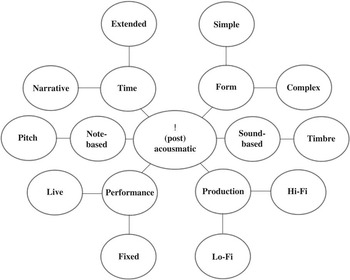
This section does not set out a taxonomy of post-acousmatic practices, recognising the impossibility of establishing such a taxonomy around emerging and continually evolving practices. Rather, the authors suggest nodes of a small sample of confluent activities as starting points for discussion (see Figure 1). These nodes propose emancipations from the acousmatic canon, first from its temporal and formal assumptions, then from its performative practice, and finally from its timbral, dynamic and tonal biases.
Nodal configuration of (post)-acousmatic practice.

The implied linear hierarchy in Figure 1 from a central node is not fixed and is presented as such for simplicity only – artistic practice is far messier. In reality, each of these nodes can be combined in multiple ways and with multiple fluid and emergent connections. Furthermore, additional nodes emerge from each of the existing ones depending on the conceptual concerns of the composer in any given work (Adkins Reference Adkins2014) to form a nexus of nodal relationships that provides both creative impetus and a means of understanding the impetus behind any given work.
3.1. Time
Prior to emergence of the Darmstadt avant-garde, musical time was considered to be primarily linear, centred on the teleology of tonal structures. Most acousmatic works follow this traditional notion of musical linearity, although typically they are based more on a teleology of timbral events than tonal geometries; defined by Bob Snyder as ‘a metaphor of physical causation ... an attempt to make musical events seem to cause each other’ (Snyder Reference Snyder2000: 230). This notion of an ‘event’ which has consequences is a core feature of many acousmatic pieces and derives from the early musique concrète experimentation of Schaeffer and Henry (Schaeffer Reference Schaeffer2013). They abstracted two main kinds of sonic/temporal content, both of which can be understood as essentially metaphorical: the first is gestural and the second is textural/timbral. The gestural is very much temporal in nature: linear, event-based, cause/effect, impact/resonance. The gesture is an event that is recognisable or experienced as a quasi-natural phenomenon. In its progression through time and its sense of gravity, the acousmatic gesture reflects the quality of other events in our known universe and our ‘understood’ behaviour of objects and bodies in familiar environments (Kendall Reference Kendall2008). Texture is less temporally focused, often acting as a metaphor of repose, fluid activity, or slowly evolving sonic elements that suggest the potential for emergent gestural activity. In such a way, the acousmatic maintains a parallel not only with our comprehension of the physical world, but also with European musical tradition, whose harmonic teleology is abandoned and replaced with events in time, impacts and resonances, into which narrative implications and apparent consequences are proposed via gestural surrogacies which allow the listener to reconstruct and reimagine such forces and causes at work.
In the post-war era, there have been numerous composers who have considered alternative modes of temporality in their work. Pierre Boulez wrote:
A composition is no longer a consciously directed construction moving from a ‘beginning’ to an ‘end’ and passing from one to another. Frontiers have been deliberately ‘anesthetized’. Listening time is no longer directional but time-bubbles, as it were. (Boulez Reference Boulez1986: 178)
Stockhausen formulised this thinking further in his concept of Momentform, while Morton Feldman aimed at a disorientation of memory through constant changes in short fragments of material. In this thinking there are striking similarities to be found in the work of Henri Pousseur, François Bayle and Eliane Radigue. Boulez’s notion of ‘time-bubbles’ has a perceptual kinship with Deleuze and Guattari’s ‘plane of immanence’ and the directionlessness of what Don Ihde terms ‘surroundability’. As Gordon Fitzell writes:
The concept refers to an enveloping sensation or ‘auditory aura’ that emanates an ‘ambiguous richness of sound.’ ... From the perspective of temporal experience, surroundability constitutes the opposite of directionality. Whereas directionality refers to a perception of predictable change along a particular dimension, surroundability refers to an experience devoid of predictable change. Within such a perception, the onset of each event is ‘enriched by the depth of those [perceived events] which have just preceded it ‘equally’ present.’ … Devoid of substantial directionality, a nonlinear temporal experience permits no protentions of closure, only nondirectional protentions of continuance. (Fitzell Reference Fitzell2004: 14–22)
Here the division between acousmatic and post-acousmatic thinking focuses on the causal relationship between events. In compositions such as Richard Chartier and Taylor Deupree’s Specification.Fifteen (2006), the Monochromes series (2009) by TU M’, the works of Eliane Radigue, some of the early work of François Bayle or Dimitri Coppe’s HG 80 (1999), the traditional linear concepts of temporality are extended. It is texture rather than gesture that becomes the principal focus of the work. Works such as Faint or Shoals by Deupree are much more than Eno-esque ‘ambient’ works. The wealth of local sonic gestural detail engages the listener whilst the larger scale textural ‘surroundability’ predominates. In essence, in contrast to much acousmatic composition, the roles of gesture and texture are reversed. In a similar vein, Radigue’s works present an extreme case of perceived parametric consistency, continuity that Thomas Clifton refers to as static succession, as ‘sameness succeeding itself’ (Clifton Reference Clifton1983: 104–5). Although Radigue’s works do change over extended periods of time, the perceived moment-to-moment progression is one of implied motionlessness. Applying Husserl’s ideas to Radigue’s almost imperceptibly changing sustained tones, the listener would identify a continuity of ‘phases’ between the beginning and end points as ‘expired duration’. Here we depart from some fundamental concepts of the event-based acousmatic timeline and from the metaphor of physical causation. The perception of time is no longer identified as an extension of the self and actions related to the self, but is dissolved into a continuity that no longer references or signposts past, present and future as markers of musical form or intent. At any one moment in the composition prior to the end point, the listener is unaware of the remaining duration, though is aware of duration resulting in the listener sensing no protentions of closure. However, Radigue’s music retains a basic connection with the acousmatic paradigm too: until recently (she has lately explored instrumental composition and performance) her compositions were entirely rooted in the abstract temporal logic of recording. In the absence of a singular moment of musical performance, musical time is captured, abstracted, dislocated and dispersed across the mediums of retrieval and reproduction. In the most time-based of all art forms, time becomes a conceptual entity, but the singular moment itself has been radically removed from the musical experience.
At least a part of the origin of this departure from acousmatic practice is surely rooted in the revelations of early musique concrète. If the first sonic metaphor discovered by Schaeffer and Henry is that of gesture, while experimenting with cutting the attack segments from recorded sounds a second metaphor emerged: texture or timbre. Timbral surfaces and depths may expand to fill the timescale implied by any particular frame/perspective as sound itself becomes more of an environment or a material, a ground from which other forces and events might emerge, rather than itself appearing as a result of these forces. Lacking the temporal dynamism of gesture, timbre is expressive of the surface, grain or immediate materiality of sound. Timbre leaves us less with sound objects than sound processes (although the concept of process implies a sense of progressive temporality that may or may not be present). Sound environments, sound ecology, ambient music, reductive music, drone, noise and soundscape composition appear to derive more from this dissipation of tones over virtual and actual spaces, rather than from the spotlighted theatre of the gestural event. If events imply the emergence of architectures, spectral morphologies, narratives and cinema for the ear, textures suggest a sense of the present as a distinct entity, an immediate materiality free from determination by the forward motion of narrative time.
3.2. Performance
Acousmatic music, by developing almost entirely as a studio-based compositional practice with only the diffusion of fixed works remaining of its live performative aspect, has accepted and indeed further exaggerated the separation of compositional time and performance time it inherited from European classical music. The aspects of live musical practice that the acousmatic paradigm has profoundly abandoned – extemporisation, variation, variability of performance parameters, and sharing the moment of invention with the audience – are exactly those which free improvisation has vigorously reasserted.
Technically and stylistically improvisation is an activity that can extend in many different directions; for example, from the hyper-gesturalism and hyper-contrapuntalism of a group such as BARK!, which have some parallels with acousmatic paradigm, to the extreme reductionism of the Berlin Echtzeitmusik era, which has clear parallels in Radigue’s work, and everything in between. So any generalisation about free improvisation is dangerous and likely to encounter contradiction. But it is arguable that in every case improvisation adheres to a particular relationship to time, and that this is how we should understand it, rather than misunderstanding it as a specific way of interacting with or shaping musical material. Improvisation embraces musical time in its singularity; time as unrepeatable, inseparable from space, and from physical or social context, and ineffable by notation, studio recording, radio broadcast, or home playback. The free improviser is primarily concerned with local actions made in a specific space and singular time, within the shared spatial, temporal and social proximity between performers and audience of the musical event: witnessing improvisation as player or as audience, one is engaged in an encounter with a continuous, unfolding, ever-precarious and unsecurable present.
The Spontaneous Music Ensemble, AMM, Music Improvisation Company, Chicago’s AACM, Paul Bley, Jimmy Giuffre and Cecil Taylor, although rooted in deviations and extrapolations of practices from free jazz, chamber music and experimental music and mostly acoustic in origin, created highly distinctive spheres of musical activity in which electronics and electroacoustic music form a strong and growing part. In essence, they merged elements of note-based and sound-based paradigms, drawing elements of the pitch-noise/gesture-texture continua together. In the 1970s and 1980s, composer–performers Hugh Davis, Bob Ostertag, George Lewis, Allan Bryant, Alvin Curran, Richard Teitelbaum, Pauline Oliveros, Laurie Spiegel, Don Buchla and Michael Waisvisz reacquainted electroacoustic music with the experience of singular time via live electronics, DIY instruments and improvisation with analogue and (later) with digital electronics.
Many composers have also worked with various combinations of improvisation and acousmatic materials and practices: combining electronic and acoustic instruments, composition and improvisation, live processing etc. The séquence-jeu, a term coined by Guy Reibel describing the constructivist game in the studio with the sounding objects to generate musical material whilst recording a sono-tournage, was at the heart of the teaching at the GRM. Pierre Henry proposed in 1977 his ‘musique d’objet’ where these techniques would come on stage (Henry Reference Henry1977). Since the 1970s, Bob Ostertag has blurred the lines between free improvisation, directed improvisation, reinterpreted improvisation, composition and acousmatic materials. David Toop has spent decades both exploring and theorising the connections between free improvisation, experimental, acousmatic and ambient music and similar concerns are at the heart of the work by Kaffe Matthews, FURT (Richard Barrett and Paul Obermayer), Lionel Marchetti, Jerome Noetinger, Diemo Schwarz, Grutronic, Valerio Tricoli and John Wall who have all combined aspects of acousmatic, musique concrète and free improvisation.
Of course the degree to which such composers employ or actively combine different aspects of the acousmatic paradigm, methodology, fixed media and aspects of acousmatic musical language varies widely. They do not form a single school or paradigm, but have simultaneous roots and destinations in multiple lineages, scenes and aesthetics. What their work questions in relation to the acousmatic paradigm is not necessarily a divergent sonic morphology but that of temporal fixedness. For the current generation of studio composers there is an increasingly strong desire for an explicit human presence in the musical performance.
The rich possibilities of acousmatic performance today rest in part on changes in technology. The technological tools which were once hidden away under lock and key in the institutional Computer Music Studio are now ubiquitous, and they are portable. Any desktop or laptop computer, and increasingly phones, tablets and other devices, can now be used to make acousmatic music or any other kinds of electronic music. At least one of the good reasons that acousmatic music only existed historically as a fixed media is surely now irrelevant, leaving fixed media less an inevitability than a definite practical and aesthetic choice.
The level of fixedness varies and in itself demonstrates a connectedness to the acousmatic paradigm. One development in live acousmatic performance practice is that of dynamic stem-mixing. This ‘in-the-moment’ mixing technique, whose roots lie as much with Dub and DJ culture as with the academy is evident in the duo performances of Ambrose Field and Paul Fretwell, as well as Helena Gough and @C (Miguel Carvalhais and Pedro Tudela). Performances by these composers often employ quite simple means and are rarely ‘gestural’ in their stage presence; yet, with discreet lighting, they mix, reorchestrate and extend/contract pre-composed materials or works, remixing them live for those witnessing and sharing in that unique performance event, sound system and acoustic space.
A number of composers have developed new tools as a means to perform specifically live-acousmatic works. David Berezan has utilised bespoke spatialisation tools to ‘find a middle ground between the fixedness of acousmatic music, and live/improvised electroacoustic music’ (Berezan Reference Berezan2007). Other composers have taken advantage of the revolution in the accessibility and portability of interactive digital tools to work specifically with ‘performed’ and ‘live’ acousmatic music, including Parmerud’s Razor Sky (2010), a live acousmatic work in which an onstage performer controls and manipulates sounds via two Wii controllers, as well as Rajmil Fischman, Adrian Moore, Chikashi Miyama, Bob Ostertag and Alex Nowitz. A step further away and in a desire to capitalise on phenomenological liveness (Auslander Reference Auslander2008), Nicolas Bernier and Martin Messier have, in ‘la chambre des machines’, built sculptures which blur the line between genuine-sounding objects and a simple sample-trigger, in a ‘desire to return to the physical world in an environment of digital creation’ (La chambre des machines nd). More distant are performers such as Mark Trayle, Jon Rose, Atau Tanaka, Leafcutter John, Pamela Z, Byungjun Kwon and Tom Verbruggen have explored electroacoustic musical concepts with a variety of controllers, sensors and instruments as a live art form.
3.3. Form
Another emerging trajectory is an effect of the current omnipresence and everyday consumption of mediated music. Acousmatic listening in the broadest sense is becoming a normative mode of listening, from the hyperreality of closely miked and edited orchestral recordings to experimental DJ culture. Interestingly, this similarity of listening modes, what Demers terms ‘aesthetic listening’ (Demers Reference Demers2010: 15) causes the artificial definitions of genre to dissolve, not just in mediated works, but also in live or concert music settings. The grooving soundscapes pumping in the compressors of Mount Kimbie’s Crooks and Lovers, the highly processed voices and strings in Björk and Radiohead, the precise layering and revealing of instrumental layers on the song-forms of Talk Talk’s Spirit of Eden and Laughing Stock, the sudden inclusion of the acousmatic composer Robert Normandeau on Aphex Twin’s label Rephlex (and the latter’s ‘acousmatic’ experiments), Autechre’s championing of Morton Subotnick and Bernard Parmegiani, or the invitation of Pauline Oliveros to the Club Transmediale festival are all evidence of continuous flux and hybridisation engendered by acousmatic aesthetic listening and common approaches in the use of technology. Such concerns are also evident in the work of Alain Thibault, Marcelle Deschênes and Jean Piché, who explored melodic sampling via a pseudo-instrumentality derived from MIDI sequencing, especially in their works of the 1980s. What initially started as different genres of music utilising the same tools for different ends has resulted in a gradual osmotic transference over the past decades in studio-based genres of influences, tools, methods and writing techniques that have facilitated a more sophisticated dialogue between each of them rather than a shallow reciprocal plundering.
One effect of a shared working methodology and the increased cultural value placed on popular music is a growing interest for simplicity and legibility of form within some post-acousmatic music. This is additionally marked by a return to more stable, pulsed rhythmic figuration and perceptible musical phraseology. This return to simplicity can be positioned in a wider cultural ambit. As Roger Silverstone (2002: 777) states: ‘we cannot walk away from our media-saturated culture … but we can begin to understand it, and in that understanding take responsibility for it. We can then, perhaps, begin to challenge and change it.’ In the work of AGF, Robert Henke and Sam Pluta, simple clear-cut forms are evident, with contrasting yet recurring sections and leitmotifs. They do not shy away from the previously forbidden regular pulses, beats and post-tonal harmonic references in their work. Rather their work offers a critique to normative forms of popular music, embracing its formal structure but developing its sonic archetypes much further. More complex and ambiguous forms are evident in the sound-based works of D’incise, though the emphasis on short song-length tracks presented on albums such as Insectes, Attente et Pixels (2006), Les Restes du Festin (2007) and Cendre et poudre (2009) clearly reference popular formats even though the material contained within is far more sonically experimental.
3.4. Production
Acousmatic music has traditionally valued the craft of quality and sound design. When listening back to the early GRM works of Bayle and Parmegiani their mastery of studio techniques independent of their musical goals is still awe inspiring. Not that their music could or should be reduced to their technical prowess alone. As digital technology developed in the 1970s and 1980s, the authors identify a perceived obsession among acousmatic composers towards high-quality audio production and sonic novelty. A critique of this focus on technique comes from Francis Dhomont, who writes: ‘It seems that the time is ripe, after a century of technical acquisitions, that electroacoustic composition concerns itself about its application and stops to consider simple digital audio innovations as musically satisfying’ (Dhomont Reference Dhomont2008).
Whereas Dhomont here suggests a move towards classicism in order to develop individual voices within a common acousmatic syntax, the authors identify other trajectories embraced by composers that point to the end of the tyranny of the clean, dynamically impressive gesture. This is possibly because it is no longer such an impressive feat to create such impactful gestures. In post-acousmatic music there has been a refocusing of attention on the sound worlds, sources and techniques that were cast adrift (and therefore had a parallel journey) and are now re-emerging as expressive elements to be explored anew by studio composers. The unspoken taboos of media artefacts, post-tonal harmony and sustained dynamic extremes can be identified as part of the expanded sonic palette available.
Tape hiss, harmonic distortion and the noise of the medium were all embraced by Michel Chion in his Requiem (1973), but examples are rare, and were often considered as a faux-pas. Chion remembers vividly that Guy Riebel himself, debriefing within a GRM group meeting on the morning following the premiere, ‘disliked the piece, strongly, physically; it gave him [...] desire to kill, notably for its appalling technical quality’ (Chion Reference Chion2016). As Paul Hegerty writes:
Musique concrète goes beyond composers like Satie and Varèse in making the entirety of a piece from found sounds, but actually goes further, in so doing, in countering noisiness. In a way, it is the most structured of music that understands noise as other, which Schaeffer is making the world musical, performing a noise reduction. Fellow concrete composer François Bayle writes that ‘musique concrète wasn’t at all a music of noises, not at all a music of provocation. It was the contrary.’ Noise here crosses into music – the music, or at least the strategy of it, retains a capacity for noise – jumps, cuts, gaps, alterations all allow this, hence the continued vibrancy of those strategies in electronica. (Hegarty Reference Hegarty2007: 34)
Whilst these were rejected more and more fiercely from the acousmatic sound world, they have been adopted by many other creative communities. As much as the electroacoustic world likes to anchor itself in Russolo’s Art of Noises (1913) (Dhomont Reference Dhomont1995), so do industrial music bands such as Einstürzende Neubauten, and many noise subgenres. From this common point of reference, the descendants take different paths, some of them towards radical mid-twentieth-century art movements. As Hegarty writes:
Fluxus was an art movement that in the early 1960s brought together artists who were working outside of the dominant avant-garde strategies … Like arte povera, it would stray far from the accepted ‘proper’ artistic materials and conventions. High and low art would both be used and taken apart … Fluxus would cross artistic disciplines and dispense with notions of artistic skill … This was a bringing of noise as practice through noise as form and content. (Hegarty Reference Hegarty2007: 27–8)
The Fluxus artist Yasunao Tone, who in addition to his solo practice, worked in noise collectives such as Group Ongaku, has played a significant part in defining early glitch music. His works throughout the 1980s for defaced CDs clearly prefigure the works of Oval such as Systemisch (1994). This embracing of the sounds of the media itself and their imperfect reproduction through continued use or destruction has led to the use of dictaphones, reel-to-reel tape machines, vinyl and cassette and other such devices. Although such techniques are common in the works of many sonic artists who present work in non-concert spaces, it is also evident in musicians such as Jerome Noetinger and Franck Vigroux. Increasingly both the oft-reduced audio quality and the mechanisms of the devices themselves leave their imprint in the material of the work. Whilst Philip Jeck, eRikm and Christian Marclay may use vinyl as the primary sound source for many of the performance works, the sonic mining of these resources is found in acousmatic works such as Christian Zanési’s Saphirs, sillons, silences (1998), Satoru Wono’s Sonata for Sine Wave and White Noise (2003), Ed Kelly and Nick Melia’s Block Groove (1999) and Åke Parmerud’s Grooves (2011).
The glitch itself has become sonic meme in contemporary music production. The sonic residue of Tone’s and Oval’s CD manipulations can be found in releases as diverse as Björk’s Vespertine (2001) and Jo Thomas, notably her EP Ultra Tonal. Thomas’s work is particularly relevant here. Having trained as an acousmatic composer, she has developed a post-acousmatic sensibility in the composition and production of her work using glitch, noise, synthetic tones and concrete sounds to add to the poetic scope of her musical language. In her work, these elements are re-appropriated and given new meaning. Noise is no longer transgressive, the glitch no longer signifies technological failure. As Thomas writes: ‘Her work is based around human fallibility, she chooses to represent the human in sound with a discourse of delicate and detailed sonic failure using a sophisticated combination of micro sound, micro tonal and glitch material’ (Thomas, Reference Thomasnd).
If, as Demers writes, we define ourselves by the art we consume, then to an extent we are also defined by the manner in which we choose to consume it. The resurgence of vinyl has affected many areas of music. That such composers as Jo Thomas, Giuseppe Ielasi and Alexander Rishaug have chosen repeatedly to release their work on vinyl makes as strong an aesthetic statement as to how they situate their work culturally as much as the music itself.
Lo-fi hyper-amplification is also a clear reaction to the clean sound. Artists such as Lee Patterson, Hanna Hartman and Christina Kubisch each take, in their own experimental way, amplification as a means to do critical, active listening of the world surrounding us, yet embracing the artefacts of their process instead of aiming for a transparent one. The observation is not neutral, not clean, yet it is poetically potent. Such thinking is also evident in the poetic hyper-amplification and decontextualisation of soundscapes, common in Hörspiel, also used in acousmatic music after Luc Ferrari’s works and his critique of reduced listening, and now present in so many forms of studio music. Artists as diverse as Francisco Lopez, Marc Behrens, Nine Inch Nails and Mount Kimbie will often take environmental recordings and project, distort, superimpose and compress them in such manner that they verge towards a wall of noise. But even this approach to intense layering and noise is now a meme: the sonic noise wall has been around in many forms for long enough to have lost its radicality. After a long detour, the multiple trajectories of sonic production stemming from Russolo are now reunited in works integrating the full range of timbres, from the purest to the grimmest. One only has to listen to the music of Thierry Gauthier, Eryck Abecassis, or Christopher Ariza to hear the liberating integration and subversion of these multiple approaches to noise and production techniques.
3.5. (Dis)functional harmony and melody
The concepts of harmony and melody are not terms usually found in discussions of acousmatic works. Analytical commentaries tend to focus on the placement and structuring of sound objects and their manipulation through the duration of the work. Where harmonic elements do occur, they are often referred to as ‘harmonicity’ as in Giselle Ferreira’s analysis of Jean-Claude Risset’s Sud (1985) (Ferreira Reference Ferreira1997) or are harmonic sound objects from previous works as in Yves Daoust’s Suite Baroque (1989) and Impromptu (1994) or Åke Parmerud’s Alias (1990). Despite these tendencies to focus attention away from such traditional musical concepts, there are works within the acousmatic repertoire where these elements are important (though not necessarily central) to the musical discourse. Works such as Erosphère (1980) and Mimameta (1989) by François Bayle include harmonic and sustained pitch materials as a ground over which other musical discourse is elaborated. Often these elements are non-directional, lacking a traditional sense of musical teleology and/or functional harmonic progression, often having a quasi-drone function. In John Chantler’s Dismantled Cabaret (2014) released by Room40, the influence of Erosphère III is clearly heard in the strongly focused pitched electronic materials that form the core of each work. More explicit harmonic figuration can be found in Dhomont’s Citadelle intérieure (the sixth movement of Sous le regard d’un soleil noir (1979–81)) and Justice Olssen’s UP (1990) in which the harmony provides a local sense of forward movement without defining larger scale formal design.
In 1993, Javier Alvarez wrote that ‘notes’:
are possibly the most abstract musical object and as such can potentially establish relational and evolutive patterns faster and more easily than formed sound objects or streams. This, of course, can be an acute point in the sense that notes are associated with harmony in conventional terms.
and that:
music integrating instrument and electroacoustic sounds has far more potential to be polymorphic and polymorphological than electroacoustic or instrumental musics could ever aspire to be on their own. (Alvarez Reference Alvarez1993: 147–8)
In works such as Bayle’s Mimameta, the streams of pitches occurs too fast to be perceived as melody. Instead we perceive relational pitch fields that form a larger musical sequence. However, in works such as Jimmy Behan’s In the Sudden Distance (2008), Nicolas Bernier’s Les Arbres (2008) and Dominic Thibault’s Comme si la foudre pouvait durer (2012), we perceive a strong sense of instrumental melody and harmony. However, unlike Alvarez’s work, which integrates electroacoustic sounds with a live instrumentalist, the instrumentality is a studio-constructed fiction reliant on recording, editing and montaging elements. The integration of sound-based and note-based paradigms is a strong element in such post-acousmatic work. References to more popular or functional harmony, instrumental performance as well an acousmatic treatment of these elements as sound objects ripe for timbral and gestural reshaping also occur in Sebastien Roux’s Songs (2006). In Roux’s work there is, however, little sense of acousmatic spatial perspective. Instead there is a focus on a dry, visceral, gestural present interspersed with occasional static sustained tones. What these and many post-acousmatic works share is a post-tonal approach to pitch. As in Deupree’s work, there is a local sense of articulation and relational movement – in this instance melody and harmony – however, this local movement is not reflected as one would expect in Western music on a larger-scale harmonic teleology. The harmonic and melodic content is itself treated as a sound object that is perceived as a unit or sequence to be placed in space or further manipulated in various ways. In this sense, the inclusion of pitch (or note-based paradigm) is not regressive as it is often non-functional in a traditional manner but rather a further development of acousmatic thinking.
4. Conclusion
This article has been written out of the authors’ respect for their acousmatic heritage. However, this heritage is not a single tradition but a vibrant and evolving mesh of nodes. As such, for it to remain culturally relevant, its practitioners need to be self-reflective and self-critical in order that the tradition does not stagnate. As Javier Alvarez writes:
a tradition in art is first of all a collection of artists with a common awareness and purpose. So, if it is conceivable to speak of such phenomenon as a ‘new tradition’, then the term electroacoustic is itself also up for revision. What is it that we want to designate: a mode of production, a mode of listening, an awareness, a genre, a position, a poetic intention? As practitioners, we must broaden the perspective beyond the singularity. (Alvarez Reference Alvarez1993: 149)
The authors contend the same for the term ‘acousmatic’. What is it that we want it to designate that is relevant to our generation? As such, this article proposes ‘trajectories’ for a polyphony of potential yet artificial ‘canons’ that are the descendants of acousmatic thinking and practice that extend beyond Alvarez’s ‘singularity’. The works of many contemporary practitioners still adheres to various aspects presupposed by the acousmatic, namely active listening, concert presentation, fixed media sonic imagery – but many other forms of sonic art have cross-pollinated in many different practices, some of which were highlighted here. Far from being exhaustive, this proposed phylogeny is a testimony to the richness of the common ancestor, yet proves that once unleashed from the institution, much remains to be said in the ‘art des sons fixés’.