The current study examines how late bilinguals (who have learned a new language in late childhood or as adults) employ grammatical information (specifically morphosyntactic features such as tense, person, and number) for lexical representation and retrieval in a nonnative language (L2). The processing of sentences and morphologically complex words in a late-learned L2 has been argued to be different from grammatical processing in a native language (L1) that has been acquired from birth. One specific proposal (Clahsen & Felser, Reference Clahsen and Felser2006a, Reference Clahsen and Felser2006b) holds that L2 processing relies less on grammatical properties than does L1 processing, even for late bilinguals who appear to be highly proficient in the L2. This proposal and the evidence presented along with it has stimulated a number of experimental studies and much theoretical discussion on the similarities and differences between L1 and L2 grammatical processing; see, for example, VanPatten and Jegerski (Reference VanPatten and Jegerski2010) and special issues of international journals such as Language Learning (60[1], 2010), Second Language Research (29[1], 2013), or Studies in Second Language Acquisition (35[2], 2013).
Morphosyntax has been identified as one of the challenging areas of L2 acquisition and processing (e.g., DeKeyser, Reference DeKeyser2005). Morphosyntax involves inflectional processes such as affixation, suppletion, and allomorphy to encode tense, number, case, person, and other grammatical functions. Most previous studies with late bilinguals have examined morphosyntactic phenomena spelled out through affixation or suppletion (i.e., free vs. bound morphemes), such as person, number, and gender agreement as well as case and tense marking (see, e.g., White, Reference White2003, Chapter 6). One common finding from these studies is that late learners show (sometimes persistent) difficulty reliably encoding these phenomena in production and instead either omit inflectional affixes or overapply unmarked word forms such as infinitives (e.g., Dewaele & Véronique, Reference Dewaele and Véronique2001; Haznedar, Reference Haznedar2001; Ionin & Wexler, Reference Ionin and Wexler2002; Lardiere, Reference Lardiere1998; Prévost & White, Reference Prévost and White2000; Slabakova, Reference Slabakova2008). Reduced sensitivity to morphosyntactic information has also been found for late bilinguals’ performance in comprehension and judgment tasks (e.g., Chen, Shu, Liu, Zhao, & Li, Reference Chen, Shu, Liu, Zhao and Li2007; Keating, Reference Keating2009; Ojima, Nakata, & Kakigi, Reference Ojima, Nakata and Kakigi2005; Sato & Felser, Reference Sato and Felser2010; Tokowicz & Warren, Reference Tokowicz and Warren2010). In contrast, morphosyntax expressed through suppletion appears to be easier to handle for late learners, in both acquisition and processing. Longitudinal production data revealed, for example, that late learners of German correctly produced suppletive tense and agreement-marked forms of auxiliaries at a time when regular inflectional affixes encoding tense and agreement on main lexical verbs were still incorrect or absent (Dimroth, Reference Dimroth2008; Parodi, Reference Parodi2000); see Ionin and Wexler (Reference Ionin and Wexler2002) for a similar contrast in L2 English. There is also experimental evidence for late bilinguals’ sensitivity to suppletive forms, for example, from studies using event-related brain potentials (Tokowicz & MacWhinney, Reference Tokowicz and MacWhinney2005) and reading-time measures (Sato & Felser, Reference Sato and Felser2010).
Besides affixation and suppletion, allomorphy represents a third way of encoding morphosyntactic information, which is highly common across different types of language. In some cases, allomorphy is phonologically conditioned, as, for example, in the case of English plural -s forms such as beds versus bets, which are determined by whether the preceding segment is voiced or unvoiced. Other instances of allomorphy are less predictable or even idiosyncratic. Consider, for example, stem allomorphy in Germanic languages. The German equivalent of the verb “to throw” has six stem allomorphs (werf, wirf, warf, worf, würf, and wurf), most of which encode morphosyntactic information such as tense, person, and number.
The question of how lexical representation and processing is informed by morphosyntax has received little attention in the L1 psycholinguistic literature and even less in bilingualism research. It is true that late bilinguals seem to perform better on morphosyntax encoded through suppletion than on morphosyntactic affixation, but the question of how they represent and process allomorphy has, to the best of our knowledge, not yet been investigated. The current study addresses this question by comparing a group of highly proficient late learners to L1 speakers of German. The linguistic phenomenon we examined is stem allomorphy in strong verbs, which (unlike weak verbs) exhibit stem changes in the present and preterit tense as well as in imperative, subjunctive, and participle forms.
THEORETICAL BACKGROUND
Morphosyntax in the L1 Mental Lexicon
The mental lexicon is a repository to permit efficient representation and retrieval of words and their component parts. Although entries in the mental lexicon are supposed to encode both form-level (phonological and orthographic) and meaning-level (semantic) information, the question of whether and how to represent morphosyntactic information is controversial. Broadly speaking, three proposals can be distinguished.
One approach holds that words and other lexical entries form units within associative networks that directly map form- and meaning-level properties (e.g. Bybee, Reference Bybee1995; Elman et al., Reference Elman, Bates, Johnson, Karmiloff-Smith, Plunkett and Parisi1996). For stem forms in German, Smolka, Zwitserlood, and Rösler (2007) proposed an account along these lines. They argued that each stem represents a distinct morphemic unit and that relationships between these units are formed according to their meaning. For example, both verbal stems such as werf-, warf-, and wirf- and nonverbal stems such as wurf (for the deverbal noun) are supposed to form a cluster in that they all activate the same semantic concept “throw,” independent of their word category or other morphosyntactic features. Other associative approaches focus on the phonological patterns of the different stem variants. Bybee and Newman (Reference Bybee and Newman1994) argued that inflectional patterns (both stem changes and affixes) are stored in form-based schemas representing phonological similarity clusters. Bittner (Reference Bittner1996) and Köpcke (Reference Köpcke1998) posited such schemas for stem variants of verbs in German. To take an example, Köpcke (1998, p. 57) argued that (like in English) the combination of /i/ plus velar nasal (e.g., singen “to sing”) represents a particularly reliable schema among the strong verbs of German. In addition, Bittner (Reference Bittner1996) pointed out that morphosyntactic features also contribute to the reliability of a particular schema. For example, the past participle is said to promote strong verb schemas more than present-tense or preterit forms. Empirical evidence for these schemas comes from an elicited production task with monolingual German-speaking primary children (Bittner & Köpcke, Reference Bittner, Köpcke and Di Meola2007) showing associative generalizations in children’s productions of inflected forms of nonce verbs. A related account is the so-called satellite model (e.g., Feldman & Fowler, Reference Feldman and Fowler1987; Lukatela, Gligorijevic, Kostić, & Turvey, Reference Lukatela, Gligorijevic, Kostić and Turvey1980), which posits a base (nucleus) form that is associatively connected to other (satellite) forms of the same lexeme. A word’s lexical identity is tied to the nucleus, and lexical retrieval from a satellite form is supposed to require additional effort. Moreover, the inflectional variants of a lexeme are connected to the nucleus but not to one another. Initially, this model was tested on case marking in Serbo-Croatian nouns. Lukatela et al. (Reference Lukatela, Mandić, Gligorijevic, Kostić, Savic and Turvey1978) and Lukatela et al. (Reference Lukatela, Gligorijevic, Kostić and Turvey1980) found shorter lexical decision times on nominative than on genitive and instrumental case forms, which suggested that the nominative is represented as the nucleus and the other case forms are represented as satellites. Later, the model has been extended to verbs and to other languages (e.g., Günther, Reference Günther1988). Feldman and Fowler (Reference Feldman and Fowler1987) examined Serbo-Croatian nouns in priming experiments. They found that, whereas dative and locative forms were fully primed by nominative forms, instrumental forms showed only partial priming. Feldman and Fowler (Reference Feldman and Fowler1987) interpreted these findings in terms of the satellite model, arguing that the connection between the nucleus (i.e., nominatives) and a satellite (e.g., datives) is stronger than the connection between two satellites.
The second approach to representing morphosyntax in the lexicon is in terms of functional morphemes that trigger morphophonological rules to derive inflected word forms (e.g., stem allomorphs) from roots or other base forms. One well-known example is the rule of lowering ablaut (/ɪ/ → /æ/ __ [+past]), a phonological change that is morphosyntactically conditioned (through to the feature [+past]) to derive the past-tense forms of verbs such as to sing, to swim, and to ring in English (Chomsky & Halle, Reference Chomsky and Halle1968). This approach has been much elaborated in the distributed morphology framework (Halle & Marantz, Reference Halle, Marantz, Hale and Keyser1993) and has also been experimentally tested, specifically for regular and irregular past-tense forms in English. Stockall and Marantz (Reference Stockall and Marantz2006), for example, observed that irregular past-tense forms such as taught facilitated the recognition of the corresponding root (teach) in similar ways as regular past-tense forms, which was taken to indicate that taught was recognized as the output of a rule operating on teach, in the same way as walked is recognized as the output of a rule operating on walk. Stem allomorphy in German has also been analyzed through morphosyntactically conditioned phonological rules; see, for example, Beedham (1994, 1995/1996) and Barbour (Reference Barbour1982).
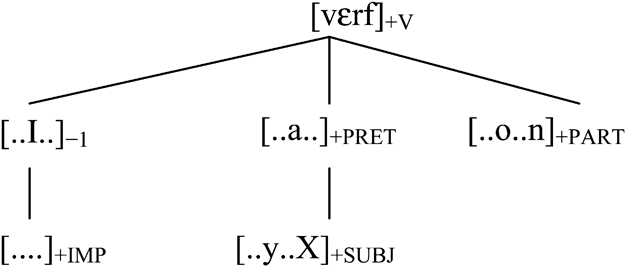
The third approach holds that morphosyntactic features (along with phonological information) are directly encoded in lexemes and provide internal structure for entries in the mental lexicon. In this approach, stem variants are conceived of as subnodes within default inheritance networks (e.g., Corbett & Fraser, Reference Corbett and Fraser1993; Wunderlich, Reference Wunderlich, Booji and van Marle1996). As an example, (1) shows some of the stem allomorphs of the German verb werfen “to throw” (Wunderlich, Reference Wunderlich, Booji and van Marle1996, p. 96):
(1)

To avoid lexical redundancy, the various stem allomorphs are minimally specified for their morphosyntactic feature content. The base stem has the most impoverished entry (e.g., werf- in [1], which occurs in most present-tense forms and the infinitive). Other stem variants occur under more specific circumstances (e.g., wirf- for second- and third-person singular present-tense forms and in imperatives or warf- in preterit forms). Fully specified entries are derived by default inheritance (Corbett & Fraser, Reference Corbett and Fraser1993) in that a subnode inherits all information from its mother, except for the features it replaces or adds; for example, the subnode [+PRET] inherits the categorial feature [+V] from the higher node. Individual entries such as (1) are instantiations of more general templates with common subnodes and inheritance structure. The distribution of morphosyntactic features in (1), for example, is parallel to other verbs in the language (e.g., sterben “to die,” verderben “to spoil,” or helfen “to help”). Structured lexical templates are another way (in addition to minimal feature specification) to reduce redundancy in the lexicon. Support for this account comes from experiments with both child and mature speakers of German. An elicited production experiment (Clahsen, Prüfert, Eisenbeiß, & Cholin, Reference Clahsen, Prüfert, Eisenbeiß, Cholin, Kaufmann and Stiebels2002) showed, for example, that, although the unmarked base stem (e.g., werf-) freely generalized to novel verbs, other stem allomorphs (e.g., wirf-) were only generalized to novel verbs in sentence contexts that matched their specific morphosyntactic feature content, for example, in the case of -i- stems, imperatives, or second-person singular and third-person singular forms. Furthermore, lexical priming experiments revealed priming asymmetries between different stem allomorphs in adult L1 speakers of German that corresponded to their morphosyntactic feature specifications (Clahsen, Eisenbeiß, Hadler, & Sonnenstuhl, Reference Clahsen, Eisenbeiß, Hadler and Sonnenstuhl2001). To take an example, the prime-target pair warft → werft was found to produce a significantly larger priming effect than the reverse prime-target pair werft → warft, ceteris paribus. This contrast was interpreted in terms of the structure of this lexeme (see [1]), in which the more specific entry warf entails the feature content of the base entry werf, thus yielding efficient priming for warft → werft. In the reverse case (i.e., for werft → warft), however, the target contains a feature that is unavailable from the prime ([+PRET]), and this feature causes increased target recognition times (i.e., reduced priming). Although these results suggest that the speaker or hearer seems to rely on morphosyntactic features encoded in structured lexical entries, only a limited set of stem variants has been tested, and it remains to be seen whether the reported findings generalize to other cases of stem allomorphy.
Stem Allomorphy in German and Russian
German exhibits stem allomorphy, mainly among the so-called strong verbs, for particular morphosyntactic feature sets encoding person, number, tense, and mood. There are 171 base verbs (Grundverben) that belong to the strong class (Fabricius-Hansen, Reference Fabricius-Hansen1977), which are traditionally divided into three minor subclasses according to their preterit and participle stems. However, stem allomorphy is also found in the present-tense and imperative forms of strong verbs. Consider, for example, verbs such as geben “to give” and schlafen “to sleep,” which, in addition to their base stems geb- and schlaf-, have a secondary -i- or umlauted stem in second- and third-person singular present tense (e.g., gib-st “give-2nd.sg,” gib-t “give-3rd.sg,” schläf-st “sleep-2nd.sg,” or schläf-t “sleep-3rd.sg”). In addition, most verbs with -e- stems in the infinitive and an -i- stem in the second- and third-person singular present tense also have an -i- stem in imperative forms (e.g., geben–gib–gibst “to give–give-imp–give-2nd.sg”), even though there are exceptions (e.g., werden–werd[e] [*wird]–wirst “to become–become-imp–become-2nd.sg”). Although morphological priming for preterit and participle stems has been studied before (Clahsen et al., Reference Clahsen, Eisenbeiß, Hadler and Sonnenstuhl2001), this does not hold for stem allomorphy in the present tense. Furthermore, the second- and third-person singular present-tense stems of verbs such as geben “to give” and schlafen “to sleep” are common in both spoken and written German usage and are therefore more likely to be familiar to L2 speakers than strong preterit and participle stems. For these two reasons, the current study examined these kinds of stem variants. In the following discussion, we refer to the secondary stems (e.g., gib-) as marked and the corresponding base stems as unmarked.
The L1 of the L2 group we tested is Russian, an Indo-European language of the fusional type with rich inflectional morphology. The phenomenon under study, stem allomorphy, is more common in Russian than in German. Russian verbs are typically composed of at least a stem and an inflectional suffix, plus optional derivational prefixes. The language has finite and nonfinite forms. The infinitive in Russian has the ending -t, -ti, or -ch, depending on the phonology of the stem. The morphosyntactic features person, number, and gender have the same values in Russian as in German. Likewise, there are two simple tenses (present and past), with periphrastic forms for future tense as well as imperative forms and present and past participles. Furthermore, Russian has regular person and number suffixation, which, unlike in German, appears only in the present tense. There are at least two distinct stem forms for each verb, one for [−PAST] and another one for [+PAST], with the one for [+PAST] also featuring in infinitive forms. Stem changes are also found in present-tense forms; consider, for example, forms of the verb hotet' “to want,” hochet “want-3rd.sg,” hotim “want-1st.pl,” and hot'at “want-3rd.pl.” However, the distribution of stem allomorphy in Russian is quite different from the one in German. In Russian, the vowels of the stem often remain constant, with the final consonant(s) exhibiting the alternation. With many verbs, it is only the first-person singular that alternates with the infinitive and all other finite forms; with other verbs, all of the finite forms exhibit a different final consonant of the stem from that of the infinitive; with still other verbs, it is the singulars (as opposed to the plurals and the infinitive) that show alternations. Furthermore, in Russian, stress alternations play a role in the present tense, which is totally unknown in German. Hence, the L2 learners are familiar with a distributionally different, richer system of verb stem allomorphy than the German one from their L1. Both of the specific morphosyntactic features we examined in their German (e.g., person- and number-marked forms in the present tense and the type of exponent [i.e., stem allomorphy]) are also available from Russian. Consequently, we do not expect to find any particular disadvantage from the L2 speakers’ L1 in handling these phenomena in German.
THE PRESENT STUDY
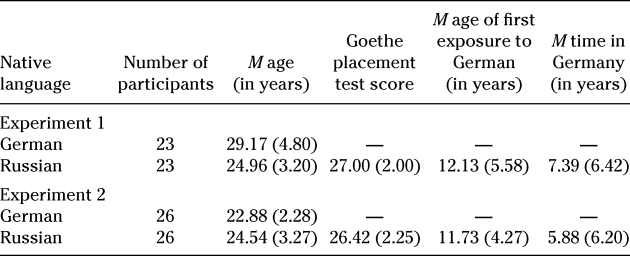
To investigate and compare the representation and processing of morphosyntax in the L1 and the L2 mental lexicon, we report the results from two behavioral experiments comparing L2 learners (with Russian as their L1) to L1 speakers of German. All participants of the two experiments were recruited from among the student communities of Potsdam and Berlin. They were all right-handed, had normal or corrected-to-normal vision, had never been diagnosed with any learning or other behavioral or neurological disorders, and had received at least 12 years of schooling. None of them had ever experienced language- or literacy-related difficulties. All participants voluntarily took part in the study, were naïve with respect to its purpose, and received a small payment for their participation. The study consisted of two behavioral experiments, with 46 participants in Experiment 1 and 52 in Experiment 2; in each participant group, half of the participants were L1 speakers of German, and the other half were L2 speakers of German (see Table 1 for biographic details). Both experiments were performed with different cohorts of participants, except for seven L2 participants who took both experiments, with a time lag of 6–8 months between the two. All L2 learners had first been exposed to German after the age of 6 in a classroom setting, and none of them considered themselves bilingual. Although they were all L1 speakers of Russian, which they acquired from birth, they had been living in Germany for at least 1 year at the time of testing and were using German in their everyday life. To determine the learners’ general proficiency in German at the time of testing, all L2 participants underwent the Goethe Institute placement test (http://www.goethe.de/cgi-bin/einstufungstest/einstufungstest.pl), a multiple-choice cloze test consisting of 30 items with gaps participants had to fill in. The scores achieved by the L2 participants (see Table 1) correspond to the C1/C2 levels, the two highest levels of this test, labeled as advanced or effective operational proficiency in the Common European Framework of Reference for Languages; these results confirm that the participants were highly proficient, late learners of German.
Biographic data and proficiency scores for the participants of Experiments 1 and 2 (standard deviations in parentheses)
The linguistic focus of the study is on allomorphic stems in German that encode morphosyntactic features such as tense, person, and number, in comparison to the corresponding base stems. Experiment 1 was a cloze test to examine participants’ knowledge of the critical verb forms in an offline task. Experiment 2 employed the crossmodal immediate repetition priming paradigm to examine processes involved in the recognition of these verb forms in a time-sensitive (online) task. Both experiments were performed in different sessions. For the L2 participants, the Goethe Institute placement test was performed before each of the two main experiments.
Experiment 1
Participants were asked to replace a missing verb from a sentence with the correct verb form, to be chosen from four response options. According to their Goethe test scores, the L2 learners who took part in the current study are all highly proficient speakers of German. Consequently, we expected them to also perform well on the phenomenon tested, verb stem allomorphy in German.
Materials
Experimental items were constructed from 32 German strong verbs that have secondary stems for finite (present-tense) verb forms, 18 verbs with -e- stems in the infinitive and an -i- stem in the second- and third-person singular present tense (e.g., werfen vs. wirf-t “to throw” vs. “throw-3rd.sg”), and 14 verbs with an -a- stem in the infinitive and an umlauted stem in the second- and third-person singular present tense (e.g., schlafen vs. schläf-t “to sleep” vs. “sleep-3rd.sg”). For the present study, the 32 experimental items were examined in two conditions, as -en forms with the base stem and as third-person singular present-tense forms with the marked stem (e.g., werf-en vs. wirf-t). These forms were matched for frequency according to the dlex database, which consists of 100 million word tokens taken from written texts of 20th-century German (Heister, Würzner, & Bubenzer, Reference Heister, Würzner and Bubenzer2011). The mean word-form frequencies were 57.6 (per million) for third-person singular present-tense forms with the marked stem and 59.6 for -en forms with the unmarked stem, a nonsignificant difference, t(31) = .71, p = .48. Length matching, however, was not possible, due to the (syllabic) -en ending, which made these forms significantly longer in terms of both mean number of letters (6.09 vs. 5.06, t[31] = 14.6, p < .001) and mean number of phonemes (5.53 vs. 4.38, t[31] = 17.7, p < .001); see the Appendix for a complete list of experimental items.
For the cloze test, sentences were constructed in which participants had to fill in one of four response options. For the 32 experimental items, there were two types of sentence contexts, half of which required a third-person singular present-tense form, as in (2a), and the other half an infinitive form, as in (2b). For both sentence types, four choices were offered: (a) a third-person singular present-tense form with the -t suffix plus a marked (-i- or umlauted) stem, (b) a second-person plural present-tense form with the -t suffix and an unmarked (-e- or -a-) stem, (c) the infinitive form, and (d) an “other” response option, to avoid any kind of forced choice. In addition to these 32 sentences, 51 filler sentences were constructed to prevent participants from developing any response strategies. These filler sentences were constructed to offer a range of other words to fill in, including finite forms and infinitives of weak verbs and inflected and bare forms of adjectives. In this way, the proportion of the experimental items was reduced to 38.6%.
(2) a. Da Lisa keine Waschmaschine hat, _______ sie ihre Wäsche immer von Hand.
“Since Lisa does not have a washing machine, she _____ her laundry by hand.”
—wäscht “wash” (third-person singular present)
—wascht “wash” (second-person plural present)
—waschen “to wash”
—andere “other”
b. Die Zuschauer können kaum ______, was auf der Bühne geschieht.
“The audience can hardly _______, what happens on stage.”
—sieht “see” (third-person singular present)
—seht “see” (second-person plural present)
—sehen “to see”
—andere “other”
Procedure and Data Analysis
The experimental items were pseudorandomized with the fillers, such that no two experimental items from the same condition appeared adjacent to each other. Participants were instructed to read each sentence and were asked to complete the sentences by choosing one of four options. For the L1 data, the web-based online survey tool SurveyGizmo (http://www.surveygizmo.com) was used. The L1 participants received this link and were asked to fill in the survey using their own computers. The L2 participants were individually tested at our laboratory. Each sentence was presented individually and remained on screen until participants pressed the Next button. The whole experiment started with five fillers to familiarize participants with the experimental task. The task took, on average, 20 min to complete.
Accuracy scores for the experimental items were calculated from the participants’ responses, by participants and by items. After transforming the aggregated proportions (using arc sine square roots), the data were submitted to two ANOVAs with the two-level variables condition (third-person singular present tense vs. infinitive) and group (L1 vs. L2), one for participants (F 1) and one for items (F 2). Prior to any statistical analysis, the item quellen “to gush” was removed from the data set due to its exceptionally high error rate (47%) in the L2 group. This verb is apparently unknown to many of the L2 speakers.
Results
Mean accuracy scores (and standard deviations) for the two conditions and the two participant groups are shown in Table 2.
Mean percentages correct (and standard deviations) in Experiment 1

The responses produced were correct at a rate of more than 95% for both types of experimental items, indicating that both participant groups are familiar with the kinds of verb forms tested. The “other” option was only selected in 1.5% of all responses by the L1 participants and in 0.75% by the L2 participants. The ANOVAs, however, revealed a main effect of condition, F 1(1, 44) = 11.96, p = .001, and F 2(1, 29) = 1.31, p = .262, as well as an interaction of condition and group, F 1(1, 44) = 14.73, p < .001, and F 2(1, 29) = 2.99, p = .094, both of which were significant in the participant analysis. Subsequent pairwise comparisons showed that the L2 group achieved significantly higher accuracy scores for infinitives than for finite (third-person singular present-tense) forms, t 1(22) = 5.02, p < .001, and t 2(29) = 1.73, p = .094, whereas this was not the case in the L1 group, t 1(22) = 0.26, p = .786, and t 2(29) = 0.45, p = .657. This contrast is due to (incorrect) choices of forms with the unmarked (-e- or -a-) stem instead of the correct one (-i- or -ä-; e.g., wascht instead of wäscht in [2a] or seht instead of sieht in [2b]). In the L2 group, 1.7% of the responses in the third-person singular present-tense condition were of this kind; in the L1 group, this was the case for only 0.3%. There were two experimental items that attracted errors of this kind: bergen “to recover” and graben “to dig,” with 18.2% and 8.7% incorrect responses, respectively, in the L2 group (L1 group: 4.3% and 0%, respectively).
These results confirm that the high-proficiency L2 learners we examined performed well on the verb forms tested. Although the L2 learners produced a small number of stem errors on individual lexical items, their overall accuracy scores were high, demonstrating knowledge of the allomorphic stems required for the third-person singular present-tense forms of the experimental items.
Experiment 2
Experiment 2 investigates mental representations and processes involved in the online recognition of allomorphic stems. To examine these verb forms, we employed the crossmodal immediate repetition priming paradigm, in which participants listen to a spoken prime word immediately followed by a visually presented target word, for which they have to perform a lexical (word vs. nonword) decision task. Priming techniques provide time-sensitive (online) measures of how morphological properties, including those of stems, influence processes involved in word recognition. Stem-priming effects have been reported in many previous studies; see Marslen-Wilson (Reference Marslen-Wilson and Gaskell2007) for a review. A regularly inflected -ed form in English—for example, walked—facilitates response times to the bare stem (e.g., walk) as much as the bare stem itself presented as a prime word (see Stanners, Neiser, Hernon, & Hall, Reference Stanners, Neiser, Hernon and Hall1979, and much subsequent work). This finding has been interpreted as a result of stem-affix decomposition of the prime word (e.g., [walk]-ed), by which the base stem is isolated, thereby directly facilitating recognition of the target word. Here we examine priming effects between different stem allomorphs of the same lexeme. A methodological advantage of the (crossmodal) priming technique we used is that participants receive spoken primes and written targets in different modalities and are therefore less likely to be affected by low-level (auditory and/or visual) properties than in unimodal priming designs. Instead, crossmodal priming is believed to be sensitive to central-level lexical representation and processing (e.g., Marslen-Wilson, Tyler, Waksler, & Older, Reference Marslen-Wilson, Tyler, Waksler and Older1994).
The experiment examines whether a stem allomorph’s morphosyntactic features affect priming patterns in the L1 as well as in highly proficient L2 learners. Different models of morpholexical representation make different predictions with respect to priming between stem allomorphs. If different stem variants form meaning-based clusters (Smolka et al., Reference Smolka, Zwitserlood and Rösler2007), symmetric priming patterns between different stem allomorphs are to be expected, because the stems in the critical item pairs (e.g., wirft → werfen vs. werfen → wirft) target the same semantic concept. Symmetric priming patterns between different stem allomorphs are also to be expected if stem variants are a product of morphophonological rules (e.g., Beedham, Reference Beedham1994, 1995/1996). Following, for example, Stockall and Marantz’s (Reference Stockall and Marantz2006) account for regular and irregular past-tense forms in English, a marked stem allomorph (e.g., wirf-) should facilitate the recognition of the corresponding base stem (e.g., werf-) in similar ways as the base stem facilitates the recognition of the marked stem. In contrast, lexical retrieval of a marked stem may always involve an additional process of backtracking to the unmarked form, as, for example, is suggested by the satellite model (Lukatela, Carello, & Turvey, Reference Lukatela, Carello and Turvey1987, p. 12), in which case we would expect an asymmetric priming pattern, with a marked stem such as wirf- facilitating the recognition of the base stem (e.g., werf-) less often than vice versa. If, on the other hand, stem allomorphs (including their morphosyntactic features) are represented in default inheritance networks (Corbett & Fraser, Reference Corbett and Fraser1993; Wunderlich, Reference Wunderlich, Booji and van Marle1996), we would expect to find priming asymmetries in the opposite direction. Given the entry in (1), for example, a specific form such as wirf- should prime the base stem werf- more efficiently than vice versa, because in the case of wirf-/werf-, the target’s features can be fully inherited from the prime, whereas in the case of werf-/wirf-, the target contains features that are unavailable from the prime. In this way, the results of the present experiment allow us to assess competing models of morpholexical representation in both L1 and L2 speakers.
Materials
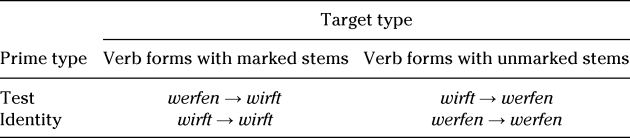
The 32 critical strong verbs tested in Experiment 1 were also used in Experiment 2 to create four types of prime-target pairs, as shown in Table 3. In addition to the two morphologically related primes and targets (test condition), a prime that was identical to the target (identity condition) was used for each of the two test conditions, which provided a baseline reflecting the maximum amount of priming for a given target item (i.e., repetition priming). We expect a reduction in repetition priming—that is, longer response times (RTs)—for both types of test primes relative to the corresponding identity primes, due to less prime-target overlap for the test condition than the identity condition. The size of the reduction of repetition priming provides the crucial measure of morphosyntactic relatedness. For the two types of test primes, we may find symmetric or asymmetric priming patterns (i.e., the same or different amounts of reduction in repetition priming).
Prime and target types in Experiment 2, with an example stimulus set (werfen “to throw”)
Morphologically related primes and targets differed only in that they were different inflected forms of the same verbs. Consequently, their semantic, phonological, and orthographic overlap and their lemma frequencies were parallel. Although primes and targets were also matched to each other and across target types with respect to mean word-form frequency, the -en form targets were longer, in terms of both phonemes and letters, than the third-person singular present-tense forms (see the Appendix). The critical prime-target pairs were distributed over four experimental versions in a Latin square design, so that each version included 32 distinct prime-target pairs, with each critical item appearing only once in each experimental condition. A set of 256 filler pairs—which consisted of 112 word-word filler pairs and 144 word-nonword pairs—was added to the 32 critical prime-target pairs in each of the four experimental versions to ensure that, in each experimental version, half of the 288 targets were existing words and half nonwords. The 144 word-word pairs consisted of the 32 critical prime-target pairs, 40 filler pairs with weak verbs, and 72 filler pairs with adjectives. The distribution of related and identical primes and targets in the 40 filler pairs with verbs was parallel to that in the critical prime-target pairs, in that half were related and half were identical prime-target pairs. The 72 filler pairs with adjectives consisted of 48 related and 24 identical prime-target pairs. The 144 word-nonword pairs consisted of 32 pairs with targets that suggested similarity to strong verb inflection patterns in German, 40 with targets that suggested similarity to weak verb patterns, and 72 adjectival nonwords. Nonwords were created by exchanging at least two letters of an existing verb’s or adjective’s stem, leaving the onset and the coda intact. Across the whole experiment, participants only encountered inflected verbs and adjectives. The critical verb endings, -en and -t, occurred on 36 items each in each experimental version. In addition, participants encountered the adjectival suffixes -e, -s, and -m on 24 items each in each version. The critical and the filler items were pseudorandomized, with critical prime-target pairs comprising 11% of the items in each of the four experimental versions.
Procedure
Participants were tested individually in a quiet room using the DMDX software package (Forster & Forster, Reference Forster and Forster2003) for stimulus presentation and data collection. Each trial followed the same sequence of events. The presentation of a fixation cross (800 ms) preceded a short auditory attention tone (200 ms), which was followed by the auditory prime word presented over headphones. Primes were prerecorded in a sound studio and were spoken by a female native speaker of German with a northern dialect. They were digitized at a sampling rate of 48 kHz, 16 bit stereo and were compiled into audio.wav files. Immediately at the offset of the (spoken) prime, the visual targets were presented in the center of a 24-in computer screen in black letters (font: Comic Sans MS, size: 28 points) against a light grey background and remained there for 500 ms. Reaction times were measured from the presentation of the targets onward. After the target disappeared, participants were given a further 2,000 ms to respond before the next trial started with the presentation of the fixation cross. Participants were asked to perform a lexical decision task on each target by pressing either a YES or a NO button on a Logitech game pad. Two breaks were provided during the experiment. To ensure that participants paid attention to the auditory stimuli, they were told before the experiment that they would have to answer questions on the presented items after each break and at the end of the experiment. Participants were given a list of 15 words and were asked to indicate whether or not they heard each word during the preceding segment of the experiment. The experiment began with 20 practice trials consisting of 10 prime-target pairs with word targets and 10 with nonword targets. After the main experiment, the L2 participants were presented with an alphabetical list of the 32 critical test items and were asked to indicate which items they knew and which were unfamiliar to them. The whole experimental session lasted approximately 25 min for the L1 speakers and 35 min for the L2 participants.
Data Analysis
As in Experiment 1, the critical item quellen “to gush” yielded an unusually low mean accuracy score among the L2 learners (53.1% compared to an average of 98% for the other critical items) and was therefore removed from any further analysis. In addition, the data for the item bergen “to recover” had to be excluded for two participants and the item stechen “to sting” for one participant, as these participants indicated that these two items were unfamiliar to them. Furthermore, all time-outs and incorrect responses (L1: 3.25%; L2: 2.78%) were also excluded. To reduce the potential influence of outliers, we followed Veríssimo and Clahsen’s (2009, p. 191) procedure of removing data points that were two standard deviations above or below a participant’s mean RT in a given condition as well as all data points with a RT below 250 ms or above 1,500 ms (L1: 2.83%; L2: 11.2%). Mean accuracy scores as well as mean RTs were submitted to 2 three-way repeated-measures ANOVAs, one for participants (F 1) and one for items (F 2), with the variables prime type (identity vs. test), target type (marked stem vs. unmarked stem), and group (L1 vs. L2); the variable group was added as a between-participants variable in the F 1 analysis and as a within-participants variable in the F 2 analysis. Although mean RTs are shown, these analyses were performed on the transformed data (using both log and z transformation). Accuracy scores were arc-sine-square-root corrected and were subsequently submitted to ANOVAs. Finally, interactions with group in the three-way analyses were further examined through separate ANOVAs for the two participant groups.
Results
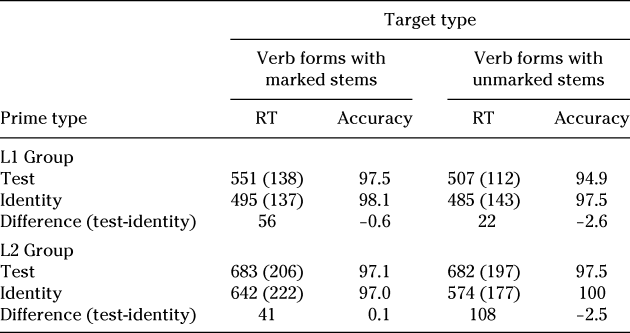
Table 4 presents mean RTs and accuracy scores for the two target types (verb forms with marked vs. unmarked stems) and the two prime types (identity and test) in the two participant groups (L1 and L2).
Mean RTs (in ms), SDs (in parentheses), and accuracy rates (in %) in Experiment 2
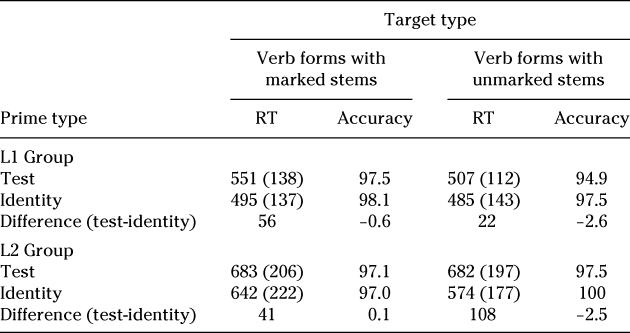
With respect to the accuracy data, Table 4 shows high accuracy scores of more than 95% correct for both participant groups for the verb forms tested and small differences of less than 3% between the test and the identity conditions. The overall ANOVA on the accuracy data yielded an interaction of target type and group, which was reliable for items only, F 1(1, 50) = 3.38, p = .072, and F 2(1, 30) = 7.01, p = .013. This contrast is due to lower accuracy scores for target words with marked stems than for those with unmarked stems in the L2 group and the reverse trend in the L1 group. There were no further main effects or interactions. The L2 learners achieved high accuracy scores not only for word targets (M = 94.7%) but also for nonword targets (M = 93.1%); recall that word targets required a yes and nonword targets a no response. Thus, high accuracy on the critical items (all of which were word targets) was not due to a bias toward yes responses.
With respect to the RT data, the overall ANOVAs yielded main effects of prime type, F 1(1, 50) = 75.47, p < .001, and F 2(1, 30) = 66.39, p < .001; target type, F 1(1, 50) = 17.59, p < .001, and F 2(1, 30) = 6.94, p = .013; and group, F 1(1, 50) = 18.12, p < .001, and F 2(1, 30) = 348.31, p < .001. More importantly, there were significant three-way interactions of prime type, target type, and group for both participants and items, F 1(1, 50) = 15.27, p < .001, and F 2(1, 30) = 5.39, p = .027, indicating that the priming patterns were different in the two participant groups. This contrast was further examined by separate ANOVAs for the two participant groups. For the L1 group, there were main effects of prime type, F 1(1, 25) = 28.2, p < .001, and F 2(1, 30) = 26.58, p < .001, and target type, F 1(1, 25) = 12.46, p = .002, and F 2(1, 30) = 3.11, p = .08, as well as an interaction of prime type and target type, F 1(1, 25) = 3.65, p = .045, and F 2(1, 30) = 1.87, p = .18; the latter two (i.e., the main effect of target type and the interaction of prime type and target type) were significant in the F 1 analysis only. Likewise, separate ANOVAs for the L2 group revealed significant main effects of prime type, F 1(1, 25) = 48.28, p < .001, and F 2(1, 30) = 37.58, p < .001, and target type, F 1(1, 25) = 7.16, p = .013, and F 2(1, 30) = 5.64, p = .024, as well as a significant interaction (in the F 1 analysis only) of prime type and target type, F 1(1, 25) = 12.02, p = .002, and F 2(1, 30) = 3.06, p = .09.
The main effect of prime type reflects the fact that, in both participant groups, the repetition-priming conditions (which had identical word forms as prime and target) yielded shorter RTs than the corresponding test conditions. The effect of target type was due to longer overall RTs for target verb forms with marked stems than for those with the unmarked stems in both participant groups. The Prime Type × Target Type interactions, however, have different sources in the two participant groups. First, although the identity conditions yielded similar RTs for both target types in the L1 group (485 ms vs. 495 ms), the corresponding L2 learners’ RTs were considerably longer for verb forms with marked stems than for those with unmarked stems (642 ms vs. 574 ms), indicating a disadvantage for the former as target words in the L2. Second, whereas, in the L1, data test primes with marked stems led to a smaller reduction of repetition priming than test primes with unmarked stems (22 ms vs. 56 ms), the opposite pattern was found in the L2 group (i.e., a larger deviation from the repetition-priming effect for prime-target pairs with verb forms containing marked stems as primes than for those containing unmarked stems as primes; 108 ms vs. 41 ms). Hence, with respect to priming effects between different inflected forms of the same lexeme, L2 learners (unlike L1 speakers) show less effective priming from marked than from unmarked stems.
DISCUSSION
The most interesting finding from the current study comes from the crossmodal priming experiment, which provides time-sensitive measures of processes involved in lexical representation and processing and revealed clear native-nonnative differences. In the L1 group, verb forms with marked stems (e.g., wirft) facilitated the recognition of the target form with the corresponding unmarked stem (e.g., werfen) more often than vice versa. The opposite pattern was found for the L2 group, with more efficient priming for werfen → wirft than for wirft → werfen. We argue that these findings can best be explained in terms of the different stem variants involved and their morphosyntactic feature content. Consider first, however, the role of a number of word-level properties of the items tested.
One factor that has been proposed to determine the size of priming effects is the degree of phonological, orthographic, and meaning overlap. The more similar primes and targets are with respect to these properties, the larger the priming effect is supposed to be (McClelland & Patterson, Reference McClelland and Patterson2002, among others). Note, however, that the critical prime-target pairs in the two test conditions are parallel with respect to their phonological, orthographic, and meaning overlap. Hence, the observed priming asymmetries (e.g., between werfen → wirft and wirft → werfen) cannot be explained in these terms. Another surface-form property that has been reported to affect the size of priming effects is the length of the prime and target words. Stolz and Feldman (Reference Stolz, Feldman and Feldman1995), for example, observed that prime-target pairs that are similar in length yield facilitation, whereas prime-target pairs that are different in length do not produce any priming effect. In our experiment, the critical prime-target pairs were different in length, an unavoidable consequence of the fact that the -en ending is syllabic in German and the -t suffix is not. Although length differences between primes and targets may contribute to reductions in priming in the two test conditions (relative to the identity conditions), length differences cannot explain the priming asymmetries, observed in both the L1 and the L2 data. Another potentially influencing factor is the frequency of the word forms involved. Although the critical items used for the priming experiment were matched as closely as possible with respect to their (word-form and lemma) frequencies, -en forms with unmarked stems are more common in German usage than third-person singular present-tense -t forms, as forms such as werfen are used as infinitives as well as for the first- and third-person plural present tense. Could this difference explain the priming patterns? Previous studies examining the impact of frequency on morphological priming (see Amenta & Crepaldi, Reference Amenta and Crepaldi2012) have found that, in overt priming designs such as the one employed for Experiment 2, derived words with low frequency yield more priming than those with high frequency. For inflected words, however, priming effects were found to be parallel for low- and for high-frequency words (e.g., Raveh, Reference Raveh2002). As the current study examined inflected word forms only, it is unlikely that the observed priming patterns are due to the frequency differences between -en and -t forms. We conclude that word-level properties do not account for the observed priming patterns in the L1 or in the L2 data.
Different accounts have been proposed to represent stem allomorphy in the German mental lexicon. Stem variants may form morphemic units that are directly connected to their corresponding semantic concept or lemma (e.g., Smolka et al., Reference Smolka, Zwitserlood and Rösler2007). Alternatively, the base stem may constitute a nucleus and other marked stems dependents (e.g., Günther, Reference Günther1988). Stem variants have also been proposed to be derivable through morphophonological rules (e.g., Beedham, Reference Beedham1994, 1995/1996). Finally, stem variants together with their morphosyntactic features may form subnodes of hierarchically structured lexical entries (e.g., Wunderlich, Reference Wunderlich, Booji and van Marle1996). To see whether any of these accounts can explain the current findings, we discuss the L1 and the L2 data separately.
Consider first the L1 data. Although Experiment 1 simply confirmed that native speakers of German are familiar with the kinds of verb forms tested, Experiment 2 yielded an asymmetric priming pattern for the different stem variants that is unexpected from accounts that directly associate stem forms and their meanings. If, as, for example, proposed by Smolka et al. (Reference Smolka, Zwitserlood and Rösler2007), the different stem variants of a given lemma activate the corresponding concept node in the same way, we would expect to find symmetric priming between them, for example, between werf- and wirf-, rather than the priming asymmetries we found. Furthermore, if a base stem such as werf- constitutes a nucleus and a marked stem such as wirf- a satellite (e.g., Günther, Reference Günther1988), we should have found a priming advantage for base stems but not for marked stems, similar to what Feldman and Fowler (Reference Feldman and Fowler1987) found for case-marked nouns. Likewise, this pattern of results is also hard to explain from the perspective of rule-based accounts of stem allomorphy in which stem variants such as wirf- and werf- are derived from each other through phonological (e.g., vowel-change) rules. Given this account, we should have obtained similar priming effects for the stem variants (e.g., Stockall & Marantz, Reference Stockall and Marantz2006) or perhaps more priming for the base stem werf-, but definitely not the pattern that was found in the L1 data—namely, more facilitation for the marked stem wirf-.
Suppose, finally, that stem allomorphy is represented in terms of structured lexical entries such as in (1). Given morpholexical representations of this kind, we can explain the unusual priming pattern found in the L1 group as follows. In a prime-target pair such as werfen → wirft, the stem wirf- of the target word contains morphosyntactic features—namely, [−1, +IMP] for the second and third person and the imperative—that are unavailable from the prime word. In the reverse case (e.g., wirft → werfen), however, the target word contains the base stem—that is, the most impoverished stem form—which does not have any features unavailable from the prime. Assuming that unprimed features lead to additional processing costs, a prime-target pair such as werfen → wirft produces less facilitation than the reverse case (wirft → werfen), in which the target does not contain any unprimed features. Further support for this interpretation comes from the results of an earlier crossmodal priming study with L1 speakers of German (Clahsen et al., Reference Clahsen, Eisenbeiß, Hadler and Sonnenstuhl2001) that reported the same pattern for a different set of stem allomorphs—namely, for preterit stems such warf- relative to the base stem werf-. In both cases, asymmetric priming patterns were found with more facilitation for prime words with marked stems (wirf- or warf-) relative to prime words with the base stem (werf-), in line with the structure of the lexical entry; see (1).
Consider next the L2 data. Whereas errors in Experiment 1 were restricted to a small number of items, Experiment 2 showed a clear and systematic contrast, with less efficient priming from verb forms that contain marked stems than from forms with the base stem, as well as longer target RTs for verbs with marked stems than for those with base stems. We attribute this contrast to the specific morphosyntactic feature content of marked stems. Whereas the base stem is not specified for any morphosyntactic features, marked stems are restricted to finite verb forms that encode features such as person, number, and tense. The use of these kinds of finite stem forms shows disadvantages relative to the unmarked base stem in the L2. The L2 learners’ knowledge of their native language, Russian, is an unlikely source for this disadvantage in their German. As pointed out previously, Russian is a language with a richer system of morphosyntactic features (which include those encoded on verbs in German) and in which stem allomorphy is more common than in German. Given the properties of their native language, the L2 learners should therefore be familiar with the kinds of verb forms we tested. Furthermore, a number of previous experimental studies have shown that native speakers of Russian make use of morphological structure and morphosyntactic features in processing their native language in the same way as L1 speakers of German. Evidence from priming experiments (Kazanina, Dukova-Zheleva, Geber, Kharlamov, & Tonciulescu, Reference Kazanina, Dukova-Zheleva, Geber, Kharlamov and Tonciulescu2008), for example, indicates that L1 speakers of Russian decompose diminutive forms into their morphological constituents during word recognition; see Clahsen, Sonnenstuhl, and Blevins (Reference Clahsen, Sonnenstuhl, Blevins, Baayen and Schreuder2003) for parallel results on L1 German. For inflectional morphology in L1 Russian, Slioussar et al. (2014) reported a brain-imaging experiment showing the familiar contrasts between regular and irregular inflection that have been obtained in comparable studies on German (Beretta et al., Reference Beretta, Campbell, Carr, Huang, Schmitt, Christianson and Cao2003) and other languages. These studies indicate that it is not the case that speakers of Russian rely less on morphology and morphosyntax for word recognition in their L1 than do German speakers in their L1.
Difficulties with morphosyntax, specifically with markers of finiteness in a late-learned L2, are familiar from previous research. Adult L2 learners have been reported to not reliably produce finite forms and to sometimes omit finite verbs or to replace them with nonfinite verb forms. Morphosyntax has also been found to be challenging for late bilinguals in comprehension and judgment tasks; see Meisel (Reference Meisel2011) and Clahsen, Felser, Sato, and Silva (Reference Clahsen, Felser, Sato and Silva2010) for reviews. Whereas most previous studies have examined inflectional affixes and suppletive forms, the current findings show that L2 learners’ difficulties in this domain also affect morphosyntax expressed through stem allomorphy, in that the L2 learners rely less on marked stem variants that encode finiteness features. Note also that the L2 groups we examined consisted of very advanced learners of German. Yet, unlike for L1 speakers of German, marked stems yielded worse performance in these learners relative to unmarked stems, an apparently persisting disadvantage for L2 learners.
The current finding of distinct priming asymmetries for the L1 and the L2 suggests that stem allomorphy is represented differently in a L1 and a L2. Although the priming asymmetries obtained for native speakers of German were explained in terms of structured lexical entries such as in (1), this account does not extend to the L2 data. Instead, the priming pattern in the L2 data is more in line with accounts that predict extra costs for marked stems. In the satellite model, for example, word recognition is supposed to happen via the nucleus (i.e., a verb’s base stem), rendering the recognition of other stem variants more demanding (Lukatela et al., Reference Lukatela, Carello and Turvey1987, p. 12). Given this account, an extra cost for processing is incurred for a marked stem such as wirf- relative to a verb form that contains the corresponding base stem werf-, because the former does not permit direct nucleus access. Although the L2 data examined for the current study are consistent with this account, we acknowledge that further testing with other kinds of stem allomorphy is required, before any general claims can be made on how stems are represented in the L2 mental lexicon.
CONCLUSION
Languages encode morphosyntactic features (e.g., tense, number, person, case, etc.) through different kinds of exponents, which include inflectional affixes, suppletive word forms, and stem allomorphs. Whereas previous studies with late bilinguals have examined affixation and suppletion, the current study is the first to experimentally investigate how stem allomorphy is represented and processed in a nonnative language. We specifically examined allomorphic stems of German verbs that encode morphosyntactic features such as tense, person, and number, in comparison to the corresponding base stems. Groups of fluent late bilinguals (with Russian as their L1) and L1 (native) speakers of German were tested in two behavioral experiments on verb forms containing marked versus unmarked stems (e.g., wirf- vs. werf-). An offline sentence-completion task (Experiment 1) indicated that advanced L2 learners of German are familiar with the verb forms we examined in the current study. Experiment 2, however, showed clear L1-L2 differences in an online primed lexical decision task. For the L2 group, we found less efficient priming from verb forms that contain marked stems than from prime words with the base stem, whereas the L1 group showed the opposite pattern. This contrast indicates that the recognition of marked stems incurs an additional processing cost in the L2, unlike in the L1, in which forms with marked stems did indeed facilitate the recognition of verb forms with the corresponding unmarked stems. This contrast was explained with reference to the marked stems’ morphosyntactic features. We conclude that lexical representations of stem allomorphy in a late-learned L2 rely less on morphosyntactic information than those in the L1 lexicon. At a more general level, the findings from the current study are consistent with the shallow structure hypothesis (Clahsen & Felser, Reference Clahsen and Felser2006a), the idea that because the L2 grammar does not reliably and automatically provide the information relevant for processing in time (e.g., information about a marked stem’s morphosyntactic features), the L2 comprehension system underuses grammatical analysis during processing relative to the L1 system.
APPENDIX
EXPERIMENTAL ITEMS AND FREQUENCIES (PER MILLION) FROM DLEX (HEISTER ET AL., 2011)