Introduction
Since the 1930s and the so-called Dust Bowl phenomenon in the American Great Plains, there has been increasing concern regarding the long-term ecological and economic impacts of tillage systems. In response to these concerns, a variety of alternatives have been developed worldwide. Practices such as direct seeding emerged in the 1970s among soybean and wheat farmers confronted with severe soil erosion in southern BrazilReference Bolliger, Magid, Amado, Neto, Ribeiro, Calegari, Ralisch and De Neergaard1. Since then the French Agricultural Research Centre for International Development (CIRAD) has been searching for improvements to these practices in collaboration with local farmer organizations, extension agencies and the private sector. Direct seeding mulch-based cropping (DMC) systems were developed based on three principles: no tillage, permanent plant cover, and adapted crop associations and rotationsReference Séguy, Bouzinac, Trentini and Cortez2, Reference Séguy and Bouzinac3. Further efforts were made to adapt these systems to contrasted eco-regions and smallholder farming conditions and to develop more efficient DMC systems that are less dependent on herbicides such as glyphosate4–Reference Jullien, Tivet, Lestrelin, Tran Quoc, Lienhard, Chabanne, Khamhung, Panyasiri, Rattanatray, Julien, Séguy, Chanphengxay, Khamhung, Panyasiri, Chabanne, Tran Quoc, Jullien, Lienhard and Tivet8. DMC systems are now gathered under the broad concept of conservation agriculture (CA) and are promoted by major international organizations including the Food and Agriculture Organization (FAO) of the United Nations9 and Centres of the Consultative Group on International Agricultural Research (CGIAR).
According to global assessments, some 106 million hectares of agricultural land are cultivated using CA or (at least) no-till systemsReference Derpsch and Friedrich10, 11. However, important questions have been raised concerning the potential and actual extent of CA in contexts of resource-poor smallholder agricultureReference Bolliger, Magid, Amado, Neto, Ribeiro, Calegari, Ralisch and De Neergaard1, Reference Erenstein12–Reference Giller, Witter, Corbeels and Tittonell14. Factors such as limited access to land, weak land tenure arrangements, limited technical knowledge, limited support from extension agencies, poor access to inputs and markets, and smallholders' need for immediate returns to investment are considered as key constraints preventing the adoption of CA. As argued by Giller et al.Reference Giller, Witter, Corbeels and Tittonell14 (p. 21), while the practice may be a valuable option for medium- or large-scale mechanized farms, it is simply ‘inappropriate for the vast majority of resource-constrained smallholder farmers and farming systems’. This paper contributes to the debate by looking at the dissemination and adoption of CA in Laos, a country where small-scale farming is the norm for a majority of the population. It does so through a 4-year agro-economic monitoring of 2160 smallholder farmers and a coupled, statistical and qualitative approach to farm-level determinants for adoption of CA. The paper examines a range of local socio-economic and environmental situations (four districts and 21 villages) and provides empirical evidence for the dynamics of CA adoption in a region that is poorly covered by similar research.
Materials and Methods
Study area
Sayaboury province is characterized by a long border with Thailand and relatively productive soils compared to the rest of the country. The province has long been at the forefront of rural development in Laos and was an important cotton production region from the 1960s to the late 1980sReference Castella, Chantharat, Thirasack and Trébuil15. Since then rapid agricultural expansion and intensification have been underway driven by the growing demand for raw materials from the Thai food-processing and animal feed industries. In the four southern districts of the province, the amount of rainfed cultivated land increased by an average of 53% between 2004 and 2008—going from 1.5 to 2.6 ha per household in Boten district, 2.6 to 3.9 ha in Kenthao, 2.8 to 3.0 ha in Paklay and 0.8 to 1.4 ha in ThongmixayReference Slaats and Lestrelin16.
With the increase in commercial crops such as maize, rice-bean, sesame and peanut, traditional shifting cultivation and crop rotations have been widely replaced by intensive monocropping systems based on mechanical tillageReference Laffort17, Reference Ducourtieux, Laffort and Sacklokham18. Under these systems, crop residues are generally burned during the dry season and/or directly buried with a mouldboard plough. A commercial hybrid maize variety from Thailand (CP888) is then hand-seeded at the beginning of the rainy season (April–May). In many instances, agricultural intensification has had negative ecological impacts, including increased soil erosion, gradual soil exhaustion and silting up of lowland paddy areasReference Tran Quoc, Khamxaykhay, Tivet, Chantharath, Panaysiri, Tivet, Tran Quoc, Lienhard, Chabanne and Panyasiri19. As monocropping systems have begun to show some limitations in terms of weed control, herbicides are now widely used for land preparation and post-emergence applicationReference Saioudom20. Weed control is achieved by a pre-sowing application of glyphosate or Gramoxone; atrazine is also widely used to control broadleaf weeds during the early stages of maize development. Tillage, purchase of hybrid maize seeds and increasingly frequent recourse to herbicides have also resulted in a rapid increase in production costs.
Since the early 2000s, CA has been promoted in Sayaboury as a possible means of achieving the agrarian transition while limiting the negative impacts of land-use intensification. No-till agriculture associated with cover crops, crop rotations or residue conservation have indeed been shown to have positive impacts on soil erosionReference Montgomery21, Reference Triplett and Dick22, as well as on the maintenance and/or renewal of the soil physical, biological and chemical propertiesReference Rhoton23, Reference Chivenge, Murwira, Giller, Mapfumo and Six24 and the soil moistureReference Govaerts, Sayre, Goudeseune, De Corte, Lichter, Dendooven and Deckers25. In a context of small-scale farming where tillage accounts for a significant share of production costs, CA can also be considered as a way to limit farm expenditure. It may also enable diversification of the local economy (e.g., through cover crops and their possible integration in livestock farming systems), hence decreasing the vulnerability of farmers to variations in market prices.
In the light of these potential benefits, a National Agro-Ecology Programme (PRONAE) was established in 2001 to test DMC systems in four villages in southern Sayaboury province. Four years later, the Programme of Capitalization in Support of Rural Development Policy (PCADR) became involved in the dissemination of three main systems: DMC maize monocropping (a no-till system with conservation of the residues of the previous season), association of maize and rice-bean (a no-till system where maize is intercropped with rice-bean) and a biannual maize–rice-bean rotation (a rotational sequence between maize and rice-bean under a no-till residue management system). Under these three systems, residues from the previous crop are left on the surface of the soil and the following crops are directly seeded into the mulch—either manually, using sticks or hand-jab seeders, or mechanically using small sowing machines imported from Brazil and adapted for hand tractors or medium-sized tractors. Like in conventional systems, the CP888 hybrid maize variety is used. Maize is sown between late April and early May (depending on rainfall distribution and plot location) and harvested between August and September. A local photosensitive variety of red rice-bean is seeded manually (using sticks or hand-jab seeders), either as the main crop in a biannual maize–rice-bean rotation or intercropped with maize. In the first instance, rice-bean is sown in May–June and harvested in December. In the second instance, rice-bean is sown 90 days after maize emergence, which allows for good vegetative development at the end of the rainy season, and is harvested in December. In all three systems, weed control involves a pre-sowing application of glyphosate and 2,4-D (dichlorophenoxyacetic acid). In some instances, atrazine is also used to control broadleaf weeds after the emergence of maize. It must be noted that these cropping systems constitute relatively basic forms of DMC. More efficient systems involve diversified rotations and the use of relay crops/cover crops during the winter dry period. Dissemination efforts involved awareness raising and training activities with farmers and extension agents, setting up farmer groups and facilitating the supply of inputs. Between 2005 and 2008, PCADR supported the establishment of farmer groups in 44 villages in the four southern districts of Sayaboury province—involving about 1100 smallholders and 1500 ha of agricultural land.
Survey data
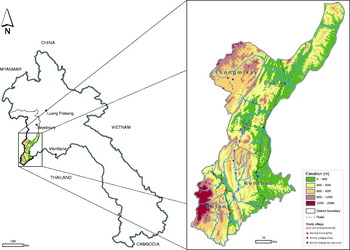
This study used quantitative data derived from two series of questionnaire surveys. A rapid questionnaire survey was conducted annually from 2005 to 2008 to determine several basic farm characteristics (e.g., land tenure, land use, income and farm inputs) in a random sample of 2160 households in 21 target villages (Fig. 1). A more detailed questionnaire survey, including education, wealth and environmental perceptions, was conducted in 2006 and 2008 in 462 households in four villages in Boten, Kenthao and Paklay districts. In addition, during the 2007 cropping season, data on labor requirements, inputs, production costs, crop yield and income were collected in regular interviews with members of PCADR farmer groups—for both DMC maize monoculture and tillage-based maize monoculture plots (121 and 110 plots, respectively). Statistical analysis of these different datasets involved calculation of correlation coefficients between household capital assets, labor, age, education level, rainfed land tenure and the extent of DMC land as a proportion of rainfed land per household. A factor analysis was performed to identify possible relations between the geomorphologic location of the farm and the extent of DMC systems as a proportion of rainfed land per household. The agro-economic data collected on DMC and tillage-based maize monoculture plots were also compared and evaluated statistically.
Intervention area of the PCADR–PRONAE projects and villages surveyed.

To obtain more qualitative information, 22 semi-structured interviews were conducted in four villages selected as representatives of a gradient of environmental constraints. Southern Sayaboury province spans three main geomorphologic zones with different characteristics in terms of slope, risk of erosion and soil productivity: from the west (Thai border) to the east (Mekong river), these zones comprise a steeply sloping and erosion-prone sandstone-argillite area, a productive and moderately sloping clayey-illite schist area with basic rock intrusions, and a productive and relatively steeply sloping clayey-ferruginous schist area (see Fig. 1). Within each village, four categories of farmers were selected for interview: (1) farmers who practiced tillage-based agriculture or shifting cultivation and had never used CA; (2) members of CA farmer groups; (3) farmers who practiced CA but were not members of a farmer group; and (4) farmers who had experimented with CA but had later reverted to tillage-based agriculture. These different categories of farmers were assumed to represent a valuable range of individual positions and opinions about CA.
Results
Diffusion of CA in southern Sayaboury province
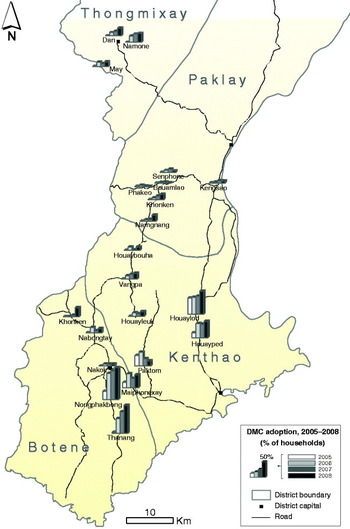
In 2008, after four years of dissemination, CA had become a significant component of agricultural landscapes in southern Sayaboury province. However, there were spatial variations in the number of farms practicing CA and in the extent of CA compared to other crop management practices. Boten district had the highest adoption rates with up to 88% in the village of Thanang and 100% in Nongphakbong (Fig. 2). With the exception of Houaylod and Houayped, where 72 and 52% of the farms practiced CA, the villages surveyed in Khentao and Thongmixay districts were comparatively less engaged in CA (11 to 28% of the population). Paklay district ranked last since, apart from the villages of Khonken (17%) and Namgnang (19%), only 1–6% of the farm households practiced CA.
Adoption of CA (% of households, 2005–2008).

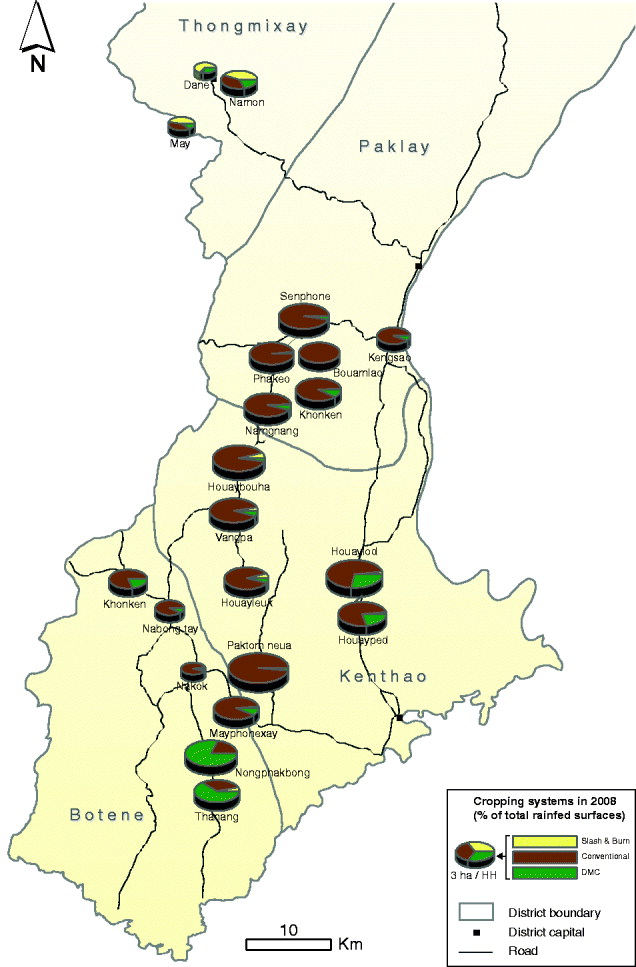
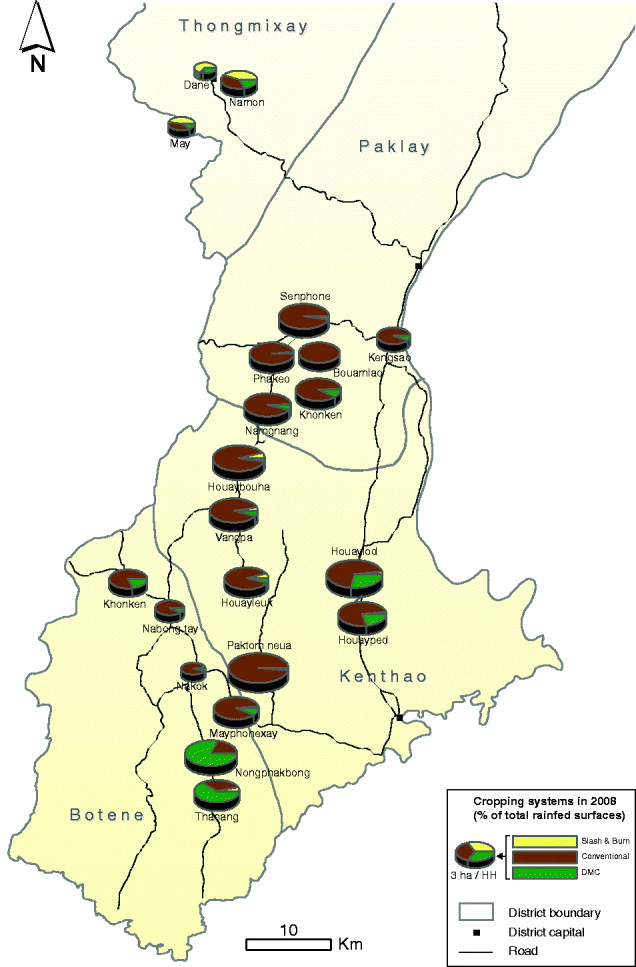
Considering the extent of the main cropping practices in the study area, Boten district again stands out. In the six study villages surveyed, CA had gradually expanded to cover an average of about 40% of the total rainfed area (Fig. 3). This figure is largely explained by the high rates of adoption in Nongphakbong and Thanang villages. In contrast, tillage-based agriculture clearly remained the most popular practice in the other villages surveyed in the district. Although the proportion of CA was lower in Kenthao district, a similar pattern was observed, with high rates of adoption in the villages of Houaylod and Houayped (respectively 30 and 20% of the average rainfed land per household) and dominance of tillage based agriculture in the other villages surveyed. CA was practiced least in Paklay district, where, despite a slight expansion at first, in 2008, CA represented less than 10% of the average rainfed land per household in the six villages surveyed. With a relatively small rainfed area per household, Thongmixay district was quite different from the other districts since in 2008, slash-and-burn remained the main cropping practice in the three villages surveyed. Although CA had gradually increased in the village of Dane (up to 30% of the average rainfed land per household), in the villages of May and Namone, it remained between 15 and 20% of the average rainfed land per household.
Relative distribution of the main cropping practices in 2008.
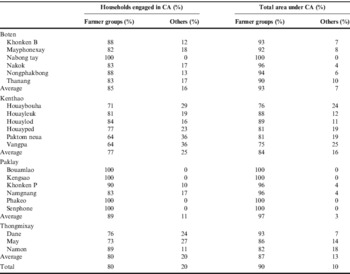
The extent of CA in the study area cannot be only attributed to the members of the PCADR and PRONAE farmer groups. As shown by disaggregated data on adoption rates and cultivated area (Table 1), CA spread beyond the farmer groups. In villages such as Paktom neua and Vangpa (Kenthao district), about one-third of the farmers who practiced CA in 2008 had never been members of farmer groups. Kenthao and Thongmixay districts are a good example of ‘spontaneous diffusion’ since, in the nine villages surveyed, an average of 20–25% of the households practicing CA had never been associated with PCADR and PRONAE. In contrast, the villages surveyed in Paklay district were characterized by very low levels of ‘spontaneous diffusion’. Looking at the total rainfed area under CA (Table 1), the results are similar. Again, Kenthao and Thongmixay districts stand out with 13–16% of the total surface area under CA managed by farming households who had never been members of farmer groups. In contrast, ‘spontaneous diffusion’ remained quite low in the villages surveyed in Boten and Paklay districts, where 90–100% of the total land under CA was managed by members of farmer groups. At the household scale there were also significant differences in the average area under CA. In the 21 villages surveyed, members of farmer groups practiced CA on an average of 1.9 ha, whereas non-farming households had 1 ha under CA.
Contribution of farmer groups to the practice of CA (2008).

Thus, if tillage remained a key agricultural practice in the study area, CA clearly increased in terms of both household engagement and spatial extent during the 2005–2008 period. The case of villages such as Nongphakbong and Thanang in Boten district or Houaylod and Houayped in Kenthao district suggests that, within a few years of dissemination, CA can become a widely accepted and adopted alternative to relatively long-established agricultural practices.
Farm-level determinants for adoption
Statistical analysis
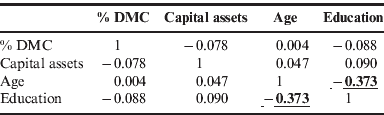
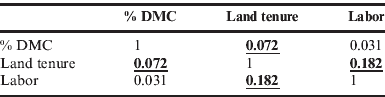
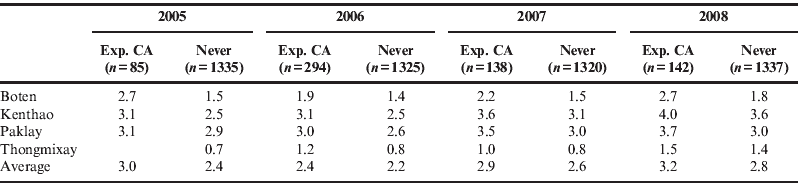
As can be seen in Tables 2 and 3, statistical analysis suggests that labor, wealth, age and education did not play a significant role in determining the level of engagement in CA of an individual household. However, the level of engagement was significantly and positively correlated with rainfed land tenure (although with a very low coefficient). This observation suggests different causal links. On the one hand, it could highlight an ex ante linkage between access to land and farmers' willingness to engage in ‘experimental’ activities. This causal link could be directly related to livelihood vulnerability and risk management strategies. On the other hand, the correlation may also indicate an ex post relation between the practice of CA and the potential it represents for farmers to expand their cultivated land. In that sense, the causal link would be more linked to livelihood improvement and supplementation strategies. Comparing rainfed land tenure between adopters during their first year of experimentation and farmers who had never experimented with CA supports the first causal link. As shown in Table 4, rainfed land tenure was systematically higher among adopters. This difference suggests the existence of a land tenure threshold under which farmers are not willing to experiment with CA. Yet, as expected given the rapid agrarian changes observed and the diversity of local situations, this threshold appears to vary quite significantly in both space and time.
Correlation coefficient matrix (Pearson): Household capital assets, age and education level of the household head and the proportion of DMC in household rainfed land (2006, n=456).
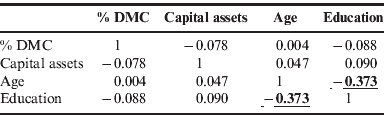
Underlined values represent significant correlations (at the 0.01 level). Household capital assets were derived from household ownership of transport and agricultural equipment.
Correlation coefficient matrix (Pearson): Household labor, rainfed land tenure and proportion of DMC in rainfed land (2008, n=2032).
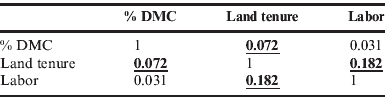
Underlined values represent significant correlations (at the 0.01 level).
Average rainfed land tenure (ha) among households that had experimented with CA (land tenure during the 1st year of experimentation) and households that had never tried CA (2005–2008).
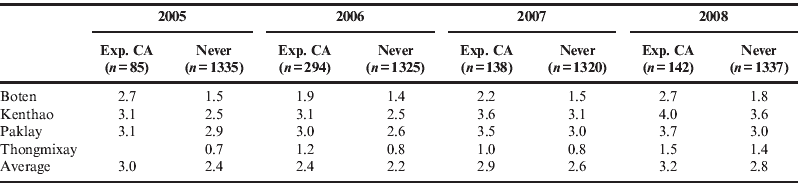
A Mann–Whitney test revealed a significant difference between the two samples (at the 0.01 level).
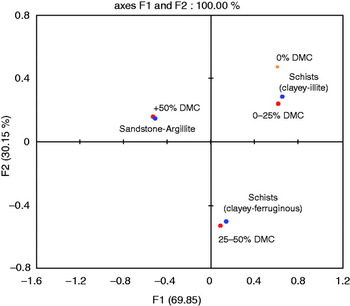
Engagement in CA also appears to be influenced by local soil characteristics and productivity. A factor analysis of the relation between geomorphologic location and the relative extent of CA in household rainfed land revealed a very significant correlation between sandstone areas and high levels of engagement in CA (Fig. 4). More generally, factor analysis highlighted a geomorphologic gradient from productive schist areas, with low levels of engagement in CA, to erosion-prone and poorly productive sandstone areas, with high levels of engagement in CA. Again, this correlation may indicate a causal relationship between livelihood vulnerability (to environmental factors in this case) and the adoption of alternatives to tillage as a risk management strategy.
Factor analysis of geomorphologic location and proportion of DMC systems in household rainfed land. Note: The ‘0% DMC’ column—which very significantly outweighs the three other columns—was excluded from the calculation to avoid distortion.

Thus, four observations emerged from statistical analysis: (1) farmers engaged in CA independently of their workforce, wealth, age and education level; (2) farmers who had access to plenty of rainfed land were more inclined to engage in CA; (3) farmers who engaged in CA more easily increased the extent of their cultivated land; and (4) farmers who cultivated soil with limited agricultural potential were more inclined to engage in CA. The following qualitative analysis helped elucidate some of these observations by considering local discourses on socio-environmental constraints and opportunities, and decision-making in relation to CA and tillage-based agriculture.
Qualitative analysis
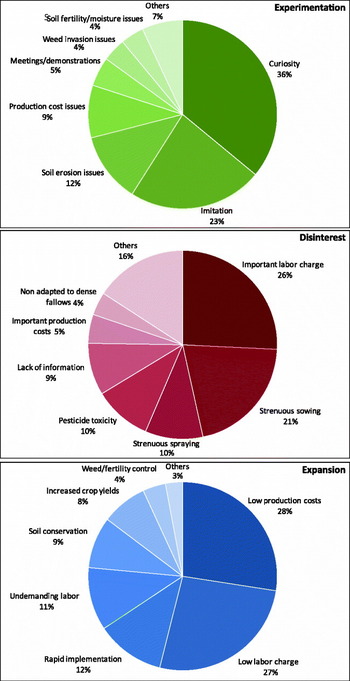
A starting point to better understand the observed heterogeneity in adoption rates is to look at the reasons that encouraged farmers to experiment with CA. In this regard, the questionnaire survey highlighted the fact that, apart from simple curiosity and imitation (which represented the main motivations by far), experimentation with CA was significantly motivated by environmental concerns (Fig. 5). As stated by several interviewees, soil erosion, weed invasion and willingness to better manage soil fertility and moisture were key incentives for experimenting with CA. These motivations link back to observations derived from statistical analysis. As would be expected, with soil erosion and fertility issues being key determinants for experimenting with CA, farmers located in areas of steep slopes and erodible soils are likely to feel particularly concerned and hence more interested in conservation alternatives. This partially explains the very high levels of adoption observed among the farmers in the villages of Nongphakbong and Thanang in Boten district. However, interview data also suggested that environmental concerns and engagement in CA cannot be considered independently from project sensitization activities. Field demonstrations and project meetings figured relatively high among the list of incentives that encouraged farmers to experiment with CA (Fig. 5). As described by several interviewees, project operators can play a significant role not only in promoting solutions to environmental issues experienced locally but also in providing external assessments and in raising environmental awareness:
‘[What was your initial motivation for experimenting with conservation agriculture?] I wanted to try the agricultural techniques that the project technicians told us about. They said these systems could increase soil fertility and crop yields. My plot is very steep and, during a meeting, they explained how ploughing on steep slopes can cause serious soil erosion and reduce soil fertility. That's why I decided to try the new cropping system.' (Mr Sing, Thanang, June 11, 2009)
In that sense, more than the actual biophysical situation of the farm (e.g., in terms of soil erosion risks and agricultural potential), it was very much the farmer's awareness of environmental threats that played a key role in his adoption of CA.
Reasons for trying (232 respondents). not trying (205 respondents) and extending land cultivated with CA (148 respondents) in Nongphakbong, Houaylod, Paktom neua and Bouamlao (frequency of answers, 2008).

This observation is in line with the conclusions of Knowler and Bradshaw' review of 31 CA adoption studies worldwideReference Knowler and Bradshaw26. These authors highlighted the fact that ‘awareness of environmental threats’ and ‘high fertility soils’ are often considered as significant determinants for CA adoption (positive for the former and negative for the latter). Similarly, the gradient of CA adoption in our study area, i.e., from productive schist areas to erosion-prone and less productive sandstone areas, appears to have been significantly determined by the different levels of environmental concern between farmers who benefit from highly productive and non-degraded soils and those who have to cope with low productivity and highly erodible soils. However, environmental awareness cannot fully explain the growing importance of CA in villages with relatively good soil conditions.
Willingness to reduce production costs also ranked high among farmers' motivations (Fig. 5). Similarly, farmers' reasons for extending their land under CA were mainly linked to the perceived advantages of the latter in terms of reduced production costs. These perceptions are logical in the context of agrarian transition which characterizes the study area. As mentioned above, farmers in southern Sayaboury province have to cope with increasing farm expenses including for ploughing services, purchase of hybrid seedlings and herbicides. In this context, reduced production costs are likely to be key incentives for the adoption of alternative cropping systems—this time, regardless of the local biophysical context.
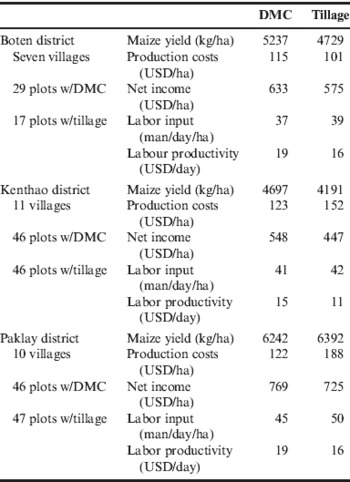
In this regard, on-farm monitoring data highlighted non-negligible differences between DMC and tillage-based maize monocropping systems (Table 5). While no statistically significant differences were observed in terms of labor requirements, productivity, crop yield and income, DMC offered clear benefits in terms of reduced production costs (−18% on average). During qualitative interviews, eight out of 13 farmers who had tried CA mentioned excessive production costs associated with tillage as their main reason for testing alternative cropping practices. As argued by the Houayped village chief, the increasing number of people willing to try CA in his village was linked to increasing debt among the farmers who used service providers for tillage:
‘[How do you see the future of CA in the village?] I think that more and more farmers will practice DMC. There are about 200 families in the village. Last year, almost 70 of them were members of the farmer group. This year, the group includes 100 families. The farmers who plough their fields can no longer pay back their loans, especially considering the low yields we had last year. Nowadays, everybody wants to try DMC to save money.’ (Mr Tchik, Houayped, June 14, 2009)
Again, project sensitization activities appear to have played a critical role in the process. As stated by the majority of adopters interviewed, project meetings and discussions with project officers were essential awareness-raising events and key starting points for experimentation with CA:
‘[When did you start conservation agriculture?] I started three or four years ago. [… What was your initial motivation?] I went to the project meetings, followed the advice of the technicians and started with two plots of maize. I had a very good harvest that year. This would have been impossible with the conventional system because there was a drought and, in that case, ploughing causes problems of dry soil and ends with low yields. [What was your motivation for participating to the project activities?] I wanted to change from conventional agriculture because it is too expensive. You have to pay for everything, for ploughing, for herbicides, for labour …’ (Mr Sinouane, Khonken (Paklay), June 13, 2009)
While low production costs were clearly a major incentive for adoption, some farmers also mentioned a link between CA and agricultural expansion. For several interviewees, engaging in CA was not only a way of reducing their farm expenses but also meant that some labor could be reallocated to cultivating more land.
‘[Why did you increase your land under CA?] I started cultivating larger plots because the cropping system means you can save on labour. You don't need to till your fields by hand and it costs less than ploughing. [ … What do you do with the extra money?] I can buy furniture for the family. I also paid to extend my paddy fields. [What do you do with the extra time?] Before, I used to spend all my time tilling one and a half hectares of land by hand, now I can cultivate four and a half hectares’ (Mr Vone, Thanang, June 11, 2009)
This observation sheds a different light on the statistical correlation between rainfed land tenure and engagement in CA. The hypothesis that farmers with more land resources would be more inclined than others to experiment with new practices remains valid and in agreement with the findings of other studies worldwideReference Knowler and Bradshaw26. However, qualitative data also suggest an ex post relation between adoption of CA and agricultural expansion. Thus, although DMC maize monoculture does not present statistically significant benefits in terms of improved labor productivity (see Table 5), some farmers were nevertheless able to cultivate more land without increasing their financial and labor investments.
Agro-economic productivity of DMC maize monocropping and tillage-based maize monocropping systems (2007).

A Mann–Whitney test revealed significantly lower production costs for DMC systems (at the 0.01 level).
Frequent references to the experience of neighbors as a reason for experimenting with CA (Fig. 5) suggest that social adherence is an important determinant for adoption. In villages such as Thanang, Nongphakbong, Houayped and Houaylod where CA is practiced by more than half of the villagers and is therefore established as a viable practice, the shift from tillage-based to CA is likely to be easier and perhaps more durable than in villages where CA is still marginal. Similarly, the participation of village leaders in the project may be important. The rapidly increasing adoption rate in Houayped (from 16 to 52% between 2005 and 2008) may partly reflect this point. During an interview, the village chief—who has been an active member of the PCADR farmer group since 2005 and uses DMC techniques on 8 hectares of rainfed land—said he considered village meetings as an opportunity to explain the functioning and benefits of CA to his constituents:
‘[Do you recommend DMC techniques to the villagers?] Yes, during village meetings, I often recommend trying DMC systems. I explain how it works, we discuss the cropping techniques, how they differ from conventional agriculture, and their advantages.’ (Mr Tchik, Houayped, June 14, 2009)
As described by another interviewee from the same village, the village chief's involvement is not only theoretical since he also gives the villagers practical help in implementing the new techniques:
‘[What was your initial motivation for experimenting with DMC systems?] I started DMC because local traders offered loans not only to buy seeds but also for herbicides. So I took out a loan to buy herbicides and then, the village chief came to see one of my plots and explained how to use DMC with maize.’ (Mr Heou, Houayped, June 14, 2009)
Generally speaking, the involvement of a village leader in both the promotion of CA and its practical implementation probably helps normalize and/or institutionalize the practice. Subsequent adoption by other farmers is likely to be facilitated. As argued by SwintonReference Swinton27, social capital embodied in variables like farmers' participation in community organizations can sometimes play a more determining role in facilitating adoption of agricultural innovations than variables such as the biophysical situation of the farm, crop prices, farm assets or even perception of environmental degradation.
So far, our analysis has mainly considered the main possible drivers for adoption. Yet, answers to questions why farmers did not try CA showed that labor requirements, arduous sowing and herbicide spraying were by far the biggest disincentives (Fig. 5). Although labor-related issues may appear unjustified given the agro-economic performance of CA (see Table 5, showing that labor requirements for DMC and tillage-based systems are similar), an observation that was repeatedly made during interviews may provide the explanation: the absence of private operators who supply the technical services specific to CA. Cover crop or residue management, herbicide spraying and sowing in DMC systems require specific equipment and technical know-how. These tasks also require considerable labor investments when large areas are concerned. In a context in which the agricultural sector has mainly been structured around tillage-based maize monoculture, many farmers prefer to use well-established service providers. Even if this system increases farm expenses, the high incomes ensured by cropping maize combined with credit schemes that allow farmers to delay reimbursing their loan until after the sale of their production tend to counterbalance the agro-economic advantages of CA:
‘[What were your motivations for changing from DMC to ploughing-based agriculture?] I had to stop last year because I didn't have enough labour to cultivate my plots. I was growing melons in my lowland fields, and that requires a lot of time. [Did you change for ploughing because DMC requires too much labour?] No, it does not require a lot of labour, especially if you can use mechanical seeders. Conventional agriculture probably requires more labour but, if you have enough money, you can hire people to work in your fields. With DMC, that is more difficult.’ (Mr Phonxay, Paktom, June 12, 2009)
Finally, several factors appear to converge to facilitate or limit the diffusion of complex DMC systems based on crop associations and rotations. In villages such as Thanang and Nongphakbong (Boten district) that are characterized by relatively poor soils but have easy access to markets for secondary crops, crop diversification and rotations have long been used by farmers as a way to maintain soil productivity. In this context, DMC systems are likely to be considered as just another way of applying long-established intercropping practices. This is not the case in Paklay district where maize monocropping is clearly the norm:
‘[Which crop do you cultivate in CA?] I grow maize. I also grow rice and peanuts but with ploughing, not with conservation agriculture. [Do you plan to associate rice bean with maize at some point?] No, I think I will only grow maize. We are used to monocropping in this village. Intercropping is impossible here because the villagers don't know how it works. [Intervention of another interviewee] Yes, and if we crop rice beans, we have to go to Kenthao to sell the harvest.’ (Mr Ma and Mr Bounma, Khonken, June 13, 2009)
Thus, limited agricultural knowledge and limited markets for ‘secondary crops’ are major constraints for the development of DMC systems based on intercropping and rotations, and hence for the emergence of a genuine CA.
Discussion and Conclusions
The adoption rates and extent of cultivated areas observed in several villages in the study area suggest that, within a few years of research and extension, CA could become a viable and accepted alternative to well-established tillage practices—even in a context of small-scale farming. Thus, this case study provides a counterargument to the conclusion of Giller et al.Reference Giller, Witter, Corbeels and Tittonell14 that CA is generally incompatible with smallholder farming. Statistical evidence suggests that farmers' engagement in CA is not contingent upon farm-level variables such as capital, labor, age and education. Access to land and associated risk-management strategies certainly help shape farmers' decision to try CA. However, the difference in land tenure between experimenters and non-experimenters appears fairly small (0.4 ha on average for the 2005–2008 period) and varies in both space and time. More generally, in line with the assessment of Knowler and BradshawReference Knowler and Bradshaw26, the present study indicates that the factors that influence farmers' decision making are highly context specific (e.g., local land degradation and production costs, involvement of local elites, markets for secondary crops). The absence of universal variables explaining local engagement in CA jeopardizes any attempt to extract general theories on farm-level determinants for adoption. However, at the level of policymaking and planning, the case of southern Sayaboury province highlights two important aspects that should be accounted for in any CA dissemination strategy. As indicated by statistical and qualitative evidence, farmers faced with serious agro-ecological constraints and land degradation are more likely to try and to subsequently adopt CA. Thus, environmental sensitization appears to be a key aspect of dissemination. Although dissemination is likely to yield fewer results in areas with productive soils, qualitative data indicate that a dissemination approach emphasizing reduced production costs is also an effective way of encouraging farmers to engage in CA and save money on tillage.
Finally, the question of the integration of CA in the broader agricultural industry also appears to be essential. On the one hand, the dissemination of CA in southern Sayaboury province benefited from a well-developed maize industry, which allows smallholders to obtain a monetary income and thus to cover the costs associated with agricultural intensification. On the other hand, the fact that the agricultural sector is entirely structured around tillage-based maize monoculture imposes considerable limits to the diffusion of CA. Without service providers specialized in CA, there are limited incentives for farmers to change from conventional cropping systems. With limited market opportunities for ‘secondary’ crops, there are also limited opportunities for the emergence of more ecologically intensive CA systems. The integration of grasses and legumes in diversified rotations and as relay crops during the dry season does not only allow for additional fodder and grain production, it also plays key roles in nutrient recycling, pest management and weed controlReference Buhler28, Reference Dabney, Delgado and Reeves29. Yet, in southern Sayaboury province, the realization of these benefits is significantly hindered by an overly specialized agrifood market. Without more diversified market opportunities, CA adoption is likely to concern only poorly efficient monocropping systems, based on residue management and requiring important amounts of chemical inputs for weed and pest control. Thus, beyond research and farm extension, the emergence of a genuine CA may also require a transformation of the agricultural industry itself.
Acknowledgements
The authors thank the Agriculture and Forestry authorities of Sayaboury Province, and Kenthao, Boten, Paklay and Thongmixay districts for their support during fieldwork, Mr Khamphao Thongtiane for his assistance with the PASS database and for translating during the interviews, all the villagers interviewed for their willingness to share knowledge and information, and three anonymous reviewers for their useful comments and suggestions.