INTRODUCTION
In the last 20 years, the maricultural industry of China has been developing very rapidly. Therefore, the demand of feed for cultured marine animals is increasing steadily. However, there is still a lack of feed which is composed of single cell protein (SCP) from marine yeasts with high content of protein and other nutrients (Chi et al., Reference Chi, Liu, Gao, Gong, Ma, Wang and Li2006).
A variety of microalgae such as Spirulina and Chlorella and brown algae are extensively used as feed for cultured marine animals (Ravindra, Reference Ravindra2000; Chi et al., Reference Chi, Liu, Gao, Gong, Ma, Wang and Li2006). However, they have some limitations for animal consumption. They have rigid cell walls. Their production is generally done outdoors and dependent on climatic conditions. Algal culture is easily contaminated by pathogenic protozoa and bacteria. Bacterial cells usually contain a higher amount of nucleic acids than yeast cells (Ravindra, Reference Ravindra2000; Gao et al., Reference Gao, Chi, Sheng, Wang, Li and Gong2007). Some yeasts such as Saccharomyces cerevisiae, Candida utilis and Candida tropicalis can be used for their single cell protein (Ravindra, Reference Ravindra2000). They have many advantages over algae and bacteria. For example, their protein contents are high. Moreover, they can also supply the feed with the B-complex group vitamins, minerals and other components. They show a low level of nucleic acid content (9.7%) compared to that in microalgae and bacteria. Especially, yeast cells have higher concentration of essential amino acids than algal cells. The digestion rate of single cell protein of yeast cells is generally above 80% (Ravindra, Reference Ravindra2000). In general, yeast cells can grow very quickly and the cell density can reach over 108 cells ml−1. Compared to algal and bacterial cultivation, it is very easy to manage the large-scale yeast cell production in the fermentor. It is also very easy to collect and concentrate the yeast cells from the liquid culture because of their flocculation and bigger cell size than bacterial cells. Many yeasts can grow well on cheap products.
Unfortunately, little is known about marine yeasts that have high protein content and could be used as aquafeed. Rhishipal & Philip (Reference Rhishipal and Philip1998) isolated 33 strains of marine yeasts from the coastal and offshore waters off Cochin in India. The isolates were inoculated into the prawn-shell wastes and the protein content of the final products was increased from 38.5% to 70.4% after the transformation of the prawn-shell waste by strain M15 of Candida sp. This finding promises wide application in aquaculture, particularly as a feed supplement. Brown et al. (Reference Brown, Barrett, Volkman, Nearhos and Nell1996) found that the marine yeasts Debaromyces hansenii ACM 4784, Dipodascus capitatus ACM 4779 and Dipodascus sp. ACM 4780 contained 23%, 32%, and 36% of crude protein, respectively, while terrestrial Candida utilis ACM 4774 contained 42% of crude protein. However, all the marine yeast strains lacked the 20:5n-3 and 22:6n-3 fatty acids, making them unsuitable as a complete diet for larval raising.
The aims of this study are to examine the diversity of the marine yeasts with high protein content and evaluate their nutritive compositions in order to obtain some marine yeasts for single cell protein production.
MATERIALS AND METHODS
Sampling
Different samples of seawater and sediments in the South China Sea (100 m depth, 20°C, pH 8.1 and 2.89% salinity, summer of 2004), Indian Ocean (50 m depth, 25°C, pH 8.1 and 2.89% salinity, summer of 2005), and the Pacific Ocean (200 m depth, 20°C, pH 8.1 and 2.89% salinity, winter of 2004) were collected during the Antarctic exploration in 2004 and hypersaline seawater (1 m depth, 26°C, pH 8.1 and 15% salinity, spring of 2004), sediments of the salterns (1 m depth, 26°C, pH 8.1 and 15% salinity, autumn of 2004), different species of marine animals and algae along the coast of the Yellow Sea, China (10 m depth, 15°C, pH 8.1 and 2.89% salinity, autumn of 2005) were also collected.
Isolation of marine yeasts
Two millilitres of the seawater or 2.0 g of the sediments or 2.0 ml of homogenized guts of marine animals or homogenized marine algae were suspended in 20.0 ml of YPD medium (20.0 g l−1 glucose, 20.0 g l−1 polypeptone and 10.0 g l−1 yeast extract) prepared with seawater and supplemented with 0.5 g l−1 chloramphenicol immediately after sampling and cultivated at natural temperature on the ship for five days. After suitable dilution of the cell cultures, the dilute was plated on YPD plates with 0.5 g l−1 chloramphenicol and the plates were incubated at 20–25°C for five days. Different colonies from the plates were transferred to the YPD slants.
Screening of marine yeasts with high protein content
Each yeast strain from the slants was grown in soy bean cake hydrolysate (Chi et al., Reference Chi, Liu and Zhang2001) with 20 g l−1 of glucose for 48 hours at 28°C. Ten millilitres of the cell cultures were collected and washed three times with sterile distilled water by centrifugation at 4°C for 10 minutes. The pellets obtained were dried at 80°C until cell dry weight was constant. 50 mg of the dried cells was digested at 180°C with High Temperature Digester KDN-08 (Xinjin Electron Co., LTD, Shanghai, China). The crude protein content in the pellets was determined by using the method of Kjehldahl with ninhydrin detection (Strickland & Parsons, Reference Strickland, Parsons and Stevenson1972).
Determination of nucleic acid content
DNA and RNA were estimated by colorimetric assays with diphenylamine and orcinol, respectively (Kochert, Reference Kochert, Hellebust and Craigie1978).
Amino acids analysis
For amino acid analysis, 40 mg of the dried cells was hydrolysed at 110°C for 24 hours with 6.0 M hydrochloric acid in hydrolysis tubes. The hydrolysate was filtered and the filtrate was heated for evaporating all the hydrochloric acid. Finally, the hydrolysate was dissolved in citrate–sodium citrate buffer (0.1 M, pH 2.2). The amino acids in the mixture were then analysed by using a High Performance Automatic Amino Acid Analyser 835 (Hitachi, Japan) at room temperature. The essential amino acid index (EAAI) was calculated according to the following equation:

where, aa1 represents the percentage of one kind of essential amino acid in the total essential amino acids in the sample; AA1 represents the percentage of one kind of essential amino acid in the total essential amino acids in control sample (Feng & Zhao, Reference Feng and Zhao1997).
Fatty acids analysis
For fatty acids analysis, 100 mg of the dried cells was added to 5.0 ml of 0.4 M potassium hydroxide–methanol solution and the mixture was incubated in a water bath at 50°C for 1 hour. Then, 5.0 ml of 14% boron trifluoride–methanol was added and mixed well and further incubated in a water bath at 50°C for 1 hour. 5.0 ml of hexane was then added to the mixture and 2.0 ml of saturated sodium chloride was added at last. The fatty acid methyl esters obtained were analysed by gas chromatography (Tianmei 6890, Shanghai) according to the methods described by Gao et al. (Reference Gao, Chi, Sheng, Wang, Li and Gong2007).
Determination of cell dry weight
Determination of cell dry weight was performed by the methods described by Chi et al. (Reference Chi, Liu and Zhang2001).
DNA extraction and PCR
The total genomic DNA of the yeast strains was isolated and purified by using the methods as described by Sambrook et al. (Reference Sambrook, Fritsch, Maniatis, Sambrook, Fritscch and Maniatis1989). Amplification and sequencing of ITS from the yeasts were carried out according to the methods described by Chi et al. (Reference Chi, Ma, Wang and Li2007).
Phylogenetic analysis and identification of the yeasts
The sequences obtained above were aligned by using BLAST analysis (http://www.ncbi.nlm.nih.gov/BLAST). For comparison with currently available sequences, 20 sequences were retrieved with over 98% similarity belonging to 20 different genera from NCBI (http://www.ncbi.nlm.nih.gov) and multiple alignment was performed by using Bioedit 7.0. The routine identification of the yeasts was performed by using the methods as described by Kurtzman & Fell (Reference Kurtzman, Fell, Kurtzman and Fell2000).
RESULTS
Screening of the marine yeasts with high protein content
A total of 327 yeast strains from seawater, sediments, guts of the marine fish and marine algae were obtained, but only the cells of 8 strains among them contained more than 30.4 g protein per 100 g of cell dry weight (Table 1). It can be observed from Table 1 that the cells of yeast strains YA03a, W6b, N3c, N11b, and G7a had more than 40 g crude protein per 100 g of cell dry weight when they were grown in the medium with 20.0 g l−1 glucose. Although the crude protein content in the cells of strain YA03a was the highest (57.4%), its cell dry weight (2.1 g l−1) was the lowest. This means that this yeast strain grew poorly on glucose. The cells of strain N3c had 42.5 g crude protein per 100 g of cell dry weight and its cell yield was 7.1 g l−1 while the crude protein content in the cells of strain G7a reached 41.4 g per 100 g of cell dry weight and its cell weight was 5.3 g l−1. Strains YA03a, W6b, N3c and G7a were isolated from the surface of marine algae, sediment of coastal seawater and deep seawater of south polar, respectively. The criteria used to evaluate SCP production are growth yield, total protein and nucleic acid contents. The protein contents should be between 39 to 73% (Patil et al., Reference Patil, Ghormade and Deshpande2000). Therefore, strains N3c and G7a could be better candidates for single cell protein production than any other strains tested in this study.
The marine yeast strains with high protein content.

The yeast cells were cultivated in the medium containing 20.0 g l−1glucose.
Data are given as means±SD, N = 3.
Nucleic acid contents
As mentioned above, the criteria used to evaluate SCP production are growth yield, total protein and nucleic acid contents and the nucleic acid contents should be 1–11% (Patil et al., Reference Patil, Ghormade and Deshpande2000). The results in Table 2 show that all yeast strains can be candidates for single cell protein production as the nucleic acid contents in the cells of the yeast strains were less than 7.8% and strains YA03a, W6b, N3c and G7a with higher protein contents contained less than 4.52% nucleic acid, especially strain N3c only contained 2.3% nucleic acid.
The nucleic acid contents of the eight strains of marine yeast.

Data are given as means±SD, N = 3.
Fatty acids compositions in the eight strains of marine yeasts
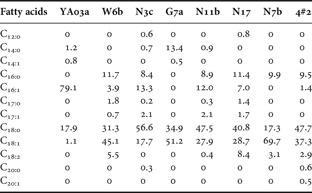
The results in Table 3 indicate that all the marine yeast strains tested in this study contained a large amount of both C18:0 fatty acid and C18:1 fatty acid. It also can be seen from the results in Table 3 that most of fatty acids in the marine yeast strain YA03a were C16:1 and C18:0 fatty acids (79.1% and 17.9%) while most of the fatty acids in other marine yeast strain were C18:0 and C18:1 fatty acids. However, all the yeast strains were characterized by lacking of the two polyunsaturated fatty acids (C20:5 and C22:6) essential for marine animals.
The fatty acid composition (% of total fatty acids) in the eight strains of marine yeasts.

Amino acid composition analysis
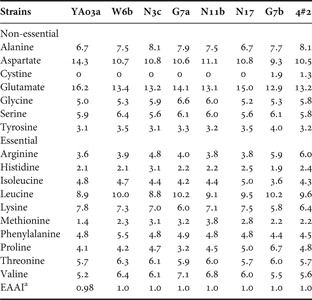
The amino acid composition analysis shows that the marine yeast strains used in this study contained very high levels of the essential amino acids, especially lysine and leucine which can promote growth of marine fish (Table 4). For example, strain YA03a contained 7.8% lysine and 8.9% leucine of total amino acids in the cells and strain G7a contained 10.2% lysine and 6.0% leucine, respectively. Brown et al. (Reference Brown, Barrett, Volkman, Nearhos and Nell1996) reported that C. utilis ACM 4774 which is widely used in feed for terrestrial animals contained only 3.8% lysine and 7.8% leucine of the total amino acids while the marine yeast strains Debaromyces hansenii ACM 4784, Dipodascus capitatus ACM 4779 and Dipodascus sp. ACM 4780 they used had 4.8% lysine and 7.5% leucine, 4.6% lysine and 7.5% leucine, 3.9% lysine and 7.9% leucine of the total amino acids, respectively. Even lysine and leucine contents in strains YA03a and G7a were higher than those in microalgae (Ravindra, Reference Ravindra2000). Among the non-essential amino acids, aspartate and glutamate had the highest concentrations (9.8–16.2%). The results were identical with those obtained by Brown et al. (Reference Brown, Barrett, Volkman, Nearhos and Nell1996).
The amino acid composition (% of total amino acids) in the eight marine yeasts.

aEssential amino acid index (Feng & Zhao, Reference Feng and Zhao1997). Values of about >0.95 indicate high quality; about 0.86–0.95 good quality; about 0.75–0.86, useful; about ≤0.75, inadequate.
Physiological and biochemical characterization
Based on the fermentation spectra and carbon source assimilation spectra and other physiological and biochemical characteristics of the marine yeasts (data not shown) and those of the type strains listed in The yeast. A taxonomic study (Kurtzman & Fell, Reference Kurtzman, Fell, Kurtzman and Fell2000), we found that strains W6b, G7a, N17 and YA03a looked similar to Metschnikowa reukaui, Cryptococcus aureus, Candida tropicalis, Hanseniaspora uvarum, respectively, while G7b and 4#2, were similar to Aureobasidium pullulans and N3c and N11b were closely related to Yarrowia lipolytica.
Phylogenetic analysis of partial sequences of ITS
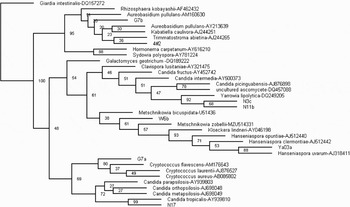
According to Kurtzman & Fell (Reference Kurtzman, Fell, Kurtzman and Fell2000), traditional and routine identification methods which depend on phenotype, usually lead to uncertain and inaccurate interpretations of species interaction. Sequence analysis of phylogeny for microbial taxonomy, is a more accurate method for determining inter- and intra- specific relationships. Therefore, ITS of the yeast strains was determined and aligned by using BLAST analysis (http://www.ncbi.nlm.nih.gov/BLAST). Phylogenetic trees were constructed by using PHYLIP software package version 3.75c (Felsenstein, Reference Felsenstein1995). Distance matrices were generated by the DNADIST program, based on Kimura's two-parameter model (Kimura, Reference Kimura1980). Neighbour-joining analysis of the data sets was carried out with the program Neighbor of the PHYLIP package. Gianda intestinalis was used as out-groups during the construction of consensus tree of the isolates based on ITS. The search for the similarity between ITS of the isolates and those in the NCBI database shows that many phylogenetically related yeast species were similar to the marine yeast strains obtained in this study. Phylogenetic relationships of ITS of the marine yeast strains are shown in Figure 1 and their GenBank accession numbers are shown in Table 5. The topology of the phylogram in Figure 1 confirms that strain YA03a was closely related to H. uvarum because per cents of their ITS identity were 99%, whereas strain N17 could be in close relationship to C. tropicalis because per cents of their ITS identity were 99%. The strain G7a was assigned to C. aureus because per cents of their ITS identity were 99%. ITS of strains G7b and 4#2 was identical to that of A. pullulans, because per cents of their ITS identity were 97%, respectively. The strains N3c and N11b were closely related to Y. lipolytica because per cents of their ITS identity were 99%. W6b was placed phylogenetically into a strain of M. reukaui as per cents of their ITS identity were 99%, respectively.
Consensus tree of the isolates based on 8 ITS sequences obtained in this study and 28 previously published sequences obtained from GenBank. The outgroup we used was Gianda intestinalis. The numbers above the branches are bootstrap, only values more than 47% are shown.

The accession numbers of the eight marine yeasts.

W6b: Metschnikowa reukaui; G7a: Cryptococcus aureus: G7b: Aureobasidium pullulans; 4#2: A. pullulans; N3c: Yarrowia lipolytica; N11b: Y. lipolytica; N17: Candida tropicalis; YA03a: Hanseniaspora uvarum.
DISCUSSION
The main components of the feed for cultured marine animals in China are microalgae and fish meal (Chi et al., Reference Chi, Liu, Gao, Gong, Ma, Wang and Li2006). However, production of microalgae and fish meal on large scale is facing many problems due to the easy contamination by pathogens and the limited bioresources of fish (Ravindra, Reference Ravindra2000). We think that the marine yeasts would be candidates for feed production because of their easy cultivation, high cell density, high content of essential amino acids and low level of nucleic acid than microalgae and bacteria (Ravindra, Reference Ravindra2000). Therefore, over 300 marine yeast strains were evaluated for SCP production in this study. We found that strains YA03a, W6b, N3c and G7a which were isolated from the surface of marine algae, deep seawater of south polar and sediment of coastal seawater, respectively, can be candidates for single cell protein production based on the crude protein contents and nucleic acid content (Tables 1 & 2) and high content of essential amino acids (Table 4). Although strain YA03a contained the highest amount of crude protein, it grew very slowly (Table 1). Strains W6b and N3c were found not to be able to secrete any enzymes which can degrade starch and other cheap polymers. In recent studies, we have found that strain G7a could secrete a large amount of inulinase and use Jerusalem artichoke extract which contains inulin as carbon source (Gao et al., Reference Gao, Chi, Sheng, Wang, Li and Gong2007; Sheng et al., Reference Sheng, Chi, Li, Gao and Gong2007). Therefore, strain G7a may be the best candidate for single cell protein production from Jerusalem artichoke extract which is very cheap and easily obtained.
The terrestrial fungi, in general used as the source for SCP are Hansenula polymorpha, C. utilis, C. tropicalis, Pichia kudriavzevii, S. cerevisiae, A. pullulans and Y. lipolytica (Revah-Moiseev & Carroad, Reference Revah-Moiseev and Carroad1981; Deshpande et al., Reference Deshpande, Rale and Lynch1992; Madzak et al., Reference Madzak, Gaillardin and Beckerich2004). Brown et al. (Reference Brown, Barrett, Volkman, Nearhos and Nell1996) found that the marine yeasts D. hansenii ACM 4784, D. capitatus ACM 4779 and Dipodascus sp. ACM 4780 contained 23%, 32%, and 36% of crude protein, respectively. According to the fermentation, physical and biochemical characteristics and results of molecular analysis of the marine yeasts (Figure 1), strains W6b, G7a, G7b, 4#2, N3c, N11b, N17 and YA03a obtained in this study were identified to be the members of M. reukaui, C. aureus, A. pullulan, Y. lipolytica, C. tropicalis and H. uvarum, respectively. We found that the marine yeasts M. reukaui (W6b), C. aureus (G7a) and H. uvarum (YA03a) obtained in this study were the new producers of single cell protein.
It has been agreed that the criteria used to evaluate single cell protein (SCP) production are growth yield, total protein and nucleic acid contents (Patil et al., Reference Patil, Ghormade and Deshpande2000). In general, the protein contents in the single cells for protein production should be between 39 to 73% whereas the nucleic acid content is 1–11% (Patil et al., Reference Patil, Ghormade and Deshpande2000). However, the nucleic acid contents in the marine yeast strains used in this study were higher than those in microalgae (Brown et al., Reference Brown, Barrett, Volkman, Nearhos and Nell1996). Furthermore, the marine yeasts with high levels of nucleic acids could be used as a feed to marine animals because some of them can produce uricase which convert uric acid into the non-toxic allantoin (Ravindra, Reference Ravindra2000).
Although all the yeast strains used in this study contained C12–C18 fatty acids, they were characterized by lack of the two polyunsaturated fatty acids (C20:5 and C22:6) essential for marine animals (Table 3). Brown et al. (Reference Brown, Barrett, Volkman, Nearhos and Nell1996) also found that the marine yeasts tested by them lacked the two polyunsaturated fatty acids. This means that the marine yeasts would need to be supplemented with live algae rich in these two polyunsaturated fatty acids when they were used as the components of feed for cultured marine animals.
The amino acids, such as leucine, methionine and lysine in SCP are very important for the growth of the fish (Stottrup & McEvoy, Reference Stottrup and McEvoy2003). The results in Table 4 show strain YA03a contained 7.8% lysine and 8.9% leucine of total amino acids in the cells and strain G7a contained 10.2% lysine and 6.0% leucine, respectively. It is very interesting to note that EAAI of all the marine yeast strains was 1.0 (Table 4). This means that the marine yeast strains YA03a and G7a obtained in this study had a high protein quality and could provide much richer sources of the essential amino acids for cultured marine animals.
In conclusion, C. aureus G7a obtained in this study could be the candidate for single cell protein production because of its high growth yield, easy cultivation, high content of crude protein, high level of essential amino acids, low level of nucleic acids and its good growth on inulin.
ACKNOWLEDGEMENT
This research was supported by grant 2006AA09Z403 from the Hi-Tech Research and Development Program of China (863).