1 Introduction
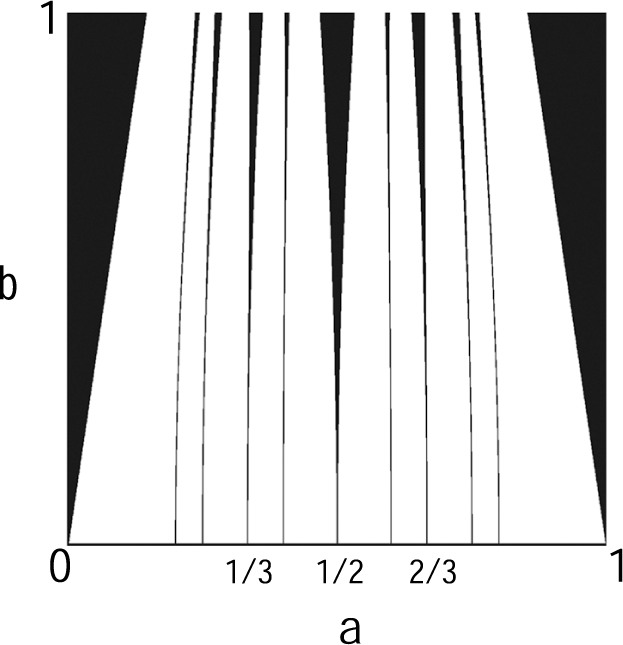
Arnold tongues are one of the most familiar images in one-dimensional dynamics (Figure 1). Consider the two real parameter family of standard (or Arnold) maps
 $$ \begin{align*} f_{a,b}(z)=z+a+\frac{b}{2\pi}\sin 2\pi z \operatorname{mod}{\mathbb{Z}},\quad a,b\in[0,1]. \end{align*} $$
They are analytic diffeomorphisms of the circle
 ${\mathbb {R}}/{\mathbb {Z}}$
for
 $b\in [0,1)$
and analytic homeomorphisms with a single cubic critical point (critical circle maps) for
 $b=1$
. The rotation number
 $\mathrm{rot} (f_{a,b})$
is a non-decreassing function of a. For each fixed
 $b>0$
, the graph of the function
 $$ \begin{align*} a\mapsto\mathrm{rot} (f_{a,b}) \end{align*} $$
is a ‘devil’s staircase’: that is, a continuous non-decreasing curve with flat ‘steps’ at rational heights. By definition, an Arnold
 $\alpha $
-tongue is the set of parameters
 $(a,b)$
that corresponds to a rotation number
 $\alpha $
. For a rational
 $\alpha =p/q$
, this set is bounded by two curves (graphs over the b-axis) that correspond to the algebraic condition of having a periodic orbit with combinatorial rotation number
 $p/q$
and the unit multiplier. They meet at the point
 $(p/q,0)$
corresponding to the rigid rotation by
 $p/q$
, cutting out a sharp tongue-looking shape. For an irrational
 $\alpha $
, the tongue is a curve—a continuous graph over the second coordinate. The question of smoothness of irrational tongues is deep and fundamental; it is the central theme of this paper.
Arnold tongues.

In 2001, Slammert [Reference SlammertSla01] proved
 $C^1$
-smoothness of open irrational Arnold tongues (that is, without the endpoints
 $b=1$
corresponding to critical circle maps). His argument rests on the theorem of Douady and Yoccoz that, for a circle diffeomorphism f, there exists a unique (
 $-1$
)-measure
 $\unicode{x3bb} $
that satisfies the invariance law
 $$ \begin{align*} \int\xi(f(x))\frac{1}{f'(x)}\,d\unicode{x3bb} = \int\xi\,d\unicode{x3bb}\quad \text{for a test function } \xi. \end{align*} $$
Slammert used these measures to describe the tangent bundle of an irrational tongue.
Much stronger results can be obtained by imposing arithmetic conditions on
 $\alpha $
. The strongest of them is due to Risler [Reference RislerRis99] who showed that open Arnold tongues corresponding to Herman numbers
 $\alpha $
are analytic curves. The Herman class (defined by Yoccoz [Reference Yoccoz, Marmi and YoccozYoc02]) consists of rotation numbers
 $\alpha $
such that if
 $\mathrm{rot}\, f = \alpha $
for an analytic circle diffeomorphism f, then it is analytically conjugate to the rotation by
 $\mathrm{rot}\, f$
. Risler also showed that, in a larger Brjuno class of rotation numbers, the curves are locally analytic for sufficiently small values of b and, furthermore, form a foliation by analytic curves over
 $0\leq b<b_0$
given a Brjuno condition with a uniform rate of convergence (see [Reference RislerRis99] for the details). Using quasiconformal surgery, similar results were later obtained in the standard family in [Reference Fagella and GeyerFG03].
Note that the above results do not address the question of the degree of smoothness of Arnold tongues at the ends
 $b=1$
, which is quite subtle. Indeed, the above proofs break down when circle maps develop critical points. In [Reference de la Llave and LuquedlLL11], de la Llave and Luque performed numerical experiments on the smoothness of Arnold tongues at
 $b=1$
. Based on the results of these experiments, they conjectured that Arnold tongues that correspond to Diophantine rotation numbers are finitely smooth at the ends. In particular, they conjectured that the tongue that corresponds to the golden ratio is
 $C^2$
-smooth at the endpoint. De la Llave and Luque suggested an explanation of this fact that involves the behavior of a conjectural renormalization operator on a neighborhood of critical circle maps.
In the same way as for the standard family, given any parametric family
 $f_\mu $
,
 $\mu \in {\mathbb {R}}^n$
of circle homeomorphisms, the Arnold
 $\alpha $
-tongue can be defined as the set of parameters
 $\mu $
for which
 $\mathrm{rot} (f_\mu )=\alpha $
. The results of Slammert and Risler, as well as the conjectures of De la Llave and Luque, suitably translate into this general setting.
Recently, in [Reference Goncharuk and YampolskyGY22], we developed a new approach to results of [Reference RislerRis99] by constructing an analytic renormalization operator for which Brjuno rotations form a hyperbolic invariant set with a codimension-one stable foliation. Furthermore, the analytic stable submanifolds coincide with analytic conjugacy classes of rotations. For an analytic family of diffeomorphisms that crosses an
 $\alpha $
-leaf of this foliation transversally, the Arnold
 $\alpha $
-tongue will be an analytic codimension-one surface, implying the above quoted results of Risler. In the present paper, we define a new renormalization framework that combines the renormalization of diffeomorphisms and the renormalization of critical circle maps developed by the second author (see [Reference YampolskyYam03a, Reference YampolskyYam03b] and the references therein).
The new renormalization operator has two hyperbolic horseshoes: one that consists of rigid rotations with a single unstable direction as in [Reference Goncharuk and YampolskyGY22] and another ‘non-trivial’ one consisting of critical circle maps with two unstable directions. Arnold tongues in this picture lie in the stable-unstable manifolds, whose smoothness at critical circle maps is quantified in terms of the Lyapunov exponents of the second horseshoe. This is, roughly, what was pictured in [Reference de la Llave and LuquedlLL11]. We give estimates of the expansion factors of renormalization of critical circle maps, and we use this to give a lower bound on the smoothness of closed Arnold tongues.
Of course, renormalization of diffeomorphisms, which we defined in [Reference Goncharuk and YampolskyGY22], cannot be directly extended to maps with critical points. The method that we use to put the two horseshoes under one roof is new and is likely to be useful in other contexts. Another notable step in our construction is extension of the results on existence, uniqueness and general properties of (
 $-1$
)-measures to maps with critical points. This is a necessary part of our proofs, and it also allows us to extend Slammert’s result to closed, rather than open, Arnold
 $\alpha $
-tongues for all irrational
 $\alpha $
. But it is also of an independent interest: (
 $-1$
)-measures are a useful technical tool in the study of dynamics, but also provide a new description of the stable tangent bundle of renormalization. In §8, we use (
 $-1$
)-measures to give a new proof of renormalization expansion, with explicit bounds. Another useful tool developed in this paper is a theorem on the smoothness of stable-unstable manifolds in a general Banach space setting, which has been previously missing in the literature.
We proceed by formulating our main results. Let
 $\mathcal D_\varepsilon $
be the set of analytic maps
 $f\colon {\mathbb {C}}/{\mathbb {Z}} \to {\mathbb {C}}/{\mathbb {Z}}$
that have bounded analytic continuations to the strip of width
 $\varepsilon $
around
 ${\mathbb {R}}/{\mathbb {Z}}$
. Equipped with the sup-norm in this strip,
 $\mathcal D_\varepsilon $
is a complex Banach manifold. Its real slice
 ${\mathcal {D}}_\varepsilon ^{\mathbb {R}}$
consists of circle-preserving maps. Let
 $\mathcal D^{\text {cr}}_\varepsilon \subset {\mathcal {D}}_\varepsilon $
be the Banach submanifold of analytic maps
 $f\colon {\mathbb {C}}/{\mathbb {Z}} \to {\mathbb {C}}/{\mathbb {Z}}$
with
 $f'(0)=0$
,
 $f"(0)=0$
and
 $f"'(0)> 0$
that extend to the strip of width
 $\varepsilon $
around
 ${\mathbb {R}}/{\mathbb {Z}}$
. Its real slice
 $\mathcal D^{\text {cr},{\mathbb {R}}}_\varepsilon ={\mathcal {D}}^{\text {cr}}_\varepsilon \cap {\mathcal {D}}_\varepsilon ^{\mathbb {R}}$
consists of critical circle maps: that is, analytic circle homeomorphisms with a single cubic critical point at the origin.
In [Reference YampolskyYam03a], the second author constructed the cylinder renormalization operator
 ${\mathcal {R}}_{cyl}$
on an open neighborhood of
 $\mathcal D^{\text {cr},{\mathbb {R}}}_\varepsilon $
in
 $\mathcal D^{\text {cr}}_\varepsilon $
for sufficiently large
 $\varepsilon $
and showed that it is hyperbolic, with one unstable direction, on an invariant horseshoe-like set
 $\mathcal I$
. This result is formulated below (see Theorem 2.1).
In [Reference Goncharuk and YampolskyGY22], we defined a renormalization operator
 ${\mathcal {R}}_{\text {dif}}$
on a neighborhood of rotations in the space
 $\mathcal D_\varepsilon $
for sufficiently large
 $\varepsilon $
(the space of analytic diffeomorphisms of an annulus), and we proved its hyperbolicity at Brjuno rotations, with a single unstable direction corresponding to the rotation angle. The construction was motivated by Risler’s result [Reference RislerRis99] and by Yoccoz’s result [Reference YoccozYoc95] on linearizations of circle diffeomorphisms.
In both cases, the renormalization of a circle map was defined to be the first-return map to a fundamental domain
 $[0, f^n(0)]$
, for a suitably chosen n, in a certain analytic chart on
 $[0, f^n(0)] / f^n \sim {\mathbb {R}}/{\mathbb {Z}}$
. The key to either construction was in the choice of a specific analytic chart. We generally say that a smooth mapping
 ${\mathcal {R}}$
of
 $ \mathcal D_\varepsilon $
to itself is a renormalization operator if, for any circle map f in its domain, there exists n such that the circle map
 ${\mathcal {R}} f$
is conjugate, via an analytic circle map, to a first-return map under f to a quotient of the fundamental domain
 $[0, f^{n}(0)] / f^n$
.
In what follows, we adopt the following notation. For a Banach manifold M, we write
 $F:M\dashrightarrow M$
to denote an operator whose domain is an open subset of M.
Theorem 1.1. For a sufficiently large
 $\varepsilon $
, there exists a Banach manifold D, a codimension-one submanifold
 $D_0\subset D$
and an analytic projection
 $p \colon D\dashrightarrow \mathcal D_\varepsilon $
such that
 $p(D_0)=\mathcal D^{\text {cr}}_\varepsilon $
and an operator
 ${\mathcal {R}} \colon D\dashrightarrow D$
such that the following hold.
-
•
 ${\mathcal {R}}$
is an analytic operator on its domain with compact differential, and preserves
$D_0$
.
-
•
${\mathcal {R}}$
preserves fibers of the projection p. Thus, the composition
$p{\mathcal {R}} p^{-1}$
is well defined. Moreover, restricted to
$ \mathcal D_\varepsilon $
, this composition is a renormalization operator on circle homeomorphisms, in the sense described above. -
•
${\mathcal {R}}|_{D_0}$
contracts on the fibers
$p^{-1} f$
; -
• There exists a set
$\Lambda \subset D_0$
invariant under
${\mathcal {R}}$
such that
$p \Lambda = \mathcal I$
,
${\mathcal {R}}$
is uniformly hyperbolic on a set
$\Lambda \subset D_0$
, with two-dimensional unstable subspaces at any trajectory in
$\Lambda $
. These unstable subspaces intersect
$D_0$
over one-dimensional submanifolds.


The Banach manifold D will be the space of triples described in §4 below; a similar construction was used in [Reference Gorbovickis and YampolskyGY20].
Using this result, we prove the following conditional result on the smoothness of Arnold tongues.
Definition 1.2. Let R be a smooth operator in the Banach space. Suppose that, for some orbit
 $g_n = R^n g$
, R has an invariant direction field
 $l_{g_n}\in T_{g_n}D$
: that is,
 $d|_{g_n}R \, l_{g_n} = l_{g_{n+1}}$
. We say that the maximal (respectively, minimal) expansion rate of R along
 $l_{g_n}$
is

The definition of the expansion rate is close to the definition of the Lyapunov exponent. Note also that if
 $g_n$
is a q-periodic orbit, then both expansion rates coincide with the root of order q of the modulus of the eigenvalue of
 $R^q$
that corresponds to the eigenvector contained in
 $l_{g_0}$
.
Let
 $f_\mu $
be an analytic family of analytic self-maps of
 ${\mathbb {C}}/{\mathbb {Z}}$
defined in a neighborhood of
 ${\mathbb {R}}/{\mathbb {Z}}$
for
 $\mu _j\in ({\mathbb {C}}^n, 0)$
. Suppose that, for real
 $\mu _j$
and
 $\mu _1<0$
,
 $f_\mu $
is a diffeomorphism of
 ${\mathbb {R}}/{\mathbb {Z}}$
. Suppose that, for
 $\mu _1=0$
, the maps
 $f_\mu $
are cubic critical circle maps with
 $0$
as a critical point. Suppose that
 $f^{\prime }_{\mu }(0)$
has a zero of order one at
 $\mu _1=0$
: when
 $\mu _1$
encircles zero,
 $f^{\prime }_\mu (0)$
makes one turn around zero. Finally, assume that
 ${\partial f}/ {\partial \mu _2}>0$
on the circle whenever
 $\mu _1=0$
. An example to keep in mind is the Arnold family, normalized as
 $$ \begin{align} f_{\mu_1, \mu_2} (z)= z+\mu_2 + \bigg(\mu_1+\frac {1}{2\pi}\bigg) \sin 2\pi z. \end{align} $$
Theorem 1.3. Let
 $g\in \mathcal I$
be a cubic critical circle map with
 $\mathrm{rot}\, g=\alpha $
, where
 $\alpha $
is of a bounded type. Let
 $\hat g \in p^{-1}(g)$
belong to
 $\Lambda $
. Suppose that the renormalization operator
 ${\mathcal {R}}\colon D\dashrightarrow D$
has an invariant direction field
 $\xi _{{\mathcal {R}}^n \hat g}\subset E^u_{{\mathcal {R}}^n \hat g}$
such that
 $\xi _{{\mathcal {R}}^n \hat g}$
is uniformly transversal to
 $D_0$
. Let
 $\unicode{x3bb} _1$
be the minimal expansion rate along the direction field
 ${E^u_{{\mathcal {R}}^j \hat g} \cap D_0}$
and let
 $\unicode{x3bb} _2$
be the maximal expansion rate along
 $\xi _{{\mathcal {R}}^j \hat g}$
. Assume that
 $\unicode{x3bb} _1>\unicode{x3bb} _2$
and let
 $\kappa \in \mathbb N$
satisfy
 $\kappa < {\log \unicode{x3bb} _1}/{\log \unicode{x3bb} _2}$
.
Then, in any
 $C^\omega $
-family
 $f_{\mu }$
,
 $\mu = (\mu _1,\ldots , \mu _s)\in {\mathbb {R}}^s$
, as above with
 $\mathrm{rot}\, f_{0} = \alpha $
, the Arnold
 $\alpha $
-tongue is given by a function
 $\mu _2=\mu _2(\mu _1, \mu _3, \ldots , \mu _s)$
that is at least
 $C^{\kappa }$
-smooth at
 $0$
.
Since
 ${\mathcal {R}}$
contracts on fibers of p that project to
 $D_0$
, we will see that
 $\unicode{x3bb} _1$
and
 $\unicode{x3bb} _2$
depend only on
 $\alpha $
and not on g,
 $\hat g$
.
Remark 1.4. The Arnold tongues for
 $\mu _1<0$
are analytic curves due to Risler’s theorem [Reference Goncharuk and YampolskyGY22, Reference RislerRis99]. This result shows that they are at least finitely smooth at
 $\mu _1=0$
. It is an open question whether these curves are analytic up to
 $\mu _1=0$
.
Remark 1.5. The condition
 $df/d\mu _2>0$
can be replaced by the condition that the vector field
 $df/d\mu _2$
is transversal to the surface
 $\{\mathrm{rot}\, f = \alpha \}$
for
 $\mu =0$
(see §6).
Remark 1.6. For a rotation number
 $\alpha $
with a periodic continued fraction of period q, the assumptions of this theorem are equivalent to the condition that, for some
 $g\in \Lambda $
with
 $\mathrm{rot}\, g = \alpha $
,
 $d {\mathcal {R}}^q|_{\hat g}$
has two distinct unstable eigenvalues, and the one with the larger absolute value corresponds to
 $E^u_{\hat g}\cap D_0$
(that is, to critical circle maps).
Remark 8.7 shows that assumptions of Theorem 1.3 always hold true for periodic continued fractions; however, for some of them, we have
 $1< {\log \unicode{x3bb} _1}/{\log \unicode{x3bb} _2} <2$
and the conclusion of the theorem does not guarantee smoothness of Arnold tongues higher than
 $C^1$
.
In hyperbolic dynamics, it is standard to expect that if a hyperbolic map has a gap
 $(\unicode{x3bb} _2, \unicode{x3bb} _1)\subset {\mathbb {R}}$
in its spectrum, then the corresponding invariant manifolds are smooth, and the degree of smoothness is at least
 $\lfloor \log \unicode{x3bb} _1/\log \unicode{x3bb} _2 \rfloor $
. This, together with Theorem 1.1, would imply Theorem 1.3, since the codimension-one manifolds
 $\{\mathrm{rot}\, f = \text {const}\}$
form a ‘weakly stable’ invariant foliation that corresponds to
 $\unicode{x3bb} _2$
and all stable eigenvalues of
 ${\mathcal {R}}$
, and the corresponding spectral gap is
 $(\unicode{x3bb} _2, \unicode{x3bb} _1)$
. In a Banach space setting, such statements were proved in [Reference ElBialyElB02]. However, [Reference ElBialyElB02] requires either global estimates on the nonlinearity of the operator or the existence of smooth cut-off functions (which are scarce in Banach spaces), so we cannot refer to these results. We prove the smoothness directly in Theorem 6.1 (see §6). We do not need to prove the existence of the invariant manifold; we study the smoothness of the existing invariant manifold. As a result, we only use hyperbolicity of the operator, with no further assumptions.
The inequality for expansion rates required in Theorem 1.3 holds for the golden ratio rotation number. Indeed, the two top unstable eigenvalues of
 ${\mathcal {R}}$
at the period-two periodic orbit that corresponds to the critical map f with the golden ratio rotation number were estimated rigorously numerically in [Reference MestelMes85, Theorem 3.2 and p.19]. The values are
 ${\gamma _1\approx -2.83}$
(corresponding to critical maps) and
 $\gamma _2\approx 1.66$
. Since
 ${\log 2.83}/{\log 1.66} = 2.05$
, this agrees with the numerical results of [Reference de la Llave and LuquedlLL11] on
 $C^2$
-smoothness of Arnold tongues that correspond to the golden ratio rotation number.
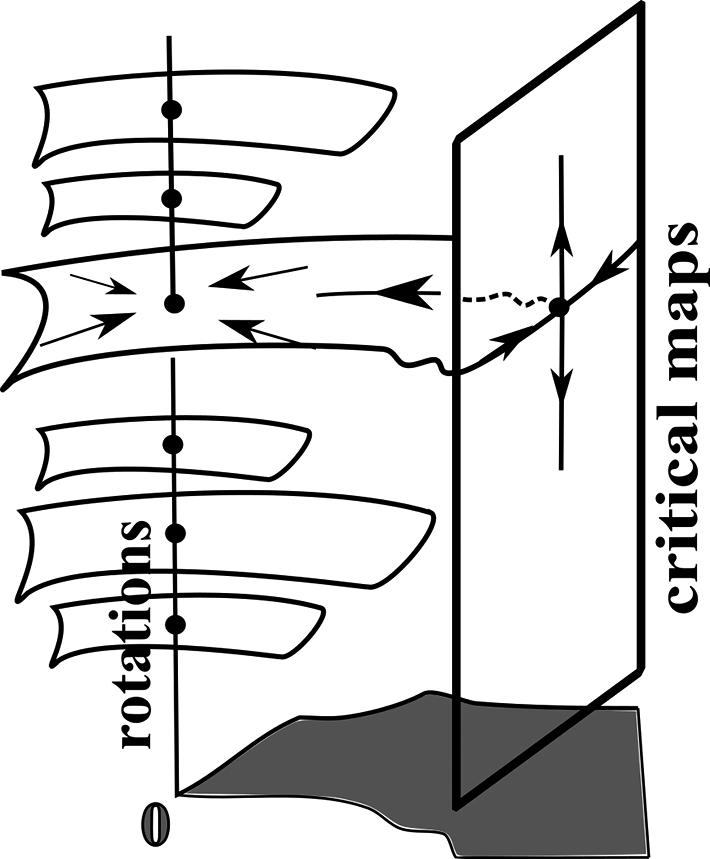
A schematic illustration of the hyperbolic picture for renormalization. The attractor in the space of diffeomorphisms is rigid rotations (left); the stable foliation has codimension one. The golden-mean leaf is indicated. It extends to a fixed point in the space of critical circle maps (right); the smoothness of the leaf at the critical boundary is determined by the spectral gap.

Also, this inequality holds for orbits in
 $\Lambda $
that correspond to rotation numbers with a sufficiently high type, due to the next result. Thus, the inequality holds for the two cases that are believed to be most extreme: high-type rotation numbers (with large denominators of continued fraction convergents) and the golden ratio (with the smallest possible denominators of continued fraction convergents). It is an open question whether the inequality holds for all Herman numbers.
Consider the Gauss map
 $G(x)=\{1/x\}$
and set
 $$ \begin{align*}\alpha_{n}=G^n(\alpha), a_n=[1/\alpha_{n}]\end{align*} $$
when defined. Numbers
 $a_n$
are the coefficients of the continued fractional expansion of
 $\alpha $
, and we have
 $$ \begin{align*}\alpha = \cfrac{1}{a_0 + \cfrac{1}{a_1+\cdots}},\end{align*} $$
which we will abbreviate as
 $$ \begin{align*}\alpha=[a_0,a_1,\ldots].\end{align*} $$
We also consider the continued fraction convergents
 $$ \begin{align*} \frac{p_n}{q_n}=[a_0,\ldots,a_{n-1}] \end{align*} $$
and write
 $\alpha \sim \{p_n/q_n\}$
for the correspondence between the number
 $\alpha $
and its continued fractional convergents.
Proposition 1.7. For any natural
 $K\in \mathbb N$
and for any real number
 $\alpha = [a_1,a_2,\ldots ]$
with
 $a_j>K$
, let
 $g\in \mathcal I$
have the rotation number
 $\alpha $
and let
 $\hat g \in p^{-1}g$
belong to
 $\Lambda $
.
Then the minimal expansion rate
 $\unicode{x3bb} _1$
of the renormalization operator
 ${\mathcal {R}}\colon D\dashrightarrow D$
along the distribution
 $E^u_{\hat g}\cap D_0$
tends to infinity as
 $K\to \infty $
. Also,
 ${\mathcal {R}}$
has an invariant line field in
 $E^u_{R^n (\hat g)}$
transversal to
 $D_0$
, and the corresponding maximal expansion rate
 $\unicode{x3bb} _2 $
remains bounded as
 $K\to \infty $
.
This, together with Theorem 1.3, implies the following corollary.
Corollary 1.8. Let
 $f_\mu $
,
 $\mu = (\mu _1,\ldots , \mu _s)\in {\mathbb {R}}^s$
be a family of analytic circle maps, as above. Let
 $K,L\in \mathbb N$
and suppose that
 $\alpha =[a_1,a_2,\ldots ]$
satisfies
 $K<a_j<L$
. For sufficiently large K, the Arnold
 $\alpha $
-tongue in the family
 $f_\mu $
is (at least)
 $C^\kappa $
smooth, where
 $\kappa =\kappa (K)$
tends to infinity as
 $K\to \infty $
.
One can extend this result to bounded-type rotation numbers such that, in the corresponding sequence
 $a_j$
, the numbers with
 $a_j<K $
are allowed but occur sufficiently rarely. Both Corollary 1.8 and Theorem 1.9 apply to measure-zero sets of rotation numbers.
Theorem 1.9. Let
 $f_\mu $
,
 $\mu = (\mu _1,\ldots , \mu _s)\in {\mathbb {R}}^s$
be a family of analytic circle maps, as above. For any
 $\delta \ge 0$
, for sufficiently large K and any
 $L>K$
, the following holds. If
 ${\alpha =[a_1,a_2,\ldots ]}$
satisfies
 $a_j<L$
and, for all m, for all sufficiently large n, we have
 $$ \begin{align*}\frac{\#\{j, m\le j<m+n \mid a_j<K\}}{n}\le \delta,\end{align*} $$
then the Arnold
 $\alpha $
-tongue in the family
 $f_\mu $
is (at least)
 $C^\kappa $
smooth, where
 $\kappa =\kappa (K, \delta )$
tends to infinity as
 $K\to \infty $
.
We conclude the introduction with a brief guide to the layout of the paper. In §2, we recall the basic setting of cylinder renormalization for critical circle maps. In §3, we construct (
 $-1$
)-measures for critical circle maps and prove an extension of Slammert’s result on smoothness of open Arnold tongues to the endpoints. In §4, we describe a Banach manifold setting in which renormalization horseshoes of diffeomorphisms and critical circle maps can be combined, and we prove Theorem 1.1. In §5, we give geometric estimates for the stable foliation of renormalization away from critical circle maps. Section 6 contains the statement of a general result on the smoothness of stable-unstable manifolds in a Banach space setting (Theorem 6.1) and the proof of Theorem 1.3 modulo Theorem 6.1. In §7, we prove Theorem 6.1. Finally, §8 contains a new construction of the expanding direction of renormalization of critical circle maps, with explicit estimates on the expansion rate as needed to derive Proposition 1.7 and Theorem 1.9.
2 Cylinder renormalization
2.1 Cylinder renormalization for cubic critical circle maps
We briefly recall the cylinder renormalization operator
 ${\mathcal {R}}_{\text {cyl}}$
on
 $\mathcal D^{cr}_\varepsilon $
constructed in [Reference YampolskyYam03a] by the second author. As before,
 $p_n/q_n$
will stand for the continued fractional convergents of
 $\mathrm{rot}\, f$
.
In [Reference YampolskyYam03a, Reference YampolskyYam03b], the second author showed that, for any
 $f\in \mathcal D^{\text {cr},{\mathbb {R}}}_\varepsilon $
, there exists
 $N(f)$
such that, for all
 $n\geq N(f)$
, the iterate
 $f^{q_n}$
has two complex conjugate repelling fixed points joined by a crescent-like fundamental domain
 $C_f$
for the iterate
 $f^{q_n}$
. The iterate
 $f^{q_n}$
glues the boundary curves of the crescent
 $C_f$
(minus the two repelling points at the ends) into a Riemann surface whose conformal type is
 ${\mathbb {C}}/{\mathbb {Z}}$
. The number
 $N(f)$
can be chosen uniformly on bounded subsets of
 $\mathcal D^{\text {cr},{\mathbb {R}}}_\varepsilon $
. Furthermore, if a critical circle map f has a fundamental crescent
 $C_f$
for an iterate
 $f^{q_n}$
, as above, then the same is true for non-circle-preserving analytic maps in an open neighborhood of f in
 $\mathcal D^{\text {cr}}_\varepsilon $
.
We fix a bounded open set
 ${\mathcal {U}}^{\mathbb {R}}\subset {\mathcal {D}}^{\text {cr},{\mathbb {R}}}_\varepsilon $
on which
 $N=N(f)$
can be chosen uniformly. The fundamental crescent
 $C_f$
for the iterate
 $f^{q_N}$
can be chosen to move holomorphically with f in an open neighborhood
 ${\mathcal {U}}\supset {\mathcal {U}}^{\mathbb {R}}$
in the space
 ${\mathcal {D}}^{\text {cr}}_\varepsilon $
of non-circle-preserving maps and to contain
 $0$
in its interior. There is a unique real-symmetric uniformizing coordinate
 $\Psi _f$
that sends the quotient
 $C_f/f^{q_N}$
to
 ${\mathbb {C}}/{\mathbb {Z}}$
with
 $\Psi _f(0)=0$
. The map
 $\Psi _f$
depends analytically on
 $f\in {\mathcal {U}}$
and conjugates
 $f^{q_N}$
to the shift
 $z\to z+1$
(for odd N) and to the shift
 $z\to z-1$
(for even N) in
 $C \cup f^{q_N}(C)$
. Note that, when
 $f\in \mathcal U^{\mathbb {R}}$
and the Nth digit of the continued fraction of f is sufficiently large, the map
 $f^{q_N}$
is near-parabolic, and we can think of
 $\Psi _f$
as the perturbed Fatou coordinate of
 $f^{q_N}$
(see, for example, [Reference ShishikuraShi98]).
Let P be the first-return map to C under the action of f, defined in a neighborhood of
 $C\cap {\mathbb {R}}/{\mathbb {Z}}$
. By definition,
 $$ \begin{align*}{\mathcal{R}}_{\text{cyl}} f := \Psi_f P \Psi_f^{-1}.\end{align*} $$
We are ready to formulate [Reference YampolskyYam03b, Theorem 3.7].
Theorem 2.1. [Reference YampolskyYam03b]
There exists a choice of an open bounded set
 $\mathcal U\subset \mathcal D^{\text {cr}}_\varepsilon $
, as above, and a corresponding choice of N such that the following holds. With these choices,
 ${\mathcal {R}}_{\text {cyl}}$
is an analytic operator
 $\mathcal U\to \mathcal D^{\text {cr}}_\varepsilon $
, which is real-symmetric and preserves
 $\mathcal D^{\text {cr},{\mathbb {R}}}_\varepsilon $
. This operator has a hyperbolic invariant set
 $\mathcal I\subset \mathcal D^{\text {cr},{\mathbb {R}}}_\varepsilon \cap \mathcal U$
with one-dimensional unstable direction. The set
 $\mathcal I$
is pre-compact in the sense of uniform convergence. There is a map
 $\iota \colon {\mathcal I}\to \mathbb N^{{\mathbb {Z}}}$
that takes any
 $f\in {\mathcal I}$
to a bi-infinite sequence such that the positive part of this sequence coincides with the continued fractional expansion of
 $\mathrm{rot}\, f$
and
 $\iota $
conjugates
 ${\mathcal {R}}_{\text {cyl}}|_{{\mathcal I}}$
to the Nth power of the Bernoulli shift.
The following theorem describes the stable foliation of this hyperbolic set.
Theorem 2.2. [Reference YampolskyYam03b, Theorem 3.8]
If
 $f,g\in \mathcal D^{\text {cr},{\mathbb {R}}}_\varepsilon $
and
 $\mathrm{rot}\, f=\mathrm{rot}\, g$
is irrational, then
 $$ \begin{align*}\mathrm{dist}\,( {\mathcal{R}}_{\text{cyl}}^k f, {\mathcal{R}}_{\text{cyl}}^k g) \to 0\end{align*} $$
at an eventually uniform geometric rate. Furthermore, all limit points of the sequence
 $\{{\mathcal {R}}_{\text {cyl}}^k f\}$
lie in the closure of
 $\mathcal I$
.
An analog of this result for the formalism of critical commuting pairs was established by de Faria and de Melo in [Reference de Faria and de MelodFdM00] under the assumption that the rotation number is of bounded type.
We will also use the following estimate. Let
 $\Pi _\varepsilon = \{z\in {\mathbb {C}}/{\mathbb {Z}} \mid |\mathop {\mathrm {Im}} z|\le \varepsilon \}$
be the strip of width
 $\varepsilon $
around the circle
 ${\mathbb {R}}/{\mathbb {Z}}$
in
 ${\mathbb {C}}/{\mathbb {Z}}$
. Here and below, we assume that the crescent
 $f^{q_{N}}(C)$
contains
 $0$
and that
 $\Psi _f(0)=0$
.
Lemma 2.3. For any
 $\varepsilon , K$
and any sufficiently large C, one can choose
 $\mathcal U$
and N as above so that, for any
 $f\in \mathcal U$
, we have
 $\Psi _f'(0)>K$
and
 $\Pi _{K\varepsilon } \subset \Psi _f (\Pi _\varepsilon ) $
.
Also, for any
 $\delta>0$
, for sufficiently large C, the distortion of
 $\Psi _f$
is bounded by C on the curvilinear rectangle
 $\Psi ^{-1}_f([a,a+1]\times [-i\varepsilon , i\varepsilon ] )$
with
 $-1+\delta <a<\delta $
: that is,
 $$ \begin{align*} \frac 1C < \bigg|\frac{\Psi_f'(k)}{\Psi^{\prime}_f(l)}\bigg| < C \quad \text{for } k, l\in [a, a+1]\times[-i\varepsilon, i\varepsilon] \end{align*} $$
and
 $$ \begin{align*} \bigg|\frac{\Psi"(k)}{\Psi'(k)}\bigg| < C\Psi'(0). \end{align*} $$
The proof is by a reference to the Koebe distortion theorem and an upper estimate on the length of the interval
 $\Psi ^{-1}[0,1]$
(see [Reference YampolskyYam03b, p.20]).
2.2 Real a priori bounds
Let
 $I_n = [ f^{q_n}(0), 0]$
. Recall that the dynamical partition
 $\mathcal P_n$
of the map f is formed by the intervals
 $$ \begin{align*} f^l(I_n),\quad 0\le l<q_{n+1}, \quad \text{and}\quad f^l(I_{n+1}),\quad 0\le l < q_n. \end{align*} $$
The intervals of
 $\mathcal P_n$
cover the circle and have disjoint interiors. For further reference, we formulate a statement of real a priori bounds for smooth critical circle maps (see [Reference de Faria and de MelodFdM99] for the proofs).
Theorem 2.4. (Theorem 3.1 [Reference de Faria and de MelodFdM99] Parts (a), (e))
There exists a universal constant
 $C_0>1$
such that, for every
 $C^3$
-smooth critical circle map f with a single critical point
 $0$
and irrational rotation number, there exists
 $N_1=N_1(f)$
such that, for any
 $n\geq N_1$
, the following hold.
-
(a) Any two adjacent intervals
$I,J$
of the partition
$\mathcal P_n$
are
$C_0$
-commensurable: that is,
$$ \begin{align*}1/{C_0}<|I|/|J|< C_0.\end{align*} $$
-
(b) For any
$0<i\le j \le q_{n+1}$
, the distortion of the restriction of
$f^{j-i}$
to
$f^{i}(I_n)$
is bounded by
$C_0$
.


The number
 $N_1$
can be chosen uniformly on a
 $C^2$
-pre-compact set of critical circle maps with irrational rotation numbers.
Real a priori bounds imply the following geometric estimate on
 $|I_n|$
.
Theorem 2.5. (Theorem 3.1 [Reference de Faria and de MelodFdM99] Part (b))
There exists
 $\delta \in (0,1)$
such that, for any
 $C^3$
-smooth critical circle map f with an irrational rotation number, there exists
 ${N_2=N_2(f)}$
such that, for all
 $n\geq N_2$
, all intervals of the partition
 $\mathcal P_n$
are shorter than
 $\delta ^n$
.
The number
 $N_2$
can be chosen uniformly on a
 $C^2$
-pre-compact set of critical circle maps with irrational rotation numbers.
We note that, since maps in
 $\mathcal I$
are infinitely many times backward renormalizable, for all of them one can set
 $N_1=N_2=1$
in the above statements.
3
$C^1$
-smoothness of irrational Arnold tongues

In this section, we prove that all Arnold tongues that correspond to irrational rotation numbers are
 $C^1$
-smooth at critical circle maps. This result does not require an inequality on eigenvalues from Theorem 1.3 and applies to all irrational rotation numbers.
The proof is inspired by, and partly based on, the results of Slammert (see [Reference SlammertSla01]). In the theory of circle maps, a special role is played by automorphic measures, or s-measures. We refer the reader to [Reference de Faria, Guarino and NussenzveigdFGN24] for the general definition of s-measures and a survey, as well as for the existence results for multi-critical circle maps in the case
 $s>0$
. We provide a definition of (
 $-1$
)-measures that is suitable for smooth circle maps with any number of critical points.
Definition 3.1. The (
 $-1$
)-measure of a smooth circle map f is any measure that satisfies
 $$ \begin{align*} \int \phi(x)\,d\mu = \int f'(f^{-1}(x))\phi(f^{-1}(x))\,d\mu \end{align*} $$
for any continuous test function
 $\phi $
.
Note that, for circle diffeomorphisms, this is equivalent to the definition of a (
 $-1$
)-measure used by Slammert in [Reference SlammertSla01],
 $$ \begin{align*} \int \xi (f(x)) \frac 1{f'(x)}\,d\mu = \int \xi\,d\mu, \end{align*} $$
if we use test functions of the form
 $\xi (x) = \phi (f^{-1}(x))f'(f^{-1}(x))$
.
The following result was obtained by Douady and Yoccoz [Reference Douady and YoccozDY99] (see also [Reference de Melo and PughdMP94]).
Theorem 3.2. A circle diffeomorphism with an irrational rotation number has a unique (
 $-1$
)-measure.
This measure might be singular for Liouville rotation numbers. If f is conjugate to a rotation via a circle diffeomorphism h (for example, if the rotation number of f is Herman), then it is easy to check that its (
 $-1$
)-measure
 $\mu _f$
is absolutely continuous with density
 $(h'(x))^2$
.
In what follows, we use the notation
 $v|_x = v(x)$
. We can synthesize the following theorem from [Reference SlammertSla01, Theorem 2.8].
Theorem 3.3. Let g be a circle diffeomorphism with an irrational rotation number
 $\alpha $
, and let
 $\mu $
be the (
 $-1$
)-measure of g. Then the condition
 $\int v|_{g^{-1}(x)}\,d\mu =0$
defines the tangent space to
 $\{\mathrm{rot}\, f=\alpha \}$
at g.
Note that, if
 $\alpha $
is a Herman number (see [Reference Yoccoz, Marmi and YoccozYoc02] for the definition of the class of Herman numbers
 $\mathcal H$
), we can prove this directly without referring to [Reference SlammertSla01]. Recall that all circle diffeomorphisms with Herman rotation numbers are analytically conjugate to rotations [Reference Yoccoz, Marmi and YoccozYoc02]; as shown in [Reference Goncharuk and YampolskyGY22], the conjugacy depends analytically on the diffeomorphism in the Banach submanifold
 $\{\mathrm{rot}\, f=\alpha \}$
. Let h be the conjugacy;
 $g(x) = h^{-1}(h(x)+\alpha )$
. Consider the probability measure
 $\mu $
with density proportional to
 $(h'(x))^2$
. Then
 $\mu $
satisfies
 $$ \begin{align} \int \phi(x)\,d\mu = \int g'(g^{-1}(x)) \phi(g^{-1}(x))\,d\mu. \end{align} $$
The tangent space to
 $\{\mathrm{rot}\, f=\alpha \}$
at g consists of vector fields of the form
 $$ \begin{align*}v = \frac{d}{d\xi} (\mathrm{id}+\varepsilon w) g(\mathrm{id} + \varepsilon w)^{-1} = w|_{g(x)} - g'(x) w,\end{align*} $$
where w is analytic. For any such vector field,
 $$ \begin{align*} \int v|_{g^{-1}(x)}\,d\mu= \int w - g'(g^{-1}(x)) w(g^{-1}(x))\,d\mu = \int w\,d\mu - \int w\,d\mu =0. \end{align*} $$
The second identity is due to (3.1). Thus, the codimension-one condition
 $$ \begin{align*} \int v|_{g^{-1}(x)}\,d\mu =0 \end{align*} $$
defines the tangent space to
 $\{\mathrm{rot}\, f=\alpha \}$
at g.
Recall that
 $\mathcal D_\varepsilon ^{\mathbb {R}}$
is the Banach manifold of
 ${\mathbb {R}}/{\mathbb {Z}}$
-preserving analytic maps defined in a strip of width
 $\varepsilon $
. The Banach submanifold
 $\mathcal D^{\text {cr},{\mathbb {R}}}_\varepsilon $
of
 $\mathcal D_\varepsilon ^{\mathbb {R}}$
consists of cubic critical circle maps with
 $f'(0)=f"(0)=0$
, and its tangent space is formed by analytic vector fields in the strip of width
 $\varepsilon $
with
 $v'(0)=v"(0)=0$
. We prove the following two theorems.
Theorem 3.4. A cubic critical circle map f with an irrational rotation number has a unique (
 $-1$
)-measure
 $\mu _f$
. The tangent space to the local analytic manifold
 $\{\mathrm{rot}\, g = \alpha , g\in \mathcal D^{\text {cr},{\mathbb {R}}}_\varepsilon \}$
at the critical circle map f coincides with
 $\{v\in T \mathcal D^{\text {cr},{\mathbb {R}}}_\varepsilon \mid \int v|_{f^{-1}(x)}\,d\mu _f=0\}$
.
If
 $g_n\to g$
are critical circle maps with irrational rotation numbers, then the corresponding (
 $-1$
)-measures weakly converge.
Theorem 3.5. For any sequence
 $f_n\to f$
, where
 $f_n\in \mathcal D_\varepsilon ^{\mathbb {R}}$
are circle diffeomorphisms and f is a cubic critical circle map with
 $f'(0)=f"(0)=0$
, if
 ${\mathrm{rot}\, f_n=\mathrm{rot}\, f = \alpha \in {\mathbb {R}}\setminus \mathbb Q}$
, then (
 $-1$
)-measures
 $\mu _n$
of
 $f_n$
converge to the (
 $-1$
)-measure
 $\mu _f$
of f. Consequently, the tangent spaces to the local analytic manifolds
 $\{\mathrm{rot}\, g = \alpha \}$
at
 $f_n$
converge to the space given by
 $ \int v|_{f^{-1}(x)}\,d\mu _f =0$
, which intersects
 $T\mathcal D^{\text {cr},{\mathbb {R}}}_\varepsilon $
on the tangent space to the local analytic manifold
 $\{\mathrm{rot}\, g = \alpha , g\in \mathcal D^{\text {cr},{\mathbb {R}}}_\varepsilon \}$
at f.
The convergence of the tangent spaces has an immediate corollary.
Corollary 3.6. Consider a
 $C^\omega $
-smooth family
 $f_{\mu }$
,
 $\mu \in {\mathbb {R}}^n$
, defined on a semi-neighborhood
 $\mu _1\in (-\varepsilon , 0]$
,
 $\mu _k \in (-\varepsilon ,\varepsilon )$
, such that
 $f_{\mu }$
is an analytic circle diffeomorphism for
 $\mu _1<0$
and a cubic critical circle map for
 $\mu _1=0$
. Assume that
 $ {\partial f}/{\partial \mu _2}>0$
on the circle whenever
 $\mu _1=0$
. Then, for each irrational rotation number
 $\alpha $
, the Arnold
 $\alpha $
-tongue is given by a function
 $\mu _2=\mu _2(\mu _1, \mu _3, \ldots , \mu _s)$
that is at least
 $C^1$
-smooth at
 $0$
.
Simultaneous proof of Theorems 3.4 and 3.5.
Step 1: Partial limits of tangent spaces are given by (
 $-1$
)-measures of critical circle maps. In the assumptions of Theorem 3.5, choose a weakly convergent subsequence
 $\mu _{n_k}$
from
 $\mu _n$
. Let
 $\mu $
be the limit measure. For any continuous test function
 $\phi $
,
 $$ \begin{align} \int \phi(x)\,d\mu_{n_k} = \int f^{\prime}_{n_k}(f_{n_k}^{-1}(x)) \phi(f_{n_k}^{-1}(x))\,d\mu_{n_k}. \end{align} $$
Due to the weak convergence of measures, (3.2) implies that
 $$ \begin{align} \int \phi(x)\,d\mu = \int f'(f^{-1}(x)) \phi(f^{-1}(x))\,d\mu \end{align} $$
for any continuous test function
 $\phi $
. Indeed, the left-hand side of (3.2) converges to the left-hand side of (3.3). In the right-hand side, the difference between the integrals of
 $f_{n_k}'(f_{n_k}^{-1}(x))\phi (f_{n_k}^{-1}(x)) $
with respect to
 $\mu _{n_k}$
and
 $\mu $
is small due to the weak convergence, and, for any fixed continuous test function, the distance between
 $f_{n_k}'(f_{n_k}^{-1}(x))\phi (f_{n_k}^{-1}(x))$
and
 $f'(f^{-1}(x)) \phi (f^{-1}(z)) $
is small for large
 ${n_k}$
.
We conclude that, as
 $k\to \infty $
, the tangent spaces to
 $\{\mathrm{rot}\, g = \alpha \}$
at
 $f_{n_k}$
have a limit, namely, a codimension-one space of vector fields with
 $\int v|_{f^{-1}(x)}\,d\mu =0$
, where
 $\mu $
is a (
 $-1$
)-measure for f.
Step 2: Relationship of (
 $-1$
)-measures for critical circle maps to tangent spaces of
 $\{\mathrm{rot}\, f=\alpha \}$
. We now prove that this limit space intersects the space of critical circle maps on the tangent space of the condition
 $\{\mathrm{rot}\, f=\alpha \}$
. By real a priori bounds, all critical circle maps with
 $\{\mathrm{rot}\, g=\alpha \}$
are quasiconformally conjugate to f. We are now going to use a stronger version of this statement, derived from the fact that the set
 $\{\mathrm{rot}\, g=\alpha \}\cap \mathcal D^{\text {cr},{\mathbb {R}}}_\varepsilon $
lies inside a complex-analytic Banach manifold
 $W\subset \mathcal D^{\text {cr}}_\varepsilon $
, which is a stable manifold of the renormalization operator constructed in [Reference YampolskyYam03b]. As shown in [Reference YampolskyYam03b], the maps in W are quasiconformally conjugate in a neighborhood of
 ${\mathbb {R}}/{\mathbb {Z}}$
, with the conjugacy varying analytically on W. The tangent space to
 $\{\mathrm{rot}\, g=\alpha \}\cap \mathcal D^{\text {cr},{\mathbb {R}}}_\varepsilon $
, which is the real slice of W, consists of the vector fields of the form
 $v = w|_{f(x)} - f'(x) w$
, where w is a real-symmetric quasiconformal vector field varying analytically with g. Hence,
 $$ \begin{align*} \int v|_{f^{-1}(x)}\,d\mu = \int w - f'(f^{-1}(x)) w(f^{-1}(x))\,d\mu = \int w\,d\mu - \int w\,d\mu =0. \end{align*} $$
Thus, the tangent space to
 $\{\mathrm{rot}\, g = \alpha \}\cap \mathcal D^{\text {cr},{\mathbb {R}}}_\varepsilon $
lies in the linear subspace given by the condition
 $\int v|_{f^{-1}(x)}\,d\mu = 0$
, and, by the dimension count, coincides with it.
Step 3: Uniqueness of (
 $-1$
)-measures for critical circle maps. We prove the first statement of Theorem 3.4: a critical circle map f has a unique (
 $-1$
)-measure. This also implies that the limit
 $\mu $
does not depend on the sequence
 $f_{n_k}$
and thus completes the proof of Theorem 3.5.
Suppose that we have two different (
 $-1$
)-measures
 $\mu $
and
 $\tilde \mu $
. Combine them with coefficients
 $c_1$
and
 $c_2$
so that
 $$ \begin{align*} \int v|_{f^{-1}(x)}\,d(c_1 \mu + c_2 \tilde \mu) =0 \end{align*} $$
for all vector fields in
 $T_f\mathcal D^{\text {cr},{\mathbb {R}}}_\varepsilon $
. For the codimension-one tangent subspace to
 $\{\mathrm{rot}\, g = \alpha \}$
, this is automatic. For the remaining direction, this can be achieved by an appropriate choice of the constants. The following lemma applies to the signed measure
 $(c_1 \mu + c_2 \tilde \mu )$
and thus implies that
 $\mu = \tilde \mu $
.
Lemma 3.7. Any signed measure
 $\nu $
with
 $\int v(f^{-1}(z))\,d\nu =0$
for any vector field
 ${v\in T_f\mathcal D^{\text {cr},{\mathbb {R}}}_\varepsilon }$
is zero.
Proof. For any vector field v, choose large n and let
 $$ \begin{align*} \tilde v(z) = v(z) + a_1 \sin n z + a_2 \cos n z, \end{align*} $$
where
 $a_1$
and
 $ a_2$
are chosen so that
 $\tilde v'(0)=\tilde v"(0)=0$
. Then
 $\tilde v \in T_f\mathcal D^{\text {cr},{\mathbb {R}}}_\varepsilon $
, and
 $ a_1, a_2\to 0$
as
 $n\to \infty $
. We have
 $$ \begin{align*} &\bigg|\!\int v(f^{-1}(z))\,d\nu\bigg| \\ &\quad =\bigg|\!\int \tilde v(f^{-1}(z))\,d\nu - a_1 \int \sin n(f^{-1}(z))\,d\nu - a_2 \int \cos n(f^{-1}(z))\,d\nu\bigg|\\ &\quad \le c|a_1| + c|a_2| \to 0 \quad\text{where } c=\int 1\,d\nu <\infty. \end{align*} $$
This implies that
 $\int v(f^{-1}(z))\,d\nu =0$
for any v, and thus
 $\nu =0$
.
This completes the proof of Theorem 3.5.
Step 4: Convergence of (
 $-1$
)-measures for critical circle maps. It remains to prove the first statement of Theorem 3.4: if
 $g_n\to g$
are critical circle maps, then the corresponding measures weakly converge. Indeed, any weak limit of a sequence of (
 $-1$
)-measures for
 $f_n$
is a (
 $-1$
)-measure for f, and since such measure is unique, the statement follows.
We conclude by proving the following lemma which will be useful to us in what follows and is interesting in its own right. For s-measures with
 $s>0$
, the statement was proved in [Reference de Faria, Guarino and NussenzveigdFGN24].
Lemma 3.8. The (
 $-1$
)-measure for a critical circle map f with irrational rotation number cannot have atoms.
Proof. Fix p and apply the definition of the (
 $-1$
)-measure for continuous test functions that approximate
 $\chi ([p- (1/n), p + (1/n)])$
. Then let
 $n\to \infty $
. We get that
 $\mu _f(\{p\}) = \mu _f(\{f(p)\})\cdot f'(p)$
. Iterating this relationship, we get
 $\mu _f(\{p\}) = \mu _f(\{f^k(p)\})\cdot (f^k)'(p)$
for any
 $k>0$
,
 $p\in {\mathbb {R}}/{\mathbb {Z}}$
.
If p is a preimage of a critical point,
 $f^k(p)=0$
, this implies that
 $\mu _f(\{p\}) = 0$
.
Otherwise, we get that
 $$ \begin{align} 1\ge \mu_f ( \{p, f(p), f^2(p), \ldots\}) = \mu_f(\{p\}) \cdot \bigg( 1+\sum_{k=1}^{\infty} \frac{1}{(f^{k})'(p)}\bigg). \end{align} $$
We prove that the terms of this series with
 $k=q_n$
are uniformly bounded below, and thus the series diverges.
Indeed, set
 $$ \begin{align*} A_n(p)=[p,f^{q_n}(p)]\quad \text{and}\quad B_n(p)=[f^{-q_n}(p),f^{2q_n}(p)]. \end{align*} $$
By real a priori bounds, Theorem 2.4,
 $f^{q_n}(B_n(p))$
contains a
 $C=C(f)$
-scaled neighborhood of
 $f^{q_n}(A_n(p))$
, and
 $f^{q_n}(A_n(p))$
is
 $C(f)$
-commensurable with
 $A_n(p)$
(the value of C becomes universal for large enough n). Furthermore, since
 $q_n$
is a first-return iterate, the orbit
 $B_n(p)\mapsto \cdots \mapsto f^{q_n}(B_n(p))$
passes through each critical point of f at most three times. Hence, by the one-dimensional Koebe distortion theorem, the iterate
 $f^{q_n}|_{A_n(p)}$
decomposes into a universally bounded number of power maps and a universally bounded number of maps with
 $K(f)$
-bounded distortion (again, K becomes universal for large n). Hence, there exists
 $c=c(f)$
(also universal for large n) such that
 $(f^{q_n}(p))'<c$
.
Since this holds for any n, the series diverges, and thus
 $\mu _f(\{p\})=0$
.
4 Renormalization in the space of triples
In this section, we define a Banach space setting for renormalization in which the results for homeomorphisms and critical circle maps can be combined, and we prove Theorem 1.1.
4.1 Space of triples
Recall that
 $\Pi _\varepsilon $
is a strip of width
 $\varepsilon $
around
 ${\mathbb {R}}/{\mathbb {Z}}$
in
 ${\mathbb {C}}/{\mathbb {Z}}$
and let
 $$ \begin{align*}\bar \Pi_\varepsilon=[-0.5,0.5]\times[-i\varepsilon, i\varepsilon]\subset {\mathbb{C}}.\end{align*} $$
Set
 $$ \begin{align} H_{a}(z) = z^3 - az. \end{align} $$
Definition 4.1. The Banach manifold
 $D=D_{\varepsilon , \varepsilon '}$
in Theorem 1.1 is the space of triples of maps
 $(F, H_{a}, G)$
where:
-
•
$F\colon {\mathbb {C}}/{\mathbb {Z}}\to {\mathbb {C}}/{\mathbb {Z}}$
is conformal on
$\Pi _{\varepsilon '} \subset {\mathbb {C}}/{\mathbb {Z}}$
; and -
•
$G\colon {\mathbb {C}}\to {\mathbb {C}}$
satisfies
$G(0)=0, G'(0)=1$
and is conformal in a neighborhood of
$\bar \Pi _\varepsilon $
.


The values of
 $\varepsilon , \varepsilon '$
will be chosen later. With the uniform norm in the domains of F, G specified above, D is an analytic Banach manifold. Let
 $D_0\subset D$
be given by
 $a=0$
.
We say that the triple is
 ${\mathbb {R}}$
-preserving if its F, G-components preserve the real line and a is real.
The projection p from the space of triples to the space
 $\mathcal D_\varepsilon $
in Theorem 1.1 is defined by
 $$ \begin{align} p \colon \hat f = (F, H_{a}, G) \mapsto F \circ \pi_{a, G} \circ H_{a} \circ G. \end{align} $$
The explicit construction of the analytic map
 $\pi _{a,G}$
is somewhat involved and requires additional assumptions on G. The map
 $\pi _{a,G}$
is defined in such a way that the map
 $ \pi _{a, G} \circ H_{a} \circ G$
commutes with the unit translation. Thus, we may consider
 $ \pi _{a, G} \circ H_{a} \circ G$
as a map of
 ${\mathbb {C}}/{\mathbb {Z}}$
into itself. Hence, the composition in (4.2) is well defined and
 $p(\hat f)$
is a map of
 ${\mathbb {C}}/{\mathbb {Z}}$
into itself, defined on a neighborhood of
 ${\mathbb {R}}/{\mathbb {Z}}$
.
The map
 $\pi _{a,G}$
is constructed in the following technical lemma.
Lemma 4.2. Let
 $\varepsilon>0$
and consider a closed set
 $\Omega ^{\mathbb {R}}$
of analytic maps
 $G\colon \bar \Pi _\varepsilon \to {\mathbb {C}}$
such that
 $G(0)=0$
, G is
 ${\mathbb {R}}$
-preserving,
 $\max _{\bar \Pi _{\varepsilon }}|G"|$
is uniformly bounded and
 $G'|_{[-0.5,0.5]}$
is uniformly bounded away from zero.
For sufficiently small
 $\delta $
and a small neighborhood
 $\Omega \supset \Omega ^{{\mathbb {R}}}$
, we can choose
 ${\tau _1, \tau _2>0}$
, the domains
 $K = K_{a, G}\subset H_a G (\bar \Pi _\varepsilon )$
and maps
 $\pi _{a,G} \colon K\to {\mathbb {C}}$
with the following properties.
-
• For any
$G\in \Omega $
, for any
$|a|<\delta $
, the map
$\pi _{a, G}$
is a biholomorphism between K and
$\pi _{a, G}(K)$
, continuous on
$\overline K$
. It depends analytically on
$a,G$
. -
• There exists
$0<\tau _1<\varepsilon , 0<\tau _2$
such that, for any
$G\in \Omega $
,
$|a|<\delta $
, the map
$\pi _{a,G}\circ H_{a} \circ G$
is defined in
$\bar \Pi _{\tau _1}$
and commutes with the unit translation. The projection of the domain to
$$ \begin{align*}\pi_{a,G}\circ H_a\circ G(\bar \Pi_{\tau_1}) \subset {\mathbb{C}}\end{align*} $$
${\mathbb {C}}/{\mathbb {Z}}$
contains
$\Pi _{\tau _2}$
.
-
• If
$G\in \Omega ^{{\mathbb {R}}}$
and
$a\in {\mathbb {R}}$
, then the map
$\pi _{a,G}$
is
${\mathbb {R}}$
-preserving. -
• If
$H_{a} \circ G$
commutes with the unit translation, then
$\pi _{a,G}=\mathrm {id}$
.


Proof. Choose small
 $\nu $
and consider the image of the left-hand side and the right-hand side of
 $\bar \Pi _\nu $
under
 $H_a \circ G$
. Join endpoints of these curves by segments. If
 ${\nu =\nu (\Omega ^{{\mathbb {R}}})>0}$
is sufficiently small, a is sufficiently close to zero and
 $G\in \Omega $
is sufficiently close to
 $\Omega ^{{\mathbb {R}}}$
, the bounds on
 $G', G"$
imply that these curves bound a curvilinear rectangle K with non-self-intersecting boundary and
 $K\subset H_a \circ G(\bar \Pi _\varepsilon )$
.
The map
 $H_a\circ G ( G^{-1}\circ H^{-1}_a(z)+1)$
takes the left-hand side of K to its right-hand side. Consider a smooth map
 $\Xi $
that depends analytically on
 $a, G$
, takes
 $\bar \Pi _\nu $
to K and conjugates
 $z\to z+1$
to
 $H_a\circ G ( G^{-1}\circ H^{-1}_a(z)+1)$
. This map
 $\Xi $
is a linear homotopy between the restrictions of the map
 $ H_a\circ G$
to the left and to the right boundary of
 $\bar \Pi _\nu $
: that is,
 $$ \begin{align*} \Xi (x+iy)= H_a G (-0.5+iy)\cdot (0.5-x) + H_a G (0.5+iy) \cdot (0.5+x). \end{align*} $$
Note that if G preserves the real line and a is real, then
 $\Xi $
preserves the real line.
We verify that the fraction
 $| \Xi _{\bar z} / \Xi _z|$
is bounded away from one. We have
 $$ \begin{align*} \begin{aligned} \Xi_x &= H_a G (0.5+ iy) - H_a G(-0.5+iy), \\ -i\Xi_y &= (H_a G)'(-0.5+iy) \cdot (0.5-x) + (H_a G)'(0.5+iy)\cdot (0.5+x) \end{aligned} \end{align*} $$
and
 $$ \begin{align*} \frac {\Xi_{\bar z}} {\Xi_z} = \frac{\Xi_x+i\Xi_y}{\Xi_x-i\Xi_y}. \end{align*} $$
Owing to the bound on
 $G'$
, the values
 $H_0G(0.5)$
,
 $-H_0G(-0.5)$
,
 $(H_0G)'(\pm 0.5)$
are positive, uniformly bounded and bounded away from zero for
 $G\in \Omega ^{{\mathbb {R}}}$
. Owing to our bound on
 $G"$
, we can choose small
 $\Omega \supset \Omega ^{{\mathbb {R}}}$
,
 $\nu $
and
 $\delta $
so that both
 $\Xi _x$
and
 $-i\Xi _y$
are close to
 ${\mathbb {R}}^+$
, uniformly bounded and bounded away from zero for all
 $|a|<\delta , (x,y)\in \bar \Pi _\nu $
. Thus, the fraction
 $| \Xi _{\bar z} / \Xi _z|$
is uniformly bounded away from one.
Define a Beltrami differential
 $\mu $
on the plane by extending
 $ \Xi _{\bar z} / \Xi _z$
to the horizontal strip of width
 $\nu $
periodically and by setting
 $\mu =0$
outside the strip. Let
 $\psi $
be a solution of the Beltrami equation
 $\psi _{\bar z}/\psi _z =\mu $
with the Beltrami differential
 $\mu $
, normalized by
 $\psi (0)=0, \psi (1)=1, \psi (\infty )=\infty $
; it exists owing to the Ahlfors–Bers–Boyarski theorem [Reference Ahlfors and BersAB60]. Set
 $\pi _{a, G} = \psi \circ \Xi ^{-1}$
. By construction,
 $\pi _{a,G}$
is an analytic univalent map in K that extends continuously to its boundary and conjugates
 $$ \begin{align*}H_a\circ G ( G^{-1}\circ H^{-1}_a(z)+1)\end{align*} $$
to the unit translation; thus,
 $\pi _{a,G}\circ H_{a} \circ G$
commutes with the unit translation on its domain. If
 $G\in \Omega ^{{\mathbb {R}}}$
, then
 $\Xi $
is
 ${\mathbb {R}}$
-symmetric, and thus the solution of the Beltrami equation is
 ${\mathbb {R}}$
-symmetric. We conclude that, in this case,
 $\pi _{a,G}$
preserves the real axis.
We prove that the map
 $\pi _{a, G}$
depends analytically on
 $a,G$
. Indeed,
 $\Xi $
(and thus
 $\mu $
) depends on
 $a,G$
analytically by construction, and
 $\psi $
depends on
 $a,G$
analytically due to the Ahlfors–Bers–Boyarski theorem. It is easy to see that an analytic compositional difference of two (non-analytic) maps depends analytically on a parameter if both maps depend analytically on a parameter. This implies the statement.
If
 $\delta $
,
 $\Omega \supset \Omega ^{{\mathbb {R}}}$
are sufficiently small, then there exists
 $\tau _1>0$
such that
 $H_a G (\bar \Pi _{\tau _1}) \subset K$
for
 $|a|<\delta ,G\in \Omega $
. Thus,
 $\pi _{a,G} H_a G$
is well defined in
 $\bar \Pi _{\tau _1}$
.
A posteriori, we know that the solution of the Beltrami equation
 $$ \begin{align*}\psi = \pi_{a,G}\circ\Xi\end{align*} $$
is smooth, with non-degenerate differential in
 $\bar \Pi _{\nu }$
. Since it depends analytically on G in
 $\Omega $
, the norm of its differential is bounded from below on
 $\bar \Pi _{\nu }$
for
 $G\in \Omega ^{{\mathbb {R}}}$
. The set
 $\Xi ^{-1} (H_0G(\bar \Pi _{\tau _1}))\subset \bar \Pi _{\nu }$
contains a strip around
 $[-0.5, 0.5]$
of width uniformly bounded from below, and thus the projection of
 $\pi _{0,G}(H_0G(\bar \Pi _{\tau _1})) = \psi (\Xi ^{-1} (H_0G(\bar \Pi _{\tau _1}))$
to
 ${\mathbb {C}}/{\mathbb {Z}}$
contains a strip around
 ${\mathbb {R}}/{\mathbb {Z}}$
of width uniformly bounded from below. Hence, we can fix
 ${\tau _2>0}$
so that, for small
 $\delta $
and
 $\Omega \supset \Omega ^{{\mathbb {R}}}$
, for
 $|a|<\delta , G\in \Omega $
, the projection of
 $\pi _{a, G}H_aG(\bar \Pi _{\tau _1})$
to
 ${\mathbb {C}}/{\mathbb {Z}}$
contains
 $\Pi _{\tau _2}$
.
If
 $H_a G$
commutes with the unit translation, then
 $H_a\circ G ( G^{-1}\circ H^{-1}_a(z)+1)$
coincides with the unit translation on the left-hand side of the rectangle K. Then
 $\Xi =\psi =\mathrm {id}$
and thus
 $\pi _{a,G}=\mathrm {id}$
.
Using Lemma 4.2, we define the projection
 $p\colon D\dashrightarrow \mathcal D_\tau $
. We set
 $$ \begin{align*}p \colon \hat f = (F, H_{a}, G) \mapsto F \circ \pi_{a, G} \circ H_{a} \circ G.\end{align*} $$
We use the same notation
 $p(\hat f)$
for an analytic extension of
 $p(\hat f)$
to any larger strips. Note that the projection p is not defined on the whole space D; its domain depends on
 $\tau $
.
The next two lemmas show that we can lift critical circle maps and analytic families of circle maps that approach critical circle maps to the space of triples.
Lemma 4.3. For any
 $\varepsilon , \varepsilon '>0$
, there exists an analytic map
 $$ \begin{align*}j\colon f\to \hat f =(F, H_0, G),\; j\colon \mathcal D_{\varepsilon}^{cr} \dashrightarrow D_{\varepsilon, \varepsilon'}\end{align*} $$
such that
 $p(j(f))=f$
on the domain of j, and j is defined for all critical circle maps
 $f\in \mathcal D_{\varepsilon }^{cr, {\mathbb {R}}}$
that have no preimages of the critical value
 $f(0)$
in
 $\Pi _\varepsilon $
except zero.
Proof. Set
 $F (z)= z+f(0)$
,
 $G(z) = \sqrt [3]{f(z)-f(0)}$
. For G, we choose the branch of the cubic root that preserves the real line for critical circle maps
 $f\in \mathcal D_{\varepsilon }^{cr, {\mathbb {R}}}$
, which defines the branch unambiguously in a neighborhood of
 $\mathcal D_{\varepsilon }^{cr, {\mathbb {R}}}$
in
 $\mathcal D_{\varepsilon }^{cr}$
. Set
 $j( f) = (F, H_0, G)$
. Then G is well defined in a strip
 $\Pi _{\varepsilon }$
, and since it contains no preimages of
 $f(0)$
under f except zero, the map
 $H_0\circ G=f(z)-f(0)$
commutes with the unit translation, and thus
 $\pi _{0, G}=\mathrm {id}$
. We get
 $F\circ \pi _{0, G} \circ H_0 \circ G = f$
.
We have
 $G(0)=0$
; to guarantee
 $G'(0)=1$
, we have to replace G by
 $c\cdot G$
for an appropriate c. This replaces
 $\pi _{0, G}$
by
 $z\mapsto z/c^3 $
and does not affect the equality
 $F\circ \pi _{0, G} \circ H_0 \circ G = f$
.
Lemma 4.4. Let
 $f_\mu $
be an analytic family of self-maps of
 ${\mathbb {C}}/{\mathbb {Z}}$
defined for
 $\mu \in ({\mathbb {C}}^s, 0)$
,
 $z\in \Pi _\varepsilon $
. Suppose that
 $f_\mu ^{-1}(f_\mu (0))=0$
in
 $\Pi _{\varepsilon }$
. Suppose that, for real
 $\mu _j$
and
 $\mu _1<0$
,
 $f_\mu $
is a diffeomorphism of
 ${\mathbb {R}}/{\mathbb {Z}}$
. Suppose that, for
 $\mu _1=0$
, the maps
 $f_\mu $
are cubic critical circle maps with
 $0$
as a critical point. Assume that
 $f^{\prime }_{\mu }(0)$
has a zero of order one at
 $\mu _1=0$
: when
 $\mu _1$
encircles zero,
 $f^{\prime }_\mu (0)$
makes one turn around zero.
Then, for some
 $\delta $
, for all
 $\mu $
with
 $ \mu _1\in (-\delta , 0)$
and
 $\mathrm {dist}\, (\mu , 0)<\delta $
, we can define homeomorphisms
 $h_\mu $
and triples
 $F_\mu , H_{a(\mu )}, G_\mu $
such that
 $F_\mu $
is holomorphic everywhere,
 $G_\mu $
is a holomorphic map defined in
 $\bar \Pi _{\varepsilon }$
, all of these objects depend analytically on
 $\mu $
, and
 $$ \begin{align*}h_\mu^{-1} f_\mu h_\mu=p(F_\mu, H_\mu, G_\mu).\end{align*} $$
For
 $\mu _1=0$
and real
 $\mu _j$
, the triple
 $(F_\mu , H_{a(\mu )}, G_\mu )$
coincides with
 $j(f)$
from the previous lemma, and
 $h_\mu =\mathrm {id}$
.
Proof. Slightly abusing the notation, we keep the notation
 $f_\mu $
for a lift
 $f_\mu \colon \bar \Pi _\varepsilon \to {\mathbb {C}}$
.
We need to satisfy
 $$ \begin{align*} h_\mu F_\mu \pi_{a(\mu),G_\mu} H_{a(\mu)} G_\mu h_\mu^{-1}(z) = f_\mu(z)\quad\text{for } G_\mu(0)=0, G^{\prime}_\mu(0)=1. \end{align*} $$
First, we satisfy these equalities without the requirement
 $G_\mu '(0)=1$
, and then we make the final adjustments.
Since
 $f_\mu $
for
 $\mu _1=0$
is a cubic critical map, for small
 $\mu _1\neq 0$
,
 $f_{\mu }$
has a pair of quadratic critical points
 $c_1, c_2$
close to zero, given by
 $(f_\mu )'(c_{1,2})=0$
. When
 $\mu _1$
makes one turn around zero, these critical points make half of a turn each and exchange; this follows from the fact that
 $(f_\mu )'(0)$
has a simple root at
 $\mu _1=0$
. Namely, it is clear that the pair of critical points depends analytically on
 $\mu $
when
 $\mu _1\neq 0$
, and thus we only need to count the number of turns; since
 $$ \begin{align*} (c_1)^{\prime}_{\mu_1} = -(f^{\prime\prime}_{z\mu_1}/f^{\prime\prime}_z)|_{c_1}\!\sim \text{ const}/ c_1, \end{align*} $$
we have
 $c_1\sim \sqrt {\mu _1}$
and this number is 1/2.
Let images of
 $c_1, c_2$
under f be
 $d_1, d_2$
. Then
 $d_1$
,
 $d_2$
make
 $3/2$
of the turn each around
 $f(0)$
when
 $\mu _1$
makes one turn around zero, and they also exchange since
 $$ \begin{align*}f_\mu(c_1)-f_\mu(0) \sim f^{\prime}_z(c_1) c_1 \sim \mu_1^{3/2}.\end{align*} $$
Also, they are complex conjugate for real
 $\mu $
,
 $\mu _1<0$
.
Both maps
 $F_\mu , h_\mu $
will be translations. We set
 $$ \begin{align*}F_\mu h_\mu (z)=z+(d_1+d_2)/2.\end{align*} $$
Note that this composition depends analytically on
 $\mu $
(the translations
 $F_\mu , h_\mu $
themselves will be chosen later). Then the critical values of the map
 $(F_\mu h_\mu )^{-1}f_\mu $
are symmetric with respect to
 $0$
and purely imaginary for real
 $\mu , \mu _1<0$
. Also, they make
 $3/2$
of the turn each around
 $0$
when
 $\mu _1$
makes one turn around zero. The difference between these points is still
 $d_1-d_2$
.
Set
 $$ \begin{align*} A(\mu)= \bigg(\frac{3\sqrt{3}(d_1-d_2)}{4}\bigg)^{2/3}. \end{align*} $$
We choose the branch of the cubic root that is real for
 $\mu _1\in {\mathbb {R}}_{-}$
(that is, when
 $d_1- d_2$
is purely imaginary). Then the critical values of
 $H_A$
, namely,
 $\pm {2A}/{3}\sqrt {A/3}$
, coincide with the critical values
 $\pm {(d_1-d_2)}/{2}$
of
 $(F_\mu h_\mu )^{-1}f_\mu $
. Since
 $d_1-d_2$
makes
 $3/2$
turns around the origin as
 $\mu _1$
makes one turn around the origin, A depends analytically on
 $\mu $
and has a simple zero at
 $\mu _1=0$
.
Consider the three-valued map
 $H_A^{-1}(F_\mu h_\mu )^{-1}f_\mu $
. It is defined in
 $\bar \Pi _{\varepsilon }$
. For each
 $\mu $
, it does not branch at critical points of
 $f_\mu $
since critical values of
 $H_A$
and
 $(F_\mu h_\mu )^{-1}f_\mu $
coincide. It might branch at other preimages of critical values of
 $f_\mu $
, but our assumptions imply that the strip
 $\Pi _{\varepsilon }$
does not contain such points. Also, it is bounded on
 $\bar \Pi _\varepsilon $
. Thus, this formula for each
 $\mu $
defines three distinct holomorphic functions in
 $\bar \Pi _\varepsilon $
that depend analytically on
 $\mu $
. We choose the one that is real for real
 $\mu $
,
 $\mu _1<0$
, and we let it be equal to
 $G_\mu h_\mu $
. Finally, we choose the translation
 $h_\mu $
so that
 $G_\mu (0)=0$
. Since
 $F_\mu h_\mu $
was chosen above, this uniquely defines
 $F_\mu $
.
Note that, for
 $\mu _1=0$
, we get
 $$ \begin{align*} A=0,\quad F_\mu h_\mu (z)=z+f_{\mu}(0),\quad G_{\mu}(z) = H_0^{-1}(f_\mu(z)-f_\mu(0))\quad \text{and}\quad h_\mu=\mathrm{id} \end{align*} $$
so, for critical maps in the family
 $f_\mu $
, the lift coincides with
 $j(f_\mu )$
from Lemma 4.3.
We now have that
 $h_\mu F_\mu H_{A(\mu )} G_\mu h_\mu ^{-1}(z) = f_\mu (z)$
, all maps depend analytically on
 $\mu $
and
 $G_{\mu }(0)=0$
. Since
 $H_{A(\mu )}\circ G_\mu $
is a circle map,
 $\pi _{A(\mu ),G_\mu }=\mathrm {id}$
(see the last statement of Lemma 4.2).
It remains to adjust our triple to achieve
 $G_\mu '(0)=1$
. Note that
 $G_\mu '(0)\neq 0$
for
 $\mu _1=0$
since f has a cubic critical point and
 $H_0^{-1}(z)=\sqrt [3]{z}$
, so
 $G_\mu '(0)=c_\mu $
is a non-zero analytic function for small
 $\mu $
. Since
 $$ \begin{align*}H_A \circ cz = c^3 H_{A/c^2}z,\end{align*} $$
we can make this adjustment while preserving analytic dependence of
 $A, F, G$
on
 $\mu $
: we replace
 $G_\mu $
by
 ${1}/{c_\mu }G_\mu $
and A by
 $A/c_\mu ^2$
,
 $F_\mu $
does not change and
 $\pi _{a,G} $
becomes
 $z\mapsto z\cdot c_\mu ^3$
. This completes the proof.
4.2 Renormalization for triples
Recall that the cylinder renormalization
 ${\mathcal {R}}_{\text {cyl}} f$
of a critical circle map f is the first-return map to a fundamental domain of the map
 $f^{q_{N}}$
in the straightening chart. In this section, we need the notation for
 ${\mathcal {R}}$
to reflect the value of N: we write
 ${\mathcal {R}}_{\text {cyl},N} f$
to denote the cylinder renormalization on the fundamental crescent of the iterate
 $f^{q_N}$
.
Recall that the renormalization operator
 ${\mathcal {R}}_{\text {cyl},N} \colon \mathcal U\to \mathcal D_{\varepsilon }^{cr, {\mathbb {R}}}$
leaves invariant the horseshoe-like set
 $\mathcal I$
. Consider a small open neighborhood
 $\mathcal V$
of
 $\mathcal I$
in the space
 $\mathcal D_\varepsilon $
so that the function
 $q_N(f)$
extends to
 $\mathcal V$
as a locally constant function. Now
 $q_N$
is defined even for non-
 ${\mathbb {R}}$
-preserving
 $f\in \mathcal V$
.
If
 $\mathcal V$
is sufficiently small, then, for each map
 $f\in \mathcal V$
, there exists a fundamental crescent
 $C=C_f$
and the perturbed Fatou coordinate
 $\Psi =\Psi _{f,N}$
with
 $\Psi (0)=0$
that conjugates
 $f^{q_N}$
to the unit translation in
 $f^{q_N}(C)\cup C$
and is real-symmetric for real-symmetric f. Thus, the operator
 ${\mathcal {R}}_{\text {cyl},N}$
extends to
 $\mathcal V$
. Moreover, due to the compactness of
 $\bar {\mathcal I}$
, all maps
 ${\mathcal {R}}_{\text {cyl},N} f$
for
 $f\in \mathcal V$
extend analytically to the same strip
 $\Pi _c$
around the real axis: that is,
 ${\mathcal {R}}_{\text {cyl},N} \colon \mathcal V\to \mathcal D_{c}$
is well defined.
The construction of renormalization
 ${\mathcal {R}}_{\text {cyl},N} \colon \mathcal U\to \mathcal D_{\varepsilon }^{cr}$
for critical circle maps motivates the following definition of the renormalization in the space of triples, which is also used in [Reference Gorbovickis and YampolskyGY20].
Definition 4.5. The renormalization in the space of triples D is defined in the following way. For any triple
 $(F, H_a, G)\in p^{-1}(\mathcal V)$
, denote
 $f = p(F, H_a, G)$
and
 $\Psi =\Psi _f$
. The triple
 ${\mathcal {R}}_N (F, H_a, G)=(\tilde F, H_{\tilde a}, \tilde G)$
is given by
 $$ \begin{align*} \tilde G = \Psi'(0) G \Psi^{-1}\quad \text{restricted to } \bar \Pi_\varepsilon, \end{align*} $$
 $\tilde a = a (\Psi '(0))^2$
so that
 $$ \begin{align*} H_{\tilde a} = \Psi'(0)^3 \cdot H_a (\Psi'(0))^{-1}, \end{align*} $$
and
 $$ \begin{align*}\tilde F = {\mathcal{R}}_{\text{cyl},N} f \circ (\pi_{\tilde a, \tilde G} H_{\tilde a} \tilde G)^{-1} \quad \text{restricted to } \Pi_{\varepsilon'}. \end{align*} $$
Since
 $ {\mathcal {R}}_{\text {cyl},N} f =\Psi \circ P \circ \Psi ^{-1}$
, where P is an iterate of
 $f = F \pi _{a,G}H_a G $
, the composition that gives
 $ {\mathcal {R}}_{\text {cyl},N} f $
will end with terms
 $H_a G \Psi ^{-1} = \Psi '(0)^{-3} H_{\tilde a} \tilde G$
. Since
 $\pi _{a,G}$
are bijections, the inverse map in the definition of
 $\tilde F$
does not produce any branching and
 $\tilde F$
is well defined.
Note that
 $\tilde F$
commutes with the unit translation as the compositional difference of two maps
 ${\mathcal {R}}_{\text {cyl},N} f$
and
 $\pi _{\tilde a, \tilde G} H_{\tilde a} \tilde G_a$
, which both commute with the unit translation.
Recall that the map
 $(a,G)\to \pi _{a,G}$
, and thus the projection p is defined on a neighborhood of a set
 $\Omega ^{{\mathbb {R}}}$
of maps G with certain uniform estimates. Thus, the operator
 ${\mathcal {R}}_N$
is defined only on a certain subset of the space D of triples where the estimates on the G-components hold true and
 $p(\hat f) \subset \mathcal V$
. The set
 $\Omega ^{{\mathbb {R}}}$
will be fixed in Lemma 4.9.
The next lemma is a partial proof of the second assumption of Theorem 1.1. However, it does not imply that (4.3) holds on the domain of
 ${\mathcal {R}}_N$
; this will be proved later.
Lemma 4.6. For any triple
 $\hat f$
such that
 $p(\hat f)\in \mathcal V$
,
 $$ \begin{align} p ({\mathcal{R}}_N \hat f) = {\mathcal{R}}_{\text{cyl},N}(p(\hat f)) \end{align} $$
whenever the left-hand side is defined.
Proof. Indeed,
 $$ \begin{align*} p ( {\mathcal{R}}_N (F, H_a, G)) = \tilde F \circ \pi_{\tilde a, \tilde G} H_{\tilde a} \tilde G = {\mathcal{R}}_{\text{cyl},N} f ={\mathcal{R}}_{\text{cyl},N} (p (F, H_a, G)).\\[-38pt] \end{align*} $$
For a subset
 $\Omega $
in the space of analytic maps on
 $\bar \Pi _{\varepsilon }$
, let
 $$ \begin{align*}U_{\Omega,\delta}= \{(F,H_a, G)\in D_{\varepsilon', \varepsilon}\mid 0\le |a|\le \delta,\; G\in \Omega\}.\end{align*} $$
The next lemma contains a choice of N and specifies the domain of
 ${\mathcal {R}}_N$
such that the first and the second assertion of Theorem 1.1 are satisfied.
Lemma 4.7. For sufficiently small
 $\varepsilon>0$
and a suitable choice of
 $\varepsilon '>0$
in the definition of the space of triples
 $D=D_{\varepsilon ',\varepsilon }$
, for a set
 $$ \begin{align*} \Omega^{{\mathbb{R}}} = \big\{G\colon \bar \Pi_{\varepsilon}\to {\mathbb{C}}, G(0)=0, G'(0) &=1, G \text{ preserves } {\mathbb{R}}\mid \\ &\qquad\sup_{\bar \Pi_\varepsilon}|G"| \le C, \min_{[-0.5, 0.5]}G'\ge 1/C\big\} \end{align*} $$
with any sufficiently large C, we can choose its neighborhood
 $\Omega \supset \Omega ^{{\mathbb {R}}}$
, the number N and a small
 $\delta>0$
such that the renormalization operator
 ${\mathcal {R}}_N$
is defined, analytic and has a compact differential on the set
 $U_{ \Omega , \delta } \cap p^{-1}(\mathcal V)\subset D$
.
The set
 ${\mathcal {R}}_N(U_{\Omega ,\delta } \cap p^{-1}(\mathcal V))$
is pre-compact, and the projection
 $p \colon {\mathcal {R}}_N(U_{\Omega ,\delta } \cap p^{-1}(\mathcal V)) \to \mathcal D_{\varepsilon }$
is well defined.
Finally, the set
 ${\mathcal {R}}_N(U_{\Omega ^{{\mathbb {R}}},0} \cap p^{-1}(\mathcal V))$
is contained in
 $U_{\Omega ^{{\mathbb {R}}},0}$
.
Proof. Note that, for any
 $f\in \mathcal V$
, the renormalized map
 ${\mathcal {R}}_{\text {cyl},N} f$
is defined in a certain strip
 $\Pi _{c}$
. Choose
 $\varepsilon <c/2$
; then the map
 ${\mathcal {R}}_{\text {cyl},N} f$
is defined in
 $\Pi _{2\varepsilon }$
. We use this
 $\varepsilon $
in the definition of D. The value of
 $\varepsilon '$
will be chosen later.
Since the map
 $\pi _{a,G}$
is analytic on
 $a, G$
, the projection p is analytic. Since the uniformizing coordinate
 $\Psi =\Psi _{f,N}$
is defined in
 $\mathcal V$
and analytic on f, the operator
 ${\mathcal {R}}_N$
is defined and analytic on the intersection of the domain of
 $\pi _{a,G}$
with
 $p^{-1}(\mathcal V)$
.
We prove the last assertion of the lemma. Let
 $(\tilde F, H_{\tilde a}, \tilde G) = {\mathcal {R}}_N(F, H_a, G)$
. Lemma 2.3 implies that, for sufficiently large N, the map
 $\tilde G= \Psi '(0) G \Psi ^{-1}$
is defined in a rectangle
 $\{-1<\mathop {\mathrm {Re}} z <1, -2\varepsilon <\mathop {\mathrm {Im}} z<2\varepsilon \}$
that covers
 $\bar \Pi _\varepsilon $
. Note that
 $$ \begin{align*} \tilde G'(z) = \Psi'(0) G'|_{\Psi^{-1}(z)} \frac{1}{\Psi'(\Psi^{-1}(z))}\end{align*} $$
and
 $$ \begin{align} \tilde G"(z) = \Psi'(0) G"|_{\Psi^{-1}(z)} \frac{1}{\Psi'(\Psi^{-1}(z))^2} - \Psi'(0) G'|_{\Psi^{-1}(z)} \frac{\Psi"|_{\Psi^{-1}(z)} }{\Psi'(\Psi^{-1}(z))^3}. \end{align} $$
Let
 $$ \begin{align*}\mathrm{dis}\, \Psi = \sup_{\mathcal V}\sup_{ a, b\in \Psi^{-1}(\bar \Pi_{\varepsilon})}\bigg(\frac{\Psi'(a)}{\Psi'(b)}, \frac{\Psi"(a) }{\Psi'(a)^2}\bigg) \end{align*} $$
be the maximal distortion of
 $\Psi $
; owing to Lemma 2.3, this is finite and independent of N. We consider any C with
 $C>2 (\mathrm {dis}\, \Psi )^2$
, and we use it in the definition of
 $\Omega ^{{\mathbb {R}}}$
.
Choose N so that
 $\Psi '(0)> 2 C \cdot \mathrm {dis}\, \Psi $
; this is possible owing to Lemma 2.3. Owing to the normalization
 $G(0)=0$
and
 $G'(0)=1$
, we conclude that if
 $G\in \Omega ^{{\mathbb {R}}}$
, then, in
 $\bar \Pi _{\varepsilon }$
,
 $$ \begin{align*}|\tilde G'|> (\mathrm{dis}\, \Psi)^{-1} \cdot |G'|_{\Psi^{-1}(z)}| > (\mathrm{dis}\, \Psi)^{-1} \bigg(1-\frac{C \cdot \mathrm{dis}\, \Psi}{|\Psi'(0)|}\bigg) > 0.5 (\mathrm{dis}\, \Psi)^{-1} > \frac{1}{C}\end{align*} $$
and
 $$ \begin{align*}|\tilde G"|<C\frac{(\mathrm{dis}\, \Psi)^2}{ |\Psi'(0)|}+ (\mathrm{dis}\, \Psi)^2 \bigg(1 + \frac{C \cdot \mathrm{dis}\, \Psi}{|\Psi'(0)|}\bigg) < 0.5 (\mathrm{dis}\, \Psi)^2 + 1.5 (\mathrm{dis}\, \Psi)^2<C.\end{align*} $$
Thus,
 $G\in \Omega ^{{\mathbb {R}}}$
implies that
 $\tilde G\in \Omega ^{{\mathbb {R}}}$
, and we have proved the last statement of the lemma.
Now we prove compactness statements. We use Lemma 4.2 to define
 $\pi _{a,G}$
and to choose
 $\delta , \Omega \supset \Omega ^{{\mathbb {R}}}$
. Set
 $\varepsilon '=\tau _2/2$
. Then, for all
 $G\in \Omega $
, we have
 $\pi _{0, G}H_0 G(\bar \Pi _{\varepsilon })\supset \Pi _{2\varepsilon '} $
due to Lemma 4.2. We use this
 $\varepsilon '$
in the definition of the space of triples
 $D=D_{\varepsilon , \varepsilon '}$
.
Since
 ${\mathcal {R}}_{\text {cyl},N} f = \tilde F\circ \pi _{\tilde a,\tilde G}\circ H_{\tilde a}\circ \tilde G$
is defined in
 $\Pi _{2\varepsilon }$
, we conclude that
 $\tilde F$
analytically extends to
 $\pi _{\tilde a,\tilde G}\circ H_{\tilde a}\circ \tilde G(\bar \Pi _{\varepsilon }) \supset \Pi _{2\varepsilon '}$
. We have shown above that
 $\tilde G$
is analytic in the rectangle
 $\{-1<\mathop {\mathrm {Re}} z <1, -2\varepsilon <\mathop {\mathrm {Im}} z<2\varepsilon \}$
that covers
 $\bar \Pi _\varepsilon $
. Since we restrict
 $\tilde F, \tilde G$
to smaller domains
 $\bar \Pi _\varepsilon , \Pi _{\varepsilon '}$
in the definition of
 ${\mathcal {R}}_N$
, the operator
 ${\mathcal {R}}_N$
has compact derivative. We have also proved that the set
 ${\mathcal {R}}_N(U_{\Omega , \delta }\cap p^{-1}(\mathcal V))$
is pre-compact.
Lemma 4.2 implies that, for sufficiently small
 $\Omega \supset \Omega ^{{\mathbb {R}}}$
and
 $\delta $
, on the image of
 ${\hat f\in U_{\Omega , \delta }\cap p^{-1}(\mathcal V)}$
under
 ${\mathcal {R}}_N$
, the map
 $\pi _{\tilde a, \tilde G} $
is defined and
 $p({\mathcal {R}}_N \hat f)=\pi _{\tilde a,\tilde G}\circ H_{\tilde a}\circ \tilde G$
is well defined in a certain strip
 $\Pi _{\tau _1}$
around
 ${\mathbb {R}}/{\mathbb {Z}}$
. This map extends to the strip
 $\Pi _\varepsilon $
since it equals
 ${\mathcal {R}}_{\text {cyl},N} f$
. Thus,
 $p\colon {\mathcal {R}}_N(U_{\Omega , \delta }\cap p^{-1}(\mathcal V)) \to \mathcal D_{\varepsilon }$
is defined. This completes the proof.
In Theorem 1.1, we fix the domain of
 ${\mathcal {R}}_N$
to be
 $U_{\Omega , \delta }\cap p^{-1}(\mathcal V)$
. Then the first assertion of Theorem 1.1 holds in the assumptions of Lemma 4.7. The second assertion of Theorem 1.1 holds due to Lemma 4.6 and the statement that p is defined on the image of
 ${\mathcal {R}}_N$
(see Lemma 4.7). The next lemma implies the third assertion of Theorem 1.1.
Lemma 4.8. In the assumptions of Lemma 4.7, the operator
 ${\mathcal {R}}_N$
in the space of triples uniformly contracts on truncated fibers
 $p^{-1}(f) \cap U_{\Omega , 0}$
of the projection p for critical maps
 $f\in \mathcal V\cap \mathcal D^{cr}_\varepsilon $
.
To give more details, for any set
 $\Omega ^{{\mathbb {R}}}$
as in Lemma 4.7, we can choose its neighborhood
 $\Omega $
, a number N and constants
 $0<\unicode{x3bb} <1$
, c such that, for any two triples
 $(F_1, H_0, G_1)$
and
 $(F_2, H_0, G_2)$
in
 $U_{\Omega , 0}$
with
 $$ \begin{align*}p(F_1, H_0, G_1) = p(F_2, H_0, G_2)\in \mathcal V\cap \mathcal D^{cr}_{\varepsilon},\end{align*} $$
for all
 $m\in \mathbb N$
, we have
 $$ \begin{align*}\mathrm{dist}\, ({\mathcal{R}}_N^m (F_1, H_0, G_1), {\mathcal{R}}_N^m (F_2, H_0, G_2)) <c \unicode{x3bb}^m \mathrm{dist}\,((F_1, H_0, G_1), (F_2, H_0, G_2)). \end{align*} $$
Proof. The estimate (4.4) applied to
 $G_1, G_2$
and Lemma 2.3 implies that, by choosing sufficiently large N, we can guarantee that
 $$ \begin{align}\mathrm{dist}\,_{C^0(\bar \Pi_\varepsilon)} (\tilde G_{1}", \tilde G_{2} ") \le \mu_0\mathrm{dist}\,_{C^2(\bar \Pi_\varepsilon)} (G_1, G_2)\end{align} $$
for some
 $\mu _0<1$
. Indeed, the first summands in (4.4) are uniformly small, and, in the second summands,
 $G_1'-G_2'$
is computed on a uniformly small neighborhood of zero and multiplied by a bounded function. Since
 $G_1'(0)=G_1'(0)=1$
, we can estimate
 $G_1'-G_2'$
on a small neighborhood of zero in terms of
 $G_1"-G_2"$
and get (4.5).
Since we only consider triples normalized by
 $G(0)=0$
and
 $G'(0)=1$
, this implies that G-components of the triples with the same projection approach each other exponentially quickly.
Since G-components of
 ${\mathcal {R}}_N^m(F_{1,2}, H_0, G_{1,2})$
approach each other exponentially quickly, the same holds for the corresponding maps
 $\pi _{0,G_{1,2}}$
due to the fact that the dependence of
 $\pi _{0,G}$
on G is analytic and thus Lipshitz on
 $\Omega ^{{\mathbb {R}}}$
. Since the triples have the same projection, their F-components approach each other exponentially quickly. This implies the statement.
Since
 ${\mathcal {R}}_N$
projects to the operator
 ${\mathcal {R}}_{\text {cyl},N}$
and contracts on the fibers of the projection, we can lift the horseshoe-like set
 $\mathcal I$
of
 ${\mathcal {R}}_{\text {cyl},N}$
to the horseshoe-like set
 $\Lambda $
in the space of triples.
Lemma 4.9. There exists a choice of
 $\varepsilon , \varepsilon '$
in the definition of
 $D=D_{\varepsilon ', \varepsilon }$
, a number N, a set
 $\Omega ^{{\mathbb {R}}}$
, its neighborhood
 $\Omega $
and a number
 $\delta>0$
such that assumptions of Lemmas 4.7 and 4.8 are satisfied. Moreover, an analytic operator
 ${\mathcal {R}}_N\colon U_{\Omega , \delta }\cap p^{-1}(\mathcal V)\to D$
has an invariant set
 $\Lambda \subset U_{\Omega , \delta }$
such that the projection
 $p\colon \Lambda \to {\mathcal I}$
is a homeomorphism that conjugates the dynamics of
 ${\mathcal {R}}_{\text {cyl},N}|_{\mathcal I}$
to the dynamics of
 ${\mathcal {R}}_N|_{\Lambda }$
.
All triples in
 $\Lambda $
are
 ${\mathbb {R}}$
-preserving.
Proof. For each critical circle map
 $f\in \mathcal I$
, construct its lift
 $j(f) = (F,H_a, G)$
to D using Lemma 4.3: namely, set
 $$ \begin{align*} G(z) = \sqrt[3]{f(z)-f(0)}/c\quad \text{and}\quad F(z) = z+f(0). \end{align*} $$
Then
 $p((F, H_0,G))=f$
.
All resulting maps G for all
 $f\in \mathcal I$
are
 ${\mathbb {R}}$
-preserving. Choose
 $\varepsilon $
small, so that all these maps extend to
 $\bar \Pi _\varepsilon $
univalently with uniform estimates on
 $\max _{\bar \Pi _\varepsilon } |G"|$
,
 $\min G'|_{[-0.5, 0.5]}$
; consider C so that the set
 $\Omega ^{{\mathbb {R}}}$
from Lemma 4.7 contains all G-components of all lifts
 $j(f)$
of critical maps
 $f\in \mathcal I$
. Decrease
 $\varepsilon $
, if needed, to satisfy the assumptions of Lemma 4.7, and use this lemma to choose
 $\varepsilon '$
. These values of
 $\varepsilon , \varepsilon '$
will be used in the definition of the space D. Finally, fix
 $\delta $
,
 $\Omega \supset \Omega ^{{\mathbb {R}}}$
and N so that assertions of Lemmas 4.7 and 4.8 hold true.
The space of triples D is now fixed, and the projection p is defined. We now write
 ${\mathcal {R}}={\mathcal {R}}_N$
,
 ${\mathcal {R}}_{\text {cyl}} = {\mathcal {R}}_{\text {cyl},N}$
for brevity.
For each
 $f\in \mathcal I$
, consider critical circle maps
 $f_{-k}\in \mathcal I$
such that
 $$ \begin{align*}{\mathcal{R}}_{\text{cyl}}^k f_{-k}=f.\end{align*} $$
Note that this uniquely defines
 $f_{-k}$
.
For each
 $f_{-k}$
, consider truncated fibers of the projection,
 $p^{-1}(f_{-k})\cap U_{\Omega ,0}$
. Owing to the choice of
 $\Omega ^{{\mathbb {R}}}$
, these sets are non-empty for all
 $g\in \mathcal I$
: every such set contains a lift
 $j( f_{-k})$
of
 $f_{-k}$
.
Since
 ${\mathcal {R}}$
contracts on truncated fibers (Lemma 4.8), the diameters of the sets
 ${\mathcal {R}}^k(p^{-1} (f_{-k})\cap U_{\Omega , 0}) \subset p^{-1}(f)$
tend to zero. All these sets are non-empty since they contain
 ${\mathcal {R}}^k (j( f_{-k}))$
. Since each set is pre-compact and
 $F,G$
-components of the triples in these sets are analytic in strips larger than
 $\Pi _\varepsilon $
,
 $\Pi _{\varepsilon '}$
, respectively (Lemma 4.7), there exists a unique accumulation point
 $i( f)$
of these sets, and
 $F,G$
-components of the triple
 $i(f)$
are defined in strips larger than
 $\Pi _\varepsilon $
,
 $\Pi _{\varepsilon '}$
, respectively. Thus, the projection p is defined on
 $i(f)$
and, by continuity,
 $$ \begin{align*}p(i(f))=f.\end{align*} $$
The construction implies that
 $$ \begin{align*}i({\mathcal{R}}_{\text{cyl}} f) = {\mathcal{R}} i( f).\end{align*} $$
Thus, the set
 $\Lambda = i(\mathcal I)$
is an invariant set for
 ${\mathcal {R}}$
, and the dynamics of
 ${\mathcal {R}}|_{\Lambda }$
is conjugate to the dynamics of
 ${\mathcal {R}}_{\text {cyl}}|_{\mathcal I}$
via the continuous map p.
Since
 $i(f)$
is the limit point of
 $ {\mathbb {R}}$
-preserving triples
 ${\mathcal {R}}^k(j( f_{-k}))$
, it is
 ${\mathbb {R}}$
-preserving.
All maps
 ${\mathcal {R}}^k(p^{-1}(f_{-k})\cap U_{\Omega ^{{\mathbb {R}}},0})$
belong to
 $U_{\Omega ^{{\mathbb {R}}},0}$
due to the last statement of Lemma 4.7. In particular,
 $\Lambda \subset U_{\Omega ^{\mathbb {R}}, 0}$
. Thus, Lemma 4.7 implies that
 ${\mathcal {R}}$
is an analytic operator with a compact differential on a neighborhood of
 $\Lambda $
.
It remains to prove that i is continuous, that is, the projection p is a homeomorphism between
 $ \Lambda $
and
 $\mathcal I$
.
Let
 $f\in \mathcal I$
,
 $\delta>0$
. We show that the lifts of sufficiently close points of
 $\mathcal I$
are
 $\delta $
-close to
 $i(f)$
. Let
 $0<\unicode{x3bb} <1, c$
be the same as in Lemma 4.8 and choose k so that
 $c\unicode{x3bb} ^k\cdot 2C<\delta /3$
. For a map
 $f_{-k}$
, take its neighborhood U in
 $\mathcal I$
, and let
 $g\in U$
. Construct the lifts
 $j( g), j( f_{-k})$
using Lemma 4.3; clearly, the lifts are close in the space of triples if U is small enough. Since
 ${\mathcal {R}}$
is analytic and thus continuous, we also have that
 ${\mathcal {R}}^k (j( g))$
and
 ${\mathcal {R}}^k(j( f_{-k}))$
are
 $\delta /3$
-close if U is small enough.
Note that the diameters of the sets
 $$ \begin{align*}{\mathcal{R}}^{k} (U_{\Omega,0}\cap p^{-1}(g))\quad \text{and}\quad {\mathcal{R}}^{k} (U_{\Omega,0}\cap p^{-1}(f_{-k}))\end{align*} $$
are smaller than
 $c\unicode{x3bb} ^k \cdot \operatorname {diam} (U_{\Omega ,0})$
, due to Lemma 4.8, and that the latter is smaller than
 $\delta /3$
due to the choice of k. Also, the closure of the first set contains both
 ${\mathcal {R}}^k(j( g))$
and
 $i({\mathcal {R}}_{\text {cyl}}^kg)$
, and the closure of the second set contains both
 ${\mathcal {R}}^k(j( f_{-k}))$
and
 $i(f)$
. Since
 ${\mathcal {R}}^k (j( g))$
and
 ${\mathcal {R}}^k(j( f_{-k}))$
are
 $\delta /3$
-close, we conclude that
 $i(f)$
and
 $i({\mathcal {R}}_{\text {cyl}}^kg)$
are
 $\delta $
-close for
 $g\in U$
. This completes the proof.
The previous lemmas provide the description of the Banach space D, projection p and the operator
 ${\mathcal {R}}={\mathcal {R}}_N$
that satisfy assertions of Theorem 1.1, with the exception of the last property: uniform hyperbolicity of
 ${\mathcal {R}}$
on the set
 $\Lambda $
with two unstable directions. The next lemma completes the proof of Theorem 1.1 and provides an explicit formula for the maximal expansion rate along the second one-dimensional unstable distribution of
 ${\mathcal {R}}$
. Since the choice of N is now fixed, we write
 ${\mathcal {R}}$
instead of
 ${\mathcal {R}}_N$
.
Lemma 4.10. In the assumptions of the previous lemma, along each orbit in
 $\Lambda $
, the operator
 ${\mathcal {R}}$
is hyperbolic, with two-dimensional unstable distribution that intersects
 $TD_0$
on a one-dimensional distribution
 $\eta _{\hat f}$
. The operator
 ${\mathcal {R}}$
is uniformly hyperbolic on
 $\Lambda $
.
The stable distribution of
 ${\mathcal {R}}$
is a full preimage under
 $(dp)$
of the stable distribution of
 ${\mathcal {R}}_{\text {cyl}}$
.
The distribution
 $(dp)\eta _{\hat f}$
is the unstable distribution of
 ${\mathcal {R}}_{\text {cyl}}$
. At the orbit of the triple
 $\hat f\in \Lambda $
, the minimal expansion rate
 $\unicode{x3bb} _1$
of
 ${\mathcal {R}}$
along
 $\eta _{\hat f}$
coincides with the minimal expansion rate of
 ${\mathcal {R}}_{\text {cyl}}$
along its unstable distribution
 $(dp)\eta _{\hat f}$
at the orbit of
 $p(\hat f)$
.
Set

where
 $\Psi _{k, m}$
is the uniformizing chart that corresponds to the iterate
 ${\mathcal {R}}_{cyl}^k$
at
 ${\mathcal {R}}^m_{cyl} p(\hat f)$
; if
 $\unicode{x3bb} _1>\unicode{x3bb} _2$
, then
 ${\mathcal {R}}$
has an invariant one-dimensional distribution
 $\xi _{\hat f}$
transversal to
 $D_0$
along the orbit of
 $\hat f$
and the maximal expansion rate along this distribution coincides with
 $\unicode{x3bb} _2$
.
Both one-dimensional distributions
 $\eta _{\hat f}$
and
 $\xi _{\hat f}$
are generated by vector fields that belong to
 $TD^{{\mathbb {R}}}$
.
Proof. Roughly speaking, since
 ${\mathcal {R}}$
contracts on the fibers of the projection p and
 ${\mathcal {R}}|_{D_0}$
projects, via p, to the hyperbolic operator
 ${\mathcal {R}}_{\text {cyl}}$
on
 $\mathcal D^{cr}_{\varepsilon }$
, the operator
 ${\mathcal {R}}$
must be hyperbolic on
 $D_0$
with one unstable direction that projects to the unstable direction of
 ${\mathcal {R}}_{\text {cyl}}$
and has the same expansion rate. Since
 ${\mathcal {R}}^k$
takes a to
 $(\Psi ^{\prime }_{m,k}(0))^2 a$
, it expands in the direction transversal to
 $D_0=\{a=0\}$
, and thus it must have one more unstable direction in D with maximal expansion rate
 $\unicode{x3bb} _2$
, as above.
Below, we provide detailed proofs of these statements, by constructing the stable foliation and unstable invariant cone fields for
 ${\mathcal {R}}$
.
Step 1. Stable distribution of
 ${\mathcal {R}}$
. Let
 $W^s_f\subset \mathcal D_{\varepsilon }^{cr}$
be the local stable manifold of
 $f\in \mathcal I$
under
 ${\mathcal {R}}_{\text {cyl}}$
. We prove that an analytic manifold
 $p^{-1}(W^s_f)$
is a stable manifold of
 $i(f)$
. Consider the lift
 $j ({W^s_f})$
constructed as in Lemma 4.3. Then
 $p^{-1} (W^s_f)$
is a saturation of
 $j ({W^s_f})$
by the fibers of p, and one of these fibers passes through both
 $j( f)$
and
 $i(f)\in \Lambda $
. Since
 ${\mathcal {R}}$
uniformly contracts on the truncated fibers and both
 $i(f)$
,
 $j(f)$
belong to
 $U_{\Omega , 0}$
, it is sufficient to prove that
 $p^{-1} (W^s_f)$
is a locally stable manifold of its point
 $j(f)$
.
Let v be any vector of unit length such that
 $(dp)v\in TW^s_f$
. We prove that v is uniformly contracted under the action of
 $d{\mathcal {R}}$
. Replacing
 ${\mathcal {R}}$
with its iterate, we may and will assume that
 $\|d{\mathcal {R}}_{\text {cyl}}^l|_{W^s_f}\| <\tau ^l $
and
 $\|d{\mathcal {R}}^l|_{p^{-1}(f)}\|<\mu ^l$
for all
 $l=1, 2, \ldots $
and some
 $\mu , \tau \in (0,1)$
. We show that the contraction rate of
 $d{\mathcal {R}}$
on v is at least
 $\max (\mu , \tau )$
.
There exists a uniform k such that, for each
 $v\in T_{\hat f} D$
, we can construct a vector u with the same projection,
 $(dp)u=(dp) v$
, such that
 $\|u\|<k \|(dp)v\|$
; indeed, we can take
 ${u = (dj)(dp)v}$
.
Take
 $c\gg 2k\|dR\|$
and consider the cones
 $$ \begin{align*}\mathcal C^s_{\hat f} = \{\|v \|> c \|(dp)v \| \mid v \in T_{\hat f}D\}\end{align*} $$
‘along’ the fibers of the projection p for all
 $\hat f\in \Lambda $
. Then, for any vector field in this cone, we have a representation
 $v=u +w$
, where
 $w\in \mathrm {Ker}\, (dp)$
and u is as above;
 $\|u\|\le k\|(dp)v\|\le (k/c) \|v\|$
. Thus,
 $$ \begin{align*}\|w\|\le \|v\|+\|u\| \le \|v\|(1+k/c)\end{align*} $$
and
 $$ \begin{align*} \|dR v\| \le \|d{\mathcal{R}} w\| + \|d{\mathcal{R}} u\| \le \mu \|v\|(1+k/c) + \|d{\mathcal{R}}\| \cdot \|v\|\cdot \frac kc. \end{align*} $$
Hence, for any
 $\varepsilon $
, for sufficiently large c, we have
 $\|d{\mathcal {R}} v\|< (\mu +\varepsilon )\|v\| $
: the contraction rate in the cones
 $\mathcal C_{\hat f}^s$
is only slightly bigger than
 $\mu $
.
Now we show that
 $\|d{\mathcal {R}}^l v\|< C (\max (\tau , \mu ) +\varepsilon )^l \|v\|$
. If all vectors
 $d{\mathcal {R}}^l v$
for all l stay in the corresponding cones
 $\mathcal C_{{\mathcal {R}}^l \hat f}^s$
, the statement follows from the above estimate. Otherwise, consider a block
 $l, l+1, \ldots , l+m$
such that
 $d{\mathcal {R}}^l v$
does not belong to the cone
 $\mathcal C^s_{{\mathcal {R}}^l \hat f}$
but the vectors
 $d{\mathcal {R}}^{l+1} v, \ldots , d{\mathcal {R}}^{l+m} v$
do. It is sufficient to prove an estimate for each (finite or infinite) block of this form.
Since
 $d{\mathcal {R}}^l v $
is not in the cones
 $\mathcal C^s_{\hat f}$
, we have
 $\|d{\mathcal {R}}^l v\|<c \|(dp)d{\mathcal {R}}^l v \|< c \tau ^l \|dp(v)\| < C \tau ^l \cdot \|v\|$
since
 $\|dp\|$
is bounded, and the statement holds for l. Further,
 $$ \begin{align*} \|d{\mathcal{R}}^{l+j} v\| < (\mu+\varepsilon)^{j-1} \cdot \|d{\mathcal{R}}\| \cdot \|d{\mathcal{R}}^l v\| < \tilde C\tau^l (\mu+\varepsilon)^{j-1} \end{align*} $$
for
 $j=1, \ldots , m$
, and thus the estimate holds for the block
 $l, l+1, \ldots , l+m$
.
This produces the codimension-one stable distribution for
 ${\mathcal {R}}$
in
 $D_0$
.
Step 2. One-dimensional unstable distribution for
 $\boldsymbol{{{\mathcal {R}}}|}_{\boldsymbol {D}_{\boldsymbol {0}}}$
. We construct unstable cones for this operator. Let
 $f\in \mathcal I$
,
 $\hat f = i(f)\in \Lambda $
. Let
 $TW^u_f$
be the unstable distribution for
 ${\mathcal {R}}_{\text {cyl}}$
. Let
 $p_{u}\colon T\mathcal D_{\varepsilon }^{cr}\to T\mathcal D_{\varepsilon }^{cr} $
be the projection onto
 $TW^u_f$
along the stable distribution
 $TW^s_f$
, and define uniformly bounded linear functionals
 $L_{\hat f}$
by
 $L_{\hat f}= p_u \circ dp$
. Let
 $u_{\hat f} \in (dj)(TW^u_f)$
be the vectors that belong to the lift of the distributions
 $TW^u_f$
to the space
 $D_0$
, constructed as in Lemma 4.3, and normalize them so that
 $L_{\hat f} u_{\hat f}=1$
; note that the norms
 $\|u_{\hat f}\|$
are uniformly bounded.
Then
 $\mathrm {Ker}\, L_{\hat f}$
is a stable distribution for
 ${\mathcal {R}}$
, and thus replacing
 ${\mathcal {R}}$
with its iterate we can achieve

Also,
 $TW^u_f$
is the unstable distribution for
 ${\mathcal {R}}_{\text {cyl}}$
, and thus by replacing
 ${\mathcal {R}}$
with its iterate we can guarantee that

Now it is easy to check that the cones
 $$ \begin{align*}\mathcal C^{uu}_{\hat f} = \{|L_{\hat f}v|>c\|v\|\}\end{align*} $$
are invariant unstable cones for
 ${\mathcal {R}}$
for sufficiently small uniformly chosen c. Note that these cones project to the unstable cones of
 ${\mathcal {R}}_{\text {cyl}}$
.
Indeed, let v belong to this cone and represent it by
 $v = L_{\hat f}(v) \cdot u_{\hat f}+w $
, where w belongs to
 $\mathrm {Ker}\, L_{\hat f}$
. Then
 $$ \begin{align*} \|w\|\le \|v\| + |L_{\hat f}(v) |\cdot \|u_{\hat f}\!\| \le |L_{\hat f}(v) | \bigg(\frac 1c + \|u_{\hat f}\!\|\bigg), \end{align*} $$

and

and hence the cones
 $\mathcal C^{uu}_{\hat f}$
are invariant for small uniform c. Also, since
 $\|d{\mathcal {R}}^lv\| \ge |L_{\hat f}(v)| \cdot \| d {\mathcal {R}}^l u_{\hat f}\| - \unicode{x3bb} _3^l ((1/c) + \|u_{\hat f}\|))$
, by using this inequality for sufficiently large iterates of
 ${\mathcal {R}}$
, we conclude that high iterates of
 ${\mathcal {R}}$
uniformly expand in the cones.
Now the unstable distribution
 $\eta _{\hat f}$
is constructed as the intersection of images of the unstable cones
 $\mathcal C^{uu}_{\hat f}$
. Since the projections of the cones (and their iterates) to
 $T\mathcal D^{cr}_{\varepsilon }$
are unstable cones (and their iterates) for
 ${\mathcal {R}}_{\text {cyl}}$
, the unstable distribution for
 ${\mathcal {R}}$
projects to the unstable distribution for
 ${\mathcal {R}}_{\text {cyl}}.$
Since, in the unstable cones, we have both lower and upper estimates on
 $\|{v}\|$
in terms of
 $L_{\hat f} ({v})$
, and thus in terms of
 $\|(dp){v}\|$
, the minimal expansion rates along these distributions coincide.
Step 3. Two-dimensional unstable distribution for
 $\boldsymbol {\mathcal {R}}$
. Let
 $\tilde \eta _{\hat f}$
be unit vectors that belong to the distribution
 $\eta _{\hat f}$
. Let
 $v\in T_{\hat f} D$
,
 ${\hat f}\in D_0$
, be represented as a sum
 $v=x \cdot \tilde \eta _{\hat f} + y \cdot ({\partial }/{\partial a}) +z $
, where
 $z\in T W^s_{\hat f}$
and
 ${\partial }/{\partial a}$
is a change of the coordinate a in the space of triples. Recall that a is multiplied by
 $\Psi '(0)^2$
under
 ${\mathcal {R}}$
. Owing to Lemma 2.3, by replacing
 ${\mathcal {R}}$
with its iterate we can guarantee that
 $\Psi '(0)^2>\mu >1$
. Thus,
 $$ \begin{align*}d {\mathcal{R}} \bigg(\frac{\partial }{\partial a}\bigg) = k \tilde \eta_{\hat f} + l \frac{\partial }{\partial a} +m, \end{align*} $$
where
 $|l|>\mu $
. Since
 $\|dR\|$
is uniformly bounded, there is a uniform bound
 $\max (|k|, |l|, \|m\|) <K$
. Also,
 $\|d{\mathcal {R}} z\| < t \|z\|$
for
 $t<1$
, due to the uniform contraction on
 $ W^s_{\hat f}$
. Now it is easy to check that
 $$ \begin{align*}\mathcal C^u_{\hat f} = \bigg\{v=x \cdot \tilde \eta_{\hat f} + y \cdot\frac{\partial }{\partial a}+z \mid |x|+c|y|>\|z\|\bigg\}\end{align*} $$
is a family of unstable invariant cones for
 $d{\mathcal {R}}$
if
 $ c$
is chosen to be sufficiently big. This implies that
 $d{\mathcal {R}}$
has a two-dimensional unstable distribution transversal to
 $D_0$
that contains
 $\eta _{\hat f}$
.
To give this more detail, assume that
 $d{\mathcal {R}} \tilde \eta _{\hat f} = \unicode{x3bb} _{\hat f} \tilde \eta _{{\mathcal {R}}{\hat f}}$
, where
 $|\unicode{x3bb} _{\hat f}|>1$
. The image of the vector
 $v=x \tilde \eta _{\hat f}+y ({\partial }/{\partial a}) +z$
has coordinates

Now,
 $$ \begin{align*}\|d{\mathcal{R}} z + y m\| <t \|z\|+K|y| < t (|x|+c|y|)+K|y| \end{align*} $$
and we also have

For a large c, the second quantity is bigger and thus the cone field is invariant.
It remains to prove that the vectors in the cone are uniformly expanded. Indeed, for large c and small
 $\delta>0$
,

that is, the vectors are uniformly stretched in the norm
 $|x|+c|y| + ({\delta }/{2}) \|z\|$
. This implies the existence of the two-dimensional unstable distribution
 $l_{\hat f}$
that uniformly expands under the action of
 ${\mathcal {R}}$
and depends continuously on a point
 $\hat f\in \Lambda $
. Thus,
 ${\mathcal {R}}$
is uniformly hyperbolic on
 $\Lambda $
.
Step 4. Second one-dimensional unstable distribution for
 ${\mathcal {R}}$
. If
 $\unicode{x3bb} _1>\unicode{x3bb} _2$
, then the existence of the unstable distribution uniformly transversal to
 $D_0$
follows from standard results on operators in
 ${\mathbb {R}}^2$
. To give this in more detail, one can choose bases in the two-dimensional unstable distributions
 $l_{\hat f}, l_{{\mathcal {R}}\hat f}, l_{{\mathcal {R}}^2 \hat f}, \ldots $
for
 ${\mathcal {R}}$
so that the first basis vector belongs to the distribution
 $\eta _{{\mathcal {R}}^k \hat f}$
and its length is uniformly bounded above and below, whereas the second basis vector has a unit projection to
 ${\partial }/{\partial a}$
and its length is uniformly bounded above and below. Then the matrices of
 $d{\mathcal {R}}^k|_{l_{{\mathcal {R}}^m \hat f}}$
in these bases have the form
 $(\begin {smallmatrix}\unicode{x3bb} _{m,k} & \tau _{m, k} \\ 0 & \mu _{m,k}\end {smallmatrix})$
with

Owing to the definition of
 $\unicode{x3bb} _1, \unicode{x3bb} _2$
, there exists k such that, for all m,
 $\unicode{x3bb} _{m, k}> (\unicode{x3bb} _1-\varepsilon )^k >(\unicode{x3bb} _2+\varepsilon )^k > \mu _{m, k}$
. Fix k and increase the lengths of the second basis vectors in
 $l_{{\mathcal {R}}^s \hat f}$
so that

This is possible since
 $\|d{\mathcal {R}}^k\|$
, and thus
 $\tau _{m,k}$
are uniformly bounded.
Now it is easy to see that the cones
 $|x|<|y|$
in
 $l_{{\mathcal {R}}^{m}\hat f}$
are invariant under
 $(d{\mathcal {R}})^{-k }$
, and thus under
 $d{\mathcal {R}}^{-ks}$
for all s (note that
 ${\mathcal {R}}$
is invertible on
 $l_{{\mathcal {R}}^m \hat f}$
). Consider their images under
 $d{\mathcal {R}}^{-ks}$
in
 $l_{\hat f}$
. The intersection of this sequence of embedded cones contains vectors v such that their images under
 $d{\mathcal {R}}^{ks}$
stay in
 $|x|<|y|$
, and thus
 $\|d{\mathcal {R}}^{ks} v\|<c \mu _{0,ks}\|v\|$
; since
 $\unicode{x3bb} _{m,k} \gg \mu _{m,k}$
, this vector
 $v\in l_{\hat f}$
is unique up to rescaling. Its images under
 $d{\mathcal {R}}$
provide us with an invariant one-dimensional distribution in
 $l_{{\mathcal {R}}^k \hat f}$
, uniformly transversal to
 $\eta _{\hat f}$
, such that the maximal expansion rate along this distribution equals

Step 5. One-dimensional unstable distributions are generated by real vector fields. Note that the above constructions of unstable cone fields work equally well in the space of
 ${\mathbb {R}}$
-preserving triples
 $D^{{\mathbb {R}}}$
. In particular,
 $\eta _f$
is generated by an
 ${\mathbb {R}}$
-preserving vector field and j lifts
 ${\mathbb {R}}$
-preserving maps to
 ${\mathbb {R}}$
-preserving triples. Thus, the resulting unstable direction fields are generated by some vectors from
 $TD^{{\mathbb {R}}}$
.
The following lemma removes the assumption that
 ${\unicode{x3bb} }_1>{\unicode{x3bb} }_2$
using the properties of
 $(-1)$
-measures; it will not be used in the proofs of our main results, since the assumption that
 $\unicode{x3bb} _1>\unicode{x3bb} _2$
is still necessary to prove the smoothness of Arnold tongues.
Lemma 4.11. The statements of the previous lemma hold true without the assumption
 $\unicode{x3bb} _1>\unicode{x3bb} _2$
: the one-dimensional unstable distribution
 $\xi _{\hat f}$
exists for all
 $\hat f\in \Lambda $
and belongs to the codimension-one subspace
 $L_{\hat f} v=0$
given by
 $$ \begin{align*} L_{\hat f} v = \int_{{\mathbb{R}}/{\mathbb{Z}}} (dp)v|_{(p(\hat f))^{-1}(z)}\,d\mu_{p(\hat f)}=0. \end{align*} $$
Proof. Note that codimension-one spaces
 $\{L_{\hat f} v=0\}$
are preimages under p of the spaces
 $\{L_f v=0\}$
in
 $\mathcal D_{\varepsilon }$
. Recall that, for circle diffeomorphisms, the condition
 $L_f v=0$
defines tangent spaces to
 $\{\mathrm {rot}\, f=\alpha \}$
, and thus
 ${\mathcal {R}}$
takes
 $\{L_{\hat f} v=0\}$
to
 $\{L_{{\mathcal {R}}\hat f} v=0\}$
if
 $p(\hat f)$
is a circle diffeomorphism. The limit transition, possible owing to Theorem 3.5, implies that the same holds if
 $p(\hat f)$
is a cubic critical circle map, in particular, for all
 $\hat f \in \Lambda $
. Also, Theorem 3.5 implies that
 $\{L_{\hat f}v=0\}$
intersects
 $D_0$
on the stable subspace of
 ${\mathcal {R}}$
, and thus is uniformly transversal to
 $\eta _{\hat f}$
.
The previous lemma implies that
 ${\mathcal {R}}$
has a two-dimensional unstable distribution
 $l_{\hat f}$
. The intersection of
 $l_{\hat f}$
with
 $\{L_{\hat f} v=0\}$
is a one-dimensional invariant distribution
 $\xi _{\hat f}$
that is uniformly transversal to
 $\eta _{\hat f}$
. Since
 ${\mathcal {R}}$
multiplies the projection of any vector to
 $d/da$
by
 $\Psi '(0)$
, the maximal expansion rate along
 $\xi _{\hat f}$
is the same as in the previous lemma. This completes the proof.
5 Uniform estimates on stable manifolds far from critical circle maps
Let
 $\hat {\mathcal V}_\alpha \subset D$
be a germ of the manifold
 $\{\mathrm {rot}\, p(\hat f) = \alpha \}$
. In this section, we give some geometric estimates on
 $\hat {\mathcal V}_\alpha $
outside a neighborhood of critical circle maps.
We start with the following result that was essentially proved in [Reference Goncharuk and YampolskyGY22] but was only formulated for the Arnold’s family (see Corollary 1.9).
Denote
 $\alpha _{-1} =1$
,
 $\alpha _k = G^k(\alpha )$
, where
 $G(x)$
is the Gauss map
 $G(x) = \{1/x\}$
. Recall that the Yoccoz–Brjuno function is
 $$ \begin{align*} \Phi(\alpha) = \sum_{j=0}^{\infty} \alpha_{-1} \alpha_0 \cdots \alpha_{j-1} \log \frac{1}{\alpha_j} \end{align*} $$
and the set of Brjuno rotation numbers
 $\mathcal B\subset {\mathbb {R}}$
consists of
 $\alpha \notin \mathbb Q$
for which
 $\Phi (\alpha )$
is finite. For any sequence
 $s_n\to 0$
, let
 $\mathcal B_{\{s_n\}}\subset \mathcal B$
be the set of numbers
 $\alpha =[a_1, a_2, \ldots ]$
such that
 $$ \begin{align*} \sum_{j=n}^{\infty} \alpha_{-1} \alpha_0 \cdots \alpha_{j-1} \log \frac{1}{\alpha_j} \le s_n. \end{align*} $$
In [Reference Goncharuk and YampolskyGY22], we defined an analytic renormalization operator
 $$ \begin{align*}{\mathcal{R}}\colon \mathcal D_\nu \dashrightarrow \mathcal D_\nu\end{align*} $$
and proved its hyperbolicity on Brjuno rotations. For any
 $\alpha \in \mathcal B$
, let
 $R_\alpha (z)=z+\alpha $
be the corresponding rotation and let
 $\mathcal V_\alpha \subset \mathcal D_\nu $
be the local stable manifold of
 ${\mathcal {R}}$
at
 $R_\alpha $
.
Lemma 5.1. For any
 $\nu>0$
and any sequence
 $\{s_n\}, s_n\to 0$
, there exists
 $\delta>0$
such that the surfaces
 $\mathcal V_\alpha \subset \mathcal D_\nu $
for
 $\alpha \in \mathcal B_{\{s_n\}}$
are graphs of analytic functions over the open ball
 $U_\delta (0) \subset V_0 = \{f(0)=0\}$
. They consist of maps that are conjugate to
 $R_\alpha $
in a strip of width
 $\Pi _{0.5\nu }$
.
Proof. Risler’s theorem implies that, for any Brjuno number
 $\alpha $
, the set
 $\mathcal V_\alpha $
is a local analytic submanifold of codimension one at
 $R_\alpha $
that consists of maps that are conjugate to
 $R_\alpha $
.
The proof of Theorem 1.5 in [Reference Goncharuk and YampolskyGY22] shows that the statement of Lemma 5.1 holds if
 $\nu> c_1 \Phi (\alpha )+c_2$
for large universal
 $c_1, c_2$
. Indeed, for
 $\alpha = [a_1, a_2, \ldots ]$
, the analytic surface
 $\mathcal V_\alpha $
was constructed as a limit of the sequence of analytic surfaces
 $\mathcal V_n$
that correspond to periodic continued fractions of the form
 $[a_1, a_2, \ldots , a_n, a_1, a_2, \ldots , a_n, \ldots ]$
, and Lemma 5.8 shows that all these surfaces for all
 $\alpha \in \mathcal B_{s_n}$
are graphs over the same ball in
 $V_0$
. This implies that all
 $\mathcal V_\alpha $
are graphs over the same ball in
 $V_0$
if
 $\nu> c_1 \Phi (\alpha )+c_2$
. Moreover, they consist of maps that are conjugate to
 $R_\alpha $
in
 $\Pi _{0.7\nu }$
, due to Lemma 5.5.
The reduction to the case of an arbitrary
 $\nu $
is the same as in §7 of [Reference Goncharuk and YampolskyGY22]. Namely, set
 $\alpha _k=G^k(\alpha )$
; use a renormalization
 ${\mathcal {R}}_{\tilde \varepsilon , m}$
of a high order
 $m=m(\{s_n\})$
to take the
 $\delta $
-neighborhood of the rotation
 $R_\alpha $
to a
 $\delta '$
-neighborhood of rotation
 $R_{\alpha _k}$
in a space
 $\mathcal D_{\tilde \varepsilon }$
, where
 $\tilde \varepsilon> c_1 \Phi (\alpha _k)+c_2$
. Owing to the above,
 $\mathcal V_{\alpha _k}\cap U_{\delta '}(R_{\alpha _k})$
are analytic submanifolds that project to one and the same ball in
 $V_0$
and consist of maps that are analytically conjugate to
 ${\mathcal {R}}_{\alpha _k}$
in
 $ \Pi _{0.7\tilde \varepsilon }$
. For large
 $\tilde \varepsilon $
, this implies that the conjugacy is close to the identity.
In [Reference Goncharuk and YampolskyGY22], we further define
 $\mathcal V_\alpha $
as a preimage of
 $\mathcal V_{\alpha _k} $
under
 ${\mathcal {R}}_{\tilde \varepsilon , m}$
. The construction of renormalization implies that the maps
 $f\in \mathcal V_\alpha \cap U_\delta (R_\alpha )$
for small
 $\delta $
are analytically conjugate to
 $R_\alpha $
, with conjugacy defined in
 $\Pi _{0.5\varepsilon } $
and close to the identity. This estimate on the conjugacy implies a uniform estimate on the slope of
 $T \mathcal V_\alpha $
. Thus,
 $\mathcal V_\alpha $
,
 $\alpha \in \mathcal B_{\{s_n\}}$
, project to one and the same ball in
 $V_0$
.
Roughly speaking, this lemma shows that
 $\mathcal V_\alpha $
,
 $\alpha \in \mathcal B_{\{s_n\}}$
, form an analytic foliation near
 $R_\alpha $
: the union
 $(\bigcup _{\alpha \in \mathcal B_{\{s_n\}}} \mathcal V_\alpha )$
is a union of graphs of analytic functions over the same codimension-one ball.
Now we prove that the same statement holds in the space of triples in a neighborhood of any triple
 $\hat f$
with Herman rotation number. We use the conjugacy of
 $p(\hat f)$
with rotation to reduce this statement to the previous lemma.
Lemma 5.2. Consider an
 ${\mathbb {R}}$
-preserving triple
 $\hat f\in D$
such that p is defined on its neighborhood and
 $p(\hat f)$
is a circle diffeomorphism with
 $\mathrm {rot} (p(\hat f)) = \alpha _0 \in \mathcal H$
.
Then, for any
 $\{s_n\}, s_n\to 0$
, such that
 $\alpha _0\in \mathcal B_{\{s_n\}}$
, there exists
 $\delta $
such that, whenever
 $\alpha \in \mathcal B_{\{s_n\}}$
satisfies
 $|\alpha -\alpha _0|<\delta $
, there exist local analytic submanifolds
 $\hat {\mathcal V}_\alpha \subset D$
near
 $\hat f$
. They consist of triples
 $\hat g$
such that
 $p(\hat g)$
is a map of an annulus that is conjugate to
 $R_\alpha $
in a strip of width bounded from below.
Let
 $V+W$
be some splitting of
 $T D$
with
 $\dim W=1$
such that W is transversal to
 $T\hat {\mathcal V}_{\alpha _0}$
at
 $\hat f$
. Then all
 $\hat {\mathcal V}_\alpha $
,
 $|\alpha -\alpha _0|<\delta $
, can be represented as graphs in
 $\hat f + V+W$
over one and the same ball
 $U_{\tau }(0)$
in V. Moreover, if
 $\hat {\mathcal V}_{\alpha }$
is represented as a graph
 $(x, Q_\alpha (x))$
in the coordinates
 $V, W$
, where
 $Q_{\alpha }\colon V \to W$
, then, for any n, the derivatives
 $Q_\alpha ^{(n)}$
are bounded on
 $U_{\tau /2}(0)$
uniformly on
 $\alpha $
.
Proof.
Construction of
 $\hat {\mathcal V}_{\alpha }$
. Let
 $f=p(\hat f)$
. Owing to Yoccoz’s theorem [Reference Yoccoz, Marmi and YoccozYoc02], f is conjugate to
 $R_{\alpha _0}$
via some analytic circle diffeomorphism h; let
 $L_h$
be a conjugacy with h,
 $f=L_h R_\alpha $
. Fix
 $\mu>0$
and consider analytic codimension-one submanifolds
 $\mathcal V_\alpha \subset \mathcal D_\mu $
,
 $\alpha \in \mathcal B_{\{s_n\}}$
, near
 $R_{\alpha _0}$
. Owing to the previous lemma, for some
 $\tau $
, all
 $\mathcal V_\alpha $
are graphs over the
 $\tau $
-ball
 $U_\tau (0)$
in
 $V_0$
, and thus the relative boundaries of
 $\mathcal V_\alpha $
are uniformly detached from
 $R_\alpha $
. Also, all maps in
 $\mathcal V_\alpha \cap U_{\tau }(R_\alpha )$
are conjugate to the rotation
 $R_{\alpha }$
in
 $\Pi _{0.5\mu }$
. In what follows, we trim
 $\mathcal V_\alpha $
to
 $\mathcal V_\alpha \cap U_{\tau }(R_\alpha )$
.
Note that the tangent spaces of
 $\mathcal V_\alpha $
at rotations are parallel, given by
 $\int _{{\mathbb {R}}/{\mathbb {Z}}} v\,dx =0$
. Since
 $\mathcal V_\alpha $
are graphs of bounded functions, their second derivatives are bounded in
 $U_{\tau /2}(0)$
and thus their tangent spaces
 $T\mathcal V_\alpha $
are close to
 $T\mathcal V_{\alpha _0}$
at
 $R_{\alpha _0}$
for
 $\alpha \approx \alpha _0$
and small
 $\tau $
.
Consider
 $\hat {\mathcal V}_{\alpha } = p^{-1}(L_h (\mathcal V_{\alpha }))\cap U_{\delta }(\hat f)$
. These are analytic submanifolds since p is analytic and
 $L_h$
is an analytic invertible operator. They are non-degenerate and have codimension one since
 $dp$
does not take
 $TD$
into
 $T\mathcal V_\alpha $
(indeed, the tangent vector field to the family of triples
 $(F+\varepsilon , H_a, G)$
is a unit vector field that does not belong to
 $T\mathcal V_\alpha $
). On
 $\hat {\mathcal V}_\alpha $
, projections of all triples are conjugate to
 $R_{\alpha }$
on some fixed strip
 $\Pi _\nu \subset h^{-1}(\Pi _{0.5\mu })$
that depends on f only. Finally, tangent spaces of
 $\hat {\mathcal V}_\alpha $
in a neighborhood of
 $\hat f$
are close to the tangent space of
 $\hat {\mathcal V}_{\alpha _0}$
at
 $\hat f$
since
 $T\mathcal V_{\alpha }$
is close to
 $T|_{R_{\alpha _0}}\mathcal V_{\alpha _0}$
.
Boundaries of
 $\hat {\mathcal V}_\alpha $
and the domain of
 $\boldsymbol {Q}_{\boldsymbol {\alpha }}$
. If
 $\delta $
is chosen to be sufficiently small, the relative boundaries of
 $\hat {\mathcal V}_{\alpha }$
belong to the boundary of
 $U_\delta (\hat f)$
: indeed, the relative boundaries of
 $\mathcal V_\alpha $
are detached from
 $R_\alpha $
, and thus the relative boundaries of
 $p^{-1}(L_h (\mathcal V_{\alpha }))$
are detached from
 $\hat f$
. After trimming by
 $U_\delta (\hat f)$
with sufficiently small
 $\delta $
, all relative boundaries will belong to the boundary of
 $U_\delta (\hat f)$
.
Tangent spaces to
 $\hat {\mathcal V}_{\alpha }$
at
 $\hat g\approx \hat f$
are uniformly transversal to W since they are close to
 $T|_{\hat f} \mathcal V_{\alpha _0}$
, which is transversal to W. Thus, for
 $|\alpha -\alpha _0|<\delta '$
with small
 $\delta '$
, all
 $\hat {\mathcal V}_{\alpha }$
are graphs over one and the same subset of V, that is,
 $Q_\alpha $
have the same domain of definition
 $U_\tau (0)\subset V$
.
Derivatives of
 $\boldsymbol {Q}_{\boldsymbol {\alpha }}$
. Since the graphs of
 $Q_\alpha $
are located in a small neighborhood of
 $\hat f$
,
 $Q_\alpha $
are bounded in
 $U_\tau (0)$
. Cauchy estimates imply that, on
 $U_{\tau /2}(0)$
, all functions
 $Q_\alpha $
,
 $\alpha \approx \alpha _0$
, have uniformly bounded derivatives.
6 General statement on smoothness of stable-unstable manifolds and proof of Theorem 1.3
In this section, we formulate a general version of the theorem on the smoothness of invariant manifolds of hyperbolic operators with a two-dimensional unstable bundle, and we use this result to prove Theorem 1.3. The proof of Theorem 6.1 will be given in §7.
Theorem 6.1. (Smoothness of stable-unstable invariant manifolds for operators in Banach spaces)
Consider a real Banach space D, a linear closed codimension-one space
 $D_0$
and open half-spaces
 $D_{-}$
and
 $D_+$
such that
 $D = D_0 \cup D_- \cup D_+$
. Consider a sequence of smooth operators
 $\{R_n\}$
,
 $$ \begin{align*} R_n \colon D\dashrightarrow D\quad\text{with } R_n D_0\subset D_0. \end{align*} $$
Choose a point
 $x_0$
and set
 $\{x_n\}$
to be its orbit,
 $x_{n+1} = R_n x_n$
. Fix
 $\kappa \in \mathbb N$
and, for a certain
 $\delta>0$
, assume that each
 $R_n$
is defined and is
 $\kappa $
times differentiable on a semi-neighborhood
 $B_\delta (x_n)\cap (D_0 \cup D_-)$
and that it has bounded derivatives up to the order
 $\kappa $
, with bounds independent on n.
For a splitting
 $D = \xi _0 + \eta _0 + l_0$
where
 $$ \begin{align*} \dim \xi_0 = \dim \eta_0=1,\quad l_0+\eta_0 = D_0, \end{align*} $$
we set
 $$ \begin{align*} \xi_{n+1} = dR_n|_{x_n} \xi_n, \; \eta_{n+1} = dR_n|_{x_n} \eta_n,\; l_{n+1} = dR_n|_{x_n} l_n. \end{align*} $$
Suppose that
 $l_n$
is a stable distribution for
 $\{R_n\}$
and that
 $\xi _n+\eta _n$
is its unstable distribution. Suppose that
 $\xi _n$
is uniformly transversal to
 $D_0$
, the minimal expansion rate
 $\unicode{x3bb} _1$
of
 $ \{R_n\}$
along
 $\eta _n$
is larger than the maximal expansion rate
 $\unicode{x3bb} _2$
along
 $\xi _n$
and, moreover,

Suppose that there exist codimension-one local manifolds
 $M_n$
with border that pass through
 $x_n$
, such that
 $(R_n M_n )\cap B_{\delta }(x_0)\subset M_{n+1}$
. Suppose that
 $M_n\cap D_0$
is a stable foliation for
 $R_n$
,
 $T(M_n\cap D_0)=l_n$
. Let
 $M_n$
be given by a function
 $$ \begin{align*} Q_n \colon (l_n+\xi_n) \to \eta_n. \end{align*} $$
Suppose that
 $Q_n$
is well defined with uniformly bounded derivative in
 $ (l_n+\xi _n) \cap (D_0\cup D_-)\cap B_\delta (x_n) $
, where
 $\delta $
does not depend on n. Suppose that
 $Q_n $
is
 $\kappa $
-differentiable in
 $ (l_n+\xi _n)\cap D_- \cap B_\delta (x_n)$
and, for any
 $\delta _1<\delta $
, all its derivatives up to the order
 $\kappa $
are uniformly (on n) bounded on
 $D_-\cap (l_n+\xi _n)\cap (B_\delta (D_0)\setminus B_{\delta _1}(D_0))$
.
Then
 $Q_n^{(l)}(x)$
with
 $l\le \kappa $
has a limit as
 $x\to D_0$
, and thus
 $Q_n(x)$
is
 $\kappa $
times continuously differentiable.
6.1 Assumptions of Theorem 6.1 hold under the assumptions of Theorem 1.3
Choose the space of triples
 $D_{\varepsilon , \varepsilon '}$
that satisfies Lemma 4.10, and let D be the space of
 ${\mathbb {R}}$
-preserving triples
 $D^{{\mathbb {R}}}_{\varepsilon , \varepsilon '}$
. Let
 $D_0 = \{a=0\}$
,
 $D_- = \{a<0\}$
,
 $D_+ = \{a>0\}$
. Set
 $R_n={\mathcal {R}}$
. Let
 $x_0=\hat g$
, and take
 $\eta _n$
,
 $\xi _n$
to be the unstable distributions
 $\eta _{\hat g_n}$
and
 $\xi _{\hat g_n}$
, respectively. Take
 $l_n$
to be the stable distribution of
 ${\mathcal {R}}$
at
 ${\mathcal {R}}^n (\hat g) = \hat g_n$
; we also use the notation
 $l_{\hat g}$
for the stable distribution of
 ${\mathcal {R}}$
at
 $\hat g$
.
Since the orbit
 $\{\hat g_n\}$
belongs to a compact set
 $$ \begin{align*} \Lambda_c = \{f\in \Lambda, \mathrm{rot}\, f \text{ is of type bounded by } c\}, \end{align*} $$
we conclude that an analytic operator
 ${\mathcal {R}}$
is defined and has uniformly bounded derivatives of each order in
 $B_\delta (\hat g_n) \cap (D_0\cup D_-)$
for a small
 $\delta $
.
The inequality on
 $\unicode{x3bb} _1, \unicode{x3bb} _2$
and the transversality condition is included in the assumptions of Theorem 1.3. It remains to establish the required properties of the invariant manifolds
 $$ \begin{align*} M_n = \{\hat f \in D \mid \mathrm{rot}\, p(\hat f) = \mathrm{rot}\, p(\hat g_n) \} \cap B_\delta( \hat g_n) \end{align*} $$
for sufficiently small
 $\delta $
.
Recall that we denote
 $\mathcal V_\alpha = \{\mathrm {rot}\, f=\alpha \}\subset \mathcal D_\varepsilon $
. We do not restrict ourselves to the sequence
 $\hat g_n$
; instead, we establish the required properties for all the manifolds
 $\hat {\mathcal V}_{\alpha } = p^{-1}(\mathcal V_\alpha )\subset D $
with
 $\alpha $
of type bounded by c. Note that
 $M_n=\hat {\mathcal V}_{\mathrm {rot} (p(\hat g_n))} \cap B_\delta (\hat g_n)$
.
Owing to Theorem 3.5, the manifolds
 $\mathcal V_\alpha $
are smooth in
 $\mathcal D_\varepsilon $
up to
 $\mathcal D_{\varepsilon }^{cr}$
. Thus,
 $\hat {\mathcal V}_{\alpha }$
are smooth in D up to
 $D_0$
. Theorem 3.5 also implies that the tangent space to
 $\hat {\mathcal V}_\alpha \cap D_0$
at the critical triple
 $\hat g\in D_0$
is the preimage under
 $dp$
of the stable subspace of
 ${\mathcal {R}}_{cyl}\colon \mathcal D_{\varepsilon }^{cr}\dashrightarrow \mathcal D_{\varepsilon }^{cr}$
, and thus it coincides with the stable subspace of
 ${\mathcal {R}} \colon D\dashrightarrow D$
. This implies that, for each
 $\hat g\in \Lambda $
,
 $T_{\hat g}\hat {\mathcal V}_{\alpha }$
is transversal to the unstable direction
 $\eta _{\hat g}$
of
 ${\mathcal {R}}$
. Thus,
 $\hat {\mathcal V}_{\alpha }\cap B_\delta (\hat g)$
can be represented as a graph
 $(x,Q_{\hat g}(x))$
of a smooth function
 $Q_{\hat g}\colon (l_{\hat g } + \xi _{\hat g})\to \eta _{\hat g}$
defined in some neighborhood of
 $0$
.
We prove that all
 $Q_{\hat g}$
are defined in a
 $\delta '$
-semi-neighborhood of
 $\hat g\in \Lambda _c$
for a certain
 $\delta '$
, and have uniformly bounded derivatives.
Recall that, for bounded-type
 $\alpha $
,
 $\hat {\mathcal V}_\alpha \cap D_-$
is an analytic codimension-one manifold at each its point, due to Risler’s theorem and analyticity of p. Also,
 $\hat {\mathcal V}_\alpha \cap D_0$
is an analytic codimension-one manifold at each of its points, namely, a leaf of the stable foliation of
 ${\mathcal {R}}_{cyl}$
(see [Reference YampolskyYam03b, Theorem 3.8]). Thus, the boundary of the domain of the corresponding function
 $Q_{\hat g}$
consists of points x such that either
 $(x, Q_{\hat g}(x))\in \partial B_\delta (\hat g)$
or
 $\|dQ_{\hat g}\|=\infty $
. The next lemma shows that
 $Q_{\hat g}$
have bounded derivatives on a certain small semi-neighborhood of
 $D_0$
. Thus,
 $Q_{\hat g}$
are defined on one and the same neighborhood of
 $\hat g$
.
Lemma 6.2. For each c, there exists
 $\delta $
and K such that if
 $\hat g\in \Lambda _c$
and if
 $$ \begin{align*}(x, Q_{\hat g}(x)) \subset B_\delta(\hat g),\end{align*} $$
then
 $\|dQ_{\hat g}|_{x}\|<K$
.
Proof. Suppose that, for some K, this statement fails for any
 $\delta $
. Owing to the compactness of
 $\Lambda _c$
, there exists a sequence of critical triples
 $\hat g_{k} \to \hat g\in \Lambda _c$
, non-critical triples
 $\hat h_k\to \hat g$
with the same rotation numbers
 $\mathrm {rot} (p(\hat h_k))=\mathrm {rot} (p(\hat g_k))$
, and vector fields
 $v_k\in l_k+ \xi _k\subset T|_{\hat g_k}D$
such that
 $\|v_k\|=1$
and the differentials
 $dQ_{\hat g_k}$
at
 $\hat h_k$
satisfy
 $dQ_{\hat g_k} v_k=C_k \eta _k$
with
 $|C_k| \ge K$
. Owing to the definition of
 $Q_{\hat g_k}$
, the vector field
 $v_k + dQ_{\hat g_k} v_k$
is tangential to the manifold
 $\{\mathrm {rot}\, p(\hat f) = \mathrm {rot}\, p(\hat g_k)\}$
at
 $\hat h_k$
.
Let
 $g=p(\hat g), g_k=p(\hat g_k), h_k=p(\hat h_k)$
be the corresponding circle maps. Let
 $\mu _k$
,
 $\tilde \mu _k$
and
 $\mu $
be the (
 $-1$
)-measures for
 $h_k, g_k, g$
. Then
 $\mu _k\to \mu $
and
 $\tilde \mu _k \to \mu $
weakly due to Theorems 3.4 and 3.5.
Since
 $v_k+dQ_{\hat g_k} v_k$
is tangential to
 $\{\mathrm {rot}\, p(\hat f) = \text {const}\}$
at
 $\hat h_k$
,
 $$ \begin{align} \int (dp)v_k|_{h_k^{-1}}\,d\mu_k +\int (dp)(dQ_{\hat g_k} v_k)|_{h_k^{-1}}\,d\mu_k =0. \end{align} $$
The first summand is uniformly bounded since
 $\|v_k\|=1$
,
 $\|dp\| $
is uniformly bounded on a compact set
 $\Lambda _c$
, and
 $\mu _k$
is a probability measure. Thus,
 $\int (dp)\,dQ_{\hat g_k} v_k|_{h_k^{-1}}\,d\mu _k $
is uniformly bounded. On the other hand,
 $dQ_{\hat g_k} v_k = C_k \eta _k$
with
 $|C_k|\ge K$
, and
 $ (dp)\eta _k = \eta _{g_k}$
is the unstable direction for
 ${\mathcal {R}}_{cyl} $
at
 $g_k$
. Since
 $\eta _{g_k}$
is uniformly transversal to the stable distribution, the values of the linear functional
 $L_{g_k} $
on
 $\eta _k$
are bounded away from zero, that is,
 $|\int \eta _k|_{g_k^{-1}}\,d\tilde \mu _k |$
is bounded away from zero. Since
 $\tilde \mu _k\to \mu $
,
 $\mu _k\to \mu $
, this implies an upper bound on K.
Thus, the statement of the lemma holds for sufficiently large K.
Remark 6.3. One can prove that the statement holds for any K: that is, the first derivatives of
 $Q_{\hat g}$
uniformly tend to zero as
 $(x, Q_{\hat g}(x))\to D_0$
. Indeed, due to Lemma 4.11,
 $l_{k}+\xi _{k}$
coincides with the subspace given by
 $\int (dp)v|_{g_k^{-1}}\,\tilde {d}\mu _{k}=0 $
, and since
 $v_k\in l_k+\xi _k$
and both
 $g_k$
and
 $h_k$
tend to g, we have
 $\lim _{k\to \infty } \int (dp)v_k|_{h_k^{-1}}\,d\mu _k = \lim _{k\to \infty } \int (dp)v_k|_{g_k^{-1}}\,d\tilde \mu _{k} =0$
. Since the first summand in (6.1) tends to zero, the second summand also tends to zero, and thus
 $|C_k|>K$
is not possible for any K.
For negative
 $a_1, a_0$
, let the set
 $K_{a_0, a_1}$
of triples
 $(F, H_a, G)$
be given by
 $a_1< a<a_0$
. It remains to prove the uniform estimate on higher derivatives of
 $Q_{\hat g}$
on the set
 $D_-\cap (l_n+\xi _n)\cap B_\delta (D_0)\setminus B_{\delta _1}(D_0)$
, that is, in
 $K_{a_0, a_1}$
with small
 $a_0, a_1$
.
The following lemma completes the reduction.
Lemma 6.4. For any c, for any
 $0>a_0>a_1$
and for all
 $\hat g\in \Lambda _c$
, the functions
 $Q_{\hat g}\colon (l_{\hat g}+\xi _{\hat g})\to {\mathbb {R}}$
have uniformly bounded derivatives on
 $(l_{\hat g}+\xi _{\hat g})\cap K_{a_0, a_1}$
.
Proof. Assume the contrary: suppose that the norms of the derivatives
 $Q_{\hat h_k}^{(s)}$
tend to infinity on these sets for
 $\hat h_k\in \Lambda _c$
. Consider a larger space
 $D_{\tilde \varepsilon , \tilde \varepsilon '}$
of triples with slightly smaller domain of definition
 $\tilde \varepsilon <\varepsilon , \tilde \varepsilon '<\varepsilon '$
. Clearly, the norms of the corresponding derivatives still tend to infinity. Extracting a convergent subsequence from
 $\hat h_k$
in this new space, we may and will assume that the triples
 $\hat h_k$
tend to
 $\hat h\in D_{\tilde \varepsilon , \tilde \varepsilon '} \cap K_{[a_0, a_1]}$
. Note that
 $\mathrm {rot}\, p(\hat h) =\lim _{k\to \infty } \mathrm {rot} (p(\hat h_{k}))$
has bounded type. Consider the splitting
 $T D = V+W$
, where V is the limit of
 $l_{\hat h_{k}}+\xi _{\hat h_{k}}$
and W is the limit of
 $\eta _{\hat h_{k}}$
. Let
 $q_{k}\colon V\to W$
be the functions whose graphs coincide with
 $M_{\hat h_{k}}$
; the norms of their derivatives of order s still tend to infinity since
 $l_{\hat h_{k}}+\xi _{\hat h_{k}} \to V$
and
 $\eta _{\hat h_{k}}\to W$
.
This contradicts Lemma 5.2, applied to the triple
 $\hat h\in D_{\tilde \varepsilon , \tilde \varepsilon '}$
.
6.2 Assertions of Theorem 1.3 follow from the assertions of Theorem 6.1
We will only use the fact that all vector fields
 $d f_\mu /d\mu _2$
for
 $\mu _1=0$
are transversal to the surface
 $\{\mathrm {rot}\, f = \text {const}\}$
. This clearly follows from the assumptions, since the positive vector field
 $v=df_{\mu }/d\mu _2>0$
cannot satisfy
 $\int v|_{f^{-1}(z)}\,d \mu _f =0$
for a (
 $-1$
) -measure
 $\mu _f$
and thus cannot be tangential to the surface
 $\{\mathrm {rot}\, f=\text {const}\}$
.
First, we reduce the general statement to the case when the critical map
 $f_0$
is close to
 $g\in \mathcal I$
, by replacing
 $f_\mu $
by
 ${\mathcal {R}}_{\text {cyl}}^n f_\mu $
. Indeed, results of [Reference YampolskyYam03a] imply that
 $\tilde f_\mu = {\mathcal {R}}_{cyl}^n f_\mu $
is well defined and close to
 $\mathcal I$
. In brief, let
 ${\mathcal {R}}_{\text {pairs}}$
be the renormalization of commuting pairs. Then
 ${\mathcal {R}}_{\text {pairs}}^n(f_\mu )$
is a rescaled pair
 $(f^{q_n}_\mu , f^{q_{n+1}}_\mu )$
. Owing to [Reference YampolskyYam03a], for
 $\mu =0$
, for large n, this pair is close to a commuting pair from the attractor of
 ${\mathcal {R}}_{\text {pairs}}$
. In particular,
 $f^{q_n}_\mu $
with small
 $\mu $
admits a fundamental crescent that joins hyperbolic repelling points of
 $f^{q_n}_\mu $
, and the corresponding linearizing chart
 $\Psi $
is defined. So
 $\tilde f_\mu = {\mathcal {R}}_{\text {cyl}}^n f_\mu $
is well defined and close to
 $\mathcal I$
.
The transversality condition holds for the family
 $\tilde f_\mu $
since
 ${\mathcal {R}}_{\text {cyl}}$
preserves the foliation
 $\{\mathrm {rot}\, f =\text {const}\}$
and has a transversal unstable direction. Also, the condition
 $\mathrm {rot}\, f_\mu = \mathrm {rot}\, g$
is equivalent to
 $\mathrm {rot}\, \tilde f_\mu = \mathrm {rot}\, {\mathcal {R}}_{\text {cyl}}^n g$
for
 $\mu \approx 0$
, and hence we do not change the Arnold tongue when we replace
 $f_\mu $
with
 $\tilde f_\mu $
. Replacing
 $f_\mu $
with
 $\tilde f_\mu $
, we may and will assume that
 $f_{\mu }$
is close to
 $g\in \mathcal I$
and thus
 $f_0$
belongs to the stable manifold
 $W_g^s$
of g for
 ${\mathcal {R}}_{\text {cyl}}$
.
Now we lift our family to the space of triples. Lemma 4.4 provides us with an analytic family
 $\hat f_\mu \subset D$
such that
 $p(\hat f_\mu ) = h_\mu f_\mu h_{\mu }^{-1}$
; for
 $\mu _1=0$
(that is, when
 $f_\mu $
is critical), we have
 $h_\mu =id$
and
 $\hat f_\mu =j(f_\mu )$
. Note that the vector field
 $d(h_\mu f_\mu h_\mu ^{-1})/d\mu _2$
is still transversal to the surface
 $\{\mathrm {rot}\, f=\alpha \}$
since the conjugacy is an invertible analytic operator that takes tangent spaces to these surfaces to tangent spaces, and thus the condition of transversality is preserved. Thus,
 $d \hat f_\mu /d\mu _2 \in TD$
is transversal to the surface given by
 $$ \begin{align*}\{\mathrm{rot} (p(F, H_a, G))=\alpha\},\end{align*} $$
since it projects under
 $d p$
to a vector
 $d(h_\mu f_\mu h_\mu ^{-1})/d\mu _2$
that is transversal to
 $\{\mathrm {rot}\, f=\alpha \}$
.
Since
 $f_0\in W^s_g$
for
 ${\mathcal {R}}_{\text {cyl}}$
, the construction of the stable foliation of
 ${\mathcal {R}}$
(Lemma 4.10) implies that
 $j(f_0)=\hat f_0$
belongs to the stable manifold for
 ${\mathcal {R}}$
that contains
 $\hat g$
, and thus, for any
 $\delta $
, we can find n such that
 ${\mathcal {R}}^n \hat f_0$
is
 $\delta $
-close to
 ${\mathcal {R}}^n \hat g\in \Lambda $
. Note that
 $d ({\mathcal {R}}^n \hat f_\mu )/d\mu _2 \in TD$
is still transversal to the surface
 $$ \begin{align*}\{\mathrm{rot} (p(F, H_a, G))=\mathrm{rot}\, p({\mathcal{R}}^n \hat g)\}\end{align*} $$
for
 $\mu _1=0$
since
 ${\mathcal {R}}^n$
preserves transversality to its invariant manifolds.
Theorem 6.1 implies that the function
 $Q_0$
that defines the surface
 $\{(F, H_a, G) \in D \mid \mathrm {rot}\, p(F, H_a, G)=\mathrm {rot}\, p({\mathcal {R}}^n \hat g)\}$
is
 $\kappa $
times continuously differentiable at
 ${\mathcal {R}}^n (\hat f_\mu )$
for
 $\mu _1=0$
and small
 $\mu _2, \ldots , \mu _s$
.
The implicit function theorem, applied to
 $Q_0$
and
 $\mu \mapsto ({\mathcal {R}}^n \hat f_\mu )$
, implies that the function
 $\mu _2(\mu _1, \mu _3\ldots , \mu _s)$
defined implicitly by
 $$ \begin{align*}\{\mu\mid \mathrm{rot}\, p({\mathcal{R}}^n \hat f_\mu)=\mathrm{rot}\, p({\mathcal{R}}^n \hat g)\}\end{align*} $$
is
 $\kappa $
times continuously differentiable at any point
 $(0,\mu _3, \ldots , \mu _s)$
sufficiently close to zero. Since
 $\mathrm {rot}\, p({\mathcal {R}}^n \hat f_\mu )=\mathrm {rot}\, p({\mathcal {R}}^n \hat g)$
is equivalent to
 $\mathrm {rot}\, f_\mu = \mathrm {rot}\, p(\hat f_\mu )=\mathrm {rot} (\hat g)=\alpha $
in a small neighborhood of
 $\mu =0$
, this function defines the Arnold
 $\alpha $
-tongue in the initial family
 $f_\mu $
, which completes the proof.
7 Proof of Theorem 6.1 on the smoothness of stable-unstable manifolds
Proof of Theorem 6.1
Step 1. Coordinates on
 $TD$
and notation. We make an appropriate choice of the vectors
 $\tilde \xi _n$
,
 $\tilde \eta _n$
, which generate the direction fields
 $ \xi _n, \eta _n$
. Namely, for a small value
 $\varepsilon>0$
to be fixed later (in Lemma 7.2), we choose
 $\tilde \eta _n$
so that

and
 $\|\tilde \eta _n\|$
are bounded away from zero and infinity. Hence, the ratio of the standard norm and the coordinate norm on the one-dimensional subspace
 $\eta _n$
that corresponds to the basis
 $\tilde \eta _n$
is bounded. This choice is possible owing to the fact that
 $\unicode{x3bb} _1$
is the minimal expansion rate along
 $\eta _n$
.
Set
 $L_n = \xi _n + l_n $
. Similarly, we choose vectors
 $\tilde \xi _n$
, which generate the spaces
 $\xi _n$
, and the norms on
 $l_n$
uniformly equivalent to the standard norm, so that

with respect to the induced norm on
 $L_n = \xi _n + l_n $
. The ratio of the standard norm and this norm on
 $L_n$
is bounded. The choice is possible owing to the fact that
 $\unicode{x3bb} _2>1$
is the maximal expansion rate along
 $\xi _n$
and
 $l_n$
is stable.
Let
 $\pi _s^n$
be the projection onto
 $L_n$
along
 $\tilde \eta _n$
and let
 $\pi _u^n$
be the projection onto
 $\tilde \eta _n$
along
 $L_n$
. Let
 $d_u$
be the derivative along
 $\tilde \eta _n$
and let
 $d_s$
be the derivative along
 $L_n$
. We use the representation
 $T_zD = \eta _n + L_n$
for tangent vectors at each point
 $z\in M_n$
, and we also use the notation
 $(a,b) $
for a point
 $x_n + a + b\tilde \eta _n$
in a neighborhood of
 $x_n$
, where
 $a\in L_n$
,
 $b\in {\mathbb {R}}$
.
Recall that
 $Q_n\colon L_n\to {\mathbb {R}}$
is the function defined on a neighborhood of zero in
 $L_n$
such that its graph
 $(y, Q_n(y))$
coincides with
 $M_n$
.
Step 2: Choosing neighborhoods.
Lemma 7.1. For any
 $\varepsilon>0$
, there exists
 $\mu>0$
such that, for all n, in a
 $\mu $
-neighborhood
 $U_n$
of zero in
 $L_n$
, for
 $y\in U_n$
,
 $z=(y, Q_n(y))$
:
-
(1)
$ \|d_s \pi _s R_n|_{z}\|<\unicode{x3bb} _2+2\varepsilon $
; -
(2)
$\|d_u(\pi _s R_n)|_{z}\|<\varepsilon $
;
$\|d_s( \pi _u R_n)|_{z} \|<\varepsilon $
; and -
(3)
$d\pi _u R_n|_{z} \tilde \eta _n = \nu _n \tilde \eta _{n+1}$
, where
$|\nu _n|> \unicode{x3bb} _1-2\varepsilon $
.


Proof. With the choice of
 $\tilde \eta _n$
as above, the matrix of
 ${d}R_n|_{x_n}$
in
 $(\tilde \eta _n, L_n)$
coordinates in the domain and
 $(\tilde \eta _{n+1}, L_{n+1})$
coordinates in the image is block diagonal. In particular,

and

Since we have uniform estimates on derivatives of
 $R_n$
on a
 $\delta $
-neighborhood of
 $\{x_n\}$
, the required estimates hold in
 $\mu $
-neighborhoods of
 $x_n$
for a certain
 $\mu $
independent of n.
Step 3. Recurrent relationship between higher-order derivatives along orbits of
 $ R_n$
. For
 $y\in U_n$
such that
 $R_n(y, Q_n(y))\in M_{n+1}$
,
 $$ \begin{align*} \pi_u R_n(y, Q_n(y)) = Q_{n+1} (\pi_s R_n(y, Q_n(y)))\end{align*} $$
since a point
 $R_n(y, Q_n(y)) =(\pi _s R_n(y, Q_n(y)), \pi _u R_n(y, Q_n(y)))$
belongs to
 $M_{n+1}=\{(y, Q_{n+1}(y))\}$
.
Now we differentiate this equality m times with respect to y and separate away the terms that involve mth derivatives of
 $Q_n$
and
 $Q_{n+1}$
. This gives
 $$ \begin{align} &d_u(\pi_u R_n)Q^{(m)}_n(y) + [ d_u d_s \pi_u R_n Q^{(m-1)}_n(y)+\cdots +d_s^{(m)} \pi_u R_n]\notag \\ &\quad = Q_{n+1}^{(m)}|_{ (\pi_s R_n(y, Q_n(y)))} \cdot (d \, \pi_s R_n(y, Q_n(y)))^m + dQ_{n+1} d_u(\pi_s R_n)Q_n^{(m)}(y) \notag\\ &\qquad + [ dQ_{n+1} d_u d_s \pi_s R_n Q_n^{(m-1)}(y))) + \cdots]. \end{align} $$
Here,
 $Q^{(m)}$
is an m-linear form on
 $L_n$
, it is defined on m-tuples of vectors from
 $L_n$
and
 $ {(d \, \pi _s R_n(y, Q_n(y)))^m}$
applies the operator
 $d \, \pi _s R_n(y, Q_n(y))$
to each vector of the m-tuple.
This relates
 $Q^{(m)}_n(y)$
to
 $Q^{(m)}_{n+1}$
at a point
 $\pi _s R_n(y, Q_n(y))$
.
We introduce the following notation.
-
•
$D_n$
acts on tuples of m vectors in
$TD$
by (this operator takes a tuple of m vectors
$$ \begin{align*}D_n := {(d \, \pi_s R_n (y, Q_n(y)))^m}\end{align*} $$
$v_1,\ldots , v_m$
in
$L_n$
to the tuple
$d \, \pi _s R_n(y, Q_n(y))) v_1$
,
$d \, \pi _s R_n(y, Q_n(y))) v_2, \ldots $
, where all derivatives are computed at
$(y, Q_n(y))$
).
-
•
$ B_n\colon \tilde \eta _n \to \tilde \eta _{n+1} $
is given by at
$$ \begin{align*}B_n:= - dQ_{n+1} d_u(\pi_s R_n)+ d_u \pi_u R_n\end{align*} $$
$(y, Q_n(y))$
.
-
•
$A_n$
is the sum of all components in the square brackets in (7.1); this sum involves derivatives of
$ R_n$
and lower derivatives of
$Q_n$
,
$Q_{n+1}$
.


Now, (7.1) turns into the relationship
 $$ \begin{align*}B_n Q^{(m)}_{n} (y) = Q^{(m)}_{n+1}|_{\pi_s R_n(y, Q_n(y)) } D_n +A_n.\end{align*} $$
Step 4. Inverting
 $B_n$
and iterating the recurrent relationship. Recall that the constant
 $\varepsilon>0$
was used to define the domains
 $U_n$
. Now we will fix this constant to guarantee invertibility of one-dimensional linear operators
 $B_n$
and the inequality
 $\|D_n\|\cdot \|B_n^{-1}\|<1$
.
Lemma 7.2. Suppose that the norms of
 $dQ_n$
in
 $U_n$
are bounded by K. Then
 $\|D_n\|\le (\unicode{x3bb} _2+2\varepsilon +2K\varepsilon )^m$
and
 $\|B_n-\nu _n\|< 2K\varepsilon $
for some
 $|\nu _n|> \unicode{x3bb} _1-2\varepsilon $
.
If
 $m\le \kappa < {\log \unicode{x3bb} _1}/{\log \unicode{x3bb} _2}$
, for sufficiently small
 $\varepsilon>0$
, the operator
 $B_n$
is invertible and
 $\|D_n\|\cdot \|B_n^{-1}\|<1$
.
Proof. The first statement follows from Lemma 7.1 since
 $$ \begin{align*}d \, \pi_s R_n(y, Q_n(y))) = d_s \pi_s R_n + d_u \pi_s R_n \cdot dQ_n\end{align*} $$
and its norm is thus bounded by
 $\unicode{x3bb} _2+2\varepsilon +2K\varepsilon $
.
The second estimate is a direct corollary of Lemma 7.1 and a bound on
 $dQ_n$
.
Thus, for small
 $\varepsilon $
,
 $B_n$
is invertible and
 $\|B_n^{-1}\|< (\unicode{x3bb} _1-2\varepsilon -2K\varepsilon )^{-1}$
, and thus
 $\|D_n\|\cdot \|B_n^{-1}\|<1$
for small
 $\varepsilon $
since
 $\unicode{x3bb} _2^m < \unicode{x3bb} _1$
.
We get
 $$ \begin{align*}Q^{(m)}_{n} (y) = B_n^{-1} Q^{(m)}_{n+1}|_{ (\pi_s R_n(y, Q_n(y)))} D_n +B_n^{-1}A_n.\end{align*} $$
Suppose that
 $L_n$
-projections of images of the point
 $(y, Q_0(y))$
under
 $ R_1, R_2R_1, \ldots , R_{n}\cdots R_2 R_1$
stay in the domains
 $U_n$
. Iterating the relationship between
 $Q^{(m)}_n$
and
 $Q^{(m)}_{n+1}$
, we get
 $$ \begin{align} Q^{(m)}_{0} (y) = B_1^{-1} B_2^{-1} \cdots B_n^{-1} Q^{(m)}_{n+1}D_n\cdots D_2 D_1 + \cdots + B_1^{-1}B_2^{-1}A_2 D_1+ B_1^{-1}A_1, \end{align} $$
where
 $Q^{(m)}_{n+1}$
is computed at a point
 $\pi _s R_nR_{n-1}\cdots R_1(y, Q_{0}(y))$
.
Step 5. End of the proof. The proof of Theorem 1.3 is by induction on l for
 $l=1, 2, \ldots ,\kappa $
. To give this in more detail, we prove that derivatives
 $Q_n^{(l)}$
have limits as
 $(y, Q_n(y))$
tends to
 $x\in D_0$
and are bounded on
 $M_n$
uniformly on n in neighborhoods of
 $x_n$
of size independent on n. The base
 $l=1$
is included in the assertions of the theorem. Assume that the statement holds for
 $l\le m-1$
, and the bound on
 $Q_n^{(l)}$
,
 $l\le m-1$
, is valid in
 $\delta $
-neighborhoods of
 $x_n$
.
Lemma 7.3. In the above assumptions, the terms
 $A_n$
are bounded by the same constant for all n and have limits as
 $(y, Q_n(y))\in M_n$
tends to
 $x\in D_0$
.
Proof. This holds since
 $A_n$
is a combination of lower derivatives of
 $Q_n$
(that are uniformly bounded and have limits owing to the assumption) and derivatives of
 $R_n$
that are continuous and uniformly bounded on a small neighborhood of
 $\{x_n\}$
.
For a point
 $z=(y, Q_0(y))$
near
 $x\in D_0\cap M_0$
, we use (7.2) to estimate the derivative
 $Q_0^{(m)}$
. The next lemma enables us to choose an appropriate number of iterates n in (7.2) so that
 $R_n\cdots R_1(y, Q_0(y))$
belongs to the set
 $B_{\delta }(D_0) \setminus B_{\delta _1}(D_0) $
, where uniform estimates on the derivatives of
 $Q_n$
hold true.
Lemma 7.4. For sufficiently small
 $\delta>0$
, there exists
 $\delta _1>0$
,
 $\delta _1<\delta $
, with the following property. For any
 $X\in M_0\cap D_0$
that belongs to
 $B_{\delta /2}(x_0)$
and for any
 $z\in M_0\cap D_-$
with
 $\mathrm {dist}\,(z, X)<\delta _1$
, there exists N such that N images of z under
 $R_1, R_2R_1, \ldots $
stay in neighborhoods
 $B_\delta (x_k)$
and
 $R_N\cdots R_1(z) $
is outside
 $B_{\delta _1}(D_0)$
.
Proof. Let
 $z_n=R_n\cdots R_1(z), X_n=R_n\cdots R_1(X)$
. Choose N such that the points
 $z_j, j\le N,$
stay in neighborhoods
 $B_{\delta /2}(X_k)\subset B_{\delta }(x_k)$
and
 $z_{N+1}$
is the first point located outside
 $B_{\delta /2}(X_{N+1})$
. This is possible since z does not belong to the stable manifold
 $M_0\cap D_0$
.
Consider a family of stable cones for
 $R_n$
at
 $X_n$
, given by
 $\{x \mid \mathrm {dist}\, (x, D_0) < k_n \mathrm {dist}\, (x, X_n)\}$
for a sequence
 $k_n$
bounded above and below. If
 $\delta $
is chosen to be sufficiently small, we have
 $\mathrm {dist}\, (R_n x, X_n) < \mathrm {dist}\, (x, X_{n-1})$
for any
 $x\in B_{\delta }(X_{n-1})$
that belongs to the stable cone and any
 $n>0$
.
Since
 $\mathrm {dist}\, (z_{N+1}, X_{N+1})>\delta /2 > \mathrm {dist}\, (z_{N}, X_{N}) $
, the point
 $z_{N}$
cannot belong to the stable cone. In particular,
 $\mathrm {dist}\, (z_{N}, D_0)> K_1 \mathrm {dist}\, (z_{N}, x_N)$
for a universal constant
 $K_1$
. On the other hand,
 $\delta /2< \mathrm {dist}\, (z_{N+1}, X_{N+1}) < K_2 \mathrm {dist}\, (z_{N}, X_{N})$
for a universal constant
 $K_2$
since derivatives of
 $R_n$
are uniformly bounded in
 $B_\delta (x_n)$
. Thus,
 $\mathrm {dist}\, (z_{N}, D_0)> (K_1/K_2) \delta /2$
and the statement holds with
 $\delta _1 = (K_1/K_2)\delta /2$
.
Consider a sequence
 $(y_s, Q_0(y_s))\to x\in D_0\cap M_0$
and apply this lemma to each point
 $z=(y_s, Q_0(y_s))$
. Fix the corresponding
 $\delta _1$
, and recall that
 $Q^{(m)}_n$
are uniformly bounded on
 $B_{\delta }(D_0)\setminus B_{\delta _1}(D_0)$
. For
 $y=y_s$
, use the formula (7.2) with the number of iterates
 $n+1=N$
provided by Lemma 7.4; note that N depends on s and tends to infinity as
 $s\to \infty $
. The relationship (7.2) applies since iterates of
 $(y_s, Q_0(y_s))$
stay in
 $B_\delta (x_n)$
. Owing to the choice of N,
 $$ \begin{align*}\pi_s R_nR_{n-1}\cdots R_1(y_s, Q_{0}(y_s))\in B_{\delta}(D_0)\setminus B_{\delta_1}(D_0).\end{align*} $$
Thus, the first term in (7.2) tends to zero as
 $s\to \infty $
since
 $Q^{(m)}_{n+1}$
is bounded on
 $B_{\delta }(D_0)\setminus B_{\delta _1}(D_0)$
and
 $\|D_k\| \cdot \|B_k^{-1}\|<1$
(Lemma 7.2).
The remaining terms in (7.2) decrease at a uniform geometric rate because all
 $A_n$
-s are bounded by the same constant (Lemma 7.3) and
 $\|B_k^{-1}\| \cdot \|D_k\|<1$
. Each term has a limit as
 $s\to \infty $
. Thus, the sum of these terms converges as
 $s\to \infty $
to the sum of limits of all the terms.
We conclude that, as
 $s\to \infty $
, the sequence
 $Q^{(m)}_{0} (y_s)$
has a limit. Repeating the same arguments for
 $(y_s, Q_n(y_s)) \to x_n$
, we show that all
 $Q_n$
are m-smooth.
To complete the inductive step, it remains to provide a uniform bound on
 $Q_n^{(m)}$
in neighborhoods of
 $x_n$
of size independent on n. The above arguments work in the
 $\delta _1$
-neighborhood of any point
 $x\in B_{\delta /2}(x_n)\cap D_0\cap M_n$
. Both the first term of (7.2) and the sum of the remaining terms are uniformly bounded due to the same estimates as above, and thus
 $Q_n^{(m)}$
are uniformly bounded in
 $\delta _1$
-neighborhoods of
 $D_0\cap B_{\delta /2}(x_n)\cap M_n$
. Also, outside
 $B_{\delta _1}(D_0)$
, the derivatives
 $Q_n^{(m)}$
are uniformly bounded due to the assumptions. Thus, they are uniformly bounded in
 $ B_{\delta /2}(x_n)$
.
This completes the inductive step for all
 $m\le \kappa $
; thus,
 $Q_n$
are
 $\kappa $
-smooth.
8 Uniform hyperbolicity and expansion rates of the renormalization operator
In this section, we present a new construction of the expanding direction of renormalization, which is different from the approach taken in [Reference Gorbovickis and YampolskyGY20, Reference YampolskyYam03a]. The proof we present uses (
 $-1$
)-measures constructed in §3, and it provides explicit estimates on the expansion rate of the renormalization operator as needed for Proposition 1.7 and Theorem 1.9.
Recall that the cylinder renormalization
 ${\mathcal {R}}_{\text {cyl}} f$
of a critical circle map f is the first-return map to a fundamental domain of the map
 $f^{q_{N}}$
in the straightening chart. In this section, it is convenient for us to use N as a parameter; we write
 ${\mathcal {R}}_{\text {cyl},N} f$
to denote the cylinder renormalization on the fundamental crescent of the iterate
 $f^{q_N}$
. Here and below, we assume that N is even; for odd N, all proofs are analogous, but the straightening map reverses the orientation on the circle.
Recall that
 $\Psi =\Psi _N$
is the straightening coordinate used in the cylinder renormalization:
 $\Psi $
is defined on
 $C\cup f^{q_N}(C)$
, where C is a crescent-shaped fundamental domain of
 $f^{q_N}$
joining fixed points of
 $f^{q_N}$
, and
 $\Psi $
conjugates
 $f^{q_N}$
to
 $z\to z-1$
in
 $C\cup f^{q_N}(C)$
. We may and will assume that
 $f^{q_N}(C)$
contains
 $[f^{q_N+q_{N+1}}(0), f^{q_{N+1}}(0)]$
and that
 $\Psi (0)=0$
.
Take a vector field
 $v\in T\mathcal D^{cr}_{\varepsilon }$
. Consider the family
 $f_a=f+av$
. Let
 $P_a$
be the first-return map to
 $[f_a^{q_N+q_{N+1}}, f^{q_{N+1}}_a(0)]$
. The map
 ${\mathcal {R}}_{\text {cyl},N} f$
for small a coincides with
 $\Psi _a P_a \Psi _a^{-1}$
, where
 $\Psi _a$
is the straightening chart for
 $f_a^{q_N}$
as above. We have
 $$ \begin{align} &d|_f{\mathcal{R}}_{\text{cyl},N} v \notag\\ &\quad=\frac d{da} {\mathcal{R}}_{\text{cyl},N} f_a = \Psi^{\prime}_a |_{P\Psi^{-1}} + \Psi'|_{P\Psi^{-1}} \cdot P^{\prime}_a|_{\Psi^{-1}(x)} - (\Psi P \Psi^{-1})'(x) \cdot\Psi^{\prime}_a |_{\Psi^{-1}(x)} \notag \\ &\quad=\Psi^{\prime}_a |_{\Psi^{-1}({\mathcal{R}}_{\text{cyl},N} f(x)) } - ({\mathcal{R}}_{\text{cyl},N} f )' (x)\cdot \Psi^{\prime}_a |_{\Psi^{-1}(x)}+ \Psi'|_{P\Psi^{-1}(x)} \cdot P^{\prime}_a|_{\Psi^{-1}(x)}. \end{align} $$
In the first summand, we choose the representative of
 $({\mathcal {R}}_{\text {cyl},N} f)(x)\in \mathcal {\mathbb {R}}/{\mathbb {Z}}$
in
 ${\mathbb {R}}$
that belongs to
 $\Psi ([f^{q_N+q_{N+1}}(0), f^{q_{N+1}}(0)])$
.
Since the map P is equal to either
 $f^{q_{N+1}}$
or
 $f^{q_{N+1}+q_N}$
, we have the following two expressions for
 $P^{\prime }_a|_{\Psi ^{-1}(x)}.$
Let
 $y=\Psi ^{-1}(x)$
.
-
• On the arc of the circle where
$P(y) = f^{q_{N+1}}(y)$
, (8.2)where
$$ \begin{align} P^{\prime}_a(y) = \sum_{l=1}^{q_{N+1}} (f^{q_{N+1}-l})'(y_{l}) v(y_{l-1}), \end{align} $$
$y_l = f^l (y)$
.
-
• On the arc of the circle where
$P(y) = f^{q_N+q_{N+1}}(y)$
, (8.3)
$$ \begin{align} P^{\prime}_a(y) = \sum_{l=1}^{q_N+q_{N+1}} (f^{q_N+q_{N+1}-l})'(y_{l}) v(y_{l-1}). \end{align} $$


Recall that (
 $-1$
)-measure
 $\mu _f$
of a smooth circle map f is a probability measure such that, for any continuous test function
 $\phi $
,
 $$ \begin{align} \int \phi(x)\,d\mu_{f} = \int [f'\phi ]|_{f^{-1}(x)}\,d\mu_{f}. \end{align} $$
In §3, we proved that any cubic critical circle map has a unique (
 $-1$
)-measure
 $\mu _f$
. Also, we proved that the stable distribution for
 ${\mathcal {R}}_{\text {cyl},N} $
is given by the condition
 $L_f(v)=0$
, where linear functionals
 $L_f$
on
 $T\mathcal D^{cr}_\varepsilon $
are given by
 $ L_f v = \int v|_{f^{-1}(z)}\,d\mu _f$
. Here and below, integrals are computed along the circle
 ${\mathbb {R}}/{\mathbb {Z}}$
. We prove the following lemma.
Lemma 8.1. The sum of the first two summands
 $$ \begin{align*}\Xi(x) = \Psi^{\prime}_a |_{\Psi^{-1}({\mathcal{R}}_{\text{cyl},N} f(x)) } - ({\mathcal{R}}_{\text{cyl},N} f )' (x)\cdot \Psi^{\prime}_a |_{\Psi^{-1}(x)}\end{align*} $$
in (8.1) satisfies
 $$ \begin{align*} L_{{\mathcal{R}}_{\text{cyl},N} f} (\Xi) = \int \Xi|_{({\mathcal{R}}_{\text{cyl},N} f)^{-1}(x)}\,d\mu_{{\mathcal{R}}_{\text{cyl},N} f} =0.\end{align*} $$
Proof. Recall that, by Lemma 3.8, the (
 $-1$
)-measure
 $\mu _{f}$
has no atoms. Thus, the formula (8.4) holds true for any function
 $\phi $
that has a single jump discontinuity. Let
 $\phi =\Psi ^{\prime }_a |_{\Psi ^{-1}(x)} $
; this function is continuous on
 $$ \begin{align*}I=\Psi([f^{q_N+q_{N+1}}(0), f^{q_{N+1}}(0)]) = [({\mathcal{R}}_{\text{cyl},N} f)(0)-1, ({\mathcal{R}}_{\text{cyl},N} f)(0)] \end{align*} $$
and has a single jump discontinuity at
 ${\mathcal {R}}_{\text {cyl},N} f(0)\in {\mathbb {R}}/{\mathbb {Z}}$
. Let
 $x\in I$
. We write
 $({\mathcal {R}}_{\text {cyl},N} f)^{-1}(x)\in {\mathbb {R}}$
for the lift of the point
 $({\mathcal {R}}_{\text {cyl},N} f)^{-1}(x)\in {\mathbb {R}}/{\mathbb {Z}}$
that belongs to I. Then the first summand of
 $\Xi $
, computed at a point
 $({\mathcal {R}}_{\text {cyl},N} f)^{-1}(x)$
, equals
 $\phi (x)$
. Also, the second summand of
 $\Xi $
, computed at a point
 $({\mathcal {R}}_{\text {cyl},N} f)^{-1}(x)$
, is
 $ [({\mathcal {R}}_{\text {cyl},N} f)' \cdot \phi ]|_{({\mathcal {R}}_{\text {cyl},N} f)^{-1}(x)}. $
We get
 $$ \begin{align*} \int \Xi|_{({\mathcal{R}}_{\text{cyl},N} f)^{-1}(x)}\,d\mu_{{\mathcal{R}}_{\text{cyl},N} f} &= \int \phi(x)\,d\mu_{{\mathcal{R}}_{\text{cyl},N} f} \notag\\ &\qquad- \int [ ({\mathcal{R}}_{\text{cyl},N} f)' \phi ]|_{({\mathcal{R}}_{\text{cyl},N} f)^{-1}(x)}\,d\mu_{{\mathcal{R}}_{\text{cyl},N} f} =0 \end{align*} $$
due to (8.4) applied to
 $\mu _{{\mathcal {R}}_{\text {cyl},N} f}$
.
Now we estimate the value of the linear functional
 $L_{{\mathcal {R}}_{\text {cyl},N} f}$
on
 $d{\mathcal {R}}_{\text {cyl},N} v$
for the unit vector field
 $v=1$
, and thus the expansion rate of the renormalization operator.
Theorem 8.2. For any map
 $f\in \mathcal I$
, we have an estimate
 $$ \begin{align} L_{{\mathcal{R}}_{\text{cyl},N} f}( d|_f{\mathcal{R}}_{\text{cyl},N} \, 1 ) \ge \frac{c}{|J_{N}\!|}, \end{align} $$
where c is a universal constant and
 $J_N$
is the shortest interval of the partition
 $\mathcal P_N$
that has the form
 $J_N = f^l(I_N)$
,
 $0<l<q_{N+1}$
.
Proof. Lemma 8.1 implies that
 $ L_{{\mathcal {R}}_{\text {cyl},N} f} (\Xi )=0$
; it remains to estimate the integral of the last summand in (8.1). Since the interval
 $ [f^{q_{N+1}+q_N}(0), f^{q_{N+1}}(0)]$
covers
 $I_{N+1} $
and is contained in
 $I_N\cup I_{N+1}$
, Theorem 2.4(a) implies that it is commensurable with
 $I_N$
. The map
 $\Psi $
takes this interval to the interval
 $[{\mathcal {R}}_{\text {cyl},N} f(0)-1, {\mathcal {R}}_{\text {cyl},N} f(0)] $
of length one; since
 $f(0)\neq 0$
on
 $\overline {\mathcal I}$
, the point
 ${\mathcal {R}}_{\text {cyl},N} f(0)-1$
is detached from
 $0$
and
 $-1$
, and Lemma 2.3 implies that the distortion of the map
 $\Psi $
on
 $[f^{q_{N+1}+q_N}(0), f^{q_{N+1}}(0)]$
is uniformly bounded for
 $f\in \mathcal I$
. Thus,
 $$ \begin{align*} | \Psi'|_{P\Psi^{-1}(x)}|>\frac c{M_N}, \end{align*} $$
where
 $M_N=|I_N|$
. It remains to prove the following proposition.
Proposition 8.3. In the family
 $f_a=f+a$
, we have
 $ P^{\prime }_a(y)> c ({M_N}/{|J_N|})$
for
 $y\in [f^{q_{N+1}+q_N}(0), f^{q_{N+1}}(0)]$
.
Proof. If
 $P(y) = f^{q_{N+1}}(y)$
, then
 $y\in [f^{q_{N}+q_{N+1}}(0), 0]\subset I_N$
. Hence,
 $f^l(y)\in f^l(I_{N})$
and
 $$ \begin{align*}(f^{q_{N+1}-l})' (f^l(y))>c \frac{|[f^{q_{N+1}+q_N}(0), f^{q_{N+1}}(0)]|}{|f^l(I_N)|}\end{align*} $$
due to Theorem 2.4b. The denominator is
 $|J_N|$
and the numerator is commensurable with
 $M_N$
, as explained above. Thus,
 $(f^{q_{N+1}-l})' (f^l(y))>c ({M_N}/{|J_N|})$
, and since other summands of the sum (8.2) are positive, the statement follows.
If
 $P(y) = f^{q_N+q_{N+1}}(y)$
, then
 $y\in [0, f^{q_{N+1}}(0)]$
. We have
 $f^{q_N}(y)\in I_N$
, and thus
 $f^{q_N+l}(y)\in f^l(I_{N})$
and
 $$ \begin{align*}(f^{q_{N+1}-l})' (f^{l+q_N}(y))>c \frac{[f^{q_{N+1}+q_N}(0), f^{q_{N+1}}(0)]|}{|f^l(I_N)|}> \tilde c\frac{M_N}{|J_N|}.\end{align*} $$
Since other summands of the sum (8.3) are positive, the statement follows.
The proof of Theorem 8.2 is thus completed.
Now we are ready to complete the proof of uniform hyperbolicity of
 ${\mathcal {R}}_{cyl}$
by providing an unstable invariant cone field.
Theorem 8.4. There exists a choice of N in
 ${\mathcal {R}}_{\text {cyl},N}\equiv {\mathcal {R}}_{\text {cyl}}$
and a universal constant
 $c<1$
such that the cone field
 $$ \begin{align*} \mathcal C_f=\{v\in \mathcal D^{cr}_\varepsilon \|L_f(v) |>c\|v - L_f(v) \|\},\end{align*} $$
defined on a neighborhood of
 $\mathcal I$
, is invariant under
 $d{\mathcal {R}}_{\text {cyl}}$
and vectors in the cones are uniformly expanding under
 $d{\mathcal {R}}_{\text {cyl}}$
.
Since linear functionals
 $L_f$
depend continuously on f in weak topology, this cone field is continuous.
Proof. Choose
 $\unicode{x3bb}>1$
.
Note that, in Theorem 8.2, the interval
 $J_N$
is the smallest out of
 $q_{N+1}-2$
non-intersecting intervals, and thus
 $|J_N|< 1/({q_{N+1}-2})$
. The denominators
 $q_{N}$
increase at a uniform exponential rate, and thus we can choose N so that
 $$ \begin{align*}\|d|_f{\mathcal{R}}_{\text{cyl},N} \, 1\|>c\frac{1}{|J_N|}>\unicode{x3bb}\quad \text{for all } f\in \mathcal I. \end{align*} $$
Increase N if, needed, so that, for all
 $f\in \mathcal I$
, the operator
 $d|_f{\mathcal {R}}_{\text {cyl},N}$
uniformly contracts on a stable distribution: for any
 $w\in T \mathcal D^{cr}_{\varepsilon }$
with
 $L_f(w)=0$
, we have
 $\|d_f{\mathcal {R}}_{\text {cyl},N} w\|< \tau \|w\| $
for a universal
 $\tau <1$
. This is possible due to [Reference YampolskyYam03b, Theorem 6.4].
From now on, we write
 ${\mathcal {R}}_{\text {cyl}}$
instead of
 ${\mathcal {R}}_{\text {cyl},N}$
and
 $d{\mathcal {R}}_{\text {cyl}}$
instead of
 $d|_f {\mathcal {R}}_{\text {cyl}}$
for brevity.
Note that
 $$ \begin{align*}L_{{\mathcal{R}}_{\text{cyl}} f} (d{\mathcal{R}}_{\text{cyl}}\xi) = L_{{\mathcal{R}}_{\text{cyl}} f}(d{\mathcal{R}}_{\text{cyl}} \, 1) \cdot L_f (\xi)\end{align*} $$
for any vector field
 $\xi \in T|_f \mathcal D^{cr}_{\varepsilon }$
since this holds both for
 $\xi =1$
and for any
 $\xi \in \mathrm { Ker}\, L_f$
.
Take
 $v\in T_f \mathcal D^{cr}_{\varepsilon }$
and let
 $k= L_f(v)$
. Then the vector field
 $v - k=w$
belongs to the stable distribution,
 $L_f(w) =0$
. Suppose that v belongs to the cone
 $\mathcal C_f$
, that is,
 $c\|w\| <|k|$
. We prove that
 $d{\mathcal {R}}_{\text {cyl}} v$
belongs to the cone
 $\mathcal C_{{\mathcal {R}}_{\text {cyl}} f}$
if c is properly chosen. Indeed,
 $$ \begin{align*}|L_{{\mathcal{R}}_{\text{cyl}} f} (d{\mathcal{R}}_{\text{cyl}} v)| = |L_{{\mathcal{R}}_{\text{cyl}} f}(d{\mathcal{R}}_{\text{cyl}} \, 1)| \cdot |L_f (v)| = |L_{{\mathcal{R}}_{\text{cyl}} f}(d{\mathcal{R}}_{\text{cyl}} \, 1)| \cdot |k| \end{align*} $$
and
 $$ \begin{align*}\|d{\mathcal{R}}_{\text{cyl}} v \| = \|d{\mathcal{R}}_{\text{cyl}} (w+k)\|\le \tau \|w\| + |k|\cdot \|d{\mathcal{R}}_{\text{cyl}} \, 1\|, \end{align*} $$
and thus
 $$ \begin{align*} \|d{\mathcal{R}}_{\text{cyl}} v -L_{{\mathcal{R}}_{\text{cyl}} f} d{\mathcal{R}}_{\text{cyl}} v \| \le \tau \frac {|k|}c + |k|\cdot (\|d{\mathcal{R}}_{\text{cyl}} \, 1\|+|L_{{\mathcal{R}}_{\text{cyl}} f}(d{\mathcal{R}}_{\text{cyl}} \, 1)|). \end{align*} $$
It remains to find c so that
 $$ \begin{align*}|L_{{\mathcal{R}}_{\text{cyl}} f}(d{\mathcal{R}}_{\text{cyl}} \, 1)| \cdot |k|> \tau |k| + c |k|\cdot (\|d{\mathcal{R}}_{\text{cyl}} \, 1\|+|L_{{\mathcal{R}}_{\text{cyl}} f}(d{\mathcal{R}}_{\text{cyl}} \, 1)|).\end{align*} $$
Since
 $\|d{\mathcal {R}}_{\text {cyl}} \, 1\|\ge |L_{{\mathcal {R}}_{\text {cyl}} f}(d{\mathcal {R}}_{\text {cyl}} \, 1)|>\unicode{x3bb} >1>\tau $
, the inequality holds for small universal c.
Now we show that the vectors in the cones are uniformly expanded. We use Theorem 8.2 again to choose s so that
 $$ \begin{align*}|L_{{\mathcal{R}}_{\text{cyl}}^s f} d{\mathcal{R}}_{\text{cyl}}^s \, 1| \gg 1+1/c\quad \text{for all } f\in \mathcal I.\end{align*} $$
Then, for any
 $v\in \mathcal C_f$
, using the representation
 $v=w+k$
again,
 $$ \begin{align*}\|d{\mathcal{R}}_{\text{cyl}}^s v\|\ge |L_{{\mathcal{R}}_{\text{cyl}}^s f} d{\mathcal{R}}_{\text{cyl}}^s v|= |k|\cdot |L_{{\mathcal{R}}_{\text{cyl}}^s f}d{\mathcal{R}}_{\text{cyl}} ^s \, 1| \end{align*} $$
and
 $\|v\|< |k|+\|w\| < |k| (1+1/c)$
, and thus
 $\|d{\mathcal {R}}_{\text {cyl}}^s v\|> C \|v\|$
for
 $C>1$
, which implies uniform expansion.
Standard techniques now imply uniform hyperbolicity of
 ${\mathcal {R}}_{\text {cyl}} $
.
-
• The unstable distribution is constructed as an intersection of images of unstable cones.
-
• This intersection may only be generated by one vector at each point due to contraction in the transversal direction, and the resulting distribution is unstable since it belongs to unstable cones.
-
• The distribution depends continuously on a point since this is true for images of cones under
$d{\mathcal {R}}_{\text {cyl}}^k$
for each k. -
• Uniform transversality of stable and unstable distribution follows from the fact that the unstable vector v at each point belongs to the unstable cone:
$|L_f(v) |>c\|v - L_f(v) \|$
, so if v is normalized by
$\|v\|=1$
, then
$L_f(v)$
is bounded away from zero.


Below, we obtain finer estimates on the minimal expansion rate along the unstable direction of
 ${\mathcal {R}}_{\text {cyl}} $
, as required for Proposition 1.7 and Theorem 1.9. The next lemma shows that the partition
 $\mathcal P_N$
contains an interval
 $f(I_N)$
of length
 $\sim M_N^3$
, which provides an upper estimate on the length of the shortest interval in
 $\mathcal P_N$
.
Lemma 8.5. For any critical map f with irrational rotation number,
 $|f(I_N)| < c(f) M_N^{3}$
, where
 $c(f)$
does not depend on N.
This bound is universal on the invariant horseshoe.
Proof. Since
 $|I_N|\to 0$
as
 $N\to \infty $
and any cubic critical map has the Taylor series expansion
 $c_0+c_1x^3+\cdots $
at zero, for any critical map f we have
 $|f(I_N)| < c(f) |I_N|^3 = c(f) M_N^3$
, where
 $c(f)$
does not depend on N.
On the invariant horseshoe
 $\mathcal I$
, there is a uniform estimate on
 $c(f)$
due to compactness of
 $\overline {\mathcal I}$
.
Now we are ready to provide finer estimates on the expansion rates of the renormalization operator. Recall that
 $\delta \in (0,1)$
is a constant that satisfies
 $M_n<C\delta ^n$
for any
 $f\in \mathcal I$
(see Theorem 2.5).
Let
 $M_{N, f}$
be the length of the interval
 $I_N$
for the map f. Denote
 $M_{N,k,m} = M_{Nk,{\mathcal {R}}_{\text {cyl},N}^m f}$
.
Lemma 8.6. For any irrational number
 $\alpha $
, if
 $f\in \mathcal I$
has rotation number
 $\alpha $
, then, for some universal constant c, the minimal expansion rate of
 ${\mathcal {R}}_{\text {cyl},N} $
over its unstable distribution
 $\eta _f$
along the orbit of f is bounded below: that is,

In particular,

Proof. The minimal expansion rate can be computed using any vector in the unstable cones since the difference of such vectors (properly rescaled) belongs to the stable distribution. Thus,

Let
 $g={\mathcal {R}}_{\text {cyl},N}^m f$
. This norm is estimated below by the value of the linear functional
 $L_{{\mathcal {R}}_{\text {cyl},N}^k g}$
on the vector field
 $d {\mathcal {R}}_{\text {cyl},N}^k \, 1$
. Owing to Lemma 8.5 and Theorem 8.2 applied to
 ${\mathcal {R}}_{\text {cyl},N}^k = {\mathcal {R}}_{cyl, Nk}$
,
 $$ \begin{align*} |L_{{\mathcal{R}}_{\text{cyl},N}^k g}d{\mathcal{R}}_{\text{cyl},N}^k|_g \,1|> \frac{c}{M_{N,k,m}^3}\quad \text{for all } k. \end{align*} $$
This implies the first statement.
Owing to Theorem 2.5, we have
 $M_{N,k, m}< C\delta ^{Nk}$
for a universal constant C. This implies the second statement.
Remark 8.7. (Periodic rotation numbers)
It is easy to prove that, for any periodic orbit of
 ${\mathcal {R}}_{\text {cyl},N} $
, there exists a limit
 $\lim _{k\to \infty } \sqrt [k]{M_{N,k, m}} $
that does not depend on m. Thus,
 $\liminf _{k\to \infty }\inf _m$
can be replaced by the limit in the previous estimate.
Owing to Lemma 4.10, the maximal expansion rate along the second unstable direction of
 ${\mathcal {R}}$
is

where
 $\Psi _{k,m}$
is the linearizing chart that corresponds to the kth renormalization of
 $g={\mathcal {R}}_{\text {cyl},N}^m f$
. The estimate on the distortion of
 $\Psi $
from Lemma 2.3 implies that

Again, for a periodic orbit, we can replace
 $\limsup $
by a limit. So the inequality
 $\unicode{x3bb} _1>\unicode{x3bb} _2$
in Proposition 1.7 will be satisfied for any periodic point of
 ${\mathcal {R}}_{\text {cyl},N} $
.
However, the previous estimates only guarantee the fraction of logarithms
 $\log \unicode{x3bb} _1/ \log \unicode{x3bb} _2 = 3/2<2$
, and we cannot conclude using Theorem 1.3 that the corresponding Arnold tongues are more than
 $C^1$
smooth. This agrees with the result of [Reference de la Llave and LuquedlLL11]: for some periodic rotation numbers, numerical experiments showed that Arnold tongues are less than
 $C^2$
smooth.
Lemma 8.8. For any
 $\delta \ge 0$
, for any
 $A>1$
and for any sufficiently large K, the following holds. If
 $\alpha =[a_1,a_2,\ldots ]$
is such that, for all m and for all sufficiently large n,
 $$ \begin{align*} \frac{\#\{j, m\le j<m+n \mid a_j<K\}}{n}\le \delta, \end{align*} $$
then, for any
 $f\in \mathcal I$
with rotation number
 $\alpha $
, the minimal expansion rate of
 ${\mathcal {R}}_{\text {cyl},N} $
over its unstable distribution
 $\eta _f$
along the orbit of f is
 $\unicode{x3bb} _1>A^N$
.
Proof. Again, the minimal expansion rate can be computed using any vector in the unstable cones; we will use
 $v=1$
. Fix A,
 $\delta $
.
By increasing K, we can guarantee that, for any irrational
 $\alpha $
and any large n, if at most the
 $\delta $
-proportion of terms
 $a_j$
,
 $m\le j\le m+n N$
, are smaller than K, then the denominators
 $q_{nN}$
of the continued fractional expansion of
 $G^m(\alpha )$
grow faster than any given geometric progression. In particular, for any large n and sufficiently large K, we have
 $q_{nN+1}> A^{nN}/c+2$
, where c is the same as in Theorem 8.2. Let
 $g={\mathcal {R}}_{\text {cyl},N}^m f$
and apply Theorem 8.2 to g. Since
 $J_{nN}$
is the shortest out of
 $q_{nN+1}-2$
non-intersecting intervals
 $g^l(I_{nN})$
,
 $0<l<q_{nN+1}$
, on the circle, we have
 $|J_{nN}|<1/(q_{nN+1}-2) < c/A^{nN} $
. Thus, for sufficiently large n and for all m, we have
 $\|d{\mathcal {R}}_{\text {cyl},N}^n|_g \, 1\|> A^{nN}$
due to Theorem 8.2.
This implies the required estimate on the minimal expansion rate.
Owing to Lemma 4.10, the minimal expansion rate along the unstable distribution of
 ${\mathcal {R}}|_{D_0}$
coincides with that of
 ${\mathcal {R}}_{\text {cyl},N} $
, whereas the maximal expansion rate along the other unstable direction of
 ${\mathcal {R}}$
is bounded by the maximal value of
 $(\Psi ^{\prime }_N(0))^{2}$
over
 $\overline { \mathcal I}$
. Thus, Lemma 8.8 implies Proposition 1.7 and Theorem 1.9.
Acknowledgement
The second author is partially supported by an NSERC Discovery grant.