INTRODUCTION
For much of American history, women could not practice law (Rhode Reference Rhode2013, 130). As jurisdictions removed legal prohibitions and cultural norms shifted, an influx of women began to enter the legal profession in the 1970s and transformed legal practice (Epstein Reference Epstein1993, 291). Women now constitute over half of all law students and 37 percent of practicing lawyers (Merritt and McEntee Reference Deborah Jones and Mcentee2019).Footnote 1 Once confined to a few “feminized fields … at the bottom of the professional hierarchy” (Menkel-Meadow Reference Menkel-Meadow1986), women practice in every legal market sector and hold some of the most powerful positions in the profession (Kay and Gorman Reference Kay and Gorman2008).
Despite this progress, true equality has proven elusive. Empirical research documents a metaphorical glass ceiling that inhibits female lawyers’ careers (Kay and Hagan Reference Kay and Hagan1995; Reichman and Sterling Reference Reichman and Sterling2004). Female lawyers are held to higher standards than their male counterparts, are continually called upon to prove their professional commitment, and disproportionately depart law firms without ascending to prestigious and lucrative partner positions (Kanter Reference Kanter1977; Hull and Nelson Reference Hull and Nelson2000; Wald Reference Wald2009). Overt forms of discrimination are also common. A quarter of female attorneys report that colleagues have treated them unfairly because of their gender (Collins, Dumas, and Moyer Reference Collins, Dumas and Moyer2017), and 57 percent have been sexually harassed.Footnote 2
Perhaps no issue has commanded as much attention as the legal profession’s gender pay gap.Footnote 3 The gender pay gap is not unique to law but appears to be of greater magnitude in law than in other professional fields such as engineering and business (Noonan, Corcoran, and Courant Reference Noonan, Corcoran and Courant2005; Dinovitzer, Reichman, and Sterling Reference Dinovitzer, Reichman and Sterling2009). Although some scholars have speculated that the gender pay gap would dissipate once women were fully integrated into the legal profession (Donovan Reference Donovan1990; Chiu and Leicht Reference Chiu and Leicht1999; Wald Reference Wald2009), most studies point to its persistence (Noonan, Corcoran, and Courant Reference Noonan, Corcoran and Courant2005; Dinovitzer, Reichman, and Sterling Reference Dinovitzer, Reichman and Sterling2009).
Scholars have offered several theories to explain the legal profession’s gender pay gap. One traditional account focuses on female lawyers’ purported tendencies to invest less in their human capital (Dinovitzer, Reichman, and Sterling Reference Dinovitzer, Reichman and Sterling2009; Hagan Reference Hagan1990; Robson and Wallace Reference Robson and Wallace2001). Another focuses on labor market segmentation or segregation - female lawyers’ sorting into less remunerative fields such as public interest or government work.Footnote 4 Scholars have also explored the role of child-rearing and other familial factors (Hagan and Kay Reference Hagan and Kay1995; Noonan, Corcoran, and Courant Reference Noonan, Corcoran and Courant2005). Modern accounts concentrate on discriminatory organizational structures that favor men and devalue women (Kay and Gorman Reference Kay and Gorman2008; Dinovitzer, Reichman, and Sterling Reference Dinovitzer, Reichman and Sterling2009; Sterling and Reichman Reference Sterling and Reichman2016).
Relying on survey data from over nine thousand full-time Texas attorneys, we provide evidence of a large gender pay gap of thirty-five thousand dollars at the median and sixty-four thousand dollars at the mean. We also show that neither differences in human capital nor labor market segregation explain the earnings gap. Despite women’s progress in the legal profession, male lawyers earn far more than similarly situated female lawyers across legal practice settings and roles. This research is also the first of its kind to examine whether the legal market especially disadvantages the most qualified female lawyers. Although scholars have consistently shown that academic performance is highly correlated with income (Sander and Bambauer Reference Sander and Bambauer2012), we find that female lawyers with the strongest performance in law school do not see the gains of male lawyers with similar records and, in fact, earn no more than male lawyers with the weakest academic records. In private practice, high-achieving female lawyers earn substantially less than both their high-achieving and lower-achieving male counterparts. Discriminatory pay structures are so entrenched that superior qualifications do not ensure pay parity. Thus, women face a double bind in the legal profession: poor academic performance will disqualify them from the most lucrative positions, whereas the legal market will not fully reward superior performance. These findings have significant implications for women’s advancement in the legal profession and gender equity more generally.
In the first section of this article, we discuss human capital theory and labor market segregation and their applications to the legal profession’s gender pay gap. We also theorize that the gender gap partly may be caused by the legal market’s devaluation of female lawyers’ academic performance, a particularly important marker for success in the legal profession. In the second section, we describe the parameters of our study and our data collection methods. In the third section, we use Blinder-Oaxaca decomposition to demonstrate that differences in human capital assets and occupational segregation explain only a small percentage of the legal profession’s gender pay gap (Blinder Reference Blinder1973; Oaxaca Reference Oaxaca1973). In addition, we compare the earnings of high-achieving female lawyers to those of other groups using ordinary least squares (OLS) regression. We find that high-achieving female lawyers earn less than high-achieving male lawyers and no more than lower-achieving male lawyers. In private practice, they earn far less than both groups, and the pay gap is especially pronounced among law firm equity partners. In the fourth section, we analyze the implications of these results and situate them in the larger glass ceiling literature. The article concludes by noting relevant limitations and possible avenues for future research.
Background
Human Capital and the Legal Profession’s Gender Pay Gap
Economists have long stressed that education, job training, and other such expenditures should be considered as investments in human capital (Schultz Reference Schultz1961; Becker Reference Becker1964). Scholars working in the human capital tradition view disparities in earnings as a function of differential human capital investments (Becker Reference Becker1985; Goldin and Polachek Reference Goldin and Polachek1987). With respect to the gender pay gap, male workers purportedly command higher wages than female workers because they invest more in their careers and therefore accumulate more experience and expertise that is rewarded in the market (Manning and Swaffield Reference Manning and Swaffield2008).
Human capital theorists do not exclude the possibility of gender discrimination but maintain that, even in the absence of discrimination, women will tend to invest less in their human capital. In particular, it is more efficient and productive for married households to agree to a division of labor whereby one spouse (generally, the female) specializes in the home and the other (generally, the male) specializes in the workforce (Becker Reference Becker1985). As Gary Becker (Reference Becker1985, 41) writes,
men and women have intrinsically different comparative advantages not only in the production of children, but also in their contribution to childcare and possibly to other activities…. Such intrinsic differences in productivity would determine the direction of the sexual division of labor by tasks and hence sexual differences in the accumulation of specific human capital that reinforce the intrinsic differences.
When women do work outside the home, they purportedly gravitate to less demanding job settings that are more compatible with childrearing and other familial responsibilities (Polachek Reference Polachek, Cynthia, Emily and Curtis1979; Dau-Schmidt and Mukhopadhaya Reference Dau-Schmidt and Mukhopadhaya1999).
A substantial literature has criticized human capital theory’s understanding of the gender pay gap (England et al. Reference England, Farkas, Stanek Kilbourne and Dou1988; Anker Reference Anker1997). Whereas human capital theorists often portray women’s employment in less remunerative fields as being driven by preferences for less demanding careers and an efficient division of labor, sociologists have emphasized that discrimination and socialization are interconnected and shape individual preferences (England et al. Reference England, Farkas, Stanek Kilbourne and Dou1988; Kay and Gorman Reference Kay and Gorman2008). Women’s ostensible decisions to invest less in their careers and gravitate to less demanding work settings are not made in a vacuum (Corcoran and Courant Reference Corcoran and Courant1985). Nevertheless, most scholars agree that differences in human capital, along with occupational segregation, account for a significant portion of the gender pay gap (Robson and Wallace Reference Robson and Wallace2001; England Reference England2005; Kay and Gorman Reference Kay and Gorman2008).
Law is a prestige-conscious profession that features “credentialed homogeneity”Footnote 5 and therefore serves as an ideal locus to study, inter alia, gender stratification and income inequality. Although methodologies differ, most studies report that male lawyers earn substantially more than female lawyers (Kay and Gorman Reference Kay and Gorman2008). Scholars continue to evaluate the extent to which these disparities are the result of differences in human capital and female lawyers’ overrepresentation in lower-paying legal market sectors (Dixon and Seron Reference Dixon and Seron1995; Kay and Hagan Reference Kay and Hagan1995; Dinovitzer, Reichman, and Sterling Reference Dinovitzer, Reichman and Sterling2009). For example, one longitudinal study of American law school graduates found that female private practitioners earn approximately six thousand dollars less than their similarly situated male counterparts two years into their careers (Dinovitzer, Reichman, and Sterling Reference Dinovitzer, Reichman and Sterling2009). Controlling for human capital, work profiles, and other factors, the study determined that male gender is associated with a 5 percent earnings premium. Since Ronit Dinovitzer, Nancy Reichman, and Joyce Sterling analyzed the gender pay gap at a time when lawyers were early in their careers and largely resembled one another, it likely underestimated the pay gap’s magnitude.Footnote 6
Other studies report a larger gender pay gap amongst lawyers. Using data from graduates of the University of Michigan Law School, Mary Noonan, Mary Corcoran, and Paul Courant (Reference Noonan, Corcoran and Courant2005) determined that male and female lawyers begin at roughly equivalent salaries but that the female lawyers earn nearly 40 percent less fifteen years later. The male lawyers enjoyed an earnings premium of over 12 percent after controlling for the lawyers’ human capital assets and occupational practice settings.
A few studies have also suggested that male and female lawyers do not obtain the same returns on their human capital assets. John Hagan and Fiona Kay’s study of Toronto attorneys shows that male private practitioners earn far more from an elite education and experience than female private practitioners do and that much of the gender pay gap is attributable to female lawyers’ lower returns on their capital assets (Hagan Reference Hagan1990; Hagan and Kay Reference Hagan and Kay1995). In a similar vein, Victoria Wass and Robert McNabb (Reference Wass and Mcnabb2006) concluded that female solicitors’ incomes in the United Kingdom would increase by 15 percent if the legal market rewarded their endowments equally to those of male solicitors.
Academic performance is an important indicator of human capital and informs employers’ decisions about hiring and compensation across economic sectors (Miller Reference Miller1998; Piopiunik et al. Reference Piopiunik, Schwerdt, Simon and Woessmann2020). In the labor market, grades serve as a signal of cognitive ability as well as other difficult-to-discern traits such as work ethic and perseverance (Arkes Reference Arkes1999; Piopiunik et al. Reference Piopiunik, Schwerdt, Simon and Woessmann2020). Even employers that are nominally skeptical of the value of academic grades regard them as a necessary screening and sorting mechanism (Rivera Reference Rivera2011). Grades are especially important in the legal profession. According to several studies, law school grades constitute the strongest predictors of attorneys’ incomes (Sander and Bambauer Reference Sander and Bambauer2012).Footnote 7 The effects of grades over time may be stronger than they are immediately following law school (Noonan, Corcoran, and Courant Reference Noonan, Corcoran and Courant2005; Sander and Bambauer Reference Sander and Bambauer2012) and are independent of their role in facilitating access to high-paying positions in corporate law firms (Heinz et al. Reference Heinz, Nelson, Sandefur and Laumann2005, 173; Sander and Bambauer Reference Sander and Bambauer2012, 920). Indeed, grades function as “a double-edged sword: poor grades are as harmful to one’s career as good grades are helpful” (Sander and Bambauer Reference Sander and Bambauer2012, 920). Yet no empirical research heretofore has specifically explored the possibility that American lawyers obtain different economic rewards from law school performance based on gender and that the legal market may depress female lawyers’ earnings by undervaluing their academic achievements.Footnote 8
Gender, Academic Achievement, and Employment
Although social science research has shown that employers use academic performance as a signal of prospective employees’ abilities and that strong academic performance correlates with higher earnings (Wise Reference Wise1975; Jones and Jackson Reference Jones and Jackson1990; M. French et al. Reference French, Homer, Popovici and Robins2015), comparatively little research examines whether gender confounds this correlation. Several mechanisms could cause employers to devalue superior academic performance in women and pay them less than men. First, gender is one of the primary systems of self-other categorization and evokes conscious or unconscious assumptions and stereotypes (Ridgeway Reference Ridgeway1997, 220; Quadlin Reference Quadlin2018, 334). When women succeed in male-dominated fields, they become “honorary men” while simultaneously being punished for failing to conform to traditional feminine stereotypes (Sommerlad Reference Sommerlad2003). The familiar competence-likability tradeoff suggests that women who present as highly competent via their academic achievement will be regarded as aloof and lacking in warmth (Fiske et al. Reference Fiske, Cuddy, Glick and Xu2002; Sommerlad Reference Sommerlad2003; Cuddy, Fiske, and Glick Reference Cuddy, Fiske and Glick2008; Quadlin Reference Quadlin2018). As Madeline Heilman and colleagues (Reference Heilman, Wallen, Fuchs and Tamkins2004, 416) write, “[w]hen acknowledged as successful [women] no longer are saddled with the image of being incompetent, but they may also pay a price. The price is social rejection, taking the form of both dislike and personal derogation, and it appears to have definite consequences for evaluation and recommendations about reward allocation.”
Second, as a result of homophily, employers in male-dominated industries may shift hiring and performance criteria in a way that disfavors women and other underrepresented groups.Footnote 9 For example, employers will shift their hiring preferences from highly educated candidates to “street smart” ones if this shift advantages men (Uhlmann and Cohen Reference Uhlmann and Cohen2005; Phelan, Moss-Racusin, and Rudman Reference Phelan, Moss-Racusin and Rudman2008). These processes are implicit and can occur even among individuals who regard themselves as being committed to gender equality (Kang and Banaji Reference Kang and Banaji2006).
Academic performance is especially important in law (Wilkins and Gulati Reference Wilkins and Mitu Gulati1998). However, the legal profession undermines high-achieving female lawyers in a variety of ways. For example, American law schools feature prototypically male pedagogy (Menkel-Meadow Reference Menkel-Meadow1987; Guinier Reference Guinier1997; Schleef Reference Schleef2001). Feminist scholars have castigated law schools’ adversarialism and reliance on the Socratic method, in particular.Footnote 10 Many women thrive in law school (Schleef Reference Schleef2001), but, akin to the law firm’s “iron maiden,” their success comes at a cost.Footnote 11 Female law students report working harder than male peers and have less time to devote to social activities and self-care.Footnote 12 High-achieving female law students may calculate that their sacrifices will pay off in the long run, but this idea presupposes that employers will reward hard work and acumen over other factors such as their abilities to assimilate into the firm’s “clubbable atmosphere” (McGlynn Reference Mcglynn2003, 170).
That legal work is difficult to evaluate may contribute to the devaluation of high-achieving female lawyers. Lawyers perform a mix of ministerial and analytical tasks, and firms and clients cannot closely supervise their work because of high monitoring costs.Footnote 13 As a result, law firms base promotion and compensation decisions not on work quality but on crude proxies such as a lawyer’s billable hours (Wilkins and Gulati Reference Wilkins and Mitu Gulati1998; Sterling and Reichman Reference Sterling and Reichman2016). Moreover, the abilities that firms reward early in lawyers’ careers are not the ones that they reward at the partnership stage (Wilkins and Gulati Reference Wilkins and Mitu Gulati1998). High-achieving female lawyers may reasonably believe that the qualities that have served them well throughout their careers, such as hard work and obeying their superiors, will continue to benefit them throughout their careers, but as David Wilkins and Mitu Gulati (Reference Wilkins and Mitu Gulati1998, 1677) have explained, law firms are not meritocratic “tournaments” but more akin to figure-skating competitions because subjective, and occasionally idiosyncratic, factors influence firms’ assessments of individual lawyers as they rise through the ranks (Galanter and Palay Reference Galanter and Palay1994). In particular, female lawyers are at a disadvantage with respect to the important business development metric: “[B]ecause so few associates actually bring in any new business to their firms, partners make promotion decisions based on their expectations that an associate will bring in business. These expectations are largely based on subjective criteria that are very susceptible to being influenced by stereotypes about the roles and desires of women” (Epstein et al. Reference Epstein, Saute, Oglensky and Gever1995, 365). Law firms could regard superior academic performance as an asset for developing business when found in a male attorney but, when found in a female attorney, they regard it as evidence that she is “too intellectual” to forge relationships with clients (Gorman Reference Gorman2006; Rivera Reference Rivera2012).
Natasha Quadlin’s (Reference Quadlin2018) research on entry-level hiring illustrates the degree to which perceptions of academic achievement are gendered. In a recent study, she found that high-achieving female candidates are half as likely to receive callback interviews as their high-achieving male counterparts. They are also less likely to receive interviews than lower-achieving female candidates. When commenting on high-achieving female candidates, employers focused overwhelmingly on likability and deployed terms such as “arrogant” and “lacking in warmth,” even though their assessments were based solely on resumes. Employers did not describe high-achieving male candidates or other female candidates in these terms (Quadlin Reference Quadlin2018, 348).
Lastly, the process of setting compensation itself may also have gendered aspects that impact the earnings of high-achieving female lawyers in particular. High-achieving female lawyers could be more reluctant than male colleagues to tout their accomplishments and initiate discussions regarding pay increases and bonuses (Babcock and Laschever Reference Babcock and Laschever2003; Dinovitzer, Reichman, and Sterling Reference Dinovitzer, Reichman and Sterling2009). Female solo practitioners may be apt to avoid clashes with their clients over unpaid fees (Davis Reference Davis2008). In other words, pay disparities could be a function of high-achieving female lawyers’ tendency to seek “invisibility.”Footnote 14 The preference for invisibility is entirely logical as a conflict- and discrimination-avoidance strategy but could undermine the most qualified lawyers’ abilities to leverage and publicize their value.
Although law firms and clients undoubtedly seek out smart and capable lawyers, this may not necessarily translate to higher earnings for women who exceed the base level of competence—graduation from law school and successful admission into the legal profession. Differential rewards for similar academic performance would also lead to a gender pay gap even in the absence of other appreciable differences between male and female lawyers.
METHOD
The Data
To assess if gender affects lawyers’ earnings, and if high-achieving women are devalued in the legal market, we relied on survey data from members of the State Bar of Texas (State Bar), which is the second-largest active-member bar association in the United States.Footnote 15 Texas’s legal market is characterized by a wide variety of private law firms as well as large governmental and corporate sectors.Footnote 16 A lawyer must maintain membership in the State Bar to practice law in Texas.Footnote 17
In coordination with the State Bar’s Department of Research, the researchers surveyed State Bar members in March 2016 regarding their 2015 earnings from legal practice, including their bonuses. In addition to questions related to income and bonuses, the survey solicited demographic information and certain measures of human capital: years of practice experience, undergraduate and law school class rank, and undergraduate majors. Lawyers also provided information about their occupational practice settings (that is, whether they worked in private practice, government, public interest, in-house, or in a non-law-related capacity). Private practitioners received additional practice-setting questions relating to the size of their law firms, their roles within the firms, and their legal practice areas.
The authors were unable to solicit information regarding the law schools that lawyers attended as part of the income survey.Footnote 18 However, 75 percent of Texas lawyers attend Texas law schools.Footnote 19 To ensure that differences in law school prestige would be unlikely to affect the results, the authors compared enrollments by gender of the four highest-ranking Texas law schools (Baylor, Houston, Southern Methodist, and University of Texas) against the enrollments of the five lowest-ranking Texas law schools (St. Mary’s, South Texas, Texas Southern, Texas Tech, and Texas Wesleyan) using American Bar Association data from 2009 to 2013.Footnote 20 The former were among the top sixty American law schools, and the latter were outside the top one hundred during the same time period, according to the influential US News and World Report rankings.Footnote 21 T-tests indicated no differences in enrollments based on gender between the higher-ranking and lower-ranking schools for any individual year or in the aggregate.Footnote 22
In total, 11,793 Texas lawyers ultimately completed the income survey over a one-month period.Footnote 23 Survey respondents’ backgrounds resemble those of State Bar members, except that women and less experienced attorneys are slightly overrepresented in the survey results. Of the respondents, 41 percent were female and 44 percent had been practicing for ten years or less. The State Bar is 35 percent female, and 30 percent of its members have been practicing for ten years or less.Footnote 24 To conduct our analysis, we focus on the 9,060 attorneys who practice full-time.Footnote 25 Analyzing pay differences only among full-time attorneys takes into account that female lawyers are more likely than male lawyers to fully or partially drop out of the workforce to care for family.Footnote 26 Removing respondents with unknown undergraduate and/or law school class rank and other missing information leads to a final analytical sample of 7,617 respondents.
Measures
We consider the effects of numerous variables on lawyers’ differential earnings, including differences in lawyers’ undergraduate educations and practice areas that have not received significant attention in previous studies. The following specific measures are used to disaggregate the gender gap in earnings and to compare the earnings of high-achieving female lawyers to those of other attorneys.
Dependent Variable
Income refers to attorneys’ gross income from legal practice in 2015 (including any bonuses).
Demographic Background Controls
Gender is coded “1” for women and “0” for men. Race is coded “1” for minorities and whites and “0” for non-Hispanic white. Region is a binary variable, coded “1” for “metropolitan area” and coded “0” for “non-metropolitan area.” We rely upon the US government’s Federal Office of Management and Budget’s classification system for metropolitan and non-metropolitan areas.
Human Capital Controls
Practice experience is reported by years of law practice experience, up to and including the year 2015. The choices were (1) two years or less; (2) three to six years; (3) seven to ten years; (4) eleven to fifteen years; (5) sixteen to twenty years; (6) twenty-one to twenty-five years; and (7) over twenty-five years of law practice experience. An undergraduate major is composed of four undergraduate major categories: (1) social sciences; (2) humanities; (3) business (including economics); and (4) science, technology, engineering, and mathematics (STEM), referring to the range of science majors and engineering (for example, math, physics, biology, engineering, and so on). Social science is the comparison major group in our statistical analyses.
Undergraduate class rank was assessed using the following question: “which of the following best describes your class rank upon graduation from college?” Possible responses were: (1) tenth percentile; (2) twenty-fifth percentile; (3) fiftieth percentile; (4) seventy-fifth percentile; and (5) do not know. Undergraduate class rank is an independent measure of human capital but can also serve as a crude proxy for law school prestige because law schools admit students based largely on their undergraduate performance and law school admission test scores (Wongsurawat Reference Wongsurawat2009). It is a “poorly kept secret” that law school admission offices focus on these criteria to the exclusion of others (Garfield Reference Garfield2013, 44).Footnote 27 The seventy-fifth percentile is the reference category in our statistical analyses.
Law school class rank was measured with the following question: “which of the following best describes your class rank upon graduation from law school?” Possible response choices were: (1) tenth percentile; (2) twenty-fifth percentile; (3) fiftieth percentile; (4) seventy-fifth percentile; and (5) do not know. The seventy-fifth percentile is the reference category. In the third section, we combine the first two categories to represent “high achievement” and the third and fourth categories to create a “lower achievement” category. The “do not know” responses are excluded from the analyses.
Occupational Setting Controls
Under occupation, respondents were asked: “for 2015, what was your primary occupation?” Respondents could specify: (1) for-profit corporate/in-house counsel; (2) government; (3) non-profit/public interest; (4) non-law-related; and (5) private law practice. The respondents could only select one setting. Non-law related is the reference group for our statistical analyses.
Occupational Setting Controls for Private Practitioners
Firm size was measured with the question: “for 2015, how many attorneys, including yourself, worked in your firm?” The survey instrument instructed respondents to consider all locations of their firms. Firm size is a continuous measure ranging from > 1 to 1,890. Role includes six dummy codes: (1) associate; (2) equity partner; (3) non-equity partner; (4) counsel; (5) other (for example, contract attorney); and (6) solo practitioner. To estimate the effects of role on income, we used associates as the reference group. Practice area refers to five dummy codes: (1) family law; (2) business; (3) personal litigation; (4) commercial litigation; and (5) criminal law. Although respondents could list more than one practice area, we focused on their primary areas.
Analytical Approach
The Blinder-Oaxaca decomposition is a widely used method of measuring differentials in earnings between two groups (Blinder Reference Blinder1973; Oaxaca Reference Oaxaca1973). Under this method, the gap in mean earnings is broken down into components. One component estimates the effects of the independent variables on the earnings differential, whereas the other estimates the portion of the differential that is unexplained by these variables and is suggestive of discrimination (Thaxton Reference Thaxton2018). In our study, we assessed the effects of demographic characteristics, human capital assets, and occupation on the differential earnings of male and female lawyers as well as those of the subsample of male and female private practitioners.Footnote 28 We hypothesized that the gender pay gap could not be fully explained by differences in demographics, capital assets, or practice settings (including attorneys’ private practice roles).
Our second hypothesis was that the legal market devalues superior academic performance in female lawyers. To test this proposition, we used OLS regression to compare the earnings of high-achieving female lawyers to high-achieving male lawyers, lower-achieving male lawyers, and lower-achieving female lawyers across practice settings and private practice roles. OLS regression analysis permitted us to quantify the premium associated with superior academic performance for different groups of male and female lawyers while controlling for other determinants of income (Zagorsky and Lupica Reference Zagorsky and Lupica2008).
Results
Gender and Earnings
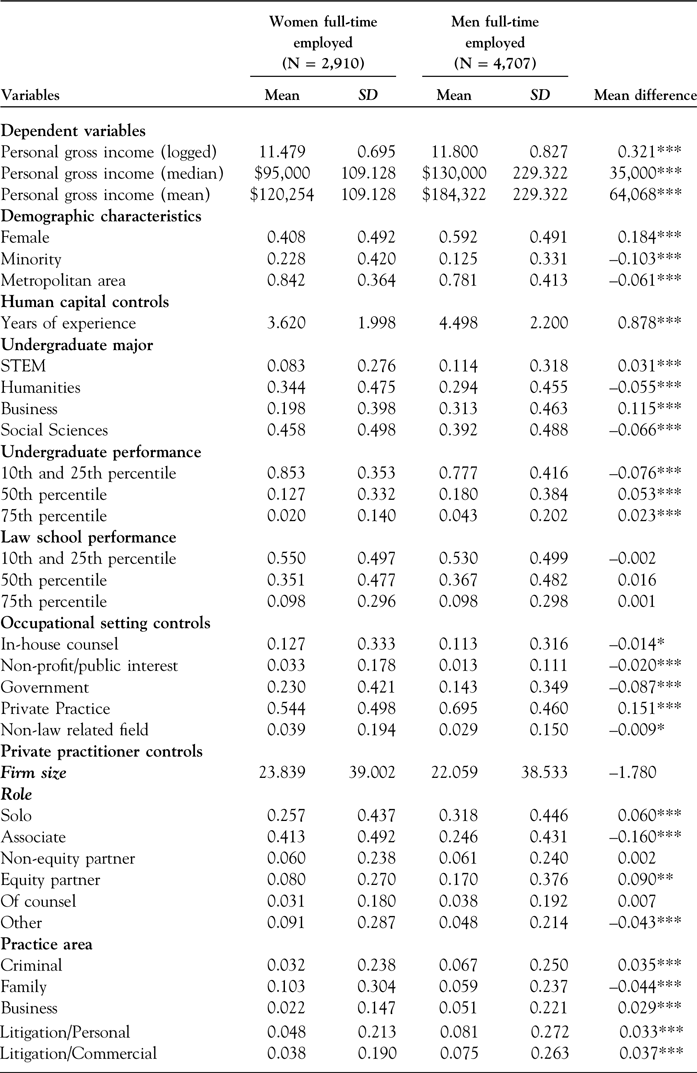
In Table 1, we provide the descriptive statistics for our analytical sample of 7,617 full-time Texas lawyers divided by gender. As Table 1 indicates, male lawyers earn significantly more than female lawyers. In 2015, male lawyers earned thirty-five thousand dollars more at the median and sixty-four thousand dollars more at the mean than their female counterparts. Previous studies have found similar disparities (Noonan, Corcoran, and Courant Reference Noonan, Corcoran and Courant2005, 858; Robson and Wallace Reference Robson and Wallace2001, 87).
Descriptive statistics of study variables (with t-tests)

Notes: † p < 0.10; * p < 0.05; ** p < 0.01; *** p < 0.001.
Our descriptive results also point to other important differences between the sample’s male and female lawyers. Female lawyers are underrepresented in private practice and overrepresented in government, public interest, and in-house positions in comparison to male lawyers (Hull and Nelson Reference Hull and Nelson2000, 241; Noonan, Corcoran, and Courant Reference Noonan, Corcoran and Courant2005, 857). Among private practitioners, female lawyers are more commonly found in associate positions and less commonly in solo practice. Male lawyers are much more often in law firm equity partner positions: 17 percent of male private practitioners are equity partners compared to only 8 percent of female private practitioners (Kay and Hagan Reference Kay and Hagan1998; Hull and Nelson Reference Hull and Nelson2000). In addition, female attorneys more frequently practice in “feminized” fields of law such as family law than in “masculine” ones such as business and commercial litigation (Bolton and Muzio Reference Bolton and Muzio2007). We detect no differences in the firm size of the male and female lawyers in the sample.Footnote 29
The lawyers also differ in terms of their human capital assets. The male lawyers in the sample are significantly more experienced than the female lawyers are. They also more frequently majored in STEM and business, arguably more rigorous majors that command greater awards in the labor market.Footnote 30 However, the female lawyers were more likely to have excelled academically as undergraduates. Although some studies report significant gender differences in law school performance, the class ranks of the male and female lawyers in our sample are similar.Footnote 31
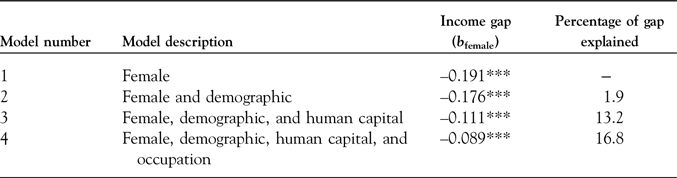
To test whether the gender pay gap can be attributed wholly to differences in human capital and occupational segregation, we apply a series of regression decompositions in Table 2. We first regress the effects of our independent variables on income. The standardized coefficients represent the effects of female gender compared to male gender on income, with negative coefficients reflecting a gender gap. Next, we use decompositions to assess the percentage of the gender pay gap that is explained by differences between the male and female lawyers in our sample. In Model 1, we examine the initial gender gap in income with no other controls. We then add demographic background factors (Model 2), human capital assets (Model 3), and, finally, occupational setting to the model (Model 4) to estimate their effects on the gender earnings gap.
Regression decomposition coefficients and percentage of the gender income gap explained with alternate models, including selected controls

Note: Demographic background controls are race and region. Human capital controls are years of practice experience, undergraduate major, undergraduate class rank, and law school class rank. Occupational controls include five categories: (1) for-profit corporate/in-house counsel; (2) government; (3) non-profit public interest; (4) private practice; and the reference category of (5) non-law related.
Table 2 demonstrates that there is initially a 19 percent earning gaps between the male and female lawyers in the sample. This gap diminishes somewhat as we add controls for demographic backgrounds, human capital, and occupation. Nevertheless, even after controlling for these factors, the female lawyers in our Texas sample earn 9 percent less than the male lawyers. Thus, differences in demographic background, human capital assets, and occupational settings fail to explain the gender pay gap, and 83 percent of the gap is unexplained after all of these variables are included in our model.
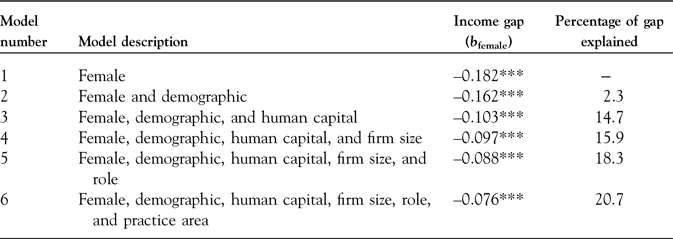
The majority of attorneys in our Texas sample are private practitioners. Previous studies have found that the gender gap may be especially large in private practice (Dixon and Seron Reference Dixon and Seron1995; Kay and Hagan Reference Kay and Hagan1995). The income differences that have been observed in this setting could be a product of female lawyers’ underrepresentation in high-paying equity partner positions (see Table 1) and female lawyers’ selection into “feminized” fields as well as discrimination (Bolton and Muzio Reference Bolton and Muzio2007). To better understand the gender gap in private practice, we disaggregate the gender pay gap among the sample’s private practitioners, once again using Blinder-Oaxaca decomposition (Antecol, Cobb-Clark, and Helland Reference Antecol, Cobb-Clark and Helland2014). The decompositions in Table 3 control for demographic factors, human capital assets, legal practice area, firm size, and law firm role.
Regression decomposition coefficients and percentage of the gender income gap explained with alternate models, including selected controls for private practitioners

Note: Demographic background controls are race and region. Human capital controls are years of practice experience, undergraduate major, undergraduate class rank, and law school class rank. The Firm size control is measured continuously. The role control equates to equity partner, non-equity partner, of counsel, solo practitioner, and associate as the reference category. The practice area controls include family law, business, personal litigation, commercial litigation, and criminal law as the reference category.
As Table 3 shows, there is a gender earnings gap of 18 percent among private practitioners. Some of this gap is attributable to differences in human capital assets and the female lawyers’ overrepresentation in less lucrative law firm roles and practice areas. Nevertheless, an earnings gap of 8 percent remains after controlling for the aforementioned factors, and 79 percent of the earnings gap is unexplained, signifying that omitted variables, including possible discrimination, are driving the gap. These results signify that the legal profession’s gender pay gap cannot be reduced to the relatively minor differences in capital assets or occupational segregation. The underrepresentation of female private practitioners in equity partner positions and in the most lucrative legal practice areas also plays a minor role. Since the gender pay gap is not predominately caused by differences between male and female lawyers, we theorize that differential valuing of like assets and achievements may be a major factor. In the next section, we explore the legal market’s gendered treatment of high academic achievement.
The Earning of High-Achieving Women
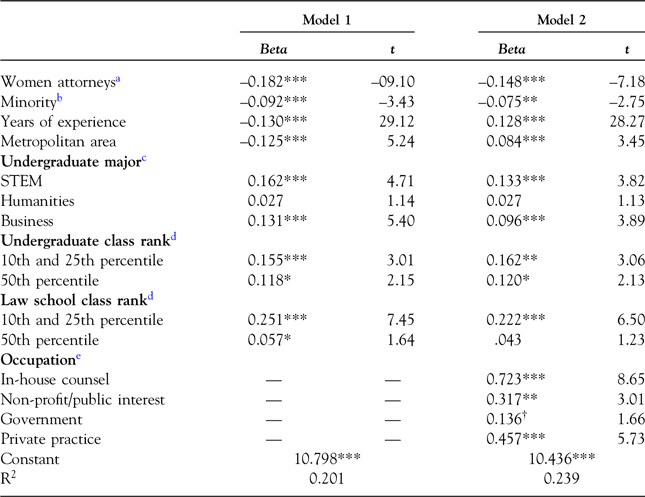
As noted, empirical researchers have consistently found that academic performance is a key measure of human capital and predicts earnings across educational contexts (Wise Reference Wise1975; Jones and Jackson Reference Jones and Jackson1990; M. French et al. Reference French, Homer, Popovici and Robins2015). With respect to attorneys specifically, superior performance in law school not only opens up pathways to lucrative positions in corporate law firms but also has a strong independent effect on income regardless of the practice setting. Law school grades are by far the most important predictor of career success if success is defined in pecuniary terms (Sander and Bambauer Reference Sander and Bambauer2012). We used OLS regression to determine the effects of law school class rank and other variables on the incomes of the Texas lawyers in our sample (see Table 4).
Predictors of earnings (full-time attorneys)

Notes: † p < 0.10; * p < 0.05; ** p < 0.01; *** p < 0.001. Standardized regression coefficients are shown in the table, with t-statistics.
a Compared to males.
b Compared to non-Hispanic whites.
c Compared to the “Social Sciences” category.
d Compared to the 75th percentile class rank.
e Compared to the “non-law” category.
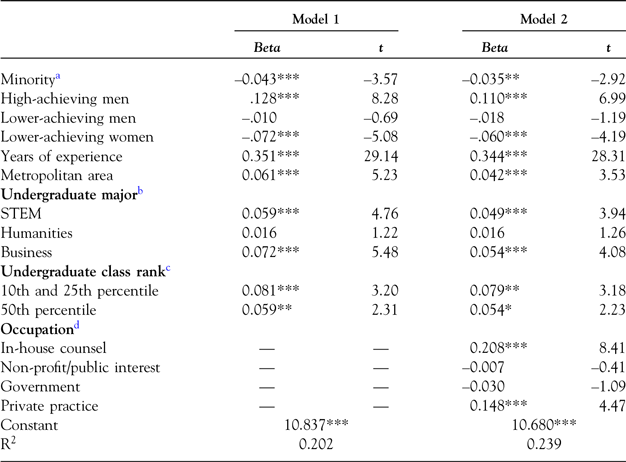
Our analysis in Table 4 shows the impact of various human capital assets on earnings. As expected, law school performance has the largest effect: graduating at the top of one’s class (tenth and twenty-fifth percentile) increases earnings by 25 percent in Model 1 and 22 percent in Model 2. Undergraduate class rank and STEM or business majors also have an independent effect on earnings in both models.Footnote 32 Unsurprisingly in light of the statistical analyses in the previous section, female gender is negatively correlated with income. Minority race also has a small negative effect.
To determine if, consistent with our theory, the legal market devalues the academic performance of high-achieving female lawyers especially, we next divided our sample into four groups based on law school class rank and gender: high-achieving women, high-achieving men, lower-achieving women, and lower-achieving men. We used OLS regression to compare the earnings of the latter three groups of lawyers to those of high-achieving female lawyers while controlling for demographic background, human capital assets, and segregation into different legal market sectors. Table 5 Model 1 regresses income for the entire sample while controlling for demographic and human capital differences. Table 5 Model 2 adds lawyers’ occupational practice settings. If our theory about the devaluation of high-achieving female lawyers’ academic performance is correct, then this group of attorneys should earn less than high-achieving male lawyers and potentially other groups as well.
Predicting income by gender and achievement (full-time attorneys)

Notes: * p < 0.05; ** p < 0.01; *** p < 0.001. Standardized regression coefficients are shown in the table, with t-statistics.
a Compared to non-Hispanic whites.
b Compared to the “social sciences” category.
c Compared to the 75th percentile class rank.
d Compared to the “non-law” category.
Our results largely support our theory. As shown in Table 5 Model 1, high-achieving male lawyers earn 13 percent more than high-achieving female lawyers do. High-achieving female lawyers earn the same as lower-achieving male lawyers, and only 7 percent more than lower-achieving female lawyers. These results hold even after controlling for occupational setting in Table 5 Model 2. High-achieving male lawyers outearn high-achieving female lawyers by 11 percent, suggesting that differential job settings cannot explain the earnings disparities between these groups.Footnote 33 Under this model, high-achieving female lawyers also do not outearn lower-achieving male lawyers and enjoy only a modest earnings premium of 6 percent over lower-achieving female lawyers.
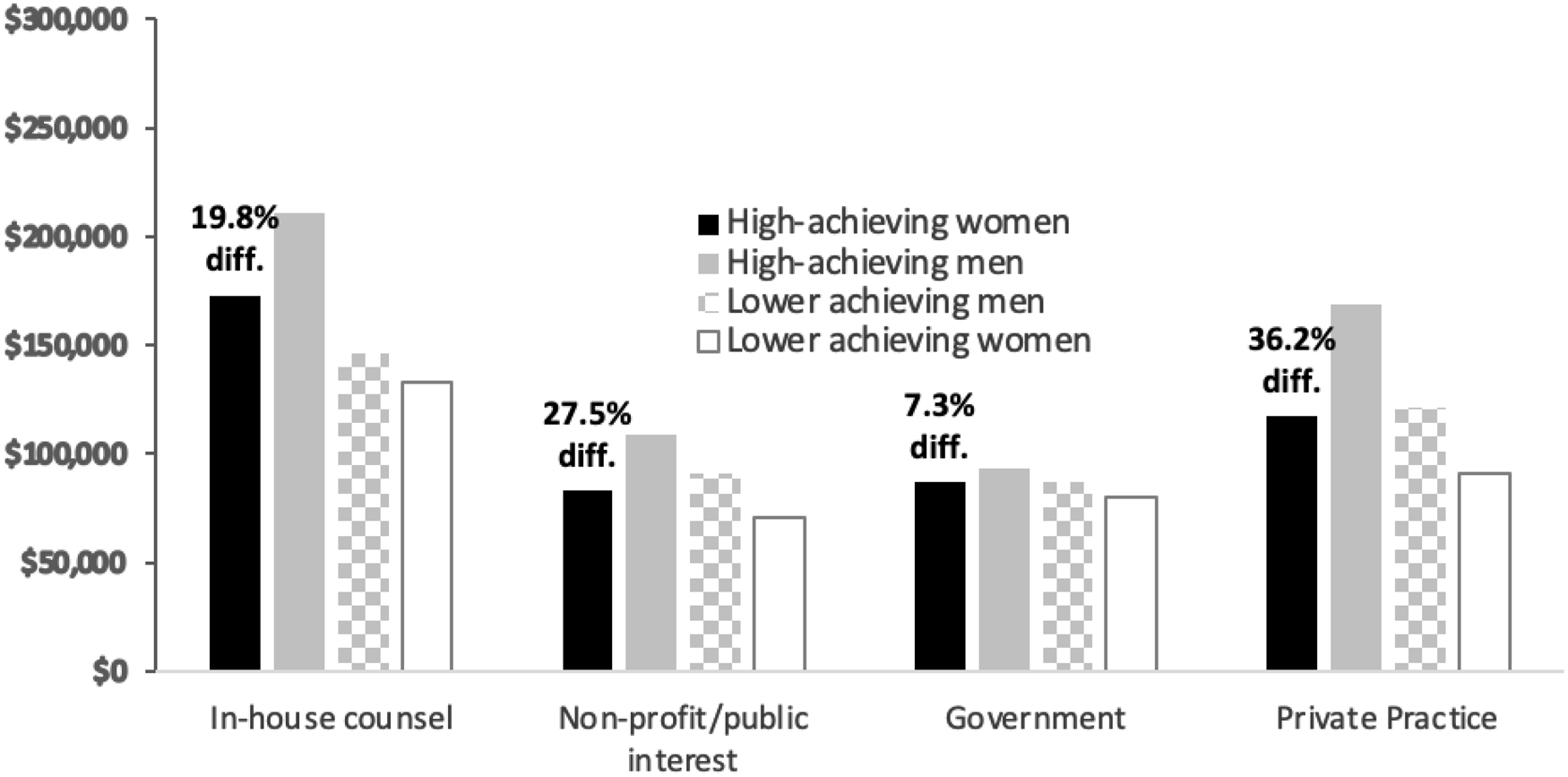
Figure 1 illustrates the gender earnings gap by occupational practice setting and academic achievement. We can see that female lawyers with the highest academic performance earn less than their similarly situated male colleagues in every occupational setting. The earnings gap between high-achieving male and female lawyers is largest in private practice (36 percent), followed by non-profit/public interest (28 percent). The smallest gender gap in earnings is observed among high-achieving male and female lawyers in government (7 percent), likely due to standardized salary structures (Dixon and Seron Reference Dixon and Seron1995).
Comparison of high-achieving female lawyers’ incomes by occupation.

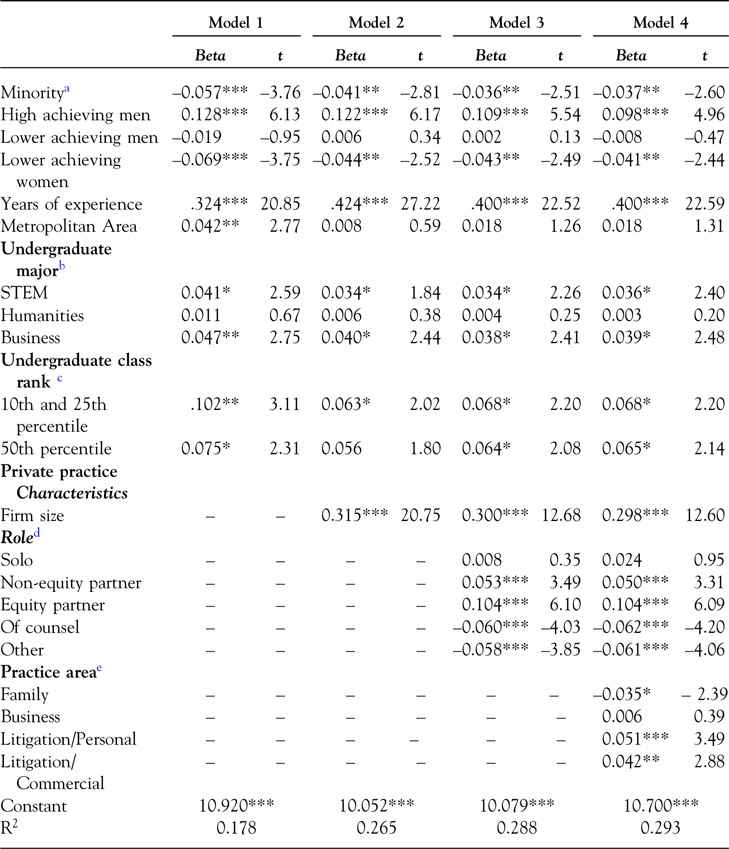
To analyze the earnings of high-achieving female lawyers in private practice further, we conducted additional regression analyses on private practitioners’ incomes. In Table 6, we divide the private practitioners into four groups based on class rank and gender. In our analyses, we controlled for demographic background, human capital differences as well as private practitioners’ firm size, legal practice area, and law firm role. This allowed us to separate the effects of academic performance and gender from other possible causes of earning disparities such as the underrepresentation of female lawyers in equity partner positions and overrepresentation in less lucrative legal practice fields (see Table 1).
Predicting income by gender and achievement among full-time private practitioners

Notes: * p < 0.05; ** p < 0.01; *** p < 0.001. Standardized regression coefficients are shown in the table, with t-statistics.
a Compared to non-Hispanic whites.
b Compared to the “social sciences” category.
c Compared to the 75th percentile class rank.
d Compared to the associate.
e Compared to criminal law.
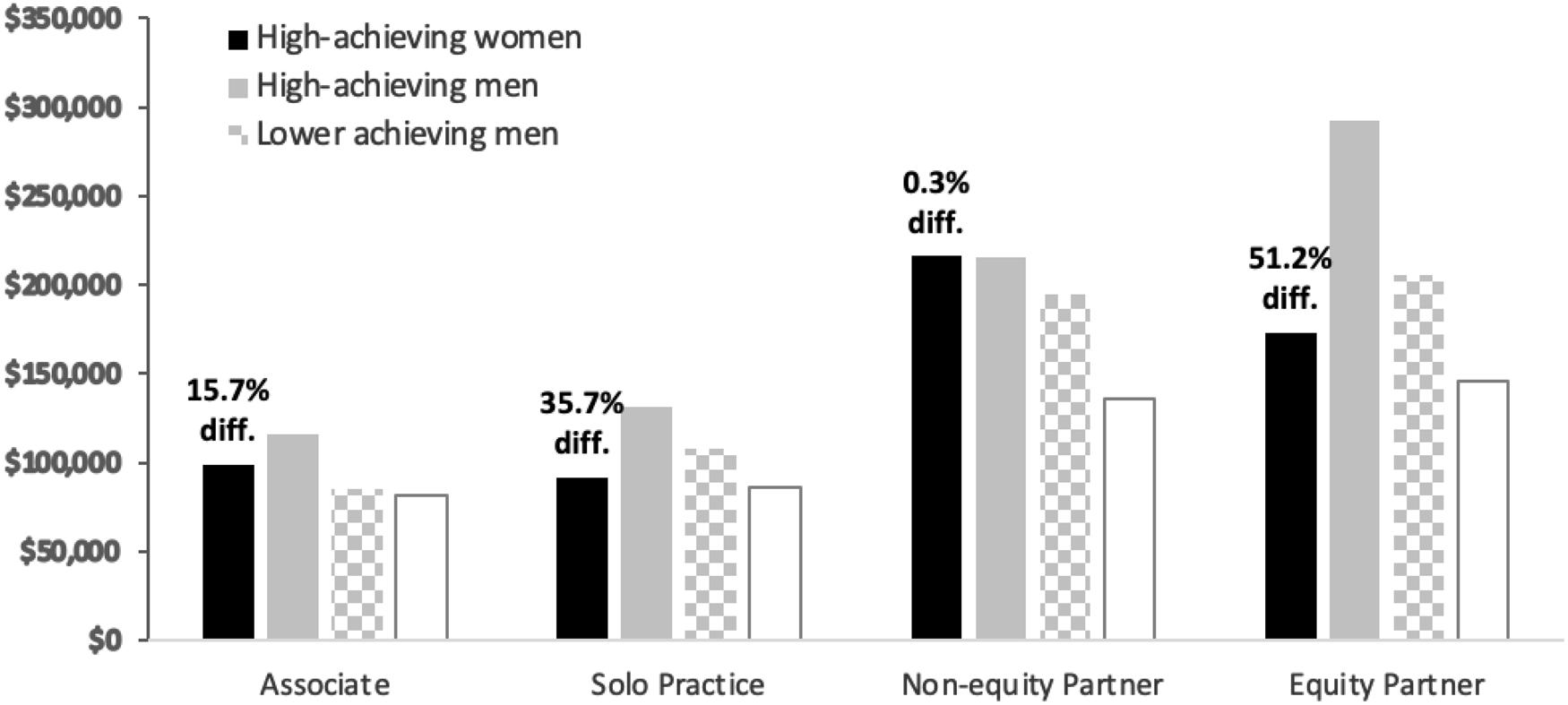
As we predicted, female private practitioners receive little benefit from superior law school performance. They earn less than high-achieving male private practitioners and no more than lower-achieving male private practitioners under all models. After all controls are added in Table 6, female lawyers earn 10 percent less than high-achieving male lawyers and only 4 percent more than lower-achieving female lawyers. Thus, the inclusion of firm size, practice area, and role in our models moderated the differences in earnings slightly. Finally, as set out in Figure 2, the magnitude of the gender pay gap depends in part on a private practitioner’s law firm roles. High-achieving female lawyers earn as much as their high-achieving male colleagues in non-equity partner positions. However, in equity partner positions, they earn 51 percent less than high-achieving male counterparts and 17 percent less than lower-achieving male counterparts. The same trend is observed in solo practice although differences are not as stark: high-achieving female solos earn 36 percent less than high-achieving male solos and 16 percent less than lower-achieving male solos.
Comparison of high-achieving female private practitioners’ incomes by role.
Notes: * Income differentials estimated from Model 4 in Table 5.

In sum, consistent with our theory, high-achieving female lawyers do not reap the same benefits from their academic performance as male lawyers do. They earn less than male lawyers with the same law school performance across practice settings, with income differences most pronounced in private practice. When they practice as equity partners or solo practitioners, they earn significantly less than both high-achieving and lower-achieving male lawyers. For female lawyers, equaling or exceeding the qualifications of male colleagues is simply not enough to achieve pay parity.
IMPLICATIONS
A robust literature has sought to identify the causes of the legal profession’s gender pay gap. Relying on a large cross-sectional sample of full-time lawyers, we have confirmed the existence of a gender gap of approximately thirty-five thousand dollars at the median and sixty-four thousand dollars at the mean that cannot be attributed solely to differences in human capital investments or female lawyers’ overrepresentation in less remunerative legal market sectors or roles.
Contrary to the suppositions of some human capital theorists, female lawyers largely resemble their male counterparts in human capital assets (Becker Reference Becker1964; Goldin and Polachek Reference Goldin and Polachek1987). We have considered lawyers’ practice experience and law school performance as well as oft-neglected factors such as undergraduate education. The female lawyers in our sample are somewhat less experienced than their male counterparts and are less likely to have majored in STEM or business, but they match their counterparts in law school performance and surpass them in undergraduate performance.Footnote 34 Differences in demographic backgrounds and human capital assets explain only 13 percent of the gender earnings gap. After adding controls for occupational sector, 83 percent of the earning difference remains unexplained.
In examining the legal profession’s gender pay gap, past scholarship has concentrated on the shunting of female lawyers into less lucrative legal market sectors and a glass ceiling that blocks women from ascending to lucrative private practice positions (Epstein et al. Reference Epstein, Saute, Oglensky and Gever1995; Noonan, Corcoran, and Courant Reference Noonan, Corcoran and Courant2005; Wald Reference Wald2009). Consistent with this literature, the female lawyers in our sample are less commonly found in private practice and in law firm equity partner positions. However, female private practitioners still earn 8 percent less than male lawyers after controlling for firm size, practice area, and partnership status. Female private practitioners undoubtedly face pitfalls in the competition for partner positions (Kay, Alarie, and Adjei Reference Kay, Alarie and Adjei2016), but even ones who ascend to these positions can expect to earn substantially less than similarly situated male colleagues.
Law has historically been male dominated. In this article, we have theorized that female lawyers’ academic success could facilitate access to lucrative positions but also engender concerns about sociability (Schleef Reference Schleef2001; Heilman et al. Reference Heilman, Wallen, Fuchs and Tamkins2004). Moreover, since performance and compensation assessments in law are nebulous and prone to subjectivity, we posited that legal employers and clients could consciously or unconsciously shift compensation criteria to disadvantage high-achieving women or that these women may fear publicizing their value (Wilkins and Gulati Reference Wilkins and Mitu Gulati1998; Williams and Richardson Reference Williams and Richardson2010; Regan and Rohrer Reference Regan and Rohrer2012). Our findings largely accord with these theories.
We demonstrate, through a series of OLS regression analyses, that high-achieving female lawyers are devalued in the legal market. High-achieving female lawyers earn 11 percent less than their similarly situated male lawyers and the same as lower-achieving male lawyers. Disparities are especially pronounced in private practice where high-achieving female lawyers earn 36 percent less than their high-achieving male counterparts. But inequities persist across occupational settings, with high-achieving male lawyers outearning their high-achieving female colleagues in public interest and in-house positions by 28 percent and 20 percent respectively. Academically accomplished female lawyers fare best in government where they earn only 7 percent less than similarly situated male lawyers. Government lawyers are paid according to fixed pay schedules based on seniority, rendering compensation decisions less subjective and biased (Dixon and Seron Reference Dixon and Seron1995; Hall Reference Hall2012).
Our findings raise the counterintuitive possibility that excessive focus on academic performance may harm female lawyers from an income maximization perspective.Footnote 35 Academic performance is the single greatest concern of law students (Krieger and Sheldon Reference Krieger and Sheldon2015). While superior academic performance facilitates access to desirable positions in corporate law firms, the benefits are not equal between the genders. Firms (and clients) claim to seek the “best and brightest” attorneys, but their actual compensation practices do not accord with this rhetoric (S. French Reference French1999).
Since the legal market does not fully reward female lawyers for academic achievement, aspiring lawyers should arguably direct some of their energies to other worthwhile endeavors. Networking is a prime example. Under the current system, female law students may be well served to focus on forging relationships with classmates and lawyers upon which they can later capitalize rather than concentrating solely on academics.Footnote 36 Fiona Kay’s (Reference Kay and Ethel2018) recent study highlights the importance of networks for minority groups especially. However, female law students have more familial responsibilities than their male peers, leaving little time for both studying and networking (Law School Survey of Student Engagement 2019). The tradeoff is not nearly as acute for male law students because they generally have more free time to devote to activities outside of law school, and any career investments they choose to make will likely boost their earnings vis-à-vis other groups.
One explanation for why women may not benefit from superior academic performance to the same degree that men do is because legal employers emphasize “cultural fit” over academic achievement and other objective factors once candidates demonstrate a baseline of competence. Employers will even dismiss their work as “not rocket science” to avoid hiring or rewarding high-achieving candidates who lack the right fit (Rivera Reference Rivera2012). The decision to favor fit could even appear economically rational if firms regard fit as a proxy for qualities such as the ability to generate business from clients.Footnote 37 Kay and Hagan’s (Reference Hagan and Kay1995) finding that the effect of bringing in clients is strongly significant for women’s partnership prospects but not for men’s is a manifestation of the tendency to take for granted that male lawyers naturally have “what it takes,” whereas female lawyers must go over and beyond to demonstrate it (Gorman Reference Gorman2006).
Legal practice settings differ in their cultures as well as the representation of women in positions of authority. Yet sizeable earning disparities exist among attorneys in private practice, in-house positions, as well as in the public interest sector. While the precise mechanisms by which women are disadvantaged in these settings probably differ, female lawyers will rarely “fit” into any of these settings as well as male lawyers do because they do not conform to long-standing expectations of how lawyers look and behave.Footnote 38 In most legal practice settings, the archetypal attorney is still very much a white male (Anleu Reference Anleu1992; Wald Reference Wald2009). Women lawyers are often conscious of this reality:
There is a little bit paternalistic attitude towards women. You can either be relegated to the role of being sort of a submissive, little worker bee or, if you’re more assertive…. I feel that sometimes I scare the guys a bit. You can be in a meeting and … they’re comfortable swearing and dropping the F-bomb here and there and so am I quite frankly, but because … there are ladies present, sometimes they’ll hold themselves back. (Garth and Sterling Reference Garth and Sterling2018, 149)
Female lawyers can match their male counterparts in human capital and even adopt “male” speech patterns and hobbies and still find that they do not have the right “fit.”Footnote 39
Even the attainment of highly sought-after and powerful equity partner positions hardly ensures pay parity. To the contrary, high-achieving female equity partners earn 51 percent less than similarly situated male equity partners and 17 percent less than lower-achieving male equity partners. We also see large disparities among solo practitioners. Income differences are smaller among associates and non-equity partners, and higher-achieving female lawyers outearn lower-achieving male attorneys in these roles. Pay disparities may be less pronounced among high-achieving male and female non-equity partners and associates because their compensation is largely set ex ante. With respect to equity partners and solo practitioners conversely, compensation depends on subjective ex post assessments by fellow partners and clients.Footnote 40 Firms and clients can dismiss or underplay good outcomes obtained by high-achieving female lawyers to justify paying them less than male lawyers with the same outcomes (Williams and Richardson Reference Williams and Richardson2010). Accomplished female attorneys may also be less apt to protest when they are not paid according to their worth because of the fear of backlash and discrimination (Kanter Reference Kanter1977).
In addition, legal acumen—as measured by law school performance—could conceivably be less important for equity partners and solo practitioners. In these roles, lawyers’ incomes are based largely on their ability to develop business and sell their firms’ services (Williams and Richardson Reference Williams and Richardson2010). Formally or informally, most law firms are “eat what you kill.”Footnote 41 Legal acumen could be more tied to associate and non-equity partner compensation because firms ultimately need lawyers in these roles to produce high-quality work for firm rainmakers (Wilkins and Gulati Reference Wilkins and Mitu Gulati1998; Reichman and Sterling Reference Reichman and Sterling2004).
Nevertheless, male private practitioners receive a substantial earnings premium from high law school class rank across roles, including in equity partner and solo practitioner positions. The fact that high-achieving female lawyers do not receive comparable income boosts from superior academic performance suggests that its connotations are more mixed for this group. Quadlin (Reference Quadlin2018) similarly found that high academic achievement does not benefit female candidates in the entry-level employment market and attributed this phenomenon to the competence-likability tradeoff. However, unlike Quadlin, we do not find that higher class rank is associated with lower returns for women. Indeed, high-achieving female lawyers earn more than lower-achieving ones across occupational practice settings and private practice roles. The legal market ascribes some value to female lawyers’ academic achievement, just not enough to boost their earnings over less-accomplished men.
A growing literature has documented that the legal profession’s gender pay gap is less of a product of differences between male and female lawyers and more of a product of differential returns on human and social capital (Hagan Reference Hagan1990; Kay and Hagan Reference Kay and Hagan1995; Wass and McNabb Reference Wass and Mcnabb2006; Ryan and Dawe Reference Ryan and Dawe2021). Our conclusion that superior law school performance rewards male lawyers far more than female lawyers is in line with Fiona Kay and Jean Wallace’s (Reference Kay and Wallace2009, 445) conclusion with respect to mentoring:
Although female lawyers are just as likely to seek out and secure mentors, the relationship does not yield the same benefits accrued to male lawyers. The social position of women within the legal profession does not afford them the strategic capacity to mobilize their social capital … to secure coveted career outcomes, particularly in the form of earnings and career advancement.
Equalizing differences in human capital and social capital is insufficient to remedy the gender wage gap if men can more effectively leverage any capital that they possess.
Comparing our findings to those of earlier studies, it appears that employers may place less emphasis on female lawyers’ academic performance than they have in the past (Dixon and Seron Reference Dixon and Seron1995). Future research should examine whether the progress that female lawyers have made in matching male lawyers in terms of education and other capital assets has caused employers and clients to implicitly downplay these assets in hiring and compensation decisions. In the absence of formal barriers, are clients and firms increasingly deploying fit and other intangible criteria to the detriment of high-achieving female lawyers? The steep gender earning differentials among solo practitioners and law firm equity partners especially imply that they are.
Structural changes have exacerbated these tendencies. For the last twenty years, private law firms have moved away from so-called lockstep compensation schemes, whereby a lawyer’s pay generally increases by a fixed increment for every year of service, toward “merit-based” pay (Donn, Cahill, and Mihal Reference Donn, Cahill and Mihal2015; Weiss Reference Weiss2020). The purported rationale for this shift in compensation schemes is that merit-based pay allows firms to retain their most talented and productive attorneys. Yet these schemes inevitably disadvantage high-achieving female lawyers because firms’ evaluations of merit are gendered and often ignore that male successes depend on the unrecognized and unrewarded efforts of women and minorities (González Reference González2014; Donn, Cahill, and Mihal Reference Donn, Cahill and Mihal2015).
To begin to remedy the legal profession’s gender pay gap, leaders of the organized bar must highlight the inequitable effects of purportedly merit-based compensation schemes and exhort firms to adopt lockstep schemes for partners, associates, and other employees. Standardized salary structures are still used by governmental employers as well some private law firms in setting associates’ and non-equity partners’ base salaries, and these settings unsurprisingly feature smaller pay disparities (Dixon and Seron Reference Dixon and Seron1995).
Firms must also be more transparent about their compensation decisions. Although efforts to require reporting of gender pay gaps have floundered in the United States, the United Kingdom has had some success with a voluntary reporting regime (Lee Reference Lee2021). Firms that are committed to pay equity may calculate that the disclosure of (non-)pay gaps will advantage them in attorney recruitment and business development. Corporate clients have been exerting pressure on law firms to hire and promote diverse attorneys and could presumably insist that their firms report on gender pay gaps as well.Footnote 42 Recent lawsuits have also highlighted troubling gender pay disparities at some law firms, undermining law firms’ public images.Footnote 43 While law firms and other legal employers should pay women equally even in the absence of a business case for doing so, if corporations are disinclined to retain firms that have troubling records on diversity and pay equity,Footnote 44 law firms may start to assess fit differently and reward the human and social capital of female attorneys on equal terms with that of male attorneys.
Some legal profession scholars have also maintained that the presence of a critical mass of female lawyers, particularly in positions of power, will transform hiring and compensation practices (Hagan and Kay Reference Hagan and Kay1995; Gorman Reference Gorman2005; González Reference González2014). There is some evidence that having more female decision-makers in firms increases the likelihood that women will be hired and promoted in law firms.Footnote 45 The gender pay gap could conceivably decrease in size, and female lawyers’ capital assets could cease to be devalued as more and more female lawyers ascend to managerial positions. Female subordinates might also be more willing to initiate discussions regarding compensation decisions with female managers (Donn, Cahill, and Mihal Reference Donn, Cahill and Mihal2015).
However, optimism on the preceding fronts must be tempered. First and foremost, the legal profession’s gender pay gap exists across practice settings. While high-achieving women fare best in the public sector, the private sector’s adoption of public sector pay models will not eliminate the gender pay gap entirely. For example, income disparities could arise even where male and female attorneys are paid the same salaries through allegedly merit-based bonus structures (Dinovitzer, Reichman, and Sterling Reference Dinovitzer, Reichman and Sterling2009).
Corporate clients’ professed commitment to diversity is also not new: General Motors and other prominent companies have urged their outside law firms to staff diverse attorneys on their matters since the 1980s (Wilkins Reference Wilkins2003). But corporate clients, by and large, have not changed their legal spending to respond to firms’ records on diversity (Braithwaite Reference Braithwaite2010). Corporate clients’ nominal commitment to diversity may not extend to law firms’ compensation decisions, and firms have little incentive to report on compensation differentials where the black box natures of their governance structures shelter their practices from scrutiny and market pressure (Pearce, Wald, and Ballakrishnen Reference Pearce, Wald and Ballakrishnen2015). Legal disputes surrounding pay disparities are often settled confidentially and without fundamentally altering the structures that gave rise to the disparities in the first place.Footnote 46
Lastly, women in positions of power can also internalize cultures that are hostile to hiring and rewarding women (Rivera Reference Rivera2012), meaning that the presence of female evaluators will not necessarily inure to the benefit of all women. Lauren Rivera and Jayanti Owen’s (Reference Rivera and Owens2021) recent study of one professional firm suggests that the most skilled female candidates are in fact disadvantaged by the presence of female evaluators. Female lawyers who have ascended to the legal profession’s highest rungs likely had to assimilate into a “man’s world” and may expect that the female lawyers who follow them do the same (Mossman Reference Mossman2003). They may be exhausted from their own battles with discrimination, with little energy to advocate for younger colleagues, some of whom may be racially diverse as well (González Reference González2014). The existence of high-profile successes also makes it easier for male lawyers to regard gender as a non-issue (Mossman Reference Mossman2003).
The gender pay gap is not a function of the differences between male and female attorneys. Rather, assessments of female lawyers’ qualifications and accomplishments are processed through the prism of gender. The legal profession can begin to address gender pay gaps by adopting alternative and more transparent compensation schemes and by promoting individuals who are prepared to disrupt long-standing pay inequities.
Limitations
This study’s sample consists of Texas attorneys who practice law full-time. Since the sample is not representative of lawyers nationwide, our results cannot necessarily be extrapolated to other jurisdictions. Gender may have less impact on earnings outside of Texas, and female lawyers could obtain greater rewards from their law school performance in other states. Texas has a sophisticated legal market, but it is possible that other states have made more progress in equalizing earnings between male and female attorneys.
We also do not specifically consider the impact of law school prestige as part of this study. Because the female lawyers in our sample academically outperformed the male lawyers at the undergraduate level and do not appear to have attended lower-ranked Texas law schools than their male counterparts, it is unlikely that the omission of this variable affected our results. Nevertheless, it is conceivable that full access to respondents’ educational information would reveal differences in law school prestige that could impact the size of the observed income differentials.
Lastly, our survey instrument focused predominately on human capital assets and occupational practice settings and did not address familial factors that may impact earnings (Becker Reference Becker1985; Robson and Wallace Reference Robson and Wallace2001). This concern is mitigated somewhat because we do not consider lawyers who practice part-time to care for children, for example. Previous studies have found that neither familial factors nor hours worked explain the gender pay gap (Noonan, Corcoran, and Courant Reference Noonan, Corcoran and Courant2005; Reichman and Sterling Reference Reichman and Sterling2013). Yet, even assuming that the female lawyers in our sample do not work as many hours as their male counterparts because of family responsibilities, these differences do not explain why high-achieving female lawyers receive only modest boosts in income over lower-achieving female peers. Differences in hours worked should also be reflected in income differentials across law firm roles, but high-achieving female lawyers earn the same as similarly situated male counterparts in non-equity partner positions and more than lower-achieving male counterparts in associate positions. Only in equity partner positions do they earn far less than both groups.
Conclusion
Scholars have long sought to identify the sources of the legal profession’s gender pay gap. This study has determined that female lawyers’ differential human capital investments and alleged self-selection into less lucrative and demanding occupational practice settings cannot account for the gender pay gap. We also show that superior law school performance is far more important for male lawyers than female lawyers. Despite the legal profession’s well-known credentialism, high-achieving female lawyers do not outearn their lower-achieving male counterparts.
Ultimately, female lawyers are unlikely to achieve pay parity by matching the human capital assets of male lawyers because gender confounds the legal market’s response to these assets. Superior law school performance may mark a woman not only as competent but also as antisocial. Depending on the gender of the lawyer being assessed, law can be, and cannot be, “rocket science.” Law firms and clients can also downplay the relevance of certain traits when they are found in female lawyers, especially if the latter are less likely to challenge compensation decisions and tout their successes for fear of backlash.
Women have made unquestionable progress in the legal profession and can be found in positions of power across occupational practice settings (Kanter Reference Kanter1977). However, men continue to predominate and will have affinities for lawyers who resemble them. The legal profession cannot eliminate the gender pay gap merely by equalizing opportunities that male lawyers are better positioned to leverage. Rather, legal employers need to shift away from individualized, black box compensation schemes that are susceptible to bias and do not fully reward female lawyers for their career investments. Women’s continuing advancement inside and outside of the profession may help to facilitate this needed disruption.