INTRODUCTION
New word acquisition in young children has been described as occurring in two phases: fast mapping and extended mapping (Carey & Bartlett, Reference Carey and Bartlett1978). Fast mapping occurs when a new word is first encountered and an initial mental representation is formed. Extended mapping is the gradual elaboration of that initial representation as the child encounters the word repeatedly and expands their phonological and semantic knowledge about the word and how it is used in various syntactic and pragmatic contexts. Fast mapping and extended mapping are relevant for both nouns and verbs. Multiple factors impact both phases of vocabulary acquisition (Hoff & Naigles, Reference Hoff and Naigles2002). Parental input plays a critical and causal role (Akhtar & Tomasello, Reference Akhtar, Tomasello, Golinkoff, Hirsh-Pasek, Bloom, Smith, Woodward, Akhtar, Tomasello and Hollich2000; Bornstein, Tamis-LeMonda, Hahn & Haynes, Reference Bornstein, Tamis-LeMonda, Hahn and Haynes2008). Mothers of typically developing children are sometimes described as fine-tuning their language input to the abilities and behaviours of their children. One aspect of this fine-tuning is input adjustments in response to a child's familiarity with a word (Cleave & Kay-Raining Bird, Reference Cleave and Kay-Raining Bird2006; Masur, Reference Masur1997; Masur & Eichorst, Reference Masur and Eichorst2002; Olson & Masur, Reference Olson and Masur2012). Analyzing regularities in caregiver–child interactions during naturalistic play can provide important insights into which factors may be explanatory. The purpose of this study was to determine whether mothers of young children with Down Syndrome (DS), language impairment (LI), or typical development (TD) talk differently about familiar and unfamiliar nouns and verbs. Children were in the early period of language development, being able to produce more than 100 words but with MLUs (mean length of utterances) of less than 2·7. Groups of children were matched on expressive vocabulary size, as measured using the MacArthur Communicative Inventory (CDI; Fenson et al., Reference Fenson, Dale, Reznick, Thal, Bates, Hartung, Pethick and Reilly1993). Dyadic interactions during toy play with specially designed toy sets were analyzed.
Characteristics of input to typically developing children
Adults from middle-class Western backgrounds make broad phonological, semantic, syntactic, and pragmatic adjustments when talking to young TD children, relative to adult–adult speech (see Chapman, Reference Chapman, Schieffelbusch and Bricker1981; Pine, Reference Pine, Galloway and Richards1994; Snow, Reference Snow, Snow and Ferguson1977, for reviews). Child-directed speech (CDS) is higher and more variably pitched, has exaggerated stress (especially for content words), and is pronounced more clearly. Caregivers scaffold conversations with their young children, in part by focusing communication on the ‘here and now’ and making their utterances contingent upon the actions and utterances of their children. They time their talk to follow the establishment of joint attention, often following their child's focus of attention. They simplify their talk, making it less diverse semantically and, perhaps as a consequence, less complex syntactically. They may adjust their talk to the developmental level of their child, providing slightly more complex input than their child is capable of producing (Conti-Ramsden & Friel-Patti, Reference Conti-Ramsden and Friel-Patti1986). They prompt their child to produce words. They use concrete, high-frequency words more than low-frequency words, and self-repetitions and imitations of child utterances are frequent. Caregivers are more likely to respond to syntactically well-formed child utterances with exact repetitions and syntactically ill-formed utterances with recasts (repairs). Use of various features of CDS is often interpreted as evidence that caregivers fine-tune their input to the language and cognitive needs of their TD children in order to successfully communicate, and that doing so supports language learning in their children.
Down Syndrome and language impairment
One important question is whether caregivers of children with cognitive and/or language disabilities speak differently to their children than caregivers of TD children. In the next sections we briefly review the language abilities of children with DS and LI and the evidence regarding input to these populations.
Down Syndrome
DS is a congenital chromosomal disorder involving an excess of genetic material from the 21st chromosome and usually results in an intellectual disability of varying degrees. Language development is particularly vulnerable in this population and delays tend to exceed what is expected given the level of cognitive impairment in children with DS. Children with DS often demonstrate a strength in vocabulary comprehension but morphosyntax is usually a weakness. Expressive language is more delayed than receptive language. In early vocabulary development, this means that there is often a large gap between vocabulary production and comprehension abilities, frequently motivating the introduction of an augmentative form of communication such as signs. The early lexicons of children with DS may contain an unusually high number of nouns and there is often a delay in the use of two-word combinations. The acquisition of new vocabulary may be constrained by a variety of factors including auditory memory deficits and intelligibility problems. See Chapman and Kay-Raining Bird (Reference Chapman, Kay-Raining Bird, Burack, Hodapp, Iarocci and Zigler2011) and Roberts, Chapman, and Warren (Reference Roberts, Chapman and Warren2008) for reviews.
Input to children with Down Syndrome
Mothers of children with DS interact with their children in ways that are both similar to and different from mothers of typically developing children. For example, mothers of children with DS are as likely as mothers of mental age- (MA-) or chronological age- (CA-) matched TD children to physically support their child during object play (e.g. moving an object of interest closer to the child) and to follow their child's verbalization with a contingent response (Roach, Barratt, Miller & Leavitt, Reference Roach, Barratt, Miller and Leavitt1998). On the other hand, they are also more likely to use verbal directives when interacting with their children than mothers of TD children (Roach et al., Reference Roach, Barratt, Miller and Leavitt1998, Tannock, Reference Tannock1988). Even so, mothers of children with DS and TD are equally responsive to their young children's communication attempts (Tannock, Reference Tannock1988). Other studies have shown that, in early vocabulary acquisition, children with DS are more likely to be corrected by their mothers if they overextend their words in specific ways, such as calling a truck a car (Mervis, Reference Mervis and Nadel1988) than children of the same vocabulary level with typical development, and mothers of children with DS use fewer internal state words compared to mothers of TD children of the same developmental level (Tingley, Berko Gleason & Hooshyar, Reference Tingley, Berko Gleason and Hooshyar1994). Johnson-Glenberg and Chapman (Reference Johnson-Glenberg and Chapman2004) reported that mothers of individuals with DS used higher MLUs in conversations around unique and complex toys than mothers of MLU-matched controls, but similar MLUs to controls matched for receptive syntax or non-verbal MA. These authors interpreted their findings as evidence that mothers of individuals with DS adjust their talk to match the receptive rather than expressive syntactic abilities of their children.
LI
A variety of terms (language impairment, specific language impairment [SLI], or primary language impairment) have been used in the literature to indicate that a child has a language learning problem that cannot be attributed to an intellectual disability, a frank neurological impairment, a sensory impairment, or autism. We choose to use the term ‘language impairment’ to acknowledge the consistent finding that these children have subtle cognitive difficulties and that their language difficulties impact multiple language domains (vocabulary, morphology, syntax, pragmatics), although deficits in morphology and syntax are considered central to the disorder (Gillam & Kamhi, Reference Gillam, Kamhi, Ball, Damico and Mueller2010; Leonard, Reference Leonard2014). Delays in children with LI can be evident in both expressive and receptive processes or in expressive processes only. Many children identified with LI in the preschool years continue to experience language delays in school, which affect their academic performance and acquisition of reading skills (Gillam & Kamhi, Reference Gillam, Kamhi, Ball, Damico and Mueller2010; Schwartz, Reference Schwartz and Schwartz2009).
Input to children with LI
Input differences have also been reported in studies of children with LI. Not surprisingly given the significant delays of children with LI, mothers of children with LI and age-matched TD controls talk differently. For example, in shared book reading caregivers of children with LI aged 3;6 to 5;4 “carry a greater portion of the conversational load, initiate more conversational turns, ask more questions and use more non-verbal directives” (Barachetti & Lavelli, Reference Barachetti and Lavelli2011, p. 581). Barachetti and Lavelli also found that mothers of children with LI produce more highly supportive conversational repairs than mothers of age-matched TD controls; however, they found no differences when the comparison was to mothers of MLU-matched TD controls. A similar finding was reported by Fey, Krulik, Loeb, and Proctor-Williams (Reference Fey, Krulik, Loeb and Proctor-Williams1999). In contrast, Conti-Ramsden, Hutcheson, and Grove (Reference Conti-Ramsden, Hutcheson and Grove1995) reported that children with SLI received fewer recasts than MLU-matched controls and that the recasts they did receive tended to be of noun phrases, not verb phrases. Whitehurst, Fischel, Lonigan, Valdez-Menchaca, DeBaryshe, and Caulfield (Reference Whitehurst, Fischel, Lonigan, Valdez-Menchaca, DeBaryshe and Caulfield1988) argue that caregivers of children with LI are likely to adjust their input to their child's expressive rather than receptive language abilities. If this is so, it is possible that the input will be oversimplified for the language comprehension abilities of children with greater expressive than receptive language delays, although it may be appropriate for their expressive language abilities.
The influence of CDS on children's vocabulary development
There has been a great deal of interest in the impact of various components of the input on children's vocabulary development (Pine, Reference Pine, Galloway and Richards1994). For the purposes of the present study, we will focus upon input frequency, the position of a word in an utterance, and learning in a joint attention context.
Input frequency
There is considerable evidence for a positive effect of input frequency on children's vocabulary acquisition. The overall frequency of a caregiver's talk is correlated with the rate of children's vocabulary growth (Hart & Risley, Reference Hart and Risley1995). Cross-linguistic studies have shown that children exposed to languages with a higher proportion of nouns in the input (e.g. English) produce more nouns in their early vocabularies, while children exposed to languages with a higher proportion of verbs in the input (e.g. Korean) have proportionately more verbs in their early vocabularies (Choi, Reference Choi2000; Choi & Gopnik, Reference Choi and Gopnik1995). In experimental studies, more novel word presentations lead to better word learning in TD children (Schwartz & Terrell, Reference Schwartz and Terrell1983), children with LI (Rice, Oetting, Marquis, Bode & Pae, Reference Rice, Oetting, Marquis, Bode and Pae1994), and children with DS (Kay-Raining Bird, Gaskell, Babineau & MacDonald, Reference Kay-Raining Bird, Gaskell, Babineau and MacDonald2000). Goodman, Dale, and Li (Reference Goodman, Dale and Li2008) reported significant positive correlations between parental input frequency and age of acquisition of word production in four lexical categories (common nouns, verbs, adjectives, and closed-class words). Input frequency was determined using combined language sample data of caregivers' talk to TD children under (usually) four years of age available through the Child Language Data Exchange System database (CHILDES; MacWhinney, Reference MacWhinney2000). Age of acquisition was determined using norms from the MacArthur-Bates Communication Development Inventory (CDI; Fenson, Marchman, Thal, Dale, Reznick & Bates, Reference Fenson, Marchman, Thal, Dale, Reznick and Bates2007). Further, Goodman and colleagues (Reference Goodman, Dale and Li2008) reported that frequency had a greater effect for words acquired after the first 100 words in a child's vocabulary. Warlaumont and Jarmulowicz (Reference Warlaumont and Jarmulowicz2012) investigated the frequency of caregiver input and child use of regular suffixes in late talkers and children with TD or SLI. They found a clear relationship between the two measures for all groups, suggesting that input frequency played a positive role in suffix acquisition, regardless of language learning capacity. Clearly, input frequency is one factor affecting noun and verb vocabulary development and morphology growth in young children with DS, LI, or TD.
Isolated productions and utterance-final position
Seidl and Johnson (Reference Seidl and Johnson2006) have shown that children as young as 7·5 months are able to recognize real and nonsense nouns presented consistently in final or initial utterance positions, but not in medial utterance positions. The authors interpreted their findings as indicating that infants are able to segment words in the speech stream from the edges of utterances. Other evidence has shown that utterance-final word productions receive primary stress and coincide with a pitch peak (Fernald & Mazzie, Reference Fernald and Mazzie1991), making words in this position perceptually salient to young children. There is evidence that producing words in isolation or at the end of an utterance facilitates acquisition. Brent and Siskind (Reference Brent and Siskind2001) analyzed the use of isolated words by mothers in their talk to children between 9 and 15 months of age. Isolated words were defined as single words separated by at least 300 ms from other utterances in the input. Isolated word productions, which were used with a variety of word types including nouns and verbs, were found to be relatively frequent and were often repeated over a short period of time. Further, the frequency of isolated word use, but not the overall frequency of word use in the input, predicted children's production of the same words, as measured using the MacArthur-Bates Communicative Development Inventories (CDI; Fenson et al., Reference Fenson, Dale, Reznick, Thal, Bates, Hartung, Pethick and Reilly1993). In terms of utterance-final position, Fernald and Hurtado (Reference Fernald and Hurtado2006) found familiar object name interpretation was faster for 18-month-olds when the words were placed in final utterance position in a familiar carrier phrase than when words were presented in isolation.
Joint attention and designating referents
Mothers use non-verbal gestures such as lifting, holding, moving, and shaking (Gogate, Bahrick & Watson, Reference Gogate, Bahrick and Watson2000; Masur, Reference Masur1997) and deictic gestures (i.e. pointing; Baldwin, Reference Baldwin1993) to attract and maintain a child's attention to a noun referent and clearly specify the referenced object. With verbs, caregivers will often demonstrate the action immediately before, during, or immediately after labelling it so as to clearly designate the referent (Pence, Golinkoff, Brand & Hirsh-Pasek, Reference Pence, Golinkoff, Brand, Hirsh-Pasek, Trabasso, Sabatni and Massaro2005). There is considerable evidence that both nouns and verbs are acquired by young children in the context of such a shared focus of attention (Hoff & Naigles, Reference Hoff and Naigles2002). Children who experience talk during joint attention in dyadic play interactions tend to have larger vocabularies (Tomasello & Todd, Reference Tomasello and Todd1983), and the frequency of joint attention interactions at 12 months of age positively predicts the child's vocabulary size three months later (Carpenter, Nagell & Tomasello, Reference Carpenter, Nagell and Tomasello1998). Young children learn new nouns more readily when the adult names an object the child is already focused upon, rather than if the adult seeks to draw the child's attention away from one to another object in experimental contexts (Dunham, Dunham & Curwin, Reference Dunham, Dunham and Curwin1993; Tomasello & Farrar, Reference Tomasello and Farrar1986), thus demonstrating the causal role of joint attention. By 18 months, however, children have acquired the social–cognitive skills necessary to determine the focus of attention of a speaker, even if a speaker is not talking about the context the child is attending to (Baldwin, Reference Baldwin1993). That is, children intuit that adults must be talking about what the adult is looking at if they are not talking about what the child is looking at.
In summary, there is evidence that higher input frequency, salient word productions, and shared focus of attention with designation of the referent while providing a novel word all positively impact noun and verb acquisition in young children. Of interest is whether caregivers vary these factors in their input to young children based upon their view of the child's familiarity with a particular word.
Input about familiar and unfamiliar (novel) words
Studies have investigated children's comprehension of constructions embedding familiar and unfamiliar nouns and verbs under various experimental manipulations (e.g. Dittmar, Abbot-Smith, Lieven & Tomasello, Reference Dittmar, Abbot-Smith, Lieven and Tomasello2014, or see Tomasello, Reference Tomasello2003, for a review). Few studies have directly investigated the ways in which caregivers modify their talk to young children as a function of word familiarity in naturalistic interactions. All of these studies have analyzed mothers' talk to typically developing children.
Clark (Reference Clark2010) investigated parental offers of unfamiliar words in a book reading context to children between the ages of 2 and 6 years. The interaction between forty-eight mothers and their children was analyzed for the first mentions of each target unfamiliar word. Words that were predicted to be unfamiliar to children were placed in a book format and parents were instructed to use the words when they read the book to their child, in the same way they would at home (Clark, Reference Clark2010). Four word classes were studied: nouns, verbs, adjectives, and prepositions. Regardless of word class, Clark found that parents highlighted their first mentions of unfamiliar words in similar ways. They often used fixed syntactic frames, placed the word in utterance-final position, and emphatically stressed the word. Parents also semantically linked unfamiliar words with other related words to facilitate comprehension (e.g. “Not rough. Another word for not rough is smooth.” p. 256). They sometimes introduced the unfamiliar word first in isolation and then placed it in a phrase or clause. After the first mention, parents typically repeated the unfamiliar word multiple times in their interactions with their child. Several methodological limitations of this study make interpretation difficult. Talk about familiar and unfamiliar words was not compared, nor was the unfamiliarity of the words for the children confirmed in any way.
Masur (Reference Masur1997) studied twenty children longitudinally from age 0;10 to 1;9. She was interested in whether variation in mothers' talk about novel versus familiar nouns (animal names) might explain children's use of lexical principles. Masur found that mothers produced labels for proportionately more animals whose names their child comprehended (M = 93%) or produced (M = 79%) than animals whose names were novel to the child (M = 66%), regardless of the age of their child. In addition, the proportion of familiar animals that were labelled increased with age while the proportion of novel animals labelled did not. Almost all first mentions of animal labels referred to the whole object, rather than parts of the animals, supporting the notion that mother's input to children helped them map the word to the whole object. Finally, mothers' first naming of a novel animal was done almost exclusively when the referent for that animal was clearly designated by either the mother or the child through reaching, pointing, or touching the object, thus helping the child distinguish the referent of a novel label. This was significantly less true for first mentions of familiar animal labels, which were often produced in question forms instead, requesting actions or objects. Interestingly, in a later analysis of the same children, Masur and Eichorst (Reference Masur and Eichorst2002) report that children's frequency of imitation of novel words more strongly predicts measures of vocabulary ability at 17 months than did their imitation of familiar words. This suggested to the authors that imitation of novel words might be a strategy for learning new words in young children. Further, Olson and Masur (Reference Olson and Masur2012) reported that mothers responded to their child's imitations of familiar and unfamiliar words differently. When their child imitated a familiar word, mothers were more likely to expand the child's utterance, but when their child imitated an unfamiliar word they were more likely to repeat their child's utterance exactly.
Cleave and Kay-Raining Bird (Reference Cleave and Kay-Raining Bird2006) studied mothers' talk about familiar and unfamiliar nouns (animal names) and verbs (transitive actions) in a somewhat older group of typically developing toddlers (average age = 2;4). First mentions and total productions of labels were analyzed, with only minor differences found for the two analyses. Similar to the findings of Masur (Reference Masur1997), these authors reported that mothers produced more labels in the familiar than novel condition and that mothers were more likely to accompany animal labels with physical support to designate the referent (e.g. while holding or pointing to the animal) when the label was novel for the child as opposed to familiar. They reported similar findings for verb labels and parallel results were obtained in analyses of first mentions. In addition, these authors found that more novel than familiar noun and verb labels were produced in linguistically salient positions, which were defined as either single-word or utterance-final productions. Finally, familiar noun and verb labels together were produced in longer utterances than novel labels, on first mention. This relationship did not hold for verbs when all mentions of target verbs were analyzed, but it did for nouns.
Purpose
Mothers talk differently to children than they do to adults. There is evidence that mothers' input to their TD children is fine-tuned to their child's knowledge of particular vocabulary items. Specifically, mothers talk differently about familiar and novel words. Input modifications for nouns and verbs are similar in many respects but different in others. The purpose of the present study was to extend our understanding of how caregivers fine-tune their talk to young children based upon their child's lexical knowledge. In particular, we were interested in extending the research to include children with language and/or cognitive difficulties. We asked the following research questions:
-
1. Does mothers' input vary to children with DS, LI, or TD?
-
2. Does mothers' input vary as a function of word familiarity?
-
3. Does the pattern of mothers' input differ when talking about nouns versus verbs?
We hypothesized that mothers of children with DS and LI would talk differently from mothers of TD children about familiar and unfamiliar words, as other input differences have been documented across these diagnostic groups. Further, we hypothesized that talk about familiar and novel words would differ, given demonstrations of such modifications in the input to TD children and discussions in the literature about input modifications that support early word learning in young children. Specifically, we predicted that mothers would produce unfamiliar noun and verb labels less frequently, in shorter utterances, more often in single-word utterances or final utterance positions, and more often with physical support, than they would familiar words.
METHODS
Participants
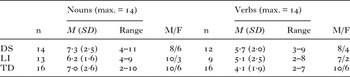
Three groups of mothers and their children with DS (31–101 months old), LI (31–53 months old), and TD (20–36 months old) participated. All participants were Caucasian and were from monolingual English-speaking homes. All children passed a hearing screening (see ‘Procedure’ section below). Children were recruited to be in the early stages of language development, defined as an expressive vocabulary of more than 100 words and an MLU below 3·5. As well, all children were reported by their mothers to produce at least two but no more than twelve of fourteen target nouns or verbs (see ‘Materials’ section below). This requirement meant that largely overlapping but somewhat different groups were formed for noun and verb analyses because a particular child might meet the criterion for target nouns, but not for target verbs, or vice versa. For the noun task analysis, fourteen children with DS (8 male, 6 female), thirteen children with LI (10 male, 3 female), and sixteen TD children (10 male, 6 female) participated. For the verb task analyses, twelve children with DS (8 male, 4 female), nine children with LI (7 male, 2 female), and the same sixteen TD children participated. The sixteen TD children were a subset of the nineteen children who participated in the Cleave and Kay-Raining Bird (Reference Cleave and Kay-Raining Bird2006) study. (Therefore, the TD data reported here is a subset of the data reported in the 2006 study.) Descriptive statistics for the number of target nouns and verbs (out of 14) reported produced by each group and the number of participants included in each analysis are presented in Table 1. Groups did not differ significantly on the number of target nouns (p = ·43) or verbs (p = ·15) they were reported to produce although the p-value for verbs suggests that groups were not well matched on this measure.
Means (standard deviations) and ranges for number of familiar target nouns and verbs reported produced by children, by group (DS, LI, TD)

notes: DS = Down Syndrome, LI = language impaired, TD = typically developing; M = mean, SD = standard deviation, M/F = males/females.
The inclusion criteria for the groups differed in some ways as well. All children with DS were reported to have Trisomy 21. The children with LI performed more than 1·5 standard deviations below the mean on one or more tests of language ability. Sixty-nine percent (9 of 13) children with LI in the noun task and 67% (6 of 9) children with LI in the verb task exhibited expressive language difficulties only using this metric. All children in the LI group obtained an IQ score within one standard deviation of the mean (with the exception of one child who attained an IQ of 82). All mothers in the LI group reported concerns with the language development of their children and almost all children were either currently receiving language therapy, on the waiting list, or being monitored by a speech–language pathologist (11/13 for nouns; 8/9 for verbs). TD children scored no more than one standard deviation below the mean and 1·5 standard deviations above the mean on all standardized measures of cognition and language, and mothers reported no concerns or diagnosed difficulties with language, cognition, or learning for these children.
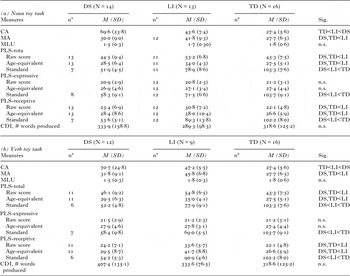
The three groups in the noun and verb analyses were matched on expressive vocabulary size, measured using the MacArthur-Bates Communicative Development Inventory (CDI; Fenson et al., Reference Fenson, Dale, Reznick, Thal, Bates, Hartung, Pethick and Reilly1993), a parent-report instrument. The reliability and validity of the CDI has been established for typically developing children and children with DS (Miller, Sedey & Miolo, Reference Miller, Sedey and Miolo1995). Young children with DS are often taught signs in the early stages of language development as an augmentative form of expressive language. Therefore, for this group, signed and spoken words were included in the estimate of vocabulary size. Two children with DS produced unique signs as well as spoken words (DS3: 52 signs and 95 spoken words; DS12: 45 signs and 69 spoken words). Matching on expressive vocabulary size meant that they were not matched on chronological age (CA), mental age (MA), and some language measures for groups in the noun and verb analyses. Table 2 (a) and (b) presents descriptive statistics for age, and cognitive and language measures for the three groups of children participating in the noun and verb analyses, respectively.
Participant characteristics by group (DS, LI, TD), for the noun and verb toy tasks

notes: N = the number of participants in each group for the noun and verb tasks; na = the number of participants included in each analysis; CA = chronological age in months; MA = either the Mental Scale of the Bayley Scales of Infant Development, 2nd ed., or the average of the Bead Memory and Pattern Analysis subtests of the Stanford-Binet Intelligence Scales, 4th ed.; PLS = Preschool Language Scales-3; CDI = MacArthur Inventories of Communication Development; * = significant at the .05 level; n.s. = not significant; MA and age-equivalents in months.
Materials
Target nouns and verbs
In total, twenty-eight target words, fourteen nouns and fourteen verbs, were selected for use in the experimental tasks. Half of the target nouns and verbs were selected to be familiar and half to be unfamiliar to children in the early stages of language development, based on the results of pilot testing. Target nouns were fourteen animal names, seven predicted to be familiar (i.e. bear, cow, dog, elephant, horse, monkey, pig) and seven predicted to be unfamiliar (i.e. buffalo, giraffe, koala, lizard, moose, panda, raccoon). Target verbs were fourteen transitive action labels, seven predicted to be familiar (i.e. blow, drive, feed, hit, open, push, wash) and seven predicted to be unfamiliar (i.e. fan, latch, load, pump, sail, scrub, yank). A target word was determined to be familiar for a specific child if the mother reported they produced the word; a target word was considered unfamiliar if the mother reported they did not produce the word in a modified version of the CDI. The CDI was modified by inserting twelve target words at appropriate locations in the CDI form (e.g. nouns were included in alphabetical order in the animals section). The other sixteen target words were already included in the original CDI. Mothers were thus asked to report their child's knowledge of target words in the same way they reported knowledge of any other word in the CDI. Therefore, individual children differed in the number of words that were determined to be familiar or unfamiliar to them and in which words were identified as such.
Animal toys
To elicit talk about target nouns, fourteen mother and baby pairs of plastic toy animals were provided with accompanying props such as boxes, troughs, and fences, which could be used in scripted play.
Action boxes
In order to elicit talk about the target verbs, specially designed action boxes were created, one for each experimental verb. These were wooden boxes that were painted in bright colours and had the target verb printed on the side. Each box could be acted upon with the targeted action. For example, the ‘hit’ box involved a stick attached with a string that could be used to hit a variety of bells.
Procedure
A human subjects’ ethics review was completed through Dalhousie University. The purpose of the study was to determine whether mothers in DS, LI, or TD groups spoke differently when talking to their children about familiar and unfamiliar nouns and verbs. Since knowing this might affect the way mothers talked to their children during the experimental tasks, efforts were made to withhold this knowledge until the end of the study. Therefore, mothers were not told the specific purpose of the study until after all testing was completed, at which point they were debriefed. In addition, the familiarity or unfamiliarity of a target word was determined by tapping a child's knowledge of these words within the context of completing the CDI, as described above.
Children and mothers attended two 90-minute sessions held within three weeks of each other. The modified CDI was completed in advance and brought to the first session. Responses were reviewed with the mother during the session. In the first session, a hearing screening was first completed using either otoacoustic emissions or behavioural testing. Next, standardized tests of cognition and language were administered and a language sample collected in play with the mother using a set of toys including several toy vehicles, a baby, dishes, and pretend food. The order of administration of the tests and language sample were individually randomized. Cognition was assessed using the Bead Memory and Pattern Analysis subtests of the Stanford-Binet Intelligence Scales, 4th edition (Thorndike, Hagan & Sattler, Reference Thorndike, Hagan and Sattler1986) or the Mental Scale of the Bayley Scales of Infant Development, 2nd edition (Bayley, Reference Bayley1993), depending upon the age and developmental level of the child. Three children in the DS group, eleven in the LI group, and none in the TD group were tested using the Stanford-Binet. Language was measured using the Auditory Comprehension (AC) and Expressive Communication (EC) subscales of the Preschool Language Scale-3 (PLS-3; Zimmerman, Steiner & Pond, Reference Zimmerman, Steiner and Pond1992). In addition, for the LI and TD groups, the Peabody Picture Vocabulary Test-Revised (PPVT-R; Dunn & Dunn, Reference Dunn and Dunn1981) was administered to assist in a determination of LI or TD group assignment. Standard, age-equivalent, and raw scores were obtained for all tests following the procedures outlined in the test's manual.
In the second session, four experimental tasks were completed: a toy play and a shared book-reading task involving either target nouns or target verbs. The noun tasks always preceded the verb tasks because the nature of the verb tasks raised concerns that mothers would discern the focus of the study and change their behaviour accordingly. Within noun and verb tasks, book reading and toy play were counterbalanced across children. The book-reading tasks are not considered further. In the noun toy task, mother and baby toy animals depicting each target noun, boxes for houses, fences, and containers for food were given to the mothers and they were instructed to play naturally with their child. For the verb task, fourteen boxes, each depicting a different target verb, were randomly placed in a semicircle and the mothers were instructed to try to explore every box with their child. The toy tasks were targeted to be 20 minutes in length; eight of the forty-three samples in both the noun and verb tasks lasted less than 20 minutes (Noun: M = 18·1, SD = 1·3, range = 15·5–19·5; Verb: M = 18·3, SD = 1·7, range = 15·0–19·5). The experimental tasks were videotaped for later analysis.
Analyses
Mother–child interactions during the noun and verb experimental toy tasks were transcribed using Systematic Analysis of Language Transcripts (SALT; Miller & Chapman, Reference Miller and Chapman1993) conventions. Recall that the child's familiarity with target words was determined through parent report using the CDI and differed across children (minimum 2 familiar, maximum 12 familiar, for both nouns and verbs). Mothers' utterances were coded for talk about familiar or unfamiliar target nouns and verbs, and for production of familiar or unfamiliar target noun and verb labels. In the verb task, the experimental words differed in terms of their likelihood of being produced outside the context of play with the verb boxes. To equate the opportunity for talk across experimental verbs, only talk that occurred when the mother and/or child were playing with the relevant verb box was included. The SALT program was used to sort mothers' utterances into four separate files for the noun and verb toy tasks separately. These were files that contained: (a) all utterances containing talk about familiar target nouns or verbs (i.e. familiar word topic utterances); (b) all utterances containing talk about unfamiliar target nouns or verbs (i.e. unfamiliar word topic utterances); (c) all utterances containing familiar target noun or verb labels (i.e. familiar label utterances); and (d) all utterances containing unfamiliar target noun or verb labels (i.e. unfamiliar label utterances). These eight files, created separately for each child, served as the corpora for the computing the measures used in all analyses. The impact of familiarity on the nature of the mothers' talk was analyzed using measures that addressed four areas: syntactic complexity, amount of talk, salience of target word productions, and presence of physical support for target word productions.
Syntactic complexity
Mean length of utterance in morphemes was used as a general measure of syntactic complexity. MLU was calculated for all utterances containing familiar or unfamiliar target noun or verb labels.
Amount of talk
The amount of talk was analyzed using three measures: the number of topic utterances produced per minute, the number of utterances containing target word labels produced per minute, and the proportion of topic utterances that contained familiar or unfamiliar target labels. The first two measures were each controlled for the differences in the number of target nouns and verbs that were familiar or unfamiliar for a given child, and differences in the length of samples. The first of these was done by dividing the total number of utterances containing talk about familiar (or unfamiliar) target nouns or verbs by the number of target nouns and verbs that were reported to be familiar (or unfamiliar) to a child. The difference in the sample lengths was controlled in the noun task by dividing the number of familiar (unfamiliar) topic or label utterances by the length of the sample in minutes. For the verb task, it was necessary to equate the samples on the amount of time spent playing with familiar and unfamiliar boxes, which controlled for the appeal of a particular box as well as the length of sample. Thus, the divisor for the verb task was the number of minutes spent playing with familiar (or unfamiliar) verb boxes. The third measure of amount of talk was computed by dividing the number of label utterances by the number of topic utterances separately for familiar and unfamiliar nouns and verbs.
Salience of target word productions
The salience measure was the proportion of the number of target labels produced as a single-word utterance or in final utterance position, divided by the number of label productions. In the noun task, the labels were coded as single-word productions if they were produced with an article (a/an, the) or not (e.g. a giraffe). In the verb task, the target verbs were transitive and almost never produced in isolation or in final utterance position. For verb analyses, therefore, target labels with an unstressed pronoun as object (e.g. push it or I will push it) but not, e.g. you push the car, were included as examples of verb targets in salient positions.
Presence of physical support for target word productions
The proportion of target label productions that were produced with physical support was calculated. In the noun toy task, physical support was defined as present when the target word was produced while the mother or child was touching, pointing to, or distinguishing non-verbally in some other way the referent animal from the rest of the toys. No physical support was when the referent animal was not present, when there was active looking for the referent animal, or when the animal was part of a group and there was no non-verbal indication as to which animal was being labelled. In the verb task, physical support was considered present when a target verb was produced immediately before, during, or after the referent action was demonstrated by the mother or child. No support was when the mother produced the target verb in the absence of a recent demonstration of the referent action.
Transcription and coding reliability
Ten percent of samples from nineteen of forty-three participants were transcribed and coded independently by two graduate students and point by point reliability calculated. Agreement for mothers' words was 97·5% (range across samples = 97% to 98%). Agreement for utterance boundaries was 93·6% (range across samples = 92% to 96%). Agreement for coding of support / no support was 95% (range across samples = 93% to 100%; κ = 0·90, range across samples = 0·85–1·0).
RESULTS
Two-way mixed ANOVAs, with group (DS, LI, TD) as the between-subjects variable and familiarity (familiar, unfamiliar) as the within-subjects variable, were conducted on each of the measures, for noun and verb toy task data separately. Alpha was set at ·05 a priori.
Noun toy task
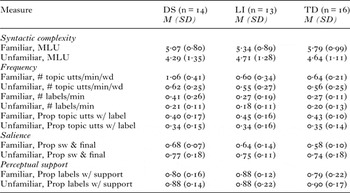
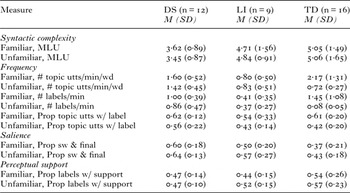
Descriptive statistics for the noun toy task measures are presented in Table 3, by group.
Noun toy play task: means (and standard deviations) for measures of syntactic complexity, frequency, salience, and presence of perceptual support measures, by group (DS, LI, TD) and familiarity condition (familiar, unfamiliar)

notes: MLU = mean length of utterance; utts/min/wd = utterances controlled for # minutes and words; w/ = with; sw = single word; prop = proportion.
Syntactic complexity
The analysis of MLU in utterances containing a target noun label revealed a significant effect of familiarity only (F(1,40) = 24·5; p < ·001; partial η 2 = ·380). The MLU for familiar utterances (M = 5·41, SD = 0·93) was significantly greater than the MLU for unfamiliar utterances (M = 4·55, SD = 1·23).
Amount of talk
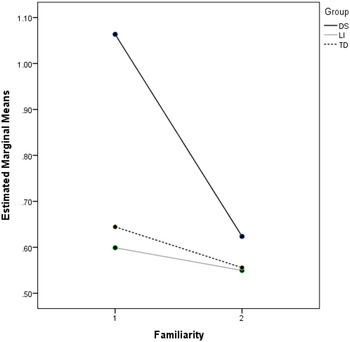
(a) The analysis of the number of noun topic utterances produced per minute per word revealed significant main effects of familiarity (F(1,40) = 10·9; p = ·002; partial η 2 = ·214) and group (F(2,40) = 6·2; p = ·004; partial η 2 = ·237). A significant interaction was also obtained (F(1,40) = 4·5; p = ·018; partial η 2 = ·182) (see Figure 1). Post-hoc paired comparisons of groups within each familiarity condition revealed that the interaction effect resulted from mothers of children with DS talking significantly more about target nouns in the familiar condition than either mothers of children with LI (p = ·002) or mothers of TD children (p = ·004). When familiar and unfamiliar data were compared for each group separately, only the mothers of children with DS had a significant result. They talked significantly more about familiar than unfamiliar nouns. (b) The analysis of number of utterances with target labels produced per minute per word revealed a significant main effect of familiarity (F(1,40) = 20·5; p < ·001; partial η 2 = ·339). Familiar labels were produced more often per minute (M = 0·32, SD = 0·20) than unfamiliar labels (M = 0·20, SD = 0·11). No other significant results were obtained for this analysis. (c) The analysis of the proportion of topic utterances containing a label revealed only a main effect of familiarity (F(1,40) = 15·5; p < ·001; partial η 2 = ·279). Familiar noun labels (M = 0·42, SD = 0·14) were produced in a significantly higher proportion of topic utterances than unfamiliar labels (M = 0·34, SD = 0·15).
Significant interaction of group and familiarity on the number of topic utterances mothers produced per minute per word in the noun toy task.

Salience of target word productions
A main effect of familiarity was obtained on this measure (F(1,40) = 19·9; p < ·001; partial η 2 = ·332). All groups produced proportionally more noun labels in single words or utterance final position in the unfamiliar (M = 0·75, SD = 0·16) compared to the familiar (M = 0·63, SD = 0·11) condition. No other significant effects were found.
Presence of physical support for target word productions
The main effect for familiarity approached significance on this analysis (F(1,40) = 3·35; p = ·075; partial η 2 = ·077). While noun labels were produced with support the majority of the time regardless of condition, there was a trend for support to be provided more often in the unfamiliar (M = 0·89, SD = 0·18) than the familiar (M = 0·82, SD = 0·17) condition, as predicted. No other effects reached significance.
Since there was only a trend for a familiarity effect in the previous analysis, an identical post-hoc analysis was completed using only first mentions (rather than all mentions) of noun labels by mothers. This time, a significant effect of familiarity was obtained (F(1,40) = 6·17; p = ·018; partial η 2 = ·158). When mothers mentioned noun labels for the first time in the animal toy play task, they produced unfamiliar labels in the presence of physical support (M = 0·97, SD = 0·10) significantly more often than familiar noun labels (M = 0·87, SD = 0·20).
Verb toy task
Descriptive statistics for the verb toy task measures are presented in Table 4, by group. One mother of a child with LI produced no familiar verb labels and therefore could not be included in any analyses involving the familiar verb label file.
Verb toy play task: means (and standard deviations) for measures of syntactic complexity, frequency, salience, and presence of perceptual support measures, by group (DS, LI, TD) and familiarity condition (familiar, unfamiliar)

notes: MLU = mean length of utterance; utts/min/wd = utterances controlled for # minutes and words; w/ = with; sw = single word; prop = proportion.
Syntactic complexity
The analysis of MLU in utterances containing a target verb label revealed a significant main effect of group only (F(2,33) = 6·23; p = ·005; partial η 2 = ·274). Post-hoc analyses showed that the MLU of mothers of the children with DS (M = 3·5, SD = 0·3) was significantly lower than that of mothers of children with LI (M = 4·8, SD = 0·4; p = ·025) or TD (M = 5·1, SD = 0·3; p = ·002). No significant difference between the MLU of mothers of LI and TD children was found.
Amount of talk
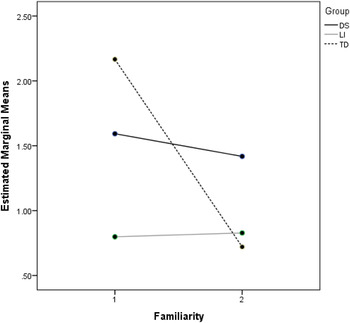
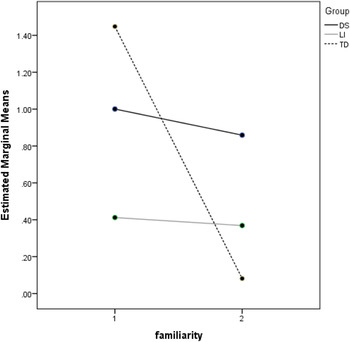
(a) In the analysis of the number of target verb topic utterances produced per minute per word, significant main effects of familiarity (F(1,34) = 11·28; p = ·002; partial η 2 = ·249) and group (F(2,34) = 4·72; p = ·015; partial η 2 = ·217) were obtained. The interaction was also significant (F(2,34) = 9·72; p < ·001; partial η 2 = ·364). As Figure 2 shows, the difference between familiar and unfamiliar utterances was much greater for the mothers of TD children than for mothers in the other two groups. Post-hoc paired t-tests revealed that familiar utterances were produced significantly more than unfamiliar ones for mothers of the TD children, and this difference approached significance for the mothers of children with DS (p = .058). One-way ANOVAs with follow-up paired comparisons showed that mothers in the TD and LI groups significantly differed in their production of familiar topic utterances, and mothers in the DS group differed significantly from both TD and LI groups in their production of unfamiliar topic utterances. (b) The analysis of number of utterances with target labels produced per minute per word revealed very similar results. There were significant main effects of familiarity (F(1,34) = 18·13; p < ·001; partial η 2 = ·348) and group (F(2,34) = 3·58; p = ·039; partial η 2 = ·174), as well as a significant interaction (F(2,34) = 14·16; p < ·001; partial η 2 = ·454). Post-hoc analyses showed that in this case both the mothers of TD children and those of children with DS produced significantly more familiar than unfamiliar utterances with labels, but this difference was again far greater for the mothers of TD children (see Figure 3). (c) The analysis of the proportion of topic utterances containing a target verb label resulted in a main effect of familiarity only (F(1,34) = 9·24; p = ·005; partial η 2 = ·214). Proportionately more labels were produced in talk about familiar (M = 0·60, SD = 0·21) than unfamiliar (M = 0·47, SD = 0·20) target verbs.
Significant interaction of group and familiarity on the number of topic utterances mothers produced per minute per word in the verb toy task.

Significant interaction of group and familiarity on the number of utterances with labels mothers produced per minute per word in the verb toy task.

Salience of target word productions
Analysis of the proportion of target verbs that were produced as single words or in final utterance position revealed a significant effect of group only (F(2,33) = 5·72; p = ·008; partial η 2 = ·269). Post-hoc analyses showed that mothers of children with DS (M = 0·62, SE = 0·05) produced target verb labels in salient positions more often than mothers of TD children (M = 0·40, SE = 0·04; p = ·007), but not the mothers of the LI children (M = 0·54, SE = 0·06; p > ·05). The talk of mothers of TD and LI children did not differ in this regard. While the unfamiliar labels were placed in utterance-final plus single-word positions more often than familiar words for all groups, the effect of familiarity did not reach significance (p = ·128).
Presence of physical support for target word productions
No significant main or interaction effects resulted from the analysis of the proportion of target verb labels produced in the presence of physical support. Approximately half of all labels were produced in the presence of physical support regardless of group or familiarity condition. To determine whether a familiarity effect would emerge if only first mentions were analyzed, an identical two-way post-hoc ANOVA was completed using first mentions of verb labels by mothers (rather than all mentions of labels). Again, no significant main effects or interaction were obtained.
DISCUSSION
The purpose of this study was to investigate whether mothers of children with DS, LI, or TD, group-matched for vocabulary production skills, fine-tune their input to their children on the basis of word familiarity. Input around both nouns and verbs was investigated. Familiarity was determined by embedding target words into the CDI, thereby masking the importance of these words to the study when mothers rendered their judgements and interacted with their children. Past research has investigated variation in talk about familiar and unfamiliar words in mothers' interactions with TD children (Cleave & Kay-Raining Bird, Reference Cleave and Kay-Raining Bird2006; Masur, Reference Masur1997; Masur & Eichorst, Reference Masur and Eichorst2002; Olson & Masur, Reference Olson and Masur2012), but this is the first study to investigate variations of this type in talk to children with DS or LI. One previous study investigated familiarity differences in mothers' talk about verbs (Cleave & Kay-Raining Bird, Reference Cleave and Kay-Raining Bird2006), and the TD sample in that study largely overlapped the TD sample in the present study.
Mothers' talk to children with DS, LI, or TD
As predicted, some group variation in the way mothers talked to their children emerged. In analyses of the noun play task, only one group difference emerged. Mothers of children with DS talked more than mothers in the other two groups about familiar nouns, and they also talked more about familiar than unfamiliar target nouns. It is possible that, by talking more about familiar nouns, mothers of children with DS were simply repeating the same information to their children. Children with DS have documented memory difficulties, and mothers may more frequently repeat themselves for this reason. On the other hand, it is also possible that mothers of children with DS were providing additional semantic information which served to extend their children's knowledge of familiar nouns. A separate analysis of these data has demonstrated that mothers of all groups go beyond simply repeating the same information when talking about familiar nouns to their children. They provide additional semantic information, specifically, talking more about the physical or distinguishing features (e.g. stripes of the zebra, growling of the bear) of the familiar animals compared to unfamiliar animals (MacDonald, New, Cleave & Kay-Raining Bird, in preparation).
More group differences emerged in analyses of mothers' talk about target verbs than target nouns. One finding was that the MLU of mothers of children with DS was lower on average than that of mothers in the other two groups. Producing shorter utterances when talking about verbs suggests that mothers of children with DS in this early period of language development are parsing their talk in such a way as to make the input syntactically simpler for their children. Why do mothers of children with DS do this? It may be that they recognize that their children have language processing and learning difficulties and they are attempting to compensate for these difficulties. The finding that mothers of children with DS place verbs but not nouns in salient utterance positions more often than the mothers of children with TD further supports this interpretation. Whether such compensatory strategies have been taught to mothers of children with DS by interventionists or are a spontaneous adaptation to their child's needs is unknown. It is the case that all the children with DS had participated in intervention programmes, often with a parent training component. It is interesting that the parsing differences observed in mothers with DS were present for target verbs only, which are thought to be cognitively and perceptually more complex than nouns and therefore more difficult for children to learn (Waxman, Fu, Arunachalam, Leddon, Geraghty & Song, Reference Waxman, Fu, Arunachalam, Leddon, Geraghty and Song2013). It is possible that mothers of children with DS recognize this and strategically simplify their talk about verbs in particular. Johnson-Glenberg and Chapman (Reference Johnson-Glenberg and Chapman2004) suggested that mothers of children with DS adjust their talk to the receptive rather than expressive language abilities of their children. Our findings do not support this claim, as the MLUs of mothers of children with DS in the present study differed from that of mothers of TD children in the verb task despite the groups of children having similar expressive and receptive language abilities.
Mothers in both the DS and TD groups talked more about familiar than unfamiliar verbs and produced more utterances with labels per minute per word for the familiar than unfamiliar verbs, but mothers of children with LI did not. This pattern of talking more often about familiar verbs, and repeating verb labels more often in the same period of time, is similar to the pattern observed for mothers of children with DS only in the noun toy play task. Once again, these findings may suggest that mothers are acting in ways that extend their children's semantic understanding of known verbs, although this once again awaits further study of the actual semantic content being produced in these familiar versus unfamiliar conditions. While the mothers of both children with DS and TD produced more familiar than unfamiliar topic utterances and utterances with labels, the mean difference between these measures of familiar and unfamiliar verbs was much more striking for the mothers of TD children (Figures 2 and 3). It is possible that mothers of TD children find their child's knowledge easier to read and therefore can adjust their talk to familiarity more clearly.
It is striking that the mothers of children with LI do not make the same adjustments observed in children with DS, even though both groups of children are experiencing language learning problems. The children in the LI group were almost all externally identified as having a language impairment, but not all had yet received therapy. As well, compared to the children with DS who are usually identified at birth, the diagnosis of LI, if present, was received more recently. It is likely then that the behaviour of the mothers of children with LI was less influenced by intervention than the mothers of the children with DS. Future studies should investigate the impact of previous intervention experiences on parental input more directly, and across diagnoses.
Whitehurst et al. (Reference Whitehurst, Fischel, Lonigan, Valdez-Menchaca, DeBaryshe and Caulfield1988) argued that mothers of children with LI adjust their talk to the expressive, not receptive, language abilities of their children, based upon similarities in the behaviours of mothers of children matched for expressive language ability. It is difficult to determine whether this is the case for the mothers in the present study. We matched groups of children on reported expressive vocabulary size, but mothers of children with LI acted similarly to mothers in the other two groups in some ways, but differently to them in other ways. This suggests that expressive vocabulary, if it was a determining factor affecting the way mothers of children with LI behaved, certainly was not always the driver of their behaviour. It should be noted that matching children with LI to the other groups on expressive vocabulary resulted in receptive language abilities that were significantly higher than those of the TD or DS groups. This was not surprising, as about 70% of the children with LI in the current study had expressive-only language problems. It would appear that the dissimilar profiles of language strengths and weaknesses in the three groups led to unique adjustments by mothers in the groups.
Mothers' talk about familiar versus unfamiliar words
We predicted that mothers would talk differently about words they thought were familiar versus unfamiliar to their child. Specifically, we expected mothers of all groups to produce novel words in shorter utterances, and more often in salient utterance positions and with physical support. This was observed for talk about novel nouns, although for the perceptual support measure the expected familiarity effect was significant only when first mentions (rather than all mentions) of the target noun label were analyzed. Research has shown that making words more perceptually salient by producing them in single-word utterances or final utterance position (Fernald & Mazzie, Reference Fernald and Mazzie1991), reducing the complexity of the utterance, and providing clear cues as to the referent for a word (Hoff & Naigles, Reference Hoff and Naigles2002), positively impacts novel word learning. The present study, then, consistent with past research (Clark, Reference Clark2010; Cleave & Kay-Raining Bird, Reference Cleave and Kay-Raining Bird2006; Masur, Reference Masur1997), provides evidence that mothers of children in all three groups (DS, LI, TD) fine-tune their talk to their young children in ways that would support novel noun learning. This is the first study to show that these facilitative adjustments are used by mothers of children with DS and LI.
We also hypothesized that mothers would make adjustments that support the extension of familiar word meanings in their children. Such adjustments were also observed, but not all of these adjustments were used by mothers in all groups. For example, only mothers of children with DS produced more topic utterances per minute when talking about familiar as compared to unfamiliar nouns, while mothers of TD children and, to a lesser extent, mothers of children with DS but not mothers of children with LI, produced more familiar verb topic utterances per minute. On the other hand, mothers in all groups used proportionately more labels when talking about familiar nouns and verbs compared to unfamiliar ones. Similar modifications were reported for mothers of TD children by both Masur (Reference Masur1997) and Cleave and Kay-Raining Bird (Reference Cleave and Kay-Raining Bird2006). The mothers Masur studied almost always named a familiar animal before providing additional semantic information, such as describing its parts or a characteristic of the animal. Thus, mothers seem to establish the referent clearly and then go on to tell the child more about the animal. In the present study, while mothers provided perceptual support more frequently for unfamiliar nouns, all noun labels were produced with support 79% or more of the time. Thus, familiar noun labels were frequently accompanied by physical support which likely provided an opportunity to directly illustrate other qualities of the animal while talking about it.
The above evidence suggests that mothers of all three groups fine-tune their input based upon their child's familiarity with particular nouns and verbs. Whether they do this consciously or not is unknown. Interestingly, we asked mothers to report which target nouns and verbs their children could produce before and after they completed the toy play tasks. Mothers in all groups reported their children knew more nouns and verbs after the play task than before, which suggests that mothers are quite attuned to the minute by minute changes in what their young child knows about individual words, and may be consciously manipulating their talk relative to the familiarity of words. Further study is needed.
Mothers' talk about familiar and unfamiliar nouns versus verbs
Mothers of children with DS, LI, and TD talked differently about familiar and unfamiliar nouns and verbs to their children. Modifications that support novel word learning were seen in noun tasks, while modifications that support the expansion of familiar word meanings were seen in both tasks.
The absence of talk that supported fast mapping of novel verbs was curious, since Cleave and Kay-Raining Bird (Reference Cleave and Kay-Raining Bird2006) reported that the mothers of the TD children they studied, whose data overlapped substantially with the present TD data, did use novel verbs more frequently in salient positions and with physical support, although not in shorter utterances. What happened? To test whether the type of analysis made a difference, we did a post-hoc reanalysis of the TD data in the present study using the same familiarity (2) by word class (2) ANOVA completed in 2006. The results were very similar, despite a slightly smaller sample (3 fewer participants). Specifically, for both measures, these new analyses revealed significant main effects of familiarity (unfamiliar > familiar) and word class (nouns > verbs) for both measures, and a significant interaction of word class and familiarity for the saliency measure. The interaction could be explained by a greater difference between familiar and unfamiliar nouns than familiar and unfamiliar verbs. Similiarly, when the 2006 data were reanalyzed using paired t-tests to compare familiarity (2) for nouns and verbs separately, as was done in the present analysis, a significant effect of familiarity was found for the nouns only for the saliency measure, and a trend for the nouns and significant effect for the verbs on the support measure. Thus, as might be expected, the number and type of variables entered in the analysis impacts the findings. The results of these reanalyses, in the light of the original results, suggest that familiarity effects in talk about verbs may be more evident in mothers' talk to typically developing children than to children with DS or LI, at least at this early period of language development. To tease out this possibility further, replication with a larger sample should be a goal of future studies.
Children acquire verbs in English less readily than nouns. Explanations have included claims that verbs are more conceptually difficult than nouns, are polysemous, often have multiple synonyms, and are more difficult to demonstrate because of their dynamic nature. In addition, the invariant features of verbs may be more difficult to perceive, and verbs are understood within an argument structure which must be acquired by children (Pence et al., Reference Pence, Golinkoff, Brand, Hirsh-Pasek, Trabasso, Sabatni and Massaro2005). Our data suggest another possibility – that mothers do not provide the same level of input support for novel verb acquisition as for novel noun acquisition at this early period of language development. It may be that their primary concern is to ‘teach’ nouns, not actions. They may also feel that the animal labels selected for this study were more relevant to their children's lives than the verb labels, and therefore expended greater efforts to teach ones they thought their child did not know. Regardless, the verb task did successfully lead mothers to talk to their children about the target actions, especially familiar ones, quite extensively, and to label them, even though mothers in all groups produced action labels less frequently with perceptual support than object labels. This would suggest that the opportunity to support fast mapping and extended mapping was present. It is possible that we did not investigate the critical ways in which mothers differentiate familiar and unfamiliar verbs in talk to their children. For example, Clark (Reference Clark2010) reported that fixed syntactic frames and emphatic stress mark talk about both unfamiliar verbs and nouns. Pence et al. (Reference Pence, Golinkoff, Brand, Hirsh-Pasek, Trabasso, Sabatni and Massaro2005) discuss how infants coordinate action and language to understand novel verbs (e.g. “Rooooollllllling” matched to the movement of a ball; p. 73). Children learn novel transitive action words more easily when presented in a semantically rich context; that is, including nominal rather than pronominal objects (i.e. roll the ball vs. roll it; Arunachalam & Waxman, Reference Arunachalam and Waxman2011), or adverbs that provide information about how the verb can be manipulated (i.e. slowly vs. nicely; Syrett, Arunchalam & Waxman, Reference Syrett, Arunchalam and Waxman2013). Mothers' use of strategies such as these to differentiate unfamiliar from familiar verbs should be explored in future studies.
CONCLUSIONS
This study has provided further evidence that mothers of typically developing children modify their talk to their young children based upon the child's knowledge of words, and the first evidence that this is done by mothers of children with DS or LI as well. Specifically, they talk differently about nouns that they report are familiar versus unfamiliar to their children. They do not do the same when talking about familiar and unfamiliar verbs, but this may reflect either the developmental level of the child or differences in the strategies mothers use to support the fast or extended mapping of different types of vocabulary.