1. Introduction
In this paper, we propose a common pool resource experiment (CPR) to study the role of bonding and bridging social capital in preventing the tragedy of the commons (Putnam, Reference Putnam2000).Footnote 1 Bonding social capital refers to trust within groups, while bridging social capital captures the formation of social capital between them. Much attention has been paid in the literature to CPRs to the conditions under which trust forms within groups (Blanco et al., Reference Blanco, Haller, Lopez and Walker2016; Ostrom et al., Reference Ostrom, Walker and Gardner1992; Reference Ostrom, Gardner and Walker1994; Schlager and Ostrom, Reference Schlager and Ostrom1992; Walker and Gardner, Reference Walker and Gardner1992). The role of intergroup relationships in preventing resource depletion has achieved less scrutiny in experimental studies on CPRs. However, there is ample ethnographic evidence on exchanges of gifts, food, or resources between tribes and collectives (Feil, Reference Feil1982; Hildebrand, Reference Hildebrand, Ettorre, Annandale, Hildebrand, Porroche-Escudero and Rothman2017; Piddocke, Reference Piddocke1965). Ritualized gift exchanges promote trust and lead to the building of institutions that improve efficiency, even if they appear inefficient (Gill and Thomas, Reference Gill and Thomas2023). They help communities mitigate risk against climate variability, avoid violent conflicts over resources, improve food security, and reduce poverty (Anbacha and Kjosavik, Reference Anbacha and Kjosavik2018; Dixit et al., Reference Dixit, Levin and Rubenstein2013; Obala et al., Reference Obala, Jaenz and Jenet2011).
There is no consensus on the factors that make some groups successful in building long-term resource-exchanges. This relates to the fact that most studies focus on a small number of cases where resource exchanges occurred, and hence may provide only partial results due to the biased sampling strategy. Case studies are not directly comparable due to the diversity of resource-sharing practices, which vary from: regular exchanges of ever-increasing gifts (moka), sporadic gifts of small presents (hxaro), to a commitment to help in the time of need without the necessity of reciprocation (osotua, see Aktipis et al., Reference Aktipis, Cronk and de Aguiar2011).Footnote 2 Moreover, existing studies do not allow the disentangling of the causal relationship between resource depletion and resource transfers or to study how they originate from individual behavior. To address this gap, in this paper, we take a different approach: we propose a common-pool experiment with renewable resources to study how the incentives to donate resources to another group change with resource depletion. The experimental method allows us to study the effects of various factors on intergroup sharing in a controlled laboratory environment. The method has proven useful in studying motives for action, e.g. in ultimatum and trust games, where the utility maximizing model has failed to predict participants' behavior (Smith and Wilson, Reference Smith and Wilson2019).
In our experiment, each round, after harvesting, group members can send some of their harvests to augment the resource of the outgroup. The reader may think of this as a form of livestock transfers between groups for breeding or communities exchanging seeds in order to increase and diversify their crops. We are interested in resource-sharing arrangements in the context of renewable resources. This is motivated by the fact that renewable resources can be sustained forever if managed properly, yet many of them are in decline because of over-extraction by group members. Resource depletion can be reversed by group members reducing temporarily their harvests, which would give the resource time to re-grow, or by receiving a transfer of resources from another group. In this context, resource transfers can be seen as insurance against environmental and social uncertainty that may prevent resource depletion and exhaustion.
We compare donations made by individuals collectively and independently of other group members, under two conditions: (1) of equal and unequal resources, and (2) in the absence and presence of matching donations, which makes sharing economically beneficial. In the baseline treatment, individuals decide for themselves how many tokens to send to another group. In the ‘vote’ treatment, groups act as the decision-makers. Here, after harvesting, the participants first vote on whether to donate resources to the outgroup. If the majority agrees, they vote on the size of a donation. One vote is subsequently selected and is binding for everyone in the group. This can be thought of as clans or their representatives deciding on donations. The question whether individuals or collectives are more likely to initiate resource sharing with outsiders is important. CPRs are often managed through customary, polycentric governance systems and social networks (Agrawal, Reference Agrawal2007; Niamir-Fuller, Reference Niamir-Fuller, Berkes and Folke1998). Individuals and groups have been shown to differ with respect to reciprocity, risk, and inequality aversion, which would affect patterns of intergroup sharing, depending on who decides on donations. For instance, groups may be more averse to disadvantageous, and less averse to advantageous, inequalities than individuals because of the influence of group identity on behavior (Chen and Li, Reference Chen and Li2009).
Studies comparing the behavior of groups and individuals typically come from one-shot games (e.g. Balafoutas et al., Reference Balafoutas, Kerschbamer, Kocher and Sutter2014; He and Villeval, Reference He and Villeval2017; Kugler et al., Reference Kugler, Bornstein, Kocher and Sutter2007). However, even if evidence from one-shot games does not show significant differences between the behavior of groups and individuals, such differences may arise in multiple-period experiments (Muller and Tan, Reference Muller and Tan2013). Moreover, reciprocity requires time to develop over time, which cannot be captured with one-shot games. Against this background, we examine decision-making by individuals and groups in a dynamic setting. We find that group voting reduces the frequency of intergroup donations. Moreover, voting makes subjects extract more resources, undermining both bonding and bridging social capital.
To study the role of inequality aversion in intergroup transfers, we propose the ‘inequality’ treatment, where groups start the experiment with different endowments. This treatment comes closest to the natural environment of intergroup interactions. We examine whether members of more affluent groups are willing to compensate outgroup members for ‘bad luck’, i.e. being assigned to a group with relatively fewer resources. We find that the probability of resource exhaustion is the largest when group voting is combined with unequal resources. Members of low-endowment groups overharvest resources in expectation of donations from affluent groups, which leads to the tragedy of the commons. This does not happen if individuals decide on donations independently of others.
Our study reveals that matching donations ensure stable resource exchanges between groups regardless of whether groups or individuals decide on donations. This suggests no difference in reciprocity between individuals and groups when sharing is economically beneficial. Matching donations, referred in the literature to as a matching gift, is a conditional commitment by the donor(s) to match the contributions of others at a given rate (Eckel and Grossman, Reference Eckel and Grossman2003; Kotani et al., Reference Kotani, Messer and Schulze2010; Meier, Reference Meier2007; Rondeau and List, Reference Rondeau and List2008). In the ‘matching’ treatment, donations are doubled before they augment the resource of the outgroup. We find that the policy increases the frequency of resource transfers from 15% in the ‘baseline’ treatment to 75%. The design of the ‘matching’ treatment can be motivated with an example of the Ereto I program, which was introduced to support the resource-sharing institution called ‘ewoloto’ (Kipuri and Sorensen, Reference Kipuri and Sorensen2008). Ewoloto is an indigenous mutual assistant mechanism, where young female livestock is transferred from more affluent to poorer households. It has been an important clan-based social institution to prevent families from falling below the poverty line, which has been waning over time. To reverse its decline, the program was introduced, where each donation from the community entering the program was matched by the same number of livestock animals as given by the community and additional support in the form of maize for human consumption. Matching donations have been successful in the program as well as in our experiment. However, the policy is costly to maintain.
The remainder of the paper is organized as follows. In section 2, we provide a brief overview of the related literature. In section 3, we discuss the technical details of our experiment and its theoretical predictions. Section 4 presents the results. Section 5 concludes and discusses policy implications of our findings.
2. Literature review
Our study relates to experimental studies on intergroup interactions: conflict and cooperation. In an important class of economic experiments, it has been shown that conflict increases cooperation within groups (Abbink et al., Reference Abbink, Brandts, Herrmann and Orzen2010; Cardenas et al., Reference Cardenas, Gomez and Mantilla2019; Gunnthorsdottir and Rapoport, Reference Gunnthorsdottir and Rapoport2006; Markussen et al., Reference Markussen, Reuben and Tyran2014; Reuben and Tyran, Reference Reuben and Tyran2010). Typically, studies compare behaviors of groups and individuals in the winner-take-all tournament, where the probability of winning a prize depends on contest investments made by each party (Tullock, Reference Tullock, Buchanan, Tollison and Tullock1980). It has been shown that contest expenditures made by groups are significantly larger than expenditures made by individuals (Abbink et al., Reference Abbink, Brandts, Herrmann and Orzen2010). Other studies examine the impact of conflict on extraction in the CPR experiment. In the experiment by Cardenas et al. (Reference Cardenas, Gomez and Mantilla2019), groups are ranked according to their performance with top performers receiving additional payoffs. This makes team members appropriate fewer resources to increase the chances of their team to outperform other groups. In the majority of studies, conflict is imposed on individuals. As an exception, Safarzynska and Sylwestrzak (Reference Safarzynska and Sylwestrzak2021) study factors that affect the frequency of conflicts in the experiment, where groups can decide whether to engage in conflict to annex land (resources) from another group. The authors consider treatments where the probability of winning: is proportional to the difference in resources between groups; depends on the number of tokens invested by each group member in conflict; is the same for both teams. The results show that conflict is the most frequent in the former treatment.
Experimental evidence on cooperation between groups typically comes from studies on the trust game (Cox, Reference Cox, Zwick and Rapoport2002; Kugler et al., Reference Kugler, Kausel and Kocher2012; Song, Reference Song2009). In the trust game, a player receives a monetary endowment and is asked to send some amount of her money to an anonymous second player, knowing that this amount will be multiplied by a positive constant. The second player can then return to the first player part of the amount received. Kugler et al. (Reference Kugler, Kausel and Kocher2012) show that groups are less trusting than individuals but just as trustworthy in the trust game. When face-to-face communication is considered, the difference in transfers between groups and individuals disappears, but groups send back significantly less than individuals (Cox, Reference Cox, Zwick and Rapoport2002). In the context of CPRs, between-group cooperation was studied by Chávez et al. (Reference Chávez, Murphy and Stanlund2018). The authors examine how resource users deter outsiders from poaching and how poaching affects the willingness to cooperate within groups. As another example, Vollstädt and Böhm (Reference Vollstädt and Böhm2019) explore whether relationships between groups tend to be more competitive and/or less cooperative than relationships between individuals. In this paper, we base the design of our ‘baseline’ treatment on the ‘sharing’ treatment in Safarzynska (Reference Safarzynska2017). The author compares the frequency of sharing resources between groups in the absence and presence of shocks destroying resources. The results reveal that shocks do not affect the frequency of donations between treatments, yet they make subjects harvest more. We extend here this study by group voting, inequality, and matching donations so as to examine different motives for sharing. We are interested in whether sharing evolves as an insurance mechanism against environmental and social uncertainty. In our experiment, donating resources to another group is payoff-reducing in the short run, but may prevent resource collapse in case group members overharvest their resource.
Our study relates also to the literature on bonding and bridging social capital (Putnam, Reference Putnam2000). Bridging social capital measured by trust or relationships between communities has been shown to improve economic growth, employment, and development (Beugelsdijk and Smulders, Reference Beugelsdijk and Smulders2009; Knudsen et al., Reference Knudsen, Florida and Rousseau2010). Baylis et al. (Reference Baylis, Gong and Wang2018) were the first to examine the impact of bonding and bridging social capital on the CPR management. The authors measure bonding social capital with the trust game played between villagers in Yunnan, while bridging social capital with the percent of days that household members spent outside their townships. They find that bonding social capital reduces firewood collection on the communal lands. On the other hand, the higher levels of community bridging social capital increase CPR consumption. Bridging social capital gives villagers an extensive social network outside the community, reducing their vulnerability to social sanctions, which limits the enforcement capability of the community. In the current paper, we examine how different factors affect simultaneously bridging and bonding social capital and the relationship between them, which has not been studied before. In our experiment, bridging social capital takes a form of resource transfers between groups, whereas the decisions of players to conserve resources are indicative of bonding social capital. In particular, sharing the common resource aligns the fate of group members and may create social identity among them.
3. Methods
In the experiment, individuals harvest resources repeatedly for 30 rounds from the common pool of resources. Each group has access to its own renewable resource, which is diminished by total harvests by in-group members, and then re-grows according to a logistic function, depending on the resource stock in the common pool left after harvesting (Brown, Reference Brown2000; Chermak and Krause, Reference Chermak and Krause2002; Schaefer, Reference Schaefer1957). A logistic equation has been shown to describe well the dynamics of renewable resources such as crops, fisheries, livestock populations, or forests (Botelho et al., Reference Botelho, Dinar, Pinto and Rapoport2014). Groups are matched in pairs, to which we refer to as the partner groups, and in which they interact over the entire experiment. The participants observe resources and harvests in both groups before deciding on donations. In the ‘baseline’ treatment, each subject decides independently of other group members how much of his/her harvest to donate to the outgroup. We consider three intergroup factors: (1) group voting; (2) unequal resources; and (3) matching donations. In particular, in the ‘vote’ treatment, groups act as the decision-makers. In all treatments, groups start the experiment with the same level of resources with the exception of the ‘inequality’ treatment, where partner groups have access to unequal resources. Finally, in the ‘matching’ treatment, donations are doubled before they augment the resource of the outgroup.
A total of 324 students participated in 18 sessions. Subjects were recruited at the University of Warsaw, using ORSEE (Greiner, Reference Greiner2004). There were 133 male participants and 191 female participants with an average age of 25.10 (±5.35). The experiment has six treatments, which can be thought of as a 2 × 2 design in the ‘inequality’ and ‘vote’, and a 2 × 2 design in ‘vote’ and ‘matching’ (see Appendix D for instructions). In particular, 54, 66, and 54 subjects participated in the ‘baseline’, ‘inequality’, and ‘matching’ treatments, respectively. Female participants constituted on average 66, 47, and 59% of the corresponding samples. In the ‘vote’, ‘inequality and vote’, and ‘matching and vote’ treatments, groups acted as collectives. In these treatments, 54, 48, and 48 subjects participated, of which female participants constituted 56, 64, and 64%, respectively. Each treatment was conducted in three separate sessions. Subjects earned on average about PLN 47.40 (±22.93), which corresponds to €11.29 (±5.46) per experiment, using the conversion rate PLN 4.2 = €1. The experiment was programmed and conducted using software z-Tree (Fischbacher, Reference Fischbacher2007). Table 1 provides an overview of sessions and equilibrium predictions.
Overview of sessions and equilibrium predictions

a Values are computed as mean values between low- and high-endowment groups.
In each session, participants were randomly seated in front of computers with partitions between them. The identities of group members were never revealed to participants. Each session was divided into three parts. In the first part, subjects were asked to answer some questions in a pre-experiment questionnaire. This includes: the IQ test; hypothetical trust and dictator games; and the risk elicitation task. The answers from the IQ test were incentivized.
In the second part, students were given the opportunity to learn the dynamics of the harvesting game in five rounds of training, i.e. in the absence of sharing. In particular, the subjects were asked to harvest resources repeatedly for five periods. The initial level of resources was equal to 45. After harvesting, the resource re-grew according to the logistic equation R t+1 = R t + rR t(1 − R t/K) − X t, where r = 0.1 captures the intrinsic growth rate of resources; K = 80 is its carrying capacity; rR t(1 − R t/K) is a re-growth of resources, while Xt are total harvests in the group. In the actual experiment, subjects harvest resources in groups of three. In the rounds of training, the decisions of the other two group members were chosen randomly by a computer.
The rounds of training were followed by the third part, i.e. the actual experiment. During this part, students were divided into groups of three. Afterward, the groups were matched into pairs, which we refer to as partner groups. The composition of groups and partner groups stayed the same over the entire experiment. Each group had access to its own renewable resource, equal to 45 tokens, just as in the rounds of training with the exception of the ‘inequality’ treatment. The players were asked to harvest resources repeatedly from the common pool. Players obtained information about harvest decisions of each co-player, appearing in a random order on the screen after each round. This meant that they could not track who harvested how much over time. The maximum extraction by each player could not exceed 1/3 of tokens in the common pool. This assumption does not affect the Nash–Markov (symmetric) equilibrium prediction.
In each treatment, subjects harvest resources repeatedly from the common pool of resources. In the ‘baseline’ treatment, after harvesting, the participants are asked whether they would like to donate some of their harvests to augment the resource of the partner group. Each person selects how many tokens she wishes to donate, which are then deducted from her payoffs, and are added to the resource stock of the partner group. Before deciding on donations, participants are informed about the total harvests and resources in both groups. They are also informed that members of the partner group would be asked simultaneously to donate some harvests to their group. After sharing, subjects receive information about the total amount of tokens sent by their group members to the outgroup, and the tokens received.
In the ‘vote’ treatment, subjects decide collectively on how much harvests to donate to the outgroup in a two-stage procedure. In the first stage, subjects vote on whether to donate harvests. If the majority opts for sharing, in the second stage, each member then votes on the size of the donation. A random vote is selected and is binding for everyone. This value is subtracted from the harvests of each group member, and the sum of the individual donations is added to the CPRs of the partner group. We use here an incentive-compatible mechanism called the random dictator rule, which implies that everyone has the same chance of dictating the outcome (e.g. Rutstrom and Williams, Reference Rutstrom and Williams2000). This allows us to study individual preferences over how much subjects believe group members should share with the outgroup, eliminating incentives for strategic considerations.
In all treatments, groups start with the same level of resources with the exception of the ‘inequality’ treatment, where groups matched in pairs start the experiment with unequal resources. In particular, one group has access to the same level of resources as groups in the ‘baseline’ treatment (K = 80, R 0 = 45), while its partner group has access to a 20% larger pool of tokens (K = 100, R 0 = 55). We will refer to these groups as high- and low-endowment groups, respectively. The participants are informed at the beginning of the third part of the experiment that they will interact with a group which has less/more resources than their own. In the ‘inequality and vote’ treatment, group voting is combined with unequally distributed resources. Finally, we conduct two additional treatments where donations are being matched by the experimenter. In particular, in the ‘matching’ treatment, the donation is doubled before augmenting the resource stock of the outgroup. In the ‘matching and vote’ treatment, matching donations and group voting are combined. Formally, in the third part of the experiment, the resource re-grows according to the logistic equation, which is modified compared to the rounds of training by the additional component bY t: R t+1 = R t + rR t(1 − R t/K) − X t + bY t. Here, Y t is a donation from an outgroup, and b is a factor by which each donation is multiplied before augmenting the resource. Parameter b is equal to 2 in the presence of matching donations, and 1 otherwise.
The experiment lasts for 30 periods. Subjects were not informed about the exact number of rounds, only that the experiment would not exceed in total 1.5 h. This way we avoided the end period effect. Members of groups, which exhausted resources, were asked to stay in the room until the end of the experiment, but they could not participate in the game anymore. If a group exhausted its resources, i.e. the number of tokens in the common pool felt below one, its members lost all their payoffs accumulated up to the moment of resource exhaustion. This created a strong incentive to conserve resources. A similar assumption can be found in the collective-risk social dilemma game (Milinski et al., Reference Milinski, Sommerfeld, Krambeck, Reed and Maotzke2008). We introduce this assumption as, in the standard CPR experiment, the unique sub-game perfect Nash equilibrium, the resource is depleted immediately (Noussair et al., Reference Noussair, van Soest and Stoop2015). To avoid the game from ending too soon, we provided subjects with strong incentives to conserve resources. This allowed us to study the evolution of resource-sharing over time. In fact, the majority of groups have diminished resources substantially in the early (five) rounds of the experiment. Unharvested resources did not provide any value to the participants. Regardless of the outcome of the experiment, students retained a show-up fee of PLN 10 (~€2.4) and the money earned in the pre-experiment questionnaire.
3.1 Theoretical predictions and hypotheses
In each group, n individuals i decide simultaneously at time t how much of the resource to harvest xit from the common-pool resource Rt. The duration of the game is determined endogenously by collective decisions. In particular, the game ends in case resources become exhausted. After harvesting, subjects decide how many tokens to donate to the partner group to augment its resource stock. Before subjects decide on donations, they observe the other group's current stock level and harvest.
The predictions are derived for self-interested agents. The utility of individual i at time t depends on his/her harvests xit and the fraction of harvests α it sent to the outgroup:

Subjects maximize the cumulative payoffs over time:


given the initial level of the resource R 0. Parameter θ is the discount rate; 0 < r < 1 is the intrinsic growth rate of resources; K is its carrying capacity; $\dot{R}_t = rR_t( 1-R_t/K)$ captures the natural growth or regeneration of resources; while total harvests Xt is the sum of harvests by n individuals: $X_t = \sum\nolimits_i {x_{it} \le R_t}$
 . We assume the symmetry of harvests so that xit is the same for all individuals in a group.
Expression f (α itX it) in equation (3) captures the expected donation from the outgroup as a function of group's own donation (α itX it ). Parameter b = 2 in the presence of matching donations, and it is equal to 1 otherwise. To derive equilibrium predictions, we solve the Bellman equation with the state variable R t, and the control variables X it and α it. This gives the following solutions (see Appendix B for derivations):


In the absence of intergroup sharing, the social optimum requires that the resource remains at half of its carrying capacity K/2, while group members consume its renewal rate (X = rK/4). This translates into the optimal levels of harvests and resources equal to 2 and 40 tokens in the social optimum, respectively. Our model predicts the tragedy of the commons. In particular, subjects are expected to harvest more initially than socially optimal, which would lead to resource depletion. In the equilibrium, harvests are equal to X* =1.45 tokens at the level of resources R* =18.95, which is less than half of the socially optimal level of resources. These numerical values are calculated by substituting K, r as in the experiment and θ = 0.95 into equations (4) and (5). An increase in the discount rate would result in more resources and greater extraction in the equilibrium, while reducing it would work in the opposite direction. In the ‘inequality’ treatment, groups are characterized by different carrying capacities. As a result, the expected and optimum levels of harvests and resources are slightly higher here than in the ‘baseline’ treatment. The theoretical predictions for low-endowment groups are the same as in the baseline, while we expect that in high-endowment groups, harvests and resources will be equal to 1.8 and 23.7 tokens, respectively. This follows from substituting K = 100 into equations (4) and (5).
Table 1 summarizes the expected and socially optimal levels of harvests and resources in each treatment. Below, we formulate four hypotheses regarding resource-sharing between groups:
H1: If b = 1, no resource transfers will occur under the assumption of agents maximizing self-regarding payoffs, regardless of whether individuals or groups act as decision-makers.
Our model predicts that in the baseline, participants will not donate harvests to the outgroup. Formally, we derive the optimal fraction of harvests α to be donated to the outgroup as α = 1 − 1/b, where b is the factor by which a donation is multiplied before augmenting the resource of the outgroup. In the ‘baseline’ treatment, b is equal to 1, and thus it is optimal to send nothing (α = 1 − 1/b = 0). Our model assumes players, who maximize their own payoffs. Voting does not affect our theoretical predictions.
H2: Resource-sharing may occur in the ‘inequality’ treatment because of inequality aversion.
Previous evidence suggests that individuals express some inequality aversion toward members of other groups (e.g. Balafoutas et al., Reference Balafoutas, Kerschbamer, Kocher and Sutter2014; He and Villeval, Reference He and Villeval2017; Kugler et al., Reference Kugler, Bornstein, Kocher and Sutter2007). As a result, wealthier individuals may be willing to compensate members of low-endowment groups for their ‘bad luck’, i.e. assignment to less affluent groups, because of inequality aversion (Falk and Fischbacher, Reference Falk and Fischbacher2006). Against this background, we expect to observe donations from high-endowment groups in the ‘inequality’ treatment. There should be no differences in donations decided by individuals in the ‘inequality’ treatment and as part of a group in the ‘inequality and vote’ treatment. If such differences do occur, it would be indicative of differences in inequality aversion between individuals and groups.
H3: In the presence of matching donations, subjects will donate half of their harvests to the outgroup.
The presence of matching donations (b = 2) changes equilibrium predictions. In the social optimum, everyone would achieve the highest payoffs if group members harvested all resources and shared most of them with the outgroup each period. This would allow resources to grow exponentially. Anticipating this solution, we informed participants in the ‘matching’ and ‘matching and vote’ treatments that the total monetary payoffs from this part of the experiment cannot exceed PLN 100 (€24) regardless of their performance. One pair of groups achieved the payoff-maximizing solution. Their members would have earned on average above €400, which exceeds substantially payoffs in economic experiments, if we did not place the cap on payoffs. The cap changes the optimal strategy. In particular, it becomes optimal to donate most harvests to the outgroup until reaching the maximum payoffs, and stop donating afterward. We expect actual donations to be below their socially optimal level. In the equilibrium, according to equation (5), subjects are expected to donate half of their harvests to the outgroup (α = 1 − 1/2 =0.5).
H4: Donations from an outgroup can prevent exhaustion of resources when they are close to their ecological limits. As a result, resource scarcity can trigger donations as insurance against environmental risks.
We calculate the optimal harvests and resources in the equilibrium as$\;X^{\rm \ast } =$ 1.45 and R* =18.95 for the discount rate θ = 0.95. At a low discount rate, e.g. θ =0.915, these values are X* =0.27 and R* =2.84, implying a high probability of resource exhaustion. Subjects can reduce the probability of resource exhaustion by receiving a donation from another group. In this case, it would be optimal to donate some resources so that the partner group reciprocates such a donation.
4. Experimental results
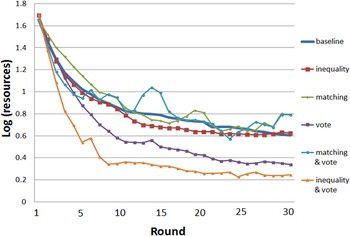
In this section, we present our experimental results. Figure 1 illustrates mean resources over time in different treatments. Most groups substantially overharvested resources in the first five rounds of the experiment. Resources are the largest in the presence of matching donations, followed by the ‘inequality’ and ‘baseline’ treatments. Resources are the most diminished in the ‘vote’ and ‘inequality and vote’ treatments. In Figure 1, we exclude one pair of groups in the ‘matching’ treatment. The successful pair solved the social dilemma, which allowed resources to grow exponentially over time. Only one pair of groups achieved this payoff-maximizing solution. This might have been caused by the cap placed on payoffs in the presence of matching donations. However, the cap only provides a partial explanation as 17% of groups exhausted resources in this treatment.
Logarithm of mean resources over time.
Note: In the matching treatment, we exclude the pair of successful groups from the mean.

Resource extraction by each pair of groups is shown in Appendix C. Two observations are worth mentioning. In most groups, resources decline steadily over time. In the ‘inequality and vote’ treatment, most groups overharvest resources in the initial two to five rounds of the experiment, maintaining them later only at the minimum level required for the game to continue, i.e. above one token in the common pool. On the contrary to other treatments, in the presence of matching donations, patterns of extraction and resources are cyclical. In particular, group members overharvest resources causing their depletion, with consecutive donations restoring resources to their previous levels.
Table 2 summarizes means computed at the group and partner-group levels. A partner group constitutes a unit of an independent observation in the statistical analysis because of between-group interactions. We examine if differences between treatments are statistically significant using the Mann–Whitney tests. The results are summarized in Supplementary Tables A1(a–e), which we also discuss below. In sections 4.1–4.4, we verify hypotheses 1–4, respectively.Footnote 3
Main statistics at the individual, group, and partner-group levels

a α stands for a fraction of harvests sent to the outgroup.
b p is the frequency of resource transfers.
c Excluding the pair of successful groups; standard deviations in parentheses.
4.1 ‘Baseline’ and ‘vote’ treatments
Result 1: Resource transfers were common in the ‘baseline’ treatment, when group members decided on donations independently of other group members. Voting undermined intergroup resource sharing.
Our theoretical model predicts that intergroup resource-transfers should not occur in the equilibrium of the ‘baseline’ treatment under the assumption of self-regarding payoff-maximizing agents. Nevertheless, we find that in 89% of groups, subjects donated some resources to the outgroup (Table 2). The frequency of sharing p is equal to 15% in the ‘baseline’ treatment, which is measured as the number of periods during which a donation was made, divided by the number of periods during which resource-exchanges were possible, i.e. both partner groups had positive resources. On average, subjects sent a small fraction of their harvests to the outgroup, equal to α = 0.05 (Table 2).
Group voting reduces the probability of intergroup cooperation as well as the frequency of sharing among groups, which engaged in resource-transfers. We find that 78% of groups in the ‘vote’ refrained from sharing. This happened only in 11% of groups in the ‘baseline’ treatment (Table 2). Moreover, voting reduces the frequency of donations from 15% in the baseline to 3% in the ‘vote’ treatment (p < 0.001).
4.2. ‘Inequality’ and ‘inequality and vote’ treatments
Result 2. Inequality of resources imposed on groups at the beginning of the experiment does not affect the frequency of sharing or the mean donation compared to the ‘baseline’ treatment.
How does inequality of resources affect resource-sharing? We find no statistically significant differences in the frequency of sharing, resources in the last period, and the total and mean donations between the ‘inequality’ and ‘baseline’ treatments (Supplementary Tables A1(a–f)). In the ‘baseline’ treatment, 89% of groups engaged in resource exchanges compared to 91% of groups in the ‘inequality’ treatment. In the latter, the frequency of sharing is equal to 0.2, which is not significantly different from 0.15 in the ‘baseline’ treatment, according to the Mann–Whitney test (p = 0.5, see Supplementary Table A1(e)). Comparing the mean donations by low- and high-endowment groups in the first period supports these findings. The mean donation in the first period in the ‘baseline’ treatment is equal to 1.39(±2.13) tokens, which is not statistically significantly different from 1.1(±2.69) tokens sent on average by low-endowment groups, or from 2.28(±2.34) tokens sent by high-endowment groups.Footnote 4 The donation from high-endowment groups is significantly larger than donations by low-endowment groups, but only at the 10% significance level.
Figure 2 shows the logarithm of the ratio between resources in the high-endowment group (R1) to the low-endowment group (R2) for each pair of groups in the ‘inequality’ treatment in each round. The value of this ratio equal to 0 indicates that both groups have the same number of tokens in the common pool, while the ratio above (below) 0 implies that a high-endowment group has more (less) resources than a low-endowment group in a given round. The figure illustrates that in about 50% of groups, the resource advantage changed between groups relatively often or the ratio fluctuated around 0. This suggests that groups might have used sharing as an insurance mechanism against resource variability. Only in three pairs of groups (out of 11) did a high-endowment group have a resource advantage in all rounds.
Evolution of resource advantage in the ‘inequality’ treatment.
Note: R1 and R2 capture resources in the high- and low-endowment group, respectively. Green solid lines indicate pairs of groups, in which one group exhausted resources; red dashed lines indicate pairs of groups in which a high-endowment group had resource advantage in all rounds; blue dashed lines show fluctuations in resource advantage in other pairs of groups.

Result 3: Voting under resource inequality leads to the tragedy of the commons. This can be explained by the fact that voting for donations makes subjects extract more resources.
Under unequal resources, the patterns of sharing are similar to those observed under equal resources. In particular, 91% of groups in the ‘inequality and vote’ treatments refrained from sharing compared to 9% in the ‘inequality’ treatment (Table 2). Voting reduced the frequency of donation from 20% in the ‘inequality’ treatment to 3% in the ‘inequality and vote’ treatment (p < 0.001).
The results in Figure 1 indicate that the combination of unequal resources and group voting is conducive to resource depletion. Resources in the last period are significantly lower in the ‘inequality and vote’ treatment (R = 1.2 ± 0.5) compared to the ‘baseline’ (R = 3.8 ± 3.4; p < 0.05) and to the ‘inequality’ treatment (R = 3.7 ± 3.1; p < 0.05). As a result, 31% of groups exhausted resources by the end of the experiment in the ‘inequality and vote’ treatment, which is significantly more compared to 6% of groups in the ‘baseline’ treatment (F(1,36) = 6.12; p < 0.02, see Appendix A). Interestingly, none of the high-endowment groups (K = 100) exhausted its resource, while the frequency of resource collapse among low-endowment groups was 63%. This exceeds 10 times the probability of resource exhaustion in the ‘baseline’ treatment, thus of groups that had access to the same level of resources initially. In other treatments, the probability of resource exhaustion varies between 13 and 17% (Table 2).
The results from panel regressions support that the combination of inequality and group voting makes subjects overharvest resources. In particular, Table 3 summarizes the results from the panel regressions with the dependent variable equal to the fraction of harvested resources by subjects. Model 1 presents the results from regressions with random effects run on the sample of data pooled from ‘baseline’, ‘inequality’, ‘vote’, and ‘inequality and vote’ treatments. In turn, models 2–7 summarize the results from the Hausman–Taylor estimator for each treatment separately. The estimator accounts for the endogeneity of harvests and donations: subjects decide on donations after harvesting. In particular, in models 2–4, we specify the following as endogenous variables: a lagged value of the standard deviation of harvests and the number of tokens sent to the outgroup at time t. In models 5–7, the latter variable is replaced by the dummy variable, which takes a value equal to 1 if a subject voted for donations at time t and 0 otherwise.
Evidence from panel regressions (random effects) with the dependent variable equal to the fraction of harvested resources by subjects

Note: We cluster errors at the partner group level. The sample includes only data in case both groups have positive resources. Standard errors in parentheses.
*** Indicates variables significant at the 1 percent level, ** at the 5 percent level, and * at the 10 percent level;
a Indicates that estimates exclude the successful pair of groups.
We include the following independent variables into regressions: the resource of the partner group in the past round (in logarithm); period; the mean fraction of resources harvested by subjects during the rounds of training; age; gender, which takes the value of 1 if a subject is female and 0 otherwise; and the outcomes of the pre-experiment questionnaire. In particular, the variables ‘trust’ and ‘divide’ measure the fraction of PLN 5 (€1.2), which subjects are willing to give to another (hypothetical) person in the trust and dictator games respectively. ‘Risk’ indicates a fraction of PLN 5 which subjects are willing to invest in the risky project. Total IQ measures the number of correct answers in the cognitive test.
We find that the coefficient corresponding to the ‘inequality and vote’ treatment dummy has a statistically significant and positive impact on the fraction of harvested resources (model 1). The dummies corresponding to the ‘vote’ and ‘inequality’ treatments are insignificant in explaining extraction. Nevertheless, the results from panel regressions provide some evidence that voting for donation makes subjects extract more resources also in the ‘vote’ treatment. In particular, the dummy variable taking a value equal to 1 if a subject voted for donations in a given round has a positive and significant impact on the fraction of harvested resources in the ‘vote’ and ‘inequality and vote’ treatments (models 5 and 6).
Result 4. Inequality aversion explains the donations by groups but not by individuals.
To examine if inequality aversion can explain our findings we conduct the regressions with the dependent variable takes a value of 1 if a subject donated her harvests to the outgroup at time t in treatments where individuals acted as the decision-makers, or voted for sharing in treatments with collective decision-making. We assume a nested structure of the error terms, where we cluster errors within groups, partner-groups, and finally within sessions in the analysis. We include the following explanatory variables: the difference between own and partner group’ harvests if the difference was positive at time t max(H1-H2,0), and in case the difference was negative max(H2-H1,0); and analogously calculated the difference between own and partner group's resources if the difference was positive max(R1-R2,0) and negative max(R2-R1,0). The detailed results from panel regressions are reported in Supplementary Tables A3(a–e). Table 4 summarizes coefficients corresponding to advantageous and disadvantageous inequalities of resources and harvests.
Estimates of inequality aversion from the mixed-level logit regressions with the dependent variable equal to 1 if a subject donated some of her harvest to an outgroup, or voted for sharing, and 0 otherwise

Note: Standard errors in parentheses.
***Indicates variables significant at the 1 percent level, **at the 5 percent level, and *at the 10 percent level.
Our results suggest that distributive concerns play no role in explaining donations by individuals. In particular, the coefficients corresponding to advantageous inequalities of harvests and resources turned out to be insignificant in almost all regressions where individuals acted as the decision-makers, namely in the ‘baseline’ and ‘inequality’ treatments (Table 4). A different picture emerges in the case of collective decision-making. The coefficients corresponding to advantageous inequality of resources have a positive and statistically significant impact on subjects voting for sharing in the ‘vote’ and ‘inequality and vote’ treatments. In the ‘inequality and vote’ treatment, also the coefficient corresponding to advantageous inequality of harvests turned out to be statistically significant (Table 4).
4.3. ‘Matching’ and ‘matching and vote’ treatments
Result 5. Under matching donations, the difference in resource transfers between groups and individuals disappears. Nearly all groups have established long-lasting resource-exchanges regardless of who decided on the donations. Only one pair of groups achieved a payoff-maximizing solution in the matching treatment.
In the presence of matching donations, almost all groups have established frequent exchanges of resources with the partner group. Only three pairs of partner groups refrained from sharing when matching donations was combined with group voting. The results in Table 2 indicate that on average subjects donated 0.26(±0.13) of their harvests to the outgroup in the ‘matching’ treatment. This fraction is equal to 0.58(±0.67) in the ‘matching and vote’ treatment, which is close to our theoretical predictions (α* = 0.5). Voting reduces the frequency of sharing in the presence of matching donations from 0.75 to 0.44 (p = 0.07). Interestingly, only one pair of groups has achieved a payoff-maximizing solution, which required from group members to harvest nearly all resources each period (87%), subsequently donating most of them to the outgroup. As a result, both groups had more than 8,000 tokens in the common pool in the last round of the experiment.
Result 6. Reciprocity explains resource transfers under matching donations.
Table 5 summarizes the ‘reciprocity’ coefficients. These coefficients come from the same regression coefficients as in Table 4, thus conducted for the dependent variable takes a value of 1 if a subject donated her harvests to the outgroup at time t in treatments where individuals acted as the decision-makers, or voted for sharing in treatments with collective decision-making. Formally, the ‘reciprocity’ coefficient corresponds to the variable: a donation received from the outgroup at t − 1. It indicates whether subjects are willing to reciprocate a donation received in the past. To disentangle the effect of reciprocity from inequality aversion, we estimate the ‘reciprocity’ coefficients depending on whether the donor group had less/more resources and harvested less/more than the recipient group at the moment of sharing, i.e. under four conditions Q1–Q4. Under condition Q1, the donor had more resources and harvested less than the recipient group at the moment of sharing. Other options are that: the donor had more resources, but harvested less, than the recipient group (Q2); the donor had less resources and harvested less than the recipient group (Q3); and finally, the donor had less resources, but harvested more, than the recipient group at the moment of sharing (Q4). We created dummies corresponding to each condition Q1–Q4, as well as the interaction terms between these dummies and the variable ‘donation received at t − 1’. We conducted four regressions for each treatment. In each of them, we removed one interaction term at a time (see Supplementary Tables A3(a–d)). The coefficient corresponding to the variable ‘donation received at t − 1’ reflects subjects' willingness to reciprocate a donation under the conditions Q1–Q4 of which the corresponding interaction term was removed.
Estimates of ‘reciprocity’ coefficient

Note: Standard errors in parentheses. We do not report the results from the ‘inequality and vote’ treatment. Here, subjects voted rarely for sharing, which resulted in the insufficient variation in the dependent variable to estimate the model.
***Indicates variables significant at the 1 percent level, **at the 5 percent level, and *at the 10 percent level.
The reciprocity coefficients are positive and significant in most regressions conducted on the samples of data from the ‘matching’ and ‘matching and vote’ treatments. A different picture emerges if sharing is not economically beneficial. Receiving a donation from the outgroup is insignificant in explaining the probability that subjects would share resources in the ‘baseline’ and ‘inequality’ treatments in most regressions, thus where individuals acted as decision-makers (Table 5). The reciprocity coefficients are positive and statistically significant only in the ‘vote’ treatment.
4.4. Resource scarcity
Result 7. Resources scarcity explains donations from relatively poor groups.
We observe a high frequency of donations sent to relatively affluent groups from members of groups with scarce resources and low level of harvests (condition Q3). We find that in the ‘baseline’ treatment, 14% of donations were sent from a group with fewer resources and harvests at time t to a more affluent partner (Table 6). Subjects donated on average 4.6 times of what they had collected in a given round under the Q3 condition. Under other conditions, the mean fraction of donated harvests has not exceeded 0.5 in the ‘baseline’ treatment. Similar patterns have been observed in other treatments with the exception of the ‘inequality’ treatment. Why would members of less affluent groups donate resources to the outgroup? Such donations may be a gift in return after receiving a transfer of resources from the partner group. Alternatively, subjects may donate resources to more affluent groups to induce conditional reciprocity, i.e. making members of the partner group reciprocate their donations. In favor of this, frequent and surprisingly high donations from relatively less affluent groups at the moment of sharing in the ‘baseline’ and ‘inequality’ treatments cannot be explained by reciprocity under the Q3 condition. On the other hand, in ‘vote’ and ‘matching’ treatments, statistical significance of the ‘Q3 reciprocity’ coefficients in the regressions does not allow us to distinguish between direct and conditional reciprocity as a motivation for sharing.
Mean and median donations as the fraction of harvests in different quadrants

Note: Statistics are computed only over positive donations.
5. Conclusions
There is surprisingly little research on the role of bridging social capital in the CPR management. To address this gap, we propose a laboratory experiment to study the impact of voting, unequal resources, and matching donations on bonding and bridging social capital in the CPR experiment. We compared donations made by individuals collectively and independently of other group members, under the conditions of equal and unequal resources. Our theoretical predictions were that with the exception of the ‘matching’ treatment, sharing between groups should not have occurred. Yet, the results show that individuals often send donations to the outgroup in the ‘baseline’ and ‘inequality’ treatments. These donations could not be explained by inequality aversion or reciprocity, suggesting that they are motivated either by random acts of kindness or sharing emerges from a conscious decision to establish insurance against environmental and social uncertainty.
Our study shows that collective decision-making regarding donations undermines both bonding and bridging social capital. In favor of this, voting reduces the frequency of donations between groups as well as increases extraction within groups. Extraction was larger in the ‘inequality and vote’ treatment compared to the ‘inequality’ treatment, while we observed no difference in extraction patterns between the ‘inequality’ and ‘baseline’ treatments. As a result, when voting was combined with unequal resources, the probability of resource exhaustion was the largest among all treatments. In the ‘inequality and vote’ treatment, most groups overharvested resources immediately, i.e. within the first two to five rounds of the experiment, sustaining resources later only at the minimum level for the game to continue. In other treatments, resources rarely declined to such low levels. The probability of resource exhaustion among low-endowment groups was 63%, which was 10 times more compared to the ‘baseline’ treatment. Our results can be interpreted as individuals expect that groups are more inequality averse than individuals. The possibility of receiving a donation crowded out harvesters' intrinsic motivation to conserve resources in the ‘inequality and vote’ treatment, leading to the tragedy of the commons in low-endowment groups. Also members of more affluent groups increased extraction, possibly in anticipation of being ‘forced’ to donate resources to another groups.
Matching donations make the difference between the behaviors of individuals and groups disappear. This suggests that individuals and groups do not differ with respect to reciprocity when sharing is economically beneficial. Nearly all groups established frequent resource exchanges, which lasted until the end of the experiment, regardless of who (groups or individuals) decided on donations. Finally, we observe donations from groups with fewer resources, close to exhaustion, toward more affluent groups, which cannot be explained by reciprocity. Such donations may be motivated by a form of conditional reciprocity when players do something nice for others expecting others to reciprocate them by being nice. This provides some evidence that resource scarcity increases the probability of resource-transfers.
Our finding that collective decision-making reduces both bridging and bonding social capital carries important implications for the management of CPRs, especially in poor rural areas. Previous studies have shown that bridging social capital reduces group cohesion and cooperation (Baylis et al., Reference Baylis, Gong and Wang2018). However, social ties outside own group typically acted as an insurance mechanism against resource vulnerability in own community, helping villagers who lived near the subsistence level. In our study, under voting, group members increased extraction even though they have not established social relationships with an outgroup, i.e. there was no history of mutual transfers.
So far, policies that rely on social networks have been marginalized in policy programs (Agrawal et al., Reference Agrawal, Kononen and Perrin2009; Devereux and Getu, Reference Devereux, Getu, Devereux and Getu2013). Some successful policy programs exist that aim at promoting resource-sharing between communities, for instance the VSP Germany Cross Borders initiative to help communities develop the reciprocal grazing agreements (Butterfield et al., Reference Butterfield, Bingham and Savory2006), or community seed banks that lend villagers seeds for field planting (Song et al., Reference Song, Guanqi, Vernooy and Song2021), but such examples are rare. In this context, our study offers insights into the design of policies to promote mutual aid between communities. The experimental evidence from this paper suggests that incentivizing resource-exchanges with matching donations might be useful in promoting mutual aid between communities. In the future, it is important to examine the minimal rate of matching donations that would ensure the policy to work, while minimizing its cost, as well as how different times of withdrawing such interventions could affect the stability and continuity of resource-sharing exchanges. The impact of in- and out-group communication, as well as of establishing a leader who decides on donations, on resource transfers constitutes also an important question for future research.
Supplementary material
The supplementary material for this article can be found at https://doi.org/10.1017/S1744137423000073
Acknowledgement
The research was supported by a grant from the Polish Ministry of Science and Higher Education (0683/IP3/2016/74).