In the mid-imperial era—the late first to the mid-third centuries CE—elites in the culturally Greek provinces of the Roman EmpireFootnote 1 devoted unprecedented resources to the appearance of streets. In virtually every sizeable city, formerly unadorned thoroughfares came to be lined with statues honoring prominent citizens, bordered by regular colonnades, and punctuated by elaborate sculptural ensembles. This development is usually ascribed to the practice of euergetism, a semi-institutionalized form of benefaction whereby wealthy citizens financed public buildings and services in return for recognition and status.Footnote 2 The new streets, it is assumed, represented organic and largely unplanned products of competitive munificence.Footnote 3 This essay will argue otherwise.
I will focus on two avenues in Ephesus, the best-excavated large city in the Roman east. One of these avenues, the Arcadiane, joined the harbor with the city center (figure 1). Colonnaded for the entirety of its half-mile length, it was bracketed by monumental gates and lined with dozens of life-sized statues representing local notables.Footnote 4 The other avenue, the Embolos, connected the Upper and Lower Agoras (figure 2). Although a few sections of this street sported porticoes, most were bordered by fountains, tombs, and other monuments, which formed a continuous marble backdrop for long ranks of portrait statues.Footnote 5
Reconstruction of the Arcadiane of Ephesus, looking toward the theater gate. The four large columns in the foreground were erected in late antiquity. After Otto Benndorf, ed., Forschungen in Ephesos I (Vienna, 1906), 132.

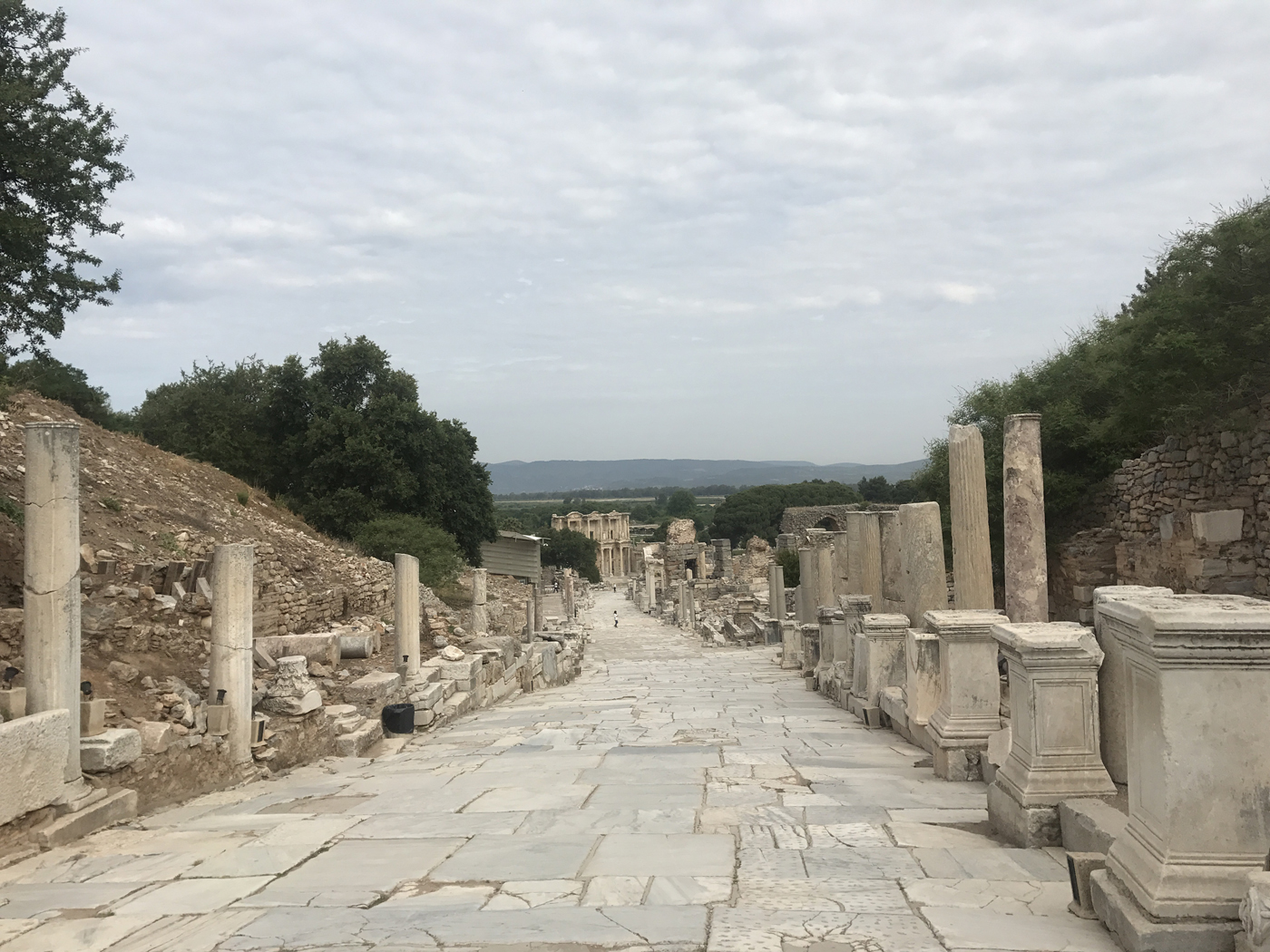
The Embolos, looking toward the Library of Celsus. Author's photo.

I hope to demonstrate that both streets, and by extension, other mid-imperial monumental avenues, can be understood as products of political negotiation between leading notables, the collective elite, and the citizen body.Footnote 6 Archaeological and epigraphic testimonia warrant this interpretation. But the paucity of direct evidence for how ancient elites engaged with the built environments of their cities calls for comparison with a better-documented parallel.
Mid-sixteenth-century Florence provides that critical analogue.Footnote 7 Late Renaissance Florence was governed by a duke with theoretically absolute power; Roman Ephesus, by a council with democratic pretensions. In both, however, a small and cohesive group, supported by a foreign imperial power, was consolidating unprecedented authority.Footnote 8 In both, a new sociopolitical arrangement had to be presented as traditional and natural. And in Florence, as in Ephesus, the construction of monumental public spaces proved an effective means of doing so.
The first section of this essay will illustrate how, in both Florence and Ephesus, political elites appropriated spaces and architectural conventions formerly associated with populist regimes. The second will consider how public sculptural displays incorporated civic history into the “dynastic” statements of the Florentine dukes and leading Ephesian notables. The third and final section will investigate the ways in which the new spaces and sculptures contributed to the performance of elite authority, above all in the context of public ritual.Footnote 9
MONUMENTAL STREETS
In both sixteenth-century Florence and second-century Ephesus, monumental streets and squares were statements of elite control. In each city, these statements relied on interplay between a native tradition of populist self-government and architectural conventions associated with an external imperial power. The spaces thus created, in Ephesus as in Florence, presented a new sociopolitical order as a corollary of the past.
Cosimo's Forum
Cosimo I de’ Medici (1519–1574), the second duke of Florence, reigned for more than a generation over a city with a complex social and political history. For most of the fifteenth and early sixteenth centuries, members of the Medici family had exercised de facto sovereignty over nominally republican Florence, building complex relationships with rival elite families and popular factions.Footnote 10 In 1531, following a short-lived revival of the republic, Alessandro de’ Medici had been declared the first duke of Florence. After Alessandro's assassination six years later, his distant cousin Cosimo was appointed duke by a coalition of leading Florentines. His authority, backstopped by a close alliance with Holy Roman Emperor Charles V, was overtly autocratic. But Cosimo never forgot his family's ancestral connection with the Florentine Republic, and in everything from official portraits to building projects he presented his absolutist rule as an extension and encapsulation of this legacy.Footnote 11
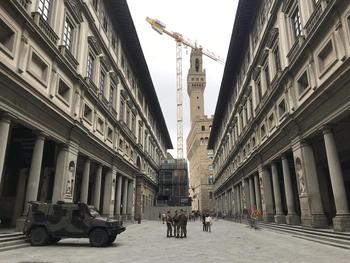
In 1560, work began on the Uffizi, a complex for the hitherto scattered offices of Cosimo's bureaucracy.Footnote 12 The architect, Giorgio Vasari, adapted his design to the practical and symbolic needs of the ducal regime. The new building was U-shaped, centered on a narrow courtyard open to the Piazza della Signoria. At the end of the courtyard opposite the Piazza, an elaborate gateway gave onto a walkway along the Arno. The long wings on either side of the courtyard were carried on arcades, into which niches for statues of distinguished Florentines were recessed (figure 3).
The Uffizi Courtyard, looking toward the Palazzo Vecchio. Author's photo.
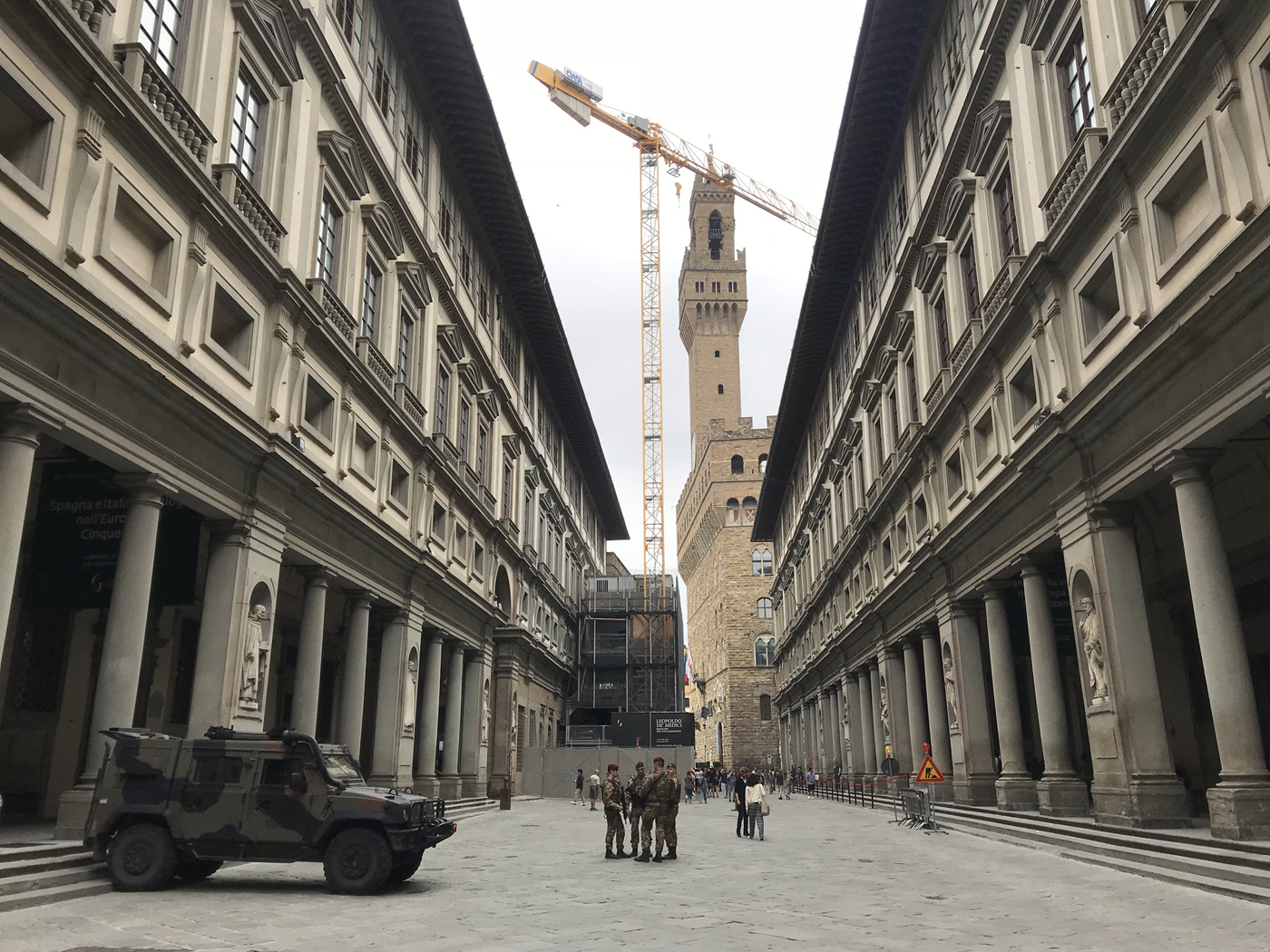
The Uffizi courtyard was representative of a broader sixteenth-century Italian trend toward classicizing monumentalization of streets and squares.Footnote 13 This trend, which paralleled the emergence of a self-consciously aristocratic culture,Footnote 14 was most pronounced in ducal regimes, whose rulers possessed both the resources and political motivation to reconfigure city centers initially shaped by republican governments.Footnote 15 Roman public architecture provided a useful set of templates for doing so. Particularly important was the discussion of forum design in Vitruvius’ De Architectura, from which Vasari seems to have borrowed both the porticoes and the basic proportions of Uffizi courtyard.Footnote 16
Vitruvius’ ideal forum, a rectangular colonnaded plaza lined by public buildings, was widely cited and imitated by sixteenth-century architectural theorists.Footnote 17 Palladio echoes Vitruvius almost verbatim in his chapters on public squares and buildings.Footnote 18 In a treatise intended to demonstrate how a Roman legionary camp could serve as the basis for a planned town, Sebastiano Serlio presents a more creative adaptation, which, despite many innovations, retains the rectangular shape and colonnades of the Vitruvian model.Footnote 19 In Vasari's own circle, the sculptor and architect Bartolomeo Ammannati produced numerous plans for ideal cities in which virtually every public space was oblong and porticated.Footnote 20 Daniele Barbaro summarized the prevailing opinion of his contemporaries in the commentary appended to his famous translation of De Architectura: “Porticoes are naturally magnificent; and to see a triumphal arch at the head of a beautiful street is both delightful and edifying.”Footnote 21
The Vitruvian forum provided sixteenth-century architects with a template for visually unified and monumental public spaces that could express the ambitions of dukes and oligarchs. Since Vasari and his contemporaries associated classical architecture with the harmonies and ratios of the natural world, they regarded Vitruvius’ proscriptions as the touchstone of all good architecture, or any effective statement of authority.Footnote 22 Their patrons were correspondingly interested in the visual possibilities of classicism: Vasari mentions that Duke Cosimo instructed him to use the Doric order—“more stable and substantial [in appearance] than the others”—in the Uffizi courtyard.Footnote 23 For both architects and patrons, moreover, Vitruvian classicism was inextricably associated with Roman public architecture, and thus with imperial power. The Granada palace of Charles V, Cosimo's patron, was modelled on Roman precedents.Footnote 24 Likewise, on the Buonsignori Map, printed in 1584 under the auspices of Cosimo's successor, the Uffizi and adjacent Piazza della Signoria are represented as a unified and orderly space reminiscent of the imperial fora in Rome.Footnote 25
Besides encapsulating the duke's imperial ambitions, the Uffizi courtyard articulated his relationship with the Florentine past. The courtyard opened on, and was designed as a pendant to, the Piazza della Signoria, the heart of the old Republic. In Florence, as in cities throughout central and northern Italy, the emergence of a popular government had been paralleled by the development of a communal palace and adjacent piazza that served as the center and symbol of self-government: the Palazzo dei Priori (Palazzo Vecchio) and Piazza della Signoria.Footnote 26 Like most of its counterparts, the Piazza della Signoria was not architecturally regular.Footnote 27 The colonnaded Uffizi courtyard stood in deliberate contrast.
In the Ragionamenti, a series of dialogues Vasari composed to explicate his redecoration of the Palazzo della Signoria, Cosimo's son Francesco is made to ask why his father did not demolish the old Palazzo and replace it with a more suitable building.Footnote 28 Vasari's reply is worth quoting:
[The Duke decided that] he had no desire to alter the foundations and maternal walls of [the Palazzo], since in their old form they were the origin of his new government. For as he was made Duke of this Republic to preserve the laws, and has added to [the laws] measures conducive to justice and the well-being of citizens, his greatness depends on the history of the Palazzo and its ancient walls. Thus it pleased him to restore good order and proportion to those walls—which were distorted and irregular—and to embellish them with suitable and well-designed decorations.Footnote 29
The Uffizi courtyard, likewise, perfected the Piazza della Signoria. Early in his reign, when Cosimo commissioned plans for a renovation of the Piazza itself, Antonio da Sangallo and a number of other architects proposed the erection of uniform porticoes around the edges of the square.Footnote 30 Cosimo never executed these plans. The creation of a new and complementary space achieved the same effect at reduced political cost.
An Avenue in Ephesus
Despite the preeminence of a few great benefactors, elite competition and a tradition of collaborative munificence ensured that no individual in Roman Ephesus could shape the urban fabric on the scale of Duke Cosimo. In some respects, however, the dynamics that shaped public space in the two cities were analogous. Under Cosimo's rule, leading Florentine notables continued to play an important role in molding the urban fabric.Footnote 31 And as we shall see, the Ephesian city council, dominated by a small group of exceptionally wealthy notables, had an impressive coordinating effect on the projects of individual benefactors.
Beyond these basic commonalities, comparison with Cosimo's Florence calls attention to the political symbolism of Ephesus’ monumental avenues. Like the Uffizi courtyard, the Ephesian avenues appropriated public spaces formerly associated with a populist government and re-imagined them in architectural terms inspired by an external imperial power.
The closest counterpart to the Uffizi courtyard in Roman Ephesus was the Arcadiane, the broad colonnaded street connecting the Ephesian harbor with the city center. The proliferation of porticated and statue-studded avenues like the Arcadiane in the second- and third-century Roman East has been assigned to various causes: a long-term trend toward the formalization of public space, the retail frontage and shade provided by colonnades, the visibility and prestige of street-side monuments in an era of competition among local notables, and consciousness of the aesthetic effects that formal streetscapes enabled.Footnote 32 Like the monumental spaces of sixteenth-century Italy, however, the new avenues are best understood as political statements created by rapidly-changing elites.
Roman Ephesus was a de facto oligarchy in which leading elite families competed for power and influence within a nominally democratic regime. Like most imperial-era poleis, Ephesus was governed by an elected council (boule), which submitted legislation for approval to an assembly of all citizens (ekklesia).Footnote 33 Thanks largely to the policies and circumstances of Roman rule, real power was increasingly vested in the council. By the beginning of the Common Era, membership in the Ephesian council, originally elective, had become lifelong and hereditary and based on wealth and social connections. As the power of the council grew, so did its corporate ethos.Footnote 34 The councilors did not always act in concert: men with exceptional riches, rank, or Roman connections sometimes formed the nuclei of competing factions.Footnote 35 Yet despite occasionally fierce contention for primacy, even the leading councilors tended to work together, establishing alliances founded on marriage ties, shared economic interests, and essentially complementary political goals.Footnote 36
This willingness to cooperate found expression in the built environment. Although the practice of euergetism had long made public building an important means of accruing political capital, collaborative construction projects only became prominent in the mid-imperial era. This development can partly be ascribed to the popularity of large and expensive structures like baths and aqueducts, which typically required multiple benefactors. The growing power of the city councils, which approved and oversaw all private building projects, also contributed.Footnote 37 Most important of all, though, was the need of every wealthy and ambitious notable to articulate his commitment to the public welfare.
By the mid-imperial era, the council dominated Ephesian politics. It remained, however, at least theoretically responsible to the citizen assembly, and popular pressure lent a degree of truth to its claim of governing with the consent and in the interests of the people.Footnote 38 Any failure to maintain the practical benefits, if not the institutional forms, of traditional civic democracy courted unrest.Footnote 39 Popular support, conversely, stood to enhance the council's prestige and confirm the authority of its position.
Ephesian notables, in short, were collectively motivated to express their dedication to the welfare of their fellow citizens. Porticated and statue-studded streets such as the Arcadiane afforded them a highly visible means of doing so. Street-side colonnades, almost invariably constructed by multiple benefactors, neatly memorialized elite collaboration and munificence.Footnote 40 Lines of honorific statues,Footnote 41 the basic currency of euergetism, articulated the same message even more clearly. Awarded by public decree for service to the city, the stance, clothing, and even hairstyles of these portraits had standard forms and conventional significance, with every detail intended to convey the honoree's status and connect it with his or her commitment to the community and its values.Footnote 42 The effect was complimented by the inscriptions on the bases of these statues, coached in the traditional “democratic” formulae of civic decrees.Footnote 43 Monumental streets, with their regular rows of statues, accentuated the portraits’ standardized and conservative appearance, flattening distinctions of personality and era into an image of changeless and cooperative public service.
So displayed, elite power was a function of good citizenship, and also a sign of essential continuity with the past. The colonnades and serried portrait statues of avenues like the Arcadiane evolved from the traditional conventions for decorating agoras.Footnote 44 In many late Classical and early Hellenistic poleis, the agora, center of democratic self-government, was bordered by porticoes. Over the course of the Hellenistic period, as elite euergetism became more prominent, the spaces in front of these porticoes began to fill with honorific statues.Footnote 45 By the first century CE, most agoras were, like the Upper Agora of Ephesus, bounded by regular colonnades and dense rows of benefactor portraits.Footnote 46 The same aesthetic, applied to thoroughfares, produced the monumental streets of the mid-imperial era.Footnote 47
Although avenues like the Arcadiane evolved from a native architectural tradition, their scale and effect owed a great deal to Roman architecture.Footnote 48 Due partly to imperial control of most marble quarries, and partly to the visibility and prestige of construction in the capital, Roman architectural conventions were widely imitated in the eastern provinces. Although wealthy and well-connected notables occasionally sponsored replicas of individual Roman monuments,Footnote 49 creative synthesis was more common than outright imitation. The Arcadiane was no exception. Several of its elements, notably the monumental arches that marked its ends,Footnote 50 were Roman in inspiration, but the overall effect was eclectic. Like Cosimo, the Ephesian notables who constructed the Arcadiane needed only to suggest an association with the imperial power that backstopped their authority. And as in Florence, Roman architecture was less a vehicle for specific political messages than a conventional language of prestige.
The Arcadiane was thus, like the Uffizi courtyard, a statement of authority that drew its potency from both local tradition and metropolitan models. It advertised the professed goals of elite authority—above all, a shared dedication to the public welfare—by borrowing the colonnades and massed honorific statues of historically democratic spaces like the Upper Agora. Yet its imperial scale intimated new political realities.
SIGNIFICANT SCULPTURES
The creation of unprecedentedly complex sculptural assemblages facilitated elite political goals in both Florence and Ephesus. The statues Duke Cosimo placed in the Uffizi courtyard and Piazza della Signoria were, like the sculptures of the tombs and nymphaea along the Ephesian Embolos, designed to merge civic with dynastic history.
Histories of Florence
Duke Cosimo planned a gallery of famous Florentines in the Uffizi courtyard and carefully edited the mythological and biblical statues of the Piazza della Signoria. Both of these projects were attempts to incorporate the republican past into a visual narrative of Medici dominance.Footnote 51
Vasari's design for the Uffizi seems to have been significantly influenced by the Forum of Augustus in Rome.Footnote 52 Although the forum's ruins were ill-understood in the mid-sixteenth century,Footnote 53 Suetonius’ Life of Augustus described a plaza dominated by the Temple of Mars Ultor and ringed by colonnades adorned with statues of famous Romans.Footnote 54 This gallery seems to have particularly intrigued Vasari.
As noted earlier, the piers of the Uffizi's first-story arcade were designed with niches for statues of eminent Florentines. These portraits, which were not installed until much later, were to include likenesses both of Cosimo's Medici forbearers and of men known for their cultural accomplishments.Footnote 55 Contemporaries regarded the portraits as a crucial element of Vasari's design.Footnote 56 In his funerary oration for Cosimo I, the Florentine humanist Bernardo Davanzati exulted: “[Grand Duke Cosimo] made that great structure for the magistrates as an annex to his palace; and he desired to place statues of illustrious citizens in the niches between its pilasters, as though in a new Athenian Keramikos or Roman Forum, with the aim of generously and nobly celebrating the authors of our citizens’ ancient glories.”Footnote 57 This gallery of civic virtue, overseen by a statue of Cosimo with the attributes of Augustus,Footnote 58 was intended to connect the duke's reign with the Florentine past. Interweaving narratives of Medici rule, civic continuity, and artistic achievement, it was to present the history and glories of the Republic as products of a single family's guidance.
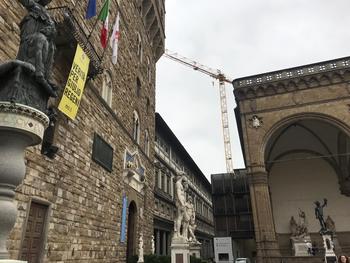
In keeping with the same initiative, Cosimo integrated the statues on the Piazza della Signoria into a celebration of Medici rule (figure 4).Footnote 59 Since the fourteenth century, two structures had served as sites for the display of sculpture in the Piazza: the Ringhiera, a low platform with three rows of stone benches built against the façade of the Palazzo dei Priori; and the Loggia dei Priori (later known as the Loggia dei Lanzi), an arcade immediately across from the Ringhiera.Footnote 60 Sculptures displayed in these very prominent locations were inevitably interpreted as political statements.Footnote 61 After the first expulsion of the Medici in 1494, for example, Donatello's Judith and Holofernes became a symbol of the Republic's victory over tyranny when it was moved from the Medici palazzo to the Ringhiera. A decade later, Judith was displaced by an even more imposing symbol of the Republic: Michelangelo's David.Footnote 62 Upon the return of the Medici, Bandinelli's Hercules and Cacus, popularly thought to commemorate the defeat of the Republic, was set up as a pendant to the David.Footnote 63 Cellini's Perseus with the head of Medusa, erected in the Loggia in 1545, was understood to evoke both Cosimo's residency in the Palazzo dei Priori and the theme of Medici victory. The massive Fountain of Neptune, constructed on one side of the Ringhiera a few years later, celebrated the duke's construction of a new aqueduct.Footnote 64
Sculptures on the Piazza della Signoria. (A replica of) Donatello's Judith and Holofernes stands in the left foreground. In the center, flanking the entrance to the Palazzo Vecchio, are (replicas of) Michelangelo's David and Bandinelli's Hercules and Cacus. Cellini's Perseus with the Head of Medusa is visible in the Loggia dei Lanzi on the right. Author's photo.
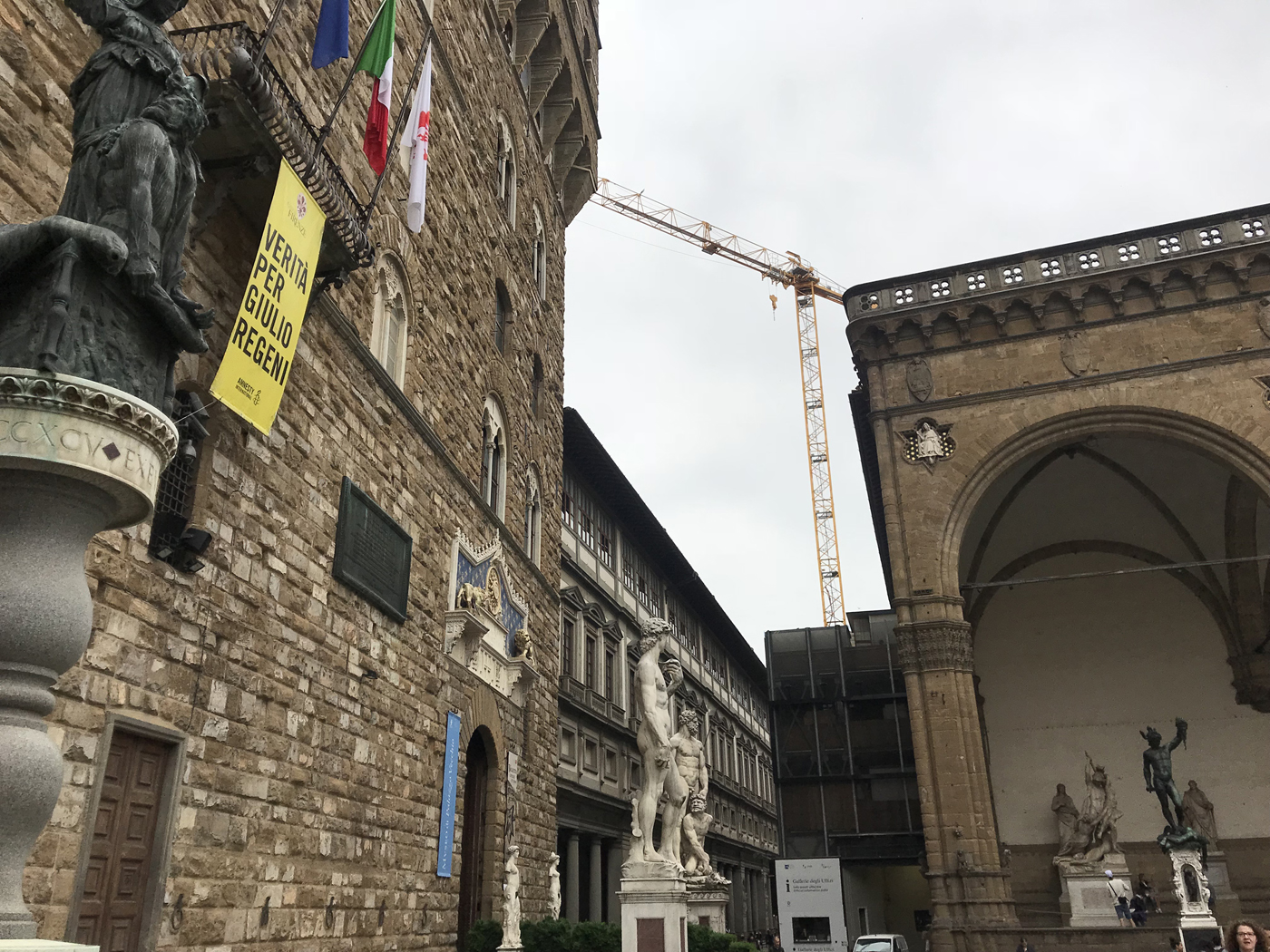
By the mid-sixteenth century, and especially after an equestrian statue of Cosimo was erected near the center of the Piazza,Footnote 65 all the sculpture crowding the Ringhiera and Loggia dei Lanzi was viewed in the light of a teleological narrative of Medicean victory and ducal rule. The degree to which this interpretation pervaded the Florentine consciousness is illustrated by the storm of criticism that followed the installation of Hercules and Cacus. Within a few weeks of the statue's unveiling, more than a hundred pasquinades were pinned to the base, overtly mocking its artistic failings, but ultimately directed at the autocratic policies of its Medici patrons.Footnote 66 Two surviving poems show educated, presumably elite authors playing with the statue's mythological associations and deriding the maladroitness of its execution.Footnote 67 Although these epigrams make no reference to the Piazza itself, their authors clearly regarded—and resented—Hercules and Cacus as an attempt to introduce a new political message into a traditionally republican space. They were right to worry. The effect Cosimo intended is encapsulated in Vasari's praise at the end of the Ragionamenti: “[On considering the Duke's accomplishments], I reflect that the many labors of [Florentine] citizens in days past and of your [Medici] ancestors were a sort of ladder by which Duke Cosimo ascended to reach the present state of glory and happiness.”Footnote 68
Reading a Nymphaeum
The monumental streets of Ephesus, as we have seen, were collective statements. Their neat lines of statues and columns were punctuated, however, by fountains, tombs, and buildings commissioned by exceptionally wealthy notables. Many of these structures featured complex sculptural programs that juxtaposed the benefactors and their families with imperial portraits and figures from the civic past. The effect was often strikingly reminiscent of Cosimo's attempts to merge Medici and Florentine history, but with several families instead of one attempting to impose their dynastic stamp on the urban fabric.
Comparison with Ducal Florence illuminates the political significance of the sculptural ensembles that towered over the avenues of mid-imperial Ephesus. Far from being mere demonstrations of wealth, these programs advanced personal and familial claims on the bases of local history and identity.Footnote 69 As such, though complementary to the more subdued mode of elite display implicit in colonnades and honorific portraits, they existed in tension with the faux-democratic cityscapes in which they were embedded.
Over the course of the mid-imperial era, exceptionally wealthy and well-connected families appeared in many Greek cities.Footnote 70 Though organic products of the new world order—uninterrupted peace enabled the creation of large and dispersed landholdings, and the emergence of province-wide associations afforded new opportunities for meeting (and arranging marriages with) social peers—these families owed their preeminence to Roman policy.Footnote 71 At least in some provinces, they were made personally responsible to the governor for the duties—more prestigious than onerous—of collecting taxes and keeping the peace. The emperors, moreover, cultivated personal relationships with them: a rescript of Hadrian refers to the expectation that cities would send “their leading men” on embassies to Rome.Footnote 72 Members of the most eminent families were encouraged to enter imperial service, where they sometimes rose to senatorial rank.Footnote 73
Leading notables built on a scale commensurate with their status. In smaller cities, a benefactor with sufficient wealth and political capital could effectively remake public space in his own image.Footnote 74 But in Ephesus, as in most poleis, several leading families alternately competed and cooperated for preeminence. This dynamic was particularly visible along the lower Embolos and Triodos (figure 5). The Embolos, as will be recalled, was the avenue that joined Ephesus’ two agoras; the Triodos was the small plaza that marked its intersection with the Lower Agora. In the early second century CE, both avenue and plaza were rapidly developed by a small group of exceptionally wealthy benefactors.Footnote 75 The spate of building began when Tiberius Iulius Aquila Polemaeanus undertook the construction of a memorial library and tomb for his father Tiberius Iulius Celsus Polemaeanus. The library, located near the entrance to the Lower Agora, was still unfinished when Aquila died a few years later. It was completed under the direction of Tiberius Claudius Aristion, who was simultaneously building the Nymphaeum of Trajan, a large monumental fountain, a short distance up the Embolos. A few years later, Publius Quintilius Varius constructed a small temple for the Emperor Hadrian between Aristion's Nymphaeum and the new Library of Celsus, and an unknown benefactor erected a two-story monumental arch on the other side of the street.Footnote 76
Plan of the lower Embolos (here labeled “Kuretenstraβe”) and Triodos. Note the Library of Celsus (no. 3), Arch of Hadrian (6), Varius’ Temple of Hadrian (15), and Aristion's Nymphaeum of Trajan (18). Courtesy of the Österreichische Archäologische Institut.

Like the honorific portraits lining the streets around them, the sculptural programs of the monuments adjoining the Triodos and lower Embolos celebrated public service. They did so, however, in a manner that emphasized the exceptional status of their benefactors.Footnote 77 Perhaps the best example is the Nymphaeum of Trajan, the monumental fountain that Aristion constructed on the Lower Embolos (figure 6).Footnote 78 About two dozen statues were displayed in the aediculae of the elaborate façade. The central niche, two stories tall, housed a colossal image of the emperor Trajan. Smaller niches on the first story framed slightly over life-size representations of Nerva, Trajan's predecessor; Androklos, the mythical founder of Ephesus; the gods Dionysus and Artemis; Aristion and his wife Julia Lydia Laterane; and other figures since lost. The second story featured statuettes of satyrs, nymphs, and other beings evocative of water and the natural world.Footnote 79
Reconstruction of the Nymphaeum of Trajan. Courtesy of the Österreichische Archäologische Institut.

The colossal statue of Trajan, the centerpiece of the nymphaeum's sculptural program, referenced Aristion's close ties with Rome.Footnote 80 Aristion's own statue, though, was not placed beside the emperor's, but instead set in one of the projecting wings where it could be juxtaposed with the image of Androklos. Julia's statue probably stood alongside Artemis in the opposite wing. Husband and wife were thus associated with the founder and the patron goddess of Ephesus. For all its stridency, this assertion of a paradigmatic relationship with civic history and identity remained, just barely, within the conventions of euergetism: an inscription on the architrave proclaimed the Nymphaeum's dedication to Artemis, Trajan, and Ephesus.Footnote 81 The visual impact of the Nymphaeum's sculptural program, moreover, was blunted by the sheer density of the honorific and programmatic sculpture along the lower Embolos. Viewed at walking pace, Aristion's program elided with neighboring monuments into a cohesive and repeated message of elite identification with the history, symbols, and welfare of the city.
Aristion's Nymphaeum, like Cosimo's sculptural programs, was designed to allow a single benefactor to assert a special connection with the bases of communal history and identity. Unlike the statues of ducal Florence, however, it was produced in an oligarchic political milieu. Although Aristion and a few other Ephesian notables had become exceptionally wealthy and well-connected by the early second century, mutual competition and the collective authority of the Council prevented them from creating a truly dynastic monumental statement.
RITUAL CONTEXTS
In both Florence and Ephesus, the political significance of monumental streets was most visible in the context of civic processions.Footnote 82 On these occasions, the colonnades of the Uffizi courtyard and Ephesian avenues gave visual definition to both participants and audience, involving spectators in the performance and redefinition of elite authority. The effect was complemented by public sculpture, which “cued” audiences to recognize coded political display.Footnote 83
Processional Ways
Classicizing colonnades advertised the Uffizi courtyard as a place for respectable men and respectable action, but the courtyard's most important function was to display the body of Duke Cosimo himself, particularly in the context of public ritual.Footnote 84
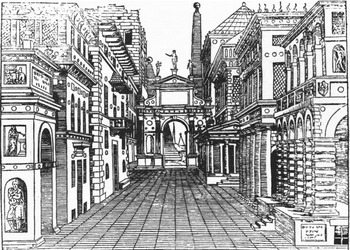
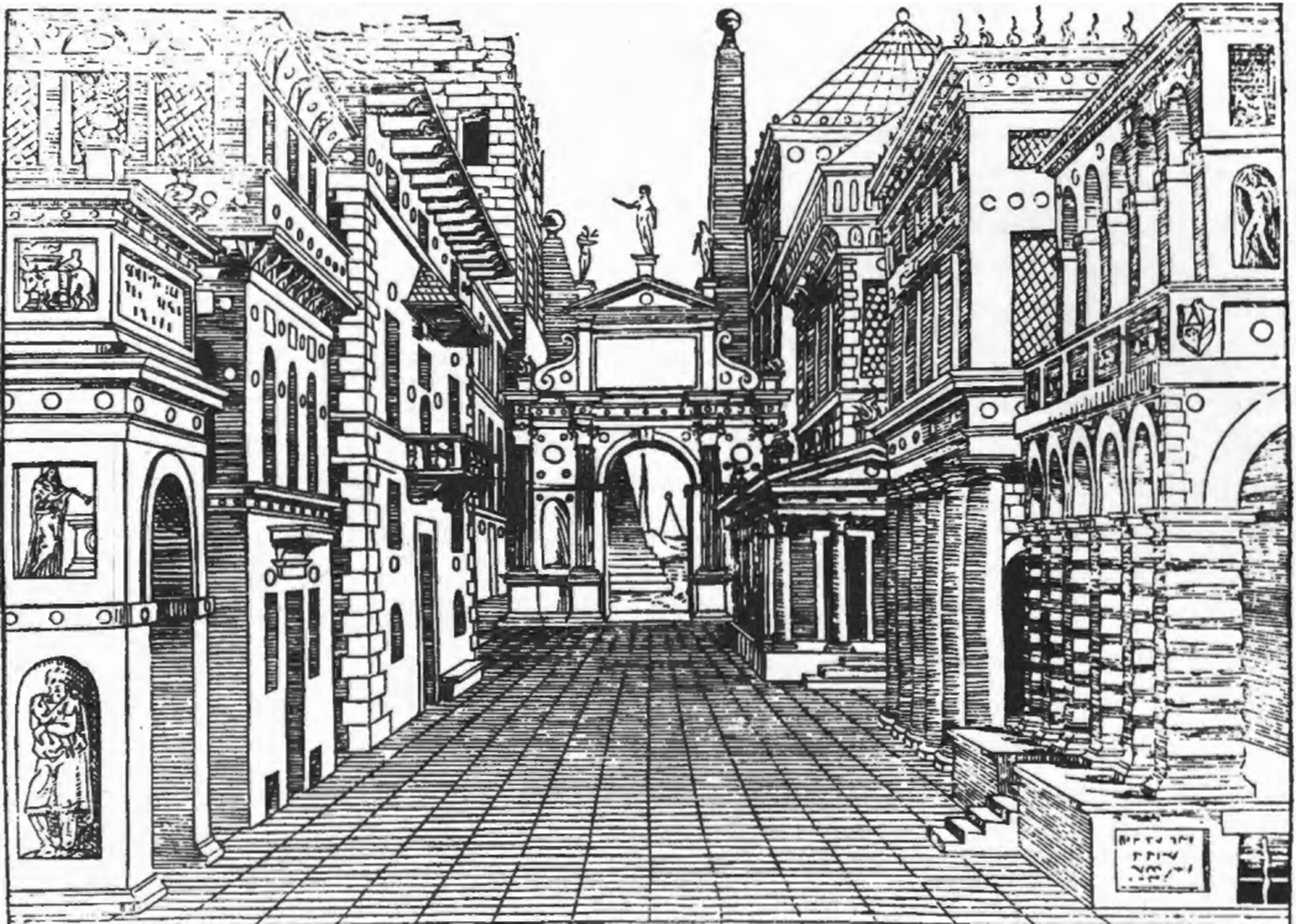
The late Renaissance trend toward the formalization of public space created broad streets and squares well-suited to the task of showcasing aristocratic authority.Footnote 85 In his commentary on the Vitruvian forum, Daniele Barbaro commented: “It is needful, good, and fitting that in a city, besides streets and avenues, there should be plazas … where respectable people can stroll … and where many public entertainments can be held.”Footnote 86 To Barbaro, the monumental Vitruvian forum seemed a particularly apt setting for display, whether in the context of a public festival or an evening promenade. Other sixteenth-century writers on architecture agreed. In his work on perspective—the second book of his sequentially published architectural treatise—Serlio presented two contrasting cityscapes as suitable backdrops for tragic and comedic plays. He recommends that stage buildings for a tragedy “have a certain nobility” befitting their moral seriousness, and illustrates the point with a figure depicting a broad classicizing avenue lined by porticoes and statues (figure 7). By contrast, his stage setting for the humble characters and burlesque action of a comedy shows a medieval streetscape, complete with Gothic pointed arches.Footnote 87
Serlio's example of a tragic stage setting. After Architettura di Sebastian Serlio, Bolognese, in sei libri divisa (Venice, 1663), 80.
An imposing and classical design marked the Uffizi courtyard as a space for serious action and dignified movement. The courtyard had a special relationship with the person of Duke Cosimo. In the words of Jacopo Guidi, Cosimo's longtime secretary: “Now, by creating a costly and well-designed building enclosing a judicial courtyard beside the citizens’ square [i.e., Piazza della Signoria], the Grand Duke has proclaimed that, since everywhere the great authority of public power is more revered [when seen] in a conspicuous place … it is especially important that those charged with such responsibility be exposed to the sight of all, and particularly that of the ruler….”Footnote 88 The Uffizi, in short, allowed Cosimo not only to supervise the workings of government, but also to be visible, if only metaphorically, to the entire city.Footnote 89 The appeal of this idea was enduring: at the end of the sixteenth century, Vasari's nephew, working for Cosimo's successors, produced a plan for an ideal city centered on a colonnaded plaza ringed by legal offices and overlooked by the palace of a prince.Footnote 90
The Uffizi courtyard's close relationship with the duke and his family was most evident during festivals. It served as a standalone site for ducal ceremonies on a number of occasions, perhaps most notably in 1590, when it was brilliantly illuminated during a nocturnal reception in the adjacent Palazzo.Footnote 91 More frequently it functioned as a processional way to the Piazza della Signoria.Footnote 92 Alessandro de’ Medici, the bishop of Florence, rode through the Uffizi courtyard with his retinue during the festivities celebrating his elevation to cardinal in 1583.Footnote 93 Funeral processions, likewise, were staged in the courtyard for Duke Cosimo and his successor Francesco.Footnote 94 On each of these occasions, the Uffizi courtyard provided the dukes with a place for intimate display, where a small crowd of favored spectators could gather to see and be seen.Footnote 95
During major civic festivals, likewise, ephemeral architecture accentuated the political implications of the new sculptures on the Piazza della Signoria.Footnote 96 Though temporary, these decorations allowed the Medici and their allies to present the cityscape as they wished it to be viewed. For example, in 1515, when Leo X (Giovanni de’ Medici) entered Florence for the first time since his election to the papacy, Medici partisans orchestrated a reception of unprecedented splendor.Footnote 97 Seven temporary triumphal arches, each decorated to represent one of the Canonical Virtues, were erected along the processional route. The arch dedicated to Justice stood beside the Ringhiera, the site of public trials, suggesting that the integrity of the Medici pope complemented that of the old Republic. An equally visible response to republican history was the colossal stucco Hercules—a Medici symbolFootnote 98—erected opposite Michelangelo's David.
A half-century later, for the wedding of Duke Cosimo's son Francesco to Joanna of Austria, the Ringhiera was incorporated into a sophisticated narrative of Medici power that centered on the personal qualities of the duke.Footnote 99 Another triumphal arch of wood and stucco was erected in the Piazza della Signoria. This structure, dedicated to civic virtue, was dominated by a colossal personification of Prudence, and decorated with scenes of Cosimo's statecraft. Beside the arch, the Fountain of Neptune, completed for the occasion, commemorated the duke's construction of an aqueduct and advertised the elemental nature of his power. Tapestries hung from the surrounding buildings suggested the Piazza's inclusion in the ducal space of the Palazzo dei Priori. The sculpture of the Piazza della Signoria obviously played a different role in this arrangement than it had in Leo's entry; but in both cases it was incorporated with considerable care into a narrative of Medici rule. In both cases, moreover, temporary appropriation had permanent implications: the stucco Hercules made for Leo's reception was eventually replaced with one of marble, and the Fountain of Neptune became a lasting addition to the Ringhiera.
Ephemeral architecture, then, presented the Piazza della Signoria as a setting for the conduct of good (Medici) government. The Uffizi courtyard was a permanent expression of the same goal.
Community and Status
Like the Uffizi and Piazza della Signoria, the monumental streets of Ephesus were designed to complement the performance of elite authority. This was especially evident in the context of public ceremonies,Footnote 100 when Ephesian notables used ritual to reference political messages implicit in the built environment.
Comparison with Florence sheds light on the interrelations of monumental space and public ritual in Roman Ephesus. Like the architectural theorists of sixteenth-century Italy, second-century notables assumed that colonnaded and statue-studded public places were well-suited for the display of status and power. And like the Medici dukes, Ephesian elites engaged most directly with the fabric of their city during public ceremonies, when the juxtaposition of their bodies with the new monumental streets was fundamental to the performance and redefinition of sociopolitical relations.
The association of monumental streets with elite display evolved, like the streets themselves, from the Hellenistic agora. Agoras, with their variety of religious, commercial, and political functions, were always spaces with complex, even contradictory, meanings for elite Greeks.Footnote 101 As local notables assumed greater power, however, they became increasingly monumental and increasingly associated with elite display.Footnote 102 These developments were paralleled by a growing emphasis on decorum: Plutarch, writing in the early second century CE, cites dancing and making faces in the agora as examples of behavior unthinkable for respectable men.Footnote 103
Like agoras, streets were regarded as places for all citizens.Footnote 104 Yet the very fact that thoroughfares were so public made them, again like agoras, appealing stages for elite performance.Footnote 105 Even if a leading citizen chose to forgo such ostentations as a litter or retinue of slaves, he could publicly advertise his status by simply walking with the mannered pace and unruffled expression that were thought to indicate education and refinement.Footnote 106 Monumental streets were particularly conducive to such display: regular colonnades offset the steady gait of elite walkers, and honorific statues mirrored their dress and poise.Footnote 107
In Ephesus, as throughout the Greek world, the construction of monumental streets was paralleled by the appearance of increasingly elaborate public processions.Footnote 108 These developments were mutually influential. Statues were sometimes integrated into the ceremonies,Footnote 109 and the steps and raised sidewalks of colonnaded streets offered spectators places to sit or stand.Footnote 110 Furthermore, as two of the Ephesus’ best-attested processions will illustrate, monumental streets provided a visually dramatic means of organizing participants and spectators.
The Arcadiane played a critical role in the annual adventus of the proconsul of Asia. Upon arriving in Ephesus, a governor disembarked in the harbor, where he was welcomed by a small group of leading citizens. In their company, he passed through a monumental gate and onto the Arcadiane, where he entered a carefully constructed image of popular consensus and elite control.Footnote 111 Crowds of spectators, arrayed by rank and civic tribe, filled the monumental frame formed by the colonnades and honorific statues lining the street. As the governor walked up the narrow alley between the long rows of citizens and columns, he became the centerpiece of a reenactment of local sociopolitical relations. His escort confirmed their status at the pinnacle of the local society by their proximity to the most powerful man in the province. The rest of the city council, walking together just behind,Footnote 112 displayed their own elite rank and corporate ethos, not least through the modulated pace and composed expression that advertised their education and lineage. On either side, colonnades and honorific portraits visible over their heads, stood the citizen body, cheering the governor's arrival, and implicitly acknowledging the authority of the local elite.
The dense sculptural ensembles characteristic of monumental streets also facilitated the performance of authority during processions, above all by associating local notables with civic tradition. The best example of how such referencing worked is provided by the procession founded by Caius Vibius Salutaris. In 104 CE, Salutaris, a wealthy Ephesian, secured the council and assembly's approval for the creation of a spectacular new ritual.Footnote 113 On the terms of his benefaction, the ephebes—three hundred young men of distinguished lineage—marched at regular intervals through the city's heart. They carried no fewer than thirty-one silver and gilded statues representing a diverse cast of figures: the emperor and members of his family, Artemis, heroes from local history, and personifications of the traditional six civic tribes. Bearing this mobile gallery, the ephebes proceeded down the Embolos on their way to the theater. As they advanced, dressed in ritual white, their robes and even postures mirrored those of the honorific statues on either side of the street, erasing distinctions between honored citizens of the past and the next generation of benefactors. More strikingly still, the sculptural decoration of the Nymphaeum of Trajan—half-finished at the time of Salutaris’ donation—and other recently erected monuments along the route echoed the statues the ephebes carried: the silver images of Augustus, Trajan, Artemis, and Androklos all had street-side marble counterparts. Performing piety, creating ephemeral ensembles as they strode, the processing ephebes demonstrated the equation of the values they embodied with those implicit in the cityscape.
Both the proconsul's adventus and Salutaris’ procession were occasions for the display and reconfiguration of sociopolitical relations. In both, as befit the oligarchic nature of Ephesian politics, the corporate elite—whether represented by the council or by the ephebes—marched together, a visual statement of solidarity that echoed and was bolstered by the lines of columns and honorific statues along the route. But each procession also afforded special prominence to eminent individuals. The notables who walked alongside the newly arrived proconsul and the ephebes who carried the gilded statues at the head of Salutaris’ procession surely belonged to exceptionally wealthy and well-connected families. Like the massive nymphaea and tombs that punctuated the colonnades, this arrangement strained, but did not compromise, an overriding statement of unity addressed by the collective elite to the citizen body.
CONCLUSIONS
Vasari designed the Uffizi courtyard to evoke both the monumental public spaces of ancient Rome and the neighboring Piazza della Signoria. The former were esteemed as settings suitable for the decorous conduct of ducal government; the latter was recognized as a source of political associations that had to be appropriated. The planned gallery of famous Florentines, likewise, was to have the dual purpose of encouraging civic virtue and incorporating a potentially dangerous republican past into a teleological narrative of Medici triumph. The sculptures Cosimo added to the Piazza della Signoria filled a complementary function, associating a fund of potent symbols with the ducal regime. This role was clearest in ceremonial contexts, when both the Piazza and the Uffizi courtyard were integrated into ephemeral programs and animated by the body of the duke.
These dynamics illuminate the political significance of the monumental streets of Ephesus. The Arcadiane and Embolos employed the pseudo-democratic architectural language of late Hellenistic agoras on a scale inspired by imperial Rome. Created by wealthy benefactors coordinated by the city council, they represented a concerted attempt to connect the traditional values of civic democracy with an oligarchy of good citizens. The same basic initiative motivated not only the proliferation of honorific statues, which couched elite dominance in the time-honored visual language of euergetism, but also the evolution of complex sculptural ensembles that implicitly presented dominance of the wealthiest and best-connected notables as a natural conclusion of civic history. The message was made explicit during processions, when the new monumental streets were implicated in the performance and recalibration of elite power.