Background
Depression is common in late life and may be a precursor of, or risk factor for, progressive cognitive decline and dementia (Steffens et al., Reference Steffens2004; Taylor, Reference Taylor2014). While neuroimaging and cognitive testing may have predictive value, they are often not readily available. Therefore, it is important to identify clinical signs and symptoms that may predict cognitive deterioration and allow for simple in-clinic assessments. Ideally, these should be elements that can be obtained by history from either the patients or their caregivers. We hypothesized that potentially informative domains useful for predicting cognitive decline in late-life depression may include personal and social functioning.
Disability is characterized by the loss of ability to perform activities of daily living (ADLs), and is a key feature of dementia that results in caregiver burden and the eventual need for nursing home placement (Desai et al., Reference Desai, Grossberg and Sheth2004). Late-life depression is similarly associated with significant functional impairment (Alexopoulos et al., Reference Alexopoulos1996; Steffens et al., Reference Steffens, Hays and Krishnan1999), with impairment in IADL being frequently observed (Bruce et al., Reference Bruce, Seeman, Merrill and Blazer1994). Previous studies suggest that higher levels of dependence in non-depressed individuals may identify patients at a greater risk of cognitive decline who could benefit from closer monitoring (Hybels et al., Reference Hybels, Pieper and Blazer2009). This may also be true for depressed elderly individuals. However, the presence of cognitive impairment in late-life depression, particularly executive dysfunction, may also contribute to greater disability (Kiosses and Alexopoulos, Reference Kiosses and Alexopoulos2005; Potter et al., Reference Potter, McQuoid, Payne, Taylor and Steffens2012).
Late-life depression is also associated with lower levels of social support (George et al., Reference George, Blazer, Hughes and Fowler1989; Isaac et al., Reference Isaac, Stewart, Artero, Ancelin and Ritchie2009). This may be related to the negative effects of depressive symptoms on personal relationships as depressed individuals often withdraw from their social network. As depression is characterized by increased negativity, there may also be a reduced perception of support even if the size of the social network does not change. In dementia, progressive cognitive deficits can lead to difficulty in social interactions or problems in traveling to visit others, leading to isolation and a reduction in support. Indeed, more socially active older adults experience less cognitive decline (James et al., Reference James, Wilson, Barnes and Bennett2011), while perceived social isolation is associated with greater cognitive decline over a ten-year period (Tilvis et al., Reference Tilvis, Kahonen-Vare, Jolkkonen, Valvanne, Pitkala and Strandberg2004). Conversely, individuals with cognitive impairment may need more functional assistance, requiring an increase in instrumental social support. Thus cognitive decline may be associated with reductions in perceived support or social network size, but increased instrumental support. Importantly, we have previously found that declines in instrumental support and frequency of social interactions is associated with worsening performance on tests of working memory and processing speed (Dickinson et al., Reference Dickinson, Potter, Hybels, McQuoid and Steffens2011), but it is unclear if social support measures predict later conversion to cognitive diagnoses.
The purpose of this study is to determine if greater disability or poorer social support predict conversion to cognitive diagnoses in older adults with depression who were cognitively intact at baseline. If greater levels of disability and lower levels of social support are more prevalent in individuals with depression who ultimately progress to dementia, such factors may have predictive value that could be clinically informative. In this study, we sought to determine if baseline measures or early change (over one year) in disability or social support measures predicted later cognitive diagnoses in depressed elderly individuals, including whether such measures differentially predicted conversion to milder or more severe diagnoses.
Methods
Sample
This study was a secondary analysis of data gathered through the NIMH-funded Neurocognitive Outcomes of Depression in the Elderly (NCODE) study at Duke University Medical Center. Eligible participants were aged 60 years or older. Depressed participants had to meet criteria for major depressive disorder (MDD) on the NIMH Diagnostic Interview Schedule (DIS) (Robins et al., Reference Robins, Helzer, Croughan and Ratcliff1981) at study entry and were additionally assessed to ensure that they met DSM-IV diagnostic criteria through an interview with a geriatric psychiatrist. Exclusion criteria included another major psychiatric illness, although coexisting anxiety symptoms considered to be secondary to MDD were allowed; history of alcohol or drug dependence; and primary neurologic illness, including epilepsy and dementia.
Depressed participants were recruited for the study primarily through referrals to the study from primary care physicians at Duke, but also through limited advertising at Duke University Medical Center and through word-of-mouth. Comparison non-depressed participants were community-dwelling individuals recruited through advertisements and from the Aging Center Subject Registry at Duke University.
The study protocol was approved by the Duke University Medical Center Institutional Review Board. All participants provided written informed consent before beginning study procedures.
Clinical evaluation
At baseline, all depressed participants were evaluated by a geriatric psychiatrist who reviewed entry criteria, current psychiatric symptoms, psychiatric history, and completed the Montgomery–Asberg Depression Rating scale (MADRS) (Montgomery and Asberg, Reference Montgomery and Asberg1979). All participants also completed the Mini-Mental State Examination (MMSE) (Folstein et al., Reference Folstein, Folstein and McHugh1975) at baseline and individuals scoring below 25 were excluded from the study.
Assessment of disability is through 16 self-report items assessing two domains of physical function (Steffens et al., Reference Steffens, Hays and Krishnan1999; Taylor et al., Reference Taylor2003). Seven items, modified from previous studies (Branch et al., Reference Branch, Katz, Kniepmann and Papsidero1984), address BADL self-maintenance skills: the ability to eat, dress, groom, ambulate, bathe, toilet, and pick an object off the floor. Nine items also modified from past studies (Rosow and Breslau, Reference Rosow and Breslau1966) assess IADL performance: getting around the neighborhood, shopping, preparing meals, cleaning house, doing yardwork, keeping track of finances, walking one-fourth of a mile, navigating stairs, and caring for children. Difficulty with each item is scored as 0 (no difficulty), 1 (some difficulty) or 2 (cannot perform). Composite scores are constructed by summing the scores within each domain, resulting in ranges of 0–14 for BADL and 0–18 for IADL.
Assessment of social support and disability was measured at baseline and annually thereafter. Social support was assessed with the Duke Social Support Index consisting of four subscales derived by factor analysis (George et al., Reference George, Blazer, Hughes and Fowler1989). The Social Network Size scale assesses the number of people with whom the individual has contact, including household members, family, coworkers, and friends. The Social Interaction scale assesses the frequency of contact with family and friends, including both in-person contacts and telephone contacts. The Instrumental Social Support scale assesses assistance a participant receives with day-to-day activities, such as errands, chores, and finances. Finally, the Subjective Social Support scale includes items referring to how the individual feels understood, useful, and listened to by family and friends, and whether or not they have a close confidant. Higher scores on all scales indicate greater levels of social support, and the scales have been validated (George et al., Reference George, Blazer, Hughes and Fowler1989).
Cognitive evaluation and determination of cognitive conversion
Neuropsychological testing was administered to all study participants at baseline and then annually. The neuropsychological battery is described elsewhere (Steffens et al., 2004) and has been successfully employed in a number of clinical and epidemiological settings (Tschanz et al., Reference Tschanz2000). Testing was administered by a trained psychometric technician and supervised by a licensed clinical psychologist.
As fully described in our previous work (Steffens et al., Reference Steffens, McQuoid and Potter2009), clinical diagnoses were made and reviewed annually by a consensus panel of experts in dementia, based on a model used in epidemiological studies of dementia. The panel consisted of three to four geriatric psychiatrists, a cognitive neuroscientist, one to two neuropsychologists specializing in memory disorders, and a neurologist specializing in memory disorders. After reviewing clinical notes, neuropsychological testing profiles and provisional diagnoses, and neurological consultations when available, panel members could jointly chose among several clinical diagnoses, including non-dementia diagnoses (Steffens et al., Reference Steffens, McQuoid and Potter2009).
For the purposes of the current study, we used these expert consensus diagnoses to categorize participants into one of three cognitive categories. Dementia was diagnosed if the clinical presentation and neuropsychological testing met DSM-IV criteria for dementia and included participants regardless of suspected etiology (Alzheimer’s, vascular, Lewy body, etc.). Participants were assigned a diagnosis of cognitive impairment – not demented (CIND) when individuals had impairment on neuropsychological testing, but mild or no functional impairment as reported by the clinician or on the Dementia Severity Rating scale (Clark and Ewbank, Reference Clark and Ewbank1996). This categorization was used regardless of the suspected underlying etiology and included individuals with a consensus diagnosis of cognitively impaired secondary to vascular disease. The final diagnostic category was non-case or normal cognition. As this was a longitudinal study, cognitive diagnoses shifted for some participants over time. For the current analyses, individuals who moved from among normal to CIND to dementia during the course of study participation were categorized as having dementia.
Statistical analyses
All analyses used SAS 9.3 (Cary, NC). We initially tested for demographic and univariate differences among the three cognitive outcome cohorts using χ2 for categorical variables and ANOVA for continuous measures.
Primary analyses used logistic regression models to examine most severe cognitive diagnosis (normal, CIND, or dementia) as the dependent variable. Separate models examined the two ADL measures and four social support measures as independent variables. For examination of baseline measures predicting cognitive diagnoses, independent variables included age, sex, and years of education. For examination of one-year measures of ADLs and social support predicting cognitive diagnoses, we used similar models but also included the baseline variable and a change variable, which was defined as score at one year – baseline score. In these primary models, we did not control for participant time in the study as this did not significantly differ between cognitive groups.
Subsequently, we conducted secondary analyses for either baseline or longitudinal variables that significantly predicted cognitive cohort assignment in primary variables. For these models, we created general linear models where the ADL or social support variables were the dependent variables and cognitive cohort became an independent variable. Other independent variables remained the same as in the primary models. With these models, we were able to calculate the adjusted means of the ADL or social support variables for each cognitive cohort and conduct group comparisons.
After establishing which scales were significantly associated with cognitive conversion, we next examined individual items within those scales. We examined how responses to each item as independent variables predicted cognitive diagnosis as the dependent variable, while controlling for age, sex, and education. For these models, we also calculated odds ratios and 95% confidence intervals.
Results
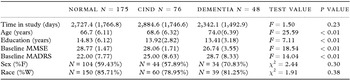
Our study examined 299 older depressed adults without a cognitive diagnosis at baseline. Utilizing the most severe diagnosis over the course of study participation (mean of seven years), 83 (28%) individuals converted to CIND and 49 (16%) developed dementia, while 167 individuals (56%) did not develop a cognitive disorder. There was no significant difference between cognitive cohorts at the time they were in the study (Table 1), nor was there a significant difference in sex or race. However, age, education, baseline depression severity by MADRS, and baseline MMSE score differed between cohorts. Upon conducting group comparisons for statistically significant demographic differences, age, baseline MADRS score, and baseline MMSE score exhibited significant differences in all group comparisons (group comparisons: age, all < 0.01; MADRS, all < 0.05; MMSE, all < 0.01). For education, cognitively normal participants were more highly educated than the other two groups (p < 0.01), but there was no significant difference between the CIND and dementia groups (p = 0.43).
Demographics

Continuous variables presented as mean (SD), with differences between groups examined using ANOVA. Models for each continuous variable had two degrees of freedom, with the model having 298 degrees of freedom. Mini-Mental State Exam (MMSE) data were not available for 22 participants. The MMSE model had 2 degrees of freedom, with the model having 299. Categorical variables presented as N (%) with two degrees of freedom. MADRS = Montgomery–Asberg Depression Rating scale.
Baseline measures as predictors
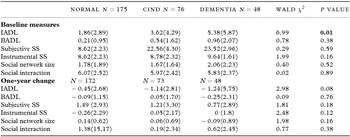
We first examined if baseline disability and social support measures predicted future cognitive diagnoses (Table 2). All models controlled for depression diagnosis, age, sex, and years of education. In all models, both advanced age (p < 0.01) and greater depression severity (p < 0.01) were associated with later cognitive diagnoses. Education was significantly associated with cognitive diagnoses only in the model examining network size (p = 0.03); sex was not significantly associated with cognitive diagnosis in any model. Baseline IADL score was the only measure significantly associated with a subsequent cognitive diagnosis. Neither BADLs nor any social support measure significantly predicted later assignment into the cognitive cohorts.
Baseline and one-year change measures predicting conversion

Baseline models controlled for baseline depression severity by MADRS, age, sex, and years of education; models examining one-year change also controlled for baseline measure. All variables had one degree of freedom. Variables presented as mean (SD) and had no units. Presenting baseline measures and change between baseline and one year assessments (presented as one year – baseline).
To further elucidate these relationships and to compare group means, we created a secondary model examining IADLs as the dependent variable. In this model, baseline IADLs significantly differed between groups (F (2, 286) = 4.29, p = 0.01). Examination of group comparisons showed a significant difference in baseline measure of IADLs between cognitively normal individuals and those who converted to CIND, as well as between cognitively normal individuals and conversion to dementia (Normal–CIND, p = 0.048; Normal–dementia, p < 0.01). However, the difference between CIND and dementia was not statistically significant (p = 0.28). This suggests that greater IADL deficits predict conversion from normal to either cognitive diagnosis (CIND or dementia), but it does not differentially distinguish between cognitive diagnoses.
Longitudinal measures as predictors
We next examined how the change in ADLs and social support measures over the first year of study participation might predict a cognitive status change (Table 2). These models were similar to the baseline models, except that they also included baseline ADL and support values in addition to examining change scores as independent variables. In these models, both greater age and baseline depression severity continued to be associated with cognitive diagnoses (p < 0.01). Education was associated with cognitive diagnosis only in models examining network size (p = 0.04) and social interactions (p = 0.05). No statistically significant relationship was found between conversion of cognitive status and change in IADLs, BADLs or other measures of social support over one year.
Analysis of individual IADL scale items
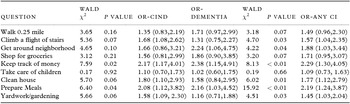
As a post hoc analysis, we sought to examine what specific IADL items were most predictive of cognitive conversion. We thus performed secondary analyses of individual factors (Table 3). In these models, two IADL factors (keeping track of money, preparing meals) were significantly associated with subsequent diagnoses. In both cases, greater deficits in these areas exhibited increased odds ratios for conversion to both CIND and dementia. Similarly, three additional factors (climbing stairs, cleaning house, and yardwork) exhibited trends towards predicting cognitive conversion, but these primary effects did not achieve a level of statistical significance. When examining the odds ratios and 95% confidence intervals, it appears that these items predicted conversion to CIND but not dementia, as the 95% confidence interval crossed zero when predicting dementia. Finally, we examined if these items predicted a conversion to any cognitive diagnosis: six of nine items (climbing stairs, getting around neighborhood, keeping track of money, cleaning house, preparing meals, and yardwork) significantly predicted any later cognitive diagnosis.
Secondary analyses of individual IADL responses predicting cognitive conversion

Models examined cognitive cohort (normal, CIND, or dementia) as the dependent variable. Independent variables included the individual IADL measures, along with age, sex, education, and baseline MADRS score. Odds-ratios (OR) presented as point estimate (95% CI) for developing CIND, dementia, or any cognitive diagnosis (CI = cognitive impairment).
Discussion
This study supports the notion that greater functional disability in depression offers clinical clues as to who will exhibit cognitive decline in the future. Higher levels of dependence identify patients at greater risk of cognitive decline who could benefit from close monitoring. While radiological and neuropsychological assessments also have prognostic value, it is important to consider easy-to-assess clinical signs and symptoms with predictive value. Even after controlling for age, depression severity, and education, increased IADL deficits predicted subsequent conversion to a cognitive diagnosis (CIND or dementia); however, measures of BADL deficits and social support did not predict such decline. Additionally, aside from individual IADL items that exhibited only a trend towards statistical significance, we did not find any measures that predicted conversion specifically for a more or less severe cognitive diagnosis. Moreover, assessment of a one-year change in disability and social support did not predict later cognitive diagnoses. While BADL deficits may be associated with cognitive deterioration, few BADL deficits were reported in our study sample. This may have limited our ability to assess the effect of BADL deficits and may account for why only IADLs were related to cognitive deterioration. Additionally, more complex task involvement seen with IADLs may be sensitive to early cognitive decline.
There is a reciprocal relationship between cognition and disability. Although depression is associated with greater levels of disability (Bruce et al., Reference Bruce, Seeman, Merrill and Blazer1994; Alexopoulos et al., Reference Alexopoulos1996; Steffens et al., Reference Steffens, Hays and Krishnan1999), disability also precedes dementia (Amieva et al., Reference Amieva2008). Individuals with dementia may first experience disability in the more complex IADL tasks (Barberger-Gateau et al., Reference Barberger-Gateau, Fabrigoule, Rouch, Letenneur and Dartiques1999), but may experience BADL disability in later stages (Fields et al., Reference Fields2010). The increased need for assistance may theoretically reduce an individual's regular cognitive and physical activity, hastening cognitive decline. The results from our current study clearly show that IADL deficits precede cognitive impairment in late-life depression, a population at risk of cognitive decline, and this effect is independent of depression severity and age. The ultimate nature of the relationship between disability and cognitive decline may reflect the effect of accelerated brain aging on both motor and cognitive neural circuits.
Our post hoc analyses examining individual IADL measures are also informative. Greater difficulty with preparing meals and managing finances predicted conversion to both CIND and dementia. As these tasks involve attention, planning, and working memory, they may be sensitive to early cognitive changes. Although we observed statistical trends, no measure predicting later cognitive diagnoses was specific to either CIND or dementia. This is concordant with the concept that individuals with milder deficits such as seen with mild cognitive impairment are at elevated risk of progressing to dementia (Petersen et al., Reference Petersen, Smith, Waring, Ivnik, Tangalos and Kokmen1999; Farias et al., Reference Farias, Mungas, Reed, Harvey and DeCarli2009). Additionally, when we combine participants across all cognitively impaired diagnoses, we observe that six of nine of our IADL measures predicted cognitive deterioration.
A strength of this study is that we examined cognitive conversion broadly and included all types of dementia in our analyses. This is a clinically helpful approach given ambiguity in making clinical diagnoses. CIND is also a useful construct, as it is a risk factor for development of dementia, with prior reports showing a two-year rate of progression to dementia of 34% (Hsiung et al., Reference Hsiung2006). By looking at both conversion to CIND and dementia, we were able to examine a wider range of cognitive deterioration.
The study also has limitations. Assessments are based on self-report, which raises concern for self-report bias. Depression may result in exaggerated symptoms due to negativity, a core feature of depression, while others may under-report the severity or frequency of symptoms in order to minimize their problems. This highlights the importance of input from caregivers, which was not available for this study. Additionally, though we accounted for baseline depression severity, the analyses do not address fluctuation in depression over the study period. Finally, length of study participation varied, which means we did not examine risk of conversion over a specified, uniform timeline.
Our findings suggest that disability assessments may serve as useful predictors of future cognitive decline. Such an approach could easily be applied to clinical populations and disability assessments should be a component of a memory disorder evaluation. However, further work is needed to determine if there are specific functional deficits that most strongly predict cognitive decline in depression. Additionally, it should be examined if interventions that improve disability in late-life depression may reduce the risk of cognitive decline. This is important as psychotherapeutic approaches such as problem-solving therapy may result in improvement not only in depressive symptoms but also in measures of disability (Alexopoulos et al., Reference Alexopoulos2011).
Conflict of interest declaration
None
Description of authors’ roles
M. Riddle and W. Taylor designed the study and had primary responsibility for writing the paper. D. McQuoid was responsible for the statistical design and conducting statistical analyses. G. Potter supervised data collection and assisted with paper writing. D. Steffens also contributed to study design and supervised data collection.
Acknowledgments
The study was supported by the National Institute of Mental Health grants K24 MH70027, R01 MH 54846, and R21 MH 099218. Preliminary data from this study were presented at the 2014 Annual Meeting of the American Association for Geriatric Psychiatry in Orlando, Florida.