1. Introduction
In the maritime transportation domain, one of the strongest incentives for pursuing Maritime Autonomous Surface Ships (MASS) is their potential to reduce incidents that stem from human error (Chauvin et al., Reference Chauvin, Lardjane, Morel, Clostermann and Langard2013; Öztürk and Çiçek, Reference Öztürk and Çiçek2019). Between 2011 and 2018, more than half of all recorded ship accidents (∼54%) were navigation-related – collisions, contacts or groundings – and 65.8% of roughly 4,000 investigated casualties were attributed to errors in human judgement (Chauvin et al., Reference Chauvin, Lardjane, Morel, Clostermann and Langard2013). These statistics highlight the possibility of lowering accident rates by automating navigational decision-making (Campbell et al., Reference Campbell, Naeem and Irwin2012; Chauvin et al., Reference Chauvin, Lardjane, Morel, Clostermann and Langard2013). Indeed, collision warning and avoidance-decision aids that support vessel officers have been studied for decades – for example, ship domain models for maintaining safe separation and ARPA (Automatic Radar Plotting Aid) radar alarms (Baldauf et al., Reference Baldauf, Benedict, Fischer, Motz and SchröderHinrichs2011; Baldauf et al., Reference Baldauf, Mehdi, Fischer and Gluch2017; Pietrzykowski, Reference Pietrzykowski2008). More recently, research has accelerated towards the goal of fully autonomous vessels (Huang et al., Reference Huang, Chen, Chen, Negenborn and van Gelder2020a; Öztürk et al., Reference Öztürk, Akdağ and Ayabakan2022).
Several demonstration projects are now under way at maritime companies and research institutes. Early showcases such as the U.K. Mayflower Autonomous Ship and Norway’s Yara Birkeland illustrate the commercial promise of first-generation MASS (Naeem et al., Reference Naeem, Irwin and Yang2012; Almeaibed et al., Reference Almeaibed, AlRubaye, Tsourdos and Avdelidis2021). Industrial initiatives like the MAXCMAS Consortium (2018) have also experimented with reinforcement-learning approaches that produce COLREGs-compliant collision avoidance behaviour in multi-vessel scenarios (Heiberg et al., Reference Heiberg, Larsen, Meyer, Rasheed, San and Varagnolo2022; Woo and Kim, Reference Woo and Kim2020; Zhao and Roh, Reference Zhao and Roh2019). Against this backdrop, path planning and collision avoidance technology constitute a core pillar of MASS development, and a wide spectrum of methods – from classical deterministic algorithms to contemporary artificial-intelligence (AI) techniques – has been proposed (Campbell et al., Reference Campbell, Naeem and Irwin2012; Zhang et al., Reference Zhang, Goerlandt, Montewka and Kujala2015; Huang et al., Reference Huang, Chen, Chen, Negenborn and van Gelder2020a).
A central challenge in MASS path planning and collision avoidance research is full compliance with the International Regulations for Preventing Collisions at Sea (COLREGs) (Johansen et al., Reference Johansen, Perez and Cristofaro2016; Naeem et al., Reference Naeem, Irwin and Yang2012). Although COLREGs prescribe internationally accepted rules that ship masters must follow, the regulations were drafted for human navigators and contain ambiguities when interpreted by machines (Johansen et al., Reference Johansen, Perez and Cristofaro2016; Chiang and Tapia, Reference Chiang and Tapia2018). Moreover, most COLREGs rules explicitly address only two-vessel encounters, meaning additional logic is required when autonomous systems operate in dense, multi-ship traffic (Kim et al., Reference Kim, Hirayama and Okimoto2017; Chiang and Tapia, Reference Chiang and Tapia2018).
Since 2017, the International Maritime Organization (IMO) has been reviewing how COLREGs apply to MASS and is now discussing formal amendments to clarify their application to autonomous ships (Huang et al., Reference Huang, Chen, Negenborn and van Gelder2020b). Nevertheless, no path planning or avoidance algorithm has yet demonstrated complete COLREGs compliance in all conceivable situations (Tam and Bucknall, Reference Tam and Bucknall2010; Zhao and Roh, Reference Zhao and Roh2019; Ohn and Namgung, Reference Ohn and Namgung2023).
Against this backdrop, the present paper offers a comprehensive literature review of path planning and collision avoidance techniques for MASS. Figure 1 provides a schematic overview of the review scope and structure. Section 2 surveys the principal COLREGs provisions, examines how they are being embedded in autonomous systems, and contrasts rule-based and learning-based approaches. Section 3 categorises existing algorithms into three broad groups – classical search/optimisation, real-time reactive methods and learning-based techniques – and analyses their strengths and limitations. Section 4 introduces the recently proposed Navigation-GPT framework, a large-language-model-driven architecture for maritime decision-making, and discusses strategies for MASS integration. Finally, Section 5 summarises current technological trends and outlines future research directions.
Overview of a comprehensive literature review on path planning and collision avoidance technologies for MASS.

2. Applying COLREGs to autonomous systems
2.1. Automation strategies for individual COLREGs rules
The COLREGs are a collection of international rules designed to prevent collisions between vessels at sea. The MASS must comply with these rules to the same extent as human captains before they can be introduced into maritime traffic (Campbell et al., Reference Campbell, Naeem and Irwin2012; Johansen et al., Reference Johansen, Perez and Cristofaro2016; Huang et al., Reference Huang, Chen, Negenborn and van Gelder2020b). Although the COLREGs contain 38 rules in total, Rules 5–19, which govern the conduct of vessels under way, are particularly important for MASS systems (Johansen et al., Reference Johansen, Perez and Cristofaro2016). Specifically, Rule 5 (look-out) and Rule 6 (safe speed) require the maintenance of adequate environmental surveillance and safety distance in all situations, while Rule 7 (risk of collision) stipulates that vessels must constantly assess the risk of collision using radar and other equipment (Huang et al., Reference Huang, Chen, Negenborn and van Gelder2020b). Rule 8 (action to avoid collision) states that any manoeuvre intended to avoid a collision shall be taken promptly and with sufficient amplitude to be readily apparent (Szlapczynski and Krata, Reference Szlapczynski and Krata2018). In addition, Rules 13–15 specify, for the three fundamental encounter scenarios of overtaking, head-on and crossing, which vessel must take the give-way or stand-on action (Kuwata et al., Reference Kuwata, Wolf, Zarzhitsky and Huntsberger2014; Johansen et al., Reference Johansen, Perez and Cristofaro2016). Furthermore, Rules 16 (action by give-way vessel) and 17 (action by stand-on vessel) provide guidance that the give-way vessel should take evasive action at an early stage, whereas the stand-on vessel should in principle maintain its course but be prepared to act if the other vessel fails to do so. Finally, Rule 18 delineates responsibilities according to vessel type, such as power-driven vessels, sailing vessels and fishing vessels, while Rule 19 addresses operating principles in conditions of restricted visibility such as fog (Kim et al., Reference Kim, Hirayama and Okimoto2017; Chiang and Tapia, Reference Chiang and Tapia2018). When designing collision avoidance functions for MASS, Rules 5–8 and 13–17 are usually considered essential (Johansen et al., Reference Johansen, Perez and Cristofaro2016); corresponding systems typically incorporate safe-speed compliance, collision risk assessment based on Distance at Closest Point of Approach (DCPA) and Time to Closest Point of Approach (TCPA), and scenario-specific avoidance strategies for overtaking, crossing and head-on encounters (Tam and Bucknall, Reference Tam and Bucknall2010; Huang et al., Reference Huang, Chen and van Gelder2019). Representative approaches for automating rule application include rule-based expert systems and constraint-based optimisation frameworks that encode COLREG compliance. Figure 2 illustrates a representative workflow of this rule-oriented collision avoidance process.
Collision avoidance process based on COLREGs rules (Namgung, Reference Namgung2022).

As an illustrative example of a rule-based approach, Perera et al. (Reference Perera, Carvalho and Soares2012) encoded the COLREGs together with traditional navigator ‘seamanship’ heuristics in a fuzzy-logic/Bayesian-network framework, thereby generating rule-compliant manoeuvres across a wide spectrum of encounter scenarios (Perera et al., Reference Perera, Carvalho and Soares2012). Praczyk (Reference Praczyk2015) likewise reported a study in which an artificial neural network was trained to recognise and apply COLREGs compliance (Praczyk, Reference Praczyk2015).
In the constraint-based approach, the rules are embedded directly in an optimisation or control framework. Model-predictive control (MPC) or optimal path-search algorithms include explicit avoidance constraints that prohibit COLREGs violations. Johansen et al. (Reference Johansen, Perez and Cristofaro2016), for instance, derived optimal evasive actions by a simulation-based motion-selection method that predicts collision risk; the MPC cost function simultaneously minimised risk and penalised any prospective rule breaches (Johansen et al., Reference Johansen, Perez and Cristofaro2016). Kuwata et al. (Reference Kuwata, Wolf, Zarzhitsky and Huntsberger2014) modified the Velocity Obstacle (VO) technique by redefining the avoidance set so that velocities leading either to collision or to rule infringement were excluded (Kuwata et al., Reference Kuwata, Wolf, Zarzhitsky and Huntsberger2014).
Namgung (Reference Namgung2022) proposed a local path planning algorithm that enables a MASS to comply with COLREGs Rules 5, 7, 8 and 13–17 by combining a Fuzzy Inference System based on Near-Collision (FIS-NC; Namgung and Kim, Reference Namgung and Kim2021), Ship Domain (SD) and VO. The algorithm supports safe and efficient navigation by minimising near-miss events, the Collision Risk Index (CRI) and track deviation. By coupling rule-based logic with optimisation, such systems pre-filter any manoeuvre that would contravene the regulations.
The COLREGs provisions most frequently addressed are those governing the three canonical encounter situations – overtaking, head-on and crossing. Many studies report at least partial implementation of Rules 13, 14 and 15 in autonomous-navigation algorithms (Johansen et al., Reference Johansen, Perez and Cristofaro2016); several extend coverage to Rules 16 and 17, thereby handling four principal scenarios (overtaking, head-on, crossing-give-way, crossing-stand-on) (Campbell et al., Reference Campbell, AbuTair and Naeem2014). Szlapczynski and Szlapczynska (Reference Szlapczynski and Szlapczynska2015), for example, proposed an extended path planning method that also incorporates Rule 8 (clarity of collision avoidance action) and Rule 19 (behaviour in restricted visibility) (Szlapczynski and Szlapczynska, Reference Szlapczynski and Szlapczynska2015). Implementation is typically realised as algorithmic constraints – e.g. conditional statements or cost-function penalties such as ‘in a head-on situation, select a starboard avoidance course’. Compliance not only guarantees legality but also renders the direction and timing of evasive manoeuvres intelligible to human mariners (Campbell et al., Reference Campbell, AbuTair and Naeem2014; Szlapczynski and Szlapczynska, Reference Szlapczynski and Szlapczynska2015).
Nevertheless, because the COLREGs are expressed in natural language, their precise interpretation is often ambiguous, making complete mechanistic codification challenging (Chiang and Tapia, Reference Chiang and Tapia2018; Kim et al., Reference Kim, Hirayama and Okimoto2017). Phrases such as ‘take early and substantial action’ (Rule 8) or ‘maintain a safe speed’ (Rule 6) lack explicit numerical thresholds, compelling system designers to introduce ad hoc criteria. Consequently, transferring the full breadth of COLREGs provisions and good-seamanship practices into autonomous systems remains an open research problem (Johansen et al., Reference Johansen, Perez and Cristofaro2016; Campbell et al., Reference Campbell, Naeem and Irwin2012).
2.2. Rule-based and learning-based strategies
Early work on MASS focused primarily on either (1) explicitly coding the COLREGs or (2) embedding constraints that forbid rule violations. Such rule-based systems inherit the existing normative framework of human navigation, thereby ensuring high consistency with established maritime traffic order; moreover, their decisions can be directly explained with reference to specific regulatory clauses (Campbell et al., Reference Campbell, Naeem and Irwin2012; Johansen et al., Reference Johansen, Perez and Cristofaro2016). In simple two-vessel encounters, rule logic offers clear prescriptions, for example ‘if own vessel is the give-way ship, alter course to starboard early’, and consequently yields stable and predictable evasive manoeuvres (Chiang and Tapia, Reference Chiang and Tapia2018). The principal limitation is poor scalability to situations that fall outside the predefined scenarios (Campbell et al., Reference Campbell, Naeem and Irwin2012; Tam et al., Reference Tam, Bucknall and Greig2009). Real-world traffic frequently involves multiple-vessel encounters or special cases not covered by the COLREGs (e.g. the merger of a third vessel at an intersection), which are difficult to exhaustively encode with if–then rules (Kim et al., Reference Kim, Hirayama and Okimoto2017; Johansen et al., Reference Johansen, Perez and Cristofaro2016). Conflicting requirements between rules, situations in which two clauses cannot simultaneously be satisfied, are also problematic; a human officer may resolve such conflicts with contextual judgement, whereas an automated system lacks that flexibility. In short, rule-based approaches are highly reliable within the programmed envelope but exhibit limited adaptability when exceptions arise (Campbell et al., Reference Campbell, Naeem and Irwin2012).
To address these shortcomings, learning-based approaches have recently attracted considerable interest (Zhao and Roh, Reference Zhao and Roh2019). Here, machine-learning (ML) or artificial-intelligence (AI) techniques are employed so that the system can acquire collision avoidance strategies autonomously rather than through hand-crafted rules. A representative method is reinforcement learning (RL): an agent undergoes tens of thousands of simulated encounters in a virtual maritime environment, receiving a reward for avoiding collisions and a penalty for collisions, thereby learning statistically optimal responses (Woo and Kim, Reference Woo and Kim2020; Du et al., Reference Du, Lin, Zhang, Dong and Zhang2022). Because the algorithm experiences a much wider variety of encounter patterns than any individual human, it can in principle adapt to complex multi-vessel situations and non-standard scenarios (Chun et al., Reference Chun, Roh, Lee, Ha and Yu2021; Chen et al., Reference Chen, Liu, Achuthan, Zhang and Chen2021). Empirical studies report that RL-based controllers sometimes maintain more conservative safety margins or perform risk assessment more quickly than human operators or rule-based systems (Zhao and Roh, Reference Zhao and Roh2019; Woo and Kim, Reference Woo and Kim2020; Ma et al., Reference Ma, Wang, Chen, Xu and Yan2025).
The disadvantages are equally notable. Performance depends heavily on the quality and diversity of the training data or scenarios; entirely novel situations may trigger unexpected behaviour (Zhou et al., Reference Zhou, Gu, Wen, Du, Xiao, Huang and Zhu2022). Without careful design of the reward function, for example imposing substantial penalties for rule violations, the learnt policy can breach the COLREGs (Cheng and Zhang, Reference Cheng and Zhang2018; Zhao and Roh, Reference Zhao and Roh2019). Consequently, several studies advocate hybrid architectures that combine rule-based and learning-based modules (Eriksen et al., Reference Eriksen, Bitar, Breivik and Lekkas2020; Johansen et al., Reference Johansen, Perez and Cristofaro2016). One common arrangement filters the action proposed by the RL agent through a secondary rule checker, thus preserving the adaptability of learning while enforcing legal compliance.
In summary, rule-based and learning-based methods reflect the broader contrast between model-driven and data-driven paradigms. Rule-based approaches translate codified maritime practice into deterministic models, offering trustworthiness and interpretability but limited coverage (Campbell et al., Reference Campbell, AbuTair and Naeem2014). Learning-based systems acquire implicit rules from data, providing superior handling of complex or unstructured encounters, yet they risk anomalous or non-compliant actions unless training is sufficiently comprehensive (Chun et al., Reference Chun, Roh, Lee, Ha and Yu2021). Current research therefore seeks to integrate the two, for example by embedding COLREG compliance directly in RL reward structures or by constructing dual-layer architectures that pair a rule engine with an ML policy (Woo and Kim, Reference Woo and Kim2020; Zhao and Roh, Reference Zhao and Roh2019). A concise visual comparison of these two paradigms is presented in Figure 3.
Comparison between rule-based and learning-based approaches for MASS collision avoidance.

2.3. Measuring COLREGs compliance and mitigation strategies
Assessing how well a MASS complies with the COLREGs is both critical and challenging (Tam and Bucknall, Reference Tam and Bucknall2010). The difficulty begins with an ambiguous definition of ‘COLREGs compliance’. For example, does simple collision avoidance suffice or should a manoeuvre be deemed non-compliant if the collision is avoided but the prescribed give-way procedure is violated? No universally accepted metric exists (Woerner et al., Reference Woerner, Benjamin, Novitzky and Leonard2019).
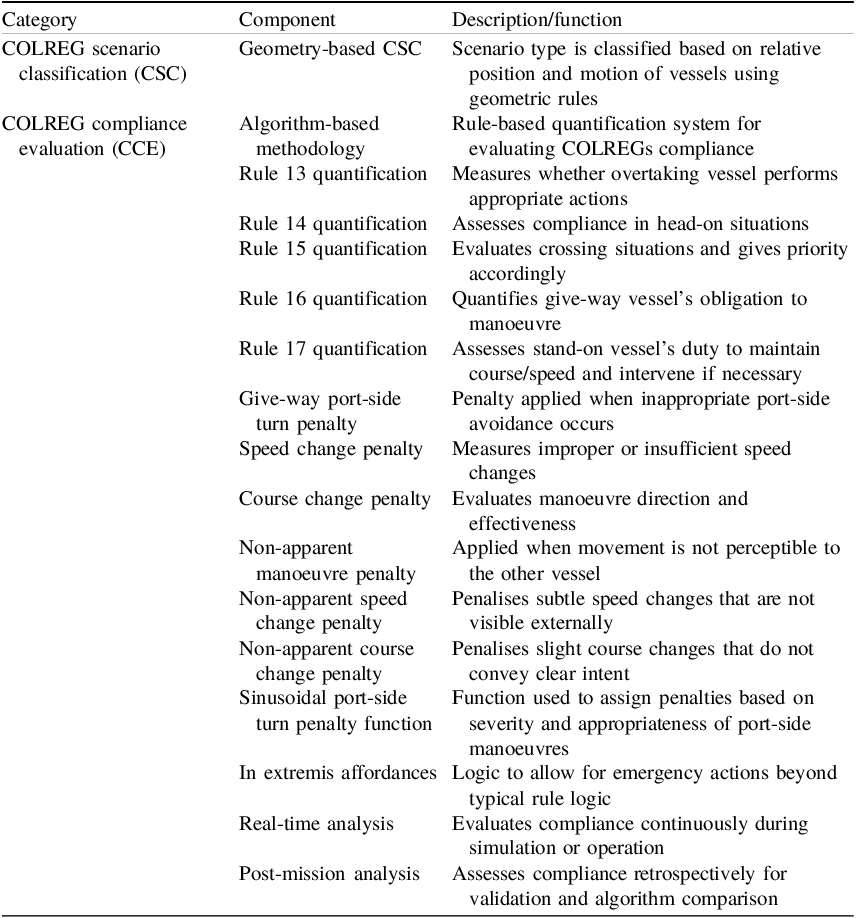
Woerner et al. (Reference Woerner, Benjamin, Novitzky and Leonard2019) proposed a real-time compliance-assessment framework that monitors interaction data between autonomous and manned vessels, and automatically classifies each vessel’s behaviour according to its designated role (give-way or stand-on). Such tools facilitate post hoc analysis of an autonomous agent’s actions and enable researchers to benchmark the rule-adherence levels of competing algorithms in simulation studies. Table 1 provides an overview of the COLREG Scenario Classification (CSC) and Compliance Evaluation (CCE) components that underpin this type of analysis. At present, however, only partial evaluations covering selected rules are feasible; a comprehensive framework spanning the entire COLREGs has yet to be developed (Woerner et al., Reference Woerner, Benjamin, Novitzky and Leonard2019). Rules such as Rule 14 (head-on) and Rule 15 (crossing) lend themselves to relatively clear, binary judgements, whereas Rules 6 (safe speed) and 8 (action to avoid collision) are difficult to quantify.
CSC and CCE components

To address these limitations in validation, recent research emphasises the importance of using realistic scenarios derived from actual maritime accidents. Lee et al. (Reference Lee, Namgung and Kim2026) proposed a novel framework for developing testing scenarios based on actual collision cases to validate collision avoidance algorithms. They argued that unlike randomly generated or simple rule-based scenarios, scenarios reconstructed from real accident data can better reflect complex maritime environments, including dynamic encounters in ports and situations where navigation rules cannot be strictly applied. This approach provides a complementary basis for compliance assessment by exposing algorithms to the realistic complexities of human error and environmental constraints found in historical collision data.
IMO is currently deliberating the establishment of standardised scenarios and performance benchmarks for verifying MASS compliance with the COLREGs (Johansen et al., Reference Johansen, Perez and Cristofaro2016; Huang et al., Reference Huang, Chen, Negenborn and van Gelder2020b). Figure 4 summarises the main challenges, technical safeguards and future research avenues associated with this endeavour. A widely proposed technical remedy for improving compliance is to introduce multilayered safety safeguards. For instance, a dedicated rule-validation layer can be placed above the collision avoidance decision module so that any prospective manoeuvre is checked for COLREG infringements before execution (Campbell et al., Reference Campbell, Naeem and Irwin2012; Johansen et al., Reference Johansen, Perez and Cristofaro2016).
Key challenges, technical enhancements and research directions for ensuring MASS compliance with the COLREGs.

For reinforcement-learning (RL)-based algorithms, the reward function can be augmented with rule-adherence terms, thereby encouraging the agent to follow the COLREGs during training (Zhao and Roh, Reference Zhao and Roh2019; Du et al., Reference Du, Lin, Zhang, Dong and Zhang2022). Excessively restrictive rewards, however, may hinder exploration; several studies therefore argue that allowing the agent to experience – and be penalised for – rule violations can yield more robust solutions (Cheng and Zhang, Reference Cheng and Zhang2018).
Provision for edge cases is equally critical, because counterpart vessels may themselves disregard the COLREGs in real traffic. Rule 17(b), for example, requires a stand-on vessel to act if the give-way vessel fails to manoeuvre. Autonomous systems must therefore cope with such exceptions (Chiang and Tapia, Reference Chiang and Tapia2018; Kim et al., Reference Kim, Hirayama and Okimoto2017). One common remedy is to incorporate heuristic fallback rules, such as ‘if the opposing vessel does not execute the expected avoidance action within a specified time, initiate an evasive manoeuvre’.
In dense traffic, decision logic must also transcend pairwise COLREG interactions (Serigstad, Reference Serigstad2017; Kim et al., Reference Kim, Hirayama and Okimoto2017). Typical strategies rank surrounding vessels by risk, apply COLREG-compliant actions to the most threatening encounter and then address the remainder in a secondary step (Ma et al., Reference Ma, Wang, Chen, Xu and Yan2025).
Ultimately, enhancing COLREGs compliance converges on endowing machines with human-like situational interpretation and judgement. Beyond literal adherence to individual clauses, autonomous navigation demands contextual flexibility and maritime ‘seamanship’, positioning this capability as a key research frontier for future maritime AI (Campbell et al., Reference Campbell, Naeem and Irwin2012; Johansen et al., Reference Johansen, Perez and Cristofaro2016).
3. Review of path planning and collision avoidance algorithms
A wide variety of path planning and avoidance control algorithms have been investigated to solve the collision avoidance problem for MASS (Naeem et al., Reference Naeem, Irwin and Yang2012). In general, these algorithms can be organised into two hierarchical layers: global path planning and local collision avoidance (Johansen et al., Reference Johansen, Perez and Cristofaro2016; Öztürk et al., Reference Öztürk, Akdağ and Ayabakan2022). The global layer searches for a safe and efficient route to the destination over a broad operating area, whereas the local layer manoeuvres the vessel in real-time to avoid collisions with nearby moving objects.
This section surveys the major research trends in three categories: (1) classical graph-search and optimisation-based techniques, which are mainly employed for global or integrated planning (Section 3.1); (2) real-time avoidance and local-manoeuvring algorithms (Section 3.2); and (3) reinforcement-learning and deep-learning approaches (Section 3.3). For each category, we outline the underlying concepts, representative studies, and comparative advantages and limitations. Figure 5 summarises the overall classification.
Taxonomy of path planning and collision avoidance algorithms for MASS.

3.1. Graph- and optimisation-based techniques
Graph-search and optimisation methods are classical approaches in robotic path planning and were among the first to be applied to the maritime domain (Campbell et al., Reference Campbell, Naeem and Irwin2012; Tam et al., Reference Tam, Bucknall and Greig2009). In graph search, the continuous sea space is discretised into a grid or a set of nodes, and algorithms such as A* or Dijkstra are used to obtain a collision free shortest path. For example, a nautical chart can be transformed into a grid in which land or shallow waters become impassable nodes and areas occupied by other vessels become dynamic obstacle nodes; the A* algorithm is then employed to find the minimum-cost route from origin to destination (Dijkstra, Reference Dijkstra1959; Xue et al., Reference Xue, Clelland and Lee2011). Because a simple grid path cannot account for ship-handling constraints such as heading changes, lattice-based search has been adopted (Pivtoraiko et al., Reference Pivtoraiko, Knepper and Kelly2009; Kushleyev and Likhachev, Reference Kushleyev and Likhachev2009). Lattice planners pre-generate a graph of kinematically feasible ship trajectories and then search for the optimal path on this motion lattice – a technique well known in ground-vehicle navigation and increasingly reported at sea (Liu et al., Reference Liu, Liu, Song and Bucknall2017; Niu et al., Reference Niu, Lu, Savvaris and Tsourdos2016).
Graph search guarantees completeness (a path is found if one exists) and facilitates global optimality with respect to distance, time or other cost criteria. However, the number of nodes – and hence the computation time – grows rapidly with problem size, making real-time operation difficult, and dynamic obstacles require repeated re-planning (Campbell et al., Reference Campbell, Naeem and Irwin2012; Tam et al., Reference Tam, Bucknall and Greig2009). To alleviate this, several studies approximate moving obstacles as static cost fields. Liu et al. (Reference Liu, Liu, Song and Bucknall2017), for instance, assigned high heuristic costs to predicted occupancy regions of target vessels, thereby steering the graph search away from potential collisions (Liu et al., Reference Liu, Liu, Song and Bucknall2017; Huang et al., Reference Huang, Chen, Hopman, Negenborn and van Gelder2018).
Sampling-based algorithms are also employed for global planning. These methods build a roadmap by randomly sampling points in the space; prominent examples include Rapidly Exploring Random Trees (RRT) and Probabilistic Roadmaps (PRM) (Chiang and Tapia, Reference Chiang and Tapia2018; Jang and Kim, Reference Jang and Kim2022; Jang and Kim, Reference Jang and Kim2023). Xue et al. (Reference Xue, Clelland and Lee2011) applied RRT to plan routes through complex maritime obstacle fields, and variants such as COLREG-RRT, which embed COLREG constraints, have been introduced (Chiang and Tapia, Reference Chiang and Tapia2018).
In optimisation approaches, the path planning problem is formulated as a mathematical optimisation task. Nonlinear programming or Mixed-Integer Linear Programming (MILP) is typically used, with objectives such as minimising travel time, distance or fuel consumption, and constraints representing collision avoidance and ship dynamics (Johansen et al., Reference Johansen, Perez and Cristofaro2016; Li et al., Reference Li, Liu, Cao and Zhang2018). Li et al. (Reference Li, Liu, Cao and Zhang2018) solved a restricted-heading collision avoidance problem via MPC for real-time use. MPC recomputes the optimal control inputs at each time step; Johansen et al. (Reference Johansen, Perez and Cristofaro2016) applied MPC to ship collision avoidance, modelling COLREG clauses as soft constraints (penalties rather than hard prohibitions) so that a feasible solution is always obtained while encouraging rule compliance.
Soft-computing techniques such as evolutionary algorithms have also been explored. Genetic Algorithms (GA), Ant Colony Optimisation (ACO) and Particle Swarm Optimisation (PSO) mimic biological evolution or swarm intelligence (Holland, Reference Holland1975; Dorigo et al., Reference Dorigo, Birattari and Stützle2006). Szlapczyński (Reference Szlapczynski2011) presented an evolutionary-sets method specialised for ship avoidance; Lazarowska (Reference Lazarowska2014) generated collision free paths for multiple moving obstacles using ACO. Tsou (Reference Tsou2016) optimised evasive manoeuvres for ships with limited turning rates via GA and Kang et al. (Reference Kang, Chen, Zhu, Wang and Xie2018) adapted PSO to enhance dynamic-obstacle avoidance (Szlapczynski, Reference Szlapczynski2011; Lazarowska, Reference Lazarowska2014; Tsou, Reference Tsou2016; Kang et al., Reference Kang, Chen, Zhu, Wang and Xie2018). Evolutionary methods possess strong global-optimum search capability and are less prone to local minima in complex maritime environments (Lazarowska, Reference Lazarowska2017). Their drawbacks include slow convergence and potential numerical instability; performance is sensitive to parameter tuning and may fail to converge (Tam and Bucknall, Reference Tam and Bucknall2010; Campbell et al., Reference Campbell, Naeem and Irwin2012). Hybrid schemes that combine classical and evolutionary methods have therefore emerged. Song et al. (Reference Song, Su, Dong, Shen, Xiang and Mao2018), for instance, used an Artificial Potential Field (APF) for global planning and a VO plus evolutionary search for local avoidance in a hierarchical framework (Song et al., Reference Song, Su, Dong, Shen, Xiang and Mao2018).
The following are key characteristics of graph/optimisation-based methods (see Figure 6).
-
Solvability: guarantee a solution if one exists, but computation time escalates with problem complexity.
-
Clarity: produce paths that are optimal for the chosen cost function; additional factors (e.g. full COLREG compliance) require separate treatment.
-
Global versus Real-Time: highly effective for global planning but less suited to real-time dynamic response without augmentation; thus they are often combined with the local methods of Section 3.2 (Tam et al., Reference Tam, Bucknall and Greig2009; Johansen et al., Reference Johansen, Perez and Cristofaro2016).
Key characteristics of graph/optimisation-based global path planning methods and their role in a two-layer navigation architecture for MASS.

In practical MASS implementations, a two-layer architecture is common: a global planner generates a waypoint sequence, while a local avoidance algorithm (Section 3.2) tracks that route and resolves immediate collision risks in real-time (themoonlight.io; Polvara et al., Reference Polvara, Sharma, Wan, Manning and Sutton2018).
3.2. Real-time avoidance and local manoeuvring algorithms
Real-time (local) avoidance algorithms generate short-horizon steering commands whenever a MASS detects an imminent collision risk with nearby obstacles such as vessels or floating objects (Benjamin et al., Reference Benjamin, Leonard, Curcio and Newman2006; Fiorini and Shiller, Reference Fiorini and Shiller1998; Kuwata et al., Reference Kuwata, Wolf, Zarzhitsky and Huntsberger2014). Figure 7 illustrates the main families of these reactive techniques, with particular emphasis on the VO framework. The VO approach was originally developed in robotics. VO computes, in relative-velocity space, the set of velocities that would lead to a collision and selects admissible velocities outside that set. Benjamin et al. (Reference Benjamin, Leonard, Curcio and Newman2006) first introduced VO to ship navigation and Kuwata et al. (Reference Kuwata, Wolf, Zarzhitsky and Huntsberger2014) later incorporated COLREG rules into a maritime VO algorithm.
Real-time local avoidance techniques for MASS, highlighting velocity obstacle and other lightweight reactive methods.

A limitation of VO is that it does not explicitly consider vessel dynamics such as acceleration limits or turning rates, so the suggested commands may be infeasible for a real ship. MPC, which embed dynamic constraints (Eriksen et al., Reference Eriksen, Bitar, Breivik and Lekkas2020; Du et al., Reference Du, Banda, Goerlandt, Huang and Kujala2020).
APF method, which assigns an attractive field to the goal and repulsive fields around obstacles; the resultant vector determines the steering angle (Ge and Cui, Reference Ge and Cui2002; Lyu and Yin, Reference Lyu and Yin2018; Song et al., Reference Song, Su, Dong, Shen, Xiang and Mao2018). APF offers very fast computation and handles multiple obstacles well, but it can suffer from local minima: in narrow channels the attractive and repulsive forces may balance and trap the vessel. Numerous remedies have been proposed to mitigate this issue (Campbell et al., Reference Campbell, Naeem and Irwin2012; Song et al., Reference Song, Su, Dong, Shen, Xiang and Mao2018).
Additional real-time manoeuvring algorithms borrowed from robotics include the Dynamic Window (DW) approach, vector-field guidance and Line-of-Sight (LOS) avoidance (Fox et al., Reference Fox, Burgard and Thrun1997; Eriksen et al., Reference Eriksen, Breivik, Lekkas and Sørensen2016; Seder and Petrovic, Reference Seder and Petrovic2007). The DW method searches the velocity–turn-rate space for feasible control inputs, evaluates each candidate for collision risk and goal progress, and selects the optimum. Xu et al. (Reference Xu, Chen, Zhang and Wang2018) applied DW to multi-ship encounters, simulating candidate inputs to assess collision risk (Xu et al., Reference Xu, Chen, Zhang and Wang2018).
Local methods consume little computational resource and can be applied instantaneously; however, their myopic nature means they may deviate from the globally optimal route. Integrated architectures are therefore required, in which the local planner returns to the global path after avoidance or triggers re-planning when necessary (Naeem et al., Reference Naeem, Irwin and Yang2012; Tam et al., Reference Tam, Bucknall and Greig2009). Verifying the safety of real-time methods is another key issue. Although stacking multiple algorithms as redundant safeguards has been explored, systematic validation is still needed to manage potential decision conflicts between hierarchical or parallel modules (Johansen et al., Reference Johansen, Perez and Cristofaro2016; Kim et al., Reference Kim, Hirayama and Okimoto2017).
3.3. Reinforcement-learning and deep-learning approaches
RL and deep learning (DL) to maritime path planning and collision avoidance has grown markedly in the past decade (Woo and Kim, Reference Woo and Kim2020; Du et al., Reference Du, Lin, Zhang, Dong and Zhang2022). Figure 8 schematically contrasts the two complementary strands of this research agenda – DL-based motion prediction and RL-based policy learning. Contemporary machine-learning research can be grouped into two complementary strands. The first injects learning into the perception and prediction layer; the second seeks to acquire the control policy itself.
Roles of deep learning and reinforcement learning in MASS collision avoidance: motion prediction versus policy learning.

In the former strand, DL models trained on large Automatic Identification System (AIS) or radar-track corpora predict the short-term manoeuvres of nearby vessels. Accurate forecasts of heading and speed over a time horizon of several minutes enable conventional avoidance algorithms to refine their decisions and reduce false alarms (Chen et al., Reference Chen, Liu, Achuthan, Zhang and Chen2021; Hwang et al., Reference Hwang, Seo and Kim2019). Supervised-learning studies that imitate human helmsmen have also been reported, although progress is constrained by the scarcity of high-fidelity manoeuvring data.
The latter strand employs RL to derive the collision avoidance policy directly. Deep-RL variants such as the Deep Q-Network (DQN) and the Deep Deterministic Policy Gradient (DDPG) have been demonstrated on one-to-one encounter scenarios (Cheng and Zhang, Reference Cheng and Zhang2018; Zhao and Roh, Reference Zhao and Roh2019). For example, trained a DDPG agent for crossing situations but did not hard-code COLREG compliance, leaving open the possibility of rule violations (Du et al., Reference Du, Lin, Zhang, Dong and Zhang2022). MPC; by embedding CPA penalties and COLREG clauses in the reward function, Xie et al. (Reference Xie, Li, Liu and Zhang2019) significantly reduced non-compliant actions (Johansen et al., Reference Johansen, Perez and Cristofaro2016).
The effectiveness of RL hinges on reward design. Kum et al. (Reference Kum, Park and Lee2020) observed that a collision-free agent nevertheless executed abrupt course and speed changes because passenger comfort and fuel efficiency were absent from the reward. DL-based global planners have also been explored, but their performance often degrades outside the training distribution, underlining a generalisation gap (Chen et al., 2021). Multi-agent RL, wherein several autonomous ships learn cooperative strategies, is emerging as a research frontier; yet the concomitant increase in state dimensionality complicates convergence and validation (Chun et al., Reference Chun, Roh, Lee, Ha and Yu2021; Zhou et al., Reference Zhou, Gu, Wen, Du, Xiao, Huang and Zhu2022).
Despite these advances, ML-centric methods remain largely at the experimental stage and few scholars consider them ready to supplant classical algorithms outright (Sarhadi et al., Reference Sarhadi, AlAzad, Rahtu and Kallio2021). The maritime environment exhibits extreme variability in vessel type, weather and traffic density, and no accredited benchmark yet exists for certifying the safety of learning-based systems. Consequently, the consensus is that ML modules will, for the foreseeable future, complement rather than replace rule-based or optimisation-based planners. Hybrid architectures that couple deterministic algorithms with learning components – thereby exploiting the reliability of explicit models and the adaptability of data-driven policies – represent the most promising trajectory of current research (Zhao and Roh, Reference Zhao and Roh2019; Woo and Kim, Reference Woo and Kim2020).
4. Navigation-GPT architecture and MASS integration framework
4.1. Navigation-GPT: an LLM-based framework for COLREGs compliance
Ma et al. (Reference Ma, Wang, Chen, Xu and Yan2025) proposed Navigation-GPT, a novel maritime decision-making framework that fuses the general reasoning capability of a Large Language Model (LLM) with domain-specific fine-tuning via Low-Rank Adaptation (LoRA). Observing that a large natural-language model can draw on its extensive knowledge base to perform logical inference and problem solving, the authors aimed to mitigate the vulnerability of existing autonomous-navigation systems in previously unknown situations. They also noted, however, that a generic LLM alone lacks direct sensor or action interfaces, making it difficult to guarantee the reliability of its outputs (Goodfellow et al., Reference Goodfellow, Bengio and Courville2016).
To resolve this limitation, Ma et al. (Reference Ma, Wang, Chen, Xu and Yan2025) devised a dual-core LLM architecture that combines the Reasoning and Acting (ReAct) framework with LoRA. In this design, Core 1 – a GPT-4-scale model – executes the ReAct algorithm: instead of producing a single textual reply, the LLM issues intermediate actions that call external tools, receives their observations and iteratively refines its chain of thought, thereby collecting and analysing situational data in real-time and making step-wise decisions. Concretely, Core 1 can invoke, through a unified API, tools that (1) query radar, AIS and electronic-chart sensors; (2) compute the DCPA and the TCPA; (3) classify encounter types; (4) evaluate collision risk; and (5) generate avoidance manoeuvres. This design not only reduces the ‘hallucination’ errors that arise when an LLM ‘imagines’ information but also delegates complex numerical calculations to dedicated, high-reliability functions (Campbell et al., Reference Campbell, Naeem and Irwin2012; Johansen et al., Reference Johansen, Perez and Cristofaro2016).
Core 2, by contrast, is a smaller LLM fine-tuned with LoRA on data that conform to the International Regulations for Preventing Collisions at Sea (COLREGs), thereby encapsulating specialised maritime knowledge. Given an input such as ‘an approaching vessel on starboard with DCPA = 0.5 NM’, this auxiliary model can output textual advice that specifies an appropriate evasive action under the relevant COLREG rule (Campbell et al., Reference Campbell, AbuTair and Naeem2014; Chun et al., Reference Chun, Roh, Lee, Ha and Yu2021). Navigation-GPT therefore operates cooperatively: Core 1 (the ReAct-based large LLM) synthesises the situation and gathers information via tool calls, then consults Core 2 (the LoRA-based small LLM) for expert guidance. Simulation experiments reported by Ma et al. (Reference Ma, Wang, Chen, Xu and Yan2025) demonstrated that this dual-core approach achieves higher COLREG compliance and more effective collision avoidance in complex scenarios than a single-LLM baseline. However, ensuring the real-time responsiveness of this framework remains a critical technical challenge. The iterative reasoning process of the ReAct mechanism and the substantial computational overhead of running dual-core LLMs can introduce inference latency, potentially conflicting with the need for millisecond-level decision-making in rapidly evolving collision situations. Therefore, optimising inference speed without compromising reasoning depth is essential for practical deployment.
4.2. Three-stage development strategy for deploying LLM-based navigation intelligence on MASS
Campbell et al. (Reference Campbell, Naeem and Irwin2012) argue that proof-of-concept alone is insufficient for applying MASS in real-world sea environments; instead, a systematic, step-by-step process of development and verification is required. In line with this recommendation, the present review briefly outlines a three-stage strategy: Core 1 development → Core 2 development → integrated operational testing (Figures 9 and 10)
Framework of navigation-GPT. Navigation-GPT can dynamically plan steps, execute actions, observe outcomes and adjust subsequent behaviours based on this feedback (Ma et al., Reference Ma, Wang, Chen, Xu and Yan2025).

Three-stage development and verification roadmap for implementing navigation-GPT on MASS.

4.2.1. Phase 1 – development and verification of core 1
The first phase establishes the ReAct-based autonomous-reasoning framework centred on a general-purpose large LLM. Concretely, an API-style tool set must be constructed that interfaces with ship sensors and navigation equipment (AIS, radar, electronic charts, etc.) and performs core collision avoidance calculations such as DCPA/TCPA estimation and COLREGs classification. A properly configured tool set enables the LLM to retrieve the required information freely, carry out accurate computations and reduce unnecessary hallucinations. The stand-alone Core 1 is then validated in a simulation environment across diverse navigation scenarios to confirm that the ReAct prompt operates as intended (Chun et al., Reference Chun, Roh, Lee, Ha and Yu2021; Ma et al., Reference Ma, Wang, Chen, Xu and Yan2025).
4.2.2. Phase 2 – development and verification of core 2
The second phase fine-tunes a small LLM with LoRA to provide domain expertise. A sufficiently large dataset of COLREG-compliant navigation cases or outputs from existing collision avoidance algorithms is required for this purpose (Zhao and Roh, Reference Zhao and Roh2019). Model performance can be evaluated using the COLREG-rule-based scenarios proposed by Campbell et al. (Reference Campbell, AbuTair and Naeem2014). Chun et al. (Reference Chun, Roh, Lee, Ha and Yu2021) advise that, if the model exhibits systematic errors in specific situations during training, additional examples of those cases should be inserted and the model retrained to improve accuracy.
4.2.3. Phase 3 – integration and operational testing
The final phase combines Cores 1 and 2 to complete the Navigation-GPT agent, followed by simulation and limited field trials (Ma et al., Reference Ma, Wang, Chen, Xu and Yan2025). During integration, a call such as ‘Action: get_avoidance_action(current situation)’ is inserted within Core 1’s ReAct reasoning chain, thereby invoking Core 2 to generate COLREG-focused expert advice. Core 1 synthesises this advice and determines the final heading or speed command. Subsequent evaluations test integrated performance in advanced environments – multi-ship encounters involving more than two vessels, scenarios containing non-compliant ships, and passages near complex topography – and verify that real-time decision latency meets maritime operational requirements (Chun et al., Reference Chun, Roh, Lee, Ha and Yu2021).
4.3. Practical considerations for sea-going deployment
MASS entails challenges that extend well beyond algorithmic proof-of-concept (Campbell et al., Reference Campbell, Naeem and Irwin2012; Johansen et al., Reference Johansen, Perez and Cristofaro2016). A first concern is computational capacity. The inference workload of a large language model is substantial, yet the physical and electrical space available on board is limited. Developers must therefore decide between installing GPU-based clusters inside the vessel and streaming computations to shore-side or cloud servers by satellite link – each option raising its own questions of latency, cost and reliability.
A second issue centres on the fidelity of the sensor data that feed the model. Radar and AIS streams are susceptible to noise, drop-outs and spoofing, while electronic-chart information can be outdated or incomplete. Recent studies emphasise the importance of multi-sensor fusion techniques that weight each source by an estimated confidence value so that spurious measurements do not propagate through the reasoning chain (Mou et al., Reference Mou, van der Tak and Ligteringen2010; Huang et al., Reference Huang, Chen, Negenborn and van Gelder2020b). Closely related is the problem of model uncertainty: large language models are known to ‘hallucinate’ plausible-sounding but incorrect statements when they stray beyond their training distribution (Goodfellow et al., Reference Goodfellow, Bengio and Courville2016). To contain this risk, Zhao and Roh (Reference Zhao and Roh2019) and Chun et al. (Reference Chun, Roh, Lee, Ha and Yu2021) recommend equipping the vessel with a safety mode that triggers conservative evasive action whenever the model’s confidence falls below a threshold and that allows the human operator to assume authority without delay.
Human–AI interaction itself forms a third consideration. The ReAct framework records the LLM’s intermediate deliberations as plain text, which affords a degree of transparency, yet mariners working under time pressure may prefer a more intuitive, graphical presentation of situational awareness and recommended manoeuvres. Designing such interfaces remains an open research task.
Finally, the regulatory environment is still evolving. Because formal guidelines for interpreting the COLREGs in the context of unmanned vessels have not yet been codified, questions of liability and compliance remain unsettled (Johansen et al., Reference Johansen, Perez and Cristofaro2016). Scholars have consequently called for dedicated certification procedures that combine formal verification of the decision logic with large-scale evidence of empirical safety. Baldauf et al. (Reference Baldauf, Benedict, Fischer, Motz and SchröderHinrichs2011) suggest that the cumulative simulation record should span several million operating hours and be complemented by a phased programme of harbour, coastal and blue-water sea trials.
In summary, while Navigation-GPT offers a qualitatively higher level of reasoning flexibility than traditional rule- or optimisation-based collision avoidance systems (Ma et al., Reference Ma, Wang, Chen, Xu and Yan2025), its practical adoption will depend on parallel advances in on-board computing infrastructure, sensor-error mitigation, uncertainty management, human-centred interface design and – perhaps most critically – a coherent legal and certification framework. Meeting these prerequisites will require sustained cooperation among shipbuilders, equipment vendors, regulatory bodies and the research community, supported by extensive field experimentation under progressively demanding operational conditions.
5. Discussion
MASS, tracing the evolution from classical graph/optimisation methods to recent reinforcement-learning (RL) and large-language-model (LLM) approaches. Particular attention has been paid to the continuing effort to satisfy the International Regulations for Preventing Collisions at Sea (COLREGs), which remain the single most stringent requirement for any autonomous-navigation system.
Early research addressed COLREG compliance through rule-based expert systems and constraint-driven optimisation, thereby enabling automated give-way decisions in the basic encounter settings covered by Rules 5–8 and 13–17 (Campbell et al., Reference Campbell, Naeem and Irwin2012; Johansen et al., Reference Johansen, Perez and Cristofaro2016; Kim et al., Reference Kim, Hirayama and Okimoto2017). Yet, ambiguities in rule interpretation and the combinatorial growth of multi-ship encounters continue to preclude full compliance (Chiang and Tapia, Reference Chiang and Tapia2018; Ohn and Namgung, Reference Ohn and Namgung2023). Objective metrics for measuring and improving the degree of compliance are therefore an active topic of investigation (Woerner et al., Reference Woerner, Benjamin, Novitzky and Leonard2019).
With respect to algorithmic foundations, classical graph search, model-predictive control and mixed-integer linear programming still dominate global planning, whereas VO, APF and DW methods remain the tools of choice for real-time local manoeuvring (Benjamin et al., Reference Benjamin, Leonard, Curcio and Newman2006; Kuwata et al., Reference Kuwata, Wolf, Zarzhitsky and Huntsberger2014). Because the former offer global optimality at the cost of computational latency and the latter provide agility at the expense of myopic decision making, hierarchical ‘global-planner + local-avoider’ architectures have become the de facto standard (Naeem et al., Reference Naeem, Irwin and Yang2012). Although evolutionary computation and neural approaches have been explored, they have not yet delivered decisive advantages over well-tuned classical baselines (Song et al., Reference Song, Su, Dong, Shen, Xiang and Mao2018; Praczyk, Reference Praczyk2015). Consequently, the community now calls for unified benchmarking scenarios and metrics that allow meaningful cross-comparison of competing algorithms prior to any sea-going trials (Zhou et al., Reference Zhou, Gu, Wen, Du, Xiao, Huang and Zhu2022; Tam et al., Reference Tam, Bucknall and Greig2009).
The arrival of data-driven AI has accelerated progress but has also exposed fresh challenges. RL and deep-learning solutions have demonstrated promising collision avoidance behaviour in simulation (Zhao and Roh, Reference Zhao and Roh2019; Woo and Kim, Reference Woo and Kim2020; Du et al., Reference Du, Lin, Zhang, Dong and Zhang2022). Nevertheless, present-day agents still lack the reliability, explainability and rule-compliance guarantees demanded for commercial service (Cheng and Zhang, Reference Cheng and Zhang2018; Chun et al., Reference Chun, Roh, Lee, Ha and Yu2021). Hybrid schemes that retain rule-based cores while harnessing the adaptability of learning algorithms are therefore attracting increasing interest (Eriksen et al., Reference Eriksen, Bitar, Breivik and Lekkas2020; Johansen et al., Reference Johansen, Perez and Cristofaro2016).
Within this context, Navigation-GPT – the dual-core LLM architecture proposed by Ma et al. (Reference Ma, Wang, Chen, Xu and Yan2025) – offers a compelling new direction. By coupling a reasoning-and-acting (ReAct) LLM with a LoRA-fine-tuned COLREG expert, the system achieved higher compliance rates and superior avoidance performance than either a standalone LLM or a conventional RL agent. Notwithstanding these gains, genuine deployment will require solutions to practical constraints such as ship-board computational capacity, sensor error management, model-uncertainty control, ergonomic human–machine interfaces and a robust legal-certification pathway.
Several research priorities emerge from the foregoing survey. First, algorithms must evolve from partial rule coverage towards seamless integration of all COLREG provisions together with tacit seafaring expertise (‘good seamanship’). Second, new methods are needed for prioritising and coordinating manoeuvres in dense, multi-ship traffic, potentially exploiting vessel-to-vessel communication. Third, a standardised evaluation framework – comprising open simulation platforms, harmonised scenarios and agreed performance indices – would greatly enhance reproducibility and comparability. Fourth, comprehensive safety assurance will depend on formal verification, extensive simulation evidence and staged sea trials under regulatory oversight. Fifth, effective human–AI collaboration will be essential during the transition period before full autonomy, necessitating carefully designed human–machine interfaces and operating procedures. Finally, the introduction of powerful LLMs raises ancillary concerns regarding data governance, cyber-security and ethical use that must be addressed in parallel with technical development.
In summary, collision avoidance technology for MASS is converging towards hybrid solutions that synthesise the determinism of classical methods with the adaptability of advanced AI. As research accelerates along this trajectory, the emergence of navigation algorithms that fuse comprehensive rule compliance with human-level maritime judgement appears increasingly plausible.
6. Conclusion
Autonomous navigation for the MASS is increasingly viewed as a key means of reducing human error and preventing marine accidents. RL and LLM approaches, all against the backdrop of the COLREGs requirement. Traditional methods such as A * search, mixed-integer or model-predictive optimisation, and real-time reactive schemes offer mathematical clarity and predictable performance, yet they show limited flexibility in dense multi-ship traffic and other atypical situations. Learning-based techniques have therefore been explored to supply that missing adaptability, but they remain vulnerable to data scarcity and to unexpected behaviour whenever the reward design fails to penalise COLREG violations adequately.
Because neither camp fully meets operational needs on its own, contemporary research now gravitates towards hybrid solutions that blend rule-based reliability with the adaptive strengths of machine learning. Achieving genuine sea-going autonomy will nevertheless require algorithms to absorb not only the letter of the COLREGs but also the tacit seamanship that mariners apply when rules conflict or circumstances fall outside textbook cases. The absence of a universally accepted verification and certification framework makes it difficult to demonstrate such competence; large-scale simulation, standardised evaluation scenarios and phased sea trials therefore remain indispensable prerequisites.
In that context, Navigation-GPT – a dual-core architecture that couples a reasoning-and-acting LLM with a LoRA-fine-tuned COLREG expert – represents a promising step forward. Experimental evidence shows that this arrangement can maintain higher rule-compliance rates and safer evasive manoeuvres than either conventional RL agents or off-the-shelf LLMs, even in complex encounter geometries. However, Navigation-GPT must still contend with practical constraints such as shipboard computing limits, satellite-link latency, sensor noise and the legal obligation to certify AI decision making. During the foreseeable transition period, autonomous functions will operate alongside human officers, so intuitive human–machine interfaces and clear operating procedures will be essential. Ultimately, the successful adoption of MASS technology will depend on an organic interplay among hybrid algorithms, rigorous verification, incremental field demonstrations and close cooperation between industry, regulators and the research community.
Funding statement
This research received no external funding.
Competing interests
The authors declare that they have no known competing financial interests or personal relationships that could have appeared to influence the work reported in this paper.
CRediT authorship contribution statement
Ho Namgung: Conceptualisation, Methodology, Formal analysis, Writing – original draft, Visualisation, Software, Validation. Joo-Sung Kim: Supervision, Resources, Writing – review & editing, Project administration, Investigation, Funding acquisition, Validation. Da-Un Jang: Data curation, Software, Visualisation, Writing – review & editing, Formal analysis, Validation.