


Introduction
Polar ice exhibits electrical properties which are very different from those of pure artificial ice or temperate glacier ice. The static electrical conductivity (SEC) of cold polar ice is typically 10−5 S m−1 compared to 10−8 S m−1 in temperate glacier ice. At a given temperature, the frequency corresponding to the maximum absorption of the Debye dispersion is similar to that of the HF-doped ices. A review of the dielectric properties of Antarctic ice was given by Reference Glen and ParenGlen and Paren (1975) and Reference Fitzgerald and ParenFitzgerald and Paren (1975). Similar results were obtained by mechanical damping measurements (Reference Vassoille, Mai, Perez, Tatibouet, Duval and MaccagnanVassoille and others 1980, Reference Vassoille, Perez, Tatibouet, Duval and MaccagnanVassoille and others 1982). The influence of impurities found in polar ice was compared with laboratory-doped ices (Reference Paren, Whalley, Jones and GoldParen 1973, Reference Fitzgerald, Glen and ParenFitzgerald and others 1977). But, as shown by Reference ShawShaw (1979), most impurities in the snow of the Antarctic plateau are microparticles (Aitken particles, sea-salt particles). Even if these particles are dissociated in firn, the influence of such impurities is difficult to assess. Moreover the content of impurities in polar ice is generally low. However a good correlation between SEC and acidity was found by Reference HammerHammer (1980) in Greenland ice and between SEC and sulphate content by Reference Maccagnan, Barnola, Delmas and DuvalMaccagnan and others (1981) in the Dome C ice core, East Antarctica. It is possible that variations of SEC are induced by impurities and that the background values of polar ice are induced by other mechanisms. Reference Fitzgerald, Glen and ParenFitzgerald and others (1977) and Reference Vassoille, Mai, Perez, Tatibouet, Duval and MaccagnanVassoille and others (1980) have suggested that ageing of firn has an effect on the electrical and mechanical behaviour of polar ice. This theory will be discussed in this paper, based on electrical measurements on Antarctic ice cores. The origin of radio echo layers observed within the Antarctic ice sheet will be also discussed in relation to variations in the ice conductivity. An explanation for the disappearance of internal reflections near the bedrock of ice sheets is also given.
1. Experimental Methods
1.1. Conductivity measurements along an ice core
Two flat faces are cut parallel to the axis of the core. An assembly of electrodes is then scratched along the core, the applied voltage being 250 V. The current is amplified and recorded. The electrodes are made of seven independent contacts, and the cathode is surrounded by a guard ring. The sliding speed of the electrodes is 5 mm s−1 or 25 mm s−1 and the temp erature is -15°C. Since the exact contact area of the electrodes with ice and the geometry of currents are unknown, and since it was not verified that the current was proportional to voltage, we cannot derive quantitative values of the conductivity; we can only record the current through the ice core. Measurements are reproducible, provided that a fresh surface is cut shortly before the experiments.
1.2. Dielectric measurements
Samples were cut from ice cores 100 mm in diameter. The flat faces of the samples were cut with a microtome and the diameter with a band saw. These operations were done in a cold room (temperature -16°C). The dimensions of the samples were 70 mm in diameter and about 7 mm in thickness.
The samples were then placed in the dielectric cell and allowed to rest for at least 3 h, under a moderate pressure of the electrodes. The dielectric cell was a cell with two silver-plated electrodes and without a guard ring (the relative importance of surface current is minor for a wide sample). Measurements were made with a General Radio capacitance measurement assembly 1520 A or a Hewlett Packard vector impedance meter 4800 A.
Some measurements were also done on pure ice samples, the dielectric behaviour of which is well known. The values found for the low frequency permittivity and the relaxation time suggest an air gap of about 0.03 mm between the sample and the electrodes. Some corrections were made on the measurements on polar ice in order to take into account the influence of this air gap (Reference MaccagnanMaccagnan unpublished).
2. Results
2.1. Dome C
SEC was measured on an ice core taken from a depth of about 681 m at Dome C, central Antarctica (74°39'S, 124°10'E, elevation: 3 240 m, mean annual temperature: -53.5°C).
The record of current shows large variations along this core: the minimum is about 0.1 μA and the maximum 0.9 μA (Fig.1). Two samples for dielectric measurements were chosen from the core: one in the less conductive part (680.96 m), and the other in the more conductive part (681.26 m). The real part of the conductivity σ at -15°C was plotted against frequency for both samples (Fig.2). The relaxation frequency, for which σ = l/2(σs + σ∞,) is the same for both samples: 2.2 kHz after computation (σs is the low frequency conductivity and σ∞ the high frequency limiting conductivity).
Static electrical conductivity along an ice core (from the Dome C ice core). The current was measured at -15°C.

Frequency dependence of conductivity of two samples from the Dome C ice core. Temperature: -15°C.

2.2. D 10
SEC was measured on an ice core taken from a depth of about 46 m at D 10, a coastal site in Antarctica (66°40°S, 140°01'E, elevation 270 m, mean annual temperature: -13° C). The current was about 0.4 μA in the upper part of the core and 0.001 μA in the lower part (Maccagnan and others 1981). The current in the lower part was of the same order as that measured on temperate glacier ice cores or on artificial pure samples. Two samples of ice were taken for dielectric measurements: one from the upper part of the core and the other in the lower part. The real part of the conductivity is plotted against frequency for these samples at -15°C on Fig. 3. The relaxation frequency is 2.4 kHz for the sample 46.05 m and 19 kHz for the sample 46.10 m.
Frequency dependence of conductivity of two samples from the D 10 ice core. Depth: 46 m, temperature: -15°C.

3. Discussion
As shown in Figure 1, large variations of SEC are observed along the ice core studied. From Hammer (1980), a good relationship is found between SEC and the acidity of melted samples, provided that the H+ concentration is higher than 1 μEquiv. H+ kg−1. For the Dome C ice core, it is confirmed that most of the acid fallout is H2SO4 induced by volcanic eruptions (M Legrand personal corammunication). Since SO3 and H2O show an eutectic with a low freezing point, sulphate can be found in a liquid phase at the grain boundaries. The high SEC values correlated with sulphate content could then be due to the existence of these liquid conducting paths (Reference MaccagnanMaccagnan unpublished). But, according to Reference Maccagnan, Barnola, Delmas and DuvalMaccagnan and others (1981), the relation between SEC and sulphate content varies from core to core. Those authors explain this discrepancy in two ways (i) variation of SEC with crystal-growth conditions in the first few metres of the firn, (ii) effect of ageing. Indeed, the static conductivity is higher for rapidly grown polycrystalline ice than for good ice single crystals (Reference von Hippel, Mykolajewycz, Runck and WestphalVon Hippel and others 1972) and it decreases with ageing (Reference Maidique, von Hippel and WestphalMaidique and others 1971, Reference Taubenberger, Whalley, Jones and GoldTaubenberger 1973). But, as a consequence, ageing effects depend on growth conditions. Thus, large ageing effects are observed when small volumes of super-cooled water freeze (Reference Evrard, Whalley, Jones and GoldEvrard 1973). From Figure 2, no measurable variation of the relaxation frequency is found for the two samples whereas large variations of SEC were observed (Fig.l). The high relaxation frequency found in the D 10 ice-core sample (Fig.3) for which the value of SEC was very small (Reference Maccagnan, Barnola, Delmas and DuvalMaccagnan and others 1981) clearly shows the effect of ageing. This assertion is supported by studies of ageing effects on the dielectric properties of ice formed by supercooling breakdown by Reference Evrard, Whalley, Jones and GoldEvrard (1973), Reference Boned, Barbier, Whalley, Jones and GoldBoned and Barbier (1973), and Reference LagouretteLagourette (1976). At a given temperature, the low frequency conductivity decreases with time whereas the Debye relaxation frequency increases. It was verified by these authors that ageing effects were obtained within a short time provided that temperature was near the melting point and that the specific surface area in the ice was high. Moreover, from experiments on disperse microcrystals, Reference Lagourette, Boned and RoyerLagourette and others (1976) deduced that the frequencies at the maximum of the Debye dipolar absorption increased with specific surface area. Reference Kvlividze, Kiselev, Kurzaev and UshakovaKvlividze and others (1974) pointed out that the mobility of the elements of the ice lattice increased as the size of the ice particles decreased.
Thus, changes in the relaxation frequency in the firn might be correlated with the specific surface area. If, due to low temperature, ageing ceases, a memory of the internal structure of ice may be kept. At Dome C, the temperature in the firn is lower than -50°C below 20 m (Reference Ritz, Lliboutry and RadoRitz and others 1982) and so ageing cannot be efficient in modifying the ice structure. Thus, ageing effects can be invoked only in the first few metres of the firn in which temperature may rise up to -20°C during summer. With this assumption, changes in the dielectric behaviour along an ice core would be induced by changes in the specific surface area in the upper metres of the firn. Only crystal growth, as observed by Reference Duval and LoriusDuval and Lorius (1980), can modify the ice structure down to 900 m at Dome C.
This point will be discussed in relation to the origin of the radio echo layers in polar ice masses.
4. Radio Echo Layers in Polar Ice Sheets
4.1. Possible causes of layering
Internal reflections have been observed over wide areas of the Antarctic and Greenland ice sheets. According to Reference HarrisonHarrison (1973) differences in the dielectric constant between layers caused by the orientation of anisotropic crystals, or density variations, can explain echoes. Similar ideas were put forward by Reference Ackley and KeliherAckley and Keliher (1979) and Reference HammerHammer (1980). Reference Paren and RobinParen and Robin (1975) show that variations in the electrical conductivity can explain the deeper echoes.
By considering a simple model with a single boundary, the reflection coefficient R is given by:
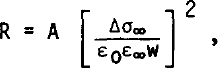
where ∆σ∞ is the variation of conductivity between two layers, ε0 the permittivity of free space, ε∞ the dielectric constant at high frequencies, and w the angular frequency.
If the dielectric behaviour of polar ice is described by two dispersions (the Debye dispersion and a low frequency dispersion), the electrical conductivity σ∞ is given by:

σs is SEC, τ1 and τ2 are relaxation times, and ∆ε1 and ∆ε2 are the differences in permittivity at low and high frequencies, respectively.
Frequency dependence of conductivity of the Dome C ice core for different depths. Temperature: -15°C.

Figure 4 shows variations in conductivity with frequency for three samples of the Dome C ice core. The reflection coefficient calculated at ∆ε-15°C for the extreme values of σ∞ is about -68 dB for a single interface.
Variations of σ∞ may be caused by (i) variations in σs (SEC), (ii) variations in the strength of the Debye dispersion in conductivity, and (iii) variations in the strength of the second dispersion in conductivity. These three possibilities are investigated.
(i) Variations in σs.
As discussed previously in this paper, high values of SEC are found in polar ice, and variations of SEC are also observed (Fig.1) (Reference HammerHammer 1980). The variation of σ∞ observed in Figure 2 seems to be caused by the variation of SEC in the two samples studied. The corresponding reflection coefficient between the two samples is about -71 dB at -15°C.
(ii) Variations in the strength of the Debye dispersion.
Differences in the Debye conductivity at high frequency may be due to variations in ∆ε1 and τ1.
The impurity level in polar ice is probably too low to induce significant variations in ∆ε1. In Figure 3, the large variation in σ∞ is clearly caused by a variation in the relaxation time between the two samples studied. The reflection coefficient calculated at -15°C is -56 dB.
Paren and Robin (1975) considered the reflection coefficient for the boundary between pure and polar ice. Differences in σ∞ were almost entirely due to differences in the activation energy. Differences in relaxation times, at a given temperature, can also result in different values of the pre-exponential factor of the Arrhenius law. The very high relaxation frequency found for a sample of the D 10 ice core (Fig.3), compared to that of Dome C ice samples, cannot be explained by variations in the activation energy. As discussed previously, only high impurity content or ageing effects may explain this particular behaviour. The very low value of SEC found for this sample by Reference Maccagnan, Barnola, Delmas and DuvalMaccagnan and others (1981) supports the assumption concerning ageing effects.
For a similar activation energy, the relaxation frequency of disperse crystals seems to increase with the specific surface area (Reference LagouretteLagourette and others 1976). A high relaxation frequency might be found in ice samples (with negligible specific surface area) provided that the memory of the physical state of ice in the firn is kept. With this assumption, radio echo layers might reflect variations in the ageing conditions or variations in the specific surface area in the first metres of the firn. As discussed above, the former depends on the latter. (iii) Variations in the strength of the second dispersion.
A low frequency relaxation, which was observed in polar ice samples by Reference MaenoMaeno (1974), gives very high values for the dielectric constant (>1000) at low frequency. The origin of this dispersion is not clear (possibly caused by polarization due to space charges or mechanical strains). Thus, at this stage, it is difficult to assess the part played by this dispersion in the internal reflections.
4.2. Cause of the disappearance of internal reflections within the lowest few hundred metres of ice sheets
From radio echo profiles given by Robin and others (1977) and that given in Figure 5, it appears that no layer is detected within the last few hundred metres of ice sheets. The separation between the deepest visible layer and bedrock changes with the location. On the other hand, there is some indication of reduced SEC above the bedrock (Reference Glen and ParenGlen and Paren 1975). The influence of higher temperature coupled with effects of strain leading to recrystallization was put forward by Reference Glen and ParenGlen and Paren (1975). From the crystalline texture in the Byrd ice core given by Reference Gow and WilliamsonGow and Williamson (1976), and in the Dome C ice core by Reference Duval and LoriusDuval and Lorius (1980), only crystal growth induced by the grain boundary free energy is observed in the top layers of cold ice sheets. With this mechanism, no crystal nucleation occurs; only the bigger crystals grow at the expense of the smaller ones. Thus, the memory of growth conditions and ageing effects in the firn can be retained. But, from the study of Reference Gow and WilliamsonGow and Williamson (1976), dynamic recrystallization must occur below 1 800 m when the temperature is higher than approximately -13°C. With this recrystallization mechanism, crystal growth is also observed but new grains are created. Thus, the memory effect of the internal structure of ice crystals in the firn should be cancelled by extensive recrystallization. Since the cumulative strain for deep ice (at about 1 800 m in the Byrd ice core) is probably higher than 100% (Reference Duval and Le GacDuval and Le Gac 1982), the critical strain for recrystallization is attained above the maximum depth at which layers are detected. Thus, only temperature can be invoked to explain the disappearance of internal reflections above the bedrock. As a consequence, the line below which no visible layer is detected is probably an isotemperature line.
Radio echo record (1977-78) showing internal layering in the Dome C area (from D J Drewry, Scott Polar Research Institute, Cambridge, England).

Acknowledgements
We thank L Philippe and A Chaillou for their important participation in the experimental work and M Legrand and R Delmas for valuable discussions. Field work was supported by Terres Australes et Antarctiques Françaises, Expéditions Polaires Françaises, and the US National Science Foundation as a contribution to the International Antarctic Glaciological Project. D J Drewry is acknowledged for the radio echo profile at Dome C shown in Figure 5.



