Introduction
Global fisheries are generally fully exploited or overexploited and many are also overcapitalized in efforts to meet growing market demand and to obtain a greater share of the catch (FAO 2019). In many coastal areas, small-scale fisheries (SSFs) in particular are facing high levels of fishing effort, lack policy support and are under-recognized due to their remoteness and weak governance (San Martìn et al. Reference San Martìn, Parma and Orensanz2010). These fisheries are particularly important for supporting coastal community food security and livelihoods, especially in the small island developing states (SIDS) where few alternatives exist (Oxenford & Monnereau Reference Oxenford, Monnereau, Barange, Bahri, Beveridge, Cochrane, Funge-Smith and Poulain2018, McConney et al. Reference McConney, Pereira Medeiros, Pascual-Fernández, Pena, Chuenpagdee and Jentoft2019). SSFs are poorly understood and undervalued, especially since their socio-environmental contexts are heterogeneous and require a focus on a large range of fishing systems and social organizations that influence their practices (McConney et al. Reference McConney, Pereira Medeiros, Pascual-Fernández, Pena, Chuenpagdee and Jentoft2019). Furthermore, these fisheries share challenges such as overfishing and potential collapse as a result of the lack of clearly defined access rights and weak management performance (WECAFC 2019). There is also a challenge in defining management schemes that fit the various contexts, as traditional command and control approaches do not address the core problem and have failed at reversing the damages to marine resources (Allison et al. Reference Allison, Ratner, Asgard, Willmann, Pomeroy and Kurien2012, Aburto et al. Reference Aburto, Gallardo, Stotz, Cerda, Mondaca-Schachermayer and Vera2013).
To address these challenges, fisheries management has recently increased effort and investment towards fisheries governance through rights-based fishery (RBF) systems such as territorial use rights for fisheries (TURFs) (Fujita et al. Reference Fujita, Epstein, Battista, Karr, Higgins, Landman and Carcamo2017). TURFs are area-based fishing rights that allocate exclusive privileges to a certain group to fish in a specific location (Cancino et al. Reference Cancino, Uchida and Wilen2007). TURFs essentially combine a series of rights including the right of exclusivity, the right to determine intensity or kind of use, the right to extract benefits and the right to future returns (Fujita et al. Reference Fujita, Epstein, Battista, Karr, Higgins, Landman and Carcamo2017). Barner et al. (Reference Barner, Lubchenco, Costello, Gianes, Leland, Jenks and Spring2015) regard RBF systems as fisheries management tools that aim to align socioeconomic goals with ecological objectives. When designed and implemented properly, RBF systems are expected to help prevent fisheries collapse, improve compliance with catch limits, stabilize catches and reverse some of the damages of overfishing (Barner et al. Reference Barner, Lubchenco, Costello, Gianes, Leland, Jenks and Spring2015, Quynh et al. Reference Quynh, Schilizzi, Hailu and Iftekhar2017).
Understanding human perspectives plays an important role in many facets of resource management, including the management of fisheries, since human behaviour is generally recognized as unsustainable and the overexploitation of resources is a direct result of human attitudes (Gelcich et al. Reference Gelcich, Cinner, Donlan, Tapia-Lewin, Godoy and Castilla2017). The attitudes of stakeholders drive their behaviour, and the perceived acceptance of stakeholders on a management strategy such as a RBF system offers key answers regarding how well various stakeholders are understood and integrated into the management strategy to deliver the strategy’s goals (Oyanedel et al. Reference Oyanedel, Gelcich and Milner-Gulland2020). Given that stakeholders are the users and managers of the resources, their attitudes towards a strategy or a policy reflect their behaviour while interacting with the resource (Oyanedel et al. Reference Oyanedel, Gelcich and Milner-Gulland2020). Conventional management strategies focus primarily on biological and economic dimensions; however, the incorporation of stakeholder perspectives into strategy design and implementation is important in the creation and maintenance of healthy ecosystems and the industries that depend on them (FAO 2019). Capturing stakeholders’ preferences forms the basis for effective and efficient management performance (Gelcich et al. Reference Gelcich, Cinner, Donlan, Tapia-Lewin, Godoy and Castilla2017). This study examines the performance of a RBF management system to establish best practices and identifies the knowledge gaps and challenges faced by fisheries stakeholders. Given the growing focus on the monitoring and evaluation of management and governance in SSFs (Bennett Reference Bennett2016), this study provides useful information for the scaling and replication of this model for fisheries worldwide.
The aim of this research is to appraise the impacts of a RBF management strategy (Managed Access; MA) on SSFs to elicit stakeholders’ views about the management strategy and how it can be improved. It seeks to identify the consensus or divergent attitudes held by the stakeholders on the use of this management strategy. This paper therefore: (1) explores the different perspectives of a diverse group of stakeholders on MA; (2) documents how different stakeholder groups have embraced the management reform model and provides insights on whether the strategy is building sustainable and profitable fisheries; (3) investigates those stakeholder groups that share the same perspectives and highlights those issues most important to the various stakeholder groups; and (4) provides recommendations for consideration in a formal review of the management strategy.
Managed Access programme in Belize
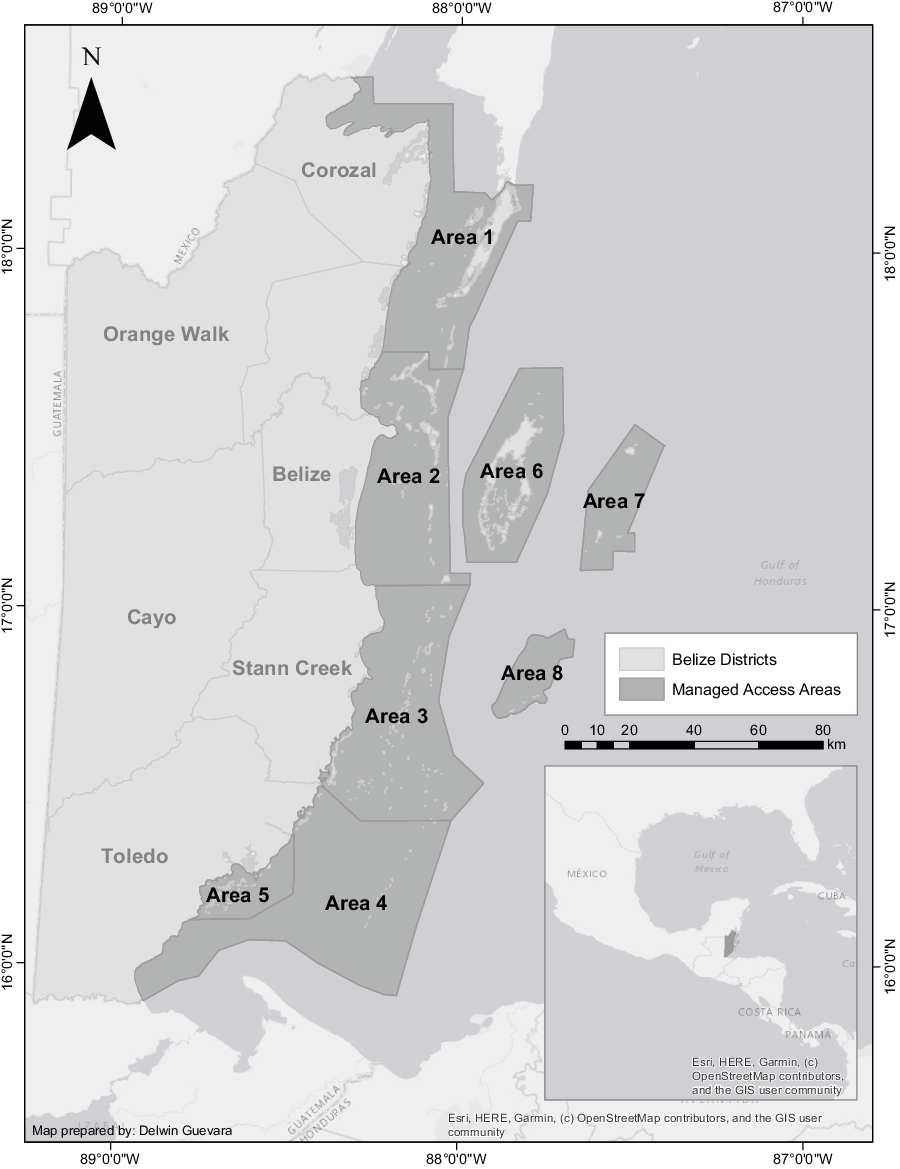
In line with the recognized need to reverse overfishing and improve the sustainable management of fishery resources (McConney et al. Reference McConney, Pereira Medeiros, Pascual-Fernández, Pena, Chuenpagdee and Jentoft2019), Belize implemented a TURFs management strategy known as MA. This started as a pilot in 2011 (Castañeda et al. Reference Castañeda, Maaz, Requeña and Chan2012, Foley Reference Foley2012) and was extended to all fisheries in 2016 (Fujita et al. Reference Fujita, Epstein, Battista, Karr, Higgins, Landman and Carcamo2017). MA was aimed at reversing the drawbacks associated with the previously employed open-access fisheries management model, which was deemed responsible for the decline in Belize’s fishery resources (Castañeda et al. Reference Castañeda, Maaz, Requeña and Chan2012). MA aims at incentivizing fishers’ stewardship to promote fisheries sustainability (Wade et al. Reference Wade, Spalding and Biedenweg2019). Working in partnership with the Toledo Institute for Development and Environment, the Wildlife Conservation Society and the Environmental Defense Fund, the Belize Fisheries Department (BFD) issued tenure rights to more than 3000 customary fishers within eight distinct fishing areas in Belize’s territorial waters (Fig. 1).
Eight nearshore fishing zones of the Managed Access programme. Each zone provides customary fishers exclusive rights to fish in Belize’s territorial waters.

In an effort to balance the socioeconomic and environmental attributes of Belize’s fishing industry, the design of MA received extensive contributions from a wide range of stakeholders. These contributions were gathered through over 100 community, focal or technical meetings and workshops (Catzim & Walker Reference Catzim and Walker2013), such that the final design was customized to match the social, ecological and biological conditions of Belize (Catzim & Walker Reference Catzim and Walker2013, Fujita et al. Reference Fujita, Epstein, Battista, Karr, Higgins, Landman and Carcamo2017) and was further informed by a 2-year pilot in two fishing areas (Castañeda et al. Reference Castañeda, Maaz, Requeña and Chan2012, Foley Reference Foley2012). The BFD headed the operations of the strategy, supported by the MA Working Group and MA Committees in each of the eight fishing areas (Foley Reference Foley2012).
Apart from MA, Belize also uses marine protected areas, complete bans, closed seasons and size and gear restrictions for selected species to manage its marine resources (Foley Reference Foley2012). The conglomerate of these management tools is unprecedented in practice, especially for a SIDS that exercises mostly small-scale coastal fisheries. Furthermore, the progression and success of Belize’s MA programme rely significantly on the cooperation of its stakeholders. These stakeholders drive compliance and in turn can further improve the programme by identifying the strengths, weaknesses, opportunities and threats to the management strategy. Indeed, gaining an understanding of the impacts of Belize’s MA strategy on the fisheries and those who depend on it at this early stage of implementation is necessary to guide adaptive management of the fisheries. Furthermore, although RBF systems, including TURFs, have been successfully applied elsewhere, usually in industrial or large-scale fisheries in the form of catch shares and designated fishing zones, their implementation in small-scale coastal fisheries such as those in the Caribbean is understudied and there is little practical guidance for resource managers. In fact, Belize is the only SIDS that has implemented a country-wide TURFs management strategy addressing multiple species throughout its territorial waters. Such studies therefore need to pay special attention to exploring the consensus and divergent views of stakeholders regarding the new management strategy to provide insights on how the collaboration between these stakeholders can be improved for the benefit of these SSFs.
The MA programme in Belize has been the focus of several recent studies. Fujita et al. (Reference Fujita, Epstein, Battista, Karr, Higgins, Landman and Carcamo2017) describe key elements that were used to scale the RBF management system from the original two pilot sites established in 2011 to cover the entire territorial waters of Belize and the lessons learnt from that effort. These include how to engage fishers in the design and implementation of MA, the importance of joint work planning and execution and the need for flexibility and adaptation as new information is obtained. Fujita et al. (Reference Fujita, Epstein, Battista, Karr, Higgins, Landman and Carcamo2017) also describe and highlight factors associated with successful outcomes in the design and implementation of MA and the adaptive management framework used. Similarly, Wade et al. (Reference Wade, Spalding and Biedenweg2019) use a combination of literature review and semi-structured interviews with 54 fishers and 25 policymakers across Belize’s fishery sector to analyse the MA programme and review its initial responses. In their study on the diversity of mental models associated with Belize’s MA fisheries policy, Wade and Biedenweg (Reference Wade and Biedenweg2019) used a cognitive mapping exercise with fishers and policymakers to investigate and test their perspectives around the MA strategy. Wade and Biedenweg (Reference Wade and Biedenweg2019) conclude that a focus on only one perspective in policy development without considering the motivations and objectives of all users may affect policy acceptance. There is therefore a need for more innovative and robust approaches to capture stakeholders’ perspectives in a holistic approach to policy creation, implementation and assessment.
This study fills this gap and employs Q methodology (Q) to reveal the range of attitudes that exist regarding the MA programme (Lee Reference Lee2017). Q is a well-established method that uses factor analysis to explore the subjective viewpoints of stakeholders (Zabala 2014). It analyses subjectivity in a way that is systematic, rigorous and statistically interpretable, and it can be used to explore viewpoints or discourses about a topic that can be debated or is socially contentious. The results of Q provide a set of factors that explain the views of persons who are involved with the subject matter, while incorporating the topics raised by the participants rather than topics imposed by the researcher, as is commonly experienced in conventional survey-based approaches (Lee Reference Lee2017, Zabala et al. Reference Zabala, Sandbrook and Mukherjee2018).
Methods
Selection of statements and participants
The Q started with the development of a concourse of statements that articulated the opinions or views about MA. This concourse included 49 comprehensive statements that incorporated a subjective opinion about MA. These statements were collected from both primary and secondary sources and included newscast scripts (secondary), online articles (secondary) and semi-structured interviews (primary). The statements from the concourse were vetted (by determining whether the statement represents an opinion, is short and standalone and is easy to read and understand) and fine-tuned to form a Q-set that included a collection of 35 heterogeneous statements. The 35 statements raised opinions about MA on matters that could be categorized under one or more of the following six themes: social; economic; biological; administration and management; enforcement and compliance; and partnerships. These statements represented the full range of opinions held by the fisheries stakeholders on MA.
Since the aim of Q is to reveal the diversity of opinions, a large sample size of participants is not necessary (Zabala et al. Reference Zabala, Sandbrook and Mukherjee2018). Participants (P-set) for the Q sorting exercises were purposely recruited based on their relevance to the study aim and their knowledge of MA, especially persons who were active since the strategy’s pilot stages. Invitation for participation in the sorting exercises was provided via email and telephone call. The target for the Q sorting exercises was 25–30 respondents.
Data collection
Eight Q sorting workshops were hosted in Belize City and the town of Dangriga in July 2019, resulting in 30 individuals sorting the statements and 28 participants providing a completed grid (Supplementary Information S1, available online). These participants were chosen because they play leading roles in the MA programme and are key stakeholders in the SSFs, being scientists, fisheries officers, fishers, cooperative members and non-governmental organizations (NGOs). The scientific stakeholders included two experts from the MA Working Group (one staff member of the Wildlife Conservation Society, Belize country office, and a professor from the University of Belize) and one marine biologist stationed at the Bacalar Chico National Park and Marine Reserve. The four fisheries officers were involved in policy, licensing, enforcement and administration of MA. Six board members of Belize’s National Fishermen’s Producers Cooperative Society Limited were recruited from the fisher cooperatives stakeholder group. The eight licenced fishers who took part in the sorting exercise were from Area 3 (Stann Creek District). Views from the fisheries NGOs were provided by seven members of the Belize Federation of Fishers, the umbrella organization for most commercial fisher associations in Belize.
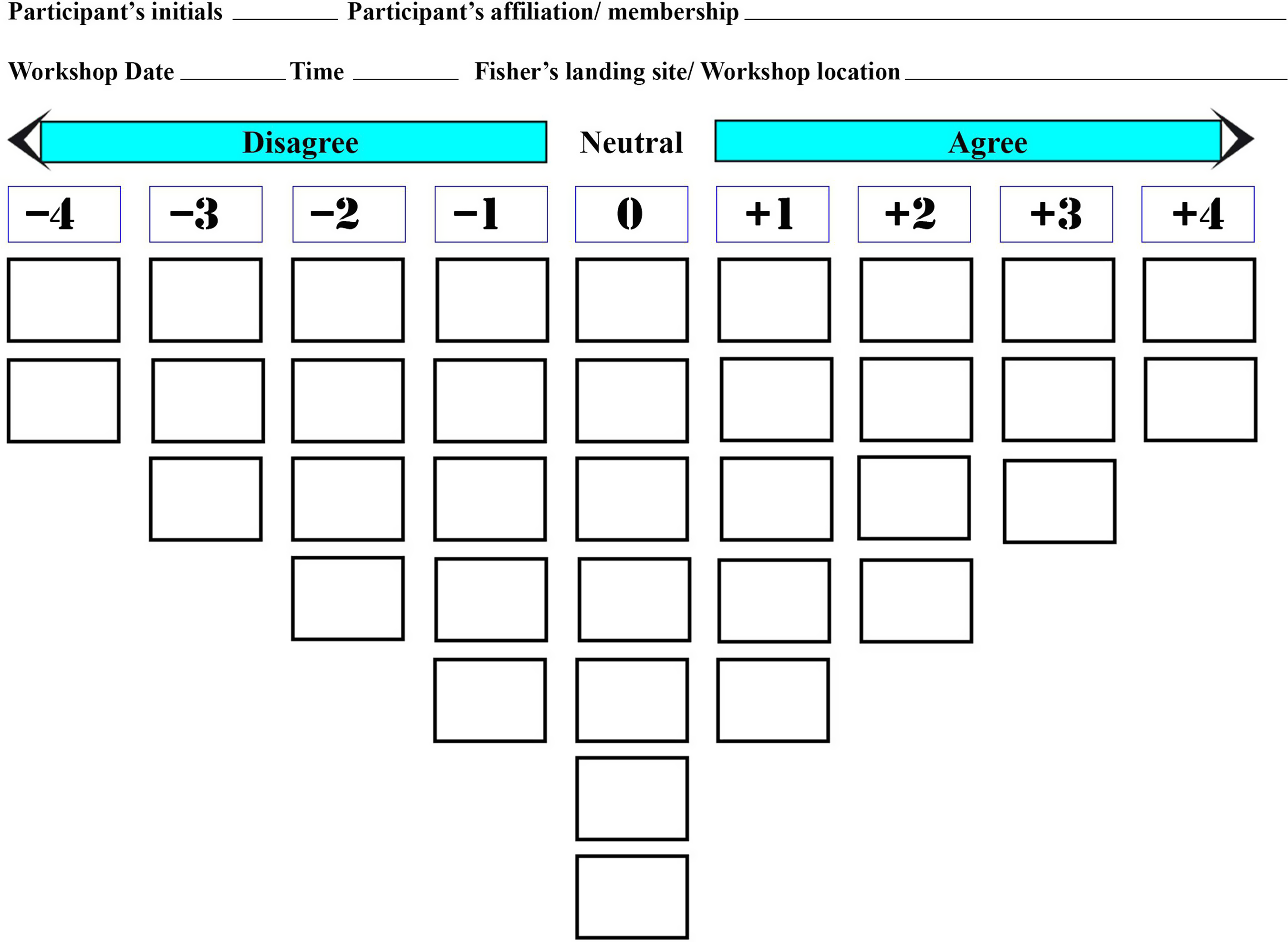
With each statement printed on separate numbered cards, participants were asked to collate the statements into three piles – agree, disagree and neutral – based on their individual judgement. Respondents were subsequently handed a Q-sort grid and were then asked to distribute their statements according to the layout of a forced-choice frequency distribution (Fig. 2). This involved placing two statements in the first and ninth categories (–4 and +4), three in the second and eighth categories (–3 and +3), four in the third and seventh categories (–2 and +2), five in the fourth and sixth categories (–1 and +1) and seven in the fifth categories (0). Each workshop wrapped up with an open discussion. This involved dialogues regarding the selection of the strongest disagree and agree statements, general feedback on topics not covered by the statements and the fishing sector.
Design of the grid used in a workshop containing a forced-choice frequency distribution including a nine-point rating scale (–4 to +4), 35 cells and 5 general fields.

Data analysis
Principal component analysis (PCA) was used to analyse the data in the R software program using the PQMethod package (Zabala 2014). A correlation matrix for all 28 Q-sorts was calculated, representing the level of similarity of perspectives among respondents. The Q-method analysis was tested for four, five and six factors (Supplementary Information S2). Those Q-sorts that loaded significantly on any factor were commanded to be flagged as ‘TRUE’. Factor loading expresses the degree to which a sort agrees with the viewpoint of the factor and so significantly loading factors are identified (Lee Reference Lee2017). Factors were then varimax rotated in order to find the best solution maximizing the variance explained by the factors. The factors were then explored to see which number of factors was optimal. As such, the four-, five- and six-factor options were tested for the statistical strength of their eigenvalues, the percentage of explanatory variance, the number of flagged sorts and Humphrey’s rule (Supplementary Appendix S2, available online). The five-factor solution was selected as optimal and all of the factors were distinct from each other.
Results
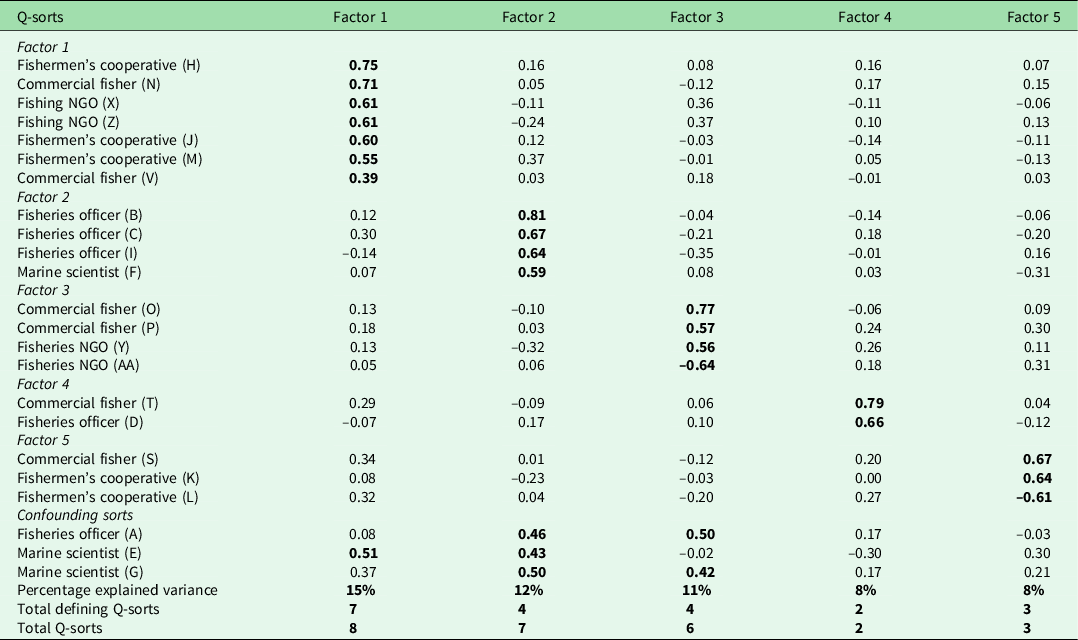
Five well-defined factors representing 55% of the total study variance and 20 of the 28 sorts loaded significantly (p < 0.001) onto one of the five factors, indicating five distinct perspectives (Table 1). Of the remaining Q-sorts, three were confounded between two of the five factors (i.e., they loaded significantly onto two of the factors), while the remaining five sorts were not significant for any of the five factors. As is standard in Q-method, the data for the confounded sorts are recognized as hybrid viewpoints and are not included in the construction of factors. The data for the five sorts that did not load significantly onto any of the factors were excluded from the construction of the factors’ viewpoints. All key ideas expressed during the interviews and workshops are represented in at least one of the factors. Sorts that loaded significantly onto a given factor were then merged to form one single sort, known as an idealized sort, configured to represent the perspective of that factor.
Summary of the five factors showing the Q-sort factor loading scores for the 23 participants whose scores loaded to one or more factors.

Note: Factor loadings of –0.30 to –0.40 or +0.30 to +0.40 are considered acceptable and values greater than ±0.50 are necessary for practical significance. The larger the absolute size of the factor loading, the more significant the loading is in interpreting the factor matrix.
Scores with an absolute value of 0.50 or larger (significant) or 0.30–0.40 (acceptable) are highlighted. Participants are listed by stakeholder group. Note that the three confounded sorts (which loaded significantly to more than one factor) are not included in the description of the five factor perspectives. Also shown are the percentages of variance explained by each factor and the numbers of sorts that made up each factor. The letters in parentheses represent a sort individual identity code used to extract verbal explanations for participants’ reasons for sorting their respective statements.
NGO = non-governmental organization.
Factor 1: Component Uncertainty
This perspective highlighted some degree of uncertainty regarding the elements or components of MA. The Component Uncertainty perspective viewed enforcement under MA as inconsistent (Statement 20), and as a result the confidence of reporting illegal fishing activities was low. In addition, this perspective regarded the licence vetting process as disorganized (Statement 19). The vetting process is a collaborative review of licence applications by MA Committees from the fishing zones and BFD to ensure that licence approval receives bipartisan scrutiny. With the vetting process perceived to be weakening, this perspective believes that there is an imbalance among the fishing zones, where some zones are over-licenced (Statement 22).
Major concerns were therefore being expressed by this perspective, most of which surround the unfair distribution of fishers to zones that are known to be more productive (11) and the continued high fishing effort since the implementation of MA (Statements 6 and 18). Lack of improvement in fish quantity and quality was also highlighted (Statement 14), but this perspective acknowledged that it was too early to expect changes in fish stock. Yet this perspective does not consider that MA has incorporated the necessary measures to make the fisheries better for stakeholders (Statement 7). While there is still some degree of confidence held by stakeholders in the strategy, this perspective articulates the growing dissatisfaction towards the way it is being managed (Statement 28).
Factor 2: Programme Optimism
According to the Programme Optimism perspective, MA is protecting local fishers’ rights and recognizes their contributions (Statement 32). This perspective recognizes the irreplaceable value of the lobster and conch fisheries for Belize (Statement 9) and expresses its confidence in MA’s ability to deliver improved livelihoods to fishers through the sector (Statement 7). While the planned benefits of MA are acknowledged, the main concern for the Programme Optimism perspective is the BFD’s lack of financial resources, along with the adequate capacity to implement the strategy as it was intended (Statement 33).
Evidently, this perspective supports MA and views its current standings from a pragmatic standpoint, where it noted that there have been visible improvements in Belize’s fishing sector since 2016. Aspects such as communication among stakeholders have improved (Statement 13); customary fishers are receiving their use rights with less competition (Statement 17); there is improved data collection via the fishing logbooks (Statements 8 and 24); and the numbers of fishers exerting fishing pressure on the fisheries are under a controlled system (Statement 4). However, Programme Optimism recognizes the challenges being experienced, especially the inconsistent and inadequate enforcement due to limited resources (Statement 20) and the marked decrease in stakeholder engagement affecting the general support from some stakeholders (Statement 33).
Factor 3: Governance and Stewardship
Governance and Stewardship shows strong concern regarding MA’s inability to activate the expected voluntary stewardship from fishers. As a result, some resource users are still participating in illegal fishing activities (Statement 12). In addition, this perspective includes worries that the illegal fishing activities, especially those being committed by transboundary fishers, are creating hardship for Belizean fishers (Statement 2). This perspective alludes to the fact that many of the frustrations being experienced by fishers regarding illegal fishing activities is due to inconsistent patrols, since the BFD does not have the capacity to deter these activities (Statement 33). Furthermore, this perspective believes that enforcement is significantly improved where it receives support from co-managers and stakeholders (Statement 21).
More than all of the other perspectives, Governance and Stewardship believes MA is not improving fishing activities and fishing effort has not decreased (Statement 30). Some participants expressed their frustrations with current approaches to governance and the limited inclusion of recommendations offered by fishers (Statements 19 and 32). Essentially, this perspective demonstrates limited confidence in the implementation of MA (Statement 28).
Factor 4: Objectivity and Science
The perspective of stakeholders under Factor 4 was focused on species and the role of science in decision-making. More than any other perspective, Objectivity and Science expressed its overwhelming concern for lobster and conch; it strongly agreed that the species are still being threatened by unsustainable fishing practices (Statement 16), while believing that MA has positively impacted lobster and conch protection (Statement 34). This perspective believes that current levels of fishing effort are too high. Objectivity and Science sought a more focused use of science in decision-making for the fishing sector (Statement 35), including the establishment of total allowable catches for all zones based on science.
Another distinguishing characteristic of Objectivity and Science is the importance of collaboration among resource managers and users, and this perspective believes that the partnership among the fisheries stakeholders is still underdeveloped (Statement 13). Objectivity and Science also rated the overall conflict that exists in the fishing industry as high (Statement 34). While this perspective expresses concerns about the biological and social aspects of the programme’s implementation, it should be noted that it has confidence in MA as a strategy (Statement 12).
Factor 5: Balanced Prosperity
The Balanced Prosperity perspective expressed concern about the contribution of MA to the fisheries stakeholders’ livelihoods, particularly the role that the sector plays in providing economic opportunities in coastal communities. Balanced Prosperity believes that only fishers of highly productive zones are receiving higher profits (Statement 25). Similarly, there is a concern for the eventual restriction of new fishers to receive licences (Statement 17). These concerns are rooted in this perspective’s fear that conch and lobster are being unsustainably harvested (Statement 10). As such, this perspective has not seen any growth in the size and quantity of conch and lobster since the implementation of MA, but it tends to believe that it is too early to draw any conclusions.
Balanced Prosperity further demonstrated concerns for the disproportionate distribution of fishers among the zones (Statement 6), which still causes conflict among resources users (Statement 1), and the need for new approaches to the alternative livelihoods component of MA (Statement 29), which they believe will also significantly reduce fishing pressure (Statement 6). Balanced Prosperity favours equitable use of marine resources and supports fishers and tour guides working together (Statement 23).
Areas of agreement
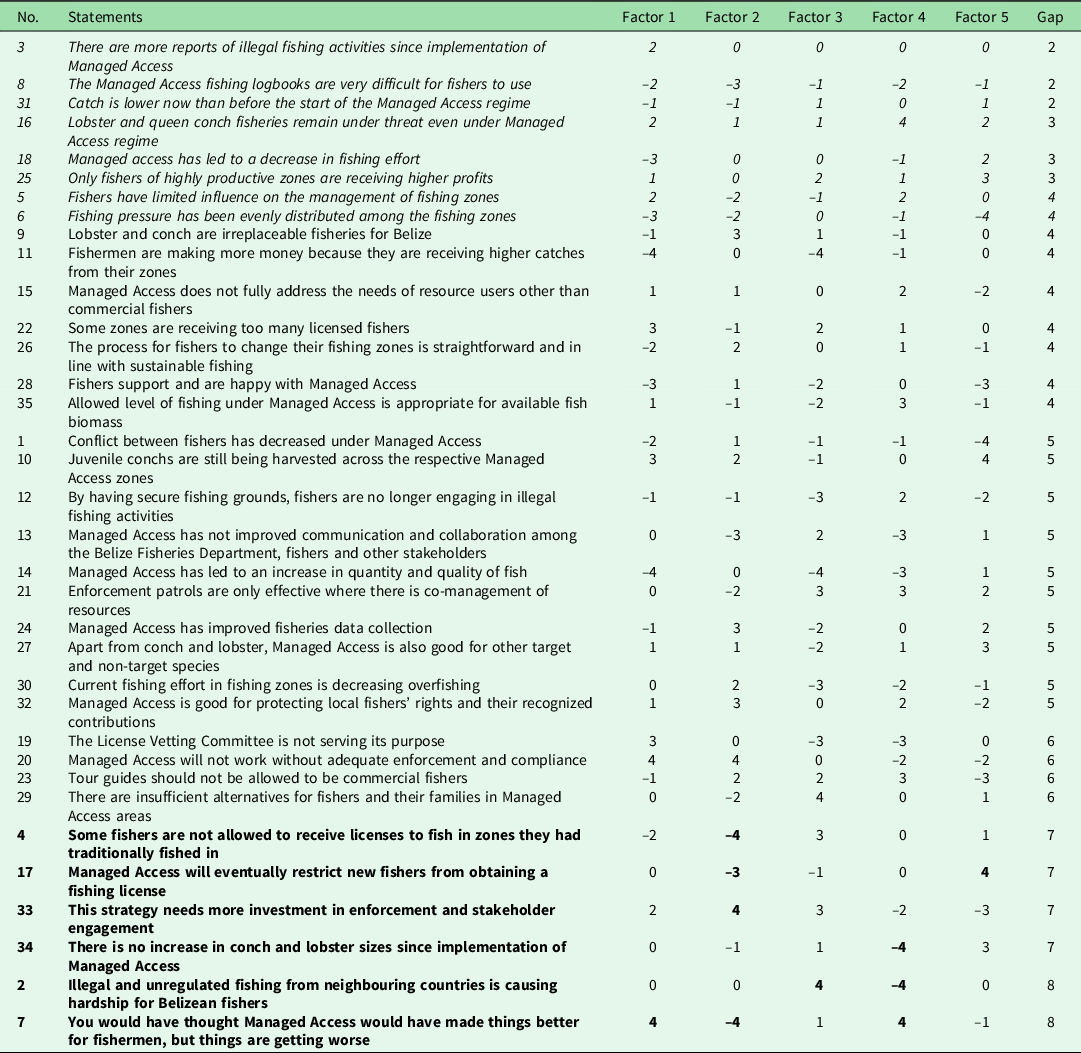
Areas of general consensus among perspectives were identified in the factor analysis by the smallest gap in the statement factor score between all factors (Table 2). All perspectives believed that conch and lobster are currently still under threat, even with the implementation of MA (Statement 16). The perspectives all agreed that other factors such as land-based influences and climate change contribute to the overall threat to target species. The perspectives also agreed that highly productive zones are likely to produce higher profits for fishers (Statement 25), but fishing pressure is not being adequately distributed (Statement 6). A final area of agreement touched on the fishing logbooks, where all perspectives believed that the books were necessary; however, several participants explained that these were not being effectively used (Statement 8).
List of the 35 statements used in the stakeholder Q-sorts, shown with their associated idealized score (score averaged over all participants in a factor grouping) for each of the five factors. The statements are ranked by the size of the gap score, which represents the difference between the most negative and most positive scores across factors. A gap of 1–2 indicates consensus among all perspectives about the importance of a statement. A gap of 3–4 indicates relative consensus except where the range goes from positive to negative. A gap of 5–6 indicates a relatively contentious statement. A gap of 7–8 indicates a very contentious statement.

Italicized statements are those that receive a consensus among all factors.
Bold statements are distinguishing statements. The factors with bold ratings for these statements hold a distinguished perspective (– negative: disagree; + positive: agree).
Areas of contention
Areas of contention were identified in the factor analysis by the biggest gap in the statement factor score between all factors (Table 2). The most contentious topic involved the restriction of fishers to fish in zones they had not customarily fished in (Statement 4). The factor analysis revealed that the Governance and Stewardship and Balanced Prosperity perspectives had a strong conviction that there were restrictions being applied to customary fishers fishing in their zones, while other non-customary fishers were given licences to fish in these zones. On the other hand, the Component Uncertainty and Programme Optimism perspectives felt that the same restrictions were being applied to both customary and non-customary fishers. The Objectivity and Science perspective did not demonstrate any position towards this topic.
Another closely related area of contention that was revealed was the potential future restriction of new fishers to obtain licences to fish (Statement 17). The Balanced Prosperity perspective expressed concerns regarding this potential restriction. The Programme Optimism and Governance and Stewardship perspectives disagreed and argued that future fishers would still be able to fish. Programme Optimism claimed that future fishers would never be restricted because MA has provisions in place for new entrants to gain licences. While Governance and Stewardship held the position that new fishers would fish irrespective of whether licences are available to them or not, Component Uncertainty and Objectivity and Science held neutral positions on this topic.
Contention was clearly revealed for the topic surrounding the need for more financial investment in enforcement and stakeholder engagement by all perspectives, for varying reasons (Statement 33). Programme Optimism demonstrated the strongest call for more financial investments in these two components. Governance and Stewardship focused more on stakeholder engagement and Component Uncertainty’s interest was focused on enforcement. The two perspectives that opposed more investment being allocated to enforcement and stakeholder engagement were Objectivity and Science and Balanced Prosperity.
The perspectives also challenged the perceived increase in the stock size of lobster and conch since the implementation of MA (Statement 34). Two of the perspectives held weak positions towards this topic: Programme Optimism, which demonstrated some belief that the stock size had increased; and Governance and Stewardship, which believed the contrary. Component Uncertainty held a neutral position towards this topic. The Objectivity and Science and Balanced Prosperity perspectives, however, showed strong contention on this topic. Objectivity and Science believed that the stock size may have increased since the strategy’s implementation, while Balanced Prosperity felt that the size is the same as before MA.
A further area of contention was the impact of transboundary illegal and unregulated fishing on Belizeans’ livelihoods (Statement 2). Balanced Prosperity, Programme Optimism and Component Uncertainty held neutral positions on this topic, but the Governance and Stewardship perspective believed strongly that Belizeans were being negatively impacted, while the Objectivity and Science perspective did not.
Discussion and conclusion
The MA strategy is viewed from diverse viewpoints. Furthermore, while some stakeholders share values and agree on issues, some of this agreement is for very different reasons. For example, stakeholders agree that conch and lobster are currently still under threat even with the implementation of MA. Some stakeholders believe that this threat goes beyond MA, as it is due to pollution from land sources and climate change, while others believe that it is because MA has not been able to activate all of its necessary components, especially research and enforcement. Similarly, those sharing a certain perspective may belong to different stakeholder groups (Table 1), emphasizing the complexity of views that challenges fisheries management. For instance, the restriction of fishers to fish in zones they had customarily fished caused the most contention between, on one side, the Governance and Stewardship (shared by commercial fishers and fishing NGOs) and Balanced Prosperity (shared by commercial fishers and the fishermen’s cooperative) perspectives, and on the other side, the Component Uncertainty (shared by the fishermen’s cooperative, commercial fishers and fishing NGOs) and Programme Optimism (shared by fisheries officers, marine scientists and the fishermen’s cooperative) perspectives. Similarly, the Balanced Prosperity perspective expressed concerns regarding future restrictions of new fishers to obtain licences, while the Programme Optimism and Governance and Stewardship perspectives disagreed, arguing that future fishers would still be able to fish. As such, tracking and understanding the impacts of management strategies such as MA will require significant attention to be paid to the views held by the various stakeholder groups (Wade & Biedenweg Reference Wade and Biedenweg2019, Wade et al. Reference Wade, Spalding and Biedenweg2019, Oyanedel et al. Reference Oyanedel, Gelcich and Milner-Gulland2020). While the areas of agreement shown here need to be continuously improved, the areas of present contention need to be addressed immediately. The overlaps and distinctions among perspectives identified here therefore highlight areas for management attention to address the drawbacks relating to collaboration through soft and inexpensive remedial interventions. Overall, the exploration of these five perspectives highlights key recommendations for the application of RBF systems, especially in SSFs.
The different perspectives highlight the complex challenges that exist for fisheries managers in their effort to manage resources effectively while satisfying the various demands of stakeholders. By issuing tenure rights to more than 3000 customary fishers in eight distinct fishing areas in its territorial waters through the MA strategy, Belize hoped this would build local capacity for self-regulation and self-organization to manage the SSFs and address some of their challenges. The design of MA hinges on the role of co-management as a catalyst for effective decentralization of management as discussed by Agrawal and Ostrom (Reference Agrawal and Ostrom2001). Agrawal and Ostrom (Reference Agrawal and Ostrom2001) advised that resource users must be continuously involved in management to ensure their commitment. While in its early stages, this seems to have been the case for the MA strategy, as it was strongly supported by the various stakeholder groups. Our findings, however, show that stakeholders through the Component Uncertainty perspective appeared to be dissatisfied with the way they perceived the components of MA being carried out by the BFD. They focused mostly on how issues such as inconsistent enforcement, disproportionate licensing and ineffective communications are affecting the delivery of the management strategy. Consequently, this perspective blames the ‘non-existence’ of expected components on the continued degradation of the fisheries and loss of benefits to resource users; it highlights that fishing pressure is still high and that the quality and quantity of fishery yields are still below par. This perspective was shared by a combination of individuals from the fishermen’s cooperative, commercial fishers and fishing NGOs. While this perspective points to a possible breakdown of the operations of MA, it primarily highlights a deterioration in the partnership among resource managers and users. MA was designed to be collaborative (Foley Reference Foley2012); however, a weakening of this partnership due to the broken communication channel between managers and users has caused a change in these stakeholders’ ability to remain confident in the management strategy.
This begs the question of whether RBF systems automatically activate voluntary stewardship from resource users. Certainly, there are several case studies that articulate this presumed immediate activation of voluntary stewardship, but many fail to address the role of management in clearly defining and socializing the responsibilities and application of ‘use rights’ (Ostrom Reference Ostrom2008, Gasalla & de Castro Reference Gasalla and de Castro2016, Quynh et al. Reference Quynh, Schilizzi, Hailu and Iftekhar2017). According to Quynh et al. (Reference Quynh, Schilizzi, Hailu and Iftekhar2017), the available guidance for managers on the implementation of TURFs lacks performance prescriptions for real-life issues such as activating stewardship and leveraging enforcement to support the strategy. Furthermore, policies including their design and implementation carry some ambiguity between ‘rights’ and ‘ownership’ (Ostrom Reference Ostrom2008), causing users to have a misconception that they have ownership of the fish remaining in the water. Such misconceptions are significantly influenced by some of the nuances of transforming customary fishing areas into TURFs (Aburto et al. Reference Aburto, Gallardo, Stotz, Cerda, Mondaca-Schachermayer and Vera2013). Aburto et al. (Reference Aburto, Gallardo, Stotz, Cerda, Mondaca-Schachermayer and Vera2013) explain that when the fishers had once fished primarily on a customary basis, which may include unsustainable practices, managers are responsible for providing adequate training to fishers to improve their fishing practices. Our findings indicate consensus across the different perspectives on the need for increased levels of training, enforcement and stakeholder communication and involvement.
Another challenge facing the management of SSFs is to establish equitable access and rights to fisheries resources among stakeholders (McConney et al. Reference McConney, Pereira Medeiros, Pascual-Fernández, Pena, Chuenpagdee and Jentoft2019). Allison et al. (Reference Allison, Ratner, Asgard, Willmann, Pomeroy and Kurien2012) state that while most of the governance reform models such as RBF systems are based primarily on instituting economic incentives to foster compliance and stewardship, their applicability to developing countries lacks significant considerations of the inherent socioeconomic drivers affecting users. This was the central issue of the Balanced Prosperity perspective. This perspective valued the productive fishing zones and access to fish of higher market value, and it also stressed the need to protect the commercial species in order to ensure future generations also benefit from them. Gelcich et al. (Reference Gelcich, Cinner, Donlan, Tapia-Lewin, Godoy and Castilla2017) noted similar areas of concerns for Chilean fishers in their review of the fishers’ perspectives after two decades of implementation. They determined that financial return from the TURFs was one the most important factors for the Chilean fishers. While no other perspective valued alternative livelihoods as a necessary component of the management strategy, Balanced Prosperity expressed serious interest in stakeholders having more livelihood opportunities. Furthermore, this perspective demonstrated that non-compliance of stakeholders may be significantly correlated with their socioeconomic challenges rather than weak enforcement.
In order to achieve sustainability of any fisheries, adequate management measures that shape behaviour and discourage misuse of the fisheries resources are necessary (Chaigneau & Brown Reference Chaigneau and Brown2016). The stakeholder perspectives revealed in this study and the diagnosis of key issues needing attention in the recently implemented MA programme in Belize add further quantitative detail and scope to those reported by Wade et al. (Reference Wade, Spalding and Biedenweg2019) and Wade and Biedenweg (Reference Wade and Biedenweg2019). In a cognitive mapping exercise across fishers and policymakers, Wade and Biedenweg (Reference Wade and Biedenweg2019) demonstrated that the concepts that explained the mental models held by members within each of these two stakeholder groups showcased significant areas of overlap, regardless of experience with the MA pilot programme. The perspectives held by fishers in contrast to policymakers were quite divergent, leading to unique interpretations of MA likely to affect compliance and adoption (Wade & Biedenweg Reference Wade and Biedenweg2019). The perspectives uncovered in our study further revealed precise explanations of the well-being attitudes and issues stakeholders have towards MA. One of the key distinctions of our study is its ability to quantitatively determine the mixed representation of the stakeholders forming the five different perspectives.
When comparing the perspectives of this research with those of other research on the implementation of RBF systems in SSFs, there are areas of common interest. Gassala and de Castro (Reference Gasalla and de Castro2016) showed that stakeholders’ perspectives were significantly focused on the protection of the target species through adequate enforcement, while Allison et al. (Reference Allison, Ratner, Asgard, Willmann, Pomeroy and Kurien2012) presented stakeholder views on the limited incentives being provided to resource users to remain motivated to be stewards. Some of the most common topics raised by studies of RBF systems, even for developed countries, are the need for the right financial investments in supporting the components and the need for continuous stakeholder engagement (Allison et al. Reference Allison, Ratner, Asgard, Willmann, Pomeroy and Kurien2012, Aburto et al. Reference Aburto, Gallardo, Stotz, Cerda, Mondaca-Schachermayer and Vera2013, Gelcich et al. Reference Gelcich, Cinner, Donlan, Tapia-Lewin, Godoy and Castilla2017).
To conclude, although SSFs around the world are highly complex, our in-depth assessment of the MA strategy suggests beneficial roles for SSFs in other geographical regions. The MA model demonstrates how stakeholders of SSFs can be managed to improve the state of SSFs. Furthermore, this research demonstrated the need for stakeholder perspectives in policy development and implementation, especially since the overlaps can be used as areas of collaboration, and those areas of differences can be addressed through remedies that fall outside the scope of conventional fisheries management strategies used in open-access systems. It is clear that stakeholders recognize the potential role of MA in reversing the drawbacks associated with open-access fishing, and all groups investigated demonstrated some degree of favour for MA. However, MA will not meet its objectives without more financial investment in enforcement, stakeholder engagement, research and the strengthening of institutional capacity. The use of adaptive management approaches such as MA is strongly endorsed for SSFs to rejuvenate fisheries management and boost the socioeconomic benefits associated with the fisheries.
Supplementary material
To view supplementary material for this article, please visit https://doi.org/10.1017/S0376892921000047
Acknowledgements
We thank the Belize Fisheries Department for offering us their office space for interviews and workshops. Special thanks are also extended to all stakeholders who took part in the interviews and workshops for sharing their time and views with us. The authors are grateful to Mr Delwin Guevara who prepared Fig. 1 depicting the fishing zones of Managed Access.
Financial support
This research was supported by scholarship funding provided by the Centre for Environment, Fisheries and Aquaculture Science (Cefas) through the Commonwealth Marine Economies Programme of the UK Foreign and Commonwealth Office (C7049) and by the Centre for Resource Management and Environmental Studies (CERMES), University of the West Indies.
Conflict of interest
None.
Ethical standards
None.