Pseudomonas aeruginosa is a source of infection outbreaks, especially in intensive care units (ICUs).Reference Jefferies, Cooper, Yam and Clarke 1 Several of these outbreaks have been directly or indirectly linked to water distribution systems.Reference Trautmann, Michalsky and Wiedeck 2 – Reference Schneider, Geginat and Hogardt 14 In ICUs, 30%–50% of P. aeruginosa infections have been associated with water.Reference Exner 15 A multicentric prospective study recently established tap contamination in patient rooms as an important environmental risk factor for P. aeruginosa acquisition.Reference Venier, Leroyer and Slekovec 16
Several factors promote water contamination, including the type of faucet,Reference Halabi, Wiesholzer-Pittl, Schöberl and Mittermayer 9 , Reference Charron, Bédard and Lalancette 17 , Reference Blanc, Nahimana and Petignat 18 the presence and type of aerator on the faucet,Reference Walker, Jhutty and Parks 19 the volume of mixed hot and cold water,Reference Charron, Bédard and Lalancette 17 the alignment of the sink drain,Reference Ehrhardt, Terashita and English 20 construction or renovation settings, and ICU vs non-ICU settings.Reference Reuter, Sigge, Wiedeck and Trautmann 3 , Reference Ehrhardt, Terashita and English 20 Once contaminated, eradication of P. aeruginosa in the water system is challenging and often results in replacing related devicesReference Hota, Hirji and Stockton 5 , Reference Bert, Maubec and Bruneau 7 – Reference Romano, Bourdier and Parer 12 , Reference Schneider, Geginat and Hogardt 14 or installing point-of-use 0.2-μm filters.Reference Aumeran, Paillard and Robin 4 , Reference Vianelli, Giannini and Quarti 13 , Reference Schneider, Geginat and Hogardt 14
Although cultivation is the reference method, it may not reveal background contamination that may flare up when the environment becomes favorable for growth and culturability. Environmental stressors present in water such as chlorine and copper decrease culturability without necessarily decreasing viability.Reference Bédard, Charron and Lalancette 21 , Reference Dwidjosiswojo, Richard and Moritz 22 Most studies describing environmental contamination have been conducted using the culture detection method. Often, P. aeruginosa could not be isolated from water but was recovered from biofilm swabs. The use of quantitative polymerase chain reaction (qPCR) for the detection and measurement of bacteria in drinking water is not yet routinely used. However, this method could offer a valuable alternative for assessing the underlying contamination of systems as well as risk areas.
Herein, we describe a follow-up investigation of the water system contamination by P. aeruginosa a decade after an outbreak in a neonatal ICU (NICU). The objectives of this study were (1) to conduct a follow-up investigation on the water system using qPCR and cultivation methods to evaluate the level of contamination and (2) to identify the factors that contribute to the persistence of P. aeruginosa in the water system despite corrective measures. To our knowledge, this is the first study to report the use of qPCR to investigate the presence of P. aeruginosa in a hospital water system.
METHODS
The investigation was performed at Centre Hospitalier Universitaire (CHU) Sainte-Justine, a 450-bed pediatric university hospital in Montreal, Canada. A P. aeruginosa outbreak took place between January 2004 and November 2005 in neonatal intensive and intermediate care units.Reference Renaud, Vallée and Perpête 23 , Reference Laferrière, Perpête and Scrivo 24 To summarize, 27 P. aeruginosa infections were reported during the outbreak (2004–2005), and 6 patients died as a consequence of infection. The following types of infections were reported: sepsis, lower respiratory infection, urinary tract infection, catheter-related infection, cellulitis, and conjunctivitis. All infection episodes reported among neonates from the NICUs were healthcare-associated. Distribution and draining water systems including faucets, aerators, and sinks were approximately 50 years old, and all taps were equipped with aerators. Corrosion deposits were visible on faucets, aerators, sink traps, and mixing valves. Clogging of the drains, resulting in water stagnation into the sinks, was frequently reported by the hospital staff at the time of the outbreak. The clogging was caused by the accumulation of carbonate scale and microbial biofilm in the drain pipes. In the 15 years prior to the outbreak, construction and renovation had required several prolonged interruptions in the water supply.
The outbreak investigation led to environmental sampling within and outside the NICU conducted between March and April 2005.Reference Renaud, Vallée and Perpête 23 , Reference Laferrière, Perpête and Scrivo 24 P. aeruginosa was recovered by cultivation from 32 of 57 sink drains (56%), 3 of 56 faucet swabs (5%), and 5 of 16 aerators (31%) during the outbreak investigation. All swabs from other environmental surfaces, solutions, and water samples collected from taps (n=69) or water distribution systems (n=40) were negative. A survey of healthcare worker hands was unrevealing. A total of 66 P. aeruginosa isolates, all obtained during the outbreak period, were subjected to PFGE testing, resulting in the identification of 51 different genotypes and variants: 7 were identified exclusively from clinical isolates and 32 were identified exclusively from environmental isolates. Common strains were identified between the clinical and water system samples, notably between 12 patients and the sink aerator where the milk bottles were prepared. The genotyping gel of the clinical and environmental P. aeruginosa strains isolated during the outbreak is presented online as supplementary material. The environmental survey and the genotyping resulting from the outbreak investigation confirmed the water system as the source of the neonatal outbreak. The implementation of the following corrective measures was successful in drastically reducing the number of cases: use of sterile water for patient care, alcohol-based gel treatment following hand washing, wearing gloves for direct contact with body secretions, installation of point-of-use filters (0.2 μm), good practices in milk preparation, replacement of drain pipes, and prohibition of storage of medical material under or within 30 cm of a sink. These corrective measures have been maintained in place since their implementation; filters were removed when drains were identified as the potential source.
A post-outbreak investigation was conducted in July 2013 in various areas of the hospital, including the NICU. A total of 28 faucets were sampled as follows: (1) a swab of the drain, (2) 1 L of first-flush cold water in sterile polypropylene bottle with 1.1 mg/L sodium thiosulfate, and (3) a swab of the aerator. Water samples from 3 additional faucets were tested. Cultivation, heterotrophic plate counts (HPCs), qPCR, and viable and total cell counts were performed on the water samples. Cultivation and qPCR were performed on swabs. HPC was determined on R2A agar after 7 days of incubation at 22°C. 25 Viable and total cell counts were performed using LIVE/DEAD BacLight Kit (Thermo Fisher Scientific, Waltham, MA). Cultivation was performed according to ISO16266:2006, 26 as previously described.Reference Charron, Bédard and Lalancette 17 Briefly, the water samples were filtered (0.45 μm pore-size filter), and the filters were incubated on cetrimide agar with 15 mg/L nalidixic acid at 37.5°C and colonies were counted after 24 hours and 48 hours. Using qPCR, the presence of P. aeruginosa was assessed by targeting the gyrB gene (Corbett Rotor-Gene 6000) for 50 cycles: 10 minutes initial denaturation (95°C), denaturation (95°C, 30s), and annealing and elongation (60°C, 90 s).Reference Lee, Wetzel and Buckley 27 DNA was extracted after filtration of 450 mL on a 0.45-μm mixed-cellulose esther filter using a bead-beating method followed by ammonium acetate precipitation and ethanol washes, as before.Reference Bédard, Fey and Charron 28
Each faucet and its environment were characterized in detail, including the type of activating device, the connecting pipe material, the faucet internal diameter, the faucet alignment to the drain, and the drainage efficiency. The copper water distribution line was fed by municipal surface water with an average residual chlorine level of 0.4 mg Cl2/L. Chlorine levels in the distribution system were maintained at similar levels, and no corrosion control initiatives or water quality changes occurred during the period between the outbreak and the follow-up study.
Statistical analyses (t test, z test, and multivariate adaptative regression spline [MARSpline]) were performed with Statistica10 (StatSoft, Dell, Aliso Viejo, CA). MARSpline regression is a nonparametric analysis in which continuous, categorical, and nominal variables can be added to the model and from which a better fit from a few or all variables is proposed. The significance level was set at P=.05.
RESULTS
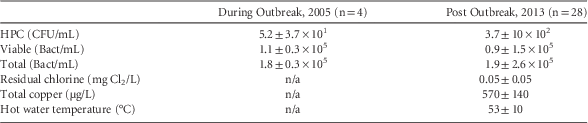
Water characteristics measured at the time of the outbreak (2005) and during the post-outbreak investigation (2013) are presented in Table 1. Total and viable cell counts were comparable between the 2 sampling campaigns, but HPCs were 1 log higher during post-outbreak sampling measurements. However, results were not significantly different between the 2 periods according to t test statistics (P>.05).
Mean Tap Water Microbiological and Physicochemical Characterization

Note. HPC, heterotrophic plate counts; Bact, bacteria; n/a, not applicable.
The post-outbreak investigation results are presented in Table 2. Results obtained by qPCR detection revealed dramatically higher positivity for all sampling sites. P. aeruginosa was detected in the water and the biofilm from the corresponding aerator and drain for 6 faucets, and 12 faucets had 2 positive sites (water/aerator, water/drain, or aerator/drain) (Table 2).
Proportion of P. aeruginosa Culture and qPCR Positive Post-Outbreak Samples for Each Type of Sampling Site and for ≥2 Corresponding Sampling Sites

NOTE. qPCR, quantitative polymerase chain reaction.
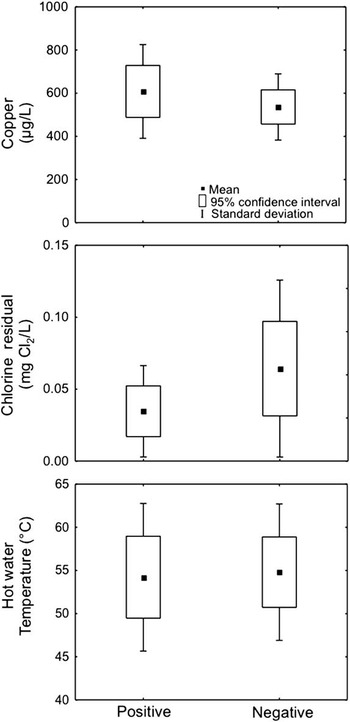
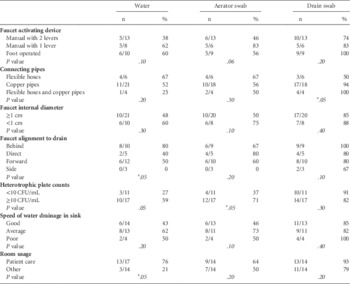
Figure 1 shows the mean concentrations of copper and residual chlorine and the hot water temperature at sampled taps for P. aeruginosa–positive and –negative water from faucets as evaluated by qPCR (Table 2). The impacts of various environmental parameters on P. aeruginosa detection are presented in Table 3. For each parameter, the positivity in the water and corresponding aerator and drain swabs are presented. Three additional faucets were sampled for water only and were included in the water sample analysis. A statistical comparison of positivity obtained for each configuration within an environmental design parameter was performed. A P value below .05 suggested that the results obtained for the different configurations within a group were significantly different and therefore affected positivity results.
Mean values for copper concentration, chlorine residual and hot water temperature for positive and negative P. aeruginosa water samples as measured by qPCR (n=28).

Summary of P. aeruginosa Occurrence and Percentage Measured by qPCR in Water, Aerator Swab, and Drain Swab Samples Grouped by Sink Environmental Design ParametersFootnote a

Note. CFU, colony-forming units.
a Statistically significant if P≤.05.
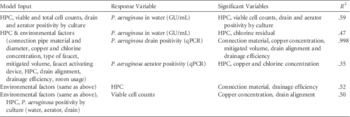
The effects of environmental factors and microbiological quality of the water on the P. aeruginosa load detected in water, aerator, and drain swabs by qPCR were analyzed using a multivariate regression (MARSpline). In addition, the impact of environmental factors on the water microbiological quality (HPC and viable cell counts) was assessed using the same regression method. Significant variables contributing to model response variables are presented in Table 4.
Multivariate Adaptive Regression (MARSpline) Results Presenting Model Input, Response Variable and Significant Variables for Environmental and Microbiological Parameters at the Sink

NOTE. HPC, heterotrophic plate counts; GU, genomic units; qPCR, quantitative polymerase chain reaction.
DISCUSSION
Environmental monitoring and prevention concentration thresholds of P. aeruginosa in water are proposed in infection control guidelines from the United Kingdom. 29 Previous P. aeruginosa outbreak investigations have also confirmed the waterborne source through the detection of P. aeruginosa in swabs from drains and faucets.Reference Hota, Hirji and Stockton 5 , Reference Ferroni, Nguyen and Pron 6 , Reference Yapicioglu, Gokmen and Yildizdas 11 , Reference Vianelli, Giannini and Quarti 13 , Reference Schneider, Geginat and Hogardt 14 , Reference Ehrhardt, Terashita and English 20 Notably, in this case and despite the established link between aerators and drains swabs and clinical cases, P. aeruginosa was not isolated from water by culture during the outbreak. The high level of aerator positivity (ie, 4 of the 5 positive aerators harbored strains shared with clinical isolates during the outbreak) led to the hypothesis of retrograde contamination from the drain.
Recent evidence has shown that the first-flush volume (<1 L) at the faucet contains strikingly higher levels of HPCs (30–100× higher) and culturable P. aeruginosa. Reference Charron, Bédard and Lalancette 17 , Reference Cristina, Spagnolo and Casini 30 – Reference Lautenschlager, Boon and Wang 32 In light of these findings, it is not surprising that all 2005 environmental outbreak investigation samples were negative for P. aeruginosa because these samples were collected after a 30-second flush. Furthermore, bacteria present in the water distribution system are exposed to stressors such as chlorine, copper, and high temperatures.Reference Bédard, Charron and Lalancette 21 , Reference Dwidjosiswojo, Richard and Moritz 22 In drinking water, stressed cells that lose their culturability can be detected by qPCR; these cells can quickly recover their culturability under favorable conditions.Reference Bédard, Charron and Lalancette 21
These findings suggest the need to re-evaluate the prevalence of P. aeruginosa in the water system using a standardized sample volume for culture and the need to apply qPCR methods recently validated in drinking water.Reference Lee, Wetzel and Buckley 27 To investigate the importance of environmental parameters, the post-outbreak investigation included detailed monitoring of water quality, including the main chemical stressors and bacterial indicators and the prevalence of P. aeruginosa in drain and aerator.
The follow-up water system investigation showed a low level of P. aeruginosa contamination in the system; 2 of 28 water samples were positive by culture. Water positivity increased drastically when measured by qPCR, which detected the presence of all cells in the sample, including viable but unculturable cells. When the aerator was positive, mean concentrations of P. aeruginosa in water were 2 log higher than in faucets in which the aerator was not positive. These results reveal a link between the aerator and water contamination.
Mean copper concentration in water was not significantly different between qPCR-positive and -negative samples (Fig. 1a). In this study, mean copper concentration in water was higher (570 μg/L) than the concentration reported to inhibit P. aeruginosa culturability (250 μg/L).Reference Bédard, Charron and Lalancette 21 , Reference Dwidjosiswojo, Richard and Moritz 22 However, this threshold concentration was obtained using strains not previously acclimated to elevated copper concentrations. Viable but nonculturable P. aeruginosa cells can persist in the presence of copper concentrations up to 2 mM, which is orders of magnitude higher than copper concentrations found in drinking water.Reference Teitzel and Parsek 33 Copper concentrations observed in drinking water would therefore affect culturability without affecting viability, with the capacity to recover culturability once copper stress is reduced.Reference Dwidjosiswojo, Richard and Moritz 22
Mean residual chlorine (Fig. 1b) was slightly more elevated in negative samples and was a significant variable for aerator positivity according to qPCR and water P. aeruginosa load (Table 4). Hot water temperature mean values were also comparable between samples positive and negative for P. aeruginosa (Fig. 1c). Temperature in the hot water system can affect water and aerator positivity if it is high enough to perform thermal disinfection. In the present study, hot water temperatures were below 65°C, a temperature lower than that required for thermal disinfection of water and biofilm.Reference Van der Mee-Marquet, Bloc and Briand 34 , Reference Park, Park and Kim 35
Further analyses performed on qPCR-positive water samples, aerator swabs, and drain swabs revealed the impact of environmental parameters (Table 3). The type of faucet activating device, the faucet internal diameter, and the speed of drainage did not lead to statistically different P. aeruginosa positivity of either the water or the aerator and drain biofilms. However, the drainage efficiency was a significant variable to predict the HPC in water as well as drain positivity (Table 4). Water and aerator positivity were not significantly impacted by the connection pipe material, although it was reported as significant in previous studies.Reference Charron, Bédard and Lalancette 17 , Reference Walker, Jhutty and Parks 19 As stated previously, copper affects culturability of P. aeruginosa, and previous studies evaluated positivity based on culture detection method. The present study suggests that viable and total water contamination is not significantly influenced by the connecting material. However, faucet alignment to drain configuration led to significantly different positivities of the water. Results suggest that water from a faucet aligned behind the drain has a higher rate of contamination by P. aeruginosa than other configurations. In previous studies direct water flow into the drain was determined to be a source of retrograde contamination of the faucet, and sink designs were changed to avoid alignment between the faucet and the drain.Reference Hota, Hirji and Stockton 5 , Reference Schneider, Geginat and Hogardt 14 , Reference Breathnach, Cubbon and Karunaharan 36 However, to our knowledge, no other study has reported the impact of the actual positioning of the faucet with regard to the drain on positivity. Drains have high rates of contamination by P. aeruginosa,Reference Hota, Hirji and Stockton 5 , Reference Schneider, Geginat and Hogardt 14 , Reference Döring, Ulrich and Müller 37 and the risk of retrograde contamination can be managed by ensuring appropriate design of the sink and maintenance of efficient drainage. Further investigation with a larger number of each drain configuration will be needed to determine the optimal drain positioning with relation to the faucet. The relation between the operating and design parameters of a sink and the drain contamination is highlighted by the correlation obtained in the modeling of drain positivity as measured by qPCR (Table 4).
Samples from taps with HPC higher than 10 CFU/mL had twice the positivity for P. aeruginosa in water and aerator biofilm samples. Heterotrophic plate counts are generally used as indicators of the general microbial quality of the water in main distribution systems.Reference Bartram, Cotruvo and Exner 38 Water positivity was significantly higher if the faucet sampled was in a patient room. A detailed utilization survey of both faucets and drains in sampled rooms would help provide an explanation for this finding. Ehrhardt et alReference Ehrhardt, Terashita and English 20 reported higher positivity for NICU faucets (71%) vs faucets sampled outside the NICU (12.5%), but there was no mention of either the faucet or the drain usage inside the NICU compared to outside.
Our study has a number of limitations. First, because of the large number of parameters investigated, some categories had a limited number of samples. Second, these results apply to 1 hospital system and may vary in different settings. Third, the post-outbreak sampling was conducted in the absence of active clinical cases.
The results from this study reveal that although bacteria may not be detectable in the water by traditional culture methods, P. aeruginosa is present and can recover its culturability under favorable conditions. In a hospital environment, this finding suggests that failure to maintain good practices, or presence of disrupting events such as renovation, may act as promoting factors leading to increased concentrations and risk of patient exposure. These results demonstrate the importance of defining a clear and detailed protocol to determine the design of and the precise maintenance required for water systems, including drains. Furthermore, detection by qPCR is a valuable tool for rapidly identifying positive sites in an outbreak investigation and in direct sampling and typing efforts. Finally, qPCR provides complementary information to culture-based results, especially for samples subjected to inhibitors such as elevated copper concentrations or disinfectant residual.
ACKNOWLEDGEMENTS
The authors would like to thank Chair staff, the participating healthcare facility personnel, Johanne Ismaïl (LSPQ) for the genotyping analysis, and Dr. Maude St-Jean and Dr. Mireille Lemay for their scientific contribution.
Financial support: This research was supported by NSERC through the Industrial Chair on Drinking Water and EB Vanier Canada Graduate Scholarship. ED holds a Canada Research Chair.
Potential conflicts of interest: All authors report no conflicts of interest relevant to this article.
SUPPLEMENTARY MATERIAL
To view supplementary material for this article, please visit http://dx.doi.org/10.1017/ice.2015.168.