Among her many contributions to developmental psychopathology theory and research, Nicki Crick highlighted specific peer experiences that were relevant for understanding adjustment in youth. Perhaps her most well-known contributions were in the area of relational aggression and victimization. Aversive peer experiences had been studied for decades, mostly focused on physical acts among peers that might confer unique risks for adjustment difficulties (Olweus, Reference Olweus1977, Reference Olweus1978). However, it was a series of Crick's seminal publications (e.g., Reference Crick1995, Reference Crick1996; Crick & Grotpeter, Reference Crick and Grotpeter1995, Reference Crick and Grotpeter1996) that helped to present a broadened definition of aggression and victimization into the mainstream. As compared to physical acts of peer aggression, relational aggression is characterized by behaviors that threaten one's dyadic relationships (e.g., threatening friendship withdrawal or “silent treatments”) or social reputation within the larger peer group (e.g., gossip or social exclusion; Bjorkqvist, Lagerspetz, & Kaukiainen, Reference Bjorkqvist, Lagerspetz and Kaukiainen1992; Crick, Reference Crick1995; Crick & Grotpeter, Reference Crick and Grotpeter1995; Galen & Underwood, Reference Galen and Underwood1997; Lagerspetz, Bjorkqvist, & Peltonen, Reference Lagerspetz, Bjorkqvist and Peltonen1988). Relational forms of aggression have distinct determinants and consequences from physical forms of aggression, and they appear to be relevant correlates of psychological adjustment across the age span (Mathieson & Crick, Reference Mathieson and Crick2010; Ostrov & Godleski, Reference Ostrov and Godleski2010; Prinstein, Boergers, & Vernberg, Reference Prinstein, Boergers and Vernberg2001). An emerging area of research is the identification of relational victimization correlates after accounting for associations with physical victimization (Ostrov, Reference Ostrov2010; Sullivan, Farrell, & Kliewer, Reference Sullivan, Farrell and Kliewer2006).
Peer victimization is a significant source of social stress. Thus, it is important to consider peer victimization in the broader context of youth stress and stress responses. In particular, recent work has emphasized the need to understand biological stress-response systems as a potential source of vulnerability to psychopathology (Hostinar & Gunnar, Reference Hostinar and Gunnar2013). Perhaps most frequently examined has been the reactive stress response of the hypothalamic–pituitary–adrenal (HPA) axis. The HPA axis is activated when an environmental stressor is perceived. The HPA stress response begins with a release of corticotrophin-releasing hormone and arginine vasopressin from the hypothalamus, which causes the pituitary gland to release adrenocorticotropic hormone. In the final stages of the HPA stress response, the adrenocorticotropic hormone causes the adrenal glands to release glucocorticoids (Chrousos & Gold, Reference Chrousos and Gold1992; Kaltas & Chrousos, Reference Kaltas, Chrousos, Cacioppo, Tassinary and Berntson2007). Cortisol, one such glucocorticoid, often is sampled from saliva prior to, during, and following a stressor to provide indices of reactive HPA stress responses. Although diurnal cortisol assessments (i.e., cortisol patterns throughout the day) provide indication of general allostatic load, examinations of stress-induced changes in cortisol provide insight regarding individuals' biological preparedness to respond to acute stress. Reactive HPA responses to stressors prepare an individual to behaviorally respond to stressors in several ways, including an increase in the availability and mobility of energy (i.e., glucose), increased blood circulation, and enhanced cognition (Sapolsky, Romero, & Munch, Reference Sapolsky, Romero and Munck2000). However, dysregulated HPA responses, including both hyper- and hyporeactive stress responses, are believed to reflect high allostatic load (i.e., the cumulative physiological and psychological effects of managing environmental stressors; McEwen & Stellar, Reference McEwen and Stellar1993). High allostatic load is believed to diminish one's cognitive and biological capacity to generate adaptive behavioral stress responses (Juster, McEwen, & Lupien, Reference Juster, McEwen and Lupien2009; McEwen, Reference McEwen1998, Reference McEwen2000). Though HPA recovery following a stressor is relatively understudied, the ability to return to baseline HPA functioning is important for preventing exhaustion of the stress-response system and subsequent increases in allostatic load (McEwen, Reference McEwen2000).
Numerous studies have examined social–psychological experiences that may be associated with dysregulated reactive HPA axis responses. For instance, findings indicate that a history of significant life stressors and current depressive symptoms are especially relevant predictors of hyperreactive or hyporeactive HPA stress responses, both of which indicate HPA dysregulation and high allostatic load (for reviews, see Guerry & Hastings, Reference Guerry and Hastings2011; Lopez-Duran, Kovacs, & George, Reference Lopez-Duran, Kovacs and George2009; Lupien, McEwen, Gunnar, & Heim, Reference Lupien, McEwen, Gunnar and Heim2009; Miller, Chen, & Zhou, Reference Miller, Chen and Zhou2007). Fewer studies have considered environmental factors that may buffer or exacerbate atypical HPA responses to stress during adolescence. This is unfortunate given that adolescence is a time of potential recalibration or instantiation of stress-reactive biological responses (Ganzel & Morris, Reference Ganzel and Morris2011), and the HPA axis is especially attuned to social stressors during this same developmental period (Stroud et al., Reference Stroud, Foster, Papandonatos, Handwerger, Granger and Kivlighan2009).
Relational victimization experiences may be an especially relevant predictor of adolescents' reactive HPA stress responses, contributing to allostatic load and diminishing healthy stress responses. Although physical forms of peer victimization establish dominance and submission hierarchies, relational victimization is unique in its focus specifically on social inclusion and exclusion. Evolutionary and biological theories suggest that adolescence is accompanied by a unique set of responses to social inclusion threats. Evolutionary theory suggests that brain structure and function may have developed to signal threats to social inclusion (i.e., “social pain”) in the same manner (i.e., in the same brain regions) as for physical pain (Eisenberger & Lieberman, Reference Eisenberger and Lieberman2004; MacDonald & Leary, Reference MacDonald and Leary2005) to ensure access to social resources. Several biological changes in adolescence also have unique implications for the processing of social stimuli. For instance, increased production of gonadal hormones during puberty leads to more oxytocin receptors in the amygdala and striatum; oxytocin has been linked with greater attention to social stimuli (Albert, Chein, & Steinberg, Reference Albert, Chein and Steinberg2013). However, this increased attention to social stimuli is accompanied by increased sensitivity to signals of social exclusion. Asynchronous timing in brain maturation across the prefrontal cortex as compared to subcortical regions contributes to especially dysregulated responses to emotionally salient environmental experiences, including social exclusion stimuli specifically (Somerville, Reference Somerville2013). Developmental findings are consistent with these biological theories. Puberty is associated with more frequent affiliation with peers, increased positive affect when in the presence of peers, and especially pronounced distress when experiencing peer-related stressors (Brown, Reference Brown, Lerner and Steinberg2004; Conley & Rudolph, Reference Conley and Rudolph2009). Because social interactions have substantial influence on adolescent development, adolescents' HPA reactions in stressful social situations are especially important to consider. As such, in the current study, a social stressor task is used to evaluate the influence of prior and current peer experiences on HPA functioning.
Prior work has hypothesized that adolescents' experiences with relational victimization are associated with dysregulated HPA functioning. Consistent with other work examining the influence of early life adversity on HPA functioning (e.g., Cicchetti & Rogosh, Reference Cicchetti and Rogosch2001), some findings suggest that victimized youth have lower diurnal levels of cortisol (Vaillancourt et al., Reference Vaillancourt, Duku, Decatanzaro, Macmillan, Muir and Schmidt2008). However, results for differences in HPA reactivity to acute stress have been equivocal. Findings have alternatively suggested that victimized children and adolescents exhibit hyperreactive HPA stress responses (Kliewer, Reference Kliewer2006), hyporeactive HPA stress responses (Ouellet-Morin, Danese, et al., Reference Ouellet-Morin, Danese, Bowes, Shakoor, Ambler and Pariante2011; Ouellet-Morin, Odgers, et al., Reference Ouellet-Morin, Odgers, Danese, Bowes, Shakoor and Papadopoulos2011), or no associations between victimization and cortisol reactivity (Kliewer, Dibble, Goodman, & Sullivan, Reference Kliewer, Dibble, Goodman and Sullivan2012; Knack, Jensen-Campbell, & Baum, Reference Knack, Jensen-Campbell and Baum2011; Rudolph, Troop-Gordon, & Granger, Reference Rudolph, Troop-Gordon and Granger2010, Reference Rudolph, Troop-Gordon and Granger2011). In this study, a rigorous examination of the association between relational victimization and adolescents' HPA stress responses to an in vivo social stressor was conducted by controlling for physical victimization, life stressors, pubertal status, and depressive symptoms as competing predictors. Given that relational victimization is a significant source of stress during adolescence, it was hypothesized that relational victimization would be associated with dysregulated HPA stress responses, as indicated by hypo- or hyperreactivity to the social stressor task.
Crick's research focused not only on forms of aggressive behavior but also on the balance and interplay between both aversive and prosocial peer experiences. Many of her contributions pertained specifically to dyadic peer experiences, including the potential buffering role of positive friendship qualities for youth adjustment (e.g., Crick, Murray-Close, Marks, & Mohajeri-Nelson, Reference Crick, Murray-Close, Marks, Mohajeri-Nelson, Rubin, Bukowski and Laursen2009; Crick & Nelson, Reference Crick and Nelson2002; Kawabata, & Crick, Reference Kawabata and Crick2008, Reference Kawabata and Crick2011; Murray-Close, Ostrov, & Crick, Reference Murray-Close, Ostrov and Crick2007; Rockhill et al., Reference Rockhill, Fan, Katon, McCauley, Crick and Pleck2007). According to stress-buffering models (e.g., Cohen & Wills, Reference Cohen and Wills1985), friendships can diminish the impact of stress on psychosocial functioning by providing emotional support and an outlet for generating potential resolutions to stress. Conversely, friendships that do not provide adequate support fail to act as a buffer, or even can exacerbate deleterious biopsychosocial responses to stress.
Understanding how friendships contribute to biological stress responses is an area that deserves much greater research attention (Hostinar & Gunnar, Reference Hostinar and Gunnar2013). Recent preliminary findings suggest that the presence of a best friend following a negative experience may be associated with lower cortisol levels in children than among children who experiencing negative events without a best friend present (Adams, Santo, & Bukowski, Reference Adams, Santo and Bukowski2011). These promising initial results offer important directions for further understanding the potential buffering role of friendships. For instance, it is unclear whether friends may buffer against stress reactivity or whether friends may facilitate rapid recovery from acute stress reactive responses. Moreover, it is unknown whether, apart from the presence of a friend, some friendship dimensions are especially potent for buffering biological stress responses. The effects of friendships require consideration of both specific friendship behaviors as well as the relationship quality in which these behaviors are embedded. Friendship quality is based on specific dynamics that may be classified within two orthogonal dimensions of positive (e.g., support and intimacy) and negative quality (e.g., conflict and antagonism). Positive friendship quality may buffer stress responses, as discussed above. Negative friendship quality, however, may serve as a source of stress (Furman & Buhrmester, Reference Furman and Buhrmester1985; Hostinar & Gunnar, Reference Hostinar and Gunnar2013) and may decrease the availability of social support (Sandler, Miller, Short, & Wolchik, Reference Sandler, Miller, Short, Wolchik and Bell1989), consequently increasing vulnerability to maladaptive responses. Much like peer victimization, friendships high in negative quality also could contribute to increased allostatic load, thereby decreasing youths' biological capacity to respond to stressors (Byrd-Craven, Granger, & Auer, Reference Byrd-Craven, Granger and Auer2011). It was hypothesized that adolescents in friendships with high positive quality would demonstrate more adaptive HPA responses, while those in friendships with high negative qualities would experience HPA dysregulation. In addition, interaction effects between friendship quality and peer victimization on HPA axis responses were explored.
In terms of specific friendship behaviors, prior observational work suggests that specific friend behaviors, such as responsiveness, may increase the utility of friendships (Piehler & Dishion, Reference Piehler and Dishion2007). A high level of a friend's responsiveness immediately following the experience of a stressor may be related to more rapid stress recovery because this fundamental component of healthy communication indicates general attentiveness to the perspective of a conversational partner, which may increase perceived support. Note that specific friendship behaviors occur in the context of a relationship that itself may be characterized as globally supportive (i.e., high levels of positive friendship qualities) or adversarial (i.e., high levels of negative friendship qualities). Responsiveness in the context of a friendship high in positive qualities is hypothesized to offer the most potent buffering effects, as indicated by increased HPA recovery following the stressor task.
Thus, the current study examined associations among forms of peer victimization (i.e., relational and physical), friendships (behaviors and quality), and reactive HPA responses following an in vivo social stressor task (i.e., the Trier Social Stress Task; TSST). Hypotheses were examined within a clinically oversampled group of participants, allowing for an examination of processes among youth who exhibited a broad spectrum of prior life stressors and stress responses. Salivary cortisol was used as an index of HPA functioning prior to, during, and after the social stressor (i.e., baseline, reactivity, and recovery). Participants' friends conversed with participants following the stressor task, and observational coding was conducted to friendship responsiveness. Given potential gender differences in the rates of peer victimization and friendship quality (Crick & Grotpeter, Reference Crick and Grotpeter1995; Lagerspetz et al., Reference Lagerspetz, Bjorkqvist and Peltonen1988), exploratory analyses of gender differences were conducted. Several variables demonstrating prior associations with HPA stress responses were considered as covariates in primary analyses; these included age and pubertal stage (Shirtcliff et al., Reference Shirtcliff, Allison, Armstrong, Slattery, Kalin and Essex2012; Stroud et al., Reference Stroud, Foster, Papandonatos, Handwerger, Granger and Kivlighan2009), gender (Schreiber et al., Reference Schreiber, Shirtcliff, Van Hulle, Lemery-Chalfant, Klein and Kalin2006; Shirtcliff & Essex, Reference Shirtcliff and Essex2008), corticosteroid medications (Hastings, Fortier, Utendale, Simard, & Robaey, Reference Hastings, Fortier, Utendale, Simard and Robaey2009), birth control (Bouma, Riese, Ormel, Verhulst, & Oldehinkel, Reference Bouma, Riese, Ormel, Verhulst and Oldehinkel2009), depressive symptoms (Guerry & Hastings, Reference Guerry and Hastings2011; Lopez-Duran et al., Reference Lopez-Duran, Kovacs and George2009), and negative life events (Lupien et al., Reference Lupien, McEwen, Gunnar and Heim2009; Miller et al., Reference Miller, Chen and Zhou2007).
Method
Participants
Participants included 62 youth (73% female) at the adolescent transition, between the ages of 12 and 16 years (M = 14.70, SD = 1.33). Approximately 76% of participants self-identified as White/Caucasian, 8% African American, 8% Latino American, 5% Asian American, and 3% mixed or other ethnicity. Approximately 65% of adolescents lived in a two-parent household; 35% lived with a biological or adoptive mother only. Mothers' highest level of education included 3% high school diploma/GED, 6% associate/trade degree, 29% some undergraduate college, 13% bachelor's degree, 6% some graduate school, 26% master's degree, and 16% doctoral degree. Participants and parents reported adolescents' current use of a variety of medications including stimulants (n = 7), anticonvulsants (n = 2), antipsychotics (n = 9), antidepressants (n = 15), hypnotics (n = 1), antibiotics (n = 5), antihistamines (n = 2), pain relievers (n = 3), corticosteroids (n = 1), and birth control (n = 3). Exactly half of all participants reported no medication usage.
Study recruitment incorporated oversampling procedures to obtain a sample with a wide range of life stressors and adjustment difficulties. As such, referral sources included local inpatient units and outpatient clinics (n = 13; 21%), community mental health agencies (n = 2; 3%), local high schools (n = 16; 26%), and mass e-mail advertisements (n = 31; 50%). Referred adolescents initially were screened for exclusion criteria (i.e., psychosis, mental retardation, or pervasive developmental disorder) that could substantially alter the validity of our assessment of social stress responses.
Procedure
Adolescents attended the laboratory-based assessment with a same-gender, same-aged (i.e., within 2 years) best friend and a primary caregiver. Adolescents first completed questionnaire data and then participated in an in vivo social stress-induction paradigm. Information about adolescents' current medication usage was collected from parents and adolescents. Participants were instructed to refrain from usage of medications on the day of testing. Salivary cortisol samples were collected at scheduled intervals throughout the visit to provide markers of HPA functioning, as detailed below.
Social stressor task
Adolescents participated in the TSST during the laboratory assessment (e.g., Hastings, Zahn-Waxler, & Usher, Reference Hastings, Zahn-Waxler and Usher2007; Klimes-Dougan, Hastings, Granger, Usher, & Zahn-Waxler, Reference Klimes-Dougan, Hastings, Granger, Usher and Zahn-Waxler2001). Participants who had been acclimated to an observational setting were oriented toward a camera connected to a closed-circuit “feedback screen” displaying their own live image. Adolescents were instructed to face this camera and feedback screen while preparing (for 1 min) and subsequently delivering a 3-min speech. The explicit goal of the speech, as explained to participants, was to convince an audience of their peers (presumably watching the live video feed in a nearby room) that they should be selected to star in a fictional television show about teens' ability to form and maintain friendships. Immediately prior to the adolescents' delivery of the speech, an opposite-gender undergraduate research assistant entered the room, ostensibly to evaluate participants' performance. Although this “observer” remained in the room at close proximity to the participant for the duration of the speech task, s/he was given instructions to focus on the feedback screen and withhold direct eye contact with the participant. At approximate intervals of 20 s, the observer was instructed to make a small mark on a clipboard in order to give the appearance of continuous evaluation.
Poststressor discussion with a friend
Within 15 min after completing the social stressor task, adolescents' best friend entered the room in which the TSST took place. Adolescents were instructed to discuss the task and their performance with their friend for a total of 4 min. Adolescents and friends then completed questionnaires in separate rooms for the following 30 min.
Cortisol collection
Adolescents provided salivary cortisol samples using a passive drool procedure (see Klimes-Dougan et al., Reference Klimes-Dougan, Hastings, Granger, Usher and Zahn-Waxler2001) on three occasions throughout the baseline laboratory assessment described above: immediately prior to the speech task (following a 20-min relaxation period), 20 min postspeech, and 40 min postspeech. Cortisol reaches peak levels in human saliva approximately 20 min after the onset or peak of a stressor (e.g., Adam, Sutton, Doane, & Mineka, Reference Adam, Sutton, Doane and Mineka2008; Gunnar, Talge, & Herrera, Reference Gunnar, Talge and Herrera2009). Thus, the first sample provided a prestressor measure of cortisol (i.e., baseline), while the subsequent samples were representative of stressor and poststressor cortisol levels. Changes in cortisol levels from baseline to stressor represent cortisol “reactivity,” while comparisons of baseline and poststressor levels of cortisol are indicative of poststressor cortisol “recovery” (i.e., return to baseline).
Salivary samples were frozen for storage at –25 °C and then shipped on dry ice to Pennsylvania State University's Behavioral Endocrinology Laboratory for assay (Salimetrics, PA). Samples were assayed for cortisol using a 510-k cleared high-sensitive enzyme immunoassay designed to assess adrenal function. This test, which uses 25 µl of saliva (for singlet determinations), has a lower limit sensitivity of 0.007 µg/dl and a range of sensitivity from 0.007 to 1.2 µg/dl.
Measures
Victimization
The victimization subscales of the Revised Peer Experiences Questionnaire (Prinstein et al., Reference Prinstein, Boergers and Vernberg2001) were used to assess overt and relational forms of victimization. This questionnaire includes 18 items that reflect different forms of victimization, including physical/overt and relational victimization, as well as adolescents' receipt of prosocial peer behavior. Items for the physical/overt subscale assessed more direct forms of victimization such as being the recipient of physical or verbal aggression (e.g., “A teen hit, kicked, or pushed me in a mean way”), while items for the relational victimization subscale assessed being the recipient of direct or indirect social aggression (e.g., “A teen left me out of an activity or conversation that I really wanted to be included in”). Adolescents were asked to report how frequently they have been the recipient of each form of behavior (i.e., 1 = never, 2 = once or twice, 3 = a few times, 4 = about once a week, and 5 = a few times a week) over the past year. The Revised Peer Experiences Questionnaire has demonstrated acceptable psychometric properties in past research (De Los Reyes & Prinstein, Reference De Los Reyes and Prinstein2004; Prinstein et al., Reference Prinstein, Boergers and Vernberg2001). For the purposes of the present study, only the overt (three items) and relational victimization (three items) subscales were included in analyses. Internal consistency of the two subscales was acceptable (overt, α = 0.77; relational, α = 0.61).
Friendship quality
Adolescents were asked to complete the Network of Relationships Inventory (Furman, Reference Furman, Bukowski, Newcomb and Hartup1998) to assess the quality of their relationship with the friend who accompanied them to the lab. This measure includes 30 items assessing eight domains of positive (i.e., companionship, instrumental aid, intimacy, nurturance, affection, admiration, reliable alliance, and emotional support) and two domains of negative (i.e., conflict and antagonism) friendship quality. Each domain is assessed with three items, and participants respond to each item using a 5-point Likert scale. Psychometric properties reported by Furman (Reference Furman, Bukowski, Newcomb and Hartup1998) support the Network of Relationships Inventory as a reliable and valid measure of friendship quality. Internal consistency in the current sample was 0.96 for positive friendship quality and 0.79 for negative friendship quality.
Observational coding
Conversational responsiveness is a basic form of support that demonstrates attentiveness to, and engagement with, someone who is speaking. In the current study, an observational coding scheme for “responsiveness” (from the Peer Dyadic Mutuality Rating System; Piehler & Dishion, Reference Piehler and Dishion2004) was implemented to provide a broad measure of the extent to which an adolescent's friend verbally and nonverbally responded to the adolescent during the poststressor discussion task. Videotapes of adolescents' poststressor discussion with a friend were separately coded by an advanced clinical psychology doctoral student and postdoctoral fellow, both blind to participants' ratings on primary measures. Responses were evaluated jointly for nonverbal features (i.e., eye contact, displayed interest, and reciprocity of behavior and affect) and verbal features (i.e., relevant and timely comments). Responsiveness was evaluated based on general frequency of occurrence during the 5-min postspeech discussion. Coders trained for 1 month to code responsiveness, with regular meetings and rating comparisons. Coders rated friends' level of responsiveness from 1 (rarely or never) to 7 (always or throughout). Reliability was determined using a novel subset (20%) of all tapes, which were randomly sampled. As in prior research using this same coding scheme (Piehler & Dishion, Reference Piehler and Dishion2007), reliability was evaluated allowing for 1-point disagreements on the 7-point scale. Upon establishing high interrater reliability (92% agreement), one coder coded the remaining tapes.
Covariate measures
Cortisol timing
Cortisol levels immediately following a stressor represent the sum of the acute cortisol response together with the basal cortisol level for that particular time of day. Thus, adolescent participants reported their time of awakening, and laboratory personnel recorded the times of cortisol collections. For each individual, a “cortisol timing” variable was computed representing the duration of time elapsed between the time of awakening and the time at which the first cortisol sample was collected.
Pubertal stage
A pictorial questionnaire was used to assess bodily changes associated with pubertal development, ranging from prepubertal (stage = 1) to postpubertal (stage = 5; Morris & Udry, Reference Morris and Udry1980). Adolescents were presented with two sets of five serial line drawings and instructed to circle the picture that was closest to their stage of growth. For girls, drawings depicted stages of breast development and pubic hair growth. Boys rated their genital development and pubic hair growth. Ratings from this questionnaire have been highly correlated with physician assessments and are considered a valid estimation of pubertal stage (Dorn, Susman, Nottelmann, Inoff-Germain, & Chrousos, Reference Dorn, Susman, Nottelmann, Inoff-Germain and Chrousos1990; Morris & Udry, Reference Morris and Udry1980). Similar to prior studies (e.g., Negriff, Fung, & Trickett, Reference Negriff, Fung and Trickett2008), the current study considered ratings of breast development (girls) and genital development (boys) to be most indicative of pubertal development associated with the hormonal changes characterizing the adolescent transition. These ratings were used to establish pubertal status for the current study.
Depressive symptoms
Adolescents reported depressive symptoms using the Mood and Feelings Questionnaire (MFQ; Costello & Angold, Reference Costello and Angold1988). The MFQ consists of 33 items rated on a 3-point scale (0 = not true, 1 = sometimes true, and 2 = mostly true) designed for children and adolescents aged 8–18 years. The MFQ has demonstrated strong psychometric properties and has shown high convergent validity with diagnostic interviews for major depressive disorder (Angold, Reference Angold and Thompson1989; Wood, Kroll, Moore, & Harrington, Reference Wood, Kroll, Moore and Harrington1995). Internal consistency in the current sample was excellent (α = 0.97).
Life events
Adolescents completed the Adolescent Life Events Questionnaire (ALEQ; Hankin & Abramson, Reference Hankin and Abramson2002) to assess their experience of a range of negative experiences in a variety of domains (e.g., school problems, relationship difficulties, and family difficulties). The ALEQ includes 70 events that are often reported by adolescents, and respondents are asked to rate the occurrence (0/1, No/Yes) of events over the past 3 months. As in prior studies (e.g, Hankin, Reference Hankin2008; Hankin, Stone, & Wright, Reference Hankin, Stone and Wright2010), summed scores of occurrence were computed, with higher scores representing more negative life events. The psychometric properties of the ALEQ have been reported in previous studies (e.g., Hankin & Abramson, Reference Hankin and Abramson2002; Hankin et al., Reference Hankin, Stone and Wright2010) and suggest that the instrument has acceptable reliability and validity; internal consistency for the scale was good in the current sample (α = 0.93).
Data analytic plan
Descriptive statistics and correlations (or t values, for gender and medication usage) were computed for all study variables. Primary study analyses consisted of latent difference structural equation models for pre–post–post study designs (Willoughby, Vandergrift, Blair, & Granger, Reference Willoughby, Vandergrift, Blair and Granger2007). A logarithmic transformation was applied to cortisol values prior to model identification. An unconditional model was fit to the data to test for significant variances in latent factors specified for cortisol intercept, reactivity, and recovery. Next, an initial conditional model incorporated both forms of victimization (i.e., physical and relational), two domains of friendship quality (i.e., positive and negative), and one measure of observed friendship behavior (i.e., responsiveness) as predictors of the latent cortisol factors, while also accounting for multiple covariates, including friendship duration, cortisol timing, age, gender, pubertal stage, corticosteroid medication or birth control use, depressive symptoms, and negative life events.
A reduced model was computed incorporating only the primary variables of interest (i.e., victimization, friendship quality, and responsiveness) and covariates demonstrating significant associations with cortisol variables in the initial conditional model. Follow-up models also considered gender and suppression effects. All latent curve analyses were conducted using AMOS 19.0 utilizing maximum likelihood methods to account for missing observations.
Results
Descriptive statistics
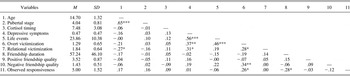
Table 1 includes means, standard deviations, and intercorrelations among all primary variables. Consistent with prior work, depressive symptoms were associated positively with both overt and relational victimization. Overt victimization was correlated positively with life events and negative friendship quality. Observed friend's responsiveness was negatively associated with friendship duration. A logarithmic transformation was applied to prestressor (M = 0.09, SD = 0.05), stressor (M = 0.12, SD = 0.09), and poststressor (M = 0.10, SD = 0.06) cortisol values. Log-transformed cortisol values showed nonsignificant zero-order correlations with all continuous study variables (|rs| < .24, ps > .07), except for cortisol timing (|rs| > .37, ps < .001).
Descriptive statistics and correlations for primary study variables

Note: Cortisol timing is the hours passed between awakening and prestressor cortisol sample; friendship duration is in months.
*p < .05. **p < .01. ***p < .001.
Gender and medication group differences on study variables were examined using independent samples t-test analyses. Girls reported significantly higher positive friendship quality and more advanced pubertal development than did boys, while boys reported greater overt victimization than did girls. Because corticosteroids and birth control have demonstrated associations with HPA functioning (Bouma et al., Reference Bouma, Riese, Ormel, Verhulst and Oldehinkel2009; Hastings et al., Reference Hastings, Fortier, Utendale, Simard and Robaey2009), usage of these medications was considered as a covariate for the current study. In the examination of medication differences, individuals reporting the use of corticosteroids and/or birth control were categorized into a “medication” group (N = 4), while all others were categorized into a “nonmedication” group. Results from t-test analyses revealed that participants in the medication group reported greater relational victimization and longer friendship duration. Given their significant associations with friendship and victimization constructs, gender and medication were included as covariates in the testing of primary hypotheses.
Prediction of HPA axis response
An unconditional latent difference model was first used to examine changes in cortisol levels over time. Latent variables for intercept, reactivity, and recovery were created using the framework outlined by Willoughby et al. (Reference Willoughby, Vandergrift, Blair and Granger2007) for pre–post–post research designs. As explained by Willoughby et al. (Reference Willoughby, Vandergrift, Blair and Granger2007), the unconditional latent difference model is identified, but it does not yield indices of overall model fit. The variances of the latent variables for cortisol intercept, reactivity, and recovery all were significant (p < .001).
An initial saturated conditional model was used to identify all covariates demonstrating significant associations with the latent cortisol factors. Cortisol timing, age, gender, medications, pubertal stage, depressive symptoms, life events, and friendship duration all were included as covariates in the model. Primary predictors in the model included victimization (overt and relational), friendship quality (positive and negative), and observed responsiveness. For observed responsiveness, a path was estimated only for the latent factor for cortisol recovery, corresponding to the time period in which friends interacted with target participants. For all other covariates and predictors, paths were estimated between each variable and the latent constructs for cortisol intercept, reactivity, and recovery. In this model, depressive symptoms were marginally associated with cortisol intercept (β = 0.28, p = .08). Cortisol timing was significantly associated with cortisol intercept (β = –0.38, p = .002) and reactivity (β = –0.24, p = .04), and marginally with recovery (β = –0.22, p = .06).
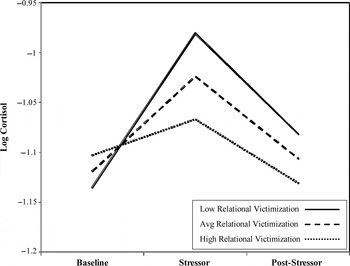
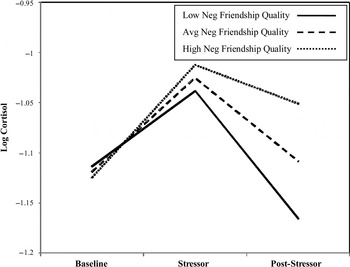
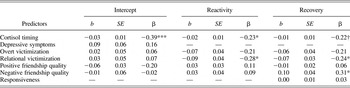
A reduced model was estimated to examine associations between primary predictors and the latent cortisol factors (i.e., intercept, reactivity, and recovery). In this model, paths among cortisol timing and all latent cortisol factors were retained. For depressive symptoms, a path was retained between depressive symptoms and cortisol intercept because this was the only marginally significant path revealed in the initial model. All other covariates were removed from the model to reduce suppression effects and increase the interpretability of findings. This model was an adequate fit to the data, χ2 (4) = 5.21, ns; χ2/df = 1.30; comparative fit index = 0.99; root mean square error of approximation = 0.07; Akaike information criterion = 127.21 (see Table 2 for model estimates). In this model, the association between depression and cortisol intercept was no longer marginally significant. Main effects for relational victimization on cortisol reactivity and cortisol recovery were observed. In addition, a main effect for negative friendship quality on cortisol recovery also was observed. Model implied trajectories of cortisol were plotted at low (–1 SD), mean, and high (+1 SD) levels of relational victimization (see Figure 1) and negative friendship quality (see Figure 2). Results indicated that higher levels of relational victimization were associated with a more hyporeactive cortisol response to the social stressor task. Although higher levels of relational victimization also were associated with greater cortisol recovery following the stressor, this effect should be interpreted in the context of the association between higher levels of victimization and blunted reactivity. In other words, higher levels of victimization were associated with lower reactivity and, thus, a quicker return to baseline. Results also indicated that higher levels of negative friendship quality were associated with reduced HPA recovery following the stressor task, predicting a slower return to baseline; this effect did not appear to be influenced by level of reactivity. A subsequent model tested gender differences using interactions between gender and each of the primary predictors. Though the interaction between gender and positive friendship quality significantly predicted cortisol recovery (β = –0.83, p < .001), independent testing of this effect for boys and girls revealed nonsignificant paths between positive friendship quality and cortisol recovery.
Linear functions showing different degrees of cortisol reactivity by level of relational victimization (average = mean; high/low = mean ± 1 SD).

Linear functions showing different degrees of cortisol recovery by level of negative friendship quality (average = mean; high/low = mean ± 1 SD).

Unstandardized and standardized regression weights for victimization, friendship quality, and observed responsiveness predicting latent difference scores for cortisol intercept, reactivity, and recovery, while accounting for covariates

Note: For recovery, positive values indicate less return of cortisol to baseline levels following the stressor; negative values indicate greater return to baseline levels.
†p < .06. *p < .05. ***p < .001.
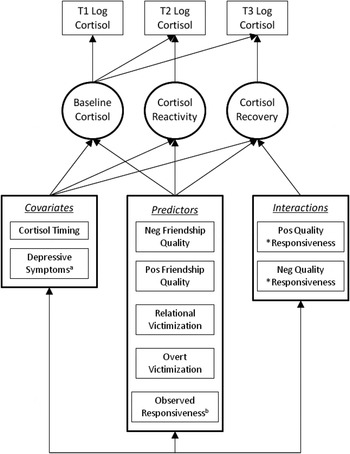
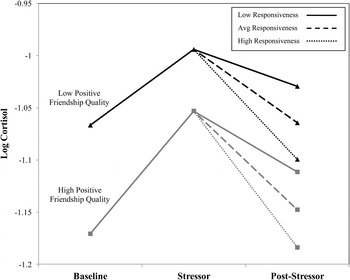
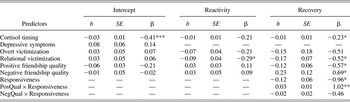
To examine whether friendship qualities interacted with specific friendship behavior to predict cortisol recovery, two interaction terms were generated (i.e., Responsiveness × Positive Friendship Quality; Responsiveness × Negative Friendship Quality). These two interaction terms were added to the reduced model (previously used to test for main effects) and paths were estimated between each interaction term and cortisol recovery (see Figure 3 for an illustration of the final model). This model was an adequate fit to the data, χ2 (8) = 6.27, ns; χ2/df = 0.78; comparative fit index = 1.00; root mean square error of approximation = 0.00; Akaike information criterion = 170.27 (see Table 3 for model estimates). In this model, the interaction between positive friendship quality and observed responsiveness significantly predicted cortisol recovery. This effect was plotted using model implied trajectories for low (–1 SD), mean, and high (+1 SD) levels of positive friendship quality and observed responsiveness (see Figure 4). Nonsignificant interactions were removed for probing to simplify interpretation of effects; effects remained unchanged with nonsignificant interactions removed. Under conditions of low positive friendship quality, high observed responsiveness was associated with greater cortisol recovery, while low responsiveness was associated with less cortisol recovery. Under conditions of high positive friendship quality, the effect was in the opposite direction. In supplementary models, gender differences and suppression effects were considered but results did not influence primary findings.Footnote 1 Though interactions examining friendship constructs (quality and behaviors) as moderators of the association between peer victimization and HPA axis responses (reactivity and recovery) were tested in the model, these interactions yielded no significant findings and were not included in the final model.
Final latent difference model with covariates, primary predictors, and interactions between friendship quality and proximal friend behavior (i.e., responsiveness) predicting latent constructs for baseline cortisol, cortisol reactivity, and cortisol recovery. All predictors were allowed to correlate with one another, as were the latent cortisol constructs. aIn this reduced model, depressive symptoms were only allowed to predict baseline cortisol. bResponsiveness was only allowed to predict cortisol recovery.

Linear functions showing different degrees of cortisol recovery by level of positive friendship quality and observed responsiveness (average = mean; high/low = mean ± 1 SD).

Model testing interactions of established peer experiences (i.e., victimization and friendship quality) with observed responsiveness predicting cortisol recovery, while accounting for main effects and covariates

*p < .05. **p < .01. ***p < .001.
Discussion
This study considered peer victimization as a form of stress that may be associated with biological stress responses, and thus may contribute to allostatic load. This study also examined aspects of dyadic friendships (i.e., friendship quality and friend's observed responsiveness behavior following an in vivo stressor) that may be associated with HPA axis responses. Consistent with theories regarding enhanced social orientation and sensitivity in adolescence, findings suggest that adolescents' experiences with peers may be especially relevant for understanding biological stress responses. These findings have important implications not only for research examining allostasis but also for documenting the manner in which aversive peer experiences are broadly relevant for understanding youth adjustment. As such, this work offers a nice extension of Nicki Crick's legacy.
In this study of 12- to 16-year-olds, many of whom already were experiencing significant life stressors and symptoms of psychopathology, prior experiences with relational victimization uniquely contributed to a blunted HPA axis response to an in vivo stressor. Given the adverse life experiences already endured by many in this sample, the effects of relational aggression are remarkable. Moreover, it is notable that significant findings emerged for relational while accounting for the effects of physical victimization. Relational victimization occurs more frequently during adolescence than in childhood (Crick et al., Reference Crick, Nelson, Morales, Cullerton-Sen, Casas, Hickman, Juvonen and Graham2001), but it may also be uniquely relevant to the biological sensitivities of adolescence. Even in nonhuman species, adolescence is accompanied by an increased social orientation (e.g., Douglas, Varlinskaya, & Spear, Reference Douglas, Varlinskaya and Spear2004); within humans, actual or perceived social exclusion/rejection experiences trigger neurological threat detection centers (Eisenberger & Lieberman, Reference Eisenberger and Lieberman2004; MacDonald & Leary, Reference MacDonald and Leary2005). Relational victimization is characterized by a withdrawal of friendship support, gossip, or collusion among peers to ostracize. These experiences are consistent with the types of social rejection cues that activate socioaffective circuitry in functional magnetic resonance imaging studies (see Eisenberger, Reference Eisenberger, Decety and Cacioppo2011, for a review) and with pro-inflammatory responses in research on epigenetic expression (Cole et al., Reference Cole, Hawkley, Arevalo, Sung, Rose and Cacioppo2007; Miller, Maletic, & Raison, Reference Miller, Maletic and Raison2009). The use of an in vivo stressor paradigm extends prior research by demonstrating the importance of prior peer experiences as predictors of adolescents' biological stress reactivity during acute stress.
Relational victimization was associated with blunted HPA reactivity in this study, extending prior work by Crick and her colleagues linking relational victimization to reduced diurnal cortisol levels in children (Murray-Close et al., Reference Murray-Close, Ostrov and Crick2007). Some evidence suggests that individuals with histories of chronic stress (characteristic of the adolescents in this study) may be more prone toward blunted HPA responses (e.g., Miller et al., Reference Miller, Chen and Zhou2007). Similar to other chronic stressors, relational victimization during adolescence may serve as a stable source of stress that frequently engages HPA stress responses, increasing allostatic load to the point that HPA responses become dysregulated. Blunted and heightened stress reactivity, and sustained HPA activation, have deleterious effects on one's ability to carry out effective, or socially desirable, behavioral and affective responses to stressors (McEwen, Reference McEwen1998, Reference McEwen2000). Each of these markers of dysregulated HPA axis response also has been linked with related biological stress response processes (e.g., pro-inflammation) and with later psychopathology among youth (Calhoun et al., Reference Calhoun, Franklin, Adelman, Guerry, Hastings and Nock2012; Hastings et al., Reference Hastings, Shirtcliff, Klimes-Dougan, Allison, Derose and Kendziora2011). In addition, adolescence may be a critical transition point where proximal and chronic symptom presentations correspond with different profiles of HPA dysregulation (Ruttle et al., Reference Ruttle, Shirtcliff, Serbin, Ben-Dat Fisher, Stack and Schwartzman2011). Findings ultimately suggest that adolescents with high levels of relational victimization experiences may be poorly equipped to manage the biological demands required by future stressors, and therefore they may be less likely to utilize adaptive cognitive or behavioral responses to stress.
This study also suggests that dyadic peer experiences are relevant for understanding HPA axis recovery following a stressor. Specifically, this study offered two findings to support hypotheses regarding the ameliorative effects of friendships in the context of stress. First, lower levels of negative qualities (i.e., conflict and antagonism) within adolescents' best friendships were associated with greater HPA recovery following an experimentally induced stressor. Second, for adolescents in low positive quality friendships, high friend responsiveness while adolescents discussed their stressful experience was associated with stronger HPA axis recovery. These findings suggest that adolescents' friendships can confer biological benefits. This offers an exciting contribution to a large body of research considering the psychological correlates of dyadic friendship experiences (Schmidt & Bagwell, Reference Schmidt and Bagwell2007). Of note, friendship quality and behaviors did not moderate the association between peer victimization and HPA responses; it could be that connections between HPA responses and chronic experiences in the broader peer group are relatively substantial and less likely to be affected by a single dyadic friendship.
It is interesting that responsiveness in the context of a very high quality friendship was associated with less HPA axis recovery. As mentioned earlier, maintaining high cortisol reactions following a stressor could result in negative consequences such as increased allostatic load and decreased capacity to respond to future stressors (McEwen, Reference McEwen2000). Findings from this study may suggest possible deleterious friendship interactions that maintain high cortisol levels after a stressful social experience. One such friendship process may be “co-rumination,” which is characterized by a persistent focus on problems and negative affect within dyadic friendship interactions (Rose, Reference Rose2002). Recent work suggests that trait ruminative thinking is associated with delayed cortisol recovery following a social stressor (Stewart, Mazurka, Bond, Wynne-Edwards, & Harkness, Reference Stewart, Mazurka, Bond, Wynne-Edwards and Harkness2013). In addition, focus on negative affect during discussions of life problems with a friend is associated with heightened activation of the HPA system (Byrd-Craven et al., Reference Byrd-Craven, Granger and Auer2011). The extension of this result to co-ruminative processes offers an intriguing direction for future research. Overall, results offer important preliminary evidence to suggest that specific relationship qualities and specific types of dyadic behaviors following stress can change adolescents' biological capacity to cope effectively. Applications of this idea to the study of other dyadic interactions in adolescents' lives (e.g., parents, therapists, or teachers) are ripe with possibilities.
This study offered a rare opportunity to examine multiple peer experiences that may be associated with HPA stress responses in adolescence. The research was strengthened by using a sample that included a high proportion of adolescents referred from clinical settings, suggesting the relevance of the findings to youth who are vulnerable to psychopathology. The study also benefited from the use of multimethod approaches, including observational coding and objective indicators of stress responses. It was impressive that significant findings emerged despite a relatively small sample and reduced power to detect effects; however, a larger sample would provide greater power for testing higher order interactions (e.g., three-way interactions), which could offer additional insight as to other factors that play an important role the observed connections between HPA functioning and peer experiences. Given that the influence of victimization and friendships on adjustment may differ for adolescent boys and girls (Rose & Rudolph, Reference Rose and Rudolph2006), future studies with more diverse samples should consider gender differences in connections between peer relations factors and biological stress responses. In addition, the utilization of peer reports could assist in determining whether findings are unique to adolescents' internalized evaluations of peer victimization and friendship quality, or whether findings can be generalized to a more “true” assessment of their social status and peer relationships. Future observational work should continue to consider specific friend behaviors that may facilitate or diminish stress recovery. Specifically, it is important to disentangle and understand the multiple facets of high-quality friendships as they relate to stress responses. As discussed, co-rumination may be one process occurring within high-quality friendships that contradicts the stress-buffering hypothesis by maintaining heightened biological stress responses. Examining negative friend behaviors, such as criticism, during poststressor discussions also may clarify reasons why high negative quality friendships are associated with less recovery. Given that the current study employed a social stressor paradigm, it is possible that the observed effects are limited to social stress responses; additional work, implementing other types of stressor tasks (e.g., performance), is needed to determine if salient peer experiences influence stress responses in other contexts.
Further, though findings contribute a unique and important perspective on peer relations, the interpretation of findings are limited by the cross-sectional nature of the study. For instance, it is unclear whether peer experiences cause dysregulation of HPA stress responses, or whether maladaptive social behaviors resulting from biological dysregulation may influence how adolescents are treated by peers. The bidirectionality of peer experiences and HPA dysregulation may be especially important to consider in the context of friendships, given that adolescents' maladaptive behavior could influence the development of positive and negative friend behaviors (e.g., support or criticism). For instance, an adolescent who has difficulty regulating stress reactions may be more likely to agitate a friend, thereby decreasing the likelihood that the friend will feel motivated to provide support. Longitudinal work considering the development of the HPA system and changes in peer experiences over time could clarify the directionality of findings. In addition, a longitudinal design would also offer opportunity to consider the chronicity of victimization and the stability of friendships as predictors of biological stress vulnerability. Both of these factors have demonstrated important connections with adjustment (Biebl, DiLalla, Davis, Lynch, & Shinn, Reference Biebl, DiLalla, Davis, Lynch and Shinn2011; Poulin & Chan, Reference Poulin and Chan2010) and may have unique associations with HPA functioning. Finally, longitudinal work is needed to determine how the influence of relational victimization and friendships on HPA stress responses may contribute to the development of psychopathology. Some work suggests that chronic stress may compromise the HPA axis' role in other important biological tasks, such as down-regulating inflammation responses (Miller, Cohen, & Ritchey, Reference Miller, Cohen and Ritchey2002). For adolescents, salient peer experiences may serve an important role in establishing biological set points that increase or decrease vulnerability to psychopathology.
Nicki Crick's research changed the way that scholars understand peer experiences. Her work broadened the repertoire of peer interactions that we now know can promote psychopathology in youth, and her contributions continue to advance future scientific discovery on the topics that were of greatest interest to her. This study demonstrated that relational victimization and dyadic friendship experiences may be associated with adolescents' biological capacity to regulate interpersonal stress. The study of peer contributions to allostatic load may yield important insights into the unique role of social experiences in adolescent development.