INTRODUCTION
One of the most interesting questions in ecological parasitology concerns the processes that contribute to the formation of parasite communities, and the resulting patterns of these assemblages (Esch et al. 1990). So what actually shapes parasite communities and how do the components of these communities interact? While some recent empirical studies have shed light upon the interactions between endoparasitic helminths within their definitive host (Byrne et al. 2003; Lello et al. 2004; Friggens and Brown, 2005), fewer studies have investigated the question of interspecific interactions inside the intermediate host. The intermediate host represents a shared habitat for the parasites it contains, many of which are at different stages of their life-cycle or have different transmission routes. Most of the studies regarding interactions between components of the parasite communities within intermediate hosts are restricted to the assemblages of digeneans in their gastropod first intermediate host (Kuris and Lafferty, 1994; Esch et al. 2001; Hendrickson and Curtis, 2002; but see Wang et al. 2002 and Fredensborg and Poulin, 2005 for exceptions).
Poulin and Valtonen (2001) found that the assemblages of larval helminth parasites occurring in fish are not random collections but are in fact structured packets determined by their transmission route. The processes that generate such patterns of association between parasites in intermediate and paratenic host organisms, as well as the consequences of these associations, are poorly known. Co-occurring parasites can have various consequences on each other's fitness and transmission success, depending on the respective goals of the different parasites that share a particular host organism (Lafferty, 1999).
The parasite community of intertidal bivalves can be quite diverse and complex (Montaudouin et al. 2000; Poulin et al. 2000), and presents an interesting model for the study of interactions between co-occurring parasites. The New Zealand cockle, Austrovenus stutchburyi, is commonly parasitized by metacercariae of 2 echinostome species that encyst within its foot. At high infection intensity they can impair the cockle's ability to burrow, forcing it to remain on the sediment's surface and facilitating the parasites' transmission to the definitive host by making cockles more susceptible to avian predators (Thomas and Poulin, 1998; Mouritsen, 2002; Babirat et al. 2004). The metacercariae that encyst in the foot of A. stutchburyi consist of 2 species from the Himasthlinae subfamily: Curtuteria australis and Acanthoparyphium sp. Due to similarity in their level of abundance and the identical ecological roles they play in the soft-sediment intertidal ecosystem, they are considered as ecological equivalents (Babirat et al. 2004), and here will be collectively referred to as ‘the echinostomes’.
By impairing their hosts' ability to burrow, the echinostome metacercariae have been demonstrated to be ecosystem engineers on the intertidal mudflats, influencing the local diversity and distribution of the biotic community through their cockle hosts (Thomas et al. 1998; Mouritsen and Poulin, 2005a,b). How the echinostomes may influence the community of other parasites in A. stutchburyi is less certain. Previous studies have already found a number of associations between the two species of echinostomes and other trematodes that infect A. stutchburyi. These resulting associations appear to be indirect consequences of the echinostome metacercariae manipulating their host's microhabitat preference. Poulin et al. (1998) found that the sporocysts of Cercaria pectinata were more commonly found in cockles that were manipulated by echinostome metacercariae. This pattern of association with the echinostome has also been found for an undescribed species of gymnophallid (Poulin et al. 2000).
Parasitizing surfaced cockles manipulated by the echinostomes has costly consequences for C. pectinata. Since C. pectinata utilizes A. stutchburyi as a first intermediate host for asexual replication (Chilton, 1904), it would be in its interest for the host to survive as long as possible. However, cockles manipulated by echinostomes experience a 7-fold increase of their risk of avian predation (Thomas and Poulin, 1998). In contrast, A. stutchburyi is also a second intermediate host for the metacercariae of the gymnophallid. This trematode is present in high prevalence in certain localities, shares the same transmission route and definitive host as the echinostomes, and would benefit from any increases in the probability of its cockle host being predated upon by birds. In fact Mouritsen (2004) noted that in the presence of sublethal predation on cockles by foot-cropping fish predators which can impose a cost upon the foot-encysting echinostomes (Mouristen and Poulin, 2003a), the gymnophallid is the only parasite to receive a clear-cut advantage from associating with cockles that are resting on the sediment surface as a result of being heavily parasitized by echinostomes.
In addition to trematodes, A. stutchburyi is also host to a number of other less common symbionts such as the myicolid copepod Pseudomyicola spinosus. The nature of the potential interactions that can occur between trematodes and this crustacean within their mutual host are unknown. The relationship between the cockle and these symbionts may not necessarily be antagonistic, as the cockle may actually benefit from housing commensals that can remove problematic materials or protect it from parasitic infections, thus forming the basis of a cleaning symbiosis relationship.
There are many known varieties of cleaning symbioses involving animals from many taxa serving as clients and cleaners (Poulin and Grutter, 1996). Among invertebrates, some studies have found situations where the host organism benefits from having commensals that can act as resident cleaners. For example, Perissinotto and Pakhomov (1997) noted that an individual tunicate Salpa thompsoni that has been invaded by the copepod Rhincalanus gigas can potentially benefit by having its filtering apparatus cleaned by the copepod when the salp experiences clogging during phytoplankton blooms. More obvious benefits to the host have been found in the relationship between branchiobdellid annelids and their freshwater crayfish host. Branchiobdellids consume material trapped in crayfish gills, and crayfish without the branchiobdellid can experience much higher mortality and slower growth rate than those with the symbiont (Brown et al. 2002). Some organisms associating with cockles have been found to protect it, to some extent, from parasitic infections. The mud flat anemone, Anthopleura aureoradiata, frequently uses cockle shells for attachment and Mouritsen and Poulin (2003b) found that cockles with anemones accumulated significantly less metacercariae than those without anemones. It seems that the anemones prey upon trematode cercariae, acting like a resident cleaner symbiont (Mouritsen and Poulin, 2003b). This is similar to the relationship between the commensal oligochaete Chaetogaster limnaei limnaei and its snail host Biomphalaria glabrata. Rodgers et al. (2005) found the presence of C. limnaei limnaei to be beneficial to its host because it protects the snail from Schistosoma mansoni infection by preventing the entrance of invading miracidia, thus protecting its host from being parasitized and enhancing its growth (Rodgers et al. 2005). It is unknown if myicolid copepods may play a similar role for their cockle host.
This study aims to explore these potential interactions between the different symbionts found within A. stutchburyi. Specially, the aims are (1) to investigate if there is a pattern of association between the metacercariae of the echinostomes and gymnophallids, (2) to examine the effect Pseudomyicola spinosus has on the number of metacercariae accumulating inside cockles, and (3) to assess if this copepod has an effect on the cockle's condition as reflected by its tissue mass.
MATERIALS AND METHODS
Cockles used for this study were collected in November 2005 in Company Bay, Otago Harbour, South Island, New Zealand. A total of 500 cockles were collected from the site, in the lower tidal range, along a transect parallel to the waterline. Of all the cockles collected, 237 were lying on the surface of the sediment with at least 50% of their shell exposed, while the remaining 263 cockles were collected from below the sediment along the same transect.
All cockles were then returned live to the laboratory where the maximum shell length of each cockle was measured with digital callipers to the closest 0·1 mm. After the measurements were taken, the cockles were dissected and inspected for parasites under a dissecting microscope. The mantle cavity of the cockle was extensively examined for the presence of P. spinosus, which were collected and individually preserved in formalin. All the metacercariae of both echinostome and gymnophallid found in each cockle were counted. The gymnophallid metacercariae were easily visible and were usually found in clumps on the outer mantle epithelium of the cockle, most of them accumulating near the hinge. The echinostome metacercariae were encysted within the foot of the cockle, therefore to obtain an accurate count, each cockle's foot was removed and placed individually in a tube of pepsin digestion solution (6 g pepsin and 7 ml of 36–38% HCl in 1000 ml of water) and incubated at 40 °C for 20–30 h. The process partially dissolves most of the host tissue while leaving the metacercariae intact. After the incubation period, all the metacercariae in the tube were recovered and counted under a dissecting microscope.
After foot removal, the rest of the soft tissues of the cockles were retained and placed individually on small metal trays which were then placed in a drying oven at 110 °C for 22 h to allow dry mass measurement.
Prior to statistical analysis, the number of metacercariae of both echinostomes and gymnophallids were log-transformed. All statistical analyses conducted were parametric tests, while the Fisher's exact test was used to compare the frequency of P. spinosus infections in the surface and buried cockles.
RESULTS
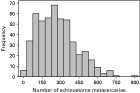
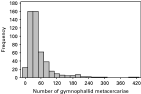
The shell lengths of cockles collected were between 24·2 and 40·7 mm, with a mean of 30·6 (±2·4) mm. Most of the cockles harboured between 100 and 400 echinostome metacercariae (Fig. 1) and 30–60 gymnophallid metacercariae (Fig. 2). All the cockles dissected were found to be parasitized by both echinostome and gymnophallid metacercariae (overall prevalence of each trematode=100%). The overall prevalence of P. spinosus in the cockles of Company Bay was found to be 4% (20 out of 500 cockles). All of the cockles found to harbour P. spinosus contained a single individual, except 1 cockle in the sample which had 3 copepods within its mantle cavity.

Fig. 1. Frequency distribution of the number of echinostome metacercariae per host among 500 cockles from Company Bay, Otago Harbour.

Fig. 2. Frequency distribution of the number of gymnophallid metacercariae per host among 500 cockles from Company Bay, Otago Harbour.
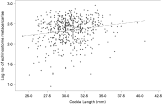
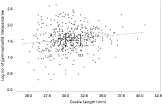
A multiple regression using cockle shell length, dry mass, and position in relation to the substrate (surfaced or buried) as predictor variables revealed the number of metacercariae correlated with the length of the cockle's shell for both echinostomes (r=0·178, P<0·001) and gymnophallids (r=0·148, P=0·003) (Figs 3 and 4), but no relationships were found between the cockle's dry mass and the number of metacercariae it harboured (echinostome: P=0·503, gymnophallid: P=0·738), nor was the position of the cockle in relation to the substrate found to have any effect on the intensity of infection (echinostome: P=0·677, gymnophallid: P=0·271). For P. spinosus in relation to the microhabitat of its host, 14 out of 237 surfaced cockles (5·9%) were found to be harbouring P. spinosus while only 6 out of 263 buried cockles (2·3%) were found to have the copepod. However, this apparent difference was not quite statistically significant (Fisher's exact test, P=0·0655).

Fig. 3. Relationship between the number of echinostome metacercariae and cockle shell length (mm), for 500 cockles from Company Bay, Otago Harbour. The line is that given by a linear regression.

Fig. 4. Relationship between the number of gymnophallid metacercariae and cockle shell length (mm), for 500 cockles from Company Bay, Otago Harbour. The line is that given by a linear regression.
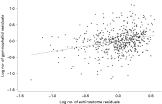
A positive association was found between numbers of echinostomes and gymnophallids (r=0·305, P<0·001). This pattern of association remained even when it was corrected for cockle shell size by using the residuals of regressions of the number of metacercariae versus shell length (r=0·287, P<0·001) (Fig. 5). This shows that this pattern was not simply due to passive accumulation of the two parasites over time.

Fig. 5. Relationship between the numbers of echinostome and gymnophallid metacercariae per cockle, for 500 cockles from Company Bay, Otago Harbour. The data are residuals of separate regressions against cockle shell length, and are thus independent of cockle size.
After correcting for cockle shell length using the method above, the presence of P. spinosus was not found to have any effect on cockle dry mass (two-sample t-test, t=0·775, D.F.=498, P=0·439). However, the presence of P. spinosus was found to be associated with a higher than expected number of echinostome metacercariae in the cockle (two-sample t-test, t=2·553, D.F.=498, P=0·011) but it was not found to have any significant effect on the number of gymnophallid metacercariae (two-sample t-test, t=0·807, D.F.=498, P=0·420). Based on back-transformed mean values (i.e. geometric means), cockles with a copepod harboured an average of 332 echinostome metacercariae, whereas those without a copepod harboured only 217.
DISCUSSION
The results of the present study show that a non-random pattern of association exists between at least 2 pairs of parasites found in A. stutchburyi. Firstly, there is a positive association between the infection intensity of echinostome and gymnophallid metacercariae. Secondly, the presence of a parasitic copepod appears to be associated with a higher abundance of echinostome metacercariae, but not of the gymnophallid. What could be the basis behind these patterns of association?
The myicolid copepod Pseudomyicola spinosus has been recorded in about 50 species of bivalves worldwide (Ho, 2001). Its presence within the mantle (branchial) cavity causes varying degrees of pathology in its bivalve hosts, the severity of which depends upon the intensity of infection (Dinamani and Gordon, 1974; Olivas-Valdez and Cáceres-Martínez, 2002). The damage caused usually involves erosion or alteration of the epithelium wall within the mantle cavity (Dinamani and Gordon, 1974; Cáceres-Martinez and Vásquez-Yeomans, 1997; Olivas-Valdez and Cáceres-Martínez, 2002; Cáceres-Martínez et al. 2005), although at low infection intensity the damage caused by the copepod is generally considered to be innocuous (Cáceres-Martínez et al. 2005). While P. spinosus can feed upon host tissue (host gill tissue has been used as food for rearing P. spinosus in the laboratory: Kajihara and Nakamura (1985)), myicolid copepods feed mainly upon host mucus (Ho and Zheng, 1994) and any mechanical injuries are most likely caused by the copepod's attachment appendages as it moves within its host (Cáceres-Martinez and Vásquez-Yeomans, 1997). Unlike many other parasitic copepods, the body of P. spinosus is comparatively unmodified and it is highly mobile inside its host.
The modification of the host epithelium within the mantle cavity by P. spinosus may have consequences for the infectivity of echinostome cercariae that enter the cockle. Wegeberg et al. (1999) noted that once within the mantle cavity of a cockle, the toughness of the host epidermis was one of the factors affecting infection efficiency for cercariae of the 3 Himasthla species they studied. Once a cercaria has entered the cockle through its inhalant siphon, it needs to adhere to host tissue with its ventral sucker, move to the appropriate infection site, and penetrate the epidermis in order to deny the host the opportunity to expel it from its mantle cavity (Wegeberg et al. 1999). By modifying the epithelium walls within the cockle's mantle cavity, P. spinosus may in fact enhance the infection efficiency of the echinostome cercariae.
The process of accumulation of metacercariae in a cockle bears some similarities to the recruitment of sessile intertidal organisms on rocky shores. Both involve free-living larval stages that must find the appropriate substrate to settle upon. In the case of a cercaria, the ‘appropriate substrate’ is the second intermediate host. For the free-living larvae of intertidal organisms (such as barnacle cyprids), the presence of other organisms (such as gastropods) that inhabit the rocky shore ecosystem can have indirect influences on settlement success. Holmes et al. (2005) found that the presence of the limpet Patella vulgata has a positive effect on the settlement success of Semibalanus balanoides cyprids on rocky shores. Earlier, Holmes (2002) found that through adhesive enmeshment, the pedal mucus produced by P. vulgata enhances cyprid settlement by a factor of about 6 in laboratory studies and by a factor of about 4 in field experiments. Thus, the presence of P. vulgata effectively modifies the nature of the substrate in a manner that facilitates the settlement success of S. balanoides (Holmes et al. 2005). This is an example of ‘niche construction’, where an organism's activities alter the selection pressure of the environment on itself and/or other organisms (Odling-Smee et al. 2003). In the case of P. spinosus and its cockle host, the copepod is also, in effect, modifying its ‘substrate’ (the epithelium wall of the cockle's mantle cavity) in a way that can enhance the settlement success of another organism (the echinostomes) that uses the same ‘habitat’ (the cockle). While the modified epithelium of the cockle is a mere ‘by-product’ of the copepod's presence and activities, it can still be considered as a form of habitat facilitation or niche construction if other organisms can take advantage of it (Laland et al. 2005).
This is not merely a case of the copepod's presence and activities within the host inducing a general stress reaction making it more susceptible to other parasitic infections. That is the case for another myicolid copepod, Ostrincola koe, in the hard clam Meretrix meretrix, which suffer mass mortality due to acute enteritis caused by the bacterium Vibrio alginolyticus (Ho and Zheng, 1994). While V. alginolyticus is a common coastal marine microbe, O. koe can induce considerable stress in M. meretrix, brought about by the irritation caused by the copepod's attachment appendages, thus compromising the clam's defence system and resulting in heightened susceptibility to vibrio infections (Ho and Zheng, 1994). However, unlike O. koe, which can occupy the mantle cavity of M. meretrix in large numbers (up to 30 copepods in a single host: Ho and Zheng, 1994) during peak periods of reproduction, P. spinosus were only found in small numbers (usually 1 per cockle host) in A. stutchburyi. No significant differences were found between the dry mass of cockles with and without the copepod, showing that it is not causing its host any significant physiological stress reflected in lower tissue mass. In addition, numbers of gymnophallid metacercariae were not affected by the presence of P. spinosus in the cockle as would be expected if the pattern observed was merely due to a process of passive accumulation of metacercariae aided by a general stress reaction suppressing the cockle's defensive system. As explained earlier, the effect that a small number of P. spinosus have on their cockle hosts appears to be more subtle. A potential reason behind this phenomenon could be the different migration routes taken by the two trematodes through their cockle host before reaching their final settlement site. Unlike echinostome cercariae, which encyst in the foot by entering through the cockle's siphon to reach the mantle cavity (Wegeberg et al. 1999) where P. spinosus resides, gymnophallid cercariae migrate through the extrapapillial space before settling between the outer mantle epithelium and inner shell surface (Cremonte and Ituarte, 2003). Thus, they do not encounter the copepod or its immediate environment. Therefore, any modification of the epithelium wall within the mantle cavity caused by the presence of P. spinosus would not alter the infectivity of gymnophallid cercariae. Ultimately, this kind of habitat modification may actually be detrimental to P. spinosus, because the accumulation of echinostome metacercariae modifies the behaviour of the cockle, making it more vulnerable to predation.
It is unknown just how important the ‘habitat facilitation’ provided by P. spinosus contributes to the overall ecology of the echinostomes; it may just be a minor effect of relatively little ecological relevance. While the copepod's effect on the settlement of echinostomes may not be major, it still results in an effect that is statistically detectable, making it a potential factor to consider in the transmission ecology of the echinostomes. It may be worthwhile to follow-up those findings with histopathological studies to verify that P. spinosus causes the kind of pathology in A. stutchburyi that has been reported for the copepod's other hosts. It would establish whether cockles harbouring the copepod have altered epithelium walls within the mantle cavity that may facilitate the establishment of echinostome metacercariae. Experimental infection of cockles by P. spinosus is not possible at present, and therefore the apparent positive effect of the copepod on echinostome infection cannot yet be confirmed experimentally.
The pattern of association found between the gymnophallid and echinostomes is interesting to consider in the context of the roles played by these two parasites in trophic transmission and host manipulation of the cockle. While it is possible that certain individuals may simply be more susceptible to a range of infections due to variability in parasite resistance, a more intriguing possibility is that intermediate hosts that already harbour manipulative parasite(s) may be actively exploited by other parasites that adopt the ‘hitch-hiking’ life-history strategy (Thomas et al. 1998). However, there are few empirical studies of the occurrence or proximate mechanism of this strategy in nature. One exception is the system involving the amphipod Gammarus insensibilis and the two trematodes Microphallus papillorobustus and Maritrema subdolum. Thomas et al. (1997) found that while M. subdolum cannot manipulate the behaviour of G. insensibilis, it is positively associated with the manipulative M. papillorobustus. Amphipods parasitized by M. papillorobustus exhibit modified behaviours in the form of positive phototaxis and the tendency to swim near the water's surface, which changes their spatial distribution (Helluy, 1983). It was found that M. subdolum achieves positive association with M. papillorobustus through cercariae that exhibit swimming behaviours which increase their likelihood of encountering amphipods that are distributed closer to the water's surface due to behavioural manipulation by M. papillorobustus (Thomas et al. 1997).
Thus a possible mechanism behind the hitch-hiking life-history strategy relates to the spatial distribution and altered microhabitat of hosts that are being manipulated. Previous studies show how altered microhabitat can lead to higher risk of infection by parasites. For instance, Poulin and Fitzgerald (1989) found that juvenile fish that swim closer to the bottom and/or vegetation are at greater risk of becoming parasitized by the ectoparasitic branchiuran Argulus canadensis. Fish actually modified their spatial distribution in the presence of A. canadensis to avoid becoming parasitized. On a larger spatial scale, Lysne et al. (1998) conducted an experiment showing that caged fish kept at shallower depths accumulated significantly more cercariae of the trematode Cryptocotyle lingua than those kept deeper. Lysne et al. (1998) suggested that the observed pattern of parasite accumulation may be due to the swimming behaviour of C. lingua cercariae, which tend to swim closer to the water surface.
Accordingly, if the gymnophallid is indeed a hitch-hiker parasite, then its cercariae should exhibit swimming behaviour leading to higher probability of encountering a cockle resting on the sediment surface than buried cockles, because cockles on the surface are usually heavily infected by echinostomes. While the preferred microhabitat of A. stutchburyi is a few centimetres below the sediment surface, when manipulated by the echinostomes, the cockle is forced to remain above the sediment (Thomas and Poulin, 1998). Preferential infection of surfaced cockles may be the mechanism through which the gymnophallid associates with the echinostomes. While this study did not find surface cockles to harbour significantly more gymnophallid metacercariae than buried cockles, this had been found before (Poulin et al. 2000). The absence of difference in this study may simply be due to the fact that individuals heavily parasitized by the echinostomes are not necessarily always found on the surface of the sediment. Cockles are haphazardly brought up to the surface by currents or other form of disturbances and due to the mechanism of the host manipulation, some heavily parasitized individuals may remain buried in the sediment. Conversely, manipulated cockles that were previously stranded on the surface may also be reburied by sediment carried by tidal movements. These abiotic factors can obscure the pattern of association that exists between the echinostomes and the gymnophallid.
The pattern of positive association between the gymnophallid and echinostomes found here confirms the findings of a previous study (Poulin et al. 2000). As the correlation between numbers of gymnophallids and echinostomes is independent of cockle shell length, it is not simply the outcome of the simultaneous accumulation of metacercariae as cockles grow older. A field experiment involving non-parasitized cockles forced to remain above or below the sediment would confirm whether the gymnophallid displays a preference for parasitizing cockles lying on the sediment's surface.
The authors would like to thank the Ecological Parasitology Group of University of Otago for useful comments on an earlier version of the manuscript.