The Chugoku Shimbun is a daily newspaper based in Hiroshima, the city that experienced the first nuclear attack in human history. Founded in 1892, with a circulation of 620,000, the Chugoku Shimbun is one of Japan's leading regional newspapers.Footnote 1 On 6 August 1945, an atomic bomb exploded above the city and citizens of Hiroshima. The bomb's powerful blast, heat rays and radiation annihilated the city, killing more than 100,000 people, including those who had succumbed to injuries and illness by the end of 1945. Those who managed to survive lost not only loved ones but also their homes, schools and workplaces. They endured the chaos of the postwar period and rebuilt the city. The Chugoku Shimbun has always stood beside the people of Hiroshima as a newspaper company that also endured the tragedy, and it worked hard to support the city's reconstruction in the aftermath of the atomic bombing. Furthermore, it has long pursued a variety of distinctive efforts to help realize a world without war and nuclear weapons.
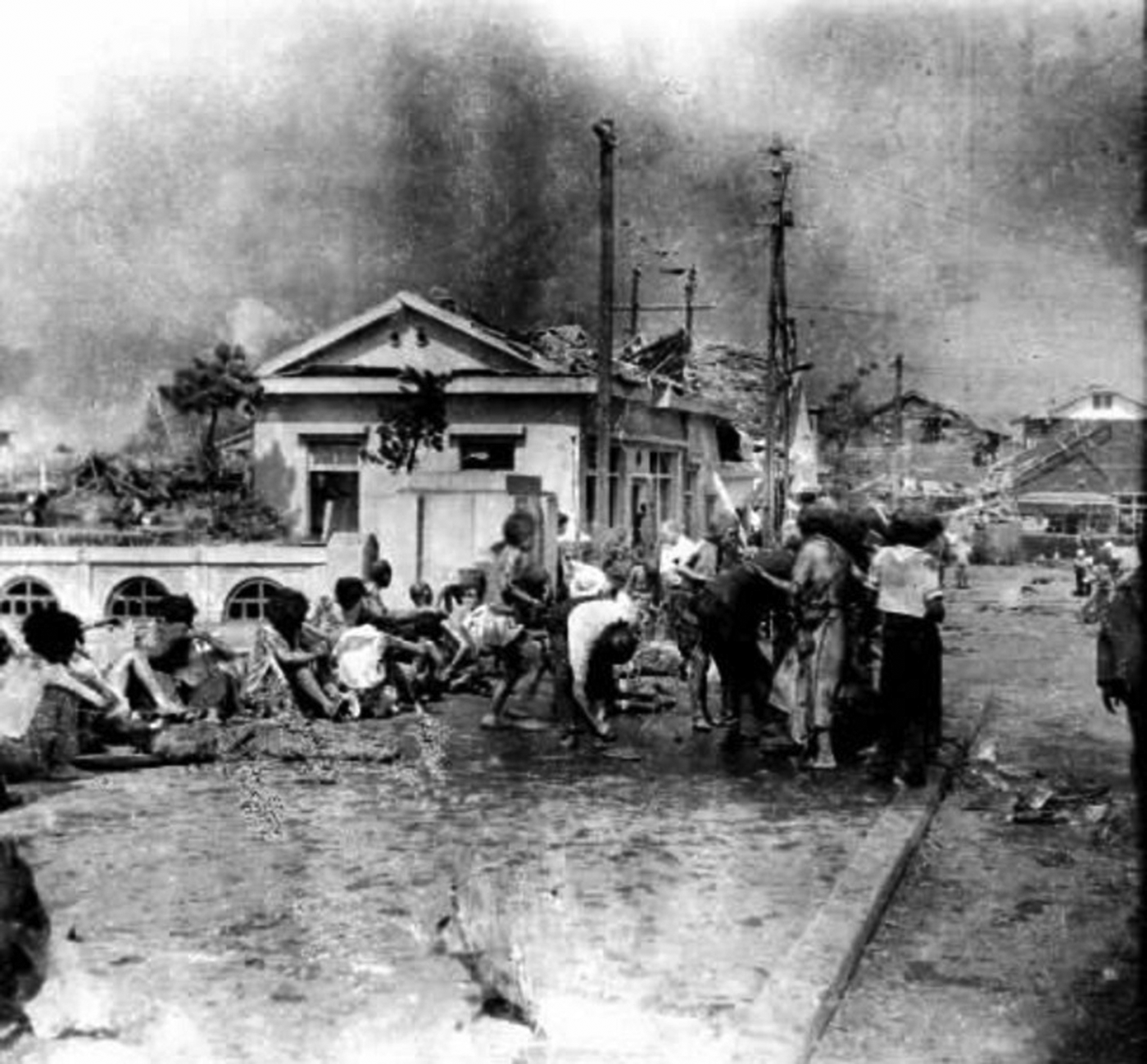
West End of Miyuki Bridge, 2.2 kilometres from the hypocentre. Survivors gather in front of the police station in Sendamachi to receive assistance from police officers. Photo by Yoshito Matsushige, © Chugoku Shimbun.

This article, illustrated with pictures taken by the newspaper's photographer, Yoshito Matushige, will give readers insight into the experience of the Chugoku Shimbun's staff on the day the atomic bomb was dropped on Hiroshima. It features the stories of three staff members, photographer Yoshito Matsushige, journalist Haruo Oshita, and Yasuo Yamamoto, manager of the paper's stenography department. It also describes the Chugoku Shimbun's efforts to document the experience of Hiroshima's citizens, notably through the establishment of the Hiroshima Peace Media Center, and the newspaper's work towards a future without nuclear weapons.
Voices of Chugoku Shimbun staff on the day the atomic bomb was dropped
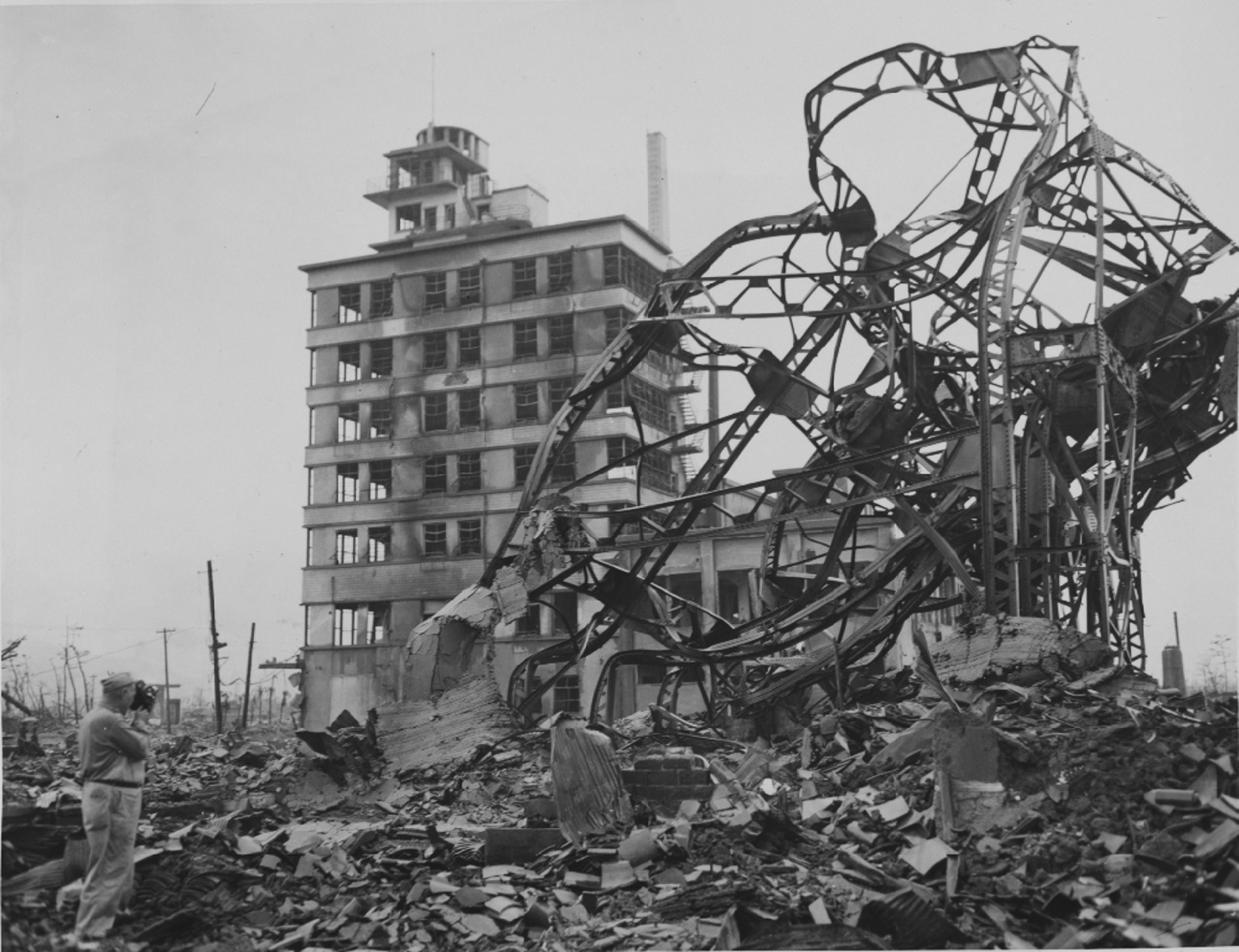
More than 100 employees of the Chugoku Shimbun, about one third of the newspaper's work force at the time, were killed in the atomic bombing, The company's headquarters, located about 900 metres east of the hypocentre, were completely destroyed. The Chugoku Shimbun's ability to print newspapers suffered a disastrous blow, with the two rotary presses destroyed by fire and the communication equipment in ruins. The surviving workers suffered injuries, and many lost family members.
Below is the testimony of three of Chugoku Shimbun's employees in 1945. Yoshito Matsushige was a photographer who took a handful of historic photos on the day the atomic bomb was dropped. Haruo Oshita saw the burnt ruins of the city, like a vision of hell, as he walked to the newspaper building. Yasuo Yamamoto lost his only son, 13 years old at the time, to the atomic bombing. Afterwards he made the revival of the Chugoku Shimbun his mission and worked tirelessly towards that end.
Yoshito Matsushige
One avenue that the Chugoku Shimbun has pursued in its efforts to realize a world without nuclear weapons is its coverage of the atomic bombing and peace issues, beginning with the five photographs taken by Chugoku Shimbun photographer Yoshito Matsushige (1913–2005) on the day of the bombing. There are many photos of the bomb's mushroom cloud taken from a distance that day, but only the five images captured by Mr Matsushige depict what happened to human beings under the atomic cloud. Some people were seriously injured, knocked unconscious by the blast, or trapped under collapsed buildings. Others had their clothes and bodies so severely burned that their skin peeled away, hanging down in strips. Still, those who survived somehow managed to flee from the city to outlying areas.
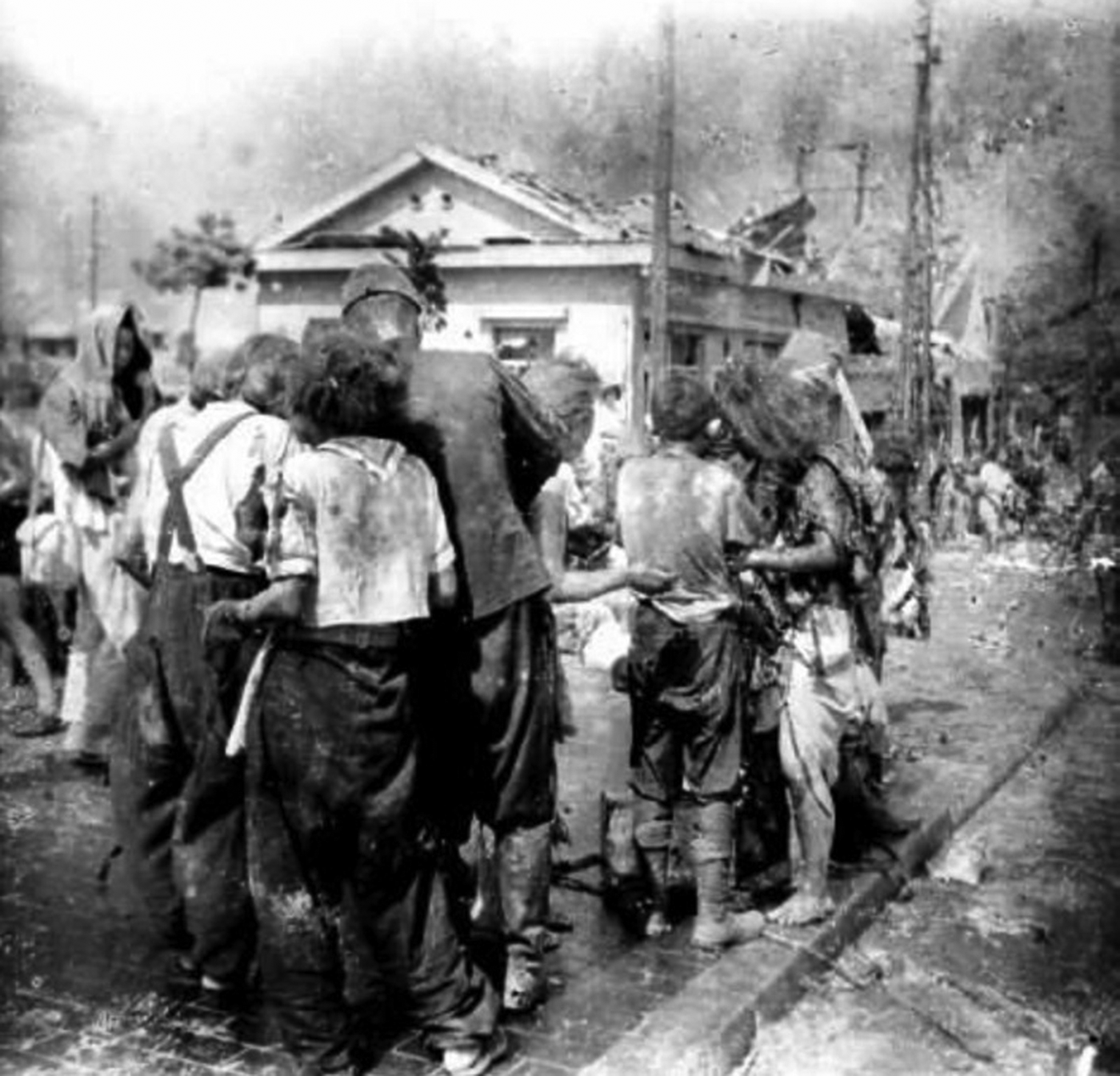
West End of Miyuki Bridge, 2.2 kilometres from the hypocentre. Survivors suffering burns receive dabs of cooking oil brought from the Hiroshima Army Provisions Depot nearby, or oil used for the transformers of the Hiroshima Electric Railway. Photo by Yoshito Matsushige, © Chugoku Shimbun.
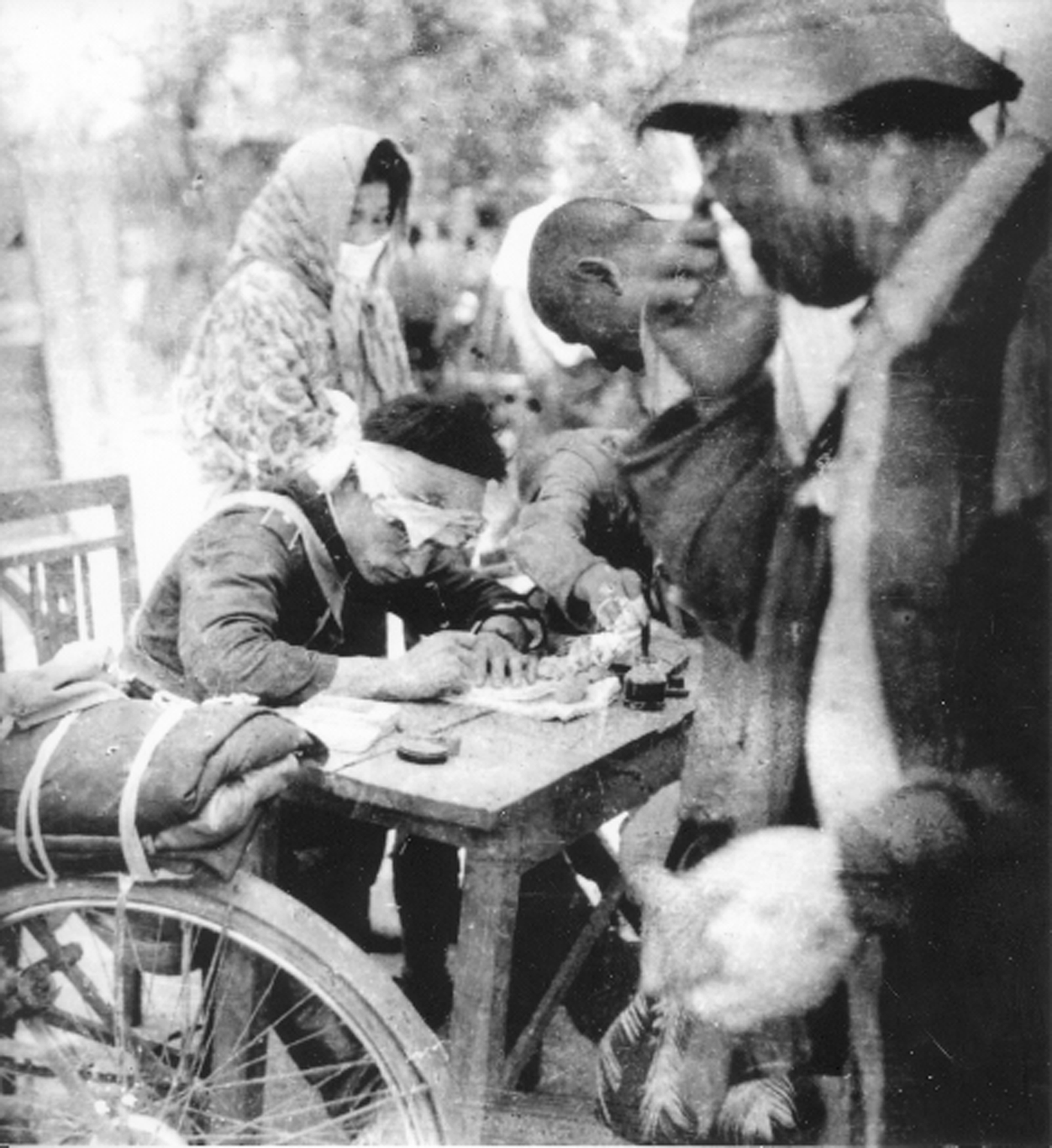
The most well-known of the five photos are the two taken at a location 2.2 kilometres from the hypocentre of the atomic blast , just three hours after the bomb exploded. The photos show people at the west end of Miyuki Bridge after they fled from the area near the hypocentre. In his later years, Mr Matsushige described what he had seen:
I had walked for two and a half hours downtown through blood-red rubble strewn with corpses, and I never snapped my shutter once. The only pictures I took were the two on the west end of Miyuki Bridge about three hours after the bombing, two more of my house that afternoon before going into town, and one more that evening of a policeman issuing survivor's certificates in Minamimachi – a total of five.
When I raised the camera for a second shot, I found that the viewfinder was clouded with tears. It wasn't really anger, but I thought America had done a terrible thing. I felt sorry for the victims and it was so cruel that I cried.
I wanted to take more photos from the police branch office. I could see people treating victims. But I found it impossible to look through the viewfinder. The scene before my eyes was so gruesome. I walked closer to people, but I couldn't snap the shutter. Feeling uncomfortable, I asked no one in particular, “Isn't this terrible?”
I think it was good that I took those photos. Of course, they won't tell everything about the horror of the bombing, but I still feel I had done well to get even a few pictures under such extreme circumstances. Without those photos, nothing would tell what really happened.Footnote 2
Through tearful eyes, Mr Matsushige managed to capture the horrific conditions in the aftermath of the atomic bombing. He is just one of many who have sought to convey the atomic bomb experience.
Map of Hiroshima at the time of the atomic bombing. © Chugoku Shimbun.
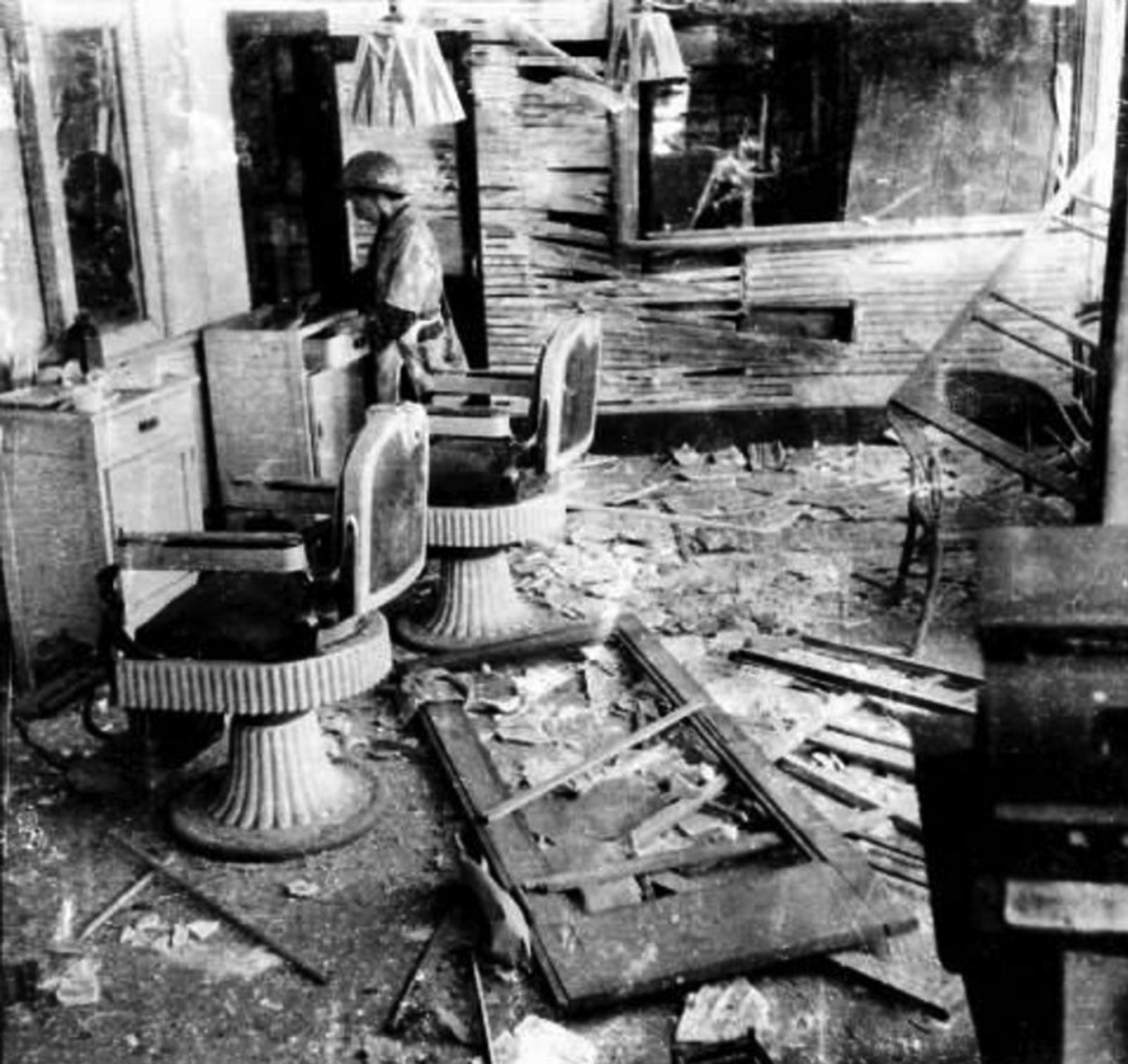
The barber shop and home of Yoshito Matsushige, located 2.7 kilometres from the hypocentre. The shop was run by Mr Matsushige's sister and his wife. The blast littered the barber shop with rubble and broken glass. His wife, who appears in the scene, was pregnant at the time. Photo by Yoshito Matsushige, © Chugoku Shimbun.
Haruo Oshita
On the morning of 6 August, Haruo Oshita, then 42 years old, looked up and saw a column of black smoke rising into the sky above Hiroshima as he left his home in Itsukaichi, about 8 kilometres west of Hiroshima, to go to the headquarters of the Chugoku Shimbun. He caught a ride on a relief truck from the Hatsukaichi Police Department, but the bridge into the Hiroshima delta had collapsed and the truck could not advance into the city. He crossed the Koi Railway Bridge, about 2.3 kilometres from the hypocentre. The railroad ties on the bridge were on fire. With raging flames blocking his path, he made his way down the road. “There was nothing but dead bodies.”Footnote 3 When he finally made it to the newspaper building, “the presses were on fire, and the newsprint warehouse was in flames, too”.Footnote 4 He simply sat there, dumbfounded.Footnote 5
Yasuo Yamamoto
From the day of the A-bombing most of the surviving employees of the Chugoku Shimbun and their families were faced with the deaths of family members. They were also struggling to learn whether others were safe …
Yasuo Yamamoto, then 42 years old, was riding his bicycle to work from his home in Danbaranaka-machi (now Danbaraminiami, Minami Ward), about 2.5 kilometres from the hypocentre, when he was thrown by the blast from the A-bombing. His 13-year-old son, Masumi, a first-year student at Hiroshima No. 1 Junior High School, had been mobilized to carry out demolition work and was working near city hall at the time of the bombing. He returned home with his face burned and swollen.
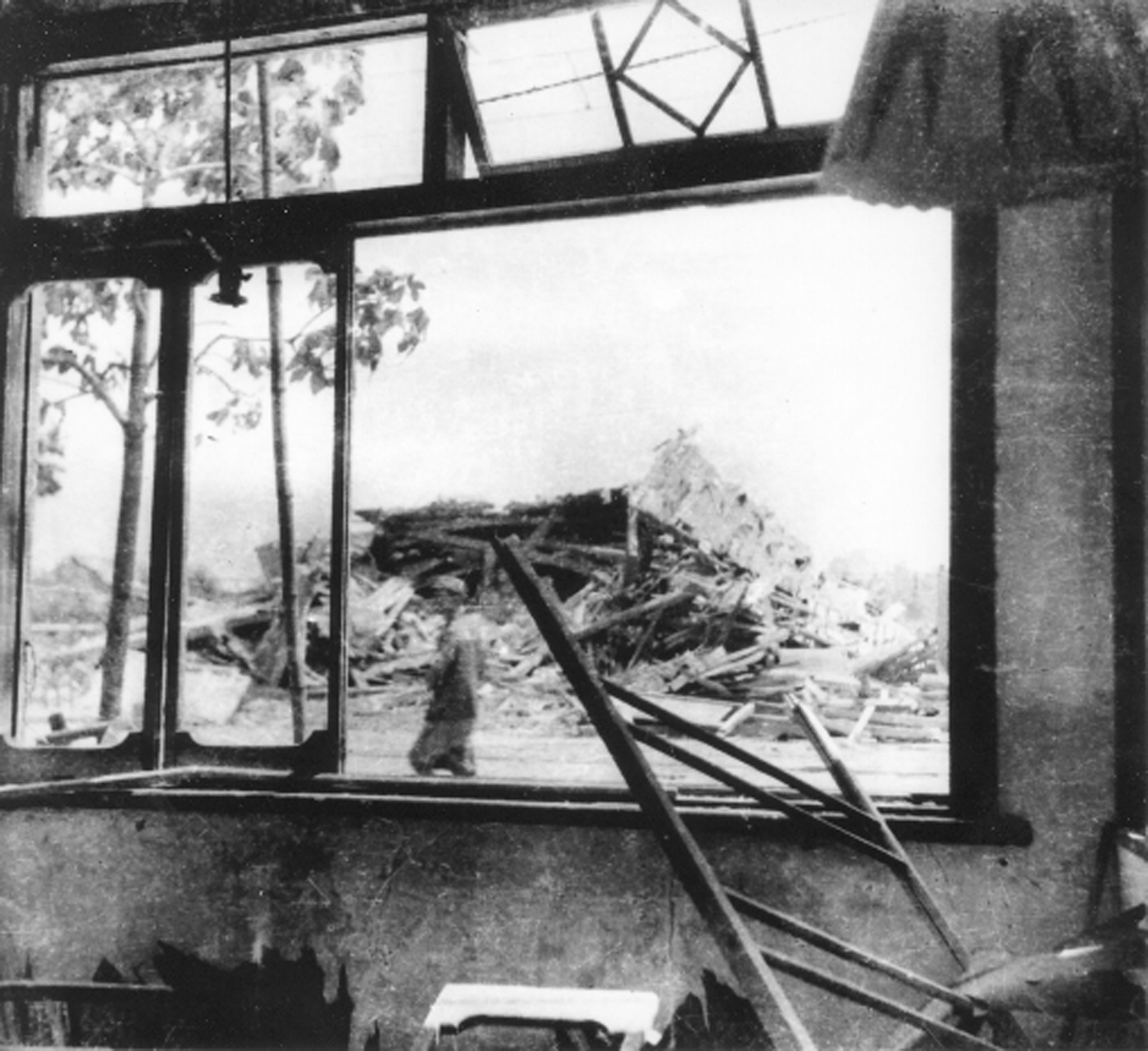
The view from the barber shop window, 2.7 kilometres from the hypocentre – the fourth photograph taken that day. A man walks past the wreckage of a two-story fire station that collapsed in the blast. Photo by Yoshito Matsushige, © Chugoku Shimbun.
Mr Yamamoto later described one of the last conversations he had with his son. “It was around 11 that night. ‘Is there really a Pure Land?’ My son asked this strange question, breathing faintly … ‘Is there jellied bean paste there?’ My wife finally choked out an answer. ‘Yes, there's jellied bean paste and everything there.’ Then he said, ‘Then I think I'll die.’”Footnote 6
Mr Yamamoto put his son's body in a handcart and carried him to the crematorium. The following day, 8 August, he went to work. He described his feelings at that time in the August 1965 edition of Shinju, an anthology of poetry he edited. “My son was dead, and I should have had no human will, but from that moment on I believed that the recovery of the Chugoku Shimbun was my duty, and I began to rouse myself.”Footnote 7
East End of Miyuki Bridge, 2.3 kilometres from the hypocentre. Tokuo Fujita, a police officer, writes out casualty certificates for survivors so they can receive rations of food and other provisions. The bandage on his head is for cuts he received from flying glass. Mr Fujita was at the Ujina Police Station, 4.7 kilometres from the hypocentre, at the time of the bombing. Photo by Yoshito Matsushige, © Chugoku Shimbun.
Employees were also stricken by the acute effects of radiation. Mr Yamamoto, who was manager of the paper's stenographic department, wrote:
After 20 days my hair began to fall out in the places where I had been burned … But I couldn't take a day off from our preparations to put out the paper, so I continued to make that long-distance round trip by bicycle with my white bandages on.Footnote 8
… Some of those who had been lucky enough to escape harm began to come back to work and then got leukemia and died. I was depressed and wondered if we'd really be able to put out the paper there.Footnote 9
Documenting Hiroshima after the mushroom cloud: The Hiroshima Peace Media Center
Over the years, many other reporters from our newspaper have written articles and taken photos in a long-standing effort to document what became of the city and its people under the bomb's mushroom cloud. At the time, the city had a population of about 350,000 people, around 140,000 of whom are believed to have died by the end of 1945.Footnote 10 Those who survived this fate still suffered the loss of loved ones, as well as feelings of guilt because they fled for their lives while leaving behind others who were calling for help. Many people later died from the after-effects of exposure to the radiation spewed out by the bomb; still others have faced a high risk of developing cancer even decades after the attack.Footnote 11
The suffering of the survivors, both physical and mental, will linger as long as they live. What happened on 6 August 1945 is not a thing of the past; seventy years later, the repercussions of that day continue to be felt. Today there are nearly 16,000 nuclear weapons on the earth.Footnote 12 Compared to the time of the Cold War, the number has been reduced significantly, but it is nonetheless enough to decimate the world many times over. Nuclear weapons are so inhumane that if a nuclear war were to break out, there would be no winners; there would be only the devastation of this planet and the extinction of humankind. Unless we work to realize a world without nuclear weapons or war, humanity will have no future because the possibility that nuclear weapons will be used will hang over our heads as long as these weapons exist. Should a nuclear war break out, humankind will face extinction and the future of our species will be lost. In other words, nuclear weapons and human beings cannot coexist. This is the message that the Chugoku Shimbun, together with the citizens of Hiroshima, has been conveying to the world.
However, a regional newspaper's influence extends only so far, and cannot move public opinion in Japan to the degree that the leading media outlets in Tokyo can. This challenge becomes even larger when seeking to convey our message to the wider world. As a newspaper company, reporting the news will always be our top priority. But as a newspaper based in a city that has suffered the consequences of the atomic bomb, the Chugoku Shimbun hopes to help the world understand the inhumanity of nuclear weapons through information and opinions on this subject, which can contribute to the realization of a world free of nuclear weapons.
In the past, the Chugoku Shimbun has made a number of efforts to communicate more widely. As one example, a feature series entitled “Exposure – Victims of Radiation Speak Out”, which ran from May 1989 through May 1990, reported on victims of radiation exposure at twenty-one locations in fifteen countries, including the former Soviet Union, Brazil, the United States, French Polynesia, India, Namibia and South Korea. This series, which was awarded the Japan Newspaper Publishers and Editors Association Award in 1990, was published in book form.Footnote 13 This effort naturally had its limits, however. The Chugoku Shimbun's reach could not extend to major bookstores in the United States.Footnote 14
The rise of the Internet has enabled the newspaper to more effectively reach audiences in Japan and overseas. In 2008, the Chugoku Shimbun established the Hiroshima Peace Media Center within the news and editorial department and launched a website dedicated to coverage of the atomic bombings, nuclear issues and peace issues.Footnote 15 The full range of articles, editorials and columns on these subjects that are written for the newspaper by our reporters and editorial writers are posted to this website. Some of this content is also translated into English so it can be accessed and read by non-Japanese speakers.
In 2014, one year before the 70th anniversary of the atomic bombings, the Hiroshima Peace Media Center website began offering content translated into Chinese, French and Russian, with the help of Hiroshima University and other supporters. This effort was made to commemorate the 70th anniversary of the atomic bombing, and the project will continue to be pursued. Although not as many articles have been translated into these languages as have been translated into English, some content from the newspaper is now conveyed to the world in a total of five languages. English, Chinese, French and Russian were chosen because these languages are spoken in the nuclear weapon States. Our hope is that the people living in the nations that speak these languages will learn what would happen to the people and cities under the mushroom cloud if nuclear weapons were used.
Toward a future without nuclear weapons
Currently, the Hiroshima Peace Media Center website contains more than 23,000 articles, which cover not only the damage caused by the atomic bombing and the current state of nuclear weapons in the world, but also issues involving nuclear energy, including the accident at the Fukushima No. 1 (Daiichi) nuclear power plant,Footnote 16 and the suffering that Japan inflicted on the people of other nations in the past.Footnote 17 Numerous photographs connected to the atomic bombing of Hiroshima are also featured, as well as articles contributed by experts on nuclear issues from around the world. To date, the website has been visited over a million times by people in 200 countries and regions. Nearly 10% of these visits are from outside Japan.
Another area of focus for the Chugoku Shimbun involves handing down the experiences of the atomic bombing to younger generations. Central to this effort are the newspaper's “junior writers”, students in Hiroshima between the sixth grade of elementary school and the third year of high school.Footnote 18 It is not unusual for Japanese newspapers to nurture student reporters, but the Chugoku Shimbun is apparently the only newspaper in Japan with student reporters who are focused on covering peace-related issues.
One of the key aspects of the junior writers' activities is the ongoing series “Survivors' Stories”.Footnote 19 Many of the survivors are part of the generation of grandparents of these young people, and their average age has now exceeded 80. The junior writers see themselves as the last generation able to listen directly to the first-hand accounts of the survivors. Their active involvement in this programme is heartening.
Another important part of their work is the series of one-page feature articles called “Peace Seeds”, which was introduced in 2015 and appears twice a month.Footnote 20 There are typically around forty-five junior writers, divided into five groups. Each group selects themes related in some way to the atomic bombing or peace, gathers information, and writes articles. This series has included such articles as “Hiroshima in 2045, 100 Years After the Atomic Bombing”,Footnote 21 “Peace Declarations Convey Desire and Determination for Nuclear Abolition”Footnote 22 and “Children in Conflict Areas Struggle to Live Normal, Peaceful Lives”.Footnote 23
Through their work, these young reporters are seeking to prevent the memories of the atomic bombing from fading. This distinctive effort has been positively received, and many notable figures have granted interviews to the junior writers, including United Nations (UN) Secretary-General Ban Ki-moon;Footnote 24 Yohei Kono, then speaker of the House of Representatives;Footnote 25 and Hayao Miyazaki, the well-known director of Japanese animation.Footnote 26
“Let's Learn about Hiroshima”, 2015, published by the Chugoku Shimbun in cooperation with the Hiroshima International Cultural Foundation. © Chugoku Shimbun.
In an effort to hand down the atomic bomb experience to the next generation, the Chugoku Shimbun has also been distributing “Let's Learn about Hiroshima”, a newspaper for peace studies programmes, at high schools and junior high schools. All junior high and high school students in Hiroshima Prefecture have received a copy of this newspaper each year since 2013. The newspaper features the accounts of atomic bomb survivors and basic information on the harm caused by the atomic bombing.
In 2015, the 70th anniversary of the atomic bombings and the end of World War II, the junior writers took on a number of challenging new tasks. Some took part in a study tour in Europe to learn about the Holocaust (Shoah) – the genocide of the Jewish people by Nazi Germany – and others travelled to New York to cover this year's Review Conference of the Nuclear Non-Proliferation Treaty (NPT), which takes place at UN headquarters once every five years.
On the study tour, eight students from Hiroshima visited Poland and the Netherlands in late March and learned about the Holocaust, which symbolizes, along with the atomic bombings, the horrors of World War II. They toured the site of the former Auschwitz concentration camp, where more than a million people were killed, and the secret annex where Anne Frank and her family hid from the Nazis. They listened to survivors of the Holocaust and exchanged views with local youth. The eight participants of the tour included six university students and two junior writers who are in high school. The university students were selected by five universities in the prefecture through a process of essays and interviews.
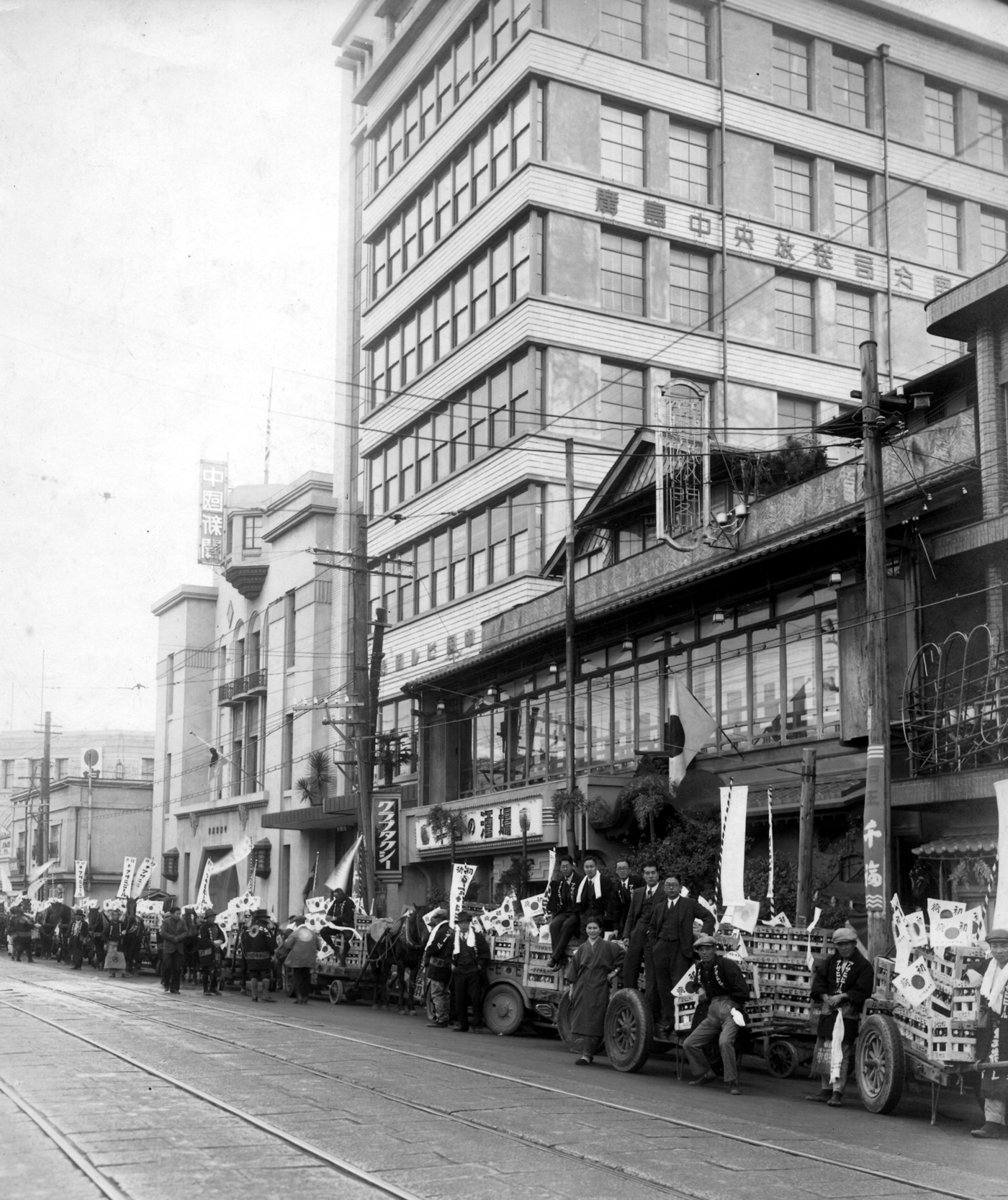
The offices of the Chugoku Shimbun before the atomic bombing. The three-storey main building, constructed with reinforced concrete, is on the left. To its right is the company's newer building, seven storeys tall. © Chugoku Shimbun, held by Takeyo Masui.
The participants engaged in discussion with young people in the countries they visited to learn how local youth are working to pass on memories of the Holocaust, and they sought to find common ground in their efforts to hand down history. At the end of May, the Japanese students reported on their experiences of the tour with public presentations. They summarized the lessons they learned by crafting the Hiroshima Youth Appeal 2015.Footnote 27
Two other junior writers were dispatched to New York to cover the 2015 NPT Review Conference. They reported on the conference proceedings as well as the activities undertaken by the Hiroshima city and prefectural governments.Footnote 28 They also interviewed Foreign Minister Fumio Kishida of Japan.Footnote 29 At the Youth Forum, which was organized by Mayors for Peace, they delivered a speech to the international community.Footnote 30 The membership of Mayors for Peace, for which Hiroshima Mayor Kazumi Matsui serves as president, now consists of more than 6,990 cities.Footnote 31
These were the first opportunities for junior writers to travel abroad to pursue their reporting. The two projects were organized so that young people in Hiroshima could take the opportunity presented by the 70th anniversary of the atomic bombings and the end of the war to think about their role and their responsibilities. People living in places that have experienced tragedy, like Hiroshima, tend to focus on their own suffering. As these young people deepened their knowledge of the tragedies that have taken place in other parts of the world, recognizing the suffering of other people and seeking to find commonality, they broadened their ability to express their views and hand down the memories of these events.
Communicating Hiroshima's message of nuclear abolition and world peace to other parts of Japan and other nations of the world is an effort to spread this appeal horizontally, around the world. At the same time, handing down the memories of the atomic bombing to the next generation is an effort to convey the past vertically, across time. Both efforts are an attempt to share the hope of the atomic bomb survivors that no other people on this planet should experience the same tragedy and endure the same suffering. For a regional newspaper, these are unique and ambitious pursuits.
A photograph of the Chugoku Shimbun's older building in the aftermath of the atomic bomb. The newer building is visible in the background. Photo by Stanley Troutman, © Chugoku Shimbun, held in the collection of the US Library of Congress.
A question often asked is: what makes the Chugoku Shimbun so earnest in these efforts? The answer is very simple: along with so many in Hiroshima, this newspaper company was hit hard by the atomic bombing. Our former headquarters was located about 900 metres to the east of the hypocentre, and 114 employees, or one third of our workforce at the time, lost their lives. The reporters who covered the news of the atomic bombing were, at the same time, survivors themselves.
Barbara Reynolds, an American peace activist and honorary citizen of Hiroshima, made great efforts to spread the wishes of Hiroshima across the world. She has said “I, too, am a hibakusha”,Footnote 32 and “The hibakusha are the inspiration for all my peace efforts. My heart is always with Hiroshima.”Footnote 33 The reporters of the Chugoku Shimbun wholeheartedly agree with Ms Reynolds that people who understand and strive to convey the survivors' message are hibakusha too, even if they or their parents or grandparents did not actually experience the atomic bombing.
Through listening to the experiences of the people who endured the terrible devastation on 6 August 1945, people come to understand how inhumane nuclear weapons are and begin to develop an awareness of themselves as hibakusha. The survivors see it as their responsibility, for the human race, to create a world free of nuclear arms and to put an end to the nuclear age that began in 1945. The spirit of Hiroshima awakens people to this responsibility.Footnote 34
Because of this responsibility, the staff of the Chugoku Shimbun newspaper can look out at the world “from under the mushroom cloud” and feel empathy for the survivors and citizens of Hiroshima. It is with this sense of honour and obligation that we have borne such weighty responsibility. The company motto, which includes “promoting world peace”, is taken to heart as our duty and our mission.
“Have the atomic bombs come to be known for their power, or for their human tragedy?”Footnote 35 We, the Chugoku Shimbun, ask the global community to consider this question by Toshihiro Kanai, who was a chief editorial writer for the newspaper from 1971 up to the time of his death in 1974. We must maintain our perspective as human beings, and should not merely view the aftermath of the atomic bombing from above the mushroom cloud or from a distance, which is the perspective of nations. This is the nature of the Chugoku Shimbun's stance in covering the atomic bombing, as well as nuclear issues and peace issues.
The efforts described above will be persistently pursued beyond the 70th anniversary of the atomic bombing. After the bombing, it was said that “nothing would grow in Hiroshima for 75 years”,Footnote 36 but the devastated land has been revived into a lush, green city by the citizens and supporters of Hiroshima. The Chugoku Shimbun, rooted right here, will continue its ongoing work to promote the abolition of nuclear weapons and lasting peace in the world.
The Hiroshima Peace Memorial Park in spring. On the left is the Atomic Bomb Dome; the Hiroshima Peace Memorial Museum is visible in the background. The white building in the upper right corner is the Chugoku Shimbun's headquarters. © Chugoku Shimbun.