


The 250th anniversary of 1776 returns the United States to a foundational democratic question: Democracy for whom? Who counts as the demos? By demos, I mean the political community recognized as legitimate members of the polity who share in governing power (Dahl Reference Dahl1989). A multiracial population does not automatically produce a multiracial demos. A multiracial democracy requires that racial groups share power, govern together, and take turns ruling rather than remaining fixed as permanent winners and permanent losers (Guinier Reference Guinier1994; Guinier and Torres Reference Guinier and Torres2002). The United States has been multiracial since its founding, yet it has never become a multiracial democracy. After 250 years of democratic development, including the expansion of suffrage, citizenship, and civil rights, why has the United States still not consolidated into a multiracial democracy?
The question is urgent because American democracy is eroding as the United States turns 250. Along three critical dimensions of democratic quality—electoral democracy (i.e., free and fair elections and basic political rights), liberal democracy (i.e., civil liberties and constraints on executive power), and participatory democracy (i.e., inclusion of citizens in political life beyond voting)—American democracy is in decline (Coppedge et al. Reference Coppedge, Gerring, Knutsen, Lindberg, Teorell, Altman and Bernhard2026). All three indices have fallen during the past decade, with the steepest declines in the past two years (figure 1). Freedom House (2026) documented the same trajectory, placing the United States among the democracies in steepest decline. The United States has undertaken two major reform efforts meant to provide a legal foundation for a multiracial democracy—the first during Reconstruction and the second through the Voting Rights Act of 1965 and the Immigration and Nationality Act of 1965 (also known as the Hart–Celler Act)—yet neither culminated in a multiracial democracy. To understand why, and to understand what is happening now, the answer begins at the founding.
The Trajectory of American Democracy, 1790–2025
Electoral, liberal, and participatory democracy indices for the United States, drawn from the V-Dem project (Coppedge et al. Reference Coppedge, Gerring, Knutsen, Lindberg, Teorell, Altman and Bernhard2026). Shaded bands mark Reconstruction (1865–1877), the Voting Rights Act of 1965 and the Hart–Celler Act, and the Trump era (2017–2021, 2025–present).

Figure 1 Long description
The x-axis represents the Year from 1790 to 2025. The y-axis represents the V-Dem index value from 0.0 to 1.0. Three lines track different metrics.
* Electoral democracy is a solid blue line.
* Liberal democracy is a dashed green line.
* Participatory democracy is a dash-dot purple line.
From 1790 to 1860, all three indices remain relatively flat and low, with Electoral democracy near 0.35, Liberal near 0.3, and Participatory near 0.2.
A light green shaded band from 1865 to 1877 is labeled Reconstruction Amendments. Following this, the lines show a significant step upward around 1900 and again in 1920.
A vertical green line and narrow shaded band around 1965 is labeled 1965 V R A and Hart-Celler. This marks a steep upward trajectory where Electoral democracy peaks near 0.9 around the year 2000, Liberal democracy peaks near 0.8, and Participatory democracy peaks near 0.6.
A final red shaded band from 2017 to 2021 and 2025 onward is labeled Trump demo. During this period, all three lines show a sharp downward dip, with Electoral democracy falling toward 0.8 and the others following a similar proportional decline.
Many scholars have examined the role of race in American political development. Smith (Reference Smith1997) brought competing ideological traditions to the forefront, showing that American political life has always blended liberal, republican, and inegalitarian ascriptive commitments rather than simply converging on a single liberal tradition. His account directly challenged the exceptionalist claim that the United States is inherently a liberal democracy and established competing ideological traditions as a central framework for understanding American political development. Smith and King (Reference Smith and King2024) argued that American politics is structured by rival racial-policy alliances, one protecting a traditionalist, predominantly white order and one seeking to repair systemic racism (King and Smith Reference King and Smith2005). Kendi (Reference Kendi2016) similarly traced the production of racist ideas from the colonial period forward, showing how claims of racial hierarchy developed alongside efforts to defend slavery, exclusion, and unequal power. Mills (Reference Mills1997) challenged social-contract theory at its foundation, arguing that the liberal contract, from its inception, has been a racial contract that grants full personhood and rights to whites and denies them to nonwhites. Rana (Reference Rana2010) focused on the constitutional order, interpreting the United States as a settler empire in which the self-rule of insiders was constitutionally bound to the subordination of enslaved people, Indigenous peoples, and other outsiders so that freedom and exclusion became two faces of the same political project. This article expands on this scholarship by treating racial exclusion as a question of regime type.
This article contends that the United States is a herrenvolk democracy,Footnote 1—a regime in which democracy is reserved for the herrenvolk, or master group (Beltrán Reference Beltrán2020; van den Berghe Reference van den Berghe1967). From this perspective, I show that racial exclusion is not a flaw, a contradiction, or an unfinished project toward a liberal democracy but instead a constitutive and predominant feature of the American political order. Through a historical analysis of the founding era, I demonstrate how the herrenvolk regime was formed deliberately and then trace how the current backsliding of American democracy reflects the regime’s resistance to power sharing across racial lines.
…racial exclusion is not a flaw, a contradiction, or an unfinished project toward a liberal democracy but instead a constitutive and predominant feature of the American political order.
HERRENVOLK DEMOCRACY AS A REGIME TYPE
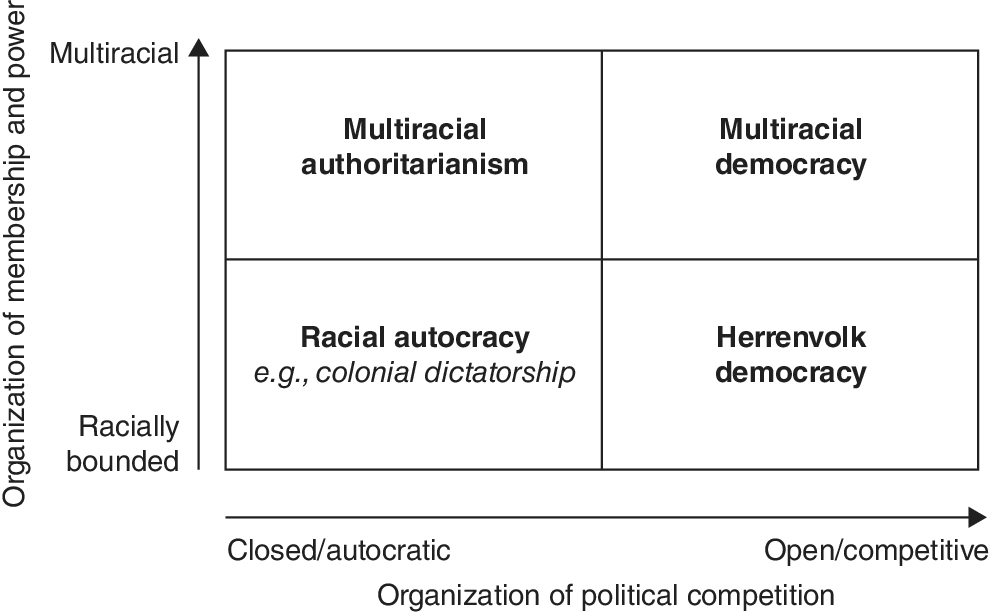
Herrenvolk democracy describes an order in which democracy is racially bounded, “democratic for the master race but tyrannical for the subordinate groups” (van den Berghe Reference van den Berghe1967, 18). The term is not a synonym for authoritarianism and does not describe the absence or failure of democratic institutions (figure 2). Elections, representation, a constitution, and the rule of law can coexist with racial exclusion by design when political membership and governing power are reserved for the dominant racial group (van den Berghe Reference van den Berghe1967, 29). The diagnostic feature is the restricted organization of membership and power, which may operate de jure, de facto, or through the interaction of both (van den Berghe Reference van den Berghe1967).
Elections, representation, a constitution, and the rule of law can coexist with racial exclusion by design when political membership and governing power are reserved for the dominant racial group.
A Typology of Regime Types by Political Competition and the Organization of Membership and Power

Figure 2 disaggregates political competition from political membership, demonstrating that a regime can be meaningfully democratic for a racially dominant group while organizing citizenship, belonging, and governing power through racial exclusion. This shift is important because classifications that conflate democracy with liberal democracy tend to treat racial exclusion as a contradiction, defect, or incomplete realization of democracy. Herrenvolk democracy, by contrast, identifies racial exclusion as constitutive of regimes where democracy is racially bounded.
THE FOUNDING OF HERRENVOLK DEMOCRACY
American herrenvolk democracy was built through founding choices that joined democratic institution building to racial boundary making. From colonial law to the Declaration of Independence, the Constitution, and the Naturalization Act of 1790, the emerging political order defined democracy through a racially bounded conception of membership and governing power.
Before 1776
During the seventeenth and eighteenth centuries, the American colonies progressively hardened racial boundaries into the legal architecture of the emerging political order. Africans had been trafficked into the colonies as enslaved people since the early seventeenth century, and racial slavery became central to the labor system on which the colonial economy depended. In the early decades, the line among enslaved Africans, indentured Europeans, and free Black people remained legally unsettled, and poor whites and enslaved Africans sometimes labored, lived, and resisted alongside one another. Bacon’s Rebellion in 1676, in which poor whites and enslaved Africans made common cause against the colonial elite, rendered the political stakes of that solidarity visible to the planter class and prompted a concerted legal effort throughout the colonies to draw a firmer racial line.
In the decades following Bacon’s Rebellion, colonial assemblies built a legal framework that tied slavery to race in perpetuity, distinguished racial slavery from indenture as permanent and inheritable, and placed free Black people outside of full legal standing while also extending privileges to poor whites that bound them more firmly to the racial order (Allen Reference Allen1994; Morgan Reference Morgan1975; Roediger Reference Roediger1991). Through successive statutes, the colonies attached slavery to maternal descent so that an enslaved mother’s child inherited her condition; prohibited interracial marriage; denied free Black people the right to testify against white people; restricted Black assembly and movement; and treated enslaved people as inheritable property. Virginia’s 1705 Act Concerning Servants and Slaves consolidated these statutes into a single code that made whiteness the condition of full legal standing and Blackness the condition of permanent subordination; Maryland, South Carolina, Massachusetts, New York, and other colonies built variations of the same framework (Berlin Reference Berlin1998; Harris Reference Harris2003; Higginbotham Reference Higginbotham1978; Morgan Reference Morgan1975; Warren Reference Warren2016; Wood Reference Wood1974). The codes did not invent racial hierarchy—they made it a legal boundary of political membership.
Taken together, these efforts policed relations among the groups and consolidated governing power in white hands. Colonial assemblies narrowed the rights of Black people, free and enslaved, across the seventeenth and eighteenth centuries while expanding the privileges of white people. They drew the line that determined who could own, vote, testify, gather, move freely, marry whom they chose, and pass legal standing to their children. By 1776, the demos that would claim independence had been forming for a century, and whiteness had become the threshold for inclusion in the political community.
The Declaration of Independence
The Declaration of Independence made the founding’s most powerful claim to popular sovereignty, grounding the new republic’s authority in the consent of the governed and asserting equality among men as a self-evident truth. The universal language was drawn from Enlightenment political theory, but that language did not create a universal political community. The political people declaring independence in 1776 were racially bounded, and the drafting history reveals that the founders had alternatives but chose not to make the Declaration a more inclusive text.
Jefferson’s original draft included a direct antislavery indictment, condemning the slave trade as a “cruel war against human nature” and naming the trade in enslaved Africans as a charge against the British Crown (Jefferson [1776] Reference Jefferson and Boyd1950, 243–47). The passage brought the contradiction between slavery and the Declaration’s universal claims into the text itself. Congress removed it. Jefferson attributed the removal to deference toward South Carolina and Georgia, although northern commercial interests in the slave trade also were implicated (Finkelman Reference Finkelman1996; Maier Reference Maier1997). The choice preserved slaveholding and commercial interests over the universal language that the Declaration advanced.
Indigenous peoples were treated with no such hesitation. The final text described Native nations as “merciless Indian Savages” whose “known rule of warfare is an undistinguished destruction of all ages, sexes and conditions.” This placed them outside of the political community and cast them as enemies rather than members of the republic (Declaration of Independence 1776; Parkinson Reference Parkinson2016; Rana Reference Rana2010). The universal language of the Declaration carried genuine democratic meaning, and abolitionists, Black petitioners, women’s rights advocates, and democratic reformers later claimed it as a resource for democratic struggle (Allen Reference Allen2014). In 1776, however, its realization was bounded by a racially restricted demos, produced through deliberate choices about whose interests would be protected and whose claims would be excluded.
The Constitution
The Constitution provided the herrenvolk order with an institutional form. The Convention faced a direct question: How to treat enslaved people? They could be counted as full persons with citizenship and the vote; they could be excluded from the count entirely; or they could be counted in a way that gave slaveholding states political power without extending membership to the enslaved themselves. Gouverneur Morris pressed the contradiction: “Are they men? Then make them citizens, and let them vote. Are they property? Why, then, is no other property included?” (Madison [1787] Reference Madison and Koch1987). The Convention rejected that challenge. The three-fifths formula counted each enslaved person as three-fifths of a person for apportionment, converting their subordination into inflated representational power for slaveholding states (US Constitution 1789, Article I, Section 2, Clause 3). Voting qualifications remained with the states; therefore, the clause by itself did not deny membership in the demos. Its significance was structural because it converted racial subordination into national political power, which gave slaveholding states amplified representation without extending membership to the enslaved people themselves.
The Convention extended the same logic to other protections for slavery. John Rutledge stated the rationale openly: “[I]nterest alone is the governing principle with nations” (Madison [1787] Reference Madison and Koch1987). The Slave Trade Clause protected the importation of enslaved Africans for 20 years as a compromise to keep slaveholding states in the union (US Constitution 1789, Article I, Section 9, Clause 1). The Fugitive Slave Clause extended slaveholders’ property claims into free states by requiring their participation in the return of those slaves who had escaped (US Constitution 1789, Article IV, Section 2, Clause 3).
Indigenous peoples were excluded through a different logic. Native nations were placed outside of the constitutional people and treated as external political communities subject to federal management rather than as members of the demos. The Constitution excluded “Indians not taxed” from apportionment and placed “Indian Tribes” alongside foreign nations in the Commerce Clause (US Constitution 1789, Article I, Section 2; and Article I, Section 8, Clause 3) (Rana Reference Rana2010). The Dred Scott case later would give judicial expression to the same theory by ruling that Black people could be placed outside of the political community whose Constitution claimed democratic authority (Dred Scott v. Sandford 1857). The Constitution did not simply accommodate an existing racial order. It translated that order into national governing power through choices about who would be counted, who would be excluded, and whose interests the new federal government would protect.
The Naturalization Act of 1790
If the Declaration of Independence was written in universal terms and the Constitution gave racial hierarchy governing form, the Naturalization Act of 1790 made the racial boundary of national membership explicit in federal law. Passed by the First Congress and signed by George Washington, the statute limited naturalization to “free white persons,” making whiteness a formal condition of entry into the political community (Haney López Reference Haney López1996; Kettner Reference Kettner1978; Naturalization Act of 1790). The Act did not define every form of citizenship and it did not govern those whose membership derived from birth, state law, or other legal sources. It stated who could become an American through naturalization, and it did so in explicitly racial terms, as shown in figure 3.
The Naturalization Bill of 1790 and the Racial Boundary of Naturalized Citizenship
Source: A Bill to Establish an Uniform Rule of Naturalization, and to Enable Aliens to Hold Lands under Certain Restrictions (US Laws, Statutes, Etc. 1790). The bill limited admission to “any alien, being a free white person”—language that became the racial foundation of the first federal naturalization rule.

Figure 3 Long description
The document is divided into two main sections.
Top section: A printed legislative bill titled A B I L L to establish an uniform Rule of Naturalization, and to enable Aliens to hold Lands under certain Restrictions. The text begins with Sect. 1st B E I T E N A C T E D by the Senate and House of Representatives of the U N I T E D S T A T E S of America in Congress assembled. It specifies that any alien, being a free white person, who has resided within the U S for two years may be admitted to citizenship. It includes provisions for children of naturalized persons and restrictions for those whose fathers never resided in the U S. The typography uses the archaic long s which resembles an f.
Middle section: A small printed line in brackets reads [N E W - Y O R K, P R I N T E D B Y T H O M A S G R E E N L E A F.]
Bottom section: A cursive, handwritten transcription of the bill's primary clause. The handwriting is in dark ink on the aged, yellowed paper, mirroring the language of the printed section regarding the requirements for a free white person of good character to take an oath to support the Constitution.
What is most revealing is not only the restriction itself but also how little dispute surrounded it. Members of the First Congress debated residency requirements and standards of character, but the limitation to “free white persons” passed without meaningful objection (Kettner Reference Kettner1978). That silence, however, does not mean that race was incidental. It suggests that among federal lawmakers, the racial boundary of national membership already was treated as settled. By 1790, the same generation that had declared independence and framed the Constitution had written into federal law what the preceding century had established in practice. Colonial law had constructed racial categories of freedom and domination. The Declaration had announced popular sovereignty through a bounded political people. The Constitution had translated racial domination into governing power. The Naturalization Act of 1790 then codified whiteness as a condition of formal entry into the republic. Taken together, these four actions comprise what I define as the founding of herrenvolk democracy.
250 YEARS LATER
The United States has developed democratic institutions for 250 years, but it has not become a multiracial democracy. The boundaries of formal membership have widened through suffrage, citizenship, and civil rights. Yet, formal membership has not translated into equal access to governing power. American democracy repeatedly has expanded in form without producing shared rule.
This pattern is visible throughout the historical record. Reconstruction opened the possibility of multiracial democracy, but that possibility was violently and legally foreclosed (Du Bois Reference Du Bois1935; Hooker Reference Hooker2017). In 1965, the Voting Rights Act and the Hart–Celler Act reopened the democratic project by expanding political participation and transforming the boundaries of national belonging. Today, that opening is narrowing once again. Figure 1 traces this trajectory across the Varieties of Democracy (V-Dem) indices (Grijalva Reference Grijalva2026). The current decline is the steepest in the series. In 2026, the Varieties of Democracy Institute reported that the United States had lost its long-term status as a liberal democracy for the first time in more than 50 years and described the 2025 decline as the largest one-year decline in American history (Nord et al. Reference Nord, Altman, Fernandes, God and Lindberg2026). This is democratic backsliding, but its source is not simply institutional dysfunction (Levitsky and Ziblatt Reference Levitsky and Ziblatt2018). Instead, it reflects the continued maintenance of a herrenvolk regime—a racialized political order that resists multiracial power sharing. That resistance operates across three domains: belonging, representation, and coercive power.
Belonging remains a central site where the racial boundary of American democracy is maintained. Two hundred and fifty years after Independence, the question of who counts as part of the constitutional people continues to be reopened through law, executive action, and enforcement. The attack on birthright citizenship makes that boundary visible because it targets membership at birth and makes citizenship vulnerable to political revision (Trump v. CASA, Inc. 2025; White House 2025a). The same boundary appears in the restriction of entry from selected African and Muslim-majority countries, the termination of Haiti’s Temporary Protected Status, the preferential pathway for white Afrikaners, and the renewed pursuit of denaturalization (US Department of Homeland Security 2025; US Department of Justice 2025; White House 2025b, 2025c). These actions mark racialized communities as conditional members or outsiders while treating whiteness as a privileged claim to national belonging. In Noem v. Vasquez Perdomo (2025), that logic appeared in everyday enforcement. Justice Sotomayor’s dissent warned that the Supreme Court had allowed a country where the government can seize anyone who “looks Latino, speaks Spanish, and appears to work a low wage job.” The boundaries of the demos are being defined through law, official rhetoric, and racialized enforcement.
Representation was the central promise of the 1965 democratic opening. The Voting Rights Act of 1965 responded to the collapse of Reconstruction and the long Jim Crow assault on Black political participation by turning formal citizenship into enforceable political power. Since 2013, the Supreme Court has preserved the language of voting rights while stripping away the tools that made those rights enforceable. Shelby County v. Holder (2013) disabled preclearance and the state-level consequences were immediate. Texas moved to implement its voter ID law within hours and North Carolina enacted restrictions subsequently struck down for targeting Black voters with “almost surgical precision.” States continued to adopt restrictive voting laws after the federal check was removed (Brennan Center 2023; North Carolina State Conference of the NAACP v. McCrory 2016; Shelby County v. Holder 2013). Louisiana v. Callais (2026) went further. After argument and re-argument, the Court treated Louisiana’s second majority-Black district as an unconstitutional racial gerrymander and narrowed Section 2 as a remedy for racial vote dilution (Louisiana v. Callais 2026). Justice Kagan’s dissent called the decision part of the Court’s “now-completed demolition of the Voting Rights Act” and warned that Section 2 had become “all but a dead letter” (Louisiana v. Callais 2026). The consequences were immediate. Louisiana suspended its congressional primaries in response to the ruling; Alabama was permitted to proceed without the two largely Black congressional districts required by the lower-court order; and Tennessee called a special session to review its congressional map (Associated Press 2026a; Landry Reference Landry2026; Lee Reference Lee2026). What remains is the formal language of voting equality without the legal machinery that made multiracial representation enforceable.
Coercive power is the domain in which racial boundaries are made enforceable and where the consolidation of power becomes possible. It appears in the expansion of executive authority, the weakening of legal accountability, and the use of federal force against communities already marked as outside of the demos. In Trump v. United States (2024), the Supreme Court placed core presidential powers beyond criminal prosecution and gave presumptive immunity to official acts, widening the space in which presidential power can operate without ordinary legal constraint. The Trump administration has pressed that power through emergency immigration authority, removals under the Alien Enemies Act, resistance to judicial limits, and the deployment of federalized troops and Marines around immigration enforcement (A.A.R.P. v. Trump 2025; Newsom v. Trump 2025; White House 2025d). The same coercive logic appears in the normalization of force within immigration enforcement, including cases in which US citizens were killed by federal immigration officers (Associated Press 2026b; CBS News 2026). In this sense, coercive power does not only enforce exclusion after the fact; it also helps to secure the conditions under which power can be consolidated and insulated from democratic challenge. Belonging, representation, and coercive power therefore point to the same conclusion. The United States is not simply experiencing democratic decline; it is confronting the unresolved herrenvolk structure of its democracy.
HERRENVOLK DEMOCRACY AND THE GLOBAL DEMOCRATIC CRISIS
The contested legacy of 1776 is that American independence showed how liberty, popular sovereignty, and self-government could be organized through racial exclusion. The universal language of the Declaration of Independence traveled widely and became a resource for abolitionists, anticolonial movements, civil-rights struggles, and democratic reformers (Allen Reference Allen2014; Armitage Reference Armitage2007). However, the regime built around that language also traveled. It showed that democratic ideals could coexist with racial domination when membership and governing power were reserved for a racially bounded people. That double inheritance is the central legacy of 1776. The Declaration of Independence gave the world a language of democratic possibility, and the founding provided a template for how democratic institutions could coexist with racial exclusion (Mills Reference Mills1997; Rana Reference Rana2010; van den Berghe Reference van den Berghe1967).
That legacy matters globally because the United States is not as exceptional as its democratic mythology often has claimed. Other democracies now confront similar struggles over migration, racial and ethnic pluralism, religious nationalism, and the incorporation of groups long treated as outsiders. The American case is a warning about how durable exclusionary democracy can become once racialized membership and unequal power are built into institutions, political identity, and law. The warning is sharper now because the United States is revealing what the late stage of an unresolved herrenvolk order looks like, with democratic erosion accelerating, institutional norms straining, and the political community fragmenting along the racial lines that the founding established.
The American case is a warning about how durable exclusionary democracy can become once racialized membership and unequal power are built into institutions, political identity, and law.
Herrenvolk democracy provides a language for that durability. It shows why elections, constitutional forms, and formal rights are not enough to secure multiracial democracy when governing power remains organized around exclusion. Democracy for whom is not a rhetorical question; it is the question that determines whether democracy means shared rule among plural groups or rule by a bounded people willing to weaken democracy rather than share power within it. Two hundred and fifty years after Independence, this is the legacy that the United States carries into the global democratic crisis. Moreover, the failure to resolve it is producing the strain on American democracy that is visible in the present moment.
ACKNOWLEDGMENTS
I thank the editors and two anonymous reviewers for their thoughtful and constructive feedback. I also thank the Multiracial Democracy Working Group, convened under the Notre Dame Democracy Initiative, for workshopping an earlier version of this article.
DATA AVAILABILITY STATEMENT
Research documentation and data that support the findings of this study are openly available at the PS: Political Science & Politics Harvard Dataverse at https://doi.org/10.7910/DVN/LBHL4F.
CONFLICTS OF INTEREST
The author declares that there are no ethical issues or conflicts of interest in this research.



 Open access

