Introduction
There is a need to identify different sources of phenotypic variation to manage or control them in agricultural research. Those sources of variation may be of genetic or environmental nature. Statistical models identify the factors and their contribution that explain the variation of phenotypes of interest. In genetic evaluations (GE) to predict animals' breeding values, the contemporary (herd-mate) comparison was proposed to allow more accurate accounting for environmental factors. Such contemporary comparisons represented a considerable increase in the accuracy of GE because of their ability to account for the specific management and environmental conditions affecting phenotypes (Robertson et al., Reference Robertson, Stewart and Ashton1956; Weigel et al., Reference Weigel, VanRaden, Norman and Grosu2017). A critical consideration in designing contemporary groups (CG) was the balance between a precise definition of the animal's environmental conditions and the need for enough herd-mates to provide an accurate estimate of the CG effect (Weigel et al., Reference Weigel, VanRaden, Norman and Grosu2017).
GE of beef cattle for traits of economic importance, such as birth, weaning and yearling weights, considers the CG as a fixed effect. A common technical definition of a CG is the group of animals born within the same year and season, raised in the same herd, of the same sex, and managed alike from birth until the time of measurement.
In México, national GE of Braunvieh's growth traits have been performed every year starting in 2003, determining that the best alternative of CG definition was the inclusion as a fixed effect in the model, considering dry and rainy seasons according to the data of rainfall distribution over the years, recorded in the meteorological stations closest to each herd (Ramírez Valverde et al., Reference Ramírez-Valverde, Núñez-Domínguez, Ruíz-Flores, García-Muñiz and Magaña-Valencia2008). Currently, Mexican Braunvieh cattle breeders perform GE for live-weight traits (Núñez et al., Reference Núñez, Ramírez, García, Larios and Hidalgo2021) using rain season criterion (RC) in the CG definition (herd, and year-season of birth). However, the search of the most convenient criteria to define the specific seasons required the exploration of different options, considering astronomical or meteorological conventionally seasons among other criteria (Herrera-Ojeda et al., Reference Herrera-Ojeda, Parra-Bracamonte, Herrera-Camacho, López-Villalobos, Magaña-Monforte, Martínez-González and Vázquez-Armijo2018a), as descriptors of environmental factors under extensive ranch conditions, specifically related to pluvial precipitation and feed availability.
Herrera-Ojeda et al. (Reference Herrera-Ojeda, Parra-Bracamonte, Herrera-Camacho, López-Villalobos, Magaña-Monforte, Martínez-González and Vázquez-Armijo2018a, Reference Herrera-Ojeda, Parra-Bracamonte, López-Villalobos, Vázquez-Armijo, Orozco-Durán, Magaña-Monforte and Jahuey-Martínez2018b) proposed the use of the aridity index (AI), based on Food and Agriculture Organization of the United Nations (FAO's) scale (Middleton and Thomas, Reference Middleton and Thomas1992; Spinoni et al., Reference Spinoni, Vogt, Naumann, Carrao and Barbosa2015) to define CG for GE of productive traits and comparing them to astronomical seasons usually used by some breeds associations in their season classifications. They found significant differences in explaining phenotypic variability and changes in estimated parameter and predicted genetic values, suggesting improvement of fitting models and predictions. A central implication of this approach is the recalibration of evapotranspiration suggested by Lobit et al. (Reference Lobit, Gómez, Bautista and Lhome2018) used in estimating the AI, considering the direct effects of solar radiation and temperatures. However, these assessments considered small data sets for the evaluation and comparison of season definition and their effects on estimating genetic parameters and breeding values for live-weight traits in Charolais cattle.
The Mexican Braunvieh Cattle Association runs a GE for live-weight traits on a yearly basis using a much larger data set than the data set of Charolais cattle (Herrera-Ojeda et al., Reference Herrera-Ojeda, Parra-Bracamonte, Herrera-Camacho, López-Villalobos, Magaña-Monforte, Martínez-González and Vázquez-Armijo2018a, Reference Herrera-Ojeda, Parra-Bracamonte, López-Villalobos, Vázquez-Armijo, Orozco-Durán, Magaña-Monforte and Jahuey-Martínez2018b). The definition of CG for the Braunvieh cattle considers the rainy season definition; therefore, the objective of this study was to evaluate the effect of incorporating AI in the definition of CG for the GE of Braunvieh's live-weight traits.
Materials and methods
For comparing season definition on GE of live-weight models, a data set of Mexican Braunvieh cattle was used. The data set included animal, sire, dam, sex, herd, date of birth, date of weaning, age of dam and Braunvieh purity percentage, birth weight (BW, n = 32 777) and weaning weight (WW, n = 22 448). BW was recorded within the first week of birth with a roman weight scale, and WW was recorded from 195 to 285 days among the different herds included in data set using chute weight scales, henceforth adjusted to WW at 240 days.
The month of birth and weaning information was used to classify the season using the RC and AI criteria. Pedigree data included 46 233 animals, born from 2001 to 2015; with 491 inbred animals with average inbreeding coefficient of 0.15. Number of sires was 1433 with an average of 22.3 progeny per sire. Number of dams was 16 832 with an average of 1.9 progeny per dam. The pedigree file covered approximately six generations.
Aridity index and rain season classifications
Definition of CG using the RC criterion considered the average of pluvial precipitation of the herd site and considering only rainy and dry categories to classify each month-season according to their weather classification (Magaña and Segura, Reference Magaña and Segura1997; Rivera et al., Reference Rivera, Ramírez, Moncada and Trujillo2013; Nuñez et al., Reference Núñez, Ramírez, García, Larios and Hidalgo2021). The RC criterion is currently used for national GE of Braunvieh cattle (Nuñez et al., Reference Núñez, Ramírez, García, Larios and Hidalgo2021).
In the other hand, a new approach based on an AI estimates, was used to classify season for inclusion into contemporary grouping for BW and WW dates based on herd localization using Pro.Clima V.1.0 App (Parra et al., Reference Parra, Ortiz, Herrera and Vega2020). This approach is described as follows:
Climatological information from the historical data bank of the National Water Commission (Comisión Nacional del Agua, by its Spanish letters) was extracted by the daily information quick extractor (ERICIII) and adapted to an R script for further analysis (R Core Team, 2018).
Meteorological data from 4500 weather stations from 1985 to 2015 were extracted, including daily rain, temperatures (minimum, maximum and means), solar radiation, relative humidity and wind velocity records. The information included all meteorological stations from Mexico. The evapotranspiration (ETo) was estimated and recalibrated by the formula suggested by Lobit et al. (Reference Lobit, Gómez, Bautista and Lhome2018), which was based on the Penman–Monteith method as follows:

where Ra = solar radiation, Tmax = maximum temperature, Tmin = minimum temperature.
After the ETo recalibration, the AI was calculated for each day and meteorological station according to the formula proposed by Middleton and Thomas (Reference Middleton and Thomas1992) and Spinoni et al. (Reference Spinoni, Vogt, Naumann, Carrao and Barbosa2015) as follows:

where AI = aridity index, P = daily pluvial precipitation and ETo = recalibrated ETo, for i = 1 to the mth day of the month.
Posteriorly, average estimates by month were used to classify each season in four categories suggested by Middleton and Thomas (Reference Middleton and Thomas1992), 0–0.20 = arid, 0.21–0.50 = semiarid, 0.51–0.65 = subhumid and > 0.65 = humid.
Model comparisons
Two approaches were used to compare the effect of season classification for the definition of CG. First, four linear mixed models were fitted, one for each trait studied (BW; WW). Models included the fixed effects of herd, year, sex and season, the linear and quadratic covariate effect of dam age, the linear covariate effect of Braunvieh purity percentage and the random effects of sire and dam. The only difference between the two models was the classification of the season according to the RC and AI criteria. The solutions of the mixed-model equations were obtained using maximum likelihood, as implemented in the MIXED procedure of the SAS package version 9.1 (SAS Institute Inc., Cary, NC, USA). The goodness of fit measures of the models was evaluated through: −2LogL (log-likelihood), AIC (Akaike information criterion; Akaike, Reference Akaike1973), corrected AIC and BIC (Bayesian information criterion; Schwarz, Reference Schwarz1978). The AIC and BIC goodness of fit measures were estimated as follows: AIC = −2LogL + 2k, and BIC = −2LogL + Log(n) × k, where LogL is the log-likelihood estimated from each assessed genetic model, k is the number of parameters (Akaike, Reference Akaike1973) and n is the number of records. The lower these statistics the better the models.
The second approach considered fitting a bivariate model including the season classifications into the CG herd-year-season structure, this structure was selected considering the current structure of GE for Braunvieh cattle in Mexico. The bivariate animal model used a pedigree size of 46 233 animals and included the random effects of sire and dam and covariance between them. For each model, fixed effects of CG (herd-year-season) and sex, the linear and quadratic covariate effect of dam age, and the linear covariate effect of purity percentage were included. These analyses were carried out using the software MTDFREML (Van Vleck and Boldman, Reference Van Vleck and Boldman1993).
Since the difference among models was the RC and AI in the CG structure, and the number of parameters for each model was the same, an exploratory comparison between models was considered using, −2LogL and computing AIC and BIC goodness of fit measures, to choose best model as previously described.
Estimates of (co)variance components, direct and maternal heritabilities, the genetic correlation between direct and maternal genetic effects, and environmental proportion effects were computed. Genetic correlations between direct and maternal effects for both traits were also estimated.
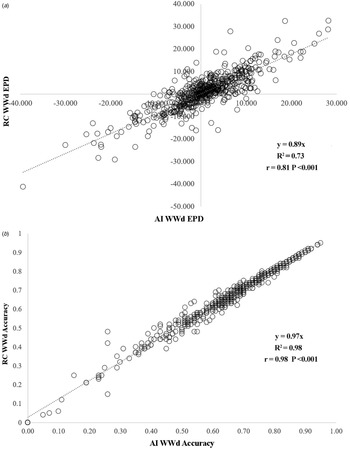
The effect of criteria to define season on the GE was evaluated on the changes of expected progeny differences (EPD), accuracies (ACC) and prediction error variances (PEV) for BW and WW of the top 10% animals selected based on EPD for WW. A paired t test analysis was performed between EPD, ACC and PEV of both models, considering the 10% top animals selected independently by WW direct (WWd) EPD or ACC, using the TTEST procedure of SAS version 9.1 (SAS, 2017). Finally, the regression of WWd EPD and ACC from those sires with more than 15 offspring was fitted to graphically illustrate those changes.
Results
Table 1 shows the goodness of fit of the models for the analysis of variance of BW and WW considering CG with the season defined according to RC or AI. The models with CG based on the AI had lower best-fitting values than those based on season classified according to RC for both traits. Classified of season according to RC had no significant effect on BW. In contrast, classification of season according to the AI had a significant effect (P < 0.001) on BW. Season effects for WW were significant regardless of classification criteria.
Goodness of fit measures for mixed models used for the analysis of variance of birth (BW) and weaning weight (WW) in Braunvieh cattle classifying season according to a rainy season criterion (RC) and an aridity index (AI)

−2LogL, log-likelihood; AIC, Akaike information criterion; AICC, corrected Akaike information criterion; BIC, Bayesian information criterion; BW, birth weight; WW, weaning weight at 240 days.
Table 2 presents the estimates of variance components obtained by the bivariate models using two different criteria to classify season. The bivariate model-fitting CG with season defined according to the AI had lower −2LogL, AIC and BIC values than the bivariate model-fitting CG with season defined according to the RC; however, the estimates of variance components and genetic parameters obtained by the two models were similar. Some differences were distinguishable between genetic correlations (Table 3) estimated by the two bivariate models.
Variance components and genetic parameters obtained from bivariate analysis for birth (BW) and weaning weight (WW) in Braunvieh cattle using different criteria to classify season for the definition of contemporary groups

−2LogL, log-likelihood; AIC, Akaike information criterion; AICC, corrected Akaike information criterion; BIC, Bayesian information criterion.
a $\sigma _{\rm a}^2$ = direct genetic variance, $\sigma _{\rm m}^2$
 = maternal genetic variance, σ dm = direct and maternal genetic covariance, $\sigma _{\rm c}^2$
 = maternal permanent variance, $\sigma _{\rm e}^2$
 = environmental variance, $\sigma _{\rm p}^2$
 = phenotypic variance, h 2 = direct heritability, m 2 = maternal heritability, r dm = direct-maternal genetic correlation, e 2 = proportion of environmental variance relative to phenotypic variance.
Genetic correlations between direct (d) and maternal (m) genetic effects for birth (BW) and weaning (WW) weight in Braunvieh cattle obtained with a bivariate model using different criteria to classify season for the definition of contemporary groups

Above diagonal: genetic correlations estimated with the model that classified season according to rain criterion. Below diagonal: genetic correlations estimated with the model that classified season according to the aridity index.
Some differences in EPD were the most evident for WW between the criteria to define the season, showing possible re-ranking among the top 10% of selected animals (Table 4). With the exception of WWd comparison when the selection criterion was accuracy, all paired t test comparisons were highly significant (Table 5).
Mean ± standard deviation, of expected progeny differences, predicted error variance and accuracies between same traits of the top 10% animals selected based on direct expected progeny difference for weaning weight in Braunvieh cattle using mixed linear models that included contemporary group with season classified according to a rainy season criterion (RC) and an aridity index (AI)

EPD, expected progeny differences; ACC, accuracy; PEV, prediction error variance; BW, birth weight; WW, weaning weight at 240 days.
Estimates in the column with subscript RC were obtained with the model that classified season according to rain criterion. Estimates in the column with subscript AI were obtained with the model that classified season according to the aridity index.
P values of paired t tests between expected progeny differences, predicted error variance and accuracies for birth (BW) and weaning weight (WW) obtained with mixed-models fitting contemporary group with season defined using different criteria, in top 10% Braunvieh cattle selected by WWd expected progeny differences and accuracies

EPD, expected progeny differences; ACC, accuracy; PEV, prediction error variance; BW, birth weight; WW, weaning weight at 240 days.
Estimates in the column with subscript RC were obtained with the model that classified season according to rain criterion. Estimates in the column with subscript AI were obtained with the model that classified season according to an aridity index.
Figure 1 shows the correlation between WWd EPD and WWd accuracies for sires with more 15 progeny obtained from the mixed models fitting CG with season defined using different criteria. The rank-correlation between EPDs was 0.81 and the correlation between accuracies was 0.98. A paired t test indicated significant differences between models except for direct BW EPDs (Table 5).
Correlation between weaning weight direct expected progeny difference (WWd EPD) (panel a) and accuracies (panel b) obtained with mixed models fitting contemporary group with season defined using different criteria, in Braunvieh cattle. Estimates in y-axis with subscript RC were obtained with the model that classified season according to rain criterion, and estimates in the x-axis with subscript AI were obtained with the model that classified season according to an aridity index.

Discussion
This study evaluated the potential use of an AI to classify season and its implications on the GE of Braunvieh cattle. Herrera-Ojeda et al. (Reference Herrera-Ojeda, Parra-Bracamonte, Herrera-Camacho, López-Villalobos, Magaña-Monforte, Martínez-González and Vázquez-Armijo2018a) compared AI season with astronomical season classification, conventionally used to classify season of birth. They used a small data set of Charolais cattle fitting univariate animal models for BW and WW traits. They found large effects on estimating genetic parameters and re-ranking animals based on their EPDs, with a considerable effect of AI explaining the phenotypic variance. Similarly, Herrera-Ojeda et al. (Reference Herrera-Ojeda, Parra-Bracamonte, López-Villalobos, Vázquez-Armijo, Orozco-Durán, Magaña-Monforte and Jahuey-Martínez2018b) used a slightly greater data set and also fitted appropriate univariate animal models for live weight traits in Charolais cattle. They found that mixed models including CG with season defined using an AI produced better goodness of fit measures compared to mixed models that included CG with season defined using RC, with no differences in genetic parameter estimates but significant differences in re-ranking animals in both BW and WW traits. They concluded that the definition of season to build contemporary grouping can produce re-ranking of animals hence possible biases when selecting animals. Additionally, this might have economic implications in the case of underestimating or overestimating breeding values.
The size of the data set used in the current study was greater than the data set used by Herrera-Ojeda et al. (Reference Herrera-Ojeda, Parra-Bracamonte, López-Villalobos, Vázquez-Armijo, Orozco-Durán, Magaña-Monforte and Jahuey-Martínez2018b) showing that the use of the AI allows a better model fitting for live weight traits than the season classification based on RC according to the goodness of fit measures. Nevertheless, genetic parameters did not show as larger differences as those reported by Herrera-Ojeda et al. (Reference Herrera-Ojeda, Parra-Bracamonte, Herrera-Camacho, López-Villalobos, Magaña-Monforte, Martínez-González and Vázquez-Armijo2018a, Reference Herrera-Ojeda, Parra-Bracamonte, López-Villalobos, Vázquez-Armijo, Orozco-Durán, Magaña-Monforte and Jahuey-Martínez2018b), statistical paired t test suggested significant differences possibly attributed to changes in CG structure and connectedness among them, producing changes in ranking of animals (Fig. 1(a)), but not perceptible by average comparisons of predictions. Furthermore, it is possible that the use of rainy season classification by RC captures importantly seasonal variation, that in the case of highly heritable traits do not yield large differences, as showed by comparison with astronomical season classifications observed in Herrera-Ojeda et al. (Reference Herrera-Ojeda, Parra-Bracamonte, Herrera-Camacho, López-Villalobos, Magaña-Monforte, Martínez-González and Vázquez-Armijo2018a, Reference Herrera-Ojeda, Parra-Bracamonte, López-Villalobos, Vázquez-Armijo, Orozco-Durán, Magaña-Monforte and Jahuey-Martínez2018b). Nonetheless, the graphical illustration of correlation between WWd EPDs obtained by the two models (Fig. 1(a)) confirmed a degree of re-ranking of sires genetic values, more evident given the number of progeny of animals included in this specific analysis with a correlation between predictions of 0.80, evidently suggesting a degree of genetic×environment interaction as pointed out by the classic paper by Robertson (Reference Robertson1959).
Nuñez et al. (Reference Núñez, Ramírez, García, Larios and Hidalgo2021) used the rainy season classification of the birth season to define CG in the GE of Braunvieh cattle. Most production systems are based on extensive management influenced by feed availability of the temporal rainy season. Henceforth, evapotranspiration could better indicate humidity and grass availability (Pereira, Reference Pereira2005). Moreover, the AI is a numeric indicator that measures the long-term hydric deficit (Cherlet et al., Reference Cherlet, Hutchinson, Reynolds, Hill, Sommer and von Maltitz2018). Further assessment in traits that are more environmentally affected (e.g. reproductive traits) would be required to support the benefit of using the AI as found here.
Under the present and future influence of climate change, constant environmental influences must be considered to describe its punctual effect on important traits of extensively managed livestock and crops (Greve et al., Reference Greve, Roderick, Ukkola and Wada2019). The AI might be estimated on a daily scale for precision estimation in longitudinal traits where the information is available. Under an international scenario of GE, where fixed effects include the month or season factors, this strategy would represent a better definition of season across the country.
The calculation of the AI has been implemented for Mexico's conditions by an open access app called Pro.Clima (Parra et al., Reference Parra, Ortiz, Herrera and Vega2020, https://www.cbg.ipn.mx/servicios.html) to estimate seasonal months in the whole Mexico territory based on the AI parameter. Further analysis with other production and reproduction traits would demonstrate the extended utility of AI indicators to be considered in the GE of animals under a climatic change environment.
As a conclusive perspective, using this approach attempts to cancel out differences among CG, however may not explain the genetic part of the animal to cope with these changing conditions; therefore, resilience under changing climate traits might be of relevant consideration. Furthermore, such traits should reflect the genetic potential for the worst situation by country when climatic changes become more and more severe and comparisons are made across countries. The scale to be used under practical applications for EBVs could be of further discussion.
Author contributions
G. M. P. B. conceptualized the study; R. R. V. and R. N. D. curated and provided the data set for analysis; G. M. P. B. and N. L. V. designed models and performed statistical analysis; G. M. P. B and J. B. H. O. wrote the first draft; N. L. V., R. R. V., R. N. D., J. F. V. A and K. E. O. D. critically revised the manuscript; G. M. P. B., J. B. H. O. and N. L. V. approved the final version of manuscript. All authors read and approved the final manuscript.
Acknowledgements
The authors thank Instituto Politécnico Nacional for the research grant ‘Proyectos para la Innovación en el IPN 20196762’, and the financial support of this research. The authors also thank the ‘Asociación Mexicana de Criadores de Ganado Suizo de Registro’, for providing the data set for analyses.
Financial support
Proyectos para la Innovación en el IPN 20196762.
Conflict of interest
None.
Ethical standards
Not applicable.