Past research suggests that the passage of Australian ballot laws at the end of the nineteenth century led to a subsequent decline in voter turnout, as ballot secrecy led political machines to cease their voter mobilization efforts (Heckelman Reference Heckelman1995, Reference Heckelman2000; Kousser Reference Kousser1974). The Australian ballot, also known as the “secret ballot,” replaced the easily identifiable, separate party strip ballots that were commonly used throughout the nineteenth century. The new form of ballot included the names and parties of all candidates on a single government-printed card, allowing voters to split their tickets in the voting booth free from the watchful eye of the party bosses. The opinion of reformers at the time was that voter “bribery and intimidation . . . would be made difficult by the enforced secrecy of the ballot” (Merriam Reference Merriam1908: 28). Because party agents would have no way of monitoring the vote, they would also have little incentive to bribe voters who could not be trusted to fulfill their prearranged agreements. Voters would also have fewer incentives to participate without these payments. As a result, the secrecy of voting under the new balloting mechanism may have led to a reduction in turnout, due to the loss of voter incentive to participate under a system without widespread bribery.
Some studies have supported a “vote market hypothesis,” suggesting that with reform there was no longer any real assurance that a payment or reward for party support would result in a favorable vote (see Heckelman Reference Heckelman1995, Reference Heckelman1998, Reference Heckelman2000). For example, Heckelman (Reference Heckelman1995) finds that Australian ballots may have accounted for a seven percentage point reduction in gubernatorial turnout between 1870 and 1910. The vote market hypothesis suggests that the new ballot laws led to a fairly substantial reduction in the size of the vote market, due to uncertainty regarding voter behavior.
Despite the potential effect of these new reforms on voter payment, it is possible that the stability of the vote market and the guarantee of voter compliance had always been somewhat uncertain for the party bosses. Splitting tickets had actually been quite common before the passage of secret ballots through the use of “pasters,” “knifing,” and “scratching” of names from printed ballots (Bensel Reference Bensel2004a; Reynolds and McCormick Reference Reynolds and McCormick1986; Ware Reference Ware2000). Cox and Kousser (Reference Cox and Kousser1981) note that voter payments may have continued to occur well after the passage of the Australian ballot in many states, although in the form of “deflationary” rather than inflationary incentives. Unfortunately, it is difficult to accurately gauge the level of vote buying before or after reform. Despite numerous accounts of vote buying and electoral corruption during the Golden Age of parties, much of the data on vote buying from this time period is limited, based on accounts by members of the opposition party or antiparty reformers at the time, or by secondhand accounts years later.Footnote 1
At first glance, much of the historical record appears to support the vote market hypothesis, due to the sharp decline in voter turnout in the years immediately after reform. This would suggest that voters simply lost the incentive to vote without payment. However, there are several alternative explanations for this subsequent decline. Many of the supposed recipients of this voter bribery were immigrants and the poor, who were prevented from voting through various legal devices employed during the period of ballot reform. There were also new costs for these otherwise legally eligible voters introduced during the Age of Reform, such as new voter registration requirements and an increased use of literacy tests and poll taxes (Keyssar Reference Keyssar2001; Kleppner and Baker Reference Kleppner and Baker1980). These new costs to voting could have reduced turnout among the legally eligible population, particularly among the poor (who were likely targeted for voter payment before reform).
There were also new informational costs associated with ballot reform that might explain these observed declines in voter turnout. With or without voter payment, the new form of balloting would create greater informational costs and impediments to voting, because the voter would be required to take the time to fill out his ballot in the voting booth, rather than simply submitting a preprepared party ballot. Because the act of voting now required a voter to be able to read his ballot, the new complex documents may have discouraged many illiterates and non–English speaking (yet eligible) immigrants from voting (Cox and Kousser Reference Cox and Kousser1981).
The present research reevaluates the effect of the Australian ballot on turn-of-the-century turnout by examining the effect of this ballot complexity. While the analysis does not examine any intentional disenfranchisement behind the drafting of these laws (which is beyond the scope of our particular research question), it is argued that the Australian ballot had a negative effect on turnout due to the difficulty voters may have had casting ballots with few party cues.Footnote 2 It is found that the design of the ballots may explain declines in voter turnout. The confusion created by the new ballot form, as well as the considerable informational costs associated with completing a ballot within the booth (rather than submitting a preprepared party ballot) might have discouraged potential voters from participating.
Concerns among Party Leaders Regarding the Design of Australian Ballots
After the passage of the first statewide ballot law in Massachusetts in 1888, the Australian ballot was quickly adopted by most states within three years (Ludington Reference Ludington2009 [1911]).Footnote 3 Despite the advantages of the new Australian ballot system, it is clear that some party leaders had concerns about turnout and voter error among various constituencies under the new laws. The new system of secret voting represented a rather dramatic shift away from the older, more public party-strip balloting system to which many voters had been accustomed. Because party representatives were no longer allowed to assist the voters at the ballot box under most of the new laws, voters had to look to election judges for assistance with their ballots (rather than known party representatives). Without party assistance, confusion and uncertainty over the proper procedures for ensuring that a ballot was cast correctly might be a deterrent for some would-be voters. For this reason, many party leaders took steps to educate their voters about the new laws and distributing sample ballots in place of the old party tickets.Footnote 4 For instance, before the first election under a new ballot law, Democratic operatives in Indiana spent a considerable amount of time training their voters to use the new ballots correctly. As the New York Times wrote before the 1892 election:
The Democratic State Committee has been particularly careful in its attention to the voters in the work of educating them to vote correctly. Under the new ballot law of this State it is not permissible to mark a ballot in any way except to stamp it in a designated place or places to indicate the voting intention of the elector. Sample ballots have been furnished to each precinct and competent instructors have been drilling the voters to use them so as to insure their acceptance by the election officers. (“United against Harrison: Effective organization of the Indiana Democrats” 1892)
There is also some evidence to suggest that those who drafted the first Australian ballot laws took steps to mitigate the possibility of a decline in turnout among supporters, by manipulating the design of their ballots. For example, most states initially adopted “office bloc” forms of balloting, where the names of candidates were arranged on the ballot by office, not party. Most of these office bloc ballots had no straight ticket provision, forcing the voter to mark his choice for each office separately. Research finds that split ticket voting became more common with the adoption of office bloc forms of balloting (Engstrom and Kernell Reference Engstrom and Kernell2005; Rusk Reference Rusk1970; Ware Reference Ware2000). Yet, one of the concerns voiced by local party leaders at the time was that the use of these ballots would also “result in hurried and incomplete preparation within the booths” (Evans Reference Evans1917: 24). Common objections to the office bloc form of ballot were that it might confuse voters, leading to under voting, ballot roll-off, and more improperly voted (and therefore disqualified) ballots (Engstrom and Kernell Reference Engstrom and Kernell2005; Ware Reference Ware2000).Footnote 5 Under this system the act of voting was much slower, and it likely created more problems for illiterate voters in completing their ballots.
As a precaution, many new ballots were instead organized by “party column” and often included a straight ticket provision, allowing voters to cast votes for multiple offices quickly and easily by simple marking an X in a box or circle above the party's name (often with a party emblem above the box or circle). Jacob Piatt Dunn, who helped draft the nation's first party column ballot law in Indiana in 1889, noted that the state's reform committee had considered this problem and had intentionally “added the ‘device’ system, by which an illiterate voter could vote a straight ticket” (Dunn Reference Dunn1910: 306–7).Footnote 6 The party column ballot more closely resembled the prereform party-strip ballots, and it would likely be more familiar to voters casting ballots under the new system.
Model Estimation and Analysis
The analysis examines the effect of the initial adoption of both forms of the Australian ballot on statewide turnout for all gubernatorial elections from 1870 to 1910. The selection of dates, data, and the base model are patterned on those employed in past research that has tested the vote market hypothesis (and the deflationary effect of the Australian ballot) (see Heckelman Reference Heckelman1995, Reference Heckelman2000). With the passage of the first statewide ballot law in 1888, the Australian ballot was quickly adopted by most states within three years. Although office bloc forms of the ballot were most common in the early years of adoption, party column ballots were the most commonly used form by the early 1890s, continuing into the early 1900s. Since the first statewide Australian ballot law was passed in 1888, the dates of 1870 through 1910 also provide for approximately 20 years before and after this date to test the hypothesis posed. The data include 760 elections without secret ballots and 650 elections with secret ballots. Of those elections employing secret ballots, 256 are office bloc and 394 are party column. Heckelman (Reference Heckelman1995) notes that several states did not implement secret balloting uniformly throughout the state during this time period (Kentucky, Maryland, Minnesota, Tennessee, Texas, and Wisconsin), or they had used secret balloting since statehood and therefore had no variation in the main independent variable (Montana, Utah, and Wyoming). Several states did not implement secret balloting or achieve statehood before 1910 (Georgia, New Mexico, New Jersey, North Carolina, and South Carolina). Therefore, these 14 states were not included in the analysis.
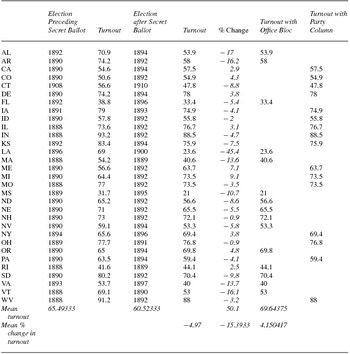
Table 1 indicates the dates of the initial implementation of statewide secret balloting in each state, as well as the percentage turnout among eligible voters in the gubernatorial elections immediately preceding and following the adoption of the Australian ballot. Data on ballot adoption and form are from Ludington (Reference Ludington2009 [1911]). Data on turnout are from A Statistical History of the American Electorate (Rusk Reference Rusk2001). Turnout is measured as the percentage of the state's voting eligible population (VEP) voting: VEP is defined as adult (more than 21 years) males, accounting for citizenship requirements and female suffrage in states where they existed. Table 1 indicates that while 13 of the 15 states adopting an office bloc form saw a decrease in turnout in their first gubernatorial elections after passage, 8 of the 16 states opting for the party column saw an increase in statewide turnout. Of the eight party column states with declines in turnout, none of the declines appear to exceed 10 percent. Of all the office bloc states, the average change in turnout after passage is -15.4 percent. This indicates a substantial deflationary effect associated with the office bloc form. Of the party column states, the average change in turnout is an increase of more than 4 percent. As the data presented here show, most of the deflationary effect of the Australian ballot appears to be isolated among the states that opted for the office bloc form.
Statewide gubernatorial turnout before and after secret ballot adoption

To analyze the effect of Australian ballot adoption on turnout we first estimate the following equation:
 \begin{equation}
{\rm TO}_{{\rm it}} = a{\rm AUSS}_{{\rm it}} + b{\rm PT}_{{\rm it}} + c{\rm LT}_{{\rm it}} + d{\rm FS}_{{\rm it}} + e{\rm PEY}_{{\rm it}} + {\rm e}\end{equation}
Equation 1 is tested using OLS. The dependent variable, TOit, is the statewide voter eligible turnout (VEP) for state i at time t, and the key treatment variable is the initial passage of ballot reform (AUSSit), measured as a dummy variable (0, 1). Controls for other legal factors that were expected to negatively affect turnout were also included as dummy variables (0, 1). Past research finds that the implementation of a poll tax, a literacy test, or female suffrage also had a negative effect on statewide turnout (Heckelman Reference Heckelman1995, Reference Heckelman2000; Kleppner Reference Kleppner1982), therefore these measures were included in the model (as PTit, LTit, and FSit). Dates of the adoption of each of the electoral reforms for each state are from Keyssar (Reference Keyssar2001) and Walker (Reference Walker1984). In addition, a dummy variable (0, 1) for Presidential Election Year (PEYit) was included and was expected to have a positive effect on turnout.
A second model includes separate measures for specific types of Australian ballots in place of the initial measure of Australian ballot reform. If voter confusion rather than secrecy explains turn-of-the-century turnout decline, it would be expected that office bloc ballots would have a significant negative effect on turnout, while the party column ballots would not. In Equation 2, treatment variables include separate measures for the adoption of an office bloc ballot OBit or a party column ballot PCit. Both are measured as dummy variables (0, 1). Equation 1 was modified as such:
 \begin{equation}
{\rm TO}_{{\rm it}} = a{\rm OB}_{{\rm it}} + b{\rm PC}_{{\rm it}} + c{\rm PT}_{{\rm it}} + d{\rm LT}_{{\rm it}} + e{\rm FS}_{{\rm it}} + f{\rm PEY}_{{\rm it}} + {\rm e}\end{equation}
Because changes in institutional rules interest us more than the political culture of the various states, we tested the model first without controlling for state-specific factors. However, in a second test we included state fixed effects to control for dissimilar rates of turnout across states (Engstrom and Kernell Reference Engstrom and Kernell2005; Heckelman Reference Heckelman1995). Equations 1 and 2 were modified as such:
 \begin{equation}
{\rm TO}_{{\rm it}} = a{\rm AUSS}_{{\rm it}} + b{\rm PT}_{{\rm it}} + c{\rm LT}_{{\rm it}} + d{\rm FS}_{{\rm it}} + e{\rm PEY}_{{\rm it}} + \Sigma f_{\rm i} + {\rm e}\end{equation}
 \begin{equation}
{\rm TO}_{{\rm it}} = a{\rm OB}_{{\rm it}} + b{\rm PC}_{{\rm it}} + c{\rm PT}_{{\rm it}} + d{\rm LT}_{{\rm it}} + e{\rm FS}_{{\rm it}} + f{\rm PEY}_{{\rm it}} + \Sigma g_i + {\rm e}\end{equation}
Finally, Key (Reference Key1949) notes that very few of the reform ballot systems used by the eleven states of the former Confederacy during the early twentieth century allowed for truly secret voting. For example, he observes that the states of South Carolina, Texas, Alabama, Georgia, and Arkansas numbered their ballots allowing for the identification of voters; Georgia allowed each of its counties to opt out of using secret ballots; North Carolina and Louisiana forced any challenged voters to sign their ballots; Tennessee used easily readable transparent “tissue” ballots; and Arkansas made voters sign a carbon copy of their ballots (Key Reference Key1949: 458–50). The lack of voting secrecy in the postreform South could make an assessment of the vote market hypothesis difficult without accounting for the unique electoral environment in these states (Kousser Reference Kousser1974). In addition, all of the Southern states listed in Table 1 enacted office bloc forms of balloting, poll taxes, and literacy tests during this time period, and none of them provided for female suffrage before the passage of the Nineteenth Amendment. Therefore, there is a notable lack of variation among these reforms in the Southern states. Also, it is often noted that turnout was generally much lower in the states of the former Confederacy, compared to the rest of the nation (Key Reference Key1949; Kousser Reference Kousser1974; Rusk and Stucker Reference Rusk, Silbey, Bogue and Flanigan1978). Any state-specific effects on turnout captured in the preceding models might be masking a regional effect. Therefore, we included a dummy variable for South (STHit) (1 if former Confederate state, 0 if not) in lieu of the state fixed effects in the previously specified models, which were tested separately. Equations 3 and 4 were modified as such:
 \begin{equation}
{\rm TO}_{{\rm it}} = a{\rm AUSS}_{{\rm it}} + b{\rm PT}_{{\rm it}} + c{\rm LT}_{{\rm it}} + d{\rm FS}_{{\rm it}} + e{\rm PEY}_{{\rm it}} + f{\rm STH}_{{\rm it}} + {\rm e}\end{equation}
 \begin{equation}
{\rm TO}_{{\rm it}} = a{\rm OB}_{{\rm it}} + b{\rm PC}_{{\rm it}} + c{\rm PT}_{{\rm it}} + d{\rm LT}_{{\rm it}} + e{\rm FS}_{{\rm it}} + f{\\rm PEY}_{{\rm it}} + g{\rm STH}_{{\rm it}} + {\rm e}\end{equation}
In light of the propensity of Southern states to adopt each, we also tested models including separate interactive measures between the South variable and passage of an Australian ballot, the office bloc ballot form, poll taxes, and literacy tests. Equations 5 and 6 were modified as such:
 \begin{eqnarray}
{\rm TO}_{{\rm it}} &=& a{\rm AUSS}_{{\rm it}} + b{\rm PT}_{{\rm it}} + c{\rm LT}_{{\rm it}} + d{\rm FS}_{{\rm it}} + e{\rm PEY}_{{\rm it}} + f{\rm STH}_{{\rm it}} + g({\rm STH} \times {\rm AUSS})_{{\rm it}} \nonumber \\
&& + \, h({\rm STH} \times {\rm PT})_{{\rm it}} + i({\rm STH} \times {\rm LT})_{{\rm it}} + {\rm e}
\end{eqnarray}
 \begin{equation}
{\rm TO}_{{\rm it}} = a{\rm OB}_{{\rm it}} + b{\rm PC}_{{\rm it}} + c{\rm PT}_{{\rm it}} + d{\rm LT}_{{\rm it}} + e{\rm FS}_{{\rm it}} + f{\rm PEY}_{{\rm it}} + g{\rm STH}_{{\rm it}}\\
\qquad\quad +\, h({\rm STH} \times {\rm OB})_{{\rm it}} + i({\rm STH} \times {\rm PT})_{{\rm it}} + j({\rm STH} \times {\rm LT})_{{\rm it}} + {\rm e} \\
\end{equation}
Additional models of only non-South states were also run, yielding results similar to those in Models 1 through 4 (yet are not reported here). Robust standard errors were used in order to address potential problems of heteroskedasticity and autocorrelation in the model (Hoechle Reference Hoechle2007; Rogers Reference Rogers1993).Footnote 7
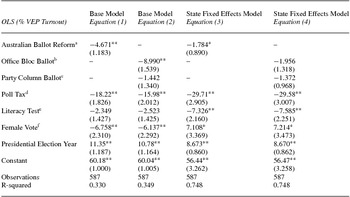
Table 2 displays the results of both OLS models of statewide turnout for all gubernatorial elections from 1870 to 1910. The coefficient for the Australian ballot variable is negative (as expected) in Equation 1, indicating a negative effect on turnout. The adoption of Australian ballot laws appear to reduce statewide turnout by 4.7 percent in the first model, which is comparable to percentages indicated in similar models without state fixed effects (see Heckelman Reference Heckelman1995). As expected, the office bloc ballot measure in Equation 2 appears to have a strong, negative, and statistically significant effect on voter turnout. The apparent deflationary effect of the office bloc ballot is around -9 percent. This indicates a substantial decline in turnout that is roughly twice that of Australian ballots alone. Likewise, any effect of the party column ballot measure on turnout appears to be minimal and does not achieve statistical significance. Together, these results suggest that ballot form, rather than ballot secrecy, best explains the relationship between the passage of Australian ballot laws and turnout. In addition, the coefficients for the control variables also indicate the predicted effect on turnout.Footnote 8 The version of the base models employing state fixed effects are tested in Equations 3 and 4. While the coefficient for the adoption of an Australian ballot law in Equation 3 remains negative and statistically significant, the apparent effect is less than half that of the measure in the base model. The office bloc ballot measure in Equation 4 does not appear to have a statistically significant effect on voter turnout, and the coefficients for each of the control variables is altered substantially when compared to Equation 2. This indicates probable intercollinearity with the state measures; therefore these coefficients should be interpreted with caution.
Effect of electoral reforms on statewide turnout: 1870–1910

Note: Robust standard errors in parentheses.
Coefficients for state fixed effects not reported.
aDummy variable, 1 = state with Australian ballot reform, 0 = state with no ballot reform.
bDummy variable, 1 = office bloc ballot in effect, 0 = no office bloc ballot in effect.
cDummy variable, 1 = party column ballot in effect, 0 = no party column ballot in effect.
dDummy variable, 1 = state with statewide poll tax, 0 = state with no poll tax.
eDummy variable, 1 = state with statewide literacy test, 0 = state with no literacy test.
fDummy variable, 1 = state with statewide female suffrage, 0 = state with no female suffrage.
** p < 0.01, * p < 0.05. Two-tailed tests.
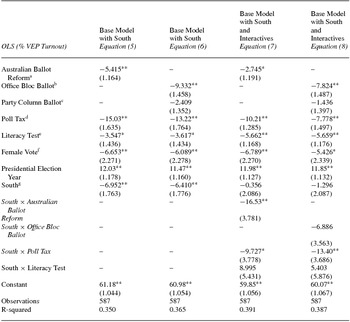
Table 3 indicates the tests of the base model with additional controls for South included. Because of the historically low turnout in the South, Equations 5 and 6 include a simple dummy variable for South (1,0), which was expected to have a negative effect on turnout. Due to the previously noted similarities with patterns of electoral reform in the South, Equations 7 and 8 also include interactions between Australian ballots, office bloc ballots, poll taxes, and literacy tests with the South dummy variable. The adoption of Australian ballot laws appears to reduce statewide turnout by -5.4 percent in the model including a control for South (Equation 5), and the coefficient is statistically significant at the .01 level. As expected, the office bloc ballot measure in Equation 6 appears to have a strong, negative and statistically significant effect on voter turnout. The apparent deflationary effect of the office bloc ballot is around −9.3 percent, which is comparable to the effect found in the base model without a control for South (Table 2, Equation 2). Additionally, any effect of the party column ballot measure on turnout appears to be minimal and does not achieve statistical significance in either the model controlling for South (Equation 2) or the model including the South interactive variables (Equation 8). While the size of the coefficient for the adoption of an Australian ballot drops substantially once the interactive variables are included, the 16.5 percent decrease in turnout indicated by the first interactive in Equation 7 (South × Australian Ballot) lends support to the suggestion that ballot adoption in the South had a markedly greater impact on turnout than in the rest of the nation.Footnote 9
Effect of electoral reforms on statewide turnout (with controls for south): 1870–1910

Note: Robust standard errors in parentheses.
aDummy variable, 1 = state with Australian ballot reform, 0 = state with no ballot reform.
bDummy variable, 1 = office bloc ballot in effect, 0 = no office bloc ballot in effect.
cDummy variable, 1 = party column ballot in effect, 0 = no party column ballot in effect.
dDummy variable, 1 = state with statewide poll tax, 0 = state with no poll tax.
eDummy variable, 1 = state with statewide literacy test, 0 = state with no statewide literacy test.
fDummy variable, 1 = state with statewide female suffrage, 0 = state with no female suffrage.
gDummy variable, 1 = South state, 0 = non-South state.
** p < 0.01, * p < 0.05. Two-tailed tests.
Both basic ballot form and the use of a straight ticket provision (STP) would be likely to influence voter behavior. As Rusk found in his examination of the effects of ballot type on ticket splitting, “the party column format in itself was facilitative of straight ticket voting” (Rusk Reference Rusk1970: 1233). However, recent research on separate straight ticket voting provisions suggests that their inclusion may actually confuse voters when used in conjunction with nonpartisan races or voter initiatives and referenda, leading to ballot runoff. In a study of their use in twenty-first-century elections, researchers note that “the office-bloc ballot with a straight-party option adds complexity to the voting process with minimal (at best) feedback . . . conceptually, this ballot creates challenges for voters who do not understand the idea of a straight-party vote” (Herrnson et al. Reference Herrnson, Hanmer and Niemi2012: 719). However, because only three states used the “Office Bloc with Straight Ticket Provision” configuration between 1888 and 1910 (Ware Reference Ware2002), and reform era voters were likely familiar with the concept voting a straight ticket due to their familiarity with the party strip ballot, it is unlikely that the use of an STP would have a negative effect on turnout during these years. But, because there is some uncertainty as to whether basic ballot form or the absence of an STP would have a different effect on turnout, the separate effects of STPs on turnout were also tested in place of the original measures of ballot form. As expected, the alternative models yielded similar negative results for the absence of an STP as in the original models controlling for ballot form. The results of this analysis are not reported here, but are available from the author upon request.
Overall, while all forms of reform ballot allow for secret voting, the analysis indicates that only the use of ballots requiring greater time and effort for the voter to complete (the office bloc) are correlated with a decline in turnout. This suggests that the secrecy of the voting, in and of itself, may not suffice to explain any drop in turnout after Australian ballot reforms were enacted for the first time. This leads us to accept voter difficulties associated with ballot design as the best interpretation of the ballot reform effect on turnout.
Discussion
The Australian ballot is often cited as one of the causes of decline in voter turnout in the early twentieth century, due to its effect on the ability of parties to monitor the act of voting. Fears that split tickets, opposition voting, or third-party voting would increase might have made parties reluctant to mobilize voters who were completing their ballots in secret. However, as this research shows, the secrecy of the voting method alone cannot explain rates of turnout before and after reform. Turnout was only significantly lower in those states adopting ballot reforms making it difficult for voters to complete their ballots quickly and easily. There was some decline in turnout after states began to adopt the Australian ballot, but it appears to be isolated among those states opting for the office bloc (or “pure”) reform ballots. For the states that adopted reform ballots that facilitated quick, straight ticket voting, there was no apparent decline in turnout. This seems to suggest that ballot reform's negative effect on turnout was largely due to the complexity of ballot design and possible voter confusion over completing ballots. The design of the new office bloc ballot was quite unlike that of the old, party strip ballot system. For most states, the adoption of a more familiar party column ballot form may have offset any substantial declines in turnout due to the implementation of ballot reform.
The link between ballot design and voter confusion continues to be a cause for concern among those advocating for ballot reform in the modern era. The manner in which voters cast their ballots can have a noticeable effect on electoral outcomes, as well as on levels of voter participation. Minor changes in ballot form can result in an even greater impact on voter behavior, as evidenced by the now infamous “butterfly ballots” of the 2000 presidential election in Florida. The example of the effects of the nineteenth-century Australian ballot reform effort can help modern scholars better understand (as well as predict) how more dramatic changes in voting technology might influence voter behavior today.
While the analysis shown here indicates that ballot form may have influenced subsequent patterns of voter turnout, there are several alternative explanations for this effect that must be noted. First, although all forms of Australian ballot ensured secrecy of voting, it is possible that voting under some forms of reform ballot was less secret than with others. Because straight ticket provisions on most party column ballots allowed voters to vote quickly, party agents might have timed voters in the booth to determine whether they were splitting their tickets. But, although this might allow for some verification of straight ticket voting, it should be noted that which party a voter was supporting would still be unclear (thereby resulting in an uncertain vote market).
Second, voting on the office bloc ballot would have been considerably more time consuming for voters not used to marking their own ballots. While this might result in voters not completing their ballots, it might also result in long lines for voters at many precincts using the office bloc ballot. As evidenced by recent problems with polling lines in the 2004 and 2008 elections, long lines at the polls can lead to the inability or unwillingness of many voters to wait to cast their ballots (Alvarez et al. Reference Alvarez, Ansolabehere, Berinsky, Lenz, Stewart III and Hall2008). It is quite possible that many voters now facing much longer wait times under the reformed system simply gave up altogether in frustration.
Third, it is just as possible that any decline in turnout associated with the adoption of the Australian ballot was due to factors other than the ballots. The election laws that led to the adoption of the Australian ballot did more than just change the design of ballots; they also made the polling environment more heavily regulated. With ballot reform, voting now took place in a closely monitored and somewhat sterile environment, in secluded booths rather than in crowded saloons or shop windows. The entire act of voting was transformed by the adoption of the new voting method, changing from a public pronouncement of party allegiance to a private and silent statement of political preference. The very nature meaning of Election Day changed with the adoption of these reforms. With this rather dramatic change in the process of voting, a once boisterous and festive atmosphere surrounding the polls was instantly transformed into a somewhat somber and sober fulfillment of civic duty. The regulation of the voting environment may have simply reduced the social incentives to vote. Ballot reform may have eventually led to a decline in turnout because it made the act of voting less enjoyable for many voters.