

INTRODUCTION
Carbon storage in soils and the relative contributions of above and below ground biomass to soil carbon pools are very important to understand the soil carbon fluxes and the extent of carbon sequestration in soils, particularly for tree crop ecosystems, since they are considered to be promising candidates for afforestation. Soils are the largest reservoir of organic carbon in terrestrial ecosystems containing three times more carbon than the vegetation they support (Post et al., Reference Post, Emmanuel, Zinke and Stangenberger1982) and are considered to be a potential sink for the rising atmospheric carbon dioxide levels. Fine roots account for a significant proportion of carbon and nutrient fluxes in soil and, to some extent, the carbon cycle of forest ecosystems is regulated by fine root biomass and production (Vogt et al., Reference Vogt, Vogt, Palmiotto, Boon, O'Hara and Asbjornsen1996). Long-term residue management studies suggest that above-ground material has a limited impact on soil organic matter (SOM) levels compared with that of root systems (Persson and Stadenberg, Reference Persson and Stadenberg2010; Rasse et al., Reference Rasse, Rumpel and Dignac2005).
Fine root production and its turnover account for a significant share of total net primary production in forest ecosystems, and estimates ranging from 40 to 73% have been reported (Agren et al., Reference Agren, Axelsson, Flower-Ellis, Linder, Person, Staaf and Troeng1980). For several decades, more importance was given to addition and transformations of above-ground biomass for sustaining soil organic carbon stocks than the addition and transformations of root detritus mainly due to comparative easiness in generating above-ground data (Rasse et al., Reference Rasse, Rumpel and Dignac2005; Valverde-Barrantes et al., Reference Valverde-Barrantes, Raich and Russell2007). Quantification of below-ground fluxes of carbon and nutrients is difficult due to high spatial heterogeneity and difficulty in recording observations (Leuschner et al., Reference Leuschner, Hertel, Schmid, Koch, Muhs and Holscher2004). However, in recent years, the growth dynamics and chemical composition of fine roots in tree crop ecosystems were the focus of several studies due to the increasing importance given to trees in sequestering carbon and now data from many tree crop systems are available in the literature. A wide variation was reported for fine root production depending on species and environmental conditions: 260 g m−2 in Quercus ilex forest in Spain (Lopez et al., Reference Lopez, Sabate and Garcia2001) and 320–470 g m−2 in beech forests (Leuschner et al., Reference Leuschner, Hertel, Schmid, Koch, Muhs and Holscher2004) were reported. Fine root biomass values ranging from 182 g m−2 in Pinus to 433 g m−2 in Hyeronima were reported for tropical tree species (Valverde-Barrantes et al., Reference Valverde-Barrantes, Raich and Russell2007). Fine root biomass was relatively low, 1.7 t ha−1 in a tropical rainforest in Malaysia (Green et al., Reference Green, Dawson, Proctor, Duff and Elston2005). Fine root biomass in a 6-year-old Eucalyptus plantation in Congo was estimated to be 1.8 t ha−1 (Levillain et al., Reference Levillain, M'Bou, Deleporte, Saint-Andre and Jourdan2011). Fine root turnover in Eucalyptus plantations in Brazil was estimated to vary from 1.8 to 1.3 year −1 depending on nitrogen supply (Jourdan, Reference Jourdan, Silva, Goncalves, Ranger, Moreira and Laclau2008). The annual fine root production of tree species ranging from 79 g m−2 in Leucaena leucocephala to 171 g m−2 in Prosopsis juliflora was reported in semi-arid regions of India (Jha and Mohapatra, Reference Jha and Mohapatra2010).
Fine root production and turnover are highly plastic and sensitive to changing soil environments, particularly soil water and nutrient availability. Appreciable seasonal variations in fine root production, with reduced root production when there is soil moisture stress followed by increased production during favourable moisture regimes, were also reported (Leuschner and Hertel, Reference Leuschner and Hertel2002). McGroddy and Silver (Reference McGroddy and Silver2000) and Green et al. (Reference Green, Dawson, Proctor, Duff and Elston2005) also observed that root biomass was strongly and positively correlated with soil moisture. The responses to nutrient availability are usually adaptive; they serve to increase the efficiency of nutrient capture under situations of nutrient limitation (Forde and Lorenzo, Reference Forde and Lorenzo2001). However, there are contradictory reports about nutritional effects on the fine root biomass of various tree ecosystems; for example, positive (Braekke, Reference Braekke1995; George et al., Reference George, Seith, Schaeffer and Marschner1997; Green et al., Reference Green, Dawson, Proctor, Duff and Elston2005), negative (Vitousek and Sanford, Reference Vitousek and Sanford1986) or no relationship (Leuschner et al., Reference Leuschner, Hertel, Schmid, Koch, Muhs and Holscher2004) have been reported. The influence of environmental variables, site and soil moisture on fine root production makes generalization difficult without repeated measurements replicated over different sites.
Rubber (Hevea brasiliensis), a forest tree indigenous to the Amazonian forests of South America, is mainly cultivated in South-East Asian countries. Currently, rubber is cultivated in more than 10 million hectare globally and the area under cultivation is fast expanding due to socio-economic reasons, apart from the importance given to this species for eco-restoration of degraded lands (Krishnakumar et al., Reference Krishnakumar, Gupta, Sinha, Sethuraj, Potty, Eappen and Das1991). Therefore, rubber plantations are significant planted ecosystems to be considered in C budgets. Studies on the root distribution pattern show that rubber has a shallow root system with a major share of fine roots scavenging the surface organic layer (George et al., Reference George, Suresh, Wahid, Nair and Punnoose2009; Jessy et al., Reference Jessy, Meera Bai, Rajendran, Geethakumari, Nair and Philip2008). Soong (Reference Soong1976) in Malaysia studied the seasonal variation of the fine root biomass of rubber trees by sequential coring and observed that the highest fine root biomass was in the 0–7.5-cm soil layer.
However, very little attention was given to the below-ground carbon and nutrient fluxes in rubber plantations and, to our knowledge, fine root and carbon turnover in rubber plantations were not studied earlier.
In the present investigation, we studied the fine root production by two methods, sequential coring and ingrowth core methods at two sites with distinctly different soil nutrient status. We also attempted to estimate the fine root turnover and carbon and nutrient fluxes through fine roots.
MATERIALS AND METHODS
Study sites
Details of study sites are described in our earlier paper (Jessy et al., Reference Jessy, Prasannakumari, Nair, Vijayakumar and Nair2010). Root measurements were recorded from two rubber plantations (clone RRII 105) established in 1989 at the Rubber Research Institute of India, Kottayam, Kerala (9° 32′N, 77° 26′E, at an altitude of 73 msl) and at the Central Experiment Station, Chethackal, Kerala (9° 22′N, 76° 50′E, at an altitude of 50 msl). The soils of the experiment site belong to the order Ultisol and suborder Humults and the sites differed in soil nutrient status, soil pH and gravel content. Chethackal is a higher fertility site (organic carbon was 2.49% and available P, K, Ca and Mg were 7.20, 8.52, 11.04 and 3.88 mg 100 g−1 soil, respectively, and pH was 4.75) than Kottayam (organic carbon was 1.99% and available P, K, Ca and Mg were 0.96, 2.81, 1.37 and 0.55 mg 100 g−1 soil, respectively, and pH was 4.40). Gravel content at Kottayam was 12.86%, whereas it was 4% at Chethackal on volume basis. A typical warm humid tropical climate is experienced in both locations with definite wet and dry periods. A long-term rainfall pattern indicates that the mean annual rainfall at Kottayam is around 3000 mm, but its distribution is skewed. Very few rains are received during the December to April period. Chethackal receives comparatively more distributed rains with more rains during the December to April (dry) period with a long-term average ranging from 3000 to 3500 mm.
Methodology
Fine root production by the sequential core method
Fine root (defined as roots less than or equal to 2 mm in diameter) biomass (g dm m−2 soil) was measured by sequential core sampling. Since highest root density in mature rubber plantations was observed in the top 7.5-cm layer (Jessy Reference Jessy2004; Soong, Reference Soong1976), sampling was confined to this layer. In an earlier study, fine root biomass was comparable in planting lines and inter-row area and hence root sampling was confined to the inter-row area (Jessy et al., Reference Jessy, Thomas and Vijayakumar2005). Studies conducted in Eucalyptus plantations by Bouillet et al. (Reference Bouillet, Laclau and Arnaud2002) and Levillain et al. (Reference Levillain, M'Bou, Deleporte, Saint-Andre and Jourdan2011) also showed no decrease in fine root density from the position of the row to the middle of inter-row. Root samples were collected leaving a minimum distance of 1.5 m from the planting lines to avoid disturbance due to tapping (harvesting of latex) operations. Eight sites in the inter-row area with representative tree height and girth measurements were selected for root sampling. Samples were collected at variable distances from the planting rows without following a specific pattern. Root samples were collected with a sharp corer of 50-mm diameter. At each of the sampling sites, six samples were collected at each sampling date (48 samples at a time). Observations recorded at monthly interval from July 2005 to June 2007 at Kottayam and from July 2005 to June 2006 at Chethackal are reported in this paper.
In the laboratory, samples were soaked in water and cleaned from soil and organic residues by sieving in a gentle stream of water over a sieve (0.25 mm) and roots less than or equal to 2-mm diameter were separated. Dead roots (necromass) were also carefully removed soon after washing. Fine roots of other plants were separated based on colour, branching pattern and texture. For estimating fine root biomass, the dry weights of all the 48 samples were recorded and, for necromass observations, the dry weight of 12 samples was recorded, since in an earlier observation, variability in fine root necromass was found to be less than in biomass (Jessy et al., Reference Jessy, Thomas and Vijayakumar2005).
From the sequential coring data, fine root production in the 0–7.5 cm soil layer was calculated by the minimum–maximum method as the difference between the maximum and minimum fine root biomass (Edwards and Harris, Reference Edwards and Harris1977) and mass balance technique (Fairley and Alexander, Reference Fairley, Alexander, Fitter, Alkinson and Read1985; Hertel and Leuschner, Reference Hertel and Leuschner2002; McClaugherty et al., Reference McClaugherty, Aber and Melillo1982). In the mass balance approach, the difference between successive sampling occasions was considered as the fine root production for that period. The loss of root dry mass due to decomposition was also accounted. The fine root production for any interval between two subsequent sampling occasions 1 and 2 was calculated with the following equation:
 $${\rm P}_{2 - 1} = ({\rm B}_2 + {\rm N}_2 ) - ({\rm B}_1 + {\rm N}_1 ) + {\rm D}_{2 - 1}$$
Fine root production by the ingrowth core method
Fine root production was measured by the ingrowth core method as described by Steingrobe et al. (Reference Steingrobe, Scmid and Classen2001). Mesh bags (length 30 cm, diameter 6 cm and mesh width 3 mm) were pulled over a plastic tube of the same size and inserted into the soil in between planting rows, leaving a minimum of 1.5 m from the base of the trees in the same location as that of the sequential core sampling. Sixty-four mesh bags each were inserted (16 replications × 4 sampling periods) in November 2005 and 2006 at Kottayam and in November 2005 at Chethackal. The ingrowth cores were inserted in November so that measurements can be commenced in January. For filling the mesh bags, soil collected from the same plots was used after removing the roots through sieving. The root-free soil was filled through the plastic tube into the mesh bag. The soil was compressed with a wooden stick to a density comparable to the average density of the bulk soil, which was 1.3 g cc−1. The whole mesh bag was filled step by step with soil by repeating the procedure. The plastic tubes were pulled out after filling the net with soil and the positions of mesh bags were marked by small pegs. On the basis of an earlier test, an incubation time of 45 days was given for stabilization. Sixteen bags each were harvested after 3, 6, 9 and 12 months (March, June, September and December) after the stabilization period.
At harvest, each ingrowth core was severed from the surrounding soil with a long sharp knife and then removed from the soil. Fine roots were separated from soil by washing over a 0.25-mm mesh sieve. Dead roots and roots of other plants were carefully removed soon after washing. Live fine roots (biomass) were dried at 70 °C and weighed. We estimated fine root production in the 0–30-cm soil layer by the ingrowth core method as the highest fine root ingrowth in the ingrowth cores.
Fine root decomposition
Fine root decomposition rate was determined by the litter bag method (Fahey et al., Reference Fahey, Hughes, Pu and Arthur1988). Live fine roots from both Kottayam and Chethackal were collected from the topsoil layer and a 2-g air dry root was inserted into the litter bags (nylon material, 40 × 40 mm, mesh size 1.2 mm). Seventy-two nylon bags each with roots were placed in the rubber plantations at both sites during the first week of January 2006, leaving a minimum distance of 1.5 m from the base of the trees to avoid disturbance due to tapping (harvesting of latex) operations and covered with 2 cm of the litter layer. Twelve bags were retrieved at bimonthly interval, and in the laboratory soil particles and litter residues were carefully removed and weight was recorded. The loss of root mass due to decomposition was calculated from the difference between the initial and remaining root mass.
Fine root turnover
Fine root turnover was estimated from the quotient of annual production and annual mean fine root biomass by sequential core and ingrowth core methods.
Soil moisture content
Soil moisture content (0–30 cm) was determined gravimetrically. The soil samples were collected on the same days of the fine root sample collection.
Chemical analyses
Composite soil samples (0–30 cm) were collected from the study sites and analysed for pH (1:2.5 soil–water ratio), organic carbon by Walkley and Black's method as described by Jackson (Reference Jackson1973), available phosphorus by the chloromolybdic stannous chloride reduction method using the Bray II extractant (Bray and Kurtz, Reference Bray and Kurtz1945), available potassium using a flame photometer (Morgan, Reference Morgan1941) and available calcium and magnesium by ammonium acetate extraction (Vogel, Reference Vogel1969), followed by subsequent determination by an atomic absorption spectrophotometer (Avanta – GBC Scientific Equipment Company Ltd., Australia).
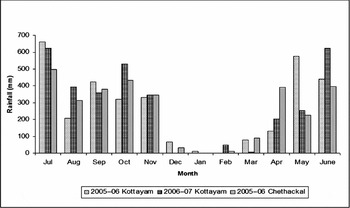
Carbon and nutrient contents of fine roots in the 0–30 cm soil layer were determined during the dry season (February), rainy season (June) and post-rainy period (October). Root carbon and nitrogen contents were determined by the dry combustion method using a C:N analyser (Leco, USA). Phosphorus content was determined by the vanadomolybdate method using an autoanalyser (AA3 – Brant Luebbe, Germany) and potassium flame photometrically using an autoanalyser. Calcium and magnesium contents were determined using the atomic absorption spectrophotometer. Rainfall data from both locations were collected from the agrometeorological observatories located near the study sites (Figure 1). The total rainfall received at Chethackal during December to April of the study year was 526.8 mm with 29 rainy days, and that received at Kottayam was 290.2 mm (rainy days: 20) during 2005–06 and 263.2 mm (rainy days: 15).
Monthly rainfall at Kottayam and Chethackal during the study period.

Analysis of variance was used to test the differences between sampling occasions and sites. Sampling occasions and sites were tested independently for comparison. For comparing the carbon and nutrient content, site was considered as factor 1 and sampling occasions as factor 2. A comparison was made between sampling occasions, sites and their interaction. For fine root biomass comparison, there were 12 sampling occasions and 48 replications, and for root carbon and nutrient contents and fine root production by the ingrowth core method, there were 16 replications.
RESULTS
Seasonal dynamics of fine root biomass by sequential coring
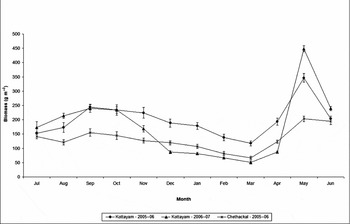
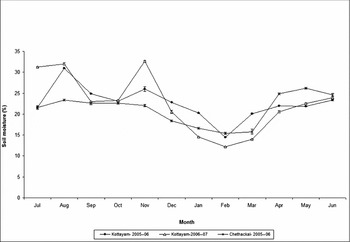
The fine root biomass quantified through sequential coring exhibited the fine root dynamics of the top 0–7.5-cm soil layer only. It showed significant seasonal fluctuation (p < 0.05), and the fluctuations were particularly wide during March–May (Figure 2). After the severe soil moisture stress during January to March, a steep increase in fine root biomass was observed after the receipt of rains. At Kottayam, the lowest fine root biomass (117 and 51 g m−2) was observed during March and highest during May (346 and 448 g m−2) during both 2005–06 and 2006–07. The mean fine root biomass was 199.53 and 173.20 g m−2 during 2005–06 and 2006–07, respectively. The mean soil moisture status was significantly different between both years (p < 0.05) and indicated a higher soil moisture stress during 2006–07 (Figure 3). The fine root biomass fluctuation was also wider during 2006–07 (Figure 2). The highest fine root biomass was 3 times higher than that of the lowest during 2005–06 and 8 times during 2006–07 at Kottayam and the differences were statistically significant at p < 0.05. After attaining the peak fine root biomass, a sharp decline was observed in subsequent months.
Fluctuations in the fine root biomass of Hevea brasiliensis at Kottayam (2005–06 and 2006–07) and Chethackal (2005–06) in the surface 0–7.5-cm soil layer.

Fluctuations in soil moisture content in the 0–30-cm soil layer at Kottayam (2005–06 and 2006–07) and Chethackal (2005–06).

At Chethackal, the fluctuation was comparatively narrower, but the pattern of seasonal fluctuation was similar. The lowest fine root biomass was observed during March (66 g m−2) and highest during May (204 g m−2), varying by a factor of 3, and the differences were statistically significant at p < 0.05. The mean fine root biomass was 132.45 g m−2. The fine root biomass at both locations also differed statistically with respect to both highest and lowest values (p < 0.05).
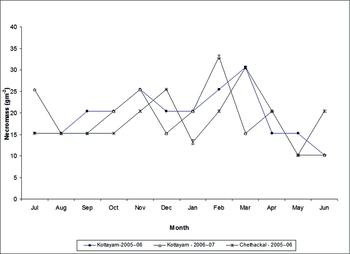
Unlike biomass, the necromass values did not show appreciable seasonal variation at both locations. The mean necromass ranged from 11 to 18% of the mean biomass at Kottayam and Chethackal, respectively (Figure 4).
Fluctuations in the fine root necromass of Hevea brasiliensis at Kottayam (2005–06 and 2006–07) and Chethackal (2005–06) in the surface 0–7.5-cm soil layer.

Fine root production in the 0–7.5-cm soil layer by the sequential core method
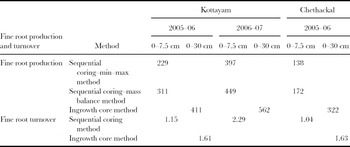
Fine root production at the lower fertility site (Kottayam) estimated by the minimum–maximum method was 229 and 397 g m−2 and by the mass balance approach was 311 and 449 g m−2 during lower (2005–06) and higher stress year (2006–07), respectively (Table 3). At the higher fertility site (Chethackal), the corresponding values were 138 and 172 g m−2, respectively, during 2005–06.
Fine root production in the 0–30-cm soil layer by the ingrowth core method
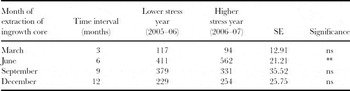
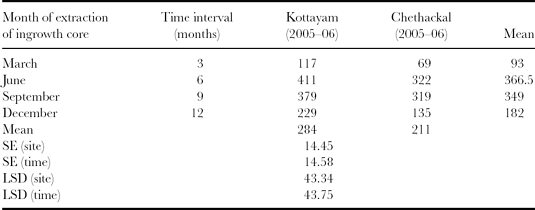
The fine root production differed significantly between both years at Kottayam and between both sites in 2005–06, but the seasonal production of fine roots followed the same trend (Tables 1 and 2). The ingrowth of fine roots in the cores was also observed during the dry season (January–March; Table 2). Cumulative fine root production was higher after six months (January–June). After March, a more than threefold increase in fine root ingrowth was observed during both years during the April–June period (411 and 562 g m−2) at Kottayam. The same trend was also observed at the other site (322 g m−2). This indicates the seasonal rapid production of fine roots after the onset of rains. After this period, fine root biomass in the ingrowth cores decreased, possibly due to decomposition.
Comparison of fine root production by the ingrowth core method during lower soil moisture stress and higher stress year (g m−2) at Kottayam.

**Significant at the p < 0.05 level (degrees of freedom: 30); ns, treatment difference is not significant; SE, standard error.
Comparison of fine root production (g m−2) by the ingrowth core method during 2005–06 at Kottayam and Chethackal.
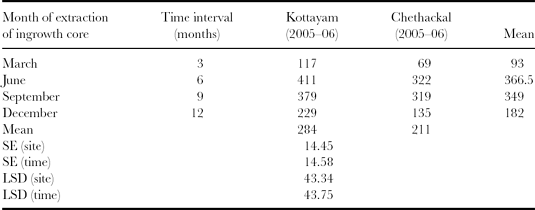
LSD is the difference (p < 0.05) above which the difference is significant (degrees of freedom: 30); SE, standard error.
Fine root turnover
Fine root turnover in the 0–7.5-cm soil layer estimated from the sequential coring data was 1.15 and 2.29 year−1 at Kottayam during 2005–06 and 2006–07 (Table 3). At Chethackal, fine root turnover was 1.04 year−1 in the 0–7.5-cm soil layer. The mean fine root biomass in the 0–30-cm soil layer by the ingrowth core method was 255.27 g m−2 at Kottayam with a turnover of 1.61 year−1 and 197.55 g m−2 and 1.63 year−1, respectively, at Chethackal.
Annual fine root production (g m−2) and turnover (year−1) estimated by different methods at Kottayam and Chethackal.

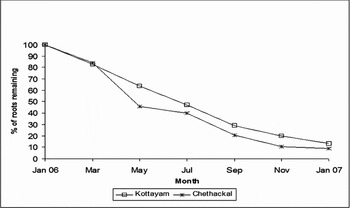
Fine root decomposition proceeded at a faster rate at Chethackal; more than 50% of the roots disappeared by May (Figure 5). At Kottayam, the decomposition rate was slightly slower; more than 40% of the dead roots were decomposed after 5 months.
Percentage of roots remaining in the litter bags at both sites. The litter bags were installed in January 2006.

Carbon and nutrient cycling through fine roots
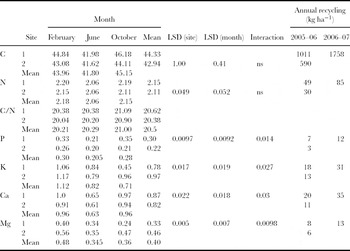
Significant temporal variability was observed with respect to carbon and nutrient content of fine roots; significantly lower C, N, P and Ca contents were observed during the rainy season (June) whereas K and Mg contents were significantly low during October at Kottayam (Table 4). At Chethackal, C and Ca contents were significantly lower during June. The interaction effect for P, K, Ca and Mg contents with respect to site and time was significant and indicates variation in nutrient status with site and time. The root nutrient status determined during 2005–06 was used to estimate the carbon and nutrient recycling during 2006–07 as well. The annual recycling of C, N, P, K, Ca and Mg through fine roots (0–7.5-cm soil layer) was 1011, 49, 7, 18, 20 and 8 kg ha−1 during the lower soil moisture stress year (2005–06) and 1758, 85, 12, 31, 35 and 13 kg ha−1 during the higher soil moisture stress year (2006–07) at Kottayam. At Chethackal, the corresponding values were 590, 30, 3, 13, 11 and 6 kg ha−1 during 2005–06.
Carbon and nutrient content of fine roots and annual recycling of nutrients at Kottayam (site 1) and Chethackal (site 2).

LSD is the difference (p < 0.05) above which the treatment difference is significant; ns, difference is not significant (p < 0.05).
DISCUSSION
Though several methods are employed for quantifying the fine root production of tree ecosystems, there are inherent problems associated with these methods. Hence, it is often suggested to use a combination of different techniques to estimate fine root production (Vogt et al., Reference Vogt, Vogt and Bloomfield1998). The sequential coring and subsequent quantification of live and dead fine root mass is the most widespread approach that has been used in forests (Hertel and Leuschner, Reference Hertel and Leuschner2002). High sample-to-sample variation and possible errors in the separation of live and dead roots and soil disturbance during coring are basic problems associated with this method. We attempted to reduce the error in root production estimates by analysing a large set of replicates (48 per sampling). Rubber roots develop on the surface layer abundantly after precipitation (often a mat of fine roots is seen on soil surface) and there will be very rapid change in fine root density in the surface soil layer. Sequential coring was restricted to the top 7.5-cm soil layer to give more emphasis to the seasonal dynamics of fine roots. Since rubber plantations are managed ecosystems, the seasonal dynamics of fine root biomass is important to optimize the time of fertilizer application. However, since soil coring was restricted to the top 0–7.5-cm soil layer, fine root dynamics of the deeper layers could not be studied by this method.
Wide seasonal variation in fine root biomass was observed at both sites, and the fluctuations were wider at the lower fertility site. However, the fine root biomass curves had the same pattern during both years of the study at both sites: lowest values at the end of the dry season and peak values after the onset of rains in May. The rubber tree is a surface feeder with a major share of fine roots in the surface soil. These fine roots die off during the dry season (December–March) and regenerate after the onset of rains. A rapid production of fine roots is observed after the rains and after attaining the peak fine root biomass; there is a rapid decline afterwards. However, a corresponding increase in necromass was not observed during or after this period. In rubber plantations, abundant fine roots produced after rains colonize soil surface to form a root mat. These ephemeral roots may have a very short lifespan and their physiological state might be different from the roots kept in the litter bags for a decomposition study and from the roots inside the soil layer. The May–June period received high-intensity monsoon rains, which might have resulted in the loss of fine roots on soil surface due to the splashing action of falling raindrops.
The seasonal variation in fine root density in Malaysia was studied by Soong (Reference Soong1976) and the highest fine root density was observed during February–March, coinciding with the leaf emergence. The contradictory results in this study may be due to the variation in the rainfall pattern in both countries; Malaysia receives distributed rains during the December–March period also, whereas in rubber growing regions in India, this is a period with severe soil moisture deficit.
At Kottayam, a remarkable difference in fine root biomass was observed between both years of the study with respect to the lowest and highest fine root biomass. The extent of reduction in fine root biomass during the dry season was higher during 2006–07 compared to 2005–06 and this might be due to the higher soil moisture stress during 2006–07, which resulted in the death of fine roots. However, after the onset of rains, more fine roots were produced, resulting in considerably higher fine root biomass during 2006–07. The fine root production after the onset of rains by the ingrowth core method was also significantly higher during the higher soil moisture stress year. Several authors have reported that soil moisture availability influences fine root production. Reduced root production when there is soil moisture stress followed by increased production during the favourable moisture regime was reported by Leuschner and Hertel (Reference Leuschner and Hertel2002). Keyes and Grier (Reference Keyes and Grier1981) observed that the above-ground production of Douglas fir was reduced in favour of fine root production on more droughty, nutrient-poor soils. Joslin and Wolfe (Reference Joslin and Wolfe1998) also reported that trees experiencing shortage of available water would allocate a greater proportion of their carbon below ground in an attempt to increase their root shoot ratio.
In our study, fine root biomass at the lower fertility site, Kottayam was substantially higher than that at Chethackal, which is a comparatively higher fertility site. The nutritional effects reported on fine root biomass are not conclusive; there are contradictory reports in the literature. Tree species differ in their response or adaptive strategies to a low fertility site and this may partly explain the contrasting results from various root studies. The variation in the experimental methods and time scales of observation may also influence the results. The experimental manipulation of soil nutrient availability results in short-term physiological responses of roots, whereas site comparisons reflect long-term adaptive growth and allocation processes of trees (Fahey and Hughes, Reference Fahey and Hughes1994). Available phosphorus content of the soil has a profound influence on the fine root production and mortality and there was appreciable difference in the available phosphorus content at the lower fertility site (0.96 mg 100 g−1 soil) and higher fertility site (7.20 mg 100 g−1 soil). Earlier studies showed that more than 75% of the fine roots are colonized by arbuscular mycorrhizal fungi and phosphorus availability did not influence the mycorrhizal colonization. However, more fine roots were produced in rubber plantations under experimentally manipulated limiting soil P conditions (Jessy et al., Reference Jessy, Meera Bai, Nair and Meti2007). Other factors that promote surface root proliferation like soil acidity (Forde and Lorenzo, Reference Forde and Lorenzo2001) and gravel content (Soong, Reference Soong1976) were also higher at Kottayam. The rainfall pattern at both sites might also have influenced the fine root biomass. Chethackal received more rains during the dry season and the soil moisture stress was less severe than in Kottayam as indicated by soil moisture status.
The ingrowth core method has been used to estimate fine root production in many tree crop ecosystems. This method can be used to get a quick and less laborious estimate of relative fine root production (Majdi et al., Reference Majdi, Pregitzer, Morien, Nylund and Agren2005; Steingrobe et al., Reference Steingrobe, Scmid and Classen2001; Vogt and Presson, Reference Vogt, Presson, Lassoie and Hinkley1991). Ingrowth cores have several limitations as well; they provide no information on the time scale of root growth and mortality and many of the in-growing roots are from severed roots (Majdi et al., Reference Majdi, Pregitzer, Morien, Nylund and Agren2005). The ingrowth cores might not be representative of the intact soils because substrates were physically disturbed at the establishment of cores and the local environments in the cores were initially root free (Vogt et al., Reference Vogt, Vogt and Bloomfield1998). Since ingrowth cores had a length of 30 cm, fine root production in the top 0–30-cm soil layer could be estimated. Fine roots re-colonized the root-free soil of the ingrowth core during the dry season as well, as indicated by the fine root production values after three months. Like in the sequential coring, the highest root production rate was observed after the onset of rains during the April–June period at both sites, indicating the same seasonal pattern of root growth in the 0–7.5-cm and 0–30-cm soil layers. Fine root growth in the ingrowth core is influenced by soil moisture (Cheng and Bledsoe, Reference Cheng and Bledsoe2002). After this period, fine root biomass in the ingrowth cores decreased, possibly due to the death of some of the freshly produced roots. Fine root biomass values ranging from 182 g m−2 in Pinus to 433 g m−2 in Hyeronima were reported for tropical tree species by Valverde-Barrantes et al. (Reference Valverde-Barrantes, Raich and Russell2007) and the fine root production in our study was in the same range, except that during the high moisture stress year at Kottayam by the ingrowth core method (562 g m−2). However, contrary to our observation they did not report any seasonality in fine root in growth in any of the species studied. The fine root production of rubber trees was higher than that of tree species in semi-arid regions of India (Jha and Mohapatra, Reference Jha and Mohapatra2010).
The mean necromass ranged from 11 to 18% of mean biomass at the lower and higher fertility sites, respectively. Varying values of necromass are reported for tropical tree crops, 13% (Valverde-Barrantes et al., Reference Valverde-Barrantes, Raich and Russell2007) to 40% of biomass (Jackson et al., Reference Jackson, Mooney and Schulze1997). The necromass decomposition rate measured by the litter bag technique might have been substantially underestimated in our study, since the annual root production estimates exceeded decomposition rates, which imply an unrealistic long-term increase of root mass (Figure 5). The physiological status of roots filled in the litter bags might be different from dead roots which composed the necromass and they might belong to different diameter classes with varying cellulose and lignin content and these might have influenced the rate of decomposition. A similar problem was reported by Hertel and Leuschner (Reference Hertel and Leuschner2002) in temperate forests. Moreover, the sharp decline in fine root biomass after May was not accompanied by a corresponding increase in root necromass, which might be due to a very rapid decay of fresh fine roots on the soil surface. The high-intensity rainfall received during the monsoon might also have resulted in the loss of fine roots on soil surface due to the splashing action of falling raindrops.
The fine root production estimates in the top 7.5-cm soil layer by sequential coring were higher at Kottayam than at Chethackal. Comparing the two methods, higher production rates were observed in the mass balance method than in the minimum–maximum method at both sites. The mass balance approach uses the same database for estimating fine root production as that of the minimum–maximum method, except that it also considers the decomposition rate of the necromass in the calculation of fine root production. At Kottayam, a higher fine root production was observed in 2006–07 than in 2005–06. This might be due to the higher soil moisture stress during 2006–07, which resulted in the death of more fine roots during summer and profuse production of fine roots after the onset of rains. Hertel and Leuschner (Reference Hertel and Leuschner2002) compared four different approaches for estimating fine root production and concluded that the most reliable estimate for temperate forest was obtained by applying the sequential coring minimum–maximum approach conducted with a large number of replicate samples in conjunction with direct observation of root growth by minirhizotrons. However, since the soil coring was restricted to the top 0–7.5-cm soil layer, the fine root production of a deeper layer could not be estimated by this method.
We estimated the fine root production in the 0–30-cm soil layer by the ingrowth core method and it was also higher at Kottayam than at Chethackal. At Kottayam, a higher fine root production was observed in 2006–07 than in 2005–06. The results indicated that soil moisture and nutrient status influences fine root production in deeper layers as well. The sequential coring method estimated fine root production in the 0–7.5-cm soil layer, whereas the ingrowth core method estimated the fine root production of the 0–30-cm soil layer and hence a comparison between the fine root production estimates by two methods is not attempted.
Fine root turnover
Fine root turnover is a function of the fine root longevity and in the surface 0–7.5-cm soil layer, varied by a factor 2 between the higher soil moisture stress and lower stress years at the lower fertility site. More ephemeral roots are produced after severe drought and these roots have a limited lifespan as indicated by their rapid disappearance, leading to greater root turnover. Steingrobe et al. (Reference Steingrobe, Scmid and Classen2001) also reported higher root mortality under limiting soil P situations, which may result in higher root production and turnover without any corresponding increase in fine root biomass. At the higher fertility site, the fine root turnover was lower, which can be expected due to the lower fine root production. The fine root turnover computed for the 0–30-cm soil layer by the ingrowth core method did not differ appreciably between both sites.
The temporal variability in root nutrient content might be related to fine root production, and lower C, N, P and Ca contents during the rainy season (June) might be due to the dilution effect. Carbon and nutrient cycling varied with the fine root production and turnover: almost three times higher recycling was observed at Kottayam during 2006–07 than at Chethackal. A significant proportion of carbon and nutrient fluxes in forests soils is through fine roots and, to some extent, the carbon cycle of forest ecosystems is regulated by fine root biomass and production (Vogt et al., Reference Vogt, Vogt, Palmiotto, Boon, O'Hara and Asbjornsen1996). In our experiment also, a substantial quantity of carbon was recycled annually through fine roots. Long-term residue management studies suggest that above-ground material has a limited impact on SOM levels compared with that of root systems (Persson and Stadenberg, Reference Persson and Stadenberg2010; Rasse et al., Reference Rasse, Rumpel and Dignac2005). However, in this study, C and nutrient cycling at Kottayam during 2006–07 was computed based on the C and nutrient status during 2005–06 and the variability due to year-wise variation in C and nutrient content was ignored.
The temporal variation in fine root biomass has significant implications in fertilizer management. Since fine roots are the primary organs of nutrient acquisition, fertilizers should be applied when there are adequate fine roots to maximize the uptake of applied nutrients.
CONCLUSIONS
The results indicated that substantial quantities of carbon and nutrients were recycled through fine roots in rubber plantations. Soil nutrient availability and moisture stress influenced the below-ground fluxes of carbon and nutrients in rubber plantations. When soil nutrient and moisture stress were more severe, fine root production and turnover and consequently carbon and nutrient cycling through fine roots were higher. The changing weather pattern and increasing intensity of drought could influence the partitioning of resources, with more allocation to the below-ground parts.
Acknowledgements
We are grateful to Dr Vijayakumar KR, former Director, Training, Rubber Board, for his support during the early part of the study. We are also thankful to the reviewers for critically going through the manuscript and suggesting improvements. We also appreciate the help rendered by Sri Aneesh PA, Statistical Inspector, Rubber Research Institute of India, for his help in data analyses.