INTRODUCTION
In 2003, the U.S. Census Bureau confirmed what many had long suspected; the Latino population had reached thirty seven million persons, moving slightly ahead of African Americans and thereby making Latinos the largest minority group in the United States (de Vries Reference de Vries2003). This report was met with great fanfare in the Latino community, as many saw this announcement as evidence of their inclusion in discussions on the historical, contemporary, and future role of race in the United States.
While this announcement made it clear that there were grounds for a shift in the racial landscape, as conceived by scholars and policy makers, it also brought popular attention to long-standing tensions between African American and Latino communities. Well before these census data emerged, simmering conflicts existed between these two groups over scarce socioeconomic and political resources which include private and public sector employment, political power, schools, and housing (Bobo and Hutchings, Reference Bobo and Hutchings1996; Johnson and Oliver, Reference Johnson and Oliver1989; Kaufmann Reference Kaufmann2003a; McClain and Karnig, Reference McClain and Karnig1990; Meier and Stewart, Reference Meier and Stewart1991; Meier et al., Reference Meier, McClain, Polinard and Wrinkle2004; Oliver and Johnson, Reference Oliver and Johnson1984; Rocha Reference Rocha2007; Vaca Reference Vaca2004).
Unsurprisingly, the evolving relationship between the Latino and African American communities has attracted the attention of Latino political leaders from both sides of the partisan divide. What is somewhat surprising, however, are the clear differences in the ways Democratic and Republican elites typically address the increasingly complex interactions between these two groups. In an attempt to downplay and potentially diffuse conflicts with African Americans, a number of Latino Democratic leaders have chosen to focus attention on the circumstances, issues, and interests that the Latino and African American communities share. In an address to the National Black Latino Summit, Los Angeles Mayor Antonio Villaraigosa recently said of relations between African Americans and Latinos, “More than ever, our families live side by side, interwoven in neighborhoods as colorful as they are All-American. Our children play together in neighborhood parks, and in schools. We shop at the same markets where Indian curries and tortillas sit on the shelf right next to barbecue sauce and English muffins” (Willon Reference Willon2008, p. B4). During a 2007 Senate debate on higher education, U.S. Senator Robert Menendez said of the shared socioeconomic circumstances facing African Americans, “Today, all students do not have an equal chance to attend college. Latinos and African Americans are less likely to be able to afford college, and are 40 to 60% less likely to earn a bachelor's degree in their lifetime than White students. By expanding federal aid opportunities for minorities, this bill will help improve those numbers and close a critical gap in higher education” (Menendez Reference Menendez2007). Similarly, Sonia Perez (then deputy vice president for research at the National Council of La Raza) claimed, “Rather than comparing groups we should be looking at the status of communities. When you look at Latino and African-American communities, the elements of the agendas are not that different. We share many of the same issues, interests and values” (Clemetson Reference Clemetson2003, p. A1). In short, statements espousing sentiments such as these have become a fairly common feature of the elite political discourse in the Latino community as a growing number of Latino Democratic leaders are emphasizing the similarities, rather than the differences, between Latinos and African Americans.
However, a number of Republican Latino elites have painted a picture somewhat different from the one described by the Democratic Latino leadership. Orlando Sanchez, former Republican candidate for mayor of Houston, has said of differences between African Americans and Latinos that “They [African Americans] see the pie as finite and limited. If a Hispanic gets in, they see a diminution of services, but it really isn't that way at all” (Miller Reference Miller2003, p. A1). Recently, Fernando de Baca, the former chairman of the Republican Party in Bernalillo County, New Mexico, said of differences between Latino and African American communities, “the truth is that Hispanics came here as conquerors. African Americans came here as slaves” (BBC News 2008). A similar view was expressed by Didi Lima, the former co-chair of Senator John McCain's Nevada Hispanic Leadership Team, who said of commonality between Latinos and African Americans, “We don't want (Latinos) to become the new African American community. And that's what the Democratic Party is going to do to them [Latinos], create more programs and give them handouts, food stamps, and checks for this and checks for that. We don't want that.” (USA Today 2008). Each of these statements emphasizes the belief that Latinos share very little with African Americans, that notions of commonality with African Americans have been fabricated by liberal elites, and that the Latino community would be best served by severing any contemporary or future ties with the African American community.
These competing perspectives concerning the similarities between the two groups beg the question: Does elite rhetoric regarding commonality with African Americans influence the attitudes of the Latino community? Unfortunately, while a number of studies have addressed the individual-level determinants of Latino perceptions of commonality with African Americans (Jones-Correa Reference Jones-Correa, Telles, Sawyer and Rivera-Salgado2011; Kaufmann Reference Kaufmann2003b; Morin et al., Reference Morin, Sanchez, Barreto, Telles, Sawyer and Rivera-Salgado2011; Nicholson et al., Reference Nicholson, Pantoja and Segura2005; Segura and Rodrigues, Reference Segura and Rodrigues2003; Sanchez Reference Sanchez2008; Wilkinson Reference Wilkinson2010), there has been no attention paid to the role that cues provided by Latino political elites may be playing in structuring these attitudes. The absence of research assessing the impact that elite discourse may have on perceptions of commonality is particularly surprising given that the so-called “elite opinion hypothesis” has come to dominate the public opinion literature (Lee Reference Lee2002).
In this paper, we investigate whether Latino public opinion regarding commonality with African Americans is influenced by exposure to elite rhetoric. We hypothesize, in line with the expectations of elite opinion theory, that Latinos who are exposed to messages on commonality from Latino elites who share their partisan affiliation will be more likely to express consonant opinions regarding commonality with African Americans than Latinos who are not similarly exposed to these messages. To test this hypothesis, we examine two sources of data on Latino public opinion that provide two distinct measures of exposure to elite rhetoric. First, we employ survey data from the 2006 Latino National Survey (LNS) to uncover if politically aware Latino Democrats and Republicans, those most likely to receive and accept elite messages, are more likely to mimic the divergent proclamations of Latino elites on the issue of commonality (Fraga et al., Reference Fraga, Garcia, Hero, Jones-Correa, Martinez-Ebers and Segura2006). We further test our hypotheses by also using a survey experiment embedded in a 2010 Latino Decisions Survey (LDS) that randomly exposes Latino respondents to a “positive” message on commonality with African Americans from a fabricated Latino member of the House of Representatives.
Our analysis reveals that Latino Democrats, relative to Latino Republicans, are influenced by elite proclamations on the issue of political commonality with African Americans. Using survey data from the LNS, we discover that political awareness, our proxy measure for exposure to elite messages, does not account for the attitudes of Republicans but positively influences the perceptions of Democrats—with the more aware seeing more in common politically with Blacks. The strong impact of exposure to elite messages on Democratic attitudes was mimicked in our survey experiment. However, Republicans in our survey experiment who were exposed to a positive message on commonality by a fictional Latino Republican member of the House perceived less support for political commonalities between African Americans and Latinos. Interestingly, exposure to elite messages does little to influence perceptions of economic commonality among Democrats or Republicans in either the LNS or the LDS. In other words, our results suggest that Latino public opinion on commonality, particularly political commonality, is influenced by the proclamations of partisan elites in unique and unexpected ways. We believe that our findings warrant further explorations of the role that partisan elites play in structuring the attitudinal foundations of Latino public opinion.
The remainder of this paper examines the nascent research into Latino perceptions of commonality with African Americans as well as the literature on elite opinion theory. We then provide a more detailed discussion of the central research questions under examination and the hypotheses that will be tested. Next, we speak to the data employed in this paper, the 2006 Latino National Survey and the 2010 Latino Decision Survey, and outline the reasons why these surveys make up for the deficiencies in the existing literature. We then delve into the explanatory findings regarding the impact of elite messages on Latinos' perceptions of commonality with African Americans. The paper ends with a discussion of these findings, speaks to the key contributions of this paper, and provides a number of avenues for future research.
COMMONALITY WITH AFRICAN AMERICANS
Do Latinos perceive a high degree of economic and political commonality with African Americans, and if so, what are the key determinants of these views? These questions have historically been overlooked in the social sciences, but recently a number of political scientists have begun to examine support for perceptions of commonality held by Latinos toward African Americans. A number of scholars employing the 1999 Washington Post/Kaiser Foundation/Harvard University National Survey on Latinos in America have found that Latinos view similar levels of commonality with both African Americans and Whites (Kaufmann Reference Kaufmann2003a,b; Nicholson et al., Reference Nicholson, Pantoja and Segura2005; Segura and Rodrigues, Reference Segura and Rodrigues2003; Sanchez Reference Sanchez2008). These scholars point to a number of key individual-level determinants of Latino perceptions of greater commonality with African Americans that include measures of: Latino linked fate (Kaufmann Reference Kaufmann2003b; McClain et al., Reference McClain, Carter, Soto, Lyle, Nunnally, Scotto, Kendrick, Grynaviski, Lackey and Cotton2006; Rodrigues Reference Rodrigues2005; Segura and Rodrigues, Reference Segura and Rodrigues2003; Sanchez Reference Sanchez2008), racial identification as Black (Kaufmann Reference Kaufmann2003b; Nicholson et al., Reference Nicholson, Pantoja and Segura2005), ethnic identification with nations having large Afro Latino populations (Kaufmann Reference Kaufmann2003b; Segura and Rodrigues, Reference Segura and Rodrigues2003), contact (McClain et al., Reference McClain, Carter, Soto, Lyle, Nunnally, Scotto, Kendrick, Grynaviski, Lackey and Cotton2006; Wilkinson Reference Wilkinson2010), and acculturation (Kaufmann Reference Kaufmann2003b; Segura and Rodrigues, Reference Segura and Rodrigues2003; Sanchez Reference Sanchez2008).
Despite the insights these studies provide into the attitudes that Latinos hold about commonality with African Americans, the literature to date has been plagued by a number of key problems. First, most of these studies employ survey data derived from the 1990s and thus do not present a contemporary view of Latinos' perceptions of commonality with African Americans in a period in which Latinos are the largest minority group in the nation and are increasingly clashing with African Americans for scarce sociopolitical resources and power in urban America (Vaca Reference Vaca2004). Second, many of these studies focus their attention solely upon a single city rather than the nation as a whole, which elicits questions regarding the generalizability of these findings. This question is particularly important given the increased dispersion of the growing Latino community throughout the United States. Finally, and most importantly, these studies focus solely on individual-level factors in accounting for Latino perceptions of commonality. In doing so, these studies fail to recognize the potential impact that contextual dynamics, most notably elite messages, may have on Latino perceptions of economic and political commonality with African Americans.
ELITE MESSAGING AND PUBLIC OPINION
The lack of attention paid to the impact of elite messages on Latino opinion regarding commonality with African Americans is surprising given the vaunted position that elite opinion theory has achieved in the study of public opinion (Gilens and Murakawa, Reference Gilens, Murakawa, Carpini, Huddy and Shapiro2002; Lee Reference Lee2002; Lee and Schlesinger, Reference Lee and Schlesinger2001). There is a long-standing consensus in political science research that information, ideas, and issue frames follow a one-way path from political elites and mainstream media to the mass public. Beginning with the early work of Berelson et al. (Reference Berelson, Lazarsfeld and McPhee1954) and Downs (Reference Downs1957), numerous scholars have hypothesized that the “rational ignorance” of ordinary citizens leads them to pay little attention to political affairs and to rely instead on cues from political elites when forming their political judgments. The elite opinion hypothesis, therefore, suggests that political discourse and public opinion are essentially top-down and elite-driven.Footnote 2
Although elite activity has been declared a central macrolevel independent variable in explaining the dependent variable of mass public opinion, it is important to note that not all members of the public are equally influenced by elite messages. Zaller (Reference Zaller1992) outlines the differential impact of elite messages in his Receive-Accept-Sample (RAS) model of opinion formation. According to Zaller the RAS model of opinion formation has two basic steps: input (how information is received and processed) and output (survey responses or “opinion statements”) (p. 1). In Zaller's formulation, the input step depends on two separate events: receiving the message (influenced by an individual's level of political awareness) and accepting the message (influenced by an individual's predispositions). More specifically, Zaller (Reference Zaller1992) argues that more politically aware people will be more likely to receive political communications than unaware people and, for those who receive these communications, acceptance will increase when the message is consistent with the individual's predispositions—broadly defined as an individual's “interest, values and experiences” (p. 22).
A key aspect of the RAS model, and elite opinion theory in general, concerns the characteristics of elite messages. According to Zaller (Reference Zaller1992), when elite messages are unified (i.e., all elites are in agreement concerning an issue at hand), all politically aware members of the public will receive the message and this message will shape their individual opinions. On the other hand, when the elites present conflicting messages on the same issue, then the opinion of politically aware members of the public reflects the elite message that is most in line with partisan or ideological identifications of the individual in question. Zaller (Reference Zaller1992) says of the characteristics of elite messages, “when elites uphold a clear picture of what should be done, the public tends to see events from that point of view … when elites divide, members of the public tend to follow the elites sharing their general ideological or partisan predisposition” (p. 8). Thus, an environment characterized by polarized elite messages regarding commonality with African Americans may elicit polarized opinions on this issue among politically aware Latinos with strong partisan attachments.
Finally, proponents of elite opinion theory have found that the influence of elite messages may be contingent upon the type of issue at hand. Given that the reliance on elites is borne from the “rational ignorance” of the public to political issues and events that they have neither the time, energy, nor the motivation to become informed about, elites hold more sway over public opinion when dealing with issues that are complex, abstract, and divorced from the daily lives of the public. Conversely, scholars have found that for issues where the public has direct experience in their daily lives and can become easily informed on their own, the impact of elite messages is not as clear cut (Paul and Brown, Reference Paul and Brown2001). As a result of these findings, we may expect that elite messages regarding commonality with African Americans will have little impact on Latino opinion given the direct experiences that many Latinos have with African Americans and the African American community (Dzidzienyo and Oboler, Reference Dzidzienyo and Oboler2005; Meier et al., Reference Meier, McClain, Polinard and Wrinkle2004; Mindiola et al., Reference Mindiola, Niemann and Rodriguez2002; Vaca Reference Vaca2004).
HYPOTHESES
Drawing on the propositions of elite opinion theory and the RAS model of opinion formation we use two unique data sets to test three distinct hypotheses:
H1: The most politically aware Latinos (who are more likely to receive elite messages on relations with African Americans) will be more likely to have an opinion on economic and political commonality with African Americans.
H2: Political awareness will be a significant predictor of support for economic and political commonality among self-identified Democrats (who are likely to both receive and accept the messages from Democratic leaders that encourage perceptions of commonality) and will be a significant predictor of opposition for economic and political commonality among self-identified Republicans (who are likely to both receive and accept the messages from Republican leaders that discourage perceptions of commonality).
H3: Latinos who are directly exposed to a “positive” message on commonality from a Latino political leader who shares their partisan affiliation will be more likely to perceive higher levels of economic and political commonality with African Americans than Latinos who are not exposed to such a message.
ELITE INFLUENCES AND THE LATINO NATIONAL SURVEY
In our attempt to uncover the determinants of Latino perceptions of commonality with African Americans, we first employed the 2006 Latino National Survey (LNS). The LNS used a random digit dialed sample of self-identified Latino residents of the United States. Interviews were completed by telephone in both English and Spanish between November 17, 2005 and August 4, 2006 among a sample of 8,634 Latino adults living in fifteen states and the District of Columbia. These states account for 87.5% of the U.S. Latino population, thus providing a large and national picture of Latino attitudes toward commonality with African Americans.
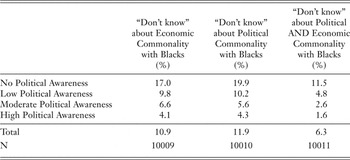
The reception axiom of the RAS model suggests that more politically aware individuals will be more likely to pick up on elite cues regarding economic and political commonality with African Americans than those with less political awareness. Thus, in line with much of the literature on the impact of elite messages, we employ a respondent's level of political awareness as a proxy for reception of elite messages regarding commonality (Dobrzynska and Blais, Reference Dobrzynska and Blais2008; Krosnick and Brannon, Reference Krosnick and Brannon1993; Marquis and Sciarini, Reference Marquis and Sciarini1999; Zaller Reference Zaller1992).Footnote 3 As a result, we hypothesized that the members of our sample with the most political awareness would be more likely to form and express opinions on commonality between Latinos and African Americans. In order to determine the validity of our initial hypothesis, we explored the extent to which more politically aware Latinos gave valid responses to the LNS questions on perceptions of economic and political commonality. Table 1 reports the findings.
“Don't Know” Responses to Commonality Questions

As Table 1 shows, a significant number of Latinos have no opinions about commonality with African Americans. Nearly 11% of Latinos responded “don't know” to the question about economic commonality, almost 12% responded “don't know” to the question about political commonality, and over 6% responded “don't know” to both questions. As Table 1 also indicates, the politically unaware are vastly more likely to say they have no opinion on economic and political commonality with African Americans than those who have a high level of awareness. In other words, the more likely an individual is to receive elite messages, the more likely he or she is to have an opinion about the presence (or absence) of commonality with African Americans.
As discussed above, the RAS model also supplies us with expectations about the reception stage of opinion formation. Positing an interaction between partisanship and awareness, Zaller's model predicts that opinions on political issues will be polarized according to partisanship among the politically aware but not among the less informed when Democratic and Republicans elites send conflicting messages. Given the divisions between Democratic and Republican leaders regarding economic and political relations between Latinos and African Americans discussed above, we hypothesized that partisanship would play an important role in structuring perceptions of commonality among aware—but not unaware—members of our sample. More specifically, we hypothesized that higher levels of political awareness among Democrats would predict stronger feelings of commonality while higher levels of political awareness among Republicans would predict weaker feelings of commonality.
To test our predictions, we conducted separate OLS regression analyses for Democrats, Republicans, and Independents.Footnote 4 The primary independent variable of interest is a measure of political awareness, which is designed to serve as a proxy for exposure to elite messages on intergroup relations. Consistent with the research discussed above, the OLS models predicting perceptions of economic and political commonality with African Americans also include measures of demographic characteristics (age and gender), long-term social characteristics (income and education), acculturation (language of interview and nativity), ideology, self-assessments of skin color, contact with African Americans (the extent to which the respondent has mostly Black friends and coworkers), Latino group consciousness (a series of questions about economic and political commonality with other Latinos),Footnote 5 and perceptions of commonality with Whites.Footnote 6 A list of each of the survey items used in the regression analysis can be found in Appendix A.
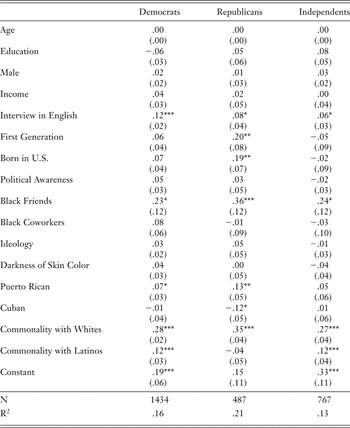
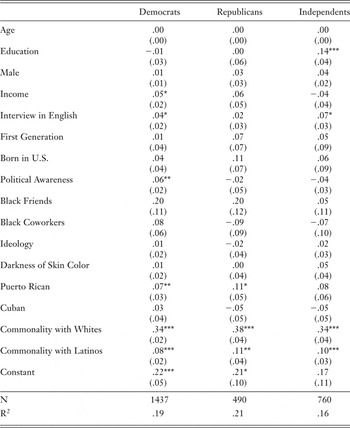
As Tables 2 and 3 show, perceptions of economic and political commonality grow from a number of common sources. First, the extent to which an individual feels economic and political commonality with Whites is an important influence on whether the individual feels a sense of economic and political commonality with African Americans regardless of partisan affiliation. Indeed, as results show, feeling a stronger sense of commonality with Whites is predicted to dramatically increase perceptions of economic and political commonalities that an individual feels with African Americans. Second, feelings of commonality with other Latinos are also important influences on perceptions of commonality with African Americans. To be more precise, feeling a strong sense of commonality with Latinos leads to much stronger feelings of political commonality with African Americans among all partisan groups. Finally, acculturation—measured by the language that the respondent chose to be interviewed in—exerts a significant influence on feelings towards African Americans, particularly seeing economic commonalities with African Americans.
OLS Regression for Perceptions of Economic Commonality, 2006 LNS

* p < .05
** p < .01
*** p < .001
OLS Regression for Perceptions of Political Commonality, 2006 LNS

* p < .05
** p < .01
*** p < .001
More germane to our specific purposes here, we also found that political awareness is an inconsistent predictor of perceptions of economic and political commonality. Contrary to our expectations that Democrats with higher levels of political awareness would express more feelings of economic commonality and Republicans with higher levels of political awareness would express fewer feelings of economic commonality, the results presented in Table 3 show that political awareness has little impact on the extent to which Latinos see something in common economically with Blacks. As Table 3 shows, political awareness also does nothing to explain perceptions of political commonality among Republicans and Independents. For Democrats, however, increases in political awareness lead to increases in perceptions of political commonality. In other words, although there is some evidence in this data that attitudes are responsive to the statements of political leaders, elite opinion leadership appears to be limited to one issue—political commonality—and one subgroup—Democrats.
ELITE INFLUENCE AND THE LATINO DECISIONS SURVEY
Attempts to estimate the impact of elite statements on political attitudes by running regression analyses on cross-sectional survey data are inevitably plagued by a number of methodological problems. Poor proxy measures of exposure to specific messages, spurious omitted variables, the potential for reverse causation, and people's inability to accurately assess the sources of their attitudes make the singular reliance on traditional surveys an unattractive option for drawing firm conclusions about the influence that political elites have on public opinion. By contrast, survey-based experimental designs (which randomly assign subjects to receive different information) can not only maximize internal and external validity but also, and more importantly, provide a closer approximation of the influence that elite rhetoric has on mass opinion (Green and Gerber, Reference Green, Gerber, Milner and Katznelson2002; Piazza et al., Reference Piazza, Sniderman, Tetlock and Stimson1989; Sniderman and Grob, Reference Sniderman and Grob1996).
In order to overcome the multitude of problems associated with studies based solely on cross-sectional survey data, we supplemented our analysis of the LNS with an experiment embedded in the October 2010 Latino Decisions Survey (LDS). The LDS used a random digit dialed sample of Latino registered voters in the United States. Interviews were conducted by telephone in English and Spanish from October 15 to October 28, 2010 among a sample of 300 Latino adults living in twenty-one states that made up 94% of the Latino electorate in 2008, also providing a national snapshot of Latino opinion toward commonality.
Our survey experiment contained three experimental conditions and one control condition. In all the treatment conditions, our subjects were presented with an excerpt from a fictional New York Times op-ed piece. This short op-ed argued that, contrary to popular depictions of the contentious relations between African Americans and Latinos, the two groups actually share a great deal in common.Footnote 7 In order to alert subjects that the source of the op-ed is a Latino political leader and to manipulate the partisanship of the elite source, we identify the author of the piece as “Democratic Representative Antonio Lopez,” “Republican Representative Antonio Lopez,” or “Representative Antonio Lopez.” Subjects were then directed to answer questions regarding the extent to which they felt feelings of political and economic commonality with African Americans. In the control condition, respondents were not exposed to any of the op-ed excerpts listed above and were, instead, immediately directed to answer the questions on political and economic commonality.
To determine the effect of being exposed to an elite cue, we compare the responses of those who were exposed to each of the attributed statements on intergroup relations to the responses of those who were not exposed to the statements. Because inclusion in the treatment and control groups was determined by random assignment, a straightforward way to discuss the results of the experimental manipulation is in the form of a multiple regression. Within the regression models, each of the treatment conditions can be represented by a simple dummy variable (which is coded 1 if the respondent received the treatment in question and 0 if the respondent did not receive the treatment). Since the control condition is excluded from the model, the coefficient for each of the dummy variables represents the differences in means between the particular treatment and control groups.Footnote 8
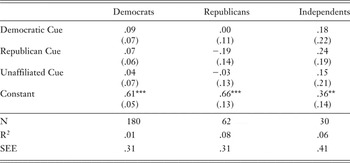
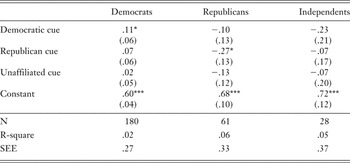
As a test for the effects of exposure to elite messages on commonality, Tables 4 and 5 display the results of the multiple regression analysis among the entire sample as well as among partisan subsamples. A number of findings from these tables are worth discussing. First, none of the experimental conditions had a significant impact on perceptions of economic commonality. As Table 4 shows, the coefficients for the Democratic cue, the Republican cue, and the unaffiliated cue are not significantly different from 0 in the total sample or among any of the partisan subsamples. According to the theory spelled out above, exposure to a positive message regarding commonality from an elite actor should lead to significantly stronger perceptions of commonality—particularly if the message comes from a representative who shares the respondent's partisanship. The results of the survey experiment do not support this expectation. When considered alongside the evidence from our analysis of the LNS data, this finding raises serious doubts about the utility of elite opinion theory in accounting for perceptions of economic commonality among Latinos.
OLS Regression for Perceptions of Economic Commonality, 2010 LDS

* p < .05
** p < .01
*** p < .001
OLS Regression for Perceptions of Political Commonality, 2010 LDS

* p < .05
** p < .01
*** p < .001
Second, consistent with our expectations, Democrats who were exposed to a message on commonality from a Democratic congressman were significantly more likely to express feelings of political commonality than Democrats who did not hear such a message. Specifically, more than three quarters of subjects who heard the statement from their fellow partisan claimed to feel “a lot” or “some” in common politically with African Americans while only half of those who were not exposed to the op-ed chose these options. The fact that Democrats were responsive to this treatment and the fact that they showed evidence of following the cues of political leaders in the LNS data lead us to conclude that elite leadership is an important element of understanding Democratic attitudes on political commonality.
Third, those who do not identify with the Democratic or Republican parties show no responsiveness to elite messages. In many respects, these findings should not be surprising. Indeed, because elite opinion theory emphasizes partisanship as the primary predisposition that anchors an individual's response to political messages, it is poorly equipped to explain the dynamics of attitude change among Independents. What's more, our analysis of the LNS data revealed that political awareness has no impact on the feelings of commonality expressed by self-identified Independents. The findings presented in Tables 4 and 5 offer further proof that elite opinion approaches will likely fall short in explaining why Independents do or do not feel commonality with African Americans.
Finally, similar to Democrats, Republicans who received a message from a congressman of their political party expressed significantly different attitudes on political commonality than Republicans who did not. Surprisingly, however, Republicans exposed to the op-ed from a Republican congressman were dramatically less likely to exhibit feelings of political commonality than those in the control condition. As Table 5 shows, Republicans receiving the Republican-authored message were over a full point on the four-point scale measuring political commonality lower than Republicans receiving no elite statement. The reasons for this are confusing. Although it is tempting to offer an explanation centered around a generalized rejection of elite messages on the part of rank and file Republicans, the evidence shows that a “backlash” only occurs when Republicans are exposed to a Republican op-ed. When coupled with our analysis of the LNS data, this finding strongly suggests that scholars look in other directions to explain the intergroup attitudes of Latino Republicans.
CONCLUSION
What impact do elite messages regarding commonality with African Americans have on the Latino community? Combining an analysis of cross-sectional data from the 2006 LNS with evidence from a survey experiment embedded in the 2010 LDS, this paper tests hypotheses derived from the dominant paradigm in contemporary public opinion research: elite opinion theory. We find that although exposure to elite messages has the predicted impact on perceptions of political commonality among Democrats, it fails to exert any significant influence among other groups and on different dependent variables. Specifically, the evidence presented here shows that reception of persuasive messages from like-minded political leaders contributes nothing to our understanding of how attitudes on economic commonality are formed and nothing to our understanding of where perceptions of political commonality arise from among Republicans and Independents. In short, rather than a blanket approach that assumes rhetoric from political leaders will have the same impact for every individual on every issue, our findings argue in favor of models that acknowledge the highly contextual and group-specific nature of elite influence.
The findings presented here make a number of key contributions to the literatures on commonality, public opinion, multiracial coalitions, and interracial conflict. First, unlike many studies on Latinos' perceptions of commonality with African Americans that focus exclusively on individual-level determinants of commonality, our study finds preliminary evidence that exposure to messages regarding the relations between African Americans and Latinos can also influence Latino perceptions of commonality with African Americans. Yet, much of the current work on the relationship between Latino elites and the Latino mass public focuses attention upon the representative quality of Latino representatives (Bratton Reference Bratton2006; Hero and Tolbert, Reference Hero and Tolbert1995; Kerr and Miller, Reference Kerr and Miller1997), the impact of Latino candidates on Latino voting behavior (Barreto Reference Barreto2007; Leighley Reference Leighley2001; Pantoja and Segura, Reference Pantoja and Segura2003), or on the mobilization of the Latino electorate by Latino elites (Ramírez Reference Ramírez2007; Shaw et al., Reference Shaw, de la Garza and Lee2000; Wrinkle et al., Reference Wrinkle, Steward, Polinard, Meier and Arvizu1996). We hope the conclusions presented here help to expand the boundaries of the literature on Latino public opinion to include studies that examine the direct impact that elite rhetoric may have on the contours of Latino political attitudes.
The second contribution that this study makes is to studies of public opinion more generally by testing the application of Zaller's model for a new population—Latinos—and for a new issue—commonality. As suggested above, there is an open question about how far elite influence will extend (Paul and Brown, Reference Paul and Brown2001). Most studies of elite influence have focused attention on issues that are abstract and complex based on the assumption that elite influence is greater on these issues given the public's proclivity for “rational ignorance” in the realm of politics. Contrary to this research, we find some evidence that elite influence extends to perceptions of political commonality with African Americans, an issue that Latinos easily can become informed about on their own and something which many Latinos experience for themselves in their daily lives (Meier et al., Reference Meier, McClain, Polinard and Wrinkle2004; Mindiola et al., Reference Mindiola, Niemann and Rodriguez2002; Vaca Reference Vaca2004). We also find, however, that elites have only a limited ability to influence perceptions of economic commonality, an issue about which it may be even easier for Latinos to form their own opinions. It appears, in other words, that elites can shape perceptions of everyday life by framing group dynamics in a particular fashion but there are limits on their ability to mold the views of the mass public.
Third, these findings further expand our understanding of the role that elites may play in the formation of multiracial coalitions between America's two largest minority groups. Studies of multiracial coalition formation have pointed to a number of conditions that are necessary to create successful multiracial coalitions—including shared interests, ideology, leadership, and circumstances (Browning et al., Reference Browning, Marshall and Tabb1984; Sonenshein Reference Sonenshein, Browning, Marshall and Tabb2003; Wilson Reference Wilson1999). Although this literature has significantly expanded our knowledge about cooperation between African Americans and Latinos, much of the existing research tells us painfully little about the underlying attitudinal foundations upon which multiracial coalitions might be built. To be exact, existing studies of multiracial coalitions between African Americans and Latinos focus too heavily on objective measures of socioeconomic, experiential, and partisan similarities and largely ignore the significant role that perceptions of commonality are likely to play in any effort to construct sustainable coalitions. We hope that the results of the analysis presented here will refocus attention on the importance of feelings of economic and political commonality in coalition formation and, more importantly, remind scholars of the primacy of political leadership in forging bonds of cooperation across racial and ethnic lines.
While we believe our findings make a strong initial case for further exploring the role of elite discourse in understanding the mass public's perception of race relations, we also believe that there is much more to be done. First, we recognize that our definition of elites, although in line with much of the work in political science, may unduly restrict the number of influential voices in the Latino community. As a result, we are in agreement with Lee (Reference Lee2002) and McClain et al. (Reference McClain, Carter, Soto, Lyle, Nunnally, Scotto, Kendrick, Grynaviski, Lackey, Cotton, Junn and Haynie2008) that when examining minority communities, the definition of “elite” should include not only political actors who are part and parcel of formal institutions, but individuals located at the boundaries of this formal political system such as local community leaders, church leaders, media personalities, and national interest group leaders, actors who all have historically been influential in shaping Latino opinion and participation in the United States (Brennan and Kim, Reference Brennan and Kim2006; Garcia Reference Garcia2003; Hammerback et al., Reference Hammerback, Jensen and Gutierrez1985; Kaplowitz Reference Kaplowitz2005; Leighley Reference Leighley2001; Marquez and Jennings, Reference Marquez and Jennings2001; McManis Reference McManis2006). Regrettably, our study examines only the impact of Latino elites whose “primary business is governing the nation” (Carmines and Kuklinski, Reference Carmines, Kuklinski, Ferejohn and Kuklinski1990, p. 266). Future work should examine if elite influence extends to other key Latino leaders both within and outside of formal political channels.
Future research should also more systematically examine the content of elite messages regarding both economic and political commonality with African Americans to get a more complete picture of the nature of elite rhetoric on this issue (e.g., whether there is a polarized or unified elite communication environment). In line with the argument set forth by Morin et al. (Reference Morin, Sanchez, Barreto, Telles, Sawyer and Rivera-Salgado2011), we also believe that future work should seek to develop more relational measures of commonality that place Latino's perceptions of commonality with other groups alongside their feelings about other Latinos. In addition we believe that new measures of commonality should reflect not only the social, political, and economic similarities between groups, but the philosophical aspects of commonality that speak to: a sense of belonging and identification with a collectivity that is important to members (i.e. minorities or people of color), a degree of mutual concern among members which is greater than that for human beings generally, a sense of linked fate, mutual trust, and loyalty as well (Blum Reference Blum2007; Shelby Reference Shelby2005). In order to provide a more encompassing portrait of the role of political elites in guiding opinion on race relations, future studies may also contribute to the work we have done here by not only examining the impact of elite messages on African American's perceptions of economic and political commonality with Latinos, but also exploring the role that political elites play in fostering perceptions of competition between the groups. Until work on these questions is done, definitive answers about the extent to which the mass public is simply following elite directives on inter-minority race relations will remain elusive.
APPENDIX A: QUESTION WORDING IN LATINO NATIONAL SURVEY
Economic Commonality with African American Americans
Thinking about issues like job opportunities, educational attainment, or income, how much do (Hispanics/Latinos) have in common with other racial groups in the United State today? Would you say (Hispanics/Latinos) have a lot in common, some in common, little in common, or nothing at all in common with … African Americans?
Political Commonality with African Americans
Now I'd like you to think about the political situation of Hispanics/Latinos in society. Thinking about things like government services and employment, political power and representation, how much do Hispanics/Latinos have in common with OTHER RACIAL GROUPS IN THE UNITED STATES TODAY? Would you say Hispanics/Latinos have a lot in common, some in common, little in common, or nothing at all in common with … African Americans?
Economic Commonality with Whites
Thinking about issues like job opportunities, educational attainment, or income, how much do Hispanics/Latinos have in common with other racial groups in the United State today? Would you say Hispanics/Latinos have a lot in common, some in common, little in common, or nothing at all in common with … whites?
Political Commonality with Whites
Now I'd like you to think about the political situation of Hispanics/Latinos in society. Thinking about things like government services and employment, political power and representation, how much do Hispanics/Latinos have in common with OTHER RACIAL GROUPS IN THE UNITED STATES TODAY? Would you say Hispanics/Latinos have a lot in common, some in common, little in common, or nothing at all in common with … whites?
Economic Commonality with Other Latinos
Thinking about issues like job opportunities, educational attainment, or income, how much do you have in common with other (Hispanics/Latinos)? Would you say you have a lot in common, some in common, little in common, or nothing at all in common?
Political Commonality with Other Latinos
Now thinking about things like government services and employment, political power, and representation, how much do you have in common with other Hispanics/Latinos? Would you say you have a lot in common, some in common, little in common, or nothing at all in common?
Political Knowledge—Question #1[
Which political party, Democrat or Republican (alternate order), has a majority in the United States House of Representatives?
Political Knowledge—Question #2
In the United States, presidential elections are decided state-by-state. Can you tell me, in the election of 2004, which candidate, Bush or Kerry, won the most votes in (respondent's current state of residence)?
Political Knowledge—Question #3
Which one of the political parties is more conservative than the other at the national level, the Democrats or the Republicans?
APPENDIX B
Democratic Treatment
In a recent New York Times editorial, Democratic Representative Antonio Lopez said, “African Americans and Latinos share a great deal in common and face a strikingly similar set of challenges. Both groups experience higher unemployment rates, lower incomes and lower levels of educational achievement than whites. Both groups are underrepresented in the nation's corridors of political power, struggle with tragically under-funded public services, and neither has been able to fully overcome a long legacy of racial discrimination. When we blindly accept media accounts that emphasize the relatively small disagreements between Blacks and Latinos, we fail to see the multitude of interests, experiences and preferences they share in common.”
Republican Treatment
In a recent New York Times editorial, Republican Representative Antonio Lopez said, “African Americans and Latinos share a great deal in common and face a strikingly similar set of challenges. Both groups experience higher unemployment rates, lower incomes and lower levels of educational achievement than Whites. Both groups are underrepresented in the nation's corridors of political power, struggle with tragically under-funded public services, and neither has been able to fully overcome a long legacy of racial discrimination. When we blindly accept media accounts that emphasize the relatively small disagreements between Blacks and Latinos, we fail to see the multitude of interests, experiences and preferences they share in common.”
Nonpartisan Treatment
In a recent New York Times editorial, Representative Antonio Lopez said, “African Americans and Latinos share a great deal in common and face a strikingly similar set of challenges. Both groups experience higher unemployment rates, lower incomes and lower levels of educational achievement than whites. Both groups are underrepresented in the nation's corridors of political power, struggle with tragically under-funded public services, and neither has been able to fully overcome a long legacy of racial discrimination. When we blindly accept media accounts that emphasize the relatively small disagreements between Blacks and Latinos, we fail to see the multitude of interests, experiences and preferences they share in common.”
Control Group—No Prompt
Thinking about issues like job opportunities, educational attainment, or income, how much do [ROTATE: Latinos/African Americans have in common with African Americans/Latinos] in the United States today? Would you say Latinos have a lot in common, some in common, little in common, or nothing at all in common with African Americans?
(1) Nothing
(2) Little
(3) Some
(4) A Lot
(88) Don't Know
(99) Refused
Now I'd like you to think about the political situation of African Americans and Latinos in society. Thinking about things like government services and employment, political power and representation, how much do [ROTATE: Latinos/African Americans have in common with African Americans/Latinos] in the United States today? Would you say Latinos have a lot in common, some in common, little in common, or nothing at all in common with African Americans?
(1) Nothing
(2) Little
(3) Some
(4) A Lot
(88) Don't Know
(99) Refused