Introduction
The Kingdom of Saudi Arabia (KSA) enacted its first strategic plan of action for conserving its biodiversity in 2005 after becoming a signatory to the Convention in Biological Diversity (CBD) in 2001 (NCW, 2005). The plan emphasizes that indigenous breeds of livestock are part of the biodiversity of the Kingdom and that they represent invaluable commodities (e.g. protein sources) in a context where KSA depends on imported animal products to meet the increasing demands from local consumers. Accordingly these genetic resources must be conserved. Several regulations and measures have been put in place to prevent endangered livestock and wildlife to become extinct. For example, the establishment of the National Committee of Medical and Bioethics, approved by a royal decree, regulating research involving human and animals, including endangered species, subjects (KACST, 2010) and the creation of the King Abdul Aziz Arabian Horses Center, a success story in maintaining and conserving indigenous Arabian horses in KSA.
The loss of indigenous livestock breeds means a loss of well-adapted animals to local environments and production conditions at a time where the production systems are facing the challenge of climate changes and where sustainability is increasingly becoming an important characteristic of all livestock production systems. The indigenous (locally called Baladi) cattle of KSA are well-adapted to local environment of dry areas and they are thought to be resistant to tropical diseases (Mason and Maule, Reference Mason and Maule1960; ACSAD, 1988). Until now the population size of these cattle population has been poorly documented. It is has been reported that the numbers of the indigenous cattle reared in traditional systems have declined from 130 136 head in the year 2008 to 102 438 head in 2012 (MOA, 2013). At the opposite, cattle censuses have showed sharp increase for exotic cattle in specialized dairy farms (MOA, 2013).
Indigenous cattle remain the common breed in traditional production systems. Most of them are reared in southwest part of KSA and they belong to a breed called Janobi. In the East region of KSA, there is another group of indigenous cattle described earlier in the literature, called Hassawi (Mohammed, Reference Mohammed1997; Al-Shami, Reference Al-Shami2003). These two populations have been described as Indian zebu type of cattle (ACSAD, 1988), whereas indigenous taurine cattle have reported to be reared in the Central and West regions of KSA. However, to the best of our knowledge, they are no scientific literature regarding these indigenous Saudi taurine cattle.
The objective of this study was to assess and to document the current situation, phenotypic diversity and origin of indigenous cattle across all regions of KSA, in a context of changes in agricultural practices and increasing importation of exotic breeds.
Materials and methods
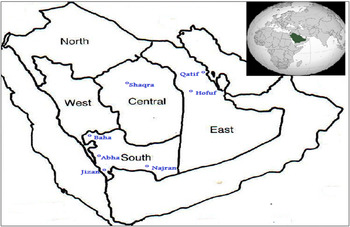
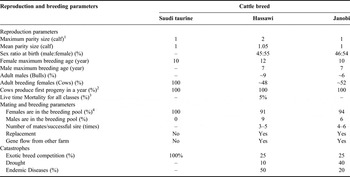
A stratified random sampling survey was used to search for the presence of indigenous cattle population phenotypically distinct and/or representing different ecotypes. The survey was conducted in rural areas across the five recognized regions of KSA (North, East, Central, West and South (Figure 1). Their topography includes plains, mountains, deserts and plateaus. The climate of KSA is a desert climate characterized by extreme heat during the day, and low temperature at night. The weather is rather temperate in the North and the south-north heights and humid at the coastal region. In the East, along the Arabian Gulf, there is a low-lying region called Al-Hasa. The survey was done in collaboration with the Ministry of Agriculture personnel. The stratification survey involved dividing the existing cattle population into groups before recording the description and characteristics of the breed. The survey was designed to capture phenotypic, reproduction and breeding parameters data, geographic location, the presumed origin of the populations and any catastrophic event that has occurred (Table 1).
Map of Kingdom of Saudi Arabia where indigenous cattle were surveyed: Qatif and Hofuf in East region, Shaqra in Central region and Baha, Abha, Jizan and Najran in South region.

Reproduction and breeding parameters recorded during our census for the three Saudi Arabian indigenous cattle breeds.

1 The annual maximum number of progeny per cow; when single is listed 1 and twin listed 2.
2 The ratio is calculated from number of cows entering the herd for the first time, to those out of them produced first progeny.
3 Measure of death rate in the entire population. It is calculated from number of animal deaths in the entire studied population.
4 The breeding pool is defined as sum of number of the breeding male and breeding female.
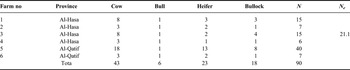
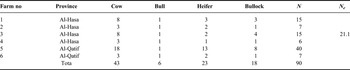
Census data of cows, bulls, heifers and bullocks were also collected to estimate population size in each region. In the South region, the indigenous cattle are reared in herds in remote areas, while in the East region, the census data were estimated based on surveying all cattle at farm levels. Table 2 shows the results from six Hassawi cattle farms surveyed in the East region. Effective population size (N e ) was estimated for Hassawi cattle population based on the number of breeding males (N m ) and breeding females (N f ) found at the farms as N e = 4(N m × N f )/(N m + N f ) (Falconer, Reference Falconer1989) (Table 1). In addition, phenotypic and production parameters of the cattle were also surveyed during sampling whenever available. In the Central region only two farms with a total of 13 indigenous cattle, were found. The survey team found no indigenous cattle in the North region. Finally, in southern and western regions, seven farms were surveyed. The number of surveyed cattle in each farm ranged from 8 to 22 heads. The linear body measurements were taken for mature cows and bulls when the standing naturally with head raised and weight on all four feet. Body length was measured from the point of the shoulder to the pin bone, height at withers from the ground level to the highest point of withers, head length from poll to nose, head width for distance between the temples, ear length from the base of the ear to its tip, horn length from the horn base to the tip, hump height from the base of the hump to its highest point and tail length from the base of the tail to its tip. Colour of coat was recorded visually.
Total (N) and effective (N e ) population size of Hassawi cattle in the East region of Kingdom of Saudi Arabia in the year 2014.
Results
Saudi indigenous cattle were found in three out of the five KSA regions surveyed during the year 2014. The results showed that two worldwide species of cattle, taurine (Bos taurus) and zebu (Bos indicus), were found in KSA.
Saudi Taurine cattle (Bos taurus)
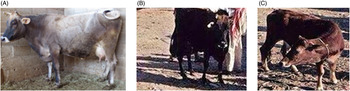
A single phenotypically pure indigenous taurine cattle was found in the Central region of KSA. The geographic area of finding is in agreement with evidences of indigenous taurine presence of this region in the past. More particularly this unique pure taurine female (10 years old) was found in Shaqra city (Figure 2A). This Saudi taurine cow matched with available historical information, phenotypic records and images of the pure Saudi breed that lived in the region few decades ago (Figure 2B, C). For example, its phenotype and morphology matched with available images (R. S. Aljumaah., personal communication, 2014) of cows reared in the same region taken in 1976. Based on these evidences, we consider this cow as a pure individual of Saudi taurine cattle from the Central region and the only one found during our survey. This pure indigenous Saudi taurine was characterized by a small body size, a varied coat colour from black to brown, small horn and legs (Figure 2). This cow might be the last individual of this breed left and therefore, in the absence of any taurine bull, we consider the breed as extinct.
Photos of Saudi Arabian taurine cattle reared in (Central Region). (A) Indigenous cow in 2014, (B) and (C) indigenous cow in 1976.

Saudi Indian cattle (Bos indicus)
The zebu cattle Bos indicus, were found and they are classified into two breeds. These are Hassawi and Janobi cattle breeds found in the East and South regions, respectively. Both breeds have close morphological and production traits. Both breeds are considered as indigenous by the local people.
Hassawi cattle breed
Hassawi cattle were found in the East region of KSA around the Hofuf and Qatif cities close to the Arabian Gulf (Figure 1). Hassawi cattle were found in six small farms with numbers between 6 and 40 heads per herd (Table 2). Five of them were surveyed in Hofuf city (Al-Hasa area). In total, 90 heads of cattle were surveyed (Table 2). Hassawi cattle are therefore reared into small numbers under small-scale traditional farms. The N e for this population, combining data from both areas is 21.1. Our census number shows a sharp and continuous decrease in comparison with previous years. If the decreasing trend continues (Table 2), Hassawi cattle could become extinct in the next coming few years.
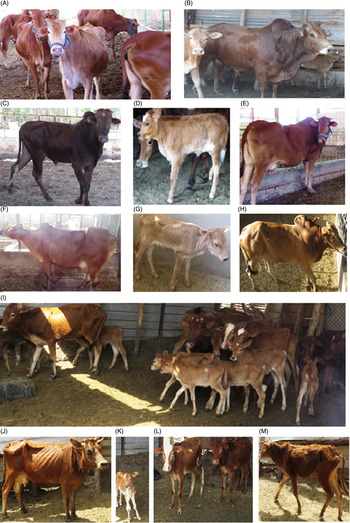
Outcomes from the surveys indicate that the main purpose of rearing Hassawi cattle is to provide milk for household consumption. The milk yield of this breed is low likely following a low inputs management system with poor quality and scarcity of feed rather than a low genetic potential, but further studies are needed here. Calf meat of this breed was preferred over other livestock's meat by local people. Their reasonable conformation, growth rate, meat yield and other good carcass traits are appreciated by the local farmers. The herds are usually kept under a sedentary production system (in permanent confinement) with separated barns for cows, heifers, bulls and bullocks as well as calves (Figure 3). The feed was green fodder and hay with supplements of low-quality date palm. Calves were kept in separate barns and allowed to suckle their mothers twice a day (Figure 3D). The dominant breeding plan is to keep at least one mature bull selected from the herd to be the sire of heifers and cows.
Hassawi zebu cattle from Hofuf and Qatif Provinces in the East Region of KSA (photographs taken in April 2014).

The Hassawi breed was phenotypic homogenous and exhibited little variations in body dimensions and colour. The measured traits of body length, height at wither and mature weight were 180 and 165 cm, 158 and 150 cm, and 215 and 175 kg for mature bull and cow, respectively. It might be considered that body size of Hassawi cattle was medium. The body coat colour varied from dark brown to red with short hair and some pigments. The head length and width were 60 and 46 cm, 35 and 21 cm for mature bull and cow, respectively. The head is small in relation to the body size with long and triangular face. In addition, they have medium size erected ears. The bulls have small horns, whereas females have vestigial horn or are hornless. They have a little dewlap. The hump is clearly visible in bulls (Figure 3H) but defined in cows (Figure 3I). The tail is long and markedly advanced on the back. The udder is small with small teats (Figure 3A). The mature cows have a fair body depth and short width at the chest and flanks (Figure 3A). The body condition score was considered low (less than 3) with ribs easily seen. The legs are long and light with fine bones (Figure 3G, L, M). The overall mortality rate was estimated to be relatively low, namely less than 5 percent a year.
Janobi cattle breed
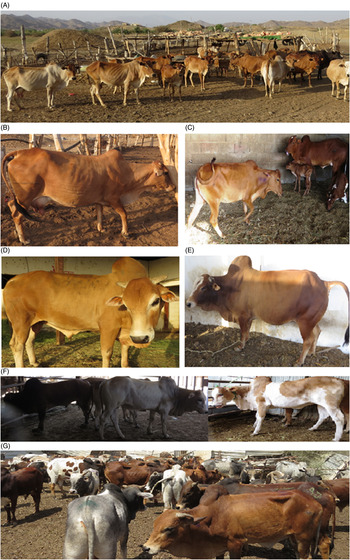
The second breed of Saudi zebu cattle was found in the South and West regions of KSA. They are called Janobi, which means in Arabic language southern. The surveyed areas in these regions covered four main provinces; Baha, Abha, Jizan and Najran (Figure 4). In general, this cattle breed is unevenly distributed over the entire South and West regions of KSA (Figure 4), but mostly in Jizan and Najran. Herd size ranges from five to a few hundred heads. They are kept in pastoral to sedentary productions systems. Most of Janobi cattle herds found in Baha and Abha are reared under the pastoral system (Figure 4A) with mature cows grazing pastures, rangeland and side-roads. The herds at Jizan and Najran are kept under the sedentary system with animals confined in barns. Both production systems are characterized by poor and traditional inputs. The population size of this breed is assumed to be in the order of a few thousands with therefore no endangerment or threats of extinction. The breed exhibits wide variation in body conformation and coat colour. They are reared in harsh environmental conditions, which prevail in most parts of the region. Janobi breed is maintained in a low input production system with very old traditional and unimproved practices (Figure 4A, B). Furthermore, the survey indicates that this breed is kept for its ability to produce milk for household consumption under the harsh condition of heat stress and feed scarcity characteristic of the region. Compared with the Hassawi breed, given the bigger sizes of udder and teats, the Janobi breed has more potential to be developed as a local indigenous milk breed (Figure 4B, E, F).
Janobi Zebu cattle. Baha city (A, B, C, D, E, F) and Abha city (G) both in the South region of KSA (photographs taken in April 2014).

There were no dominant breeding practices noticeable all over the studied south-west region. Most farmers usually keep at least one family-based selected bull from same herd to be the sire of heifers and cows regardless of any inbreeding considerations. The bulls were usually kept in permanent confinement with separated barn. Newly born calves with their mothers for suckling were also kept separately (Figure 4C). The feeding plan is grazing whenever it is available during the year. Supplements of green fodder, hay and other vegetable leftovers are given.
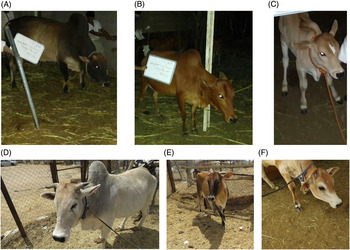
The average measured traits of body length, width and height at wither were 138, 66 and 135, and 133, 65 and 130 cm for mature bull and cow, respectively. The head length and width were 55.2 and 32, and 31.6 and 23.7 cm for mature bull and cow, respectively. The body size could generally be assumed to be medium for mature females and males. The head is long and medium in size in relation to the body size. They have medium size erected ears for both sexes. The bulls have medium straight horns of 15 cm on average length, whereas females have either rudimentary or small straight horns. Both mature sexes have an obvious dewlap (Figure 5A, F and 5B, D). The hump is clearly seen in bulls (20 cm in length and 35 in width) and cows (10 cm in length and 20 in width). In general, body score were reasonably good with fair chest and flanks flatted over seen ribs. The legs are strong and long with noticed bones, suggesting that the animals have ability to walk long distances (Figures 4 and 5). The tail is long and markedly advanced on the back. As indicated above, despite smaller body conformations than Hassawi individuals, the udder and its teats are bigger than those of Hassawi. As a consequence, milk production in this breed might show good potential considering the low input production system, in which they are kept. Last but not the least variation at phenotypic and performance traits support a broad genetic base for the breed (Figures 4 and 5). For example, the Janobi cattle exhibited wide variations in body coat colour (Figures 4 and 5). The body coat colour varied from creamy to black. The reddish coat colour was dominant in most of the herds from Baha down to Najran (Figures 4 and 5). In addition, the body coat was characterized by short hair. Pigmentations were noticed in different parts of the body.
Janobi zebu cattle taken in Jizan city (A, B, C) and in Najran D, E, F in the South region of KSA (photographs taken in April 2014).

Rearing indigenous cattle along with exotic cattle
During the survey, we observed in several cases the presence of an exotic bull within the herd, which is used in mating with indigenous cows. This F1 cross-breeding is considered as the main threat for the conservation of the genetic diversity of indigenous Saudi cattle population. The farmers practice cross-breeding mating or even breed replacement with exotic breed in order to improve milk production.
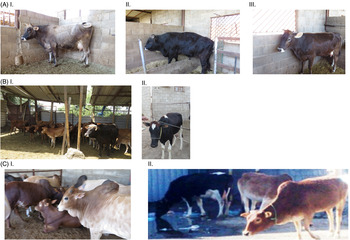
There was a case where an exotic Brown Swiss bull was used for breeding a herd of 20 females in order to produce heavier calves (Figure 6A). It was in the same farm where the last pure Saudi Arabian taurine cow was found (Shaqra city). The exotic bull was allowed to mate with all taurine × zebu hybrid females present in the farm as well as the last pure indigenous cow (Figure 6A). In a Hassawi cattle herd an exotic bull was allowed to mate with the indigenous Hassawi heifers (Figure 6B-I). In addition, a hybrid Hassawi–Friesian heifer was produced by crossing indigenous Hassawi cow with the presence of Holstein–Friesian bull in order to improve milk yield while keeping the adaptive environmental traits of the Hassawi (Figure 6B-II). Finally, a similar situation was observed for the Janobi breed with exotic bulls reared along Janobi cows in different farms in the South and West regions. For example, exotic Somali beef bulls were imported for meat consumption and used as terminal sire with local Janobi cows for better meat yield (Figure 6C-I), while Holstein–Friesian bulls were used to produce hybrid cows in the same breed (Figure 6C-II).
Photographs illustrating cross-breeding of indigenous Saudi cattle with exotic. (A–I) Represent the pure indigenous Saudi taurine cow II. Represent exotic Brown Swiss bull III. Represent a hybrid offspring cow. (B) Images of an exotic beef bull and indigenous Hassawi heifers (I) hybrid Hassawi–Friesian heifer (II). (C) Somali bullocks allowed to breed with Janobi indigenous heifers in Baha city (I). Hybrid Janobi–Friesian heifer in Najran (II).

Discussion
Our survey was performed in accordance to Ericson (Reference Ericson1965) recommendation sampling each subpopulation independently within an overall population. We found indigenous cattle in 3 out of the 5 regions of the KSA. The survey indicates that two main cattle species (taurine, zebu) (Grubb, Reference Grubb, Wilson and Reeder2005) are present, although today we were only able to record a single indigenous taurine cow. We also found exotic European taurine as well as exotic zebu breed. The taurine cattle were found in the Central region, whereas zebu cattle belong to two breeds (Hassawi and Janobi) found in the East and South regions, respectively. Both Zebu breeds have variable morphological and production traits, and it is of our opinion that they should definitively be considered as two distinct breeds. Although in the past some reports have lumped them as one breed, even though morphological and production differences were reported (ACSAD, 1988).
We consider the taurine cattle in KSA now virtually extinct as only one 10-year old female was found; although it remains possible more animals could be present in areas and regions not covered in this study. The extinction of a breed is considered when either sexes or one of them disappeared (FAO, 2000). The observations from the current survey indicated that these indigenous taurines are characterized by low milk production, a likely slow growth rate and a small body size. It should be noted that our survey does not allow us to distinguish between the possible low genetic potential of the breed as milk producers and the consequence of low management inputs in a production system where indigenous cattle are kept under harsh environmental conditions. Moreover, the introduction of exotic breeds in 1970s which lead to many hybrid animals with different proportion of exotic genetic background and with, based on our observation, no obvious loss of fitness is further complicating the issue.
There are hardly any available studies or reports regarding indigenous Saudi taurine cattle. A study aimed at surveying the presence of coccidian parasites reported that 205 indigenous domestic cattle Bos taurus from five regions of KSA were examined in 1985 (Kasim and Al-Shawa, Reference Kasim and Al-Shawa1985). It suggests that the number of Saudi taurine was at least a few hundred in the 1980s.
The endangerment level is a function of the downward trend in the number of breeding animals at a country or geographical level (FAO, 1995; Al-Atiyat, Reference Al-Atiyat2009). The number of breeding animals is the most common assessing system of endangerment of any species or breed (1995). In fact, there are more assessing system commonly used (DGFZ, 1991; European Commission, 1992; EAAP, 2005). The FAO (1995) system is the most commonly used. It states that if N e is less than 82 then the breed is at a critical and endangered level. Using these criteria, following the results of Table 2 for the Hassawi cattle breed, the breed has reached the critical level of endangerment and it may face extinction in the near future. Their overall N e was 21.1 which is much less than the reported critical N e value.
Hassawi cattle are kept in small numbers on some small-scale traditional farms in the Eastern province of the KSA. In fact, the breed has been previously described in the literature (Mohammed, Reference Mohammed1997; Al-Shami, Reference Al-Shami2003). Census number shows sharp and continuous decrease over the last years (MOA, 2013). The major threat is the culling of the cattle as a result of endemic tuberculosis outbreaks. Due to this and other anticipating threats (e.g. feed scarcity and cross-breeding practices), Hassawi cattle breed may become extinct in the coming few years, and thus their potential as indigenous genetic resources will be lost. Institutional support and conservation initiatives are needed for saving the breed. . It is worth mentioning that the only cattle market in the KSA was at Al-Hasa (Figure 7A). The cattle used to be flown in and out of the market from all nearby gulf countries. Hassawi cows seen in this market were phenotypically different from the cow of 1970s (Figure 7A).
Ancient images of Saudi Arabian Zebu indigenous cattle (A) Hassawi cow, cattle market in Hofuf (1976), (B) Janobi cow from Jizan city (1985), (C). Janobi cow from Najran (1985). (D) Janobi bull from Abha city (1985) and (E) Janobi cow from Baha city (1985).

Similarly, old images of indigenous cattle breed from different regions dating from the same period of Al-Hasa market pictures (in year 1976) matched with the present indigenous cattle photographs both in size, conformation and colour (Figure 7B–E).
The indigenous cattle of the KSA represent still today a source of valuable animal proteins in the form of milk and meat. Their importance and uniqueness comes from their adaptation to the local harsh environmental conditions including water scarcity, heat stress and endemic diseases. Nasher (Reference Nasher1990) reported that indigenous cattle in Asir, in south-western KSA, were well-resistant to 13 parasite species. They also showed resistance to ticks infestation and tick-borne diseases.
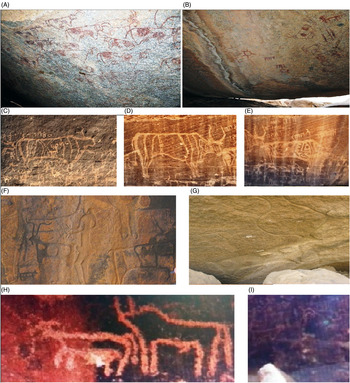
We also observed an ancient rock art of wild and domesticated cattle in different regions of KSA during our cattle survey (Figure 8). Ancient drawing of what may be interpreted as domesticated cattle was first seen in caves in Al-Shouq valley in Abha city (Figure 8A, B). The most overwhelming cattle rock arts were seen in Najran province, at the site of the ancient citadel of Al-Okhdood and at Bir Hima (Figure 8 C, D, E). These ancient drawings are assumed to date from the period of 2500–1000 BC (Jennings et al., Reference Jennings, Shipton, Al-Omari, Alsharekh, Crassard, Groucutt and Petraglia2013; Olsen, Reference Olsen2013). Cattle are the most common representation of animals in more than 25 sites in the KSA (Jennings et al., Reference Jennings, Shipton, Al-Omari, Alsharekh, Crassard, Groucutt and Petraglia2013; Olsen, Reference Olsen2013). For example, Figure 8(F) shows engravings of goats (ibex or wild) and bovids (wild or domesticated cattle), on the right, including a large example with horns and head turned to one side. The second image shows equally a wild or domesticated bovid (Figure 8G). These two examples were reported by Jennings et al. (Reference Jennings, Shipton, Al-Omari, Alsharekh, Crassard, Groucutt and Petraglia2013) in the Jubbah area of northern KSA. The presence of some piebald coats indicate that some of these bovids were domesticated animals (Figure 8G) (McCorriston and Martin, Reference McCorriston, Martin, Petraglia and Rose2009). Furthermore, heritage drawings of mating Saudi taurine cows and bull indicate breeding in the Central region (Figure 8H). Another drawing was seen at the same place showing a likely pregnant taurine cow (Figure 8I). Both drawings were found in Soaj Mountain near the Qassim area on the Najad Plateau of the Central region.
Example of ancient rock art depicting domestic cattle in different sites in Kingdom of Saudi Arabia (KSA) dated around the first millennium period (BC or AD?) (Jennings et al., Reference Jennings, Shipton, Al-Omari, Alsharekh, Crassard, Groucutt and Petraglia2013; Olsen, Reference Olsen2013). (A) and (B) Rock painting of humpless domesticated cattle drawn (Al-Shouq valley in Abhaa city south-western KSA). (C), (D) and (E) Cattle rock carving (ancient citadel of Al-Okhdood and Bir Hima sites in Najran in southern KSA. (F) and (G) Rocket carving of bovides in Northern KSA (Jennings et al., Reference Jennings, Shipton, Al-Omari, Alsharekh, Crassard, Groucutt and Petraglia2013). (H) Drawings of a taurine cows and bull (Soaaj Mountain near Qassim region on the Najad Plateau) and (I). t Pregnant taurine cows, (Soaaj Mountain near Qassim region on the Najad Plateau). Photo credits etc.

These pictorial evidences emphasize that KSA was a habitat of wild, ancient and indigenous cattle and while the wild relatives became extinct in the past, our study shows that today their domesticated counterparts may follow the same path in the Kingdom. Once these valuable animal genetic resources are lost, the KSA will have to depend exclusively on imported cattle animal products, particularly meat, to meet increasing demand by consumers. Moreover, the loss of indigenous livestock breeds means the loss of important animal genetic resources well-adapted to local environments and production conditions. Urgent measures and interventions are now required. More particularly, it is recommended that the indigenous cattle of the KSA are further characterized at phenotypic and genotypic levels for implementing sustainable conservation plan.
Conclusions
The current status of indigenous cattle in KSA indicated the existence of two main separate types; taurine and zebu cattle. Saudi taurine cattle are currently considered under the threat of extinction or even extinct because they have disappeared in many regions where they had existed previously and only a single pure cow was found. On the other hand, the zebu cattle are in a better situation being found in large number. However, N e of Hassawi zebu cattle breed has now reached the endangerment level of extinction as a result of continuous downward trend in number over the years. The Janobi cattle breed is still common and it is not in danger of extinction in the short-term. The threat of extinction exists due to the following for example disease outbreak and culling, cross-breeding and scarcity of food. Archaeological pictorial evidences indicate the presence of wild and domesticated cattle in the KSA in large number in the past. However, today the remaining indigenous cattle populations of the KSA are the modern legacy of the ancient pastorals societies. We recommend that in parallel to molecular and quantitative characterization studies, conservation plans must urgently be put in place to conserve these unique livestock genetic resources of the KSA.
Acknowledgement
The authors would like to extend their sincere appreciation to King Abdul-Aziz City for Science and Technology (KACST) for funding this research (project number M-P-33-18).
Conflict of Interest
The authors wish to state that there is no conflict of interest in regards to this manuscript.