Introduction
Patients with schizophrenia die more frequently from sudden cardiac death than the general population.Reference Hou, Hung, Jhong, Tsai, Chen and Kuo 1 Antipsychotics are suggested as one of the causes of increased risk of sudden cardiac death.Reference Hennessy, Bilker and Knauss 2 In fact, antipsychotics are associated with a threefold increase in risk of sudden cardiac death.Reference Straus, Bleumink and Dieleman 3 Cardiac death can be caused by several mechanisms. In particular, a fatal polymorphic ventricular tachycardia, torsades de pointes (TdP), is associated with some antipsychotics.Reference Glassman and Bigger 4 TdP is rare and cannot be predicted, but prolongation of the QT interval corrected for heart rate (QTc) serves as a risk factor for TdP and is used as a proxy for TdP in clinical practice.Reference Fermini and Fossa 5
Both typical and atypical antipsychotics have been associated with prolonged QTc interval when used as monotherapy.Reference Leucht, Cipriani and Spineli 6 , Reference Hasnain and Vieweg 7 It has become common to use antipsychotic polypharmacy in the treatment of schizophrenia.Reference Barnes and Paton 8 However, because of contradictory evidence, it is uncertain whether antipsychotic polypharmacy prolongs the QTc interval more than antipsychotic monotherapy.Reference Barbui, Bighelli and Carrà 9 – Reference Takeuchi, Suzuki, Remington and Uchida 11 A recent systematic review did not find an increased QTc interval in patients with schizophrenia treated with antipsychotics, but the available evidence is scarce and inconsistent.Reference Takeuchi, Suzuki, Remington and Uchida 11
The aim of the present study was to investigate the associations between QTc interval and antipsychotic monotherapy and polypharmaceutical treatment, and to examine whether monotherapy and polypharmacy relate to the dose of antipsychotic.
Methods
Design
The study was a prospective, dual-center, naturalistic study of unselected patients with schizophrenia visiting outpatient facilities. It is part of an interventional quality-assurance project to prevent early death from somatic causes in patients with mental illness.Reference Hansen, Hjorth, Kristiansen, Vandborg, Gustafsson and Munk-Jørgensen 12
Sample
Inclusion criteria
Patients diagnosed with schizophrenia according to the ICD–10 research criteria were included. 13 Patients were recruited from two psychiatric outpatient clinics in the Central Region of Denmark: Regional Hospital Herning and Regional Hospital Randers. Both facilities treated first-ever diagnosed patients, aged 18–45 years, in an intensive 2-year treatment program.Reference Petersen, Jeppesen and Thorup 14 The patients were enrolled consecutively from January of 2013 to June of 2015.
Patients with chronic schizophrenia treated at Regional Psychiatry West who were diagnosed at least two years prior to the start of the project were also included.
Data
Demographic and clinical characteristics
Data on age, sex, height, weight, blood pressure, tobacco use, heart rate, illness duration, diabetes medicine, heart medication, antidepressants, mood stabilizers, and antipsychotic drugs were collected, along with clinical activity, and registered into a research database. Illness duration was defined as the time between first-ever contact with psychiatric healthcare, regardless of diagnosis and date of the interview. Doses of antipsychotic drugs were transformed into a defined daily dose (DDD). 15 QTc-prolonging antipsychotics were defined as quetiapine, ziprasidone, sertindole, chlorprothixene, clozapine, haloperidol, risperidone. 16
Electrocardiogram
A standard 12-lead paper electrocardiogram (ECG) was recorded at 25 mm/s and then scanned (HP Scanjet G3110) at 600 dpi. Using an on-screen caliper, the ECG was analyzed at a magnification of 800%. To eliminate interobserver variability, the analyses were performed by a single observer (TC). The QT interval was measured from the onset of the QRS complex to the offset of the T wave, defined as the deflection of the T wave where it returns to the isoelectric line or as the nadir between the T and U waves. The QT interval was measured in three successive beats in lead II, and a mean QT was calculated. Fridericia’s formula (QT/RR1/3), RR being the time between beats representing the heart rate, was employed to calculate the QTc.Reference Goldenberg, Moss and Zareba 17 In accordance with the original definition of prolonged QTcReference Schwartz, Moss, Vincent and Crampton 18 and previous studies,Reference Goldenberg, Horr and Moss 19 we a priori defined QTc prolongation as a QTc interval longer than 440 ms. Using this cutoff for QTc prolongation, healthy individuals may erroneously be categorized as having prolonged QT. However, this definition ensures identifying patients who may experience severe consequences from a prolonged QT interval.Reference Schwartz, Moss, Vincent and Crampton 18 , Reference Fanoe, Kristensen and Fink-Jensen 20
The PR interval and QRS duration were calculated as the mean of measurements in three beats in lead II.
Statistical analysis
Descriptive statistics regarding patients’ characteristics were calculated with index data for all participants. Mean values for QTc and DDD stratified by the number of antipsychotics were examined and compared. Analyses of descriptive statistics were done using one of three methods: (1) for normally distributed data, either a t-test (Welch’s t-test) or an ANOVA was used to determine differences; (2) for nonnormal data, either Wilcoxon’s rank-sum or the Kruskal–Wallis test was utilized; and (3) for hypotheses regarding proportions, a test for equal proportions was employed to determine differences in the proportion (e.g., the proportion of females are the same in all antipsychotic groups).
Initially, a linear regression model with dependent variable QTc and independent variables DDD and number of antipsychotics was used. After further inspection, DDD was found insignificant for the model and reduced from the final model only including the number of antipsychotics as independent variable. Further, a likelihood ratio test was performed to determine if the reduced model was nested in the initial model.
All calculations were done using STATA software (v. 12.1; StataCorp, College Station, TX) and R (v. 3.1.1).
Ethics
The Danish Research Ethics Committee (Central Region) approved the study as a quality-assurance study of departments (cf. law 593, §2 No.1, enquiry 197/2012). The study was also approved by the Danish Data Protection Agency (no. 2007-58-0010).
Results
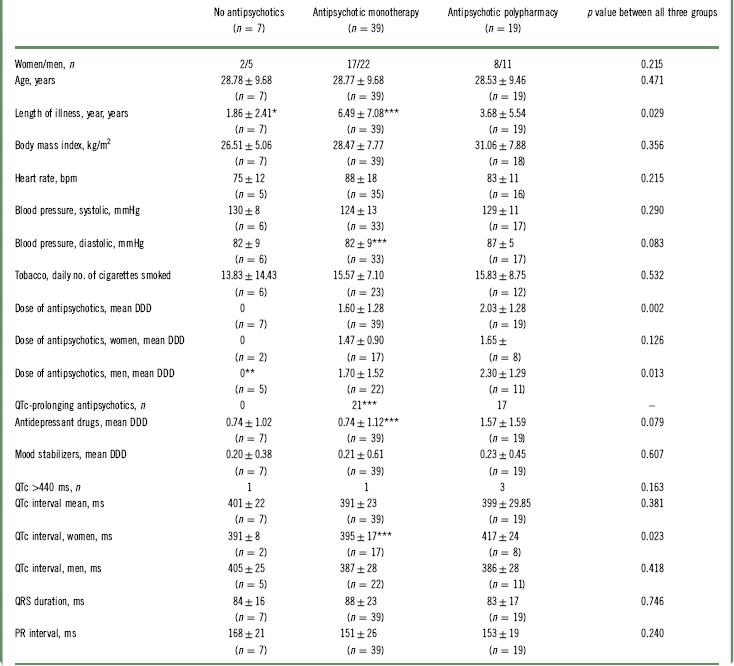
ECGs were available in 65 patients. Seven patients received no antipsychotic drugs, 39 received 1 antipsychotic drug (monotherapy), and 19 received 2 or more different antipsychotics (polypharmacy). A total of 44 patients had first-ever diagnosed schizophrenia, while 21 patients had chronic schizophrenia. There were no significant differences between patients receiving no antipsychotics, monotherapy, or polypharmacy with regard to sex, age, body mass index, heart rate, blood pressure, and number of cigarettes smoked daily (Table 1). However, the number of patients who smoked varied: 86% patients in the no antipsychotic group smoked, while only 59% and 66% smoked in the monotherapy and polypharmacy groups, respectively. Patients treated with antipsychotic monotherapy had a significantly increased length of illness compared with the groups receiving no antipsychotics (p=0.039) and antipsychotic polypharmacy (p=0.033). None of the 65 patients received any cardiac medications. Furthermore, there were two patients with diabetes in the group receiving antipsychotic monotherapy and one patient with diabetes in the antipsychotic polypharmacy group.
Demographic and clinical features of patients with schizophrenia (N=65) treated with no, one (monotherapy), or two or more (polypharmacy) antipsychotics (mean ± SD unless otherwise indicated)

QTc-prolonging antipsychotics: quetiapine, ziprasidone, sertindole, chlorprothixene, clozapine, haloperidol, risperidone.
DDD=defined daily dose.
* Significant difference between no antipsychotics and antipsychotic monotherapy (p<0.05).
** Significant difference between no antipsychotics and antipsychotic polypharmacy (p<0.05),
*** Significant difference between antipsychotic monotherapy and antipsychotic polypharmacy (p<0.05).
One patient in the no antipsychotics group and one patient in the monotherapy group had a QTc interval longer than 440 ms, and three patients in the polypharmacy group had a QTc interval longer than 440 ms. According to QRS duration and PR interval, no significant differences between groups were found.
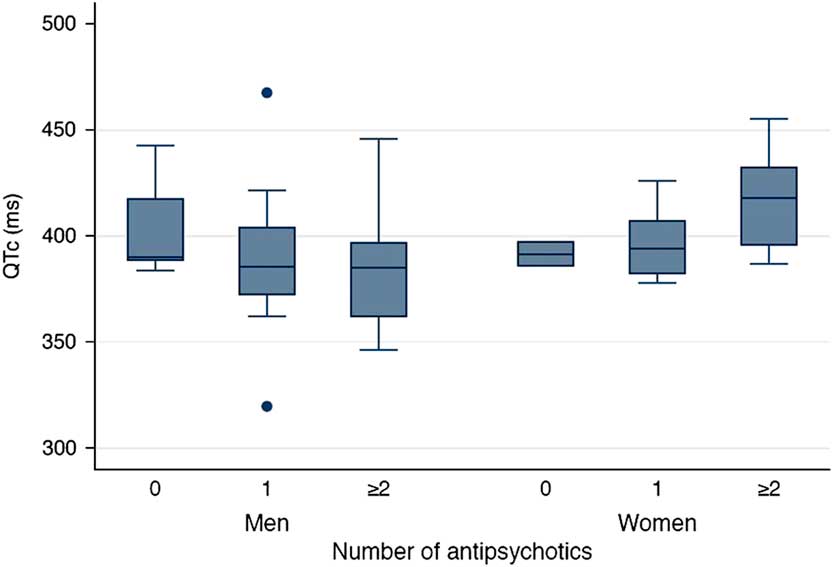
Figure 1 shows a boxplot of the QTc interval in men and women according to the number of antipsychotics they received. The QT interval was not increased in those treated with antipsychotic mono- or polypharmacy (p=0.917).
Correlation of number of antipsychotics and QT interval corrected for heart rate (QTc) in patients with schizophrenia (men, n=38; women, n=27). Men and women were divided into three groups: one group received no antipsychotics, one group received one antipsychotic (monotherapy), and the other received two or more antipsychotics (polypharmacy).

Women in the group receiving antipsychotic polypharmacy presented with longer QTc intervals than the women in the group receiving antipsychotic monotherapy (p=0.010), while no such difference was observed in men (p=0.917). According to a linear regression model, computed with the women receiving either antipsychotic poly- or monotherapy, and QTc as the QTc interval could be expressed as: QTc=18.46594 ×number of antipsychotics +376.9479. This model was significant (p=0.009).
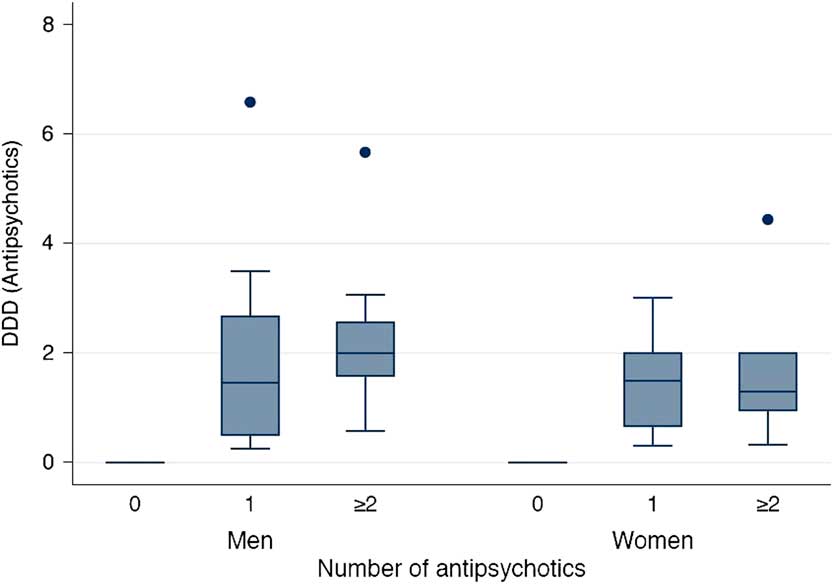
An overview of DDD of antipsychotics according to the number of antipsychotics received is depicted in Figure 2. No significant increase in the DDD of antipsychotics was observed in patients receiving multiple antipsychotics compared with patients receiving a single antipsychotic drug or no antipsychotic.
Correlation of number of antipsychotics and defined daily dose (DDD) of antipsychotics in patients with schizophrenia (men, n=38; women, n=27). Men and women were divided into three groups; one group received no antipsychotics, one group received one antipsychotic (monotherapy), and the other received two or more antipsychotics (polypharmacy).

The antipsychotic medications used in the polypharmacy group comprised primarily drugs that prolong the QT interval, in contrast to the drugs used in the antipsychotic monotherapy group. Some 98% (17 patients) in the polypharmacy group received a QTc-prolonging antipsychotic, while only 54% (21 patients) in the monotherapy group received a QTc-prolonging antipsychotic (p=0.02). This is distributed, as 81% (9 male patients) of men receive the QTc-prolonging antipsychotics and all 8 women received QTc-prolonging antipsychotics.
We found a significantly (p=0.025) higher DDD of antidepressant drugs in patients receiving antipsychotic polypharmacy (mean DDD=1.57) than in patients receiving antipsychotic monotherapy (mean DDD=0.74). However, the DDD of antidepressant drugs did not influence the QTc interval in women (p=0.80).
Discussion
In the current study, the frequency of patients with a QTc interval longer than 440 ms was 6%. Only among women did we observe a significantly increased QTc interval when treated with antipsychotic polypharmacy compared with antipsychotic monotherapy. No such increase in QTc was found in men. The dose of antipsychotics did not increase when patients received multiple antipsychotic drugs, compared with the dose of antipsychotics in patients receiving only one type of antipsychotic.
A previous studyReference Nosè, Bighelli and Castellazzi 10 found that 20% of patients with schizophrenia had QTc prolongation with a QTc interval above 450 ms, but in our study the QTc interval was calculated according to Bazett’s formula. The proportion found by Nosè et al.Reference Nosè, Bighelli and Castellazzi 10 is high compared to the findings of our study, where only 6% of patients had a QTc interval longer than 440 ms. This may be due to that fact that the two outpatient facilities followed safety recommendations with regard to prolonged QTc interval that may have led to a selection of individuals without a great number of ECG abnormalities, but one must also consider the different formula used to correct the QT interval. Bazett’s formula may overcorrect when subjects have a fast pulse. Fridericia’s formula, used in the present study, is considered more precise in subjects with a high heart rate.Reference Goldenberg, Moss and Zareba 17 Other studiesReference Ramos-Ríos, Arrojo-Romero and Paz-Silva 21 , Reference Pasquier, Pantet and Hugli 22 reported a prevalence rate for QTc prolongation corrected after Bazett’s formula of between 2 and 3.5% of patients with schizophrenia, but the threshold for QTc prolongation in these studies was a QTc interval above 500 ms.
In our study, antipsychotic polypharmacy did not increase the dose of antipsychotics, compared with antipsychotic monotherapy. This is in contrast to a study by Barbui et al.,Reference Barbui, Bighelli and Carrà 9 which found that antipsychotic polypharmacy is associated with prolongation of the QTc interval, and that this effect is mediated by the dose of antipsychotics. One explanation could be that patients treated with antipsychotic monotherapy received a high dose of antipsychotic, in contrast to patients treated with antipsychotic polypharmacy, who received two or three low doses of antipsychotics. There is also the possibility that it is a type II error.
It should be taken into account that the patients in our study receiving antipsychotic polypharmacy received a greater percentage of QTc-prolonging antipsychotics than patients receiving antipsychotic monotherapy. By this distribution, we would have expected that both men and women had an increased QTc interval when treated with polypharmacy, but in our study only women’s QTc intervals were increased. This is in accordance with the existing literature. It is well-described that women are at increased risk of prolonged QTc interval with QTc-prolonging drugs.Reference Yang, Wang and Liu 23 , Reference Rabkin 24
In addition to antipsychotics, numerous risk factors may increase QTc interval, among which are antidepressant medications and mood stabilizers (such as lithium).Reference Fanoe, Kristensen and Fink-Jensen 20 In this study, we observed no difference in the use of mood stabilizers between the three groups. However, there was a significant increase of the DDD of antidepressant medications in the patients of the antipsychotic polypharmacy group. In our cohort, there was no difference in QTc interval with different use of antidepressants.
The QTc interval increases with older age, so that age is also considered a risk factor.Reference Rabkin 24 In our study, age was not taken into account, as patient ages were very similar in the three groups we compared.
Our study has some limitations. First, two centers were involved in the study, so that different ECG recording devices were employed. Although the ECGs were recorded digitally, there were logistical difficulties in analyzing the ECGs directly on screen at both centers. Therefore, the ECGs had to be printed out and sent to a location where all the ECGs were scanned electronically. We cannot dismiss the possibility that some resolution and accuracy of the ECGs could have been lost. However, it is not likely that the results with respect to QTc interval would have changed much with digital analysis.
Second, prior studies have shown that an increased QTc interval seems to differ markedly among different antipsychotics—for example, thioridazine, ziprasidone, and sertindole increase the QTc interval more than haloperidol, olanzapine, quetiapine, and risperidone.Reference Leucht, Cipriani and Spineli 6 , Reference Haddad and Anderson 25 This has not been taken into account in the current study. Our study merely investigated the overall effect of antipsychotics when given as either monotherapy or polypharmacy in routine clinical practice.
Third, the relatively small number of patients included in our study may help explain why there was no significant difference in DDD between the groups with antipsychotic poly- and monotherapy—a possible type II error.
Among the strengths of our study is that we included otherwise nonselected patients from routine clinical practice in two centers.
Conclusions
Only 6% of patients with schizophrenia showed QTc prolongation during antipsychotic drug treatment. Women had increased QTc intervals when treated with two or more types of antipsychotics versus treatment with a single antipsychotic, which may indicate that women are at increased risk of TdP. We recommend an increased focus on monitoring the QTc interval in women with schizophrenia receiving antipsychotics as polypharmacy.