Introduction
Recent nationally representative data from South and South East Asian countries indicate that the Philippines lags behind neighbouring countries with respect to reproductive health indicators, particularly modern contraceptive use and unintended pregnancy (ICF, 2012). Although 54% of married Filipina women report using any type of contraception (Philippine Statistics Authority (PSA) & ICF, 2018), a greater proportion of women (14%) rely on less-dependable traditional methods compared with neighbouring countries (Marquez et al., Reference Marquez, Kabamalan and Laguna2018; PSA & ICF, 2018). Recent estimates also indicate that, in comparison to other countries in the region, the Philippines has the highest proportion of unintended pregnancy (29%), with nearly one in three recent births characterized by women as being ‘unwanted’ or ‘mistimed’ (ICF, 2012; PSA & ICF, 2018).
Use of contraception is integral to reducing unintended pregnancy and achieving reproductive rights and desires, yet cultural and socio-political barriers to contraceptive uptake persist in the Philippines. The Catholic Church exerts a powerful influence on sexual and reproductive norms and reproductive health policy in the Philippines, as evidenced by the contentious and delayed enactment of the 2013 Responsible Parenthood and Reproductive Health Law. For years, and despite broad support among the population, the Church attempted to block passage of the law, which provided funding for sexual and reproductive health information and services for poor Filipinos, including modern contraceptive methods (Congress of the Philippines, 2013; Ford, Reference Ford2013; Hussain & Finer, Reference Hussain and Finer2013; Cabral, Reference Cabral2013; Ozaki et al., Reference Ozaki, Guadalupe, Saquido, Gepte, Higuchi, Morita and Tanimoto2017).
Alongside these religious influences, traditional social norms stemming from Spanish colonial law are still codified into current Philippine legal statutes, dictating appropriate sexual practices and outlining ‘acceptable’ behaviours (Austria, Reference Austria2004). These influences manifest within relationships where traditional gender roles and female sexual norms persist. Girls and women are expected and incentivized to follow rules of social propriety, to be passive in sexual relationships with boys and to refrain from communication with partners about sexual and reproductive health decisions, including initiating discussions of condom use (Upadhyay & Hindin, Reference Upadhyay and Hindin2006; Upadhyay et al., Reference Upadhyay, Hindin and Gultiano2006; Lucea et al., Reference Lucea, Hindin, Gultiano, Kub and Rose2013; Medina, Reference Medina2015). Previous research has outlined the social consequences for Filipino women who buck gender or propriety norms, including the loss of social standing and close ties with family members and peers (Upadhyay & Hindin, Reference Upadhyay and Hindin2006; Upadhyay et al., Reference Upadhyay, Hindin and Gultiano2006; Gipson et al., Reference Gipson, Gultiano, Avila and Hindin2012).
These political, social and cultural influences in the Philippines shape the ways in which sex, contraception and childbearing are discussed (or not), as well as the ways in which individuals and couples engage in sexual and reproductive decision-making. Earlier studies in the Philippines, focused on married women and couples, have described male partner opposition as a reason for not using contraception despite wanting to prevent pregnancy, aligning sexual and reproductive decision-making with both traditional gender norms and deference to male partner preferences (Biddlecom et al., Reference Biddlecom, Casterline and Perez1997; Casterline et al., Reference Casterline, Perez and Biddlecom1997). More recent results from Gipson et al. (Reference Gipson, Uysal, Narasimhan and Gultiano2020) – a mixed-methods study from Metro Cebu (the site for the present study) – contextualized decision-making processes and found that male partners often dominate decision-making across reproductive life stages: at first sex, in the beginning stages of family formation (after 1–2 children) and even later after the birth of several children. Another study among this population found that coercion or force at sexual debut was commonplace and associated with a subsequent two-fold greater risk of unintended pregnancy (adjusted OR (aOR)=2.2; 95% CI 1.3, 3.7) (Wiles et al., Reference Wiles, Agustin, Narasimhan and Gipson2018).
Systematic Anomalous Case Analysis (SACA) is a sequential, mixed-methods approach in which multivariable regression models are analysed to identify statistical outliers, or ‘anomalous cases’ that do not exhibit the expected behaviour (Axinn & Pearce, Reference Axinn, Pearce, Axinn and Pearce2006). In-depth interviews are then conducted with these anomalous cases to gain additional insights on the outcome(s) of interest. Together, these complementary methods can provide more holistic insights on a social phenomenon, and are particularly useful in refining social theory, as well as measurement and intervention strategies (Pearce, Reference Pearce and Stolzenberg2002; Axinn & Pearce, Reference Axinn, Pearce, Axinn and Pearce2006).
Systematic Anomalous Case Analysis has been employed previously in two studies on fertility and reproduction. The Chitwan Family Study in Nepal employed 28 in-depth interviews with anomalous cases to examine a range of issues that might impact childbearing preferences (Pearce, Reference Pearce and Stolzenberg2002). The study found that family religious background played a pivotal role in childbearing preferences and, when added to previous empirical models, improved predictions of family size preferences among younger and older age groups. Similarly, Moore and colleagues (Reference Moore, Keogh, Kavanaugh, Bankole, Mulambia and Mutombo2014) studied childbearing preferences among Zambian men and women with both high fertility and high HIV prevalence. Through in-depth interviews with 48 anomalous cases they found that contrary to predictive models, cases who desired another child were more likely to be influenced by outside attitudes about their fertility. This group also expressed stronger beliefs in anti-retroviral efficacy, making their HIV-positive status less important in predicting their desire to have another child. In both studies, the process of SACA uncovered cultural and interpersonal dynamics that were vital to improving model prediction.
Given these past empirical findings from the Philippines and demonstrations of the utility of SACA in other global settings, in this study the SACA method was employed to contextualize and improve predictive models of contraceptive use among Filipino women. The final two analytic stages of the SACA process were: (1) identification of key qualitative findings gathered from participants purposively sampled from the original quantitative models, and (2) use of these qualitative findings to identify an omitted construct to revise the original, quantitative models. Finally, evidence is presented that inclusion of this construct significantly improves empirical models predicting contraceptive use among Filipino women in the sample.
Methods
Setting
Metropolitan Cebu, located in Cebu Province in the Central Visayas region, is the second largest metropolitan area in the Philippines. In 2015 the area was home to nearly 3 million people and remains a fast growing urban centre (PSA, 2018), accounting for nearly 62% of the province’s population. The median age of the population is 23 years old and the average household size is 4.4 persons (PSA, 2018).
Systematic Anomalous Case Analysis – Steps 1–4
The first four steps of the SACA process have been reported previously (Gipson et al., Reference Gipson, Uysal, Narasimhan and Gultiano2020). These four steps are briefly discussed then the final two steps of the SACA, which are reported in this paper, are described.
First, multivariable quantitative models were constructed using longitudinal data (1998–2009) from the Cebu Longitudinal Health and Nutrition Survey (CLHNS). The CLHNS is a longitudinal cohort study initiated in 1983 which recruits pregnant Filipina women giving birth in 33 communities (barangays) using a single-stage cluster sampling procedure (n=3000 women and their newborns). All women and their newborns (index children) were followed in a tracking survey conducted in 2009 (Feranil et al., Reference Feranil, Gultiano and Adair2008; Adair et al., Reference Adair, Popkin, Akin, Guilkey, Gultiano and Borja2011). In the first step of SACA, time to first sex and number of living children among the CLHNS index children were modelled using mother and child data from 1998–2009 using Cox proportional hazards/Cox regression models and Poisson regression models, respectively. Covariates were selected based on their empirical and theoretical relevance to sexual behaviour and childbearing in the Philippines and included index children characteristics (socio-demographics; household characteristics; sexual attitudes and behaviours; peer and family influences) and mother’s characteristics (socio-demographics; educational aspirations for child; communication and closeness with child) (see Gipson et al., Reference Gipson, Hicks and Gultiano2014, Reference Gipson, Uysal, Narasimhan and Gultiano2020, for more detail on methods and results).
In the next step, a sample of ‘normative cases’ and outliers were identified from the two quantitative models (Pearce, Reference Pearce and Stolzenberg2002). In total, four cases were selected for in-depth interviews from each of twelve different groups (male/female and low/predicted/high residuals), resulting in a total of 48 in-depth interviews conducted from August 2013 to January 2014 when the identified index children were 29–30 years old. The interview field guide was developed based on the quantitative findings, as well as previous research from Cebu on sexual and reproductive decision-making (Gipson et al., Reference Gipson, Hicks and Gultiano2014, Reference Gipson, Uysal, Narasimhan and Gultiano2020). Each in-depth interview was conducted in the local language (Cebuano), then transcribed and translated into English.
Systematic Anomalous Case Analysis – Step 5: conduction of qualitative analysis and identification of key findings
Following the above four steps, qualitative data analysis was conducted with the in-depth interview data from the 48 anomalous and predicted cases. First, a coding scheme was constructed based on key domains from the interview field guides, and in vivo codes. A subset of transcripts was coded to ensure consistency of coding before completing the full set of transcripts. The constant comparative method (Glaser, Reference Glaser1965) was used to identify and group similar pieces of text from each transcript, to construct coding sorts for the purpose of identifying the range and relationship of the codes to one another, then to develop memos on key findings.
The next step of analysis focused on the identification and further explication of the construct of ‘control over life circumstances’ – a dominant theme identified across the transcripts and sampling groups. Based on the richness of these narratives and their implications for contraceptive use among the female participants, the analysis focused on the 24 in-depth interviews with the CLHNS female participants. Following the results from Gipson et al. (Reference Gipson, Uysal, Narasimhan and Gultiano2020), where no marked differences in contraceptive use across ‘first sex’ or ‘living children’ sampling groups were found, participants were assigned to one of three strata: (1) ‘earlier than predicted sexual initiation’ and ‘more children than predicted’ groups were combined together (high residuals), (2) the ‘later than predicted sexual initiation’ and ‘fewer children than predicted groups’ were combined together (low residuals), or (3) ‘predicted sexual initiation’ or ‘number of living children’ groups (normative).
Systematic Anomalous Case Analysis – Step 6: revision of theory and re-analysis of survey data
In the final step of the SACA, the dominant theme of ‘control over life circumstances’ was captured by two questions from the 2005 CLHNS survey that could serve as proxies for this construct. The 2005 survey was chosen as it was the most recent comprehensive survey of the full sample of index children and included measures that would precede outcomes measured in the 2009 CLHNS survey. The two questions were asked with yes/no dichotomous response options: (1) ‘Index child thinks what happens to him/her is usually their own doing’, and (2) ‘Index child often feels that he/she doesn’t have enough control over the direction life is taking him/her’.
A multivariable logistic regression model was run with the dichotomous outcome of ‘ever use of contraception by 2009’ (yes/no) using the covariates from the original multivariable model (Step 1 of the SACA analysis) with the addition of these two measures of women’s ‘control over life circumstances’. To match the analytic sample of the original quantitative models (Step 1 of SACA) analysis was limited to female participants who participated in the 1998–2000 and 2009 CLHNS surveys who had reported having sex by the 2009 survey CLHNS survey (n=532) (Gipson et al., Reference Gipson, Hicks and Gultiano2014, Reference Gipson, Uysal, Narasimhan and Gultiano2020). The multivariable models were duplicated from Step 1; however, only significant predictors from this prior analysis were kept. Model fit was assessed comparing changes in the Wald χ 2 tests (cut-off p<0.05). All quantitative analyses were run with STATA Version 14.2. The data that support the findings of the study are available from the corresponding author upon reasonable request.
Results
Qualitative participant characteristics
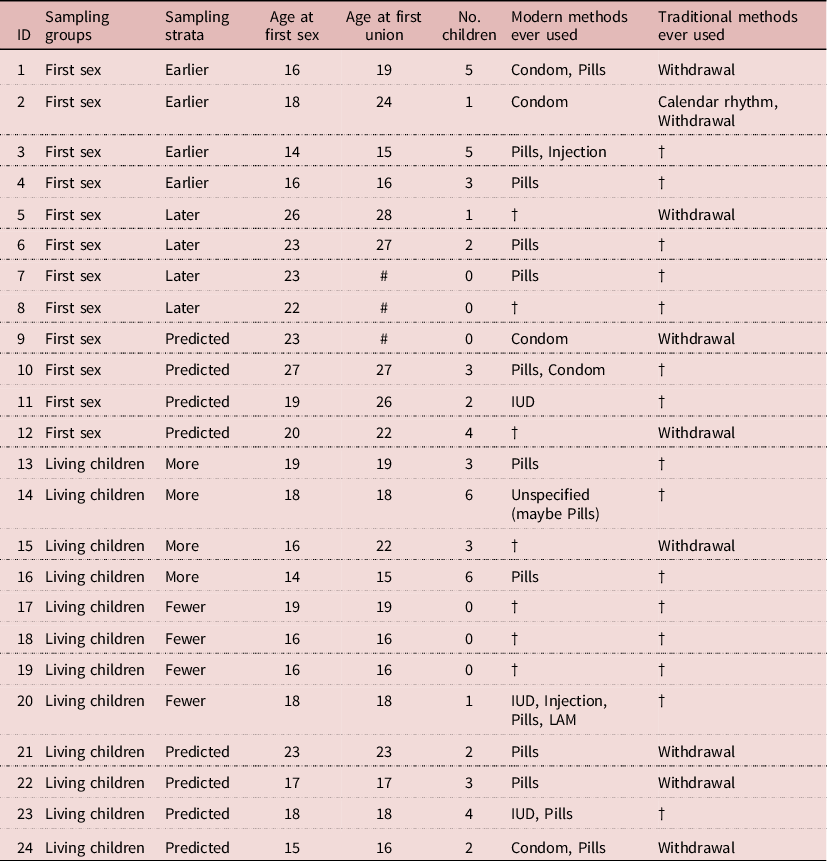
Table 1 reports the characteristics of the female participants’ reported age at first sex, age of first union, number of living children and use of contraception by sampling group and sampling strata (number of children model: more, fewer or predicted number of children; sexual initiation models: earlier, later or predicted sexual initiation). All participants reported sexual debut and most participants reported their first union (either marriage or cohabitation) by the time of the interview (age 29–30). The women in the ‘earlier than predicted sexual initiation’ and ‘more children than predicted’ groups reported having an earlier sexual experiences and more living children, as well as more children than desired, as compared with participants in other groups. In addition, the majority of women in the ‘fewer children than predicted’ groups had no children at the time of interview.
Demographic and contraceptive characteristics of female interview respondents in ‘first sex’ and ‘living children’ sampling groups, N = 24

#No union by the time of interview; †No use of contraceptive type reported by interview.
Modern methods classified as: IUD, Pills, Injection and Male Condom. LAM=lactational amenorrhoea method (note that LAM is considered a modern contraceptive method in the Philippines; PSA & ICF, 2018, p. 8).
Traditional methods classified as: Calendar rhythm and Withdrawal.
Qualitative findings
In the majority of in-depth interviews, women expressed having minimal ‘control over life circumstances’, with implications for their reproductive decision-making and subsequent contraceptive use. This theme emerged from participants across sampling groups and strata and centred around two main subthemes: 1) general lack of control over life events, and 2) lack of control due to partner dominance.
Lack of control over life events leads to little control over fertility decisions
Several respondents, particularly in the ‘earlier than predicted sexual initiation’, ‘predicted sexual initiation’ and ‘more children than predicted’ strata, often described life events as happening by chance with little forethought, and often as a result of the desires or decisions of other people in their lives, such as parents, partners and older siblings. When asked about decisions surrounding major life events (e.g. sexual debut; marriage or cohabitation; pregnancy), women often described these events as something that ‘just happened’ to them. Several women had histories of adversities, including poverty, interrupted or truncated schooling and familial abuse or neglect. Several women in these groups had also experienced at least one coercive or forced sexual event, sometimes at first intercourse. In this group, deliberate consideration of contraception was rare, but if any conversations occurred, they were commonly with their mothers and after having multiple children.
One participant who described growing up in poverty with eleven siblings discussed events leading to her first pregnancy, a result of coerced sexual initiation. Her first sex experience took place at a fiesta (celebration of a town’s patron saint) and ‘was when I was already vomiting, and I couldn’t stand up anymore’ (after drinking alcohol). The man, who was older (left high school) and in the police academy, chose not to be involved with her or the pregnancy, even though she believed making her pregnant was intentional on his part. When asked about her first sex and marriage decision-making, she replied,
R: I never expected it [sex] to happen. That was the reason why everything was destroyed [laughs]. I was afraid I would get pregnant… what will happen when my tummy would get bigger…what will the people say…that I suddenly got pregnant… I just scratched my head [laughs]. What have I done? [laughs]. I was embarrassed [laughs]. I was shocked because my previous boyfriends did not do anything like that to me [laughs]. I did not think of the future. I really did not expect that this will happen to me. It’s what destroyed everything. I now realize it’s difficult having children.
I: What about marriage? You never thought about it? You did not have any plan?
R: None at all.
(ID 15, more children than predicted)
This woman’s narrative reveals a common theme amongst this group – navigating sexual and reproductive decisions was often challenging or impossible because their perception of the power for determining important decisions, for example intercourse, was in others’ hands. These women were also subject to other constraints on their reproductive decision-making including their lack of knowledge about sex or contraception, feeling they were too young or inexperienced to know about contraception, being forced or shamed into living with a partner by family members who believed (sometimes incorrectly) they were having sexual intercourse and feeling pressured into marrying because of the need for financial support or to atone for impropriety.
Lack of control due to partner dominance of fertility decisions or sexual intercourse
A second subtheme – partner dominance – emerged across all sampling groups; the majority of female respondents described how reproductive choices, such as procuring contraception or taking action to prevent pregnancy (e.g. abstaining from sex during the fertile period), was difficult because of their partner’s sexual needs or desires. Respondents in the ‘earlier than predicted sexual initiation’ and ‘more children than predicted’ groups reported not using any contraceptives at sexual debut or not using modern contraceptives regularly during their partnerships. Most women described frustrations around the burden of additional children and household responsibilities, while also citing their partner’s desire to have (more) children.
Partners’ concerns regarding contraception were central to many women’s decisions, as described by this participant with five children whose partner worried that her use of contraception would cause health issues and infertility:
I: He [your partner] was afraid?
R: He told me to stop [using an injectable contraceptive] because I did not menstruate anymore and it might cause a tumor…I still have to handle the household chores and take care of the children. [I] go crazy thinking on how to cope with everything especially when we don’t have money! I tell him but he insists that I discontinue using the injection.
(ID 3, earlier than predicted sexual initiation)
However, a few respondents in the ‘fewer children than predicted’ and ‘predicted number of children’ groups also discussed partners’ desires as a barrier and large consideration in reproductive choices. A few respondents, mostly in the ‘earlier sexual initiation’ and ‘more children than predicted’ groups, described their partner’s active interference in contraceptive use. They described how their male partners would refuse to buy contraceptives or would throw out their contraceptives. This led some women to secretly use contraceptives.
I always had two boxes of pills at hand at that time, but my husband threw them away. Then I forgot to take the pills which I hid from him. That’s why I really got pregnant. If I ask my husband to buy, he won’t.
(ID 16, more children than predicted)
Other women described difficulties in effectively using their preferred methods of contraception due to influences of their male partners. One woman who did not wish to have any more children described wanting to use a condom and a fertility awareness method, taught to her by a doctor, but was unable to use either method consistently because she could not decide the timing of sexual intercourse with her partner and he opposed using a condom. As a result, she resorted to using hormonal contraceptive pills despite experiencing major side-effects. Due to the side-effects, she would take the pills intermittently, thereby reducing their effectiveness in preventing pregnancy.
For me, it’s already enough, but I cannot be sure if I say it’s enough because I have no control. On pills but I did not feel well. I felt nauseous, after nausea… I do not want to eat anymore. I use that [pills] sometimes because my husband, if I am not safe [ovulating], that’s the time he wants to [have intercourse].
(ID 1, earlier than predicted sexual initiation)
Male partners often interfered with the ability to use rhythm or withdrawal as well, sometimes resulting in method failure.
I would tell my husband, you seem like an expert, now look what happened. We won’t use this [calendar rhythm method] again, because we might count wrong again. That’s the reason why we have the twins, we counted wrong.
(ID 10, predicted timing of sexual initiation)
One woman in the ‘later than predicted sexual initiation’ group expressed her partner’s opposition as the reason that they relied primarily on withdrawal rather than any barrier or hormonal contraceptives in their relationship, despite her interest in using them. Interestingly, the woman described great motivation and control over her life choices prior to marriage, entering into her first sexual relationship at 22 years of age – later than others in the sample. Once with her partner, she described wanting to use contraceptive pills or an IUD, but was admonished by her husband who believed it would cause health problems:
I just tell him it’s up to him. If it [withdrawal] fails, then we cannot do anything about it. I wanted to control through the use of IUD or [birth control] pills but he did not allow it because maybe something might happen to me. I tried opening up to him, but he does not like it.
(ID 5, later than predicted sexual initiation)
In further probing, she elaborates on why she has left the method of birth control up to her partner:
I will tell him, don’t ejaculate inside, just pull it out… just withdraw it. Not to go all the way because I want to get pregnant only after some time. There are also sometimes that he really wants to ejaculate inside.
In contrast to the above narratives, a few women in the ‘predicted’ and ‘fewer children than predicted’ groups described clear forethought, planning and self-efficacy in their reproductive decision-making including partner choice, family size and contraceptive use. Respondents in this group had vivid recall of reasoning and types of contraceptives used. Several expressed their ‘plan to get pregnant’.
I: How many children do you have with your current partner?
R: Two. So, I have a total of four children. We [my current partner and I] really planned to have my third child, as well as the fourth one. The boy is now 2 years old, and the girl is 8 months.
I: So, [you said] you had your IUD removed?
R: Yes, because we planned to have a child already at that time. We really planned our [last] two children.
(ID 23, predicted number of children)
Another 29-year-old respondent with one child expressed clear decision-making around several aspects of her reproductive life, including deciding when she would have sex, when she would get married, and then with having a planned and wanted pregnancy.
R: We planned to get married. It was like I became serious with our relationship at that time.
I: But you already had sex before you got married?
R: It was when…I mean I was already…like we planned it to happen, and then it happened… [laughs] he was able to have sex with me [nahilabtan] and then he formally asked for my hand in marriage [pamaye] but then my father rejected him…so we eloped [laughs]. I used an IUD, and then after that I used pills already.
I: So, it was because you were still breastfeeding your baby that you used an IUD instead of pills?
R: Yes, that was for one year only, and then I returned to using pills since my baby was already big.
I: The IUD was taken out? Why did you have it taken out?
R: I had an infection. I did not respond well to using an IUD, that’s why I returned to using pills again…our plan was for me to get pregnant when we live separately from them in our own house. When he came home last May… actually I already consulted a doctor in April on what to use so that I would get pregnant. So, the doctor prescribed some vitamins to enhance my fertility. I also had a pap smear and I took the prescribed vitamins to make me fertile…when my husband came home in May…in June I did not anymore have my menstruation. We really planned this pregnancy.
(ID 20, fewer children than predicted)
In addition to referencing a ‘plan’ several times, this participant recalled the use of specific modern methods (IUD and pill) and switching methods after experiencing side-effects. She describes engagement in preconception behaviours, such as visiting the doctor for a pap smear and taking vitamins to enhance fertility. The narrative ends with an expressly wanted and intended pregnancy.
Another woman described the importance of having a supportive husband with whom she is able to engage in joint discussions and decision-making, particularly as it affects their ability to effectively use withdrawal as a contraceptive method:
Yes. I was lucky to have a husband who thinks. Even if my husband is still young, he is conscious about birth control. He was the one who controlled when I was still in school… My husband really thinks that it is difficult to have many children. If he was not thinking of that, he would not have practised withdrawal. We would buy a condom because I was still in school at that time. If we don’t have money to buy a condom, then we…withdraw.
(ID 24, predicted number of children)
SACA Step 6: Translating the qualitative results to quantitative models
Results from the qualitative analyses indicated variations in women’s ‘control over life circumstances’ with respect to reproductive decision-making. Following the SACA methodology, the original quantitative models that were used to predict reproductive outcomes among the larger cohort (sexual initiation and number of children), and which drove the sampling frame for the in-depth examination of anomalous and predicted cases, were revisited. Analysis tested whether the model fit would improve significantly with inclusion of two additional variables extracted from the 2005 CLHNS survey to represent this construct of ‘control over life circumstances’: (1) ‘Index child thinks what happens to him/her is usually their own doing’, and (2) ‘Index child often feel that he/she doesn’t have enough control over the direction life is taking him/her’.
Quantitative results
The sample consisted of 532 female index children from the CLHNS cohort (i.e. born between 1983 and 1984) who had their sexual debut and remained in the sample through 2009 (ages 25–26). The mean age of first sex in the sample was 19.7 (SD=2.7) years and the average number of living children by 2009 was 1.3 (SD=1.14). Seventy-eight per cent of women in the sample reported ever using contraception by 2009.
First, the model used in Step 1 of the SACA method was revisited; however, the ‘control over life circumstances’ measures did not significantly predict number of living children in bivariate or multivariable Poisson models. Based on the qualitative interview findings regarding contraceptive decision-making and use, as well as the role of contraception as a more proximal outcome when predicting fertility (Bongaarts, Reference Bongaarts1978), analyses were conducted with women’s reports of ‘ever use of contraception’ by 2009 as the outcome variable.
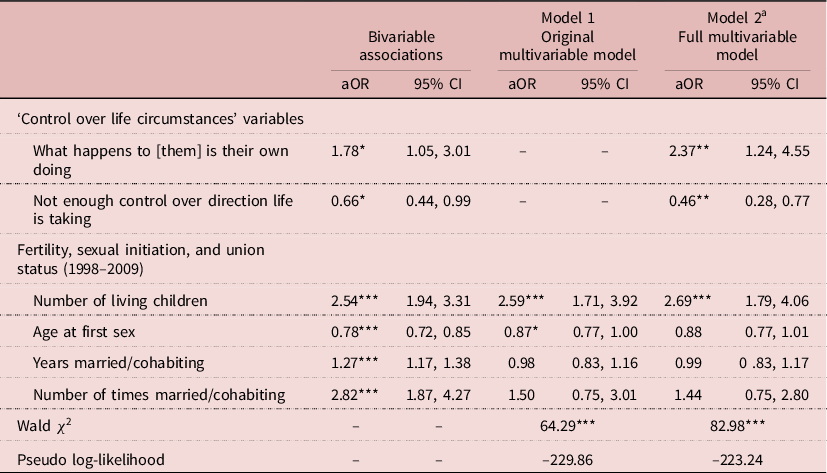
In the bivariate results, both ‘control over life circumstances’ measures were significantly predictive of reporting contraceptive ever use. In the subsequent two models, a base model was run (Table 2; Model 1) without ‘control over life circumstances’ measures to assess the relationships of the predictor variables from the original quantitative model to ever use of contraception. In this multivariable model, number of living children (aOR = 2.59, p < 0.001) and household wealth (aOR = 1.16, p < 0.05) were positively associated with ever use of contraception. Religiosity (measured by church attendance at least weekly) (aOR = 0.54, p < 0.05) and age at first sex (aOR = 0.87, p < 0.05) were associated with lower odds of contraceptive use.
Bivariable and multivariable logistic regression analyses examining reports of ever use of contraception by 2009 for women aged 25–26 in Cebu, Philippines, N = 532

Multivariable models (Models 1 and 2) include covariates from original quantitative models (see Gipson et al., Reference Gipson, Uysal, Narasimhan and Gultiano2020), controlling for adolescent characteristics (CLHNS 1998), household characteristics (CLHNS 1998), peer and family influences (CLHNS 1998), mother–child relationship and mother’s socio-demographic characteristics.
aOR=adjusted odds ratio.
a Comparative model.
*p<0.05; **p<0.01; ***p<0.001.
The final model (Table 2; Model 2) included the two ‘control over life circumstances’ items identified from the 2005 CLHNS survey. Women who indicated that ‘what happens to [them] is their own doing’ were 2.4 times more likely to report ever use of contraception (p < 0.01) compared with women who reported negatively to the item, when adjusted for covariates. Similarly, women who indicated they ‘did not [have] enough control over direction life is taking’ had lower odds of ever using contraception (aOR = 0.46, p < 0.01), after controlling for other covariates. Number of living children (aOR = 2.69, p < 0.001) and household wealth remained positive and significant indicators of ever use of contraception, but the effects of church attendance and age at first sex were attenuated in Model 2. The Wald test (χ 2 = 82.98, p < 0.001) indicated a better fit with the addition of the two measures (Model 2) compared with the original model Wald test (Model 1): χ 2 = 64.29, p < 0.001).
Discussion
This paper describes the final synthesis and analysis steps in the application of the SACA method to examine contraceptive use in the Philippines. The SACA method allowed us to identify a previously omitted construct ‘control over life circumstances’ – a key domain described in qualitative interviews. Subsequent addition of items to approximate this construct improved the theoretical and empirical models predicting ever use of contraception among Filipina women.
To the first objective, in the in-depth interviews, lack of ‘control over life circumstances’ manifested in two, interconnected ways. First, the expression of lack of ‘control over life circumstances’ highlighted that for some women, planning for their future – even regarding pivotal life events – seemed difficult, if not impossible, given other constraints in their lives. Previous qualitative research among the women recruited into the CLHNS cohort (the index children’s mothers) found similar evidence of fatalistic beliefs influencing contraceptive use (Avila & Wong, Reference Avila and Wong2001). These authors characterized women as ‘pro-active’ versus ‘reactive’ contraceptive users, with pro-active users more likely to espouse beliefs that childbearing was within their control, and that controlling childbearing was to their advantage.
Notably, difficulties with planning for future events were concentrated among women with consistent disadvantage, including those with experiences of poverty and abuse, and lack of educational opportunities. Research conducted in other low-resource settings describes the ways in which poverty induces and perpetuates a ‘scarcity mindset’ or ‘tax’ on cognitive resources, fundamentally altering decision-making amidst material deprivation and distress such that immediate survival needs may be prioritized over long-term implications. The decisions made as a result of scarcity often lead to trade-offs that deprioritize planning of reproductive behaviour. Moreover, women may be compelled to uphold gendered notions of respectability (e.g. marriage following an out-of-wedlock pregnancy) in order to maintain social standing or community support and to maintain/gain the approval of family members (Gipson et al., Reference Gipson, Gultiano, Avila and Hindin2012; Medina, Reference Medina2015; Tsai, Reference Tsai2017).
A second component of ‘control over life circumstances’, as mentioned by women across all groups, was partner dominance as a direct influence on sexual and reproductive decision-making. Specifically, women described ways in which their partners affected their ability to make decisions and constrained their choices around contraceptive use. Men dictated, first, if contraceptives could be used and second, what types of contraceptives were acceptable, even if these directives ran contrary to women’s preferences. This finding is echoed by several earlier studies in the Philippines in which contraceptive discontinuation and unmet need was linked with prioritization of men’s needs; men’s desires most often superseded women’s when perspectives on family size, contraceptive use and willingness to use contraceptives differed (Biddlecom et al., Reference Biddlecom, Casterline and Perez1997; Casterline et al., Reference Casterline, Perez and Biddlecom1997; Avila & Wong, Reference Avila and Wong2001). Subsequent studies highlight the integral nature of sexual and reproductive agency in the Philippines and its outsized dependency on women’s perception of partner supportiveness (Avila & Wong, Reference Avila and Wong2001; Upadhyay & Hindin, Reference Upadhyay and Hindin2006). Most recently, a mixed-methods study among the CLHNS cohort examined sexual and contraceptive decision-making by reproductive life stage, finding that while male preferences appeared to predominate across all reproductive stages, it was particularly pronounced at younger ages and at times of sexual transition, including sexual debut, and prior to the birth of their first child (Gipson et al., Reference Gipson, Uysal, Narasimhan and Gultiano2020). Often because of financial and social survival, women may be reliant on men for livelihoods and may not have the social capital or support to go against their partner’s preferences (Avila &Wong, Reference Avila and Wong2001; Upadhyay & Hindin, Reference Upadhyay and Hindin2006; Gipson et al., Reference Gipson, Gultiano, Avila and Hindin2012).
Taken together, the findings align with those of previous studies from the 1990s (Biddlecom et al., Reference Biddlecom, Casterline and Perez1997; Casterline et al., Reference Casterline, Perez and Biddlecom1997; Avila & Wong, Reference Avila and Wong2001) suggesting that gender and relationship norms continue to dictate the power women have in reproductive decision-making, despite the clear advances of women in other societal spheres in the Philippines (Mason & Smith, Reference Mason and Smith2000). Evidence of the apparent intransigence of these gender norms suggest that more concentrated efforts in gender-norm transformation or male involvement may be needed to improve sexual and reproductive health outcomes.
Findings from this study, as well as the larger body of evidence from this setting, highlights the pivotal role of partner involvement and partner education in the Philippines to improve uptake and continuation of modern contraceptives for those who desire them. Considering the male role in family planning use, their benefit as supportive partners and their possibilities as change agents are vital strategies to improve reproductive agency. Interventions focusing on male involvement in family planning (e.g. increasing knowledge, access and communication around contraceptives), as well as male outreach programmes that privilege creating spaces for men to discuss reproductive health, are critical to facilitating access to and use of contraceptives to achieve reproductive desires (Law et al., Reference Law, Polig and Tangcalagan2019, Reference Law, Abdur-Rahman, Avni and Schaefer2020; Greene & Biddlecom, Reference Greene and Biddlecom2000; Shattuck et al., Reference Shattuck, Kerner, Gilles, Hartmann, Ng’ombe and Guest2011; Hartmann et al., Reference Hartmann, Gilles, Shattuck, Kerner and Guest2012; USAID & Progress in Family Planning, 2012). In situations where women are unable to garner partner support, family planning programmes could make greater use of familial supports or trusted advisors to help women in accessing and continuing contraceptives (Shattuck et al., Reference Shattuck, Kerner, Gilles, Hartmann, Ng’ombe and Guest2011; Hartmann et al., Reference Hartmann, Gilles, Shattuck, Kerner and Guest2012; Greene & Biddlecom, Reference Greene and Biddlecom2000).
With respect to the second objective of identifying omitted constructs and variables for integration in the quantitative models, ‘control over life circumstances’ was found to be a significant independent predictor of contraceptive use in revised, multivariable empirical models; respondents who expressed ‘control over life circumstances’ were more likely to report ever use of contraceptives. This methodological finding on the utility of SACA builds on the work of Pearce (Reference Pearce and Stolzenberg2002) and Moore et al. (Reference Moore, Keogh, Kavanaugh, Bankole, Mulambia and Mutombo2014) to identify and test if new constructs enhance both theoretical frameworks and the original empirical models.
The identification of ‘control over life circumstances’ and its significant and independent effects on contraceptive use, above and beyond an extensive set of individual, familial and household variables, underscores that a woman’s ability to pursue reproductive goals depends on the extent to which she believes it is appropriate to act, and she is able to act, according to her own individual preferences with respect to contraception. This finding highlights the importance of the inclusion of individual and relational psychosocial measures – such as agency, reproductive autonomy and self-efficacy – when predicting sexual and contraceptive outcomes. In two recent literature reviews of women’s empowerment in lower- and middle-income countries spanning studies from 1990–2012, it was found that such psychosocial measures are under-represented in investigations of sexual and reproductive health outcomes compared with, for example, measures of marriage/relationship characteristics and household decision-making (Upadhyay et al., Reference Upadhyay, Gipson, Withers, Lewis, Ciaraldi, Fraser, Huchko and Prata2014; Prata et al., Reference Prata, Fraser, Huchko, Gipson, Withers and Lewis2017). However, recent efforts are shifting towards greater inclusion of these concepts in research and practice – for example, validated scales to measure reproductive autonomy (Upadhyay et al., Reference Upadhyay, Gipson, Withers, Lewis, Ciaraldi, Fraser, Huchko and Prata2014) and interventions with family service providers to promote individual agency and to facilitate supportive engagement of men and boys (Law et al., Reference Law, Polig and Tangcalagan2019, Reference Law, Abdur-Rahman, Avni and Schaefer2020).
This study contains a few limitations related to data constraints. First, an individual-level analysis of the women was conducted, as couple-level data were not available for the 2009 CLHNS survey. However, an earlier analysis of couples using 2005 CLHNS data indicated the significant and independent influences of both individual- and couple-level characteristics on couple communication (Preciado et al., Reference Preciado, Krull, Hicks and Gipson2016). Second, the ‘control over life circumstances’ questions were only asked in the 2005 CLHNS survey; therefore, it was not possible to examine changes in these perceptions over time or in relation to other life circumstances (e.g. number of children; household wealth; change in partners, etc.).
In conclusion, the integration of ‘control over life circumstances’ in original models and their subsequent impact on women’s lifetime contraceptive use demonstrates that application of the SACA method will yield deeper understanding of ties between cultural outlook and sexual and reproductive health behaviours. Further identification and integration of these constructs in empirical and public health interventions will probably facilitate improved reproductive decision-making and improved sexual and reproductive health theories and interventions. The use of SACA shows promise in improving understanding and measurement of sexual and reproductive health outcomes where indicators are stagnant or worsening, which is particularly important in countries with rapidly changing cultural contexts.
Funding
Research reported in this publication was supported in part by the California Center for Population Research at UCLA (CCPR), which receives core support (P2C-HD041022) from the Eunice Kennedy Shriver National Institute of Child Health & Human Development (NICHD) under Award No. R24HD041022. Subasri Narasimhan would like to acknowledge funding from CCPR’s NICHD pre-doctoral grant T32HD007545. Jessica Gipson would like to acknowledge funding from NICHD grant 1K01HD067677. The content is solely the responsibility of the authors and does not necessarily represent the official views of the National Institutes of Health.
Conflicts of Interest
The authors have no conflicts of interest to declare.
Ethical Approval
The study was approved by the University of California Los Angeles Institutional Review Board.